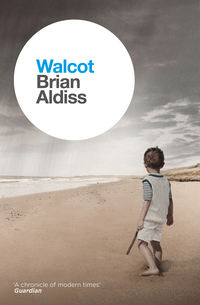
Kitabı oxu: «Walcot»
BRIAN ALDISS
Walcot

HarperVoyager
An imprint of HarperCollinsPublishers Ltd
1 London Bridge Street
London SE1 9GF
www.harpervoyagerbooks.co.uk
This ebook first published in Great Britain by HarperVoyager in 2015
Copyright © Brian Aldiss 2009
First published in Great Britain by Goldmark 2009
Cover layout design © HarperCollinsPublishers Ltd 2015
Cover photographs © Shutterstock.com
Brian Aldiss asserts the moral right to
be identified as the author of this work.
A catalogue copy of this book is available from the British Library.
This novel is entirely a work of fiction. The names, characters and incidents portrayed in it are the work of the author’s imagination. Any resemblance to actual persons, living or dead, events or localities is entirely coincidental.
All rights reserved under International and Pan-American Copyright Conventions. By payment of the required fees, you have been granted the non-exclusive, non-transferable right to access and read the text of this e-book on screen. No part of this text may be reproduced, transmitted, down-loaded, decompiled, reverse engineered, or stored in or introduced into any information storage and retrieval system, in any form or by any means, whether electronic or mechanical, now known or hereinafter invented, without the express written permission of HarperCollins.
Source ISBN: 978-0-00-748226-9
Ebook Edition © December 2015 ISBN: 978-0-00-748227-6
Version: 2015-10-19
Dedication
To Ronnie
with remembrance of Ruth
with regards as always
Epigraph
God forbid that we should give out a dream of our own imagination for a pattern of the world.
– Francis Bacon
Novum Organum
Contents
Cover
Title Page
Copyright
Dedication
Epigraph
Introduction
PART ONE
Chapter 1: Barefoot
Chapter 2: An Adult Breath
Chapter 3: Almost Drowned
Chapter 4: An Absolute Slave
Chapter 5: ‘Bloody Cripples!’
Chapter 6: Earth Sciences
Chapter 7: The New Widow
Chapter 8: Kendal, of All Places
Chapter 9: A Good Old Row
Chapter 10: A Slight Change of Plan
Chapter 11: Carnage on the Road
Chapter 12: ‘War or no War …’
Chapter 13: ‘We’re Okay Here …’
Chapter 14: Over the Boundary
Chapter 15: Le Forgel
Chapter 16: A Lesson in Aristotle
Chapter 17: The Wehrmacht Pays a Visit
PART TWO
Chapter 1: What a Wild Man
Chapter 2: Hoarded Biscuits
Chapter 3: Christmas at Gracefield
Chapter 4: ‘Please Not to Shoot Us’
Chapter 5: Endless Carnage
Chapter 6: Kiss Whom You Like
Chapter 7: Leaving Home
Chapter 8: Old Children
Chapter 9: Ex-Army Furniture
Chapter 10: A Man About Town
Chapter 11: A Break in Torremolinos
Chapter 12: The Disastrous Party
Chapter 13: On the Grand Canal
Chapter 14: Elizabeth Sips Her Wine
Chapter 15: ‘I Must Love Abby’
Chapter 16: A Modernizing Government
Chapter 17: In the Alley
Chapter 18: Blood on the Ice
PART THREE
Chapter 1: A New Line of Thought
Chapter 2: Guernica
Chapter 3: One of the Poor
Chapter 4: ‘We Don’t Want no Trouble’
Chapter 5: Some Family Conversation
Chapter 6: Over Jurassic Sand
Chapter 7: Another Invitation
Chapter 8: Supper at Sandy Bassett
Chapter 9: Tolstoy Unread
Chapter 10: Violet in Her Bath
Chapter 11: Flight to Austin, Texas
Chapter 12: The Future of the World
Chapter 13: An Arrival From Venice
Chapter 14: The Known Unknowns
Chapter 15: The Sacrifice
Chapter 16: A Fuller Understanding
Notes
About the Author
Also by Brian Aldiss
About the Publisher
Introduction
‘You are free men, whatever that means.’ So says Steve Fielding to some German soldiers, whose lives he spares during the closing events of a world war, in the freezing cold Ardennes. But Steve, as we learn in this complex unfolding of a life, is himself not a free man.
We find him first of all as a child, playing alone on a Norfolk beach – the beach that gives this complex tale its title.
Already, like a tide, doubt enters his life. Is he in danger? High on the dunes, a woman, almost a stranger, looks to see if Steve is safe.
So the question arises, to be solved if possible: do Steve’s parents wish to get rid of him? In love, in war or peace – or in an uncertain interlude between the two – the uncertainty continues to tease.
As this delightful and complex story unfolds, the reader meets new astonishments and some strange old events.
Questions remain, but now there’s beloved Verity – and a cheetah – and of course the sort of unexpected we all expect to meet.
A long and intriguing story unfolds before us.
Brian W. Aldiss
Oxford, 2015
PART ONE
1
Barefoot
At high tide, the sea lapped close to the dunes, leaving little sand to be seen. The remaining sand above the high tide mark was as fine as sifted salt. Spikes of marram grass grew from it like quills from a porcupine. No stones were visible. The small waves, white and grey, seethed against their limits. How lonely it was, this wild coastline.
When the tides began their retreat, they revealed first a line of pebbles, grey and black. The pebbles gleamed like jewels until the sun dried them, when they became as grey and inert as if they had grown rapidly old and died. Occasionally among the stones lay a small, dead crab, its up-turned belly the respectable white of death.
The pulse of the sea appeared to quicken; its faltering waves had left the slopes of the beach and were now retreating over level territory. Venturing down to follow this august daily event, you found your feet sinking into the wet sand, and so you kept moving. The sand squelched with every step you took, turned pale, went dark. Went slurp.
Stretches newly revealed were bare, immaculate, except perhaps for that baby crab, soft to the touch as you bent down to it. What caused it to die? Did crabs become ill?
Everything about you shone with a joyous newness.
The small ripples of waves as they rolled back towards their mother sea were transparent, and consequently looked as golden as the sand beneath them. They were so beautiful it was essential to pat them with bare feet, to jump up and down in them, splashing.
So you followed this grand revanche, as if you, too, were determined to get back into the real sea. You were hopping about in a world of ceaseless movement; these waves, or very similar waves, would never stop, would still be rolling back and forth in their interplay with the beach for eternity, or until you grew up, whichever time was the nearer. You felt very close to eternity because everything here was marvellous, and in this year before the nineteen-thirties had dawned, you had the entire beach all to yourself.
Look to left, look to right. Along the great expanses of beach, not a single person was to be seen.
All through that slumbrous summer you were there, playing on the sands. And in those bygone summers the sun shone always overhead, undeterred by cloud. The sun was there when you arrived on the dunes in the morning, pausing and taking in the whole wonderful spectacle, and when you departed in the late afternoon; at that time, the red ball of it was only just beginning to slope down towards those dunes.
The retreating waves swirled about a fishing boat. It was Mr North’s boat, anchored on the sand. Mr North, rowing strongly, went out in it at night, when you were in bed asleep, with your arms about your golliwog. The sea eroded a bowl in the sand round the stern of the boat before retreating further, to leave the craft high and dry, a perch for the odd seagull.
At last the wavelets left the dunes as far away as possible. Their strength exhausted, they sank back into the embrace of the sea. The sea made little fuss as it swallowed them. This was the enchanted, the bronze, the salty and sublime, the interminable and august month of August, when everything is in compliance. The blue morning sky overhead was occasionally flecked with ribs of thin cloud, into which the sun was as yet still climbing.
Every day was calm and hot, in both reality and memory.
Very distant were the dunes, shallow as the breasts of an adolescent girl. They were perhaps half a mile from the lip of the sea. The sea was perceived as friendly, luxurious, playful, puppyish. You wore only a bathing costume and a round, grey, felt hat. You were completely solitary. You were able to exercise your imagination, free from interference. One year, you had a small wooden boat, which went exploring and survived many hazards.
On that stretch of fresh sand, firmer now, baked to the brown of the crust of one of your mother’s pies, what adventures could be had! This was a newly discovered land, yours alone. It was the beginning of the world on which as yet no plant could grow, no animal would tread.
And there were rivers on this new-found land, miniature Amazons which wound towards the sea, sometimes deep, sometimes shallow, delta-like. They carved cliffs an inch high in the damp sand as they went. A spade, a wooden spade, could deflect some of their tributaries.
The sea, in its munificence, had also left behind, to punctuate this generous plain of sand, pools of various shapes and sizes. The sun glinted on them, spilling diamonds and daggers. You could lie in these pools; they were warm baths, more luxurious than any man-made bath. Little fishes were trapped here. Shrimps would come and tickle your toes. Sometimes you splashed, but never made much noise. You were in a secret, far-away land, where it was polite to be silent. You were encompassed, though, by a great shell of sound, sung by the sea in its conversation with itself; this was the resonant music of your happiness – though you were frequently unaware of it, or even of the fact that you were happy.
To either side of you the beaches stretched hazily into the distance, to Happisburgh in one direction, to Bacton in the other. No one was to be seen, even as far as all the way to where the view dissolved into vibrations of heat, nor was any ship to be spotted out to sea. Nothing lay between you and this unveiled nature, which would last for only a few hours, until the tide came rushing back to reclaim its territories, spilling over itself in rude haste.
You arrived barefoot on the beach. You had with you a rubber pail and a little paper Union Jack on a stick, a wooden spade and a bun wrapped in greaseproof paper in case you became hungry during the hours you are alone here.
Your mother baked the bun. You meant to repay her generosity by taking her back swarms of shrimps in your pail. She would throw the shrimps into boiling water and you would eat them together, on brown bread and butter, for tea. You were always distressed to see the shrimps go into the boiling water, although your mother told you that they died instantly. The idea of dying instantly held no appeal to a small boy only four years old. You did not know what it meant.
You spent days alone on the sands last summer, when you were only three. Your mother remained in the bungalow and read romantic novels by Norah Lofts, borrowed from the library. Norah Lofts and Ethel Mannin; of the two, she preferred Norah Lofts.
You stayed with her in a bungalow named ‘Omega’, which belonged to the family. You believed Omega to be the name of a flower, even when you were told it meant ‘The End of Things’. The bungalow was built, in a way, at the end of things. The country seemed to you utterly remote. It was rare for anything but a farm cart to pass along the road at the foot of Omega’s garden. The bungalow stood at one side of a pathway dignified by the name of Archibald Lane. When you walked up Archibald Lane towards the sea, you had a cornfield on your right. In those distant days, cornfields were gay, with red poppies and blue cornflowers, the seeds of which went into the bread to make it tastier.
At the top of the lane, just before the dunes, stood two old railway carriages, joined together to make one long carriage. Here lived the North family: a mother, a father and two quite big boys with sandy-coloured hair. They all had freckles. Your mother mistrusted people who lived in old railway carriages, but you were fascinated by them. You enjoyed being in the carriages, sometimes running from end to end in your excitement. Mrs North and her boys were kind to you. She sometimes sat you down and gave you a cold sausage to eat. Mrs North was freckled and pretty. Her eyes were blue. She wore an old blue apron. The North family were remarkably cheerful. You laughed a lot when you were together. Mr North was a fisherman; his was the boat high and dry on the sands. He slept in the day, when tides were low.
Sometimes when you were alone on the beaches for all the hours of the day, especially when the tide came racing in, you might turn and see Mrs North standing on the dunes, watching for you, shielding her blue eyes with a brown hand. You would wave. She would wave back.
You were busy. You were building a splendid castle on the edge of one of the warm pools. You were kneeling, determined to get the towers just right, when the water started to lap about your knees. You ignored it. You knew what it implied, but you are concentrating on getting the castle to look its best before the invading tide washed it all away.
The castle was completed. You stood up. Waves were racing across the acres of sand, covering them. You watched them, fascinated by the speed of the race. Soon the waters were dashing against the walls of your castle. It began to crumble. A tower fell into the flood. You removed the paper flag from the still surviving tower and put it in your pail with the shrimps. You collected up your spade. It was time to move to safety; but you wanted to watch the destruction of the splendid castle. It was a pity your mother was not there to see and admire it, but the beaches did not interest her.
The castle succumbed slowly. You knew you had better go; it was not so easy. You floundered through a pool now flooded by the new waters, then there was a deep gully to negotiate before you could reach the safe, dry slope of the higher beach. The gully looked deep and menacing now. You waded in. The current was fierce; it carried you sideways. You held pail and spade high. There was an unexpected pool underfoot. You staggered and went under. In your unwanted ducking, the shrimps were reprieved from the pot and the paper flag was washed away. You could see it go, but you were too frightened to do more than struggle for the safety of the shore. The rank water you swallowed in your ducking made you cough and splutter.
Once you were on the dry sand, you were cross with yourself for being frightened. Some way out to sea now, you could see a safe stretch of sand. But it was inaccessible, separated from the shore by a waste of water which heaved and tumbled in a hostile manner.
Would you say that this was the period of your life when you felt yourself to be closest to Nature?
Those sun-drenched, soul-drenched days alone? You believe I was in touch with all that was grand yet transitory. But who can speak for a lad only three years, four years old, when one’s psyche is not yet developed?
What did you think about, there on the sands all day? Did you feel you were being encompassed by a great soul?
I doubt I was even aware of time – only of time as local, affecting the comings and goings of the sea at Walcot, and the possible arrival of teatime.
So you were sent to play on the beach?
I believe that was the case. Yes.
The sea and the time bound to destroy the finest castle you might build?
Of course. It was in the nature of things.
You sat and watched as the tide raced in. Well, you would be back again tomorrow, when that new world, ever fresh, would be revealed once more. Tomorrow, the little pools, the arcane rippling and ribbing of the sand, would be there anew; only you would be there to appreciate them. And there was still a whole week before the holiday had to end.
You looked up at the mackerel sky and it was then that there was a disturbance in the thin cloud, and a golden bird came speeding down. When it stood before you you could see that it was in fact vaguely human in form, seeming youthful, despite its long beard. You observed that it had no genitals.
It spoke. ‘Have you been good today?’
You did not know what exactly to answer. It was obvious to you that opportunities for being ‘bad’ were strictly limited when you were alone on the beaches.
‘Are you a Christian?’ it asked.
You were forced to go to Church every Sunday. You had been given a little book into which you could stick a pretty stamp to mark each attendance. You recited the rhyme printed in the blank spaces.
Every stamp cries Duty done!
Every blank cries Shame!
Finish what you have begun
In the Saviour’s Name.
The golden thing seems satisfied with this response. ‘Do you say your prayers?’
You would have preferred it to have asked if you had enjoyed the day, but it had only tedious questions, such as those the local vicar might ask.
‘Yes,’ you said.
‘Do you wish to get to Heaven?’ it asked.
Again it was difficult to know what to answer. The day had been like heaven, with nobody to order you about, or be miserable at you.
‘Not yet,’ you said. ‘Not while we’re enjoying Walcot.’
The golden thing stood there. It finally said, ‘Your time will come.’ And then it zoomed back into the sky. You watched it until it vanished.
You decided to run home. You told your mother, ‘Mummy, I just saw God.’
Your mummy said you must not tell lies.
‘Perhaps it was just an angel. It was all gold.’
Your mummy frowned and asked if you had caught any shrimps.
‘Does God have a weewee, mummy?’ you asked.
Your mummy threw a Norah Lofts at you. ‘Don’t be so rude, you little so-and-so!’
The Norah Lofts missed you. You silently thanked God that Mummy never had a good aim.
2
An Adult Breath
Your mother liked being in Omega. She decorated it according to her own tastes. The living room was fairly dark; it had only one small window which looked towards the cornfields. It had hip-high wooden panelling painted a deep brown, thus adding to the darkness of the room. To offset this, your mother had scattered orange cushions about on the chairs and settee. She also had, stationed at strategic points, a number of gleaming copper jugs which she polished regularly. And there was a fine brass lamp with a frosted white shade and a clear glass chimney which she lit at dusk. The lamp shed its cosy light over part of the room. There was no electricity available within several miles of Omega.
The walls above the wooden panelling were painted white, and here your mother had hung a number of reproductions of paintings of flowers in bowls and vases. The paintings were glazed and bound in passe-partout. They most typically showed pink and white roses in a deep blue bowl, standing on a well-polished table. A petal had fallen and reflected its colour on table and bowl. Always a fallen petal, its hint of imperfection emphasizing the perfection of the picture.
Your mother was more than usually torpid and framed no flower pictures that night. She was a tall woman, heavy of body, heavy of face. She did her pale hair in a bun, bound tightly to the back of her head, like a supplementary brain. She was given to long skirts of woven material. She had within her the seed of a future child who was destined to take your place; but of this impending event you were not told. It was, as yet, your mother’s secret.
She kept news of her early pregnancy, too, from her visitor. She was a secretive woman and did not entirely trust her visitor, whom she considered superficial. This visitor was younger and more vivacious than your mother. You knew her as your Auntie Violet. ‘No shrinking violet, she!’ your mother was apt to exclaim. ‘Comes from Grantham, of all places,’ she said, appalled.
Auntie Violet was sharp and pale of face, with beautiful arched eyebrows and a permanent wave in her hair which, despite its permanence, was frequently renewed. She had a neat upturned little nose, which you mentally labelled pert. She generally wore strings of beads which rattled across a generous bosom. Her flesh was pale and clear. She smelled delicious. Her clothes were bright, worn with belts which drooped over the upper reaches of her behind. Her shoes, at least at this moment, were bright red. You were fascinated by this flitting figure who drove to Omega in her own open-top tourer. Auntie Violet was married to your mother’s younger brother, Bertie Wilberforce.
Auntie Violet smoked cigarettes in a long amber holder. Her lips were red. She had another endearing trait: she liked small boys and, in particular, she liked giving you treats. She had brought you a wooden glider. You ran outside to fly it; it flew well and meant many excursions between the crisp stalks of the cornfield to retrieve it.
While you were flying your glider, your mother and your aunt had a quarrel. Somehow you perceived this as you returned to Omega. Auntie Violet stood smoking on the verandah, looking statuesque. She made a decision and said to you, ‘I do not neglect my children. I love my children. And I love you, Stevie dear.’ She bent and kissed you on the forehead. You were puzzled by this sudden display. You entered the bungalow to see your mother standing with her arms akimbo – always a bad sign.
While you were accustomed to your mother’s moods, there was another worry on your mind. Auntie Violet was staying overnight. Omega contained only two bedrooms and the spare bed was in your room. You would have Auntie Violet sleeping in the bedroom with you. You were unsure how you should behave in this situation. You knelt and said your prayers by your bedside every night, as your mother had taught you; somehow, instinct told you now that Auntie Violet did not kneel by her bedside to say her prayers. It might be advisable to skip prayers this evening. And you hoped that God would be understanding, although he did not seem to have been particularly understanding in the past. He seemed, like your mother, to be a bit moody.
Several years later, when your auntie was thinking of committing suicide, she told you a remarkable story, which was to haunt much of your life. She said that for an hour or two she and your mother were not talking to each other. She looked hard at you and said that she was in your bedroom until the storm blew over, when the phone rang in the main room. Your mother had picked up the phone. Auntie Violet had listened to the conversation, and concluded that it was your father, your cold and distant father, who was on the other end of the line.
According to Violet, your mother said, ‘Yes, high tide was at about a quarter-to-four today … no, no, he came back as usual … we hope for better things tomorrow … it is likely to be windier, so the sea should be choppier … I can’t do anything more, sorry … No, he doesn’t mind being alone there … no, no one … if he was you know, it would of course be a regrettable accident … Don’t worry. As you say, hope for the best. I don’t want to discuss it … Good-bye.’
That is what your Auntie Violet told you she overheard your mother saying.
Your Auntie Violet was alarmed by the deductions she drew from this one-sided conversation. She believed it meant you were in grave danger. She did not know what to do and so she did nothing.
You were called for supper. Your mother instructed you to behave as Valerie would have behaved. You sat quietly at the table and ate your mackerel, mashed potato and mange touts. Your mother and Auntie Violet drank white wine from South Africa. They made polite conversation. The brass lamp with the frosted white shade shed a comfortable glow over the woven tablecloth.
You had been taught not to hum with pleasure as you ate.
The dessert was pineapple slices and cream. You luxuriated in the taste of pineapple, although it sometimes made your lips rough. You lingered over it. The meal being finished, your mother made Violet and herself some tea. She unfortunately brought up the case of the golden thing she said you pretended to have seen on the beach.
‘I didn’t pretend. I did see it,’ you said.
‘There’s no such creature as this golden thing,’ your mother responded.
‘Perhaps he really did see something if he says so,’ remarked Auntie Violet, casting a smile in your direction.
‘You’ll just have to go back tomorrow and perhaps you’ll see it again,’ your mother said, rather snappishly. After a short while she suggested you go to bed.
As you lay in bed, you could hear the murmur of their voices in the next room. At last, the bedroom door quietly opened. You closed your eyes and pretended to sleep. Your Auntie Violet entered, carrying a candle in a blue metal holder with a broad rim, with which you were familiar. The candle flame flickered in the draught of her entry.
Your auntie set the candle down on the bedside table you shared between you. She looked over at you. You feigned sleep.
She undressed. Her fragrance came to you. There was a moment when she removed her panties, letting them slide to the ground, and you saw the smooth arc of her back shining in the candlelight, and the innocence of her buttocks. Something within you was obscurely touched. Then her nightdress slipped over her head.
As she climbed into bed, the springs of the bed squeaked. Her head was on the pillow. You imagined she was staring towards you, and squeezed your eyes more tightly shut.
‘Stephen,’ she called in a whisper.
In a minute, she called your name again. ‘Stevie.’
You sighed and turned over. It was very realistic. Then you sat up, to ask if she’d called you.
She said she knew you weren’t asleep. She invited you to go over to her bed and have a cuddle.
Although you wished to go, you protested that you wanted to get to sleep.
She laughed softly and told you not to be shy. Again she invited you across that narrow space between your beds.
You felt yourself blushing as you obeyed. She opened up the bed and you climbed in. She put her arms around you and hugged you. She blew out the candle. You were in darkness together, the two of you, with her fragrance and her body heat.
She kissed your neck. You felt her tender warmth and found it more beautiful than you could possibly imagine. Without knowing how you could dare to do it, you wriggled about and put your arms round her neck.
‘That’s more like it,’ she said. Her breath was adult, with flavours of nicotine and toothpaste.
You had no idea what to do next, although you felt something was required. She kissed you on your cheek, then lay there with her head on the pillow, her dark hair overflowing, and her lips against your cheek. You filled with happiness, only to find how like terror happiness is.
You blurted out that you loved her.
‘Good, my little darling,’ she said in a whisper. ‘And I love you.’
Slowly and gently, she fell asleep. You struggled to sleep for her warmth and beauty. But eventually you did sleep.
The next day, your bright and loving young auntie drove away from Omega. You stood with your mother and waved her goodbye. Because you were so young and dominated by your mother, you were unable to put your feelings into words; they swam in you like fish that never reached the surface. For that reason perhaps, you could never name them.
In the same way, this grave and joyful event became confused with the idea of the gold thing which came down from the sky, both events being seen as in someway ‘golden’. As time went by and you did not see anything more descending from heaven, you began questioning the truth of the experience, prompted perhaps by your mother’s disbelief. But you never doubted the truth of climbing into your auntie’s bed and being encompassed by her warmth and goodness. Indeed, in your adult life, whether consciously or not, you frequently sought to relive that transcendental experience in the beds of other women. It was only in those years of your childhood, when you were soon replaced by the baby girl to whom your mother shortly gave birth, that you sometimes wondered if your auntie had behaved out of a spirit of mischief, rather than a spirit of what you generally regarded as compassion.
Of course, as a four-year-old you were not clear about this matter. You never considered, as your aunt had done, that your parents had hoped to be rid of you by ‘accidental’ drowning. Only during Violet’s disquisition did you discover – and great was your dismay upon hearing it – that those long summer days of contentment, playing in solitude on the beaches of Walcot, were intended to be your last: for what caring parent would permit a small child to remain all alone for so long, in circumstances which by their very nature held danger for the unwary?
In your innocence, such thoughts did not occur to you. However, on one occasion they came close. You were playing in one of the warm pools that dotted the great beaches. Shrimps and little fish were floating by you. You tried to trap one fish with an idle hand. It stung your finger with unexpected intensity. The pain shot up your arm. You could not bear it. You needed your mother’s comfort.
Abandoning pail and spade, you ran back, nursing your hand, husbanding your tears, over the dunes, down Archibald Lane, to Omega. You ran inside, for the door was never locked.
Your mother had gone. No one was there. The bungalow was empty.
Mary’s mother, Granny Wilberforce, had been staying for two days. They had gone. Father had driven them off for a jaunt somewhere. The familiar car was not in the driveway. They had abandoned you to the sands and the tides.
You lay stunned on the sofa, waiting for their return. After an hour you grew ashamed, ashamed of yourself, ashamed of your parents. You crept away, back onto the beaches, so that their neglect was hidden from them.
Here’s an instance of your concealing your pain, isn’t it?
Why do you draw my attention to it?
Because it becomes a lifelong habit. A habit that makes some people find you difficult to understand. Do you see that now?
I never felt my parents troubled to understand their son. That was certainly a pain I strove to hide.
Tell me why.
I suppose I didn’t … didn’t want them to feel bad … Because … they already felt bad enough.
3
Almost Drowned
Quite late in your life there fell into your hands a leather-bound copy of the Holy Bible, which, you were told, had been owned by your paternal grandmother. This Bible had been a present from your grandfather to Elizabeth Harper when he was courting her. Later he would win Miss Harper’s hand in marriage. A label inserted in the preliminary pages of the Bible read, ‘From S.M.F. to Miss Elizabeth Harper as a token of his love’. And there was a date, May 1891.
The formality of this message enclosed within the pages of a Bible convinced you of the solemnity of a Victorian courtship. Possibly it also spoke of something slightly stiff in the character of your grandfather.
The evidence of your father’s courtship of your mother was hardly more substantial, obscured as it was by the advent of war. Even before the Victorian Age was over, the nations of Europe were arming themselves against one other. In another August, an August graver than the one we have been discussing, war broke out after a shot was fired in Sarajevo. One by one, the nations were drawn towards the flame. Soon, all of Europe was at war. And your father was of an age to volunteer to fight. So the story went that young Martin Fielding became a pilot in the Royal Flying Corps, which at a later date became the Royal Air Force. He flew in Sopwith Camels, first of all on the Western Front and then in Mesopotamia. He shot down three German planes and became an air ace, with his picture in the Daily Graphic.
When Martin’s plane crashed he was injured and spent some months in a hospital in Cairo – ‘Cairo of all places’, as your mother was frequently to say thereafter. In 1918, with the war ending, he was brought home on a troopship. The troopship moored a mile outside Southampton harbour, the troops fretting over the delay about getting ashore. It is here that Martin emerges from being ‘Mentioned in Despatches’ and becomes part of the folklore of your family. Martin dived off the troopship and swam ashore, in his impatience to meet again Miss Mary Wilberforce, to whom he was engaged. Another reason for his rebellious act was that he had become politicized by his wartime experiences. He had experienced the great division between men and officers and became a Socialist.
Mary Wilberforce lived in a sleepy cathedral town outside London. It was her younger brother, Bertie, who was later to marry your Aunt Violet; her older brother, Ernest, was killed in the Battle of the Somme. You can understand that all over Europe, people were scuttling everywhere, trying to pick up the threads of their lives, hoping to restore a normality that had vanished and would never return to the world.
Mary Wilberforce married Martin Fielding in May of 1919. Many marriages must have taken place in that year, as people strove to put the horrors of the war behind them and reconstruct their lives. You may ask why, if Martin was in such a hurry to get ashore and claim his ladylove, the marriage was delayed for almost a year. Certainly Martin, your father, had been injured in the war, but the wound had healed sufficiently to enable him to swim that mile from ship to shore. It seems not unlikely that he was suffering from some other type of malady, possibly picked up during his weeks of recuperation in the city of Cairo.
Although your father had to give up flying, he did not lose his love of aviation. In 1924, the year you were born, Imperial Airways undertook a commercial programme of flights across the world. Martin worked for Imperial before moving to Vickers Aviation, where Bertie Wilberforce was also employed. Bertie was a pilot. Bertie flew a Vickers ‘Victoria’, a troop-carrying plane, to Kabul in Afghanistan in 1929, rescuing six hundred people threatened by revolution there.
Martin was active in trade unionism, determined to obtain better pay and conditions for the workers. He made himself unpopular and moved to another company on the South Coast. The family went with him.
Omega was to be sold.
‘We have to make sacrifices now and again,’ said Martin, consolingly, to his weepy wife.
The last summer spent at Walcot was during the nineteen-thirties, when war clouds were gathering and the voice of the dictator of Germany was growing louder and shriller. You had a small, lively sister, Sonia, by that time. Your mother accompanied Sonia and you down to the beach. Your father was also there, during one of his increasingly rare visits. Politics taking up more of his time, he was a candidate to become Socialist Member of Parliament for the New Forest constituency on the south coast, following the death of Bernie Hale, the previous incumbent.
While Sonia and you played on the newly revealed stretch of beach, your parents sat nearby on deck chairs. Both were fully dressed; your father, you remember, wore highly polished brown shoes. They always kept anxious eyes on Sonia who, in consequence, was nervous, and did not like to splash in the deeper pools. You were absorbed some distance away, chasing a small crab with your shrimping net. The intense murmuring silences of the sea were broken by Sonia’s shrieks and your father’s shouts at you. You caught the crab in your net before turning.
Sonia was lying on her back a few feet away, her hair in a shallow pool. She was crying in terror. Your father was ordering you to go to her aid. You popped the crab in your rubber pail and then ran over to her. While helping her to her feet, you could not understand why she had not got up of her own accord.
Your father was furious with you. ‘Why didn’t you hurry? Sonia could have drowned!’
‘No, she couldn’t. Her face was not in the water.’
He clenched his fist. ‘She almost drowned.’
‘No, she didn’t, dad, really.’
‘Don’t you argue with me, boy!’
‘I’m just saying her face –’
‘She was helpless. You didn’t care one bit, you little wretch.’
‘I rescued her, didn’t I?’
‘Go back to the bungalow at once! Get off the beach! Go away!’
After tipping your crab back into the warm pool, you made your way up the beach.
‘Come back, Stevie!’ called Sonia. ‘I’m all right! Really I am!’
You did not turn your head. You made your way down Archibald Lane without a tear. You went into Omega and settled down to read a book. You never in your childhood saw the beaches of Walcot again.
4
An Absolute Slave
Of course there were other Wilberforces, other Fieldings.
You recall various splurges with some of them, and with other friends of yours – indeed, splurges too with strangers. Splurges when you were half-boy, half-adult, ending up in Indian restaurants, swilling down glasses of Kingfisher lager, showing off, laughing ‘fit to bust’.
You remember going off to pee one time, almost falling down the steep steps to Avernus, into the reeking, hot basement, realizing you were drunk, staggering, running your dirty hand over the dirty walls to steady yourself. Alien territory, sopping towels lying exhausted on the floor, doors marked successively STAFF, PRIVATE, LADIES, KEEP OUT. A fellow rushing by, throwing out a look of contempt as you were already unzipping, ready for the outpouring. GENTS, it said. And you smelt the urine/disinfectant smell like soup spilt on an oilcloth table cover. You tossed away in disgust from between your lips the half-puffed fag. It fell on the red-tiled floor. You directed a first splash at it to put it out, laughing weakly, then directing all your energy to the hard squirt into the china bowl, in which sodden things lay. You used your penis like a hose, amused to direct it to splash right up the wall. It writhed in your fingers, glad as a puppy for its master’s touch.
You did not know then that a time would come when you would climb unsteadily down those same stairs, to that same urinal, this time going slowly, hobbling even, the frayed remnant of what you cherished proudly long ago already leaking into your trousers in anticipation and then, when you make it to the sordid bowl, unable to produce anything but an irregular drip. You would lean your arm against the wall and your head against your arm and you would spit into the yellow trail below. You would not be miserable exactly. You would just know that you had run out of spark and spunk and steam, and would be sort of semi-glad of it. But all this awaits you in the future.
You and all your pals.
Early in life you saw what old age and its captivities meant. You were fortunate, in that respect, to escape.
You mean I will not become a prisoner in my old age?
That is not my meaning exactly.
What do you mean?
Let us continue with your timelife story.
You worry me. What do you mean?
No, you do not worry. That’s just a figure of speech. You will become old but never reach extreme old age.
You had a girlfriend at this period, as young as you but with plenty of female assurance. Her name was Gale Roberts, a rather cinematic name which bestowed glamour on her. Her mother was a big, hearty woman, who liked to praise things in general. She called you ‘sensible’. When she despatched you and Gale to visit her Uncle Norman and his wife, Tamsin, she described their tragedy in enthusiastic terms.
‘She’s totally incapacitated, poor darling thing! She bears her misfortune so nobly. And my brother – well, Norman’s such a sweetie-pie! Of course, an absolute slave to Tammy, an absolute slave, he does everything, but everything for her. As you’ll see, my dear.’
The visit proved a memorable one.
Tamsin Roberts had ‘broken her back’, as the phrase had it, when crossing a road in France and encountering a slow-moving vehicle. She suffered complex fractures of several vertebrae. Both Robertses were in their early fifties; to you they seemed vastly old. They lived in a small terraced house, the upper floor of which they let out.
When you rang the bell, Norman peeped out before nodding and letting you both in.
‘Just doing a spot of cleaning,’ he said with a laugh that affected at once to laugh at himself and to explain the floral apron he was wearing. Norman was a small, dry man with a sandy moustache and a large red nose. He clutched a yellow duster.
Tamsin was confined to an armchair in what had been their dining room, where she could gaze out at the small garden. Now she got her meals on a tray. Her husband, Gale’s uncle, looked after her, doing everything for her; dressing her, undressing her, shopping and cooking for her.
Somehow they remained cheerful. The radio was always on. They kept two cats, Mike and Snippets, both tabbies. The cats hung about in picturesque positions on items of furniture, the one on the piano, the other on a side table. When they moved, they moved carefully about the little crowded room, full of its small tables, its china figures and its potted plants.
Gale presented the Roberts with a cake her mother had baked. They chatted of small things. Tamsin spoke in a flat voice, but appeared cheerful enough. Norman said he pushed her up the street and back in her wheelchair every day, when all the neighbours came out to speak to them.
‘What a lot they are,’ said Tamsin, looking slightly humorous as she referred to the neighbours.
As you and Gale were about to leave, Norman ushered you out, saying, ‘Careful how you go. Mind the ironing board. I’ve just got to iron one of Tammy’s nighties. I’ll just shut the kitchen door. We love the cats so much; we don’t want them to escape. We never let them go outside.’
So off the two of you went, carefree and skipping up the street, Gale swinging her mother’s wicker shopping basket. You were getting to the stage when you might dare to kiss Gale.
‘So what do you make of that pair of old crocks?’ Gale asked.
‘Your uncle’s very good with Tamsin. Life can’t be much fun for him.’
Gale sat down on a low wall, adjusting her dress so that first you saw a lot of thigh and then none. ‘I reckon uncle enjoys being prison warden.’ She spoke carelessly.
‘Prison warden? How do you make that out?’ You stood in front of her, your trousers all but touching her knees. ‘I thought he was her slave. Isn’t that the general idea?’
She tossed a lock of dark hair from her eyes. It immediately fell back into its original position, its lowest strands to rest on her rosy cheek. ‘You heard what he said – about the cats, I mean. He loves the cats but is afraid they may escape. So they are stuck for ever in the house. Could be he feels the same about her.’
‘You mean he feels Tamsin might escape?’
‘Maybe he used to. You can see how insecure he is. He’s glad she is stuck in that chair, unable to get away from him.’
Such a concept had not occurred to you. The novelty, the secrecy of it, thrilled you in some way. ‘But what does she feel?’
Gale sighed and looked up at you with a contemplative air. ‘Work it out for yourself. Could be she likes being a prisoner. She was always a bit valetudinarian, even when she was young – like her mum.’
‘So you’re saying they get on okay?’
‘I’m saying it may not be the way it looks, with them both being miserable. Just could be it even suits them.’
‘But you can’t ask them –’
She reached out and touched your hand. ‘Of course you can’t ask them, silly!’
‘What a bugger that you can’t ask them straight out.’
But your mind was not really on that mystery of human relationships; it centred more on Gale’s pretty, moist lips. You leant forward, clutched her shoulders and kissed her.
The world turned to gold dust about you.
You often wondered what sort of person Valerie had been in her short life. After the visit to the Roberts’ house, you found reason to wonder about yourself. You had gone on this rather boring – as you initially saw it – visit to an invalid, simply to be near Gale. You were well aware of the life of the senses, even if, at that early age, you stood as yet high and dry on its shores. You were also aware of another life, one that might hinder or distract you from the sensual oceans represented by the tepid lake of Gale Roberts, and that was one to which she herself had directed your attention: the life of human motivation, so cunning, so unfathomable.
For which way had it been in the invalid’s semi-detached home? Was old Norman the slave or the captor? Was she the dominatrix or the prisoner? Only slowly, as you sat upstairs in your bedroom, gazing blankly at the painting of birds quietly despoiling a wheat harvest, did it occur to you that both interpretations, such was the complexity of the human psyche, could be simultaneously viable.
Yet never did it occur to you that there were parallels here with your own unresolved dilemma; the Walcot problem.
5
‘Bloody Cripples!’
When Martin joined Short’s, another aviation company, the family followed him to Southampton, where Short Brothers was based. You saw little of your father. Politics kept him busy.
You remember an occasion when he had been addressing a small group of men on a street corner. He came home and told you that a policeman had appeared and said to him, gently but firmly, ‘Move along there, there’s a good lad.’
Your father had asked why he should move along. The bobby had replied, ‘Because I say so, sir, if you don’t mind.’
Your father was furious at this demonstration of power.
Looking back, you regret the disappearance of this kind of policing.
Your early existence was trapped between the two world wars, your later one by the Cold War. Your father provided constant reminders of the first war. The injury to his leg pained him continually; the broken bone had been badly set in the first place, and had to be re-broken and re-set. Throughout your boyhood, he was in and out of hospital. The aggravation increased his bitterness and his silence.
‘Does your poor leg hurt very much, Daddy?’ you asked him on one occasion, perhaps trying to curry favour.
‘We all have to make sacrifices,’ he said. It had become a favourite expression.
‘Do you have to sacrifice us?’ Sonia asked. As the spoilt one, she dared to criticize.
In fact, Martin had been lucky. He had survived the prolonged Battle of the Somme, a battle in which a million men had died – Germans, French and British – owing to a well-timed attack of pneumonia.
Your home was not generously provided with books. You remember one book in particular from those early days; it was bound in half-leather and consisted of twelve volumes: The Daily Telegraph History of the Great War. Through an absorbed study of those volumes, you gained an insight into the various hells through which your father had suffered and through which humankind put one another.
One painting reproduced in that book almost destroyed you with pity. The scene was in France; the ruins of a French town could be discerned mistily in the distance. In the foreground lay a wounded horse. It had to be left behind by the troops. The troops could be seen in the background, beckoning to a figure in the middle ground to hurry up and join them. But the figure in the middle ground lingered. His hand was raised in sad farewell to his horse. He it was who provided the caption to the picture: ‘Farewell, old friend!’
You were inconsolable. You cried and cried until your mother became angry and left you to weep. The argument that this was ‘only a painting’ carried no weight with you, for you felt certain it was a representation of something that could have happened, where the innocent suffered along with the wicked.
Surely at that time, one of your admirable qualities was born and fortified: compassion.
For the first thirteen months of the family’s removal to Southampton, you all stayed in a rented flat. Your father and mother could not find a house on which they could get a mortgage that they liked enough to buy. You were allotted a small room in the attic, where you were probably better situated than were the other members of the family. Sonia had a small room overlooking a banana importer’s yard. The wallpaper was violently colourful and featured the endlessly reduplicated image of an animal with big ears driving a little red car. To this Sonia took strident objection.
‘I hate it! I hate it! Take it away. It’s horrid.’
‘You’ll soon get used to it, darling,’ Mary had said, wearily. ‘This was a child’s room and, after all, you are a child, you know.’
Sonia screamed in response to this apparent injustice. ‘I am not that kind of a child. I am a child hunchback! A famous child hunchback! I’m special. I can’t sleep with this horrid thing hanging on the wall.’
‘Valerie would love that wallpaper! Please don’t be troublesome, dear.’
‘It’s not me. It’s the wallpaper.’
But Sonia had to put up with it. And there in that flat you spent a confined Christmas. Before you had your presents, Mary insisted on crimping Sonia’s hair. Protest as Sonia might, the tongs, the crimping paper, were brought to bear, and soon her chestnut locks were covered with waves like a sea of frozen gravy. The scorching smell still lingered round her head even when you sat down to dinner later that day.
Wished upon you was a girl of twelve, bigger than you and even more sulky, a girl of twelve with pigtails, by name Joan Pie. Martin had joined the local trade union. One of his docker friends had been struck by a falling girder. He was lying in hospital after a shoulder operation and his wife was ill, so Martin had generously volunteered to have Joan Pie come to stay with you all over Christmas and Boxing Day.
‘I don’t want to sit next to her,’ Sonia said, after one second’s inspection of the visitor. ‘She’s a pig.’
‘Ooh, snooty!’ said Joan Pie, and poked her tongue out at Sonia.
‘Behave yourselves,’ Mary ordered. But from then on, you two youngsters had conceived a hatred of this intruder into your uncomfortable quarters. You and Sonia were immediately united against her.
You asked your sister at the dinner table if she had ever heard of such a funny name as Pie. ‘Fly is silly too,’ Sonia said in a judicious manner. She asked the visitor, ‘Do you know anyone called Fly, Pie?’
‘Stop that, or I’ll make you get down,’ said Martin from his side of the table.
Now Mary was slicing and serving the Christmas pudding, doing it with slow care. You watched the operation like a hawk, alert for injustice.
Your plate with a slice of pudding was set down before you. Next, Joan Pie was served. Then Sonia. Suddenly, your mother exclaimed. Leaning forward, she rapidly switched your plate with Sonia’s.
You were angry at once. ‘Why did you do that?’
Mary waved her hands about. ‘I gave you the wrong plates, that’s all. Nothing else. Have some custard, Stevie.’
‘How were they wrong?’
‘Just be grateful for what you’ve got,’ Martin said, sternly.
‘Yes, be grateful for what you’ve got,’ echoed Joan Pie, giving Martin a silly look, seeking his approval.
‘You’ve got a bigger piece of pudding now, Stephen, so be quiet,’ said Mary. ‘Valerie would never complain as you do.’
You subsided. The Bird’s custard circulated in its little boat. You all ate in silence. Christmas pudding, dark, reluctant to crumble, heavy as mud, comprising many unknown things, bizarrely pleasing and quelling to the taste buds, a thing of the Stone Age. Eaten once a year like a human sacrifice.
Sonia gave a shriek and plunged her fingers into the sodden mass on her plate.
‘Look! I’ve got it!’ She waved a little bright object, to which a squashed currant adhered. ‘A sixpence! I’ve found a sixpence.’
You burst into tears. Well, you were only eight.
Only eight, but a bit of a baby.
You perceived that you had been swindled. It was a case of naked favouritism – And a reminder to me that I had been born into an unjust world.
No, the world has its invariable laws. It is human society which has established injustice.
Don’t tell me any more. I don’t want to remember –
It is necessary to remember, and to proceed.
After the meal, you had indoor fireworks. You and your sister loved indoor fireworks. There were paper mazes to which Martin applied his glowing cigarette end at the position marked ‘Start’, at which a spark went racing across the blank spaces to a destination it celebrated with quite a loud crack. There were sparklers you could hold and wave in dazzling patterns. There were folded papers that burnt into pretty ferns. There were flimsy paper cylinders to which you applied a lighted match and, as the paper burned down, magically rose and ascended to the ceiling. And there were snakes.
How you both loved the snakes.
By this time, you were in a better mood to enjoy the snakes. To comfort you, Sonia had whispered that she would share the sixpence, giving you half. Still grieving over the injustice, you had responded grumpily that it was your sixpence.
‘It’s not yours, it’s mine, ’cos I’ve got it,’ said Sonia, with some logic. ‘So for that I’ll only give you twopence.’
‘That’s not fair!’
‘And if you don’t shut up, you’ll only get a penny, so there.’
The snakes came in two kinds. One form of snake emerged from a volcano. The volcano was very small and encased in green ‘silver paper’. It stood on a circular cardboard base. When the peak of the volcano was lit, little green flecks, closely resembling grass, poured from it, covering the base. Finally, the snake emerged, writhing realistically as it came. It was thin but, with what seemed like evil intent, it crossed the grass as if to attack. Then, mercifully, it froze.
Sonia and you were enraptured. But Joan Pie said, contemptuously, ‘It didn’t do much.’
‘It would have bitten you if it could,’ you told her.
‘Stephen!’ Martin said, reprovingly. ‘You be nice to Joan or you’ll go up to your room.’
The other kind of snake was bigger and more terrifying. That was why you liked it better than the grass snake.
This snake, possibly a python, was concealed in a small, black top hat. This Christmas, Martin had discovered a cardboard box full of the little top hats, left over from the previous year by the last tenant of the flat. You clapped your hands with excitement at the sight of so many hats.
‘How Valerie would have loved them,’ Mary exclaimed wistfully.
Your father set one of them on the table near the grass snake, struck a match and tried to light it. The hat would not burn. Martin burnt his finger instead, and swore.
‘Try another match, daddy,’ shouted Sonia, full of anticipation.
He struck another one, but it also failed to ignite the hat, and again he burnt his finger.
‘Don’t be daft, Martin,’ Mary said. ‘You can see they’re old and damp. You’ll only burn yourself.’
Perhaps he was annoyed to be called daft. He took the box of top hats and flung it onto the coal fire, which heated his end of the room. You and Sonia groaned your disappointment. Joan Pie stuck her tongue out at you both, enjoying your dismay. But the box caught fire. The next minute, a dozen huge black pythons came uncoiling out of the fire and across the hearth to the carpet. What a sight! Sonia gave a yelp of delight. Joan Pie ran from the room, howling with fear.
What a sight! What a triumph!
Your father seemed always to be standing, holding forth in those days, despite his bad leg. He was a big man, generally to be seen in a tight-fitting Aertex shirt. He had a broad face and steely eyes. His lips were generally compressed, as if with anger against the injustices of the world.
You remembered an occasion when your parents had been having what you thought of as ‘a cold row’. Few words were spoken during their cold rows, but there was plenty of body language, of glaring of eyes and turning of backs. Your father had said, ill-advisedly, that his Socialist principles had been formed because he was shocked to find families like his wife’s in penury.
‘The Wilberforces’ lot was much more humble than the Fieldings’,’ he said.
‘I wouldn’t say that,’ Mary protested, stiff of face. She liked to think she came from ‘respectable stock’. ‘We weren’t too badly off. When I was fifteen Dad had an indoor lavvy tacked on.’
A recital of your antecedents made you dizzy. It seemed to you that these dead people all became middle-aged shortly after their thirtieth birthdays, that they died in their fifties or sixties, and that they were poor in ways forgotten in the more prosperous present – your present.
‘Take your mother’s family,’ Martin said, directing his words at you and glaring through you into the past. ‘Zachariah Frost was grandfather to your grandfather. Where he came from, heaven knows, but his parents must have been extremely poor, since the story has come down that they had to remove Zachariah from school because they were unable to provide the halfpenny a week required to keep him there.
‘A ha’penny! Think of that, Stephen!’ He shot a corrective glance at you, huddled in an armchair with a comic.
You thought of it. You knew ha’pennies. They had the last king’s head on one side of them and a sailing ship on the other. Those coins were often worn thin with usage, having passed through innumerable pockets.
‘Zachariah became a cobbler,’ Martin continued. ‘He married one Jane Wilberforce. They lived in a small house in Brick Street, Newbury. Although she was a scraggy little thing, by all accounts, they produced two girls and two boys. The kids were brought up on jam butties. They were all Baptists – Buttie Baptists – and went to chapel every Sunday.’
‘They were always religious,’ Mary said, defensively. She was making a cloth cover in which to keep the week’s Radio Times.
‘One of those girls died aged three. A common fate in those days. Rickets, probably.’
‘We used to have soap flakes called Ricketts,’ your mother exclaimed, unable not to enjoy talk of the old days, despite the offence she had taken. Your father ignored her remark.
‘Then the other girl, Hettie, her name was, she ran off with a foreigner and went to the Continent and was never heard of again.’
‘I ’spec she wanted to escape the family,’ said Sonia.
‘Getting above herself, more like,’ said Mary. ‘The Continent! Of all places! Fancy!’
Father remarked in an aside that Paris must have been better than Portsmouth.
‘One of Zachariah’s boys was known as “Flash Harry”. They say in the family that Flash Harry seduced the vicar’s daughter. In any case, he went to fight the Boers and died in some horrible spot of Africa.
‘The other Frost brother got a job in Utterson’s, the hardware merchant. His name was Ernie, Ernie Frost. You picture him and his like in rough black suits, wearing caps when out on the street, where most of the lads like him spent much of their spare time.’
‘Why was that?’ you asked. You failed to see the attraction of streets.
He shrugged. ‘Where else could they go in those days? Besides, the houses were so pokey –’
Ernie had the urge to improve himself. He rejected his surname, Frost, on the grounds that it was unappealing. He changed his name by deed poll to his mother’s maiden name of Wilberforce. It was a rejection of all that cobbling and grubbing for the last farthing.
‘Next, Ernie took up the banjo. He hired himself out to sing and play at parties. He had no wish to live forever in the back streets with a shared thunderbox. He had a daguerreotype taken of himself in a straw boater, strumming the banjo. Your mother can show it you. He must have been quite a lad, young Ernie. Leaving Utterson’s at the age of nineteen, he became the delivery man for Ross, the big Newbury grocer. He worked hard and was reliable. Pretty soon, he was driving about in a pony and trap, delivering the groceries to the better houses of the district.
‘That was how he met the young lady who played the organ at the Baptist chapel in Brink, just outside Newbury. Her name was Sarah Ream. She was a shy lass, though not without spirit, and she couldn’t resist Ernie’s charm and jollity. He coaxed Sarah to play piano accompaniment while he strummed the banjo and sang.’
‘Oh, and they say that my mother never went near the chapel again,’ Mary interposed, caught somewhere between shame and pride.
‘Anyhow, Ernie and Sarah became a duo, quite stylish! The duo became quite fashionable. He wrote a song entitled I Stand and Play My Banjo in the Strand. It was printed as sheet music, and was very popular for a time.’
Your father sang, looking genial.
‘The girls all fall for me
They ask me home for tea,
They think I’m grand.
They didn’t ought to risk it
’Cos they know I take the biscuit
When I stand and play me banjo in the Strand,
Hey ho! I stand and play me banjo in the Strand.’
Sonia clapped the performance. Mary looked pleased and said she loved that old song.
‘Ernie and Sarah got married and went to live in 33, Park Road. Although Ernie had no “background”, as people used to say, his ease of manner served him well. With the help of local Baptists, he soon acquired four houses in Park Road. He became a man of substance and was appointed secretary of the local Baptist Church. He was never afraid of work, was Ernie. Sarah became director of the local Waifs and Strays House –’
So there you were, the fatal family four of you, in the cramped room. A light fitting hung centrally overhead, like the God in which you all more or less believed at that period. It was the only light in the room. On a side table stood the wireless, the only wireless in the house. A coal fire burned in the grate. On the mat in front of the grate lay a rug, and on that rug centrally stood your father, holding forth, as fathers did in those days, before they were deposed.
‘Sarah and Ernie produced five children: first of all three boys, and then two girls, of which your dear Mother was the last to be born.’
Martin cast Mary an affectionate, if patronizing, glance as he mentioned her. The cold row was over.
‘You can imagine that Ernie’s increasing prosperity was shared by many of the lower classes at that time. Only four of your generations ago, Steve, listen to this, most people in England lived the sort of life Zachariah Frost lived; ill-educated, hand-to-mouth, having too many kids, dying young. Change since then has been incalculable, mainly thanks to the rise of Socialism.’
Socialism always backed science.
‘These three Frost, or Wilberforce, sons formed an architectural partnership. Things were looking up. The town itself was expanding. The partnership built many of the rows of houses in which a new generation of engineers and artisans and other workers lived. It’s all in the records. The sons all married young. They needed wives for social purposes. You’ll remember your Uncle Jeremy and Auntie Flo’s little house, with its cheerful geranium window boxes?’
You did remember it. Uncle Jeremy’s house was full of heavy furniture. The rooms smelt of mothballs. Sombre engravings of Napoleon’s retreat from Moscow and similar improving subjects hung on the walls in heavy frames. Jeremy and Flo employed a little servant girl called Ann.
When you were taken visiting to the house, you used to run off to see Ann. She lived in the gloomy rear of the house until called. Ann was nice to you. Ann would even do a cute little dance for you. Ann was of obscure origin, probably illegitimate. She was quick and ardent, always smiling. What secret sorrows were hers you never knew. Nor did her employers enquire. Many feelings natural to earlier generations were necessarily repressed in the name of progress. When Ann finally climbed, late at night, to her tiny cabin in the attic, no one knew or thought to know what eternities of hope or disappointment she underwent there.
‘Then the war came,’ Martin went on, although this was on another occasion, just after your pet rabbit died. ‘1914. I’ll never forget the date. August 1914. It was royalty brought the war about. The blinking Crowned Heads of Europe! The war gradually ground into action, swallowing up young men all over Europe and far beyond. Among those cast into the maw of this monster were the three brothers of the architectural partnership; your uncles, poor buggers.’
‘Martin!’ exclaimed Mary, reprovingly.
‘I said beggars. Off they bravely went – Bertie, Jeremy and Ernest, Sarah shedding motherly tears as she waved them off on the train.’
‘My poor mother! What she went through!’
‘Two of the lads were captured by the Germans and spent most of the war in an Oflag. The third one, Ernie – a handsome youth of twenty-one – stopped a bullet at Passchendaele and died on the spot.’
‘It was the Somme, of all places,’ said Mary. ‘I ought to know. He got shot in the Somme offensive. August 1916.’
‘The Somme,’ cried Sonia, bored with talk of war. ‘That was where I got my hunchback.’ She was sitting huddled in an armchair with Gyp, our Airedale, sprawling on her lap. Suddenly she threw Gyp off. ‘I’m going to have an operation to get it removed.’
‘Do stop that nonsense,’ your mother scolded her. ‘Valerie would never say anything like that.’
The dog sat and scratched himself, staring at Sonia with a look of amazement. Everyone was amazed by Sonia.
Martin pressed grimly on with his account.
‘They say Ernie fell face down in the mud, was trampled over, got buried in it – never to play his banjo in the Strand again. Sarah, his widow, never remarried, poor lass.’
‘She set up a teashop with a lady companion. It stood on what’s now the Southampton Road,’ said Mary. ‘Valerie and I often used to go there in the old days.’
‘The other two brothers, Bert and Jeremy, returned unharmed at the end of the war. Jeremy rejoined his Flo – her folks were no one much – and Bertie married Violet from Grantham, a member of the smart Parkins family. The Parkinses manufactured the latest thing in lawnmowers for the upwardly mobile generations. Violet is a bit of a goer – I’d say out of Bertie’s class.’
‘Don’t say that,’ Mary exclaimed. ‘I wouldn’t trust Violet further than I could throw her!’
Contemplating the idea of anyone throwing any aunties anywhere, Sonia burst into laughter. Her mother hushed her.
‘Any road, at Violet’s prompting, Bertie ceased to pursue his architectural career. He became instead a stunt pilot. Violet thought that was much more glamorous. He flew with Sir Alan Cobham’s Air Display, touring the country and delighting audiences with his daring. Jeremy remained with the architectural business, sole owner. Bedazzled by his young wife, skittish Flo, he began to neglect his work. Gradually the business went downhill. Bertie finally gave up his flying and joined the sinking business. He and Jeremy built that little Baptist chapel down Greenacres Road.’
You imagined that old Zachariah Frost was a refugee from some starving stretch of the country, where life for the poor was even harder than life in the towns. Sonia drew a picture of him in crayon: a terrible old man with a big, hook nose and a hump on his back. Martin snatched up the paper and was furious at what he saw.
‘You should show some respect, girl!’
Sonia jumped up, stamping her foot. She grabbed the paper back.
‘It’s me! It’s not him! It’s me, dressed up. Mind your own business.’
You would never have dared speak to your father like that. It would have provoked a beating.
‘We’ve never had hunchbacks in our family,’ Martin said. He enjoyed telling you and your sister about the family history. You listened more passively than Sonia. But you, like her, were obsessed with your appearance. Shutting yourself in your north-facing bedroom, you would stare at your face in the looking glass. Eyes of an indeterminate colour. But were you not rather aristocratic, by and large? Possibly lantern-jawed? What was a lantern jaw? Did it shine like a lantern? Lantern-jawed. You spent hours practising being lantern-jawed, walking round the room being lantern-jawed.
And still your father did his best to educate you in family history.
‘We Fieldings became more prosperous earlier than did the Frosts,’ Martin said. ‘In the parish records, William Fielding comes into the picture with dates attached. Born in the eighteen-forties. His wife Isabelle – Isabelle Doughty, she was – was from the superior Norfolk family of Doughtys. Isabelle bore William seven children, no less. William himself was one of nine children, two of whom were daughters. Two of William’s brothers died at sea.’
‘We still have a record somewhere of the death of one of the brothers, James. James Fielding was Chief Petty Officer of the ship Montgomery. He died of a fever off the Grand Banks, aged twenty-five. A fine young man. His body was committed to the deep.’
Your father spoke these last words in a deep voice, as if to convey the depth of the ocean involved.
‘What are the Grand Banks actually, Daddy?’ you asked.
‘Not the same as Barclay’s Bank.’ Perhaps he thought he had made a joke. ‘No, the Grand Banks are off Newfoundland, and covered permanently in fog.’
‘Did they push him over the side when he was dead?’ Sonia asked. It was the first time she had shown any real interest in the account.
‘His coffin was lowered over the side with all due reverence.’ Martin gave his Aertex shirt a tug, as if to demonstrate.
‘It may have been these deaths that persuaded William to settle in Swaffham and open a chemist’s shop instead of going to sea. One of his sons, my dad, your grandfather, Sydney Fielding, established a similar business in Horncastle. He combined a dentistry with his pharmacy. In Horncastle were born all of Sydney and Elizabeth’s children, one of them being none other than me, your father.’
Your mother was quite a bit younger than your father.
You feared him. He would beat you with a slipper even when you were small – say, two years old. After the beating, when your feelings were hurt as well as your behind, he would make you shake hands with him and declare that you were still friends. This you always did, fearing another beating if you didn’t, but you never ever felt he was your friend.
‘Never,’ you swore under your breath, accentuating the word by becoming momentarily lantern-jawed.
When your father was not angry, he was morose. You remember watching him staring moodily out of your front window at the street. A little band of wounded ex-servicemen was playing there, with trumpet, tambourine and penny whistle. A cap lay on the pavement at their feet. The old soldiers could muster only five eyes and four legs between the three of them. You would often stand and look at them with a kind of puzzled sympathy, until they told you to clear off. Your father regarded them icily through the window. He had no patience for those who did not, or could not, work.
‘Bloody cripples,’ he said, catching you staring at him. He had to fight against being a cripple himself, with his painful leg. Such disabled soldiers fell outside his socialist sympathies for the working man.
‘Work’s the saviour, young feller-m’-lad,’ he told you. He often called you ‘young feller-m’-lad’, as if he could not quite remember your name. Perhaps he thought that a new breed of men would have to appear before wars ceased; men without the savagery that begot wars. You know he sometimes spoke to your mother of how the world could be redeemed. How God should send his Son down again, pretty promptly, and alter everything; yet his words were empty of any real sense of belief.
And Mary would sniff and say that these were awful times they were living in.
‘It’s the end of the British Empire,’ Martin would respond. ‘India has let us down. Remember when the present king held his durbar in Delhi? What a show that was. Those times are gone for ever.’
‘Good old King George and Queen Mary,’ your mother exclaimed.
‘I’ve nothing against him, but what’s he ever done for the poor? Look at the miners.’
And Mary would say, rather despairingly, ‘Martin, couldn’t we just talk about happy things?’
‘Like what?’ your father would ask.
She would gesture. ‘Oh, can’t we ever laugh? I long for humour the way you long for a pork chop.’
‘You’re too superficial, that’s the trouble with you, dear.’
Your little sister, detecting something frosty in the air, perhaps another cold row brewing, would bang heartily on a tin tray with a spoon, while shrieking at the top of her voice her favourite swear word, ‘Shuggerybees!’
You often wondered where Sonia got her high spirits from.
You were barely in your teens when you bought a book for twopence off a market stall. It was called The Old Red Sandstone. You were attracted by the title –
I don’t remember it.
Yes, you do. Your father approved, because the book was written by a working man who became a geologist, a rare achievement in early Victorian times. What fascinated you were such dramatic passages as, ‘At this period in our history some terrible catastrophe involved the sudden destruction of the fish of an area at least a hundred miles from boundary to boundary, perhaps far more. It exhibits unequivocally the marks of violent death …’
Yes, I was thrilled by it, and by the idea of geology. Better than any fairy tale!
It was to play a part in your later life.
I don’t think so.
We shall see, shan’t we?
Pulsuz fraqment bitdi.