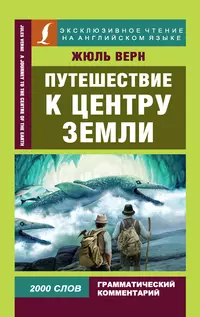
Kitabı oxu: «Путешествие к центру Земли / A Journey to the Centre of the Earth»
© С.А. Матвеев, адаптация текста, словарь
© ООО «Издательство АСТ», 2020
1
On the 24th of May, 1863, my uncle, Professor Otto Liedenbrock1, rushed into his little house in Hamburg. He was professor at the Johannaeum2, and was delivering a series of lectures on mineralogy. His teaching was to benefit himself, not others. He was a learned egotist. Germany has many professors of this sort. The name of Liedenbrock was honourably mentioned in colleges and learned societies. Moreover, my uncle was the curator of the museum of mineralogy formed by the Russian ambassador; a most valuable collection, the fame of which is European.
He was a tall man, of an iron constitution, and with a fair complexion. His restless eyes were in incessant motion behind his spectacles. His long, thin nose was like a knife blade.
He lived in his own little house in Königstrasse3, a structure half brick and half wood4. My uncle was tolerably rich for a German professor. The house was his own, and everything in it: his god-daughter Gräuben5, a young girl of seventeen, Martha6, and myself. As his nephew and an orphan, I became his laboratory assistant. The blood of a mineralogist was in my veins, and in the midst of my specimens I was always happy.
2
One day I came to his study. It was like a museum. Specimens of every kind lay there in their places in perfect order, and correctly named, divided into inflammable, metallic, and lithoid minerals7.
My uncle was sitting in a velvet armchair, and was looking at a book with intense admiration.
“Here’s a remarkable book! What a wonderful book!” he was exclaiming. “Don’t you see? I have got a priceless treasure, that I found this morning in the bookshop.”
“Magnificent!” I replied, with a good imitation of enthusiasm.
Why worry about this old, bound in rough calf, yellow, faded volume?
“See,” the Professor went on. “Isn’t it a beauty? Yes; splendid! Did you ever see such a binding8? Doesn’t the book open easily? Yes; it stops open anywhere. But does it shut equally well? Yes; for the binding and the leaves are flush. And look at its back, after seven hundred years!”
I asked a question about its contents, although I did not feel the slightest interest.
“And what is the title of this marvellous work?” I asked.
“This work,” replied my uncle, “this work is the Heims Kringla 9of Snorre Turlleson10, the most famous Icelandic author of the twelfth century! It is the chronicle of the Norwegian princes who ruled in Iceland.”
“Indeed;” I cried, “and of course it is a German translation?”
“What!” sharply replied the Professor, “A translation! What can I do with a translation? This is the Icelandic original!”
“Ah!” said I; “and is the type 11good?”
“Type! What do you mean by the type, wretched Axel12? Type! Do you take it for 13a printed book, you ignorant fool? It is a manuscript, a Runic manuscript.”
“Runic?”
“Yes. Do I need to explain what that is?”
“Of course not,” I replied in the tone of an injured man. But my uncle continued.
“Runic characters were in use in Iceland in former ages. They were invented, it is said, by Odin 14himself. Look there, and wonder, impious young man, and admire these letters, the invention of the Scandinavian god!”
Well, well! I was going to prostrate myself before this wonderful book, when a little incident happened to divert conversation into another channel. A dirty slip of parchment slipped out of the volume and fell upon the floor.
“What’s this?” cried my uncle.
And he laid out upon the table that piece of parchment, five inches by three15, with certain mysterious characters.
The Professor raised his spectacles and pronounced:
“These are Runic letters; they are exactly like those of the manuscript of Snorre Turlleson. But what is their meaning? It is certainly old Icelandic.”
Suddenly two o’clock struck by the little clock over the fireplace. At that moment our good housekeeper Martha opened the study door, and said:
Pulsuz fraqment bitdi.