

10% endirim hədiyyə edin
Bu kitabı tövsiyə edin və dostunuzun alışından 0,10 ₼ əldə edin.
0+

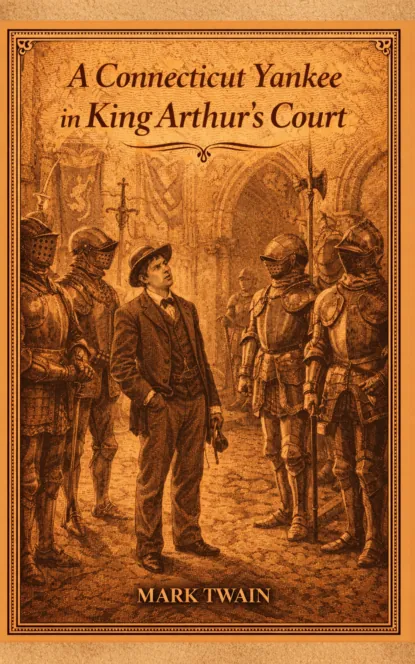
A Connecticut Yankee in King Arthur's Court is one of Mark Twain's most imaginative and satirical works, blending historical fantasy, social commentary, humor, and sharp political critique into a timeless adventure. First published in 1889, the novel tells the story of Hank Morgan, a practical and resourceful 19th-century American engineer who is mysteriously transported back to 6th-century England during the reign of King Arthur.
After a blow to the head during a factory dispute, Hank awakens in the legendary world of knights, castles, jousting tournaments, and medieval superstition. Armed with modern knowledge of science, technology, and democratic ideals, he quickly realizes he is centuries ahead of the society around him. Using his intelligence and ingenuity, Hank positions himself as a powerful figure in Camelot by performing what appear to be magical feats—actually clever applications of scientific knowledge, including predicting a solar eclipse.
As «The Boss,» Hank sets out to modernize Arthurian England. He introduces schools, factories, newspapers, telegraph lines, and even attempts to build a republic in place of the monarchy. Through his efforts, Twain explores themes of progress, power, technology, social reform, and the clash between old-world tradition and modern innovation. Hank's ambitious mission to transform medieval society raises questions about whether progress can truly be forced upon a culture—and at what cost.
While filled with adventure and comic misadventures—featuring iconic characters such as King Arthur, Merlin, and the Knights of the Round Table—the novel is much more than a simple time-travel story. Twain uses satire to critique romanticized notions of chivalry, blind loyalty to aristocracy, and the injustices of feudal systems. Beneath the humor lies a biting examination of social inequality, religious corruption, and the darker side of technological advancement.
The story balances lighthearted comedy with increasingly serious and even tragic undertones as Hank's grand experiment in modernization begins to unravel. Twain ultimately challenges readers to reflect on the nature of civilization itself: Is technological progress inherently moral? Does innovation guarantee improvement? Can one person reshape society without unintended consequences?
Rich in wit, irony, and philosophical depth, A Connecticut Yankee in King Arthur's Court remains one of Twain's most provocative and enduring works. It is a novel that entertains with its fantastical premise while offering profound insights into power, progress, and the human condition—making it as relevant today as when it was first published.