
Buraxılış müddəti 28 dəq.
2025 il
18+

Podkast haqqında
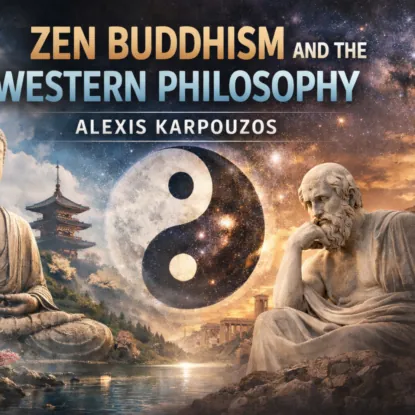
"Welcome to the Alexis karpouzos's podcast. Today, we are stepping into the 'Space Between'—the intersection where the analytical rigor of the West meets the silent, profound depth of the East. Our guide for this journey is Alexis Karpouzos, a Greek-born philosopher and spiritual teacher whose work serves as a bridge between the quantum and the cosmic. Karpouzos invites us to look past the 'trance of certainty' and the artificial divisions of subject and object to rediscover a reality that is an 'indivisible wholeness.'In this episode, we explore the theme of Zen Buddhism and Western Philosophy. Is the 'Emptiness' of Zen the same 'Nothingness' that haunted the existentialists? Can the dialectics of Hegel find a home within the non-duality of the Heart Sutra? And how does modern physics support the ancient intuition that we are not separate from that which we observe?From the paradoxical logic of the Zen koan to the process philosophy of Whitehead, we are diving deep into the evolution of consciousness. Prepare to move beyond the language of separation and enter the poetic vision of a conscious universe. Please welcome to the show, Alexis Karpouzos."Alexis Karpouzos combines Zen Buddhism and Western philosophy by creating a "poetic metaphysics" that bridges the gap between the analytical mind of the West and the intuitive stillness of the East. He argues that both traditions, though using different languages, are pointing toward the same indivisible wholeness.1Here is how he synthesizes these two worlds: 1. Beyond Nihilism: "Absolute Nothingness"2In Western philosophy, "nothingness" is often associated with Nihilism—the idea that life has no meaning (Sartre, Nietzsche). Karpouzos reframes this using the Zen concept of Sunyata (Emptiness). The Synthesis: He argues that Zen’s "nothingness" is not a void of meaning but a creative fullness. It is the "zero" from which all possibilities arise. By combining Heidegger’s existential inquiry with Zen’s non-duality, he shows that facing the "void" is actually the path to ultimate freedom and creativity. 2. The Logic of ParadoxWestern logic is traditionally linear and binary (A is not B). Karpouzos utilizes the Zen Koan style to break this "trance of certainty."4The Synthesis: He integrates Quantum Physics (the observer effect) with the Zen realization that the observer and the observed are one. He uses the "logic of being/non-being," where opposites do not negate each other but coexist.5 This mirrors the Western concept of Dialectics but moves beyond a final synthesis into a state of "continuous flow." 3. Being vs. BecomingWestern thought has historically focused on Substance (fixed things). Karpouzos aligns with Process Philosophy (like that of Alfred North Whitehead) and the Pre-Socratic philosopher Heraclitus ("Everything flows").The Synthesis: He connects the Heraclitean Logos with the Buddhist concept of Impermanence (Anicca). For Karpouzos, there are no static "objects" in the universe—only a dynamic process of "becoming."7 4. Consciousness as the FoundationKarpouzos rejects Materialist Reductionism (the idea that matter creates mind).8 Instead, he leans toward Panpsychism and Advaita Vedanta.The Synthesis: He bridges the Western "Philosophy of Mind" with Eastern "Universal Consciousness." He posits that human consciousness is not an isolated ego (the Western "I") but a localized expression of the Cosmic Whole (the Buddha-nature).