Kitabı oxu: «The Organic Garden»
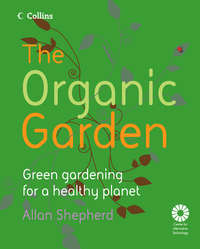
The Organic Garden
Green gardening for a healthy planet
Allan Shepherd

Table of Contents
Cover Page
Title Page
Introduction
Ten principles of organic gardening
Chapter one My space: planning your garden
Chapter two Garden micro-climate and soil care
Chapter three Choosing and growing your plant stock
Chapter four Gardening for food
Chapter five Gardening for wildlife, ornament and fun
Chapter six Weeds, pests, diseases and disorders
Chapter seven Gardening beyond the garden
Chapter eight Climate change and gardening: the elephant in the room
Further reading
Directory
Index
Acknowledgements
Copyright
About the Publisher
Introduction
Picture the scene. I’m standing in a Weld halfway up a Welsh hillside knee-deep in slug-infested cabbages. As I bend down to pick another slimy gastropod off a brassica leaf I notice a tousled blond figure waving at me. Even with 30 metres between us I can see that my guest has four undone shirt buttons beneath the collar. It’s not my lucky day. It’s only my landlord, rock legend Robert Plant, come to pick up some basil. It can’t get much more surreal than this, I think to myself, as I wander over to shake his hand, self-consciously wiping the slime trails off my fingers as I go. Here I am, organic market gardener and tenant farmer to the man who wrote ‘Stairway to Heaven’ and ‘Whole Lotta Love’. I’m standing in his field, the sun is shining and right at that moment I’m having the time of my life. I am not worthy.
Some days, the sunny ones mainly, it was a bohemian rural idyll. We had discussions about politics as we dug. Friendships were made and one or two great romances forged.
When I met Robert Plant ten years ago I was living out a good-life fantasy. A couple of friends and I farmed a rough bit of high-altitude sheep Weld, not at all what you’d imagine as a ‘good’ place to grow vegetables. We had a Rotavator that didn’t work and a wonky-wheeled cliché of a car – a traditional French peasant’s 2CV (apparently they were designed to carry so many dozens of eggs down a French farm track) – that broke down halfway through the season.
A hundred and one things that could go wrong did go wrong. We lost plants, money and one of our rabbit-catching cats. Not deceased, just debunked to a nearby farmhouse. By rights we shouldn’t have survived more than a few weeks. But we did. And we actually managed to grow vegetables. Even with minimal experience we delivered a weekly box of vegetables to 50 families within a 30-kilometre radius.
My friends and I used to play a game we called fantasy farming. We’d see some neglected corner of a farm and plan grand schemes of orchards, organic smallholdings and market gardens. We were disillusioned with mainstream agriculture and thought we could do better. For a brief period in 1996, at Robert’s place, we did.
We transformed a barren sheep field into a productive vegetable patch and enriched the lives of hundreds of people. Folks came to visit from all over Britain. Some came for a few hours. Others stayed for days. We had wonderful picnics of fresh salads and homemade elderflower wine. People brought musical instruments and played homemade songs (though never Robert, unfortunately). Our friend Kevin built a gardener’s shed out of straw bales and lime plaster – one of the first of its type in Britain. We sat in it on rainy days dunking bakery doughnuts in tea.
Some days, the sunny ones mainly, it was a bohemian rural idyll. We had discussions about politics as we dug. Friendships were made and one or two great romances forged. There was plenty of heartache – and arguments too. It was the stuff of life.
The garden was even featured in the Lily Savage programme Life Swaps on BBC2. Jenny and Roxanne, the two women who started the garden and did most of the hard work setting it up, lived in an automated house of the future for a week while their swappees came to work on the field. My favourite line from the resulting TV programme came as one of the participants berated the vegetables: ‘Why are you so slow?’
At the risk of sounding like someone who has never quite got over his first love, I haven’t experienced the same feeling of contentment and connection to a piece of land since. Before I worked there I never imagined that gardening could bring together so many elements of life. Even when it rained, when the water soaked through our waterproofs to our skin, when the wind blew the clouds over us like dandelion seeds in a storm, it was still the best. And we got to sell basil to a rock god. Party on, dude.
Now go back another twelve years. It’s 1984. I’ve never heard of Robert Plant. I’m on a bus back from Lincoln, having just experienced my first fast-food-induced food poisoning. I don’t know why I’m ill. I’m an ignorant fourteen-year-old. A teenager obsessed by the Golden Arches. I’m fat and furious. I live in the middle of nowhere and every time I go near a city I have to get my fix. I’m part of the emerging culture of obesity. A trendsetter. Ahead of my time. I’m the only fatty in the village.
Despite my weight problem, I manage to garden a little vegetable plot with one of my friends. I keep the accounts. We buy seeds and fertiliser. We reap a huge harvest of vegetables, some of which we sell to the local shop. When we come to work out the accounts at the end of the season, the fertiliser has taken up most of the profit. It puts me off gardening. I go back to playing Football Manager on my Amstrad 464.
Then, somewhere between 1984 and 1996, I think I was abducted by organic-loving Led-Zeppelin-listening aliens.
If I can go organic, anyone can.
I own my own piece of land now. It’s no Chelsea show garden but it’s mine and I love it. I enter my garden and immediately want to slow down to the pace of a snail. I take it all in. And see what thoughts are thrown up. More often than not the change of pace is inspiring.
At night, when the garden is as quiet as a mouse, I like listening to the sound of ivy crack under the weight of snails, and watching bats swing in and out of the street light opposite, devouring moths with pendulum efficiency.
When I look up through the wood behind my plot and see thousands of insects illuminated in the shafts of light that come through to the garden, I am reminded of how much life there is on planet Earth. They look like dust particles caught in a cinema projection, but they seem as wonderful as any image you might see on a silver screen. At night, when the garden is as quiet as a mouse, I like listening to the sound of ivy crack under the weight of snails, and watching bats swing in and out of the street light opposite, devouring moths with pendulum efficiency. During the day I watch spitfire house martins picking off daytime flyers.
It’s the opposite of fast-paced veggie gardening. I’m in no hurry. I’m more interested in the wildlife in my garden. And creating a space that inspires me and my friends. Organic gardening is not just about growing food. It’s also about creating beauty and biodiversity. This is what I tell myself, as I work my north-facing, damp, shady, slatey-soiled place, berating the vegetables for being too slow. It’s good to eat food grown in your own garden but sometimes I get more out of just watching and listening.
To ease my regret at having lost out in the perfect garden lottery, I have developed a simple hierarchy of choice when it comes to buying fresh vegetables. I have a box of vegetables delivered every week. I supplement the box with a few things from an organic market stall and a local shop owned by an organic meat farmer. If all else fails I go to the supermarket.
As if this choice wasn’t enough, my friends take pity on my shade-dwelling self and offer me vegetables from their own sun-kissed plots (which is a bit of a laugh anyway, living in Wales as we do). These vegetables always taste the best, perhaps because they are usually cooked or eaten raw straight from the plot. Despite my best teenage intentions I seem to have landed in community-spirited gardening nirvana.
As the adverts say, it doesn’t stop there. We have a fantastically well-organised seed-swap group to keep favourite varieties of plants going, a wide selection of organic plots to visit and one of the UK’s oldest Soil Association-approved vegetable plots, run by Roger MacLennan at The Centre for Alternative Technology. We have people selling organic cut flowers, others growing more salad than you can shake a stick at. Every other person seems to be a gardener. Frankly I feel inadequate.
And everyone wants to give you something or offer you some advice. It’s as if organic gardeners in my area have gone through some sort of harmony realignment device and come out the other side wanting to help people. To be part of this community is uplifting and exciting.
But the truly amazing thing is that there’s nothing particularly unusual about our scene. Go to almost any area of the country (and world) and you will find something similar going on. Frankly, my teenage self would be horrified by this slow food revolution. And none of it franchised! Just ordinary people coming together to make food important again.
Every which way you care to look there’s some amazing activity going on in Britain: 300 organic box schemes, 250 farmers’ markets, 1,000 community gardens, 59 city farms, 75 school farms, 500,000 volunteer gardeners, thousands of organic allotmenteers…the list goes on.
St Ann’s Allotment Gardens in Nottingham, one of the biggest and oldest in the country, boasts a thriving list of community enterprises benefiting everyone from nursery-age children to the long-term unemployed. Ragman’s Lane farm in Gloucestershire has taught generation after generation of organic gardeners. Ludlow has declared itself a Cittàslow centre for good living, creating in the town an atmosphere conducive to appreciating quality over speed in all aspects of life. In Cornwall the real Eden project is going on at Ken Fern’s Plants for a Future in Lostwithiel. Here they’re testing a new system of horticulture called perennial edible or forest gardening that could help us to garden successfully in conditions of climate change. In Totnes Martin Crawford of the Agroforestry Research Trust is doing the same. In Kent Iain Tolhurst is developing new ways to garden without recourse to artificial or animal-related by-products. Coventry has the Heritage Seed Library and Garden Organic (HDRA); Bristol, The Soil Association and the ethical bank, Triodos; London, Fresh and Wild organic food shops; Keighley, The Ecology Building Society. Every part of Britain has an emerging network of community-inspired organic businesses and volunteer organisations.
Why is all this happening? I think it’s because people have rediscovered what it’s like to be part of something. Whether it’s a community or a local group or a movement. It’s fun and it feels like you’re doing something vitally important. It’s bringing people together to combat loss of biodiversity, social injustice and, the biggest threat to our culture, global climate change.
If I was abducted by aliens, it happened metaphorically, one night in 1991 – the first time I visited The Centre for Alternative Technology, or CAT as it is generally known. In those days you arrived at CAT via a ten-minute walk up an unlit, unpaved driveway shaded by trees. I climbed the path with fifteen friends from Hull University (we were all volunteering for the weekend). When we emerged from the trees at the top of the drive we entered a starlit courtyard of stone buildings. It was the first time starlight took my breath away.
A small handmade wooden sign directed us to our billet for the weekend – an unpretentious little wooden hut I later found out was a reclaimed exhibit from the 1976 Ideal Home Show. It was called Tea Chest. There was no one around. It was like a fairytale house. I half expected a little hobgoblin to come out shaking a stick at me. We opened the door and right in front of us laid out on an old wooden table was a beautiful homemade cake with a little note attached to it. The note said: ‘Help yourself.’ Some people say how notes like ‘I love you’ or ‘Will you marry me?’ changed their lives. For me it was ‘Help yourself’. With those two little words I was hooked. If this was organic living, count me in.
Visiting CAT for the first time was like pushing back the coats at the back of the wardrobe and stepping into Narnia.
Visiting CAT for the first time was like pushing back the coats at the back of the wardrobe and stepping into Narnia. I couldn’t believe such a place existed. Here were people who acted on their beliefs, not in a highminded fashion, but in a very practical down-to-earth way. They would show the world it was possible and preferable to live an organic lifestyle by doing it. By building houses with wood instead of concrete, by generating their own power using renewable energy, by growing their own organic food. Even by baking homemade cakes for complete strangers. Luxury items might have been scarce but they had plenty of passion and nerve. And they had community.
Through 70s’ recession and 80s’ economic miracle, the workers at CAT just carried on ploughing their own furrow. Showing that you didn’t have to buy in to what the rest of the world had to offer. You could do something different. They weren’t the only people to go against the prevailing wisdom. In the late 60s and early 70s organisations that have become household names were started in cramped offices all over Britain: Greenpeace, Friends of the Earth, The Soil Association, The Henry Doubleday Research Association (now Garden Organic).
But CAT has always been a little bit different. Out on a limb in Wales, hidden from view almost, it had the opportunity to test the alternatives without anyone really noticing. At least that was the intention. But even by 1976, within the first two years of its existence CAT attracted visitors. A trickle at first, then a steady stream of curious people, all wanting to know what was going on at the disused quarry in Machynlleth. Even TV execs became interested. They dispatched Blue Peter presenters and the Why Don’t You? team to find out what you could do if you switched off your television set and did something less boring instead. Royalty came. First Prince Philip and then his son Charles. All the time CAT, or The Quarry as it became known, carried on doing what its founder Gerard Morgan Grenville set out to do – show that alternatives were not only possible but preferable.
And now the alternatives have come of age. The Soil Association represents the fastest-growing agricultural sector in Britain. Greenpeace and Friends of the Earth feature in just about every news broadcast. Garden Organic (HDRA) has the support of our leading garden horticulturalists. And CAT helps hundreds of thousands of people every year find practical, positive solutions to environmental problems.
The non-organic world is a place I will not go back to. Despite the CS Lewis analogy, I think the organic world is the more real. It is why I live.
When I was seventeen my A-level history teacher told me of a book that started ‘come with me as we rush headlong towards the conclusion’. I can’t remember the title of the book but the quote obviously made an impression on me because it’s stuck in my head for nineteen years. I can’t promise such a breathless experience as that, Mrs Hedley, if you’re reading this, but I can say that this gardening book is unique.
This book goes beyond the realms of other organic gardening reference books by treating gardening as the starting point for a whole organic lifestyle. We show you how to garden organic and live organic. We believe you can’t value organic living more highly than when you work a garden. Working a garden helps you appreciate why slow food is better than fast. Why home-grown is better than bought. And why seasonal is better than imported. A garden is like Google. A question answered with every hit.
CAT has three important words in its mission statement: to inspire, inform and enable. I hope The Organic Garden does just that too.
Ten principles of organic gardening
I want to start with a story – if you are sitting comfortably.
Once upon a time a contented shepherd called Elzéard Bouffier kept a flock of sheep alive on a hillside of wind-blown soil, in a corner of France almost lost and best forgotten. There were no trees on this land, nor were there any of the joys that trees would have brought with them. There were no springs of water and no streams. No plants. Or animals to eat them. And as there was nothing there to take pleasure or profit from, there were no people either. Apart, that is, from those who had to live there, who had no choice in the matter. And of these people most were as harsh and bitter as the wind that swept through the gaps in the walls of their blank stone houses.
Although he could have been easily discouraged by this landscape, Elzéard was not interested in the reality that was. Only with the reality that was yet to be. Content to be alone, not bitter or lonely in his isolation, longing for nothing, Elzéard spent his unoccupied hours planting acorns – wherever he found an empty desolate spot that deserved to be occupied by timber and leaves. With no wife or family to occupy his time, nor matters of important business to attend to, nor entertainment to distract him, with the years on his side, he realised he could plant a forest, and did so.
As the acorns grew into saplings and the saplings into trees, he noticed how the raindrops no longer ran along the surface of the compacted soil to puddle the hillside with damp craters. But instead ran down the leaves and the branches and the trunks of his oaks, into the soil, where the water stayed, until the earth could hold no more. Then it bubbled its way out again, through springs and into one of the many streams that now ran through the forest.
When the leaves fell he watched the worms and the ants break them up and drag them into the earth. He witnessed plants erupt from seeds he had not planted.
When the leaves fell he watched the worms and the ants break them up and drag them into the earth. He witnessed plants erupt from seeds he had not planted. He did not care how they had got there. Perhaps they had re-awakened from a deep slumber, or maybe they were fresh migrants arrested in flight from some other place and shackled to the earth by his trees. That they were there was the only thing that mattered, and that insects came to feed on their nectar and that birds came to feed on the insects. And that owls returned to hunt the mice that ate the seeds of the flowers. And that rabbits and deer came to eat the plants. And finally that humans returned in their tens of thousands to take pleasure in the amazing and mysterious natural phenomenon that was Elzéard Bouffier’s forest.
The original version of The Man Who Planted Trees by Jean Giono is a golden cloth of literature compared to the tailored square of material I have presented above. I haven’t really done it justice, so make it the next book you buy. What I will try to do in this book is give you the skills and ambition to have your own back garden Elzéard Bouffier moment. Not to plant a forest! Just to take a dead space and transform it into something living and wonderful. A good place for people, plants and animals.
One: create space
Space: as in, a place to be. Gardeners grow flowers and vegetables and fruit and herbs and trees and shrubs, but over all these things they create space.
They bring together disparate elements and make something whole and beautiful. They learn which combinations of plants and materials work well together and which don’t. They appreciate how space can change the way we feel, defining our moods, inspiring and enchanting us. We know when we have stepped into a beautiful garden space. We can see how much love and work has been dedicated to it. We get an idea of what sort of person the gardener is. The gardener gives more time and attention to detail to a space than any other type of person. Unlike an interior designer who leaves when the job is finished, the gardener’s job is never completely done and nor does a gardener want it to be. Though we rest between work, a garden space never sits still. Plants grow and die back, and have illnesses and unwelcome pest visitors. The garden space changes from day to day. We watch what’s happening to our plants and tend to those which have succumbed to one of life’s little mishaps. This is the joy of caring for a garden space.
Two: soil is everything
Before you plant a single thing, get your soil care right. Plants need nutrients from compost to grow strong and prosper. Some plants will grow on poor soils but the ones we demand to grow most often, the vegetables, the fruit and the cultivated flowers, need to eat a lot of food to grow. Chemical gardeners use artificial fertilisers to feed their plants. Organic gardeners use compost and other soil improvers.
Compost improves the structure of the soil, helping soils to retain water when plants need it most, and provides food for composting creatures. Healthy soils produce healthy plants less likely to be attacked by pests and disease.
One of the most striking displays at the CAT visitor centre is a simple row of vegetable beds, one next to the other, each one filled with a different quantity of slate, soil and compost. The first bed is made up entirely of slate waste. The second bed is just slate and soil. The third bed slate, soil and compost.
Plants grown in the first bed are always small and weedy, and are attacked readily by slugs and other pests. Plants grown in the second bed are only slightly better served by the soil than those in the first. Only in the third bed, the bed stacked high with soil and compost, are plants able to flourish as they should.
Three: grow a little food
Food grown at home is better for you and better for the planet. Raw food picked fresh from the plant is better for you than cooked. And there are always more foods to eat than we ever imagine.
When I moved to Wales I fell amongst inspirational people. Every single day of the year Roger MacLennan and his volunteers prepared for the whole of the CAT staff (and still do) enough salad for each of us to fill a large plate. Amongst the salads were leaves I had never tasted before and flowers I would never have thought you could eat. Each one of these plants was raised without a single chemical and with more or less no external energy required, by which I mean materials and resources brought in from beyond the garden. The compost was made on site. The wood for materials came from hedgerows around the garden. Even some of the tools were homemade. Amongst the rows of vegetables, Roger planted flowers to attract predator insects and around the edges he dug ponds for frogs to venture forth from and eat slugs. The food travelled approximately 200 metres to reach the table (at most!). And each day we sat together, talked and enjoyed what had been grown for us.
Four: don’t garden alone
Wildlife is at the heart of your organic garden, so enlist the support of your garden allies. A true organic gardener assesses how to work with nature to get the most from their garden without having to be its constant guardian. The garden is more important to those species that occupy it full-time, so make a garden for those who always use it. If you do it right the pollinating insects will bring you flowers. The composting creatures will improve your soil. The predators will eat the pests. Garden for other species and they will garden for you.
Five: grow for ornament
Vegetable plots are only part of the story. Ornamental gardens can be organic, and edible and non-edible plants can be grown together in beautiful spaces. And beautiful spaces change lives. We are only beginning to understand how bad spaces ruin lives, but with each passing year there are fresh studies that reinforce the commonsense view that people with access to beautiful spaces are happier. Just as we see studies showing that young people perform better at school if they have access to healthy food, so we are beginning to see how people of all ages perform better in beautiful environments. In Chicago, crime rates have fallen dramatically in areas where new parks have been created. It seems that people have more respect for each other and their local area when they are under less stress. And access to beautiful spaces reduces stress.
When I was twenty-six I met my friend and long-time collaborator Chloë Ward. Chloë is a true gardener, by which I mean it is her main occupation. Much of what I know about gardening I owe to her. Chloë is one of those rare people who can see beyond that which exists today to think about what might be possible in the future. Like Elzéard Bouffier, she plants for her own enjoyment but with an eye on what might be in the years to come. Many of the pictures you’ll see in this book are taken at the Garden Organic (HDRA) gardens in Yalding, where she formerly worked as deputy head gardener. Chloë’s particular mission is to grow edible plants in spaces that are designed not as vegetable gardens but as ornamental landscapes, mixing the ornamental and the edible. A fact borne out by her writing on food gardens in this book, including the section on the up-and-coming and relatively new technique known as forest gardening, a subject about which she is one of only a handful of people qualified to write on.
Six: value lies in the land
July 2006 saw two of the hottest days ever recorded in Britain. The beautiful damp, lush green Wales I know and love started to look like the Mediterranean. First, CAT gardener Roger MacLennan recorded the highest temperature in his garden in twenty years. Then the next day the record was broken. In 2006 the Welsh rain failed us. A temporary blip or a sign of things to come?
The question that concerns me most is how can we garden and live in an era of climate change without losing the peace, security and good living we enjoy today? As the government’s chief advisor on the issue has already suggested, climate change is now a matter of national emergency. Perhaps we need to conjure up the spirit of that other great national gardening effort, the Dig for Victory campaign of the Second World War, to look forward to our better world. To rekindle a love of gardening in a time of global crisis would be a wonderful thing.
But what kind of gardening should we aspire to? In the future, will each of us need to garden for self-sufficiency and put our leisure pursuits to one side, just as millions of people did during the Second World War? Or is this a different kind of crisis, where it is more important to use our gardens as little centres for well-being and low-carbon lifestyles?
When I’m in my garden I buy less music, I rent fewer DVDs, I don’t go out so much. I stay in, I dig, mend, make, plant, plan. I travel less. Use less electricity. Need no space heating. I invite people round and we party. It’s all a way of cutting my carbon use.
I figure if I can build a good life for myself here, one that is continually refreshed by new experiences of my garden, landscape and home town, I don’t need to travel or pursue carbon-costly activities. I’m trying to kick carbon addiction by creating a low-carbon lifestyle and my life is all the richer for it. I’m not saying I’m perfect, but my garden helps me keep within what the carbon experts say is a global fair share of carbon emissions – 2.6 tonnes of CO2 per year, compared to a UK average of 10 tonnes – the amount of carbon every person in the world could produce each year without causing global climate change. I’ve long since given up on the idea of total self-sufficiency. CAT’s Peter Harper once calculated the productivity of his garden. He weighed everything that came out of it – vegetables, fruit, garden waste, wood, the lot – for a year. He wanted to see in percentage terms how self-sufficient an average garden could be. He calculated that his garden could generate around 0.5 per cent of his annual space-heating demand in wood cuttings and about £140 worth of fruit and vegetables (at 1997 prices). After removing the cost of seeds and plants from this total, the economic value of his garden amounted to 0.9 per cent of total household expenditure. The true value of a garden lay not in its economic output, however, but ‘in terms of entertainment, therapy, exercise, education, contribution to environmental quality, nutrition, convenience, gourmet delights and sheer connectedness with the Earth’. In other words, all things that are priceless.
Self-sufficiency is a grand ideal but it may not be what is needed during this period of global climate change. My friends Tom and Lisa Brown (pictured above left) have a smallholding and grow almost all their own foods, make endless amounts of honey, jams and chutneys, and generally lead what you might describe in the old cliché as ‘The Good Life’. But they have a lifetime of learning under their belts and several acres of land in which to make their dream possible. The good life is a good life but it is also a full-time occupation. When I walk around Tom and Lisa’s place I am struck by their absolute commitment to the value of land, and their place in the history of the land they now have stewardship over.
In this period of climatic instability we will need to care for our own little patches with equal passion. Bad weather erodes soil and weakens our plants. But if we know our land well we can help to do our bit to keep it strong and healthy. If we can guide our own gardens through the traumas that climate change may bring, we will have played our part.
Seven: plant for biodiversity
To keep a check on the villains in your garden, fill it up with lots of different species of plants. Gardens are healthier if they have a large variety of different species and plants are less likely to suffer from disease.
In the flatlands of Lincolnshire I lived amongst space that was more or less dead for nature. Field upon field of agricultural crops stretched out around my village. Every summer millions of black flies blew across the open hedgeless country into our gardens. Here they would rest upon our clothes on the line, so much so that we would have to wash them all over again. They fell between gaps in our window frames and filled up the aluminium corners like ground black pepper. They got into the roots of our hair and into the corners of our eyes. The worst job I could imagine in my childhood was mowing the lawn on a hot day, one hand on the sticky vibrating plastic handle of the hover mower, the other brushing away the sweat and the flies from my face.
And all beyond me I could see the flat, open, soulless fields filled with their single crops stretching out for miles and tractors showering chemicals over them. If you were a black fly where would you go? Beneficial insects like biodiversity and pests hate it.
Eight: make a social space
Make gardens for people as well as for plants and animals. Gardens are not just for wildlife or food production. They are social spaces too and need to be designed for humans.
As a gardener I’m most interested in atmosphere, purpose and technique – what a garden feels like to be in, what it will be used for and how I can make it work horticulturally. We need a garden to do different things for us. A garden space does not just cater for one emotion or for one person or activity. It must mean different things for us at different times. For me a garden is a foil to my ever-changing moods. It’s a social space when I want it to be. A quiet space whenever I need it. A place to be active. A place to be still. A sanctuary. An invigorator. One male reviewer of my last book called it too feminine for any red-blooded Englishman. I wasn’t offended by the criticism. His wife loved it.
I’m altogether comfortable with my feminine side. A garden requires a long-term commitment to care and nurture. You can get all macho about gardening, but I think it’s a mistake. If your only relationship with a garden is to do with strength and posturing, you might as well abandon subtlety, suggestion and the idea that a garden can cater for more than one mood.
Nine: go local
Whenever you can’t meet your own needs, support your local gardening enterprises. Small organic nurseries are a wellspring of local plant knowledge as well as being part of the glue that binds a community together. Local craftspeople can supply us with garden furniture, bird houses and feeders, fencing materials and other garden paraphernalia. Market gardens and box schemes can deliver much of our food.
My friend Sue Harper has her own cut flower business. It’s called Sweet Loving Flowers. She wants to grow local cut flowers to reduce the need for those flown in from the four corners of the world. Sue’s plants are hand grown and tended organically on a small, oneacre, south-facing field in Wales where, contrary to some of my occasional moans, the sun does shine. Sue was once the gardener for the famed River Café in London but moved back to Wales about five years ago to bring up her child. Her enterprise is tiny compared to some of the multinational companies that import a continuous flow of chemically produced, hot-house-grown, air-miles-laden, environmentally damaging plants from abroad. But she is only one of a handful of people meeting the growing demand for organic, local cut flowers.
Work with materials that are local to your area and learn how to fashion some of the things you need in your garden from natural, sustainable materials. Natural materials grown close to home are a fantastic and beautiful resource. As you will see later, this could include beautiful woodland materials such as willow, hazel and oak, or natural earthen products such as slate, local stone or clay. Very often they are also materials that the average gardener would feel happy to learn to work with. Some of the techniques for using them are very pleasing, almost therapeutic.
Half of garden design is about choosing plants. The other half is about materials and structures. The impact on the environment of buying a few plants is relatively small compared to the impact of some garden materials, furniture and accessories. The atmosphere and ecological footprint of a garden can be spoilt by poor material choice. Make sure you are not creating a paradise at home by destroying one somewhere else.
Ten: what we do in our gardens matters
It matters to somebody somewhere, even when we think it doesn’t.
Many people have changed the direction of my life. Some of them I’ve never met. Top of this list is Chico Mendes. Chico Mendes worked in a small area of rainforest in a remote region of Brazil. His job was to extract a harvest of natural rubber from trees – a job he could do without harming the trees. Chico supplemented his income by collecting other things from the forest too – Brazil nuts, herbs and fruits. He believed in harvesting from the forest in a way that would keep the forest intact for ever. Being totally reliant on it he was horrified to hear that his area of rainforest was to be cut down. Faced with the loss of his own livelihood, he organised a peaceful campaign of protest and resistance. He was sitting on the steps of his home when two gunmen hired by loggers shot him dead.
Can there be anything more ugly than the jagged edges of felled tree stumps poking up from empty soil?
What could be so important to take the life of a man like Chico Mendes? The sad reality is that the wood Chico died to protect was turned into charcoal, garden furniture and plywood fences. It appeared in chain stores around Britain and we bought it.
How extraordinary it must have been to garden a rainforest. To walk amongst giants every day. To be no bigger than an ant nor older than a child in comparison to the living things around you. How brave to go into your garden every morning wondering whether you will return to sit on the steps of your home each night. As gardeners we can imagine how it must have been for Chico Mendes as he heard the bulldozers move onwards through the forest. Wondering when his garden would be next.
I can picture the landscape after the bulldozers moved on. It doesn’t take much imagination. We’ve all seen the photographs. Can there be anything more ugly than the jagged edges of felled tree stumps poking up from empty soils?
But however vivid these pictures are, they still don’t tell the whole story. We might think that within a few years farmers are happily ploughing and harvesting crops on this new landscape but the truth is that once a rainforest has been removed from a piece of land nothing on that land is ever quite the same again.
Rainforest soil relies on rainforests. Once they are removed the soil loses its fertility. It is a story that 300 million slash-and-burn farmers know all over the tropical world. Each one cuts, farms and moves on, chasing ever-decreasing circles of fertility until they are forced off the land altogether, into city slums. This is competition at its most brutal. Competition amongst men for land, and with nature for fertility.
Making ethical decisions
You’re going to need to be equipped to start living organically, so I thought it would be helpful to list the thought processes that go through my mind when I’m making an ethical decision. I don’t want to give the impression that I’m a puritan and never buy anything brand new. It’s just that I like to think carefully before I buy anything.
Before you buy…DIY
Do I need it? This is a classic example of an obvious question often overlooked. How many times do you buy something on impulse and then realise that you could have done very well without it? This may seem a bit puritan to people who like shopping without boundaries, but the first step to ethical living is think before you engage credit card.
Can I make it at home? In Chapter one I rattle on about a garden bench I made. It’s not a particularly amazing bench but, because I made it, it’s the best thing since unsliced bread. Making stuff yourself is the best ecological option. You can choose the materials yourself and put it together in the least energy wasteful way.
If I can’t make it myself, can one of my friends or swap buddies make it or offer me another solution? Check out www.freecycle.org for a national network of swapcrazed freeloaders.
If I have to buy something, can I buy recycled, secondhand or reused?
If I have to buy new, can I buy products that are sustainable, local, natural and carry an approved symbol? (Be it a Soil Association, Forest Stewardship Council or other ethical standard.)
If I can’t buy local or natural, can I buy sustainable from the UK or Europe and from an ethically minded national company?
If I can’t buy from Europe, can I buy fair trade, organic and sustainable from developing countries?
If I can’t buy within these criteria, should I bite the bullet and buy it or is there another solution I hadn’t thought of?
This sounds like a laborious process but actually after a while you can make these decisions quite quickly. It’s just another skill to learn.
Pulsuz fraqment bitdi.