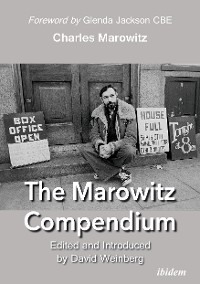
Kitabı oxu: «The Marowitz Compendium»
ibidem-Press, Stuttgart
Artists to my mind are the real architects of change and not the political legislators who implement change after the fact.
—William S. Burroughs
Books by Charles Marowitz
THE SOUNDS OF MUSIC;
EARLY RECORDING ARTISTS - (World Audience, Inc.)
HOW TO STAGE A PLAY (Amadeus/Limelight)
THE OTHER CHEKHOV (Applause Boks)
ESSAYS ON THEATER (Drama/Denmark)
STAGE DUST (Scarecrow Press)
THE OTHER WAY (Applause Books)
ALARUMS & EXCURSIONS (Applause Books)
RECYCLING SHAKESPEARE (Macmillan)
DIRECTING THE ACTION (Applause Books)
BURNT BRIDGES (Hodder & Stoughton)
PROSPERO’S STAFF (Indiana Univ. Press)
POTBOILERS (Marion Boyars, Inc.)
CLEVER DICK (Dramatists Play Svc.)
SEX WARS (Marion Boyars, Inc.)
THE ACT OF BEING (Taplinger Press)
THE MAROWITZ SHAKESPEARE (Marion Boyars)
CONFESSIONS OF A (Eyre-Methuen)
COUNTERFEIT CRITIC
THE METHOD AS MEANS (Barrie & Rockliffe)
ROAR OF THE CANNON (Applause Books)
[Plays & Translations]
SILENT PARTNERS (Dramatists Play Svc.)
MURDERING MARLOWE (Dramatists Play Svc.)
QUACK (Dramatists Play Svc.)
BOULEVARD COMEDIES (Smith & Kraus)
STAGE FRIGHT (Dramatists Play Svc.)
BASHVILLE IN LOVE (Samuel French, Ltd.)
SHERLOCK’S LAST CASE (Dramatists Play Svc.)
CLEVER DICK (Dramatists Play Svc.)
WILDE WEST (Dramatists Play Svc.)
DISCIPLES (Dramatists Play Svc.)
HEDDA (Aschehoug, Norway.)
ARTAUD AT RODEZ (Marion Boyars, Inc.)
THE SHREW (Marion Boyars, Inc.)
MEASURE FOR MEASURE (Marion Boyars, Inc.)
AN OTHELLO (Penguin Books)
A MACBETH (Marion Boyars, inc.)
VARIATIONS ON THE (Marion Boyars, Inc.)
MERCHANT OF VENICE
THE CRITIC AS ARTIST (Hansom Books)
THE MAROWITZ HAMLET (Penguin Books)
& DOCTOR FAUSTUS
CYRANO DE BERGERAC (Smith & Kraus)
MAKBETT (Ionesco) (Grove Press)
AND THEY PUT HAND- (Grove Press)
CUFFS ON THE FLOWERS
(Arrabal)
List of Contributors
Thelma Holt CBE
After a successful career as an actor, Thelma Holt, in partnership with Charles Marowitz, founded the Open Space Theatre in Tottenham Court Road, which became the forerunner of the London fringe. Later Thelma Holt joined the Royal National Theatre and was responsible for several acclaimed West End transfers. She was also responsible for major tours of RNT productions to Paris, Vienna, Zurich, North America, Moscow, Tbilisi, Tokyo, and Epidaurus. Thelma Holt produced multiple visits to the RNT in London by international theatre companies, including performances of The Hairy Ape by Eugene O’Neill, directed by Peter Stein (production from the Schaubühne, Berlin), Miss Julie by August Strindberg and Hamlet by William Shakespeare both directed by Ingmar Bergman (productions from the Royal Dramatic Theatre, Stockholm), Macbeth by Shakespeare and Medea by Euripides both directed by Yukio Ninagawa (the Ninagawa Company from Tokyo), Tango Varsoviano by Teatro del Sur (Buenos Aires), The Grapes of Wrath by the Steppenwolf Theatre Company (Chicago), and Uncle Vanya by Anton Chekhov by the Moscow Art Theatre. For the first international season Thelma Holt received the Olivier/Observer Award for Outstanding Achievement in the Theatre and a special award from Drama Magazine. Among a list of celebrated productions Holt was Producer for Hay Fever by Noel Coward, directed by Peter Hall, starring Judi Dench, produced at Theatre Royal Haymarket, London, Six Characters in Search of an Author by Pirandello, directed by Franco Zeffirelli at the RNT. Holt was named Commander of the Order of the British Empire (CBE) in 1994 and was awarded the Order of the Rising Sun, (Golden Rays with Rosette) in 2004 by the Japanese government. She was awarded (with Bill Kenwright) the Tony Award for Best Revival in 1996 (A Doll’s House). Holt was Cameron Mackintosh Professor of Contemporary Theatre at Oxford University and has been a producer with the Royal Shakespeare Company since 2004.
Glenda Jackson CBE
Is an actor and former Member of Parliament (1992–2015). Jackson won a scholarship to the Royal Academy of Dramatic Art in London and was discovered by Charles Marowitz during the Theatre of Cruelty. In 1964 she had a breakthrough when she portrayed the French radical Charlotte Corday in the RSC/West End production of Marat/Sade. She reprised the role in the New York production in 1965, which marked her Broadway debut, and in the film version (1967). Jackson’s performance in 1970 in Ken Russell’s film Women in Love gained her the Academy Award (1971) for Best Actress. Jackson received Emmy Awards for her portrayals of Queen Elizabeth I, both in the BBC television miniseries Elizabeth R (1971) and in the film Mary, Queen of Scots (1971). She followed with a second-Best Actress Academy Award for A Touch of Class (1973). In 1992 Jackson left acting and won a seat in the House of Commons representing Hampstead and Highgate in North London. Known as an outspoken critic of the legacy of Margaret Thatcher, after leaving Parliament in 2015, Jackson resumed her acting career and in 2016 starred in a West End production of King Lear. Her performance earned Jackson her fourth Laurence Olivier Award nomination. Further acclaim including a Tony Award followed in 2018, when she appeared in the first Broadway staging of Edward Albee’s Three Tall Women. The next year she reprised her role as King Lear in the play’s Broadway staging. Jackson was named a Commander of the Order of the British Empire (CBE) in 1978.
David Weinberg, PhD
Is a theatre historian and theatre director. The Marowitz Compendium is Weinberg’s second book. He originally collaborated with Charles Marowitz in 1999 at the Malibu Stage Company in Los Angeles and continued to collaborate with him until his death in 2014. Weinberg has worked at West End theaters, including the Arts Theater, Leicester Square Theater, St. James Theater, Trafalgar Studios, and the Soho Theater, as well as Off-West End/regionally/internationally at the Young Vic Theater, Oxford Playhouse, Piper’s Opera House, Cockpit Theater, King’s Head Theater, Rose Playhouse, Theatro Technis, Baron’s Court Theater, Burton Taylor Studio, Etcetera Theater, Actors Lab Theater (Los Angeles), Hudson Theater (Los Angeles), RADA, and a festival hosted by the RSC in Stratford-upon-Avon. In 2012 it was confirmed that he was the first American to direct at the historic Rose Theatre, Bankside, where the plays of Shakespeare and Marlowe were originally performed. He has taught theater studies at Kingston University London and the University of London.
Table of Contents
Foreword by Glenda Jackson CBE
Introduction
Part One OUT OF THE MELTING POT (Four Excerpts)
Dumped in the Melting Pot
The Golden Year
Harold Pinter: Pinteresque until the End
Working with Havel
Part Two PRODUCTION DIARIES
RSC Theatre of Cruelty (1966)
The Four Little Girls by Pablo Picasso (1972)
The Sherlock File (1987)
Part Three PLAYS
The Marowitz Hamlet & Introduction (1968)
Tea with Lady Bracknell (1981)
Epilogue
Remembering Charles Marowitz by Thelma Holt CBE (2014)
Appendices
Artaud at Rodez (1972)
Conversation with Gaston Ferdiere
Conversation with Roger Blin
Conversation with Arthur Adamov
Foreword by Glenda Jackson CBE
Charles and I first met when I auditioned for what, many months later, became the Theatre of Cruelty. He was always work oriented, a style very different to his style as a friend. But whatever his ‘style’, he was always honest, creative, rambunctious absolutely, open to ideas, hungry for innovation, cynical, caustic, fearless and a true, true friend and a true, true believer in the power of theatre, to transform, engage, question, involve, and discover.
His was a transformative view of what a director can, perhaps even, should do. Never mis-lead, always lead, always explore, truth, truth, truth. He was deeply human, sensitive, intelligent, supportive or scathing if the situation warranted it. He was truly an explorer and I still feel privileged that I went on some of his journeys with him.
He would close as many doors as he would open, but he never left you outside on the doorstep. I’ll never forget ‘Charles’, as I always called him, and I am so grateful that I had the opportunity to work with him. Even more, he was a friend, much loved, much missed but never forgotten.
Introduction
During 1963 and 1964 Charles Marowitz and Peter Brook put Artaud’s theories into practice with the Royal Shakespeare Company Experimental Group/Theatre of Cruelty at LAMDA. This was the first full-fledged experimental project of its kind in Britain and injected Artaud’s ideas into contemporaneous theatre practice. Marowitz was the first American to direct at the Royal Shakespeare Company and the first American to direct at the Czech National Theatre (while collaborating with Vaclav Havel). A police raid on his theatre in London during the screening of an Andy Warhol film was the subject of a debate in the British Parliament involving a future prime minister. He wrote over a million words and numerous figures who have come to shape contemporary theatre and larger society were influenced in the formative stages of their careers by Marowitz. Marowitz directed the British premieres of Pablo Picasso’s The Four Little Girls, Samuel Beckett’s Act Without Words II, Arthur Miller’s The Man Who Had All The Luck, Saul Bellow’s The Bellow Plays, and the 1966/67 production of Joe Orton’s Loot, which received the Evening Standard Award for Best Play of the Year.
It has been seven years now since Marowitz’s passing on 2 May 2014 due to complications from Parkinson’s disease. It is important with perspective and hindsight to consider the significance of his life and career and his impact on theatre and the times in which he lived. Without Marowitz the theories and ideas of Antonin Artaud would potentially remain obscure. The entire trajectory and ecology of theatre and performance since the 1960s has been considerably influenced by this alone. The present-day popularity of ‘immersive theater’ was a mode of performance originally popularized in British theatre by Charles Marowitz and Allan Kaprow in the famous ‘Happening’ at the 1963 Edinburgh Drama Conference. The conference may be seen as marking the point when the experimental practices of the Edinburgh Fringe began to proliferate more widely to the rest of the UK.
In 1968 Marowitz started the Open Space Theatre on Tottenham Court Road in collaboration with Thelma Holt. The Open Space was an experimental theater run as a repertory company and introduced many important American writers to the British Theatre including Sam Shepard, Terence McNally, and John Guare. In many respects the Open Space was an Off Broadway Theatre based in London. It hosted an American season of plays in 1969 and continued to premiere many more American plays. The work at the Open Space also included British theatre artists such as Howard Barker and Mike Leigh in the early stages of their careers. There is a gap in our collective understanding of this important figure and a gap in currently available literature about him.
I collaborated with Marowitz four times and he sent me his new writing for feedback over the last fifteen years of his life. In an informal sense I inherited Charles’ collection of theater journals, magazines, and trade publications, and in reading my way through the material I found a number of gems that have not seen the light of day in fifty years or more. I also had works of his that have not been published as well as several hours of recorded interviews with Marowitz and his close associate Jim Haynes. This inspired me to organise a compendium of Marowitz’s unpublished and otherwise obscure but intensely valuable writings.
The purpose of The Marowitz Compendium, is first to spark a posthumous revaluation of Marowitz oeuvre and second to provide an edited collection that surveys his entire contribution to the theatre for generations encountering his work for the first time. The collection contains previously unpublished material including a selected section from Marowitz’s memoir Out of the Melting Pot (2014) as well as the play script for Tea with Lady Bracknell (1981). There is also obscure material of great value such as Marowitz’s 1966 interview with Roger Blin, director of the world premiere of Waiting for Godot. Included in the collection is work that is emblematic of his oeuvre and ‘greatest hits’ or at least reference to them such as the Broadway production diary for Sherlock’s Last Case (1987). The Epilogue is Marowitz Remembered (2014) by Thelma Holt his lifelong friend and closest collaborator.
This chapter introduces Marowitz and places him within the context of contemporaneous theoretical movements and changes in broader culture. In addition, indicators of his influence on performance are identified and discussed. This introduction provides a map of the book so that readers can more easily navigate each section. It also provides a brief description of the methodology, and a set of claims about substantive and theoretical issues at the core of the compendium’s purpose. This book shows that Charles Marowitz had an impact which has not been fully acknowledged or examined to date. It contributes to a more comprehensive and dynamic understanding of the forces which shape theatre and culture today. The audience for this book includes students, postgraduates, specialists, and general readers interested in drama and the history of contemporary theater.
Volume II
Due to the Covid pandemic it was not possible to access the Marowitz archive at the Harry Ransom Center at the University of Texas at Austin during the preparation of this collection. The archive contains adaptations of Timon of Athens, and Tartuffe, Poetry by Marowitz (Approximately 75 Pieces) and correspondence with Peter Brook, William Saroyan, Glenda Jackson, Vaclav Havel, Norman Mailer, Arthur Miller, Julie Harris, Lynn Redgrave, Trevor Nunn, Robert Brustein, Robert Lewis, Mel Brooks, Thelma Holt, Dudley Moore, Eric Bentley, Hermione Baddeley, Edward Albee, Larry Gelbart, John Schlesinger, Sir Andrew Lloyd Webber, Kenneth Tynan, Steven Berkoff, Sam Wanamaker, Jonathan Miller, Janet Suzman, and Christopher Fry. Given proper permissions there will almost certainly be a second volume of The Marowitz Compendium, containing some of this unpublished material once the pandemic is over. There are also Village Voice columns, personal columns from the Army (Chateauroux), The Promising Young Man (BBC script), Breach of Faith (BBC script) containing handwritten notes, play reviews, articles, and profiles from the London Guardian, London Times, and the New York Times including lengthy profiles of Peter Brook, Ingmar Bergman, Harold Pinter, and Glenda Jackson. Beyond that there is also the Open Space archive at the Victoria and Albert Museum in London.
Biography of Charles Marowitz
1932–2014
Early Years
Marowitz was born in Manhattan on January 26th, 1932, and raised in poverty, the third child of exclusively Yiddish-speaking immigrants, on the Lower East Side of New York City. At the age of sixteen he read The Fervent Years (1945) by Harold Clurman. Clurman detailed the troubled history of the Group Theatre (1931-1941). At the age of seventeen Marowitz founded his own acting company on the Lower East Side of New York. In 1950, while still in High School Marowitz became the youngest theatre critic for the newly formed Village Voice and experienced first-hand the advent of the Off Broadway movement. Greenwich Village, where Marowitz spent his youth, was also the site of Off Broadway Theatres. ‘Off Broadway’ is a geographical demarcation but also has roots in definitions of the alternative theatre movement in America (Aronson 2000).
During the early 1950s Marowitz considered American life to be dominated by superficiality and conformity. He was drafted by the US Army during the Korean War but ended up spending two years stationed in France. He believed French culture could have a civilising influence upon him and began to imagine that he would have a more meaningful life in Europe. In due course he endeavoured to find a drama academy in France that he would be able to attend. However, there were no G.I. Bill approved drama schools in France whereas in England there were approved drama schools in both Glasgow and London. Marowitz opted to train at the London Academy of Music and Dramatic Art in the hope that he would be able to return to France on a regular basis.
London
At the age of twenty-four Charles Marowitz moved to London, during the summer of 1956. Continental influences as well as new American drama were beginning to open new possibilities for the future direction of the British Theatre (Shellard 1999: 17). Along with the work of Ionesco and Adamov and the London premiere of Waiting for Godot, in 1955 at the Arts Theatre, Joan Littlewood’s productions of Brecht promised change in theatre subject matter and practices. These productions were followed by the London tour of the Berliner Ensemble in the autumn of 1956. On 8 May 1956, Look Back in Anger, premiered at the Royal Court Theatre.
The Suez crisis as well as the Hungarian uprising in 1956 led to reverberations in British society. Other factors such as the growing power of young people, changes in family relationships, and new standards of sexual behavior would lead to widespread social upheaval in the two decades which followed. As a relative outsider Marowitz became conscious of certain tendencies within British culture. He found people obsessed with class identity. He found a society in the midst of radical change, given to dissent, anti-establishment fervor, and new trends which were convulsing British culture.
According to Marowitz, he became aware at LAMDA for the first time of the British as opposed to the American approach to acting. He developed a perception that the British approach was somewhat weighted towards voice and movement. He found that from his point of view, the British approach at the time was almost exclusively concerned with externals and uninterested in the concept of inner technique (Rebellato 1999: 78). In his view, Stanislavsky was given mindless lip service. Only one class at LAMDA theoretically touched on his ideas, a bi-weekly improvisation session. Marowitz considered these sessions to be a travesty of Method work, consisting exclusively of improvisations of little playlets worked up by the students under the instructor’s supervision. When some of the other American students who were already versed in the Method suggested that the work they were doing was devoid of appropriate actions, subtext, and palpable contact, the instructor did not appear to understand or be versed in the terminology they were using (Marowitz 1990: 14-15). Marowitz became bitterly disillusioned at LAMDA as did two of his American classmates who left the course. Marowitz wanted to follow suit but had he done so he would have lost his G.I. Bill subsidy and would have had to return to the United States, which he was unwilling to do.
Marowitz considered the training at LAMDA to be backward, although he did encounter some interesting work on verse technique and he was exposed to the habits of established British classical theatre practitioners. He found that acting was thought to be merely a mode of projecting language and physical technique. In his view the school was intellectually and artistically a kind of British feeder for the West End theatre establishment and he felt himself becoming increasingly anti-social. Marowitz decided to branch out into the London theatre itself and directed his first theatre production in Britain at the London Unity Theatre. He directed a production of his own adaptation of Gogol’s comedy Marriage, and the production received a favourable notice in The Times (Marowitz 1990: 17). Marowitz was then asked to work on a Living Newspaper called World on Edge, being devised at Unity in November 1956 on the subject of the recent Suez crisis and the Hungarian uprising (Chambers 1989: 340-345).
Shortly after that production Marowitz started a Method workshop at Unity Theatre which he used to introduce a number of English actors to the principles and ideas of Stanislavsky although Unity had run a Stanislavsky based school in the late 1930s (Chambers 1989: 361). He also developed his own exercises and ideas. Marowitz decided that instead of using material such as Clifford Odets, Gorky, and Arthur Miller he would use Shakespeare, Marlowe, and Webster (Marowitz 1990: 17). After one year at LAMDA Marowitz transferred to the Central School of Speech and Drama but found his experience there to be very similar to that at LAMDA and after his G.I. Bill subsidy ran out, the Method workshop became his primary source of income. He immersed himself as much as possible in the study and practice of Stanislavsky but found that applying this practice to texts by Shakespeare, Marlowe, and Webster was problematic just as others such as Michel Saint-Denis had found before him. Marowitz soon became associated with the Method label and at the age of twenty-nine, wrote his first book entitled The Method as Means (1961).
In-Stage
Marowitz began writing criticism for the Encore Reader magazine, the theatrical bi-monthly publication, which was originally started by Clive Goodwin in 1954 (Marowitz, Milne, Hale eds. 1965). Also, in 1958 Marowitz persuaded the British Drama League to allow him to convert a rooftop studio at Fitzroy Square in London into his own experimental theatre which he then called ‘In-Stage’ (Miles 2010: 125). At In-Stage Marowitz attempted to define a non-naturalistic style, building on the theories of the early Absurdist and Surrealists. This effort involved essentially a paring down of language as far as possible while establishing an ingrained awareness of what things are essentially, rather than what they seem to be on the surface. Marowitz’s experimental work was intended to run in parallel with classical theatre productions and commercial theatre and was warmly received by the critic Alan Pryce-Jones of the Observer (Marowitz 1990: 19-20).
In-Stage went on to produce a play by J.B. Lynne called The Trigon, with performances by Timothy West and Prunella Scales. The Trigon, transferred to Brighton and then the Arts Theatre Club in London’s West End. At In-Stage Marowitz also mounted the British premiere of Samuel Beckett's Act Without Words II, Arthur Miller’s The Man Who Had All the Luck, and William Saroyan's The Cave Dwellers. In-Stage was also the first theatre in Britain to produce works by the playwright Murray Schisgal. This was the period immediately before Marowitz’s affinity for Artaud found expression in his theatre practice.
Before long—one can never date these things but it was around the early Sixties—I realized I had been blinded by Strasberg in precisely the same way he had been conned by Stanislavski, and that in some kind of prophetic way, my attempt to apply Method to classics was really an indication of an entirely different temperament, one which found its realisation in the ideas of Artaud (Hewison 1986: 90-91).
At the In-Stage theatre at Fitzroy Square spectators would line up in a small room below the rooftop studio where they were offered tea and biscuits by Marowitz’s friend and collaborator Gillian Watt. When the show was about to start audience members would move in single file up the narrow staircase that led to the tiny platform stage. Marowitz would often be backstage working the lights and sound tape. After the performance the audience would file out and Gillian Watt would stand at the bottom of the staircase holding a wicker basket into which members of the audience would drop coins and sometimes notes.
At In-Stage the actors received no wages, and the audience paid no admission, which was also a characteristic of many contemporaneous Off Off Broadway theatres in New York (Crespy 2003). The productions were both offbeat and highbrow as were the audiences. Many of the audience members were readers of the New Statesman which, along with the British Drama League magazine, were the only publications In-Stage could afford to advertise in. The audiences at In-Stage formed the beginnings of a new theatre-going public, a public which would eventually patronise places such as the Roundhouse, UFO, Ambiance, Soho Poly, the Oval House, and the Open Space. These were the forerunners of what would eventually become the London Fringe.
Theatre of Cruelty
When Marowitz arrived in London in 1956 he was still writing and reviewing regularly for the Village Voice. Once in London Marowitz started writing for The Encore Reader as well. In fact The Encore Reader was what originally brought Peter Brook and Charles Marowitz together as they were both regular contributors (Marowitz 1990: 81). One of the first productions Marowitz had seen after moving to Britain was Peter Brook’s 1957 production of Titus Andronicus, at Stratford-upon-Avon, which Marowitz reviewed for the Village Voice. In the review Marowitz stated, ‘A short scalene-shaped man named Peter Brook, aged 33, is the greatest director in England’ (Marowitz 1990: 81). One of the things which had attracted Marowitz to the Encore publication was its association with Brook. Marowitz wrote a letter to Brook and invited him to a production he was directing at In-Stage of A Little Something for the Maid, by Ray Abell and Brook attended. Afterwards Brook and Marowitz met in London and then again in Paris where Brook originally introduced Marowitz to the idea of collaborating on the 1962 production of King Lear, with Paul Scofield.
Together Brook and Marowitz were primarily responsible for the injection of Artaud’s ideas into contemporary theatre practice (Kershaw 1992: 103). During 1963/64 Charles Marowitz and Peter Brook put Artaud’s ideas to the test with the Royal Shakespeare Company Experimental Group/Theatre of Cruelty at LAMDA. Initially Brook brought Marowitz into the RSC as his assistant on the famous 1962 production of King Lear, and it was through that relationship that the Theatre of Cruelty group came about (Chambers 2004: 152). The group’s stated intention was ‘to explore certain problems of acting and stagecraft in laboratory conditions, without the commercial pressures of public performance’ (Cole and Chinoy 1970: 430). This was the first full-fledged experimental project of its kind in Britain. Artaud saw the conventional use of language in theatre as a means of repressing society (Sontag in Artaud 1988: np). Artaud’s emphasis on non-verbal communication through movement and sound has influenced a trend in contemporary theatre towards prioritising the body over conventional literary interpretation.
It was Marowitz’s job during the first three months of the Theatre of Cruelty project to devise a series of exercises by which the actors’ untapped creativity could be accessed (Burns 1972: 178-179). This involved an effort to engage with areas of the actors’ minds and bodies which lay beneath, inaccessible to the conventional naturalistic techniques on which contemporary actors predominantly based their performances. Marowitz believed that Stanislavsky's most important discovery was the notion of ‘subtext’. Behind surface existence was something resembling a complex of needs, drives, symbols, and unformulated emotions which existed in the realm Artaud described as ‘that fragile fluctuating centre which forms never reach’ (Marowitz 1990: 85-86). The exercises Marowitz invented were intended to penetrate the realm of the actors’ primitive drives. They were designed to coax the actor into sounds, movements, spatial metaphors, and non-verbal improvisations which in theory derived from a place where individual human communication originates.
During the period when the Theatre of Cruelty was being formed it was also Marowitz’s job to audition actors who might join the experimental company (as distinct from the main RSC). Marowitz looked for actors who were open enough to accommodate highly unorthodox techniques. Instead of seeing actors on a one-to-one basis, Marowitz worked out a system of collective auditions whereby groups of eight and ten would interact with one another through improvisations, nonsense texts, and various theatre games engineered to test both their imaginations and their critical temperament.
Unlike a traditional rehearsal process which begins after actors have already been cast in particular roles, the Theatre of Cruelty’s creative process involved Marowitz and Brook putting the actors through a series of tests and exercises which primarily included improvisations and games in which actors’ personal imaginations were constantly being provoked into outward expression. The showing of the company's work was a kind of surrealist selection (Hewison 1986: 91). The pieces explored psychic interiors and the extremes of performance with wild bouts of violence and cruelty (Davies 1987: 159) while incorporating a variety of authors’ work (including John Arden, Shakespeare, Paul Ableman, Alain Robbe-Grillet, and others).
It was also during this season that Marowitz first wrote and directed his twenty-eight minute version of the collage Hamlet, which was later expanded to eighty minutes. Marowitz’s eighty-minute version of his collage Hamlet, was first produced with In-Stage for the Literarisches Colloquium, Berlin, at the Akademie der Kunste in 1965. It went on to the Jeanetta Cochrane Theatre in London in 1966 (Schiele 2005: 3). The company also presented a version of Genet’s The Screens, at the Donmar Studio, established in 1961 by West End producer Donald Albery as a rehearsal space for his production company Donmar Productions (whose name is derived from the first three letters of his name and his wife’s middle name, Margaret) and the RSC then turned the space into a theatre called The Warehouse (Chambers 2004: 72). Later, the company of eighteen actors was integrated into the main Royal Shakespeare Company and went on to utilise the language and techniques developed during the Theatre of Cruelty for the 1964 production of Peter Weiss’s Marat/Sade, directed by Peter Brook. Marowitz was offered a permanent position with the company but he turned it down because he did not want to become trapped in Brook’s shadow.
London Traverse
Following Marowitz’s participation in the landmark Happening during the 1963 Edinburgh Drama Conference, he and Traverse Theatre artistic director Jim Haynes, who had helped sponsor the conference, began to collaborate. In 1964 Marowitz persuaded future Nobel laureate Saul Bellow to allow him to direct three one-act plays Bellow had written, at the Traverse Theatre club in Edinburgh. The Traverse Theatre with Haynes (from Louisiana) was intended as a permanent year-round home for the kind of experimental work that was taking place during the Edinburgh Fringe Festival for three weeks in August every year. The programme became known as The Bellow Plays, and later transferred to the Fortune Theatre in London. Also, in 1964 Marowitz directed Jack Richardson’s Gallows Humour, at the Traverse during the Edinburgh Festival. In 1965 he directed Peter Barnes’s first work entitled Sclerosis, and Peter Weiss’s play A Night with Guests, at the Traverse (McMillan 1988: 105–110). Haynes believed that in order to maximise the trajectory of the Traverse’s work, both in terms of prospective talent as well as finance, a London venue needed to be directly linked with the Traverse in Edinburgh so successful productions could transfer. After a prohibitively expensive season of work at the Arts Theatre, Haynes relocated the venture to the Jeanetta Cochrane in London in 1966 and asked Marowitz to be associate director (Hewison 1986: 112).
In 1966-1967 Marowitz directed Joe Orton’s Loot, at the London Traverse, which received the Evening Standard Award for Best Play of the Year. Previously the play had a difficult run in the regions. Nonetheless Marowitz was approached by producers Michael White and Oscar Lewenstein about the play in 1966. During the regional run the cast sensed that audiences were not engaging with the material and so they began to add one-liners and inject their own collective invention into the ‘performance script’. When Marowitz was approached about doing the play at the London Traverse he asked to see the original version of the script and when he read it he was astonished by its sophisticated literary constructions and the subtle black comedy. He immediately agreed to stage the production during the London Traverse’s first season and then worked on the script with Orton.
Marowitz’s directorial approach to the play was to make social and moral excesses plausible, and to find the truth which lay deep within the material. The production opened in September 1966 and transferred to the Criterion Theatre in London’s West End in January 1967. Loot, ran for 342 performances (Shellard 1999: 127) but despite positive reviews the play continued to cause offended patrons to leave the theatre in the middle of the performance. Nevertheless, the production achieved such a profile that during the West End run directed by Marowitz the producers also negotiated the film rights for the play. The production also became a point of reference during the ‘dirty plays’ controversy initiated by the impresario Emile Littler, a controversy based around collective hostility towards displays of nudity, promiscuity, and most of all the representation of homosexuality (Marowitz 1990: 104–105).
Ten months after the play opened, Orton was murdered in his sleep on 9 August 1967 by his lover Kenneth Halliwell who then committed suicide by overdosing on sleeping pills (Shellard 1999: 126). The murder-suicide was headline news and Marowitz was subsequently approached by numerous journalists and researchers interested in any insights he could provide about Orton. Although Marowitz and Orton did not particularly like each other on a personal level (Marowitz 1990: 109), they shared a similar irreverence and hostility towards the British establishment which found expression in their collaborative work together.
Open Space
In 1968 Marowitz opened the Open Space Theatre on Tottenham Court Road in collaboration with Thelma Holt (Hewison 1986: 200), a young actor and producer who had recently completed training at the Royal Academy of Dramatic Art (Marowitz 1974: 7-10). Marowitz first met Holt when she was acting in Leonid Andreyev’s play, He Who Gets Slapped, at the Hampstead Theatre Club in 1964. Marowitz said he explained that he wanted to create a permanent home for a small resident company and mount experimental and unorthodox theatre and performance, including works which were not plays necessarily but collaborations collectively devised by a permanent ensemble. Holt was interested, according to Marowitz but only on the basis that she would have an active managerial role in the new theatre.
Over the next twelve years the Open Space would become one of the leading experimental theatres in Britain and introduce new works by such British playwrights as Howard Barker, Trevor Griffiths, Howard Brenton, Peter Barnes, David Rudkin, John Hopkins, and Mike Leigh. The Open Space would also introduce new work to the British theatre by many important American playwrights including Sam Shepard, John Guare, Terence McNally, Lawrence Melfi, Charles Ludlam, Mike Weller, as well as work by Jean Claude van Itallie.
Marowitz was interested in utilising the best material from Off Broadway and Off Off Broadway. Such material in addition to being novel material within a British context, was also written to be performed in very similar conditions to those provided at the Open Space. In his introduction to Off Broadway Plays 2, Marowitz explained that ‘The Open Space Theatre rapidly became a kind of extraterritorial Off Broadway outpost.’ (Marowitz 1972: 10) In many respects the Open Space was an Off Broadway Theatre in London. The Open Space was known for environmental pieces, Shakespeare collages, and premieres of new writing, including the 1971 British premiere of The Four Little Girls by Pablo Picasso. Picasso and Artaud had been friends and it was the link with Artaud that, at least in part, piqued Marowitz’s interest in directing the text as part of Picasso’s 90th birthday celebrations (Schiele 2005: 53).
The first production presented at the Open Space was Fortune and Men’s Eyes, by John Herbert. The play opened on 10 June 1968 and was set in a Canadian reformatory. The audience was ushered in through a fire exit instead of the main entrance and walked in single file through a narrow passage way on the iron fire escape. A metal door was opened by an armed guard who took the audience’s tickets while two inmates stared silently from behind iron bars as the audience entered. Another guard with a submachine gun supervised from above. The audience was fingerprinted, and then ushered into a cell until twelve people were in each cell. Meanwhile loudspeakers blasted announcements related to prison life until the sound of a shower and the appearance of the four actors who were central to the play marked the beginning of the performance.
The production was an attempt to break down the traditional barriers associated with a proscenium arch theatre and to implicate the audience directly in the action of the play. The audience is made to adopt a role and is inculcated into a subjective view of a criminal justice scenario. This in turn had the potential to alter the individual audience member’s view as it relates to the criminal justice system. Before the foundation of the Open Space Marowitz had repeatedly stated that, in his view, there was no theatre movement in Britain which could be described as avant-garde. His fundamental concern was with breaking down the conventional presentation of character (Schiele 2005: 111). The run of the play was extended at the Open Space until 4 October 1968. It transferred to the Comedy Theatre in London's West End on 17 October (Moffat 1978: 69).
In 1970, during the Open Space’s third year of operation, the theatre received £1500 (now worth roughly £40,000) from the Arts Council but was otherwise struggling financially. Marowitz and Thelma Holt decided to arrange film screenings of a new Andy Warhol film called Flesh, about a male prostitute who is pressured by his wife to raise money for her lesbian girlfriend’s abortion. Warhol was a popular sensation at the time. Marowitz and Holt believed that the film screenings would generate some much-needed income for the theatre and also reflect Marowitz’s interest in the avant-garde and Greenwich Village experimentation. The film was screened three or four times daily for three weeks, starting in January 1970. On 3 February thirty-two police constables and a superintendent from Scotland Yard raided the Open Space during a scheduled screening and ordered the projectionist to stop the film. The film and projector were confiscated by the police as were the Open Space’s documents, books, and receipts (Miles 2010: 292).
The following day the raid was headline news and there was shortly thereafter a debate in the House of Commons about the film, involving then Labour Home Secretary and future Prime Minister James Callaghan. Ultimately, the Director of Public Prosecutions advised the Metropolitan Police that a criminal prosecution with respect to charges of obscenity was not warranted. Nevertheless, a magistrate’s hearing on the lesser charge that the theatre had allowed members of the general public into a licensed club was allowed to go forward. The Open Space was fined £220 which was then paid by Andy Warhol himself in a gesture of public support for the theatre (Marowitz 1990: 143–145).
Works known as the Marowitz Shakespeare collages which were produced at the Open Space included Hamlet, A Macbeth, An Othello, The Shrew, Measure for Measure, and Variations on the Merchant of Venice (Marowitz 1978: 7–27). Marowitz’s intention in creating these works was primarily to confront the substructure of the plays in an attempt to test or challenge, revoke or destroy the foundations on which classical plays were revered and generally accepted. To accomplish this Marowitz challenged Shakespeare's presentation of theme and character and altered it to suit his own interpretation or intentions. He objected to the reverence with which he believed these plays had been treated and endeavoured to extract something new and pertinent by breaking them into pieces and reassembling them in a particular way (Schiele 2005: 15). Marowitz wanted to create a different vantage point and obtain an inside view of external developments which he believed would potentially alter the entire resonance of the theatrical experience. In challenging the institutionalisation of Shakespeare’s canonical texts Marowitz sought to reinvigorate these works and redirect their potential efficacy within culture and society in parallel with work his colleague Peter Brook was doing about the same time.
In addition to the Shakespeare collages Marowitz also adapted four additional works during his London period. Oscar Wilde's The Critic as Artist, was adapted in 1971 and produced at the Tottenham Court Road space as was George Buchner’s Woyzeck, in 1973. In 1979 Marowitz adapted August Strindberg's The Father, which was performed at the Open Space Euston Road premises, and Hedda, based on Hedda Gabler, in 1980 which was performed at London’s Roundhouse. Marowitz claimed his collage work and adaptations were primarily inspired by the work of William Burroughs whom he cast as President Nixon in Flash Gordon and the Angels, in 1970 (Miles 2010: 293) and again as Judge Hoffman in The Chicago Conspiracy (1971) both at the Open Space. The productions encompassed many different themes but share a common characteristic theme: the struggling individual bound by the strictures of conventional society and isolated from the rest of humankind because of a desire to break free from it.
Both verbal and visual shock tactics were incorporated into performances as an integral part of the means of expression. Simple or bare sets were used to facilitate quick changes, and lighting was the chief means of design, suggesting a different realm or reality from the real world, as in the use of gauze curtains and lighting effects in the Critic as Artist. Such design elements were utilised to remove the audience from the performance scenario by creating a dreamlike quality within the environment. Marowitz created an important and characteristic emphasis on speed. Speed generated a film-like technique in which the production would switch from one visual image to another unexpectedly and without rational explanation. This was intended to expose, through external expression, what was happening in the mind of a particular character as in a Hollywood movie.
Marowitz’s 1971 adaptation of The Critic as Artist, involved the addition of a dramatic scenario in which Oscar Wilde and Lord Alfred Douglas meet for the first time. The adaptation stripped away Wilde’s original prose from the piece, leaving only dialogue. The rationale for this move was to compensate for the fact that Wilde’s original was not intended as a piece of dramatic writing. The set was a Victorian sitting room and green carnations were handed out to the audience as they entered the theatre. Curtains made of gauze surrounded the space and, when lit, became transparent, giving a dreamlike quality to the production. Timothy West played the part of Oscar Wilde and Peter Davies played the role of Lord Alfred Douglas. The production was critically successful and ran for five and a half weeks.
The second original piece by Marowitz to be presented at the Open Space was Artaud at Rodez, in December 1975 (Schiele 2005: 214). Marowitz drew upon information he had gained through research into Artaud’s life and his interviews with Dr. Gaston Ferdiereand, Roger Blin, and Arthur Adamov in 1966. Dr. Ferdiere was the man responsible for Artaud’s electric shock treatments at Rodez where Artaud was hospitalised. The piece shows a man obsessed with a personal vision of what art in the theatre ought to be and who is driven mad by his inability to realise his vision. The play was dramatised as a confrontation between Dr. Ferdiere and Artaud himself. Dr. Ferdiere was portrayed as the personification of conformist values at odds with Artaud who was portrayed as the personification of the artistic temperament.
In 1976 The Open Space moved to temporary premises in a disused post office on Euston Road because the block of Tottenham Court Road where the original Open Space was located had been closed for redevelopment. The company responsible for the redevelopment promised to include plans for a new theatre for the Open Space to occupy on Tottenham Court Road upon completion. This promise helped to influence the Camden Council to approve the demolition, but there was no written agreement and the construction company subsequently failed to honour its spoken agreement (Schiele 2005: 7). This, along with a confluence of other factors, principally including the departure of Holt from the Open Space, led to the dissolution of the Open Space and Marowitz’s subsequent departure from the UK in 1980. During the period at the Open Space Theatre (1968–1979) more than 175 plays were produced. Many writers and directors, such as Sam Shepard and Mike Leigh (Hewison 1986: 204), who started their careers at the Open Space were to go on to have significant influence on the course of theatre history and cinema in subsequent decades.
1981 was the year that Marowitz left Britain and returned to the United States on a permanent basis. In 1981 his Hamlet, was presented at the Los Angeles Actors Theater (now the Los Angeles Theater Center). That production began an association which lasted until 1989. During this period, he was also a theatre critic with the Los Angeles Herald Examiner. While Marowitz was still the artistic director of the Open Space in 1974 there was a playwright who abruptly dropped out of a scheduled production after receiving a more lucrative offer elsewhere. This left the Open Space in the lurch with an imminent vacancy in the schedule looming and with rehearsal scheduled to begin in two-weeks. Thelma Holt suggested that Marowitz come up with something. This initially led to a one act called Sherlock’s Last Case, which after its production in the UK was eventually expanded into a full-length play which was first produced at the LAAT as part of the city’s 1984 summer Olympic festivities and then on Broadway starring Frank Langella in 1987.
He founded a new theatre, the Malibu Stage Company, in 1990 and was its artistic director for a dozen years. In 1991 Marowitz’s most popular and influential book Recycling Shakespeare, was published. In this book Marowitz delves deeply into the collected works, illuminating and interpreting the nature and nuances of the cannon. Marowitz shows how Shakespeare, like so many of his own earlier sources, can be reused, restructured, and recycled for contemporary consumption. While artistic director Marowitz continued to attempt with great difficulty to assemble a permanent company based around the Actors Equity Association’s 99 seat agreement within the Los Angeles area. During this period, he continued to create new works such as Murdering Marlowe, which premiered at the Malibu Stage Company in 2002. The play is a fiction about William Shakespeare’s involvement in a conspiracy to murder Christopher Marlowe.
Unfortunately, the end of Marowitz’s relationship with the company and its board was not amicable. Throughout his life Marowitz was famously involved in arguments both personally and professionally. When considering this aspect of his life it is important to note that this man was at his heart a subversive not unlike Kit Marlowe or Oscar Wilde and the drive to topple the apple cart of tradition, groupthink, and establishment orthodoxy was inextricably linked with who he was at all times.
During his time living in Malibu his home was threatened by fire on three occasions. When forced to evacuate he had to choose which possessions were a priority to save potentially from the fire. Marowitz chose to take his computer, a half dozen manuscripts, and as many 78 rpm records from his collection he could stuff into an oblong bag. In hindsight this led him to the conclusion that essentially words and music, were what really mattered to him. Music as nourishment and inspiration, and words as a product of that nourishment and inspiration.
In the spring of 1996 Marowitz read Eric Bentley’s The Brecht Memoir. He was immediately drawn to the material as he believed it was the most revealing work, he had read about the person of Bertolt Brecht. Marowitz wrote a letter to Eric Bentley (1916-2020), the celebrated drama critic who had started writing pieces for the theatre, expressing his enthusiasm and suggesting that Bentley consider turning his memoir into a play. He did not hear back from Bentley for four years. In 2000 Marowitz heard back from Bentley and this began a unique collaboration for both men which culminated first in February 2002 when Marowitz directed a rehearsed reading of Silent Partners, based on The Brecht Memoir, at the Coronet Theatre in Los Angeles where the original production of Brecht’s The Life of Galileo, starring Charles Laughton, was staged in 1947. Then in April 2006 Silent Partners, premiered at the Scena Theatre in Washington DC and in London at the White Bear Theatre in 2013.
In 2004 his biography of Michael Chekhov The Other Chekhov, about the largely forgotten Oscar-nominated nephew of Anton Chekhov was published. Throughout his life Marowitz described a certain tug-a-war between Stanislavski based approaches to theatre craft and more ‘metaphysical’ approaches such as those he believed were contained in the theories of Artaud. His interest in Michael Chekhov was part of this struggle to find methods that would potentially reconcile this aesthetic conflict. Michael Chekhov shared an ambivalence towards a limited naturalistic approach to theatre making as expressed in such writings as To the Actor (1953).
In 2005 Marowitz directed Vaclav Havel’s Temptation, at the Czech National Theatre in collaboration with the Nobel laureate and former president of the Czech Republic. Marowitz’s recollection of the production is enclosed within. Marowitz was the first American to direct at the Czech National Theatre. Following this production Marowitz began to slow in his output and activity. In 2009 he was offered a lecture tour of Denmark under the auspices of the US Embassy in Copenhagen of universities, societies, and theatre schools. Marowitz was invited to direct his Hamlet, collage at the University of Victoria in Canada for nine performances in March 2012. This was the last production he directed. He died on May 2nd, 2014 in Agoura Hills; California due to complications from Parkinson’s disease. He is survived by his wife, Jane Windsor-Marowitz, whom he married in 1982, and by a son, Konstantin, known as Kostya.
Marowitz as Thinker
Charles Marowitz became a key figure in an important new phase in the development of contemporary theatre. The groups and people associated with Marowitz would serve to delineate the antithetical purpose of the alternative theatre and establish an engagement between this sector and the commercial theatre establishment which could be argued had dialectical characteristics. A synthesis of alternative and mainstream characteristics has emerged and influenced contemporary theatre as a whole into a more comprehensive level of engagement with society. In this a somewhat more representative and comprehensive number of communities and voices find representation. One could go to the most commercial theatre in the present day and identify characteristics, such as an increased emphasis on physicality and non-verbal expression, or the irreverent deconstruction and decentring of canonical texts, and trace these characteristics back to the influence of the alternative theatre. In several societies, there is a tendency for mainstream theatre to draw direct influence from the alternative theatre if it exists.
In a conventional proscenium arch actor/audience scenario the audience is a part of an active/passive relationship. In conventional narrative-text-character based theatre the reception of the performance will be optically and auditorily focused and selective with regard to the incidents and their narrative significance. The audience member will sit in a designated position which orientates in a certain direction. The seat is fixed to the floor and the lights are extinguished except for a specific area where the performance activity is located. The audience is expected to acquiesce in a level of subordination and passivity. Marowitz’s theatre sought varieties of alternatives to such a rigid format.
These changes were intertwined with his own personal journey as well as contemporaneous events. Marowitz experienced the advent of Off Broadway firsthand as a youth in Greenwich Village and as a theatre critic for the Village Voice climbing fire escapes and attending unconventional performances in unconventional locales. His move to Britain during the watershed year of 1956 combined with his iconoclasm and his pattern of confronting established practices and institutions were perhaps in some way emblematic of the changes in the theatre itself during the period.
During the earlier period of his career Marowitz was caught up in prevailing theatrical preoccupations of the day. During the 1960s his theatrical temperament transformed from an interest in applying Stanislavski’s methodology to the ideas of Artaud whom he first read in 1958. In his own sensibility Marowitz shifted away from socially committed plays and ideology to an emphasis on aesthetic innovation and metaphysical exploration. In particular, when he was working with the Traverse he found that there was a predominant emphasis on new writing. He decided that no amount of new writing would really change theatre itself or free it from a state of aesthetic obsolescence so he began to search for new forms and techniques which would transcend the mundane and the temporal (Marowitz 1973: 8-9). He became committed to the creation of a collective instrument based around the idea of a permanent company. Working collectively in collaboration with a director but without specific reference to a single playwright per se would, in his view, by virtue of its artistic chemistry, create a new and original kind of artistic specimen that was more efficacious than the written word itself (Marowitz, Interview, 2011). It was in order to realise this vision that Marowitz originally collaborated with Peter Brook on the Theatre of Cruelty season in 1963/64, which effectively popularised the ideas of Artaud within contemporary theatre. He created the Open Space Theatre Company in 1968 which was the only example in Britain of a laboratory company run on a repertory basis. Marowitz’s development in this direction started with his experience of the Group Theatre and the emergence of the ‘American Method’ or rather American derivations of Stanislavski. In particular, Stanislavski-based improvisational techniques were an important formative influence on Marowitz.
Characteristics of his work included a subversion of conventional narrative, the exploration of non-traditional time, experimentation with location and space, an emphasis on a diversity of voices, and new approaches to the physicalisation of performance, experimentation with audience and stage configuration and relationship (Total Space), artistic experimentation with form and content, Post-Brechtian forms of political engagement, non-traditional venues and audiences, non-narrative and language based (physical theatre), use of American ‘Method’ techniques, anti-class based form and content, and the use of obscene language and nudity. In addition included experimentation with language (physicalisation and obscenity), experimentation with form (performance art and one-acts), and a breaking down of traditional hierarchies in terms of the economics and process of production as well as the actor/audience relationship. Further he explored issues of identity as expressed in theatre in ways which problematise and challenge perception of identity in terms of any single overarching or homogenising categorisation.
During the 1950s General Eisenhower, who embodied in many ways older attitudes, was elected to the US presidency twice and former soldiers who were now in their thirties applied the discipline and group ethos that was engrained during the War into civilian activities. Meanwhile the younger generation who had greater educational opportunities as well as fewer financial restrictions and arguably, as a consequence, a greater emphasis on individual fulfilment emerged as a characteristic of the new ‘Baby Boom’ generation which by the late 1950s was entering its teenage years. Teenagers began to assert their identities and it was in part because of these contrasts and contributing factors that a generational clash grew on both sides of the Atlantic, in which many American influences, including what may be described as an emerging youth culture, played an influential role.
In 1956, in Britain, for example more than eighty local councils banned screenings of the hit musical film Rock Around the Clock, amid widespread fears it would foment teenage delinquency. The system of theatre censorship in Britain and taxation combined with a lack of public subsidy led to a situation where theatrical output was restricted. American work, meanwhile, was not created with the intention of satisfying these conditions and over time had a role in changing the prevailing environment in Britain.
In the years after World War II an economic boom in the United States eventually created economic conditions during the 1950s which led to a need for an alternative to Broadway in order to cultivate experimentation, discover new voices, and test untried material which in the pre-war period would have been possible on Broadway (Aronson 2000: 4). By 1951 New York was the richest city in the world and an inflationary boom during the 1950s drove the costs of production on Broadway to unprecedented heights while at the same time Broadway’s audiences were being lost to the cinema and to television (Bottoms 2004: 19). The increasingly severe economic imperatives of commercial Broadway Theatre meant that conventional producers were unwilling or unable to risk money on unfamiliar names and unconventional material so that full scale productions produced on Broadway of plays by unknown playwrights became very difficult.
In this context the Off Broadway sector emerged in Greenwich Village. Greenwich Village was also the place where the ‘counter culture’ started as a rebellion against 1950s conformity. On the Road, by Jack Kerouac was written in 1951 (published 1957) and figures such as William Burroughs, Allen Ginsberg, Thelonious Monk, and Jackson Pollock, to name a few were revolutionising literature, music, and the visual arts. There were important distinctions between Off Broadway and Off Off Broadway but there was also a certain continuity. During the late 1950s and early 1960s Off Broadway theatres also became increasingly commercial and as a consequence young theatre artists and writers began to form (and perform) in tiny cafes and non-theatre spaces such as church basements, lofts, and living rooms. Most of these spaces were also located in Greenwich Village or in the East Village and became associated with the label Off Off Broadway.
The emergence of these non-theatre spaces coincided with the blossoming of the downtown arts scene. Poets, dancers, painters, musicians, and filmmakers were simultaneously experimenting with anti-narrative based art forms and means of collective creation in comparable ways. Julian Beck, the co-founder of the ground-breaking Living Theatre, for example, was himself an abstract expressionist painter of some renown. Together with his wife Judith Malina they saw the purpose of the Living Theatre was to introduce the new movements expressed in experimental dance, music, painting, and poetry into live theatre (Bottoms 2004: 25). In his 1961 book Theatre of the Absurd, Martin Esslin suggests that theatre had a delayed reaction to movements which had broken the boundaries of other traditional art forms in the earlier part of the century such as abstract expressionism.
The mixed media interventions known as ‘Happenings’ were part of a fundamental layer in the development of alternative theatre during the 1960s. In 1911 Boccioni used part of a wooden window frame in a piece of futurist sculpture, and ever since 1911 or 1912 when Braque or Picasso, depending on which source one follows, glued a piece of real material to a canvas and originated collage, actual elements have been incorporated into painting. The picture moved out into the real space of the room. As an environment the painting then took over the room and finally as a sort of, environment with action, became the alternative theatre form known as ‘Happenings’ based at the Reuben Gallery in New York (Kirby 1965: 22). ‘Cultural’ and ‘ideological’ transactions took place and were brought about through the rupturing of established norms and contexts which were facilitated by the anti-hierarchical use of space, interdisciplinary content, and inclusive modes of audience assemblage and participatory performance practices (Aronson 2000: 7).
In September 1963, Jim Haynes, John Calder, and Kenneth Tynan organised the International Drama Conference at Edinburgh University’s dedicated graduation hall, McEwan Hall. One hundred and twenty international theatre artists attended, including Peter Brook, Sir Laurence Olivier, Ionesco, and Martin Esslin (Marowitz 1990: 55). During a scheduled speech at the 1963 conference Marowitz seemingly set out to codify a rigid interpretation of Beckett’s Waiting for Godot. He insisted that his should be the official interpretation of Godot, no flexibility or alternatives allowed. Although clearly intended as satire, Marowitz’s provocation set a chain of events in motion which resulted, on the last day of the conference, in what is widely considered to be the very first Happening in the UK.
A Happening is a collective experience, based on chance, surrealism, Dada, non-narrative theatre and the Zen Huang Po doctrine of universal mind which held that ‘centricity within each event is not dependant on other events’ (Aronson 2000:38). Marowitz, Allan Kaprow, and a number of collaborators were responsible. Kaprow had earlier coined the term ‘Happening’ during the spring of 1959 in New York and had since become a well-known practitioner. The Happening was a deliberate attempt to generate performance crisis and subvert and replace dominant post-Renaissance theatre and Western theatrical conventions dating back to Aristotle. In this case, it included a nude woman being wheeled across a gallery space. Although at the time women could appear nude on the British stage as long as they did not move, pictures on the front pages of the national press depicted nudity in motion and it caused a scandal. The Happening itself was received with great outrage by many of the attenders. Nevertheless, it provoked important questions about performance consciousness and what was ‘real’ and what was ‘not real’. Essential questions were posited concerning time and the collective versus individual experience of performance (Marowitz 1990:66).
The Happening was a deliberate attack on the conference participants’ fundamental sense of what is theatrical. In most traditional theatre the play is understood through a cumulative reading of information transferred to the audience through plot, dialogue, sets, and costumes. Conventional centres of interest and meaning were totally removed from the Happening. The event was attended by the Queen’s cousin, Lord Harewood, then Artistic Director of the Edinburgh Festival, and, importantly, was also televised on the BBC’s Monitor programme. An unsuccessful case was later brought against the conference organisers in the Scottish Law Courts. The case was front page news for weeks in the UK and influenced the production of many similar events during the 1960s and 1970s (Haynes 1984: 61). A poetry conference proposed for the following year, however, was cancelled as a consequence of the furore.
The Happening in Edinburgh is a clear example of performance as ideological transaction. It generated a performance crisis by rupturing the accepted rules and norms which govern the use of signs and conventions in performance. A Happening is seen from as many viewpoints as there are participants and witnesses. There is no common consent about its centres of interest or meaning. Its meaning is dynamically conditioned by contextuality and the spontaneous perceptions of those involved, who tend to respond to stimuli and incidents not specifically intended by the participants, stimuli and incidents often brought into meaning by reactions to prepared events thereby contributing to the potential for performance efficacy.
The majority led by a harried Ken Tynan, apoplectic with rage, deplored the disturbance…. Celebrated directors from Yugoslavia, India, Ireland, and Germany called it ‘nonsense’ and ‘child’s play’. Joan Littlewood immediately sprang to its defence, dismissing questions such as ‘What did it mean?’, ‘Was it Theatre?’, ‘Did it succeed?’ Alexander Trocchi spat the word ‘Dada’ in Tynan’s face and exclaimed that critics could not merely explain away new forces in art by bundling them into ready-made classifications. (Marowitz 1990: 62–63).
To summarise, Marowitz’s work revolved around utilising aesthetic and intellectual tools to upset the status quo. Marowitz agitated conventional theatre and this disruption had the effect of shaking things loose, calling various received notions into question, and generally turning accepted conventions on their head. What was taking place during this period was a loose constellation of activities whose objectives at times were very different but, although there was never a singular unifying premise or manifesto, there was a shared antipathy to the conformity and commercialism of mainstream society and mainstream theatre. What happened was the evolution of a theatre diametrically opposed to the conventions of drama as literature common in the West since the Renaissance. It was an approach that rejected the beliefs and expectations of traditional audiences, complemented experimental influences and radically altered both the aesthetic and organisational basis upon which performances are created. These cultural and ideological intersections in turn helped to shape the identity of the theatre during this period.
Outline of the Book
Introduction
This chapter introduces Marowitz as artist and man and places him within the context of contemporaneous theatrical movements and changes in broader culture. This chapter provides a map of the compendium so that readers can more easily navigate each section. It also provides a brief description of methodology, and indicators of Marowitz’s influence on performance practices are identified and discussed.
Part One: OUT OF THE MELTING POT (2014)
Out of the Melting Pot, is Marowitz’s unfinished autobiography. It was his wish to have the memoir published however it is still highly disordered and in draft form due to his incapacity from Parkinson’s disease. Discussions continue at the time of this publication as regards to the entire document. The first excerpt Dumped in the Melting Pot is a personal account of Marowitz’s family and growing up in poverty on the Lower East Side of New York. The writing is raw and at times can become morose as Marowitz writes as though he is already dead. The exercise of writing a memoir is in part to come to terms with one’s own life of course. The second excerpt The Golden Year is the story of how Marowitz lost his virginity. It is included because it is emblematic of Marowitz’s humour as well as his philosophy of life. The third and fourth excerpts are Marowitz’s recollections of his work with Nobel Laureates Harold Pinter and Vaclav Havel. These excerpts help to establish for the reader a sense of the arc of Marowitz’s life from humble origins and will be of greatest general interest.
Part Two: PRODUCTION DIARIES
RSC Theatre of Cruelty (1966)
This is Marowitz’s production journal from he and Peter Brook’s groundbreaking RSC experimental Theatre of Cruelty season. This work subsequently gave birth to the legendary RSC production of Marat/Sade. In the main this happened by way of a sketch in the Theatre of Cruelty season, about Christine Keeler and Jackie Kennedy. The Theatre of Cruelty season and Marat/Sade were particularly important in representing an intersection between experimental theory and a new radicalism at the time. Marat/Sade by all accounts was an unforgettable production, was filmed, and remains a signal event in post-war British theatre. It changed the lives of many people who saw it, including future innovative artists such as Mike Leigh and David Hare.
Picasso’s ‘The Four Little Girls’ (1973)
This is Marowitz production journal from the British premiere of Pablo Picasso’s The Four Little Girls, which was a part of Picasso’s 90th birthday celebrations in 1971. Picasso knew Artaud in Paris. They travelled in the same circles of fellow artists and thinkers. Picasso contributed paintings for Artaud’s benefit when he was released from Rodez asylum after World War II. The production journal also delves into detailed practical considerations and gives the reader a genuine sense of what a moment in the life of the Open Space Theatre was like. The Four Little Girls, is dreamlike and the production was extremely innovative in its immersive design elements. Picasso was a non-playwright and the surrealist unconventional structure and nature of the play allowed a fair amount of space for Marowitz and his collaborators to construct a production that was itself an extremely ambitious and unique work of art.
The Sherlock File (1987)
This excerpt is from the unpublished book The Sherlock Log, about Marowitz’s experiences bringing his play Sherlock’s Last Case, to Broadway. Marowitz wrote the play under a pseudonym in England and directed three separate versions of it before it was optioned for a Broadway production by Frank Langella, who also played the title role, under the direction of A. J. Antoon. Picking up where the Conan Doyle stories end, the play centres on a supposed plot against Sherlock Holmes by the son of his late nemesis, Professor Moriarty. Holmes finds himself imprisoned, trapped not by young Moriarty but, to his shocked amazement by Dr Watson. It turns out Watson has long been bitterly resentful of his sidekick status and Holmes’ pomposity. After Holmes' death Watson comes into his own, or seems to, until several impostors turn up claiming to be the real Sherlock Holmes.
Part Three: PLAYS
The Marowitz Hamlet (1968)
“I despise Hamlet. He is a slob, a talker, an analyser, a rationalizer. Like the parlour liberal or the paralysed intellectual, he can describe every facet of a problem, yet never pull his finger out.” Considering the play imprisoned by centuries of critical appreciation and grand acting, Marowitz has taken it bodily, broken it into pieces and reassembled it in a collage which, he hoped, makes its meaning real again. This is the original full-length version with the original 1968 introduction restored. Along with the play Sherlock’s Last Case (1984), and his book Recycling Shakespeare (1991), this is Marowitz’s most popular work and it is the prime example of his collage adaptations of Shakespeare, Marlowe, Buchner, Ibsen, and Strindberg. The Marowitz Hamlet is also indicative of the turbulent era in which it was created much like Shakespeare’s version.
Tea with Lady Bracknell (1981)
Tea with Lady Bracknell, is a previously unpublished one woman show that Marowitz wrote for actress Hermione Baddeley. Hermione Baddeley (1906-1986), was effortlessly funny and authoritative and was nominated for an Academy Award for Best Supporting Actress for her performance in Room at the Top (1959) and she portrayed Ellen the maid in the 1964 Walt Disney film Mary Poppins. In this play Lady Augusta Bracknell’s wisdom lies not only in her pessimistic yet advanced philosophy of life and marriage, but also in her mastery of language. Her words are loaded with sharp arrows that aim at her ultimate purpose, which is to test the suitability of those in her orbit. The play is reminiscent of the Stanislavski exercise whereby an actor is interviewed in-character and caries on a conversation and goes about their business. The iconic mandarin Lady Bracknell shares her hilarious subjective view of the world of Oscar Wilde’s The Importance of Being Earnest.
Epilogue
Remembering Charles Marowitz, by Thelma Holt CBE (2014)
This is Thelma Holt’s personal account of her twelve-year collaboration with Marowitz and their lifelong friendship and association thereafter. In this piece she describes how they first met and their fervent years together running the Open Space in London. It provides among other things fascinating anecdotal information regarding the various personalities involved and describes how the trajectory of their lives and careers were greatly influenced by one another. Holt was among other things the leading lady at the Open Space and when Marowitz left England she retired from acting and stated that she would never act for any other director. This piece gives the reader the kind of personal insight that can only come from a first-hand account.
Appendix
In the included 1972 article, Artaud at Rodez, Marowitz draws in part on the interview material provided from friends and confidantes based upon the true incidents of Antonin Artaud’s life and his incarceration in the asylum at Rodez. Also, included in this section are Marowitz’s interviews with Artaud's psychiatrist, Dr Gaston Ferdiere, and leading avant-garde figures of the time such as Roger Blin, (1907-1984) one of Artaud’s earliest protégés, and one of France’s leading directors. Blin’s productions included the world premieres of Samuel Beckett’s Waiting for Godot, Endgame, Krapp’s Last Tape, and Happy Days. He also directed the first productions of Jean Genet’s The Blacks, and The Screens. In addition, Arthur Adamov (1908-1970) was, with Beckett and Ionesco, considered for a time as one of the leading Absurdist writers of the 50s and one who strongly revealed signs of Artaud’s tutelage.
Acknowledgements
The editor would like to thank and acknowledge Jane Windsor-Marowitz for her generous supply of documents and permissions, Valerie Lange at Ibidem Press, Holly O’Neill at Cambridge University Press, Professor Maria Shevtsova at Goldsmiths College, London and Editor of New Theatre Quarterly, and Rainbow Underhill for her generous graphic design assistance. ‘Notes on the Theatre of Cruelty’ was first printed in the Tulane Drama Review, Volume 11, No. 2, Winter 1966, pp 152-172, reprinted courtesy of TDR: The Drama Review and The MIT Press. ‘Picasso’s Four Little Girls’ by Charles Marowitz, was first printed in TDR, Volume 16, No. 2, June 1972, pp 32-47, reprinted courtesy of TDR: The Drama Review and The MIT Press. ‘The Marowitz Hamlet’ with Introduction was first printed by Allen Lane/The Penguin Press in 1968. Penguin was contacted regarding permissions and responded that we should contact the rights holder (Jane Windsor-Marowitz). Marion Boyars which reprinted ‘The Marowitz Hamlet’ in 1978 and 1990 with a different Introduction was also contacted several months in advance of this publication but never responded. ‘Marowitz Remembered’ by Thelma Holt was first printed in the New Theatre Quarterly, 30(3), 2014, pp 206-207, reprinted courtesy of Cambridge University Press. ‘Artaud at Rodez’ by Charles Marowitz was first printed in Theatre Quarterly, Volume II, No. 6, April-June 1972.
Notes
Aronson, Arnold. American Avant-Garde Theatre: A History, London & New York: Routledge, 2000.
Shellard, Dominic. British Theatre Since the War, New Haven & London: Yale University Press, 1999.
Rebellato, Dan. 1956 and All That: The Making of Modern British Drama, London & New York: Routledge, 1999.
Marowitz, Charles. Burnt Bridges: A Souvenir of the Swinging Sixties & Beyond, London: Hodder & Stoughton, 1990.
—The Encore Reader: A Chronicle of the New Drama, (edited with Tom Milne & Owen Hale) London: Eyre Methuen, 1965.
—Open Space Plays, (editor) London: Penguin Books, 1974.
—Off-Broadway Plays, Volumes 1 & 2 (editor) London: Penguin Books, 1970 & 1972.
—The Marowitz Shakespeare: Adaptations & Collages of Hamlet, Macbeth, The Taming of the Shrew, Measure for Measure, and the Merchant of Venice, New York & London: Marion Boyars Publishers Ltd, 1978.
—New American Drama, (Contributor) London: Penguin Books, 1973.
Chambers, Colin. The Story of Unity Theatre, London: Lawrence & Wishart, 1989.
—Inside the Royal Shakespeare Company, London: Routledge, 2004.
Miles, Barry. London Calling: A Countercultural History of London Since 1945, London: Atlantic Books, 2010.
Hewison, Robert. Too Much: Art & Society in the Sixties (1960-1975), London: Methuen, 1986.
Crespy, David. Off-Off Broadway Explosion: How Provocative Playwrights of the 1960s Ignited a New American Theater, New York: Back Stage Books, 2003.
Kershaw, Baz. The Politics of Performance: Radical Theatre as Cultural Intervention, London & New York: Routledge, 1992.
Chinoy, Helen Krich, and Toby Cole (eds.) Actors on Acting, New York: Crown Publishing, Inc., 1970.
Artaud, Antonin. Artaud: Selected Writings, (edited by Susan Sontag) Berkeley & Los Angeles: University of California Press, 1988.
Burns, Elizabeth. Theatricality: A Study of Convention in Theatre and in Social Life, New York and London: Harper and Row, 1972.
Davies, Andrew. Other Theatres: The Development of Alternative and Experimental Theatre in Britain, Totowa, New Jersey: Barnes and Noble, 1987.
Schiele, Jinnie. Off-Centre Stages: Fringe Theatre at the Open Space and the Round House 1968—1983, University of Hertfordshire Press & Society for Theatre Research, 2005.
McMillan, Joyce. The Traverse Theatre Story 1963 -1988, London: Methuen Drama, 1988.
Moffat, Alistair. The Edinburgh Fringe, London & Edinburgh: Cassell Ltd, 1978.
Marowitz Interview 2011
Bottoms, Stephen. Playing Underground: A Critical History of the 1960’s off-off-Broadway Movement, Ann Arbor: University of Michigan, 2004.
Esslin, Martin. The Theatre of the Absurd, London: Pelican Books, 1968.
Kirby, Michael. Happenings, New York: Dutton, 1965.
Haynes, Jim. Thanks for Coming, London: Faber & Faber, 1984.
Part One
OUT OF THE MELTING POT
(Four Excerpts)
PLEASE NOTE
An early memoir written by Charles Marowitz was entitled BURNT BRIDGES (A Souvenir of the Swinging Sixties & Beyond) published by Hodder & Stoughton in 1990. The material in OUT OF THE MELTING POT predates that period dealing with events from boyhood in the Lower East Side of New York right the way up to events and friendships from the start of the new millennium.
The proper sequence of chapters does not yet exist; it is still being assembled. The enclosed material is not intended to be chronological nor has the sequence of the material been conclusively decided. The nature of the Memoir is to describe salient points in the author’s private and public life as they are recalled. There is, of course, a logical undercurrent that guides events but no attempt to present them in the order in which they occurred. Among the persons depicted in the Memoir, besides intimate friends, the reader will find mementos of PETER BROOK, GLENDA JACKSON, SIR LAUENCE OLIVIER, PAUL SCOFIELD, FRANK LANGELLA. LENNY BRUCE, SAM SHEPARD, SAMUEL BECKETT, THELMA HOLT, JOE ORTON, PETER BARNES, SAM WANAMAKER, and other luminaries with whom the author has come into contact.
Preface to: OUT OF THE MELTING POT
Autobiography is an attempt to outwit death. If a book can live on after its author has expired, the author, despite moldering in his grave is, in some verifiable way, still amongst us and available to future generations; a gratifying form of perpetuation although, of course, not particularly gratifying to the dead author who, being dead, is beyond the lure of all gratifications.
It’s also an exercise in thrift. If a life is not memorialized in print, your own or someone else’s, it might just as well have never been. A good biographer endows it with infinitude. But if not, what a waste of fourscore years and ten, and who but the wastrel will ever know what hopes, fears, joys, vanities and lunacies collided with each other during his or her brief span on earth?
For many years I’ve kept a diary and, for just as many years, I have tried to rationalize why I did so. Was that too an attempt to outwit death? A way of saying, ‘Hey, I was here, and this is how it was, so don’t erase me entirely from the rolls.’ Or was it, as I sometimes rationalized it, a therapeutic way of dealing with blows and buffets that, without the anodyne of inscribed reflection, would have been even more difficult to bear? Or was it only the irrepressible ego proclaiming its durability in the midst of waste and ruin, a grandstand play to a future generation I would never know in order to affirm a significance I never had? Or, might it have been simply a kind of post-dated letter to loved ones—a wife and a child—preserving feelings never fully expressed in person; a kind of Last Will and Testament that divvied up one’s soul to those two or three people most entitled to some share in it.
I ask these questions but, as I try to define what my life has been, I have no answers. No doubt, if this tome has any future readers, they will draw their own conclusions no matter how tendentiously I veer them towards my own. For the great thing about being dead is that one need no longer ‘take a position’ on the thorny issues of life. ‘Not having to vote’ is one of the great blessings of being posthumous.
And then, of course, there is the preposterousness of the task—viz. trying to locate and inscribe the happenings of one’s life. No one has ever written a comprehensive autobiography for to do so one would need the lifetime that one no longer has. Those who have attempted it have often produced an egocentric valentine to their own self-esteem. Autobiographies bear a strong resemblance to archeological digs; most of the time is spent shoveling rubble and only a very small amount polishing up a handful of precious objects. One of the promises I made to myself at the outset was that I would not clog up the sinuses of my readers with mountains of dirt and dust doggedly gathered from the quotidian. I would only fasten on to those things that burned with a clear, memorial light. If all autobiographies followed that rule, none would be longer than a hundred pages. But most writers-of-memoirs fall into the songwriter’s litany of: “...and then I wrote”, accumulating in print the cloying minutiae that clogged their calendar-days with both author and reader getting swamped in redundancy. A mirror-image of their spent (often misspent) lives.
I write these things mainly as an admonition to myself; to lay down guidelines for what I am about to compose. Like all writing, I am thinking out loud and I don’t give a damn if you heed me or not. I am resolved not to add to the glut of typography in which we all drown daily. Books, more books, websites, twitters and no Hercules will ever have shovels enough to clean out the proliferation of these Augean stables—although I know full well that in writing anything I am simply adding to the compost heap. Yet another of those mental roadblocks that one crashes through to avoid being entirely mewed up by contradiction.
Everyone, if they are honest, has only a handful of vivid memories which are truly memorable. A person here and there, an encounter, a glitch, a voyage, a surprise, a triumph, a defeat, the memory of a night, a day, an hour; if one is lucky, a fleeting epiphany. A few dozen happenings which, once assembled and articulated, make up the essence of one’s life. All the rest is dross; circumambulating routine and a lot of waiting around for letters and phone calls. We aggrandize the mundane because we are ashamed to admit it was so mundane, but the real highpoints of our lives are etched so finitely in the mental archives that we constantly anecdotalize them to strangers and reiterate them to oneself. If these ineradicable memories could be gathered together and defined, we would have the essence of our lives in miniature, and I don’t know that we would need very much more as a memento of having lived. The problem is not marshalling them but explaining them to oneself and to others. The reproduction of life’s quintessential moments are nothing if their meaning is not understood and their significance interpreted. But if one can pull that off, one might possibly achieve that elusive Socratic ideal: if the ‘unexamined life is not worth living’, the life that reveals every dram of its significance and every relevance to the world that encapsulates it, adds something unspeakably precious to human existence.
Writing is not a ‘voyage of discovery’; at least autobiographical writing is not. It is a coming to terms with events which we have never seen entirely in perspective because we are endowed with true perspective only towards the end of our lives. It is leaving a noisy and jostling party in order to sort out the jumble of sensations one was too involved to perceive at the time. Is this a valuable thing to do? It is for the autobiographer. Whether it has any relevance for the reader depends on a number of variables—e.g. the ability to empathize another’s experience, the degree of clarity and honesty available to an author in positing his own, the number of illusions he is able to dispel, the number of deceptions he is able to unmask, the width of his frame of reference, the richness or poverty of his character.
Although life is sequential, the recollection of life is fragmented and hap-hazard. What I have retrieved from my past are high and low points that defy standard chronology. Life is not orderly and past events battle with current ones as they move from the past to the present. Therefore I have not even attempted a chronological order but permitted my imagination to wander and halt, leap forward and back, zoom in and out of incidents that in some cases, insist on being recalled, and in others, slurred and even erased.
As we are gently released from the strictures of Time, there is an overwhelming desire to be remembered by those who remain—not simply as one who was once in attendance, but for the imperishable meaning of one’s now-absent presence. To achieve this, the retiree is obliged, using the finest perceptions of which he or she is capable, to tell it how it was.
Here’s how it was. **CM**
Dumped in the Melting Pot
My mother was a Galitzyaner—i.e. a native of Galicia; my father, a Litvak; born and bred in Lithuania. The twain was never meant to meet. Traditionally, Galitzyaner’s loathed Litvaks and vice versa. They both arrived in America around the turn of the 20th century; met in the lower East Side of New York and married. I’ve always attributed the schizoid part of my personality to the fact that I was the offspring of two antagonistic cultures. Life was always a shuttling between stratospheric ‘uppers’ and infernal ‘downers’.
In the late 30s and early 40s, the Lower East Side of New York was a Dickensian wasteland inhabited by greenhorns (disparagingly called ‘mockeys’) drawn from every part of Europe. Although much has been written about the sense of community that existed—a kind of lovingly recreated shtetl life—the grimmer truth was that it was a ruthless society generated by agonizing poverty and the kind of double-dealing that breeds especially among the poor. The émigrés were led to believe the streets were paved with gold. In fact, they were strewn with a kind of deadly quicklime that created casualties far more than it did millionaires; goniffs, shysters, con-men and whores all desperately scraping for a living and very early learning the national truth that in America, the prevailing credo was more often dog-eat-dog than love-thy-neighbor.
The Lower East Side was, to all intents and purposes, a self-imposed ghetto. The denizens never wandered beyond its parameters, Delancey Street on the east and 14th Street on the west. Everything they needed could be found between those twenty-some blocks. It was a place where Yiddish was spoken and memories of ‘the old country’ were constantly invoked. ‘Uptown” was as distant as Antarctica. It could be reached by a ten-minute subway-ride, but never was. It was populated by foreigners—i.e. ‘Americans’, and was a cold, unfriendly place where immigrants were disparaged and mistrusted. The ghetto-consciousness was strong in all of us. We went shopping on Orchard Street; to synagogue on Eldridge Street; ate ‘deli’ on Delancey Street and, when we could afford it, bought tickets for the Yiddish Theatre in the three or four playhouses that dotted Second Avenue. 14th Street was ‘Uptown’; the last bastion before the sprawling City took over and disorientated everyone that lived below its borderline.
As a child, I had begun to romanticize Broadway; the Great White Way; the glittering marquees; the High Life. At about ten or eleven, anxious to experience the glitter with my own eyes, I ventured on my own, and despite warnings not to do so, beyond 4th and 5th Avenue over to Broadway. It was a non-descript street populated with warehouses, lofts and candy stores—just like the Lower East Side. Of course, it was Lower Broadway, and, like a befuddled Columbus, I had mistakenly believed I had reached the ‘New World’, the incandescence of Times Square and the Rialto. The street sign clearly proclaimed ‘Broadway’ but the reality cruelly contradicted the myth. It would be several more years before I actually experienced Uptown; the uptown that was so swingingly celebrated by Anita O’Day in the pop song Let Me Off Uptown, or the Busby Berkeley number Lullaby Of Broadway. Once it was glimpsed, the Lower East Side was cast into a squalid perspective from which it would never escape.
My father was in ‘the rag trade’. He worked long hours in sweatshops sewing zippers into men’s trousers until the influx of Puerto Rican workers rendered him, and thousands like him, redundant. After that, he sat around the house reading the Cabala, and the works of Rabbi Moses ben Maimonides while my mother complained bitterly that he was shiftless and lazy and ought to get out and find a job. She never quite grasped the reality of the social situation—that there were no jobs and those that existed were scooped up by hispanics for half the wages they would have had to pay my father.
After dinner, there were long walks down 2nd Avenue—from 4th Street to 14th Street and then back again—during which he philosophized to his young son about life and love, marriage and tradition. “Never marry a shiksa!“ he commanded in Yiddish for he had never mastered English “as that is the worst sin a Jew can commit.” In 1976, had he lived that long, it would have broken his heart to discover that I had married a long-limbed, golden-haired model who was the personification of the ‘Shiksa Goddess”, the very creature his constant abjurations had warned me against. Most “nice Yiddisheh boys” tended to lust after the forbidden but voluptuous golden-haired gentiles, bypassing the yenta-like Jewish girls ‘from good families’ whose noses were invariably over-extended and who never shaved under their armpits. We all shared the same fantasies and they were all grossly shiksafied: Jean Harlow, Betty Grable, Veronica Lake, Marilyn Monroe, Kim Novak, Grace Kelly. When she came along, we all abhorred Barbara Streisand. She was the personification of the ‘nice Yiddisheh girl” we were supposed to bed but wouldn’t be caught dead with. No amount of hype about her Grecian features and svelte form ever persuaded us that she was anything other than ‘a dog’.
On one of those walks along 2nd Avenue, my father asked me how it was that the moon, which had appeared on our right when we began our walk, was on the left side when we returned. Being an enlightened American pupil enrolled in P.S. 25, I should have had the answer to such a question, but I hadn’t a clue. Even to this day, I can’t explain it. Much of the time he would put questions of that sort to me and, though I could never provide answers, it inspired in me an appreciation of the unfathomable Mystery of the Universe. In my mind, his simple questions segued into far greater questions. What is a ‘moon’ anyway? And how did it get there? Why does it wax and wane? And how can something that far away exert a pull on the tides?—No doubt there were concise scientific answers to all those questions, but they concerned me as little then as they do now. What I realized was that there was an inexplicable universe beyond the rooftops of the Lower East Side and it looked down upon us with as much perplexity as we looked up at it, and no matter what intelligence the scientists would gather, nothing would ever penetrate the mystery. It never has.
Yiddish was the only language my mother and father knew, although they both gamely struggled to express themselves in an English that was more mutilated than ‘broken’. When I was drafted into the US Army and shipped overseas, my mother wanted desperately to remain in contact. English being beyond her, she wrote letters in phonetic Yiddish, carefully using the little English she knew to recreate the sounds of the only language that was available to her. On receiving them, I carefully decoded them by pronouncing the Yiddish words she had meticulously inscribed in her shaky English hand, often before the bewildered looks of my barracks-buddies who assumed I was ‘decoding’ some arcane enemy communiqué. My replies were always in basic, childishly simple English phrases which my mother persuaded more Americanized Yiddish neighbors to ‘translate’ for her. In this way, contact-of-sorts was maintained over a period of some two years.
The atmosphere in our tenement apartment, first on 4th Street then on 3rd, was usually hilarious; this, despite the grinding poverty and the minuscule portions of food which were served up at mealtimes. My father (they Christened him Harry, but his Yiddish name was Yudel and he answered only to that) was something of a Zen zany. He often donned my mother’s tattered Persian lamb coat and plunked her flowered hat onto his head to regale my brother, my sister and myself. If that joke began to wear thin, he would jut the dentures half out of his mouth and blink like a chimpanzee. That was good for a long and protracted uproar from everyone, my mother more helpless than everyone else but still hectoring Yudel to desist and restore some dignity to the proceedings.
When relatives came—viz. Uncle Lena, her brother Gus and other stocky, obstreperous in-laws—the apartment reverberated with raucous argument. Bring together three or four Jews with opposing views and the sound they make will peel the plaster from the walls and splinter the windowpanes. My father was the most excitable of all and the blast of his rhetoric tended to beat down all counterarguments.
The subjects were usually the unions (i.e. The Workman’s Circle), assimilation and Judaism but, just as often they involved condemnations of the ‘trumbanik’ shenanigans of other relations who had married out of the faith or cut off their children or committed some other dastardly crime which had to do with money or religion. When a particularly heinous malefaction had been committed by a relative, we all ‘sat Shiva’ on him or her; intoning the prayer for the Dead over them which, in theory, rendered them lifeless. From then on, even if they were smack in our midst, they were treated as the ‘un-dear departed’, neither acknowledged nor addressed. The English have a way of ‘cutting’ people they dislike, an imperturbable ‘looking-past’, offhand glance which is immensely effective in nullifying people that delude themselves into believing they actually exist. The Jews just took it a stage further. If one ‘sat Shiva’ for someone, they were obviously dead and being so, there was no way they could be corporeally extant and therefore need never be socially acknowledged.
We all loathed the squalor of our apartment, my sister Bess most of all. When we moved from what we disdainfully called the ‘chaser-stahl’ (pig-sty) of East 4th Street to the infinitesimally superior apartment on 3rd Street, I remember her cursing the abandoned slum and aggressively kicking the furniture and pulling the peeling plaster of the walls. It was as if those meager and jerry-rigged tangibles were what proclaimed our impoverished state. Bess would eventually marry a tollkeeper who was flagrantly unfaithful to her. Although she knew it was a shaky union, it was a passage to marriage and domesticity, and she was at a dangerous age where spinsterhood definitely threatened. The marriage was heartbreaking with the errant husband leaving her alone night after night to go to dances where he would pick up transient girlfriends. He had a gigantic store of pills of every kind and color in large jars in the bathroom. Eventually, they induced an early death by heart failure. After that, his cruel infidelities and insufferable selfishness became diffused with the passage of time and he was remembered affectionately, even by the mortified widow.
Although marriage had been miserable, widowhood was even more so. Bess bonded strongly with my mother and the two of them lived for each other; endlessly bargain-hunting, gossiping, carousing, nostalgizing. My mother, Tillie, was ravenous for society, but there was little of it available for her in the Lower East Side project where she lived in a one-room ‘studio-apartment’ and what friends she made—gossiping busy-bodies and self-serving widowed geriatrics—involved agonizing compromises. Bess was the only real soulmate and when she died in her early 50s, Tillie was bereft. Yudel had already passed on and Bess had been the perpetual link with the world they both knew. Despite her aloofness and lack of sympathy, my mother tried to adopt my brother’s wife as a replacement, but she had always alienated Tillie and Bess had despised her but, so hungry was she for some kind of human companionship, my mother butched down her enmity and made the effort. She believed, in the circumstances, given her loss and the sparseness of any immediate family, a reconciliation of some sort with the glacial daughter-in-law might be affected. She encountered only an impassive stone-wall and was forced deeper and deeper into her shell. David, the elder son, dutifully visited every Thursday but because Tillie felt it was only out of a sense of duty, it brought no joy into her life. With Bess, she could share laughs and mock all the ‘mishagoyim’ that constituted the outer world. With David, there was only silence and manufactured small talk.
I was living in London and had been for some fifteen years. I would make occasional visits to her tiny apartment in one of the downtown Projects that housed aging senior citizens like herself, but those visits were always short-lived. I knew I was in a sense abandoning her, but my life had become rooted in Europe and I rationalized my guilt by telling myself that at least she had David and some small circle of friends.
The fact is after Bess’s death, the ‘circle’ had contracted into a noose. There were no friends and nothing that constituted a tolerable society. A state-employed female companion came to her two or three times a week, a colored lady with whom she had nothing in common. Each morning the Superintendent of the Project building would knock on her door and wait for some screeched verbal response. “They knock like that,” she told me once “to make sure I’m still alive. Funny, no?” During one of those visits, she broke down and all the pent-up despair and isolation of her life spilled out. “I’m like a dog in a box,” she rasped not with self-pity but with anger at being old and abandoned. The years after Bess’s death were a long dark tunnel filled with desperate but vain attempts to conjure a friend out of the embittered crones that made up her neighbors. Even when she managed to create a spark with one or another of them, they would either die or become aggrieved over some trifle and turn away. Her overeager quest for ‘a friend’ in her old age was desperate and heartbreaking.
Pulsuz fraqment bitdi.