Kitabı oxu: «It’s Not What You Think»
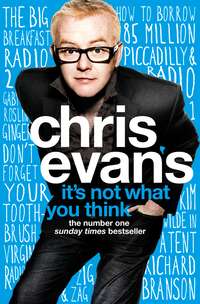
It's Not What You Think
Chris Evans

 Copyright
HarperCollinsPublishers Ltd. 1 London Bridge Street London SE1 9GF
www.harpercollins.co.uk
First published by HarperCollinsPublishers 2009
© Chris Evans 2009
Chris Evans asserts the moral right to be identified as the author of this work
A catalogue record of this book is available from the British Library
While every effort has been made to trace the owners of copyright material reproduced herein, the publishers would like to apologise for any omissions and will be pleased to incorporate missing acknowledgements in any future editions.
All rights reserved under International and Pan-American Copyright Conventions. By payment of the required fees, you have been granted the non-exclusive, non-transferable right to access and read the text of this ebook on-screen. No part of this text may be reproduced, transmitted, down-loaded, decompiled, reverse engineered, or stored in or introduced into any information storage and retrieval system, in any form or by any means, whether electronic or mechanical, now known or hereinafter invented, without the express written permission of HarperCollins ebooks
HarperCollinsPublishers has made every reasonable effort to ensure that any picture content and written content in this ebook has been included or removed in accordance with the contractual and technological constraints in operation at the time of publication
Source ISBN: 9780007327218
Ebook Edition © SEPTEMBER 2009 ISBN: 9780007327256
Version: 2017-05-04
To everyone that’s ever helped me, tolerated me, loved me, laughed with me, cried with me, created with me and forgiven me at any time, anywhere. Thank you.
Note to Reader
Dear Reader,
For the purposes of bespoke compartmentalisation during the course of this book, where Dickens went for episodes, Shakespeare went for stanzas and the Good Lord himself for chapter and verse, being a DJ I have gone for Top 10s.
If it was good enough for Moses and his Commandments, it should be good enough for my book.
CE
Table of Contents
Cover Page
Title Page
Copyright
Dedication
Note to Reader
Preface
Prologue
Part One Mum, Dad and a Girl Called Tina
Top 10 Basic Facts about Christopher Evans
Top 10 Things I Remember about My Dad
Top 10 Best Things about Mrs Evans Senior
Top 10 Double Acts
Top 10 Resounding Memories of Primary-school Life
Top 10 Tastes, C. Evans, 1966-86
Top 10 First Memories of Going to School
Top 10 Weird Things about Teachers from a Kid’s Point of View
Top 10 Deaths
Top 10 Favourite Jobs (Other than Showbiz)
Top 10 Bosses I’ve Worked For
Top 10 Treats
Top 10 Girls—Actually Women—I Thought about Before I Had My First Girlfriend
Top 10 Schoolboy Errors
Top 10 Things I’m Rubbish at
Top 10 Things that Freak Me Out
Top 10 Things I Remember from School Lessons
Part Two The Piccadilly Years
Top 10 Best DJs I Have Ever Heard
Top 10 First Commercial Radio Stations in the UK
Top 10 Most Significant Cars in My Life
Top 10 Items of Technology in the Evans Household, circa 1983
Top 10 Things to Consider When Attempting to Make a Move in Your Career
Top 10 Things a Boss Should Never Do
Top 10 Things to Do When the Cards Are Stacked Against You
Top 10 Business Names I Have Been Involved in
Top 10 Dance Floor Fillers for Mobile DJ C. Evans circa 1985
Top 10 Memories of the great Piccadilly Radio exponential learning curve
Top 10 Things that Will Happen to You and that You Will Have to Accept
Top 10 Genuine Names of 80s Nightclubs in the North West of England
Top 10 Stars Recognised by a Single Name
Top 10 Records I remember from My Piccadilly Radio Days
Top 10 Things Never to Joke about on the Air
Top 10 Christmas Presents
Part Three Fame, Shame and Automobiles
Top 10 Things No One Tells You about London
Top 10 Legends I Have Worked With
Top 10 Books that Have Inspired Me and at Times Kept Me Sane
Top 10 Jobs at a Radio Station—in My Very Biased Opinion
Top 10 Pivotal Moments in My Career
Top 10 Things that Make a Successful Radio Show (the type of shows I do, that is)
Top 10 Seminal Items of Technology that Had the World Aghast
Top 10 Pads
Top 10 Things to Take to a Meeting if You Think You are Going to get Shafted
Top 10 Memories of The Big Breakfast
Top 10 Female Pop Stars
Top 10 Things to Consider When You Split Up with Someone
Top 10 Songs Regularly Murdered at Karaoke
Top 10 TV Shows
Top 10 Expletives
Top 10 Great Questions to be Asked
Top 10 Reasons to Stay Friends with Your Ex
Top 10 Memories of Radio 1
Top 10 Bands on Radio 1 During Our Watch
Top 10 TFI Moments
Top 10 Things that are True about Showbiz
Top 10 Signs You Are Losing the Plot
Top 10 Things a Celeb Should Never Do
Top 10 Things I Think About—Other than My Wife and Family
Top 10 Offers I Have Declined
Top 10 Best Bits of Advice
Top 10 Most Useless States of Mind
Top 10 Things that Help Get a Deal Done
Top 10 Mantras
Top 10 Things People Put Off
Top 10 Reasons Why I Presume Capital Never Took Us Seriously
Top 10 Human Responses I Experienced Leading up to the Deal
Top 10 Houses I Have Found Myself In For One Reason Or Another
Keep Reading
Appendix it is what you think…notes from the cast
Acknowledgements
About the Author
About the Publisher
Preface
Top 10 Tabloid Newspaper Descriptions of Me
10 GENIUS
9 WHIZZ KID
8 MOGUL
7 MOTORMOUTH
6 UGLY
5 MEGLOMANIAC
4 DRUNKARD
3 TYRANT
2 LIAR
1 TOSSER
As you can see there have been countless occasions when I have done myself few favours in the public eye. After some deep thought and consideration on the road back to the real world, I can only conclude that this was because I reached the top of a mountain I never even expected to climb. Once there it’s obvious to me now that I didn’t have the first clue what to do next—so I jumped off.
‘Far more fun than merely walking back down and having a rest before setting off in search of the next one,’ I thought.
Wrong!
As a thirteen-year-old paperboy I never for a second imagined the tabloids I was then delivering would one day take me into their beloved bosom and splash me on their front covers with such regularity and for such varying reasons. Some good, some bad, some true, some fittingly published, but that’s all part of the deal. Anyone that complains about it—famous people that is—have to realise they can’t have their cake and eat it. The fatal mistake is to moan—if you don’t like the bright lights and everything that comes with them, get off the stage.
For years, as the song went, I did it my way; for years I thought I was bomb-proof; for years I was just plain lucky when I thought I was being a wise guy. Of course I got things wrong from time to time, but I put that down to being part of life’s rich tapestry—after all, few of us set out to get things wrong on purpose.
In the first half of my life—at least I hope it’s only been the first half of my life—I achieved everything I ever aspired to. I performed a job that I loved, I punched way above my weight when it came to dating the opposite sex, I worked with and met some of the most talented and exciting people on the planet, I bought cars and houses that were to die for and at one time I was co-owner of a company that was worth over a billion pounds. Yet here I am, sat back in front of the keyboard with a cup of tea, wondering just how on earth any of this happened.
Was there a plan? Not that I’m aware of, but then again I suppose there must have been—surely a story like this couldn’t occur by chance? Or maybe that’s what life is: just one big accident from start to finish and what comes round the corner to hit us depends on which road we’re on at the time.
Ultimately I look back and see a minefield of huge risks and high stakes in all aspects of my life, some of which went my way, some of which did not, but most of which I didn’t have to take in the first place, yet I still felt compelled to do so. Barring physical, mental and social disadvantages, I think this is the single most common theme that links people who might be more likely to exceed their so-called ‘expectations’ as opposed to those who don’t.
I am constantly intrigued by this existence of ours and why we are here at all in the first place and therefore, as a result, I am fascinated as to just how far we can take things before we are asked to leave. I also don’t want to leave; I love being alive and here and breathing and laughing and crying and loving and feeling, and so I have tried to grab every day by the scruff of the neck and wring it out for all it is worth. (Often to the detriment of my own well-being as well as to the exasperation of those around me.) But I’m sorry, I just can’t help it: that’s the way I am. Anyone who has a half- decent life and doesn’t wonder on a daily basis about the magnificence and irony of being a human being I simply cannot comprehend. Life is too fantastic to ignore.
Along this path of frustration and wonderment I have been lucky enough to achieve what many consider to be a reasonable level of success in my professional life (if not in my personal life)—or at least that’s what I thought. I have since come to realise that real success is about the long term. There is no better way to prove yourself than to get better at what you do every day you do it.
There is no question I have made at least as many bad decisions as good ones, probably many more, and there’s plenty of evidence to prove it—losing a bunch of money for a start—£67 million pounds at the last count (not that I had much to start with, so let’s not dwell on that). But I have also learnt that it only takes one good break to turn your life around and launch you into a stratosphere you never even dared dream of.
If I had to sum up the difference between the good times and the bad, the bottom line is that when I have put the effort in I have reaped the rewards, and when I have failed to do so my life has stalled—on several occasions going into a complete flat spin. It really is as simple as that.
As far as I can see, life is one big bank account and the best philosophy is just to keep on making deposits whenever you can; be they financial, emotional, occupational, or otherwise. This is the absolute number one way to reduce the risk of disappointment, unhappiness, poverty and loneliness. By rights, I’m not at all sure I should even still be here to tell my tale, but by the grace of God I am, so here goes.
Prologue
Top 10 Stories Still
to Come…
10 How much is that chat-show host in the window?
9 How not to buy a national newspaper
8 The management have walked out—what do I do now?
7 Let’s give away a million pounds—hey, I’ve got an even better idea: let’s give away two
6 Macca and the maddest TFI moment of all
5 The £30,000 carrier bag
4 Gazza, the tour bus and a ‘convenient’ substitution
3 Quick, wake up—you’re 300 and something in the Sunday Times rich list
2 The £24-million cappuccino
1 Billie, the Doctor and a golfer named Natasha
Part One Mum, Dad and a Girl Called Tina
Top 10 Basic Facts about Christopher Evans
10 Born 1 April 1966
9 In Warrington in the north-west of England
8 Mother Minnie (nurse)
7 Father Martin (wages clerk, former bookie)
6 Brother David (twelve years older—nursing professional)
5 Sister Diane (four years older—teaching professional)
4 Very bright
3 Reluctant student
2 Needed glasses but nobody knew for the first seven years of his life, which meant I couldn’t see a bloody thing at school (presuming this is what the world actually looked like)
1 Had fantastically red hair
Life for me growing up was no great shakes one way or the other. We were an average working-class family with an average working-class life. We weren’t poor but, looking back, we were much less well off than I had realised.
I was nought to start off with, but I quickly began to age and lived with my loving mum and dad, Minnie and Martin, and my elder brother and sister, David and Diane. Our house at the time was both a home and a business. We had a proper old-fashioned corner shop like the ones you see on the end of a terraced row of houses, just like in Coronation Street, some of which had those over-shiny red bricks that looked more like indoor tiles. This is my first memory of one-upmanship: we never had those bricks but what we did have was a thriving retail outlet. Our shop sold almost everything—at least that’s what my mum says—not like Harrods sell almost everything, like elephants and tigers and miniature Ferraris, but like a general store might sell almost everything, like chickens, shoelaces, cigarettes and liquorice.
I don’t remember the shop at all, to be honest, but I do remember the tin bath that we all shared on a Sunday night in the living room behind where the shop was. It was a heavy, old, silvery grey thing, rusty in parts, which was ceremonially plonked in front of the fire (for heat retention
purposes, I assume) before being filled by hand with scalding-hot water from the kettle boiled on the stove. This was then topped up with cold water via a big white jug, after which we took our turns bathing en famille.
I remember the outside toilet, the coal shed, Mr Simpson the greengrocer, and the rag and bone man—who I was a bit scared of—but if I’m honest that’s just about it, apart from how upset my mum was when the Council made a compulsory purchase, not only on our house and our shop, but on our whole street, not to mention hundreds of other houses around where we lived, to make way for something so instantly forgettable I’ve actually forgotten what it was.
As a result of this compulsory order we were forced to move to council housing and another part of town some three miles away, which for a working-class family was tantamount to emigrating to Australia. Although many years later my brother did emigrate to Australia and he assured me it was not the same at all.
For my part I wanted to break out of the council estate which we were forced to call home and where I was brought up mostly. From day one I felt compelled to escape those grey concrete clouds of depression.
The house we lived in was of no particular design, in fact it was of no particular anything. It was more nothing than something. In short, it was not the product of passion. Council estates don’t do passion, they just do numbers.
The estate I lived on didn’t even do bricks. Huge great slabs of pebble-dashed prison walls had been slotted together in rows of mediocrity as an excuse for housing. Housing for people with more pride in the tip of their little finger than the whole of the town planners’ hearts put together. People like my mum, who had survived the war as a young girl whilst simultaneously being robbed of her youth by having to work in a munitions factory. People like my dad and my uncle who had fought overseas to protect us from other kinds of Nazis.
How dare they ‘home’ these fine people in such an unnecessary hell?
It was waking up to this backdrop of pessimism and injustice every day that made my childhood blood boil. It was like the whole place had been designed to make you want to kill yourself. A curtain of gloom against a drama of doom. I hated the unfairness of it all.
Why did some people, for example, who lived not more than half a mile away, have a detached or semi-detached house that looked like someone may have actually cared about how it turned out? How come they had nice drives and nice cars and a pretty garden at the front and the back?
Not that I begrudged the owners of such places, or rather palaces as they appeared to me, on the contrary—good for them. I just thought things should be the same for my family.
The apathy of it all also drove me crazy. Why did people who lived on these estates all over Great Britain accept this as their lot? Why did mums and dads bother going to work each day to be able to pay the rent for these shitholes? The authorities should have been paying them to live there, with a bonus if they managed to make it all the way through to death.
So there you have it, that’s where my initial drive came from. It wasn’t that I was bullied at school or the early death of my dad, or any of the other predictable psychobabble reasons often wheeled out to explain success. It was purely and simply that I wanted a better life.
Top 10 Things I Remember about My Dad
10 The back of his neck creasing up on the top of his shirt collar
9 The fact that he never took me to a football match
8 His belly, which went all the way in if I pressed it with my finger
7 His vest-and-braces look
6 The smell of Brylcreem
5 His snooker-cue case
4 His handwriting (which was beautiful)
3 His smile
2 His voice
1 How much my mum loved him
Dad is, sadly, a faint and distant memory for me.
Although he was around for the first thirteen years of my life, I only have a few vivid recollections of him as a personality. I remember him mostly as being just a great dad. What else does a dad need to be?
He was, however, relatively old for a dad, especially in those days, and to be honest I wish he had been a bit younger. Having said that, I’m only a couple of years ahead of him now where my own son is concerned and if my wife and I are lucky enough to pop out another little sprog or sprogette any time soon, I will more likely than not be almost exactly the same age to our second child as my dad was to me.
But Dad was also older in his ways. He was a proud guy from a proud time who met my mum at a dance. Dancing was the speed-dating of its era, something we might want to learn from today.
Mum still says, ‘You can tell all you need to know about a man if you dance with him—proper dancing that is.’ And as the dance halls have disappeared while divorce rates have gone up, it looks like she may well have a point—she usually does.
Whatever Dad did on the dance floor that night, he obviously did it very much to my mum’s liking, as from that day onwards, right up until now, some thirty years after he passed away, my mum’s heart is still the sole property of one Mr Martin Joseph Evans.
My sister and I were once stupid enough to ask Mum if she had ever considered remarrying. She looked at us as if we had lost our minds—brilliant, beautiful and hilarious all at the same time.
Martin Joseph was a straight up and down suit-and-tie man for the majority of his waking hours. He was also a handsome bugger with a permanent tan which Mum insisted he received as a reward for serving with the RAF in Egypt during the war. I believed her—it was a cool story.
Dad worked hard every day except Sunday, leaving at the same time every morning and always arriving home at the same time every evening—a quarter past five, more than a minute or two after that and Mum would start getting worried whilst Dad’s tea would start getting cold.
He played snooker once a week, where he apparently enjoyed a pint and a half of bitter, but other than that, unless he had a secret life none of us knew about, that was him.
Except, of course, for the gee-gees.
Ah, now, there you have him. Dad loved the horses.
There’s a famous phrase that goes something like: when you want to know who wins on the horses you need to bear something in mind: the bookmakers have several paying-in windows but only one paying-out window. That should tell you all you need to know about where most of the money goes.
Not that this should have concerned Dad as he was indeed a bookie; he was the enemy and his betting story is the strangest I’ve ever heard. My dad’s entire bookmaking career both started and finished before I was born.
He set up his ‘bookies’ shop in the fifties with a pal of his, and by all accounts, particularly their own, they did pretty swift business—as most bookmakers do.
Warrington was a typical working-class town in those days, and many an honest man’s one and only indulgence was a flutter on the nags once or twice a week. Dad and his partner were happy to facilitate such flights of fancy—until, that is, one day when the frost came down.
This was no normal frost, however, but an almighty frost—a frost that would last not for days or weeks but for months. Four months, to be precise. All racing came to a halt and consequently all wagering. It was the steeplechase season, the favoured genre of the northern man, but the race courses fell silent, the jumps remained unchallenged, the stands stood empty.
Every morning, day in day out, bookies and punters alike, would wake up and draw back the curtains, hoping and praying for a break in the weather, but for weeks on end to no avail.
Eventually, when the break did come, the respective members of both parties could not wait to get back to the business of backing. With news of a change in the weather rumoured the night before, there was a palpable excitement in the air. The horses would soon be free to commence battle once again—as would the punters and the bookies.
Dad, eager to return to business, was up and out the next morning way before dawn; his shop would be the first in town to open that day. The early bird catches the worm, as they say, but little did Dad know this worm had ideas of his own.
There was a man, you see, a man who liked to bet, an honest man, a working-class man, the type of man of whom I have already made mention. This particular man used to walk the three miles or so to work every day. He worked in a factory making soap powder. It wasn’t the greatest job in the world, but since the war it was all he’d ever known; it was a wage and for him that was enough.
He would pass Dad’s betting shop every morning on his way to work, but it would never be open as it was too early and although he bet with Dad at the weekends, during the week he always placed his bets at the next betting shop on his journey, just before his work.
However, this morning, Dad’s shop, as I said, was the first to open in town that day.
The man, not unlike the horses, was chomping at the bit to get back into the action, so when he saw Dad’s shop with the blinds up and the open sign hung on the door, he had no hesitation in entering.
‘Morning, Martin.’
‘Morning, Fred.’
‘Am I the first?’
‘You are indeed and a pleasure to do some midweek business with you at last.’
‘Well, what an honour. Let’s have a look then, shall we?’
‘Please go ahead.’
And with that, good old Fred started to study the form from racing pages Dad had pinned to the walls of his establishment half an hour previously.
Fred mused for a while, casting his eye over the various ‘opportunities’, before finally plumping for a choice. He placed his usual style of bet. It was a forecast—that’s the way Fred always betted, and lots of people used to bet that way. The chances of winning were next to nothing but it was a lot of excitement for very little risk, not dissimilar from how the lottery is today. However, if a forecast did come in, there would be no need for any more shifts at the soap factory, that’s for sure.
And that is exactly what happened. The frost had thawed, the horses had been saddled, Britain was racing again and Fred went and picked a string of winners.
The bet wiped Dad out. He was the only bookie I have ever heard of that was taken to the cleaners by a punter.
The win was so huge, he couldn’t afford to pay Fred straight off, but he was a man of his word and vowed to return him every penny that was owed. Unlike his partner, who would have nothing to do with the whole affair. He reasoned that Dad should never have taken on such a bet without first laying it off, something he himself would have insisted upon doing.
Why hadn’t Dad done this? In truth, who knows?
Maybe it was because he didn’t have the time to do so with business being so brisk and all—on the first day back after the longest forced break in jump racing since the war. Maybe he was too excited and had simply forgotten. But maybe it was also because he took a chance.
Maybe he took a chance that the odds were massively stacked in his favour and massively stacked against Fred, and as a man who knew his maths well and his racing odds even better, he thought it was a risk worth taking—a safe bet, if you like. But as we all know, there is no such thing.
From that day onwards Dad’s wealth would never be financial, but that doesn’t mean to say he would never be rich. He had a woman he adored and who adored him back and he was the head of a loving family. ‘It’s not what you’ve got in your life, it’s who you’ve got in your life,’ he used to say. Now there’s a wise man. A very wise man indeed.
Top 10 Best Things about Mrs Evans Senior
10 Her name, Minnie. She was named after a horse but it suits her perfectly
9 Her obsession with death and anything or anyone dying
8 Her art for telling stories for hours on end and hardly ever repeating herself
7 Her magic hotpot from the war recipe, hardly any meat but oh so meaty*!
6 Her directness—second only to her vivid imagination
5 Her vivid imagination
4 Her rapier wit
3 Her wicked laugh
2 Her selflessness
1 Her love for my dad
My mum is a formidable piece of work, simple as.
When she had her cataracts done on her eyes, for example, she was well into her sixties and she requested only a local anaesthetic—this was so she could stay awake during the operation and see what was going on. Not an easy thing generally, but especially as this particular operation involves the popping out of the eyeball and the resting of it on one’s cheek, while the back is then duly sawn off ready for a new, artificially improved lens to be attached.
Upon hearing a patient had requested such a thing and for such reasons, the consultant surgeon was at first a little shocked before becoming aware of the prospect of a rare opportunity. He wondered if he could also make the most of the situation with a request of his own. He asked my mum if it would be alright for him to invite some students in to watch the procedure and, if she could bring herself to bear it, would it be permissible for them to ask her questions as it took place? Mum was over the moon, she couldn’t get enough—apparently she had the students in stitches the whole time she was being operated on.
Before we were born Mum was many things, but for most of my childhood, she was a state-registered nurse.
Mum was one of the original night nurses. She started off working in psychiatric care at a place called Winwick Hospital, notorious in the area for being the local nuthouse. Looming large off the A49, it was set back in glorious green parkland and looked exactly like a Victorian prison, though it never had been. This was a proper insane asylum, designed and built solely for that purpose. At one time my dad, my brother and my mum all worked there. As a consequence of this I had been through the infamous heavy black iron gates many times. I even had the pleasure of wheeling the odd harmless ‘patient’ down some of its eight miles of corridors.
After several years of diligent service with the loonies (she said it was exactly like One Flew Over the Cuckoo’s Nest, still her favourite film) Mum went on to work at Warrington General Hospital. She always worked nights so she could be with us, her children and her husband, to whom she always referred as Dad, in the day. Her hours were shiftwork, always 10—6, usually, three nights on, four nights off, alternating with four nights on, three nights off.
Now of course this was all well and good, but it doesn’t take a genius to figure out this meant she would be getting very little sleep. Here’s one of Mum’s work days:
Finish at 6 a.m., picked up by Dad, home soon after, where she would grab a quick half-hour’s shut-eye ‘in the chair’. She would then make Dad his breckie, get my sister and I up and ready for school, feed us and then see us out of the house just before nine. Next she would start on the housework and go to bed just before lunchtime where she would languish until three o’clock before having to get up to prepare for the family’s return. After making our tea and washing up, she would have another quick half-hour’s shut-eye ‘in the chair’ before getting herself washed and dressed for work and ready for Dad to run her back to the hospital for her next night shift. By my reckoning that’s no more than three hours’ sleep a day!
During all the years she did this, I never heard her complain once. In fact she only ever laughed about the crazy episodes her and her colleagues came across while the rest of us were in the land of nod. Like the Christmas Eve that Mr Jolly died whilst on the loo: she thought this was hilarious and seeing as it was she and her pals who had to get his trousers back up around his bottom and hump him back to his bed, they felt a little laughter was the least they were allowed.
After Dad passed away Mum was forced to take on the one remaining role she’d been spared thus far.
Never the greatest at maths; my mum now had to handle the family accounts.
I remember distinctly her sitting us down and telling us the score. She told us she’d sold Dad’s car for eighty pounds and that was it.
‘That was what?’ we wondered.
‘That was it,’ she repeated, ‘that’s what we, as a family, are now worth.’
Our house was rented from the council and we didn’t own anything else. Mum had resisting selling Dad’s car before he died as a mark of respect and so the neighbours wouldn’t talk, but now he was gone, so was the Vauxhall.
‘OK, fine,’ we thought nonchalantly. We didn’t really understand what a big deal it was to have so little money and as far as we were concerned things had always been alright anyway. Until Dad became bedridden we’d always had days out and a week away in the summer and nice Christmas presents and sweets at the weekend.
My mum went back to work immediately, although probably as a magician rather than a nurse, as a few years later we had a family bank account with some proper ‘rainy day’ money in it, added to which somehow she’d managed to buy our house! Alright, it was only a couple of thousand pounds, but nevertheless.
Maybe there was something Dad hadn’t been telling us. Mum was a fox with the finances.
*I asked my mum for this recipe on countless occasions for the book. She kept fobbing me off for weeks until I informed her the deadline was imminent and it was now or never, at which point she merely replied: ‘Time and patience!’
Top 10 Double Acts
10 Little and Large (I don’t care, I loved them)
9 Abbott and Costello (Saturday mornings, there was little else on television)
8 Bodie and Doyle (the kings of cool)
7 Pixie and Dixie (left-field, and nowhere near as predictable as Tom & Jerry)
6 Ernie and Bert (I wanted to be Ernie but fear I will end up becoming Bert)
5 Morecambe and Wise (of course)
4 Zig and Zag (…more later)
3 Lennon and McCartney (they wrote the only songs I really know)
2 Tom and Max (my cousins, both international rugby players and top boys all round)
1 Mum and Dad (a loving but lethal combination)
Dad never once hit me—he didn’t have to, I was scared enough of him as it was, not all the time, just when he wanted me to be. Is that what good parenting is all about? Scaring your kids half to death at precisely the right point for precisely the right amount of time—selective scaremongering at will, if you like? Is this how parents get their kids to behave? With the threat, tacit or otherwise, of physical violence? It definitely worked in our house.
In Dad’s case the simple raising of his voice or the odd glare in my direction was enough to instil the fear of God into me—I don’t know what I feared, I just did. I wasn’t scared of my mum at all but I didn’t have to be, she had figured out the genius and infallible Mum and Dad combo threat. How about this…
Mum (If I had done something wrong sometime in the afternoon):
‘You mark my words (another one of those phrases I’ve never really understood) your father is going to want to hear about this when he gets home.’
My goodness me, those words still send shivers down my spine even today. The Mum and Dad dreaded combo—just the threat of the man who never hit me was enough to make me conform.
I remember waiting and listening when Dad arrived home after such an episode to see if Mum would carry out her threat and tell him. More often than not it looked like she hadn’t, as the evening would continue as normal, first around the dinner table and then another relatively uneventful family night around the telly. With each passing minute I would become slightly more relaxed about the fact that I was probably in the clear. The thing was, though, I never knew for sure, not even the next day, whether I was definitely off the hook or not. This was the master stroke.
Had Mum told Dad? Had Mum told Dad and Dad had decided to let it go? Had Mum told Dad so he knew what had happened and then Dad told Mum that he would pretend he didn’t know what had happened; making her look more compassionate in the process?
Whatever the scenario, it worked like a dream. I remember Mum would often sit there for the rest of the night and every time I glanced her way she would give me one of those motherly knowing looks, the count-yourselflucky look. She would then also go on to benefit from several days of me loving her even more for not grassing me up to the big guy.
Our dinner, or tea as we referred to it, was often prefixed with the phrase, ‘Your tea’s on the table!’
And it would be, literally. We would join the dinner table at the last possible minute where we would remain for not a second longer than it took to wolf our food down. We were not a family who sat and chatted, at least not over tea, not much over anything to be honest. My poor mum would make a proper full-on meal every night and we would all reward her by sitting down for no more than seven or eight minutes before leaving her as quickly as we’d arrived with the ingratitude of a huge heap of dirty plates and pans to wash up. No wonder she’s never been that impressed when I cook her a meal!
I don’t know when Mum and Dad did their chatting—if they ever chatted at all. I’m guessing they did, but maybe not—my sister and I were pretty much around all day, every day, and I can never remember them having any private time whatsoever to speak of. I never heard them argue, that’s for sure—not the once. Maybe there wasn’t that much to discuss or argue about. We were a simple family unit with simple family needs. Maybe they really were the happiest couple in the world or maybe Dad did have a secret life and thought the less he said about anything the better.
When it came to ‘S-E-X’, for example, the mere suggestion of any of our family talking to each other about such a subject would have caused us all to flee the house screaming. Most families that I knew were the same.
All of my friends and I, without exception, had absolutely no formal training in the science or art of anything to do with what goes on between a boy and a girl down below from any of our parents. Now, I really loved Mum and Dad, but come on guys, you have to tell your kids about the thrills, the spills and ultimately the pills that surround the desires of the flesh.
I didn’t get the information from my parents, I didn’t get it from my elder sister or brother and I didn’t get even get it from school—well, not really. I had to fumble around and figure the whole tawdry affair out for myself. I’m not saying it wasn’t fun or exciting, but a guiding hand would not have gone amiss. If you’ll forgive the expression.
Top 10 Resounding Memories of Primary-school Life
10 Mr Warburton, the school caretaker, who looked like he’d been cast from Grange Hill. He was perfect: brown overall, flat cap, pipe, black plastic specs, the works
9 Mr Antrobus, our headmaster saying, ‘If you can’t say anything good about a person don’t say anything at all’
8 Going swimming once a week on a big red Routemaster bus, never having enough time to get dried properly afterwards and wondering how come the other kids didn’t seem to have this problem—did they have special quick drying skin?
7 The hot chocolate from the vending machine after swimming
6 The first day I told my dad it would probably be a good idea if he stopped kissing me goodbye outside the school gates when he dropped me off
5 Making plasticine puppets that took me ages to produce and then performing a play with them on a stage constructed out of a crisp box (they’d fall to pieces before the end of the first page of dialogue)
4 The kid who thought it was hilarious to defecate anywhere but in the toilet cubicles—his tour de force was to do it in the pool when we were swimming
3 Competitions to see who could keep their hand on the hot radiators longest
2 Amanda, my first kiss
1 My packed lunch
School is in many ways the beginning of those shark-infested waters we call real life—when people, young innocent children in this instance, are hauled out of the utopia that is the family unit, hopefully full of love and warmth and protection, to be thrust instead into a whole other world where they are instantly told what they are and are not good at, who’s better than them and why they need to change immediately.
What a particularly stupid idea. Within days, the humiliation begins. There are sports team selections that you do or don’t make, the latter always being the case where I was concerned. Immediately you’re made to
feel like a loser and maybe, like me, then start to consider the rounders team as an option as long as it means you might get picked.
Then there’s the endless giving out of gold and silver stars and house points and merits and the ticks and the crosses and all manner of other things that start suddenly coming at you. All designed to let you know whether you are currently a chump or a champ—so many things that can cause a kid to become paralysed as the first pangs of the fear of failure begin to set in. How many self-help books have been written on the selfsame subject? Yet it’s something that’s bred into us almost from the word go. And how about the poor kids who never get a mention?
How often do we hear of a professional sportsman who suffers career-threatening dips in confidence because of a run of poor results? Think about the poor little kiddies peeing their pants waiting for the humiliation of another set of spelling test results.
Then there’s the social aspect of the pecking order, evident nowhere more than at lunchtime.
There’s the kids that go home for lunch—does this mean their parents love them more than yours love you?
The kids that bring packed lunches—does this mean their folks can’t afford school dinners?
The kids who receive free school dinners—surely this should be kept a secret?!
The kids who go back for seconds—is this the only meal of the day they’re getting?
The kids whose mum is a dinner lady and get extra chips as a result. (Not that we ever had chips at our school, not once—we had scooped mash that tasted strange, nothing resembling any other mash I’ve tasted before or since!)
For the record I was a packed-lunch child, not for any other reason than that I didn’t like school dinners. My packed lunch was without doubt the pinnacle of my school day, it truly was manna from heaven and the thought of it was one of the few things that kept me going through the interminable hours that made up my morning lessons. Cold toast was included for break, an item of fruit, a choccie bar, usually a Breakaway but sometimes a Kit-Kat, a Blue Riband or a Penguin, a flask of soup* and the unquestionable stars of the show: two pasties for lunch that Mum had cooked from frozen in the morning and then opened up so she could fill them with ketchup before resealing them again. Absolutely mouthwatering.
*My flask was always under great threat as we used our bags for goalposts when playing footy at break or lunchtime—during which, if the ball happened to hit the post (i.e. pile of bags) hard enough, this would be heralded with the sound of several flasks simultaneously smashing from within. The only thing left to do with a flask after such a catastrophe was use it as a maraca for the rest of the day before getting shouted at when you arrived home.
Top 10 Tastes, C. Evans, 1966-86
10 Chips and Tyne-brand tinned stewed steak with heaps of mint sauce and tinned peas
9 Bovril crisps dipped in tea or tomato soup
8 Ham on over-buttered floured baps from Greggs the bakers
7 Tinned toms and bacon with as many rounds of white bread and butter as it will stretch to—minimum five
6 Soggy tinned salmon sandwiches on white bread with white pepper and too much vinegar, hence the ‘soggy’
5 Meat and potato pie sandwiches with ketchup—making my mouth water now as I think about them
4 Beans on toast, plain and simple, no poncey Worcestershire sauce or anything lke that
3 Fish, chips and gravy—gravy on chips (it’s a Northern thing)
2 Dad’s gravy dip chip butties—sublime
1 Mum’s hotpot from the war, again, with added miracle margarine pastry*—there is no better thing to put in your mouth on planet Earth
When you’re a kid, there are hierarchies and lowerarchies (a word that doesn’t exist but common sense says it should) springing up everywhere you look. Who’s hanging out with whom in the sandpit? Who’s always at the top of the climbing frame? Who’s on their own in the corner of the playground?
The argument that all this is a good idea, I suppose, is that these are the situations that will help prepare children for similar environments they may encounter when they are re-released into the free world. Well, how about the fact that the future adult environments may only exist because of the creation of former childhood ones? Sure, it may have always been thus in the past, in caveman times, but shouldn’t we be doing something to change that now instead of perpetuating them—at least honour the worst kids with something if only to stop the tears. Awards for one, awards for all, that’s what I say. We’re all good at something; it’s up to the schools to prise out of us what that may be.
My infant/junior school was St Margaret’s—absolutely run of the mill. Old Victorian classrooms complete with ornate, rain-echoing verandas somehow linked clumsily to a new unimaginative square concrete building that looked like it had fallen out of the sky and landed there by mistake.
From the off we had the good teachers and the bad teachers as most schools do, those that could and those that could not when it came to communicating. There was Mrs Clark, the old Ena Sharples battleaxe type who would scare the living daylights out of us—although I can’t remember exactly how. There was the glamorous Mrs Johnson who looked like she should have been on one of those ever so slightly risqué Top of The Pops album covers and there was Mrs Smith who always reminded me of Virginia Wade for some reason. But my favourite was a supply teacher we had called Mr Hillditch. He was born to teach and took us to the Robinson’s bread factory one afternoon where he used to work. When his two weeks of deputising came to an end I remember being genuinely sad that he was leaving. I even wrote him a song and stood up in class to sing it to him.
Mr Hilditch we think that thee Is no good at being referee.
The only thing you’re good at is baking bread Also we’d like to thank you For giving us such a lot to do Mr Hillditch we love you And good bye.
(I was also pretty pleased with the tune I came up with for this ditty—on the audio book I will give it plenty, don’t you worry.)
During breaks it was conkers, the climbing frame, a game of footy, or British bulldog, or you could, if you wanted, while away the hours clinging to the school fence, pretending to be a prisoner, dreaming of freedom and rueing the crime that put you inside. I did this quite a lot.
Prizegiving was one of the few highlights, as was sports day, mostly because it meant no lessons. Rarely did I feature in either of these annual events—from the first year it was obvious which three or four kids would rule the roost in both categories and after that the rest of us were demoted to mere bit-part players in the predictable soap opera of typical primary school education.
*This is a magic pastry that takes 15 minutes from bagged to baked, all brown and crusty. None of this resting it in the fridge for four hours wrapped in cellophane nonsense. Again, any attempt by me to get the recipe for this fell on conveniently deaf ears.
Pulsuz fraqment bitdi.