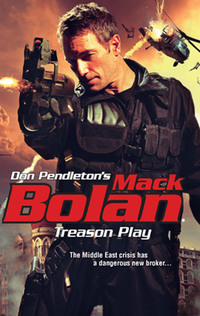
Kitabı oxu: «Treason Play»
Bolan yanked Khan from the car.
Once he had dragged the man a safe distance from the vehicle, he stretched him along the ground. The soldier pulled a small flashlight from a pocket, clicked it on and ran it over Khan’s blood-soaked form. Three bullet holes had pierced the man’s chest.
Khan’s eyes fluttered open. Bolan noticed that the former ISI agent’s gaze looked unfocused. His breath came in shallow puffs. After a second, Bolan’s presence registered with him, and he turned his head slightly to look at the big American.
“Cooper,” Khan told him. “It’s not over.”
“It is for you,” Bolan growled.
“Not for you. Not even close.”
A shudder passed through Khan, and he was gone.
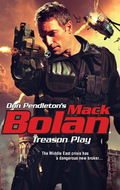
Treason Play
Mack Bolan ®
Don Pendleton’s
 www.mirabooks.co.uk
I know that there are angry spirits
And turbulent mutterers of stifled treason,
Who lurk in narrow places, and walk out
Muffled to whisper curses to the night;
Disbanded soldiers, discontented ruffians…
—Lord Byron, 1788–1824
Conspirators lurk in the shadows, biding their time, hiding their faces. I’ll drag the criminals into the light of day and unmask them for all to see.
—Mack Bolan
Contents
PROLOGUE
CHAPTER ONE
CHAPTER TWO
CHAPTER THREE
CHAPTER FOUR
CHAPTER FIVE
CHAPTER SIX
CHAPTER SEVEN
CHAPTER EIGHT
CHAPTER NINE
CHAPTER TEN
CHAPTER ELEVEN
CHAPTER TWELVE
CHAPTER THIRTEEN
CHAPTER FOURTEEN
CHAPTER FIFTEEN
CHAPTER SIXTEEN
CHAPTER SEVENTEEN
CHAPTER EIGHTEEN
CHAPTER NINETEEN
CHAPTER TWENTY
CHAPTER TWENTY-ONE
CHAPTER TWENTY-TWO
CHAPTER TWENTY-THREE
CHAPTER TWENTY-FOUR
CHAPTER TWENTY-FIVE
CHAPTER TWENTY-SIX
CHAPTER TWENTY-SEVEN
CHAPTER TWENTY-EIGHT
CHAPTER TWENTY-NINE
CHAPTER THIRTY
CHAPTER THIRTY-ONE
CHAPTER THIRTY-TWO
CHAPTER THIRTY-THREE
CHAPTER THIRTY-FOUR
CHAPTER THIRTY-FIVE
CHAPTER THIRTY-SIX
PROLOGUE
Dubai, United Arab Emirates
Terry Lang pretended not to notice the man following him.
In fact, it was the third man he’d pretended not to see in the past couple of hours. Whoever had taken it upon themselves to track his every move at least had shown enough sense to switch out the agents following him, a small attempt to hide that they were tailing him. But their skill had ended there. The first and the third had fallen all over themselves to not make eye contact with Lang, averting their gazes as if burned whenever he looked directly at them.
Lang stopped and bought a bottle of root beer from a street vendor. Unscrewing the cap, he brought the glass bottle to his lips, drained some of it and resumed walking. After two more blocks he spotted what he’d been looking for, an alley. Slipping inside, he advanced several yards. Along the way, he tipped the root beer bottle and drained its contents onto the cracked asphalt. It made a fizzing noise and welled up in a whitish foam. The odor of garbage cooking under Dubai’s midday heat registered with him and his nostrils wrinkled reflexively at the stench.
He found a recessed doorway and pressed himself inside its shade.
He switched the empty bottle to his other hand, his ears strained as he waited. Surely his tail hadn’t fallen back? He doubted it. They hadn’t followed him halfway across the city just to fall back when he disappeared into an alley. They didn’t strike him as particularly skilled, but they seemed committed.
Sweat beaded underneath his hairline, then rolled down his temples, cheeks and jawline. His pulse quickened. Moments later he heard the soft shuffling of shoe soles brushing against the pavement. The muscles of his legs, arms and torso bunched up as he prepared to pounce. A dark shadow stretched along the ground past his hiding place.
The sound of movement halted.
A small grunt telegraphed the guy’s next movement. By the time his pursuer rounded the doorway, a small, black automatic pistol clutched in his hand, Lang was prepared. He brought the bottle down in a wide arc. The fat end of the bottle exploded into a constellation of glass shards that glinted in the sunlight. Lang’s downward swing continued, the edges of the broken bottle raking flesh, opening crimson ravines in his face.
The man yelped in pain and surprise. He whipped his head away and covered the wound with his hand. Blood immediately seeped between his fingers. In the same instant he started to raise his shooting hand so he could get a bead on his mark.
Lang’s hand snaked out and he caught the guy’s wrist in his grip, squeezing hard. His other hand, the one clutching the neck of the bottle, came around in a horizontal arc. Lang buried the jagged end into his attacker’s eye socket.
The man screamed and wheeled away. His grip on his pistol loosened and the weapon fell to the ground. Lang gave the injured man a hard shove in the chest that sent him reeling.
Grinning, Lang tossed aside the remnants of the bottle. He scooped up the man’s discarded pistol and grabbed a handful of the man’s blood-soaked shirt and yanked him to his feet.
Shoving the guy into a wall, he pressed the gun’s muzzle into the man’s throat.
“Who sent you?” Lang asked, his voice barely a whisper.
The man, his face and neck streaked with blood, spit in Lang’s face. With the back of his fist, Lang wiped the glob of blood and saliva from his forehead.
“You stupid son of a bitch,” he said. “Who sent you? What do you want with me?”
The man’s lips curved outward as though he was ready to spit again. This time Lang drove a knee into the guy’s groin, eliciting a sharp draw of air, followed by a gut-churning moan.
“I can do this all day,” Lang said.
And to prove his point, he kneed the guy a second time. Groaning again, the man sagged and Lang let him crumple to the ground.
The squeal of tires on asphalt caused Lang to spin. A big midnight-blue sedan jerked to a stop at the mouth of the alley. Front and back doors snapped open and four men spilled from the vehicle’s interior, guns drawn, sites trained on him.
“Drop it!” someone yelled in English.
He guessed he could take out one, maybe two, before they killed him. More likely one. And then he’d end up on a slab. He still had no idea what this was all about and it was possible that, since he hadn’t killed anyone, he could talk his way out of this. He knelt and set the pistol on the asphalt. Raising his hands, he came back up to his full height.
A rail-thin man in navy-blue slacks and a white dress shirt broke from the group of shooters and approached Lang. Keeping his gun trained on the American, the small man scooped up the fallen pistol and shoved it into the waistband of his pants. He barked in Arabic—a language in which Lang was fluent—for someone to call an ambulance.
The guy gave Lang a murderous look. In return, he flipped the guy the middle finger.
“No ambulance,” a voice called in Arabic. “This one’s not worth the trouble.”
Lang turned and looked at the new speaker. A flash of recognition immediately morphed into dread.
A Caucasian man with sandy-brown hair, a wide face and flushed cheeks rounded the front of the sedan blocking the alley. He wore a blue polo shirt, tan slacks and brown loafers. If he carried a weapon, it wasn’t visible.
“Hello, Terry,” Daniel Masters said, his British accent obvious.
Lang nodded, but said nothing.
“You’ve caused us some problems,” Masters said.
“Sorry, Daniel,” Lang said. “I didn’t know you were in Dubai. Perhaps we can talk about this.”
If the Englishman was surprised Lang knew his name, he showed no outward signs. Instead, Masters nodded at the man on the ground. By now, the man was tucked into a fetal position, groaning, one hand clasped over his injured eye.
“Think I’ll pass,” Masters said. “I see how you talk.”
Lang shrugged. “Sorry about your man. I didn’t want to do it, but he pulled a gun on me.”
Masters made a dismissive gesture. “To hell with this idiot. You could kill fifty like him for all I care. Maim them, whatever. Best man won, as far as I can tell.”
“Very understanding.”
“You’re tough. For a reporter.”
“Special Forces. Army. Long time ago, but I still have a few tricks I can use. You probably already knew that, though.”
“I did. But I think it goes deeper than that.”
“I’m sure I don’t know what you mean.”
“I think you do.”
Lang knew where the conversation was going and he didn’t like it. Fear fluttered in his stomach and sweat slicked his palms. His hands closed into fists. Masters was close, but not close enough to take a swing at without taking a couple of steps forward, telegraphing the attack. Because it didn’t fit his cover, Lang didn’t carry a gun, though he thought longingly of the one hidden back in his apartment.
One of the men was moving in a wide circle around Lang, moving behind him. A third had broken away and was approaching from the side. All kept their distance, forcing him to lunge in any one direction if he wanted to strike first. That gave them ample time to put a bullet in his head before he could complete any attack.
Masters apparently sensed the calculations racing through Lang’s head.
“You can’t make it,” he said. “Even if you took one of us, the others would put you down in a heartbeat.”
Lang flashed what he hoped was his best disarming grin. He spread his hands wide. No threat here, his body language said.
“Hey, if this is about something I did, something I wrote, we can talk about it.”
A humorless laugh escaped Masters’s lips. “What you write in your shitty little newspaper isn’t the issue. It’s what you’re reporting elsewhere that’s giving us heartburn.”
“I don’t—”
“Khan tried to shut you down, tried to stop your snooping. It didn’t work. He tried to do it the easy way. Evidently, you’re too damn thick to get the message. So here we are.”
Lang put some steel in his voice. “Khan doesn’t tell me where to go, who to talk to. If he doesn’t like it, he can go to hell.”
“And aren’t you the crusader?” Masters said. “Playing the part to the very end. There’s a good lad.”
He nodded and the men who’d surrounded Lang closed in. Lang figured the charade was over. Lang hoped that because Masters had spent so much time jawboning and getting his men into position, that Masters wanted him alive. If that and Lang’s lack of a discernible weapon caused the men to hesitate even slightly, he’d exploit it as best he could.
If not, well, he probably wasn’t going to come out of this alive anyway. Given the choice of dying now or dying in captivity, he’d just as soon get it over with. The end result was the same.
The gunman closest to him brought his shooting hand up to shoulder level and locked his pistol on Lang. The CIA agent stepped sideways and brought the gleaming blade down in an arc, burying it in the soft tissue of the man’s neck. Yanking the blade, he brought it forward until steel burst through flesh in a spray of crimson. The man’s gun thundered, discharging a round within inches of Lang’s face. The close-range blast caused his ears to ring and disoriented him.
At the same instant something blunt, hard, punched the back of his skull. The impact caused a flash of white light to explode from behind his eyes. His legs turned rubbery and he crashed first to his knees, then to all fours.
Gasping, vision blurred, he only was vaguely aware of a shape that loomed overhead. When the second blow to the head was struck, his limbs went loose and he crashed to the ground. A black veil of unconsciousness settled over him.
CHAPTER ONE
Mack Bolan, aka the Executioner, was the last to arrive at the War Room. When he entered, he found Hal Brognola, his sleeves rolled up to the middle of his forearms, a tattered cigar clenched between his teeth, already seated at the table. Barbara Price, Stony Man Farm’s honey-blonde mission controller, was also seated at the table. She was setting a coffee carafe on the table, and judging from the steam wafting from her mug had just filled it with coffee. Her full lips turned up in a warm smile, which Bolan returned.
Brognola, who’d been staring into the contents of his coffee mug, his brow furrowed, looked up at Bolan and gave him a tight smile. Aaron “the Bear” Kurtzman, head of Stony Man Farm’s cyberteam, shot the big Fed a look. When he spoke, he laced his voice with mock indignation.
“What the hell, Hal?” he said. “You’re looking at the coffee like you expect the Loch Ness monster to pop out of there.”
“I don’t think Nessie could survive in this swill,” Brognola retorted.
“Where is the love?” Kurtzman replied.
Bolan found his seat and, against his better judgment, poured himself of a cup of Kurtzman’s coffee. Once the soldier got settled in, Brognola turned to him, his face grim.
“We’ve got a lot to discuss, Striker,” the big Fed said.
“I expected as much.” Bolan leaned forward and rested his forearms on the table. His old friend slid a folder across the tabletop and it came to rest inches away from Bolan. The soldier opened the folder and leafed through the contents, which included several top-secret intelligence reports, several printouts of news stories from newspaper websites and half a dozen or so pictures. Bolan picked up the pictures and scanned through them one at a time. The image of a Caucasian man with ruddy cheeks, blond hair and pale blue eyes stared back at him.
“His name’s Terry Lang,” Brognola said.
“The journalist?”
“Among other things. There’s more to this guy than meets the eye. Lots more.”
“Meaning?”
Brognola turned his gaze in Price’s direction. “You want to field this one?”
Price set down her coffee mug. She tucked a lock of hair behind her ear and scanned several papers arrayed in front of her before looking up and meeting Bolan’s gaze. “What Hal means is that Mr. Lang has one hell of a freelance gig going on the side.”
Bolan scowled. “You two aren’t making a lot of sense.”
“You’re right,” Price said. “We really aren’t. Sorry.”
“I know Lang is a reporter for the London Messenger. He writes mostly about energy and foreign policy. Occasionally he writes about nukes and nonproliferation issues, too. Works out of the Middle East a lot, I guess because of the energy coverage.”
Price seemed impressed. “When do you have time to read anything other than top-secret dossiers?”
“His articles have been in more than one of my mission packets,” Bolan said. “Occasionally he publishes a clunker or two. But most of his stuff seems to track with what I’ve seen. I always guessed he either had impeccable sources or he was a spook.”
“Give the man a cigar,” Brognola said.
“So he really is a spook?”
Price nodded.
“He works for the Central Intelligence Agency. He operates in a nonofficial cover capacity, and he tracks nuclear proliferation and smuggling for them. Or he did.”
“Did?” Bolan said. “I don’t like where this is going.”
“It gets even worse,” Brognola interjected. “Lang relocated to Dubai several months ago. It gave him a better perch to watch for any illicit shipping of nuclear technology or radioactive materials. Despite all the glitz, the country has become a hotbed for arms and drug smugglers and their fellow travelers. That’s included nuclear smuggling, too.”
Bolan nodded.
“Lang has lots of sources,” Brognola continued. “Some damn fine ones. White hats and black hats. And he could consort with them easily because of his cover. With all that information coming in, he had a lot of irons in the fire, a lot of cases working. The guy dug up loads of good information.”
Bolan arched an eyebrow. “And the problem is?”
“He went missing about forty-eight hours ago,” Brognola said. “Bam, just disappeared. That’s not necessarily a big deal, considering the nature of his cover. But he was supposed to check in with his handlers in Langley and never did. According to the CIA, Lang never, and I mean ever, misses a check-in call. He always made his contacts, except this time.”
“And now everyone’s worried.”
“Yes.”
“He clean?”
Brognola nodded. “Best we can tell. The counterintelligence people are poring over their files. They want to make sure they haven’t missed anything. According to what the President has told me, though, the Agency has yet to come up with anything bad on the guy.”
Bolan considered what he was being told. “You need what from me?”
“Go to Dubai,” Brognola said. “Find out whatever you can. Frankly, there doesn’t look to be any good outcomes here. If the guy has disappeared of his own accord, it’s probably because he’s gone rogue. If he’s vanished because he’s been kidnapped, that could be even worse. Regardless, we need to know what happened to him. You game?”
“How soon can Jack fire up a plane and fly me to Dubai?”
CHAPTER TWO
Dubai, United Arab Emirates
The C-37 jet airplane stood on the tarmac at Dubai International Airport, parked near a hangar that housed government-owned planes. Heat rose from its engines and caused the air above them to shimmer. The craft’s side door popped open and a small stairwell dropped from the plane.
A tall figure, his eyes obscured behind aviator-style sunglasses, a large duffel bag slung over one shoulder, disembarked from the craft’s air-conditioned interior. He scowled involuntarily as he collided with a wall of scorching heat. A sheen of perspiration formed on his forehead almost immediately. Dry heat, my ass, he thought.
The Executioner descended the steps, walked onto the tarmac and swept his gaze over his surroundings. The soldier spotted a black sedan parked perhaps a dozen yards away. A short slender man, with hair trimmed down to stubble, stood next to the vehicle, his arms crossed over his chest. Light gleamed off the lenses of his mirrored sunglasses.
When Bolan reached the car, the man bent his head a bit and peered over the rims of his glasses at Bolan.
“You Cooper?” he asked Bolan, referring to the soldier’s Matt Cooper alias. Bolan nodded.
“You Carl Potts?”
“None other,” Potts said. He produced a black wallet, unfolded it and showed Bolan his FBI credentials.
“Special agent in charge,” Potts said. “That means I work ninety hours a week instead of seventy like the rest of my people do.”
“You probably have two alimony payments to prove it.”
“Three,” Potts said, holding up as many fingers. “Fortunately, I think this job will kill me before I get a fourth.”
“We all need a bright spot.”
Potts nodded over Bolan’s shoulder at the plane. “You got more gear?”
“The pilot can take care of it,” Bolan said. “You guys get us a rental?”
“Better,” Potts replied. He nodded toward a gleaming black Mercedes parked next to a terminal building. “Just remember to fill the tank and wash the windows before you bring it back.”
“Nice,” Bolan said.
“Just don’t say Carl Potts doesn’t take care of his friends. Or friends of friends. How’s Mr. Brognola doing these days?”
“Works like a dog.”
Potts shook his head. “Some things never change.” He tossed the soldier the keys for the car. Bolan caught them with his free hand.
“We appropriated it,” Potts said. He made air quotes with his fingers when he said appropriated. “Got it from some Russian gunrunner. He forfeited it.”
“I don’t have the greatest track record with cars,” Bolan said.
Potts scowled and shook his head. “Washington always sends me the prizes.”
THE FBI’S DUBAI OFFICE was located on the top floor of the U.S. Embassy. Bolan was in Potts’s office, seated across the desk from him. The Executioner studied the various certificates and awards on the office wall. He noted that Potts had a bachelor’s degree in international studies from Princeton University and a law degree from Harvard University.
“You didn’t strike me as an Ivy Leaguer,” Bolan said.
“You can see how far it’s gotten me,” Potts replied. “The second wife tried to take the law degree and divorce. She offered me a dog in return. Hell of a deal in retrospect. You want some coffee?”
Bolan nodded. Potts picked up a mug that stood next to the coffeemaker, peered inside it, wrinkled his nose as though he had seen something disgusting. Shrugging, he filled it with coffee and handed it to Bolan. The soldier waited while the federal agent rounded his desk and fell into his chair. Leaning forward, Potts reached into a side drawer, grabbed a folder and set it on his desk. He opened it and picked through the contents, his brows furrowed in concentration. From his vantage point, Bolan could see several pictures mixed in with the paperwork.
Finally, Potts stopped rooting through the dossier. He removed a picture and tossed it across the desk at Bolan, who studied it.
The picture depicted three men. The man closest to the lens, his head topped by a thick, gray mane, was scowling. Bolan pegged him in mid-fifties. The other two men looked younger, with full heads of hair, sunglasses covering their eyes. Bolan guessed they were the muscle even before Potts told him as much.
“The silver-haired devil’s the guy you want. That’s Khan. Just how you get to the guy, I can’t say. He moves around a lot both in this city and throughout the Middle East. There’s rumors that he has body doubles, but I have no idea whether that’s true. A lot of these gunrunners have massive egos. They like to lie to one an other, build legends about themselves. Seems pretty damn silly.”
“So what’s the best path to finding Khan?”
“Funny you should ask, my friend,” Potts said. Shuffling through the folder, he found another photo. This one contained three men. With what appeared to be a black permanent marker, someone had circled the face of a thickset bald man. The guy was cradling an FNC assault rifle and grinning from ear to ear.
“It’s a surveillance shot,” Potts said. “The moron in his natural habitat, I call it. Guy’s name is Adnan Shahi. He’s one of Khan’s lieutenants. If Khan passes gas, this guy probably can tell you what the old man’s been eating.”
Potts paused, sipping some coffee while Bolan studied the photo, memorizing the guy’s face.
“He doesn’t look like much,” Potts said. “That’s because he’s not. But he tends to travel very heavily guarded. He knows everything Khan does. If Khan took Lang, Shahi will know about it. He’ll know which doors to kick in.”
“You have a location for him?”
Potts nodded. “We’ve had him under surveillance for the past several hours, ever since I first got the call from Washington. Like I said, though, if the heat’s on, he’s not going to be calling his BFFs and talking about it. He’s going to stay quiet. He’s a bad human being, but he’s not a moron. Once I heard about Lang’s disappearance, and that Khan might be involved, I wanted to go in and shake down Shahi. Hal asked me to stay cool. Goes against my grain, but I did it anyway. He thought it best that you make the first contact.”
“That bothers you.”
Potts smirked. “Past tense, brother. Now that you’re here, I can see why Hal wanted me to wait.”
“Because?”
“Because you’re a spooky bastard. I can lean on them, but you’re going to break them. Every last one of them. And hopefully find Lang in the process.”
“Hopefully,” Bolan replied.
“YOU CAN DO THIS FOR me, can’t you?” Ahmed Haqqani asked.
“I’ll do it,” Nawaz Khan replied. He stood at one of his windows, his hands behind his back, the fingers of his left hand wrapped around his right wrist, and stared at the skyscrapers that surrounded the building.
He heard Haqqani take a step, saw the man’s reflection close in on his own.
“If you can’t do it, I need to know,” Haqqani stated.
Khan spun and faced the other man. “I said I will do it.”
Haqqani nodded. “I just know how hard it will be to get this. Some say it doesn’t even exist.”
“It exists. Trust me. I know for a fact it does.”
Haqqani shot Khan a curious look.
“When I was with the ISI, we had very good information that it existed. I never saw it personally, of course. But the intelligence was solid.”
“How solid?”
Khan ignored the question. “Just make sure you have the money. Leave the rest to me.”
“How soon can you have it?”
“Soon,” Khan replied. “How soon?”
“You ask too many questions, Ahmed. That makes me nervous.”
“I meant no offense.”
“I’m not offended, just suspicious.”
The other man apologized again, but Khan dismissed him with a wave. “Never mind. I know this is important to you. You want to do this for your father.”
“Yes,” Haqqani said.
“Leave it to me.”
CHAPTER THREE
Sometimes Adnan Shahi wondered whether it was worth all the bullshit.
He stood on the balcony of his penthouse and stared at Dubai’s skyline. At that elevation, the sound emanating from the traffic below was muted, broken only by the occasional honking of horns. He barely heard it. Instead, all he heard was the constant chatter of his thoughts as they relentlessly raced through his head. As Nawaz Khan’s second in command, he had plenty of worries and they never seemed to stop battering him, like waves hitting rocks, one after another.
Just running Khan’s business, what essentially was a massive logistics operation, and endless march of trucks and airplanes and ships, was a big enough task. Add to that the fact that every flight contained illegal contraband and the whole thing suddenly exploded into a mammoth pain in the ass. Just thinking about it caused the acid in his stomach to bubble and churn, like a witch’s brew in a cauldron, hot enough that he expected steam to shoot out from between his clenched teeth.
Then Khan decided to kidnap an American. And not just any American, but a damn CIA agent. Suddenly, Shahi found himself waking up in hell on a daily basis. Unconsciously his open hand drifted to his stomach and he patted it. He shook his head in disgust. An American spy. They’d snatched the damn guy off the street and Shahi knew that’d be the end of it. Where they were taking the American, he was as good as dead.
Shahi slid a hand into the right hip pocket of his pants and pulled from it a pack of cigarettes and a lighter. Sliding a cigarette between his lips, he torched the end of it, took a long drag and blew tendrils of smoke through his nostrils. He returned the cigarettes and the lighter back into his pocket and turned his attention back to the traffic below.
There was just nothing good that could come of this, he thought. Normally he trusted Khan, in part because experience told him he could and in part because the guy called the shots. But this time Shahi couldn’t help but wonder whether Khan had miscalculated, whether he was going to walk them off a cliff. Khan’s decision to cozy up to the Russians made Shahi especially nervous.
But surely Khan had thought all this through? Sure, he could be ill-tempered and stubborn, but the man wasn’t a fool. He hadn’t become a major player in the ISI without being able to think strategically.
“He’s no fool,” Shahi muttered, as though saying it out loud would make it a fact.
The crash of glass shattering reached out from inside the apartment and yanked Shahi from his thoughts. That noise was followed by a man’s scream.
What was that? he wondered.
He stepped to the double doors that led from the balcony into the penthouse. He pulled open the door in time to see one of his gunmen stagger toward him. The guy had a hand clutched over his chest. Rivulets of blood seeped through his fingers and rolled down his forearms. He dropped to the ground and released a final death rattle before his body went limp.
A thrill of fear raced down Shahi’s spine. He dropped to one knee next to the fallen man, one of his guards, and rummaged beneath the man’s bloodied coat, looking for his gun. It was gone, as was his mobile phone.
Shahi didn’t want to go inside. But, if he was under attack, he also knew he couldn’t continue to hide on the balcony. If his attackers found him out there, he’d have no place to run. Swallowing hard, he slipped through the door and into his home. Another of his guards was curled up on the floor, his body still, blood pooling around him. Another was draped over the back of the couch, the shirt on his back soaked in blood, the top of his head pressing into a seat cushion.
He saw something else and froze.
A man dressed in black stood several yards away. A pistol was clutched in his hand and aimed directly at Shahi’s head. The Pakistani’s eyes darted to a pistol that lay several yards away on the floor, discarded. The man in black apparently read his intentions and shook his head.
“Don’t,” he said.
Shahi swallowed hard, his mind racing through the numbers one final time as he brought up his hands in surrender. The math didn’t make sense. This son of a bitch had just knocked out three of his guards—and those were the ones he’d seen—and looked none the worse for it. No obvious injuries. No hesitation in his graveyard voice or his eyes.
Instinctively, Shahi knew he couldn’t bridge the distance between himself and the discarded pistol before the other man shot him. The only thing he’d get from that was the satisfaction of knowing he’d gone down fighting. He was too much of a pragmatist to consider that a fair trade for his life. He had to think of another way out.
BOLAN SIGHTED DOWN THE barrel at Shahi, the pistol’s snout locked dead center on the guy’s face.
As grim as hell, the soldier marched toward the Pakistani. Along the way, he bent and picked up the pistol that Shahi was eyeing, shoving it into his belt.
“Who the hell are you?” Shahi sputtered.
“Where’s Lang?”
Fear flickered in the guy’s eyes. He licked his lips.
“That’s what this is about? You’re looking for the reporter? You shoot my place up just to ask me about that?”
Bolan looked left, then right, surveying the carnage. “It appears so.”
“You can’t come in here and shoot my place up. Do you know who I am? I own the fucking police around here. They’ll string you up by your balls.”
“You talk too much, Shahi,” Bolan said, “about all the wrong things. Tell me something interesting.”
“What if I don’t know anything?”
“You do.”
Shahi’s eyes seemed to search Bolan’s face for several strained seconds. Bolan guessed the guy was running a cost-benefit analysis of turning on his boss versus taking a few extra breaths.
The change in Shahi’s expression was almost imperceptible. His eyes drifted from Bolan and looked over the American’s shoulder. Was it a trick?
Spurred by instinct, the soldier spun, the Beretta’s snout looking to acquire a target. He caught sight of a man in a navy-blue business suit, a small submachine gun clutched in both hands. The guy was trying to draw a bead on the Executioner.
Bolan triggered the Beretta and the pistol coughed a trio of 9 mm rounds, two of which drilled into the man’s chest. His legs suddenly went rubbery and he collapsed to the floor in a boneless heap, his hands clutching at the torn flesh of his torso. The SMG skittered across the floor.
A grunt of exertion spurred Bolan to whip back around. In the same motion he fisted the Desert Eagle and cocked back the hammer. By the time he’d come around, he found Shahi had sprung to his feet. The Desert Eagle’s muzzle hovered only inches from the guy’s nose. Shahi’s eyes bulged and he raised his hands in surrender.
“Can you tell how pissed I am?” Bolan asked.
The other man nodded.
“Good. Now, where’s Lang?”
Shahi opened his mouth as if to answer, but checked himself. He shook his head. “Forget it.”
“Loyal to the end, huh?”
“Not even close,” Shahi said. “I just know it’s not worth it. Not worth it for you to know.”
The guy paused. Bolan stayed quiet and stared, letting the uncomfortable silence expand.
“Wherever he is, he’s dead,” Shahi said. “Understand?”
“Where’d they take him?”
Shahi shook his head vigorously. “Forget it. Where he was going, he’s already dead or he will be by the time you get there. Quit wasting your time. Quit killing people for no reason. If you ever find him, he’ll be nothing but a sack of flesh and bones. And I’m not going to tell you anything. Take me to jail and Khan will have me out in twenty-four hours.”
“You have a good line of bullshit,” the soldier said. “But here’s some straight talk. Tell me where I can find Lang or I will fire this thing point-blank at your head. In case you haven’t realized it, I didn’t put handcuffs on any of your guys and they’re not going to jail. “
“You’ll kill me anyway.”
“Not if you answer my questions.”
Shahi heaved a sigh and his shoulders sagged. He muttered the address, which Bolan memorized.
“Why did Khan go after Lang?” Bolan asked.
“I don’t know. Lang had been looking into us, but that’s all I know.”
Bolan nodded. His finger tightened on the Desert Eagle’s trigger and a peal of thunder swelled in the room, then died out. A foot-long tongue of flame lashed from the hand cannon’s barrel. The slug drilled into a wall. Shahi screamed and crossed his forearms over his face protectively. Dropping to his knees, he cupped his hands over his eyes and sobbed.
“Apparently you take me for a saint or an idiot. Either way, you’re wrong. I’m not going to listen to your endless stream of bullshit.”
By now, the soldier was unsure whether the other man could even hear or understand him, having been exposed to the handgun’s roar at such close range. Bolan was used to the weapon, but even his ears rang. For someone exposed to a shot up close and personal, the noise could be disorienting.
“Tell your friend Khan I’m coming for him,” Bolan said. “I’ll dismantle his organization piece by piece and put him in the ground.”
Shahi nodded without looking at Bolan.
The soldier backed a few steps away from Shahi and holstered the Israeli-made handgun. He walked out past the indoor pool, through a massive sitting room filled with brightly colored rugs, a plasma-screen television and leather-upholstered furniture. When he reached the front door, he pushed it open and exited the apartment.
Message delivered.
HIS HANDS SHAKING, SHAHI picked himself up from the floor. His cheeks burned hot with shame and anger churned in his gut. The American had gotten the best of him. He became aware of a warm sensation in his crotch. Looking down, he saw that the fabric of the front of his pants was dark where he’d involuntarily urinated, guessed it had happened when the bastard had fired the gun at his head.
The carnage around him was stunning. Dead bodies were sprawled at different points on the floor. Shards of glass littered the floor. Through one of the doors, he saw a corpse bobbing facedown in the pool, blood clouding the water around the body.
His breath came fast as adrenaline raced through him, causing his hands to shake and his heart to pound in his chest until he swore it would explode.
He stumbled to one of the fallen guards, knelt next to him and reached beneath the guy’s sport coat. Shahi found a mobile phone on the guy’s belt, stored in a black leather clip-on case. Picking it up, Shahi pounded in a number. With each ring the anxiety and impatience grew in him.
Finally, on the fourth ring, someone answered the phone.
“Yes?” Khan asked.
“We have trouble,” Shahi replied.
CHAPTER FOUR
Bolan crept up the stairs of the three-story apartment building, screams still echoing in his ears.
He fisted the Beretta 93-R, raised it in front of him, let it lead the way. As he neared the top of the stairs, another scream—this one more frantic and agonized—stabbed into his ears, lingering.
The solider muttered a curse. He already was losing time and likely was at risk of blowing the mission. From the third-floor landing, he heard the rumble of a throat clearing. Hugging the wall, he crept about halfway up the final flight of stairs, stopped and listened for a couple of heartbeats. A throat cleared again and the sole of a shoe scraped against the floorboards.
Bolan surged up the final steps. As he crested the stairs, he spotted a beefy man, his hair slicked straight back, coughing into a clenched fist. The guy apparently sensed the motion and wheeled in Bolan’s direction. His hand grabbed for a pistol holstered on his hip.
The Beretta sighed and a trio of subsonic 9 mm rounds lanced from its barrel. The swarm of slugs stabbed into the man’s mouth and cheek and exploded from the back of his skull in a spray of crimson. The guard’s legs suddenly turned rubbery and his body collapsed to the floor in a boneless heap. A Glock slipped from the man’s lifeless fingers and thudded to the floor.
The soldier cursed under his breath, but continued to march toward the source of the agonized screams.
In a perfect world, he would have preferred to have caught the guard unaware and put him down soundlessly with a knife to the throat.
In a perfect world, yeah. As if the soldier had ever seen such a thing.
Here in the real world, there was every possibility that the noised had alerted the band of killers hiding out in the apartment, every possibility he’d lost the element of surprise. So, okay, it was time to try the direct approach. Kneeling next to the corpse, he dug through the man’s pockets until he found a wallet, which he pocketed, figuring he could comb through its contents for possible intel later, and a ring of keys. Stepping near the door, he pressed his ear against it and listened.
By now the screaming had stopped, but he heard murmurs of conversation. It was impossible to decipher the words or to discern the emotional state of the speaker. As best he could tell, Nawaz Khan or whoever had outfitted this slaughterhouse, had positioned a couple of security cameras on the building’s exterior, but nothing inside, at least nothing he could see. It was possible the guys inside had no idea their comrade had just been gunned down.
His fingers curled softly around the knob and he tried to turn it, but found it locked. His mind flitted back to the ring of keys he’d found on the dead guard, but he dismissed the notion immediately. He had no time to test half a dozen keys in the hope that one of them might open the door. To hell with it, he decided. He needed to move now.
The Executioner tapped the Beretta and set loose a trio of slugs that chewed into the doorknob and lock. The tattered lock only held the door closed barely and Bolan hammered it with a kick of his booted foot.
The door flew inward. Bolan followed right behind it. Icy-blue eyes took in his surroundings and he saw he was in a room furnished with a card table, a trio of metal folding chairs and a big blue plastic cooler. Two gunners, one seated, one standing, were also in the room.
A slender man in blue jeans and a red T-shirt who’d had his back turned when Bolan stormed the place, whirled. His hand snaked out, something black gripped in it. The Executioner’s Beretta coughed out a line of bullets that lanced into the thug’s chest, causing him to fall in a boneless heap. The hardman who’d been sitting on a chair simultaneously dived sideways and squeezed off a couple of shots from his automatic pistol. The slugs whistled within inches of Bolan’s skull. The soldier returned the favor with another triburst from the Beretta that pulverized the man’s chest and caused him to slump to the floor in a heap.
As the man hit the floor, the Executioner was in motion. First, he checked a small adjoining room and made sure it was empty. Then, retracing his steps, he returned to the entryway before veering into another corridor that branched off from the open area. Bolan took a step forward and a foul but not unfamiliar smell registered with him, causing his nose to wrinkle.
A pair of doors lined the right side of the corridor and another door stood to the left. Light spilled into the dark hallway from beneath the two doors to Bolan’s right. The soldier snapped a fresh clip into the Beretta and checked through the rooms, but found them unoccupied. He crossed the hallway and, with the Beretta leveled in front of him, and gave the third door a closer look. It had been pulled closed, but not latched.
Standing off to one side, Bolan nudged the door open with a toe. This time the smell smacked him like a sledgehammer. It was a mixture of excrement and charred flesh and God knew what else. The contents of Bolan’s stomach began to push at the top of his throat. He swallowed hard and pushed his way into the room. With a sweeping gaze, Bolan took in the room’s interior.
The plastic painting tarps that covered the floor crunched under the soles of his shoes. A hospital bed, side rails pulled up, stood in the middle of the room. Surgical instruments—scalpels, forceps, a small saw—stood on a wooden nightstand, the top covered with plastic sheeting. Next to the traditional surgical tools lay a soldering iron and a small torch.
Bolan fixed his gaze on the figure on the bed, felt his stomach clench as he took in the horrible sight. Death’s rigor had caused the arms to curl up. Strips of skin, uniform in length and cut with precision, had been peeled from the chest, abdomen and forearms. The exposed tissue, still wet with blood, glistened beneath the big halogen lamps that burned overhead. Flesh seared by the soldering iron was black and puckered. Thick hair soaked with blood was matted against the skull. Blood had soaked the mattress beneath the man and pooled beneath the surgical bed.
The soldier marched around to the other side of the bed and studied the man’s profile. The crazy butcher responsible for this savagery had left the one side of the man’s face untouched. Bolan studied the man’s features so he could confirm his identity.
The soldier set his jaw to hold back the rage that boiled inside him.
He keyed his throat mike. “Eagle One,” he said.
“Eagle One,” Jack Grimaldi replied. “Go, Striker.”
“I found the package.”
“And?”
“Expired,” Bolan stated.
“Damn.”
“I took out multiple targets up here,” the soldier said. “We’re missing at least one. As best I can tell, these guys all are muscle. Whoever did this—” he snapped a look at Terry Lang, then looked away “—isn’t among them.”
“You know this how?”
“The muscle’s clothes weren’t bloody,” he replied. “I heard Lang’s last death screams, so whoever did this likely had no time to wash off. Keep an eye out. The sadistic bastard who did this may still be in the building or will be exiting it soon.”
Bolan found a discarded pile of clothes lying in one corner of the room. He guessed they were Lang’s and searched the pockets, but found nothing inside them. Exiting the torture room, the soldier returned to the hallway. From outside the building, he could hear the murmur of car traffic and the hum of an air conditioner.
He took a couple more steps and suddenly his combat senses screamed for his attention, followed by the grunt of someone exerting himself. The soldier whirled and glimpsed a large shape hurtling toward him. Metal glinted, a knife blade poised to fall on the soldier. Bolan reacted, taking a step back. The blade whistled through the air just an inch or so from his face. The attacker pressed his advantage and stabbed at Bolan twice more, the frenzied action forcing the soldier to take a couple of steps back.
The guy slashed wildly at the Executioner and continued to press forward. Bolan sidestepped the attack and drove his fist into the guy’s floating ribs. The man grunted and fell back, his eyes bulging with fear. His free hand flew up to cover his injured ribs. A scream of pain and fear exploded from his mouth as he renewed his attack. He lunged at Bolan, the tip of the knife hurtling at the Executioner’s midsection. The soldier stepped aside and the gleaming blade whooshed past his torso, slicing open the nylon windbreaker he wore, but leaving his flesh intact. The soldier drove another fist into the guy’s now-injured ribs and heard his opponent gasp with pain. The man dropped the knife and spun away.
Bolan drew the Beretta and leveled it at the man. The knife fell to the floor with a clatter and the man brought his hands up.
“You and I,” Bolan said, “are going to talk.”
BOLAN WENT TO THE stainless-steel sink in the torture room. He filled a white foam cup with cold water from the tap and returned to the hallway where Ayub Sharif lay in the hallway.
By now, Grimaldi had arrived. He leaned one shoulder into the wall and crossed his arms over his chest. Bolan stood over Sharif and threw the contents of the water into the guy’s face. Sharif’s eyes popped open and his expression quickly flashed through shock, fear and finally rage as he took in his surroundings and assessed his situation. He looked at Bolan, then at Grimaldi and finally back at the Executioner.
“Hello, Ayub,” Grimaldi said, his voice irritatingly bright. Sharif raised his forearm, dragged it across his face to wipe away the water that had been splashed on him.
“You know my name,” he said. Though Bolan knew from his intel that the guy was a native of Pakistan, he spoke English with no trace of an accent. “How do you know my name?”
“Big fans,” Grimaldi said.
“Your work speaks for itself,” Bolan said. “Best cutter this side of Jack the Ripper. Besides, we have a file on you.”
“Who are you?”
“Why don’t you let me ask the questions?” Bolan said. “That’s what I’d do if I were in your position.”
“My position. And just what position might that be?” Sharif asked.
“Royally fucked.”
“You don’t scare me.”
“Then you’re an idiot,” Bolan said. He jerked a thumb at the room where Lang had been tortured to death. “You killed Terrence Lang. Did it in cold blood. Kidnapped him. Tortured him. For God knows what reason. I could put a bullet in your head, dump your body in the river and celebrate with a steak dinner.”
Sharif licked his lips. A sheen of perspiration had formed on his forehead and had beaded on his upper lip. “You can’t prove I killed him.”
Bolan knelt in front of Sharif. He rubbed his chin and studied the guy for several seconds. Finally he shook his head slowly, as though overwhelmed with disbelief.
“Sharif,” he said, “I can’t tell whether you’re brave or stupid. Truth be told, I don’t care which it is. You have blood under your fingernails. Your clothes and shoes are splattered with blood. Your file says that your best skills are torture and interrogation. So if you want to tell me you didn’t kill Terry Lang, fine. I can live with that.” Bolan slipped the Beretta from his shoulder holster. “I’m not here to put you on trial. The burden of proof I require before blowing your head off is light. I mean, life’s too short for heavy burdens. Am I right?”
“What’s in it for me?”
Bolan shook his head. “One breath, two breaths. Who knows?”
Grimaldi chimed in. “Best speak truth to power, Sharif.”
Sharif scowled. Bolan watched as the cutter stared at his lap, thumbnail of one hand digging under the other while he considered his situation.
“Maybe I need to clarify,” Bolan said. “I don’t like you. You’re a monster preying and profiting on the misery of others. You wore out my patience three minutes ago. If I had more time, or was a better interrogator, I’d establish a rapport with you, earn your trust, make you a lot of promises. I don’t have that kind of time. So answer my questions. What’s the game here?”
“He poked his nose into Khan’s affairs.”
“And?”
“Khan didn’t like it.”
“News flash.”
“I mean, he betrayed Khan.”
Bolan’s brow furrowed. “Betrayed. You mean, they were working together?”
“That’s what Khan thought. I mean, Lang was working through an intermediary, but Khan thought he had him, had leverage over him.”
“What kind of leverage?” Grimaldi asked.
“When Lang first started poking around Khan’s operations, Khan thought the guy was just another journalist sticking his nose where it didn’t belong. We tried to throw him off the trail. We sent a couple of people his way, ones who gave him bad information, tried to send him in the wrong direction.”
“And?” Bolan asked.
“And it didn’t work. Not for long, anyway. Sure, he might follow the lead for a little while, but then he always came back around, asking the right people the right questions, going to the right places. It was uncanny.”
“And Khan considered this a betrayal?”
Sharif shook his head. “No. After a while, Khan got tired of playing games with him and started having his people do their own digging, build their own case. Khan started to believe Lang was getting his information from an intelligence source or multiple sources.”
“You thought he was a spy.”
“Well, wasn’t he? I mean, look at you two. You’re not reporters, are you?”
Grimaldi looked at Bolan and grinned. “Pretty perceptive for a psychopath.”
He turned to Sharif. “So Khan decides Lang’s a spy and has him killed. And here we are. How’s that a betrayal?”
“I don’t know all the details.”
“But you know some,” the pilot replied.
“The way I understand it, Khan never knew for sure Lang was a spook or at least working with spooks. He made inquiries with his old ISI contacts, but they had nothing much on the guy. He’d been in Islamabad for a while, but their records had always pegged him as a journalist and nothing more. But Khan wasn’t convinced, so he decided to try recruiting him.”
“As a double agent,” Grimaldi said.
Sharif nodded. “He wanted to see just how much Western intelligence really knew about him and he figured that, if Lang knew something, he’d share it, maybe even take bad information back to his handlers. If the right pressure was applied.”
“Clever,” Bolan said. “Risky, but clever.”
“Too clever by half. Khan underestimated him. We thought we were turning him, but he was using us, penetrating the organization further all the time. He got what you Americans call the family jewels. Pieced together the organization’s structure, found out who Khan did business with, what he sells and where. Surely some of this information you’ve seen.”
Bolan gave a noncommittal shrug. “Khan knew all this stuff was going out the door?”
“Not at first, but he got the idea after a while. Hey, Khan had been an intelligence agent himself and had run operations against India while he was with the ISI. He knew the score. He’s no fool.”
“Not if he surrounds himself with top-shelf talent like you,” Bolan said. “Didn’t Khan think it was risky killing Lang? Who cares whether he was a reporter or a spy? Either way he’s dead, and now you have me and a bunch of other folks breathing down your neck. Seems like a bad trade to me.”
Sharif’s lips parted as he prepared to reply to Bolan. Before he could utter a sound, though, a small dark hole opened on his forehead, followed an instant later by the sound of glass breaking. Bolan whirled toward the sound and spotted the window behind him disintegrating in a waterfall of glass shards.
Grimaldi grabbed hold of Bolan’s windbreaker and gave it a hard yank, causing him to reel backward. A bullet sizzled through the air and pierced the space where he’d been standing only a moment before.
Once the Executioner hit the ground, he rolled across the floor and got out of direct site of the now-shattered window.
Grimaldi simultaneously was on the move, his hand filled with a Browning Hi-Power as he sought cover. Bolan saw from the corner of his eye that his friend was safe, which freed him to deal with the shooter. Three more rifle slugs lanced through the window and drilled into the floor and walls. None of them came close to hitting the Stony Man warriors, though the shooter did succeed in keeping them out of sight of the window.
The shooting was over in a matter of seconds.
“You okay?” Bolan asked his old friend.
“Yeah. You?”
The Beretta leveled in front of him in a two-handed grip, Bolan was up on one knee, looking through the window and scanning the rooftops of nearby buildings. A trained sniper himself, his mind was running through a rough series of calculations, trying to determine the angle from which the shots had come so he could best identify the building from which the shooter had attacked. He saw no movement on any of the nearby rooftops, but within a couple of seconds thought he’d identified the sniper’s perch.
He shot to his feet and moved toward the window. By the time he’d reached it, he heard tires squeal from the street below. He looked down in time to see a forest-green sedan rocket out of a nearby alley, cutting off an oncoming car before disappearing in traffic.
“There goes our shooter,” Grimaldi said.
Bolan nodded. He stowed his weapon, ran outside and crossed the street to the alley from where the green sedan had shot into traffic. He searched the building’s perimeter while Grimaldi continued to watch from above.
Minutes later Bolan keyed his throat mike. “I got nothing,” he said. “But I do hear sirens. I guess it’s time we made our exit.”
Pulsuz fraqment bitdi.