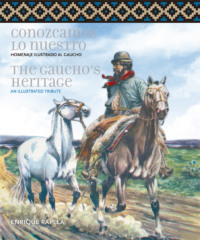
Kitabı oxu: «Conozcamos lo nuestro - The Gauchos's Heritage»


www.editorialelateneo.com.ar

/editorialelateneo

@editorialelateneo


El gaucho, arquetipo del ser nacional

Lo conocí, lo vi y allí estaba. Solo, como casi siempre. Al lado mío, tan cercano que yo también me creí que era como él. Mentira, me faltaba tanto aprender. ¿Cómo iba yo a saber que un día me podría apenas parecer a quién? Y me fui arrimando lento, con todo el miedo de no ser prudente. Es que a veces, el atrevimiento comete algunos errores, esos de los sinsabores de quien mastica un pasto amargo sin saber que ya lo hizo un Gaucho.
Es el gaucho el que hizo todo en esta tierra argentina. Es el gaucho, el único arquetipo del ser nacional. Es el gaucho quien dejó el apelativo “gauchaje” y “gauchada”, puesto que uno trata grupos de gente, el otro lo de la “ayudada”, de los que siempre dan sin importarles nada.
A veces insisto en que ser gaucho no es solo saber pialar, andar en botas, lucir una rastra, andar todos los días en alpargatas de soga y ensillar…, más bien es un sentir, eso de sustituir y no pedir.
Antes de definir al gaucho, de determinar lo que para nosotros son sus lujos, usos y costumbres, es muy importante el decir del trabajo de Enrique Rapela. Es él quien va de una posta de una estancia a un esquinero. De un molino a un carruaje. De un alambre estirado a la matera. Quien nos pinta el lazo del lado izquierdo del anca, la manea, el recado o la encimera. Es que lo dibuja con pasión, un estilo que no queda otra opción.

ENRIQUE RAPELA, CON EL QUE TODOS APRENDÍAMOS
Fue Enrique uno de esos tipos que nos enseñaba a dibujar las cosas nuestras. Para mi edad, el plumín, dibujante, pintor, acuarelista, guionista e impresionista de la escuela de la pintura gaucha argentina, era de esos escritores ilustradores que seguíamos día tras día en revistas como El Tony y tiras en los diarios (La Razón).
Fue uno de los creadores de la historieta gaucha; claro que era autodidacta porque no había escuela, pero vencía como otros pintores costumbristas, haciendo de todos los días el tema gaucho con total conocimiento de sus costumbres e historia. Idoneidad, educación campera, rigurosidad y dedicación lo hicieron un referente para que “conozcamos lo nuestro”.
Sus historias, tiras, hoy llamadas comics, así lo denotan. Como “Cirilo el Audaz”, “Cirilo el Argentino”, “El Huinca” y “Fabián Leyes”. Tuvo, además, evocaciones históricas sobre nuestro canto, ejércitos, batallas, uniformes de combatientes. Es que desde chico, en la estancia La Carolina (Roque Pérez), se contagió del aire, la historia y sus gauchos, siempre legendarios.
Se animó, como su Cirilo El Audaz, a la técnica de la acuarela en un fuerte tono varonil y sin abandonar los colores de la patria .“Continuará…” decía la tira de Cirilo en La Razón y, de alguna manera, lo copiaba a Hernández con las andanzas de nuestro mayor poema: El gaucho Martín Fierro.
Dibujo y texto. Texto y dibujo. El artista se convierte en guionista, dibujante y casi cronista. En fin, todo lo narra.
La síntesis, una sola, el gaucho.
TODO ESTO ES TRADICIÓN
La tradición no es un recuerdo melancólico del pasado, es un proceso permanente que no termina nunca… y es por eso que los hombres hacemos hoy la tradición del mañana. Es que nuestra raza nació de una raza muy vieja y de una tierra muy nueva. Entonces, al salpicarse de rojo el damasquinado suelo (por el hierro damasquino) nació nuestro ser original, que es el gaucho.
Todavía quizá tengamos que recordarlos, pero no son otros que españoles e indios. Allí está el criollo, es decir el gaucho: hombre de la tierra y sobre todo soldado en la Campaña del Desierto, con los Colorados de Monte, con los Infernales de Güemes y, fundamentalmente, con los conquistadores de América, es decir, los Granaderos de San Martín.
Y es cierto, el gaucho fue el primer soldado. No existían guapos para acompañar a las milicias y fue don Juan Manuel de Rosas quien se valió de sus gauchos para avanzar en la frontera sur, tal cual don Julio Argentino Roca. Quizá, después del gran don Martín Miguel de Güemes y por sobre todos, el más grande entre los grandes, quien los entrenó en el Plumerillo para cruzar el Ande: el Gran Capitán, don José de San Marín.
Es por todo lo que decimos que el gaucho no deja de ser una amalgama de tierra y hombre. La sangre, siempre presente. Derramada, inhiesta, escarlata, morena, omnipresente. La tierra: recuperando como tantas veces el final, elevando su espiga por recordar, la hacienda por cortar y los lanares por ramonear.
Si creen que la tradición o el gaucho son cosas del pasado, ¡les vamos a explicar que no y por qué!: la gauchada no es olvidada. Nuestros paisanos siguen viviendo sus lujos, usos y costumbres.
EL GAUCHO, LUJOS Y COSTUMBRES
El gaucho hoy mantiene “lujos y costumbres”. Les voy a contar ese malentendido, lo de “vago y mal entretenido”. Jamás fueron vagos, sino por el adjetivo de distancia, es decir por vagar, librarse, pasear, alargar. Lo de mal entretenido, solo por juegos, aguardiente y alguna baraja para entretenimiento. Fueron los de la guerra, la yerra, el trabajo, la fragua, la tierra, la doma, la patrona, el caballo, la pampa, el estero y la montaña. Son nuestros paisanos un desparramo de colores, gustos y folclores distintos. Son el buen gusto en la fiesta, en el baile, la comida y la vida.
Una vez me preguntaron si alguno es distinto del otro y le dije sin dudar que sí. No es lo mismo el hombre del llano, la estepa, la montaña, el cerro, la puna, el río, el estero y cuanto más. ¿Cómo van a comer lo mismo en el río que en la pampa, a cantarle parecido al llano o a la montaña? ¿No es igual recitar tranquilos un poema y un grito? ¿Cómo se va a arropar el hombre de una canoa, el del quebracho del chaco o el del frío surero? No es lo mismo encontrar carne de guazuncho, dorado, colas de yacaré, lisas, peludos o un pescado de la Patagonia, salado y que está bien. O criar cordero al lado de la mejor carne, la de vaca. Gallina, patos y pollos, lo que quede en la sartén. Mucho bicho que camina va a parar a la cocina y la vizcacha en escabeche también, pues es una carne madrina.
Es por eso que seguimos comentando el campo, es decir, el único terreno de nuestros paisanos. Y si nos referimos a su tradición, volvemos a los usos y costumbres.
Es imposible que un gaucho de la montaña vista como el de la pampa. Son otros los colores, son otros los calores. Hay que pelear con distintos sinsabores. Y, en el Norte, andaban con el aplomo del sol, sandalias y sudor. En la Mesopotamia con polainas y, en la pampa, botas de cuero. Pañuelo golilla en Corrientes; arriba del cuello, allá en la pampa. Sombrero halado en Cuyo, más chico en Buenos Aires y, con mucho orgullo el chambergo, siempre destacado y quieto en San Antonio de Areco.
Si no se viste igual es por la patria grande, tampoco se ensilla igual, en esta tierra distante. ¿Cómo no voy a poner un recado de bastos, en el llano de la pampa o un basto medio pato, allá en donde la cueca manda? Arzones allá en el norte o una cangalla Malvinera y esos campos despejados, en donde música no hubiera. Un mandil que ya no existe, lujo y Perico Ligero. Un cojinillo de oveja, marrón y cuidado, en la sombra del alero. Un poncho Pampa enrollado, en el anca del overo y el lazo, como siempre, en el costado izquierdo.
MÚSICA Y LETRA
Entonces, como hablamos de la olla, el fuego, el viento, el barro o la cacerola. También podemos dedicarnos al decir, porque no se siente lo mismo, cuando hay letra, geografía y un sentir. ¿Cómo va a cantar, entonar y versear alguien de allá en Misiones, que otro de la montaña, la estepa o la llanura? Si uno mira el río lejos, el otro el mar azulado, la selva en el campo de al lado, la llanura interminable y la montaña, que a veces suele ser Ande.
Y allí la poesía, el canto y la melodía: cueca, ranchera, milonga, chamamé, polca, chacarera, tonada, chamarrita, cifra, algo de un paso doble, un cielito, otro infiernito, el gaucho entona otra cosa y versea despacito.
La Virgen Madre es una constante en el sentir gaucho. Como también los hijos, el Tata, el boliche, el “vidrio”, el tabaco, el farol, el charqui, la salmuera, el mate, la galleta o la yerra. Y decimos esto porque el gaucho no descansa, trabaja hasta los domingos en una yerra, con el cordero en la cruz y las criadillas en el rescoldo, debajo de la parrilla. Asado, jineteada, carrera cuadrera o diversión cualquiera. También porque el campo lo requiere y lo sabe más que nadie.
Los animales comen el pasto que por suerte a veces crece y, si no se los cuida, nada florece. El campo es una fábrica sin francos. Esa que precisó siempre de una fajina diaria y hasta un peón de guardia.
Apenas unos vicios que ignoran los absurdos. Pero ¿si podemos?, por qué no un lomo de carne, otros lomos de naipes, un puchero de marucha, taba cargada, bochas lisas y rayadas y si quedara alguna duda, aguardiente con ruda.
Total, siempre habrá un buen decidor, una suerte de pastor que bien podría decir que en una esquina cualquiera tropezó y cayó mi potro, que el hombre que tome vino, no llame borracho a otro.
Tan libre es el gaucho, que no lo entienden. En los pueblos prometen “desfiles gauchos” y los gauchos no desfilan, los gauchos pasan. Nadie los manda, se mandan así mismo con el bien, la bonhomía, la decencia, el buen gusto, sus lujos y costumbres. Por eso es que hablamos del arquetipo del ser nacional, de esa amalgama de tierra y hombre.
UN SIMPLE DÍA DE GAUCHO
En las madrugadas, un bife arde en la matera, cerca de los tamariscos, antes de ensillar y ajustar la encimera. Después vendrá el día y la tierra, la porfía, cosas que en el campo hace tiempo conocía. Y luego, solo un momento para descabezar un sueño. Un rato más de campo; tarde, mate y sereno, porque con el rocío hay que arrancar de lleno…
Es por eso que les digo que si el gaucho no es un mito ni una leyenda, ayudemos a desterrar la idea de su fantasiosa muerte.
“Al gaucho que llevo en mí, como la custodia lleva a la hostia” (Ricardo Güiraldes, es decir, Don Segundo Sombra).
MARIANO FRANCISCO WULLICH
Periodista del diario La Nación, recorrió cinco años la Argentina para “Crónicas del País”. Jefe de Cartas de Lectores, autor del Rincón Gaucho y secretario de Cierre de Redacción. Cubrió la guerra del Líbano y los viajes antárticos: estaba embarcado cuando se incendió el rompehielos Almirante Irízar. Publicó los libros Nuestra Argentina, El caballo, Don Emilio Solanet y el prólogo del Martín Fierro (Sancor).
The gaucho, archetype of the national being
I knew him, I saw him and there he was. Alone, like almost always. By my side, so close that I also believed I was like him. A lie, there was so much I had to learn. How was I to know that someday I could hardly resemble whom? And I was getting closer slowly, afraid of not being cautious. Because, sometimes, the boldness makes some mistakes, like someone who chews bitter grass without knowing that a Gaucho have already done that.
The gaucho is who did everything in this Argentine land. The gaucho, the only archetype of the national being. The gaucho, who left us the nouns gauchaje and gauchada, the first one denoting a group of people; the second one, the “help” coming from those who always give without worrying for anything else.
Sometimes I insist on the fact that being a gaucho is not only to know how to lasso an animal, wear boots, wear a rastra, wear everyday alpargatas and saddle a horse…, it is rather a feeling, that thing of substituting and not asking anything.
Before defining a gaucho, determining what are, for us, their luxuries, customs and habits, it is really important to talk about Enrique Rapela’s work. He goes from an estancia to an esquinero [corner post in a fence]. From a mill to a wagon. From an extended wire fence to the matera [gathering place for countrymen]. He paints for us the lasso on the left side of the rump, the hobble, the tack up to the encimera [piece of the tack that goes over the rest]. That is what he draws with passion, a style without another option.
ENRIQUE RAPELA, THE MAN WHO TAUGHT US ALL
Enrique was one of those guys who taught us how to draw our stuff. For people of my age, he was the nib, the draftsman, the painter, the scriptwriter and the impressionist of the school of the Argentine gaucho painting; he was one of those writers and illustrators we followed day after day in magazines like Tony and cartoons in newspapers (La Razón).
He was one of the creators of the gaucho’s cartoon; of course, he was a self-taught person because there was not a school for that, but he won, as other costumbrist painters, treating every day the gaucho topic with full knowledge of tradition and history. Aptitude, countryside education, accuracy and dedication turned him into a referent for “The Gaucho’s Heritage”.
His stories, cartoons —called comics today— show all these characteristics. For example, “Cirilo el Audaz”, “Cirilo el Argentino”, “El Huinca” and “Fabián Leyes”. He also had historical evocations of our songs, armies, battles, soldiers’ uniforms. The reason for this was that, since he was a child, in the estancia La Carolina (Roque Pérez), he grabbed the air, the history and its gauchos, always legendary.
He brought himself, as his Cirilo el Audaz, to the technics of watercolor with a strong masculine tone, without abandoning the colors of his homeland. “It will continue…” said Cirilo’s cartoon in La Razón and, in some way, he copied Hernández and the adventures of our main poem: El gaucho Martín Fierro.
Drawing and text. Text and drawing. The artist becomes a scriptwriter, a draftsman and almost a chronicler. In short, he narrates everything.
The synthesis, just one: the gaucho.
ALL THIS IS TRADITION
Tradition is not a melancholic memory of the past, it is a permanent, endless process… and that is the reason why human beings are building today tomorrow’s tradition. Our race was born from a very old race and very new land. So, when the Damascene floor (due to Damascene iron) was splashed with red, our original being —the gaucho— was born.
Maybe we still have to remember this, but our ancestors are none other than Spaniards and indigenous people. Thus, the Creole was born, that is, the gaucho: a man from the land and mainly a soldier in the Campaign of the Desert, with the Colorados del Monte, with the Infernales of Güemes and, essentially, the Grenadiers of San Martín.
And that’s true: the gaucho was our first soldier. There were no tough guys to accompany the militia, and Juan Manuel de Rosas took advantage of his gauchos to advance into the Southern frontier, as well as Julio Argentino Roca. Maybe, this happened after the great Martín Miguel de Güemes and, above all, the greatest among the great, the general who trained them in Plumerillo to cross over the Andes: the Great Captain, José de San Marín.
That’s the reason why we say that the gaucho is a fusion between land and man. The blood, always present. Spilled, erect, scarlet, dark, omnipresent. The land: recovering the end as so many times, raising its spike to harvest, the cattle to cut and the sheep to graze.
If you think that traditions or the gaucho are things from the past, we are going to explain that it is not true and why!: the gauchada is not forgotten. Our countrymen are still living with their luxuries, their customs and their habits.
THE GAUCHO, LUXURIES AND HABITS
The gaucho still has today his “luxuries and habits”. I am going to tell you about this misunderstanding, that thing about the gaucho being “vago y mal entretenido” (lazy and full of bad habits). The gauchos were never lazy, they were “vagos” just in the sense of roaming, wandering, being fee. The bad habits have to do with gaming, alcohol and some gambling for fun. They were the people for the war, the branding, the hard work, the forge, the land, the taming, the wife, the horse, the Pampas, the lagoon and the mountain. They are our countrymen, a scattering of different colors, tastes, and folklore. They are the good taste at the party, in the dance, in food and in life.
Once they asked me if one is different from the other and I said without hesitation that they are. It is not the same a man from the plains, the steppe, the mountain, the hill, the puna, the river, the lagoon, etc. How are they going to eat the same food near the river or in the Pampas; to sing the same songs to the plains or to the mountains? It is not the same to quietly recite a poem or shout. How the man of the canoe, the man from the quebracho in Chaco or the man from the Southern cold weather is going to be dress? It is not the same to find meat of gray brocket, river tiger, yacaré’s tails, lizas, armadillos or any fish from Patagonia, salted and that is okay. Or raising lamb next to the best meat: beef. Hens, ducks and chickens, whatever is in the frying pan. Every animal that walks ends up cooked, and also the marinade vizcacha.
That’s why we keep talking about the countryside, that is, the only land of our countrymen. And, if we refer to their tradition, we come back to their customs and habits.
It is impossible that a gaucho from the mountain wears the same clothes as one from the Pampas. The colors are different, the weather too. They need to fight different troubles. And, in the North, they moved with the aplomb of the sun, with sandals and sweat. In the Mesopotamia, with leggings, and, in the Pampas, with leather boots. Lower neckerchief in Corrientes; higher, in the Pampas. Large brim hat in Cuyo, smaller brim in Buenos Aires and, very proudly, the chambergo, always prominent and quiet in San Antonio de Areco.
If they do not dress the same, it is because of the large country, and they do not saddle the same way either, in this remote land. How am I not going to put a tack with cushions in the plains of the Pampas, or a duck tail tack there where the cueca orders it? Saddle trees in the North or a malvinera saddle and those clear fields, where there is no music. An apron that does not exist anymore, luxury and perico ligero. A brown and neat sheep cushion, under the eaves shade. A Pampa poncho rolled up on the rump of the overo and the lasso, as always, on the left side.
MUSIC AND LYRICS
So, as we talk about the pot, the fire, the wind, the mud or the pan, we can also talk about the ways of saying, because we do not feel the same when there are lyrics, geography and a feeling. How is somebody from Misiones going to sing, modulate and compose verses? And someone from the mountains, or the steppe or the plains? If one looks at the river far away, the other at the blue sea, the forest in the next field, the endless plains, the mountains, which sometimes could be the Andes.
And there the poetry, the singing and the melody: cueca, ranchera, milonga, chamamé, polka, chacarera, tonada, chamarrita, cifra, a paso doble, a cielito, another infiernito, the gaucho sings another thing and slowly composes verses.
The Virgin Mother is a constant in the gaucho’s feeling. Also, his children, the Tata, the boliche, the “vidrio”, the tobacco, the lampost, the charqui, the brine, the mate, the galleta or the branding. Because the gaucho does not rest, he works even on Sundays in a branding, where the lamb rests in the cross shaped grill and the calf´s testicles on the embers, under the grill. Asado, jineteada, carrera cuadrera or any kind of entertainment. Also because he demands it and he knows all that better than anybody.
The animals eat the grass that, fortunately, sometimes grows and, if it is not taken care of, nothing prospers. The countryside is a factory without holidays. It always needs the daily work and a worker on duty.
Just some vices that absurd people ignore. But if we can? Why not a filet, some cards, a stew with rump steak, the loaded taba, plain and stripped bochas, and, if there were some doubts, aguardiente [moonshine] with ruda [ruta].
Anyways, there will always be a good “sayer”, some kind of shepherd who can say that, in any corner, my horse stumbled and fell, that the man who drinks wine cannot call another one a drunk.
So free is the gaucho that he is misunderstood. In some villages, “gauchos’ parades” are promised but the gauchos do not parade, the gauchos pass. Nobody gives them orders, they only respond to themselves with wellness, bonhomie, integrity, good taste, their luxuries and traditions. That is the reason why we talk about the archetype of the national being, of this fusion of land and man.
A SIMPLE GAUCHO’S DAY
In the early morning, a stake is burning at the matera, close to the tamarisks, before he saddles and adjusts the tack. After that, the day and the land, the stubbornness will come, things that, in the countryside, were known long time ago. And then, just a moment to take a nap. A little longer in the field; afternoon, mate and sereno, because, with the dew, it is necessary to start again…
That is the reason why I am telling you that, if the gaucho is neither a myth nor a legend, let us help banish the idea of his fantasy death.
“To the gaucho I carry inside myself, as the custode carries the communion wafer” (Ricardo Güiraldes, that is to say, Don Segundo Sombra).
MARIANO FRANCISCO WULLICH
A journalist for the newspaper La Nación, he toured Argentina for five years for “Chronicles of the Country”. Head of Readers Letters, author of Rincón Gaucho and editorial secretary. He covered the Lebanese war and Antarctic travels: he was on board when the icebreaker Almirante Irízar caught fire. He published the books Nuestra Argentina, El caballo, Don Emilio Solanet and the prologue to Martín Fierro (Sancor).
Semblanza
de un pionero

En las biografías que circulan de Enrique José Rapela (1911- 1978) se destacan algunos rasgos precisos. Si bien completó el colegio secundario, en el dibujo y la acuarela fue autodidacta. Descendiente de familia inmigrante pero argentino de séptima generación, conocedor directo de los temas gauchos por haber administrado La Carolina, el establecimiento de su madre, en Roque Pérez, cerca de Mercedes en la provincia de Buenos Aires, donde nació. Fue un apasionado emprendedor, guionista, dibujante, editor, escritor e historiador, situado en una época de oro donde se aúnan grandes paradigmas: el revisionismo histórico de las décadas del 60 y 70; el auge de los medios gráficos, ya sean revistas o diarios consumidos por miles a toda hora y toda la semana; sellado con la profusa difusión del folclore nacional con intérpretes como Los Chalchaleros, Los Cantores de Quilla Huasi, Horacio Guarany, Eduardo Falú y el auge de festivales y peñas.
Lo nativista se consumía y difundía en la ciudad, pero fue en los medios gráficos matutinos donde se consolidó como género genuino el de la historieta criollista. Con “Cirilo el Audaz”, aparecido en el diario La Razón en 1939, Rapela narra las aventuras de Cirilo Cuevas, un gaucho huido de la justicia que busca protección en las líneas del ejército rosista. El esquema de aquella tira luego se repite con otros personajes y llega a ser un arquetipo que percibe la autoridad como agresiva y corrupta, por lo que prefiere mantenerse fuera de la ley; donde hay referencias histórico-políticas, como la Campaña del Desierto, la Guerra del Paraguay y se citan personajes de nuestra historia como Nicolás Avellaneda, Adolfo Alsina o Juan Manuel de Rosas. El texto no estaba en los clásicos globos de las historietas, sino que se ubicaba debajo de los dibujos. En relación con el discurso, se evidencia una visión nacionalista que reivindica al campo, mediando con el arquetipo de un héroe que todo lo puede con muy pocos elementos. De este modo, en la tira completa, el gaucho, en gran medida solo con su fuerza, su astucia y cierto azar a su favor, se convertía en vencedor.
Su compromiso didáctico con la difusión de ese entorno se sitúa después de 1872, cuando, como sostuvo el historiador argentino Bonifacio del Carril, los gauchos constituían una verdadera clase social. El propio Rapela dijo en una conferencia: “En esta forma comprenderemos que este maravilloso país no fue habitado por bárbaros inútiles, vagos y mal entretenidos, como se insistió en forma sistemática y perfectamente organizada en una monumental campaña sostenida por los que solo concebían la civilización si esta provenía de allende los mares, pero renegando del origen latino hispano”. Se oponía claramente a una matriz que propició la aparición de un nuevo tipo de ciudadanía que justificaba “domesticar lo salvaje”. Por ello, el tiempo elegido es el mismo del enfrentamiento entre Domingo Sarmiento y Juan Manuel de Rosas, una épica devenida de Civilización y barbarie. Vida de Juan Facundo Quiroga y aspectos físicos, costumbres y hábitos de la República Argentina (1845), donde al gaucho se lo señala como el principal culpable del atraso cultural que atenaza el desarrollo del país. Se trata de un nodo esencial de nuestra historia, pero también de un imaginario de época, donde expandir la frontera era un imperativo para acceder a la organización del estado-nación.
Por esa tendencia revisionista, el arquetipo del gaucho se destacaba por los rasgos de una oralidad caída en desuso en el campo, tal como “apestao” o “virgüela” negra. También la vestimenta era recreada luego de acceder a documentos de museos históricos, a tal punto que hasta las armas dibujadas fueron descripciones fidedignas de las usadas en ese entonces. Esa vocación por la representación gráfica de la cultura material, tanto en Rapela como en otros pares, se acrecentaba por el grado de cercanía del entorno campero de la llanura, pero se basaba en investigaciones históricas y literatura de autores que describieron la época, lo que configura un valor didáctico que acercó a generaciones información certificada.
EL GAUCHO EN EL PAPEL
Carlos Gilberto Landa y Julio César Spota, desde la antropología y la arqueología histórica, profundizaron en un artículo la importancia de la historieta argentina, ya que ahí se desarrollaron ciertas relaciones temáticas, verdaderas revisiones críticas respecto de procesos que conformaron el pasado nacional, enfatizando que “la historieta se erigió por medio de soportes estéticos de divulgación masiva, en una aproximación alternativa a dicho pasado”. Entienden los autores que el concepto moderno de frontera fue anticipado en las historietas gauchescas por “elementos de reflexión relativos a los procesos de contacto, diálogo y conflicto intercultural que recién fueron incorporados en la década de 1980 como paradigma de referencia común dentro de los ámbitos de discusión antropológico-histórica”. El escenario donde se ubicaron los desarrollos argumentales de obras como Cabo Savino, de Carlos Casalla; Lanza Seca, de Guillermo Roux; El Huinca, de Enrique Rapela; Martín Toro, de Jorge Morhain y Bernoy en los dibujos; Lindor Covas, el Cimarrón, creada por Walter Ciocca; Capitán Camacho, con guión de Julio Alvarez Cao y dibujos de Carlos Casalla –por solo enumerar algunos títulos de la extensa producción artística– mostraba en toda su complejidad las distintas vinculaciones sociales, los modos de los intercambios culturales y el caso de las dependencias económicas recíprocas existentes entre los grupos blancos, indios y mestizos.
Fue en la década del 40 cuando comienza la que podría denominarse la época de oro de la historieta nacional, cuyo hito es la aparición y consolidación de la historieta tildada de seria y adulta, con la revista Intervalo de Editorial Columba en 1945. La revista Billiken ya se editaba para los chicos y Patoruzito, infancia del personaje Patoruzú, para los jóvenes. En 1945 en Patoruzito se publica Lanza Seca de Roux, quien realiza una serie sobre la conquista del desierto y la guerra a los aborígenes. Hay que recordar que Patoruzú se publicó por primera vez en la contratapa del diario Crítica, en octubre de 1928 cuando su creador, Dante Quinterno, tenía 18 años. El protagonista era el último vástago de la tribu de los tehuelches, hijo de un rico cacique de la Patagonia, un paradigma que también describe un entramado cultural lleno de matices e historia.
En 1950 apareció la tira “Hormiga Negra” en La Razón, de Walter Ciocca que luego tuvo una saga sobre un fuerte de frontera y los hombres que la habitaban: “Fuerte Argentino”, también de Ciocca, se publica en la revista Misterix, para la cual pidió la colaboración del historiador Hugo Portas. El “Cabo Savino”, de Carlos Casalla, nació en 1954 en el diario La Razón y tiene un récord histórico pues lleva seis décadas ininterrumpidas de galopes a caballo, peleas con cuchillos y malones indios, cambiando de medios donde aparece. En 1958 aparecería el primer número de la revista Patrulla, con personajes como “Cirilo el Argentino”, de Rapela. En 1967 Enrique lanza la editorial Cielosur, junto a otros socios, y sus personajes gauchescos El Huinca y Fabián Leyes comienzan a encabezar sus respectivas publicaciones, en las cuales había otras tiras, pero siempre con la misma temática, como ser la ya nombrada Lanza Seca de Roux y Mapuche de Almendro y Desilio.
RAPELA EDITOR
La editorial Cielosur da origen a revistas de varios tamaños y períodos: mensual, álbum o fascículo. En las tiras se destinaba un segmento al origen de las palabras como pulpería, sangría, ranqueles. Esta pasión de Rapela por ampliar los conocimientos del lector consigue que aparezca una sección especial llamada Conozcamos lo nuestro, descripta como “una singular enciclopedia de terminología campestre”, que en 1977 y en exitosas ediciones posteriores, ya se publicaban en tres tomos. En los diálogos de ambas historietas se intenta reflejar el habla gauchesca y se reproducen muchas de sus expresiones. Se puede decir que ambos héroes –El Huinca y Fabián Leyes aparecidos en Patoruzito y el diario La Prensa respectivamente, durante la década de 1970– son gemelos arquetípicos de justicieros que, junto a sus laderos, ayudan al prójimo. El acompañante del primero es Zenón y el del segundo, Amancio. “Para eyos [sic], ésa es su vida, pampa y cielo. Guadal y pajonales. Libres como el viento, alegres como los pájaros cuando nace el día”, se afirma en una de las tiras. Aunque también eran contratados alternativamente como guías para las partidas exploratorias que circulaban en torno a los fortines por su conocimiento de la llanura y el entorno.
A ese valor emprendedor y didáctico se une el estético, ya que si enfocamos en el arte de Rapela, hay que destacar especialmente las imágenes donde registra el paisaje retratando un cielo sereno con sutiles rayas verticales; o cuando describe unas siluetas negras con ligeros toques blancos que señalan la luz lunar en contraste con las figuras. La vestimenta y el tipo de tela se nota en sus arrugas que están representadas con soltura, como también se describen los ranchos, los senderos, los árboles y las diligencias. Se trata de un dibujo sobrio, aplomado, clásico, pero con grises que enriquecen no solo la composición, sino que funcionan como ornato. Son dibujos frescos, de trazos vigorosos y oficio diestro en el uso del pincel y la pluma. Pero destaca especialmente por los dibujos de caballos, con excelentes planos que detallan la anatomía de sus cabezas o el galopar de sus patas, así como la montura y el detalle del apero. “Supo reflejar gráficamente las llanuras inconmensurables que parecen proyectarse al infinito”, sostiene el escritor Germán Cáceres, él mismo un ideólogo de la cultura gauchesca. Falleció en Buenos Aires a la edad de 67 años, pero su impronta trasciende claramente su corta vida.
PILAR ALTILIO
Licenciada en Arte por la UNLP, Posgrado Internacional Gestión y Política en Cultura y Comunicación FLACSO Argentina. Docente de nivelación de posgrado en Prácticas artísticas contemporáneas UNCuyo. Gestora y curadora independiente desde 1999. Como investigadora independiente y crítica de arte publica regularmente en Revista Ñ de Cultura, ArtNexus revista colombiana, arte-online.net y El Gran Otro.
Fuentes: Judith Gociol y Diego Rosemberg, La historieta argentina. Una historia. Ed. De la Flor, Carlos G. Landa y Julio César Spota Trazos fronterizos en http://www.gazeta-antropologia.es/?p=1477
Portrait
of a Pioneer
In the circulating biographies of Enrique José Rapela (1911- 1978), some precise strokes stand out. Even though he completed high school, he was a self-taught person regarding drawing and watercolor. Descendant from an immigrant family but seventh generation of Argentine people, he was a direct expert on gauchos’ topics because he administered La Carolina, his mother’s estancia, in Roque Pérez, close to Mercedes, in the province of Buenos Aires, where he was born. He was a passionate entrepreneur, scriptwriter, draftsman, editor, writer and historian, living in a golden age where great paradigms reunite: the historical revisionism of the 1960’s and 1970’s; the boom of graphic media —both magazines and newspapers were read by thousands of people all the time and the whole week—; and, finally, the profuse spreading of the national folklore with performers like Los Chalchaleros, Los Cantores de Quilla Huasi, Horacio Guarany, Eduardo Falú, and the boom of festivals and peñas [meetings where folk songs are played].
The native was consumed and spread in the city, but the morning graphic media were the place where the Creole cartoon was established as a genuine genre. In Cirilo el Audaz, published in the newspaper La Razón in 1939, Rapela narrates the adventures of Cirilo Cuevas, a gaucho who runs away from the law and seeks protection in the lines of Rosas’ army. The outline of that cartoon is repeated later with other characters and it becomes an archetype that perceives authority as aggressive and corrupt, and for that reason prefers to stay outside the law. There are historical-political references, like the Campaign of the Desert, the War of Paraguay; and personalities of our history, like Nicolás Avellaneda, Adolfo Alsina or Juan Manuel de Rosas are mentioned. The text was not in the typical speech balloons of the cartoons; it was located under the drawings. Regarding the speech, there is a nationalistic view that defends the countryside, through the archetype of a hero who can do everything with very few elements. In this way, in the whole cartoon, the gaucho, to a large extent alone with his strength, his ingenuity and some kind of luck in his favor, became a winner.
This didactic involvement with the diffusion of this environment could be placed after 1872, when, as the Argentine historian Bonifacio del Carril held, the gauchos were a true social class. Rapela himself said in a conference: “In this way we will understand that this wonderful country was not inhabited by useless barbarians, lazy people with bad habits, as a huge systematic and perfectly organized campaign, supported by people who only conceived as civilized what comes from overseas, rejecting the Latin Hispanic origin, repeated”. He was clearly opposed to a matrix that fostered the appearance of a new kind of citizenship that justified “domesticating the wild”. For that reason, the time chosen is the same of the conflict between Domingo Sarmiento and Juan Manuel de Rosas, an epic that turn into the book Civilización y barbarie. Vida de Juan Facundo Quiroga y aspectos físicos, costumbres y hábitos de la República Argentina (1845), where the gaucho was pointed out as the main responsible for the cultural backwardness that stopped the development of the country. It is an essential node of our history, but also the result of the imaginary of the time, where extending the limits was imperative to get access to the organization of the Nation State.
Due to this revisionist trend, the archetype of the gaucho outstands thanks to the features of an already obsolete orality in the countryside, such as “apestao” or black “virgüela”. Also the garments were recreated after having access to documents from historical museums, to the point that even the drawn weapons were trustworthy descriptions used in that time. That vocation for the graphic representation of the material culture —both in Rapela and in some of his peers— was increased by the degree of closeness to the countryside environment of the plains, but it was based on historical research and literature by authors who described the period, which configures a didactic value that provided certified information to generations.
THE GAUCHO IN PAPER
Carlos Gilberto Landa and Julio César Spota, from anthropology and historical archeology, went deep, in an article, about the relevance of Argentine cartoon, because some thematic relations, true critical revisions regarding the process that conformed the national past were developed there, emphasizing that “cartoon rose, through aesthetic means of massive diffusion, as an alternative approximation to that past”. The authors understand that the modern concept of frontier was anticipated in the gauchos’ cartoons by “elements of reflection related to processes of intercultural contact, dialog and conflict that were incorporated only in the 1980’s as a paradigm of common reference within the circles of anthropological-historical discussion”. The setting of works like Cabo Savino, by Carlos Casalla; Lanza Seca, by Guillermo Roux; El Huinca, by Enrique Rapela; Martín Toro, by Jorge Morhain and Bernoy in the drawings; Lindor Covas, el Cimarrón, created by Walter Ciocca; Capitán Camacho, with a script by Julio Álvarez Cao and drawings by Carlos Casalla –just to mention some titles of the extensive artistic production— showed, in their entire complexity, the different social links, the ways of cultural exchanges, and the case of the mutual economic dependencies existing among the white, the indigenous and the mestizo groups.
It was in the 1940’s when what can be called “golden age” of national cartoon starts, and its milestone is the appearance and consolidation of the cartoon considered serious and adult, with the magazine Intervalo of Editorial Columba in 1945. The magazine Billiken was already being published for children, and Patoruzito, the child version of the character Patoruzú, for young adults. In 1945 Patoruzito published Lanza Seca by Roux, who writes a series on the Conquest of the Desert and the war against indigenous people. We must remember that Patoruzú was published for the first time in the last page of the newspaper Crítica in October 1928, when its creator, Dante Quinterno, was 18 years old. The main character was the last offspring of the Tehuelche tribe, son of a rich cacique from Patagonia, a paradigm that also describes a cultural web full of nuances and history.
In 1950 the cartoon strip Hormiga Negra appeared in La Razón, created by Walter Ciocca; then there was a saga about a border fort and the men who inhabited it: Fuerte Argentino, also by Ciocca, was published in the magazine Misterix; for this work, he asked for the contribution of the historian Hugo Portas. Cabo Savino, by Carlos Casalla, was born in 1954 in the newspaper La Razón and it has a historical record, because it has six uninterrupted decades of gallops on a horse, fights with knives and raids of indigenous people, changing the media where it was published. In 1958, the first issue of the magazine Patrulla appeared, with characters such as Cirilo el Argentino, by Rapela. In 1967, Enrique initiates the publishing house Cielosur, with some partners, and his gauchos characters El Huinca and Fabián Leyes start to lead their respective publications, where there were other cartoon strips, but always with the same subject, like the already mentioned Lanza Seca by Roux and Mapuche by Almendro and Desilio.
RAPELA, THE EDITOR
The publishing house Cielosur gives rise to magazines of several sizes and regularity: some are monthly, others are albums or delivered by installments. In the cartoon strips, there was a segment to the origin of words like pulpería, sangría, ranqueles. Rapela’s passion for expanding the reader’s knowledge leads to the appearance of a special section called Conozcamos lo nuestro [The Gaucho’s Heritage], described as “a singular encyclopedia of rural terminology”, that, in 1977 and in successful subsequent editions, was published in three volumes. In the dialogs of booth cartoons, there is an intention of reflecting the gauchos’ talk, and a lot of their expressions are reproduced there. We could say that both heroes –El Huinca and Fabián Leyes that appeared in Patoruzito and the newspaper La Prensa respectively, during the 1970’s– are archetypical twins of an avenger that, together with their side parties, help others. The companion of the first one is Zenón, and of the second one, Amancio. “For them, that is their life, pampa and sky. Sandy bogs and scrublands. Free like the wind, happy like birds when the day is born”, this can be read in one of the strips. However, sometimes they were also hired as guides for exploration watches around the forts due to their knowledge of the plains and the surroundings.
This entrepreneurial and didactic value joins forces with the aesthetic value, since, if we focus on Rapela’s art, we have to highlight specially the images where he registered the landscape portraying a serene sky with subtle vertical strips; or when he describes the black silhouettes with light white touches that indicate the moonlighting in contrast with the figures. The clothes and the type of fabric are shown in their wrinkles that are represented with skill, as well as the ranchos, the roads, the trees and the stagecoaches are described. It is a restrained, composed, classical drawing, but with greys that not only enrich the composition, but work as ornament. They are fresh drawings, with vigorous strokes and great skill in the use of the brush and the pen. But he outstands specially in the drawing of horses, with excellent images detailing the anatomy of their heads or the gallop of their legs, as well as the saddle and the details of the tack. “He knew how to reflect graphically the immense plains that seems to project to the infinite”, says the writer Germán Cáceres, who was also an ideologist of the gaucho´s culture. He died in Buenos Aires when he was 67 years old, but his mark clearly transcends his short life.
PILAR ALTILIO
Graduated in Arts, UNLP, Posgrado Internacional Gestión y Política en Cultura y Comunicación FLACSO Argentina. Professor in charge of placement in graduate programs on Contemporary Artistic Practices, UNCuyo. Manager and independent curator since 1999. As independent researcher and art critic, she regularly publishes in Revista Ñ de Cultura, ArtNexus, a Colombian magazine, arte-online.net and El Gran Otro.
Sources: Judith Gociol and Diego Rosemberg, La historieta argentina. Una historia. Ed. De la Flor; Carlos G. Landa and Julio César Spota, Trazos fronterizos, at http://www.gazeta-antropologia.es/?p=1477.
Nota del editor
Editorial El Ateneo se enorgullece en presentar Conozcamos lo nuestro, de Enrique Rapela.
Los textos, originalmente aparecidos en tres fascículos, han sido organizados en capítulos y partes temáticas. Hemos sido extremadamente respetuosos de su estilo, conservando su minuciosidad a la hora de describir cada nudo, los juegos tradicionales, la variedad en el color de pelo de los caballos.
Magistral dibujante, sus ilustraciones son una parte indisoluble del texto, con el que conforman una obra única. Las imágenes fueron tratadas de manera de limpiar las manchas que el tiempo pudo ocasionar en ellas, para devolverlas prístinas a ojos del lector. Para ello, se las escaneó de los originales, se limpiaron con Photoshop® hasta que quedaron sin moiré, para luego pasarlas a vector en Illustrator®. Esto permitió mostrarlas en el tamaño deseado sin perder ni un ápice de calidad.

Editor’s note
Editorial El Ateneo is proud to present The Gaucho’s Heritage, by Enrique Rapela.
The texts, originally published in three installments, have been organized in chapters and subject parts. We have been extremely respectful of his style, preserving his thoroughness when he describes each knot, the traditional games, the variety of the coat color of the horses.
Beieng an excellent draftsman, his illustrations are inseparable from the text: they constitute all together a unique work. In order to clean the stains that time could have caused in them, the images were treated to make them pristine again to the reader’s eyes. To achieve that, they were scanned from the original; they were cleaned with Photoshop® until they were left without moire, and then they were passed to a vector in Illustrator®. That allowed us to show them in the desired size without losing an ounce of quality.

¿Qué es
conozcamos
lo nuestro?

Presento esta obra que titulé Conozcamos lo nuestro. Si bien muchas de las cosas de que hablo e ilustro no tienen aplicación práctica en estos días, todas cumplieron importante función en su época. Nada hizo el gaucho que no tuviera una importante finalidad. Todo lo que salió de sus manos hábiles probó el notable ingenio del que era poseedor. Siempre se ha hablado de la habilidad de nuestro gaucho para dominar al que fue su inseparable compañero, el caballo. En esta obra trato de demostrar que eso fue cierto. Creo que conocer todo lo que al gaucho atañe es necesario que las generaciones actuales lo sepan y otros de más edad lo recuerden, porque de este modo aprenderemos a respetarlo al conocerlo mejor. En esta forma comprenderemos que este maravilloso país no fue habitado por bárbaros inútiles, vagos y “mal entretenidos”, como se insistió en forma sistemática y perfectamente organizada en una monumental campaña sostenida por los “ilustrados”, que solo concebían la civilización si esta provenía de allende los mares, pero renegando del origen latino hispano.
El gaucho, que heredó todo del pueblo español, chocó con el hombre de ciudad que no lo comprendió, y respaldó con energía al ciudadano que no lo despreció y no trató de demostrar ostensiblemente su diferente forma de vivir.
Veremos cómo y por qué usaron tal o cual prenda, su origen, procedencia y adaptación. Cómo y por qué los aperos se diferencian en cada zona de tan extenso país. Su forma de trajinar un potro, la manera de lidiar con vacunos y lanares; y lo que más llama la atención es la inteligencia que mostró poseer al ingeniar las distintas maneras de utilizar “las sogas” para dominar el caballo.
Todo esto y muchas cosas más que atañen a la vida de nuestros antepasados lo veremos en esta obra. De ese modo tendremos una visión bastante amplia de todo ello, a lo que agregaremos un pantallazo de los usos y costumbres del indio, aquel valiente dueño de la tierra que defendió con valor y orgullo luchando contra el gaucho, que fue el primer instrumento que el “ilustrado” utilizó para liberar esas grandes extensiones de rica tierra que pasaron a su poder sin arriesgar más que la sangre de esos maravillosos gauchos. Tengo la pretensión de creer que este modesto trabajo sirva para que muchos lectores no tengan que callar cuando deban responder a preguntas sobre usos y costumbres de nuestro campo, pero, sobre todo, es un homenaje que rindo al gaucho con esta obra Conozcamos lo nuestro.
ENRIQUE RAPELA
What Is The
Gaucho’s
Heritage?

I present this work I titled The Gaucho’s Heritage (Conozcamos lo nuestro). Even though many things I talk about and illustrate have no practical application nowadays, all of them fulfilled an important function in their time. The gaucho did not do anything that did not have a relevant purpose. Everything that came from his skilled hands was an evidence of the significant ingenuity he possessed. Always people have talked about the skills of our gaucho to master his inseparable companion: the horse. In this work, I try to demonstrate that this was right. I think that knowing everything concerning the gaucho is necessary for new generations, and older people should remember it, because, in this way, we will learn how to respect him once we know him. Thus, we will understand that this wonderful country was not inhabited by useless barbarians, lazy people with bad habits, as a huge systematic and perfectly organized campaign supported by people who only conceived as civilized what comes from overseas, rejecting the Latin Hispanic origin, repeated.
The gaucho, who inherited everything from the Spaniard people, crashed with the man from the city who did not understand him, and backed with energy the urban man who did not look down on him, and did not try to demonstrate ostensively their different way of living.
We will see how and why they wore this or that piece of clothing, its origin and adaptation. How and why tacks are different in each part of such a vast country. Their way to work with a horse, the way to deal with cattle and sheep; and what draws more attention is the intelligence they showed when they created the different ways to use “the ropes” to master the horse.
All this and many other things concerning the life of our ancestors will be seen in this work. In this way, we will have a pretty large view of all of it, and we will add to this an overview of the customs and habits of the indigenous people, those brave owners of the land they defended with courage and pride fighting against the gaucho, who was the first instrument the “illustrated people” used to free those vast extensions of rich land that passed to them without risking anything but the blood of these great gauchos. I want to believe that this modest work will be useful so that many readers will not have to remain silent when they should answer questions about customs and habits of our countryside, but, mainly, it is a tribute I pay to the gaucho with this work The Gaucho’s Heritage.
ENRIQUE RAPELA

PRIMERA PARTE
El gaucho

El gaucho, el hombre poblador de nuestros inmensos campos, era el jornalero de las grandes estancias, muy diestro en el arte de dominar y amaestrar el caballo, con el que realizaba los trabajos de ganadería y agricultura.
Este personaje fue muy castigado por esos literatos que solo veían lo bueno si tenía raíz francesa o sajona. El origen del denominado “gaucho” es incierto y los ensayos para explicarlo son variados. Por ejemplo, Pablo Groussac considera como verosímil y lógico que tal palabra nunca fue dicha no conocida en la península, sino por traslado americano. Es, para él, una de las pocas que no pasó por España antes de implantarse en el Nuevo Mundo. Groussac cree que deriva de la palabra incásica “guacho”, que significa (en un sentido bastante denigrativo) “abandonado, errante, huérfano”. Acepción que, en general, rechazamos.
Don Félix de Azara, sabio enviado por el gobierno español para poner en ejecución el Tratado de San Idelfonso, marcando los límites entre España y Portugal en sus posesiones sudamericanas, permaneció desde 1781 a 1801 en los diversos territorios del Río de la Plata, levantando mapas, explorando y escribiendo sus luego famosos libros. Gran observador, dejó conceptos que no podemos pasar por alto. Azara, refiriéndose al poblador de la llanura, expresa:
“No es menos admirable el tino con que prácticos ‘baqueanos’ conducen al paraje que se les pide en terrenos horizontales, sin caminos, sin árboles, sin señal alguna ni aguja marítima, aunque disten cincuenta o más leguas. Además de los dichos, hay por aquellos campos otras castas de gente, llamada más propiamente GAUCHO o GAUDERIOS”.
El nombre de “gauchos” o “gauderios”, que designaba al principio a estos aventureros de la llanura, comprendió después a todos los hombres de campo dedicados, por lo general, al pastoreo.
El gaucho fue siempre de tez blanca. Su aspecto tuvo más de árabe que de indio como pretendieron hacernos creer los historiadores al servicio de algo que no tenía nada que ver con nuestro origen. No podemos ignorar que la sangre de los conquistadores españoles fue un factor decisivo en la formación etnológica de cada agrupación, para deducir, con bases fijas de criterio, la importancia ulterior, sus actividades y la influencia que tuvieron en el carácter individual y de conjunto.
Muchos son los autores que han querido ver en el moro español el origen
de nuestro gaucho. Esto lo sostienen al ver lo parecido de las prendas de vestir del gaucho y la similitud de los elementos que utilizaron. Vieron en el poncho el albornoz de los berberiscos, y el chiripá les recordaba los amplios calzones de los levantinos. El ancho tirador escamado de monedas, los coloridos y amplios pañuelos y las armas, como la faja que sujetaba el chiripá, se les antojaba orientales; los largos facones (herramienta y arma); las grandes barbas y los amplios calzoncillos bordados los indujeron a caer en ese error.
Es evidente que todo lo dicho da a nuestro gaucho gran semejanza con los pueblos mahometanos de Oriente. Las particularidades de las prendas de vestir, el tipo físico, el modo de montar, y muchas palabras de origen árabe de uso en la pampa, como “jagüel”, por ejemplo, han inducido al error de dar como probable origen una emigración a esta parte del mundo, de los moriscos españoles. Esto es desechable, porque los moros no vinieron entonces a América. Pero sí vinieron los españoles amoriscados, los jinetes andaluces, aquellos hijos de moros que, al verse en estas dilatadas llanuras, renació en ellos la dormida herencia de sus abuelos, aquellos bohemios soñadores que abandonaron los inmensos desiertos arábigos para conquistar casi toda España a punta de lanza, bajo el fecundo reinado de Isabel la Católica en aquel 1492, dejando con fuerza indeleble, como herencia, su arte y cultura milenaria, que entonces entró en el ocaso.
Las primeras generaciones nacidas aquí conservaron el carácter belicoso de los expedicionarios de Juan de Garay y Pedro de Mendoza, luchando contra el indio valiente y feroz cuando supo dominar al caballo. De esta lucha surgió el “gaucho”, jinete gallardo y valeroso que conservó, en medio de su rusticidad intelectual, la rectitud de carácter y la nobleza de corazón. El gaucho era de a caballo, honrado
y valiente hasta la temeridad. Su indómito valor lo transformó en gran guerrero, gestor de la emancipación americana. Hospitalarios, al viajero le dan comida y albergue sin preguntar quién es ni a dónde va.
El gaucho solo tuvo del indio su astucia, su frugalidad cuando era necesario, su conocimiento del terreno y sus habilidades para el manejo de las armas primitivas. Lo más corriente era que dirigía su “montado” hacia algún rancho de cristianos cuando necesitaba mujer. Los azares de la guerra o la necesidad lo inducían a unirse con la india. A través del tiempo, este solitario de la pampa, que se tornó aislado manteniéndose entre la civilización y la barbarie, se negaba a reconocer la autoridad del Cabildo y menos aún al cacique de la toldería.
Reacio en general a toda organización, era individualista casi hasta las últimas consecuencias; se puede decir que vivía en comunidad y con otros gauchos en los días de fiesta. Estaba acostumbrado durante siglos al aislamiento y contaba solo con su propio esfuerzo para desenvolverse en su entonces fácil existencia. Le bastaba su habilidad en la caza de animales salvajes en los grandes desiertos verdes, para vivir y procurarse dinero. Fue generoso y desprendido, poco le importó el dinero; poco le importaba “luego de un día de abundancia, una semana de escasez”, “día de mucho, víspera de nada”.
Los gauchos, por causa de ciertas corrientes filosóficas
importadas e intereses extranacionales, fueron huérfanos de toda sociedad, unos abandonados de la “civilización”; hoy, con más sutilezas que la experiencia dictó, sucede más o menos lo mismo. Pero el gaucho que regó con su sangre el largo trayecto de la independencia de muchos pueblos de América, fue maltratado por los “historiadores” cuando, después de la independencia, comenzaron en el país los enfrentamientos civiles y él intervino en la vida pública y fue retaceado cuando dio a la historia héroes “tremebundos de una gloria salvaje”, forma habilidosa de reducir la valía de su intervención.
La personalidad de este maravilloso antepasado fue tan avasalladora que hasta sus más grandes detractores, por formación e influencia extranjera, no pudieron eludir la atracción que sobre ellos ejerció este “paria de la civilización”. Daireaux fue uno de los que rindieron a la postre su homenaje. Domingo F. Sarmiento, que no trepidaba en aconsejar “… y no me ahorre sangre de gauchos”, le rinde también el suyo en Civilización y barbarie, al reconocer en el baqueano (un gaucho como muchos) un ser extraordinario de agudo sentido de observación y gran inteligencia para sacar conclusiones, eran detalles que pasaban totalmente desapercibidos para el hombre “civilizado y culto”.
Para otro, el gran Facundo Quiroga, blanco del ataque de todos los intelectuales a la europea de entonces, con sus seguidores de hoy, no pudo ser menos que comparado con un héroe legendario al ser considerado “el peludo Aquiles de la Ilíada gauchesca”.
La literatura influenciada de entonces cargaba sus tintas cuando había que juzgar al gaucho; catalogó como “gaucho malo” a ese hombre individualista que, con gran espíritu libertario se negaba a servir los intereses de los “cultos”. Muy a menudo se veía obligado a defender su libertad con las armas en la mano y ya se convertía en fugitivo de la ley; si no moría en la empresa, terminaba en la frontera sirviendo bajo régimen severísimo. Allí luchaba en la indigencia para contener la indiada, cuidando y defendiendo los intereses de sus jueces condenadores, sin más futuro que morir en la miseria.
En este ensayo trataré de recordar al castigado gaucho, mostrándolo en su ambiente, con la presión de acercarme a la
verdad en lo atinente a los elementos en que desenvolvió su existencia; sus costumbres, las supersticiones y algunas
“leyes” con que regían sus vidas de relativa relación.
FIRST PART
The gaucho
The gaucho, the man who inhabited our vast fields, was the day laborer of the large estancias, very skilled in the art of mastering and training the horse, that accompanied him in the jobs related to livestock and agriculture.
This character was extremely punished by those men of letters who only considered that something was good if it had French or Saxon roots. The origin of the so called “gaucho” is uncertain, and the essays to explain it are diverse. For instance, Paul Groussac considers plausible and logic that this word was never said, it was not known in the Iberian Peninsula, except for an American transfer. For him, this is one of the few words that did not pass by Spain before being implanted in the New World. Groussac thinks that it comes from the Incan word “guacho”, that means (in a quite derogatory sense) “abandoned, wandering, orphan”. This is a meaning that, in general, we reject.
Don Félix de Azara, wise man sent by the Spaniard government to implement the Treaty of San Ildefonso, marking the limits between Spain and Portugal in their South American possessions, remained from 1781 to 1801 in the different territories of the Río de la Plata, drawing maps, exploring and writing their later famous books. Great observer, he left concepts that we cannot ignore. Azara, referring to the inhabitant of the plains, expresses:
“It is no less admirable the good sense with which practical ‘baqueanos’ lead to the place they are asked to in horizontal fields, without roads, without trees, without any signal or compass, although they are fifty or more leagues away. Besides them, there are in those fields other lineages of people, called more properly GAUCHO or GAUDERIOS”.
The name “gauchos” or “gauderios”, designating, at the beginning, those adventurers of the plains, later on comprised all countrymen devoted, in general, to shepherding.
The gaucho had always a white complexion. His look was more Arabic than Indigenous, as some historians at the service of something that does nothing to do with our origin pretended to make us think. We cannot ignore that the blood of Spanish conquerors was a decisive factor in the ethnological constitution of each group, to deduce, with fixed bases of criteria, the ulterior importance, their activities and the influence they had in the individual and group character.
There are many authors that have wanted to see, in the origin of our gaucho, the Spanish Moor. They back this theory on the resemblance they see in their clothing and the similarity of the elements they used. They saw in the poncho the Berbers’ gown, and the chiripá reminded them the wide breeches of the natives of Mediterranean Spain. The wide belt decorated with coins, the colored and broad neckerchiefs and the weapons, as well as the sash that hold the chiripá seemed to them of Eastern origin; the long facones (both the tool and the weapon); the huge beards and the wide embroidered breeches led them to fall in that mistake.
Obviously all that has been mentioned gives our gaucho a great resemblance to the Mohammedam peoples of the East. The distinctive features of the clothes, the physical type, the way of riding, and many words of Arabic origin, commonly used in the Pampas, such as “jagüel” [well], for instance, have led to the mistake of taking as a possible origin a migration of Spanish Moors to this part of the world. This has to be dismissed because the Moors didn’t come to America at that time. But Moorish Spaniard did come, the Andalusian horsemen, those children of Moors that, when they saw themselves in these vast plains, felt a reawakening of the slept heritage of their grandparents, those bohemians dreamers that abandoned the huge Arabic deserts to conquer almost all Spain at spear point, under the fruitful reign of Isabella of Castile in that 1492, leaving with an indelible force, as their heritage, their ancient art and culture, that then began to decline.
The first generations born here preserved the bellicose nature of Juan de Garay and Pedro de Mendoza’s expeditionaries, who fought against the brave and fierce indigenous people when they knew how to master the horse. From this fight the “gaucho” was born: elegant and valiant horseman that maintained, within his intellectual rusticity, the integrity of his character and the nobility of his heart. The gaucho was an honest and brave up to recklessness horseman. His wild courage turn him into a great warrior, agent of the American emancipation. Hospitable, they give food and refuge to the traveler without asking who he is or where he goes.
The gaucho only got from the indigenous people his astuteness, his moderation when it was necessary, his knowledge of the land and his skills to use primitive weapons. The most common thing was that he led his horse to some rancho de cristianos when he needed a woman. The hazards of the war or his needs led him to join an indigenous woman. Through time, this lonely man from the pampas, who became isolated keeping himself between civilization and barbarism, refused to acknowledge the authority of the Municipal Council and even less that of the cacique of the toldería.
Reticent in general to any kind of organization, he was individualistic almost until the last consequences; we can say that he lived in a community and with other gauchos in festive days. He was used through centuries to isolation and he only counted with his own effort to cope with his then easy existence. His skills in hunting wild animals in the huge green deserts was enough to live and earn money. He was generous and disinterested, he did not care too much about money; he did not care a lot about the fact that “after a day of abundance, a week of scarcity” followed: “day of a lot, eve of nothing”.
The gauchos, because of some imported philosophical trends and extra national interests, were orphans of any society, some were abandoned by “civilization”; today, when we have more subtleties dictated by the experience, more or less the same is happening. But the gaucho that watered with his blood the long journey to the independence of many American nations, was abused by the “historians” when, after the independence, the civil confrontations started in the country and he took part in public life and received less than he deserved when he gave to history “tremendous [heroes] of a wild glory”, skilled way of reducing the value of his intervention.
The personality of this fabulous ancestor was so overwhelming that, even his biggest detractors, due to education or foreign influence, could not help feeling attracted to this “outcast of civilization”. Daireaux was one of the people who finally paid tribute to him. Domingo F. Sarmiento, who did not hesitate to advice “… and do not economize in gauchos’ blood”, also pays his tribute in Civilización y barbarie, when he recognizes in the baqueano (a gaucho like many) an extraordinary being with keen sense of observation and great intelligence to draw conclusions from details that went completely unnoticed to the “civilized and educated” man.
Another gaucho, the great Facundo Quiroga, target of the attack of all the thinkers influenced by the European culture of that time, and their followers today, could not be less than compared to a legendary hero when he was considered “the hairy Achilles of the gauchos’ Iliad”.
The influenced literature of the time exaggerated when it had to judge the gaucho; it labeled him as a “gaucho malo” [bad gaucho], an individualistic man who, with a great libertarian spirit, refused to serve the interests of the “educated people”. Frequently, he was forced to defend his freedom with weapons and became a fugitive; if he did not die in the endeavor, he ended up in the frontier serving under a very strict regime. There he fought in poverty to contain the indigenous people, taking care of, and defending the interests of his condemning judges, without any future but to die in misery.
In this essay, I will try to remember the afflicted gaucho, showing him in his environment, with the pressure of approaching the truth about the elements with which he developed his existence, his traditions, the superstitions and some “laws” that ruled his life and relationships.
capítulo 1
a
Prendas de vestir

Cada zona del país tuvo su tipo de gaucho, que adaptaba sus ropas, las prendas de su apero y los implementos de trabajo a la topografía del terreno.
Por ejemplo, en la primera ilustración puede verse al gaucho rioplatense, austero en el vestir y vivir. Era de talla alta, propia de los hombres de la llanura necesitados de ver a la distancia en una superficie plana que se extendía por kilómetros y kilómetros sin que nada obstruyera el horizonte.
La pampa inmensa le desarrolló notablemente la vista: identificaba a gran distancia cualquier bulto extraño y sin error posible. Esta cualidad encantaba a los extranjeros que tenían la suerte de pisar nuestra maravillosa tierra. El gaucho bonaerense (o mejor aún, el de la pampa húmeda) es un personaje del que nos vamos a ocupar mucho, por ser, creo, el más importante de los paisanos del país.
Con respecto a las prendas gauchas, nuestro antepasado vestía un traje muy particular. Cubría la parte inferior de su cuerpo con un amplio paño que le ceñía exactamente como un pañal a los niños. Tipo de prenda tan rudimentaria era justificable en lugares alejados de toda posibilidad de conseguir una prenda complicada de confeccionar como un pantalón. Además, en su traje como en sus costumbres era, sin saberlo él, muy similar a los árabes. Su poncho era muy parecido al albornoz berberisco, así como el chiripá nos recuerda los amplios calzones levantinos. Esta prenda y su uso tienen muchos antecedentes de increíble antigüedad. Su forma de usarla se asemeja a la forma de cubrirse de la milenaria raza hindú.
No es descabellado pensar que, a través de los siglos, esa manera de vestir llegara al norte de África, siguiera por la costa y pasara a España con los árabes y de allí a esta parte del mundo. El ancho tirador, escamado con monedas, que sostiene el chiripá y es cartera o monedero para el gaucho, lo mismo que la faja, propia de los orientales, recuerdan usos y costumbres de los moros.
Esta prenda, el chiripá, era generalmente de la llamada bayeta, género de baja calidad. La palabra “chiripá” proviene del quichua y significa “para frío”. Ya hemos dicho que se coloca como un pañal a un niño y se sujeta en la cintura con una faja tejida terminada en flecos (A) y (B). Sobre esa faja ponían un cinturón ancho de cuero. Los gauchos pobres (casi todos) lo sujetaban en la forma que mostramos en la figura (C). La aparición del alambrado y el avance de la sociedad de consumo hicieron que el chiripá cayera en desuso. Fue suplantado por la bombacha (D), prenda más cómoda que sujetaban en igual forma.

Las prendas militares que se usaron desde el año en que se inició la resistida guerra del Paraguay, que pertenecieron a la guerra de Crimea, y hasta con los remiendos originales fueron a cubrir los cuerpos de nuestros jóvenes guerreros, dieron origen al uso de la bombacha, pues este uniforme lucía una amplia gama de color rojo.
El gaucho, por lo general, no vestía más que el poncho: tal era su pobreza. Esto lo han asegurado muchos escritores, viajeros y estudiosos del ambiente; pero no vayamos a caer en la simpleza de suponer que nuestros paisanos eran unos menesterosos, pues trabajaban en las estancias o se dedicaban al comercio en ínfima escala como ser: vender cueros, plumas y cerdas. Con eso cubrían sus necesidades, que no eran muchas, pues ya hemos dicho que era sobrio en todo; así fue que, en un principio, usó una camisa de amplias mangas (E). Esta prenda llamaba la atención verla cerrada en la boca por un tiento que pasaban por los ojales. Esto era a causa de la falta de botones y de hilo por parte del paisano de tierra adentro, que se veía obligado a suplirlos con el único material a su alcance y en abundancia: el cuero. Se concretaba a cerrar la abertura con un delgado tiento que pasaba por los ojales, ni más ni menos como en la Edad Media. Estas mangas fueron llamadas “buche”.


Sobre la camisa, los no tan pobres se colocaban una blusa corta (F), evidentemente inspirada en la chaqueta andaluza. En un principio, como lo indicaba la moda de la época, tenía solapa pequeña; luego desapareció y se colocó solo un botón en la parte superior. Conservó su talle corto y hoy se la reconoce como “corralera”. Sobre todo esto, se colocaba el poncho (G), prenda rectangular con abertura central para la cabeza. Es casi igual al albornoz berberisco y, para el gaucho, es parte importantísima de su persona. Con él se cubría de las inclemencias del tiempo, era su escudo en la pelea y cobija de sus amores. En tiempo cálido lo usaba terciado sobre su hombro izquierdo; la razón de esto se comprende si pensamos que en caso de peligro, obligado a defenderse, solo con dejar caer el poncho sobre su brazo izquierdo, ya estaba listo para cumplir su función de escudo, parando los posibles golpes del facón enemigo. Esta prenda tenía variadas medidas. El poncho fino, liviano, solía tener un largo de un metro por setenta; pero el rudo, de abrigo, caía hasta más debajo de las rodillas, amplitud que le permitía proteger de la lluvia no solo su cuerpo, sino también su apero. Medía un metro ochenta por uno veinte, aproximadamente. El más famoso y caro de los ponchos es, sin duda, el de vicuña, confeccionado con la fina lana de este camélido del noroeste.
Otro de los ponchos más conocidos era el pampa, confeccionado por los indios sobre telares oblicuos. Eran característicos los dibujos de sus guardas, cuyos motivos siempre se basaban en la cruz en ángulos rectos. Los indios tenían el conocimiento de los elementos naturales con que hacer sus tinturas, que extraían (y aún hoy extraen) de los frutos, cortezas y raíces de ciertas plantas, árboles y yuyos. Los colores eran indelebles: por eso se conservan aún hoy prendas que datan de muchísimo tiempo con frescura tal en sus colores que realmente asombra. El negro y el gris, tan usados por los pampas para teñir lanas, lo conseguían del churqui, una acacia o aromo muy rico en tanino. El espinillo también servía para tales fines.
Antiguamente, el indio quichua, poblador del norte del país que, viniendo por la cordillera llegaba hasta Santiago del Estero y que no poseía aún la tijera, procedía a enterrar el cuero en lugar húmedo, donde lo dejaban varios días. Después con solo tirar de la hebra, esta se desprendía con toda facilidad. Los flecos que adornan los lados más angostos del poncho (es decir, las partes que penden al frente y atrás) no son agregados: es la consecuencia de dejar, simplemente, los hilos de la urdimbre.
Del poncho se puede hablar muchísimo, pero esta obra solo busca abarcar, a grandes rasgos, todo (o casi todo) lo que al gaucho concierne. Por lo tanto, se dará paso a las otras prendas de este personaje, tan grato a nuestro espíritu argentinista.


chapter 1
a
Clothing
Each zone of the country had its own type of gaucho, who adapted the clothes, the elements of his tack and his working tools to the topography of the land.
For instance, in this first illustration , we can see the gaucho from the Río de la Plata: he was austere in his clothes and way of living. He was tall, a characteristic of the men from the plains who needed to see from a distance in a flat surface that stretched for miles and miles with nothing obstructing the horizon.
The vast pampas markedly developed his sight: he identified from a great distance any strange lump without any possible mistake. This quality fascinated the foreigners who were lucky to set foot in our wonderful land. The gaucho from the Buenos Aires province (or even better, from the Humid Pampas) is a character we are going to take care of a lot, for being —I guess— the most important countryman in Argentina.
Regarding the gaucho´s clothing, our ancestor wore a very particular outfit. He covered the lower part of his body with a wide cloth that fitted him exactly like a diaper for children. A so rudimentary piece of clothing was justifiable in places that were far away from any chance of getting a complicate to elaborate piece like pants. Besides that, both in his outfit and his habits, he was, without knowing that, very similar to the Arabs. His poncho was resembled the Berber robe, and the chiripá reminds us of the wide Levantine breeches. This garment and its use have many antecedents of incredible antiquity. His way of wearing it resembles the way of covering of the ancient Hindu race.
It is not unreasonable to think that, through the centuries, this way of dressing reached North Africa, continued along the coast and passed to Spain with the Arabs, and from there to this part of the world. The wide belt, decorated with coins, which holds the chiripá and is a wallet or purse for the gaucho, as well as the sash, typical of Oriental people, remind us of Moorish habits and customs.
This piece of clothing, the chiripá, was usually made of baize, a low-quality fabric. The word “chiripá” comes from Quichua and means “for cold”. We have already said that is worn like a children’s diaper and fastened at the waist by a woven sash finished in fringes (A) and (B). Over this sash, they put a wide belt made of hide. The poor gauchos (almost all of them) secured it in the way we show in figure (C). The emergence of wire fences and the advance of the consumer society caused chiripá stopped being worn. It was replaced by the bombacha (D), a more comfortable piece of clothing that they secured in the same way.

The military garments that were worn from the year the resisted Paraguayan war began belonged to the soldiers of the war of Crimea and, even with the original patches, went to cover the bodies of our young warriors. These uniforms gave rise to the use of the bombachas and displayed a wide range of red.
Usually, the gaucho only wore the poncho: such was his poverty. Many writers, travelers and environmental scholars have claimed that; but we should not simplify and suppose that our countrymen were some needy people, because they worked in the estancias and they were engaged in low scale trade, such as selling hides, feathers and bristles. With that, they met their needs, which were not a lot, since, as we have already said, they were moderate in everything; that is the reason why, at the beginning, they wore a wide sleeve shirt (E). This piece of clothing drew the attention when it was fastened by a thin piece of hide that went through the buttonholes. The reason for this was that the countrymen from distant lands did not have access to buttons and thread, and were forced to replace them with the only material they have at their reach and in abundance: hide. They managed to close the opening with a thin strap they passed through the buttonholes, as in the Middle Ages. The sleeves of the shirts were called “buche” (craw).
Over the shirt, the gauchos that were not so poor wore a short blouse (F), inspired obviously in the Andalusian jacket. At the beginning, as it was dictated by the fashion trends of the time, it had a small lapel; then it disappeared and just one button was left in the top part. It maintained its short size and today it is recognized as “corralera”. Over all these clothes, the poncho was worn (G), a rectangular piece of cloth with a central opening for the head. It is almost equal to the Berber robe and, for the gaucho, it is a very important part of his being. With it, he protected himself from inclement weather, it was his shield in the fights and the blanket for love. In warm weather, he wore it over his left shoulder; the reason of this can be understood if we think that, in case of danger, if he was forced to defend himself, with only dropping the poncho over his left arm, it was ready to fulfill its role as a shield, stopping possible blows of an enemy facón. This piece of clothing had several sizes. The thin, light poncho used to be 1 m by 70 cm; but the rough one, to keep him warm, reached below the knees, a spaciousness that allowed it to protect from the rain not only the gaucho’s body, but also his tack. It was 1.80 m by 1.20 m, approximately. The most famous and expensive poncho is, without a doubt, the poncho of vicuña, made of the fine wool of this Northwestern camelid.
Another well-known poncho was the Pampa one, made by indigenous people in oblique looms. The drawings in its patterns, whose motives were always based on the cross with right angles, were typical. The indigenous people knew the natural elements to make their dyeing, extracted (then and still today) from fruits, barks and roots of some plants, trees and herbs. The colors were indelible, for that reason, pieces of clothes from long time ago are preserved even today with such freshness in their colors that really amazes. The black and the grey, so used by the Pampas to dye wool, were obtained from the churqui, an acacia very rich in tannin. The espinillo also served this purpose.
Formerly, the Quichua people, who lived in the North of the country and, coming through the mountain range, arrived to Santiago del Estero, as they did not have scissors yet, buried the hide in a humid place where he left it several days. Afterwards, just pulling the thread, it separated very easily. The fringes that ornate the most narrow sides of the poncho (that is, the parts that hang at the front and the back) are not added: they are the consequence of simply leav-ing the threads of the warp.
We can talk a lot about the poncho, but this work only tries to include, roughly, everything (or almost everything) concerning the gaucho. Therefore, we will pass to other garments of this character so agreeable to our Argentine spirit.
b
El chiripá
Con respecto al chiripá, Ciro Bayo dice:
“Pretina que por una extremidad se rodea la cintura y pasando la otra por entre las piernas, se vuelva todos lo entiendan, poner de ejemplo lo que seguramente todos han visto hacer: un chiripá es, exactamente, un amplio paño que se coloca como se coloca el pañal a un bebé y se sujeta con una faja”.
Esta prenda comenzó a tener su mayor difusión allá por 1828, en que hasta la usaban las tropas del gobierno. Así teníamos que los estancieros (A) vestían la ropa de los gauchos, pero con el lujo que les permitía su situación económica. Las tropas de caballería también lucían, especialmente la de Santos Lugares (B), llamada así por estar en ese lugar este cuerpo de soldados que formara Rosas. Este campamento se calculaba que en 1840 tenía unas cinco mil plazas. La figura (C) representa a un soldado del cuerpo de artillería de 1858 de la Confederación Argentina, cuyo gobierno residía en Paraná y era ejercido por el general Urquiza. En un desfile de todas las fuerzas armadas de Entre Ríos, el doctor Germán Burmeister hace una descripción del acto. Burmeister, ilustre hombre de ciencia alemán, médico, escritor y naturalista, consagró gran parte de su vida al servicio de nuestro país. Desde 1862 hasta 1892 fue director del Museo Nacional. Entre otras cosas, dice:
“No deja de tener interés la clase de uniformes, armas y número de soldados. (…) Los soldados llevaban ponchos rojos de franela, chiripá del mismo color, calzoncillos blancos de algodón y un gorro de campo estilo español antiguo, también colorado. Algunos iban descalzos y no llevaban más armas que un sable. Los cañones eran de composición y bastante usados. Los oficiales se parecían, en color y corte de los uniformes, a los franceses; llevaban pantalones anchos arriba y angostos abajo, una levita azul con prendidos rojos y un pequeño quepí más agudo hacia arriba; completamente un modelo francés”.
La figura (D) representa a un soldado de carabineros, reconstruida en base a documentos del Archivo General de la Nación. Tal cual muestra el dibujo así vestían los soldados del Fuerte Federación en 1835:
• Gorreta de paño grana.
• Chiripá del mismo paño con vivo blanco.
• Bota de potro.
• Espuela de hierro como armas.
• Carabina.
• Sable.
• Boleadoras.
En legajos de la época, vemos entre los pedidos “350 chiripás paño grana”. En otro legajo se halla un pedido de un centenar de boleadoras, arma formidable en manos de esos soldados gauchos de que fueron víctima Paz, Rauch y Medina. En 1839, el uniforme de la Guardia de Caballería era “chaqueta azul, chaleco punzó, pantalón azul, corbata negra, divisa de “¡Federación o muerte!” “¡Vivan los federales!” “¡Mueran los salvajes unitarios!”. Penacho punzó en el sombrero, y luto federal con cintillo punzó por “Nuestra ilustre heroína federal, la Sra. Da. Encarnación Escurra de Rosas”. Los soldados de la Guardia debían cabalgar en caballos hoscos (morenos oscuros) y colorados.


Durante el Sitio de Montevideo se organizaron diversos batallones para su defensa, entre otros el número 5, comandados por el coronel argentino Mariano Echenagucía. La figura (E) representa a un soldado de ese cuerpo. Su original uniforme se componía de una gorra semejante a las de manga, pero armada con cuero interiormente, de color azul con trencillas blancas. Llevaban atada la cabeza, lo que era muy común entre la gente de la campaña, pues muchas veces el pañuelo reemplazaba al sombrero. Usaban chaqueta corta color verde con vivo blanco; camisa blanca con corbatín colorado; chaleco celeste y blanco como la bandera uruguaya. Chiripá rojo floreado con adornos negros; lo llevaban en forma de delantal como los indios, los correntinos y paraguayos. Conocido como “mortero”, estaba sostenido por una guasca (cuerda de cuero) a la cintura. Calzoncillos blancos con pequeños pliegues en lugar de flecos completaban su atuendo, calzando botas de potro.


La denominación de “mortero” con que se conocía la forma de llevar el chiripá suponemos proviene de ese utensilio circular, muy diferente al chiripá usado por los gauchos, de lo que conocemos como pampa, y en especial en la provincia de Buenos Aires.
La difusión del chiripá era muy grande en todas las esferas sociales; tenemos la prueba en el museo de Luján, en donde se puede ver la reproducción fotográfica de don Ignacio Videla, alcalde de la Villa en 1860, vistiendo un vistoso chiripá. La figura (F) representa a un vigilante de la misma época y lugar.
En la figura (G) se muestra a uno de los heroicos fronterizos que llevaba también esa prenda. Si bien en el decreto de la creación del cuerpo no se habla del chiripá, en la práctica no llevaban más distintivo que los identificara como soldados, que el quepí. La tropa de caballería debía llevar “quepí grancé (1) con vivos negros, aro, atributos del arma y número del cuerpo, chaquetilla de paño azul gris, con vivos y cuello grancé, pantalón ancho azul gris con franja grancé, bota granadera de caña blanca con espolines de bronce”.
Luego, por orden del entonces ministro de guerra Adolfo Alsina, en 1877 se dio a la tropa una coraza de cuero de vaca sin curtir, que se endurecía poniéndola al relente. Este procedimiento le daba una dureza que detenía el golpe de la lanza del salvaje. La coraza fue rechazada por el soldado que suponía ser ventajero en esa lucha. Pese al decreto de creación del cuerpo, la realidad estuvo muy lejos de las buenas intenciones de proveer de uniformes a la tropa. En verdad, los gauchos llevaban todo lo poco que tenían y solo algunos eran provistos de sable, quepí y, con suerte, de alguna chaqueta.
b
Chiripá
Regarding the chiripá, Ciro Bayo says:
“Piece of cloth that, with one end, surrounds the waist, and passing the other in between the legs, it becomes what everybody understands, the example everybody has seen how it’s done: a chiripá is, exactly, a wide cloth put like a diaper to a baby and fastened with a sash”.
This piece of clothing had its greatest diffusion back in 1828, when even the government army wore it. So, the owners of the estancias (A) wore the garment of the gauchos, but with the luxury they could afford due to their economic situation. The cavalry troops also wore it, especially the troops from Santos Lugares (B), called that way because the corps of soldiers formed by Rosas were in this place. This camp had in 1840 an estimated of five thousand places. Figure (C) represents a soldier from the 1858 artillery corps of the Argentine Confederation, whose government resided in Paraná and was in charge of the general Urquiza. At a parade of all the armed forces of Entre Ríos, Germán Burmeister makes a description of the public act. Burmeister, illustrious German scientist, physician, writer and naturalist, devoted much of his life to serve our country. From 1862 to 1892, he was the National Museum’s director. Among other things, he writes:
“The type of uniforms, weapons, and the number of soldiers are not without interest. (…) The soldiers wore red flannel ponchos, chiripá of the same color, white cotton breeches and an old Spanish style field cap, also in red. Some were barefoot and didn’t carry any weapon except a saber. The cannons were of compositions and quite worn out. The officers looked like the French in the color and the cut of the uniforms; they wore pants that were wide above and narrow below, a blue frock coat with red details and a small kepi sharper up; absolutely a French model”.
Figure (D) represents a carabineer soldier, a reconstruction based on a document from the National General Archive. As shown in the drawing, the soldiers of the Federation Fort looked like this in 1835:
• Burgundy cloth cap.
• Chiripá made with the same cloth, and with a white trim.
• Bota de potro (foal boot).
• Iron spur as a weapon.
• Carbine.
• Saber.
• Boleadoras.
In some documents of this time, we see among the orders “350 burgundy cloth chiripás”. In another document, there is an order of one hundred boleadoras, formidable weapon in the hands of these gaucho soldiers who killed Paz, Rauch and Medina. In 1839, the uniform of the Cavalry Guard was “blue jacket, red vest, blue pants, black tie, badge with the words “¡Federación o muerte!” [Federation or Death] “¡Vivan los federales!” [Long life to the Federals] “¡Mueran los salvajes unitarios!” [Death to the savages Unitarians]. A red feather in the hat, and a sign of federal mourning: a red headband for “Nuestra ilustre heroína federal, la Sra. Da. Encarnación Escurra de Rosas” [Our illustrious federal heroine, Mrs Encarnación Escurra de Rosas]. The soldiers of the Guard had to ride on surly (dark haired) and red colored horses.
During the Siege of Montevideo, several battalions were organized for its defense, among others the number 5, commanded by the Argentine colonel Mariano Echenagucía. Figure (E) represents a soldier from this corps. His original uniform was composed by a cap similar to the ones called “de manga”, but armed with leather in the interior; it was blue with white soutaches. They had a kerchief tied in their heads, something very common among people from the countryside, because many times it substituted the hat. They wore a short green jacket with a white trim; white shirt with a red short tie; light blue and white vest, similar to the Uruguayan flag. Floral red chiripá with black ornaments; they wore it as an apron like the indigenous people, and the people from Corrientes and Paraguay. Known as “mortero” [mortar], it was secured by a guasca [leather rope] to the waist. White breeches with small pleats instead of fringes completed their outfit, and, in the feet, botas de potro.
The denomination “mortero” with which the way of wearing the chiripá was known supposedly came from this circular utensil; it was very different from the chiripá worn by the gauchos known as Pampa, and especially in the province of Buenos Aires.
The spreading of the chiripá was very large in all social spheres; we have evidence of that in the Museum of Luján, where we can see the photographic reproduction of Ignacio Videla, major of the village in 1860, wearing a colorful chiripá. Figure (F) represents a policeman from the same time and place.
In figure (G), one of the heroic frontiersmen wearing this piece of clothing is shown. Even though, in the decree of creation of the corps, nothing is said about the chiripá, in the practice, they didn’t have any other emblem that identified them as soldiers, except the kepi. The cavalry troops should wear “red kepi (1) with black trims, ring, attributes of the weapon and number of the corps, jacket made of blue gray cloth, with trims and red collar, wide blue gray pants with a red strap, grenadier boots with white cane and bronze spurs”.
Afterwards, by order of the then War Minister Adolfo Alsina, in 1877, the troops received a cow rawhide breastplate that hardened when exposed to the dew. This procedure caused the breastplate to have the strength to stop the blow of the indigenous’ spear. The breastplate was rejected by the soldiers because he supposed to be “opportunistic” in this fight. In spite of the decree creating of the corps, reality was far away from the good intentions of giving uniforms to the troops. Actually, the gauchos wore the few things they have and only some of them were supplied with saber, kepi and, if they were lucky, some jacket.
c
Sombreros y gorros
En estas apretadas reseñas sobre todo lo que atañe al gaucho, nos ocuparemos brevemente del sombrero o “cubrecabeza”, porque no de otro modo se podría llamar a lo que se ponían sobre ella.
El sombrero que usaron fue de formas y materiales diversos. A través de las litografías de Pallière y Pellegrini (conocidos artistas de la época en los que debemos apoyarnos para conocer los detalles de la vestimenta de nuestros antepasados de antes de la documentación de Daguerre) vemos que la galera (A) fue de uso muy difundido. Se dice que ello se debió a un cargamento de tales prendas que traía un barco inglés que, por un accidente muy común en estas playas, se vio obligado a alijar su cargamento. Las galeras pasaron así a las estanterías de los negocios de la ciudad y la campaña.
Nuestros paisanos no tuvieron inconvenientes en cubrirse con ellas. Es famoso el cuadro de Justo José de Urquiza cubierto con su poncho y luciendo esa famosa galera con su uniforme militar. Los sombreros de paja, muy usados en toda época, eran de diversas formas y tamaños. La figura (B) representa a un paisano con el cónico pajizo. Otros modelos de forma chata de angosta ala tuvieron gran difusión en los primeros años del siglo xix. En general, se los conoció como de “jipi-japa”.
En la época de Rosas se puso en boga el gorro de manga, muy usado hasta por las tropas regulares. Se los conoció de diversas formas. Ya existía a principios del siglo xix un cuerpo de ejército, el de Infantería del retiro, que usó un gorro de manga de forma muy particular, azul, conocido como “de mitra”. Lo sabemos por una acuarela de la época que perteneció a Justo Mateo y que este la obsequió al escribano Victoriano José Cabral, el que, a su vez, se la regaló a Enrique Udaondo, quien la publicó en su famoso libro sobre los uniformes militares. Tenía al dorso una leyenda que rezaba “Infantería del Retiro, regimiento Sánchez”. Se supone que se trata del coronel Valerio Sánchez, que ocupó el cuartel de la época colonial que sirvió de alojamiento a los primeros escuadrones del regimiento de Granaderos a Caballo.
Una de las formas más comunes fue el de la figura (C).


En las láminas que ilustran lo referente al chiripá, vemos a los soldados con diversos gorros de manga. Así tenemos el gorro de manga largo y blanco que cae flácido como el que luce el soldado de Caballería de Santos Lugares. En el carabinero de 1839 vemos que el tal gorro, alto y rígido, es de los de “mitra”, por su semejanza con la mitra episcopal. Pero no lo usaron solamente los hombres de Rosas, la infantería de Urquiza y su caballería, y los artilleros de la Confederación.
También se descubrió que la Guardia Nacional de Caballería de 1865 lucía un gorro blanco de manga azul, con aro y borla color rojo. Nos recuerda al gorro frigio que usaron mucho los franceses durante la Revolución que marca un hito en la historia.
Un sombrero muy común, usado por el paisano de tierra adentro, fue el llamado “panza de burro” (D); como su nombre da a entender, se confeccionaba con el cuero sacado de la panza de un burro (E). El paisano, al hacerlo, conservaba el pelo del cuero. Primero lo sometía a una larga inmersión a fin de ablandarlo. Mojado y dejándolo hacia afuera, lo moldeaba en un poste para darle la forma que deseaba (F). Luego lo colgaba al aire libre y así se endurecía. El arreglo se completaba con tiras de cuero que anudaba bajo el mentón o en la nuca.


La figura (G) muestra cómo era el sombrero concluido. No hay mucho más para decir salvo que semejaba una campana. Suponemos que no debía ser muy fresco ni muy liviano.
También muy usado el pañuelo atado a la cabeza y anudado atrás en la nuca. No hay duda de que, salvo el “panza de burro”, todos los sombreros que usaron nuestros paisanos fueron importados o inspirados en el extranjero.
Al hablar de los gauchos salteños, nombramos el amplio sombrero de cuero, común en la zona norteña, cubierta de montes achaparrados y agresivas espinas, con él se defendía. El “panza de burro” no poseía alas pronunciadas, se puede decir que carecía de ellas. No las necesitaba en una zona carente de bosques naturales y plantas espinosas, porque los que lo usaban eran, por lo general, de la pampa húmeda.


c
Hats and caps
In these short reviews on everything concerning the gaucho, we will briefly talk about the hat or “cubrecabeza” [headcover], because there would be no other way to call what they wore over it.
They wore hats with different shapes and made of several materials. Through the lithographies by Pallière and Pellegrini (known artists of the time on whom we have to rely to know details of the garments of our ancestors before Daguerre’s documentation), we see that the top hat (A) was widely used. People say that the reason was a shipment of these pieces of clothing brought by an English ship that, by a very common accident in this coast, was forced to unload its cargo. The top hats went then to the shops’ shelves both in the cities and the countryside.
Our countrymen have no problem in covering their heads with them. There is a well-known painting where Justo José de Urquiza appears covered with his poncho and wearing this famous top hat with his military uniform. The straw hats, widely used at all times, had different shapes and sizes. Figure (B) represents a countryman with a conical straw hat. Other flat shaped models with a narrow brim had a wide diffusion in the early years of the 19th century. Usually, they were known as “jipi-japa”.
In Rosas’ time, the “gorro de manga” [a hat with a long bent top] went into fashion, because it was worn by regular troops. They were known under different shapes. At early 19th century there was an army corps —the Infantry of Retiro— that wore a blue gorro de manga with a particular shape, known as “de mitra” [miter]. We know that thanks to a watercolor of the time, belonging to Justo Mateo who gave it as a present to the notary Victoriano José Cabral, who, in turn, gave it to Enrique Udaondo, who published it in his famous book on military uniforms. Supposedly, the man in the painting is colonel Valerio Sánchez, who occupied the colonial era barracks that accommodated the first squadrons of the Regiment of Horse Grenadiers.
One of the most common shapes was the one that appears in figure (C).
In the pictures illustrating the chiripá, we can see soldiers with different gorros de manga. So, we have the long and white hat that falls limp worn by a soldier from the Cavalry of Santos Lugares. In the 1839 carabineer, we can see the tall and rigid hat called “gorro de mitra”, because of its similarity to the episcopal miter. But they were not only worn by Rosas’ men, Urquiza´s infantry and cavalry, and the artillerymen of the Confederation wore them too.
It was discovered too that the 1865 National Cavalry Guard wore a blue hat with a blue long top, a ring and a red tassel. This reminds us the Phrygian hat that the French wore during the Revolution and that marks a milestone in history.
A very common hat, worn by the inland countrymen was the one called “panza de burro” [donkey´s belly] (D); as its name implies, it was made with the hide from a donkey’s belly (E). When the countryman made it, he preserved the hair in the skin. First, he subjected the hide to a long immersion in order to soften it. Wet and on the outside, he molded it in a post to give it the shape he wanted (F). Afterwards, he hung it outdoors and it hardened. The arrangement was completed with leather straps that knotted down the chin or at the nape.
Figure (G) shows how the finished hat was. There is not much more to say, except that it looked like a bell. We suppose that it should not be a very cool or very light hat.
A neckerchief tied to the head and knotted back at the nape was also very common. There is no doubt that, except for the “panza de burro”, all the hats our countrymen wore were imported or inspired abroad.
When we talked about the gauchos from Salta, we mentioned the wide leather hat —very common in the Northern area, covered by squad mounts and aggressive spine—, because it served him as a defense. The “panza de burro” didn’t have pronounced brims, we could say that it lacked them. It did not need them in an area that did not have natural bush lands and thorny plants, because it was worn mainly by the countrymen of the Humid Pampas.
d
La bota de potro
Una de las prendas que más usó el gaucho, y que él mismo se confeccionaba, fue la bota de potro. Las alpargatas existían, pero era menester tener dinero para adquirirlas y duraban poco, por lo que era necesario reponerlas. Nuestro gaucho pronto ideó cómo calzarse sin gasto, ya que el material que necesitaba era lo que entonces más abundaba en los campos que recorría a su libre albedrío: caballos.
De la pata de un potro o potrillo o vaca, en última instancia, se confeccionó sus botas. Cortaba en redondo el cuero a la altura de la corva y el nudo (A), y lo despegaba tirando. Para despegar la parte que corresponde a la canilla le colocaba en medio una soga de a dos, con el rebenque u otro objeto similar, “haciendo torniquete” o “dando garrote”, como decían, al ser igual al suplicio que aplicaban en España para los ajusticiamientos; haciendo girar esa ceñidura, se conseguía despegar el cuero. El dibujo señalado con la letra (B) es bastante claro. Sacado el cuero, lo daban vuelta y quedaba el interior hacia afuera; metían una tabla adentro y procedían al descarne (C). Tenían la precaución de dejar más gruesa la parte de atrás y los costados del garrón, destinados a servir de suela. Algunos comenzaban a sobarlas en leche (porque adquieren, además de blandura, una blancura especial), antes que se secara del todo, pues sobarlas es una tarea muy importante para conseguir una bota flexible como un guante,


Estas botas podían ser peludas o lonjeadas, es decir conservando o no el pelo. De conservar el pelo, quedaban muy vistosas si la pata del animal del que se sacó el cuero tenía manchas iguales. Era tal cantidad de caballos que pululaban en salvaje libertad, que el paisano se podía dar el lujo de tener para el invierno botas con pelo, que eran más abrigadas, y para el verano las lonjeadas, es decir limpias de pelo. Bien sobadas, se les daba forma usándolas. La punta (o boca) se dejaba abierta si el paisano estribaba “entre los dedos” (D).
De esta “bota abierta” se conocen dos formas: la que solo deja los dedos afuera y la de “medio pie”, la que, como su denominación indica, deja casi la mitad del pie a la vista. Era raro el paisano que anduviera descalzo, pero los había. Hasta las mujeres solían calzarse con botitas de potrillo. El zapato, en aquellos tiempos en que se veían obligadas a vivir lejos de toda población, era muy difícil de obtener.
Lucio V. Mansilla, en su Viaje al país de los ranqueles, refiriéndose a la hija de un cacique, dice:
“A falta de zapatos, le habían puesto unas botitas de potro, de cuero de gato” .
Como el paisano usaba estribo, y por lo tanto introducía la punta del pie en él, cerraba la boca de la bota, cosiéndola hacia adentro, dándole la forma del pie; o de lo contrario, se mojaba la punta y se doblaba hacia arriba o hacia abajo y se ataba fuertemente a la altura de los dos mayores. Una vez amoldada al pie, se hacía una costura pequeña. Luego se volvía la bota hacia afuera y la costura quedaba dentro, pero sin producir daño al pie.
La figura (E) muestra la punta de una bota cosida hacia adentro. Las formas de lucir las botas fueron variadas: eran los pequeños lujos del paisano, junto con otras pocas prendas de vestir, y sobre todo, el caballo y el apero. Su fantasía le llevó a elegir botas que tuvieran iguales manchas en el pelo. Había quien las usaba cortas de caña; otros la cortaban mucho más larga para luego, al colocárselas, dar vuelta la parte alta. A esta la llamaban “bota con delantal” (F). También solían cortar esos flecos en tiritas, dándoles una vistosa forma: la llamaban “delantal con flecos” (G). Si estos dos últimos tipos de botas eran con el pelo hacia afuera, la vuelta o delantal quedaba blanco por ser la zona lonjeada.
Otro lujo que se podía dar el paisano era el calzoncillo cribado, que se usó mucho hasta el último cuarto del siglo xix. Se los ha visto luciendo casi todos los uniformes hasta el año 70, aproximadamente, de los que se mostraron algunos al hablar del chiripá. Se usaba suelto, tapando la bota hasta el pie o metido dentro de la bota. También se utilizaron de un ancho muy exagerado, como lo muestran las fotografías del libro de reseñas El Gaucho, que recopiló José M. Paladino Gómez.


d
Bota de potro
One of the pieces of clothing the gaucho wore the most, and that he made by himself, was the “bota de potro” [boot of foal]. There were alpargatas [espadrilles], but it was necessary to have money to acquire them and they were short-lived, for that reason, it was necessary to replace them. Soon our gaucho came up with an idea to cover his feet without spending any money, because the material he needed was the most abundant in the fields he wandered at his free will: horses.
From the leg of a foal or a cow —as a last resort—, he made his boots. He cut the hide round at the height of the knee pit and the knot (A), and he detached it pulling. In order to detach the part corresponding to the shin, he put in the middle a rope folded in two with the whip or another similar object, and “making a tourniquet” or “dando garrote”, as Spaniard people said, because it was similar to the torture applied in Spain for the executions; in sum, spinning that girdle, the gaucho managed to detach the hide. The drawing marked with the letter (B) is quite clear. Once he got to remove the hide, he turned it so the inside was left out; he put a board inside and he proceeded to take out the flesh (C). He was careful to leave the back and the sides of the hock thicker, because these parts were going to be the boot’s sole. Some gauchos rubbed the hide with milk (so it acquired not only softness but a special whiteness), before it got completely dry, since rubbing them was a very important task to obtain a flexible boot, like a glove.
These boots could be hairy or sliced, depending if the hair was preserved or not. In the first case, they were very flamboyant if the animal’s leg from which the hide was detached had equal spots. There were so many horses wandering in wild freedom that the countryman could afford to have hairy boots for the winter, because they were warmer, and sliced —that is, without hair— for the summer. If they were well rubbed, the shape was obtained when they were worn. The tip (or mouth) was left open if the gaucho put the stirrup “in between the toes” (D).
There are two shapes of these “open boots” known: one only leaves the toes outside; instead the “half a foot” boot, as its name indicates, leaves almost half a foot in sight. It was rare to find a barefoot countryman, but there were some. Even women used to wear short this kind of boots. The shoe, in that time when they were forced to live far from a village, was very difficult to obtain.
Lucio V. Mansilla, in his book Viaje al país de los ranqueles, refering to the daughter of a cacique, says:
“For lack of shoes, they had put her some short botas de potro, made from cat hide”.
Since the countryman used the stirrup and, therefore, he introduced the tip of the foot there, he closed the mouth of the boot sewing it in, giving it the shape of the foot; or, otherwise, he wetted the tip and he bent it up or down and he tied it strongly at the height of the two largest toes. Once it was molded to the foot, he did a small seam. Afterwards he turned the boot out and the seam remained inside, but without causing any harm to the foot.
Figure (E) shows the tip of a boot that was sewed inside. The ways to wear the boots were diverse: they were the small luxuries of the countryman, along with a few other garments and, specially, the horse and the tack. His fantasy drove him to choose boots with similar spots in the hair. Some people wear short-cane boots; other people cut them much longer and then, when they put them, they turned the top over. They call this kind of boot “bota con delantal” [boot with apron] (F). They also used to cut fringes in thin strips, giving them an attractive shape: they called this “delantal con flecos” [apron with fringes] (G). If these last two types of boot had the hair outside, the turn or apron was white because was the sliced part.
Another luxury the countryman could afford was the “calzoncillo cribado” [embroidered breeches], that was worn until the last quarter of the 19th century. They could be seen in almost all the uniforms until 1870, approximately; we have seen some when we talked about the chiripá. It was worn loose, covering the boot up to the foot or tucked inside the boot. They were also exaggeratedly wide, as seen in the reviews’ book El Gaucho, compiled by José M. Paladino Gómez.
e
Calzoncillo,
cribo y espuela
El calzoncillo podía ser con flecos, que lograban desflecando la tela; pero el lujo mayor lo constituía el cribo, bordado muy calado hecho a la aguja (A). Cuanto más complicado, más lujoso lo suponían. El paisano no decía cribado, sino “cribao”.
Una parte muy importante del gaucho, en lo que atañe a sus usos y costumbres, se encuentra como herramienta y lujo: las espuelas. Se aseguraban a los talones para acicatear al caballo, elemento este indispensable para su vida de hombre de campo.
El indio también hacía uso de las espuelas, utilizaba una de madera dura, similar a la del dibujo (B). También confeccionó espuelas con cuernitos de venado, a los que afilaban. El indio, por lo general, cuidaba mucho “su montado”, pues de él dependía su vida. Las primeras espuelas usadas en esta parte del mundo fueron las llamadas de “acicate”, iguales a las que en la Edad Media llevaron los cruzados (C).


Luego se usaron las de rodete o nazarenas. Algunas son verdaderas joyas, hechas por orfebres de gran renombre, cuyas firmas aparecen en piezas que hoy figuran en museos y colecciones famosas.
Las nazarenas eran de gran tamaño: algunas se han conocido de más de tres kilos. El nombre de nazarenas con el que el gaucho las conocía, no se tiene mucha seguridad del porqué. Una acepción da como causa al parecido por su forma al nimbus y la corona del Nazareno. Con lo que respecta al nombre de “lloronas”, existe una versión que se atribuye al sonido acompasado y monótono que producen cuando el paisano anda con su paso cansino, propio del caballista.
Las distintas partes de la espuela y las cadenillas o sogas con que se ajustan al pie tienen su nombre; describirlas sería muy difícil de comprender; por eso las mostramos gráficamente en (D). Espuelas se conocieron en infinidad de formas y tamaños: de plata, primorosamente cinceladas, con incrustaciones de oro; generalmente eran de hierro. Entonces, como ahora, la variedad dependía del poder adquisitivo de cada uno.

e
Calzoncillo,
cribo and spurs
The calzoncillo could have fringes that were made fraying the fabric; but the greatest luxury was the cribo, the openwork embroidery made with a needle (A). The more complicated, the more luxurious it was supposed to be. The countryman didn’t pronounce “cribado” but “cribao”.
A very important part of the gaucho concerning his customs and habits is something that was both a tool and a luxury: the spurs. They were secured to the heels to spur the horse, an essential element for his life as a man of the land.
The indigenous people also used the spurs, they took advantage of a hard wood, as shown in drawing (B). They also made spurs with sharpened deer horns. Usually, indigenous people took great care of their “montados” [horses], because their lives depended on them. The first spurs that were used in this part of the Globe were the ones called “prod spurs”, similar to the spurs the crusaders used during the Middle Ages (C).
Afterwards, the rowel spurs or “nazarenas” showed up. Some spurs are true jewels, made by well-known silversmiths, whose signature appears in pieces that today are in museums and famous collections.
The nazarenas were large: some of them weighted more than three kilos. There is not certain why there were called “nazarenas”, name with which the gaucho knew them. Some give as a cause the similarity between the shape of the nimbus and the crown of Jesus the Nazarene. Regarding the name “lloronas” [weeping women], there is a version that attributes the name to the rhythmic and monotonous sound they make when the gaucho walks with his slow pace, something characteristic of a horseman.
The different parts of the spur and the chains or ropes with which they adjust to the foot have their name; to describe them would be very difficult to understand; therefore, we show them graphically in (D). Spurs had infinity of shapes and sizes: made of silver, beautifully chiseled, with inlaid gold, but usually they were made of iron. As today, the variety depended on the purchasing power of each person.
f
La rastra
La indumentaria del gaucho se complementaba a menudo con otro lujo: la rastra, adminículo que servía para cerrar el cinto con que el paisano sujetaba el conjunto de calzón y chiripá a su cintura. Por lo general, estaba confeccionada en chapa de plata de variadas formas y adornos; comúnmente, el adorno consistía en la marca de la estancia del poseedor, cuando se trataba de un estanciero (A); o cualquier otro motivo criollo.
Hubo rastras que eran verdaderas joyas, obras de grandes plateros. En los paisanos pudientes, este tirador estaba adornado con patacones y otras monedas de valor. Buenos Aires tuvo grandes artífices en el cincelado de la plata y el oro, como Serantes, Castillo y Machado.
La rastra propiamente dicha, el paisano la sujeta al cinto o tirador por medio de monedas, botones o patacones de plata unidas a ella por chapones o cadenas. Los más pobres que no podían darse el lujo de poseer una rastra, solían sujetar el tirador con un simple tiento con un botón en su extremo, o en su defecto, un simple nudo. Eso se verá con más claridad a la hora de hablar del cuchillo verijero.
Este conjunto de cinto y rastra sujetaba todo junto con la faja (B). El chiripá no tiene bolsillos y muy a menudo el paisano no poseía la chaqueta o saco, que sí los tiene. Por eso, el tirador (que es un cinto ancho de cuero curtido), por lo general tenía bolsillos del lado de adentro o de afuera y allí el gaucho guardaba el dinero. La verdad, no era necesario que ese bolsillo fuera grande, no había mucho que guardar; pero eso sí, lo usaba con soltura y gracia (C).
El criollo apreciaba poco el dinero. Ya Félix de Azara, aquel gran observador, decía:
“(…) aprecian poco el dinero (…) No beben vino sino aguardiente y es su costumbre llenar un vaso grande y convidar a los presentes, pasándolo de mano en mano y repitiendo hasta que se finaliza el dinero del convidante, tomando a desatención el no beber siendo convidado”.
Es comprensible esa forma de ser del paisano, sueño del infinito que era esa pampa interminable que recorría a su albedrío y que le proporcionaba todo lo que él necesitaba para vivir. Su ingenio y su destreza en las armas le permitieron vestirse, comer y refugiarse; la tierra y el agua y el cuero le dieron habitación que techaba con paja. La cruza con razas que venían de lugares de existencia ardua, les inculcó cierto concepto del ahorro, pero no mucho. Eso explica la desaparición de grandes fortunas.


f
Rastra
The gaucho’s attire was complemented frequently with another luxury: the rastra, accessory that served to buckle the belt with which the countryman fastened the ensemble of breeches and chiripá around the waist. Usually, it was made of a silver plate of different shapes and ornaments; in the case of an estanciero, most of the time, the ornament consisted of the mark of his estancia (A); or any other Creole motif.
There were rastras that were true jewels, the work of great silversmiths. In the case of wealthy countrymen, this buckle was adorned with patacones and other valued coins. Buenos Aires had great artists in the chiseling of silver and gold, like Serantes, Castillo and Machado.
The rastra itself was secured to the belt or tirador by coins, buttons or silver patacones attached to it by plates or chains. The poorest gauchos who could not afford to have a rastra used to hold the belt with a simple leather strap with a button in the end or a simple knot. This will be seen more clearly when we talk about the flank knife.
This set of belt and rastra held everything in place, along with the sash (B). The chiripá has no pockets and, frequently, the countryman has no jacket or coat, pieces of clothing that do have pockets. Therefore, usually the tirador, that is, a wide belt made of tanned hide, had pockets inside or outside, and the gaucho kept his money there. The truth is that it was not necessary a big pocket, because there was not much to put inside; but the gaucho wore it with ease and grace (C).
The Creole had little appreciation of money. Already Félix de Azara, a great observer, had said:
“(…) they do not appreciate money a lot (…) They do not drink wine but aguardiente and their custom is to fill a big glass and invite those present, passing it from hand to hand and repeating that until the money of the person who invited is finished, considering rude not to drink when have been invited”.
It’s understandable this way of being for the countryman, a dream of the infinite that were that endless Pampas he roamed at his will and that gave him everything he needed to live. His ingenuity and his skills with weapons allowed him to clothe, to eat and to get refuge; the land, the water and the hide gave him an accommodation he roofed with straw. The mix of races coming from places where living was hard gave them some notion of savings, but not too much. This explains the disappearance of great fortunes.
g
Prendas del
estanciero
Por su posición económica, el gaucho estanciero se diferenciaba del gaucho que el vulgo conoce como tal. Era un hombre tan diestro como sus peones en tareas del campo. Vestían como él, aunque con más lujo (A).
Así tenemos a un Urquiza y a un Rosas, de quien se dijo “era el más gaucho de los gauchos”. En el campo usaba chiripá de paño de poncho, ricos chalecos y pañuelo que cerraba una camisa de amplio cuello (B). Era corriente verlos con un sombrero de amplias alas y otro parecido al de marinero (C). Llevaban cribado fino, botas de confección y espuelas de plata. Algunos llevaban a menudo el cabello largo, con el que se hacían una trenza llamado coleta (D). Pero aquellos estancieros de antaño eran hombres que se habían hecho en la frontera, compartiendo los riesgos que ello entrañaba.
No se puede negar que Juan Manuel de Rosas fue tan conocedor de lo que es la vida del campo, que casi no se puede hablar de él sin tener que citar, en algún momento, sus Instrucciones para la administración de estancias. Poco o nada de las fabulosas extensiones de tierras que entregara a la civilización están en poder de sus descendientes.
Esto que digo no lleva la intención de tomar posiciones encontradas, sino para que vayamos acostumbrándonos a escuchar opiniones, tal vez opuestas, sin que causen resquemor. Creo que es necesario respetar las opiniones ajenas para que un país se unifique.


g
The estanciero’s
clothes
Due to his economic position, the estanciero [owner of an estancia] gaucho differentiated from the gaucho that people know as such. He was a man as skillful in field tasks and dressed like other gauchos, although in a more luxurious way (A).
So, we have an Urquiza or a Rosas, who was called “the most gaucho among the gauchos”. In the countryside, he wore chiripá of poncho cloth, rich vests and a neckerchief that closed a wide collar shirt (B). It was common to see them in a wide brim hat o another one similar to a sailor hat (C). They wore a fine cribado, tailored boots and silver spurs. Some of them often had long hair, and they styled it in a braid called coleta (D). But those old estancieros were men who had opened the frontier, sharing the risks this entailed.
We cannot deny that Juan Manuel de Rosas was so knowledgeable about country life that we can hardly talk about him without having to quote his Instrucciones para la administración de estancias. Little or nothing of the fabulous stretches of land he handed over to civilization are owned by his descendants.
What I am saying is not intended to take conflicting positions, but rather to become accustomed to hearing opposite opinions, without causing resentment. I think it is necessary to respect other people’s opinions for a country to unify.
capítulo 2
a
IMPLEMENTOS DE TRABAJO
El apero

Se puede decir que el gaucho pasaba la vida a caballo y, lógicamente, era muy diestro en su dominio. En este arte superó a sus maestros, los jinetes andaluces. Por esta razón, la primera silla de montar que usó era de jineta, igual a la andaluza, a su vez similar a la montura árabe (A). Las distancias tan enormes que debía recorrer para cualquier cosa en esta nueva tierra lo obligaron a poner sobre la dura silla algo que hiciera menos dolorosa la travesía (B). Unos cueros de lanares sobre ella solucionaron el problema (C). Se llamó “cojinillo”, nombre que proviene del cojín que colocaba el andaluz sobre la silla, que solía ser una manta de lana. El cojinillo, que era el cuero de una oveja bien sobado para darle flexibilidad, se forraba con lona en la parte interna para evitar que el sudor que produce el calor del jinete y el animal que monta impregne la silla. Esta prenda llegó a ser un lujo que lució el paisano en su apero. En un principio se usó muy largo, luego se cortó y peinó; más tarde se puso de moda el cojinillo negro. Aunque parezca mentira, llegó una época en que se usó un cojinillo de hilo, espeso y lacio, que venía de Inglaterra. Estos comerciantes lograron lo que parecía imposible.


Poco a poco, los altos arzones originales fueron disminuyendo su altura y las sillas fueron adaptándose a las distintas regiones. Así, el gaucho de la zona andina adoptó una de arzones o borrenes altos, donde el jinete quedaba calzado para los repechos y descensos (D). El salteño ideó un apero de arzones cerrados, por la misma razón que el andino, pero le agregó unos amplios guardamontes para defenderse de la agresiva selva en que desarrollaba sus actividades (E). Los famosos “Infernales” de Güemes lo llevaban en su apero. Se cuenta que cuando atacaban a los españoles en las tantas sorpresas que relata la historia, lo hacían gritando y golpeando los guardamontes con el rebenque, así se producía un ruido infernal que encogía el corazón de los soldados y los llevaba a derrotas que detuvieron el tiempo suficiente su avance.
El gaucho de la zona llana o pampeana en principio usó lomillo de borrenes bajos (F). Luego, allá por 1870, adoptó recado plano y grande. Este apero sufrió muchas transformaciones en tamaños y formas. En tiempos bastante lejanos, cuando el cuero no era artículo de lujo como lo es hoy, el paisano usaba la cincha, es decir, la pieza que pasando por la panza del animal sujeta todo el conjunto que se conoce como apero. De anchura descomunal, en ella figuraba la marca del estanciero al que perteneció el animal del cuero. Este derroche de cuero luego fue reduciéndose, pero no debemos olvidar que esa ancha cincha tiene por objeto sujetar con seguridad.


En Córdoba se usó un apero que difería un poco del de Entre Ríos. Como se ve en la figura (G), el apero tiene borrenes no muy pronunciados, suficientes para las cuestas que ofrecen las sierras de Córdoba y las cuchillas entrerrianas. En Entre Ríos se veía la variante en la parte llana en lo que se refiere a la cincha. Es sabido que en esta provincia hay zonas bajas e inundables; por esta razón, el paisano cambió la tradicional cincha de cuero por la de piola, hecha con hilo trenzado y engrasado, que soportaba la humedad sin estirarse, como sucede con la de cuero que se ablanda, y por lo tanto, afloja la sujeción del apero.
En la Patagonia se usó un apero inspirado en la “cangalla chilena”. Los tehuelches inventaron uno de madera (H). La figura es copia del apero que menciona George Musters, estudioso de la Patagonia de fines del siglo xix. El gran caballista y creador de lo que hoy se conoce como “el juego del pato”, don Alberto del Castillo Posse, se inspiró en ella para crear el apero que se conoce hoy como “lomillo patero”.
El más popular es el recado actual porteño, que se difundió en casi toda la república. En Buenos Aires se conocía solo el lomillo, un basto con cabezadas, confeccionado en junco, cuero y madera (I); este es un lomillo de 1830. Se ven los bastos fijos, más frescos y blandos, que eran rellenos de cerda. Esos cueros que cuelgan es lo que el paisano llama “delantal”. Pero hemos comenzado al revés: lo lógico es que, para describir al apero, comencemos por decir qué era lo primero que se colocaba sobre el animal para apearlo: se ponía un acopio de “bajeras”, es decir: todo lo que va debajo de la silla, en este caso el lomillo. Colocaban la sudadera (J), un cuerito grande o dos cosidos, esquilados y con la lana hacia arriba. Luego se ponía una gran manta doblada (K) que servía para la cama gaucha. Hoy esta es suplida por uno o dos “mandiles”, una especie de colchón fino de fibras comprimidas de diversos colores, que dan vistosidad al apero. Sobre esto se colocaba una carona grande de cuero de vaca en estado natural, entera o cosida al medio (L).

Se conocieron algunas muy lujosas, sobre todo en el norte, donde el tigre abundaba. Otras en suela primorosamente labrada que por suerte hoy se conservan en museos y colecciones privadas. Los pudientes colocaban sobre la carona de vaca (que elegían la mejor manchada) la de suela (M); sobre esto, el hijar, pequeño cuero crudo de potro; y esto, con el lomillo, encimera, cincha, cojinillo y cinchón (N), completaban el apero.
En la Mesopotamia se hicieron famosos los aperos que ofrecían pequeñas variantes con respecto al conocido lomillo porteño. Se conocieron, por ejemplo: el recado Victoria, de bastante difusión en Entre Ríos; el “malabrigo”, también llamado chaqueño o montura correntina; el recado de albarda, de bastos partidos y grupas pronunciadas; el lomillo correntino de 1830, de borrenes bastante pronunciados y corto; y dos o tres más que no difieren mucho de los ya descriptos.
El recado en la actualidad conocido como “de bastos partidos”, unidos por tientos que tiene la ventaja de poder separarlos de acuerdo con la anchura del lomo del animal, se compone también de múltiples “bajeras”, aunque fue recortándose hasta la ínfima expresión que hoy presenta en Buenos Aires. Se componía de la sudadera, que tiene por función evitar que el sudor del animal eche a perder, con su acción corrosiva, las otras prendas. Luego iban los mandiles, que suplantaron las matras (O). Sobre los mandiles se colocaba la carona, y sobre esto los bastos, rellenos de junco o cerda, dependiendo del poder adquisitivo del jinete.

Como se ve en el dibujo, los tientos dan la luz que se necesite para adaptarlo al lomo del animal (P). Sobre ellos, se colocaba un cuerito o descarne como protección y luego la encimera, unida a la cincha por correones, todo esto de resistente material (Q). En este dibujo se verán sobre la encimera, las boleadoras. De la encimera penden (o mejor dicho, se atan) los estribos, que se alargan o se acortan, acomodándose al largo de las piernas. Se puede ver una argolla tradicional, sujeta a la encimera con un tiento fuerte, que sirve para tirar a la cincha. La colocación de esta argolla nos indica que ese lado va a la derecha del animal, es decir, que se cincha en la izquierda; así remataban el apero, el cojinillo y el sobrepuesto, que era un delgado cuero que tenía por función evitar el excesivo calor que podía dar en verano la lana del cojinillo. Los que podían, lo confeccionaban con cuero de carpincho muy sobado, pero resistente y duradero, y adquiere un color marrón claro muy vistoso. Todo esto, apretado por el pegual con asidera, que suplió al antiguo cinchón de dos vueltas. El viejo cinchón, que daba dos vueltas al cuerpo del animal, tenía también otra finalidad en aquellos tiempos en que no existía el alambrado: al desensillar en campo abierto, servía para asegurar al animal cuando no se disponía de cosa mejor. También servía para hacer una manea redonda. El pegual es una prenda material muy fuerte, que servía para “tirar a la cincha” (R).


chapter 2
a
WORK IMPLEMENTS
Tack

We could say that the gaucho spent his life on back of a horse and, logically, he was very skillful in this domain. In this art, he outstood his teachers, the Andalusian horsemen. For this reason, the first saddle he used had short stirrups, as the Andalusian, and it was also similar to the Arabic saddle (A). The huge distances he should travel for everything in this new land forced him to put over the hard saddle something that made less painful the journey (B). Some sheep hides over it solved the problem (C). This was called “cojinillo”, a noun that comes from the cojín (cushion) the Andalusian put on the saddle, and that used to be a wool blanket. The cojinillo —the hide of a sheep that had been rubbed to make it flexible— was lined with canvas to prevent the sweat produced by the heat of the horseman and the animal from impregnating the saddle. This piece became a luxury the countryman had in his tack. At the beginning, it was very long, but then was cut and combed; later on, the black cojinillo was in fashion. Oddly enough, there was a time when the countrymen used a thick, straight yarn cojinillo from England. The traders achieved what seemed impossible.
Little by little, the original tall saddle trees were reducing their height and the saddles were adapting to the different regions. So, the gaucho from the Andean region adopted a saddle with a tall tree, where the horseman remained firm in slopes and descents (D). The gaucho from Salta created a tack with closed saddle trees for the same reason that the Andean one, but he added some wide chaps to defend himself from the aggressive bush lands where he carried out his activities (E). The famous “Infernales” [Infernal men] of Güemes had them in their tack. Some people say that, when they attacked the Spaniard army in the many surprises the history tells, they did it screaming and hitting their chats with the whip, so they produced a hellish noise that made the hearts of the soldiers shrink and drove to defeats that stopped their progress long enough.
The gaucho of the plains or Pampas’ area used, at the beginning, a saddle with low pommels (F). Afterwards, in 1870, he adopted a flat and big tack. This tack suffered many transformations both in sizes and shapes. In quite distant times, when hide was not a luxury item like today, the countrymen used a hide saddle strap, that is, the piece that, passing through the belly of the animal, holds the whole ensemble known as tack. Characterized by its enormous width, the mark of the estanciero who owned the animal providing the hide was there. This waste of hide was then reduced, but we must not forget that this wide strap was intended to hold everything securely.
In Córdoba, the gaucho used a tack slightly different from the one used in Entre Ríos. As seen in figure (G), the tack has not very pronounced pommels, they were enough for the slopes offered by the sierras of Córdoba and the hills of Entre Ríos. In Entre Ríos, a variant regarding the saddle strap was seen in the flat region. It is known that in this province there are low and floodable zones; for this reason, the countryman changed the traditional leather saddle strap for a string, made of braided and oiled thread, that bore the humidity without stretching, which happens to the leather one that softens and, therefore, loosens up the tack’s fastening.
In Patagonia, a tack inspired in the “canals Chilean” [a Chilean saddle] was used. The Tehuelche people invented a wooden tack (H). The figure shows a copy of the tack mentioned by George Musters, a Patagonia’s scholar at late 19th century. The great horse expert and creator of what today is known as “the game of pato”, don Alberto del Castillo Posse, was inspired by it to create the tack that today is known as “lomillo patero” [used to play pato].
The most popular is the current tack from the city of Buenos Aires, which spread to almost all the country. In Buenos Aires, only the lomillo was known. It consisted of a cushion with saddle trees made of reed, leather and wood (I); this is an 1830 lomillo. We see the fixed fresher and more soften cushions that were filled with horsehair. These leather pieces hanging there are what the countryman call “delantal” [apron]. But we have started all the way around: the logic thing is, in order to describe the tack, to start saying what was the first piece put on the animal to saddle it: the first thing was a collection of “bajeras”, that is to say, everything that goes under the saddle, in this case the lomillo. The countrymen put the sudadera (J), a big hide or two of them sewn, sheared or with wool and with the wool up. Then they put a big folded blanket (K) that served for the bed of the gaucho. Today this is replaced by one or two “mandiles”, a kind of thin mattress made of compressed fibers of various colors that made the tack colorful. Over this, they put a big carona [saddle hide] made of cowhide in natural state; it could consist of a whole piece or two pieces sewn in the middle (L).
Some of them were very luxurious, mainly in the North, where the tiger abounded. Other were made of beautifully wrought sole that, luckily, are still preserved in museums and private collections. The wealthy countrymen put over a carona [saddle hide] made of a mainly spotted cowhide (M); over this, the hijar, a small foal rawhide; and this, with the lomillo, la encimera, the saddle strap, the cojinillo and the cinchón (N), completed the tack.
In the Mesopotamia, the famous tacks offered small differences with respect to the known “Porteño lomillo”. There were, for instances, the Victoria’s tack, quite popular in Entre Ríos; the “malabrigo”, also called saddle of Chaco or Corrientes; the recado de albarda, with separate and pronounced rumps; the 1830 lomillo of Corrientes, short and with quite pronounced pommels; and another two or three that do not differ a lot from the already described.
Currently the tack knows as “de bastos partidos” [separated cushions], tied with leather straps, that has the advantage of being able to separate them according to the width of the back of the animal, consist of several “bajeras”, although it was reduced to the least expression it has today in Buenos Aires. It was composed by the sudadera that has for function to prevent the animal sweat from spoiling, with its corrosive action, the other pieces of the tack. Then, follow the mandiles that replaced the matras (O). Over the mandiles the carona [saddle hide] was put, and over it the cushions, filled with reed or horsehair, depending on the purchasing power of the horseman.
As seen in the drawing, the leather straps give the space needed to adapt the tack to the animal back (P). Over them, there was a small hide or flesh split as protection, and then the encimera, tied to the saddle strap by big straps, everything made of a resistant material (Q). In this drawing, we will see over the encimera the boleadoras. From the encimera the stirrups hang (or better they are tied); they can be extended or shortened, according to the length of the legs. We can see a traditional ring, held to the encimera with a strong leather strap, used to pull the saddle strap. The placing of the this ring indicates us that this side goes to the right of the animal, that is to say, that it is cinched on the left side; that is the way they closed the tack, the cojinillo and the sobrepuesto —a thin hide whose function is avoiding the excessive heat that, during the summer, the wool of the cojinillo generated. The countryman who can afford it made it with rubbed capybara hide, that was resistant and long lasting, and it has a light brown color that is very attractive. All these pieces were secured by the pegual with asidera [a saddle strap with rings], that replaced the two turn cinchón. The old cinchón, that surrounded two times the animal’s body, had also another purpose in the times when the wire fences did not exist: when the gaucho unsaddled in open field, it served to secure the animal when there was not something better available. It also served to do a round hobble. The pegual is a piece of very strong material that served to “pull the saddle strap” (R).
Pulsuz fraqment bitdi.