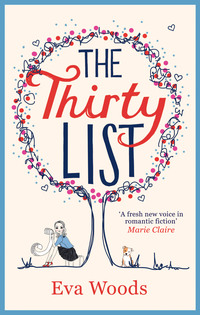
Kitabı oxu: «The Thirty List»

EVA WOODS grew up in Ireland and lives in London, where she writes and teaches creative writing. She likes wine, pop music and holidays. And she thinks that online dating is like the worst board game ever invented. This is her first romantic comedy.


www.millsandboon.co.uk
MILLS & BOON
Before you start reading, why not sign up?
Thank you for downloading this Mills & Boon book. If you want to hear about exclusive discounts, special offers and competitions, sign up to our email newsletter today!
SIGN ME UP!
Or simply visit
signup.millsandboon.co.uk
Mills & Boon emails are completely free to receive and you can unsubscribe at any time via the link in any email we send you.
To Alexandra Turner,
my favourite primary-school teacher
Table of Contents
Cover
About the Author
Title Page
Dedication
Prologue
Chapter One
Chapter Two
Chapter Three
Chapter Four
Chapter Five
Chapter Six
Chapter Seven
Chapter Eight
Chapter Nine
Chapter Ten
Chapter Eleven
Chapter Twelve
Chapter Thirteen
Chapter Fourteen
Chapter Fifteen
Chapter Sixteen
Chapter Seventeen
Chapter Eighteen
Chapter Nineteen
Chapter Twenty
Chapter Twenty-One
Chapter Twenty-Two
Chapter Twenty-Three
Chapter Twenty-Four
Chapter Twenty-Five
Chapter Twenty-Six
Chapter Twenty-Seven
Chapter Twenty-Eight
Chapter Twenty-Nine
Chapter Thirty
Chapter Thirty-One
Chapter Thirty-Two
Chapter Thirty-Three
Chapter Thirty-Four
Chapter Thirty-Five
Chapter Thirty-Six
Chapter Thirty-Seven
Epilogue
ACKNOWLEDGEMENTS
Endpages
Copyright
Prologue
If you believe the films, there should be a moment in life when it all comes together. When you’ve got everything you ever wanted, and your happy ending is here. The music is swelling. Everyone’s smiling at you.
Well, this was mine. This was my happy ending. And I was more terrified than I’d ever been in my life.
Beside me in the portico of the church, Dad was nervously tying and retying his cravat, ready for the short walk we were about to undertake. It was only thirty seconds, tops. But once it was over, nothing would be the same again. I’d be married to Dan. I’d be someone’s wife.
‘All right, Muffin?’
‘Just a bit … you know.’
‘Nervous?’ In fact, I was frozen in terror, unable to move my vintage-style Mary Janes a single step forward. ‘I don’t blame you. All those eyes looking at you.’ He shuddered. ‘It’s just like my recurring nightmare about being on Countdown and only able to make three-letter words.’
‘Yes, it’s exactly like that.’
‘Except I’ve got my clothes on in this one.’
‘Thanks, Dad.’ Inside the door of the church, the organ was already playing. I hadn’t wanted it—we weren’t religious, but it meant a lot to Dan’s family. I could see his mum, her enormous hat dominating the front row, and his dad looking frail, leaning on a walking stick. He’d had a stroke the month before and was still wobbly. I’d suggested we postpone the wedding, but Dan wouldn’t hear of it.
I clutched my posy of freesias, which was leaking water onto my ballet-length lace dress. My veil was snarled around my face, making me breathless. ‘Dad?’
‘Yes, Muffin?’
‘How do you know? I mean, how can you be sure? About the person you marry?’
‘Eh …’ He looked deeply uncomfortable, and not just because his tie was cutting into his neck. ‘You just meet someone, and you like them, and you make it work somehow. It isn’t hard. Not like Countdown.’
‘But at least Countdown has rules.’
‘You are … fond of Dan?’
‘Of course! Of course. We’re very happy.’ Eight years with barely a row, sliding easily into dating, cohabitation and now marriage. Of course we were happy. We’d even bought a house, in Surrey. After the wedding we’d be packing up and leaving Hackney with the police sirens and falafel joints and shop downstairs that still sold Panini stickers from the 2002 World Cup. Dan had casually suggested it a few months ago, right in the middle of wedding planning. There’d be more space, less crime, a garden. All those things you were supposed to want. I’d already given notice at my job in the cool little design agency above a tattoo parlour in Shoreditch.
‘Muffin,’ said Dad, growing alarmed at my failure to move. ‘We have to go in. Everyone’s waiting. Unless you …’
‘I’m fine! Fine! I’m just nervous!’ Through the crack in the doors, I could see eyes begin to turn, murmurs going up. Looking for me. At the front of the church, my sister, Jess, and my best friends, Emma and Cynthia, were already waiting in their lavender prom dresses. Jess as usual looked stunning. The vicar, a friend of Dan’s family, was in place. This was it, my moment. Just waiting for me to move forward.
Gently, Dad took my arm. ‘Come on, Muffy. You don’t want to go back, do you, call it all off? Because if you do …’
‘No!’ I loved Dan. We had a whole life together. I remembered what he’d said to me yesterday, before he went to sleep at his parents: ‘I’ll never leave you, Rachel. I promise we’ll always be together.’ He’d even stroked my face, although it was encrusted in an avocado skin mask.
‘Even if I look like this?’
He’d smiled. ‘You always look good to me.’
Dad patted my hand. ‘Well, if you can’t go back, you have to go forward. Your time’s up, Muffy.’ He began to hum the Countdown theme tune. ‘Do do-do do-do …’
‘OK, OK. I’m ready.’
‘You know what marriage is, Muffy?’
‘A nine-letter word?’
‘It’s eight letters, Muffs. Honestly, Maths never was your strong point. Anyway, it’s not a word. It’s a sentence.’
‘Um, that’s not helpful.’
‘What I mean is, it’s a beginning. It’s not an end.’
Far down at the end of the aisle, I could see the back of Dan’s head, his ears slightly red with the pressure of eyes watching him, his arms crossed in front of his dove-grey morning suit. I thought of our life together, our new house, our friends, our families. This was right. This was what you were supposed to do. I took a deep breath. ‘OK, Dad. Let’s do it.’
‘Excellent. Consonant, please, Carol!’
The music changed. The doors opened. I started to move forward.
Chapter One
Two years later
Things that suck about divorce, number three: at the exact moment your life has hit rock bottom, and all you need is a particular inspiring tune to lift your spirits and provide guidance and cheer, you can’t find the CD you want because your ex-husband, your soon-to-be ex-husband, has moved it and you can’t ask him where it is, because, you know, you’re getting divorced and it probably isn’t very high up his list of concerns.
I was lying on the floor on my stomach, feeling under the shelving unit we use—used—to keep CDs in. Where the bloody hell was it? Why would he take the KT Tunstall CD? KT Bumstall, he called her.
When my friends came back into the room, staggering under boxes, they found me still on the floor, weeping and trying to hum my own jaunty backing track in a voice choked with tears, dust and the two-bottles-of-Chardonnay hangover I was nursing from the night before.
‘Rach! What is it now? Did you find another one of his socks? Did you listen to your wedding first-dance song?’ Emma rushed over, dropping her box into Cynthia’s awkward embrace.
‘Careful, Em! That’s the Le Creuset in there! You could have crippled me.’
I was babbling. ‘KT … Can’t find it … Need the song!’
‘What song?’
‘That one!’ In the depths of my grief, I couldn’t remember the name of it. ‘The makeover montage song. From The Devil Wears Prada. You know, the one that goes—do do do-do do-do-do. I need it! So I can walk along in great shoes and get a dream job and nice clothes, even if my boss is mean to me, and everything will be OK!’
Emma and Cynthia exchanged a look, then Cynthia took out her iPhone and pressed some buttons. ‘Do you mean this one?’ ‘Suddenly I See’ began to play out of the phone, slightly tinny.
I was still crying. ‘This is rock bottom! I need to listen to this song and then feel better and walk along in my heels. You see?’
‘You aren’t wearing heels, darling,’ said Cynthia kindly. ‘You think they’re tools of patriarchal oppression, remember?’
On my feet were mud-encrusted purple welly boots, which I had donned for uprooting some of the plants I’d grown in the garden, thinking I might pack them in a box and take them with me, before realising this was crazy, as I had nowhere to live, let alone a garden. That’s what you do when you’re getting divorced. You go crazy. I started crying again. ‘I know! I don’t even have any heels! Everything is awful!’
Emma and Cynthia had a quick muttered eye-rolling chat, and then Emma called out to me in a ‘talking to a mad person’ voice: ‘Look! We’re walking for you, love!’ They were marching up and down my soon-to-be-ex living room on the exposed wooden floor, Emma in sensible walking shoes and Cynthia in expensive brown knee boots.
We had noticed several subtle changes in Emma’s character since she became a primary school teacher: one, an exponential increase in bossiness; two, a habit of asking did we want to go to the toilet before we went anywhere; and three, the total loss of any physical shame. Now she was prancing about the floor, accompanied by an eye-rolling Cynthia, who gamely waved her long limbs about, then broke off as the song stopped and her phone rang. ‘Cynthia Eagleton. No, for Christ’s sake, I said send them out already. Listen, Barry, this is a serious question—what do you mean that’s not your name? Never mind, I’m going to call you Barry. Can you not do anything for yourself? How do you manage to get out of bed in the morning? Just get it done.’ She hung up, sighing. ‘I swear it’s a miracle he can even blow his own nose, that boy.’
‘Was it hard for you to get a day off?’ I mumbled dustily.
‘Only about as hard as it was for Richard Attenborough and his mates to get out of that prison camp. But don’t worry, darling. I’m here to help. Barry, or whatever his name is, will just have to learn to tie his own shoelaces.’ Cynthia’s had a lot to contend with in life. Not just the fact her mum saw fit to call her Cynthia—there was some great-aunt’s will involved—but also the fact she was ten years older than her siblings, and the only one to be fathered by her mum’s first love, who’d been deported back to Jamaica before Cynthia was even born. Still, she’d clawed her way up to a top legal job, she strikes terror into the hearts of her colleagues and she does have really nice hair.
Emma looked down at me kindly. ‘It’s good you want to listen to this song, you know. You’re done with all that R.E.M., then? Sixteen renditions of “Everybody Hurts” in a row?’
‘Not sure,’ I mumbled into the floor.
‘Well, you’ll have to be, because I’ve buried the CD in the garden and I’m not telling you where.’
‘Oh.’
‘Do you want to get up now?’
‘Not really.’
‘Come on, love. I’ll give you a sticker.’
So this was me, Rachel Kenny, aged thirty, imminently to be divorced, having to be prised away from my hardwood floors, my back-garden hydrangea and my wind chimes and exposed-brick chimney piece. All those things I barely looked at but saw every day, and which were mine. I had floor dust down my front and was wearing an old college sweatshirt, partly because everything was packed, and partly because I had owned it before I met Dan, and I wanted to try to reset to that person.
This was the kind of crazy logic I was operating on at this moment in time. Things that suck about divorce, number seven: you go completely and totally out of your tree.
Finally, after two emergency trips back for things I’d forgotten that seemed really important at the time (hairbrush, muffin tray, mop), we were in the van Emma had hired me.
‘Ready?’ Cynthia asked me, settling into the wide front seat.
‘I don’t know. It’s … My whole life was there. I don’t know what I’m going to do now.’
She squeezed my arm with her manicured hand. ‘I know, darling. But what’s that thing your dad always says?’
‘Um … Countdown’s never been the same since Carol left?’
‘No, I mean that other thing. If you can’t go back, you have to go forward.’
I stared back at the house. Dan would be coming back later. I didn’t even know where he’d been staying while I moved my things out. This was what we’d come to. ‘Do you think I should leave him a note? I mean, I can’t just … go. That can’t be the last conversation we ever have. We were together for ten years!’
They exchanged another look. ‘We’ve talked about this, Rach,’ said Emma gently. ‘I know it’s hard, but this is just how it has to be.’
We drove off. The house receded in the mirror to the size of a Lego cottage, till I almost felt I could pick it up and pop it into the pocket of my hoody, and then I couldn’t see any more anyway because of the tears filling my eyes, spilling out and running down onto my dust-stained front. Cynthia passed me a flowery tissue and Emma patted my hand as she cut up school-run mums in massive Jeeps. I closed my eyes.
Things that suck about divorce, number nine: moving out of the home you spent years creating, with nowhere else to go. And remembering halfway up the M3 that you left the KT Tunstall CD in the car, which was no longer yours, along with all the rest of your life.

I cried four times on the journey from Surrey to London. One was in the forecourt of a garage while Emma filled up (Cynthia refused to get petrol on her green leather driving gloves). Dan and I had done a lot of driving when we first got married and bought our car, a fourteen-year-old Mini. When we still had things to say to each other. We’d get the worst compilation CD we could find in the garage—Seventy Valentine’s Day Rockers! Fifty Smooth Driving Tunes!—and sing along, eating crisps, our hands touching in the greasy packet. I wondered if I’d now be sad every time I went to a garage for the rest of my life. It would make popping out for a Twix quite problematic.
One good thing about crying is it’s quite a useful way to pass the time, if you don’t mind chronic dehydration and people staring at you, so the journey went by for me in a blur of motorways, hiccuping sobs and love songs on Mellow Magic FM, and soon we were at Cynthia’s Chiswick-based palace. She has three storeys and even a garden you could swing several cats in.
We had stopped. The girls were looking at me, worried. I wiped my face, feeling like one of those criminals who needed to be bundled out of court in a blanket. You messed up your marriage, Rachel Kenny! Even though you had three Le Creuset pans and a fixed-rate mortgage! This court finds you guilty of being an idiot!
‘Come on, darling,’ said Cynthia. ‘Let’s get you down for the night.’
‘I’m not a baby, you know.’
‘Funny,’ Emma said, ‘because with all the crying and dribbling, it is actually quite like being with a baby.’
I gulped. ‘At least I still have bladder control. Unlike you that time with the Red Bull shots.’
Emma smiled and patted me on the hand. ‘That’s my girl. Don’t let the bastards grind you down.’
Cynthia actually had a spare room, with a bed and soft white sheets and a carafe of water on the bedside table, plus arcane things like armoires and runners that I’d only ever seen in design magazines. Once I was settled into bed for the night—completely shattered, all my stuff in archive boxes, with no idea where my toothbrush might be—my phone bleeped with a text. Dan? My heart did a sort of funny swoop and fall, guilt and sadness and something else all in one. But no, of course it wasn’t Dan. I doubted he would ever text me again. It was Emma, asking if I was OK. I didn’t know how to answer that, so instead I composed imaginary texts to Dan, supposing he were actually talking to me and might listen to what I had to say.
I’m sorry. I’m so, so sorry. Please let me come home.
I miss you.
I can’t do this on my own.
I didn’t send them, and for the rest of the night my phone stayed as dark and silent as the R.E.M. CD that was now buried somewhere under my bedding plants, ex–bedding plants, in a garden I’d probably never see again. I thought of him saying two years before: I’ll never leave you, Rachel.
Yeah, right. But then, neither of us had exactly kept the promises we made that day.
Chapter Two
When I woke up in Cynthia’s white-cotton-and-distressed-wood (why would it be distressed? It’s in a lovely house in Chiswick. I’ve never understood that phrase) spare room, I’d no idea where I was for a moment. Had I fallen asleep in a branch of the White Company? Then it all came back and I felt the first tears of the day push against my eyelids. None of that. Today I had to find somewhere to live. I got ready in the en suite, with its rainfall shower and roll-top bath (if I was very quiet, maybe I could just stay here forever) and dressed in jeans and Converse. I brushed my hair, as I had to appear like a normal functioning member of society today, and that was hard for me at the best of times.
Cynthia was at the scrubbed wood table with The Sunday Telegraph—she married a Tory; I know, but it can happen to your dearest friends sometimes—croissants and fresh coffee. Unlike how I’d have been on a Sunday in my own kitchen—toothpaste-encrusted jammies and butter in my hair—she was dressed in a grey wool dress and different, equally expensive knee boots. ‘There you are. Ready for the first day of the rest of your life?’
‘I thought that was yesterday.’
‘No, that was the last day of … a different bit of your life.’
‘Catchy.’
‘Croissant? Bagel? Scrambled eggs? Toast?’ Cynthia was one of those people who would hostess you to death if you let them.
‘Croissants would be lovely, thanks. Do you have any tea?’ It was tragically uncool, but I’d never learned to like coffee.
Cynthia found some PG Tips hidden shamefully in a cupboard, holding them away from her as if they were toxic waste, or a shopping bag from Lidl. ‘They must be the cleaner’s.’
Of course they had a cleaner.
She furnished me with tea, croissants, jam and bits of the paper. ‘What do you want to be depressed by? The stagnant house market, the rising price of ski holidays or the dangers of uncontrolled immigration?’
‘I’ll take immigration. I need a laugh. You know, you should get them to interview you. Young Tory lawyer who had a black immigrant dad. They’d choke on their crumpets.’
Oh dear. Maybe I shouldn’t have mentioned her dad. But she only said, ‘I’m not a Tory. I just married one. It could happen to anyone.’
‘Where is Rich, by the way?’ It was easy to forget someone else lived in this palace of white and sisal; he was so seldom there.
‘Went into the office.’
‘On a Sunday?’ Of course he did. I shouldn’t have asked. I might have been a lot poorer than most of my friends— if we were the UN, I’d be Yemen—but at least I could lie in bed and mope whenever I wanted to. You couldn’t put a price on that.
I was reading an article on house prices and feeling gloom settle over me. ‘I’ll never get on the property ladder again. There’s a cardboard box here for sale for a hundred grand. Apparently, it’s “bijou” and “compact” and made of “environmentally friendly materials”.’
‘You’re not off the ladder. You’ve just stepped away for a while, is all.’
‘Fell off, more like.’
‘Frank fell off a ladder once. Broke his leg in three places.’
That was me, I reflected gloomily. Fallen back to earth with a crash, while up above me everyone else just kept on climbing that damn ladder. It was like doing gymnastics in PE all over again. ‘How are your mum and Frank?’
‘Fine. Talking about joining the Caravan Club, so that’ll be nice and embarrassing for Rich’s parents when we have them over at Christmas. They think caravans are for stable hands and New Age travellers.’
I wondered again how Cynthia felt about the fact her dad had never tried to contact her. I’d known her as long as Emma, the three of us meeting in the first term at Bristol Uni, huddling together in a refuge against the posh girls with long blonde hair, ski outfits and double-barrelled names, but sometimes I still had no idea what she thought about things.
‘So you’re house-hunting today?’ she said.
‘Urgh. Yes. Nightmare.’
‘You can stay here as long as you like, you know that?’
‘Thank you. But I think me and my existential crisis need a room of our own.’
Cynthia dropped me off at the station in her BMW, pointing out helpfully where I had croissant flakes in my hair, and I began the first of my viewings.
Two years ago, when we were still congratulating ourselves on our good life decisions—getting married, eating five portions of fruit and veg a day, opening pensions—Dan and I had bought a semi in suburbia, which wasn’t much but had two bedrooms, a bathroom that wasn’t incubating new species of mould, and a small scrappy patch of grass where we sentimentally thought our children would play, and before that our border collie, or golden retriever; we hadn’t got that far yet. Remembering some of the places I’d lived before this, I dreaded flat-hunting.
Now, I like to think I’m a fairly positive person.
I mean, I’m not, not at all, but I like to think it, and I try to give what my Buddhist friend Sunita calls ‘a cosmic yes to the universe’. Spending the day flat-hunting in London is enough to make you give a giant no, no, no, and hell no to the universe, and crawl back into bed with the duvet over your head, reflecting on how you can’t really afford a bed, or even a duvet. My day went something like this:
The ‘sunny studio’ in Sydenham turned out to be one room with a single bed in a house share of five other people, one of whom showed me the room wearing just a pair of Y-fronts and a jokey rape-themed T-shirt. ‘You’re OK with parties, right? One house rule though is everyone, like, has their own stash. It’s just cooler that way.’ No.
The ‘quiet garret room’ in Blackheath was a single bed in an alcove off the living room of a nervy older lady.
‘There’s no door?’ I said, edging to the window. The place was where light came to die and there was a strong smell of cat pee.
‘Oh, no. The little ones don’t like to be shut out.’ She said this cooing at one of the three cats I had spotted so far, a black tom with a scar over one eye and a malevolent glare out of the other.
The bedcover was chintz, approximately forty years old, and as she showed me it, a different, ginger cat jumped off the wardrobe and raked its claws over my neck. ‘Oh, he likes you!’
No.
The ‘lovely room in modern flat with friendly city gent’ in Docklands turned out to be a nice place, if a bit ‘chrome and leather are the only decorative materials that exist, aren’t they’ for my taste, but I was followed round at a distance of three centimetres by Mike, the owner, who told me at least five times he didn’t need the money, like, he earned a packet in the City, but he wanted a bit of ‘feminine companionship’ round the place. No.
The ‘delightful double in house with fun girl’ turned out to be the living room, turned into a bedroom, in the flat of Mary from Camden, who handed me a list of her ‘house rules’ when I stepped in. First was, always take off your shoes when entering and put on special slippers, which were embroidered with cat faces.
No, no, no, hell no.


The only thing that made house-hunting vaguely bearable was to imagine I was researching locations for a new gritty TV show where people got murdered in the dingiest possible flats. CSI: Croydon. I put in my headphones as I trudged about and asked myself what Beyoncé would do, as I often pondered in moments of stress. Well, probably she’d charter her private helicopter and get airlifted to one of her mansions, so that was no use. I repaired to a café in Kentish Town, trying to cheer myself up with tea and a Florentine. Then the bill came to £4.50 and I realised I might not be able to afford cafés at all after this. I’d have to be one of those people who knitted jumpers and always took their own sandwiches wrapped in tinfoil, just like at school. This wasn’t what I’d grown up for. It was depressing indeed to realise you were no further up the pecking order than you were at seven.
I was on my phone, scanning the property websites for anything under £700 that didn’t look likely to have fleas/mould/sleazy landlords. Could I live in Catford? Was that even in London? Would I be able to stomach a large flat share, given I currently worked from home? Alternatively, could I live and work in a studio flat where you couldn’t open the fridge without moving the bed? Could I possibly get my freelance work going again to the point where I’d actually make some money?
I began scrawling figures on a napkin, but it was too scary, so I ordered another Florentine instead and then worried about money and calories and being single again at thirty. Not even single. Divorced.
I was getting back into some very bad thoughts—you should ring Dan, beg him to take you back, you can’t afford this, you can’t manage alone—when my phone rang. Emma. ‘Are you busy?’
‘No. Just contemplating the ruins of my life.’
‘Oh dear, is it not going well?’
‘Put it this way, the only person with less luck than me at choosing where to live is Snow White. I’ve seen most of the seven dwarves today—Grumpy, Horny, Druggy …’
‘Remind me again why you had to move out. It was your house too, and he was the one who wanted—’
‘I couldn’t afford the mortgage on my own. And you know it’s better to be in London for work.’ Work that I didn’t have yet. I wasn’t going to think about that.
‘Well, check your emails. I just sent you something.’
‘OK, let me find my phone.’
A pause. ‘You’re on your phone now, Rach.’
‘Oh, right. What did you send?’
‘An amazing flat share. It’s in Hampstead, lovely garden and house, but, best of all, it’s free!’
‘What? How is that possible?’ I was thinking of Mike, the ‘city gent’.
‘There’s some house-sitting and pet-sitting involved.’
‘Pets?’ I said warily, thinking of the cat house—ironically, not in Catford.
‘A dog.’
‘Oh my God!’
‘I know. So call them now! When I get off the phone, I mean.’
Sometimes I wondered if my friends thought I was a complete idiot. ‘Thanks. You’re sure it’s not a sex trafficking thing though?’
‘You can never be totally sure.’
‘Oh.’
‘I’ve got the address just in case.’
‘Thanks.’
‘I can craft the orders of service for your funeral. I just got a new glue gun.’
‘I’m going now! Bye!’
I hung up and waited for the email to download.
A flip of excitement in my stomach—when you reached thirty, property websites gave you the same feeling that dating websites did in your twenties. Not that I’d ever dated. The house was beautiful—three storeys of red brick, set among trees, and there was even a turret! Oh my God. I read on. Underfloor heating, en suite room, massive kitchen with dishwasher—some of the places I’d looked at didn’t even have washing machines. What was the catch? As I’d learned from my property search, there was always a catch. Under price, it said ‘N/A’. Could there really be no charge? I looked at the number listed and on impulse dialled it. I was only ten minutes from Hampstead, after all.
It went to voicemail. A man’s voice, deep and clipped. Slightly posh. ‘This is Patrick Gillan. Please leave a message.’
Voicemails are my nemesis. Cynthia still talks about the time I rang her at work to tell her I’d seen cheap flights to America, and ended up singing ‘Hotel California’ down the line while her entire office listened on speakerphone.
‘Erm … hi. I saw your ad. I’d like somewhere to live. I don’t have much money at the moment—’ Oh no, I shouldn’t have said that. Like with jobs and dating, the only way to get a room you really needed was to pretend you didn’t need it at all. ‘Erm … I mean, I’m looking to relocate and I am most interested in your room. I should like to view it at the earliest convenience. Erm … I’m down the road right now. Call me. Oh … it’s Rachel.’
I hung up. Classic rubbish voicemail, I’d managed to sound mad, posh and needy all at once. I paid for my biscuit and went out into the drizzle. Approaching me was a shiny red bus, slick with rain and the word ‘Hampstead’ on the front.
I’ve heard people say that they sometimes have moments when they feel as if Fate is tapping them on the shoulder and saying, ‘This way, please,’ like one of those tour guides with the little flags being followed around by Chinese tourists in matching raincoats.
I’ve never had this happen. Even if I did, I’d get stuck on the Northern Line and Fate would have left for another appointment. But that day I thought, sod it, I’m getting divorced, I have nothing to do and the bus is right there. So I got on. And, ten minutes later, I found myself ringing the bell at the house of Patrick Gillan.
Chapter Three
As I stood on the doorstep of a house on a tree-lined street in Hampstead, a dog started barking inside. I smiled. There really was one. I caught sight of myself in the shiny door knocker and sighed. My hair was frizzy with rain and I wore a fraying mac, jeans and holey Converse. When I worked in an office, tights were the bane of my life, like having cling film applied to your most delicate areas, always wrinkling round your ankles or laddering if anyone breathed in a ten-mile radius. So since going freelance—this was how I was choosing to describe my current circumstances to myself—I mostly worked in jeans … OK, pyjamas. The door had panels of stained glass, and I saw someone approach, turned different colours by the light. I stuck on my best ‘not a crazy person’ smile. The man who opened the door was holding a phone in one hand, and with the other had a barking Westie by the collar. ‘Shut up, Max!’ He, the man, not the dog, wore jeans and a soft blue-grey jumper. He had greying curly hair and a cross expression. ‘What is it? I don’t plan to vote in the council elections. Not until you do something about the disgraceful state of your recycling policy.’
‘No— It’s— I saw your ad. The room. I was in the area and …’
He stared at me for a few moments while the dog tried to climb up me.
‘I’m not mad,’ I said quickly.
‘That’s good to know.’
‘I suppose a mad person might say that.’ I laughed nervously.
He looked me up and down. Sighed. ‘You better come in.’
Sometimes, when you walk into a place, you know you were meant to be there. It just smells right or something. Dan hated this method I had of choosing houses. What do you mean it didn’t feel right? It’s got outdoor decking and a dedicated parking space!
‘It’s amazing,’ I said. The inner doors all had stained-glass panels, filling the hallway with a kaleidoscope of colour. The floor was old-fashioned parquet, a little scuffed, and the place smelled of coffee and daffodils, of which there was a large handful crammed into a jam jar. I could tell instantly it was a middle-class home because:


The man still looked cross. ‘Come into the kitchen. I’m in the middle of something, so I wish you’d waited, but never mind.’
‘You’re sure?’
‘I said so, didn’t I? Do you want coffee?’
‘Oh, thank you, I don’t drink it.’ I may as well have said I didn’t believe in changing my socks.
‘You don’t?’
‘I don’t like the taste. I like the smell and I love coffee cake and those sweets you get in Roses. Isn’t that weird? I mean, hardly anyone likes those.’
He studied me. The phone in his hand chirped and he looked at it, frowned. ‘Tea, then?’
‘Yes, please.’
‘How do you take it?’
‘Milk, quite strong, but sort of milky if that makes sense.’
Once I sat down, the dog scampered across the kitchen and hurled himself onto my knee, where he crouched with his chin on my shoulder, panting. ‘Oof! Hello.’
‘He goes mad for new people. Sorry.’
‘It’s OK. I wish I had that effect on men.’ Oh, shut up, shut up, Rachel. Another side effect of working alone—you forget that there are supposed to be ‘inside head’ thoughts as well as ‘outside head’ sayings.
Patrick peered at the kettle. ‘So, Rachel—that’s you, I assume? What made you want the room?’
‘Honestly? I need somewhere to live at short notice. I also work from home at the moment, so I can’t really be in a big flat share.’ Or the sex slave of a rich city banker, come to think of it. All the sex-slaving would probably cut right into my freelancing time.
He was still frowning. ‘And where have you been living?’
‘Out in Surrey. I owned a place.’
‘Don’t you want to buy again, then?’
Things that suck about divorce, number fifteen: having to explain it to strangers. ‘My husband and I are splitting up. He’s keeping the house for now, so I have to move out.’ I cuddled the dog. ‘I’m in bit of a bind. But—’
‘You’re not mad.’
‘No.’
‘You’re getting divorced.’
‘Yes.’
He leaned against the counter and I saw he had no wedding ring on. ‘Join the club.’
‘Oh.’
‘Not much fun, is it?’
‘It sucks. In fact, I’m keeping a list. Things that suck about divorce.’
‘How many things are on it?’
‘Several hundred and counting.’
‘How about this one?’ The kettle had boiled, but he kept staring out the window. The phone beeped again, but he ignored it. ‘Having to find a lodger so they can dog-sit and look after the house, because you spend too much time at your job, and that’s why your wife left you in the first place, because with all the time she was on her own she had to find new hobbies, like, for example, having an affair with the next-door neighbour?’
I followed his gaze to the house just visible over the fence and nodded slowly. ‘I’ll put that one in after having to move out of the house you bought in the suburbs because your husband doesn’t want you there any more, but not being able to rent anywhere in London because you’re broke, so your only option is to move into massive house shares, or live with mad cat ladies or sex pests, or … answer weird ads that don’t list any rent.’ I paused. There were posh Waitrose biscuits on the table, so I crammed one into my mouth to shut myself up.
Patrick Gillan was watching me curiously. ‘Look, I have a demanding job, so I need someone here during the day, to be with the dog and take deliveries and maybe do some light au pairing, but I can’t afford a full-time housekeeper. I was just … thinking outside the box. I thought someone might do it in exchange for free rent. It was sort of a mad late-night idea, to be honest. I’m kind of at my wit’s end here.’
Free rent. FREE RENT. Suddenly, I was ripping up the calculations I’d done on the napkin and feeling a large weight lift from my chest. I wouldn’t be totally broke. I wouldn’t have to bring my own sandwiches when we went to Pizza Express and divide up the cost of each dough ball. He was still looking at me. ‘Why are you here, Rachel? I mean really?’
I was a little high on all this unexpected honesty, among the lies you get told when looking for a place to live, about south-facing lawns and nearness to transport and exactly how many cats there are in a given household. ‘Really? When I got married, we moved to Surrey and my husband, I mean, my ex—’ it was hard to say the word ‘—got me a job at the local council where he worked. Graphic design. But then he asked me to move out, and coincidentally, the next day, I was made redundant.’
He was still looking at me. ‘Kettle’s boiled,’ I pointed out. The biscuit was lodged in my dry mouth.
He shook himself and got a cup. ‘So you’re at home all day?’
‘Most days.’ I held my breath. This had been a problem with many of the rooms I’d looked at, landlords muttering about extra bills and so on. ‘I’m going to look for a job, obviously, but also try to build up my freelance work. I used to do a bit on the side.’
‘And you like dogs?’
‘Love them.’ I stroked Max’s head. ‘I was about to get one, but then—well. Everything happened.’
‘And would you mind sort of housekeeping a little, answering the phone, getting parcels, maybe sticking dinner on?’
‘Of course. I love cooking. And I don’t smoke and I’m … fairly tidy. You mean you literally wouldn’t charge me any rent?’ I looked at him suspiciously. ‘What’s the catch?’
He laughed, and instantly he looked ten years younger, happy, even a little wicked. ‘I was wondering the same about you. I suppose I should ask for references.’
‘Well. My previous landlord is my ex-husband, and my current boss is myself. Can you prove you’re not a mad killer?’
‘It’s hard to prove a negative.’
‘Hmm.’
‘Phone a friend, tell them where you are.’
‘But I would be dead by the time they found me.’
‘True, but at least you’d have a nice funeral.’
I was still thinking when there was a noise and the back door opened, and in trudged a small child in red wellies, clutching a big muddy bunch of daffodils. He was gorgeous—dark glossy curls, brown eyes. Maybe four or five. ‘I got some more, Dad.’
‘That’s good, mate. Give them here.’ Patrick looked at me over the child’s head. ‘I may as well explain—this is the catch.’
‘Cynth!’ I hissed.
‘Hello? Who is this? I’m not interested in PPI claims, thanks. Unlike some, I wasn’t stupid enough to buy it in the first place.’
‘It’s me. Rachel.’
‘Ohh! You’re still alive, then.’ I had emailed her to tell her about the possible flat share, figuring the more people who knew the better for retrieving my murdered corpse.
‘I took the room. God, the place is gorgeous.’ The room I was sitting in had more stained glass in the window, which looked out over Hampstead Heath. It was on the third floor, filled with light. I could put a drawing table in the window. There was an old wooden bed, a thick cream carpet and an en suite with a deep claw-foot bath. On the bedside table was a jar with more daffodils.
‘Alex,’ Patrick had said when he’d shown me up. ‘He won’t stop picking them.’
Ah yes. Alex.
‘So is it really OK? How on earth can he be offering it free?’
‘Well, there’s a kid.’
‘Ugh,’ she said. Cynthia felt about children the way most people felt about mould spores—some unfortunates had to live with them, but careful vigilance could prevent them from ever taking hold in the first place.
‘The dad, he’s getting divorced, so he has the kid.’
‘Where’s the mother?’
‘I’m not sure. Gone overseas to work for a while, I think.’
‘I see. He wants a free nanny.’
‘Well, Alex will be at school during the day. I think Patrick just wants someone to be here. Answer the phone, put the washing machine on.’ He’d described it as ‘Maybe I can help you, and you can help me’. I understood, I thought.
Cynthia was talking. ‘Make sure it’s not a de facto employee post, sweetie. You know how people are. Since you’re there could you just make the dinner, and do the shopping, and re-grout that bathroom … Working from home still means working.’
‘I know. But where else can I go? This is a million times nicer than anything I could afford.’
‘Well, OK. If you’re happy.’
I realised I’d talked myself into staying here, and before I knew it I was arranging to collect my things and move in that very night. Me, my ten thousand sketchbooks, my fifteen pairs of trainers and Bob the dog-substitute bear were going to make our home here.
Alex, apparently the world’s most biddable child, had presumably gone to bed when I came back with the van, and Patrick was in the kitchen with an iPad and glass of wine. There was a smell of stew in the air and a Le Creuset dish soaking in the sink. It felt weird. Like coming home, but to a home that wasn’t mine. He jumped when I let myself in, and I wondered if he’d forgotten he’d given me a key or, worse, forgotten me entirely. ‘Hello,’ I said.
‘Hi. You’ve got … things?’
‘Yes.’
‘I better help you.’
We hauled my meagre goods up the stairs. ‘What’s in here, rocks?’ Patrick asked, and I’d had to admit that yes, there were rocks in some of the boxes; I collected them for drawing practice. Dan had kept all the Ikea/Argos chipboard that furnished our marital home, so there wasn’t much. ‘Do you want a glass of wine?’ Patrick said, when the room was a mess of boxes and cheap Ikea blue bags.
I did, but I felt odd about sitting with him, and I was worried I’d been drinking too much as my marriage fell apart. ‘I’m OK, thanks. I’m very tired.’
‘I’ll leave you to it, then.’
I liked to think I was fairly spontaneous and fun. The kind of girl who’d jump on a train to Madrid with only the clothes on her back and not even book a return flight in advance. The kind of girl who bought train tickets at the station instead of getting them online for up to a third less. Who didn’t know what they were doing three weekends hence but was fairly sure it would involve a music festival and a twenty-four-hour drugathon with dubious men in goatees, and not a trip to Ikea for a new magazine rack.
I wasn’t spontaneous. Plus, I hated goatees. Things that suck about divorce, number twenty-two: nothing is where it should be. If you wanted to make your famous lemon risotto, the recipe books were still in the house, and you didn’t manage to get custody of the food processor. If you wanted to go hiking, your boots were in the car your husband/ex-husband was still driving to work every day. You wanted to wear a blue dress and realised it was at the dry cleaner’s, the ticket God knows where, and you weren’t making the thirty-mile trip for a frock from New Look anyway.
Nothing is where it should be. Not you. Not your heart. Not your life.
Finally, I’d unpacked nothing but my toothbrush and pyjamas, but I was in bed and was listening to the unfamiliar house around me. The trickle of old plumbing. The creak of the attic. I took out my phone—my screen saver was still a picture from two years ago, Dan and I doing a selfie at our wedding. He was planting a kiss on my cheek and I was smiling widely, as if I couldn’t even imagine a time when we wouldn’t be that happy. I thought about texting him to tell him I’d found somewhere, but I knew he wouldn’t care. That was another thing that sucked about divorce. You were hurting and lost and alone, and the only person you could think to tell about any of it was the one who no longer wanted to talk to you at all.
Chapter Four
When I woke up, it was the day after the first day of the rest of my life. No one ever talked about that. That’s the day when you have to live with your momentous decision, start redirecting post, unpacking boxes. My overwhelming wish was to lie in bed, sorrowfully dwelling on the terrible mess I’d made of my life. When you’re freelance, you see, you have those luxuries. But I didn’t get the chance, because I was woken at six by a tapping on the door. Mice? Ghosts? I cleared my throat. ‘Hello?’ Indistinct mumbling. A shy ghost? ‘You can come in!’
There was a fumbling and the door creaked open. In flew twenty pounds of overexcited dog. Max leapt up on the bed, where he rolled over with his feet in the air, indicating I could do as I wished with him. Sadly, it was only dogs who reacted this way to me in bed.
In the doorway stood Alex, holding yet more dripping daffodils. He wore one red welly, the other foot clad in a stripy sock, and a pretty on-trend onesie with Thomas the Tank Engine’s face on front. ‘Hello,’ I said.
‘’Lo.’ He stared at me out of his dark eyes.
‘Those are nice flowers.’
‘Flarrs for you,’ he muttered, darting in and crushing them onto my bedside table, where they left green smears.
‘For me? Thank you, Alex.’
‘Mummy likes flowers.’
Awk-ward. ‘I’m sure she does. And how is Max today?’
‘He’s not allowed on the bed.’
‘Is he not? He’s naughty, then, isn’t he?’
‘Yes. Can I come in the bed?’
‘OK. The more the merrier.’ Alex needed my help to get up, and I suggested he leave the remaining welly behind. He sat cross-legged, looking at me.
‘What’s your name?’
‘Rachel.’
I pitched around for four-year-old conversational topics. I liked kids but was still having conflicted feelings over whether I wanted them or not. Dan and I hadn’t even been able to manage a dog. I could feel the panic reach up in me from the pit—the one of ‘I’m broke and thirty and I’ll be alone forever’—so I focused on Alex. It’s hard to have existential horror when you’re with a four-year-old. They barely understand the concept of ‘tomorrow’ let alone ‘the rest of my miserable life’.
‘So who’s that on your onesie?’
‘’S Thomas.’
‘Oh yeah? Who’s your favourite person in Thomas?’
Alex and I were having a little chat about animated trains—I bluffed my way through, my sister has kids—when I heard footsteps coming up the stairs and Patrick burst in. He too wore a onesie in a fashionable nautical stripe, a thick grey jumper on top. ‘Alex! I told you to leave Rachel alone. She was sleeping.’
‘No, she wasn’t,’ said Alex, with impeccable logic. ‘Brought her flarrs.’
‘Yes, we’ve talked about this, mate. We have to leave some of the flowers in the garden or there won’t be any more. Come on, get down. You too, Max.’ Child and dog slid off the bed. Max waddled out, wagging his little tail and wheezing. Alex clung to his dad’s hand. Patrick took a look at me, in my alluring sleepwear—Bruce Springsteen T-shirt, fleece pyjamas with sheep on. ‘I’m sorry about them.’
‘It’s OK. It’s a nice way to wake up.’ Then I worried he’d think I meant him in his onesie, so I quickly said, ‘Max and Alex, I mean—I’ve always wanted a dog.’
‘That’s fortunate, because Max is very hard to shake off. I found him inside my coat the other day. I’ll try to keep them both out of here.’ He looked round at the mess of boxes and bags, paintbrushes rolling on the desk, reams of paper stacked about the place. ‘You’re an artist, are you? I didn’t quite catch what it was you did.’
‘I’m a graphic designer really, but I used to also be a sort of freelance cartoonist. I do caricatures of people, for weddings and birthdays and that, and sometimes a bit for magazines.’ As I said it, I realised this sounded like the world’s flakiest career, like ‘vajazzalist’, or ‘toenail consultant’. I also realised the room was an absolute tip.
‘I’m not finished unpacking,’ I said hurriedly. I was not tidy. I liked to pretend it was something to do with my artistic temperament, but really I was just a slob and quite forgetful. I’d put down bits of toast and then wonder what happened to them and make some more. It used to drive Dan crazy. That’s how it goes, isn’t it? When you start out, when you’re in love, it seems as if these things could never matter, as if they’re just crumbs in the bed of your love. Then as time goes by, all you can feel is the crumbs. They’re itchy. They keep you awake. I suppose all those little crumbs become a big loaf in the end, rising between you, keeping you apart.
That wasn’t the best metaphor I’d ever come up with. Moving on …
Once I was up, showered in my lovely en suite, and had pushed some of the mess into the fitted cupboards, I stuck on Destiny’s Child’s ‘Survivor’ on a loop, looking for inspiration, and sat on the bed with a notebook to make a list. A list for the rest of my life.
I liked lists. They were my way of trying to put some order on the desperate mess of my life. In fact, I even had a list of my favourite lists, ones I’d been keeping for years:


I opened my notebook—a pretty one with a pink silk cover, my lists deserved the best—and chewed on my pen.
I’d thought my life was going to be all Volvos and trips to Sainsbury’s, dogs and mortgages and maybe babies in a few years. My friend from yoga suggested I think positively about all the things I could achieve now I was ‘on a different life path’—Buddhists are always saying things like this. For example, I’d always wanted to try lots of hobbies. Languages, maybe. Kick-boxing. That looked like fun and would come in handy with all the awful men I’d probably have to date now I was single. Oh God. Dating.
The thought was so depressing I crawled back under the covers, in my jeans and jumper, and lay there panicking about being alone forever.
After a while of this, the phone rang. It was Emma. ‘Hello! Are you lying in bed panicking about being alone forever?’
‘No. Well, yes, but least I got dressed.’
‘Good girl. Now, can you come over tonight? Cynthia has promised she’ll leave work by seven, and Ian will cook.’
‘Will you help me with my list?’
‘Which list is this?’
‘The list of what to do with the rest of my life.’
‘Of course. I love a good list.’ It was true. It was one of the main reasons we were friends.
I agreed to come over and settled down for a good long worry about life.

I must practise some conversation topics for tonight, I thought. House prices might be a good one.
Pulsuz fraqment bitdi.