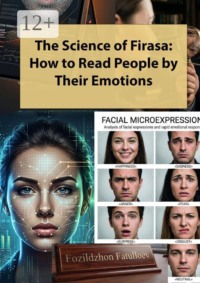
Kitabı oxu: «The Science of Firasa: How to Read People by Their Emotions»
© Fozildzhon Fatulloev, 2026
ISBN 978-5-0071-3750-8
Created with Ridero smart publishing system
Part I. The Science of Reading People
Concept
The book is built on the idea that the human face isn’t a mask that can be removed with a single movement, but a complex system of signals that requires a careful and multidimensional approach. The protagonist of the TV series “Lie to Me,” Cal Lightman, read people instantly, caught microexpressions on the fly, and was almost never wrong. It’s a captivating image, but in real life, such precision is impossible without extensive preparation, an understanding of the context, and the use of modern tools.
Most books on reading people revolve around one figure: Paul Ekman, a pioneer in facial expression research and creator of the FACS facial action coding system. His work is fundamental, but science is constantly evolving. Modern research shows that emotions aren’t always universal, that cultural context alters how expressions are perceived, and that the brain constructs emotions rather than simply reading them from the face. Ignoring these findings means giving the reader an outdated and incomplete picture.
This book opens a broader horizon. At its core is the science of Firasa, both ancient and modern. The term “firasa” comes from Arabic tradition and signifies an intuitive yet practiced ability to discern a person’s hidden intentions and character. Unlike a mystical “sixth sense,” firasa is a skill cultivated through observation, knowledge, and practice.
The book draws on the work of not only Paul Ekman, but also Lisa Feldman Barrett with her theory of constructed emotion, Robert Plutchik with his evolutionary model and the wheel of emotions, James Russell with his circumplex model, Carol Izard with his differential theory of emotion, Richard Davidson with his research on the connection between emotion and brain function, as well as contemporary meta-analyses and critical reassessments of the universality of emotion. This allows the reader to view the field of knowledge as a whole, rather than through the narrow slit of a single school.
The main practical difference is integration with the Firasa app. This isn’t just a theoretical exercise, but a fully-fledged learning and practice tool. Firasa is a personal face-reading assistant that runs right in your browser. Its philosophy is simple: when words lie, the face tells the truth.
The app analyzes facial expressions in real time. The user presses a button, the camera turns on, and information immediately appears on the screen: the emotion being expressed, how strong it is, and which facial muscles are engaged. Next to it is a diagram for the last thirty seconds, showing how the user’s mood has changed. The first few seconds are spent memorizing the user’s typical face; then the app measures deviations from that face, not from an average chart. This is important: every face is unique, and a personalized database provides more accurate results than a universal template.
Firasa captures microexpressions — flashes of emotion lasting from 40 to 500 milliseconds. That’s one to two tenths of a second, impossible to capture with the naked eye. The app tracks each muscle group individually, recording the moment when the movement reaches its peak, saving a frame at that moment, and noting the time. The report shows how many flashes there were, when exactly, and what emotion flashed. This transforms facial expressions from an elusive stream into specific, measurable events.
The app evaluates the sincerity of a smile. Does it involve only the mouth, or are the eyes also involved? This is a classic test based on the difference between a social and a genuine smile, and Firasa performs it automatically, showing which muscles are involved.
Everything happens on the user’s device. The recognition model is downloaded to the browser once and then runs locally — whenever there’s a network connection. Video is not sent to the server; the analysis history is stored in the browser itself. Any recording can be deleted, and the entire history can be cleared. Only the user account information — email, name, and avatar — is stored in the database. This isn’t a marketing gimmick, but an architectural decision: privacy is built into the app’s design.
Firasa generates detailed PDF reports. They include a color legend, diagrams of emotions and states, and key moments with timestamps. At the end, there’s a verbatim summary: which emotion dominated, whether the smile was genuine, and how many flashes there were. The report can be attached to a project, shared with a client, or used for self-analysis.
Training is built into the app. Seventy training lessons: an expression is shown for a split second, and the user names the emotion. The difficulty increases, progress is recorded, and errors are analyzed. Next to it is an explanation of the method itself and an assistant who answers questions about how it all works. This transforms reading people from abstract advice into a concrete, measurable skill, developed through muscle memory.
Firasa is designed for a variety of professions and tasks. Negotiators and salespeople use it to better understand their partners. Coaches and psychologists use it to analyze sessions with the client’s consent. Teachers and actors use it to improve communication skills. Researchers and security specialists use it to analyze behavior. Banks and loan officers use it as additional observation during in-person meetings with borrowers, alongside, not instead of, document verification. Social media users analyze public figures — bloggers, content creators, politicians. In aviation, the app can be used for pre-flight video screening of the emotional state of pilots and crew — fatigue and stress are visible before a person even mentions them. Face control at the entrance to events or important venues means a calm person passes through, while a tense person receives the attention of security. Customs and border control use it during baggage screening and border crossings. Mafia, poker, and debate players — analyzing the recording reveals where they give themselves away, and their skills improve faster than through practice alone. Customer support and sales teams analyze call recordings to understand where customers lost understanding and where they became irritated. Doctors and caregivers analyze recordings to detect pain or anxiety in those who don’t talk about it: the elderly, children, and post-surgery patients.
At the same time, Firasa clearly defines its boundaries. It is an educational tool, created in compliance with all legal norms. It does not detect lies, make diagnoses, or pass judgment on a person. The app displays observable signs and their severity, and the decision is always up to the user. This is important: science shows that behavioral signs are stress, not deception. Stress can occur in an innocent person. Firasa helps us see more, but it does not replace human judgment and ethical responsibility.
Registration takes just half a minute. The app is free and doesn’t require a card. The camera is activated by simply tapping the button. You can get started right away — turn on the camera and see what’s visible on your face.
This book teaches you not how to catch liars, but how to understand people. It shows where science ends and conjecture begins, why context is more important than a single gesture, and how modern technology helps develop the ancient skill of firasa. Each chapter is linked to practice in the app: the reader studies the theory, then opens Firasa, records themselves or analyzes the video, and the theory takes on concrete form. This isn’t a book to read and forget. It’s a book that teaches a skill.
Chapter 1. From Ekman to Modern Science
Paul Ekman — the foundation
In the 1960s, American psychologist Paul Ekman traveled to remote corners of the planet — from New Guinea to Japan — to answer a question that had puzzled philosophers and scientists for centuries: do people express emotions the same way around the world? His answer was revolutionary. Ekman demonstrated that six basic emotions — joy, anger, fear, sadness, disgust, and surprise — are universal across all cultures. Regardless of language, religion, or geography, a person experiencing fear furrows their brow, opens their eyes wide, and tenses the muscles around their mouth in roughly the same way.
This discovery became the foundation for the entire modern science of reading people. But Ekman didn’t stop at theory. He developed the Facial Action Coding System (FACS). It’s a highly detailed atlas of the human face, where every muscle movement has its own code. Raising the inner corner of the eyebrow is AU1. Lowering the corners of the mouth is AU15. Combinations of these codes describe any expression with millimeter accuracy. FACS has become the gold standard used by researchers, animators, forensic scientists, and psychologists worldwide.
Ekman’s most famous discovery is microexpressions. These are brief flashes of genuine emotion, lasting 40 to 500 milliseconds, that a person tries to hide or suppress. They are so fleeting that the naked eye doesn’t notice them. But they are there. And they are involuntary. Ekman demonstrated that microexpressions are a window into a person’s true emotional state, which they try to conceal behind a mask of calm or a smile. This idea formed the basis of the TV series “Lie to Me,” where Cal Lightman catches these flashes instantly, like a predator catches the movement of grass.
But reality is more complex than television drama. And that’s where things get interesting.
Critique of universality
Margaret Mead, the renowned American anthropologist, was one of the first to challenge Ekman. She criticized him for using staged — simulated — expressions in his experiments. In her view, when someone is told to “show fear,” they are displaying not an emotion but a cultural pattern, a social programming. This is not the same as genuine fear, which arises unexpectedly. Mead argued that the universality Ekman discovered was the universality of theatrical facial expressions, not lived experience.
Ekman responded brilliantly. He conducted hidden-camera experiments, observing people’s reactions in natural settings. He compared Japanese and American students watching a stressful video: alone, they expressed disgust equally, but in the presence of a researcher, the Japanese were more likely to hide their negative feelings. Ekman introduced the concept of “display rules” — cultural norms that dictate which emotions can and cannot be shown. But the debate didn’t end there. It transformed.
Modern research from 2024 shows that context radically alters perception. Take a typical expression of fear: wide eyes, raised eyebrows, a stretched mouth. Show it to people without context, and they’ll say “fear.” But tell them that this person has just been rudely insulted, and the same people will interpret the expression as anger. The same muscles, the same movements — a different interpretation. Emotions can’t be read from a face in a vacuum. Context is needed: what happened before, what the person is saying, the relationship between the observer and the observed.
This means that even a perfectly trained expert who knows all the FACS codes by heart can make a mistake if they ignore the situation. This is where technology comes to the rescue. The Firasa app, available on the website foza. appFirasa solves this problem architecturally. It doesn’t just recognize microexpressions — it records them over time, creates a diagram of emotional changes over thirty seconds, and saves footage of key moments. You can revisit the recording, see what happened before and after, and analyze the context. Firasa transforms facial expressions from a static snapshot into a dynamic story, where each emotion has its own time and place.
Alternative theories
If Ekman is the foundation, then modern science is a multi-story building built on this foundation, but extending in the most unexpected directions. A book that focuses solely on Ekman is like a city guide that describes only the central square. The real city is much richer.
Lisa Feldman Barrett’s theory of constructed emotion. A psychology professor at Northeastern University in Boston, she proposed a radical idea: emotions aren’t hard-wired into the brain like songs on a CD. They’re created in the moment — based on past experience, current predictions, physiological state, and context. The brain doesn’t read emotion from a face. It constructs it, using the face as one of many signals. Today, you see “anger” on your partner’s face — but it’s not because anger is hardwired into their muscles. It’s because your brain, based on what you know about that person, the situation, and your own state, interprets the signals as anger. Tomorrow, in a different context, the same signals might appear to you as despair or determination.
This is an important counterpoint to Ekman’s rigid universalism. Barrett doesn’t deny that faces express emotions. She demonstrates that between muscle movement and the experience of emotion lies complex brain activity that can’t be ignored. Firasa takes this into account: the app doesn’t say, “This person is angry.” It says, “Signs of anger detected, intensity 78%, muscles AU4, AU5, AU7.” The interpretation is up to you — with your knowledge of the context, your experience, your Firasa.
Carol Izard is a differential theorist of emotion. His work focuses on the earliest emotions in infants. Izard demonstrated that newborns express interest, joy, sadness, anger, and disgust even before they learn to imitate adults. This supports the idea of the biological basis of emotions, but adds a nuance: emotions develop, evolve, and become more complex. A child’s anger today is not the same as that of an adult negotiator. Izard teaches us to view emotions as a living process, not as static categories.
Robert Plutchik — evolutionary theory and the “wheel of emotions.” Plutchik proposed thinking of emotions not as isolated islands, but as a spectrum where basic emotions blend to create complex states. Joy plus trust equals love. Trust plus fear equals submission. Fear plus surprise equals awe. This explains why human faces so often express impure, mixed emotions, rather than the classic anger or ideal fear. Firasa, analyzing faces in real time, reveals precisely this mixture: the predominant emotion is joy, but there are also elements of surprise and slight tension. Such detail is impossible without technology that tracks each muscle group separately.
James Russell’s circumplex model. He proposed abandoning rigid categories altogether. According to Russell, any emotion is a point on a circle with two axes: “pleasantness-unpleasantness” and “arousal-depression.” Arousal plus pleasantness equals elation. Depression plus unpleasantness equals despondency. The same facial expression can occupy different points on this circle depending on its intensity. This explains why the same facial expression can be read differently: not because someone is wrong, but because emotion is a gradient, not a switch.
All these theories aren’t competitors to Ekman. They’re his successors, clarifying, expanding, and sometimes correcting. Together, they provide a complete picture. Ekman demonstrated that faces speak. Barrett explained that we hear not only the face but also the context. Izard reminded us that emotions escalate. Plutchik demonstrated that they blend. Russell demonstrated that they flow.
Firasa on the websitefoza. appembodies this synthesis. It uses Ekman’s scientific foundation — FACS, microexpressions, muscle unit detection. But it doesn’t claim to have “read” the emotion. It displays the data: which muscles were activated, in what sequence, with what intensity, how the pattern changed over time. This allows the user to apply any theory — be it Ekman’s rigid universalism, Barrett’s constructivism, or Russell’s circumplex. The app is not a judge, but a witness. It provides the facts, and you draw conclusions using the full wealth of modern science.
In the following chapters, we’ll delve deeper into each of these theories. But even here, it’s important to understand the key: reading people isn’t magic or an algorithm. It’s a skill that requires knowledge, practice, and the right tools. Firasa is one such tool. It doesn’t replace you. It enhances you. Just as a microscope enhances a doctor’s eye without replacing their experience and intuition.
Chapter 2. What is Firasa?
The word “firasa” came into the Russian language from Arabic. In Islamic culture, it signified a special, almost mystical skill — the ability to look beyond a person’s outer shell and discern their true intentions, character, and hidden motives. Firasa was attributed to sages, righteous men, and those who had spent years honing their powers of observation and intuition. It wasn’t magic, but the result of a profound understanding of human nature, sharpened to such a degree that it seemed supernatural.
Pulsuz fraqment bitdi.