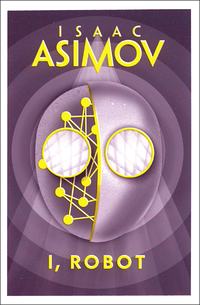
Kitabı oxu: «I, Robot»


Copyright
HarperVoyager
An imprint of HarperCollinsPublishers Ltd
1 London Bridge Street
London SE1 9GF
www.harpercollins.co.uk
First published in Great Britain by Dobson Books Ltd 1967
Copyright © Isaac Asimov 1950, 1977
Cover design and illustration by Mike Topping © HarperCollinsPublishers Ltd 2018
Isaac Asimov asserts the moral right to be identified as the author of this work.
A catalogue copy of this book is available from the British Library.
This novel is entirely a work of fiction. The names, characters and incidents portrayed in it are the work of the author’s imagination. Any resemblance to actual persons, living or dead, events or localities is entirely coincidental.
All rights reserved under International and Pan-American Copyright Conventions. By payment of the required fees, you have been granted the non-exclusive, non-transferable right to access and read the text of this e-book on screen. No part of this text may be reproduced, transmitted, down-loaded, decompiled, reverse engineered, or stored in or introduced into any information storage and retrieval system, in any form or by any means, whether electronic or mechanical, now known or hereinafter invented, without the express written permission of HarperCollins.
Source ISBN: 9780008279554
Ebook Edition © March 2018 ISBN: 9780007369355
Version: 2018-04-17
Contents
Cover
Title Page
Copyright
Introduction
1. Robbie
2. Runaround
3. Reason
4. Catch That Rabbit
5. Liar!
6. Little Lost Robot
7. Escape!
8. Evidence
9. The Evitable Conflict
About the Author
By the Same Author
About the Publisher
The Three Laws of Robotics
1 – A robot may not injure a human being, or, through inaction, allow a human being to come to harm.
2 – A robot must obey the orders given it by human beings except where such orders would conflict with the First Law.
3 – A robot must protect its own existence as long as such protection does not conflict with the First or Second Law.
Handbook of Robotics, 56th Edition, 2058 A.D.
Introduction
I looked at my notes and I didn’t like them. I’d spent three days at US Robots and might as well have spent them at home with the Encyclopedia Tellurica.
Susan Calvin had been born in the year 1982, they said, which made her seventy-five now. Everyone knew that. Appropriately enough, US Robots and Mechanical Men, Inc. was seventy-five also, since it had been in the year of Dr Calvin’s birth that Lawrence Robertson had first taken out incorporation papers for what eventually became the strangest industrial giant in man’s history. Well, everyone knew that, too.
At the age of twenty, Susan Calvin had been part of the particular Psycho-Math seminar at which Dr Alfred Lanning of US Robots had demonstrated the first mobile robot to be equipped with a voice. It was a large, clumsy unbeautiful robot, smelling of machine-oil and destined for the projected mines on Mercury. —But it could speak and make sense.
Susan said nothing at that seminar; took no part in the hectic discussion period that followed. She was a frosty girl, plain and colorless, who protected herself against a world she disliked by a mask-like expression and hypertrophy of intellect. But as she watched and listened, she felt the stirrings of a cold enthusiasm.
She obtained her bachelor’s degree at Columbia in 2003 and began graduate work in cybernetics.
All that had been done in the mid-twentieth century on ‘calculating machines’ had been upset by Robertson and his positronic brain-paths. The miles of relays and photocells had given way to the spongy globe of plantinumiridium about the size of a human brain.
She learned to calculate the parameters necessary to fix the possible variables within the ‘positronic brain’, to construct ‘brains’ on paper such that the responses to given stimuli could be accurately predicted.
In 2008, she obtained her Ph.D. and joined United States Robots as a ‘Robopsychologist’, becoming the first great practitioner of a new science. Lawrence Robertson was still president of the corporation; Alfred Lanning had become director of research.
For fifty years, she watched the direction of human progress change – and leap ahead.
Now she was retiring – as much as she ever could. At least, she was allowing someone else’s name to be inset upon the door of her old office.
That, essentially, was what I had. I had a long list of her published papers, of the patents in her name; I had the chronological details of her promotions— In short I had her professional ‘vita’ in full detail.
But that wasn’t what I wanted.
I needed more than that for my feature articles for Interplanetary Press. Much more.
I told her so.
‘Dr Calvin,’ I said, as lushly as possible, ‘in the mind of the public you and US Robots are identical. Your retirement will end an era and—’
‘You want the human-interest angle?’ She didn’t smile at me. I don’t think she ever smiles. But her eyes were sharp, though not angry. I felt her glance slide through me and out my occiput and I knew that I was uncommonly transparent to her; that everybody was.
But I said, ‘That’s right.’
‘Human interest out of Robots? A contradiction.’
‘No, doctor. Out of you.’
‘Well, I’ve been called a robot myself. Surely, they’ve told you I’m not human.’
They had, but there was no point in saying so.
She got up from her chair. She wasn’t tall and she looked frail. I followed her to the window and we looked out.
The offices and factories of US Robots were a small city; spaced and planned. It was flattened out like an aerial photograph.
‘When I first came here,’ she said, ‘I had a little room in a building right about there where the fire-house is now.’ She pointed. ‘It was torn down before you were born. I shared the room with three others. I had half a desk. We built our robots all in one building. Output – three a week. Now look at us.’
‘Fifty years,’ I hackneyed, ‘is a long time.’
‘Not when you’re looking back at them,’ she said. ‘You wonder how they vanished so quickly.’
She went back to her desk and sat down. She didn’t need expression on her face to look sad, somehow.
‘How old are you?’ she wanted to know.
‘Thirty-two,’ I said.
‘Then you don’t remember a world without robots. There was a time when humanity faced the universe alone and without a friend. Now he has creatures to help him; stronger creatures than himself, more faithful, more useful, and absolutely devoted to him. Mankind is no longer alone. Have you ever thought of it that way?’
‘I’m afraid I haven’t. May I quote you?’
‘You may. To you, a robot is a robot. Gears and metal, electricity and positrons. —Mind and iron! Human-made! If necessary, human-destroyed! But you haven’t worked with them, so you don’t know them. They’re a cleaner, better breed than we are.’
I tried to nudge her gently with words, ‘We’d like to hear some of the things you could tell us; get your views on robots. The Interplanetary Press reaches the entire Solar System. Potential audience is three billion, Dr Calvin. They ought to know what you could tell them on robots.’
It wasn’t necessary to nudge. She didn’t hear me, but she was moving in the right direction.
‘They might have known from the start. We sold robots for Earth-use then – before my time it was, even. Of course, that was when robots could not talk. Afterward, they became more human and opposition began. The labor unions, of course, naturally opposed robot competition for human jobs, and various segments of religious opinion had their superstitious objections. It was all quite ridiculous and quite useless. And yet there it was.’
I was taking it down verbatim on my pocket-recorder, trying not to show the knuckle-motions of my hand. If you practice a bit, you can get to the point where you can record accurately without taking the little gadget out of your pocket.
‘Take the case of Robbie,’ she said. ‘I never knew him. He was dismantled the year before I joined the company – hopelessly out-of-date. But I saw the little girl in the museum—’
She stopped, but I didn’t say anything. I let her eyes mist up and her mind travel back. She had lots of time to cover.
‘I heard about it later, and when they called us blasphemers and demon-creators, I always thought of him. Robbie was a non-vocal robot. He couldn’t speak. He was made and sold in 1996. Those were the days before extreme specialization, so he was sold as a nursemaid—’
‘As a what?’
‘As a nursemaid—’
1
Robbie
‘Ninety-eight – ninety-nine – one hundred.’ Gloria withdrew her chubby little forearm from before her eyes and stood for a moment, wrinkling her nose and blinking in the sunlight. Then, trying to watch in all directions at once, she withdrew a few cautious steps from the tree against which she had been leaning.
She craned her neck to investigate the possibilities of a clump of bushes to the right and then withdrew farther to obtain a better angle for viewing its dark recesses. The quiet was profound except for the incessant buzzing of insects and the occasional chirrup of some hardy bird, braving the midday sun.
Gloria pouted, ‘I bet he went inside the house, and I’ve told him a million times that that’s not fair.’
With tiny lips pressed together tightly and a severe frown crinkling her forehead, she moved determinedly toward the two-story building up past the driveway.
Too late she heard the rustling sound behind her, followed by the distinctive and rhythmic clump-clump of Robbie’s metal feet. She whirled about to see her triumphing companion emerge from hiding and make for the home-tree at full speed.
Gloria shrieked in dismay. ‘Wait, Robbie! That wasn’t fair, Robbie! You promised you wouldn’t run until I found you.’ Her little feet could make no headway at all against Robbie’s giant strides. Then, within ten feet of the goal, Robbie’s pace slowed suddenly to the merest of crawls, and Gloria, with one final burst of wild speed, dashed pantingly past him to touch the welcome bark of home-tree first.
Gleefully, she turned on the faithful Robbie, and with the basest of ingratitude, rewarded him for his sacrifice by taunting him cruelly for a lack of running ability.
‘Robbie can’t run!’ she shouted at the top of her eight-year-old voice. ‘I can beat him any day. I can beat him any day.’ She chanted the words in a shrill rhythm.
Robbie didn’t answer, of course – not in words. He pantomimed running, instead, inching away until Gloria found herself running after him as he dodged her narrowly, forcing her to veer in helpless circles, little arms outstretched and fanning at the air.
‘Robbie,’ she squealed, ‘stand still!’ —And the laughter was forced out of her in breathless jerks.
—Until he turned suddenly and caught her up, whirling her round, so that for her the world fell away for a moment with a blue emptiness beneath, and green trees stretching hungrily downward towards the void. Then she was down in the grass again, leaning against Robbie’s leg and still holding a hard, metal finger.
After a while, her breath returned. She pushed uselessly at her disheveled hair in vague imitation of one of her mother’s gestures and twisted to see if her dress were torn.
She slapped her hand against Robbie’s torso, ‘Bad boy! I’ll spank you!’
And Robbie cowered, holding his hands over his face so that she had to add, ‘No, I won’t, Robbie. I won’t spank you. But anyway, it’s my turn to hide now because you’ve got longer legs and you promised not to run till I found you.’
Robbie nodded his head – a small parallelepiped with rounded edges and corners attached to a similar but much larger parallelepiped that served as torso by means of a short, flexible stalk – and obediently faced the tree. A thin, metal film descended over his glowing eyes and from within his body came a steady, resonant ticking.
‘Don’t peek now – and don’t skip any numbers,’ warned Gloria, and scurried for cover.
With unvarying regularity, seconds were ticked off, and at the hundredth, up went the eyelids, and the glowing red of Robbie’s eyes swept the prospect. They rested for a moment on a bit of colorful gingham that protruded from behind a boulder. He advanced a few steps and convinced himself that it was Gloria who squatted behind it.
Slowly, remaining always between Gloria and home-tree, he advanced on the hiding place, and when Gloria was plainly in sight and could no longer even theorize to herself that she was not seen, he extended one arm toward her, slapping the other against his leg so that it rang again. Gloria emerged sulkily.
‘You peeked!’ she exclaimed, with gross unfairness. ‘Besides I’m tired of playing hide-and-seek. I want a ride.’
But Robbie was hurt at the unjust accusation, so he seated himself carefully and shook his head ponderously from side to side.
Gloria changed her tone to one of gentle coaxing immediately, ‘Come on, Robbie. I didn’t mean it about the peeking. Give me a ride.’
Robbie was not to be won over so easily, though. He gazed stubbornly at the sky, and shook his head even more emphatically.
‘Please, Robbie, please give me a ride.’ She encircled his neck with rosy arms and hugged tightly. Then, changing moods in a moment, she moved away. ‘If you don’t, I’m going to cry,’ and her face twisted appallingly in preparation.
Hard-hearted Robbie paid scant attention to this dreadful possibility, and shook his head a third time. Gloria found it necessary to play her trump card.
‘If you don’t,’ she exclaimed warmly, ‘I won’t tell you any more stories, that’s all. Not one—’
Robbie gave in immediately and unconditionally before this ultimatum, nodding his head vigorously until the metal of his neck hummed. Carefully, he raised the little girl and place her on his broad, flat shoulders.
Gloria’s threatened tears vanished immediately and she crowed with delight. Robbie’s metal skin, kept at a constant temperature of seventy by the high resistance coils within, felt nice and comfortable, while the beautifully loud sound her heels made as they bumped rhythmically against his chest was enchanting.
‘You’re an air-coaster, Robbie, you’re a big, silver air-coaster. Hold out your arms straight. —You got to, Robbie, if you’re going to be an air-coaster.’
The logic was irrefutable. Robbie’s arms were wings catching the air currents and he was a silver ’coaster.
Gloria twisted the robot’s head and leaned to the right. He banked sharply. Gloria equipped the ’coaster with a motor that went ‘Br-r-r’ and then with weapons that went ‘Powie’ and ‘Sh-sh-shshsh.’ Pirates were giving chase and the ship’s blasters were coming into play. The pirates dropped in a steady rain.
‘Got another one. —Two more!’ she cried.
Then ‘Faster, men,’ Gloria said pompously, ‘we’re running out of ammunition.’ She aimed over her shoulder with undaunted courage and Robbie was a blunt-nosed spaceship zooming through the void at maximum acceleration.
Clear across the field he sped, to the patch of tall grass on the other side, where he stopped with a suddenness that evoked a shriek from his flushed rider, and then tumbled her on to the soft, green carpet.
Gloria gasped and panted, and gave voice to intermittent whispered exclamations of ‘That was nice!’
Robbie waited until she had caught her breath and then pulled gently at a lock of hair.
‘You want something?’ said Gloria, eyes wide in an apparently artless complexity that fooled her huge ‘nursemaid’ not at all. He pulled the curl harder.
‘Oh, I know. You want a story.’
Robbie nodded rapidly.
‘Which one?’
Robbie made a semi-circle in the air with one finger.
The little girl protested, ‘Again? I’ve told you Cinderella a million times. Aren’t you tired of it? —It’s for babies.’
Another semi-circle.
‘Oh, hell,’ Gloria composed herself, ran over the details of the tale in her mind (together with her own elaborations, of which she had several) and began:
‘Are you ready? Well – once upon a time there was a beautiful little girl whose name was Ella. And she had a terribly cruel step-mother and two very ugly and very cruel step-sisters and—’
Gloria was reaching the very climax of the tale – midnight was striking and everything was changing back to the shabby originals lickety-split, while Robbie listened tensely with burning eyes – when the interruption came.
‘Gloria!’
It was the high-pitched sound of a woman who has been calling not once, but several times; and had the nervous tone of one in whom anxiety was beginning to overcome impatience.
‘Mamma’s calling me,’ said Gloria, not quite happily. ‘You’d better carry me back to the house, Robbie.’
Robbie obeyed with alacrity for somehow there was that in him which judged it best to obey Mrs Weston, without as much as a scrap of hesitation. Gloria’s father was rarely home in the daytime except on Sunday – today, for instance – and when he was, he proved a genial and understanding person. Gloria’s mother, however, was a source of uneasiness to Robbie and there was always the impulse to sneak away from her sight.
Mrs Weston caught sight of them the minute they rose above the masking tufts of long grass and retired inside the house to wait.
‘I’ve shouted myself hoarse, Gloria,’ she said, severely. ‘Where were you?’
‘I was with Robbie,’ quavered Gloria. ‘I was telling him Cinderella, and I forgot it was dinner-time.’
‘Well, it’s a pity Robbie forgot, too.’ Then, as if that reminded her of the robot’s presence, she whirled upon him. ‘You may go, Robbie. She doesn’t need you now.’ Then, brutally, ‘And don’t come back till I call you.’
Robbie turned to go, but hesitated as Gloria cried out in his defense, ‘Wait, Mamma, you got to let him stay. I didn’t finish Cinderella for him. I said I would tell him Cinderella and I’m not finished.’
‘Gloria!’
‘Honest and truly, Mamma, he’ll stay so quiet, you won’t even know he’s here. He can sit on the chair in the corner, and he won’t say a word – I mean he won’t do anything. Will you, Robbie?’
Robbie, appealed to, nodded his massive head up and down once.
‘Gloria, if you don’t stop this at once, you shan’t see Robbie for a whole week.’
The girl’s eyes fell, ‘All right! But Cinderella is his favorite story and I didn’t finish it. —And he likes it so much.’
The robot left with a disconsolate step and Gloria choked back a sob.
George Weston was comfortable. It was a habit of his to be comfortable on Sunday afternoons. A good, hearty dinner below the hatches; a nice, soft, dilapidated couch on which to sprawl; a copy of the Times; slippered feet and shirtless chest – how could anyone help but be comfortable?
He wasn’t pleased, therefore, when his wife walked in. After ten years of married life, he still was so unutterably foolish as to love her, and there was no question that he was always glad to see her – still Sunday afternoons just after dinner were sacred to him and his idea of solid comfort was to be left in utter solitude for two or three hours. Consequently, he fixed his eye firmly upon the latest reports of the Lefebre–Yoshida expedition to Mars (this one was to take off from Lunar Base and might actually succeed) and pretended she wasn’t there.
Mrs Weston waited patiently for two minutes, then impatiently for two more, and finally broke the silence.
‘George!’
‘Hmpph?’
‘George, I say! Will you put down that paper and look at me?’
The paper rustled to the floor and Weston turned a weary face toward his wife, ‘What is it, dear?’
‘You know what it is, George. It’s Gloria and that terrible machine.’
‘What terrible machine?’
‘Now don’t pretend you don’t know what I’m talking about. It’s that robot Gloria calls Robbie. He doesn’t leave her for a moment.’
‘Well, why should he? He’s not supposed to. And he certainly isn’t a terrible machine. He’s the best darn robot money can buy and I’m damned sure he set me back half a year’s income. He’s worth it, though – darn sight cleverer than half my office staff.’
He made a move to pick up the paper again, but his wife was quicker and snatched it away.
‘You listen to me, George. I won’t have my daughter entrusted to a machine – and I don’t care how clever it is. It has no soul, and no one knows what it may be thinking. A child just isn’t made to be guarded by a thing of metal.’
Weston frowned, ‘When did you decide this? He’s been with Gloria two years now and I haven’t seen you worry till now.’
‘It was different at first. It was a novelty; it took a load off me, and – and it was a fashionable thing to do. But now I don’t know. The neighbors—’
‘Well, what have the neighbors to do with it? Now, look. A robot is infinitely more to be trusted than a human nursemaid. Robbie was constructed for only one purpose really – to be the companion of a little child. His entire “mentality” has been created for the purpose. He just can’t help being faithful and loving and kind. He’s a machine – made so. That’s more than you can say for humans.’
‘But something might go wrong. Some – some—’ Mrs Weston was a bit hazy about the insides of a robot, ‘some little jigger will come loose and the awful thing will go berserk and – and—’ She couldn’t bring herself to complete the quite obvious thought.
‘Nonsense,’ Weston denied, with an involuntary nervous shiver. ‘That’s completely ridiculous. We had a long discussion at the time we bought Robbie about the First Law of Robotics. You know that it is impossible for a robot to harm a human being; that long before enough can go wrong to alter that First Law, a robot would be completely inoperable. It’s a mathematical impossibility. Besides I have an engineer from US Robots here twice a year to give the poor gadget a complete overhaul. Why, there’s no more chance of anything at all going wrong with Robbie than there is of you or I suddenly going looney – considerably less, in fact. Besides, how are you going to take him away from Gloria?’
He made another futile stab at the paper and his wife tossed it angrily into the next room.
‘That’s just it, George! She won’t play with anyone else. There are dozens of little boys and girls that she should make friends with, but she won’t. She won’t go near them unless I make her. That’s no way for a little girl to grow up. You want her to be normal, don’t you? You want her to be able to take her part in society.’
‘You’re jumping at shadows, Grace. Pretend Robbie’s a dog. I’ve seen hundreds of children who would rather have their dog than their father.’
‘A dog is different, George. We must get rid of that horrible thing. You can sell it back to the company. I’ve asked, and you can.’
‘You’ve asked? Now look here, Grace, let’s not go off the deep end. We’re keeping the robot until Gloria is older and I don’t want the subject brought up again.’ And with that he walked out of the room in a huff.
Mrs Weston met her husband at the door two evenings later. ‘You’ll have to listen to this, George. There’s bad feeling in the village.’
‘About what?’ asked Weston. He stepped into the washroom and drowned out any possible answer by the splash of water.
Mrs Weston waited. She said, ‘About Robbie.’
Weston stepped out, towel in hand, face red and angry. ‘What are you talking about?’
‘Oh, it’s been building up and building up. I’ve tried to close my eyes to it, but I’m not going to any more. Most of the villagers consider Robbie dangerous. Children aren’t allowed to go near our place in the evenings.’
‘We trust our child with the thing.’
‘Well, people aren’t reasonable about these things.’
‘Then to hell with them.’
‘Saying that doesn’t solve the problem. I’ve got to do my shopping down there. I’ve got to meet them every day. And it’s even worse in the city these days when it comes to robots. New York has just passed an ordinance keeping all robots off the streets between sunset and sunrise.’
‘All right, but they can’t stop us from keeping a robot in our home. —Grace, this is one of your campaigns. I recognize it. But it’s no use. The answer is still, no! We’re keeping Robbie!’
And yet he loved his wife – and what was worse, his wife knew it. George Weston, after all, was only a man – poor thing – and his wife made full use of every device which a clumsier and more scrupulous sex has learned, with reason and futility, to fear.
Ten times in the ensuing week, he cried, ‘Robbie stays – and that’s final!’ and each time it was weaker and accompanied by a louder and more agonized groan.
Came the day at last, when Weston approached his daughter guiltily and suggested a ‘beautiful’ visivox show in the village.
Gloria clapped her hands happily, ‘Can Robbie go?’
‘No, dear,’ he said, and winced at the sound of his voice, ‘they won’t allow robots at the visivox – but you can tell him all about it when you get home.’ He stumbled all over the last few words and looked away.
Gloria came back from town bubbling over with enthusiasm, for the visivox had been a gorgeous spectacle indeed.
She waited for her father to maneuver the jet-car into the sunken garage. ‘Wait till I tell Robbie, Daddy. He would have liked it like anything. —Especially when Francis Fran was backing away so-o-o quietly, and backed right into one of the Leopard-Men and had to run.’ She laughed again. ‘Daddy, are there really Leopard-Men on the Moon?’
‘Probably not,’ said Weston absently. ‘It’s just funny make-believe.’ He couldn’t take much longer with the car. He’d have to face it.
Gloria ran across the lawn. ‘Robbie. —Robbie!’
Then she stopped suddenly at the sight of a beautiful collie which regarded her out of serious brown eyes as it wagged its tail on the porch.
‘Oh, what a nice dog!’ Gloria climbed the steps, approached cautiously and patted it. ‘Is it for me, Daddy?’
Her mother had joined them. ‘Yes, it is, Gloria. Isn’t it nice – soft and furry. It’s very gentle. It likes little girls.’
‘Can he play games?’
‘Surely. He can do any number of tricks. Would you like to see some?’
‘Right away. I want Robbie to see him, too. —Robbie!’ She stopped, uncertainly, and frowned, ‘I’ll bet he’s just staying in his room because he’s mad at me for not taking him to the visivox. You’ll have to explain to him, Daddy. He might not believe me, but he knows if you say it, it’s so.’
Weston’s lips grew tighter. He looked toward his wife but could not catch her eye.
Gloria turned precipitously and ran down the basement steps, shouting as she went, ‘Robbie — Come and see what Daddy and Mamma brought me. They brought me a dog, Robbie.’
In a minute she had returned, a frightened little girl. ‘Mamma, Robbie isn’t in his room. Where is he?’ There was no answer and George Weston coughed and was suddenly extremely interested in an aimlessly drifting cloud. Gloria’s voice quavered on the verge of tears, ‘Where’s Robbie, Mamma?’
Mrs Weston sat down and drew her daughter gently to her, ‘Don’t feel bad, Gloria. Robbie has gone away, I think.’
‘Gone away? Where? Where’s he gone away, Mamma?’
‘No one knows, darling. He just walked away. We’ve looked and we’ve looked and we’ve looked for him, but we can’t find him.’
‘You mean he’ll never come back again?’ Her eyes were round with horror.
‘We may find him soon. We’ll keep looking for him. And meanwhile you can play with your nice new doggie. Look at him! His name is Lightning and he can—’
But Gloria’s eyelids had overflowed, ‘I don’t want the nasty dog – I want Robbie. I want you to find me Robbie.’ Her feelings became too deep for words, and she spluttered into a shrill wail.
Mrs Weston glanced at her husband for help, but he merely shuffled his feet morosely and did not withdraw his ardent stare from the heavens, so she bent to the task of consolation, ‘Why do you cry, Gloria? Robbie was only a machine, just a nasty old machine. He wasn’t alive at all.’
‘He was not no machine!’ screamed Gloria, fiercely and ungrammatically. ‘He was a person just like you and me and he was my friend. I want him back. Oh, Mamma, I want him back.’
Her mother groaned in defeat and left Gloria to her sorrow.
‘Let her have her cry out,’ she told her husband. ‘Childish griefs are never lasting. In a few days, she’ll forget that awful robot ever existed.’
But time proved Mrs Weston a bit too optimistic. To be sure, Gloria ceased crying, but she ceased smiling, too, and the passing days found her ever more silent and shadowy. Gradually, her attitude of passive unhappiness wore Mrs Weston down and all that kept her from yielding was the impossibility of admitting defeat to her husband.
Then, one evening, she flounced into the living room, sat down, folded her arms and looked boiling mad.
2
Runaround
It was one of Gregory Powell’s favorite platitudes that nothing was to be gained from excitement, so when Mike Donovan came leaping down the stairs toward him, red hair matted with perspiration, Powell frowned.
‘What’s wrong?’ he said. ‘Break a fingernail?’
‘Yaaaah,’ snarled Donovan, feverishly. ‘What have you been doing in the sublevels all day?’ He took a deep breath and blurted out, ‘Speedy never returned.’
Powell’s eyes widened momentarily and he stopped on the stairs; then he recovered and resumed his upward steps. He didn’t speak until he reached the head of the flight, and then:
‘You sent him after the selenium?’
‘Yes.’
‘And how long has he been out?’
‘Five hours now.’
Silence! This was a devil of a situation. Here they were, on Mercury exactly twelve hours – and already up to the eyebrows in the worst sort of trouble. Mercury had long been the jinx world of the System, but this was drawing it rather strong – even for a jinx.
Powell said, ‘Start at the beginning, and let’s get this straight.’
They were in the radio room now – with its already subtly antiquated equipment, untouched for the ten years previous to their arrival. Even ten years, technologically speaking, meant so much. Compare Speedy with the type of robot they must have had back in 2005. But then, advances in robotics these days were tremendous. Powell touched a still gleaming metal surface gingerly. The air of disuse that touched everything about the room – and the entire Station – was infinitely depressing.
Donovan must have felt it. He began: ‘I tried to locate him by radio, but it was no go. Radio isn’t any good on the Mercury Sunside – not past two miles, anyway. That’s one of the reasons the First Expedition failed. And we can’t put up the ultrawave equipment for weeks yet—’
‘Skip all that. What did you get?’
‘I located the unorganized body signal in the short wave. It was no good for anything except his position. I kept track of him that way for two hours and plotted the results on the map.’
There was a yellowed square of parchment in his hip pocket – a relic of the unsuccessful First Expedition – and he slapped it down on the desk with vicious force, spreading it flat with the palm of his hand. Powell, hands clasped across his chest, watched it at long range.
Donovan’s pencil pointed nervously. ‘The red cross is the selenium pool. You marked it yourself.’
‘Which one is it?’ interrupted Powell. ‘There were three that MacDougal located for us before he left.’
‘I sent Speedy to the nearest, naturally. Seventeen miles away. But what difference does that make?’ There was tension in his voice. ‘There are the penciled dots that mark Speedy’s position.’
And for the first time Powell’s artificial aplomb was shaken and his hands shot forward for the map.
‘Are you serious? This is impossible.’
‘There it is,’ growled Donovan.
The little dots that marked the position formed a rough circle about the red cross of the selenium pool. And Powell’s fingers went to his brown mustache, the unfailing signal of anxiety.
Donovan added: ‘In the two hours I checked on him, he circled that damned pool four times. It seems likely to me that he’ll keep that up forever. Do you realize the position we’re in?’
Powell looked up shortly, and said nothing. Oh, yes, he realized the position they were in. It worked itself out as simply as a syllogism. The photo-cell banks that alone stood between the full power of Mercury’s monstrous sun and themselves were shot to hell. The only thing that could save them was selenium. The only thing that could get the selenium was Speedy. If Speedy didn’t come back, no selenium. No selenium, no photo-cell banks. No photobanks – well, death by slow broiling is one of the more unpleasant ways of being done in.
Donovan rubbed his red mop of hair savagely and expressed himself with bitterness. ‘We’ll be the laughing stock of the System, Greg. How can everything have gone so wrong so soon? The great team of Powell and Donovan is sent out to Mercury to report on the advisability of reopening the Sunside Mining Station with modern techniques and robots and we ruin everything the first day. A purely routine job, too. We’ll never live it down.’
‘We won’t have to, perhaps,’ replied Powell, quietly. ‘If we don’t do something quickly, living anything down – or even just plain living – will be out of the question.’
‘Don’t be stupid! If you feel funny about it, Greg, I don’t. It was criminal, sending us out here with only one robot. And it was your bright idea that we could handle the photo-cell banks ourselves.’
‘Now you’re being unfair. It was a mutual decision and you know it. All we needed was a kilogram of selenium, a Stillhead Dielectrode Plate and about three hours’ time – and there are pools of pure selenium all over Sunside. MacDougal’s spectroreflector spotted three for us in five minutes, didn’t it? What the devil! We couldn’t have waited for next conjunction.’
‘Well, what are we going to do? Powell, you’ve got an idea. I know you have, or you wouldn’t be so calm. You’re no more a hero than I am. Go on, spill it!’
‘We can’t go after Speedy ourselves, Mike – not on the Sunside. Even the new insosuits aren’t good for more than twenty minutes in direct sunlight. But you know the old saying, “Set a robot to catch a robot.” Look, Mike, maybe things aren’t so bad. We’ve got six robots down in the sublevels, that we may be able to use, if they work. If they work.’
There was a glint of sudden hope in Donovan’s eyes. ‘You mean six robots from the First Expedition. Are you sure? They may be subrobotic machines. Ten years is a long time as far as robot-types are concerned, you know.’
‘No, they’re robots. I’ve spent all day with them and I know. They’ve got positronic brains: primitive, of course.’ He placed the map in his pocket. ‘Let’s go down.’
The robots were on the lowest sublevel – all six of them surrounded by musty packing cases of uncertain content. They were large, extremely so, and even though they were in a sitting position on the floor, legs straddled out before them, their heads were a good seven feet in the air.
Donovan whistled. ‘Look at the size of them, will you? The chests must be ten feet around.’
‘That’s because they’re supplied with the old McGuffy gears. I’ve been over the insides – crummiest set you’ve ever seen.’
‘Have you powered them yet?’
‘No. There wasn’t any reason to. I don’t thing there’s anything wrong with them. Even the diaphragm is in reasonable order. They might talk.’
He had unscrewed the chest plate of the nearest as he spoke, inserted the two-inch sphere that contained the tiny spark of atomic energy that was a robot’s life. There was difficulty in fitting it, but he managed, and then screwed the plate back on again in laborious fashion. The radio controls of more modern models had not been heard of ten years earlier. And then to the other five.
Donovan said uneasily, ‘They haven’t moved.’
‘No orders to do so,’ replied Powell, succinctly. He went back to the first in the line and struck him on the chest. ‘You! Do you hear me?’
The monster’s head bent slowly and the eyes fixed themselves on Powell. Then, in a harsh, squawking voice – like that of a medieval phonograph, he grated, ‘Yes, Master!’
Powell grinned humorlessly at Donovan. ‘Did you get that? Those were the days of the first talking robots when it looked as if the use of robots on Earth would be banned. The makers were fighting that and they built good, healthy slave complexes into the damned machines.’
‘It didn’t help them,’ muttered Donovan.
‘No, it didn’t, but they sure tried.’ He turned once more to the robot. ‘Get up!’
The robot towered upward slowly and Donovan’s head craned and his puckered lips whistled.
Powell said: ‘Can you go out upon the surface? In the light?’
There was consideration while the robot’s slow brain worked. Then, ‘Yes, Master.’
‘Good. Do you know what a mile is?’
Another consideration, and another slow answer. ‘Yes, Master.’
‘We will take you up to the surface then, and indicate a direction. You will go about seventeen miles, and somewhere in that general region you will meet another robot, smaller than yourself. You understand so far?’
‘Yes, Master.’
‘You will find this robot and order him to return. If he does not wish to, you are to bring him back by force.’
Donovan clutched at Powell’s sleeve. ‘Why not send him for the selenium direct?’
‘Because I want Speedy back, nitwit. I want to find out what’s wrong with him.’ And to the robot, ‘All right, you, follow me.’
The robot remained motionless and his voice rumbled: ‘Pardon, Master, but I cannot. You must mount first.’ His clumsy arms had come together with a thwack, blunt fingers interlacing.
Powell stared and then pinched at his mustache. ‘Uh … oh!’
Donovan’s eyes bulged. ‘We’ve got to ride him? Like a horse?’
‘I guess that’s the idea. I don’t know why, though. I can’t see – yes, I do. I told you they were playing up robot-safety in those days. Evidently, they were going to sell the notion of safety by not allowing them to move about without a mahout on their shoulders all the time. What do we do now?’
‘That’s what I’ve been thinking,’ muttered Donovan. ‘We can’t go out on the surface, with a robot or without. Oh, for the love of Pete’ – and he snapped his fingers twice. He grew excited. ‘Give me that map you’ve got. I haven’t studied it for two hours for nothing. This is a Mining Station. What’s wrong with using the tunnels?’
The Mining Station was a black circle on the map, and the light dotted lines that were tunnels stretched out about it in spiderweb fashion.
Donovan studied the list of symbols at the bottom of the map. ‘Look,’ he said, ‘the small black dots are openings to the surface, and here’s one maybe three miles away from the selenium pool. There’s a number here – you’d think they’d write larger – 13a. If the robots know their way around here—’
Powell shot the question and received the dull ‘Yes, Master,’ in reply. ‘Get your insosuit,’ he said with satisfaction.
It was the first time either had worn the insosuits – which marked one time more than either had expected to upon their arrival the day before – and they tested their limb movements uncomfortably.
The insosuit was far bulkier and far uglier than the regulation spacesuit; but withal considerably lighter, due to the fact that they were entirely nonmetallic in composition. Composed of heat-resistant plastic and chemically treated cork layers, and equipped with a desiccating unit to keep the air bone-dry, the insosuits could withstand the full glare of Mercury’s sun for twenty minutes. Five to ten minutes more, as well, without actually killing the occupant.
And still the robot’s hands formed the stirrup, nor did he betray the slightest atom of surprise at the grotesque figure into which Powell had been converted.
Powell’s radio-harshened voice boomed out: ‘Are you ready to take us to Exit 13a?’
‘Yes, Master.’
Good, thought Powell; they might lack radio control but at least they were fitted for radio reception. ‘Mount one or the other, Mike,’ he said to Donovan.
He placed a foot in the improvised stirrup and swung upward. He found the seat comfortable; there was the humped back of the robot, evidently shaped for the purpose, a shallow groove along each shoulder for the thighs and two elongated ‘ears’ whose purpose now seemed obvious.
Powell seized the ears and twisted the head. His mount turned ponderously. ‘Lead on, Macduff.’ But he did not feel at all light-hearted.
The gigantic robots moved slowly, with mechanical precision, through the doorway that cleared their heads by a scant foot, so that the two men had to duck hurriedly, along a narrow corridor in which their unhurried footsteps boomed monotonously and into the air lock.
The long, airless tunnel that stretched to a pinpoint before them brought home forcefully to Powell the exact magnitude of the task accomplished by the First Expedition, with their crude robots and their start-from-scratch necessities. They might have been a failure, but their failure was a good deal better than the usual run of the System’s successes.
The robots plodded onward with a pace that never varied and with footsteps that never lengthened.
Powell said: ‘Notice that these tunnels are blazing with lights and that the temperature is Earth-normal. It’s probably been like this all the ten years that this place has remained empty.’
‘How’s that?’
‘Cheap energy; cheapest in the System. Sunpower, you know and on Mercury’s Sunside, sunpower is something. That’s why the Station was built in the sunlight rather than in the shadow of a mountain. It’s really a huge energy converter. The heat is turned into electricity, light, mechanical work and what have you; so that energy is supplied and the Station is cooled in a simultaneous process.’
‘Look,’ said Donovan. ‘This is all very educational, but would you mind changing the subject? It so happens that this conversion of energy that you talk about is carried on by the photo-cell banks mainly – and that is a tender subject with me at the moment.’
Powell grunted vaguely, and when Donovan broke the resulting silence, it was to change the subject completely. ‘Listen, Greg. What the devil’s wrong with Speedy, anyway? I can’t understand it.’
It’s not easy to shrug shoulders in an insosuit, but Powell tried it. ‘I don’t know, Mike. You know he’s perfectly adapted to a Mercurian environment. Heat doesn’t mean anything to him and he’s built for the light gravity and the broken ground. He’s foolproof – or, at least, he should be.’
Silence fell. This time, silence that lasted.
‘Master,’ said the robot, ‘we are here.’
‘Eh?’ Powell snapped out of a semidrowse. ‘Well, get us out of here – out to the surface.’
They found themselves in a tiny substation, empty, airless, ruined. Donovan had inspected a jagged hole in the upper reaches of one of the walls by the light of his pocket flash.
‘Meteorite, do you suppose?’ he had asked.
Powell shrugged. ‘To hell with that. It doesn’t matter. Let’s get out.’
A towering cliff of a black, basaltic rock cut off the sunlight, and the deep night shadow of an airless world surrounded them. Before them, the shadow reached out and ended in knife-edge abruptness into an all-but-unbearable blaze of white light, that glittered from myriad crystals along a rocky ground.
‘Space!’ gasped Donovan. ‘It looks like snow.’ And it did. Powell’s eyes swept the jagged glitter of Mercury to the horizon and winced at the gorgeous brilliance.
‘This must be an unusual area,’ he said. ‘The general albedo of Mercury is low and most of the soil is gray pumice. Something like the Moon, you know. Beautiful, isn’t it?’
He was thankful for the light filters in their visiplates. Beautiful or not, a look at the sunlight through straight glass would have blinded them inside of half a minute.
Donovan was looking at the spring thermometer on his wrist. ‘Holy smokes, the temperature is eighty centigrade!’
Powell checked his own and said: ‘Um-m-m. A little high. Atmosphere, you know.’
‘On Mercury? Are you nuts?’
‘Mercury isn’t really airless,’ explained Powell, in absentminded fashion. He was adjusting the binocular attachments to his visiplate, and the bloated fingers of the insosuit were clumsy at it. ‘There is a thin exhalation that clings to its surface – vapors of the more volatile elements and compounds that are heavy enough for Mercurian gravity to retain. You know: selenium, iodine, mercury, gallium, potassium, bismuth, volatile oxides. The vapors sweep into the shadows and condense, giving up heat. It’s a sort of gigantic still. In fact, if you use your flash, you’ll probably find that the side of the cliff is covered with, say, hoar-sulphur, or maybe quicksilver dew.
‘It doesn’t matter, though. Our suits can stand a measly eighty indefinitely.’
Powell had adjusted the binocular attachments, so that he seemed as eye-stalked as a snail.
Donovan watched tensely. ‘See anything?’
The other did not answer immediately, and when he did, his voice was anxious and thoughtful. ‘There’s a dark spot on the horizon that might be the selenium pool. It’s in the right place. But I don’t see Speedy.’
Powell clambered upward in an instinctive striving for a better view, till he was standing in unsteady fashion upon his robot’s shoulders. Legs straddled wide, eyes straining, he said: ‘I think … I think— Yes, it’s definitely he. He’s coming this way.’
Donovan followed the pointing finger. He had no binoculars, but there was a tiny moving dot, black against the blazing brilliance of the crystalline ground.
‘I see him!’ he yelled. ‘Let’s get going!’
Powell had hopped down into a sitting position on the robot again, and his suited hand slapped against the Gargantuan’s barrel chest. ‘Get going!’
‘Giddy-ap!’ yelled Donovan, and thumped his heels, spur fashion.
The robots started off, the regular thudding of their footsteps silent in the airlessness, for the nonmetallic fabric of the insosuits did not transmit sound. There was only a rhythmic vibration just below the border of actual hearing.
‘Faster!’ yelled Donovan. The rhythm did not change.
‘No use,’ cried Powell, in reply. ‘These junk heaps are only geared to one speed. Do you think they’re equipped with selective flexors?’
They had burst through the shadow, and the sunlight came down in a white-hot wash and poured liquidly about them.
Donovan ducked involuntarily. ‘Wow! Is it imagination or do I feel heat?’
‘You’ll feel more presently,’ was the grim reply. ‘Keep your eye on Speedy.’
Robot SPD 13 was near enough to be seen in detail now. His graceful, streamlined body threw out blazing highlights as he loped with easy speed across the broken ground. His name was derived from his serial initials, of course, but it was apt, nevertheless, for the SPD models were among the fastest robots turned out by the United States Robots and Mechanical Men Corp.
‘Hey, Speedy,’ howled Donovan, and waved a frantic hand.
‘Speedy!’ shouted Powell. ‘Come here!’
The distance between the men and the errant robot was being cut down momentarily – more by the efforts of Speedy than the slow plodding of the fifty-year-old antique mounts of Donovan and Powell.
They were close enough now to notice that Speedy’s gait included a peculiar rolling stagger, a noticeable side-to-side lurch – and then, as Powell waved his hand again and sent maximum juice into his compact head-set radio sender, in preparation for another shout, Speedy looked up and saw them.
Speedy hopped to a halt and remained standing for a moment – with just a tiny, unsteady weave, as though he were swaying in a light wind.
Powell yelled: ‘All right, Speedy! Come here, boy.’
Whereupon Speedy’s robot voice sounded in Powell’s earphones for the first time.
It said: ‘Hot dog, let’s play games. You catch me and I catch you; no love can cut our knife in two. For I’m Little Buttercup, sweet Little Buttercup. Whoops!’ Turning on his heel, he sped off in the direction from which he had come with a speed and fury that kicked up gouts of baked dust.
And his last words as he receded into the distance were, ‘There grew a little flower ’neath a great oak tree,’ followed by a curious metallic clicking that might have been a robotic equivalent of a hiccup.
Donovan said weakly: ‘Where did he pick up the Gilbert and Sullivan? Say, Greg, he … he’s drunk or something.’
‘If you hadn’t told me,’ was the bitter response, ‘I’d never realize it. Let’s get back to the cliff. I’m roasting.’
It was Powell who broke the desperate silence. ‘In the first place,’ he said, ‘Speedy isn’t drunk – not in the human sense – because he’s a robot, and robots don’t get drunk. However, there’s something wrong with him which is the robotic equivalent of drunkenness.’
‘To me, he’s drunk,’ stated Donovan, emphatically, ‘and all I know is that he thinks we’re playing games. And we’re not. It’s a matter of life and very gruesome death.’
‘All right. Don’t hurry me. A robot’s only a robot. Once we find out what’s wrong with him, we can fix it and go on.’
‘Once,’ said Donovan, sourly.
Powell ignored him. ‘Speedy is perfectly adapted to normal Mercurian environment. But this region’ – and his arm swept wide – ‘is definitely abnormal. There’s our clue. Now where do these crystals come from? They might have formed from a slowly cooling liquid; but where would you get liquid so hot that it would cool in Mercury’s sun?’
‘Volcanic action,’ suggested Donovan, instantly, and Powell’s body tensed.
‘Out of the mouths of sucklings,’ he said in a small, strange voice, and remained very still for five minutes.
Then, he said, ‘Listen, Mike, what did you say to Speedy when you sent him after the selenium?’
Donovan was taken aback. ‘Well damn it – I don’t know. I just told him to get it.’
‘Yes, I know. But how? Try to remember the exact words.’
‘I said … uh … I said: “Speedy, we need some selenium. You can get it such-and-such a place. Go get it.” That’s all. What more did you want me to say?’
‘You didn’t put any urgency into the order, did you?’
‘What for? It was pure routine.’
Powell sighed. ‘Well, it can’t be helped now – but we’re in a fine fix.’ He had dismounted from his robot, and was sitting, back against the cliff. Donovan joined him and they linked arms. In the distance the burning sunlight seemed to wait cat-and-mouse for them, and just next to them, the two giant robots were invisible but for the dull red of their photo-electric eyes that stared down at them, unblinking, unwavering and unconcerned.
Unconcerned! As was all this poisonous Mercury, as large in jinx as it was small in size.
Powell’s radio voice was tense in Donovan’s ear: ‘Now, look, let’s start with the three fundamental Rules of Robotics – the three rules that are built most deeply into a robot’s positronic brain.’ In the darkness, his gloved fingers ticked off each point.
‘We have: One, a robot may not injure a human being, or, through inaction, allow a human being to come to harm.’
‘Right!’
‘Two,’ continued Powell, ‘a robot must obey the orders given it by human beings except where such orders would conflict with the First Law.’
‘Right!’
‘And three, a robot must protect its own existence as long as such protection does not conflict with the First or Second Laws.’
‘Right! Now where are we?’
‘Exactly at the explanation. The conflict between the various rules is ironed out by the different positronic potentials in the brain. We’ll say that a robot is walking into danger and knows it. The automatic potential that Rule Three sets up turns him back. But suppose you order him to walk into that danger. In that case, Rule Two sets up a counter-potential higher than the previous one and the robot follows orders at the risks of existence.’
‘Well, I know that. What about it?’
‘Let’s take Speedy’s case. Speedy is one of the latest models, extremely specialized, and as expensive as a battleship. It’s not a thing to be lightly destroyed.’
‘So?’
‘So Rule Three has been strengthened – that was specifically mentioned, by the way, in the advance notices on the SPD models – so that his allergy to danger is unusually high. At the same time, when you sent him out after the selenium, you gave him his order casually and without special emphasis, so that the Rule Two potential set-up was rather weak. Now, hold on; I’m just stating facts.’
‘All right, go ahead. I think I get it.’
‘You see how it works, don’t you? There’s some sort of danger centering at the selenium pool. It increases as he approaches, and a certain distance from it the Rule Three potential, unusually high to start with, exactly balances the Rule Two potential, unusually low to start with.’
Donovan rose to his feet in excitement. ‘And it strikes an equilibrium. I see. Rule Three drives him back and Rule Two drives him forward—’
‘So he follows a circle around the selenium pool, staying on the locus of all points of potential equilibrium. And unless we do something about it, he’ll stay on that circle forever, giving us the good old runaround.’ Then, more thoughtfully: ‘And that, half the way, is what makes him drunk. At potential equilibrium, half the positronic paths of his brain are out of kilter. I’m not a robot specialist, but that seems obvious. Probably he’s lost control of just those parts of his voluntary mechanism that a human drunk has. Ve-e-ery pretty.’
‘But what’s the danger? If we knew what he was running from—’
‘You suggested it. Volcanic action. Somewhere right above the selenium pool is a seepage of gas from the bowels of Mercury. Sulphur dioxide, carbon dioxide – and carbon monoxide. Lots of it – and at this temperature.’
Donovan gulped audibly. ‘Carbon monoxide plus iron gives the volatile iron carbonyl.’
‘And a robot,’ added Powell, ‘is essentially iron.’ Then, grimly: ‘There’s nothing like deduction. We’ve determined everything about our problem but the solution. We can’t get the selenium ourselves. It’s still too far. We can’t send these robot horses, because they can’t go themselves, and they can’t carry us fast enough to keep us from crisping. And we can’t catch Speedy, because the dope thinks we’re playing games, and he can run sixty miles to our four.’
‘If one of us goes,’ began Donovan, tentatively, ‘and comes back cooked, there’ll still be the other.’
‘Yes,’ came the sarcastic reply, ‘it would be a most tender sacrifice – except that a person would be in no condition to give orders before he ever reached the pool, and I don’t think the robots would ever turn back to the cliff without orders. Figure it out! We’re two or three miles from the pool – call it two – the robot travels at four miles an hour; and we can last twenty minutes in our suits. It isn’t only the heat, remember. Solar radiation out here in the ultraviolet and below is poison.’
‘Um-m-m,’ said Donovan, ‘ten minutes short.’
‘As good as an eternity. And another thing. In order for Rule Three potential to have stopped Speedy where it did, there must be an appreciable amount of carbon monoxide in the metal-vapor atmosphere – and there must be an appreciable corrosive action atmosphere. He’s been out hours now – and how do we know when a knee joint, for instance, won’t be thrown out of kilter and keel him over. It’s not only a question of thinking – we’ve got to think fast!’
Deep, dark, dank, dismal silence!
Donovan broke it, voice trembling in an effort to keep itself emotionless. He said: ‘As long as we can’t increase Rule Two potential by giving further orders, how about working the other way? If we increase the danger, we increase Rule Three potential and drive him backward.’
Powell’s visiplate had turned toward him in a silent question.
‘You see,’ came the cautious explanation, ‘all we need to do to drive him out of his rut is to increase the concentration of carbon monoxide in his vicinity. Well, back at the Station there’s a complete analytical laboratory.’
‘Naturally,’ assented Powell. ‘It’s a Mining Station.’
‘All right. There must be pounds of oxalic acid for calcium precipitations.’
‘Holy space! Mike, you’re a genius.’
‘So-so,’ admitted Donovan, modestly. ‘It’s just a case of remembering that oxalic acid on heating decomposes into carbon dioxide, water, and good old carbon monoxide. College chem, you know.’
Powell was on his feet and had attracted the attention of one of the monster robots by the simple expedient of pounding the machine’s thigh.
‘Hey,’ he shouted, ‘can you throw?’
‘Master?’
‘Never mind.’ Powell damned the robot’s molasses-slow brain. He scrabbled up a jagged brick-size rock. ‘Take this,’ he said, ‘and hit the patch of bluish crystals just across that crooked fissure. You see it?’
Donovan pulled at his shoulder. ‘Too far, Greg. It’s almost half a mile off.’
‘Quiet,’ replied Powell. ‘It’s a case of Mercurian gravity and a steel throwing arm. Watch, will you?’
The robot’s eyes were measuring the distance with machinely accurate stereoscopy. His arm adjusted itself to the weight of the missile and drew back. In the darkness, the robot’s motions went unseen, but there was a sudden thumping sound as he shifted his weight, and seconds later the rock flew blackly into the sunlight. There was no air resistance to slow it down, nor wind to turn it aside – and when it hit the ground it threw up crystals precisely in the center of the ‘blue patch’.
Powell yelled happily and shouted, ‘Let’s go back after the oxalic acid, Mike.’
And as they plunged into the ruined substation on the way back to the tunnels, Donovan said grimly: ‘Speedy’s been hanging about on this side of the selenium pool, ever since we chased after him. Did you see him?’
‘Yes.’
‘I guess he wants to play games. Well, we’ll play him games!’
They were back hours later, with three-liter jars of the white chemical and a pair of long faces. The photo-cell banks were deteriorating more rapidly than had seemed likely. The two steered their robots into the sunlight and toward the waiting Speedy in silence and with grim purpose.
Speedy galloped slowly toward them. ‘Here we are again. Whee! I’ve made a little list, the piano organist; all people who eat peppermint and puff it in your face.’
‘We’ll puff something in your face,’ muttered Donovan. ‘He’s limping, Greg.’
‘I noticed that,’ came the low, worried response. ‘The monoxide’ll get him yet, if we don’t hurry.’
Pulsuz fraqment bitdi.