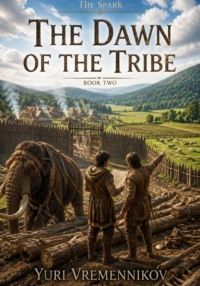
Kitabı oxu: «Volume 2. The Dawn of the Tribe»
Chapter 1. The Spring of Hopes
Spring came to this world unexpectedly bright — as if someone enormous had exhaled warmth all at once and awakened everything living. Only yesterday snow lay on the branches, and today it was already running in streams, revealing last year's leaves and the first green grass pushing through the mold. The air filled with the smell of meltwater, rotting leaves, and something new, alarming and sweet, that happens only at the beginning of spring, when nature is reborn after a long sleep.
Miron sat on a large boulder at the entrance to the dugout and watched the forest wake up. He loved this time — the time of change. In his past life, spring meant the start of the field season, excavations, new hopes of finding something amazing. Now spring meant survival. Winter was over, supplies were running low, but soon fresh greens would appear, herds of deer would come, and one could hunt to one's heart's content.
Beside him, leaning his back against the warm stone, sat Arsen. His brother, as always, was busy with something — drawing something with a stick on a piece of birch bark spread on his knee. For three weeks now he had been struggling with the design of the bow, and today, it seemed, he had found a solution. Miron glanced at the drawing — complex lines, calculations, notes. Arsen had always been like that: before making something, he calculated everything. An engineer to the core.
"Look," Arsen handed his brother the birch bark. "If we make the base from elm, and glue a layer of sinew on the outside, it will spring stronger. I've calculated the approximate tension force here..." — He poked a finger at some numbers understandable only to him. "It should come out about twice as powerful as a simple bow. The arrow will pierce a bison's hide clean through."
Miron smiled. Even here, in the Stone Age, his brother remained an engineer, a designer, a man who couldn't live without improving the world around him. He himself, of course, hadn't forgotten his science either — there, in the corner of the dugout, lay a neatly folded collection of fossils gathered over the winter. Several vertebrae of some large animal, a fragment of a tusk, a strange stone with a shell imprint. But right now his thoughts were elsewhere.
"Ars, listen," he interrupted, distracting his brother from his calculations. "Do you notice how fast everything is changing? A year ago we were starving here, sleeping in a shelter, trembling with fear every night. And now we have dugouts, pots, stores of dried meat, even some kind of library made of birch bark... We're building a civilization here, do you understand?"
Arsen tore himself away from the drawing and looked at his brother. A smirk flickered in his eyes.
"And we've made enemies for ourselves," he added gloomily. "Bork came yesterday, saw tracks of foreign hunters south of the Big Ravine. Five of them, judging by the prints. They walked carefully, clearly scouting. If these are the same 'Fanged Ones' the refugees told us about..."
Miron's face darkened. Spring brings not only birds but also enemies. It's hard to fight in winter, but summer is the very time for raids. He remembered the stories of Yara, a woman from a ruined tribe whom they had taken in in the autumn. The "Fanged Ones" spared no one — neither old people nor children. They simply came, killed the men, took the women and supplies. If they were coming here...
"We'll manage," Miron said firmly. "We're not alone now. Look how many people are in the tribe — almost sixty. And our weapons are better than theirs. Your bow... By the way, when will it be ready?"
"In a couple of days. I still need to dry the string properly and soak it in fat so it doesn't get damp. And arrows — we need a lot of them."
"We'll make arrows. We'll get the women involved, the children. Everyone."
Chick burst out from around the bend of the path leading to the stream. He had grown — though he was only eight, the boy moved fast and noiselessly, like a forest animal used to hiding from predators. With him was Niya — a girl of about seven whom the brothers had noticed last year for her amazing ability to mold clay figurines that looked like living animals. The children were out of breath, their faces flushed from running fast.
"Ir-Tan!" Chick shouted, running up and grabbing Miron by the arm. "There, by the stream... such bones! Big ones! Niya and I found them when we were looking for clay for pots!"
Miron leaped up instantly, forgetting everything in the world. His heart beat faster. He, a paleontologist who had dreamed all his life of finding something worthwhile, now had a unique opportunity to study the remains of ancient animals live — and not somewhere on an expedition where every vertebra had to be scraped out of rock for weeks, but right here, a few minutes' walk from the settlement. And most importantly — these animals might have roamed these forests quite recently, and maybe they roam them even now.
"Lead the way!" he shouted, grabbing his "tool" — a sharp stone for clearing, a piece of birch bark for notes, and a pouch where he could put small finds.
Arsen watched them go and shook his head. His brother would never change. The threat of attack, preparations for defense — all of it receded into the background when it came to bones. But, on the other hand, Miron was also contributing: his knowledge of animals, of their habits, of which bones could be used for tools — all of it came in handy. Arsen stayed — he had to finish the bow. He immersed himself in the drawing again, but kept one ear on what was happening around him.
From the neighboring dugout came Yara — the very woman they had saved in the autumn. She had already settled in, learned to make pots, and helped with the household. With her was her daughter, a little girl, and her nephew Vetka — a teenager of about twelve who looked at everyone like a wolf but was gradually thawing. Vetka was carrying an armful of brushwood for the fire.
"Or-Var," Yara addressed Arsen, "when are we going for roots? Veda says it's time to gather young shoots while they're juicy."
"Go today," Arsen replied. "Take someone from the hunters with you, just in case. The animals are hungry after winter."
Yara nodded and went to the women who were already gathering at the common fire. Life in the settlement was bustling — someone was sharpening stones, someone was weaving ropes from nettles, someone was repairing shelters after winter. Children ran around shouting, playing at hunting. An ordinary morning of an ordinary day in the Stone Age. But Arsen knew: this calm was deceptive. Somewhere out there, beyond the forest, enemies were already on the move, and spring would bring not only warmth but also blood.
Meanwhile, Miron and the children ran to the stream. The spring flood had greatly changed the banks — the water had risen and then subsided, exposing new layers of soil. In one place, where the stream made a bend, the water had washed away the steep bank, and huge bones protruded from the clay. Miron froze, unable to believe his eyes.
Vertebrae — each the size of a human head — lay right on the surface, as if waiting to be found. Nearby were fragments of ribs, long and curved, and a little further — part of a skull with a preserved tusk. The tusk was crooked, almost as long as Miron was tall, covered with cracks, but whole.
"A mammoth," Miron breathed. "A real woolly mammoth!"
He dropped to his knees right in the cold water, not noticing that he was getting wet. His hands trembled as he carefully touched the vertebra. Yes, it was it — Mammuthus primigenius, the very one Miron had read hundreds of books about, whose skeletons he had seen in museums, whose images he had reconstructed from skulls during his studies. But here, live, touching with his hand the fossilized (almost fossilized — the bones had not yet fully mineralized, they were heavy but not stone) surface, he felt something incredible — a touch of eternity. This animal had walked on this land, breathed this air, maybe just a few thousand years ago. And for geology, a few thousand years is like yesterday.
"Is this an evil spirit?" Niya asked fearfully, hiding behind Chick. The girl looked at the huge bones with horror and curiosity at the same time.
"No, little one," Miron turned and smiled, trying to speak calmly. "These are just the bones of an ancient animal. It lived here a very, very long time ago, when our tribe didn't exist yet. Then it died, and the earth preserved its bones. See these vertebrae?" — He pointed at the rounded bones. "This is part of the back. And these are ribs. And this is a tusk — mammoths had such long teeth to dig in the snow and get to the grass."
"Was it big?" Chick came closer, examining the vertebrae. In his eyes burned not fear but greedy interest. Miron recognized himself in this as a child.
"Huge. Taller than these trees." — Miron pointed at the tall pines. "Four meters at the shoulder, and with the tusks — even taller. Imagine, such a mountain walking, the ground trembling. And the wool was long, down to the ground, so it wouldn't freeze."
"How did it die?" Chick asked.
"I don't know. Maybe it grew old, maybe it got stuck in a swamp, maybe hunters killed it. But the bones were preserved because they were covered with earth. Now the water has washed away the bank, and we see them."
Miron carefully began to clear the find, explaining to the children how to work so as not to damage the bones. Chick listened greedily, memorizing every word. He could already count, write a little, and clearly strove for knowledge. Niya was also interested, but she was more attracted not by the bones but by the strange patterns on them — traces of teeth of some predator that had gnawed the mammoth after death.
"Who gnawed this?" she asked, pointing at the scratches.
"Maybe a cave lion, maybe hyenas. They lived then. Also huge."
The children gasped. Miron grinned: he himself would have gasped at seeing a live cave lion. But so far, thank the gods, they had met only ordinary predators — bears, wolves, lynxes. And that was enough.
After sitting by the stream until the very evening, Miron selected several vertebrae and a fragment of tusk — for study and for crafts. He sprinkled the rest with earth to preserve it until next time. Chick and Niya helped carry the finds to the settlement. On the way, Miron told them about mammoths, about the Ice Age, about how people hunted these giants. The children listened with their mouths open.
They returned to the settlement already after dark. People were sitting by the fire, soup was cooking. Seeing Miron with his burden, many came over to look. The news of the find quickly spread through the tribe. The old shaman Gurr, on hearing it, frowned and shook his head:
"These are the bones of earth spirits. They must not be disturbed. The spirits will be angry."
"Gurr," Miron said gently, sitting down next to the shaman by the fire. "Look. These bones are very, very old, they've lain in the earth for thousands of years. The spirits left them long ago. And we can make useful things from them." — He took one vertebra, heavy and dense. "See? From such a bone you can make an excellent spearhead — stronger than stone. Or needles for sewing hides. Or amulets to protect people. The spirits will be glad if we use their gifts wisely."
Gurr hesitated. He was silent for a long time, stroking his long gray beard, then took the vertebra in his hands, turned it over, tapped it.
"Heavy," he said at last. "Stone-like."
"Not stone, but hard. Tomorrow I'll show you how to make a knife from such a bone. You'll see — it's good, not evil."
The shaman nodded, but worry remained in his eyes. Miron understood: the faith of the ancestors is strong, one cannot simply dismiss it. One must act carefully, proving the benefit.
The next day he fulfilled his promise. Taking a fragment of a mammoth rib, he spent a long time chipping it with a stone, giving it shape. Then he sharpened the edge against sandstone. The result was a knife — not as sharp as a flint one, but strong, convenient, not brittle. Miron demonstrated to Gurr how easily one could cut meat with this knife.
Gurr tried it himself and was surprised. Then Miron showed how to make a smooth amulet from the tusk — carve a sun on it, the sign of life. The amulet came out beautiful, white, with a warm sheen. Miron hung it around Gurr's neck.
"The spirits have permitted it," the shaman declared, touched by the gift. "We may take the bones. But only with gratitude."
Thus the "Grey Lynxes" gained a new source of raw material. And Miron gained the opportunity to conduct real excavations — and to teach the children what he himself knew.
In the evening of the same day, when it got dark and everyone had gone to their dugouts, Miron sat by the fire with his brother. Chick and Niya had settled nearby — they now never left their teacher.
"Ars, can you imagine," Miron was saying, stirring the coals with a stick. "There's a whole mammoth graveyard there! If we dig it up, we'll have enough bones for tools for years. We can study them — how many there were, how old they were, what they were sick with... This is unique material!"
"Just don't forget that war could start any day," Arsen reminded him. He was sitting, leaning against a log, cleaning feathers for arrows. "Bork saw smoke to the east again today. Closer than yesterday."
"I remember. But if we survive, this knowledge will remain. Chick," — Miron turned to the boy, "do you want to become a scientist? Search for bones, study ancient beasts?"
Chick beamed:
"I want to! Like you, Ir-Tan."
"Then listen and remember. Tomorrow we'll go to the stream, and I'll show you how to tell which bones belong to which animals. And you'll write everything down on birch bark."
Niya pouted resentfully:
"And me?"
"And you will draw. Make pictures of mammoths so everyone knows what they looked like. Deal?"
The girl nodded, smiling happily.
Arsen looked at his brother, at the children, at the warm firelight and thought: this is happiness. Not the kind he had sought in his past life — career, achievements, recognition. But simple, warm, alive. Here and now.
But the thought of the smoke to the east would not let go. Tomorrow he would have to send out scouts, prepare the people... But today, let there be this peaceful evening.
The thought of the smoke made Arsen remember last autumn, when they had found an orphaned baby mammoth. Then, as now, someone else's smoke was rising above the forest — enemy scouts. But the brothers weren't thinking about danger then; they were saving a tiny creature that had now grown into the mighty Fluffy and become the tribe's main strength. "We must be ready for anything," Arsen thought.
He took a branch and again began to whittle a shaft for an arrow. Work calmed him. Nearby Miron and the children were talking quietly, muffled voices came from the dugouts, somewhere a baby cried, and the mother sang a quiet song. An ordinary evening of an ordinary tribe lost in time.
But somewhere far away, beyond the forests and hills, the fires of enemy camps were already being lit. Spring was gaining strength.
Chapter 2. The Threat on the Horizon
The night passed calmly, but Arsen hardly slept. He lay on the hides in the dugout, listening to the sounds of the forest — the hooting of owls, the distant howling of wolves, the rustling of small animals. Somewhere beyond these sounds lurked another, more dangerous silence — the silence of creeping enemies. Toward morning he dozed off, but slept lightly, half an eye open, like a beast sensing danger.
He woke because someone touched his shoulder. He opened his eyes — Bork, the shaman's son, was standing beside him. The very one who had once been at odds with the brothers and had now become one of the best hunters. Bork's face was gloomy and focused.
"Or-Var, come. I found something."
Arsen rose instantly, threw on his hide jacket, and tucked a knife into his belt. Miron was still asleep, curled up — his brother could always sleep in any situation, a gift Arsen envied. He quietly left the dugout.
Dawn was just breaking. The sky in the east was brightening, turning pink, promising a clear day. The settlement was already waking up: women were blowing on the coals in the fire pit, children were climbing out of the shelters, stretching. It smelled of smoke and dampness.
Bork silently led Arsen beyond the palisade, to the path leading south. About three hundred meters on he stopped and pointed at the ground.
Tracks. Clear imprints of bare feet in the soil still damp from the night. Arsen crouched, examining them. Five, no, six people. They had walked in single file, trying to step in each other's footprints, but here and there the prints diverged. Experienced hunters.
"They passed yesterday evening," Bork said quietly. "I came across them this morning. They came from the direction of the Big Ravine, then turned back. Reconnaissance."
Arsen straightened up, scanning the forest. It was quiet around, too quiet. Even the birds were silent, as if sensing a foreign presence.
"Definitely not ours?"
"Ours don't walk like that. And the foot size is different — wider, coarser. Strangers."
They returned to the settlement when the sun was already above the trees. Arsen immediately called a council. In the large dugout gathered Run, the chief, Bork, several elders, Miron, and Gurr. Gurr was old, but his mind remained clear, and nothing was decided without his word.
"Strangers are near," Arsen began without preamble. "Reconnaissance. That means they're preparing an attack."
Run frowned. He was a young chief, elected after the old one's death, but he had already shown himself wise and firm. He sat in the place of honor, covered with a bear hide, and listened attentively.
"How many are there?" he asked.
"Six. But those are only scouts. The main force, I think, is no fewer than fifty."
"How do you know?"
"Logic," Arsen replied. "If there were few of them, they would have attacked at once without sending scouts. And if there are many — they need to know where we are, how many of us, what fortifications we have."
Gurr coughed, stroking the amulets on his chest:
"The spirits warned. I saw a dream: a black river flowed toward our settlement. That means trouble."
Miron, who had been listening in silence, spoke up:
"We can prepare. We've almost finished the palisade. The moat is dug, stakes stand at the bottom. We need to make more arrows."
"Arrows are few," Bork said. "There aren't enough stones for the tips. The flint is gone, and new flint must be sought far away."
"We can make them from bone," Miron recalled. "We have mammoth bones now. They're hard if sharpened."
Run nodded:
"Good. Let the women and children make bone arrows. The men will finish the palisade. Bork, you and the hunters will guard day and night. If you spot strangers — report at once."
The council ended, everyone went about their business. Arsen lingered with his brother.
"Do you think we'll make it in time?" Miron asked.
"We must. If they don't attack in the next few days."
"And if they do?"
"We'll fight. We have no choice."
Miron sighed. He still wasn't used to the thought that he might kill. In his past life he had only read about wars, studied skeletons with traces of trauma, but he himself had never held a weapon against a man. Here he had. And, apparently, would again.
While the men prepared for defense, the women and children set about making arrows. Miron brought several mammoth bones and showed how to split them, how to carve tips. The work went slowly — bone is hard and requires patience. But the people tried, understanding: their lives depended on these arrows.
Chick sat next to Miron and watched his every movement closely. He had already tried sharpening a bone tip himself, but it came out crooked.
"Don't rush," Miron taught. "First give it shape, then sharpen. And make sure the edges are even — otherwise the arrow will fly off course."
"And why is bone better than stone?" Chick asked.
"Not better, just a different material. Stone is sharper, but it's brittle. Bone is flexible; it won't split if it hits an animal's bone. But sharpening it is harder."
Chick nodded and set to work again. Nearby Niya was molding little figures from clay — she always calmed down that way when she was scared. Today she was molding a mammoth, the way Miron had described it — with long wool and big tusks.
"Is it coming out?" Miron asked, looking over her shoulder.
"Yeah. Only the tusks won't stay on — they keep falling off."
"First make the head, then insert the tusks. Make little holes, fix them with sticks."
Niya obeyed, and soon the mammoth acquired tusks. She smiled contentedly and showed the figure to Chick.
"Look, it's like it's alive!"
"Almost like the real thing," Chick agreed. "Only small."
Miron looked at the children and thought: this is what's worth living and fighting for. So that they grow up in peace, so that they can learn, so that they can mold mammoths from clay instead of hiding from enemies. But for that, they had to win.
By evening strangers came to the settlement. Not enemies — refugees. They were spotted by the guards — three women and two children, barely able to move their legs. They were trudging along the path, falling, getting up, and walking again.
Arsen went out to meet them with his bow ready, but seeing their condition, lowered his weapon. The women were emaciated, dressed in rags, their faces covered in dirt and bruises. The children — a boy of about ten and a younger girl — looked at them with wild eyes.
They were let into the settlement, seated by the fire, given water and food. The eldest woman, whose name was Yara, drank greedily, burning herself, then spoke — incoherently, crying, stammering.
"They came at night... The Fanged Ones... Killed everyone... The men tried to defend themselves, but there were too many of them... We hid in a pit, covered ourselves with branches... They left in the morning, thinking everyone was dead... We walked for three days... Afraid they'd catch up..."
"How many of them?" Arsen asked.
"Many... I didn't count... Maybe fifty, maybe more... They have clubs with bone spikes... And spears... They're strong..."
"Where did they go?"
"I don't know... Toward the west, I think... Following the sun..."
Arsen and Miron exchanged glances. West — that meant toward them. There was little time left.
Yara burst into sobs, burying her face in her daughter's shoulder. The second woman, old, with a wrinkled face, sat in silence and only shook her head. The third was very young, almost a girl, with empty eyes — she seemed to have lost her mind from horror.
"We will take you in," Run said, approaching the women. "We have food and shelter. You will be safe."
Yara raised her eyes to him, full of tears and gratitude.
"Thank you... Thank you... We will work... We know how to do everything..."
"Rest," Miron said gently. "We'll talk later."
The women were taken to a free dugout, given hides and food. The old one, whose name was Veda, turned out to be a healer — she came to a little and asked for herbs to heal wounds. They all had scrapes and cuts.
Miron brought his supplies — dried leaves, bark, roots. Veda looked, nodded:
"Good herbs. Gathered correctly."
"You know about medicines?" Miron asked.
"I healed my tribe for thirty years," Veda replied. "Now there's no one left to heal."
"Now you'll heal us. We have sick people too."
Veda smiled faintly for the first time all evening.
The boy, Yara's son, Vetka, sat by the fire and was silent. He clenched his fists and stared into the fire. Chick sat down next to him:
"How are you?"
Vetka flinched, looked at Chick, then stared at the fire again.
"They killed my father," he said hollowly. "I saw it. He fell, and they beat him with clubs. And I lay in the pit and couldn't do anything."
"You were little," Chick said. "What could you do?"
"I'll grow up and kill them all."
Chick was silent for a moment, then said:
"Ir-Tan and Or-Var teach us. They know a lot. They'll teach you too. You'll shoot a bow — then you can protect your people."
Vetka raised his eyes:
"Will they teach me?"
"They will. They're kind. Come on, I'll show you where we sleep."
Chick took Vetka by the hand and led him to the dugout. On the way they met Arsen.
"A new friend?" Arsen asked, looking at Vetka.
"His name is Vetka. He wants to learn to shoot so he can kill the Fanged Ones."
Arsen crouched down to be at the boy's level.
"Killing isn't the main thing. The main thing is protecting. If you think only of revenge, you'll die yourself and won't help others. Understand?"
Vetka nodded, though anger burned in his eyes.
"Come to us tomorrow morning. We'll learn."
And he went on. Chick and Vetka climbed into the dugout where Niya and the other children were already asleep. Vetka tossed and turned for a long time, unable to sleep — he kept thinking of his father, of the enemies, of how he would take revenge. But then fatigue took its toll, and he fell into a dreamless sleep.
At night Arsen again did not sleep. He sat by the fire, cleaning his bow, checking the string. Miron settled nearby — he couldn't sleep either.
"Do you think they'll attack soon?" Miron asked.
"I think so. There was reconnaissance, refugees came — that means they're near. We have three or four days."
"Will we manage to prepare?"
"We'll try. The main thing is that the people don't panic. You keep working with the children, it'll be calmer for them. And I'll be with the hunters."
"All right. You know, Ars, I sometimes wonder — why are we here? Well, we ended up here, fine. But why us? Why must we teach these people, protect them, kill for them?"
Arsen was silent for a moment, looking at the fire.
"Maybe because there's no one else? Maybe it's our duty — as scientists, as people who know more? We can change the course of history. Make it so that this tribe survives, develops, creates a civilization. Isn't that what we studied for?"
"That's what," Miron sighed. "Only it's hard. Every time someone dies, I feel guilty. What if we could have saved them but didn't make it in time?"
"Don't take too much on yourself. We're not gods. We're just people trying to do our job."
They fell silent. The fire crackled quietly, sparks flew up into the black sky. Somewhere far away a wolf howled, and another answered. The forest lived its own life, indifferent to human cares.
"I'll go get some sleep," Miron said. "There's a lot to do tomorrow."
"Go. I'll sit a while longer."
Miron went into the dugout. Arsen remained alone. He sat and thought that his brother was right — it was hard. But there was no retreating. They were here, they were needed, and they would do everything to protect these people. Even at the cost of their lives.
He checked the string one last time, put the bow down beside him, and leaned his back against the log. His eyes were closing. He had to sleep at least an hour — tomorrow would be a hard day.
The morning began with shouts. Arsen jumped up, grabbed his bow — but it wasn't enemies. One of the women was screaming, pointing at the forest. There, at the edge of the forest, stood people. Several people, unarmed, with raised hands.
"More refugees," Arsen exhaled. "How many of them are there?"
These were two more families — a man, two women, three children. They told the same story: the Fanged Ones were coming, destroying everything in their path. Their tribe was broken, they had escaped by a miracle.
The settlement was quickly filling with people. One should rejoice — new workers, new hands — but there was no joy. Too many mouths, too little time to prepare. And too obvious a threat hung over everyone.
Run called a council again. They decided: accept the refugees, distribute them among families, put all the men on guard, the women — on making arrows and food. Teach the children whatever they could.
Miron looked at the new people and thought: this is only the beginning. If the Fanged Ones are strong, they will wipe out all these small tribes. Only those who unite and can fight back will remain. Maybe the "Grey Lynxes" will become such a center of unification? Maybe they will create an alliance that will withstand?
But for that, they had to survive the coming battle.
Veda, the old healer, was already examining the new refugees — many had wounds and illnesses. She directed the women, showed them which herbs to brew. Miron helped her, writing down new recipes on birch bark. Time was slipping through their fingers like water.
And in the forest, beyond the hills, the warriors of the Fanged Ones were already gathering. Their chief, a huge hulk with a bear skull on his head, listened to the scouts' reports.
"There's a big settlement there," the scout was saying, pointing west. "They have a palisade, a moat. Many people."
"Many?" the chief repeated.
"Like ants. But they're weak. They have no bronze, only stone and bone."
The chief grinned:
"We'll take them. Tomorrow we march."
And a black smoke rose above the forest — the signal to gather.
Chapter 3. The School by the Stream
The morning after the refugees' arrival was busy. The new people were settling in, the women were distributing food, the men had gone hunting — they had to feed the extra mouths. But Miron firmly decided: lessons with the children must not stop. If the enemy came, the children must be able not only to hide but also to help — carry arrows, light signal fires, treat the wounded. And most importantly — they must understand why they live, what they strive for.
He gathered his students by the large boulder on the bank of the stream. The place was beautiful — from here there was a view of the river, the distant forests, the sky with floating clouds. The spring sun was warm, it smelled of young leaves and damp earth.
Today many children came — not only the regulars Chick, Niya, Tuk, but also new ones: Vetka, Yara's son, his little sister, whose name was Irra, and three more children from the refugee families. They sat warily, huddling together, not understanding what was wanted of them.
Miron smiled at them:
"Don't be afraid. No one will hurt you here. We're going to learn — it's interesting."
Chick, already feeling like an old-timer, nodded importantly to the newcomers:
"Ir-Tan knows everything. He'll tell you about animals, about the stars, about how to make pots. Listen and remember."
Miron laughed:
"Well, I don't know everything. But I know some things. Let's get acquainted. I'll ask, and you answer. Deal?"
The children nodded. Even Vetka, gloomy and wary, relaxed a little.
"Tell me," Miron began, "what is the most important thing for a hunter?"
"A spear!" shouted Tuk, who already considered himself almost an adult hunter.
"A bow!" added Chick.
"Strong arms," said Niya.
Miron shook his head:
"All of that is important. But the most important thing is the head. A hunter must know the habits of the beast, must be able to read tracks, must understand where the deer will go, where the hare will hide, when the bear will come out of its den. If you know this — you'll get meat even with a bad spear. And if you don't — you'll stay hungry even with a good bow."
The children fell to thinking. Vetka raised his hand — as Chick had taught him.
"And how do you learn the habits?"
"Observe," Miron replied. "Watch. Remember. Think. For example," — he pointed at the stream, "do you see the water flowing? Why does it flow?"
"Because it flows downhill," said Chick.
"Right. Water always flows downhill. And if we dam the stream with stones, what will happen?"
"The water will stop?" Niya suggested.
"At first it will stop, then it will start looking for another way, go around the stones or overflow them. That's how animals in the forest are. If there's danger on their path, they'll find another road. Knowing this, a hunter can guess where they'll go."
Miron spoke simply and fascinatingly, showing with his fingers, drawing with a stick on the sand. The children listened with their mouths open. Even the little ones, who had been fidgeting at first, quieted down.
"And now let's play," Miron suggested. "I'll be the beast, and you'll be the hunters. Guess where I'll go."
He stepped aside, looked around, chose a direction, and walked, deliberately leaving noticeable tracks on the damp earth. The children rushed after him in a crowd, examining the prints.
"This way!" Chick shouted. "See, the grass is pressed down!"
"And here he stepped on a stone," added Tuk, pointing at a scratch.
Vetka suddenly stopped and said:
"He'll turn toward the stream. There's water, he'll want to drink."
Miron, who had already reached the stream, turned and smiled:
"Well done, Vetka! Right. I did go to the water. How did you guess?"
"My father..." Vetka began and faltered, his voice trembling. "He taught me. He said a beast always goes to water when it's hot."
"Your father was wise," Miron said quietly. "You'll be a good hunter."
Vetka turned away so no one would see his tears. Chick came up to him and touched his shoulder:
"Come on, let's keep watching."
The game continued for another hour. Miron showed the children how to read tracks, how to tell how long ago the beast had passed, which way it had gone, whether it had run or crept. The children got carried away, forgetting fear and hunger.
Then they all returned to the boulder, and Miron took out the birch-bark sheets — his "library." He laid them out on a flat stone.
"This is writing," he explained to the newcomers. "Signs that stand for words. This sign is 'sun.' This one is 'tree.' This one is 'man.' If I write sun and three sticks, it means 'three days.'"
"And why is that?" asked little Irra, Vetka's sister.
"To remember. For example, today we learned about tracks. If I write this on birch bark, in a month you can read it and remember. Or if I leave and you want to know something, you'll read it in my notes."
"And you'll leave?" Niya asked fearfully.
"Not soon," Miron smiled. "But someday everyone leaves. And knowledge must remain."
Chick could already read simple signs and proudly showed the newcomers how to put syllables together. Niya drew pictures on a separate sheet — animals, people, trees. Her drawings were so lifelike that even Miron was amazed.
"You're an artist," he said. "Your drawings are also writing. From them one can understand how we lived."
Vetka looked at the birch bark with doubt. Then he asked:
"Can you write how to kill the Fanged Ones?"
Miron's face darkened, but he answered calmly:
"You can. But it's better to write how to defend yourself. How to build a palisade, how to make bows, how to heal wounds. Killing is not the most important thing in life."
Vetka frowned but said nothing.
Meanwhile, at the other end of the settlement, Arsen was working with the adults. He was showing the hunters how to shoot a bow correctly, how to hold formation, how to cover themselves with shields. The new people, the refugees, watched with surprise — they had never seen such a weapon.
"This is wood and sinew," Arsen explained, showing the bow. "The strength is not in the arms but in the elasticity. The bow accumulates force when you draw it and gives it to the arrow. The arrow flies fast and far."
He loosed an arrow into a tree — it went in two fingers deep.
"I want to learn," said one of the refugees, a man of about thirty with a deep scar on his face. "I could fight with a spear, but this... This is power."
"I'll teach you," Arsen nodded. "I'll teach everyone. The enemy is coming soon, and we must be able to defend ourselves."
The man's name was Rad; he had been a hunter in his tribe until the Fanged Ones killed everyone. Now he looked at Arsen with hope and anger at the same time.
"I want to kill them," he said quietly. "Many of them."
"Killing will be necessary," Arsen agreed. "But the main thing is not to let them kill ours. Understand?"
Rad nodded.
By evening Arsen had trained a dozen men in the basics of archery. Not everyone succeeded — hands trembled, eyes squinted, arrows flew wide. But those who had been hunters caught on quickly. Bork and Tuk helped the newcomers, showing them how to set their feet, how to aim.
"In a week they'll shoot decently," Bork told Arsen. "If we keep training."
"In a week it may be too late," Arsen replied. "We train every day while there's time."
The sun was slanting toward sunset when Miron finished his lessons with the children. They ran off to help the adults — some carried brushwood, some helped the women clean fish, some just played, but quietly, not disturbing anyone. Chick lingered with Miron.
"Ir-Tan," he asked, "do you really think we'll beat the Fanged Ones?"
Miron looked at the boy. In his eyes was not a child's question — he already understood what death and danger were.
"I really do," Miron said firmly. "Because we're smarter. Because we're preparing. Because we have bows and a palisade. And because we're defending our home, and they came to plunder. Defenders are always stronger if they believe in their cause."
"And you believe?"
"I believe. And you believe."
Chick nodded and ran off. Miron remained alone by the boulder. The sun was setting behind the river, coloring the sky in orange and pink. Somewhere a bird was calling, voices could be heard in the settlement, the smell of smoke from the fires. "What a beautiful world," Miron thought. "And how cruel. But we'll make it kinder. At least for these children."
Pulsuz fraqment bitdi.