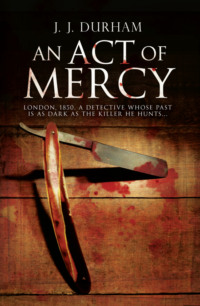
Kitabı oxu: «An Act of Mercy: A gripping historical mystery set in Victorian London»
An Act of Mercy
J. J. Durham

an imprint of HarperCollinsPublishers
www.harpercollins.co.uk
This novel is entirely a work of fiction.
The names, characters and incidents portrayed in it,
while at times based on historical fact, are
the work of the author’s imagination.
Killer Reads
An imprint of HarperCollinsPublishers
1 London Bridge Street
London SE1 9GH
www.harpercollins.co.uk
First published in Great Britain as A Killing Kindness, by J. J. Durham 2014
This edition published by HarperCollinsPublishers 2015
Copyright © J. J. Durham 2015
J. J. Durham asserts the moral right to be identified as the author of this work
Cover layout design © HarperCollinsPublishers 2015
Cover photographs © Shutterstock.com
A catalogue record for this book is available from the British Library
All rights reserved under International and Pan-American Copyright Conventions. By payment of the required fees, you have been granted the non-exclusive, non-transferable right to access and read the text of this e-book on-screen. No part of this text may be reproduced, transmitted, down-loaded, decompiled, reverse engineered, or stored in or introduced into any information storage and retrieval system, in any form or by any means, whether electronic or mechanical, now known or hereinafter invented, without the express written permission of HarperCollins e-books
Ebook Edition © APRIL 2015 ISBN: 9780008132767
Version 2015-03-02
Contents
Cover
Title Page
Copyright
CHAPTER ONE
CHAPTER TWO
CHAPTER THREE
CHAPTER FOUR
CHAPTER FIVE
CHAPTER SIX
CHAPTER SEVEN
CHAPTER EIGHT
CHAPTER NINE
CHAPTER TEN
CHAPTER ELEVEN
CHAPTER TWELVE
CHAPTER THIRTEEN
CHAPTER FOURTEEN
CHAPTER FIFTEEN
CHAPTER SIXTEEN
CHAPTER SEVENTEEN
CHAPTER EIGHTEEN
CHAPTER NINETEEN
CHAPTER TWENTY
CHAPTER TWENTY-ONE
CHAPTER TWENTY-TWO
CHAPTER TWENTY-THREE
CHAPTER TWENTY-FOUR
CHAPTER TWENTY-FIVE
CHAPTER TWENTY-SIX
CHAPTER TWENTY-SEVEN
CHAPTER TWENTY-EIGHT
CHAPTER TWENTY-NINE
CHAPTER THIRTY
CHAPTER THIRTY-ONE
CHAPTER THIRTY-TWO
CHAPTER THIRTY-THREE
CHAPTER THIRTY-FOUR
CHAPTER THIRTY-FIVE
CHAPTER THIRTY-SIX
CHAPTER THIRTY-SEVEN
CHAPTER THIRTY-EIGHT
CHAPTER THIRTY-NINE
CHAPTER FORTY
CHAPTER FORTY-ONE
CHAPTER FORTY-TWO
CHAPTER FORTY-THREE
CHAPTER FORTY-FOUR
CHAPTER FORTY-FIVE
CHAPTER FORTY-SIX
CHAPTER FORTY-SEVEN
CHAPTER FORTY-EIGHT
CHAPTER FORTY-NINE
CHAPTER FIFTY
CHAPTER FIFTY-ONE
CHAPTER FIFTY-TWO
CHAPTER FIFTY-THREE
CHAPTER FIFTY-FOUR
AUTHOR’S NOTE
Have you enjoyed An Act of Mercy?
About the Publisher
CHAPTER ONE
‘There ain’t many things in life I’m afraid of, sir … ’
‘But … ?’ Sergeant Harry Pilgrim glared up at the constable from halfway down the sewer ladder.
He hopped from one foot to the other, peering down at his superior. ‘Rats is one of them.’
‘Rats?’
‘Just so, sir. Fearful scratchy, louse-ridden creatures, sir, and I could no more go down that hole with you than walk on water, sir, even if you paid me a hundred guineas.’
Pilgrim looked at the constable. They both knew he earned just twenty shillings a week.
‘I don’t have time for this, Wainwright. Pass me the tinder box.’
‘Here it is, sir.’ The constable’s face slackened with relief.
Pilgrim took the box and tested the wheel. It fired readily; spinning sparks into the darkness as he descended the ladder. The rungs were surprisingly dry – it hadn’t rained for more than a fortnight – but even so, Pilgrim landed at the bottom with a splash. He didn’t look down to see what he had landed in, but up instead, to Wainwright’s face, haloed by the night sky like a lugubrious saint.
‘If I’m not back in five minutes go to the barracks.’ Pilgrim’s voice echoed off the arched brickwork. ‘Tell Constable Williamson where I am, and get him to wake some of the men to follow me.’
‘Will do, sir … and sorry, sir … about the rats.’
Pilgrim sparked the tinderbox again, and lit the wick of the lamp. He raised it up. He was in one of the new parts of the sewer system. The roof was easily high enough for him to stand, but the bricks were already crumbling, and daubed with rust-coloured streaks. It wasn’t rust, of course.
Pilgrim grimaced. He was glad that smallpox had robbed him of his sense of smell. He knew he had to hurry. The man he was pursuing was at least five minutes ahead of him now. He pressed on into the sewer; a straight tunnel with no turns or visible exits.
‘… seventy-four … seventy-five …’ He counted the paces, until he reached a point where the tunnel split into two. He hesitated. His quarry could have gone down either of them. But which one? He lifted the lamp higher, and listened. Nothing. Except the scratch of claws on brickwork. He could make out the huddle of rats on the copings beyond the range of his lamp. It was just as well Wainwright hadn’t wanted to join him. On the other hand, if he had, they would at least have been able to explore both routes. Frustration welled. Pilgrim had come so far, but now found himself torn between choosing one of the tunnels at random and turning back.
Then he heard it: the rasp of metal on metal, coming from the left hand branch. He took off his scarf, hung it on a nail that was protruding from the wall of the left hand tunnel, then galvanized into action, wading through the water as quickly as he could. It was impossible not to splash, but he hoped that the man he was chasing would be too absorbed in his own progress to hear the pursuit. Pilgrim ran on through the greasy water. Something caught at his foot. He lurched and stumbled, pitching forwards, then floundered a moment, grabbing for something, anything, that might help to keep his face out of the filth. His fingers closed on something substantial, and he used it to push up onto his feet. Releasing it, he recoiled at the sight of an eye staring up at him. A dead dog.
He made an effort to steady the pounding of his heart. At least he hadn’t dropped the lamp. He listened. Nothing. All his senses told him he was alone in the tunnel.
‘Bollocks.’
He lifted the lamp. More brick, more slime, more black water, stretching away into the darkness. But there, on the boundary of the glow cast by the lamp, he saw something else: rungs set into the wall. He waded towards them and peered up at a manhole cover. If his suspect was no longer in the tunnel, he had to have got out somewhere. Realising he couldn’t climb with one hand, Pilgrim took a deep breath and pinched out the wick of the lamp. Blackness swallowed him: a solid thing. He beat down his anxiety by concentrating on the feel of the metal rungs under his hands. One. Two. Three. Four. Five. Hand over hand; he pulled himself upwards, until his head bumped against the manhole cover. He lifted it, and slid it to one side. He blinked.
Moonlight painted the lane as bright as midday in Margate. He made a hasty calculation of direction and distance, and decided he was probably somewhere to the west of St James’ Square. Behind Curzon Street, perhaps. Or Half Moon Street. A wealthy area, that wouldn’t take kindly to detectives popping up out of the sewer, even at that hour. He levered himself up out of the hole, glad that most of the worthy citizens of Mayfair would be tucked up in their beds.
After a moment’s hesitation, he left the cover partly off the hole, considering it worth risking an accident in the hope that the moonlight would guide Wainwright, Williamson, and the other constables to him.
He straightened up and listened. His suspect had to be long gone: the manhole was at the junction of three lanes, and he could have fled in any direction. But he willed himself, with a discipline forged from experience, to stand still. To listen and to look. A shadow detached itself from the larger shadow of a nearby wall, and wound itself around his legs. He resisted the urge to kick it, and peered instead at the surrounding buildings. Several stable blocks lined the converging lanes, overshadowed by the houses behind them. The houses were all in darkness.
Except one. One with lights shining in several windows on the upper floors. Pilgrim headed for it. The gate that gave onto the lane was closed, but not locked. The hinges were well oiled, and it swung open without a sound.
As he picked his way towards the house, he paused, his eye caught by something gleaming on the path. Water. He suppressed a thrill of triumph. His man had come this way: given the recent dearth of rain, there was no other way for the path to be wet. There didn’t seem to be a back door, but there was a side entrance, in the shadows of the neighbouring building. It was too gloomy to see the doorway properly, so he bent to touch the step, a parody of genuflection. It was also wet.
He hesitated. He couldn’t go crashing into a wealthy household on his own, although he wouldn’t have had the same scruples in one of the poorer parts of the city. If Wainwright had gone back to the barracks as instructed, if he had then roused Dolly and the other constables and taken them to the manhole in Cockspur Court, then Pilgrim was looking at a wait of at least forty minutes. Providing, of course, that Dolly had spotted the scarf he had left to mark the left-hand tunnel in the sewer. If not …
With a feeling that the situation was slipping out of his grasp, he worked his way around to the front of the house. And there his anxiety deepened: a Hackney carriage was waiting at the kerb. The nag between the traces had a dejected air, looking no happier to be out in the middle of the night than Pilgrim was himself. Pilgrim guessed it had been there for some time.
He crept into a gap in the shrubbery, just yards from the cab. He had no sooner settled into his chosen spot, however, when a gust of night air found a crack in the glass of one of the carriage lamps, and extinguished the flame. The driver’s shoulders slumped, and he slid off the box. Pilgrim heard a flint strike.
‘Come on, you tokey bugger.’ The driver jabbed at the wick, and the lamp flared.
Pilgrim drew back into the shadows so that the driver wouldn’t see him, pulling his collar over the lower half of his scarred face. The carriage lamp died again, plunging Pilgrim back into gloom.
‘Stay like that, then, you bugger.’ The driver continued berating the lamp until he resumed his seat on the box, where he lapsed once more into silence.
Pilgrim’s eyelids drooped, and he wondered, not for the first time, what he was doing there. It was one of his golden rules never, ever, to act on tip-offs from the public. In his experience, anonymous leads were unreliable at best, if not downright mischievous. But there had been something about the note he had received that evening, the use of red ink, perhaps? It had been addressed to him, care of ‘Mr Charles Dickens, at the offices of Household Words’. Pilgrim was not a man given to fancies – far from it – but he had had the strangest sensation when Dickens put the envelope into his hand.
He settled further into his hiding place, pondering the nature of anonymous informants, the use of red ink, and the usefulness of having golden rules if you were in the habit of breaking them. His eyes drifted shut …
He jerked awake again as the carriage door slammed. Had someone climbed inside? The driver shook his reins and urged the horse into motion. Pilgrim resisted the impulse to shout at him to stop; he didn’t want to lose the element of surprise. He had no choice but to spur his reluctant limbs into action. Luckily, the horse was no more enthusiastic for the exercise than he was, and barely accelerated above an amble to the end of the street. It slowed down still further to turn the corner, and Pilgrim seized his chance. He put on a burst of speed, and grabbed for the door handle, using his own forward momentum to open the door and swing himself up into the cab.
‘What the … ?’ The startled passenger, a young man with mutton chop whiskers, leapt off the seat. Pilgrim swung his fist lazily, almost casually, and felt it connect with the man’s chin. He slid to the floor, like a puppet with its strings cut.
The driver sawed the cab to a halt. ‘What in hellfire … ?’
Pilgrim ignored him, and turned his attention to the packages on the floor. There were six in total, all swathed in brown canvas. The largest was about the same size as a hatbox. Pilgrim knelt beside it, and started to tear at the wrappings. It was indeed a hatbox. He fumbled with the strap. As he did, the box slipped from his grasp and it sprung open, dumping the contents. A roughly spherical object bounced away across the floor of the cab, trailing wet strips of rag behind it. It came to rest under the seat.
He stared at it. It stared back. It took him a long, shocked moment to realize what it was.
CHAPTER TWO
‘Can’t beat a splendid piece of beef. And the bloodier the better, eh? Builds up the constitution.’
The chunk of flesh quivered so rare on the silver platter that it looked as if it had trotted to the table straight from Smithfield, without detouring to a kitchen.
‘So I understand, Mr Phillips.’ The Guest of Honour, who much preferred his beef brown, masked his dismay with a smile. Charles Dickens was nothing if not a social creature, and prided himself on his manners.
‘Don’t mind if I carve it meself, do you?’ asked Phillips. ‘The servants always make a bloody hash of it.’
‘Language, John.’ The rebuke from Mrs Phillips was mild, for the guests of her late supper party were used to her husband’s eccentricities. She nodded as the footman replenished her wine glass.
The dining room was panelled from floor to ceiling: a surfeit of mahogany and scagliola columns. The gentlemen, wearing white waistcoats, uniformly red-faced and bewhiskered, were indistinguishable from each other. The women, on the other hand, had gone out of their way to be as individual as possible, resulting in a visual cacophony of multicoloured silks, feathers, and paisley shawls. Lady Harcourt-Brown rustled as she leaned towards Dickens, offering a generous view of crepey bosom.
‘We have been reading in Household Words, Mr Dickens, about the new detective police who have been appointed.’
He kept his eyes fixed on the beef that was yielding to the enthusiasm of his host’s carving knife. But the Lady was not to be similarly distracted.
‘Do you think they will put an end to the lawlessness on our streets?’ she prompted.
‘Ha!’ It was not Dickens, but her husband, Sir Harold, who responded.
‘You do not think so, sir?’ They’d caught his attention at last.
‘Indeed I do not. In my experience, these so-called detectives are very ordinary people, with delusions of cleverness, who are worth nothing when taken beyond their usual routine.’
‘I’m afraid I must disagree with you,’ Dickens began. ‘The rate of …’
‘It will all come to nothing.’ Sir Harold dismissed Dickens, the detectives, and the improved conviction rates of the capital with a wave. As Justice of the Peace for Clerkenwell East, he was well known for being ‘down on’ anyone unlucky enough to appear before him, and prided himself on that reputation. ‘It is never a wise or safe proceeding to put authority in the hands of the lower classes.’
Dickens’s gaze flicked to the footmen lining the room. They remained granite-faced, as good servants should.
‘If you ask me,’ continued Sir Harold, ‘there’s something underhand about these detectives of yours. All that sneaking about and lurking in corners. It isn’t …,’ he cast around for a suitable word, ‘English.’
‘Nonsense, Harold,’ snorted Lady Harcourt-Brown. ‘I, for one, feel safer with these gentlemen on our streets.’
‘Hear, hear,’ said Mrs Phillips.
‘I imagine they must possess very specific qualities?’ Mr Phillips surrendered the beef to a footman to distribute among the guests.
‘Indeed.’ Dickens understood his host’s question for what it was: his cue to earn his supper. He took a breath. ‘You might think that a detective, having been recruited from the ranks, would inevitably betray some evidence of his lowly beginnings, but you would be wrong!’ He wagged a finger at his audience. ‘A good detective must blend in as easily in the upper echelons of society as among the criminal classes. He must be well mannered and respectable looking, with good deportment – nothing lounging or slinking in his manner. And, of course, he must possess keen observational skills and a quick perception.’
Sir Harold harrumphed.
Dickens continued. ‘In my opinion, this city needs an effective police force, in the same way a child needs the guidance of a wise and impartial parent. It offers protection to the vulnerable elements of the population. Which is why I am determined to do all I can for it.’
As he finished, he wondered whether Harry Pilgrim had acted on the anonymous note he had given him earlier in the evening. The detective had received the tip-off with his usual sangfroid, giving him no indication whether he intended to do anything about it. Pilgrim would certainly be able to give some of his acquaintances a run for their money at the cribbage table.
‘I understand there is one detective who is particularly successful,’ said Mrs Phillips, apparently picking up on his thoughts. ‘Sergeant Pilchem, I believe he is called?’
‘His real name is Pilgrim. Henry Pilgrim. A veritable prince of detectives.’
Lady Harcourt-Brown’s gaze slid mischievously to her husband. ‘In that case, perhaps we should invite Sergeant Pilgrim to our next supper party, Harold?’
Sir Harold’s face suffused with blood, and his eyes bulged. For a moment – one brief, glorious moment – Dickens thought he might be choking on the beef. But no. It was indignation.
‘Over my dead body!’
CHAPTER THREE
Pilgrim tucked into his breakfast: bloody pork chops and coddled eggs. Freshly shaved and wearing a suit, he was almost unrecognisable as the man who, less than five hours earlier, had apprehended the murderer who would be dubbed ‘The Hackney Cab Killer’ by the second editions of the newspapers. Pilgrim’s scarred face was shocking in the morning light; the skin of the lower half of his chin and neck as pitted as orange peel.
He sat apart from the younger, uniformed officers that also boarded at the barracks, letting their banter wash over and around him, like waves around a rock. The dining room was functionally furnished, with no comforts beyond the long scrubbed table and benches, and a motto painted on the wall: ‘Be sure your sin will find you out’. Pilgrim eyed it as he chewed. If only it were true, it would save him a world of trouble.
‘There you are, sir.’ Adolphus Williamson bounced over to sit beside him, carrying his own tray. Pilgrim smothered a smile. Dolly Williamson, with his smooth, scrubbed features and pink cheeks, looked exactly like the toy he was nicknamed after. Pilgrim knew that appearances were deceptive, however: beneath Dolly’s cherubic appearance lay a will of iron.
‘Sorry we were too late this morning to be of any assistance, sir.’ Dolly continued, taking up his knife and fork. ‘I said we should have come as we were, in our nightshirts, but Sergeant Tanner wouldn’t hear of it. Wish I’d been with you when you stopped that cab, sir.’
‘He didn’t put up much of a fight, if that’s any consolation.’
‘Not really.’ Dolly pulled a face, and bent to feed a ginger tomcat a piece of his own chop. ‘Any scrap’s better than none at all. What do we have on this morning?’
‘Whitehall, but I need to call in at the Chronicle first, to see if there are any rooms to rent.’
‘You’re moving out of the barracks?’ Dolly raised his eyebrows. ‘You can’t do that, sir, you’re a fixture here, just like old Thomas.’
Pilgrim studied the cat that glared back at him with its single remaining eye. He avoided it whenever he could, for it had the temperament of a Glaswegian stevedore.
‘Did you know the neighbours have been complaining about him?’ He said to Dolly. ‘Apparently he’s turned cannibal. He’s been eating their pet kitty cats. If I don’t get out of these barracks soon I might start to do the same.’
‘Nonsense.’ Dolly bent to stroke the cat, but his gaze remained on Pilgrim. ‘You’re an old softy, aren’t you?’
There were only five detectives in the new detective division of Scotland Yard – two sergeants and two constables – headed by Chief Inspector Charley Field. They all shared an office, apart from Field, but it was empty when Pilgrim and Dolly finally arrived, after a fruitless visit to the offices of the Chronicle.
The furnishings reflected the fact the division was newly created: all four desks and chairs were mismatched, gleaned from elsewhere in the force, and a sofa – strictly for visitors – borrowed from Customs and Excise. A map, divided into sections with thick blue ink, hung on the wall: Cross’s New Plan of London, published earlier that year. There was nothing else in the room to betray its function: no housebreakers’ tools, silverware, luggage, or other unclaimed stolen goods, no disturbing drawings of criminal physiognomy. To all intents and purposes it was indistinguishable from an office of shipping clerks. Pilgrim knew it was a source of disappointment to Charley Field, who would have liked something more dramatic to show visitors.
As Pilgrim took off his overcoat, Constable Wainwright lurched through the doorway, shouldering a large mail sack.
‘You’re here, sir!’ he gasped. ‘I have your monthly delivery for you, from Mr Dickens’s journal.’ Wainwright heaved the sack onto Pilgrim’s desk and upended it with a flourish. ‘It’s the biggest yet.’
Pilgrim scowled at the pile of letters. ‘Did you have to put them there?’
‘But they’re from well-wishers, sir.’
‘Well-wishers? People demanding that I find their missing cats, or jewellery. Or husbands. For some reason they believe everything Dickens writes about Sergeant Pilchem, but he has nothing to do with me.’
‘Go on with you, sir,’ said Dolly. ‘There’s no need to be modest. Everyone knows it’s you.’
Pilgrim scowled. ‘I wish the Inspector would stop encouraging Dickens.’
‘Hear bloody hear!’ The words were spoken by Dick Tanner, the other Detective Sergeant, who stood in the doorway. A powerfully built man in his thirties, he had a head like a bullet and hands made for heavy labour. He glowered at Wainwright. ‘Where the hell have you been?’ He tossed a file onto his desk.
Wainwright flushed. ‘To Household Words, sir. Inspector Field sent me.’
Tanner glared at the pile of mail on Pilgrim’s desk. ‘Waste of time, puffing up egos when there’s proper work to be done.’
‘Couldn’t agree with you more,’ said Pilgrim.
‘Egos that are big enough already, if you ask me.’
Pilgrim ignored the aside, and bent to retrieve some paperwork that had fallen from Tanner’s desk. It was a mortuary sketch of a young woman. ‘Did you do this, Wainwright?’ he asked.
‘Sir?’
‘This drawing; it’s very good.’
Dolly moved to stand behind Pilgrim to inspect the drawing for himself. Wainwright relaxed under their evident approval.
‘Inspector Field says I have a gift.’
‘He’s right,’ said Pilgrim.
The young woman in the drawing looked as if she could be asleep, her eyes closed, freckled face relaxed, and lips slightly parted. The gash across her throat had been cleaned of blood, and Wainwright had faithfully recorded each layer of skin and muscle, the seam of subcutaneous fat, and the section of vertebrae that was visible through the incision.
‘Who is she?’ asked Pilgrim.
Tanner took the drawing from him. ‘Another sorry slapper gone to meet her maker. Found on the floor of her lodgings on the Waterloo Road.’
‘What’s her name?’
Tanner didn’t reply. Pilgrim had to prompt him. ‘She did have a name?’
‘Eliza Grimwood.’
‘You got the killer?’
‘No one saw or heard anything.’
Dolly grinned. ‘Business as usual, then.’ He wandered to Pilgrim’s desk and picked up one of the letters. ‘Aren’t you going to open these, sir? I can give you a hand, if you like.’
Pilgrim was saved from having to answer by Wainwright.
‘Oh, I forgot to tell you, Sergeant Pilgrim, sir, Inspector Field has asked to see you and Constable Williamson. Right away, he says. He’s getting his photograph taken at present, but says as you’re to go straight in.’
A flash greeted Pilgrim and Dolly as they entered Charley Field’s office. When their vision cleared, they could see the Inspector standing in the middle of the room, fists on his waist and legs akimbo.
‘Be with you in a minute, boys,’ he said. ‘You can’t hurry art, you know.’
A barrel-chested figure, in his early fifties, with a ruddy face and military air, he was generally a man of action, unable to stay still for more than a moment at a time. At that particular moment, however, he had no choice, for his head was gripped by a photographic brace.
The legs of the photographer were visible beneath the camera cover, as well as one arm, which was holding aloft a smoking tray. He emerged from under the cover, his hair sticking up in spikes.
‘I think we might have that last one.’ His tone spoke more of desperation than conviction, and his hands shook slightly as they replaced the plate in the back of the camera with a fresh one. ‘Now we’ll try a different pose.’ He released the springs holding Field’s head.
Field shook himself like a dog. ‘All done?’ he said. ‘Capital!’
‘But we … ’
‘Nonsense. I’m sure you’ve got what you need.’ Field grabbed the camera tripod. ‘Let me help you with your equipment.’
As the photographer rushed to rescue his camera, Field also scooped up the photographic plates. ‘These are yours, aren’t they? And this? We wouldn’t want you to forget anything.’ He bundled up plates, camera, vice, photographer and all, and practically threw them out into the corridor.
Closing the door on the confusion, he turned back into the room and signalled for Pilgrim and Dolly to take a seat.
‘Newfangled nonsense,’ he said. ‘Making people stand about like cattle. It’ll never catch on. Still, we have to keep the newspapers happy.’ He settled himself in the chair behind the desk, and turned his knowing gaze from Pilgrim to Dolly, and back again. ‘I have to say, you don’t look at all well, boys. I’ve seen more colour in gallows-meat. What you need is a spot of country air.’
Before they had a chance to respond, he jumped up, strode back to the door, and disappeared through it.
Dolly looked at Pilgrim. ‘What … ?’ he began.
But Field was already back, towing a bespectacled man in his wake. He pulled up another chair, and pushed the man into it.
‘This is Chief Constable Moxton. Head of the Essex Constabulary and an old friend of mine. He needs our help.’ Field turned to Moxton. ‘Now, George, tell my boys all about your problem. If anyone can help you, these two can. They’re the city’s best. Even Mr Charles Dickens will tell you so.’
Chief Constable Moxton’s eyebrows rose fractionally. ‘Quite a recommendation.’
Pilgrim sensed the barb beneath the words.
‘Indeed it is.’ Field swallowed it.
‘How can we help you, sir?’ asked Pilgrim. He nodded at Dolly to take out his notebook.
Moxton took off his spectacles and wiped them. ‘Last Friday morning, a little after noon, a large trunk was delivered to the Reverend Bonwell, of Great Barrow …’
‘Is that one ‘l’, sir, or two?’ cut in Dolly. ‘In Bonwell?’
Moxton turned his gaze on the constable, replaced his spectacles, and continued as if he had never spoken. ‘The trunk contained the body of a young boy, aged about four years old.’
Pilgrim felt Field’s gaze flash over him, but kept his own firmly on Moxton.
‘Our initial examination,’ continued Moxton, ‘showed that the boy died of unnatural causes.’
‘Did the Reverend know him?’ asked Pilgrim.
‘No. I have given Inspector Field all of our notes to date. Everything is in the file.’ Moxton stood up. ‘The investigation is in your hands now, Field. I wish you luck of it.’
Pilgrim and Dolly, taken by surprise at the brevity of the briefing, were slow to rise.
‘Adolphus,’ said Field, ‘would you be so good as to show the Chief Inspector out?’ He jumped up and pumped Moxton’s hand. ‘We will keep you abreast of developments here, George. You may count on it.’
Pilgrim and Field watched as Dolly followed Moxton out and closed the door behind them. Pilgrim turned to look at Field.
‘Sour old bastard,’ said Field.
Pilgrim sat down again. ‘So what’s the real story?’
Field went to the decanter and splashed some port into a glass. ‘Join me?’ he asked.
Pilgrim shook his head.
‘Sorry, I forgot.’ Field carried his drink back to his seat and propped his feet on the desk. ‘The Reverend Bonwell, in his wisdom, burned the wrappings on the parcel. But not before the housekeeper had noticed from where the carriage had been paid, God bless her soul. “Euston Square Station”. She said as much in her interview.’
‘Which made it a Metropolitan case.’
‘Exactly so. George wasn’t pleased. They don’t get many murders in Essex.’ Field looked at Pilgrim, his eyes sharp and serious. ‘I must be straight with you, Harry, I wasn’t sure if I should put you on the case.’
Pilgrim’s features smoothed. ‘Why wouldn’t you?’
‘Don’t be disingenuous. The boy’s not much younger than … ’
‘I don’t have a problem with the case,’ cut in Pilgrim, ‘but the same can’t be said for Moxton. You’re making enemies, Charley.’
‘You can’t make custard without breaking eggs.’
‘Do you want me to keep Moxton abreast with developments?’
‘Do I hell! The old goat can roast as far as I’m concerned.’
Pilgrim stood. ‘Thank you for putting Adolphus on the case. It will help to have two pairs of eyes and ears at Great Barrow, and Dolly is sharp, even though he pretends not to be.’ Pilgrim smiled. ‘He reminds me of someone I used to know, years ago.’
‘The boy will go far.’ Field grinned and finished off his port.
Pilgrim nodded and made for the door.
Field stopped him. ‘I forgot to congratulate you on your arrest of Johannes Appler last night.’ At Pilgrim’s blank look he was forced to elaborate. ‘The man in the cab? Quite a task you left for the poor Desk Sergeant, with all those stinking packages to tag and record.’
‘You’ve interviewed Appler?’
‘Briefly. He claims he was transporting the packages for an acquaintance.’
Pilgrim frowned. ‘Of course, he would say that …’
‘But … ?’ Field eyed him. ‘I can sense a “but”.’
‘There was something about his expression, just before I hit him.’
‘Surprise, I should imagine!’
‘Something else too. Or, rather, something that wasn’t there.’
‘Oh?’
‘Fear of discovery.’
Field stared at Pilgrim for a moment, then shook his head. ‘You’re chasing shadows. We couldn’t have caught Appler more red-handed. However,’ he rubbed his nose, ‘if you’d like to speak to him yourself?’
Pilgrim nodded. ‘If you think it might help.’
The holding cells were on the ground floor. The Desk Sergeant, an ex-soldier by the name of Phelps, had charge of the keys.
‘Pity I was off shift last night, sir. I hear you had quite a time of it. Would you like me to come in there with you?’
‘No thank you, Sergeant, I can handle it.’
‘So you can, sir, so you can.’ Phelps handed the keys to Pilgrim with a gap-toothed grin.
When Pilgrim entered the cell Johannes Appler sat up on his cot. A sickly bruise spread from under the whiskers on his jawbone, right up to his cheek.
‘Do not come any closer.’ The young man gave Pilgrim a look of frank dislike. ‘In Amsterdam I would be charging you with brutality. And I would be permitted to have a lawyer present.’
‘You’re not in Amsterdam.’ Pilgrim drew up a stool, which was the only other piece of furniture in the cell. ‘Would you tell me how the packages came to be in your cab?’
Appler rubbed his eyes. Pilgrim realized that he had been crying, for all his apparent self-possession.
‘I have already told your Chief Inspector everything. He made notes. What is the point in my repeating it? All I seem to do is to incriminate myself further.’
‘You say you didn’t kill this girl.’
‘I certainly did not.’
‘The surest way to prove that is to help us catch the real killer.’ Pilgrim persisted. ‘Tell me about the packages.’
Appler sighed. ‘I agreed to take them to the East India Dock. To repay a debt.’
‘To whom?’
‘I do not know his name.’
Pilgrim lifted an eyebrow.
‘I know it does not look good. I met the man at a gambling club on the Brompton Road, and lost a sum of money to him. He agreed to write off the debt if I took a delivery to the Docks.’
‘He brought them to your house?’
Appler nodded. ‘Yesterday afternoon. And told me to expect a cab at midnight.’
‘What did you think was in the packages?’
Appler shrugged. ‘I did not consider it my business.’
‘Weren’t you at all suspicious? Couldn’t you smell them?’ Pilgrim hadn’t been aware of the stink himself, but it had been much complained about when he had brought them into the station.
‘I have a head cold.’ Appler took a handkerchief from his pocket, and blew his nose extravagantly, as if to emphasize the truth of it. He sighed. ‘I guessed the delivery was dishonest in some way. But I chose to … how do you say … turn an unseeing eye? The debt was considerable.’ He tucked the handkerchief back into his pocket. ‘I swore to myself that I would not gamble again, that once I had repaid the debt I would go back to Amsterdam.’
‘You’ve given a description of the man to the Chief Inspector?’
‘He was a young man, but there was nothing about him that stood out.’ He hesitated. ‘I do not think he was British.’
‘What makes you say that?’
‘He had an accent.’
‘French? German? American?’
Appler shrugged. ‘It is hard for me, een Nederlandse, to say.’
Pilgrim gave him a pen and a sheet of paper. ‘Write down anything else you can remember. Anything at all. And make a note of all your engagements on the day of your arrest and the four days previous to it.’
As Pilgrim went to the door of the cell, Appler stood up.
‘My parents,’ he said. ‘They do not know I have been arrested. They live in Amsterdam, in the Pijlsteeg.’
‘Write down the address and I’ll telegraph them.’
Appler stopped him before he went out of the door.
‘Could you please try to be as tactful as possible? They are simple, God-fearing people.’
CHAPTER FOUR
The journey to Great Barrow was as slow and unpleasant a trip as was possible, considering it was no more than forty miles and the weather mild. But a cow on the line at Brentwood, and the fact that Great Barrow itself wasn’t within walking distance of Chelmsford, made it well past noon when Pilgrim and Dolly climbed down from the pony and trap in front of the Great Barrow Police Station. It was a neatly kept building with flowers in a tub outside. Inside, the well-swept reception hall was empty and silent. No police officers. No lawyers. No sheepish-looking thieves or carousing drunks. No sign of life at all, in fact, except for a moth-eaten gun dog sleeping by the counter that didn’t even lift its head as Pilgrim strode to the desk and rang the bell. There was a scuffle on the other side of the door, and it opened to reveal a uniformed Desk Sergeant, with the stiffest, most extravagant handlebar moustache the detectives had ever seen. Dolly stifled an exclamation of awe.
‘Sergeant Pilgrim and Constable Williamson,’ said Pilgrim. ‘We’re here on the Bonwell case.’
‘Aye, you’re expected. Thought you’d be here sooner.’
He came out from behind the desk, stepped over the dog, and headed out of the door.
‘Where are you going?’ asked Pilgrim.
‘You’ll be wanting to see the lad’s body, won’t you?’
They followed him along the main street, which was thick with mud, dodging a pair of geese that cut across their path, and into a ramshackle coaching inn that occupied the corner. With its red pantiled roof and mullioned windows the inn looked idyllic, but the impression was quickly dispelled by the interior. The corridor was dark, low, and smoky, carrying the sounds of eating and drinking from the main taproom. The whiskered sergeant led them away from the noise, towards a stout door at the other end of the passage. He stopped outside it and gave Pilgrim a key.
‘He’s in here,’ he said.
‘Why, for God’s sake?’
The sergeant had the grace to look sheepish. ‘The guv’nor wouldn’t have him at the station. “No room” he said. He twisted old Frobisher’s arm, that’s the landlord, to keep him here.’
Pilgrim caught Dolly’s eye as he took the key.
‘You’ll bring it back when you’re done?’ asked the sergeant.
Pilgrim nodded, and he stomped away along the passage.
The door opened into a small airless room, obviously a storeroom of some kind, with a high barred window and stone floor. It was cool, but not cool enough. Dolly clapped his hand to his nose. On the table lay a shape, covered with a sheet.
‘I can’t believe they put him in here,’ said Dolly. ‘Can you really not smell him, sir?’
‘No. You can leave him to me, if you like.’
Dolly shook his head. ‘No point me being here if I don’t help, is there?’
Pilgrim drew back the cover on the table. The boy who had been delivered to the Reverend Bonwell lay underneath it, his eyes open. He was dressed in a smock and a spotted neckerchief, with a straw hat resting on his chest. With his wispy hair and round cheeks still unaffected by death, he was obviously little more than a baby. Younger, certainly, than Moxton’s estimate. Pilgrim’s guess was no more than three years old.
‘Help me undress him,’ he said.
They started at the bottom. Dolly unlaced the thick-soled shoes and inspected them, one at a time, while Pilgrim peeled off the stockings to look at each of the boy’s feet in turn. He turned the small feet gently in his hand. They were rimed with dirt but otherwise unmarked, without blisters or calluses. The flesh was spongy under his fingers, well past the stages of rigor mortis and bloat, and into active decay, which meant the boy had been dead for quite a few days. But not, thought Pilgrim, as long as a week.
He passed the stockings to Dolly, and moved on to the hands. He inspected the fingers one by one, scraping the dirt from under the fingernails and peering at it. There was nothing out of the ordinary: no blood, or any tissue. He turned his attention to the stockings and shoes, noting the darns on the stockings, and the worn soles of the shoes.
‘You’re going to have to help me with this, sir.’
Together they eased the boy’s coarse smock over his head.
‘There’s our cause of death,’ muttered Dolly.
Black and yellow bruises ringed the boy’s throat, obscene against the white skin. Pilgrim brushed his fingers against them.
Dolly investigated the smock minutely, while Pilgrim removed the boy’s vest and drawers.
Pilgrim looked down at the corpse, naked on the table, and felt reality slip. For an instant he was no longer standing in the storeroom of the inn, but a sparse living room with a fireplace. The boy laid out on the table was bigger, the limbs just starting to stretch into childhood proper, his head not fair, but a mop of brown. Pilgrim could see every hair etched clearly, every freckle on the skin. The features were so familiar, so sharp, he could reach out and touch them. The vision was merciless in its detail, robbing him of breath.
He glanced at Dolly, but the constable was oblivious, engrossed in his examination of the smock. As Pilgrim reached for the vest, he noticed his hand was shaking. He stilled it by sheer force of will. This was not the time for sentimentality. He stared at the vest for a moment without really seeing it. Then he peered closer. ‘That’ll do,’ he said.
‘What?’
‘Laundry mark.’ Pilgrim showed Dolly a faded symbol, drawn in ink on the seam.
‘Looks like an “F”,’ he opined.
‘We’ll keep this.’ Pilgrim was gripping the vest so hard his knuckles were white. ‘And the neckerchief. Let’s finish here, and find somewhere to wash up. We have to pay our respects to the clergy.’
In the fading afternoon light St Margaret’s rectory looked like a child’s drawing; four-square and perfectly symmetrical, with five windows to the front and a big black door.
Pilgrim pulled on the doorbell for a third time, and glanced at Dolly, who was sniffing the lapel of his jacket.
‘What’s the matter?’ he asked.
‘I still smell, sir. We both do.’
‘Can’t be helped now.’
The door opened.
‘Yes?’ An old woman with skin like a lizard peered at them.
‘Detective Sergeant Pilgrim and Detective Constable Williamson, to see the Reverend Bonwell.’
‘You’d better come in.’ She ushered them through the hallway into a parlour, without taking their coats. ‘I’ll tell the Reverend you’re here.’
‘And Mrs Bonwell, if you please,’ said Pilgrim.
She threw them another dark look, then went out and closed the door behind her.
‘Anyone would think we were after the silver,’ muttered Dolly. He took a seat in one of the overstuffed armchairs.
After a glance around the room, Pilgrim strolled to a side table crammed with photographs. They showed stiffly dressed, hatchet-faced, people in formal poses. It was difficult to imagine a less amiable group of people. He picked up one – a family grouping. The Reverend, identifiable by his collar, was seated in the centre, with a woman, presumably Mrs Bonwell, standing behind him. They were flanked by two children: girls of about five and three. Pilgrim studied the photograph more closely. There was something odd about it. The children were not quite to scale, either with their parents or each other, and their figures were paler, their features blurred. The effect was disturbing, ghostly.
He spotted a large family bible, and was about to open it when he heard footsteps approaching the door.
‘Follow me,’ snapped the housekeeper.
Her eyes narrowed as she saw the bible in Pilgrim’s hand. He replaced it on the table and followed her.
They were met in the study by the Reverend and his wife, positioned exactly as they had been in the photograph: the Reverend seated and Mrs Bonwell standing behind him. Bonwell had a lantern jaw and thick black hair. He met Pilgrim’s gaze directly, unlike his wife, who stared down at the carpet. Pilgrim and Dolly took the seats indicated by the housekeeper – two chairs directly in front of the Reverend. As Dolly pulled out his notebook he couldn’t resist another sniff of his jacket.
‘I understand you are from the constabulary.’ The Reverend Bonwell had a deep voice, suited to sermonising.
‘We are from the Metropolitan Police, sir. As you know, the trunk was sent from Euston Square Station.’ Pilgrim turned to the woman. ‘Mrs Bonwell took delivery of it, I understand?’
‘She did,’ said the Reverend.
‘Can you describe the wrappings, madam? Or the label?’
‘I would be grateful if you could address your questions to me,’ said the Reverend. ‘My wife’s nerves are not strong. As I have already said, at some length, to the other police constables, I myself removed the paper from the package. There was nothing remarkable about it.’
‘And the handwriting on the label?’
‘Unremarkable.’
‘I understand you threw the label away? Did you not think it might have provided valuable evidence?’
‘My wife disposed of it. She has many qualities, but the ability to think like a policeman is thankfully not one of them.’
Mrs Bonwell flushed, and pulled her sleeves over her bitten fingernails.
Pilgrim considered her. ‘Do you know anyone in London?’ he asked.
‘No one at all,’ replied the Reverend.
Mrs Bonwell swallowed so hard that Pilgrim could see the movement of her Adam’s apple above her collar.
‘Perhaps, Mrs Bonwell, you have friends or family …’
‘My wife has no family: none living. Address your questions to me.’
Pilgrim obliged. ‘You really have no idea why someone might have sent the boy to you?’
‘My dear Constable … ’
‘Detective Sergeant,’ corrected Pilgrim.
‘My dear Detective Sergeant, how can I possibly begin to imagine what goes on in the mind of such a person? The criminal classes are so far below me, both in understanding and sensibility that I am at a loss when dealing with them. A complete loss. But of course, a man such as yourself, a police constable … ’
Pilgrim flushed. ‘A man like myself, a Detective Sergeant, finds it hard to believe that someone completely unconnected to you would send the boy for no reason at all.’
‘The Lord works in mysterious ways.’
Pilgrim curled his lip.
If the Reverend was aware of his disdain, he gave no sign. He smiled and rose. ‘If that is all? I was about to go out. Parish business, you understand. I really cannot help you further.’ He went to the door and opened it. ‘Why I should be the target of such an outrage is a mystery.’
Pilgrim and Dolly nodded to Mrs Bonwell and followed the Reverend into the hallway, where the housekeeper helped the Reverend into his coat and opened the door.
‘Good day to you.’
The detectives followed the Reverend out, and watched him stride off down the lane.
Dolly flipped open his notebook and sighed at the still blank page. ‘Well that was time well spent.’
‘I think so.’ Pilgrim tugged his hat back on, his expression serene. ‘We need the boy on the same train as us. You might have to grease the Station Master’s palm to make sure of it.’
‘But … ’
‘I can’t do it,’ said Pilgrim. ‘I’ve lost my pocketbook.’
Dolly managed to secure a berth in the luggage carriage of the train, although he was obliged to be economical with the truth when it came to the actual contents of the large packing case he stowed there. He made sure all the straps were secure, and the lid well nailed down, before making his way to the First Class passenger carriage.
Pilgrim glanced at him over the top of his Evening Chronicle as he entered. A steward was lighting the gas lamps, bouncing buttery light off polished wood and brass. The train guard on the platform blew his whistle, and the steward went out, leaving the detectives alone.
‘I’ve never travelled First Class before,’ said Dolly. The whistle blew again, and the train gave a jolt as it began to move. Dolly reached into his pocket. ‘Before I forget, sir, I’ve been meaning to give you this.’ He handed Pilgrim a piece of paper. ‘My cousin is taking in lodgers. She’s a widow. Very respectable. And she lives in Holborn, so it’s only a hop and a skip to Whitehall.’
‘Your cousin?’
‘Mrs Charlotte Piper.’
‘Thank you.’ Pilgrim put the paper in his pocket without looking at it, and passed the Chronicle to Dolly.
Dolly opened the newspaper, and gasped.
‘Will you look at that! It’s the Chief Inspector! This must be the piece Mr Dickens was writing.’ Sure enough, Charley Field straddled the page like a colossus, under a headline that bellowed ‘New Detective Force Foils Hackney Cab Killer.’ ‘Shall I read it to you, sir?’ Without waiting for an answer, Dolly cleared his throat and began to read.
The mutilated body of a human being, stated to be that of an adult female, was discovered in a Hackney carriage on Saturday night in the West End of the City. The shocking circumstances were outlined to this journalist by none other than our very own Detective Chief Inspector Field:
‘On Saturday night Detective Sergeant Henry Pilgrim, of the Metropolitan Force had reason to stop and search a four-wheeled cab leaving residential premises on the east side of Curzon Street. The vehicle contained only a single passenger, and a number of parcels. When Sergeant Pilgrim respectfully requested the man to reveal the contents of the parcels, the smallest was found to contain the decomposed head of a woman. The remaining parcels, which were larger, had in them the trunk of a woman, apparently about 20 years of age, and two arms and legs. The murderer has given his name to the police as Johannes Hendrik Appler, 26, residing at 14 Bolton Street. He is charged with having in his possession the mutilated body of an adult female, at present unknown, which has been unlawfully killed by him. The mutilated remains were removed by the police and handed over to the coroner’s office. They are now lying in St Bartholomew’s Mortuary.’
This deed of unprovoked savagery on behalf of Mr Appler that would scarcely be effected by a bestial horde of Red Indians, or the Maoris of New Zealand, is abhorrent in an age as civilized as ours. How inconceivable then, that such a crime could be carried out in the heart of our own comfortable Metropolis, and how reassuring that we may now rely upon that most admirable Instrument of Justice, our new Detective Police Force.
When he reached the end, Dolly grinned at Pilgrim. ‘That’s grand. You’re famous, sir. Properly famous. Mr Dickens has used your real name this time, not Sergeant Pilchem, like he does in the Journal.’
Pilgrim stared out of the window, but could only see the blur of his own reflection.
Dolly frowned. ‘Don’t you like Mr Dickens? He’s much admired, generally.’
Pilgrim sighed. ‘I have nothing against him. As a novelist. But I do take issue when he starts mixing fiction with fact.’ Pilgrim paused. ‘What if, for the sake of argument, our Hackney Cab Killer isn’t?’
‘Sir?’
‘What if we have the wrong man?’
‘But … ’
‘Appler claims he was transporting the packages for an acquaintance. Someone he owed money to.’
‘Cock and bull. He’s just trying to wriggle out of the noose.’
‘But what if he’s telling the truth? What if the letter Dickens passed on to us was from someone trying to frame Appler? Appler hasn’t gone to trial yet, his jury hasn’t been chosen. But now, thanks to Mr Dickens, he’s as good as hanged.’
Dolly subsided onto his seat, the newspaper forgotten.
‘Dickens has it wrong, Dolly. We’re not an Instrument of Justice – that’s up to the judges. It’s our job to discover the truth, to discover what is hidden, and drag it into the light. Nothing more.’ Pilgrim sighed. ‘God knows that can be hard enough, without help from novelists.’
Pulsuz fraqment bitdi.