Kitabı oxu: «The Day of Creation»
J. G. BALLARD
The Day of Creation

Fourth Estate
An imprint of HarperCollinsPublishers 77–85 Fulham Palace Road London W6 8JB 4thestate.co.uk
This edition published by Fourth Estate in 2014
First published in Great Britain by Victor Gollancz 1987
Copyright © J. G. Ballard 1987
The right of J. G. Ballard to be identified as the author of this work has been asserted by him in accordance with the Copyright, Design and Patents Act 1988.
Introduction copyright © Joshua Cohen 2014
Interview copyright © Travis Elborough 2006
A catalogue record for this book is available from the British Library.
This novel is entirely a work of fiction. The names, characters and incidents portrayed in it are the work of the author’s imagination. Any resemblance to actual persons, living or dead, events or localities is entirely coincidental.
All rights reserved under International and Pan-American Copyright Conventions. By payment of the required fees, you have been granted the non-exclusive, non-transferable right to access and read the text of this e-book on-screen. No part of this text may be reproduced, transmitted, down-loaded, decompiled, reverse engineered, or stored in or introduced into any information storage and retrieval system, in any form or by any means, whether electronic or mechanical, now known or hereinafter invented, without the express written permission of HarperCollins eBooks.
This book is sold subject to the condition that it shall not, by way of trade or otherwise, be lent, re-sold, hired out or otherwise circulated without the publisher’s prior consent in any form of binding or cover other than that in which it is published and without a similar condition including this condition being imposed on the subsequent purchaser.
HarperCollinsPublishers has made every reasonable effort to ensure that any picture content and written content in this e-book has been included or removed in accordance with the contractual and technological constraints in operation at the time of publication.
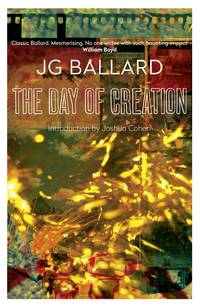
Cover by Stanley Donwood.
Overlaid image partly derived from combustion of ammonium dichromate, carried out by Dr Roy Lowry at Plymouth University; photographed by Anna Walker.
Ebook Edition © JUNE 2010 ISBN: 9780007290116
Version: 2014-09-25
Praise
From the reviews of The Day of Creation:
‘It could only have been imagined by a master of visionary realism…a country of the mind as vivid and viable as anything this extraordinary writer has ever produced’
Spectator
‘Ballard continues to prove that his imagination is unmatched by any contemporary British writer. His vision is relentless. Ballard’s acrid landscapes of a surreal and glittering Africa disturb as well as entrance. The obsessive desires of the hero, Dr Mallory, are equalled only by the compulsion Ballard’s creative genius has to write’
Glasgow Herald
‘Part spellbinding story, part fable for our time, Ballard’s novel is a vividly cinematic but nightmarish vision of a corrupted world. In a narrative filled with ironies, Ballard’s prose is honed and supple, often flowering into vivid lyricism. A mesmerizing tale by a master of the craft, one that resonates with dark implications for the future of humanity on this planet’
Publishers Weekly
Contents
Title Page
Copyright
Praise
Introduction by Joshua Cohen
1 The Desert Woman
2 The Gunmen
3 The Third Nile
4 The Shooting Party
5 Fame
6 The Oak and the Spring
7 The Impresario of Rubbish
8 The Creation Garden
9 The River Mallory
10 The Cascade
11 The House of Women
12 Noon
13 Piracy
14 Out of the Night and into the Dream
15 The Naming of New Things
16 The Helicopter Attack
17 Escape
18 The Green World
19 The Lanterns at Dusk
20 The Documentary Film
21 The Skirmish
22 Into the Lagoons
23 Journey Towards the Rain Planet
24 A Dream of Fair Women
25 The Wildfowlers
26 The Gardens of the Sahara
27 The Stolen Channel
28 Doctor Mal
29 The Blue Beaches
30 The Arcade Peep-Show
31 The Death of the Diana
32 The Poisoned Valley
33 The River Search
34 The Source
35 Memory and Desire
Interview with J. G. Ballard
About the Author
By the Same Author
About the Publisher
Introduction
by Joshua Cohen
1
‘Dreams of rivers, like scenes from a forgotten film, drift through the night, in passage between memory and desire.’
Or, better, let’s set it like a poem:
Dreams of rivers,
like scenes from a forgotten film,
drift through the night,
in passage between memory and desire.
Now it reads less like a first sentence – which it is, the first sentence of J. G. Ballard’s The Day of Creation – and more like the novel’s displaced epigraph.
Now we can begin, and I’ll gush about this and leak about that and then this introduction will trickle to an end and you’ll begin the novel proper only to find that sentence again and perhaps you’ll feel – perhaps you’ll feel now that I’m exhorting you to – the prosodic ebbs and flows of water. The opening sentence of Finnegans Wake is the continuation, the circumfluence, of its closing sentence. Joyce’s first page begins: ‘riverrun, past Eve and Adam’s, from swerve of shore to bend of bay, brings us by a commodius vicus of recirculation back to Howth Castle and Environs.’ His last page ends: ‘A way a lone a last a loved a long the’
No capitalization at top, no punctuation at bottom.
Of course, Joyce also wrote poetry and his prose was ‘poetic’ – whereas we read Ballard for a pitilessly mass-produced language more suitable to ‘the contemporary’. Or we assume we do (or we assume pitiless mass-production is more suitable), because the stark sad thingness of drainage culverts and overpasses and parking lots and empty swimming pools – empty except for the junkfood wrappers and condoms and cigpacks and bottles – too often overwhelms the ambient mosquito music abounding.
Prose lets us see and poetry lets us hear but the best of both do both at once, though so does 3D IMAX with Dolby Digital.
So, ‘like scenes from a forgotten film’ – what does Ballard mean? Who forgot this film and why? Rather, is this line disposable? Or is a brackish meaning bubbling behind it? In film, by which I mean mostly in Hollywood, when everything’s been shot and edited and even reshot and re-edited and test audiences still can’t understand what the hell’s going on, directors or, frequently, producers in conflicts with their directors, seek to salvage the thing either by introducing voice-over – from the hero, perhaps, or an omniscient God-narrator, explaining, ‘An hour before dawn, while I slept in the trailer beside the drained lake, I was woken by the sounds of an immense waterway’ – or by slapping together a title card that proclaims: ‘Africa, The Present.’
‘Like scenes from a forgotten film’ strikes me as Ballard’s equivalent of this technique. The line introduces a first-person narrator (first-person is literature’s overdubbing), while it also serves to reorient – or deoccident – you, the reader, for whom film, or TV – the screen – has become so primary a medium as to be beyond second nature: The mediation has become Nature Itself.
After that line Chapter 1 continues its cinematic panning:
As on all weekend visits to the abandoned town, I was seized by the vision of a third Nile whose warm tributaries covered the entire Sahara. Drawn by my mind, it flowed south across the borders of Chad and the Sudan, running its contraband waters through the dry river-bed beside the disused airfield.
But everything’s so vivid that you’d be forgiven for not having noticed that the theatre you’re in is still just a skull: one man ‘seized by the vision’, a Nile ‘drawn by my mind’. It’s as if we have to be ensconced in an imitative darkness before that line about film is granted its literal justification, in the midst of the chapter: refugees from the Sudan are feeding campfires with wood stripped from a police boat, using ‘strips of celluloid left behind by the film company’ as accelerant.
2
In 1984 Ballard published his first and only overtly autobiographical novel, which was also his first and only mainstream success, Empire of the Sun. In 1987, the film version appeared, and Ballard’s next novel was published – The Day of Creation, whose somniloquent symbolism alienated whatever new audience Empire had earned, and failed to interest the old audience already alienated by the Hollywoodization – the Spielberging – of a cult author and genre-totem (who was also a 57-year-old single father of three). The Day of Creation has never been filmed, though it’s already a series of action scenes strewn with dialogue sparse enough for the markets abroad. What augurs against adaptation, however, is that it has no elevator-pitch – no plot.
The hero of The Day of Creation is Dr Mallory, a Brit born in Kowloon, Hong Kong (Ballard was born in Shanghai), trained in Ireland as a physician (Ballard trained at Cambridge to be a physician), who now administers a clinic for the World Health Organization in Port-la-Nouvelle, the second city/shantytown of an unnamed, formerly French colonial ‘war-locked nation, that lay between the borders of Chad, the Sudan, and the Central African Republic in the dead heart of the African continent’. That war pits General Harare’s guerilla units against a paramilitary police force commanded by Captain Kagwa. Repeated clashes have wrecked Port-la-Nouvelle’s viaducts and reservoir, left the local Lake Kotto dry, and sent the engineers involved with irrigation drilling fleeing back to Belgium. Mallory is captured and about to be executed by Noon, a prepubescent girl and Harare rebel, but her rifle jams, and her co-revolutionaries scatter to the forest with the arrival of Kagwa’s squadrons and the landing of a twin-engine Dakota chartered to Air Centrafrique. Mallory’s life is saved, or his death is, with a popcorny fortuity. If the rifle had functioned properly the rest of the novel would’ve been the soul’s passage through delirium, and all its waterways would be the Styx.
The Dakota’s passengers are Professor Sanger, an Australian-German ‘sometime biologist turned television popularizer’, and his Indian protégé Mr Pal, who’ve come to deliver five tons of rice donated by West Germany – to a populace that has never eaten rice, to an uninhabited town – and to make a self-financed documentary – about the war, about Kagwa, about anything – for Africa Green, a ‘television charity’, which maintains ‘satellite links with the major Japanese networks’.
Sanger settles for producing agitprop by and about and even for Kagwa – a viewership of one. Mallory, meanwhile, maniacally schemes to reverse the drought. Literature teems with mad mariners – Mallory is its foremost mad hydrologist. He suspects, or prophesies, an underground limestone aquifer, and in the course of his divination campaign orders one of Kagwa’s sergeants to remove the stump of an ancient fallen oak. The tractor extracts the gnarled root-bole – ‘like the petrified heart of an extinct bull, or the crown of an underworld deity ripped from the ceiling of a subterranean palace’ – and exposes ‘an open mouth wide enough to swallow a small car’. But then water fills the cavity, black water, which gradually overflows it, and floods Lake Kotto, and washes the earth blank of its town: boats become the only tenable dwellings, as the Sahara engreens into ‘an Eden’.
Mallory purchases the river from Kagwa for $1000 US. Sanger senses an opportune subject for his documentary, and shoves his camera and mic in the doctor’s face, but only after he registers the river with the National Geographic Society in Washington, DC, naming it the Mallory. Noon, whether out of penance for her execution attempt, or in gratitude for the H20, assists Mallory in commandeering a car-ferry, the Salammbo, and the two depart toward the river’s source, their objective changing like a stream of consciousness, or becoming a stream of consciousness: One moment Mallory wants to dam the Mallory, the next he wants to destroy it.
All of the above happens in a hundred or so pages. The nearly two hundred pages remaining are pure journey: Kagwa’s pursuit (to reclaim the car-ferry, which contains the Mercedes he bought with the river funds); Harare’s skirmishing; Sanger and Pal coming aboard to collect their leagues of unscripted footage, and the overtaking of the Diana: a ‘brothel-ship’, formerly patronized by oil-riggers, and now under the commission of Mrs Warrender, another Brit, another white, who’d superintended the animal breeding station with her Rhodesian husband, until he was slaughtered …
3
Think back, now, to the way movies used to be – not on computers, but in halls – not digital, but analogue, a succession of frames flowing off a reel like water until all that was left was a flume of hot white light projecting its pristination at a screen. Think back to the size of the screens and so to the size of the people on them – people firmamental, stars – skygods enacting myths in perpetual sequel.
What I mean is: Apocalypse Now. Directed by Francis Ford Coppola in 1976 but released only in 1979. Apocalypse Now features title cards and is narrated by Captain Willard (Martin Sheen), who is dispatched upriver – the fictional Nung River – to terminate Colonel Kurtz (Marlon Brando), who has ‘gone native’, and formed a private militia to fight his private wars. The film’s production was notoriously plagued: principal photography in the Philippines was interrupted by typhoon season; Harvey Keitel was fired (for reasons never publicized), and replaced by Sheen, who promptly had a heart attack; Brando showed up unprepared, obese, and with his head shaved; Dennis Hopper, who plays a traumatized photojournalist, was method acting his way through a coke-binge. At least ‘the extras’ were reliable – scores of Vietnamese who’d fled one violent insurrection for another. President Marcos regularly demanded the return of the army helicopters the production were renting, which he scrambled to surveil and even strafe the New People’s Army of the illegal CPP, the Communist Party of the Philippines. This drama behind the drama made its way into a documentary assembled by Eleanor Coppola, in which her director-husband can’t stop himself from airing the resemblance between the psychologies of artistic creation and military-industrial destruction: ‘We were in the jungle, there were too many of us, we had access to too much money, too much equipment, and little by little we went insane.’[1]
Hearts of Darkness is the title of that making-of documentary, and it’s obvious to everyone sweating in it – except Brando, who refused to do any reading – that Apocalypse Now is based on Conrad’s Heart of Darkness. In that novella, Marlow, the original of Willard, steamboats up the Congo River scouring the rainforest for the rogue ivory-trader, and slaver, Kurtz. In Conrad’s telling neither Marlow nor Kurtz are elite soldiers, but are or were employees of ‘the Company’, and the setting is the Central African Congo Free State, which was, in fact, a corporation wholly owned and operated by Belgium. Another liberty Coppola took: his Kurtz is assassinated by Willard, while the page-bound Kurtz dies slowly, and Marlow falls ill, from ‘an impalpable greyness’, ‘a sickly atmosphere of tepid scepticism’. Heart of Darkness was serialized in 1899, and republished in 1902 as the middle novella of a trilogy that bridged the stages of terraqueous life: preceding it is Youth, in which the foreign is exotic, yet nurturing; following it is The End of the Tether, in which the foreign has become indistinguishable from home and the only Empire left is a watery grave. Between the two fictions – between birth and death – is dream: ‘It seems to me I am trying to tell you a dream – ’ Marlow says, ‘making a vain attempt, because no relation of a dream can convey the dream-sensation, that commingling of absurdity, surprise, and bewilderment in a tremor of struggling revolt, that notion of being captured by the incredible which is of the very essence of dreams … ’
Heart of Darkness, of course, has its own ur-versions, its own unconscious – in the legends that European and Anglo-American writers translated from, and were inspired to invent by, the African and Asian cultures they nonetheless regarded as ‘primitive’, or ‘inferior’. Stay close, because we’re approaching the Inmost Station.
We have stories about treasure hunters who leave their lands and wander the globe, only to be recalled by a dream of a willow in their house’s yard, under which a hoard of gems is buried; we have tales of hunters slaying wild boars whose carcasses metamorphose into the corpses of fathers. Then there’s ‘My First Day in the Orient’, an essay of around 1890 by the half-Greek, half-Irish Lafcadio Hearn, who spent two decades as a reporter and English tutor in Japan:
Then I reach the altar, gropingly, unable yet to distinguish forms clearly. But the priest, sliding back screen after screen, pours in light upon the gilded brasses and the inscriptions; and I look for the image of the Deity or presiding Spirit between the altar-groups of convoluted candelabra. And I see – only a mirror, a round, pale disk of polished metal, and my own face therein …
An adventurer seeks the divine, and finds himself instead. Tug aside the curtain, and the man is the Maker, and the Maker is the man – ‘The horror! The horror!’
Imagine if Apocalypse Now was filmed again with state-of-the-art CGI, so that Willard survives his river cruise only to discover that he is Kurtz. (Which would’ve been preferable, if Sheen had played both the roles? Or Brando?)
Imagine Heart of Darkness rewritten so that Marlow makes the same discovery – and now he is foundered, crazed, suicidal.
All this brings us, by a commodius vicus of recirculation, back to The Day of Creation, in which Mallory (which is ‘Marlow’ mixed with ‘Ballard’) sets out toward the source of his river, which might not be Lake Chad or the mountains of the Massif, but his own deluged deluded brain: malnourished, fevered. The River Mallory is the doctor’s crosscurrent double, an inconstant, alternately reflecting/reflected ‘black mirror’. ‘I tried to stand back from my own obsession,’ Mallory says, ‘but I could no longer separate myself from my dream of the Mallory.’
In the first book of the first of the books, the Bible, ‘The Day of Creation’ occurred a full week before Paradise even existed: ‘And the earth was without form, and void; and darkness was upon the face of the deep,’ and everything would’ve been perfectly peaceful, if God hadn’t said, ‘Let there be light’ – and there was light. Ballard’s novel reminds us that we’ve suffered ever since for our projections.
Brooklyn, March 2014
1. Around 1969, George Lucas tried to make a version of the John Milius script, but his proposal to shoot it in 16mm as a pseudo-documentary on location in South Vietnam, with the war still in progress, found no support at the studios. Coppola channeled this conceit through a brief cameo in his own movie as a telejournalist yelling at Air-Cav soldiers who’ve just razed a village: ‘Don’t look at the camera! Just go by like you’re fighting!’ In 1971, Dennis Hopper released The Last Movie, which he directed and starred in as ‘Kansas’, a stuntman on a Western being filmed in Peru. Kansas stays on after the production has wrapped, and makes an attempt at a calmer if romanticized life with a native prostitute. Their idyll is threatened, however, once an indigenous tribe, misunderstanding the Hollywood fakery, fashions equipment out of bamboo and starts ‘filming’ a Western in which the violence isn’t staged, but fatal.
1
The Desert Woman
Dreams of rivers, like scenes from a forgotten film, drift through the night, in passage between memory and desire. An hour before dawn, while I slept in the trailer beside the drained lake, I was woken by the sounds of an immense waterway. Only a few feet from me, it seemed to flow over the darkness, drumming at the plywood panels and unsettling the bones in my head. I lay on the broken mattress, trying to steady myself against the promises and threats of this invisible channel. As on all my weekend visits to the abandoned town, I was seized by the vision of a third Nile whose warm tributaries covered the entire Sahara. Drawn by my mind, it flowed south across the borders of Chad and the Sudan, running its contraband waters through the dry river-bed beside the disused airfield.
Had a secret aircraft landed in the darkness? When I stepped from the trailer I found that the river had gone, vanishing like a darkened liner between the police barracks and the burnt-out hulk of the cigarette factory. A cool wind had risen, and a tide of sand flowed over the bed of the lake. The fine crystals beside the trailer stung my bare feet like needles of ice, as the invisible river froze itself when I approached.
In the darkness the ivory dust played against the beach in a ghostly surf. Nomads had built small fires, refugees from the Sudan who rested here on their way south to the green forest valleys of the River Kotto. Each weekend I found that they had torn more planks from the hull of Captain Kagwa’s police launch, lighting the powdery timbers with strips of celluloid left behind by the film company. Dozens of these pearl-like squares emerged from the sand, as if the drained lake-bed was giving up its dreams to the night.
Once again I noticed that a strange woman had been here, gathering the film strips before they could be destroyed. I have seen traces of her for the past weeks, the curious footprints on the dispensary floor, with their scarred right heels and narrow thumb-like toes, and her absentminded housework around the trailer. For some time now I have suspected that she is keeping watch on me. Any food or cigarettes that I leave behind are always removed. I have even placed a small present for her on the trailer steps, a plastic viewfinder and a set of tourist slides of the Nile at Aswan, the humour of which might appeal to her. Last weekend, when I arrived at the trailer, I found that the mattress had been repaired with wire and string, though perhaps for her comfort rather than mine.
The thought that I may be sharing a bed with one of these young desert women adds a special glamour to my dreams of the night-river. If she suffers from eczema or impetigo I will soon carry the infection on my skin, but as I lie in the bunk I prefer to think of her naked to the waist, bathing in the warm waters that flow inside my head.
However, her main interest is clearly in the film strips. When I returned to the trailer I found a plastic bucket tucked behind the wooden step. I knelt in the cold dust, and searched through the curious rubbish which this young woman had collected – empty vaccination syringes from the dispensary floor, the sailing times of the Lake Kotto car ferry, a brass cartridge case and the lens cover of a cine-camera lay among the clouding film strips gathered from the beach.
Together these objects formed a record of my life, an inventory that summed up all the adventures that had begun in this shabby town in the northern province of a remote central African republic. I held the cartridge case to my lips, and tasted the strange scent, as potent as the memory of Noon’s embrace, that clung to its dull metal. I thought of my journey up the Mallory, and of my struggle with the great river which I had created and tried to kill. I remembered my obsession with Noon, my duel with Captain Kagwa’s helicopter, and all the other events which began a year ago when General Harare and his guerillas first came to this crumbling town.
2
The Gunmen
‘Dr Mallory, are you going to be executed?’
I searched for the woman shouting to me, but a rifle barrel struck me across the shoulders. I fell to the ground at the gunmen’s feet, and cut my hand on a discarded canister of newsreel film which the Japanese photographer was feeding into her camera. In a few seconds, I realized, the expensive celluloid would see its first daylight while recording my own death.
Fifteen minutes later, when General Harare had withdrawn his guerillas into the forest, leaving the lakeside town he had occupied for a few frightening hours, I was still trying not to answer this all too loaded question. Thrown at me like a query at a chaotic press conference, it summed up the dangers of that last absurd afternoon at Port-la-Nouvelle.
Was I going to be shot? As the guerillas bundled me on to the beach below the police barracks, I called to the young Japanese in her silver flying overalls.
‘No! Tell Harare I’ve ordered a new dental amalgam for his men. This time the fillings will stay in …’
‘The fillings …?’
Hidden behind her hand-held camera, Miss Matsuoka was swept along by the group of excited soldiers running down to the lake, part beach-party and part lynch mob. There was a confusion of yodelling whoops, weapons playfully aimed at the sun, and knees twisting to the music that pumped from the looted radios and cassette players strung around the gunmen’s necks among their grenades and ammunition pouches.
There was a bellow from General Harare’s sergeant, a former taxi driver who must once have glimpsed a documentary on Sandhurst or St Cyr in a window of the capital’s department store. With good-humoured smiles, the soldiers fractionally lowered the volume of their radios. Harare raised his long arms at his sides, separating himself from his followers. The presence of this Japanese photographer, endlessly scurrying at his heels, flattered his vanity. He stepped from the beach on to the chalky surface of the drained lake-bed, stirring the milled fish bones into white clouds, a Messiah come to claim his kingdom of dust. Dimmed by heavy sunglasses, his sensitive, malarial face was as pointed as an arrowhead. He gazed piercingly at the horizons before him but I knew that he was thinking only of his abscessed teeth.
Behind me a panting twelve-year-old girl in an overlarge camouflage jacket forced me to kneel among the debris of beer bottles, cigarette packs and French pornographic magazines that formed the tide-line of the beach. Prodding me with her antique Lee-Enfield rifle, this child auxiliary had driven me all the way from my cell in the police barracks like a drover steering a large and ill-trained pig. I had treated her infected foot when she wandered into the field clinic that morning with a party of women soldiers, but I knew that at the smallest signal from Harare she would kill me without a thought.
Filmed by the Japanese photographer, the General was walking in his thoughtful tread towards the wooden towers of the artesian wells whose construction I had supervised for the past three months, and which symbolized the one element he most detested. I sucked at the wound on my hand, but I was too frightened to wet my lips. Praying that the wells were as dry as my mouth, I looked back at the deserted town, at the looted stores visible above the teak pillars of the jetty where the car ferry had once moored ten feet above my head. Behind the party of guerillas, some lying back on the beach beside me, others dancing to the music of cassette players, I could see a column of smoke lifting from the warehouse of the cigarette factory, like a parody of a television commercial for the relaxing weed. A pleasant scent bathed the beach, the aroma of the rosemary-flavoured tobacco leaf which the economists at the Institut Agronomique had decided would transform the economy of these neglected people, and provide a stable population from which the local police chief, Captain Kagwa, could recruit his militia.
Turned by the light wind, the smoke drifted towards the dusty jungle that surrounded the town, merging into the haze fed by an untended backyard incinerator. Beyond the scattered tamarinds and shaggy palms the whitening canopy of forest oaks stood at the mouth of a drained stream whose waters had filled Lake Kotto only two years earlier. Their dying leaves blanched by the sun, the huge trees slumped among the stony sand-bars, tilting memorials in a valley of bones.
I inhaled the scented air. If I was to be executed, it seemed only just that I, renegade physician in charge of the drilling mission whose water would irrigate the tobacco projects of Port-la-Nouvelle and supply the cities of the former French East Africa with this agreeable carcinogen, should be given an entire warehouse of last cigarettes.
Still trailed by the Japanese photographer, Harare strode towards the beach. Had one of the dry wells miraculously yielded water for this threadbare redeemer? His thin arms, touching only at the wrists, were pointing to me, making an assegai of his body. I sat up and tried to straighten my blood-stained shirt. The guerillas had turned their backs on me, in a way that I had witnessed on their previous visits. When they no longer bothered to guard their prisoners it was a certain sign that they were about to dispense with them. Only the twelve-year-old sat behind me on the beach, her fierce eyes warning me not even to look at the bandage I had wrapped around her foot. I remembered Harare’s pained expression when he gazed into my cell at the police barracks, and his murmured reproach, as if once again I had wilfully betrayed myself.
‘You were to leave Port-la-Nouvelle, doctor. We made an agreement.’ He seemed unable to grasp my real reasons for clinging to this abandoned town beside the fossil lake. ‘Why do you need to play with your own life, doctor?’
‘There’s the dispensary – it must stay open as long as there are patients. I treated many of your men this morning, General. In a real sense I’m helping your war effort.’
‘And when the government forces come you will help their war effort. You are a strategic asset, Dr Mallory. Captain Kagwa will kill you if he thinks you are useful to us.’
‘I intend to leave. It seems time to go.’
‘Good. This obsession with underground water – your career has suffered so much. You always have to find the extreme position.’
‘I shall be thinking about my career. General.’
‘Your real career, not the one inside your head. It may be too late …’
The radios were playing more loudly. A young guerilla, his nostrils plugged with pus from an infected nasal septum, danced towards me, eyes fixed knowingly on mine, his knees tapping within a few inches of my face. I remembered the Japanese woman’s question, and its curious assumption that I had contrived this exercise in summary justice, among the beer cans and pornographic magazines on this deserted beach at the forgotten centre of Africa, and that I had already decided on my own fate.
3
The Third Nile
The guerilla unit had emerged from the forest at nine that morning, soon after the government spotter plane completed its daily circuit of Lake Kotto. During the night, as I lay awake in the trailer parked behind the health clinic, I listened to the rebel soldiers moving through the darkness on the outskirts of Port-la-Nouvelle. The beams of their signal torches touched the window shutters beside my bunk, like the antennae of huge nocturnal moths. Once I heard footsteps on the gravel, and felt a pair of hands caress the steel framework of the trailer. For a few seconds someone gently rocked the vehicle, not to disturb my sleep, but to remind me that the next day I would be shaken a little more roughly.
By dawn, as I drove my jeep to the drilling site, the town was silent again. However, as I opened my bottle of breakfast beer on the engine platform of the rig I saw the first of the guerillas guarding the steps of the police barracks, and others moving through the empty streets. Beyond the silent quays, in the forecourt of the looted Toyota showrooms, Harare stood with his bodyguard among the slashed petrol pumps, his feet shifting suspiciously through the shards of plate glass.
For all his ambitious dreams of a secessionist northern province, Harare was chronically insecure. A sometime student of dentistry at a French university, he had named himself after the capital of a recently liberated African nation, like the other four Generals in the revolutionary front, none of whom commanded more than a hundred disease-ridden soldiers. But his socialist ideals travelled lightly with a secondary career of banditry and arms smuggling across the Chad border. With the drying out of the lake and the virtual death of the Kotto River – its headwaters were now little more than a string of shallow creeks and meanders – he had decided to extend his domain to Port-la-Nouvelle, and impose his Marxist order on its vandalized garages and ransacked radio stores.
Above all, Harare detested the drilling project, and anyone like myself involved in the dangerous attempt to tap the sinking water table and irrigate the cooperative farms on which the bureaucrats at the Institut Agronomique had squandered their funds. The southward advance of the desert was Harare’s greatest ally, and water in any form his sworn enemy. The changing climate and the imminent arrival of the Sahara had led to the abandonment of Lake Kotto by the government forces. Most of the population of Port-la-Nouvelle had left even before my own arrival six months earlier as physician in charge of the WHO clinic. Within a week Harare’s guerillas had sabotaged the viaduct of galvanized iron which carried water from the drilling pumps to the town reservoir. The Belgian engineer directing the work had been wounded during the raid. Hoping to salvage the project, I had tried to take his place, but the African crew had soon given up in boredom. The few tobacco workers who remained had packed their cardboard suitcases with uncured leaf and taken the last bus to the south.
None of this, for reasons I should already have suspected, discouraged me in any way. With few patients to care for, I turned myself into an amateur engineer and hydrologist. Before his evacuation in the police ambulance the Belgian manager had despairingly shown me his survey reports. Ultrasonic mapping by the Institut geologist suggested that the enfolding of limestone strata two hundred feet below Lake Kotto had created a huge underground aquifer flowing from Lake Chad. This subterranean channel would not only refill Lake Kotto but irrigate the surrounding countryside and make navigable the headwaters of the Kotto River.
The dream of a green Sahara, perhaps named after myself, that would feed the poor of Chad and the Sudan, kept me company in the ramshackle trailer where I spent my evenings after the long drives across the lake, hunting the underground contour lines on the survey charts that sometimes seemed to map the profiles of a nightmare slumbering inside my head.
However, these hopes soon ran out into the dust. None of the six shafts had yielded more than a few hundred gallons of gas-contaminated brine. The line of dead bores stretched across the lake, already filling with milled fish bone. For a few weeks the wells became the temporary home of the nomads wandering westwards from the famine grounds of the Southern Sudan. Peering into the bores during my inspection drives, I would find entire families camped on the lower drilling platforms, squatting around the bore-holes like disheartened water-diviners.
Yet even then the failure of the irrigation project, and the coming of the Sahara, had merely spurred me on, lighting some distant beacon whose exact signals had still to reach me. Chance alone, I guessed, had not brought me to this war-locked nation, that lay between the borders of Chad, the Sudan and the Central African Republic in the dead heart of the African continent, a land as close to nowhere as the planet could provide.
Each morning, as I stepped from my trailer, I almost welcomed the sharper whiteness of the dust which the night air had washed against the flattened tyres. From the tower of the drilling rig I could see the thinning canopy of the forest. At Port-la-Nouvelle the undergrowth beneath the trees was still green, but five miles to the north, where the forest turned to savanna, the network of streams which had once filled Lake Kotto was now a skeleton of silver wadis. Day by day, the desert drew nearer. There was no great rush of dunes, but a barely visible advance, seen at dusk in the higher reflectivity of the savanna, and in the faded brilliance of the forest along the river channels, like the lustre of a dead emerald from which the light has been stolen.
As I knew, the approach of the desert had become an almost personal challenge. Using a variety of excuses, I manoeuvred the manager of WHO’s Lagos office into extending my three-month secondment to Port-la-Nouvelle, even though I was now the town’s only possible patient. Nonetheless my attempts to find water had failed hopelessly, and the dust ran its dark tides into my bones.
Then, a month before Harare’s latest incursion, all my frustration had lifted when a party of military engineers arrived at Port-la-Nouvelle. They commandeered the drilling project bulldozer, pressganged the last members of the rigging crew, and began to extend the town’s weed-grown airstrip. A new earth ramp, reinforced with wire mesh, ran for a further three hundred yards through the forest. From the small control tower, a galvanized iron hut little bigger than a telephone booth, I gazed up at the eviscerated jungle. I imagined a four-engined Hercules or Antonov landing here loaded with the latest American or Russian drilling equipment, hydrographic sounders, and enough diesel oil to fuel the irrigation project for another year.
But rescue was not at hand. A light aircraft piloted by a Japanese photographer landed soon after the airstrip extension was complete. This mysterious young woman, who camped in a minute tent under the wing of her parked aircraft, strode around Port-la-Nouvelle in her flying suit, photographing every sign of poverty she could find – the crumbling huts, the sewage rats quarrelling over their kingdom, the emaciated goats eating the last of the tobacco plants. She ignored my modest but well-equipped clinic. When I invited her to visit the maternity unit she smiled conspiratorially and then photographed the dead basset hound of the Belgian manager, run down by the military convoys.
Soon after, the engineers left, without returning the bulldozer, and all that emerged from the wound in the forest was General Harare and his guerilla force, to whom Miss Matsuoka attached herself as court photographer. I assumed that she was one of Harare’s liberal sympathizers, or the field representative of a Japanese philanthropic foundation. Meanwhile the irrigation project ground literally to a halt when the last of the diamond bits screwed itself immovably into the sandstone underlay. I resigned myself to heeding the heavy-handed advice of the local police chief. I would close the clinic, abandon my dreams of a green Sahara, and return to Lagos to await repatriation to England. The great aquifer beneath Lake Kotto, perhaps an invisible tributary of a third Nile, with the power to inundate the Sudan, would continue on its way without me, a sleeping leviathan secure within its limestone deeps.
Pulsuz fraqment bitdi.