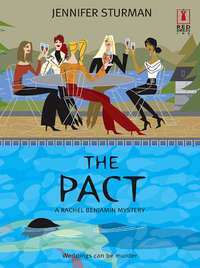
Kitabı oxu: «The Pact»
The Pact
Jennifer Sturman

www.millsandboon.co.uk
CONTENTS
ACKNOWLEDGMENTS
PROLOGUE
CHAPTER 1
CHAPTER 2
CHAPTER 3
CHAPTER 4
CHAPTER 5
CHAPTER 6
CHAPTER 7
CHAPTER 8
CHAPTER 9
CHAPTER 10
CHAPTER 11
CHAPTER 12
CHAPTER 13
CHAPTER 14
CHAPTER 15
CHAPTER 16
CHAPTER 17
CHAPTER 18
CHAPTER 19
CHAPTER 20
CHAPTER 21
CHAPTER 22
CHAPTER 23
CHAPTER 24
CHAPTER 25
CHAPTER 26
CHAPTER 27
CHAPTER 28
CHAPTER 29
CHAPTER 30
CHAPTER 31
CHAPTER 32
CHAPTER 33
CHAPTER 34
EPILOGUE
ACKNOWLEDGMENTS
This book would never have been written without Michele Jaffe, who had the great misfortune to read every draft and provided invaluable encouragement and input.
Laura Langlie, my agent, guided me through this process with a sure hand, unflagging confidence and good humor. She even pretended to take my theory of jinxing seriously.
I owe a tremendous debt of gratitude to Farrin Jacobs, Margaret Marbury and the entire team at Red Dress Ink for (however clichéd it may sound) making a dream come true.
My college roommates—Anne Coolidge, Holly Edmonds, Heather Jackson and Gretchen Peters—kindly allowed me to steal bits and pieces of themselves and our past (liberally seasoned with artistic license, of course!). Rulonna Neilson, ad hoc image consultant, shepherded me through the jungle that is Bloomingdale’s cosmetics department and captured the moment for posterity. Meg Cabot offered the wise perspective of an industry veteran and more champagne than was probably good for either of us.
My mother, Judith Sturman, my sister-in-law, Lindsay Jewett Sturman, author Gini Hartzmark and friends Stefanie Reich Offit and Karen Bisgeier Zucker graciously served as early readers, critics and sounding boards. Finally, my father, Joseph Sturman, and my brothers, Ted and Dan Sturman, managed neither to laugh at nor tease me about the excellent use to which I was putting my MBA.
Thank you all.
This book is dedicated, with love and gratitude, to my parents.
PROLOGUE
I met Chris at the beginning of my junior year. He was tall and handsome, with thick dark hair and green eyes fringed with the sort of lashes that only boys seem to get but that girls covet. He sat next to me one September afternoon in Modern Art and Abstraction. I dropped my pen, he picked it up, our eyes met, and I fell head over heels in love with a sociopath.
Of course, it took nearly six months for me to realize that he was, in fact, a sociopath. He was a senior and a bit of a mystery to my circle of friends. He’d transferred to Harvard from a small liberal arts college out west, and he had an air about him that was part Mark Darcy and part James Bond. He swept me off my feet, and I was more than willing to be swept.
The first time I realized something was off was the night he figured out how to call in to my answering machine and play back the messages. I was at the library working on a paper, but he was convinced that I was cheating on him. A few months and a number of similar incidents later, I was out of love and desperate to be rid of him.
He wasn’t easy to break up with, but after several tedious conversations that began with “We’ve got to talk” and ended with him still thinking I was his girlfriend, he finally gave up. Soon I heard that he was dating a sophomore, who no doubt was just as enchanted by his attentions as I’d originally been.
The night my breakup with Chris became official, my four roommates and I rose to the occasion with a Girls’ Night Out, a ritual that we’d perfected since its inception freshman year. We would start with blender drinks in our common room in Lowell House and then embark on a pub crawl in Harvard Square, inevitably ending up at Shay’s, our favorite wine bar on JFK Street.
By the time we arrived at Shay’s that fateful evening it was after midnight. The tables were crowded with a mix of undergrads and some business school students from across the river, easily identifiable by their conservative dress and bottles of imported beer. We found seats on the front terrace and ordered the usual—a bottle of cheap red wine to be shared by everyone except Jane, who ordered a Black and Tan. As we waited for our drinks, I began lamenting my poor judgment for the umpteenth time that evening. “How could I have been so stupid?” I moaned. I was a little worse for wear after five hours of fairly enthusiastic drinking.
Hilary, never one to mince words, had a ready reply. “I don’t know. Was he that great in bed?”
Luisa exhaled a stream of cigarette smoke with impatience. “Have a little sympathy, Hil. Rachel was in love. Her first love. Everyone acts like an idiot the first time.”
Hilary snorted her reply but held her tongue while the waiter unloaded our drinks. Emma looked around the table expectantly. She was wearing a sleeveless Indian print dress and woven leather sandals, her mass of dark blond hair hanging loose down her back.
Jane took a sip of her Black and Tan and gave me a good-natured smile. “We all knew that you would come to your senses sooner or later. It happened to be later than we would have liked, but the important thing is that it happened.”
“But why didn’t I listen to you?” I asked. “You all tried to tell me what a nightmare he was—God only knows how many times—and I just didn’t want to hear it.”
“You were doing what you wanted to do,” said Jane.
“Even though what you wanted to do was completely fucked up. I mean, it was clear the guy was bad news from day one.” Hilary poured wine into her glass and passed the bottle to Luisa. “He was so full of himself.”
“He was not bad news from day one,” Jane protested. “He did a lot of things right at first. Remember all of the flowers? And when he took Rachel to Walden Pond? You have to give him at least a few points for that.”
“He’s a man,” said Luisa, stubbing out her cigarette and preparing to light another. “It’s a waste of time to dissect what he did right and what he did wrong.” She pointed the end of the unlit cigarette at me and locked her dark-eyed gaze on mine. “The most important thing is to learn to enjoy men but also to take care of yourself. Next time you’ll know better.”
“But what if I don’t know better?” I asked. “What if the next one is equally awful but in a different way, so that I don’t recognize that he’s awful?”
“Maybe next time you’ll listen to us,” said Jane.
“That’s right,” agreed Hilary. “You’ll remember what a fool you made of yourself with Chris, and you’ll listen.”
“You know, Hil, you haven’t always had the greatest judgment yourself. Remember Tommy Fitzgerald? And what about that guy from the Owl Club? What was his name again? The one with the—?”
“You’re one to talk, Jane. Remember freshman year when you and Sean were taking a ‘break’ and you started going out with that asshole from the crew team?”
“Okay, enough,” said Luisa. “We’ve all made mistakes—there’s no need to catalog them.”
“Luisa’s right. None of us has a very good record on assessing the men in our lives. And when push comes to shove, the rest of us always figure it out before the one who’s actually in the relationship.” Emma was so quiet that when she did speak people listened closely. We were all silent for a moment, considering her words.
“Well, the point is that if any of you come to me and tell me my boyfriend’s an asshole, I promise I’ll listen,” said Jane. This was easy for her to say, given that Sean was as close to the ideal boyfriend as a mere mortal could be. Still, her voice held a challenge in it for the rest of us. She looked around the table.
“Me, too,” said Emma, thoughtfully. “In fact, I’d even make a pact on that.”
“Well, I’d probably already know the guy was an asshole, but I’d listen to you,” said Hilary. “You can count me in.”
“No argument here, especially if it means that I never have to go through a relationship like this again,” I said.
“Luisa? What about you?” asked Emma.
She gave a slight shrug. “We’ve made so many pacts that it’s hard to keep them all straight. Remember the one about giving up caffeine? That lasted about five minutes. Why should this one be any different? What happens if we all promise to listen to each other but then we don’t? Then what?”
“Then the rest of us take matters into our own hands,” replied Hilary. “Obviously. We waste the guy.”
That made everybody laugh. “Come on, Luisa, don’t be such a skeptic,” said Jane. “This one’s serious.”
“Fine, fine.” She caved in to our pleading with another shrug of her shoulders. “I’m in.”
“Good. Then it’s unanimous. We’re making a pact,” said Emma.
“A pact,” agreed Jane.
“Let’s toast!” urged Hilary.
We laughed and clinked our glasses together—all except Jane, who hated when people clinked. In unison, we drank.
None of us would have guessed where this pact would lead.
CHAPTER 1
Perhaps the only thing worse than getting drunk by accident is not being able to get drunk on purpose. I’d switched from champagne to vodka tonics during the second course, but I still felt as clearheaded as the valedictorian at an AA graduation. And somehow calling for tequila shots seemed unseemly in these staid country club surroundings. Instead, I asked the waiter for another vodka tonic, meeting his raised eyebrows with an innocent smile and a request to go easy on the tonic.
The Fates were conspiring against me this evening, I all too soberly reflected. Here I was at my best friend’s rehearsal dinner, and rather than overflowing with joy I wanted to put my head down on the crisp linen tablecloth and weep. And not because of the bridesmaid’s dress I was scheduled to wear the following evening at half past six. (Although I was still curious as to how Emma, who I sincerely believed had only honorable intentions towards us all, had managed to find a style and color that didn’t flatter even one of her four bridesmaids.)
No, the dress and the prospect of wearing it were just fanning the flames of my distress. And while I dreaded the toast I would shortly have to make, it was merely fuel for the fire.
The horror, I thought. The horror.
If I turned my head to the right and counted over three seats, I could see the reason for my silent anguish in the flesh, smugly resplendent in a custom-made charcoal pinstriped suit and vivid Hermés tie, his black hair slicked neatly back from a widow’s peak.
Richard.
He was talking to a client who’d stopped by the table to say hello. He suddenly looked my way, as if he could feel the weight of my eyes upon him. He met my gaze with a smarmy wink and returned to his conversation.
I didn’t know then that a smarmy wink from Richard should have been the least of my worries compared to everything else the weekend held in store. I stifled a shudder and took a big gulp of my fresh drink, trying to ignore how much it tasted like insect repellent and fighting off yet another pang of anxiety. The clock was ticking, moving inexorably toward disaster; the ceremony that would bind Emma to Richard was to take place in less than twenty-four hours.
I sent a desperate glance around the table for moral support, a reassuring word of some sort. The seat directly to my right was empty, reserved for the best man, whose flight from the West Coast had been delayed. Not that I expected any friend of Richard’s to be remotely comforting in this situation. Emma, sitting next to Richard, had turned in her seat to greet one of the many well-wishers who’d come by to speak to her. She’d been so busy with the stream of visitors that she’d barely touched the food on her plate, and the shy smile on her face was starting to look more than a little forced.
To my left sat Matthew, the sort of guy you could always count on to help you out of a difficult spot. Tonight, however, he’d be the least appropriate person to turn to. He hated Richard as much, if not more, than any of us. With good reason. Matthew was the one Emma should be marrying. Unfortunately, this was glaringly obvious to everyone except Emma. I felt indignant on Matthew’s behalf but more than a bit frustrated by his seemingly calm acceptance of the situation. If only he’d made Emma realize how right they were for each other, had taken action years ago, then everything would be different. But the patience and sensitivity that made him such a good doctor seemed to have rendered him tragically unassertive in his personal affairs. And if he was upset tonight he was hiding it well, slicing into his apple tart with surgical precision and chatting good-naturedly with Jane, who sat on his other side.
A cousin of Emma’s sat between Jane and Hilary, and Hilary was trying her best to flirt with him, although his attempts at risqué banter were painfully bland. Still, Hilary felt it was important to practice even on the most unpromising of males. The flush that had stained his cheeks from the first glimpse she’d offered him of her cleavage had yet to subside. I almost felt sorry for him.
Hilary and her cleavage were flanked by Jane’s husband, Sean, who was flanked in turn by Luisa. From the stoic set of Sean’s usually relaxed features, I assumed that he had chivalrously assured Luisa that her cigarette wouldn’t bother him at all. They were swathed in a blue halo of Gauloises-scented smoke. A colleague of Richard’s who was serving as a groomsman the next day occupied the remaining seat at the table. I’d spoken to him during the cocktail hour and ascertained that he was entirely harmless but equally dull. He was listening to Sean and Luisa with a glazed look.
Everyone was deep in conversation with somebody else. Except, of course, me. Alas. I belatedly remembered that I’d promised myself the last time I went dateless to a wedding weekend that I would never do it again. There was nothing more depressing, nothing that could make me feel more like a total freak of nature, than to be hopelessly alone at an event that celebrated coupledom, however mismatched this particular couple was. It was fine for Hilary—she was fiercely protective of her single independence; it would never occur to her to wallow in self-pity just because she didn’t have a boyfriend by her side. Luisa had Isobel, her partner of nearly three years, waiting for her when she returned to South America. All she had to worry about was fighting off her parents’ pressure to marry and procreate. Jane and Sean had celebrated their tenth anniversary in June, just another in what would certainly be a long line of anniversaries commemorating their happy pairing. And I could hardly take comfort in the knowledge that while Emma had Richard, she was embarking on the biggest mistake of her life.
I sighed and flipped through my notes one more time, praying for a sudden natural disaster that could save me from making the toast. An earthquake was more than I could hope for in this part of the country, but perhaps I could bribe a waiter to pull the fire alarm? Not my waiter, of course. He made it clear from the way he set down my most recent drink that he wasn’t doing me any more favors tonight, no matter how sweetly I smiled up at him. If it weren’t so noisy I would have sworn he clucked his tongue as he moved on to the next table.
Resigned, I turned my attention back to the careful outline I’d made. I wasn’t afraid of public speaking, not by a long shot. In my line of work, the ability to comfortably address large groups was almost a prerequisite. My colleagues in Mergers and Acquisitions at Winslow, Brown, as well as the board members of assorted clients, hostile dissenters at shareholder meetings—even full auditoriums of Harvard Business School students, eager to learn more about how to gain entrée to a top-tier investment banking firm—I’d stood before them all and delivered talks ranging from detailed slide presentations to improvised monologues. I was skilled at laying out the facts about a merger or joint venture in a professional and persuasive manner and in beating back questions that were designed to embarrass with logic, composure, and eloquence. Yet none of that was enough to prepare me for toasting the imminent merger of my best friend with Satan.
I was pushing away a mental image of the shrieking mouth in Munch’s The Scream when Emma’s mother caught my eye from her seat at the next table and discreetly tapped her watch. It was customary, I knew, for the maid of honor to give the first toast at the rehearsal dinner, and Lily Furlong was a stickler for tradition. There was no escaping it—the time had come.
I sighed again and drained the last of my vodka tonic for one final drop of liquid courage. Slowly, I scraped my chair back and stood, champagne glass in hand. My knife rapping against its crystal made a sharp, pinging noise that echoed in the cavernous room, and the hum of voices from the tables around me faded into an expectant hush.
Richard had spared no expense this evening, I noted, although I wouldn’t be surprised if he was planning to write the entire affair off as a business expenditure. This rehearsal dinner was by no means a small gathering for the family and wedding party. Rather, Richard had been sure to invite everybody who was anybody among both his friends and those of the Furlongs, which was likely a far more fruitful hunting ground. None of Richard’s family was present, although I secretly wondered if he even had one. It was entirely possible that Richard had crawled out from under a rock somewhere, already fully formed. Meanwhile, half the Social Register was in attendance, not to mention the leading lights of the New York arts and literary scene, seated at round tables covered with starched white linens and graced with extravagant floral arrangements. Perhaps the even greater surprise was that so many of them had made the long drive up to this remote corner of the Adirondacks, committing themselves to a weekend at one of the handful of motels and overly cutesy bed-and-breakfasts the area had to offer, not to mention battling rush-hour traffic on a Friday afternoon in August to make it here in time for cocktails and dinner. This was surely more of a tribute to their great esteem for the Furlongs and Emma than any warmth of feeling for a swine like Richard Mallory.
I cleared my throat once more, deliberately stalling to make sure that any natural disaster had ample time to strike. But none was forthcoming. I plastered a brave smile on my face, took a deep breath, and reluctantly launched into my toast.
“I’m Rachel Benjamin, and I have the honor of serving as Emma’s maid of honor tomorrow afternoon.” This simple declaration was met by friendly applause.
“I first met Emma our freshman year at Harvard. Actually, we met the very first day. We were assigned to the same dorm room, and we were each eager to establish ourselves as the most considerate roommate. Neither of us wanted to confess whether we preferred the top or bottom bunk, the left side of the closet or the right side of the closet, the desk by the window or the desk by the door, for fear that we would offend the other.” An appreciative chuckle bubbled up from the audience. It was an easy crowd, I sensed, despite the impressive pedigrees scattered throughout the large dining room of the country club.
“We resorted to that most scientific of methods, one that you would expect to be used at only the most elite institutions of higher learning, to figure out who should take which bunk, which side of the closet, and which desk.
“I’m referring, of course, to the sophisticated discipline known colloquially as Rock, Paper, Scissors.” Much merriment from the audience at this. I briefly debated ditching my cushy corporate career on Wall Street and my steady, sizable paycheck to take my act on the road.
“I don’t mean to embarrass Emma in front of you all—she did her best. But she was no match for me. I handily beat her, two out of three. And, trying to endear myself to the woman with whom I’d be sharing those less-than-spacious quarters, I tried to choose the options that she seemed to want least.
“She’d mentioned that she was a painter—I assumed that she’d want to be able to gaze out the window, so I took the desk by the door. I also chose the left side of the closet, the side farthest from the mirror and the bathroom.
“And then came the most important decision of all—should I take the top or bottom bunk?
“My noble intentions warred with my most base desires. As a small child, I begged for a bunk bed. Nothing seemed more glamorous than to sleep high above the floor in a top bunk. Tantrums, hunger strikes—even being nice to my brothers—none of my efforts could melt my parents’ stony resistance. My pleas fell on deaf ears, and I had to make do with a beruffled canopy until well into my teens.” Hilary emitted a mock moan of sympathy. I paused to glare at her before continuing.
“Here I was with this tempting opportunity—away from home for the first time, the world my oyster, and the top bunk beckoning me upward. I was torn, but I made the right choice, the selfless choice, and opted for the bottom bunk—I gave the top bunk to Emma. In fact, I insisted that she have it, despite her protests. And her protests were quite vehement. But I could see through her words, and I held firm to my generous choice.
“For the entire year, Emma climbed up to the top bunk while I tried to suppress the envy that threatened to overwhelm me. When she offered to switch midyear, I swallowed my impulses and told her that wouldn’t be necessary. After all, there would be other dorm rooms in the coming years. But the next year we moved into a large suite with Luisa and Hilary and Jane—we all had single beds. Ditto the next two years. My one opportunity for a top bunk—selflessly sacrificed to the cause of friendship.
“The summer after we graduated from college, Emma and I traveled to France. On a sunny June day, we found ourselves at the Eiffel Tower. There was a long line of tourists, but I wanted to see the view from the top. Emma waited patiently next to me for nearly two hours before our turn came. We squished into the elevator with our fellow sightseers and waited until the doors opened onto the top deck of the monument. I rushed to the railing, excited to see Paris spread out below us. But after a few minutes, I realized that Emma wasn’t beside me.
“Instead, she was standing with her back against the wall, as far from the railing as she could be, her eyes screwed shut and her complexion a decidedly unbecoming shade of green.
“It was only then that she admitted to me that she was terrified of heights. ‘But what about freshman year?’ I asked. ‘You loved having the top bunk.’
“‘No,’ she confessed. ‘It’s just that I thought you wanted the bottom bunk.’” The room erupted in laughter. They couldn’t understand how Emma’s absurd need to please had manifested itself in so many other, less humorous ways. I waited for the laughter to subside before I went on.
“I tell this story for a couple of reasons. First, I wanted to make it clear that trying to beat me at Rock, Paper, Scissors is a waste of time. I always, always win.” More laughter. I took a deep breath and steeled myself for the mushy part.
“Second, and more importantly, I wanted to give all of you a sense of what sort of person Emma is. The list of glowing adjectives could go on forever, starting with giving, loyal, and trusting. But I worry that the story doesn’t do justice to all of the other traits that make her so special—her quiet insight, her subtle wit, her incredible talent.
“I feel privileged to have Emma for a friend. I think I speak for all of her bridesmaids when I say that we are honored that she wants us to stand up with her tomorrow, and that we hope that she has some small inkling of how much we want her to be happy. I trust that Richard realizes how very fortunate he is to have Emma in his life.” I hesitated, wondering if my last sentence had sounded sincere. Richard was far too arrogant ever to understand how lucky he was to be sitting at the same table as Emma tonight, let alone marrying her.
Raising my glass, I scanned the assembled guests. “Please join me in drinking a toast to Emma.”
“To Emma,” the crowd joined in. I sat down amidst a cascade of clinking glasses.
Embarrassed, I looked over at her. A silent tear rolled down her face. “Thank you,” she mouthed.
“Of course,” I mouthed back. What else could I do?
CHAPTER 2
“Well done,” a voice said, low and intimate and positioned mere inches from my right ear. It was a warm, deep voice, and it sent a distinctly pleasant tremor down my spine.
Startled, I turned to establish its owner.
The seat next to me, the one that had been empty all through dinner, was now filled by the most beautiful man I’d ever seen.
He wasn’t beautiful in the obvious sense—the male model, movie star sense. In fact, by traditional measures, he was fairly nondescript. Thick, sand-colored hair, a regular-size nose, normal-size eyes topped by straight eyebrows that were golden at the edges, as if he spent a lot of time in the sun. He was altogether not my type—as a general rule, I preferred men who were dark, brooding and aloof. Still, I found myself wondering what our children would look like. My cheeks flushed in that lovely way that makes my freckles stand out as if I’ve been spattered with mud.
“I’m Peter Forrest,” he said with a quiet smile, displaying even, white teeth. “Richard’s best man.”
My heart slid like a lead weight from the fluttering position it had assumed in my throat down to the depths of my stomach. The glowing mental photograph I’d constructed of our two (perhaps three) perfect children morphed from color to black-and-white and then faded into shadow. Surely a close friend of Richard’s was, by definition, an evil troll, even if every molecule in my body begged to differ. I should have known that any handsome unattached stranger must have a tragic flaw.
“My flight was late,” he continued, oblivious to the fact that his previous words had destroyed any potential for our future together. “But I got here just in time for your toast. I’m glad I don’t have to give mine until tomorrow. You’re a tough act to follow.” As if flattery could mitigate his damning association with Richard.
“I’m Rachel,” I said, hoping that my voice didn’t betray the speed with which I’d just internally staged and discarded courtship, marriage and procreation. “Emma’s maid of honor. We’re friends from college.” I gave myself a swift mental kick in the shin—after all, I’d just spent several minutes explaining precisely that to the entire room. Then I gave myself another mental kick in the shin for caring about the impression I was making on one of Richard’s cronies. “But I guess you know that. And how do you know Richard?” I asked, trying to mask the despair I felt. If only his answer could in some way absolve him of the intimacy implied in being Richard’s best man.
“Oh, I’ve known Richard since birth, practically. We grew up together in San Francisco, went to the same school and everything. At least until Richard came east for boarding school.” I’d known Richard was from San Francisco, but I never gave it much thought. Yet when Peter said San Francisco, my mind instantly conjured up images of Peter on a sailboat, Peter skiing on an Alpine trail, Peter hiking up a mountain, and Peter doing all of those other healthy things for which the Bay Area is famous. As quickly as these images flashed before my eyes, I struggled to replace them with ones that more accurately would reflect the ways in which any friend of Richard’s must pass his leisure time—Scotch drinking, cigar smoking, shooting small defenseless animals, and amusing his like-minded pals with misogynistic limericks. All my mental maneuverings, however, met with little success.
“San Francisco,” I said, trying my best to act like a normal person making conversation with her dinner partner. “It must be hard for you to see much of each other when you’re so far away.” I was grasping at straws, I knew, but somewhere inside me burned a small flame of hope that hadn’t yet been extinguished by the facts at hand.
He hesitated a moment before answering, contemplating the bubbles in his glass of champagne, as if he were trying to word his response with care. Then he turned his gaze back to me. His eyes were the color of rich, dark chocolate. “It is hard. In fact, I’ve only seen him a couple of times since we started college. His mother moved away from San Francisco years ago, and I don’t think he’s been back to the West Coast since then except for maybe a couple of quick business trips.”
My brain sucked up that fact with the power of an industrial-strength magnet and allowed my heart to register a flicker of pleasure. After all, you can forgive anyone for his childhood friends; it’s just the friends people choose when they’re old enough to know better that you can hold against them. Still, I couldn’t help but wonder why Richard would ask someone he was barely in touch with to be his best man.
As if reading my thoughts, Peter leaned toward me and confided, “I have to admit, I was a bit surprised when Richard called and asked me to be in the wedding. It must have taken some doing for him just to track down my phone number. But it’s hard to say no to someone you’ve known all your life.” My heart gave another flutter when he said this; loyalty, even to someone as vile as Richard, was a noble trait, however undeserving its object might be. But Peter’s words still didn’t explain why Richard had asked him in the first place. Was Richard that bereft of close friends? It was entirely possible, I guessed; I was all too aware that to know Richard well was to despise him.
Richard’s tedious colleague stood to give the next toast, and Peter turned his head to listen. This provided me with an excellent opportunity to observe his profile, the strong set of his jaw, and the handful of prematurely gray hairs at his temple. I pretended to listen to the toast, laughing at the appropriate moments, but mostly I was busy looking at Peter’s left hand, loosely gripping his champagne glass, and thinking about how nice his left earlobe was. I caught myself unconsciously leaning toward it, the better to give it a gentle nibble. “Behave yourself,” I admonished my wayward id.
The toasts went on, as they usually do, interminably. It turned out that I’d had no need to fear the audience’s level of sobriety. A number of drunken but earnest souls, some of whom barely knew either the bride or the groom, stood to bless Richard and Emma’s union. Finally, the last well-meaning speaker had slurred his way through a wandering speech and sunk back into his seat. I saw Emma’s mother give the bandleader a discreet but urgent hand signal. Her sense of etiquette was extraordinarily well developed, and the endless toasting and clinking of glasses was probably like a form of torture to her. She hated public displays of emotion and frivolous sentimentality more than anyone I’d ever met; if I found the toasts tiresome, she probably found them excruciating.
Peter turned toward me as the band began to play. “Care to dance?” he asked.
“I’d love to,” I answered, quickly, before my brain could thoroughly analyze the situation and pass down a judgment that would forbid physical contact of any sort. He helped me up from my chair and took my hand in his. His palm was pleasantly warm and dry. From the corner of my eye, I saw Jane and Luisa exchange a bemused look.
Peter led me onto the dance floor and swung me smoothly into a fox-trot. I silently thanked my parents for those nights as a child when my mother had played our old battered piano while my father twirled me around the living room, my bare feet resting atop his polished shoes as he taught me the elements of ballroom dance that he’d learned long ago in Moscow.
I was so appreciative of how well Peter led and so busy refereeing the battle raging between disparate internal constituents that I almost forgot to pay attention to anything he was saying.
“—how talented she is,” I heard him say. “I mean, I’d heard her name, but I’ve never really followed the art scene. And somehow I never pictured Richard with an artist. I was in New York on business a few months ago, and I stopped into the gallery to see her show. I had no idea—I mean, I didn’t know what to expect, really, but I was incredibly impressed. I would have been interested in buying a couple of pieces if everything hadn’t already been sold. Although, I doubt I would have been able to afford anything. The prices all seemed to have an extra zero or two on them.” He was talking about Emma’s most recent exhibition, I realized, which had opened at the prestigious Gagosian Gallery in May and met with unqualified critical praise.
“Everything was spoken for by the end of the opening,” I told him proudly. “And the reviews were great, too. As soon as I can get a day off, I’m going to have to dredge up all of my old notebooks and letters to see if Emma doodled in any of the margins. I could make a killing on eBay and retire. I’m sure she wouldn’t mind.” He laughed.
“What do you do now that you don’t get days off and you want to retire so badly?”
“Ugh,” I replied. “Do you really want to know?” For some reason, finding out about my profession was usually enough to send most men running. Not, I reminded myself, that I should care what any friend of Richard’s thought of me or my chosen career.
“Of course. It can’t be any worse than hawking your best friend’s personal memorabilia on the Web.”
“I’m an investment banker,” I confessed. “Mergers and Acquisitions at Winslow, Brown.” I cocked my head and waited for him to gasp with horror and run, shrieking, from the dance floor.
Instead, he chuckled. “You say that like you’re a bounty hunter or a paid assassin.”
“Not too far off,” I said. “Even worse, it’s so 1987.”
“Hardly. I’m sure it’s very high-powered. All of that glamorous wheeling and dealing.” There was a teasing edge to his voice.
I laughed. “I guess it depends on how you define glamorous.” I’d spent far more sleepless nights crunching numbers and cranking out client presentations for smug bald men than I cared to remember. My life at Winslow, Brown bore about as much resemblance to Gordon Gekko’s in Wall Street as my legs did to Cindy Crawford’s. But at least the rules for a successful career in investment banking were clear, and I knew how to follow them. My hours were long and grueling, and I frequently despised my colleagues and my clients, but my bonus checks were large and if I continued to play the game, I might be in a position to retire well before my fortieth birthday with several million in the bank, financially secure and independent at last. I changed the subject. “What about you? What do you do?”
“Me? Equally embarrassing. Very 1999.”
“What? Tell me,” I demanded.
“I run an Internet start-up.”
“How is that embarrassing? Now that really does sound glamorous. And hip. I bet you never have to wear a suit. And you probably get to take your dog to work.”
“Right,” he said. “I spend most of my time sucking up to venture capitalists and worrying about how I’m going to make the payroll.”
“Still, it must be exciting,” I told him, even though the very idea of so much risk and uncertainty was enough to make my blood pressure rise.
“It doesn’t seem so exciting when you can’t sleep because you don’t know where your next round of financing is going to come from,” he replied, but his easy tone suggested that he didn’t really lose much sleep.
“Maybe I could help,” I started to offer, when a sharp elbow jostled me and a spike heel stamped down on my foot. Icy liquid splashed down my dress and a glass shattered on the floor, but I was blinded by pain and hardly noticed.
“Oh, dear,” I heard someone drawl in a faintly slurred lockjaw. “Now look what I’ve done. Darling, are you all right?” The black curtain of physical anguish that had swept before my eyes faded to jagged purple and white lines, through which I could make out one of Emma’s aged great-aunts gazing at me with tipsy alarm and wearing a dress that had probably been the height of chic when she’d purchased it from Monsieur Balmain’s house of couture back in the late 1950s. Its pattern clashed in an unfortunate way with the vibrating stripes that clouded my vision. She couldn’t have weighed more than ninety pounds, even if you factored in the heft of her bee-hived hair, but I still felt as if a Mack truck had run over my foot.
“I’m fine,” I managed to gasp out. “Really.” You old bat, I added silently.
“Oh, but your frock, darling. I’m so sorry.”
“Nothing a little seltzer water won’t fix,” I said as politely as I could under the circumstances. She was still apologizing as Peter took me by the elbow and steered me across the room and through a swinging door into the kitchen. The room was busy with staff cleaning up the remains of the elaborate meal, but a harried waitress pointed us to a side pantry in answer to Peter’s inquiry about seltzer.
This was just great, I thought to myself as Peter guided me across the crowded kitchen. Only a moment ago I’d been managing to dance and have a conversation with an attractive man simultaneously. Now I had a huge splotch all over the front of my dress and had provided him with a choice demonstration of just what a clumsy oaf I was.
Peter led us through another swinging door into the pantry, a small room lined with counters and cabinets. “Alone at last,” he said with a smile that acknowledged the cheesiness of his words. “But that looked like it hurt.” His eyes were filled with concern.
“Which part?” I asked, trying to put up a valiant front. “The puncture wound to my foot or the destruction of a perfectly good Armani? Do you think I should get a tetanus shot? Matthew probably has his doctor’s bag around here somewhere.”
Peter put his arms around my waist and set me on one of the counters. This simple gesture was almost enough to make me forget the pain I was in. He knelt to examine my foot, while I studied the top of his head. I gripped the edge of the counter tightly to prevent myself from running my hands through his hair, which was full and sun-streaked, with a couple of adorable cowlicks shooting off in unlikely directions. “Okay, there’s no blood. And I don’t think anything’s broken.” He rose to his feet and looked at my dress. “I wish that I could say the same thing about the Armani.”
I quickly inspected the Scotch-and-soda-colored stain spreading across the creamy silk. “It’s not looking good, is it?”
“Well, if the seltzer doesn’t work, maybe we could just get a bottle of whisky and dye the entire thing?”
“I’m sure Giorgio would applaud your creativity,” I answered gamely.
Peter began rummaging through the cabinets. “Peanut butter, Ritz crackers, Miracle Whip—wow, we are deep in WASP country, aren’t we?” He held up the jar for me to see, an eyebrow arched with amusement. “Here we go.” He replaced the mayonnaise and lifted out a plastic bottle of club soda. “It’s not imported, but it will probably work, won’t it?”
He found a clean dishrag and doused it liberally with the bubbling water. I knew it was too much to hope for that he’d swab me down himself; still, I was disappointed when he handed me the towel. I began dabbing gingerly at the stain, more shocked by the unexpected impact this man was having on my usually tightly guarded emotions than the damage to my dress.
Peter was standing gallantly by, proffering more seltzer and tactical advice, when I heard tense words pouring in from the porch adjacent to the pantry. I froze, surprised, when I realized that one of the speakers was Emma. She was so soft-spoken—it was rare to hear her voice raised, much less laced with the bitterness that now infused her tone.
“You have no right,” she was saying. “God knows, you seem to hold the world record in screwing up, so why should I listen to you? It’s the only way to fix everything, and you know that.”
“Emma, honey. You don’t have to do this. It’s not worth it. We’ll call it off, we’ll figure something out.” When I looked out the window over the sink, I could see Jacob Furlong’s hawklike profile illuminated by a single porch light. Only the top of his daughter’s head was visible.
She let out a laugh that sounded tinged with hysteria. “There is no choice. You know Mother wouldn’t be able to deal. She’s shaky enough as is.”
“Your mother—” began Jacob, then stopped. He sighed. “Look, Emma, it’s time for us all to live our own lives.”
“Like you ever stopped?” she retorted. “Don’t you think it’s a little too late to start playing concerned father?”
Jacob looked like he’d been slapped. His craggy features seemed suddenly old and weary. He passed a hand slowly across his brow.
I looked at Peter and he looked at me. Silently, he helped me down from the counter, and we tiptoed back into the kitchen.
At least, Peter tiptoed.
I limped.
CHAPTER 3
The dining room was emptying out, and only a few swinging diehards remained on the dance floor. Judging by the unenthusiastic way the band was plodding through an old Sinatra tune, they seemed ready to call it a night. I spied Richard near the wood-paneled door that led out to the foyer, bidding the departing guests farewell. His double-breasted suit still looked as crisply pressed as if he’d just left the tailor, and a silk handkerchief peeked neatly from his breast pocket. I’ve never understood American men who insisted on dressing like Eurotrash.
A moment later, Emma joined him, her lips tightly set in a strained smile. I guessed that she’d walked around the outside of the club and reentered through the front. Richard slung his arm across her thin shoulders in a proprietary manner that made me want to slug him. It was all I could do not to rush to her side, pull her free from his slimy grasp, drag her into a corner and find out what was really going on. I couldn’t recognize my best friend in the woman I’d overheard arguing with her father just a few minutes before, and I was even more concerned and confused now than I’d been all through dinner.
But she and Richard were surrounded; the odds of getting a word with her in private were slim. I would have to wait until the party was over.
Peter and I headed back to our table, picking our way through the maze of abandoned tables and scattered chairs. The gentle pressure of his hand on the small of my back ignited a minor fire that radiated from the base of my spine up my vertebrae, around my neck and up to my cheeks, which felt distinctly flushed. At least the pleasant warmth managed almost completely to eclipse the pain in my foot, if not the uncomfortable thoughts in my head.
Thankfully, the bland cousin and Richard’s dreary colleague had disappeared, leaving only my friends, who seemed ready for the evening to be over. They had pulled their chairs away from the table and into a small circle. Jane had kicked off her shoes and was resting her feet in Sean’s lap. He rubbed her toes with the practiced expertise and serene composure of a happily married man. Matthew was ribbing Hilary about something or other while Luisa looked on, her eyelids drooping with the late hour. She’d arrived just that morning on an overnight flight from South America.
As we approached, they looked the two of us over with uniformly bemused expressions. My rather long and distinguished trail of romantic disasters was common fodder for group conversations, and I could tell they were looking forward to having some new material with which to enjoy themselves at my expense.
Peter made his introductions while I sank into an empty chair. If he noticed the way that Jane elbowed Matthew or how Hilary raised one inquisitive eyebrow he didn’t show it. He bore up well under Luisa’s coolly assessing gaze and acted like he didn’t see the exaggerated wink Sean gave me or the finger I flipped back at him.
Jane and Luisa bent forward to examine the stain on my dress. “It doesn’t look good, Rach.” Jane’s voice was somber. When it came to weighty matters of what could and could not be removed from fabric, Jane was an expert. I gazed down at the brown splotches despondently. The soda water treatment may have lent some romantic intrigue to the evening, but it hadn’t done much to undo the damage wrought by Emma’s great-aunt.
“However,” said Luisa in a stage whisper, “something else looks quite good.” She shot me a knowing glance. I tried to muster up a haughty look, but instead the flush in my cheeks deepened even further.
“Well, I think the time has come,” Matthew announced. “If we don’t get out of here soon they’ll be kicking us out. Peter, you’re staying at the Furlongs’ house, aren’t you? Do you need a ride there?”
“That would be great,” said Peter. A lock of hair had fallen across his forehead, making him look even more adorably boyish than he had before. “I took a taxi straight here from the station so I don’t have a car. Let me just go get my bag—I left it in the cloakroom.”
“I’ll go with you,” Matthew volunteered, putting a hand on Peter’s unsuspecting shoulder and guiding him toward the exit. Sean gently removed Jane’s feet from his lap and rose from his seat to follow them.
“We’ll see you all back at the house,” he called over his shoulder with a barely disguised grin. This was more of a commandment than a suggestion. I watched their blue-blazered backs head toward the door, with Peter caught innocently in the middle, and inwardly groaned. The two of them could never resist the chance to play big brother, even though I had two of my own who were required by blood to play the role and did so exceedingly well. Peter would be thoroughly interrogated by the time they got back to the house, at which point Matthew and Sean would let me know in no uncertain terms if they found him a suitable candidate for me.
I sighed and turned my head to meet the unabashedly curious looks of my old roommates.
“Well?” asked Hilary.
“Well what?” I retorted with, I hoped, dignity. She stretched out one long bronzed leg and kicked me. Fortunately, she’d removed her high-heeled sandals. I tried to stare her down, but after a couple of seconds gazing at her jade green eyes I began to giggle.
“He’s cute,” said Jane. “I mean, I know old married women aren’t supposed to notice these things, but he really is very cute. And you certainly seem to think so. I haven’t seen you blush like this in years. He seems nice and normal, too.” In direct contrast to the sort of guy I usually went for, she was no doubt thinking but was too kind to say. She ran a hand through her bobbed brown hair, which gleamed in the dim light. Her arms were tanned against the simple blue sheath she wore.
“Quite handsome,” agreed Luisa, her faint South American accent elongating her words. She pulled a cigarette from a silver case and lit it with an engraved lighter before returning the case to an embroidered black evening bag. She inhaled luxuriously, exhaling a stream of smoke from her full lips. For what must have been the millionth time I wondered how she managed to keep her lipstick on for an entire evening.
“But why is he friends with Richard?” demanded Hilary. “I mean, do we know if he’s worthy? Can he possibly be worthy?” Ah. The question on all of our minds. Trust Hilary to be the first to pose it aloud.
“Oh, do be quiet, Hilary,” said Luisa. “Rachel’s a grown-up. She can take care of herself.” These were disingenuous words from the woman who’d taken it upon herself to cancel a date she deemed “inappropriate” for me our senior year.
“I’m sure the Inquisition will have that all figured out in no time,” I said, referring to Matthew and Sean. I paused then continued in a more serious tone. “I have to admit, I have the same concern. I mean, Peter seems smart and nice, and he’s a really good dancer and he smells incredible, and he’s got the most wonderful eyes and he has a great sense of humor—and did I mention how good he smells? But he’s a friend of Richard’s.” The way I said Richard’s name could leave no doubt as to how I felt about him. “Peter said that the two of them grew up together and that they haven’t really been in touch for years. And he seemed pretty surprised that Richard wanted him to be his best man. That’s a good sign, but is it enough to outweigh being friends with Richard in the first place?” I looked around for affirmation. I’d learned long ago that, when it came to men, my judgment left much to be desired and it was wise to seek a second opinion.
“Speak of the devil,” muttered Hilary. I followed her gaze and saw Richard nearing the table with Emma trailing alongside. She looked exhausted; even her long, golden hair seemed to droop with fatigue.
“Girls, how are you?” asked Richard in that fake hearty way I hated so much, acting as if we were all the best of friends. Girls, indeed. Normally I wouldn’t get too worked up about politically incorrect terminology, but coming from Richard this was particularly irksome. I bit my tongue to keep from pointing out that we’d just attended our ten-year college reunion.
“We’re just fine, Dick,” answered Hilary, giving him a big smile. He didn’t even flinch.
“Emma,” I called. “Come sit with us. We haven’t gotten to spend a minute with you all night.”
“I’d love to,” she said, her quiet voice hoarse from all of the talking she’d had to do that evening. “But I have to get back to the house. My mother’s completely stressed out about tomorrow and all of the logistics, and she wants to go through the master plan one more time. If she’s calm enough, maybe we can all have a nightcap by the pool?” Richard didn’t wait for us to respond before he started shunting her toward the door. “I’ll see you at the house,” she called, casting a wistful look over her shoulder.
“God, I hate that man,” said Hilary, not waiting for them to be out of earshot. She angrily brushed a strand of platinum hair back from her face.
“Of course you do,” said Luisa. “He’s appalling.”
“That’s one word for it,” I said.
“What is Emma thinking?” asked Jane.
“We could sit here all night without answering that,” said Hilary, sounding uncharacteristically dejected. She stood up abruptly, smoothing her short skirt over her thighs. “Let’s go.”
The club’s valet was nowhere to be seen and the parking lot was nearly deserted as we made our way out to the car I’d borrowed from a colleague for the weekend. It was a huge black Suburban that made me feel as if I were driving a tank on the way up from New York.
“Does anybody else feel like driving?” I asked. “I probably shouldn’t.”
“Why—too much to drink or too dazzled by love?”
“Shut up, Hil.”
Jane took the keys and we piled into the car, lapsing into silence as she swung onto the narrow country road that led from the club to the Furlongs’ house. An air of sadness settled over us; doubtless, each of us was thinking about Emma and Richard and the ceremony that would take place the next day. On top of that, I still had the exchange I’d overheard between Emma and her father spinning in my head.
If anyone had asked us to take bets years ago as to which one of us was most likely to make a disastrous matrimonial mistake, the odds would have been on me as the winner, hands down. Yet here we were, on the eve of Emma’s wedding, and I desperately wished that I could find even one thing I liked about the bridegroom, or at least a sign that maybe things would work out for the best.
Unfortunately, when it came to Richard, there just wasn’t much to like. Even I had to admit he was handsome, although that fluke of biology was completely offset by the disproportionate level of interest he took in his clothes. He was also clever and knowledgeable, able to hold his own on topics ranging from high finance to obscure Scandinavian writers.
When Emma first showed up with Richard on her arm, I tried to give him the benefit of the doubt. After all, I never knew for sure what exactly had happened between him and Luisa all those years ago. But during the months that Emma and Richard dated and then the months during which they’d been engaged, I hadn’t discovered even one mildly redeeming quality.
That Richard had fouled a deal I was involved in soon after he and Emma started dating was just the tip of the iceberg. I’d been representing a major publishing house in the acquisition of a boutique literary press. Richard, an agent for a number of well-known writers, had quietly lured away the boutique firm’s bestselling author, a loss that reduced the value of the acquisition tremendously. My client was too far down the acquisition path to retreat without losing face in the industry; the letters of intent had already been signed. The acquisition went through, although the price my client paid was widely criticized by Wall Street. The company’s stock price had languished since.
The client blamed the mishap on Winslow, Brown, and the Winslow, Brown partner who’d insisted on taking the lead on the deal, enjoying all the hobnobbing it entailed with the literary world, did his best to deflect the blame onto me once things went sour. This was an easy task in the firm’s testosterone-heavy environment, where a woman’s competence was always in question. I calculated that Richard’s coup had added at least six months and probably a year to the already onerous path to partnership at my white-shoe firm.
To a certain extent, the sequence of events was business as usual. As “expert” advisors, we should have negotiated contingencies into the original agreement that protected our client in the event that a significant change in the target company’s author list occurred. For that oversight we could only blame ourselves. You could also argue that Richard was only doing his job—the author he’d stolen away signed a much more lucrative deal with another publishing house.
What bothered me was that Richard knew that I was involved in the deal, or I assumed he did, because I’d found him in my study during a cocktail party at my apartment, leafing casually through my notes on the preliminary negotiations. He didn’t even have the grace to look flustered at being caught, but just glibly explained that he was looking for a piece of paper to write down a phone number. I wordlessly pointed to the blank legal pad that sat front and center on my desk, returned the file to the drawer in which it had been stowed, watched while Richard pretended to jot something down, and escorted him out of the room.
Pulsuz fraqment bitdi.