Kitabı oxu: «Child of the Prophecy»
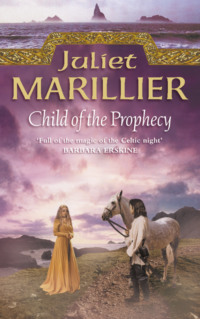
JULIET MARILLIER
Child of the Prophecy
Book Three of the Sevenwaters Trilogy

To old friends
Contents
Cover
Title Page
Dedication
Map
Chapter One
Chapter Two
Chapter Three
Chapter Four
Chapter Five
Chapter Six
Chapter Seven
Chapter Eight
Chapter Nine
Chapter Ten
Chapter Eleven
Chapter Twelve
Chapter Thirteen
Chapter Fourteen
Chapter Fifteen
Chapter Sixteen
Afterword
About the Author
Praise
Also by the Author
Copyright
About the Publisher
Map

Chapter One
Every summer they came. By earth and sky, by sun and stone I counted the days. I’d climb up to the circle and sit there quiet with my back to the warmth of the rock I called Sentinel, and see the rabbits come out in the fading light to nibble at what sparse pickings might be found on the barren hillside. The sun sank in the west, a ball of orange fire diving beyond the hills into the unseen depths of the ocean. Its dying light caught the shapes of the dolmens and stretched their strange shadows out across the stony ground before me. I’d been here every summer since first I saw the travellers come, and I’d learned to read the signs. Each day the setting sun threw the dark pointed shapes a little further across the hilltop to the north. When the biggest shadow came right to my toes, here where I sat in the very centre of the circle, it was time. Tomorrow I could go and watch by the track, for they’d be here.
There was a pattern to it. There were patterns to everything, if you knew how to look. My father taught me that. The real skill lay in staying outside them, in not letting yourself be caught up in them. It was a mistake to think you belonged. Such as we were could never belong. That, too, I learned from him.
I’d wait there by the track, behind a juniper bush, still as a child made of stone. There’d be a sound of hooves, and the creak of wheels turning. Then I’d see one or two of the lads on ponies, riding up ahead, keeping an eye out for any trouble. By the time they came up the hill and passed by me where I hid, they’d relaxed their guard and were joking and laughing, for they were close to camp and a summer of good fishing and relative ease, a time for mending things and making things. The season they spent here at the bay was the closest they ever came to settling down.
Then there’d be a cart or two, the old men and women sitting up on top, the smaller children perched on the load or running alongside. Danny Walker would be driving one pair of horses, his wife Peg the other. The rest of the folk would walk behind, their scarves and shawls and neckerchiefs bright splashes of colour in the dun and grey of the landscape, for it was barren enough up here, even in the warmth of early summer. I’d watch and wait unseen, never stirring. And last, there was the string of ponies, and the younger lads leading them or riding alongside. That was the best moment of the summer: the first glimpse I got of Darragh, sitting small and proud on his sturdy grey. He’d be pale after the winter up north, and frowning as he watched his charges, always alert lest one of them should make a bolt for freedom. They’d a mind to go their own way, these hill ponies, until they were properly broken. This string would be trained over the warmer season, and sold when the travelling folk went north again.
Not by so much as a twitch of a finger or a blink of an eyelid would I let on I was there. But Darragh would know. His brown eyes would look sideways, twinkling, and he’d flash a grin that nobody saw, nobody but me where I hid by the track. Then the travellers would pass on and be gone down to the cove and their summer encampment, and I’d be away home, scuttling across the hill and down over the neck of land to the Honeycomb, which was where we lived, my father and I.
Father didn’t much like me to go out. But he did not lay down any restrictions. It was more effective, he said, for me to set my own rules. The craft was a hard taskmaster. I would discover soon enough that it left no time for friends, no time for play, no time for swimming or fishing or jumping off the rocks as the other children did. There was much to learn. And when Father was too busy to teach me, I must spend my time practising my skills. The only rules were the unspoken ones. Besides, I couldn’t wander far, not with my foot the way it was.
I understood that for our kind the craft was all that really mattered. But Darragh made his way into my life uninvited, and once he was there he became my summer companion and my best friend; my only friend, to tell the truth. I was frightened of the other children and could hardly imagine joining in their boisterous games. They in their turn avoided me. Maybe it was fear, and maybe it was something else. I knew I was cleverer than they were. I knew I could do what I liked to them, if I chose to. And yet, when I looked at my reflection in the water, and thought of the boys and girls I’d seen running along the sand shouting to one another, and fishing from the rocks, and mending nets alongside their fathers and mothers, I wished with all my heart that I was one of them, and not myself. I wished I was one of the traveller girls, with a red scarf and a shawl with a long fringe to it, so I could perch up high on the cart and ride away in autumn time to the far distant lands of the north.
We had a place, a secret place, halfway down the hill behind big boulders and looking out to the south west. Below us the steep, rocky promontory of the Honeycomb jutted into the sea. Inside it was a complex network of caves and chambers and concealed ways, a suitable home for a man such as my father. Behind us the slope stretched up and up to the flattened top of the hill, where the stone circle stood, and then down again to the cart track. Beyond that was the land of Kerry, and further still were places whose names I did not know. But Darragh knew, and Darragh told me as he stacked driftwood neatly for a fire, and hunted for flint and tinder while I got out a little jar of dried herbs for tea. He told me of lakes and forests, of wild crags and gentle misty valleys. He described how the Norsemen, whose raids on our coast were so feared, had settled here and there and married Irish women, and bred children who were neither one thing nor the other. With a gleam of excitement in his brown eyes, he spoke of the great horse fair up north. He got so caught up in this, his thin hands gesturing, his voice bright with enthusiasm, that he forgot he was supposed to be lighting the little fire. So I did it myself, pointing at the sticks with my first finger, summoning the flame. The driftwood burst instantly alight, and our small pan of water began to heat. Darragh fell silent.
‘Go on,’ I said. ‘Did the old man buy the pony or not?’
But Darragh was frowning at me, his dark brows drawn together in disapproval. ‘You shouldn’t do that,’ he said.
‘What?’
‘Light the fire like that. Using sorcerer’s tricks. Not when you don’t need to. What’s wrong with flint and tinder? I would have done it.’
‘Why bother? My way’s quicker.’ I was casting a handful of the dry leaves into the pot to brew. The smell of the herbs arose freshly in the cool air of the hillside.
‘You shouldn’t do it. Not when there’s no need.’ He was unable to explain any further, but his flood of words had dried up abruptly, and we brewed our tea and sat there drinking it together in silence as the sea birds wheeled and screamed overhead.
The summers were full of such days. When he wasn’t needed to work with the horses or help around the camp, Darragh would come to find me, and we explored the rocky hillsides, the clifftop paths, the hidden bays and secret caves together. He taught me to fish with a single line and a steady hand. I taught him how to read what day it was from the way the shadows moved up on the hilltop. When it rained, as it had a way of doing even in summer, we’d sit together in the shelter of a little cave, down at the bottom of the land bridge that joined the Honeycomb to the shore, a place that was almost underground but not quite, for the daylight filtered through from above and washed the tiny patch of fine sand to a delicate shade of grey-blue. In this place I always felt safe. In this place sky and earth and sea met and touched and parted again, and the sound of the wavelets lapping the subterranean beach was like a sigh, at once greeting and farewell. Darragh never told me if he liked my secret cave or not. He’d simply come down with me, and sit by me, and when the rain was over, he’d slip away with never a word.
There was a wild grass that grew on the hillside there, a strong, supple plant with a silky sheen to its pale green stems. We called it rat-tails, though it probably had some other name. Peg and her daughters were expert basketweavers, and made use of this grass for their finer and prettier efforts, the sort that might be sold to a lady for gathering flowers maybe, rather than used for carrying vegetables or a heavy load of firewood. Darragh, too, could weave, his long fingers fast and nimble. One summer we were up by the standing stones, late in the afternoon, sitting with our backs to the Sentinel and looking out over the bay and the far promontory, and beyond to the western sea. Clouds were gathering, and the air had a touch of chill to it. Today I could not read the shadows, but I knew it was drawing close to summer’s end, and another parting. I was sad, and cross with myself for being sad, and I was trying not to think about another winter of hard work and cold, lonely days. I stared at the stony ground and thought about the year, and how it turned around like a serpent biting its own tail; how it rolled on like a relentless wheel. The good times would come again, and after them the bad times.
Darragh had a fistful of rat-tails, and he was twisting them deftly and whistling under his breath. Darragh was never sad. He’d no time for it; for him, life was an adventure, with always a new door to open. Besides, he could go away if he wanted to. He didn’t have lessons to learn and skills to perfect, as I did.
I glared at the pebbles on the ground. Round and round, that was my existence, endlessly repeating, a cycle from which there was no escape. Round and round. Fixed and unchangeable. I watched the pebbles as they shuddered and rolled; as they moved obediently on the ground before me.
‘Fainne?’ Darragh was frowning at me, and at the shifting stones on the earth in front of me.
‘What?’ My concentration was broken. The stones stopped moving. Now they lay in a perfect circle.
‘Here,’ he said. ‘Hold out your hand.’
I did as he bid me, puzzled, and he slipped a little ring of woven rat-tails on my finger; so cunningly made that it seemed without any joint or fastening.
‘What’s this for?’ I asked him, turning the silky, springy circle of grass around and around. He was looking away over the bay again, watching the small curraghs come in from fishing.
‘So you don’t forget me,’ he said, offhand.
‘Don’t be silly,’ I said. ‘Why would I forget you?’
‘You might,’ said Darragh, turning back towards me. He gestured towards the neat circle of tiny stones. ‘You might get caught up in other things.’
I was hurt. ‘I wouldn’t. I never would.’
Darragh gave a sigh and shrugged his shoulders. ‘You’re only little. You don’t know. Winter’s a long time, Fainne. And – and you need keeping an eye on.’
‘I do not!’ I retorted instantly, jumping up from where I sat. Who did he think he was, talking as if he was my big brother? ‘I can look after myself quite well, thank you. And now I’m going home.’
‘I’ll walk with you.’
‘You don’t have to.’
‘I’ll walk with you. Better still, I’ll race you. Just as far as the junipers down there. Come on.’
I stood stolid, scowling at him.
‘I’ll give you a head start,’ coaxed Darragh. ‘I’ll count to ten.’
I made no move.
‘Twenty, then. Go on, off you go.’ He smiled, a broad, irresistible smile.
I ran, if you could call my awkward, limping gait a run. With my skirt caught up in one hand I made reasonable speed, though the steep pebbly surface required some caution. I was only halfway to the junipers when I heard his soft, quick footsteps right behind me. No race could have been less equal, and both of us knew it. He could have covered the ground in a quarter of the time it took me. But somehow, the way it worked out, the two of us reached the bushes at exactly the same moment.
‘All right, sorcerer’s daughter,’ said Darragh, grinning. ‘Now we walk and catch our breath. It’ll be a better day tomorrow.’
How old was I then? Six, maybe, and he a year or two older? I had the little ring on my finger the day the travelling folk packed up and moved out again; the day I had to wave goodbye and start waiting. It was all right for him. He had places to go and things to do, and he was eager to get on his pony and be off. Still, he made time to say farewell, up on the hillside above the camp, for he knew I would not come near where the folk gathered to load their carts and make ready for the journey. I was numb with shyness, quite unable to bear the stares of the boys and girls or to form an answer to Peg’s shrewd, kindly questions. My father was down there, a tall, cloaked figure talking to Danny Walker, giving him messages to deliver, commissions to fulfil. Around them, the folk left a wide, empty circle.
‘Well, then,’ said Darragh.
‘Well, then,’ I echoed, trying for the same tone of nonchalance and failing miserably.
‘Goodbye, Curly,’ he said, reaching out to tug gently at a lock of my long hair, which was the same deep russet as my father’s. ‘I’ll see you next summer. Keep out of trouble, now, until I come back.’ Every time he went away he said this; always just the same. As for me, I had no words at all.
The days grew shorter and the dark time of the year began. With Darragh gone there was no real reason to linger out of doors, and so I applied myself to my work and tried not to notice how cold it was inside the Honeycomb, colder, almost, than the chill of an autumn wind up on the hilltop. It was an aching feeling that lodged deep in your bones and lingered there like a burden. I never complained. Father had shown me how to deal with it and he expected me to do so. It was not that a sorcerer did not feel the heat of the fire or the bite of the north wind. A sorcerer was, after all, a man and not some Otherworld creature. What you had to do was teach your body to cope with it, so that discomfort did not make you slow or inefficient. It had to do with breathing, mostly. More I cannot say. My father was once a druid. He said he had put all that behind him when he left the brotherhood. But a man does not so easily discard all those years of training and discipline. I understood that much of what I learned was secret, to be shared only with others of our kind. One did not lay it bare before the ignorant, or those whose minds were closed. Even now there are some matters of which I cannot and will not tell.
There were many chambers in the Honeycomb. We lit lamps year round, and in my father’s great workroom many candles burned, for there he stored his scrolls and books, grotesque and wondrous objects in jars, and little sacks of pungent-smelling powders. There was a dried basilisk, and a cup made from a twisted, curling horn, its base set with red stones. There was a tiny skull like a leprechaun’s, with empty eyes. There was a thick grimoire whose leather cover was darkened with age and long handling. In this room my father spent days and nights in solitude, perfecting his craft, learning, always learning.
I knew how to read in more than one tongue and to write in more than one script. I could recite many, many tales and even more incantations. But I learned soon enough that the greatest magic is not set down in any book, nor mapped on any scroll for man to decipher. The most powerful spells are not created by tricks of the hand, or by mixing potions and philtres, or by chanting ancient words. I learned why it was that when my father was working hardest, all he seemed to be doing was standing very still in the centre of an empty space, with his mulberry eyes fixed on nothing. For the deepest magic is that of the mind, and you will not find its lore recorded on parchment or vellum, or scratched on bark or stone. Not anywhere. Father owed his first learning to the wise ones: the druids of the forest. He had developed it through dedication and study. But our talent for the craft of sorcery was in our blood. Father was the son of a great enchantress, and from her he had acquired certain skills which he used sparingly, since they were both potent and perilous. One must take care, he said, not to venture too far and touch on dark matters best left sleeping. I could not remember my grandmother very well. I thought I recalled an elegant creature in a blue gown, who had peered into my eyes and given me a headache. I thought perhaps she had asked questions which I had answered angrily, not liking her intrusion into our ordered domain. But that had been long ago, when I was a little child. Father spoke of her seldom, save to say that our blood was tainted by the line she came from, a line of sorcerers who did not understand that some boundaries should never be crossed. And yet, said Father, she was powerful, subtle and clever, and she was my grandmother; part of her was in both of us, and we should not forget that. It ensured we would never live our lives as ordinary folk, with friends and family and honest work. It gave us exceptional talents, and it set our steps towards a destiny of darkness.
I was eight years old. It was Meán Geimhridh, and the north wind beat the stunted trees prostrate. It threw the waves crashing against the cliff face, forcing icy spray deep inside the tunnelled passages of the Honeycomb. The pebbly shore was strewn with tangles of weed and fractured shells. The fishermen hauled their curraghs up out of harm’s way, and folk went hungry.
‘Concentrate, Fainne,’ said my father, as my frozen fingers fumbled and slipped. ‘Use your mind, not your hands.’
I set my jaw, screwed up my eyes and started again. A trick, that was all this was. It should be easy. Stretch out your arms, look at the shining ball of glass where it stood on the shelf by the far wall, with the candles’ glow reflected in its deceptive surface. Bridge the gap with your mind; think the distance, think the leap. Keep still. Let the ball do the work. Will the ball into your hands. Will the ball to you. Come. Come here. Come to me, fragile and delicate, round and lovely, come to my hands. It was cold, my fingers ached, it was so cold. I could hear the waves smashing outside. I could hear the glass ball smashing on the stone floor. My arms fell to my sides.
‘Very well,’ said Father calmly. ‘Fetch a broom, sweep it up. Then tell me why you failed.’ There was no judgement in his voice. As always, he wished me to judge myself. That way I would learn more quickly.
‘I – I let myself think about something else,’ I said, stooping to gather up the knife-edged shards. ‘I let the link be broken. I’m sorry, Father. I can do this. I will do it next time.’
‘I know,’ he said, turning back to his own work. ‘Practise this twice fifty times with something unbreakable. Then come back and show me.’
‘Yes, Father.’ It was too cold to sleep anyway. I might as well spend the night doing something useful.
I was ten years old. I stood very still, right in the centre of my father’s workroom, with my eyes focused on nothing. Above my head the fragile ball hovered, held in its place by invisible forces. I breathed. Slow, very slow. With each outward breath, a tiny adjustment. Up, down, left, right. Spin, I told the ball, and it whirled, glowing in the candlelight. Stop. Now circle around my head. My eyes did not follow the steady movement. I need not see it to know its obedience to my will. Stop. Now drop. The infinitesimal pause; then the dive, a sweep before me of glittering brightness, descent to destruction. Stop. The diver halted a handspan above the stone floor. The ball hung in air, waiting. I blinked, and bent to scoop it up in my hand.
Father nodded gravely. ‘Your control is improving. These tricks are relatively easy, of course; but to perform them well requires discipline. I’m pleased with your progress, Fainne.’
‘Thank you.’ Such praise was rare indeed. It was more usual for him simply to acknowledge that I had mastered something, and go straight on to the next task.
‘Don’t become complacent, now.’
‘No, Father.’
‘It’s time to venture into a more challenging branch of the art. For this, you’ll need to find new reserves within yourself. It can be exhausting. Take a few days to rest. We’ll begin at Imbolc. What apter time could there be, indeed?’ His tone was bitter.
‘Yes, Father.’ I did not ask him what he meant. I knew it was at Brighid’s feast that he first met my mother; not that he ever spoke of her, not deliberately. That tale was well hidden within him, and he was a masterful keeper of secrets. The little I knew I had gleaned here and there, a morsel at a time over the years. There was a remark of Peg’s, overheard whilst I waited for Darragh under the trees behind the encampment, unseen by his mother.
‘She was very beautiful,’ Peg had said to her friend Molly. The two of them were sitting in the morning sunlight, fingers flying as they fashioned their intricate baskets. ‘Tall, slender, with that bright copper hair down her back. Like a faery woman. But she was always – she was always a little touched, you know what I mean? He’d watch over her like a wolf guarding its young, but he couldn’t stop what happened. You could see it in her eyes, right from the first.’
‘Mm,’ Molly had replied. ‘Girl takes after her father, then. Strange little thing.’
‘She can’t help what she is,’ said Peg.
And I remembered another time, one summer when the weather was especially warm, and Darragh finally grew impatient with my persistent refusal to go anywhere near the water.
‘Why won’t you let me teach you how to swim?’ he’d asked me. ‘Is it because of her? Because of what happened to her?’
‘What?’ I said. ‘What do you mean?’
‘You know. Your mother. Because she – well, because of what she did. That’s what they say. That you’re frightened of the water, because she jumped off the Honeycomb and drowned herself.’
‘Of course not,’ I replied, swallowing hard. ‘I just don’t want to, that’s all.’ How could he know that until that moment, nobody had told me how she died?
I tried to dredge up some memory of my mother, tried to picture the lovely figure Peg had described, but there was nothing. All I could remember was Father and the Honeycomb. Something had happened long since and far away, something that had damaged my mother and wounded my father, and set the path forwards for all of us in a way there was no denying. Father had never told me the tale. Still, it was an unspoken lesson built into everything he taught me.
‘Time to begin,’ said Father, regarding me rather severely. ‘This will be serious work, Fainne. It may be necessary to curtail your freedom this summer.’
‘I – yes, Father.’
‘Good.’ He gave a nod. ‘Stand here by me. Look into the mirror. Watch my face.’
The surface was bronze, polished to a bright reflective sheen. Our images showed side by side; the same face with subtle alterations. The dark red curls; the fierce eyes, dark as ripe berries; the pale unfreckled skin. My father’s countenance was handsome enough, I thought, if somewhat forbidding in expression. Mine was a child’s, unformed, plain, a little pudding of a face. I scowled at my reflection, and glanced back at my father in the mirror. I sucked in my breath.
My father’s face was changing. The nose grew hooked, the deep red hair frosted with white, the skin wrinkled and blotched like an ancient apple left too long in store. I stared, aghast. He raised a hand, and it was an old man’s hand, gnarled and knotted, with nails like the claws of some feral creature. I could not tear my eyes away from the mirrored image.
‘Now look at me,’ he said quietly, and the voice was his own. I forced my eyes to flicker sideways, though my heart shrank at the thought that the man standing by me might be this wizened husk of my fine, upright father. And there he was, the same as ever, dark eyes fixed on mine, hair still curling glossily auburn about his temples. I turned back to the mirror.
The face was changing again. It wavered for a moment, and stilled. This time the difference was more subtle. The hair a shade lighter, a touch straighter. The eyes a deep blue, not the unusual shade of dark purple my father and I shared. The shoulders somewhat broader, the height a handspan greater, the nose and chin with a touch of coarseness not seen there before. It was my father still; and yet, it was a different man.
‘This time,’ he said, ‘when you take your eyes from the mirror, you will see what I want you to see. Don’t be frightened, Fainne. I am still myself. This is the Glamour, which we use to clothe ourselves for a special purpose. It is a powerful tool if employed adeptly. It is not so much an alteration of one’s appearance, as a shift in others’ perception. The technique must be exercised with extreme caution.’
When I looked, this time, the man at my side was the man in the mirror; my father, and not my father. I blinked, but he remained not himself. My heart was thumping in my chest, and my hands felt clammy.
‘Good,’ said my father quietly. ‘Breathe slowly as I showed you. Deal with your fear and put it aside. This skill is not learned in a day, or a season, or a year. You’ll have to work extremely hard.’
‘Then why didn’t you start teaching me before?’ I managed, still deeply unsettled to see him so changed. It would almost have been easier if he had transformed himself into a dog, or a horse, or a small dragon even; not this – this not quite right version of himself.
‘You were too young before. This is the right age. Now come.’ And suddenly he was himself again, as quick as a snap of the fingers. ‘Step by step. Use the mirror. We’ll start with the eyes. Concentrate, Fainne. Breathe from the belly. Look into the mirror. Look at the point just between the brows. Good. Will your body to utter stillness … put aside the awareness of time passing … I will give you some words to use, at first. In time you must learn to work without the mirror, and without the incantation.’
By dusk I was exhausted, my head hollow as a dry gourd, my body cold and damp with sweat. We rested, seated opposite one another on the stone floor.
‘How can I know,’ I asked him, ‘how can I know what is real, and what an image? How can I know that the way I see you is the true way? You could be an ugly, wrinkled old man clothed in the Glamour of a sorcerer.’
Father nodded, his pale features sombre. ‘You cannot know.’
‘But –’
‘It would be possible for one skilled in the art to sustain this guise for years, if it were necessary. It would be possible for such a one to deceive all. Or almost all. As I said, it is a powerful tool.’
‘Almost all?’
He was silent a moment, then gave a nod. ‘You will not blind another practitioner of our art with this magic. There are three, I think, who will always know your true self: a sorcerer, a seer and an innocent. You look weary, Fainne. Perhaps you should rest, and begin this anew in the morning.’
‘I’m well, Father,’ I said, anxious not to disappoint him. ‘I can go on, truly. I’m stronger than I look.’
Father smiled; a rare sight. That seemed to me a change deeper than any the Glamour could effect; as if it were truly another man I saw, the man he might have been, if fate had treated him more kindly. ‘I forget sometimes how young you are, daughter,’ he said gently. ‘I am a hard taskmaster, am I not?’
‘No, Father,’ I said. My eyes were curiously stinging, as if with tears. ‘I’m strong enough.’
‘Oh, yes,’ he said, his mouth once more severe. ‘I don’t doubt that for a moment. Come then, let’s begin again.’
I was twelve years old, and for a short time I was taller than Darragh. That summer my father didn’t let me out much. When he did give me a brief time for rest, I crept away from the Honeycomb and up the hill, no longer sure if this was allowed, but not prepared to ask permission in case it was refused. Darragh would be waiting for me, practising the pipes as often as not, for Dan had taught him well, and the exercise of his skill was pleasure more than duty. We didn’t explore the caves any more, or walk along the shore looking for shells, or make little fires with twigs. Most of the time we sat in the shadow of the standing stones, or in a hollow near the cliff’s edge, and we talked, and then I went home again with the sweet sound of the pipes arching through the air behind me. I say we talked, but it was usually the way of it that Darragh talked and I listened, content to sit quiet in his company. Besides, what had I to talk about? The things I did were secret, not to be spoken. And increasingly, Darragh’s world was unknown to me, foreign, like some sort of thrilling dream that could never come true.
I reached up a hand to stroke the long muzzle of a placid grey beast, and the lad who had whistled before appeared at my side. He was a gangling, freckled fellow somewhat older than myself. I had seen him many times with the others, and never exchanged so much as a word. Behind him a couple more boys hovered.
‘His name’s Silver.’ This was offered with diffidence, as if the speaker were not quite sure of his possible reception. There was a pause. Some response from me was clearly expected. It was all very well to maintain the Glamour, to keep myself as this not-quite-myself that they all seemed to want to look at and talk to. My techniques were well up to that. But I must also act in keeping; find the words, the smiles, the little gestures. Find the courage. I slipped a hand into the pocket of my gown, repeated the words of an old spell silently in my head, and drew out a wrinkled apple that had not been there when we left home.
‘Is it all right if I give him this?’ I asked sweetly, arching my brows and trying for a shy smile.
The boy nodded, grinning. Now I had five of them around me, leaning with studied casualness on the wall, or half-hiding behind one another, peering around for a better look without being conspicuous. I put the apple on the palm of my hand, and the horse ate it. His ears were laid back. He was uneasy with me, and I knew why.
‘Is it true you can make fire with your hands?’ blurted out one of the lads suddenly.
‘Hush your mouth, Paddy,’ said the first one with a scowl. ‘What are you thinking of, asking the young lady something like that?’
‘None of our business, I’m sure,’ said another, though doubtless he, like all of them, had exchanged his fair share of speculative gossip about what we got up to, those long lonely times in the Honeycomb.
‘It’s my father who’s the sorcerer, not me,’ I said softly, still stroking the horse’s muzzle with delicate fingers. ‘I’m just a girl.’
‘Haven’t seen you out and about much this summer,’ commented the freckled boy. ‘Keeps you busy, does he?’
I gave a nod, allowing my expression to become crestfallen. ‘There’s only my father and me, you see.’ I imagined myself as a dutiful daughter, cooking sustaining meals, mending and sweeping and tending to my father, and I could see the same image in their eyes.
‘A shame, that,’ said one of the lads. ‘You should come down sometimes. There’s dancing and games and good times here in the camp. Pity to miss it.’
‘Maybe –’ began the other boy, but I never heard what he was about to say, for it was at that point my father called me, and the lads melted away quicker than spring snow, leaving me alone with the horse. And as I turned to follow my father obediently back home I saw Darragh, over on the far side of the horse lines, brushing down his white pony. Aoife, her name was; he’d argued long and hard with Dan to be allowed to keep her, and he’d had his way in the end. Now Darragh glanced at me and looked away, and not by so much as a twitch of the brow or a movement of the hand did he give me any recognition.
‘Very good,’ my father said as we walked home in the chill of a rising west wind. ‘Very good indeed. You’re getting the feeling of this. However, this is just the beginning. I’d like you to develop a degree of sophistication. You’ll need that at Sevenwaters. The folk there are somewhat different from these fishermen and simple travellers. We must begin work on that.’
‘Yes, Father.’
‘We might start sooner than planned, I think. As soon as Dan’s folk are away we’ll take the next step. You can have one day’s rest. You’ve earned that much; we cannot afford more. Use the day wisely.’
There was no choice in it; there never had been. ‘Yes, Father,’ I said, and as we made our way up the cliff path and into the dark tunnels of the Honeycomb, I let the Glamour slip away and was once more my limping, clumsy self. I had done what my father asked. Why, then, did I feel so unhappy? Hadn’t I proved I could be what I pleased? Hadn’t I shown I could make people admire me and bend them to my will? Yet, later, lying on my bed, I stared into the darkness and felt an emptiness inside me that bore no relation whatever to spells, and enchantments, and the mastery of the craft.
It was a night of restless dreams, and I awoke before dawn, shivering under my woollen blanket, hearing the howl of the wind, and the roar of the sea as it pounded the rocks of the Honeycomb. Not a good day to be abroad. Perhaps Dan Walker and his folk would decide to stay a little longer. But it never did happen that way. They were as true to their time as birds flying away for the winter, their arrivals and departures as precise as the movement of shadows in a sacred circle. You could count your year by them. The golden times. The grey times. It seemed to me the voice of the wind had words in it. I will sweep you bare … bare … I will take all … all … And the sea responded in kind. I am hungry … give me … give …
I put my hands over my ears and curled up tight. It was supposed to be a day of rest, after all. Might I not sleep in peace, at least until the sun rose? But the voices would not go away, so I got up and dressed, not sure what the day might hold, but thinking I would make myself very busy indeed, and try to ignore the sick, empty feeling in my stomach. It was as I pulled on my boots that I heard, very faintly through the blast of the wind, another sound. A note or two, fragments of a tune over a steady, solid drone. The voice of the pipes. So, they were not gone yet. Not stopping to think, I grabbed my shawl and was away, out of doors and up the hill towards the standing stones, my hair whipped this way and that in the wild weather, the sea spray pursuing me as far from the cliffs as its icy fingers could stretch.
Darragh stopped playing when he saw me. He’d found a sheltered spot amongst the stones, and sat with his legs outstretched and his back to the great dolmen we called the Guardian, not disrespectful exactly, just blending in as if he belonged there, the same as the rabbits. I stumbled forward, pushing my hair back from my eyes, and sat down beside him. I clutched my shawl closer around me. It was still barely dawn, and the air held the first touch of a distant winter.
It took me a while to catch my breath.
‘Well,’ said Darragh eventually, which wasn’t much help.
‘Well,’ I echoed.
‘You’re abroad early.’
‘I heard you playing.’
‘I’ve played up here often enough, this summer. Didn’t bring you out before. We’re leaving this morning. But I suppose you knew that.’
I nodded, sudden misery near overwhelming me. ‘I’m sorry,’ I mumbled. ‘I’ve been busy. Too busy to come out. I –’
‘Don’t apologise. Not if you don’t mean it,’ said Darragh lightly.
‘But I did want – I hadn’t any choice,’ I told him.
Darragh looked at me straight, his brown eyes very serious and a little frown on his face. ‘There’s always a choice, Fainne,’ he said soberly.
Then we sat in silence for a while, and at length he took up the pipes and began to play again, some tune I did not recognise that was sad enough to bring the tears to your eyes. Not that I’d have cried over so foolish a thing, even if I’d been capable of it.
‘There’s words to that tune,’ Darragh ventured. ‘I could teach you. It sounds bonny, with the pipes and the singing.’
‘Me, sing?’ I was jolted out of my misery. ‘I don’t think so.’
‘Never tried, have you?’ said Darragh. ‘Odd, that. I’ve never yet met a soul without some music in them. I bet you could sing fit to call the seals up out of the ocean, if you gave it a try.’ His tone was coaxing.
‘Not me,’ I said flatly. ‘I’ve better things to do. More important things.’
‘Like what?’
‘Things. You know I can’t talk about it.’
‘Fainne.’
‘What?’
‘I don’t like to see you doing that – that – doing what you were doing yesterday. I don’t like it.’
‘Doing what?’ I lifted my brows as haughtily as I could manage, and stared straight at him. He looked steadily back.
‘Carrying on with the lads. Flirting. Behaving like some – some silly girl. It’s not right.’
‘I can’t imagine what you mean,’ I retorted scornfully, though I was struck to the heart by his criticism. ‘Anyway, you weren’t even looking at me.’
Darragh gave his crooked grin, but there was no mirth in it. ‘I was looking, all right. You made sure everyone would be looking.’
I was silent.
‘My father was right, you know,’ he said after a while. ‘You should get wed, have a brood of children, settle down. You need looking after.’
‘Nonsense,’ I scoffed. ‘I can look after myself.’
‘You need keeping an eye on,’ persisted Darragh. ‘Maybe you can’t see it, and maybe your father can’t see it, but you’re a danger to yourself.’
‘Rubbish,’ I said, bitterly offended that he should think me so inadequate. ‘Besides, who would I wed, here in the bay? A fisherman? A tinker’s lad? Hardly.’
‘You’re right, of course,’ Darragh said after a moment. ‘Quite unsuitable, it’d be. I see that.’ Then he got to his feet, lifting the pipes neatly onto his shoulder. He had grown a lot, this last year, and had begun to show a dark shadow of beard around the chin. He had acquired a small gold ring in one ear, just like his father’s.
‘I’d best be off, then.’ He looked at me unsmiling. ‘Slip you in my pocket and take you with me, I would, if you were a bit smaller. Keep you out of harm’s way.’
‘I’d be too busy anyway,’ I said, as the desolation of parting swept over me once again. It never got any easier, year after year, and knowing I would myself be leaving next autumn made this time even worse. ‘I have work to do. Difficult work, Darragh.’
‘Mm.’ He didn’t really seem to be listening to me, just looking. Then he reached over to tweak my hair, not too hard, and he said what he always said. ‘Goodbye, Curly. I’ll see you next summer. Keep out of trouble, now, until I come back.’
I nodded, incapable of speech. Somehow, even though I had learned so much this season, even though I had come close to a mastery of my craft, it seemed all of a sudden that the summer had been utterly wasted, that I had squandered something precious and irreplaceable. I watched my friend as he made his way through the circle of stones, the wind tugging and tearing at his old clothes and whipping his dark hair out behind him, and then he went down the other side of the hill and was gone. And it was cold, so cold I felt it in the very marrow, a chill that no warm fire nor sheepskin coat could keep at bay. I went home, and still the sun was barely creeping up the eastern sky, dark red behind storm-tossed clouds. As I walked back to the Honeycomb, and lit a lantern to see me in through the shadowy passages, I made my breathing into a pattern. One breath in, long and deep from the belly. Out in steps, like the cascades of a great waterfall. Control, that was what it was all about. You had to keep control. Lose that, and the exercise of the craft was pointless. I was a sorcerer’s daughter. A sorcerer’s daughter did not have friends or feelings; she could not afford them. Look at my father. He had tried to live a different sort of life, and all it had brought him was heartache and bitterness. Far wiser to concentrate on the craft, and put the rest aside.
Back in my room I made myself picture the travelling folk loading their carts, harnessing their horses, setting off up the track northwards with their dogs running alongside and the lads bringing up the rear. I made myself think of Darragh on his white pony, and forced myself to hear his words again. I don’t like to see you doing that … you made sure everyone would be looking … you’re a danger to yourself … If that was how he saw me, it was surely far better that our paths were separating now. Year after year, season after season I had waited for him, pinning my hope and happiness on his return. It had seemed to me, sometimes, that I was not fully alive unless he was there. Now my grandmother was coming, and I was being sent away; everything was changing. Best if I put Darragh from my thoughts and just get on with things. Best if I learn to do without him. Besides, what could a travelling boy understand about sorcery, and shape-changing, and the arts of the mind? It was a different world; a world beyond his wildest imaginings. It was a world in which, finally, one must be strong enough to move forward quite alone.
Chapter Two
That day I set all my things in order. I tidied my narrow bed and folded the blanket. I swept the stone floor of my bedchamber, which was one of many caves in the Honeycomb’s maze of chambers and passages. I put away my shawl and outdoor boots in the small wooden chest which housed my few possessions. Our life was very simple. Work, rest, eat when we must. We needed little. Deep in the chest, half-hidden under winter bedding, was Riona. She was the only possession I had that was not a strict essential of life. Riona was a doll. When folk spoke of my mother, they would say how beautiful she was, and how slender, like a young birch, and how much my father had loved her. They’d say how she was always a little touched in the head, though it had shocked them when she did the terrible thing she did. But you never heard them talk about her talents, the way they’d mention that Dan was a champion on the pipes, or Molly the neatest basketweaver, or how Peg’s dumplings were the tastiest anywhere in Kerry. You’d have thought my mother had no qualities at all, save beauty and madness. But I knew different. You only had to look at Riona to know my mother had been expert with the needle. After all these years Riona was more than a little threadbare, her features somewhat blurred and her gown thin in patches. But she’d been made strong and neat, with such tiny, even stitches they were near invisible. She had fingers and toes, and embroidered eyelashes. She had long woollen hair coloured as yellow as tansy, and a gown of rose-hued silk over a lace petticoat. The necklace Riona wore, wound three times around her small neck for safekeeping, was the strongest thing of all. It was strangely woven of many different fibres, and so crafted that it could not be broken, not should the greatest force be exerted on it. Threaded on this cord was a little white stone with a hole in it. I did not play with Riona in Father’s presence. Of course, now I was too old for play. It was a waste of time, like taking silly, dangerous dives off the rocks when there was no need for it. But over the years Riona had shared countless adventures with Darragh and me. She had explored deep caves and precipitous gullies; had narrowly avoided falling from cliffs into the sea, and being left behind on the sand in the path of a rising tide. She had worn crowns of threaded daisies and cloaks of rabbit skin. She had sat under the standing stones watching us as if she were a queen surveying her subjects. Her dark embroidered eyes held a knowledge of me that could at times be disturbing. Riona did not judge, not exactly. She observed. She took stock.
That day I felt a strong need to be occupied, to channel my thoughts into the strictly practical. So, when my chamber was bare and clean, I went to the place where we kept our small supply of food, and took the fish the girl had brought, and a few turnips. The fish was already gutted and scaled. My father and I were not cooks. We ate because it was necessary, that was all. But I had time to fill. So I made up the fire, and let it die down, and then I roasted the turnips in the coals, and baked the fish on top. When it was ready I took a plateful down to the workroom for my father. But the door was bolted from the inside. I could not hear his voice chanting or speaking words of magic. The only sound was the harsh cawing of a bird within the vaulted chamber. That meant Fiacha was back. My heart sank, for I disliked Fiacha intensely. The raven came and went as he pleased, and when he stayed in the household he always seemed to be staring at me with his little, bright eyes, summing me up and finding me less than impressive. Then he’d be suddenly gone again, without so much as a by-your-leave. Perhaps he brought messages. Father never said. I did not like Fiacha’s sharp beak or the dangerous glint in his eye. He pecked me once when I was little, and it hurt a lot. Father said it was an accident, but I was never quite so sure.
I left the food outside the door. There was a rule which need not be spoken, that when the door was locked, one did not seek admittance. Some elements of the craft must be exercised in solitude, and my father sought always to deepen and extend his knowledge. It is too easy for an outsider to judge us wrongly, to see a threat in what we do, simply because of a lack of insight. Our kind are not always made welcome, not in all parts of Erin, for folk tell tales of us which are half truth and half a jumble of their own fears and superstitions. It was not by chance that my father had come to live in this distant, remote corner of Kerry. Here, the folk were simple souls whose lives turned on sea and season, whose world had no place for the luxury of gossip and prejudice. They had accepted him and my mother as just two more dwellers in the bay, quiet, courteous folk who left well alone. And everyone knew a settlement with its own sorcerer was the safest of places to live in. My father had quickly demonstrated that, for one summer, soon after his arrival in Kerry, the Norsemen came. All along the coast there were tales of their raids, the brutal killings, the rape, the burning, the stealing of women and children, and there were tales of the places where they’d come in their longships and simply moved in, taking the cottages and farms and settling down as if they’d a right to. But there was no Viking settlement in our cove. Ciarán had seen to that. Folk still told the story of how the longships with their carven prows had come into view, rowing in hard towards the shore with so little warning there was no time to flee for cover. The sunlight had flashed on the axes and the strange helms the men wore; the many oars had dipped and splashed, dipped and splashed as the fisherfolk stood frozen in terror, watching their death come closer. Then the sorcerer had walked out onto a high ledge of the Honeycomb with his staff of yew in his hand, and raised it aloft, and an instant later, great clouds had begun to roll in from the west, and the swell had risen till white-capped breakers began to pound the shore. The longships had begun to struggle and list, and the neat rows of oars were thrown into confusion. Within moments the sky was dark with storm, and the ocean boiled, and the folk watched round-eyed as the vessels of the Norsemen cracked and split and were torn asunder each in its turn. Later, children found strange and wondrous objects cast up on the shore. An armlet wrought with snakes and dogs, curiously patterned. A necklace in the shape of a tiny, lethal axe threaded on twisted wire. A bronze bowl. The shaft of an oar, fine-fashioned. The body of a man with pale skin and long, plaited hair the colour of wheat at Lugnasad. So, there was no Viking settlement in our cove. After that my father was revered and protected, a man who could do no wrong. When my mother died they grieved with him. All the same, they gave him a wide berth.
All that long day my father stayed in the workroom with the door bolted. When at last he emerged to take up the plateful of food and eat it abstractedly, not noticing it had gone cold waiting for him, he looked pale and tired. Sitting by the remnants of my small cooking fire, he picked at the congealing fish and had nothing to say. Fiacha had followed him and sat on a ledge above, staring at me. I scowled back.
‘Best go to bed, daughter,’ my father said, and coughed harshly. ‘I’m not good company tonight.’
‘Father, you’re sick.’ I stared with alarm as he struggled for breath. ‘You need help. A physic, at least.’
‘Nonsense.’ His expression was grim. ‘There’s nothing wrong with me. Go on now, off to bed with you. This will pass. It’s nothing.’
He had not convinced me in the slightest.
‘Father, please tell me what’s wrong.’
He gave a brief laugh. It was not a happy sound. ‘Where could one begin? Now, enough of this. I’m weary. Good night, Fainne.’
So I was dismissed, and I left him there, unmoving, staring into the heart of the dying fire. As I walked away to my chamber, the sound of his coughing followed me, echoing stark through the underground caverns.
She arrived one morning late in autumn, while Father was away fetching water. I made my way out, hearing her calling from the entrance. We had few visitors. But there she was; an old lady wrapped in shawls, trudging along on foot with never a bag or basket to her name. Her face was all wrinkled and her eyes so sunken you could scarce see what colour they were. She had a crown of dishevelled white hair and a very loud voice.
‘Well, come on, girl! Invite me in. Don’t tell me I wasn’t expected. What’s Ciarán playing at?’
She bustled past me and on down the tunnel towards the workroom as if the place belonged to her. I trotted after, hoping my father would not be too long. Suddenly she whirled back to face me, quicker than any old lady had the right to move, and now she was gazing intently into my eyes, as if assessing me.
‘Know who I am, do you?’
‘Yes, Grandmother,’ I said, for although she seemed quite different from the elegant woman I remembered, I could feel the magic seeping from every part of her, powerful, ancient, and it was plain to me who she must be.
‘Hmm. You’ve grown, Fainne.’ Clearly unimpressed, she turned her back on me and continued her confident progress through the darkened passages of the Honeycomb. Before the great door of the workroom, she halted. She put her hand out and gave a push. The door did not budge. Carven from solid oak, and set in a heavy frame which fitted tightly within its arch of stone, this entry was sealed by iron bolts and by words of power. My father guarded his knowledge closely. The old woman pushed again.
‘You can’t go in there,’ I said, alarmed. ‘My father doesn’t let anyone go in. Just him, and sometimes me. You’ll have to wait.’
‘Wait?’ She lifted her brows and gave an arch smile. On her ancient features, it looked hideous. Her eyes bored through me, as if she wished to read my thoughts. ‘Has your father taught you this trick, how to come out of a room and leave it locked from the inside?’
I nodded, scowling.
‘And how to unlock such a door?’
‘You needn’t think I’m going to open it for you,’ I told her, my voice growing sharp with anger at her temerity. I felt my face flush, and knew the little flames Darragh had once noticed would be starting to show on the edges of my hair. ‘If my father wants it locked, it stays locked. I won’t do it.’
‘Bet you can’t.’ She was taunting me.
‘I won’t open it. I told you.’
She laughed, a young girl’s laugh like a peal of little bells. ‘Then I’ll have to do it myself, won’t I?’ she said lightly, and raised a gnarled, knobby hand towards the heavy oak panels. She clicked her fingers just once, and a bright border of flame licked at the door, all round the edges. Smoke billowed, and I began to cough. For a moment I could see nothing. There was a popping sound, and a creak. The smoke cleared. The great door now stood ajar, its surface blackened and blistered, its heavy bolts hanging useless where they had fallen away from the charred wood.
I stood in the doorway, watching, as the old woman took three steps into my father’s secret room.
‘He won’t be happy,’ I said tightly.
‘He won’t know,’ she replied coolly. ‘Ciarán’s gone. You won’t see him again until we’re quite finished here, child; not until next summer nears its end. It’s just not possible for him to stay, not with me here. No place can hold the two of us. It’s better this way. You and I have a great deal of work to do, Fainne.’
I stood frozen, feeling the shock of what she had told me like a wound to the heart. How could Father do this? Where had he gone? How could he leave me alone with this dreadful old woman?
She was standing in front of the bronze mirror now, apparently admiring herself, for she took out a comb from a pocket in her voluminous attire and proceeded to drag it through her wild tangle of hair. Despite myself, I moved closer.
‘Didn’t Ciarán tell you about me, child? Didn’t he explain anything?’ She stared intently at her reflection. I came up behind, drawn to gaze over her shoulder into the polished surface.
The woman in the mirror stared back at me. She might have been sixteen years old, no more. Her hair was a glossier, prettier version of mine, curling around her shoulders with a life of its own, a rich, deep auburn. Her skin was milk-white, so pale you could see the faint blue tracery of veins on the pearly surface. Her figure was slender but shapely, with curves in all the right places. It was the figure I had tried to create for myself that day when I went down to the camp. I had thought myself skilful, but beside this, my own efforts were paltry. This woman was a master of the craft. I looked into her eyes. They were deep, dark, the colour of ripe mulberries. They were my father’s eyes. They were my own eyes. The old woman smiled back from the mirror, with her red, curving lips and her small, sharp white teeth.
‘As you see,’ she said with a mirthless chuckle, ‘I’ve a lot to teach you. And we’d best start straight away. Making you into a fine lady is going to be quite a challenge.’
For as long as I could remember, it had been the two of us, my father and I, working together or working separately, the day devoted to the practice of the craft. Our meals, our rest, our contacts with the outside world were kept to what was strictly essential: the fetching of water, the gathering of driftwood for the fire. Fish accepted from the girl at the door. Messages entrusted to Dan Walker. I had had the summers with Darragh. But Darragh was gone, and I was grown up now. Those times were over. My father and I understood each other without much need for words. Sometimes he would explain a technique or the theory behind it. Sometimes I would ask a question. Mostly, he let me find out for myself, with a little guidance here and there. He let me make my own mistakes and learn from them. That way, he said, I would become more responsible, and retain those things I most needed to know. Indeed, in time this discipline would lead not just to knowledge, but to understanding. It was an orderly, well-structured existence, if somewhat outside the patterns of ordinary folk.
My grandmother had quite a different method of teaching. She began by telling me Ciarán had neglected my education sorely; the least he could have taught me was to eat politely, not shovel things with my fingers like a tinker’s child. When I sought to defend my father, she silenced me with a nasty little spell that made my tongue swell up and grow fuzzy as a ripe catkin. No wonder she had said she could not live in the same place as her son. One of our most basic rules was that the craft must never be used by teacher against student, or student against teacher. My father would have recoiled from the idea of using magic to inflict punishment. Grandmother employed it with no qualms whatever. I hated the way she spoke of him, of her own son.
‘Well,’ she observed as she watched me eating my fish, her eyes following each scrap as it travelled from platter to lips, ‘he’s taught you shape-shifting and manipulation and sleight of hand. How much good will those skills be to you when you sit at table with the fine folk of Sevenwaters? Can you dance? Can you sing? Can you smile at a man and make his blood stir and his heart race? I thought not. Don’t gape, child. Your education’s been quite inadequate. I blame those druids, they got hold of your father and filled his head with nonsense. It’s just as well he called me when he did. Before I’m done with you, you’ll be expert at the art of twisting a man around your little finger – clumsy, plain thing that you are. I’m an artist.’
‘I have learned much from my father,’ I said angrily. ‘He is a great sorcerer, and deeply respected. I’m not sure we need your – artistry. I have both lore and skills, and will improve both as well as I can, for my father has given me a love of learning. Why spend time and energy on table manners?’
She laughed her young woman’s laugh, so incongruous as it pealed from that wizened, gap-toothed mouth.
‘Oh dear, oh dear. It stamps its little foot, and the sparks fly. The first thing you need to learn is not to give yourself away like that, child. But there’s more, so much more. I know your father has given you a grounding in the skills. The bare bones, so to speak. But you can achieve great things at Sevenwaters if you make the most of your opportunities. I’ll help you, child. Believe me, I know these people.’
From that point on she took charge. I was used to lessons and practice. I was used to working long hours, and being perpetually tired, and keeping on regardless. But these lessons were so tedious. How to eat as neatly as a wren, in tiny little morsels. How to giggle and whisper secrets. How to hold myself upright as I walked, and sway my hips from side to side. This one was not easy, with my foot the way it was. In the end she grew exasperated.
‘You’ll never walk straight in your own guise,’ she told me bluntly. ‘You’ll never dance without making a fool of yourself. No matter. You can use the Glamour when you will. Make yourself as graceful as you want. Have the loveliest feet in the world, if there’s need of them. The only problem is, it gets tiring. Keeping it up all the time, I mean. It wears you down. Why do you think I’m a wrinkled old hag? Our kind live long. Too long, I sometimes think. But I’m the way I am from being charming for Lord Colum all that time, keeping him dancing to my will.’ She gave a sigh. ‘Ah, now, there was a man. Shame that little upstart Sorcha thwarted me. If she hadn’t done what she did, there’d have been no need for all this. It would all have been mine, and in his turn, Ciarán’s. Your wretched mother would never have existed, and nor would you, pet. Think what I could have achieved. It would all have been ours, as it should have been. But she did it, she outwitted me, she and those – those creatures that call themselves fancy names. Otherworld beings. Huh! Power went to their heads a long time ago, that’s their problem. Shut our kind out. We were never good enough for them, and don’t they love reminding us of it? Well, we’ll see what the Fair Folk make of my little gift to them. They’ll be laughing on the other sides of their faces when your work is done, girl.’
Pulsuz fraqment bitdi.