Kitabı oxu: «The Bridegroom»
Dear Friends,
In The Bridegroom, the fourth Stone Creek Western, you’ll meet Gideon, the youngest of the famed Yarbro outlaw brothers. He’s out to save Lydia Fairmont from entering into a bad marriage—and since he’s a hardheaded Yarbro, it doesn’t seem to matter whether Lydia wants to be saved or not! It’s going to be a wild ride, so saddle up and come prepared for a lot of romance and adventure.
I also wanted to write today to tell you about a special group of people with whom I’ve recently become involved. It is The Humane Society of the United States (HSUS), specifically their Pets for Life program.
The Pets for Life program is one of the best ways to help your local shelter: that is to help keep animals out of shelters in the first place. Something as basic as keeping a collar and tag on your pet all the time, so if he gets out and gets lost, he can be returned home. Being a responsible pet owner. Spaying or neutering your pet. And not giving up when things don’t go perfectly. If your dog digs in the yard, or your cat scratches the furniture, know that these are problems that can be addressed. You can find all the information about these and many other common problems at www.petsforlife.org. This campaign is focused on keeping pets and their people together for a lifetime.
As many of you know, my own household includes two dogs, two cats and four horses, so this is a cause that is near and dear to my heart. I hope you’ll get involved along with me.
May you be blessed.
With love,

Praise for the novels of Linda Lael Miller
“As hot as the noontime desert.”
—Publishers Weekly on The Rustler
“This story creates lasting memories of soul-searing redemption and the belief in goodness and hope.”
—Romantic Times BOOKreviews on The Rustler
“Loaded with hot lead, steamy sex and surprising plot twists.”
—Publishers Weekly on A Wanted Man
“Miller’s prose is smart, and her tough Eastwoodian cowboy cuts a sharp, unexpectedly funny figure in a classroom full of rambunctious frontier kids.”
—Publishers Weekly on The Man from Stone Creek
“[Miller] paints a brilliant portrait of the good, the bad and the ugly, the lost and the lonely, and the power of love to bring light into the darkest of souls. This is western romance at its finest.”
—Romantic Times BOOKreviews
on The Man from Stone Creek
“Sweet, homespun, and touched with angelic Christmas magic, this holiday romance reprises characters from Miller’s popular McKettrick series and is a perfect stocking stuffer for her fans.”
—Library Journal on A McKettrick Christmas
“An engrossing, contemporary western romance…”
—Publishers Weekly on McKettrick’s Pride (starred review)
“Linda Lael Miller creates vibrant characters and stories I defy you to forget.”
—New York Times bestselling author Debbie Macomber
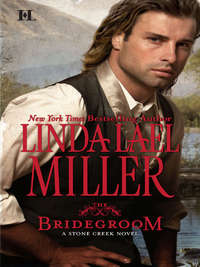
LINDA LAEL MILLER
THE
BRIDEGROOM
A Stone Creek Novel

For my Rebel cousins,
Doris Parker Brooks and Jim and Gladys Lael.
Thank you from the bottom of this ole Yankee heart.
THE
BRIDEGROOM
A Stone Creek Novel
CONTENTS
CHAPTER ONE
CHAPTER TWO
CHAPTER THREE
CHAPTER FOUR
CHAPTER FIVE
CHAPTER SIX
CHAPTER SEVEN
CHAPTER EIGHT
CHAPTER NINE
CHAPTER TEN
CHAPTER ELEVEN
CHAPTER TWELVE
CHAPTER THIRTEEN
CHAPTER FOURTEEN
CHAPTER FIFTEEN
CHAPTER SIXTEEN
CHAPTER SEVENTEEN
CHAPTER EIGHTEEN
CHAPTER NINETEEN
EPILOGUE
CHAPTER ONE
Phoenix, Arizona, summer 1915
EXCEPT FOR THE OLD CODGER huddled on the stool at the far end of the bar and the barkeep, who looked vaguely familiar, Gideon Yarbro had the Golden Horseshoe Saloon to himself, and he liked it that way. Just wanted to drink his beer in peace, wash some of the inevitable sooty grit from the long train ride from Chicago to Phoenix out of his gullet, and gear himself up to travel on to Stone Creek come morning.
His brothers, Rowdy and Wyatt, would be after him to stay on once he got home, settle down, pin on a badge like Rowdy had, or start a ranch, like Wyatt. Get himself married, too, probably, and sire a pack of kids. Both considerably older than Gideon, who was the baby of the family, the former outlaws had left the urge to wander far behind them, long ago. They were happy in their new lives, and for them the lure of the trail was a distant memory.
Not so for Gideon.
One of the things he loved best about his work was that it took him to places he’d never been before. This time, though, it was taking him home.
He sighed, reminded himself that Wyatt and Rowdy meant well. It was just that, being Yarbros, they tended to come on strong with their opinions, and they treated him like a kid brother—emphasis on “kid.”
He was twenty-six, damn it. A man, not a boy.
Gideon reined his musings back in, corralled them in the right-now. Distractions could be lethal for someone in his line of work, and of course trouble tended to strike when a person was thinking about something other than the immediate situation.
Against the far wall, up to its clawed crystal feet in dirty sawdust and peanut shells, the piano gave a ghostly twang, as if one of the wires had snapped. Gideon spared enough of a grin for one corner of his mouth to quirk up, but the face he saw reflected in the streaked and dusty mirror behind the long bar barely registered the change. His dark blond hair was in need of barbering, he noticed, and he’d need a shave, too, if he didn’t want a lot of hectoring from his sisters-in-law, Lark and Sarah, when he showed up in Stone Creek tomorrow.
Again, the piano sounded just the echo of a note, a sort of woeful vibration that trembled in the air for a few moments, along with the tinge of stale cigar smoke and sour beer.
“Damn place is haunted,” the barkeep said, either to everybody in general or nobody in particular. He was a bulky type, balding, with a belly that strained at the buttons of his stained shirt and a marked tendency to sweat, and watching him wipe down glasses with a rag made Gideon wish beer came in bottles. “I swear it’s that piano player that got himself shot in the back last year. Never had no trouble until ole Bill Jessup bit the dust.”
Gideon didn’t acknowledge the remark—he placed little or no stock in tales of spooks and specters—but he recalled the shooting well enough. Rowdy followed such things, being a lawman, and he’d mentioned the incident, in passing, in one of his letters. Mail from home—Stone Creek being the only place Gideon ever thought of in that particular context, and then not with any great degree of sentimentality—was infrequent, and since he moved around a lot in his profession, it generally took some time to catch up to him.
“You want another whiskey there, Horace?” the barkeep asked the old man. He sounded nervous, like he didn’t want to offer, but feared dire consequences if he failed to make the gesture. Not that the leprechaun represented any threat to the bartender; Gideon would bet the shriveled-up little old man wouldn’t have weighed in at more than a hundred pounds if he’d been sopping wet and wearing granite shit-kickers.
And from the looks—and smell—of Horace, he’d gone past “enough” a long time ago, but he grunted, without looking up, and shoved his glass out to be filled again.
The barkeep poured the whiskey, standing back farther than seemed sensible and sweating harder. Gideon took all this in, not because he was interested, but because it was what he did. Working for the Pinkerton Agency after college, and then for Wells Fargo, he’d learned to pay attention to everything going on around him, even in the most ordinary circumstances.
Especially then.
He’d have bet that barkeep hadn’t washed his hands in weeks, let alone taken a bath. Gideon frowned and studied his beer mug more closely, but except for a few smudges and a thumbprint or two, it looked passably clean. He wasn’t back East anymore, he reminded himself, with another slight contortion of his face that might have been accepted as a smile in some quarters. Best get over being so fastidious.
He felt the slight shift in the air even before the doors to the street swung open, a sort of quiver, similar to the throb of the piano strings, but soundless.
Setting his beer mug down, he watched in the mirror as two men came in from the street, single file, both of them the size of grizzly bears raised up on their hind feet.
No, Gideon corrected himself silently, these yahoos would dwarf the average grizzly. Despite the heat—he’d left his own suit coat at the train station, with his bags—they wore the long canvas coats common to gunslingers as well as ordinary ranchers, and both of them carried sidearms, the butts of long-barreled pistols jutting out of the waistbands of their dark woolen pants. Their gazes tracked and found the old man, sliced over to Gideon, sharp as honed knives, then swung back and bored into their target again.
“Monty,” one of them ground out, presumably greeting the barkeep. They’d paused just inside the doors, which were still swinging on their rusted hinges.
Monty gulped audibly, set down the bottle he’d poured the old coot’s drink out of, and took a couple of steps backward. Came up hard against the shelf behind him, with its rows of bottles and glasses. The front of his shirt, damp before, was nearly saturated now, he was perspiring so heavily.
“I only give ole Horace more whiskey ’cause he asked me to,” Monty spouted, as if he’d been challenged on the matter, working up a grimace of a smile that wouldn’t stay put on his face.
Entertained, Gideon suppressed a smile, along with the sigh that came along behind it. When he got to Stone Creek and started his new job—the one he’d lied to Rowdy and Wyatt about in his last letter—such amusements as this one would be few and far between.
He was in the Golden Horseshoe Saloon, he reminded himself, to have a beer, not watch a melodrama—or to participate in one. Still, the fine hairs were standing up on the nape of his neck, and the sixth sense he’d developed working as a detective was in fine form.
“You’d better go on back to the storeroom or the office and check on whatever needs checking on,” the taller of the two men told the barkeep. His voice had a thick, stuffy sound, as if at some point he’d had his head held under water for too long, or hadn’t gotten enough air in the first few minutes after he was born.
It was hard to imagine him as a baby, Gideon thought, amused.
His mama must have been a big woman—or else she’d have split wide-open giving birth to the likes of him.
Monty was only too glad to check on whatever needed checking on—he gave Gideon a look, part warning and part pity, and skedaddled.
Gideon felt no need to reach for the Colt .45 riding low on his left hip, but he did take some comfort in its presence. Straightening, he rolled his shirtsleeves down and fastened the cuffs; and though he knew he appeared to be mainly concerned with emptying his mug, he had a full mirror-reflected view of the room through his eyelashes.
One of the men cleared his throat, though the pair still hadn’t moved from their post just over the threshold. “Ma says supper’s gonna be ready early tonight,” he announced, not exactly cautious in relaying this news, but definitely tentative. “She wants to be at the church on time for the pie social.”
So she had survived childbirth, Gideon thought. Either that or the woman in question was a stepmother. Out West, a lot of men ran through a whole slew of wives, wearing them out with hard work and childbearing and all the rest of it.
Gideon’s own mother had perished giving birth to him.
The old man grunted once more, that being his primary means of communication, apparently, but didn’t turn around or speak an intelligible word. He just drained his glass, made a satisfied sound as the firewater went down and reached for the bottle poor old Monty had left behind on the bar when he fled.
At last, the giants moved again, as one, like Siamese twins with no visible attachment. Strange for sure, that was Gideon’s involuntary assessment.
There were times when he’d rather just ignore goings-on, and this was one of them, but it wasn’t in his nature. He pondered everything, weighed and considered and sorted.
The taller fellow snagged Gideon’s gaze in the saloon mirror. “We don’t want no trouble now, friend,” he said. “We’ve come to take Dad home for supper, that’s all, so we’d be obliged if you didn’t mix in.”
Gideon gave a disinterested nod, waited to see if the old whiskey-swiller would raise an objection to what he’d no doubt regard as a premature departure.
There wasn’t much to him, for all that his sons were big as trees.
Like as not, he’d go along peaceable. Then Gideon would finish his beer, leave payment on the bar, and go on about his business—checking in to the hotel across the street, having some of his gear brought over from the train depot, getting himself shaved and sheared and bathed. He’d stop by the post office, too, in case some mail had straggled in since the last time he’d passed through Phoenix.
The brothers positioned themselves on either side of the bar stool, set their feet as if they meant to put down roots right through the sawdust and the plank floor beneath, exchanged wary glances, and simultaneously cleared their throats.
“Get on home,” the old man croaked, thereby proving he possessed a vocabulary after all, however limited, though he didn’t look at either one of them. All his attention seemed to be fixed on the bottom of that whiskey glass, Gideon observed, as if there was some kind of scene being played out there. “Tell your ma I’ll be along when I’m damn good and ready, and not before.”
“She said we’d better not come home without you if we know what’s good for us,” the smaller brother said gravely. “And you know we’ve got to mind, lest Ma lose her temper.”
With that, and another glance at each other, the brothers closed in and took hold of the old man’s arms.
And that was when all hell broke loose.
Dear old Dad turned into a human buzz saw, all jagged edges, ripping into the air itself, and practically throwing off blue sparks. He kicked and twisted and punched, spitting out oaths and cusswords that even Gideon, raised in the back of a saloon in Flagstaff, had never heard.
The brothers had all they could do to contain their pa, and the three of them tangled all the way across the saloon floor to the doors, a blur of fists and flying coattails and swearwords that sizzled like water flung onto a hot griddle.
Gideon pushed back from the bar, walked to the swinging doors, stopped their wild swaying with both hands. Watched over the top as old Horace’s sons flung him into the back of a buckboard by his suspenders, like a bale of hay by the twine. One of them scrambled up to take the reins, while the other climbed into the wagon-bed to hold the old man down with both hands.
And that took some doing, all by itself.
“Are they gone?” Monty asked tentatively, from somewhere behind Gideon.
Gideon turned, saw the bartender back at his post, but poised to hit the floor or make another dash for safety if Dad and the boys chanced to return.
“On their way home to supper,” Gideon said. “Looks like Ma will be right on time for the pie social.”
With that, he plucked a coin from the pocket of his tailored vest, walked over to the bar and laid it down.
“I don’t believe I caught your name,” Monty said, after swiping the coin off the bar with one paw.
“I don’t believe I gave it,” Gideon replied.
Monty narrowed his eyes, and recognition dawned, though Gideon had hoped it wouldn’t. His kinfolk were well-known in Phoenix, since it was only about a day’s ride from Stone Creek, and Rowdy, along with his best friend, Sam O’Ballivan, often had business there. As a boy, Gideon had accompanied them once or twice.
“You’re that Yarbro kid, aren’t you? The marshal’s little brother. I used to work in one of the saloons up there in Stone Creek, and I recollect that you took a bullet at a dance one night, trying to catch hold of some fool that rode a horse right into the Cattlemen’s Meeting Hall.”
As always, the word kid made Gideon bristle, way down deep where it didn’t show, and being over six feet tall, he didn’t consider himself anybody’s “little” anything, but he was feeling charitable after the beer, and somewhat resigned, so he let the comment pass.
“Yep,” he said simply, turning to leave.
“That Chink sawbones fixed you up,” Monty prattled on. Maybe it was nerves, considering the scuffle just past, but he’d sure turned talkative. “Wouldn’t have given spit for your chances, but he pulled you through with his needles and poultices.”
That Chink. The term stuck under Gideon’s hide like a cactus needle.
“He saved my life,” Gideon said stiffly, “and the life of somebody I cared about.” Lydia Fairmont had been the other patient, he recalled, eight years old and one of Lark’s students. Rowdy’s wife had been the schoolmarm up at Stone Creek back then, and had taken the neglected child under her wing. Where was Lydia now? Maybe Lark would know. “And his name was Hon Sing.”
Monty hastened after him, came all the way to the sidewalk. “I didn’t mean no disrespect, Mr. Yarbro,” he prattled. “I truly did not set out to offend.”
Hon Sing, along with his wife, Mai Lei, had gone back to China, after inheriting the old Porter house and eventually selling it at a high profit, once copper was discovered in the foothills rimming the still-small town.
And that copper mine was the reason Gideon had been sent to Stone Creek. There was a strike brewing, and his job was to see that it didn’t happen.
He made no response to the bartender’s apology, beyond a cursory nod. Turning his mind to other things, he crossed the street, wending his way between horses and buggies and slow-moving wagons headed in opposite directions. The Desert Oasis Hotel offered some attractive amenities, including hot and cold running water, a decent restaurant and its own barbershop.
The lobby was opulent by Western standards, with carpets on the floors, leather sofas and copious potted palms.
Gideon registered for a room on the second floor and sent the hotel’s sweep-up man—a boy, really—back to the depot for his suitcase. Climbing the broad staircase, intending to put the tub in his room to immediate use, he wondered again, now that she’d staked out a place in his thoughts, how little Lydia Fairmont was faring. She’d be an adult now, since ten years had passed, and maybe not so little anymore, either, he reflected with a smile. She was probably married—even at eight, with her silvery-fair hair and violet-blue eyes, she’d shown the promise of growing into a very fetching woman one day.
Gideon’s smile slipped a little as he took out his key and let himself into the room. Lydia, grown up, with a husband and children? For some reason, the idea didn’t set well with him.
It was because she was delicate, he told himself. Too fragile, surely, to be bearing some man’s babies, or chopping wood, or any of the thousand other hard tasks a wife was called upon to do.
He pushed the recollection of Lydia Fairmont to the back of his mind.
In Stone Creek, he’d have plenty to occupy his thoughts, between Rowdy and Wyatt and their families and the work he’d be doing at the Copper Crown Mine. He’d told plenty of lies as it was, and he’d have to tell more before it was over. Keeping track of them, so his story stayed straight and his brothers didn’t figure out his real reason for coming back home, would be as much as he could manage.
Anyhow, there was no place in his plans for a woman—at least, not the kind Lydia had surely turned out to be.
LYDIA’S TWO GREAT-AUNTS, Mittie and Millie, spinsters the pair of them and both in their late sixties, twittered like schoolgirls as they peered through the tall, narrow windows on either side of the front door.
A loud chugging sound came from the street, along with an ominous bang that caused Lydia, lurking unnoticed in the doorway to the main parlor, to start slightly.
“Here he comes now,” Mittie enthused, under her breath.
“Too bad he’s so fat and old and homely,” Millie lamented. “Our Lydia requires a handsome husband, one who’ll give her lots of children.”
“Hush,” Mittie scolded, in a whisper. “Lydia will hear you! And for the life of me, I can’t think why she would turn up her nose at a man like Jacob Fitch. He might be portly and of a certain age, and I’ll even concede that he’s not much to look at. But he’s rich and he owns an automobile.”
Lydia, carefully trained, since she’d been brought to this imposing house as an eight-year-old orphan, in many things, not the least of which was the wholesale impropriety of eavesdropping, cleared her throat delicately in order to make her presence known.
Both aunts blushed prettily when they turned to face her.
“Mr. Fitch has arrived,” Millie announced, recovering first. Like Mittie, she was small, almost doll-like, with the near-purple eyes that were the pride of the Fairmont line. As young women, the sisters had been breathtakingly beautiful, as their portraits attested. According to Helga, the housekeeper, Millie had loved a Confederate major, Mittie, a Union captain. Both men had been killed in the line of duty.
Word of the deaths had arrived on the same day, the legend went, and the aunts had worn mourning gowns ever since. Now, they contented themselves with the ups and downs of other people’s romances, especially their only niece’s.
If indeed the arrangement between Lydia and Mr. Fitch could be called a romance. It certainly didn’t feel like one to her.
“Let’s go and make tea,” Mittie said, snatching Millie by the puffed sleeve of her sad black dress and dragging her past Lydia, in the direction of the kitchen.
Lydia suppressed an urge to flee, or beg her aunts to tell Mr. Fitch she was indisposed—anything to avoid receiving the man and passing an interminable hour of “courting” in the parlor.
But, like eavesdropping, lying to evade one’s social obligations was not considered proper—and Lydia placed a great deal of importance on propriety.
As always, Fitch pounded at the front door, foregoing the bell, with its pleasant, jingly little ring.
Lydia smoothed her lavender dress, laid out for her that morning by Helga, because it matched her eyes. That, of course, had been before Mr. Fitch had sent his calling card ahead to announce an impending visit.
She dredged up another smile—it took considerably more effort this time—and went to open the door.
The man Lydia was to marry the following afternoon stood impatiently on the verandah, his motoring goggles pushed up onto his forehead in a way that was probably meant to appear jaunty, but instead gave him the look of a very plump bullfrog. He was covered in road dust—Mr. Fitch did love his automobile and was constantly racing along the dry and rutted roads of Phoenix at speeds of up to twenty miles an hour.
Often, he insisted that Lydia accompany him.
Now, he clutched a bouquet of wilting flowers, probably purloined from some neighbor’s water-starved garden, in his left hand. “Good afternoon, Lydia,” he said.
“Mr. Fitch,” Lydia acknowledged, with a coolness she couldn’t quite hide.
His small, too-watchful eyes swept over her. “You’re not dressed for the road,” he pointed out, his tone mildly critical. “Any wife of mine will always be prepared to go driving.”
Any wife of mine…
Lydia managed not to shudder, though the smile she’d put on—if it was a smile and not the death grimace it felt like—wobbled on her mouth. “It’s such a hot day,” she said. “I was hoping we could stay inside.” And I’m not your wife, Jacob Fitch. Not yet, anyway. Not until tomorrow.
Mr. Fitch trundled past her, into the house, nearly stomping on her toes. “Honestly, Lydia, this delicacy of yours is bothersome. Any wife—”
Lydia closed the door smartly behind him, cutting off the rest of his sentence. She was not delicate, had not been seriously ill since she was a child, though admittedly her appearance made her seem fragile. Like her great-aunts, she was small-boned, though at five feet two inches, she was taller than Mittie and Millie, and she did have a nice bosom.
Protesting that she was as healthy as anyone, however much she wanted to do just that, would serve no purpose. Jacob Fitch did not listen to anything she said, unless, of course, it was precisely what he wanted to hear.
He fairly shoved the flowers at her.
Lydia took them, and her heart turned over at their thirsty state. “I’ll just put these in water,” she said brightly. “Do sit down in the parlor, Mr. Fitch, and make yourself at home. I’ll only be a minute.”
Fitch tilted his head back, admired the high, frescoed ceilings, fading now, but still finely crafted. The huge crystal chandelier glittered, though unlit—at night, powered by gas, it glowed, and even after all these years, it seemed magical to Lydia.
A faint smile touched Mr. Fitch’s narrow lips. “The old place could use a man’s touch,” he said huskily, letting his gaze drift slowly to Lydia, then over her, like a spill of something viscous. No doubt he was anticipating their wedding night. “And so could you.”
Again, Lydia managed not to shudder, but just barely.
The thought of Jacob Fitch putting his hands to that lovely old house, much less to her naked body, made the pit of her stomach drop, as if from a great height.
Overcome with a flash of pure dread, she turned on one heel, biting her lower lip, and fled to the kitchen. Oh, to go right on through, out the back door, down the alley to—
To where?
She had no place to go.
No one to turn to.
Months ago, in a fit of panic, she’d sent off the letter, the one Gideon Yarbro had written to himself in case she ever needed to send it—Please come and get me right away, was all it said—when she was a little girl, recovering from pneumonia and the loss of her father. But there had been no reply, of course.
There wouldn’t have been, though, would there? Gideon, a mere boy at the time, anxious to reassure her, had scratched out that single line in penciled letters, sealed the envelope, addressed it to: Gideon Rhodes, Deputy Marshal, General Delivery, Stone Creek, Arizona Territory. Heaven knew where he was now, after a decade—he’d been bound for college that year, so it was unlikely that he was still the deputy marshal up at Stone Creek. And Arizona wasn’t even a territory anymore, it was the forty-eighth state.
These and other equally hopeless thoughts tumbled in Lydia’s mind as she ignored Helga’s penetrating gaze and filled a vase with cool water for the fading flowers. Now, she simply felt foolish for adding postage to that very old letter and dropping it through the slot down at the post office. She blushed to imagine it actually reaching Gideon—especially at this late date—and silently prayed that it had gone astray.
And yet it was her one hope, that letter.
“Why don’t you just tell Jacob Fitch to get back into that smoke-belching horseless carriage of his,” Helga, never one to withhold advice, asked intractably, “and drive himself straight off the nearest mesa?”
Helga’s disapproval of Mr. Fitch was of long standing, and so was her opinion of the automobile. One of the first such machines to appear in Phoenix, a point of pride with Jacob, the vehicle, with its constant sputtering and backfiring, frightened old Mrs. Riley’s chickens so badly they wouldn’t lay. Helga had laid the fault for more than one skimpy breakfast at Mr. Fitch’s door.
“You know I can’t,” Lydia said softly, taking longer than necessary to attend to the flowers.
Helga had been running the household for years—only Mr. Evans, the late butler and sometime carriage driver, had worked for the family longer—and she felt free to express herself on any and all matters concerning the Fairmonts. “Miss Nell,” the sturdy middle-aged woman said implacably, “must be rolling over in her grave. You, the last hope of the family, marrying that old—”
Tears stung Lydia’s eyes, and she sniffled once, raised her chin, the way she always did when a weeping spell threatened. Nell Baker, her father’s only sister, had come to fetch her up at Stone Creek after Papa’s death in a blizzard, thereby saving her from two equally frightening alternatives: being sent to an orphanage, or left in the care of her selfish, slatternly stepmother, Mabel. Nell had raised Lydia, with help from Helga, Evans and the great-aunts, hired private tutors because the local schools did not meet her standards, clothed and fed Lydia, allowed her to keep stray cats, bought her watercolor paints and fine brushes at the first indication of talent.
Most of all, Nell, a childless widow herself, had loved her.
Aunt Nell had passed on suddenly, the previous year, and Lydia still felt the loss like a nerve laid bare to a winter chill.
“I’ll tell him for you,” Helga said, in an almost desperate whisper, when Lydia didn’t reply to her suggestion. “I’ll send him packing, once and for all, and good riddance!”
Lydia, having forced herself to start toward the parlor, where Mr. Fitch was waiting, closed her eyes. They’d had this discussion before—Helga knew full well that most of the Fairmont money was gone. The house would soon follow, since it was heavily mortgaged. And while both Lydia and Helga would be fine if that occurred—eventually, anyway—what would happen to the great-aunts?
Phoenix had been a mere crossroads when Mittie and Millie had come to the Arizona Territory with their widowed father, Judge William Fairmont, after Union troops had burned their Virginia plantation, fields, house and outbuildings, during the war. This house, originally only three rooms, but enlarged as the Judge prospered and then grew even richer than he’d been in Virginia, was their haven, a sanctuary in a world that had already proved itself violent and harsh. Every corner, every nook, held some precious memory.
Except for church services on Sundays, the aunts never ventured farther than the garden out back.
“You must stay out of this, Helga,” Lydia said, after swallowing and without turning around.
“You could marry any man in this town!” Helga argued.
There was some truth in that assertion, Lydia supposed, but none of the men who’d offered for her had Jacob Fitch’s money, or his power. None of them could save the big stone house and its cherished furnishings, each one with a story attached. And none of them would be willing to provide houseroom to two very old ladies who still suffered from fiery nightmares and woke up screaming that the Yankees had come.
Mr. Fitch, the only son of an elderly mother, had already promised that Lydia, the aunts and Helga could all stay right here under this roof. On their wedding day—dear God, tomorrow—he would pay off any outstanding debts and declare the mortgage, held by his bank, paid in full—he had given Lydia his word on that. Even had documents prepared, so stating.
All Lydia had to do was marry him.
When she could sign “Lydia Fairmont Fitch” on the appropriate lines of the papers Jacob’s lawyers had drawn up, the aunts and their memories would be safe.
Again, Lydia thought of the letter she’d mailed off to Gideon in a fit of panic, and something rose into her throat and fluttered there, like a trapped bird.
Even supposing Gideon would be willing to help her, what could he possibly do?
Nothing, that was what.
She had to stop this incessant spinning back and forth between hope and despair.
Gideon wasn’t coming to her rescue, like some prince in a storybook.
No one was.
Tomorrow afternoon at two o’clock, wearing Aunt Nell’s altered wedding gown, she would stand up beside Jacob Fitch in front of the cold fireplace in the formal parlor in that burden of a house and vow to love, honor and obey the husband she didn’t want.
“Lydia?” Helga whispered miserably. “Please. You mustn’t be hasty—”
“The decision,” Lydia said, for Helga’s benefit and for her own, “has been made, Helga, and there will be no further discussion.”
With that, Lydia left the kitchen, the vase containing Jacob’s flowers shaking in her hands, fit to slip and shatter into a million fragments.
BECAUSE GIDEON PASSED THROUGH Phoenix at least once a year, he kept a postal box there, as he did in several cities around the country. That afternoon, shaven and barbered and bathed, he stuck the appropriate key in the lock and opened the heavy brass door, stooped a little to peer inside. Straightened as he removed the usual printed sales fliers and outdated periodicals.
Throwing these things away in a small barrel provided for the purpose, he nearly missed the thin, time-tattered envelope tucked in among them.
The letter had been forwarded numerous times, but beneath the cross-outs and travel stains, Gideon saw his own youthful handwriting, nearly faded to invisibility.
Gideon Rhodes, Deputy Marshal
General Delivery
Stone Creek, Arizona Territory
For a few moments, Gideon’s surroundings faded away, and he was back in Mrs. Porter’s kitchen up in Stone Creek, handing the letter to a wide-eyed, frightened child.
He heard his own voice, as if he’d just spoken the words of the promise he’d made that long-ago winter day.
“…if you ever have any trouble with anybody, all you’ll have to do is mail the letter. Soon as I get it, I’ll be coming for you….”
CHAPTER TWO
HAVING COME DOWN WITH A SICK headache five minutes after joining Mr. Fitch in the parlor, Lydia had nonetheless soldiered through the ordeal. The instant her future husband had departed, however, she’d retreated to her room upstairs and collapsed onto the bed without even removing her shoes.
She was still lying there, staring up at the shifting ceiling-shadows cast by the branches of the white oak outside her window, when a light rap sounded at the door, and Mittie poked her head in without waiting for a “Come in.”
This in itself was highly unusual; although they were window-peekers, the aunts never entered Lydia’s “bedchamber,” as they called it, without permission. Given their old-fashioned sensibilities, they were probably terrified of accidentally catching her in a state of undress.
But here was Mittie, with her aureole of snow-white hair gleaming fit to hurt Lydia’s eyes in the dazzle of late-afternoon sunshine, and her faced glowed with something very like wonder. She looked downright…transfigured.
An aftereffect of the headache, Lydia thought, sitting up. They often affected her vision. Now, however, the worst of her malady had passed, and Aunt Nell’s kindly but firm voice echoed in her mind. Mustn’t shirk our duties, Lydia. After all, we are Fairmonts.
Was it already time to help Helga set the table for supper?
Mittie, fairly bursting with news, continued to shine as brightly as if she’d climbed a ladder into a night sky and gobbled the moon down whole, like one of the small, sweet biscuits she enjoyed every afternoon with her tea.
Finally, breathless with excitement, the old woman could not contain the announcement any longer. “You have a caller!” she bubbled. “A gentleman caller.”
Lydia frowned as the faint pounding beneath her temples began again. “Mr. Fitch is back?”
“No,” Millie blurted, appearing just behind Mittie, popping her head up over her taller sister’s right shoulder, then her left. “This man is handsome!”
“He doesn’t have an automobile, however,” Mittie pointed out, sobering a little. “And while his clothes are certainly well fitted, I doubt he’s at all rich.”
“Who on earth—?” Lydia muttered, stooping to glance into the mirror on her vanity table and assess the state of her hair.
A few pats of her hands set it right.
And neither Mittie nor Millie said a word.
They simply stood there, in the doorway, gaping at her as though she’d changed somehow, since they’d seen her last.
“Is there a calling card?” Lydia prodded, staring back.
Neither answered.
Lydia tried again. “Did he at least give his name, then?”
“He did,” Millie said, her nearly translucent cheeks blushing pink, “but I’m afraid I was so taken aback by his resemblance to dear Major Bentley Alexander Willmington the Third that it has completely escaped me.”
At this, Mittie bristled. “He does not resemble the major, sister. He is the image of my own Captain Phillip Stanhope.”
Millie straightened her narrow shoulders. “You refer, of course,” she replied stiffly, “to that traitor to the Southern cause?”
“Captain Stanhope was not a traitor, Millicent Fairmont! He was a man of principle who could not abide the Peculiar Institution—”
“Ladies,” Lydia interceded, hoping to head off another of the sisters’ rare but spirited battles. The term Peculiar Institution referred to slavery, and with her marriage to Mr. Fitch fast approaching, Lydia found the subject even more abhorrent than usual. “Whoever this man is, I’m sure he looks exactly like himself and no one else.”
As she swept toward the door, forcing her aunts to part for her like small waves on a sea of time-faded ebony bombazine, Lydia’s response echoed uncomfortably in her fogged brain.
She was only eighteen, and already she was starting to sound just like Mittie and Millie.
If the mysterious caller turned out to be a bill collector, as she suspected he would, she would simply inform him that, as of tomorrow, all claims should be referred to her husband, founder and president of the First Territorial Bank. There were, after all, a few consolations attached to her forthcoming marriage.
The aunts crept along behind Lydia as she descended the stairs, calling upon all the dignity she possessed. After today, she would not have to deal with visits like this one.
“He’s in the parlor!” Mittie piped, in a voice sure to carry far and wide. Like Millie, she was midway down the stairs, clinging to the rail, as eager-faced as a child about to open gifts on Christmas morning.
Lydia put a finger to her lips and tried to look just stern enough to silence them, but not so stern as to make them cry.
She could not bear it when the aunts cried.
Reaching the entryway, Lydia drew a deep breath. Then, after straightening her skirts and squaring her shoulders, she marched through the wide doorway and into the parlor—and nearly fainted dead away.
Gideon rose out of the Judge’s leather chair—no one, not even Jacob, sat in that chair—and regarded her with a pensive smile, his handsome head cocked slightly to one side.
“You look all right to me,” he said.
Lydia was so stunned, she could not manage a single word.
Gideon pulled an all-too-familiar envelope from the pocket of his shirt, held it up. Her letter.
“It finally reached me,” he told her quietly. “I don’t go by ‘Rhodes’ anymore—that was my brother Rowdy’s alias, and I borrowed it for a while. But my last name is ‘Yarbro.’”
He seemed to be waiting for some reaction to that.
Flustered, Lydia croaked out, “Do sit down, Gid—Mr. Yarbro.”
He grinned. She remembered that grin, slanted and spare. It had made her eight-year-old heart flitter, and that hadn’t changed, except that now the reaction was stronger, and ventured beyond her chest.
“Not until you do,” Gideon said, his green eyes twinkling a little for all their serious regard.
Lydia crossed the room and sank into her aunt Nell’s reading chair, grateful that her wobbly knees had carried her even that far.
Once she was seated, Gideon sat, too.
“The letter?” Gideon prompted, when Lydia didn’t speak right away.
Lydia felt her neck heat, and then her face. If only the floor would open and Aunt Nell’s chair would drop right through, and her with it. “It must have been sent by accident, Mr. Yarbro, and you must pay it no heed,” she said, in a rush of words. “No heed at all—”
Lydia stopped herself from prattling with a determined gulp. What was the matter with her? First, she hadn’t been able to utter a syllable, she’d been so thunderstruck, and now she was inclined to chatter senselessly.
“Gideon,” he said, very solemnly, his eyes still watchful.
“I beg your pardon?” It took all the force of will Lydia possessed not to squirm in her chair.
“Call me Gideon, not Mr. Yarbro.” He leaned forward, easy in the imposing chair, easy in his skin. Rested his elbows on his thighs and looked deep inside Lydia, or so it seemed. His probing gaze made her feel uncomfortable, intrigued, and almost naked, all of a piece. “You sent the letter, Lydia,” he reminded her, “and I don’t believe it was an accident.”
“She’s getting married tomorrow,” Helga proclaimed loudly from the parlor doorway, a herald in a plain dress, apron and mobcap. All she lacked, in Lydia’s fitfully distracted opinion, was a long brass horn with a banner hanging from it and velvet shoes with curled toes. “To a man she hates.”
Lydia’s face throbbed with mortification. “Helga,” she said firmly, “I do not hate Jacob Fitch, and you are overstepping—again. Kindly return to the kitchen and attend to your own affairs.”
Helga didn’t obey—she never did—and the aunts stayed, too, hovering behind the housekeeper, all aflutter.
“All right,” Helga conceded, “perhaps you don’t actually hate Fitch, but you certainly aren’t in love with him, either!”
Lydia’s humiliation was now complete.
Gideon rose from his chair, crossed the room, and spoke so quietly to the women clustered in the doorway that Lydia couldn’t make out his words. Miraculously, the avid trio subsided, and Gideon closed the great doors in their faces.
Lydia sat rigid, and squeezed her eyes shut.
She didn’t hear Gideon approaching her, and when his hand came to rest on her shoulder, she started, gave a little gasp. It wasn’t so much surprise that had made her jump, she realized, horrified, but the strange, sultry charge Gideon’s touch sent coursing through her entire system.
“Open your eyes, Lydia,” he said. “Look at me.”
He was crouched beside her chair now, his green gaze searching her face, missing nothing, uncovering secrets she’d kept even from herself.
Or so it seemed.
“It’s really a misunderstanding,” she whispered, trying to smile.
Gideon took her hand. Squeezed it gently. “Stop lying to me,” he said, his voice husky and very quiet. “Who is this Jacob Fitch yahoo, and why are you getting married to him if you don’t love the man?”
Lydia swallowed, made herself look directly at Gideon. She forced out her answer. “I have my reasons.”
“And those reasons are…?”
Tears blurred Lydia’s vision; she tried to blink them away. “What does it matter, Gideon? I have no choice—that’s all the explanation I can give you.”
He straightened, reluctantly let go of her hand, went to stand facing the marble fireplace, his back turned to her. Looked up at the life-size portrait of the Judge looming above the mantel, dominating the entire room, big as it was.
At least, Lydia’s great-grandfather’s painted countenance had dominated the room, seeming so real that she’d swear she’d seen it breathing—until Gideon Yarbro’s arrival.
“There are always choices, Lydia,” Gideon said gruffly. “Always.”
He turned around, leaned back against the intricately chiseled face of the fireplace, folded his arms. His shoulders were broad, under his fresh white shirt, and his butternut-colored hair, though still slightly too long, had been cut recently…
She gave herself a little shake. Why was she noticing these things?
Lydia sat up a little straighter in her chair. Maybe there were “always choices,” as Gideon maintained, but in her case, all the alternatives were even worse than the prospect of becoming Mrs. Jacob Fitch.
The aunts, fashionably impoverished now, would become charity cases. Their cherished belongings would be sold at auction, pawed through and carried away by strangers.
And she herself, with no means of earning a living, might be reduced to serving drinks in one of Phoenix’s overabundance of saloons—or worse.
No, she would marry Mr. Fitch.
The following afternoon, at two o’clock, she’d be standing, swathed in silk and antique lace, almost where Gideon was standing now, with Jacob beside her and his termagant of a mother looking on from nearby, while a justice of the peace mumbled the words that would bind Lydia like ropes, for the rest of her life.
“Lydia,” Gideon said firmly, sending her thoughts scattering like chickens suddenly overshadowed by the wingspan of a diving hawk. “Talk to me.”
“I’ll lose this house if I don’t marry Mr. Fitch,” Lydia heard herself say. “The aunts—you saw them, they’re ancient—will be displaced—no, destitute. It doesn’t—it doesn’t bear thinking about.”
Gideon tilted his head back, scanning the high ceiling, with its hand-carved moldings and thousands of tiny inlaid seashells imported from some faraway ocean.
Lydia wished she could magically transport herself to that ocean. Jump in and sink beneath its waves and never be seen again.
But, alas, there she remained, in that august parlor, in the middle of dry and dusty Phoenix, with no handy place to drown.
“It’s a fine house,” Gideon allowed. “But it’s only a house. And your aunts would adapt to new surroundings. People do, you know—adapt, I mean.”
Lydia stood up abruptly, found that her knees were still quite unreliable, and dropped back into her chair again. “You don’t understand,” she protested weakly.
Gideon’s handsome face hardened a little. “I’m afraid I do,” he answered. “You’re willing to sell yourself, Lydia. And the price is a house. It’s a bad bargain—you’re worth so much more.”
His statement stung its way through Lydia, a dose of harsh medicine.
But then a strange, twittering little laugh escaped her, as she remembered just how hopeless her situation truly was.
Would the embarrassment never end? Again, she found that she could not look at Gideon, could not expose herself to the expression she’d surely catch on his face if she did. “Just forget the letter, Gideon,” she said. “I’m sorry if I inconvenienced you, made you go out of your way, but, really, truly, I—”
“I can’t,” Gideon broke in. “I can’t ‘just forget the letter,’ Lydia. Our agreement was that you’d send it if you were in trouble, and I know you are. In trouble, that is.” He paused. “And I just accused you of selling yourself. Did you miss that? Most women would have slapped my face, but you didn’t even get out of your chair.”
Lydia didn’t trust herself to answer.
Gideon strode across the room again, bent over her, his hands gripping the arms of her chair, effectively trapping her between his arms.
“There’s nothing you can do to help,” Lydia nearly whispered. She simply couldn’t lie anymore. Nor could she meet his eyes, though the sunlight-and-shaving-cream scent of him filled her nose, and invaded all her other senses, too, and made her dizzy. “Please, Gideon—just go.”
He didn’t move. His voice was a rumble, low and rough, like thunder on the distant horizon. “I’m not going anywhere—except maybe to find your bridegroom and tell him the wedding is off.”
Lydia flinched, her gaze rising to collide with Gideon’s now. “You mustn’t do that!” she cried, aghast at the prospect. “Gideon, you mustn’t! This house, my aunts—”
“Damn this house,” Gideon growled, backing up now, but just far enough to take hold of Lydia’s shoulders and pull her to her feet. “You are not marrying a man you don’t love!”
At last, Lydia dredged up some pride. Lies hadn’t worked. Neither had the truth. Bravado was all that was left to her. “You can’t stop me,” she said fiercely.
She saw his eyes narrow, and his jawline harden.
“Yes, I can,” he ground out.
“How?” Lydia challenged.
And that was when he did the unthinkable.
He kissed her, and not gently, the way a friend might do. No, Gideon Yarbro kissed her hard, as a lover would, slamming his mouth down on hers—and instinctively, she parted her lips. Felt the kiss deepen in ways she’d only been able to imagine before that moment.
That dreadful, wonderful, life-altering moment.
Gideon drew back too soon, and Lydia stood there trembling, as shaken as if he’d taken her, actually made her his own, right there in the parlor, both of them standing up and fully clothed.
“It won’t be like that when he kisses you,” Gideon said, after a very long time. Then he let go of her shoulders, he turned, and he walked away. He opened the parlor doors and strode through to the foyer, then banged out of the house.
Lydia couldn’t move, not to follow, not to sit down, not even to collapse. She simply could not move.
Damn Gideon Yarbro, she thought. Damn him to the depths of perdition. He’d ruined everything—by being right.
Jacob Fitch would never kiss her the way Gideon had, never send thrills of terrible, spectacular need jolting through her like stray shards of lightning. No, never again would she feel what she had before, during and after Gideon’s mouth landed on hers. In some inexplicable way, it was as though he’d claimed her, conquered her so completely and so thoroughly that she could never belong to Jacob, or any other man, as long as she lived.
Gideon had aroused a consuming desire within Lydia, simply by kissing her, and simultaneously satisfied that desire. But—and this was the cruelest part of all—that sweet, brief, soul-drenching satisfaction had shown her what a man’s attentions—one certain man’s attentions—could be like.
He’d left her wanting more of what she could never have—and for that, she very nearly hated him.
The aunts and Helga rushed into the room, like a talcum-scented wind, pressing in around Lydia, so close she nearly flailed her arms at them, the way she would at a flock of frenzied, pecking crows.
“You look ghastly!” one of the aunts cried, sounding delighted.
“Do sit down,” begged the other.
“Glory be,” Helga exalted, throwing up her hands like someone who’d just found religion. “That man kissed you like a woman ought to be kissed!”
Lydia recovered enough to sweep all three women up in one scathing glance. “Were you peeking through the keyhole?” she demanded. It was as if another, stronger self had surged to the fore, pushed aside the old, beleaguered Lydia, taken over.
That self was a wanton hussy, mad enough to spit fire.
And not about to sit down, whether she looked “ghastly” or not.
“Helga was,” Mittie said righteously. “Millie and I would never do any such thing. It wouldn’t be genteel.”
“To hell with ‘genteel,’” Helga said joyously. “He might as well have laid you down and had you good and proper as to kiss you like that!”
Mittie and Millie gasped and put their hands to their mouths.
Even the wanton hussy was a little shocked.
“Helga!” Lydia erupted, her face on fire.
“Such talk,” Mittie clucked, shaking her head.
“Major Bentley Alexander Willmington the Third used to whisper naughty things in my ear,” Millie confessed, succumbing to a dreamy reverie, “while we were rocking on the porch swing of an evening. Papa would have had him horsewhipped if he’d known.”
“Millicent!” Mittie scolded.
Helga laughed out loud. “Glory be,” she repeated, turning to leave the room. “Glory be!”
“You don’t understand,” Lydia said, for the second time that afternoon. The wanton hussy had suddenly vanished, leaving the fearful, reluctant bride in her place, virginal and wobbly lipped and tearful. “Gideon accused me of—he left here in a rage—” She began to cry. “He’s never coming back.”
“You’re a damn fool if you think that,” Helga answered, from the doorway. “He’ll be back here, all right, and in plenty of time to put a stop to this wedding foolishness, too.”
“You didn’t see—he was furious—”
“I saw him,” Helga countered, more circumspectly now that the glory bes had subsided. “He nearly knocked me down, storming through this doorway like he did. No denying that he’s fighting mad, either. But he’ll be back just the same. You mark my words, Lydia Fairmont. He’ll be back.”
The prospect made Lydia feel both hope and fear, as hopelessly tangled as the mess of embroidery floss in the bottom of her sewing basket.
Mittie, now solicitous, patted her arm. “Has your headache returned, dear?” she asked. “You really do look dreadful. Perhaps you should lie down, and Helga will bring you your supper in bed—”
“I will not serve Miss Lydia’s supper in bed!” Helga shouted, already halfway to the kitchen, from the sound of her voice. “She’s not an invalid—so just forget that nonsense, all of you!”
Mittie, Millie and Lydia all looked at each other.
“I think Helga has grown a mite obstinate,” Mittie confided, wide-eyed.
“Papa would never have tolerated such insolence,” Millie observed, but her expression was fond as she gazed toward the space Helga had occupied in the parlor doorway.
“Oh, for heaven’s sake,” Lydia snapped. “Have neither of you noticed, in all these years, that Helga not only manages the household, she manages us?”
“Perhaps we should send her packing,” Mittie said, tears forming in her eyes at the very idea.
“Show her the road,” Millie agreed, crying, too.
“She’s not going anywhere,” Lydia told her aunts, softening at their obvious dismay. “You’re not, either, and neither am I.”
Mittie sniffled. “We’re not?”
“No,” Lydia assured her, slipping an arm around each of her aunts’ shoulders.
No, echoed a voice deep within her heart, with sorrow and certainty. Because Gideon Yarbro or no Gideon Yarbro, tomorrow afternoon, at two o’clock sharp, you’re going to do your duty as a Fairmont and marry Jacob Fitch.
Lydia lifted her eyes to the Judge’s portrait, glaring down at her from above the fireplace.
Sure as sunrise, he was breathing.
THE FIRST THING GIDEON had to do was talk himself out of going back to the Golden Horseshoe Saloon and swilling whiskey—forget beer—until he stopped thinking about Lydia Fairmont.
The second thing was track down Jacob Fitch.
That was easier. He asked about Fitch on the street, and was directed to the First Territorial Bank, right on Main Street.
Still full of that strange fury Lydia had stirred in him, Gideon strode into that bank as though he meant to hold it up at gunpoint, and the few customers inside actually fled as he approached the counter.
The clerk, apparently alone in the place, looked as though he might drop right to the floor and cover his head with both hands.
Gideon slapped his palms down on the counter top. “I want to see Jacob Fitch,” he said. “Now.”
The clerk, a small man with a twitch under his right eye and a nose that wriggled like a rabbit’s, blinked behind his thick spectacles. “Well,” he said tremulously, “you can’t.”
“Why not?” Gideon demanded, not to be put off.
“Because he’s not here,” the clerk retorted, getting braver. “He’s at the tailor’s, being fitted for his wedding suit.”
“And which tailor would Mr. Jacob Fitch be patronizing?” Gideon asked.
“I don’t have to tell you that,” the clerk said.
Gideon reached over the counter, got the little man by his shirt front, and pulled him clear off his no doubt tiny feet. He didn’t normally handle people, at least not ones that were smaller than he was, but he was in a state and nothing would do him but finding Jacob Fitch. “Which tailor?” he repeated. Then, realizing the man couldn’t answer because he was being choked, Gideon slackened his grip just enough to allow the fellow to suck in some wind.
“Feinstein’s,” the clerk sputtered. “On Third Street.”
Gideon allowed the man to slide back to his feet. “Thank you,” he said moderately, and left the bank.
He found the tailoring establishment right where the clerk had said it would be. Mindful of the stir he’d caused in the bank—and regretting it a little—Gideon paused on the sidewalk out front to draw a deep, slow breath. He read and reread the golden script printed on the pristine display window—Arthur Feinstein, Purveyor of Fine Men’s Wear—even examined the three-piece suit gracing a faceless mannequin, as though he might be in the market for new duds.
When he thought he could behave himself, Gideon pushed open the door and went into the shop.
A little bell jingled overhead.
The place seemed deserted, a development that threatened Gideon’s carefully cultivated equanimity.
“Anybody home?” he called. You could take the boy out of Stone Creek, he reflected, but you couldn’t take Stone Creek out of the boy.
A bald head appeared between two curtains at the back of the store. “I’ll be with you right away, sir,” the man said, speaking clearly despite the row of pins glimmering between his lips.
Mr. Feinstein, no doubt. Purveyor of fine men’s wear.
“I’m looking for Jacob Fitch,” Gideon said, raising his voice a little.
Another head appeared beside Feinstein’s, also balding. The face beneath the pate was sin-ugly, and none too pleased at having the fitting interrupted.
“I’m Fitch,” the second man said. “Who are you and what do you want?”
Lydia, Gideon answered silently. I want Lydia.
“My name is Gideon Yarbro,” he said aloud, nodding to the tailor. “And I think you’d prefer it if we had this discussion in private.”
“Feinstein has been my tailor for years,” Fitch said. “I’ve got no secrets from him.”
Gideon did not remark on the oddness of that statement. “All right, then,” he said. “I want to talk to you about Lydia Fairmont.”
Fitch’s face broke into a broad and somewhat lecherous smile, which did nothing to improve Gideon’s mood. “My little bride,” he said. “The wedding is tomorrow.”
“The wedding,” Gideon said, amazed at his own audacity even as he spoke, “is postponed. Maybe even cancelled.”
Fitch stared at him, finally came out from behind the curtains. He was wearing a fancy suit, with the cuffs of the trousers pinned up, but no shirt. Whorls of thick hair covered his chest. “Is Lydia sick?” he asked.
“No,” Gideon said. “She just needs a little time to think.”
What was he doing? Had he gone crazy?
Lydia had told him, straight-out, that she meant to go ahead with the marriage. He had no earthly right, interfering this way.
And yet, she’d sent that letter.
Kept it all those years, and then mailed it.
That, he couldn’t ignore.
Fitch reddened, clearly displeased. Mr. Feinstein ducked back behind the curtains, looking as though he might swallow the pins in the process.
“Time to think?” Fitch thundered. “What is there to think about?”
“Well, sir,” Gideon said diplomatically, “she’s not sure she loves you.”
“What?”
“Things like this happen. Women get the jitters. What with the wedding night and all—”
“Who the hell are you?” Fitch shouted, knotting his banker’s fists at his sides, but not advancing.
A prudent choice, Gideon thought.
“I told you. My name is Gideon Yarbro.”
Fitch, still seething, drew both eyebrows together into one long, bushy streak of hair. “And what have you to do with Lydia?”
“I’m an old friend,” Gideon said.
Fitch glowered. “Before Almighty God, if you’ve tampered with her—”
“‘Tampered’ with her?” Gideon asked.
“You know damn well what I mean!”
Pulsuz fraqment bitdi.