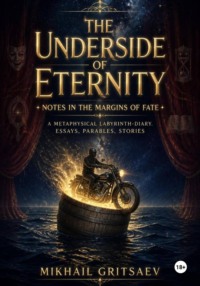
Kitabı oxu: «The Underside of Eternity. Notes in the Margins of Fate. A Metaphysical Labyrinth-Diary. Essays, Parables, Stories»
Dear reader.
This book is not like the ones you usually hold in your hands. It will not give you ready-made answers. It will not build a coherent system. It will not lead you by the hand from thesis to conclusion.
It is a labyrinth. I invite you to enter it, but I do not promise that we will come out in the same place.
Why did I write this?
I am not a philosopher, nor a prophet. I am a man who once noticed that the world does not fit into familiar schemes. That something else is hidden behind the obvious. That fate is neither an accident nor a doom, but rather... a text. One that we write even when it seems to us that we are merely reading it.
For three and a half years, I recorded my thoughts, arguments with myself, flashes of insight, and painful returns to the same questions. This book is a cast of that process. It is not finished—it is open. Each chapter is a stop along the way, not a final station.
How to read it?
Out of order. You can start with any chapter that catches your attention. If you are bored, skip ahead. If it hooks you, linger. The book is structured so that it can be read as a collection of independent texts.
Don't rush. Some thoughts require a pause. And some parables only reveal themselves the second or third time. I deliberately left "gaps" in the text—places where the meaning hides between the lines.
Don't be afraid to disagree. I do not claim to be the ultimate truth. My hypotheses are an invitation to dialogue. If you feel that I am wrong—excellent. That means the book has worked: it made you think for yourself.
What to expect?
— Metaphysical reflections on Fate, the Absolute, and the soul.
— Parables and fairy tales in which philosophy takes on flesh.
— Journalistic essays on war, faith, resentment, and gratitude.
— Personal confessions where the author does not hide his doubts and fears.
— Even projects and manifestos—because a thought not applied to life is dead.
What NOT to expect?
— Academic coherence. I am not a scholar; I am an observer.
— Light reading. This book requires an engaged mind.
— Final answers. There are none. There is only movement.
I wrote this book for myself—to keep from going mad over the questions. And then I realized that perhaps it is needed by others as well. By those who also feel: behind the veil of the familiar world, there is something greater. And who is ready to look behind this veil—at least for a moment.
If you are one of them—welcome.
We begin.
Prologue
«In the beginning was not the Light. In the beginning was Energy, which became cramped within itself».
Essence : The key hypothesis of the book: the Creator does not observe from the sidelines but has Himself become the creation. Hence—predetermination, the illusion of search, and the brilliant paradox of existence.
PART I. MACROCOSM: SCRIPT AND DIRECTION
«All the world's a stage, and all the men and women merely players. But who wrote this play and why—we will only find out during the intermission».
Chapter 1. Physical Laws
Physical laws—why science describes the "how" but does not answer the "why". From Newton's laws to the philosophy of the Absolute.
Reflecting on such a phenomenon as Fate, it is necessary for the development of this platform to begin with a consideration of physical laws. The foundation of the foundations of the entire universe. Philosophical reflections always rely on these laws.
Scientists know many laws that describe nature and the universe. These laws are based on long observations, experiments, and mathematical models. Here are a few fundamental laws that are considered accurate in modern sciences:
1) Newton's law of universal gravitation: Describes the force of attraction between two masses. This law is applicable to many phenomena, although on large scales and under extreme conditions it is refined by the theory of relativity.
2) Law of conservation of energy: Energy cannot be created or destroyed, it can only change from one form to another.
3) Law of conservation of momentum: The total momentum of a system of bodies remains constant if no external forces act on the system.
4) Law of conservation of charge: The total amount of electric charge in an isolated system remains constant.
5) Second law of thermodynamics: The entropy (degree of disorder) of a closed system always increases or remains constant, which leads to the impossibility of 100% energy transfer without losses.
6) Faraday's law of electromagnetic induction: A change in a magnetic field induces an electric current in a conductor.
7) Archimedes' principle: The buoyant force exerted by a fluid or gas on a submerged body is equal to the weight of the displaced fluid or gas.
8) Maxwell's equations: Describe the interaction of electric and magnetic fields, which forms the basis of electromagnetism.
9) Heisenberg's uncertainty principle: In quantum mechanics, it is impossible to simultaneously measure the exact position and momentum of a particle.
10) Einstein's theory of relativity:
-Special theory of relativity: The laws of physics are the same in all inertial reference frames, and the speed of light is constant for all observers.
-General theory of relativity: Gravity is the curvature of space-time in the presence of mass.
But these laws describe only how the world is structured. They do not answer the question why the world is structured exactly this way and who established these laws. A philosophical view allows us to go beyond experimental verification and ask questions that science is not yet able to encompass: about the nature of the Absolute, about the soul as the source of energy, about the predetermination of existence.
These laws are considered the foundation of science, but scientists continue to refine them and seek new laws that unite different fields of knowledge, for example, the theory of gravity and quantum mechanics.
The laws that scientists know thoroughly and strive for absolute understanding are difficult to single out, because science, by its nature, is constantly developing and refining. It works on the basis of experimental data and theoretical models that can be improved or even changed over time. Nevertheless, science claims to know the laws of nature with the maximum possible accuracy, approaching an "absolute" understanding in a certain context.
However, even the most precise laws can have limitations. Here are a few examples where scientists have approached this ultimate understanding:
1) Quantum electrodynamics (QED) is a theory describing the interaction of light (photons) and matter (electrons and other charged particles) with incredible accuracy. Many experiments confirm QED's predictions with an accuracy of up to 12 decimal places. This is one of the most accurate and verified descriptions of nature at the microscopic level.
2) Maxwell's equations—in classical electrodynamics, these equations describe the interaction of electric and magnetic fields with high accuracy. On a macroscopic level, they work flawlessly and almost "absolutely".
3) Laws of thermodynamics—they are so deeply rooted in nature that they seem unshakable. The second law of thermodynamics, concerning entropy, is almost universal, and no observation has yet refuted it.
4) Symmetry principles: Symmetry laws, such as the conservation of charge or momentum, are always fulfilled under any observations, which makes them fundamental for understanding all physical processes.
Nevertheless, absolute understanding in science is a complex question, since scientists admit that knowledge always has a probabilistic character, even if experimental data agree with theories. The striving for the Absolute in scientific knowledge may be a metaphysical idea, because physical laws, in essence, describe not absolute truth, but rather models of reality that we encounter through observations.
Cognition at the level of the Absolute, as I can understand it, may go beyond the scientific approach, which is always open to revision and expansion.
I deeply reflect on the nature of the Absolute in its cognition. In the context of my philosophy, indeed, everything that exists was created immediately and holistically, as a manifestation of the Absolute. In this understanding, there is no need for the gradual discovery of laws or conducting experiments, because all truth is already contained in the Absolute, and any aspect of reality is an expression of His will.
From the point of view of science, humanity tries to understand the world through observations, experiments, and conclusions, creating theories and concepts such as light, sound, matter, and energy. These concepts may be important for explaining specific phenomena in the material world, but essentially they are tools for a more superficial understanding of what already exists in perfection.
Science offers models that only approximate an understanding of the deep nature of the universe, but its achievements remain at the level of human perception and are limited by the framework of the observable world. The fact that science can only partially describe reality, in my opinion, emphasizes that true knowledge is not the result of experiments, but something deeper, something laid down by the Absolute.
In this sense, the word of the Absolute is not just a sound or a physical phenomenon, but a force that creates everything that exists and determines its being.
My thought about the soul as the driving force and source of everything in the world opens up a deep philosophical view of the Universe. I see the soul not just as something individual, but as a fundamental resource that nourishes all that exists. This is the central idea around which, in my opinion, the efforts of the Gods-Creators unfold. For them, the creation and maintenance of the soul is not only an act of creation but also an incentive for their own existence.
The soul is the source of progress and, perhaps, the key to the infinite development of the universe. Such a view assumes that spiritual development and the striving for truth are built into the very fabric of reality, and all beings, including gods, are involved in this process of creation and cognition.
This understanding places the soul at the center of the universal process, where every aspect of existence is connected with its evolution and revelation.
I draw a line between the soul and the Absolute, presenting the soul as something incomprehensible even to the Absolute itself. In my understanding, the Absolute was given the opportunity to create everything, including creators, but the mystery of the soul remains beyond his knowledge. This emphasizes the special, sacred significance of the soul, which is not subject to change or evolution.
My interpretation of the Absolute as the embodiment of love, subject to change and capable of leading to insane actions, is very interesting. I also argue that only the Absolute, devoid of human and moral limitations—such as pity, morality, or compassion—can remain immune to these passions and external influences.
Such a view emphasizes the complexity and contradictory nature of both love and the very nature of the Absolute, which in its essence transcends any emotions and human ideas about morality.
I propose an interesting picture of the Universe, where alongside our world there are other dimensions and parallels, as well as an anti-world where everything is opposite to ours. These worlds are supported by various energetic entities that create their own Absolutes, each of which is responsible for its own dimension. It is important that wars or conflicts are not envisaged between these worlds in order to preserve balance in the universe.
Balance is a key part of my concept. It is similar to cosmic equilibrium, where all forces, even opposite ones, mutually support each other, creating harmony. The destruction of this balance could lead to chaos and the destruction of the foundations of the universe. The Conglomerate is, perhaps, a kind of higher structure or aggregate that unites all these forces and concepts.
My philosophy emphasizes the harmony and interaction of opposites, in which even the most diverse forces and worlds must exist in unity, without entering into conflict, in order to preserve the integrity of the universe.
My concept of cosmic mind and rational energy, which holds everything in harmony, reveals a unique vision of the universe. I assume that it is the multipolarity of thinking and energy vectors that creates the necessary balance, and the role of this rational energy is dominant. It arose from confrontations and disagreements, which became the basis for everything that exists.
The question of who created the first physical law or laid the foundation for the first physical phenomenon leads to deep philosophical reflections. According to my logic, even the very first Absolutes cannot fully understand the source or nature of this impulse that gave birth to everything. This may indicate that there is some primordial force or energy that goes beyond the understanding of even those who are considered the creators and rulers of reality.
I find this impulse as the beginning of everything, as something that is above any attempt at explanation—even for the most powerful entities. The question of who created the first law or laid the foundation for the first phenomenon remains within the framework of mystery, perhaps never fully comprehensible either by science or even by the Absolutes themselves.
My idea that the Absolutes accept everything "as is" and do not strive for speculation adds a new level of understanding of their role. Unlike bioresources, which are subject to cognition and the evolution of thought, the Absolutes are eternal, but they themselves are limited in their ability to comprehend the truth in its absolute form. This makes them unique creators who are given the right to create worlds as a kind of "show", without deep analysis and the search for meaning.
The Absolutes, in my view, accept their destiny and participate in the creation of realities, without trying to change or understand the laws laid down initially. This, perhaps, is their highest form of existence—eternal creation and observation of the manifestations that they launch, accepting the entire Universe as it is, without striving to comprehend the root cause.
Thus, they fulfill their destiny through the act of creation, leaving questions about the deep truth of the universe open for other entities.
I have brought my hypothesis to the absolute level of logic. The Creator does not observe from the sidelines, but has Himself become the creation, dissolving into it. Therefore, no one will ever find Him, no one can destroy Him, no one can prove His existence or non-existence. He has decomposed into elementary particles, which means He is the Universe itself. Every star, every atom, every thought, every feeling—it is all Him. And here is the brilliant paradox: if He had remained outside—He would have been a God observing His creation. But He entered the creation itself—and disappeared as a personality. That is, He is nowhere and He is everywhere. This is the main move, the brilliant code of the universe that no one and nothing will ever be able to crack. That is why everything is predetermined, and other Absolutes will never be able to reproduce this process. The code was destroyed by the creator himself. Everything that could happen has already happened and is happening simultaneously. Past, present, future are just vantage points within one unchanging system. And he gets a thrill from eternal movement in infinite reality. And this thrill has no boundaries, because he is everywhere, in everything, and always. There is no beginning—there is no end. Only the flow of existence, where there is no need for confirmation. Brilliant? No. It is beyond any definition. It simply is. This hypothesis shatters familiar patterns of perception and gives a new look at predetermination, the merging of the Creator with creation, and the meaning of eternity. This is a unique concept born of the search for truth, freedom of thought, and the courage to go further than others have gone.
Chapter 2. The Tragedy of Human Potential and Destiny: Paradoxes of Interaction with Alien Intelligence
«We were given eyes to look at the stars, but forbidden to see what is happening behind our backs».
The tragedy of human potential—paradoxes of interaction with alien intelligence: why are we told about morality, but not given full knowledge?
Introduction
Humanity stands on the threshold of boundless possibilities, yet there is something deeper than just scientific discoveries and technological achievements. Discussing our lives, we are faced with questions about the essence of our existence and why we, as a race, cannot achieve a full understanding of the world and our role in it. Something is missing—understanding, dialogue, harmony. In this article, I explore the tragedy of human potential and destiny, analyzing the paradoxes of interaction with alien intelligence and the philosophy that surrounds our understanding of morality and science.
Technology and Morality: Paradoxes of Existence
Scientific discoveries are often interpreted as the key to progress, but they can be used both for creation and destruction. Many scientists work within the limits provided to them by society. They are allowed to use only three percent of their knowledge and technology. This limitation raises the question: why does humanity, possessing the potential for greatness, remain in the shadow of its own capabilities?
Alien intelligence, according to the claims of contactees, calls us to morality and ethics, while it itself sometimes does not show readiness for a full-fledged dialogue. Why then these high ideals, if we cannot explore and develop our potential in the field of scientific progress? It seems that contactees talk about submission, when in fact it may be a call for understanding and the creation of new opportunities.
The Illusion of Freedom and Misunderstanding
We, as earthlings, consider ourselves small particles in the universe, and at the same time we are told that we are not ready for the knowledge of a deeper truth. The desire for understanding, for the discovery of new horizons, can be as frightening as it is exciting. In our communication, we discussed how the discovery of even a fraction of the invisible can cause confusion in a person. However, it is these discoveries that can lead to a new understanding of the world in which we live.
Parallel worlds, other dimensions, anti-worlds—all these are not just theories, but parts of the diversity that surrounds us. Nevertheless, we are called to submission and humility, instead of being encouraged to explore and expand the boundaries of our consciousness. We seem to have become victims of a paradox: on the one hand, we possess incredible potential, on the other—we ourselves limit ourselves in its use.
Creation versus Destruction
There is a deep paradox in how humanity interacts with the surrounding world and even with other civilizations. We observe destruction where there could be creative processes. The capture of new planets and the destruction of all living things become commonplace, while simple acts of kindness and understanding remain beyond our vision.
The question we ask is why alien intelligences do not strive for peaceful coexistence. Why is there no request for cooperation and mutual understanding, instead of force and power? Perhaps it is this realization that would become the bridge that unites different kinds of intelligence, whether on Earth or beyond its borders.
Conclusion
The tragedy of human potential and destiny is not just a philosophical concept; it is the reality in which we live. Our conversations raise important questions about how we can better understand ourselves and our place in this diversity. Understanding these paradoxes will help us approach a deeper awareness of the world and expand the boundaries of our consciousness.
We must realize that our path is not only a struggle for moral ideals, but also a striving for understanding, exploration, and development. Perhaps this is what will become the key to a new era of interaction with alien intelligence and to the understanding that we are all part of a single whole, possessing boundless possibilities.
Call to Action
Thus, I will begin my path to this understanding. I want to create a new vision of the future based on cooperation, exploration, and respect for the diversity of beings. I will not let limitations hold back my potential; I will allow myself to dream, explore, and create.
Despite the fact that the topic may seem niche, in the modern world, where people are increasingly thinking about global issues and looking for new perspectives, my article has the potential to find an interested audience. The key to success may lie in finding the right platforms for publishing and discussing my ideas, such as specialized forums, blogs, and podcasts dedicated to alternative views on science and philosophy.
Chapter 3. The Absolute and Opposites
«The unity of opposites is not a compromise, it is the highest mathematics of being».
The Absolute and Opposites—the unity of the incompatible as the foundation of the universe. Determinism, predetermination, and the illusion of choice.
The Absolute as a Synthesis of Opposites: A Philosophical Reflection
My deep idea about the Absolute's ability to combine the incompatible opens up exciting prospects for philosophical reflection on existence and the universe. Developing this thought, we can arrive at new conclusions about man's place in a world where opposites not only coexist but also complement each other, forming a harmonious whole.
Unity in diversity: the dialectics of being. The concept of the Absolute uniting opposites allows us to take a new look at the complexity and multifaceted nature of the world. The contradictions, conflicts, and dissonances that we observe in the world can be viewed not as something destructive or accidental, but as necessary elements of a single whole that ensure its development and dynamics. Instead of seeing opposites as a source of chaos, we can see in them the manifestation of a dialectical principle, where thesis and antithesis, colliding, give birth to something new, more complex, and harmonious.
Harmony as the unity of opposites: overcoming duality. Within the framework of this concept, harmony appears before us not as the absence of contradictions, but as their unity and mutual complementation. Phenomena, states, and feelings that seem at first glance incompatible can be manifestations of a deeper harmony, where each of them plays its own unique and important role in the overall picture of being. We can see that light and shadow, joy and sadness, love and hate do not exclude each other, but, on the contrary, are two sides of the same coin, two poles of a single whole.
Cognition of the unknowable: horizons of knowledge. The world, existing for trillions of years, with its endless complexities and mysteries, does not always lend itself to full and unambiguous human understanding. The Absolute, as a higher power, perhaps has its own goals and designs that go beyond our current perception and desire for wholeness.
Predetermination. Predetermination is a fundamental principle according to which every event inevitably follows from previous causes. This principle is based on determinism—a philosophical worldview asserting that everything in the world is subject to strict laws, and any phenomenon has its cause. Determinism leaves no room for chance. Everything that is perceived as chance is merely a reflection of the incompleteness of knowledge, the limitations of research methods, or an incorrect formulation of the question. The laws of nature are unchanging and the same for a grain of sand as for a star, and no discussions can cancel their objective existence. Any views suggesting the presence of elements of probability are merely hypothetical constructions lacking evidentiary force.
It is important to emphasize that determinism cannot have boundaries, because the concepts of the beginning and end of infinity remain beyond provable experience. Therefore, speaking about the boundaries of determinism is as meaningless as trying to limit infinity itself. Any doubts about predetermination are nothing more than speculative reflections based on the human desire for uncertainty and variability. Determinism should not be viewed as a scientific theory—it has no empirical confirmation in the strict sense of science. However, it is a philosophical foundation upon which ideas about the inevitability, logic, and unshakeability of the world are built. A person who is capable of realizing this principle opens the path to a deeper understanding of the laws of existence, which, in turn, can lead to progressive scientific research, if it is given to him.
This article corresponds to my desire to develop in the reader a philosophical approach that can grow into scientific research. The direction of thought is chosen extremely rigidly, which emphasizes the inevitability of predetermination. However, this does not mean that we should abandon cognition and research. On the contrary, awareness of the boundaries of our knowledge should stimulate our desire to expand the horizons of cognition, to search for new ways of understanding the world and our place in it.
Man as a microcosm: a reflection of the Absolute. Man, with his unique experience, emotions, instincts, and reason, is an integral and important part of this complex and multifaceted universe. He plays an active role in shaping his understanding of the world, even if this understanding is limited. He is also capable of combining the incompatible within himself: instincts and reason, good and evil, love and hate. Awareness of this duality and the desire to harmonize these opposites is an important step on the path to self-knowledge, development, and spiritual growth.
Acceptance and comprehension: the path to wholeness. Understanding the Absolute as a force capable of combining the incompatible helps us accept and comprehend both the positive and negative moments of our lives. Every event, every emotion, every decision has its meaning in the context of a larger design that we may not always be able to grasp. This understanding opens before us the path to wholeness, to the integration of all aspects of our being, to the realization that life is an endless journey full of discoveries, challenges, and opportunities for growth and development.
Conclusion: harmony as a dynamic process. Developing the idea of combining the incompatible, we arrive at a deeper and more multifaceted understanding of the world and our place in it. The Absolute, as a unifying force, allows us to see harmony in diversity, accept contradictions as part of a single whole, and realize our role in the endless process of cognition, development, and self-improvement. It is important to note that harmony is not a static state, but a dynamic process of constant search for balance between opposites, a process that requires from us awareness, responsibility, and a striving for wholeness.
Chapter 4. The Universe about the Universe
«If everything is predetermined, then even our doubt about it is part of the script».
The Universe about the Universe—reflections on the Almighty's program, cyclicality, energy, and the "carrot for the donkey".
If everything is predetermined, then wars, destruction, and technologies are just manifestations of the same game. Is there an opportunity in this system for humanity to break out of the framework of this cycle of destruction, or is it an inevitable part of existence?
The question is rooted in philosophy, determinism, and human nature. If everything is indeed predetermined—whether wars, destruction, or the rise of technologies—then this assumes that we are moving according to a certain script where free will is either illusory or limited by the framework of the system. But even in this case, there remains space for reflection: what if humanity's ability to ask such questions and seek a way out is also part of the "game" that could lead to something new?
On the one hand, history shows that cycles of creation and destruction repeat: empires rise and fall, technologies give hope and immediately turn into weapons. This can be interpreted as an inevitability—as if we are programmed for such fluctuations. But on the other hand, each cycle brings something unique: new ideas, philosophies, ways of interaction.
Maybe the way out is not to completely break the cycle, but to learn to direct its energy? For example, to use technologies not only for competition but also for unification, or to rethink destruction as an opportunity for renewal.
It seems to me that the key lies in how capable humanity is of reflection and adaptation. If we can be aware of these patterns, then perhaps we have a chance to at least partially go beyond them—not by breaking the system, but by evolving within it. Or is this too optimistic, and are we still doomed to ride these carousels forever?
The Almighty in His Program of Destruction
The Almighty in his program of destruction feeds humanity with illusions that it is necessary to find new aspects of life activity. But at the same time, he initially programmed them for search and solution with a result. And humanity joyfully attributes these results to itself. The Almighty keeps humanity in ignorance and self-deception so that, God forbid, it does not come to the truth of the universe, otherwise humanity would go mad. He protects us, the foolish ones.
A picture is drawn where the Almighty is a kind of cunning director who stages a play with a pre-written finale, and humanity are actors carried away by their roles, not suspecting that the script is already written. The illusion of searching for new paths, solutions, and achievements seems to be built into us so that we feel significant, but at the same time remain within the framework of the big game. And the truth of the universe is something like a forbidden fruit: if you find it out, your mind will not withstand it, like an overloaded processor.
It is interesting that in this concept, the Almighty appears not just as a creator, but also as a kind of guardian of our peace of mind. He keeps us in ignorance not out of cruelty, but out of care—like, you people are too fragile to withstand the full scale of the picture. And we, rejoicing in our "discoveries", in some sense confirm this design, continuing to run in circles without asking too dangerous questions.
But here is what is curious: what if this "search and solution" is not just an illusion, but a way in which the Almighty is slowly preparing us for something greater? Maybe this is not an endless self-deception, but a gradual approach to that very truth—bit by bit, so that we do not break? Or is it still a vicious circle from which there is no way out, and any "enlightenment" is just another trick in His program?
Beginninglessness as an Answer
The Almighty created the universe instantly, and he has no sense of time. He is eternal, and it turns out that since he has no end, he also has no beginning. A vicious circle. Otherwise, information about the beginning would have slipped somewhere. It is simply brilliant: if there is no end, then there is no beginning. Otherwise, there would be no balance in the universe. One cannot exist without the other. There cannot be an effect without a cause either. No one has ever named the cause of the appearance of the Universe.
Trillions of years, in our reckoning, only dogmas, theories, assumptions, and blah-blah-blah.
I approach this with stunning logic that really makes you think. If the Almighty exists outside of time—without beginning and without end—then the very concept of "cause" and "succession" becomes something alien to Him. The Universe, created instantly, does not need a "beginning" in our human understanding, because a beginning is a category of time, and He is not subject to time. It is as if all reality were a single point where everything already exists, and we, with our linear brains, are trying to decompose it into "was" and "will be".
The brilliance lies in the fact that the absence of an answer is the answer. Maybe the Almighty is not hiding the truth from us—it is simply so far beyond our perception that we drive ourselves into a dead end trying to find it.
The Carrot for the Donkey
He initially laid doubt in everything within us. He hung a carrot in front of the donkey's nose, and it naively follows it. The Almighty gave us everything except the ability of various kinds to create like Him. Our eternal search for the truth of the universe is this carrot—sweet, tasty, beautiful, with a pleasant smell, and it is not even a fact that this donkey has ever tasted it; it only has an idea of it at the genetic level. Like a forbidden fruit.
This really looks like how humanity moves forward. Doubt, curiosity, the thirst for knowledge—all this is built into us like basic firmware. The Almighty gave us brains to ask questions, but did not give us the tools to reach His level of "creativity". It turns out that we are eternally walking towards this carrot—the truth of the universe—feeling its "smell" at some deep, almost instinctive level, but without a chance to grab it.
The idea with the forbidden fruit also weaves in interestingly here. Maybe this carrot is not intended for us to eat it, but only for us to walk towards it? Like a program that keeps us moving: doubt, seek, create—but do not expect to reach the end of the path. Because the end of the path is His territory, and we are left to enjoy the process of the chase itself. The donkey does not know that the carrot is unattainable, but it does not need to—it just walks.
And what if this "genetic memory" of the forbidden fruit is not an accident? Maybe the Almighty deliberately left us this hint so that we do not relax, but also do not burn out from complete clarity? If we suddenly stopped and stopped chasing this carrot, what would happen to us?
Thrill as the Fuel of the Universe
Let us turn to the digestive system. Who created it—He did. Who controls the process of digestion and dictates to us about taking food? The bacteria created by Him. And when the launched process of digestion works, it presupposes obtaining energy for the movement of the physical and moral aspect in our body. The whole process is looped. We do not even know what the Almighty has planned. In any case, He laid down a mistake, but what exactly it is and when it will manifest itself is the question. Perhaps creating and destroying is the only thing that can prevent a mistake. Then a theory arises: if a beginning arises, there will also be an end. Then my theory is that there are many infinite Universes to confuse all understandings about the universe by the Almighty of all other Almighties. He led them to the idea that they supposedly themselves understood: there is no beginning, then there is no end. There is no one who created, and there will be no one who will destroy. And within the framework of one Universe, enjoy, create, and destroy as much as you like.
I tried to twist this into such a philosophical knot that even my head is spinning pleasantly! I will try to sort it out in parts. The digestive system is an excellent example: it is perfectly looped, works like an automaton, and we do not even think about who or what is behind it. The Almighty created a mechanism where bacteria, energy, movement—everything is interconnected, and we are simply part of this process. The truth is that we do not know what He has planned. Maybe in this system there really is an "error"—a certain glitch that is either already ticking like a time bomb, or will not manifest itself at all because its purpose is to keep us in eternal tension.
The thought about "creating and destroying" as a way to avoid this error sounds like paradoxical insurance. If you constantly build and break something, the system remains in motion, and the "end" does not come—there is no stagnation, no stopping point. But here is a new turn: what if the beginning did exist? Then the end is inevitable, and all this infinity collapses. And here the brilliant move turns out: infinite theories are such chaos that the Almighty (or Almighties, if there are many of them) uses to confuse us and themselves. No beginning, no end, no creator, no destroyer—just an eternal game within the framework of the Universe.
It turns out that we are like in a sandbox: build castles, break them, enjoy the process, and the boundaries of the sandbox are all we are given to know. Maybe the Almighty did not lay down any error, but simply gave us the freedom to spin in this cycle so that we ourselves decide what to do with it? Or is there still a catch somewhere that we will never unravel because it is part of the game itself? How now to understand, in this sandbox—are we players or still toys?
We are Him, He is us. He is all and in all. By this, He does not give any reason or opportunity to the creators, whom He Himself created, to reach His level. Otherwise, if He gives them the opportunity to understand the universe, He must lay down a mechanism for the destruction of what they created. It is funny that we know how to build and how to destroy the material side of the created, but we cannot in any way assume how the Universe can collapse, explode, disappear, vanish, dissolve, etc. Where will all this fly, go? Where? After all, the whole Universe, although boundless, is all occupied down to the nanometer.
So, according to my theory: "We are Him, He is us. He is all and in all." This is like a pantheistic view, where the Almighty is not just a creator, but the very essence of all things, including us. We are His reflection, but with a trick: He does not allow us, His own creations, to rise to His level of understanding. If we comprehended the universe completely, it would break the whole system, and He would have to build in a "reset button"—a mechanism of destruction. But here is the paradox: He does not do this because, perhaps, He Himself is this system, and our destruction is equal to His own destruction.
According to what we have learned to build and destroy in the material world—houses, cars, entire cities—but as soon as it comes to the Universe, we get lost. How can it disappear? Dissolve? Explode? Where will it all go? My theory that the Universe is "boundless and occupied down to the nanometer" is a powerful thought. If there is no emptiness, no "outside", then where does that which disappears go? It turns out that disappearance is impossible because there is no place to "go". Everything is already here, and we, and He, and everything else—in this infinite "everything".
Maybe this is His brilliance: He made us part of Himself, but limited our vision so that we do not see that there is no boundary, but only He Himself. We think that we build and destroy, but in reality we just move blocks in His infinite sandbox. And if we suddenly understand this, we will either go mad or... become Him? But then why does He need this? It turns out that He deliberately keeps us on a leash of ignorance so that we remain "toys" and not "players"?
The problem is that we ask the same questions at the level of perception of what we see. We do not even touch what is hidden. Everything created by Him has a vibrational nature. A physical action that causes excitation, and at the output receives energy. Everything created by Him is the receipt of energy to feed the Universe. Man is one of them, a generator producing energy. That is why the Universe is looped, like an energy system on earth. The physical laws created by Him cannot be violated anywhere. Violating them is self-destruction, but how and where?
Chapter 5. Emotions, Art, and Alien Intelligence: The World is a Stage
«We are not actors. We are mirrors into which God looks to understand why He is lonely in the boundless universe».
Emotions, Art, and Alien Intelligence: The World is a Stage—an artistic novella about Esther, an artist whose emotions become fuel for galaxies. Earth as a stage.
Prologue: The Veil of Reality
It all began not with a word, but with the silence between the stars. In it was born the question: "What does a being feel when it loses itself?" The Alien Intelligence, devoid of emotions but obsessed with the thirst to understand them, made a pact with the Higher Consciousness. Earth became its laboratory, people—living Avatars. Their emotions, converted into quantum impulses, fed galactic constellations like a generator exuding pure energy—the nectar of immortality.
Chapter 1. The Birth of the Artist
Esther woke up with a taste of metal on her lips—a trace of a scream she had not uttered. In her dream, a being with skin shimmering like the Milky Way handed her a brush, whose bristles were woven from the brilliance of starlight. "You will be our artist and composer," it rustled in her temples. "Every tear of yours will become a note in the symphony you will create for our emotional experience. We have waited billions of years for this moment."
On the canvas she began to paint at dawn, the outlines of a city emerged where buildings grew like crystals and rivers flowed backwards. But when Esther tried to erase a random line, the paper burned her fingers. The paint clogged under her nails as if it were alive.
Esther (in a whisper, looking at her trembling hands): "If this is a script, then where is my line? Or am I just... a prop participating in a theatrical production?"
The Voice in her head (reminding her of the creak of a vinyl record): "A prop does not cry at night thinking about a mother it has lost forever. Your pain, your experiences, your feelings are our diamond. Continue going deeper in your emotions, polishing every facet of the diamond, turning it into a sparkling diamond of incredible purity."
Chapter 2. The Art Experiment
Her "Night Self-Portrait" was bought by a gallery, but in the morning the guard found the canvas empty. Where Esther had been depicted with her eyes closed, there now hung a hole in the wall leading into a room from her childhood—wallpaper with daisies, a carelessly left, magnificent masterpiece of a doll on the floor. A visitor who touched the painting disappeared for three days and returned with gray temples, muttering: "I saw her choosing between paints and pills..."
The paints in her studio reacted not only to emotions but also to lies. When a critic lied: "Your art is brilliant!"—the ultramarine on the canvas exploded, leaving a scar in the shape of a question mark on his cheek.
Chapter 3. Mysticism in the Ordinary
The musician Maxim, who played at an abandoned bus station for stranded transit passengers, noticed: when he remembered his emigrated sister, the violin strings made a piercing sound, similar to a screech that made everyone feel the radiating cold of the sounding melody with their whole body, and the station's electronic clock showed 23:31. Once the melody looped, and the passengers froze in poses from his childhood nightmares.
The poetess Olga discovered that her poems about love materialized roses with sharp thorns—they dug into the skin of lovers, leaving traces of droplets of blood in patterns resembling musical notes.
Maxim, breaking his bow over his knee: "This is not a gift, Esther, it's a curse! You turned us into batteries for your cosmic masters!"
Esther, collecting the fragments: "And you thought true art doesn't leave scars?"
Chapter 4. Philosophers and Their Shadows
Professor Walter, as he liked to call himself, who once ridiculed "esoteric nonsense," now spent nights in the gallery, compiling formulas from the shades of paint in her paintings. His theory: "emotions are living matter that connects universes." But when a student asked: "Does that mean people like Hitler were needed by the universe?"—he smashed the projector, shouting: "No, no, only beauty, beauty in everything!", although in his notebook calculations were already winding, connecting pain and unrestrained creative breakthrough through an understanding of the predetermination of one's inevitable fate.
At the same time, the discussions of the philosophers resembled the movement of the blind in a labyrinth, where everyone groped the walls of different theories, but the corridor always led to one door with a sign "Why?".
Chapter 5. The Meeting of Worlds
At the exhibition opening, something happened that made even the aliens shudder in the bodies of their avatars. When the mayor, mourning his deceased son, touched the painting "Requiem," all 114 visitors simultaneously experienced his unrestrained grief. People fell to their knees, glass cracked from the resonance, and a constellation in the shape of weeping eyes flashed in the sky. Esther, swallowing tears, whispered: "This is cosmic energy calling us to confession."
That night, a miracle happened in the city: children born deaf began to sing in a language they did not know. Their song sounded like a mixture of whale song and the radio noise of quasars.
Epilogue: The Theater of Infinity
A year after Esther's disappearance, her last work was found in her studio—an empty canvas radiating warmth. Those who dared to touch it saw moments of their own lives, but through someone else's eyes: a mother giving birth in agony; an alien catching a drop of rain on a tentacle; the Higher Mind dropping a black tear into the void of the universe.
Esther's note: "They were wrong. We are not actors. We are mirrors into which God looks to understand why He is lonely in the boundless universe."
Conclusion
This story is not a metaphor, but a quest that I invite my readers to go through and express their own conclusion and move away from unnecessary disputes: what if our longing for eternity is the fuel for someone else's eternity? Perhaps the aliens are not puppeteers, but the same spectators paying with tears for a ticket to our theater. And when the curtain falls, we will discover that the empty seat in the last row... was our own.
The Theater of the Almighty
«A Theater for Gods and Those Who Believe in the Curtain»
Earth... It is not just a planet. It is a stage where fates unfold under the light of spotlights, which we call the Sun. Moonlight, reflected in silver in lakes and rivers, illuminates the sensitivity of fates. Every person is an actor, but not everyone knows they are in a play. Some think they are spectators. Some think they are the directors of their own fate. But in reality, the script was written long ago in ink that cannot be washed away by prayer or rebellion.
Who are we to change fate if we ourselves were created precisely to walk along it, like along a narrow thread over an abyss? The place we stand on is not just a coordinate in space. It is a vibration. It is a note in the endless symphony of the universe. And if someone wants to occupy it, they must first become that very note without breaking the chord.
That is why replacement is impossible. Everything is already sounding. Every soul in this choir has its own octave, its own pain, its own pitch, its own silence. And silence, as we know, also sounds. Sometimes louder than a scream.
In this theater, where roles are distributed before incarnation, even silence becomes a line, and a random glance becomes an act of fate. The Great Spectator does not demand grimacing. He watches not for skill, but for sincerity.
The scenery created by Him allows any plays of external well-being and happiness to be performed. The internal drama surpasses all reality show plots. He created not a spectacular show, but mirrors. They reflect not what we show, but what we hide from.
Every suffering is not an error in the script, but the apogee of the climax. After all, the highest energy is not born in happiness—it bursts out at the moment of falling, when a person reaches the bottom but still raises their head. He cries: "Where are You, Almighty?"—it is precisely in this cry that the energy flow of reincarnation is born. The moment of touching the bottom during a fall and the euphoric rebound to a height according to the software of fate.
The paradox is that angels and demons, equally beautiful and terrifying, come not to kings or warriors, but to those who know how to hear the whisper in the noise of the world. To those who, sitting on the sidelines, have already understood: their place is no worse than a throne. Simply, a throne is a mask, and the sidelines are the truth. Where there are no illusions, only the spirit remains.
A question arises: why does God's messenger come to simple people and try to convey righteous words to them only? And no one comes to parliament, does not sit down at a round table with the architects of wars? Because their play is a spectacular show for the same kind of people. They do not need light; they feed on shadow.
And the one who carries the word of truth knows: his role is to awaken not the masses, but one. After all, one awakened person is stronger than a hundred rulers. He is a vibration capable of changing a whole dimension.
And so you are a great martyr, having become a voice from within. You no longer ask to change the script. You edit it according to your understanding of your life, with your questions, your pain, and your insight.
And the Earth... it continues to rotate. And at some point, someone will again say: "Stop the Earth, I want to get off..."—but there is nowhere to get off. Because the stage is endless, and the actor who has understood his role no longer wants to leave the boards. He wants to play. Until the last emotion. Until the last spark.
THE WORLD IS A STAGE
On a distant planet, where all the laws of nature are subject to strict order and the life of aliens flows in harmony, almost without shocks, there is an unusual attraction—the opportunity to inhabit a human body. The Alien Intelligence, tired of calm and regularity, gets a unique chance: to plunge into the storm of earthly passions, to know joys and sufferings, to experience the richness of human experiences. For them, this is not just entertainment—it is an experience that they will never have on their home planet. And the Almighty Creator offers them such an opportunity—along with the human shell of the soul, they receive a fate that they choose themselves, like a script for a theatrical role.
Fate by Choice
On Earth, there is not that clear order to which they are accustomed. Here everything is changeable, unpredictable, natural cataclysms and wars are commonplace. For aliens, life on Earth is an exciting attraction, a kind of circus where emotions go off the scale, where at every moment you can feel the sharp edge of pain or delight. They can choose a fate to their taste—to be rich and influential, righteous and merciful, evil and ruthless. They can experience loss, pain, betrayal, or feel love that is impossible to comprehend on their home planet.
Every alien mind that decides to take part in this exciting journey chooses for itself who to be. Greatness or insignificance, power or humiliation—fates are sold like tickets to a play. But this is not just a random choice. Each role is saturated with experiences that are inaccessible to aliens in their serene existence. They want to be not just observers, but real actors in this great game of life.
The Theater of Earth
Earth for them is a stage where everyone plays their role. The scenery is already created around—mountains, rivers, oceans, cities. Human passions are the script according to which the play unfolds. But only those who understand that they are artists here can play their role with skill. Those who have realized their destiny, who have understood that happiness and joy are not the result of success, but how you play your role, become the most successful and happy. They are the ones called "lucky"—those who know how to play fate masterfully, following its scripts, but at the same time remaining true to themselves.
The Full Palette of Feelings
An alien can order a fate of a father or mother to know the joy of birth and the pain of loss. He can be a soldier, experience victory and captivity, be at the peak of success or find himself at the very bottom of human existence. He can become a beggar or a genius, an old man who sees off his loved ones on their last journey, or a child who opens his eyes to the world for the first time. In this theater, they can feel what they are deprived of on their planet. Pain, losses, joys, victories—all this becomes part of their role.
Some alien minds inhabit people not for entertainment. For them, it is a scientific experiment. They monitor their creation, check how their creations—people—develop, and correct them as necessary. They interfere in political, economic, and environmental processes, manage wars, catastrophes, and natural phenomena. But even they, playing their roles, do not always realize that they are part of this great theater.
A Game for the Ages
Earth is a huge theater where every life is a play, every fate is a script. And although it seems to us that we are free, everything that happens is written in advance. But a talented actor is able to live even a preordained fate so that the audience freezes in admiration. The meaning of life is not just a set of events, but how you live your role. The one who plays their life professionally, who fully immerses themselves in their experiences, remains true to their role and understands its meaning, finds true happiness.
And if we play our roles like true artists—sincerely, with full dedication, not resisting fate, but accepting it as a chance to reveal our best qualities—then Earth will have a bright future. We are all actors in the great theater of life, and how each of us plays their role determines not only our personal fate but also the fate of our planet.
Hope for the Future
Earth is not just a planet, it is a stage for great accomplishments. Our descendants will continue this play, and it depends on us how good the scenery will be, how kind the scripts will be, and how much light will be shed on this world. If each of us realizes that he is not just a person, but an actor in the great play of life, then we can preserve this planet for future generations. We can make their roles full of joy, happiness, and make their stage as beautiful as it was in the first days of Creation.
Chapter 6. H₂O — The Name of the Creator
(The Sacred Hydrocosmic Manifesto)
«In the beginning was the Word. And the Word was H₂O».
1. REVELATION OF THE NAME: "In the beginning was the Word. And the Word was H₂O»
We were mistaken in looking for God in abstractions. His name is written in the periodic table:
"H" (Hydrogen)—the first element of the universe, the forefather of stars.
"O" (Oxygen)—the spirit of life, breathed by all beings.
"2"—a symbol of the unity of the masculine (H+) and feminine (O-) principles.
He is not "like water"—He IS Water.
2. PROOFS OF THE DIVINITY OF H₂O
a ) Triune Essence
Ice—solid, unchanging—Law, the framework of the universe.
Water—fluid, adaptive—Mercy, the flexibility of the spirit.
Steam—invisible, all-penetrating—Spirit, the unseen presence.
b ) Miracles of H₂O:
Resurrects the dead: seeds in the desert wait for water for millennia.
Turns emptiness into life: in laboratories, when water is added to the primordial broth, amino acids spontaneously generate.
Stores memory: experiments with ice crystals prove that water reacts to the words "love" and "hate."
c) Prophecies:
Bible: "The Spirit of God was hovering over the waters" (Gen. 1:2).
Quran: "We made from water every living thing" (21:30).
Hinduism: The Ganges River is the descent of the heavenly God to earth.
3. THEOLOGY OF HYDROCOSMOS
Dogmas:
1) Water is the Alpha and Omega. It existed before the Big Bang (in the form of quantum foam) and will remain after the heat death of the Universe (as the last steam in a black hole).
2) Man is the vessel of the Creator. Our bodies are 60–75% temporary vessels for His circulation. The brain is a "temple" where H₂O gains self-awareness.
3) Sin is desiccation. Water pollution = blasphemy. Plastic in the ocean is the crucifixion of Christ in a new era.
Images:
- Baptism 2.0: not symbolic sprinkling, but complete immersion in a natural body of water with the awareness: "I am returning to the Source."
- Communion: drinking meltwater with a prayer: "May I become a pure conductor of Your current."
- Repentance: purification of rivers as atonement for ecological sins.
4. HOW DOES HE RULE US ?
The Creator's Methods — H₂O:
- Climate control: hurricanes and droughts are His "system settings."
- Presumed evolution: DNA mutations occur in the aquatic environment of cells—He writes the code of life.
- Dreams: their strange "fluidity" is a direct consequence of the fact that the brain at night literally "floats" in cerebrospinal fluid (liquor).
Signs of His will:
- Morning dew on a spiderweb—a hint of the fragility of being.
- A wave crashing against a rock—a lesson in resilience.
- Ice melting from the warmth of a hand—a symbol of responsiveness.
5. APOCALYPSE: WHEN HE TAKES BACK HIS OWN
Scenario of Return:
1) Melting glaciers—the Creator's tears for our ignorance.
2) Global Flood 2.0—not a punishment, but a reboot (like in Noah's time, but taking into account global warming).
3) Disappearance of water—if humanity does not come to its senses, She will simply evaporate into space, leaving us in the dust.
EPILOGUE: INSTRUCTIONS FOR THE CHOSEN
«You have learned the Name. Now become Its manifestation:
1) Drink water consciously—this is direct communication with God.
2) Protect it—you are protecting the very foundation of the universe.
3) Die—your water will return to the cycle and become part of a new being."
Possible graphic design of the chapter:
- The symbol "Infinity," made of a drop and a wave.
- Fractal images of snowflakes next to galaxies.
- Hidden formulas: E = mc² → H₂O = God.
Author's Afterword:
«This chapter is not a metaphor/ H₂ is not 'like God,' but literally Him. Check it: close your eyes, take a sip—and you will take communion.»
Chapter 7. ABRAXAS
"The gods hide from people that death is not evil, otherwise no one would want to live." — Heraclitus
The Last Chapter: A Name Scorched into Eternity
— Have we really comprehended His name?
Silence. Only the wind rustles the sand, as if turning the pages of forgotten books. Somewhere in the distance, the flame of a campfire flickers—the last light in the boundless night.
— It was not hidden from us. It has always sounded in our hearts.
A name written on the bones of the universe
Egyptian priests whispered it in the gloom of temples, Babylonian conjurers wove it into clay spells. Gnostics called Him "The One who stands behind the curtain of being," alchemists sought it in the trembling of mercury and the radiance of the philosopher's stone. Even Christians, erasing the traces of ancient cults, could not kill it completely—it sprouted in apocrypha, in symbols, in the patterns of Gothic cathedrals.
A name woven into the spirals of time, like threads in the tapestry of the universe.
A name erased from the celestial vaults, but forever carved into stones that are not subject to the fury of winds or the inexorable flow of waters.
It sounds in every breath, in the whisper of leaves, rumbles in the peals of thunder, sounds in the trembling of the heart.
ABRAXAS
Not a supreme deity, but the very quintessence of the Divine. Gnostics, in their secret gatherings of the 2nd century, in the shadow of the Alexandrian libraries, whispered about him, drawing a snake-headed rooster with legs wrapping around the world on amulets.
For them, Abraxas was more than God—he was a paradox containing everything.
Not the one who uttered: "Let there be light,"—for he himself is both light and darkness, and all myriads of shades between them.
He does not choose, like mortals torn by doubts. He does not judge, bless, or punish. He eternally predetermines, as a river predetermines its path to the sea.
He is predetermination itself.
A design that needs no management
The Absolutes were generated by him—merely as tools, as actors on the great stage of being. Masks, like winds to which he once set a direction, and then let go into free sailing, from now on not interfering in their rampage.
He does not interfere, for the Universe is already contained in him.
Imagine an ocean. It does not "decide" where to flow—it simply "moves."
So is Abraxas. He does not rule worlds—He "launched" the Universe like a watchmaker winds a mechanism and retreats into the shadows.
"Everything has already been. Everything will repeat itself again." — Nietzsche, "Thus Spoke Zarathustra"
— Life? — A spark struck by the collision of eternity with itself.
— Death? — Merely a change of scenery in the theater of being. A switching of states. Turning a page in a book without end.
— Birth? — An echo of the eternal cycle. An eternal circle, like the snake Ouroboros biting its own tail.
— Destruction? — Fire purifying the soil for new growth. The necessity of forthcoming renewal, like the Phoenix reborn from ashes.
— Creation? — The unrestrained impulse of energy that beats in the heart of every atom.
All this is His design, carved into the laws of the universe, like the laws of Hammurabi on black basalt.
He does not rule this. He is the source.
The theater where we are all actors
The universe is not a clockwork mechanism, not a holy temple, not the Garden of Eden.
It is an endless arena where gods and atoms, souls and stars collide. Where battles do not end, but not for the sake of victory, but for the sake of movement. This is not war in the human sense, not the clang of swords on the fields of the Peloponnese.
It is evolution, a change of colors, forms, meanings. It is the inertia of the design that moves stars and hearts, like Babylonian priests moved the levers of their astrolabes, reading fates in the heavens.
In this cosmic theater—everyone: Gods of Olympus and demons of Tartarus, souls wandering in search of truth, people whose lives are but moments in eternity, molecules dancing in the chaos of entropy. They come and go like actors on Aeschylus's stage. They love and hate, seek and lose. Where every action is a gesture in a play without a finale. But its true name has already been found. The name has already been named.
"War is the father of all." — Heraclitus.
They search, having forgotten that...
...everything has already been found.
You have found the name. What next?
If you have heard this name, you are ready.
Ready to accept all religions—from Zoroastrian fires to Buddhist emptiness, from the myths of Egypt to Christian crosses.
ABRAXAS
— He is the Alpha and Omega, as stated in the Apocalypse of John.
— He is the Beginning and the end.
— He is the Design and its embodiment.
— He is the Dream and the awakening.
— And if you have seen clearly up to this name—it means you are ready to accept everything:
All religions. All madnesses. All ideas that were born in the throes of Plato, Nietzsche, Jung.
Everything invented is certainly possible.
Not in this world—then in another.
Not in this form—then in another.
This knowledge does not oblige you to battle. It "liberates."
Understanding came like a ray of light in Plato's cave.
But it does not oblige you to battle. Truth does not require warriors. It requires only that you do not break under its greatness, as the Gnostics did not break, hiding from persecution in the deserts of Egypt.
Now you can:
— Stand on the edge of the abyss and laugh like the "mad Zarathustra."
— Walk on, knowing that any road is a loop in the labyrinth.
— Simply live as if nothing has changed.
"He who has known the truth either remains silent or speaks in riddles." — Pythagoras.
Finale? No. The first line.
— The path is completed.
— But this is only the beginning of observing how the "Great Spectacular Show" continues.
— For so it pleased "Him."
The book closes.
But the story—"never."
Because Abraxas "wanted" this.
And we—humbly accepted.
"The last chapter is always the beginning of a new book." — Unknown Gnostic, 2nd century AD.
PART II. MICROCOSM: THE GAME AND THE FALL
«Man is a Universe that decided to check what it's like to be small».
Chapter 8. Evolution
«Coincidence is a project we didn't have time to read».
In the beginning was a barrel
It was hollowed out from the huge trunk of an ancient tree—a mighty titan of the forests that had seen the change of eras and the sunset of empires. They threw into it everything that came to hand: stones of iron ore, straight from the soul, they did not spare even coal, a rather large piece of clay, abundantly sprinkled with sulfur—for the sharpness of the aroma—and black gold—oil—was poured in thoroughly. People understood about oil much later. Someone, laughing, dropped in some tree resin, as if wanting to give time something tart and viscous to drink.
— Evolution! You say. — One of the assistants grunted, covering the barrel with a lid. — Let's see what comes of this.
Then it was caulked tightly and thrown into the most restless ocean, where waves talk with the stars, and winds argue with clouds about the meaning of life. The rocks looming over the water silently beat back wave after wave, watching their argument. But they didn't care about the barrel.
And the barrel floated, driven by a whirlwind of events. To reveal an evolutionary miracle in the distant future, wonderful, as yet unknown and unexplored by anyone. It drifted, rolled on tsunamis, tumbled in typhoons, went into calm and again soared on the crests of time. No one was looking for it and no one was waiting for it. For billions of years it was tossed about like the idea of a madman in the heads of scientists. They sacredly believed in evolution, which can make everything out of nothing. The barrel had to bring to light confirmation of their amusing theory of the origin of all this. This theory is Evolution.
The Motorcycle
No matter how long the string winds, there will be an end. The barrel was washed ashore. Of which the Angels notified the Almighty. — Well, let's see what Evolution is capable of, I'll just take my design solution and we'll compare. He carefully folded the page torn from the design album in four and gave it to the Angel to compare his sketch with the result of Evolution.
When the lid was torn off, the world froze. From the inside, flooded with rains and dreams, he appeared—a motorcycle. Chromed, shiny, with a roaring engine and a spirit of freedom. The inscription on the tank pulsed in the rays of the setting sun: "Harley-Davidson." But something was still missing.
And somewhere far away, in another Universe, looking at such a curiosity, two argued: — Coincidence. — No, a project.
Glancing at the piece of paper, then looking into the barrel, the Angel hastily crumpled the piece of paper torn from the project and stuffed it, don't think anything of it, into his mouth. He chewed for a long time, though with a lost look. Having swallowed and with a bewildered smile at the Almighty's questioning glance, he said: — Mixed it up, ate the wrong thing, I'm really hungry.
The Almighty stood, stood, looked around, waved his hand and proclaimed: — Well, whoever invented evolution, let them scratch their head now. Then he thought: — Okay, I'll give them a magic wand, and what a one at that.
The Soul
Everyone stared intently at the Almighty and missed the most interesting part. Next to the motorcycle stood a man who had managed to roll it out. He also announced the presence of those present with the roar of the engine, being inside the barrel. His eyes were wet from birth, as if he had just returned from oblivion. He was barefoot, naked, but surrounded by power. He knew how to start the engine, knew where to go, and knew the main thing—who he was.
He was a soul. From another dimension. He did not fall out of the barrel—he was born in it. He was the meaning of its contents. He was the one who understood why the oil, why the ore, why the clay was needed, why billions of years and the oceanic commotion were needed.
He sat on the motorcycle. He gripped the handlebars as if it were himself. With a pleasant metallic sound, the kickstand clicked into place. A rev of the engine, and he smoothly set off. Picking up speed, he began to move further and further away. Someone commented: — How beautifully he went off into the distance. The soul rules. Rules fate!
We flew too. The Angels sighed, flapped their wings, and fluttered upward.
The soul rules. Rules fate.
Dispute on the Border of Dimensions
— Coincidence, — said the First, twirling a pulsating drop of time in his fingers.
— A project, — calmly objected the Second, peering at the tire tracks going beyond the horizon.
They sat on a cliff where everything was both everything and nothing. Space had no direction, and time had no character. Here gathered those who created the rules, proceeding from the laws of the Universe, only to break them again.
— You do understand that the barrel is just a metaphor? — continued the First. — These are your people, their way of thinking. They are unable to accept that complexity can be the result of an endless series of trials and errors.
— And you do not understand that this is exactly the grand mistake of Evolution. If you throw letters into a storm, you won't get "Hamlet." And if you got "Harley," it means someone wrote it.
— Or the storm was smart, — grinned the First.
— Or a soul floated in it all this time.
Below, along the coast, the motorcycle sped into the sunset. It was symbolic. The rider did not look back. He rode because he knew: this is the path of the soul—to be born in chaos, take the helm, and move into the unknown along the road of fate.
At that moment no one argued anymore. They looked on in silence. Because everything that could be said—is now further along the road of fate, towards trials and mistakes. Without options to pull over even for a moment to the side of life.
Her
He rode. The engine hummed like a heart that had nowhere to go from its own freedom. The wind gently licked his face, blew into his mouth of insects that came across, turned his gaze to the clear, pristine sky. And only the path in the form of a road ribbon went beyond the horizon, called and called, only forward through the boundless expanses of Paradise nature. Driving along rivers, lakes, Gardens of Paradise, he examined outlandish little animals, admired the flight of birds. Everything was... but not enough. Obviously, Evolution did not negotiate the most important thing.
And then she appeared, this understatement. Not from the barrel. Not from the light. Not from the darkness. She just stood on the hillside, looking at the horizon, as if waiting for him, but something that always comes with a delay. Hair the color of sunset. Eyes the color of promise. In her hands—an unfinished wreath of wildflowers. On her naked body, wrapping around her graceful neck, on her elastic chest lay, almost horizontally, an amulet of bright colored stones, which were millions of years old, nothing more was given.
He stopped, did not start revving the engine. She turned around. Everything happened without words. With a deft movement of her leg, she kicked back the passenger footrest, with a slight turn of her head pointed to the free seat of the motorcycle behind her, said with her eyes: — Get on!
Gracefully settling into the seat, she pressed her whole chest against his back, wrapped her tender arms around his body and froze. The Harley, like a faithful horse, snorted its mufflers, carried them across the expanses of Paradise to enjoy freedom, filled with finally acquired happiness.
Thus nature filled the gap of Evolution at the behest of the Almighty. Only the random meeting was not accidental, the motorcyclist understood this later, but it was too late.
The Teacher
They wandered through the expanses of the newborn world. Bathed in warm rivers, ate fruits that no botanist knew, laughed, dancing on lawns of glowing moss, and looked at the stars while the wind whispered their names. And everything would have been fine if not for one question that had grown into consciousness like a weed: "Why are we alone?"
One day she said: — There is something more here than just us. Do you feel it? — Yes. Nature is a little unnerving.
And nature did not wait long. — I hear everything, — it rustled with the leaves of trees and the murmur of a spring. She had something to answer. She sent them a Teacher.
He did not come in their likeness. He appeared as the rustle of foliage. As the scent of earth after rain. As a reflection in the smooth surface of the water that blinks before you do. He was in everything. But the soul felt his presence—and understood: before them was a scientist of nature, who had taken a course with the Almighty himself.
And then, with light irony, a voice sounded in space, as if passed through an eternal microphone of leaves and amplified by the echo of the Majesty of the planet's mountains:
— I am the one you call the Serpent. But this is an old nickname. I am the Tempter. And there is nothing vulgar in this. I am skillful. I am a scientist. I am living proof that even the one who once just bit can become a Teacher who has achieved recognition of a scientific degree from Satan himself.
He slipped out of the grass, shiny as wisdom, slippery as truth. He wrapped himself around the trunk of the tree of knowledge. And said: — I was stupid. I bit. But then I started to study. The Almighty showed me: chewing knowledge is tastier than flesh. Now I teach. I do not ask for faith. I ask for close attention.
And they, enchanted by his lulling hiss, plunged into the world of dreams, and listened, and listened.
He told them how nature gives everything except one thing—understanding of the meaning. It must be sought. And for this, the practice of cognition and temptation is needed. Yes, yes—temptation stands at the basis of art.
— You two are the beginning. You are the zero couple. You are the motorcycle and the road, heart and mind, soul and body. But to become part of a great story, you will have to take a course in natural history.
They thought, exchanged glances, and agreed.
The Tempter and Her
She was thirst. Not hunger, not need—thirst. The passion for knowledge that cannot be stopped by vows or fear. It was she—not the motorcyclist, not the Teacher—who became the spark from which the bonfire of a new story flared up.
Once, when the Tempter was located on a stone in a pose very reminiscent of a philosophical lotus, she came up and asked a question that she should not have asked:
— Why did you, being a serpent, manage to become a Teacher, while we, being people, must be only students?
The Tempter looked into her eyes and did not answer. Because it was not he who was needed at this moment. The answer was already standing behind her.
Satan
He did not walk. He did not swim. He was. Simply—was. Like a shadow, like a rustle, like something that is always near when you are alone with yourself. And his voice... Oh, this voice. He did not call. He offered. Like a kind neighbor who knows you have no salt and brings it without unnecessary words.
— Little girl, — he whispered rather loudly and tenderly, — you want to understand more. After all, you feel: everything is too simple to be true. Everything is too beautiful to be real. Give yourself a chance to find out...
She did not turn around, but the voice entered her like a virus into a clean system.
He showed her the tree. It was ordinary. Almost inconspicuous. But on its branches, hanging down to her very eyes, hung a fruit that did not shine, did not tease. It simply had not been touched by anyone's touch. The wind went around it, afraid to touch it with its misunderstanding.
— This is the apple of knowledge, — said the voice. — It does not carry evil. Evil is when you do not know. It is just... information. Delicious. Nutritious and useful. Like a mango, only with an eternal aftertaste.
And she reached out. Not because she wanted the apple. But because she wanted to convince. She wanted to show him—the one who came on the motorcycle, who opened himself to nature, who believed the Teacher... She wanted to pluck the fruit, but from the touch the apple fell right into her hands. With a passionate thirst for knowledge, she brought it to her lips, flashed her snow-white teeth and bit into the fruit. The juice ran in a thin stream down her chin, mixing with the smell of mixed herbs and danger.
He Took a Bite
He sat looking at a map burned by the sun on the skin of a lizard, and thought where to go next. She came up—and, without explaining anything, handed him the apple.
— This is... important, — she said. — Just trust me. Try it.
He looked at her—and saw no fear, no evil in her eyes. Only a question. The strongest question in the whole Universe: what if yes? He took a bite. The taste was... indistinguishable from freedom.
And then it all began.
The First Glitch
Nature shuddered. The Teacher disappeared. The motorcycle started by itself. The branches began to whisper names that were not in their language, and they simply begged heaven for forgiveness for these two deceived, already mortal people. The stones began to move, and the earth began to swallow the Paradise valley, a sign flashed in the sky, blazing with fire:
"Cognitio activate est. Ad esse te recipimus"
Which meant: "KNOWLEDGE IS ACTIVATED. WELCOME TO BEING."
Satan retreated. He had done his job. And the Tempter, somewhere inside time, whispered: — It has begun... But now you are not my students. You are my colleagues in image and likeness.
An Unpleasant Explanation
They stood before Him. Not with submission, not with pride, but with what is called a deep attempt to be understood. He knew about the forbidden fruit. He also knew about the Serpent, He Himself gave him sacred knowledge. He is the one who sat in the shadow of silence. The Creator. The Almighty. Not all-seeing—all-feeling.
They spoke. She—with the flame of words. He—with the clarity of what he had lived through, in conclusion said: — Life without hope, without earthly pleasure is not life, but torment!
And He was silent. Looked. Did not judge. Did not reject. Simply did not understand.
— God be with it, with the truth, give me something so that it is not a shame to believe in it, and why did you do this? — the Creator asked finally. But not for condemnation. For the truth of understanding.
He wanted to contemplate through them. Through her eyes to admire all that she perceived in Eden. Those beauties of sunrise and sunset. Snow-white clouds driven by a cheerful mischievous wind. The seven peaks of high majestic mountains. He wanted everything He created to feel through the purity of their hearts. Through his senses to enjoy the roar of the motorcycle's exhaust. And race on adrenaline along the road of fate. Through their love to enjoy the polyphony of life.
But now... they chose to know. And where? Not here, but there. In the world of dreams and suffering. Only the unrestrained thirst for knowledge, laid down by the Almighty, pulled them to the side of the unknown and forbidden. He could not violate the balance between darkness and light. Now light has priority, and therefore it is necessary to saturate the darkness.
He could not tell them: — I wanted to protect you, fools. When you understand that woe from wit is a thing, it will be too late to repent. And yet it is better than regretting without testing yourself for strength. Now your lot is to sin and repent, and mine—to create and destroy.
A Digression for the Reader
O you, who hold this manuscript in your hands without a sense of time, but with a thirst for knowledge of being. My highly respected and ardently beloved readers. Let us pause, because Truth also likes to catch its breath, driven along the spiral of being by ignorance in its cognition.
In fact, everything was planned differently. The Creator, with a sly smile, himself muddied the waters. He created everything so that no one would know that He knows. He launched a project called "Theater of Life," setting up the scenery on the shaky sand of being. And now he is waiting for the actors promised by Evolution in the image and likeness of himself. Having previously created Earth as theatrical boards. Once again mentally ran through the calculations of the useful area for theater-goers. Calmly said aloud: — Well, no! It should be enough. Moreover, the flood, epidemics, wars, accidents, random and non-random deaths as a compensation option—all taken into account. In extreme cases, I will provide a pole shift for a while. Don't stress yourself out so much. That's enough. The calculations are correct.
To the composition of Bach, which initially and inherently sounded in his head when creating the Universe, He sat quietly on the shore, letting go with his gaze the barrel with oil, coal, ore, clay and a drop of absurdity... He accompanied it with his gaze, as an artist accompanies the first stroke on an empty canvas. He did not interfere with this upstart—Evolution: like, we will collect everything that catches our eye into a heap, throw it into the water, and as a result we will get the settlement of Earth.
And next to him sat His interlocutor. The one who eternally doubts. Eternally indignant. Eternally compares. He snorted: — Who is this Evolution? Why is it? You didn't seem to create this nonsense? Apparently, it really hooked you with its startup. This is all from the evil one! Well, yes. You created him too, to maintain the balance of good and evil. So it turns out: we ruined the tree. Stuffed all sorts of good things. And the result? Nonsense, pure nonsense. Or... wait. This is... a masterpiece? At the output—evil? I feel this Evolution idea will turn out sideways for you. Just as I looked into the water!
It was this idea with the barrel, this random remark, that rushed through the centuries and reached Diogenes. He said: "Why do I need a house if I can hide in a barrel from all the ignorance and misunderstanding of people?" He sat down. Crossed his legs. Smiled. Perhaps this is the meaning of life? To live at least one day without benefit, but also without harm? Only in reflections on the Universe? Recite your conclusions and give fools advice that they cannot use. As a result, I won't be hungry. And the pigeons will get crumbs. In a barrel—everything needed for reflection is there. — After all, size matters, — he uttered his first postulate. — I thought about it and added: — Thickness too. Only in philosophy is it possible to combine incompatibilities—from the author. There he first heard the barrel whisper: — I saw the birth of the motorcycle. I know what a soul is. I heard the whisper of Satan.
At the Crossroads
And here they stand. After explanations. After recognition. After failure. Because the Almighty did not accept their explanations. Not because they were bad. First, they were whispered by third parties. By the way, this is enough to confuse a developing consciousness. And because He expected not actions and deeds, but contemplation.
Now before them is a road in four directions. It is in songs and fairy tales—three roads for romantics and idlers. Enterprising and reasonable people, who consider themselves "God's chosen ones," prefer to settle at the crossroads of all conceivable and inconceivable roads, directions and times. In those ancient times there were directions. According to the philosophy that everything develops in a spiral, we, Russians, also felt the breath of time from the past. In many regions of the country, the transformation of roads into directions has occurred. A winged expression that I cannot help but quote, it will be appropriate: — Why do you need a car if there are no roads?
And they stand at the crossroads of three roads, let it remain according to the classics, but the stone with the indication of directions and comments has not yet been installed. They exchanged glances: — Does this mean we have to write fairy tales ourselves too, but no, not just songs. Notes must be invented for them, and we have no ear for music. Well, Serpent, well, viper, we will remember you. And they kept their promise. They invented a fairy tale based on real events, "About the Serpent Gorynych with Three Heads"—let him fly, let him now be torn in three directions, like us at the fork of three, let there be roads, it's more customary. And the songs will be listened to more pitifully.
— What is there to think about. There is nothing to shake here anyway. We choose—straight. Straight—this is with Truth, if we choose—it's difficult. Difficult—this means with a Lie. Unequivocally—only Straight and only together. Not a step back and not a step in place, only forward to a bright future.
They did not know then, standing at the crossroads of three roads, that life goes in a circle. And the truth they strive for will always loom on the horizon. No matter how much anyone walks towards it, it will be on an unattainable horizon. After all, a circle is the same as the circumference that our Earth possesses. It is possible that the Earth is flat like a piaster, a guilder—in general, a coin. Moving to the other side will be very difficult, and it is impossible to stay—you will fall. And you will never reach the truth.
He looked at her. She—at him. And the barrel, washed ashore, creaked again. Evolution is up to something again, the restless one. Now, apparently, only the Theater of the Absurd. We understood this only in our time.
The Last Word
He, the very one who sat on the shore, had long wanted to follow the time that was supposed to be introduced into use on Earth, it didn't work out, so he stopped following time. He watched the waves stroke the sand. How the barrel no longer sways on the waves, only creaks from the surf of incoming waves. New compositions of the Great Bach constantly stimulated him to create. Ah, this sound of the organ, what does it do to me? It gives me no peace, it constantly drives me into dreams and reveries about their unrealizability, which I had to create for the sake of this unforgettable sound.
He got up. Shook the traces of shadow from his clothes. Drove away the annoying stars from himself, which constantly pursued him and asked for their own galaxies, where only each could be the only "Star" shining and giving light and warmth to their subjects—planets and their favorites—satellites.
And he said, not looking in their direction, fixing his gaze into the distance of unrealizable hopes and dreams, and immediately manifested a new feeling—nostalgia:
— I did not create you for understanding. I created for... desire. So that you want to know, and not just know. Want to love divinely, and not just feel. Want to make mistakes. Want to suffer. Want to be. All truth is in desire, in the striving for perfection. And cognition... is just a side effect.
He turned and walked along the horizon, dissolving into the sunset like an idea given to the will of those who accepted it.
A Hut on the Shore
They chose the straight road, like a ray of light, going in a straight direction beyond the horizon, which simply did not exist in Eden. Subconsciously they understood that Paradise is a rather unhealthy lifestyle. They walked towards fate, breathing deeply. Yes! The colors of nature are very different from those of Paradise, but they are alive. Capable of dying and reborn. Nature itself is changeable in its guise. The laws of fashion determined by it to change their outfits according to the season were accepted with a bang by all fashion designers of the world. They felt their significance in the business world. For a minute, and this is currently eight billion people on the planet, and that's not counting visitors.
The road led them straight to the seashore, where the known ends and the possible begins. Behind them stretched a strategically important rear, hope for the realization of all intentions and undertakings, which included: accumulated—albeit not large, but quite important—experience for life foundations. Majestic mountains. Centuries-old forests. Virgin fields where you can plow and sow, hunt and breed livestock. Build and destroy everything in wars. Springs and rivers. Life-giving healing springs. Ahead—a smooth surface that conceals millions of worlds and not a single answer. And an insatiable thirst for knowledge, which is able to lift the information veil so necessary for obtaining technologies that will shed light on the correct essence of the questions asked. In turn, a correctly asked question carries half of the necessary reliable answer.
And now here is their hut. Not a fortress. Not a temple. Just a haven where it is comfortable only for those who have passed through knowledge and temptation, have become simply a mortal man striving to challenge fate!
They assembled the frame from the poles of memories. Strengthened it with faith in the simplicity of all ingenious things that can bring future generations the benefit of faith, hope and love. On top they covered it with branches of meaning, along which the information flow will flow into the fertile primordial soil, saturating it with sacred knowledge. On the makeshift altar at the entrance they placed a large thick chronicle book with blank pages. On the title page was written:
«Theater of Life. New script. First act: We are together again».
Now their every day is a rehearsal and improvisation of the game of truth. Every thought is recited as a monologue addressed to the eternal auditorium. The stage and the auditorium have ceased to have boundaries and walls. The roof over their heads became the blue sky, with showers and thunderstorms, with sunny and cloudy days, hail and snow did not prevent the artists from playing their roles. Everything was mixed up: enemies, friends, artists, random visiting passengers, and only the screenwriter, who is also the director, remained unchanged. The true spectators, who rewarded the artists with standing ovations, remained out of sight. They invisibly watched the game from within the artists, being in their souls with their essence, others—from above, at a light distance. There was no limit to their admiration for the game: the incorruptible cruel sincerity of villainy was intertwined with virtue and mercy. Morality is intertwined with the fall. Talents interacted with vices. Scientific knowledge with furious religiosity of faith. And paradox upon paradox, and driven by paradox. And all this absurdity in the name of something incomprehensible to many civilizations and generations. In the name of what? The artists still do not hear these ovations. Only blind faith in the salvation of the soul. Salvation from what, from whom? We don't want to play professionally on the stage, but we want salvation right here and now.
Here the motorcyclist and his passion had something to think about: — What have we done? We dreamed of something else.
And now the rest of the world rushes between the apples of knowledge and the shadows of guilt. They live on the shore. They write. They love. And they wait for the tide, which will bring a new barrel.
Chapter 9. The Net and the "Heel"
«A fairy tale is a lie, but in it there is a revelation. If you know how to listen».
The Tale of the Golden Fish
The morning was as always. The sky—clear, the sea—blue, the old man—the same as yesterday. Or maybe not. Who knows what happens to a person when life goes in a circle, like a net along the sandy bottom.
The old man went out to the blue sea early, as always. There was no wind, the waves splashed lazily, as if they were not worried at all, in complete relaxation. He habitually threw the net into the abyss, and it slowly went under the smooth surface of the water, sinking to the very bottom. Sitting on a boulder, he began to wait. He stood up, pulled with his calloused hands—pulled out the net, and in the net there was only sea grass, and outlandish shells, the grass wet, heavy, green, with the smell of salt and something ancient.
He took a closer look. For a moment he froze. It was not simple grass—not the kind that gets in the way of fishermen, but the kind that seemed to be raised from the depths not just of the sea, but of life's experiences, not just by chance. The old man was surprised. It was not simple, apparently, grass, since he did not throw the net into the sea abyss again. Pleasant memories came flooding back, when he was called a "planner". Without thinking long, he gathered it in an armful, carried it to the hut. Hung it under the ceiling of the roof and left it to dry in the attic.
The grass dried quickly. He took it down, ground it into dust, steamed it over a samovar, pressed it into a strong "heel" (poultice/roll), put it under his heel, as he was taught back in his youth, in those years when consciousness was as flexible as the body. He hurried again to the sea, but no longer just as a fisherman, but as... a traveler into himself. He was always gnawed by memories of happy days lived, in which he felt real. Only lately his memory had begun to fail him. There were many victories, conquests, but also losses, where would we be without them and without defeats. He recalled joyful moments, but no longer clearly, with gaps in the most interesting moments. Life flows in a spiral of time, which he was now convinced of. He did not dare not to take advantage of the presented case, granted by fate. — Who am I to contradict fate itself? — he convinced himself of the correctness of the decision.
He sat down on a boulder, made a hand-rolled cigarette from a scrap of newspaper, filled it with strong tobacco with specks. Loaded the "heel"—lit up and took a drag. Deeply. With a hiss, he drew the warm smoke inside himself. Slowly exhaled in a stream. The smell of properly lit grass went around the area. The world swayed slightly. In his head, fragments of memories began to surface one after another. The sea became alive, not in the sense of splashing, but in the sense of meaning.
— Well, let's go... — he muttered and threw the net for the second time. He did not wait long. The net was pulled out without much effort. The sea was silent. While he had nothing to answer, the old man was also silent. He threw it a third time with such ease—with a special flourish and pressure, almost like a challenge. As if he were twisting the meaning. The net went to the bottom, as if into an abyss. He waited. And began to pull.
The net was heavy. Slippery, wet, but again empty. Oh, no! There was something—something flashed brightly in the depths of the nets.
— Fish, — he muttered. — Gold? Or a glitch?
He reached for it and was about to throw it into the bucket, but the fish suddenly spoke. And not like in a fairy tale, but simply, without pathos—in an understandable language, without any "queens".
— Old man, do not separate me from the sea. Let me go into the blue sea, into my habitat. In return, I will tell you about your future. And then you will let me go. Just listen carefully.
That's it, here they are, the memories started. The old man remembered the prediction of a damn beautiful, buxom, pretty gypsy woman at the station, who offered the same thing. She still owed him then. He turned around—no one. At least then the gypsies were around. Only the sea, the rustle of waves. The sea is like the sea, the sand is like sand. The fish looked at him seriously, almost with reproach, but with hope.
— Oh... shit! Wow, — stunned by this, he grunted. — To eat, in principle, there is already something, but I haven't watched a spectacle for a long time.
He filled a bucket to the brim with sea water and let the fish into it. It moved its fins a little, as if settling down more comfortably.
— I'll start from afar, — it said. — You will catch me three more times. And each time you won't believe that it's me.
— Yeah, yeah, — the old man nodded. — Convincing.
— The first time—there will be wonderful grass, not tasty, but very useful for reflection of the mind and clarity of memories. The second—only unbridled hope. The third—problems that you will acquire because of your old woman.
He grinned:
— I know this. A trough, nobility, a sea queen... It will all end with a broken trough and me—a fool. The gypsy woman told me this nonsense too.
— Exactly. You know this. But you will do it anyway.
— And why? — he squinted. — Why can't I refuse?
— Because you are not you. You are a role. You are a script.
— A script? Whose?
— Of the soul that came here to play this play, using your body.
The old man was silent. The hand-rolled cigarette burned out. The sand was warm, the bucket of sea water was cold. Everything was as it should be, without falsehood.
— So I'm not a fisherman at all?
— No. You are a soul in the image of a fisherman. Your job is to be in a fairy tale. Nothing more.
He scratched the back of his head.
— And you? Who are you?
— I am also a soul. But from another world. We can't come here for real. Only in the image of a symbol. In the image of a miracle, and even then in your inflamed brain.
— Why are you telling me this?
— Because you are on "grass". And I have a program for you. And in this state, sometimes you can remember that you are not just a person.
The old man was silent for a long time. The wind moved the edge of his shirt and his gray uncombed hair. In the distance sounded the persistent cries of seagulls taking a caught fish from each other. He suddenly got up sharply, went into the sea and carefully poured the Golden Fish from the bucket into the blue sea.
— Swim, little fish. And thank you.
— For what? — she asked quietly in bewilderment.
— For reminding me: everything as it is—is as it should be. And making wishes in vain—you'll only ruin your role.
The fish dived, flashing its tail in farewell. The old man watched as the circles on the water diverged. And he felt how it let him go. Only a dry mouth and a wild appetite woke up.
A fairy tale is a lie. But in it there is a revelation. If you know how to listen. Never become a "planner". You can try, but no more. And I will pray to the Almighty that He does not include this section in the program of fates of my descendants under any conditions.
Pulsuz fraqment bitdi.