Kitabı oxu: «DANCE WITH YOURSELF. A practical book about the body, self-acceptance»
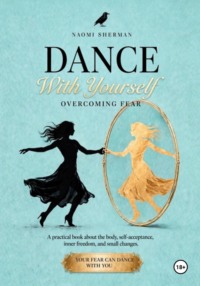
DANCE WITH YOURSELF
Overcoming Fear
A practical book about the body, self-acceptance, inner freedom, and small changes
Closing. A Dance Called “Life in Harmony”
You don’t have to wake up one day as someone who is no longer afraid of anything. Life does not require us to be confident all the time. It changes along with us—sometimes gently, sometimes unexpectedly, sometimes through very small steps.
Perhaps now you notice your body a little more carefully. You hear your breathing. You see how movement changes when there is no longer a need to live up to someone else’s idea of who you should be.
Perhaps you have learned to pause before your usual reaction and ask yourself, “What do I want?”
And maybe that alone is already a small success.
The dance with yourself does not end on the last page. It continues in ordinary days: when you choose comfort instead of tension, honesty instead of pretending, movement instead of freezing, support instead of being alone.
You may not always find it easy to move. Sometimes the step will be small. Sometimes you will want to stop. Sometimes the past will remind you of itself again. That does not mean you have gone backward.
You are simply continuing your dance.
The dance called “Life in Harmony” is not about perfection. It is about gradually finding your rhythm, noticing yourself, and leaving room in your life for breathing, movement, choice, and silence.
Look in the mirror.
Take a calm breath.
And make one movement that you choose for yourself.
That is enough for today.
And tomorrow, the dance will continue.
Naomi Sherman
Take a step toward yourself with a dance called “Dance with Yourself.”
Contents
Preface. A Few Minutes Just for Yourself
How to Use This Book
Part I. Returning to the Body
1. Your Body Does Not Have to Stay Silent
2. Looking at Yourself Without Judgment
3. Music, the Mirror, and the First Movement
4. From Tension to Fluidity
Part II. The Japanese Principle of the Small Step
5. Kaizen: You Don’t Have to Change Yourself All at Once
6. Wabi and Sabi: Making Room for Imperfection
7. The Present Instead of Endless Returning to the Past
8. Your Own Point of View
Part III. Eight Practices for Returning to Yourself
9. A Conversation with Your Body
10. Gratitude Before Letting Go
11. Symbolic Closure
12. After the Conversation—Returning to Yourself
13. A Conversation with Your Future Self
14. Meeting Your Past Self
15. A Step Forward After a Difficult Moment
16. Your Name Before an Important Choice
Part IV. 28 Days. Dance with Yourself
Closing. Thank Yourself
If You Need Support
Preface. A Few Minutes Just for Yourself
Before you read any further, pause. You do not need to become stronger right now. You do not need to urgently get rid of fear, find the right answer, or prove to yourself that you have already changed. Simply give yourself a few minutes. Close the door if that makes you feel more at ease. Put your phone away. Create a space where no one will expect you to be convenient, beautiful, composed, or productive.
Take a few calm breaths. Do not force your breathing to be deep. Let it be whatever it is today. Choose music you like. Not music you are “supposed” to dance to, but music that makes you want to move, even a little. Put on clothes that feel comfortable. Clothes that do not make you constantly adjust yourself, suck in your stomach, hide your shoulders, or think about how you look. Put a mirror in front of you. Not to look for flaws. Simply so that one day you can see yourself not through the eyes of an imaginary audience, but through your own.
Start with the smallest thing. Move your wrists. Your shoulders. Your head. Shift your weight from one foot to the other. Let your hands move the way they want to. At first, the movement may feel awkward. You may feel tension, embarrassment, or the urge to stop. Do not rush. You do not have to dance beautifully. You need to be present in your own body.
After a few minutes, try to notice what is changing. Maybe your shoulders become more relaxed. Maybe your breathing becomes calmer. Maybe you begin to move more freely. If your body allows it, add very simple stretching or yoga movements. Only without pain and without trying to prove your flexibility. You can bend, gently extend your arms, reach upward, or shift your weight forward or to the side. If you want to—improvise. You can repeat one movement several times. Not because it has to become perfect, but because repetition lets you feel, “This is my movement. I chose it.”
And one day, try looking at yourself in the mirror and asking a different question. Not, “What will people think of me?” But, “Do I like the way I look right now? Am I comfortable in this movement? Do I recognize myself?” It is a small change, but returning to yourself begins with small changes.
How to Use This Book
This book does not suggest fighting fear. Fear is not always the enemy. Sometimes it tells you that something matters to you. The purpose of the practice is not to force yourself to stop being afraid, but to learn how to stay beside yourself when fear appears.
This book uses ideas from Japanese culture and the principle of gradual improvement. It is important to clarify: there is no single scientifically established “Japanese subconscious technique” that can guarantee the elimination of fear. Here, Japanese concepts are used as cultural reference points for a gentle practice: taking a small step, paying attention to imperfection, being present, and respecting the process.
If strong anxiety, painful memories, dizziness, or physical discomfort arise during an exercise, stop. You can return to your normal breathing, open your eyes, sit down, or reach out for support. This book is not a substitute for medical or psychological care.
Part I. Returning to the Body
1. Your Body Does Not Have to Stay Silent
We tend to think of fear as a thought: “What if it doesn’t work out?” “What if they reject me?” “What if I make another mistake?” But distress is often noticed through the body as well: shoulders rise, breathing becomes shallow, the stomach tightens, and movements become cautious. There is no need to make a mystery out of this or look for a mystical explanation for every sensation. It is enough to recognize the obvious: thoughts and bodily reactions are connected, and paying attention to the body can help you notice your state earlier.
That is why the first practice does not require analysis. Place one hand on your chest and the other on your stomach. Do not try to fix anything. Ask yourself, “What is happening with me right now?” The answer can be anything: “I’m tired,” “I’m angry,” “I’m afraid,” “I don’t feel anything,” “I want to be left alone.” All of these answers are allowed.
Then ask, “What does my body need from me right now?” Sometimes the answer will be movement. Sometimes rest. Sometimes water, sleep, a conversation, or a hug. Being able to hear a need does not mean you have to fulfill it immediately. For now, it is enough to notice.
Pulsuz fraqment bitdi.