Kitabı oxu: «The Woman Men Marry»
PRACTICAL WORKBOOK
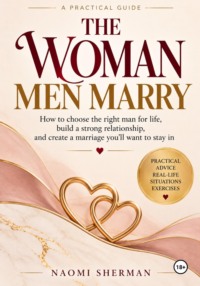
THE WOMAN MEN MARRY
How to choose a life partner, build a strong relationship, and create a marriage you want to stay in
Naomi Sherman
CONTENTS
Introduction. You Don’t Need to Become Someone Else
Chapter 1. Why Some Women Get Married While Others Date for Years
Chapter 2. Are You in Love with Him—or with Your Future with Him?
Chapter 3. Stop Auditioning for the Role of the Perfect Woman
Chapter 4. Attraction Is Not the Same as Compatibility
Chapter 5. How to Talk About Marriage Without Begging for a Proposal
Chapter 6. Why Promises Don’t Replace Actions
Chapter 7. Five Conversations to Have Before the Wedding
Chapter 8. How to Tell What Kind of Husband a Man Will Be in Real Life
Chapter 9. Housework, Money, and Responsibility
Chapter 10. How to Argue Without Destroying the Relationship
Chapter 11. How to Maintain Intimacy After the Wedding
Chapter 12. How to Tell When a Relationship Needs to Change
Chapter 13. Relatives and Boundaries for Your New Family
Chapter 14. Children: Shared Desires and Real Responsibility
Chapter 15. When a Man Pulls Away
Chapter 16. How Not to Lose Yourself in Marriage
Chapter 17. Intimacy, Desire, and Shame-Free Conversations
Chapter 18. Infidelity, Loss of Trust, and Rebuilding
Chapter 19. How to Make Big Decisions Together
Chapter 20. Create Your Own Definition of a Happy Marriage
Conclusion. Love Is Built on Mutual Choice and Respect
Appendix. Questions to Ask Before a Serious Relationship
INTRODUCTION. YOU DON’T NEED TO BECOME SOMEONE ELSE
CHAPTER 1. WHY SOME WOMEN GET MARRIED WHILE OTHERS DATE FOR YEARS
The phrase “the woman men marry” can make it sound as though there is a universal set of qualities that leads to a wedding. But people get married for different reasons. There is no single personality type or appearance that guarantees marriage.
There is a difference between a relationship that is moving forward and one in which one person is constantly waiting for the other to make a decision. In the first, the couple gets to know each other, discusses expectations, and makes decisions together. In the second, the future keeps getting pushed back: first one problem must be solved, then the right moment must arrive. Circumstances can be complicated, but endless uncertainty is information, too.
Anna and Ilya have been together for almost three years. He is affectionate, supportive, and says he loves her. Whenever Anna brings up marriage, he replies, “Of course, someday. It’s just not the right time.” He gives no reasons and names no conditions that would have to change. Anna waits because everything else seems good.
Ilya has the right not to be ready. Anna has the right to want clarity. She does not need to force a promise out of him; she needs to understand whether their plans match. She can say, “I want a family. It’s important for me to understand whether you see marriage with me and what needs to happen before we make that decision.” The answer may be difficult, but it will give her more to rely on than another “later.”
Don’t measure your attractiveness by one man’s decision. A relationship may not lead to marriage because plans differ or the partners are not compatible enough. That does not prove there is something wrong with the woman. What matters more is understanding whether the situation as it really is works for her.
The Difference Between Love and Readiness for Marriage
A person can have genuine feelings and still not want to get married, may not be ready for the responsibility, or may not see a shared future. These things can be painful to acknowledge because love can feel like a sufficient reason to take the next step. But feelings and life decisions are connected without being identical. You can love someone and still want different things. You can want a wedding without being ready for the everyday work a family requires.
A Conversation Without Blame
Instead of asking, “Why haven’t you proposed yet?” you can begin by explaining what marriage means to you and why you want it with this particular person. Then ask how he sees the future and what is keeping him from deciding. Don’t feed him the “right” answer, and don’t accept just any answer because you are afraid of losing the relationship. Listen to what he says, ask for specifics, and compare his words with what he does afterward.
Practice
Write down the signs of forward movement you see in your relationship: planning together, discussing important topics, sharing responsibility, meeting each other’s loved ones, and being able to resolve conflicts. Then make a separate list of what remains uncertain. This will help you discuss the actual situation instead of arguing about whether you are good enough.
A Situation to Examine
There is a question women ask themselves far more often than they admit out loud: “What is wrong with me if men want to date me but don’t want to marry me?”
Conflicting Rules
Perhaps your friends have told you to be softer. Your mother may have said that good men get snapped up quickly. Social media may tell you that a woman must be independent, gentle, sexy, wise, mysterious, and never demanding—all at once. At some point, a relationship starts to feel like a complicated exam you are still not prepared for.
Return to Your Own Choice
You have to respond to messages the right way. Don’t rush things, but don’t waste time either. Be independent, but let a man feel needed. Don’t show too much interest, but don’t seem cold. While you try to sort through these contradictory rules, it is easy to lose sight of what matters most: knowing what kind of man you want.
Understanding, Not Control
This book does not promise to teach you how to control another person’s feelings. No set of tricks can guarantee a marriage proposal. But you can learn to understand people better, notice incompatibilities, talk openly about the future, and avoid spending years in a relationship that is heading somewhere you do not want to go.
A Woman Who Chooses, Too
The woman men marry is not necessarily the most beautiful woman in the room. She is not necessarily the calmest, wealthiest, or most accommodating. She does not belong to a special category of women who know a secret about male psychology. She is a woman who makes choices, too. She can fall head over heels, make a mistake, and eventually discover that the man she thought would be her future husband imagines family life very differently.
The Main Question
Over time, she learns to distinguish desire from compatibility, beautiful words from real actions, and temporary excitement from a willingness to build a shared future. Most importantly, she understands that marriage itself is not proof of her worth. The goal is not to make every man want to marry you. The goal is to be able to say yes to a man with whom you genuinely want to share your life. Start by asking: Is he right for me—or am I already too busy trying to be right for him?
After he sends a rare, affectionate message, you start waiting again, even though nothing about your agreement has changed. Write down the facts and decide what direct question could help clarify the situation.
CHAPTER 2. ARE YOU IN LOVE WITH HIM—OR WITH YOUR FUTURE WITH HIM?
At the beginning of a relationship, imagination moves quickly. One good date can be enough to make you picture trips together, a home, and children. We barely know the person, yet we are already emotionally attached to a version of the future we have created ourselves.
The problem begins when we protect that imagined picture from the facts. He rarely calls—he must be busy. He avoids serious conversations—he must be afraid of his strong feelings. Any behavior can be explained away when it is frightening to admit that someone may not be ready to give us what we want.
Lena called a new acquaintance “very family-oriented” because he once said, “Someday I want kids.” But he showed little interest in her views on family, did not plan dates in advance, and disappeared for days at a time. Lena was in love less with their actual relationship than with the possibility it represented.
Divide your impressions into three lists: what you know about him from his actions; what he has told you about himself; and what you assume or hope to see. The first list should contain observable facts: Does he keep his word? Can he discuss disagreements? Does he show interest in your life? Potential is a possibility, not a promise.
Pulsuz fraqment bitdi.