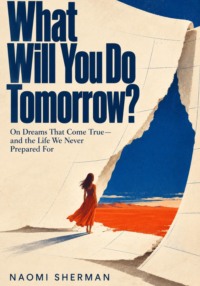
Kitabı oxu: «What will you do tomorrow?»
WHAT WILL YOU DO
TOMORROW?
On dreams that come true—and the life
we never prepared for
NAOMI SHERMAN
Contents
Prologue. The Morning After the Dream
1. We’re Used to Dreaming About the Finish Line
2. The Habit of Wanting
3. A Million Dollars on the Table
4. Waking Up Famous
5. When You No Longer Have To
6. Freedom Without Instructions
7. Your Desire or Someone Else’s Script?
8. The Fear of Taking the First Step
9. The Price of Choosing
10. When Success Has Already Happened
11. A Plan That Helps You Live
12. An Ordinary Tuesday
13. The Right to Change Your Mind
14. Life Without a Dress Rehearsal
15. What Remains When the Dream Comes True
Epilogue. At the Threshold
Afterword. The Next Paradox
Prologue. The Morning After the Dream
Imagine that tonight, something you have thought about for years finally happens. There is an amount of money in your account that once seemed out of reach. People know your name—people whose attention used to exist only in your imagination. You are offered the job you dreamed of. Or perhaps you have gained the most important thing of all: the freedom to manage your time without asking permission or explaining yourself.
The first few minutes feel like a scene from a movie. You check your phone, reread the message, and check it again. Then comes silence. No one tells you what to do next. The day begins like any other: daylight appears outside, you get thirsty, and your phone demands attention. And suddenly, a question you never made room for in your dream appears: what now?
We often imagine the moment of achievement in detail, but almost never the ordinary day that follows. We plan how to enter a new life as if a complete script will automatically appear on the other side of the door. But beyond that door is a space where we still have to make choices.
This book does not begin with advice to try harder. It begins with the pause between wanting and acting. In that pause, you can see that a dream is made up of different things: what you genuinely want; what you hope will impress others; the habit of wanting; and the hope that one day you will finally be given permission to live differently.
You do not need to find the right answer. Imagine that what you wanted has already happened, and do not run away from the morning that follows. Sometimes that morning shows us what we truly want. Tomorrow, you wake up as the person you dreamed of becoming. You no longer have to prove anything to anyone. The day is yours. What will you do first?
1. We’re Used to Dreaming About the Finish Line
A dream usually comes to us as an image. We see ourselves in a beautiful home, in another country, onstage, running our own business, or living a life in which we have enough money without constant fear. The image is vivid because doubt, tedious tasks, mistakes, and waiting have already been edited out. It contains the outcome, but not the process.
In our imagination, success is edited like a movie. We skip the days when nothing works, the conversations we will have to face, the dull decisions, paperwork, calculations, rejections, and uncertainty. We jump from today’s exhaustion to a wonderful ending. Fantasy can offer relief. The problem begins when it becomes the only place where we ever meet our desire.
Remove the audience from your dream. No one will know that you succeeded. There will be no congratulations, envious looks, beautiful photos, or chance to say, “I did it.” Only the changes in your everyday life will remain. Do you still want it?
If your answer changes, that does not mean the desire is false. Perhaps two things have become tangled together: getting what you want and receiving proof of your own worth. Money can mean security, but it can also mean never wanting to feel inferior again. Fame can mean having influence, but it can also mean finally being seen.
The goal is not to give up beautiful images. It is to turn them around and look at what is outside the frame. If you dream of owning a café, imagine not only the guests by the window, but also supplies, schedules, complaints, and exhausting evenings. If you dream of becoming a well-known writer, imagine not only the book cover, but also working on the next book.
A desire becomes clearer when it can withstand contact with reality. Perhaps you still want the café. Or perhaps what you really need is a creative project that brings together people, taste, and freedom. The difference matters: it helps you choose a path instead of just a postcard of the finish line.
**Practice: Frame by Frame.** Write down one big dream. List five details that usually appear in your imagination. Beside them, list five everyday details that will inevitably appear if the dream comes true. Do not judge them. Simply put back into the picture what used to remain outside the frame.
The question of this chapter: if you removed the chance to impress other people from your dream, what part of it would remain?
2. The Habit of Wanting
Some desires stay with us for so long that we stop questioning them. “Someday I’ll move.” “Someday I’ll start my own business.” “Someday I’ll become famous.” We repeat these statements almost as if they were our name or profession. The desire becomes part of our biography, even though it changes nothing about our calendar, budget, or decisions.
The habit of dreaming can be comfortable. As long as the goal stays in the future, we can preserve the image of ourselves as someone capable of great things. We do not have to find out whether we like the actual work, can handle uncertainty, or are willing to learn, ask for help, or look like a beginner. The future stays flawless because no one has touched it yet.
Taking action makes us vulnerable. It brings feedback and sometimes rejection. If you say you want to write a book but never write a page, the dream cannot disappoint you. If you write a page, it may be weak. But now you have something real to work with.
The habit of wanting has another trap: it lets us explain the present by pointing to the future. “I’ll put up with this for now; I’ll start living later.” But life does not always send a formal notice announcing the beginning of the next chapter. Often, it simply passes through the calendar.
Check the age of your desires. How long have you been repeating them? What has changed during that time? Perhaps they are still yours. Perhaps they belong to the person you were five years ago. You have the right to update a dream, make it smaller, let it go, or finally make it concrete.
**Practice: The Archive of Dreams.** Write down three dreams you repeat most often. For each one, note when it began, what you have done, what you have not done, whether you still want it today, and what small experiment could test the desire within a week.
The question of this chapter: which dream are you holding on to not because you still need it, but because you have grown used to calling it yours?
3. A Million Dollars on the Table
Imagine that a large sum of money is already yours. It has not been promised or expected; it is available now. You might feel relief, excitement, or disbelief. Then the decisions begin. Do you keep the money safe? Pay off debts? Help family? Buy a home? Quit your job? Invest? Leave town? Change nothing for several months?
Money does not make decisions for us. It expands our options, but it does not set our priorities. If every day used to be consumed by earning a living, the disappearance of that necessity may bring not only freedom, but also emptiness. When the familiar “I have to” falls away, you can hear what you actually want to do with your time.
The dream of having a certain amount of money is often emotionally clear but practically vague. “I want a million” may mean “I don’t want to fear unexpected expenses,” “I want to leave a job that drains me,” “I want to care for the people I love,” “I want to travel,” or “I want to feel that I matter.” Each desire calls for a different plan.
If the money suddenly landed in your hands, the first useful step would not necessarily be a purchase. It might be wiser to pause, check the legal and tax implications, understand the terms attached to the funds, and avoid irreversible decisions made in a rush of excitement. A major change deserves clarity, not an impulsive display.
Imagine that your basic expenses are covered and no one around you knows about your money. How would you spend a week? What would you keep doing? What would you stop doing? Who would you spend time with if you no longer needed relationships for status? What would you do when no one asked whether it was profitable?
**Practice: The Week After a Million.** Describe the first seven days after receiving the money. Do not list only purchases. Write down what you would check, which decisions you would postpone, whom you would talk to, and what you would leave unchanged. Then sort your desires into three groups: security, freedom, and pleasure.
Pulsuz fraqment bitdi.