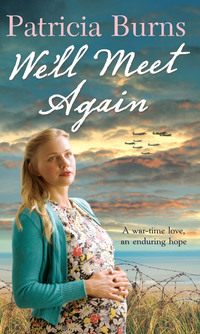
Kitabı oxu: «We'll Meet Again»

PATRICIA BURNS is an Essex girl born and bred and proud of it. She spent her childhood messing about in boats, then tried a number of jobs before training to be a teacher. She married and had three children, all of whom are now grown up, and she recently became a grandmother. She is now married for the second time and is doing all the things she never had time for earlier in life.
When not busy writing, Patricia enjoys travelling and socialising, walking in the countryside round the village where she now lives, belly dancing and making exotic costumes to dance in.
Find out more about Patricia at www.mirabooks.co.uk/patriciaburns

Patricia Burns
 www.mirabooks.co.uk
To Dorothy Lumley,
who never stopped believing in this book
Contents
Cover
About the Author
Title Page
Dedication
CHAPTER ONE
CHAPTER TWO
CHAPTER THREE
CHAPTER FOUR
CHAPTER FIVE
CHAPTER SIX
CHAPTER SEVEN
CHAPTER EIGHT
CHAPTER NINE
CHAPTER TEN
CHAPTER ELEVEN
CHAPTER TWELVE
CHAPTER THIRTEEN
CHAPTER FOURTEEN
CHAPTER FIFTEEN
CHAPTER SIXTEEN
CHAPTER SEVENTEEN
CHAPTER EIGHTEEN
CHAPTER NINETEEN
CHAPTER TWENTY
CHAPTER TWENTY-ONE
CHAPTER TWENTY-TWO
CHAPTER TWENTY-THREE
CHAPTER TWENTY-FOUR
CHAPTER TWENTY-FIVE
CHAPTER TWENTY-SIX
CHAPTER TWENTY-SEVEN
CHAPTER TWENTY EIGHT
CHAPTER TWENTY-NINE
CHAPTER THIRTY
CHAPTER THIRTY-ONE
CHAPTER THIRTY-TWO
CHAPTER THIRTY-THREE
CHAPTER THIRTY-FOUR
CHAPTER THIRTY-FIVE
CHAPTER THIRTY-SIX
CHAPTER THIRTY-SEVEN
Copyright
CHAPTER ONE
January 1953
IT SEEMED to be a day like any other. Windy, certainly, but at Marsh Edge Farm they were used to almost constant wind, exposed as they were. It swept over the Essex flatlands with increasing power that day, the last day of January in the year of the new Queen’s coronation. It came howling across the low grasslands that had once been part of the sea, raced over the snaking sea wall and buffeted the grey North Sea into angry white-topped waves.
It whipped the skirts of Annie Cross’s old grey mac round her frozen legs as she brought the dairy cows in for evening milking. She pulled her muffler more snugly round her neck and looked round anxiously at her small son. Bobby was plodding behind the last animal, stick in hand, the clinging mud nearly to the top of his wellingtons. His small face was pinched and his nose was streaming. In the gap between his raincoat and his boots, his bare knees were bright red with cold. Annie forced an encouraging smile.
‘Nearly there, darling! Grandma’s making us some scones for tea. That’ll be nice, won’t it?’
Bobby nodded and sneezed, and wiped his nose on his sleeve. Annie’s heart contracted. He shouldn’t be out here in the wind and the cold. He should be indoors in front of the kitchen range, being cosseted by his grandma. But cosseting was out of the question at Marsh Edge Farm.
Her father was waiting for them in the yard. A small man, Walter Cross watched their arrival from beneath the peak of his cloth cap, his eyes hard in his narrow face.
‘You took your time. What’s the matter with you? Having a holiday?’
Annie shook her head. It wasn’t a question that required answering.
‘You’ll have to do the milking. I still haven’t got that blasted tractor to work. Don’t know what you’ve gone and done to it,’ her father said.
‘Right,’ Annie said.
It was no use pointing out that the tractor had failed while he’d been driving it. After all, everything that went wrong round here was her fault. Hers or Bobby’s.
‘And make sure that brat of yours helps. Cold, indeed! I never heard the like. Never got colds in my day. Get the little bastard working. That’ll soon cure him.’
Walter glared in the direction of the child, who stood in the yard entrance, his frightened eyes flicking from his mother to his grandfather. Walter grunted.
‘Bad blood,’ he muttered.
Annie’s self-control snapped. ‘He’s your grandson!’
Her father’s mouth stretched into a grim smile. He had provoked her. Satisfied, he turned to trudge across the yard to where the tractor stood under an open-sided shelter.
‘Make sure it’s all scrubbed down proper after. No skiving off early. I’ll be checking to see you’ve done it right, mind,’ he warned over his shoulder.
Annie said nothing. Walter stopped and slowly looked back at her. Behind her, Annie heard Bobby give a small whimper of fear.
‘You heard what I said?’ he demanded.
‘Yes, Dad.’
‘Good.’
His absolute authority assured, Walter walked on.
‘Pig,’ Annie muttered under her breath. ‘Bully. Schweinhund.’
She had learnt that one from the pictures. It gave her particular pleasure. She repeated it with as guttural a German accent as she could manage.
At least the milking was inside. Annie and Bobby went about the well-worn routine—feeding, washing udders, fixing on the cups. Without Walter there criticising their every move, they could almost enjoy it. Bobby sniffed and sneezed but worked manfully. He was only seven, but he was a well-seasoned assistant.
‘When I was little,’ Annie told him, ‘we did all this by hand. It took ages, even though we didn’t have so many cows then.’
Like Bobby, she had had to help from an early age. She could hardly remember a time when she hadn’t laboured on the farm.
‘Did they like you doing it by hand?’ Bobby asked. ‘The cows?’
Annie thought about it.
‘Yes. I think so. But you had to do it properly, or they’d kick you, or knock the bucket over.’
‘I bet he didn’t like that.’
‘No, he didn’t.’
The long day wasn’t yet over. The cows had to be turned into their pens and the dairy scrubbed down. Then there were the pigs to feed and hens to shut up for the night. By the time they had finished, Bobby’s teeth were chattering. Annie fished a handkerchief out of her pocket and held it over his nose.
‘Blow,’ she told him.
He blew.
‘That feel better?’
He nodded.
Annie put an arm round his shoulders and gathered him to her. He hugged her hips, nestling his balaclaved head against her. She glanced over to where her father was still leaning over the tractor engine with a spanner in his hand. She knew better than to go in without clearing it with him.
‘We’re finished, Dad,’ she called across the yard.
He didn’t let them go in straight away, but that was normal. Instead he found fault in their cleaning of the milking parlour. But when that was finally done to his satisfaction, they all went inside.
Marsh Edge farmhouse was a square plain brick building with a parlour, large kitchen, a scullery and an outside toilet downstairs and two large and two small bedrooms upstairs. The only room in the house that was heated was the kitchen, and it was there that they lived. It was hardly a model of comfort. The floors were stone-flagged, the walls whitewashed. A wooden sink and some shelves were built under the window, a green-painted dresser and some deal cupboards stood against one of the walls, a plain scrubbed table occupied the middle of the room with four stick-back chairs round it, while two Windsor carver chairs and a settle were set round the rag rug in front of the blackleaded range. The only clues that this was 1953 rather than 1903 were the big brown wireless on top of one of the cupboards, and the single electric light bulb under its red shade in the centre of the room.
Plain as it was, the kitchen seemed a haven of light and warmth after the raw cold of the yard. Annie and Bobby left their macs and wellingtons in the porch and washed their hands in the scullery. Edna Cross welcomed them in.
‘You poor things; you must be frozen. How’s my poor boy? That cold any better? Here, come and get warm by the range. I’ll open the front up …’
Edna was an older version of her daughter, small and round-faced with a turned-up nose, but years of hard work, poor health and marriage to Walter had etched lines into her pretty face, and made her painfully thin rather than slender. Her narrow hands were red and rough and the hair that had once been fair and naturally wavy was limp and colourless. She had long ago given up any idea of being anything but a drudge.
‘Is he coming?’ she asked Annie, with a motion of her head towards the yard.
‘I think so.’
‘I’ll do the toast, then. Can you make the tea, love?’
Annie shifted the big black kettle from where it was simmering on the side of the range to the hot spot in the middle, while her mother threaded a thick slice of bread on to the toasting fork. Bobby crouched on the rug, warming himself like a cat.
‘He got that tractor fixed?’ Edna asked.
‘Not yet.’
Neither of them made any further comment. It went without saying that his failure would not improve Walter’s temper. Edna’s hand shook a little as she held the toasting fork. Walter came in and the meal was put on the table—toast and dripping followed by scones and gooseberry jam, washed down by plenty of tea. The lack of conversation was disguised by the measured voices of the BBC announcers on the Home Service.
The evening passed like a hundred others. Annie put Bobby to bed and then sat by the range knitting him some socks. Walter read the local paper with the odd comment on the stupidity of one person or another while Edna hand-worked buttonholes in a rayon blouse for one of her customers. They listened to Saturday Night Theatre on the wireless. The weather forecast warned of continuing gales.
‘There’s a spring tide tonight and all,’ Walter said.
Edna looked fearful.
‘Spring tide and a gale? Will we be safe?’
‘Don’t talk daft, woman,’ Walter scoffed. ‘Wind’s offshore. If anyone gets it, it’ll be them Dutchies. Very low-lying, Holland is. Much more’n here.’
Annie made cocoa and put the porridge pot to simmer on the range, then there was the ritual of locking up before they went upstairs. Annie undressed as quickly as possible in her freezing bedroom and put on a flannelette nightie that came up to her neck and down to her ankles while on her feet she wore woolly socks.
Before getting into bed, she held back the curtain and took a quick peep outside. Way across the fields was the dark line of the sea wall, the place where she had met Tom, all those years ago when they had both been hardly more than kids. She pulled her mind away. It was no use dwelling on Tom. Under the sea wall, a light shone in a window, bringing a smile to her face. The light meant love and cheerfulness and hope. It came from Silver Sands, the little wooden chalet where her dear friends Reggie and Gwen lived, surrounded by the half dozen caravans that they insisted were going to make their fortune one day soon. While Reggie and Gwen were there, her life had a bright spot in it. She sent them a goodnight blessing. Then she climbed into the iron bedstead with its lumpy mattress and curled into a ball round her stone hot water bottle, gradually extending her feet down the bed as it warmed up.
Tired out from a long day working in the cold wind, she fell deeply asleep, only to be woken some time later out of a confused dream. Somewhere out in the yard, a door was banging. It was still a wild night out there. Wide awake and anxious about her friends, Annie slid out of bed and padded across the dark room to the window. Gwen was expecting a baby any day now. What if it had chosen tonight to arrive? What if Reggie’s car, never very reliable, refused to start? She drew back the thin curtain and looked out once more. The sky had cleared and a bright moon shone down, silvering the marshes, glinting off—water! Annie caught her breath, not wanting to believe her eyes. There was a lake where the lower meadows should be. The fields were flooding.
She stared through the night, trying to make out what was happening, trying to distinguish the solid bulk of the wall, their only protection from the North Sea. She could see the pale glimmer of Reggie and Gwen’s caravans crouching under where it should be.
‘My God! Gwen!’ she cried out loud.
If the water was coming over the wall, Reggie and Gwen were right in its path.
She blundered for the door, feeling for the light switch. Nothing happened. She flicked it up and down. Still nothing.
‘Damn, damn.’
She stumbled across the landing and banged on her parents’ bedroom door.
‘Dad, Mum! Wake up! The water’s coming over the wall! There’s a flood!’
It took a few minutes to get her father awake and to make him understand what was happening. Once he did, his thoughts were for the stock.
‘Get dressed. We got to get the store cattle in. The dairy herd’ll be all right. The water won’t reach as far as here.’
‘But, Dad, it’s already over the lower meadows—’
Her head rocked sideways as his heavy hand caught her round the ear. Through the ringing, she heard him shouting at her.
‘Don’t argue with me, girl. Get some clothes on. Quick.’
Annie knew better than to say any more. As she hurried into sweaters and trousers and felt her way downstairs in the dark, anxiety about her friends gnawed at her. How could she warn them? If only they had a telephone. Her father was in the kitchen, cursing as he lit the hurricane lamps that they kept for emergencies. The warm glow only made the shadows in the corners of the kitchen look darker. He thrust one into her hand.
‘Come on.’
Annie hurried after him into the night. Once out of the protection of the farmyard, the full force of the gale hit her, nearly knocking her off her feet.
‘Shift y’self, you useless mare, it’s not even high tide yet. It’ll get worse,’ her father yelled.
‘Who said it was all right because the wind was offshore?’ Annie muttered, but she did not dare say it out loud.
They struck out across the fields, leaving the gates open as they went, Annie almost running to keep up with her father as he strode ahead. The wind was pulling at her raincoat, buffeting her face, making her ears ache and her eyes water. She did not look ahead, just kept her eyes on her father, a darker shape in the surrounding night. When they got close to the drainage ditches, where the water usually flowed sluggishly along the bottom, she could see by the moonlight that it was lapping over the edges. And there was another thing—something wrong. She could not put her finger on it at first, what with the wind and the dark and the effort of keeping up with her father, but then it came to her. The water in the ditches was running the wrong way. It was not draining away to the sea, it was coming in. Soon it was spreading out into wide puddles. She slid and floundered on the waterlogged ground. She fell on her knees and staggered up again. The journey took on the quality of a nightmare, going on and on, with her father looking back occasionally and cursing her for not keeping up.
Then at last they were at the field nearest to the sea wall. The young cattle were huddled at the gate, already up to their hocks in floodwater.
‘Get round behind them, you stupid slut!’ her father bawled.
She tried to obey, wading round the uneasy herd, moving with difficulty as the floodwater came over the tops of her wellingtons and filled them up. She started yelling at them. The wind tore the sounds from her mouth. She thumped and pushed the animals’ rumps, her feet sliding and squelching in the thick mud. Already upset by the storm, they started lowing and milling about. She could only hope that one would have the sense to get going, and then the others would follow it. To her relief, some instinct for survival seemed to get hold of them. One went through the gate, then another. Knowing where to go now, they went plodding into the next field. Already that was awash as well, the gale whipping it into miniature waves. Over the next field and the next they went, gathering up more stock, herding the frightened animals towards each gate, forcing them through. The water seemed to be racing ahead of them, turning each field into a lake before they reached it. Annie’s throat was raw with yelling at the beasts, every muscle in her body ached, her legs felt like weights, dragging her back, slowing her down. But ahead was the farmhouse, silvered in the moonlight. They were in the home field.
She paused in her own battle to spare a thought for her friends, staring through the night towards Silver Sands. With the electricity out, there were no lights showing, no way of knowing whether Reggie and Gwen were awake and saving themselves.
‘Don’t stop now! Get on!’ her father shouted.
‘Reggie and Gwen—’ she yelled.
‘What? What now?’
‘Reggie and Gwen. At Silver Sands—’
‘Too late. Get on.’
If only they had a telephone. Or a boat. If only the tractor were working. If she could just know what was happening. How deep was it down by the sea wall now?
Then, above the howl of the storm, she heard, or rather felt, a rumbling roar, and there, coming towards her across the flooded fields, was a wall of water that seemed as high as a double-decker bus. Terrified, she turned and tried to run.
She staggered forward, fear giving her a new desperate energy. Ahead of her the farm buildings loomed, blacker in the surrounding darkness, promising safety, but her way was blocked by a solid rank of frightened, bewildered cattle. She shrieked and beat at them, trying to get through. She glanced over her shoulder. The wave was getting nearer.
The first cows reached the farmyard and waded inside, fanning out into the wider space. Annie lashed out at the ones behind, swinging the hurricane lamp at them, screaming. Then the water hit her.
Icy and black, the whole weight of the North Sea behind it, it knocked her off her feet. Helpless, she was carried along, her arms and legs thrashing uselessly in the swirling current, knocking into bony rumps and sharp horns. There was a roaring in her ears. Her lungs were bursting. Then, just as she thought she could not hold her breath any longer, she crashed into something solid and held on with both arms and all her strength. She found her feet and dragged herself upright. Her head surfaced. Choking and gasping, she sucked in the blessed air.
She had fetched up against a tree. For several moments she just clung on to the slender trunk, shaking, gasping, thankful simply to be alive. Around her she could hear the cattle still lowing in fear, but now her only thought was for herself. She had to get to the house. The water was up to her shoulders and still rising.
‘Ann!’
A croak in the darkness. Her father. At first she couldn’t see him in the swirling confusion.
‘Ann! Help me!’
The moonlight caught his head. His hat was gone, his face was twisted in fear. He was being washed towards her, the tyrant reduced to a helpless rag doll by the raging force of the flood. Annie could see him trying and failing to get his feet to the ground, his arms flailing. An odd disconnected thought slid into her head. He hadn’t called her by her name in years.
A chance eddy brought him near to her, nearer—
‘Ann!’
There was terror in his voice, desperation in his face. His hand stretched out to her. He was three yards away, two. The events of her life seemed to whirl before her. She was six years old again, was cowering before him as he grasped her arm, his heavy hand beating her again and again. She was eleven. Her teacher said that if she worked hard, she could pass the exam for the grammar school. But her father sneered at the very idea. Grammar school was not for the likes of her. She was needed on the farm.
‘Please, Ann—!’
He was her father. He couldn’t swim.
‘Dad?’ she croaked.
She had only to let go of the tree with one hand and reach out to him.
She saw Bobby cowering, Bobby terrified at having failed to do some task way beyond his years and strength, Bobby called nothing but ‘that boy’ and forced to call his own grandfather ‘Mr Cross’.
‘Ann, for God’s sake—’
He was close enough for her to touch his fingertips. But she did not. And a moment later he was gone, swallowed up into the black water.
‘Dad!’ she screamed.
She let go with one arm and strained after him. The hungry current got her in its grip, tugged and sucked at her.
‘Dad!’
Frantically, she flailed about, trying to find him, to catch hold of him.
But it was too late.
CHAPTER TWO
July 1940
‘No MORE school, no more books, no more teacher’s dirty looks!’ Annie’s friend Gwen chanted as she danced along the road.
Annie followed with a heavy heart. This was her last day of freedom, the last day she would walk towards home with Gwen, the last day of laughing and chatting to her friends at break time, the last—
‘Let’s go and look at the beach!’ Gwen called over her shoulder. Her freckled face was pink with excitement, her girlish plaits and her white ankle socks contrasting oddly with the woman’s figure beneath her cotton frock.
Annie glanced down at her own woefully small breasts. That was something else that Gwen had more of than her. It wasn’t fair.
‘All right,’ she agreed.
Anything to put off going home.
Gwen waited for her to catch up and threaded an arm through hers.
‘I’m never going to open another book again,’ she vowed.
Annie sighed. ‘I probably won’t be allowed to.’
‘Oh, you—’ Gwen pushed her away and pulled her in again. ‘You’re such an old swot. Mr Clifton’s favourite! Teacher’s pet! What did he say to you, when he called you up to his desk?’
‘He wished me luck and told me to keep going to the public library,’ Annie admitted.
She was going to miss Mr Clifton, Annie decided. He had stuck up for her when her dad had refused to let her take up her scholarship to the grammar school. He’d offered to go and speak to her dad about it. Not that it had done any good, but at least he had tried. And he’d always been kind to her and encouraged her reading, getting her to try new authors and discuss what she had read.
‘No need to tell you that,’ Gwen said. ‘Oh, isn’t it lovely? We’re grown-ups now. We’re not kids any more.’
‘It’s all right for you; you’re going out to work. You’ll have money of your own. I’ll just be stuck on the farm, day in, day out,’ Annie said.
School had been her escape. Her father didn’t see the point of her going, but it was the law that children had to attend until they were fourteen, and even he had to obey that. He flouted it as much as he could, keeping her back when they were busy on the farm, but still Annie had been able to get away most of the time. But from now on, she was going to be tied. It was like a prison sentence, stretching away ahead of her, with no let-off for good behaviour. Already, her father had given notice to the elderly man who had worked for them for the last ten years. She was cheaper, and available seven days a week.
‘But you’ll get time off, surely?’ Gwen said. ‘He won’t have you working in the evenings. We can go to the pictures together.’
‘Yes—’ Annie tried to be optimistic. ‘He can’t keep me in all the time, can he? We’ll go to the pictures Friday nights.’
‘Cary Grant …’ Gwen sighed. ‘Humphrey Bogart …’
‘Clark Gable …’ Annie responded.
‘Who would you like to be, if you was a film star?’ Gwen asked.
‘Judy Garland.’
How wonderful to be Dorothy and meet the Tin Man and the Cowardly Lion … how wonderful to escape from your farm and land in Oz. But of course you had to live in Kansas for that to happen to you. Whirlwinds didn’t tear across Essex.
‘Judy Garland? Oh, no. I want to be glamorous. I want to be Vivien Leigh.’
And meet Rhett Butler.
‘Oh, yes …’ Annie sighed.
Both happy now in their fantasy world, the girls marched arm in arm along the dusty summer streets of Wittlesham-on-Sea. The neat terraces of guest houses leading to the sea front still had ‘Vacancies’ notices hopefully displayed in their front windows, but many of the gardens had their roses and geraniums replaced by lettuces and peas as people answered the call to dig for victory.
When they reached the sea front, they stopped automatically and looked towards the pier.
‘Quiet, isn’t it?’ Gwen said. ‘My mum says it’s hardly worth keeping open.’
Gwen’s mum ran The Singing Kettle, a tearoom fifty yards from the pier entrance. The previous summer, the last summer of peace, it had been a little gold-mine, and Gwen had been kept as busy as Annie, running from kitchen to table with trays of teas and cakes and sandwiches, and back again with piles of dirty crockery. This year the visitors were few and far between. People were reluctant to go on holiday when invasion forces were threatening just across the Channel.
‘Blooming Hitler,’ Gwen grumbled as they surveyed the sprinkling of holiday-makers and the barbed wire entanglements running the length of the beach. ‘Gone and ruined everything, he has. That’s what my mum says.’
‘Yes,’ Annie agreed. ‘We’ve had to plough up the fields by the road because of him.’
Digging for Victory had meant that her father had had to change some of his farming practices. He hadn’t liked that at all, and she and her mother had been the ones to bear the brunt of it.
The girls turned away from the pier and strolled along together towards the southern end of the promenade. Even fewer businesses were open here, and the locked doors and boarded-up windows gave the prom a forlorn air.
‘D’you really want to go and work at Sutton’s Bakelite?’ Annie asked.
Gwen shrugged. ‘It’s good money, and it’s all year round,’ she pointed out.
Year-round jobs were at a premium in Wittlesham, where seasonal work was the norm.
‘Yes, but Sutton’s—Beryl’s dad,’ Annie persisted.
‘I know—’ Gwen said.
Both of them thought of Beryl Sutton, their sworn enemy.
‘—but it is war work. I’ll be making parts for aeroplanes and stuff. Wirelesses, that sort of thing,’ Gwen said.
‘I s’pose so. But Toffee-nose Beryl—’
‘Swanky knickers—’
‘Posh pants—’
They giggled happily, dragging up every insult they’d ever thrown at Beryl. But it still didn’t help with the deep jealousy Annie harboured, swilling like poison in her gut. Beryl had been allowed to go to the grammar school, when Annie had always beaten her in every school test they ever did. On top of that, they shared a birthday. Somehow, that made it much worse.
‘She won’t be there,’ Gwen pointed out.
No, Annie thought. She’ll be at school, for another two years. Lucky cow.
‘And her dad’s all right.’
‘Yes.’
That was another thing. Beryl’s dad was all right. He was nice. He was big and cheerful and adored Beryl. But then Gwen’s dad adored her, too. He called her his little princess and slipped her money for treats with a wink and a ‘Don’t tell your mother.’ Annie sighed. It wasn’t fair.
The closed up souvenir shops and cafés dwindled into bungalows as the cliff ran down towards the marsh at the edge of the town. As the sea wall joined the end of the prom, there was a no man’s land of nettle-infested building plots and little wooden holiday chalets on legs that was not quite town but not country either. The roads here were just tracks and there was a temporary feel about the place. On the very last plot, a field under the sea wall that took a corner out of Annie’s father’s land, was a holiday chalet called Silver Sands. It belonged to the Suttons, who let it out to summer visitors.
‘Looks like they’re opening it up,’ Annie said.
She was right. The windows and doors were open and the net curtains were blowing in the breeze. Rugs hung over the veranda rails. From inside came the sound of someone banging around with a broom.
‘Trust the Suttons to get lets when no one else can,’ said Gwen. ‘There’s a lot of people in this town don’t know what they’re going to do if this war goes on much longer. My aunty May’s desperate. She’s only had two families so far this summer, and lots of her regulars have cancelled. And my uncle Percy, he can’t work, not with his chest. And, like she says, rates’ve still got to be paid, and the gas and electric and everything, and the rooms kept nice, whether there’s visitors or not. She was talking to my mum about it the other day. Went on about it for hours, she did.’
‘Yes,’ Annie said.
Her eyes were on Silver Sands. It was a trim little place, painted green and cream with sunray-effect woodwork on the veranda rails. Around it was about half an acre of wild ground with roughly cut grass, a few tough flowering plants and a swing. Positioned as it was, right next to Marsh Edge Farm, it had always held a special place in her imagination. When she was little, she liked to picture herself creeping in and living there, safely out of the way of her father, her own small palace where she could order everything the way she wanted.
‘I wish it was mine,’ she said, without really meaning to let it out.
‘It’s only a holiday chalet like all the rest,’ Gwen said. ‘I dunno why you make such a fuss about it. You wasn’t half mad when the Suttons bought it! I thought you was going to burst a blood vessel!’
‘Well, why should they have it? Them, of all people? That Beryl …’
Annie’s voice trailed off. There, on the track leading to the chalet, was Beryl. It was as if she had been summoned like a bad genie by Annie’s speaking her name. Annie took in her grammar school uniform, the green and white checked dress, the green blazer, the straw hat with its green ribbon and green and yellow badge. Her guts churned with jealousy.
‘Ooh—’ she jeered. ‘It’s the posh girl. Look at her soppy hat! What’re you wearing that hat for, posh pants? Looks like a soup plate!’
‘Soup plate on her head!’ chimed the faithful Gwen.
Beryl glared at them. She was a solid girl with brown hair cut in a straight fringe across her broad face and thick calves rising from her white ankle socks. The school uniform that Annie envied so much did nothing for her looks.
‘Common little council school brats,’ she countered, her lip curling into a full, cartoon-sized sneer. She glanced behind her. ‘Come on, Jeffrey. Mummy doesn’t like us talking to nasty little guttersnipes. They might have nits.’
It was only then that Annie noticed Jeffrey Sutton, Beryl’s younger brother by a year, sloping up along the track towards them. He was also in grammar school uniform, his leather satchel over his shoulders, his green and black striped cap pushed to the back of his head. It was unfortunate for Beryl that she took after her mother while her three brothers favoured their father, for the boys had the better share of the looks. Jeffrey caught up with his sister and threw Annie and Gwen a conciliatory grin. You never knew which way Jeffrey might jump. His loyalties depended upon the situation.
‘Wotcha!’ he said.
Beryl rounded on him. ‘Jeffrey! Ignore them.’
Jeffrey shrugged and walked on, opting out of the situation. As he went, he said, ‘Bye!’
It was difficult to know who he was speaking to, but Annie leapt on the one word and appropriated it.
‘Bye, Jeffrey,’ she said, as friendly as could be.
She was rewarded by a look of intense annoyance on Beryl’s face.
‘So you’re going to be one of my father’s factory girls, are you?’ she said to Gwen, breaking her own advice of ignoring Gwen and Annie.
‘I’m going to be earning me own living,’ Gwen retorted. ‘Not a little schoolgirl in a soup plate.’
‘You are so ignorant, Gwen Barker,’ Beryl said, and stalked off up the track and in at the gate of Silver Sands.
‘Ooh!’ Gwen and Annie chorused and, linking arms again, marched after her, past the gate and on towards the sea wall. As they dropped arms to take a run at the steep slope, Beryl’s mother came out on to the veranda, her face set in lines of disapproval.
Annie couldn’t resist. She gave a friendly wave.
‘Afternoon, Mrs Sutton!’ she called cheerfully and, before Mrs Sutton had a chance to reply, the pair of them raced up the grassy bank, over the bare rutted path at the top and slid down the other side. They landed in a heap at the bottom, giggling helplessly and scratched all up their bare thighs from the sharp grass blades.
‘Did you see her face?’ Gwen chortled.
‘Sour old boot!’ Annie gasped.
It was warm and still at the foot of the sea wall, for the wind was offshore. There was a smell of salt and mud and rotting seaweed on the air. The very last of the Wittlesham beach was at their feet, a narrow strip of pale yellow sand and shingle that dwindled to nothing fifty feet to their right where it met the marsh.
Annie wrapped her arms round her legs and rested her chin on her knees, staring through the barbed wire entanglements, out across the fringe of grey-green marsh and wide expanse of glistening grey-brown mud to where the waters of the North Sea started in lace-edged ripples. It was friendly today, in the height of summer, the sunlight glinting off the gentle green waves. She let the peace steal into her with the heat of the sun. A curlew uttered its sad cry. She felt safe here.
‘Jerries are over there, across the water,’ Gwen said.
‘Mmm,’ Annie said.
That was what they said, on the wireless. It was difficult to believe right here, sitting in the sunshine.
‘My dad’s out every evening, drilling with the LDVs. No, not that. The Home Guard, it now is. Mr Churchill said.’
‘My dad doesn’t hold with it,’ Annie said.
But then her dad didn’t hold with anything that meant cooperating with anyone else. And her dad would be expecting her home soon. She didn’t own a watch, so she had no idea of the exact time, but her dad knew when school ended, and how long it took to walk home. Reluctantly, she stood up.
‘S’pose I’d better go,’ she said with a sigh.
‘You got to?’ Gwen asked. ‘It’s the last day of school. It’s special.’
Gwen’s mum had promised her a special tea, and then they were all going to the pictures—Gwen, her sister and her mum and dad.
‘Not in our house, it isn’t,’ Annie said. ‘Have a nice time this evening. Tell me all about it.’
They scrambled to the top of the sea wall again. Gwen set off towards the town. Annie stood for a moment watching her, then turned and ran down the landward side and up the track beside Silver Sands. She couldn’t help glancing over the fence at the little chalet in its wild garden but, though the windows were still open, none of the Suttons were outside. She skirted round the back of the garden and struck out across the fields. The newly expanded dairy herd grazed the first two. Then there was an empty field that had been cut for silage. Ahead of her across the flat land, she could see the square bulk of the farmhouse and the collection of sheds and barns round the yard. Marsh Edge Farm. Home. It gave her a sinking feeling.
One field away from the house, Annie climbed over the gate and on to the track that led from the farm to the Wittlesham road. She looked at the yard as it grew steadily nearer. Was her father there? She started counting—an odd number of dandelions before she reached the hawthorn tree meant he was there, an even number meant he wasn’t. Nineteen—twenty—twenty-one. Bother and blast. Try again. If she could hold her breath as far as the broken piece of fence he wouldn’t be there …
She reached the gate into the yard. In winter, it was a sea of mud, but now, in summertime, it was baked into ruts and ridges in some places and beaten to dust by the passing of cattle hooves twice a day in others. Hens strutted and scratched round the steaming midden in one corner, the tabby cat lay stretched out in the sun by the rain barrel. A gentle grunting came from the pig pen. Annie started to relax. Perhaps he was in one of the fields on the other side of the farm. She could go in and have a cup of tea with her mum.
Then there was a sudden flutter and squawk from the hens, and out of the barn came her father. He stopped when he saw her and fixed her with his pale blue eyes.
‘You’re late,’ he said.
CHAPTER THREE
ANOTHER long day of work was done and the last chores in the farmyard were finished. Annie looked in at the kitchen door. Her mother was sitting at the big table, turning the wheel of her sewing machine. The needle flew up and down so fast that it became a blur, while her mother fed the long side seam of a green silk dress beneath it.
‘Mum?’ Annie asked. ‘You all right? You need me to do anything?’
‘No—no—’ Edna Cross did not take her eyes from the slippery fabric. ‘Just want to get this done before Mrs Watson comes for her fitting tomorrow.’
‘I think I’ll go out for a bit, then.’
‘All right, dear.’
Annie slid out of the porch, ran across the yard and away down the track before her father could see what she was doing. Once over the gate into the first field, she slowed to a walk. She felt physically light, as if she might bounce along if she wanted to. For a short while, until it got dark and she had to go back indoors, she was free.
She headed automatically for the sea wall. It was no use looking at Silver Sands, for a big family had moved in two days ago for a holiday. Even from here she could see the two little tents they had put up in the garden because the chalet wasn’t large enough to accommodate them all. But it would be all right the other side of the wall. That was one advantage of the barbed wire—it kept people off the beach. Nobody but her liked to sit on the small bit of sand between the wall and the wire.
It was a beautiful summer’s evening, warm and still. Annie dodged the cow-pats and the thistles, singing as she went.
‘Wish me luck as you wave me goodbye …’
The one big bonus of the war, as far as she was concerned, was that her father had gone out and bought a wireless so he could listen to the news each evening. Which meant that they could also listen to Henry Hall and Geraldo, and her mother could have Music While You Work on. Now she knew all the latest songs just as soon as Gwen did.
As she came nearer to Silver Sands, she could see the family there out in the garden. She felt drawn to study them. There were two women—Mum and Aunty, maybe?—sitting on the veranda knitting, together with a man reading a newspaper, while a bunch of children all younger than herself were running round the bushes and up and down the steps in a game of ‘he’. Annie skirted the garden, wishing there was another way on to the sea wall, but you had to walk a long way away from the town before you got to the bridge over the wide dyke that ran along behind the wall. There were shrieks from the children as someone was caught, and then yells of, ‘Joan’s It! Joan’s It!’ Annie wondered what it would be like to have a holiday. It must be nice to be able to play all day long like those children. Not that she was wanting to run around playing now, of course. She was too grown up for that. But she would have liked it when she was little.
She ran up the sea wall, stopping at the top to look about.
‘Oh!’ she said out loud.
For there, just below her on the seaward side of the wall where nobody ought to be, was a boy a year or so older than herself with a sketch-book on his knee.
If he had heard her, he made no sign of it, but just kept on glancing at the sea then looking down at his paper and making marks. Fascinated, Annie looked over his shoulder. He was making a water-colour sketch. The sky was already done and, as Annie watched, he ran layers of colour together to make the sea, leaving bits of white paper showing through so it looked like the low sunlight reflecting off the waves. He made it look so easy, so unlike the clumsy powder paint efforts that she had occasionally been allowed to do at school.
‘That’s ever so good,’ she said before she could stop herself.
The boy turned his head, screwing up his eyes a little to see her as she stood against the light.
‘Oh—’ he said. ‘Hello. I mean—thanks. I thought you were one of my beastly kid cousins creeping up on me.’
He had an angular face with broad cheekbones, and very dark hair cut in a standard short-back-and-sides, but what struck Annie most was his unfamiliar accent—something she vaguely identified as being northern.
‘No,’ she said.
Now that she had started the conversation, she wasn’t quite sure what to say next.
‘You an artist?’ she blurted out, and instantly curled up inside with embarrassment, because how could he be an artist? He wasn’t old enough.
But, to her relief, instead of laughing, he took her question seriously.
‘I want to be. But I don’t know whether I’m going to be good enough.’
‘But you are! That’s lovely!’ Annie cried.
He shook his head. ‘Not really. The colours aren’t right.’
‘They are—well, nearly,’ Annie said, sticking to the truth. ‘And it’s—’ She stopped and considered, her head to one side. She’d never really looked at a painting before, not a proper one. She had no words to describe what she thought about it. ‘It’s like—moving. Yes—that’s it. The sea’s sort of moving—’
It sounded daft, put like that, because paint didn’t move. But the boy’s face lit up. He had an infectious smile.
‘Really? You think so?’
Glad that she’d hit the right note, Annie grinned back. Without thinking about it, she came and sat down by him. He was dressed in a blue short-sleeved shirt, khaki shorts and plimsolls. His arms and legs were long and skinny. His nose was peeling.
‘I do, honest. I think it’s good,’ she assured him. ‘Are you going to put the pier in? And the wire?’
‘When it’s dry I’ll draw the pier in Indian ink, so I’ll be able to get all the little details. I don’t know about the wire. I think I might do another one, without the pier, just sea and sky and the wire across it.’
Annie nodded slowly, seeing it in her head. ‘Yes, sort of … like a prison—’ The boy turned and gave her a long, considering look.
‘Yes,’ he said. ‘That’s just it. It’s supposed to be keeping the Jerries out, but if you look at it the other way, it’s keeping us in.’
‘But if you look through it—sort of fuzzy your eyes—you know? You can pretend it isn’t there at all,’ Annie said.
Which brought on that dazzling smile again.
‘Yes! That’s what I’m doing right now! Just—making it go away. How did you know that?’
‘I do it a lot,’ Annie told him. ‘Pretending things aren’t there. Or people. It’s better like that.’
‘And how,’ the boy said.
They looked at each other, breathless, startled by that heart-stopping moment that revealed a kindred spirit.
‘I’m Tom. Tom Featherstone.’
That intriguing accent. The way he said ‘stone’.
‘Annie Cross.’
Self-consciously, they shook hands. Tom put down his sketch-book and brushes.
‘Are you here on holiday?’ she asked.
‘Mmm. At the chalet.’
‘Silver Sands?’
If it had been anyone else, she would have resented them being in the place she wanted for her own retreat, but with Tom it was different.
‘S’right.’ he said. ‘You?’
‘I live at the farm. Marsh Edge. Over there.’
She pointed her thumb over her shoulder.
‘Oh—that farm. We can see it from the garden. I wondered who lived there.’
‘I wondered who the family was at Silver Sands. I saw the tents in the garden. I thought—I thought it must be nice, to have a holiday, and lots of people to play with. If you’re a little kid, of course.’
‘They’re pests, my cousins,’ Tom said. ‘They’re all younger than me. My sister Joan’s five years younger than me, and my cousin Doreen’s only a year younger than her, so they’re friends, and then the twins, that’s Doreen’s brothers, they’re always together anyway. I came over here to get away from them.’
It was all falling into place.
‘Who are the grown-ups? They your mum and dad?’
‘My mam and Aunt Betty and Uncle Bill. My dad had to stay at home and mind the business.’
Mam. She liked that.
‘Where’re you from?’ she asked.
‘Noresley. It’s near Nottingham.’
Nottingham. Annie pictured the map of England in her head. They’d traced it and put in all the boundaries and principle towns and cities in Geography a couple of years ago. Nottingham was just about in the middle. The Midlands.
‘Where Robin Hood came from?’
‘Sort of. We’re not in Sherwood Forest, though. It’s all pit villages round our way.’
‘Pits? You mean coal mines?’
Miners were one of her father’s many dislikes. They were all good-for-nothing commies in his opinion.
‘That’s right. We run a bus and coach company, in and out of Nottingham and Mansfield, and between the villages.’
Annie thought of being out and about all the time, driving from one place to another, talking to all the people getting on and off the bus.
‘Sounds like fun. Are you going to drive a bus when you’re older?’
Tom sighed. ‘I suppose I’ll have to. I can’t really see my dad letting me go to art school. Depends, though, doesn’t it? If the war’s still going on by December next year I’ll be joining up.’
‘D’you think it’ll go on that long?’
‘Last one did, didn’t it? It went on for four years.’
‘Four years! I’ll be eighteen then.’
Eighteen. It seemed a huge age. And where would she be then? Still here at Marsh Edge Farm, probably. Or … Annie looked at the barbed wire that was supposed to keep the Germans out and a dreadful thought struck her.
‘Do you think they will invade?’ she asked.
It had never really presented itself as a possibility before. It was something lingering on the edge of imagination, like a past nightmare. Now she saw waves of grey-uniformed soldiers coming ashore, cutting through the wire, marching over the fields—her fields—towards her home. Fear sliced through her.
‘I don’t know,’ Tom said. ‘We’re winning the Battle of Britain so far. Our planes are shooting down more of their planes. We can’t lose, can we? I mean—we just can’t—’
‘No,’ Annie agreed. ‘We can’t.’
They both stared through the wire to the horizon. The fear subsided, but still lurked there.
There was a rustling and panting on the other side of the wall, and then two shrill voices broke through their reverie.
‘Tom! Tom! Your mam says you’re to come in, she’s making the cocoa.’
Annie turned round. Two small boys with identical round faces, grey eyes and grubby knees were staring at her.
‘Who’s she?’ one of them asked.
‘Never you mind. Go and tell my mam I’m just coming,’ Tom told them.
The twins stood and gazed.
‘What’s she doing here?’ the other one asked.
‘Talking. Now buzz off. Now! Hop it! Go!’ Tom ordered.
Giggling, they went.
‘Brats,’ Tom grumbled.
‘I thought they were quite sweet,’ Annie said.
Their likeness was fascinating.
‘Huh. You don’t have to share a tent with them,’ Tom said.
He washed his brushes, emptied his water jar, closed his paint box. While they had been talking, the light had faded. It was dusk.
‘You—er—you going to be here at all tomorrow?’ he asked, not looking at her.
‘I’ve got to work. But I might be able to get away in the evening again. I might,’ Annie said, knowing as she said it that she would move heaven and earth to do so.
‘Come over this side again. Where that lot can’t see us,’ Tom said, indicating his family with a backward movement of his head. ‘If you want to, that is.’
‘Righty-oh. If I can,’ Annie said. ‘Bye, then.’
Tom looked at her now and smiled—a shy smile.
‘Bye, Annie.’
She ran all the way home in the gathering dark, inches above the ground.
Pulsuz fraqment bitdi.