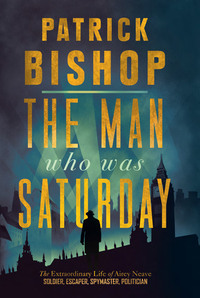
Kitabı oxu: «The Man Who Was Saturday»

Copyright
William Collins
An imprint of HarperCollinsPublishers
1 London Bridge Street
London SE1 9GF
www.WilliamCollinsBooks.com
This eBook first published in Great Britain by William Collins in 2019
Copyright © Patrick Bishop 2019
Cover design and illustration by Leo Nicholls
Maps by Martin Brown
The publishers have made every effort to credit the copyright holders of the material used in this book. If we have incorrectly credited your copyright material please contact us for correction in future editions.
Patrick Bishop asserts the moral right to be identified as the author of this work
A catalogue record for this book is available from the British Library
All rights reserved under International and Pan-American Copyright Conventions. By payment of the required fees, you have been granted the non-exclusive, non-transferable right to access and read the text of this e-book on-screen. No part of this text may be reproduced, transmitted, down-loaded, decompiled, reverse engineered, or stored in or introduced into any information storage and retrieval system, in any form or by any means, whether electronic or mechanical, now known or hereinafter invented, without the express written permission of HarperCollins.
Source ISBN: 9780008309084
Ebook Edition © March 2019 ISBN: 9780008309060
Version: 2019-12-17
Dedication
TO MARY JO, THOMAS AND MARTHA ROSE
Contents
Cover
Title Page
Copyright
Dedication
List of Maps
Preface
Prologue: ‘Some Devils Got Him’
1 A Question of Upbringing
2 Blooded
3 ‘In the Bag’
4 The Escaping Club
5 Home Run
6 Room 900
7 From Normandy to Nuremberg
8 The Long March
9 Darkest Hour
10 ‘A Perfect Woman, Nobly Planned’
11 The Arithmetic of Victory
12 Warrior in a Dark Blue Suit
13 ‘The Perfect Target’
Epilogue: Hinton Waldrist
Acknowledgements
Notes
Picture Section
Index
Also by Patrick Bishop
About the Author
About the Publisher
Maps
The siege of Calais
Plan of Colditz Castle
AN’s unsuccessful and successful escapes through Germany, Poland and Switzerland
Escape lines operated by Pat O’Leary and Comet in France and the Low Countries
Arnhem showing Pegasus operations


Preface
Biography masquerades as history but is often a species of fiction. That is not necessarily the fault of the biographer. Establishing the external facts of a public life in modern, well-documented times is fairly straightforward. It is charting the inner landscape that is the problem. How can we know what someone really thought, what drove him or her to do this or that? Letters and diaries open a window on these processes, of course, but can we be sure the motives and feelings they reveal are genuine, and not retouched with an eye to the good opinion of posterity?
In tackling the life of Airey Neave I have leaned on two versions of who he was. The public one is laid out in the several memoirs he published based on his service in the Second World War. The other is contained in the voluminous diaries he kept covering crucial years in the last period of his political career. The frequent introspective and unsparing passages make it hard to believe they were written for anyone but himself. Thus I felt I had the basis for something like a reasonably authentic portrait: Neave as he would like to be seen – and Neave as he saw himself.
There is another very important viewpoint – Neave as he appeared to everyone else. Neave struck many of his contemporaries as inscrutable. The face he presented to the world was conventional and confident. This was to some extent an act. Behind the bland mask lay a very different personality: racked by insecurities, plagued by doubts and depressions and haunted by a sense of failure and underachievement. Studying his life confirmed for me the truth of the words of the country priest whom André Malraux met when serving with the Maquis in the mountains of south-eastern France. Asked what he had learned about humanity from the many confessions he had heard over the years, he gave the answer ‘The fundamental fact is that there is no such thing as a grown-up person.’
I find that answer moving and heartening. It is said to be a hazard of writing biography that familiarity breeds contempt and in the course of the research the author comes to loathe the relative stranger they blithely shacked up with at the start of the project. I am happy to say that for me the experience had the opposite effect. I came to like Neave a lot. He had his faults: vanity, touchiness, a dissatisfied nature. But they are greatly outweighed by his virtues: physical bravery – not in short supply among his generation – but also moral courage, quiet patriotism and a basic decency.
All came to an end in a shocking death at the hands of the forces he had been opposing in one way or another all his life. He led an interesting one, and his story has a satisfying curve. The adventures and achievements of his early career seemed to promise a glowing future. Instead, there followed years of frustration that sometimes brought him close to despair. Then, unexpectedly, the stars aligned to deliver a success that was all the more satisfying for its late arrival. He lived through a period of history which, though fairly recent, now feels curiously remote. What follows is an attempt to reanimate both him and his time.
Prologue
‘Some Devils Got Him’
On Friday, 30 March 1979, change was in the air. For much of the month the weather had been cold and wet, but lately it had warmed up and in London the trees were in bud. The change of season matched a great political climacteric. Two days before, the Labour administration of James Callaghan had finally stumbled to an end after months of public-service strikes, already notorious as the ‘Winter of Discontent’. In five weeks, a general election would in all probability elect a Conservative government with, for the first time in British history, a woman at its head.
When Airey Neave woke up that morning he had every reason to savour the atmosphere of promise and renewal. As the man who had engineered Margaret Thatcher’s accession to the Conservative leadership, he had played a crucial part in great events. At the age of sixty-three, after a long wait and many disappointments, he was about to taste real power.
As a reward for his services, Mrs Thatcher had offered him any shadow portfolio he wanted. To the bafflement of many, he picked Northern Ireland. Political progress in Ulster was at a standstill and political violence a fact of everyday life. It seemed a masochistic choice. Neave saw it as a challenge – a last chance to bring off an achievement that would leave his mark in history. Since adolescence he had been opposing those he saw as the enemies of democracy – as a soldier, a prisoner of war, a Colditz escapee and an intelligence officer. The position of Secretary of State for Northern Ireland would put him in command of the latest phase of the struggle – Britain’s war against Irish terrorism. The thought gave him great satisfaction.
A pleasant weekend lay ahead. He would be spending it in his Abingdon constituency with his wife Diana in the Oxfordshire village of Hinton Waldrist, where they rented a wing of the Old Rectory. Before leaving, he had some business to attend to at his office in the House of Commons. At 9.30 a.m., he left the family flat at 32 Westminster Gardens, in Marsham Street SW1, telling Diana he would be back to collect her at 3.30 p.m. The big nine-storey block was built in the 1930s and the apartments were spacious and comfortable, an ideal London base for politicians and senior civil servants.
It was half a mile from the House, but Neave chose to drive. He had long since given up smoking and drinking, following a heart attack, but was notoriously averse to exercise and his health had given his wife and children frequent cause for concern. The car, a modest Vauxhall Cavalier supplied by the engineering firm whose interests he represented in parliament, was parked in a lot beside the flats.
The journey took a few minutes. He drove through the gates of New Palace Yard, next to Big Ben, then down the entry ramp to the underground car park. Having found a space, he took the lift to the ground floor and made his way to the offices of the Leader of the Opposition, a collection of cramped rooms in a corridor behind the Speaker’s chair in the House of Commons, for a 10 a.m. meeting of the Shadow Cabinet. At 11.40 a.m. he went back to his room together with Richard Ryder, the young de facto head of Mrs Thatcher’s private office, and they spent some time discussing the election campaign.* Ryder left, and for an hour and a half Neave and his secretary, Joy Robilliard, ‘discussed constituency weekend business, Saturday morning surgery, diary dates for the next month’.1 Then Neave asked her to inform the Special Branch of the Metropolitan Police that ‘he would be leaving town at 3.30 p.m. for Hinton Waldrist.’ The Special Branch were kept informed of all his movements. However, that was the extent of his personal security arrangements, and he had turned down the offer of a police bodyguard.
At 1.30 he ‘announced that he would have something to eat in the House and then take a cab to his tailor.’ This was Tom Brown in Princes Street, Mayfair, where he had a 2 p.m. appointment. Neave had been getting his suits from the same venerable establishment since his schooldays at Eton, where the original shop sits in the High Street. Today he was having the first fitting for two suits he had ordered a few weeks before.
The measuring over, he took a taxi back to the House, then descended to the underground car park to collect his car. Miss Robilliard’s evidence to the police suggests it was unlikely that he inspected it before getting in, because although he was ‘fairly good about security of the vehicle’, he would ‘not be troubled by anything lying on the floor of the car. He never checked the exterior of the vehicle.’
He climbed behind the wheel of the light-blue company Cavalier, switched on the ignition and moved off towards the ramp that led up to the cobbles of New Palace Yard. At 2.58 p.m., the Palace of Westminster was shaken by a great explosion. Richard Ryder ran to the window of Mrs Thatcher’s office. Immediately below lay the smoking remnants of Neave’s Vauxhall, ‘just blown to smithereens’.2
Policemen and parliamentary journalists ran to the wreckage. Neave was lying back in the driver’s seat. His face was blackened and his clothing charred. The explosion had removed his right leg below the knee and shattered the left leg. His face was well known in the Westminster village. One of the journalists had been with him only the night before. Neave’s injuries were so bad that for a while no one recognised him. It took almost half an hour to free him from the debris and load him into an ambulance, which took him to Westminster Hospital, a mile away. He died eight minutes after getting there, just before Diana arrived.
The other woman in his life was at an event in her Finchley constituency when the bomb went off. It was a while before she learned the identity of the victim. As dusk fell, London looked wintry again. Returning to her home in Flood Street, Chelsea, with grief and shock still etched on her face, she paid her first tributes to her friend. ‘He was one of freedom’s warriors,’ she told one camera crew. ‘No one knew what a great man he was … except those nearest to him. He was staunch, brave, true, strong. But he was very gentle and kind and loyal.’ To another she vented her feelings about those who had killed him. ‘Some devils got him,’ she said. ‘And they must never, never, never be allowed to triumph. They must never prevail. Those of us who believe in the things that Airey fought for must see that our views are the ones which continue to live on in this country.’
For those of a certain age, the death of Airey Neave was a JFK moment. They can remember where they were and how they felt when the news reached them. This author was a young newspaper reporter and heard it on the radio while driving up from the West Country, where he was covering the Jeremy Thorpe affair. At that time political assassinations were scarcely unusual. Killing British public figures was a major part of Irish Republican strategy. There were two reasons, though, why Neave’s death felt different. One was where it had happened. If the House of Commons car park wasn’t safe from Irish terrorists, where was? The other concerned who he was. Neave was known as a right-hand man of the woman who seemed likely to be the next prime minister. The message the killers wanted to send was clear. Nowhere and no one was beyond their reach.
For all the shock of the killing, most people outside politics would have found it difficult to put a personality or even a face to the dead man. His name stuck in the mind because it was unusual. Older people might have remembered him as a war hero, the first British officer to escape from Colditz. Even inside the Westminster stockade, he was seen as rather enigmatic, detached and unknowable.
To Jonathan Aitken,† then a young backbencher, he was ‘the cat who walks alone … a sphinx’.3 Aitken’s first impression of him was of a man who ‘shimmered’ and ‘seemed to hover around the edge of corridors, as though he were trying to vanish. If you tried to guess what his occupation might have been, you might have said “spook” or “ghost”, because he moved in a funny way … He was unobtrusive … I think he cultivated an air of mystery and spookiness … I remember being struck by his air of ghostliness or secretiveness.’
It is a sentiment echoed by several people I interviewed. ‘I can see him walking along,’ recalled Tom King.‡4 ‘He seemed to make no sound and leave no impression as he went by. I always thought he was a natural conspirator … I don’t mean in an unkind sense. But he was quite a schemer, and clever.’
At first glance he looked completely conventional. He was five feet eleven inches tall and weighed fourteen stone. He looked very English. His face was round and rosy, his pouched eyes a hazy blue, his skin smooth and his light hair sparse. The new Tom Brown suits he was measured up for that afternoon were just like those he had always ordered: both grey worsted, one with a faint check, the other with a discreet stripe and each with an extra pair of trousers.5 Even in 1979 such garments looked old-fashioned.
They marked him out as a member of the wartime generation. There were still plenty of them around on both sides of the House, but the world they were familiar with had changed. To some, it seemed that informality was becoming the norm, thrift had fallen to mass consumerism, and lingering wartime-era notions of a communal investment in shared goals and ideals had given way to the pursuit of individual and sectional interests. Older Britons complained that the rising generation seemed to believe that what to them were almost decadent luxuries were a natural right: cars, washing machines, restaurant meals, foreign holidays. And they did not expect to have to work very hard to get them.
Looking back, these aspirations seem modest and notions of what constituted a good time or a treat touchingly simple. In 1979, no one had heard of prosecco. In that morning’s Daily Mail, the Victoria Wine company advertised Easter bargains including Martini Bianco at £1.39 a bottle and Olé medium sherry at £1.47. The television page carried the schedule for the three national channels. At 8 p.m. – prime time – viewers could choose between half an hour of the comedian Les Dawson (BBC1), a documentary on the Bengali community of Brick Lane (BBC2), or Flambards, a country-house mini-series set in the early years of the century (ITV). If you missed a programme, you might capture it on the new video recorders that were now in the shops. It meant a significant investment. A Philips N1700 carried by Currys cost £499, the equivalent of the monthly average wage.
Even for trendy, well-heeled Londoners looking for a sophisticated meal out, choices were, to today’s eyes, either circumscribed or unappetising. At Bumbles, in Buckingham Palace Road, a short stroll from the Neaves’ flat, the choices included cold lettuce soup, kidneys in champagne with saffron rice, and mushrooms stuffed with prawns and grilled with Stilton.
Neave was sometimes irritated by modern life and could get furious at displays of modern bad manners. But he was in many ways a progressive, far from the popular notion of an Eton and Oxford Tory. His voice was not loud and assertive but soft, sometimes almost inaudible. He hated country pursuits and, when compelled to stay with his wife’s family at their Palladian mansion in Staffordshire, preferred to sit in an armchair reading rather than going shooting or riding to hounds.
He went to gentlemen’s clubs but was not ‘clubbable’. He no longer drank, and he breathed the atmosphere of cigar smoke, brandy and leather armchairs out of duty rather than pleasure. He preferred the company of clever women to pompous men. His experience of running female agents in occupied Europe in the war could be said to have turned him into a quasi-feminist, convinced that women were just as quick, resourceful and physically and mentally courageous as males. The one person he was truly himself with was Diana, who came equipped with all that he admired in a woman: intelligence, energy and good looks. Their marriage was a partnership and his story is to a considerable extent also hers.
The circumstances of his death gave a military quality to his funeral. It took place eight days after the explosion, in the church of St Mary at Longworth, near the Neaves’ home in Hinton Waldrist. Margaret and Denis Thatcher led the mourners, hemmed in by a phalanx of armed police. The narrow nave and old oak pews were far too small for the hundreds who had turned up, and the service had to be relayed by loudspeaker to the crowd outside. Standing among the gravestones in the April sunshine, they heard the rector, Jim Smith, praise a ‘supremely loyal subject of the Queen, a true patriot, and a good citizen of the world’.6
Given Neave’s prominence and the shocking way in which he had been killed, interest in the story faded remarkably quickly. The election campaign, followed by Margaret Thatcher’s victory, dominated the media agenda. Coverage of the hunt for his killers soon moved to the inside pages and then disappeared. There was nothing much to report. A number of suspects were rounded up, only to be released. Photofit images of possible perpetrators appeared in the press, but the faces they showed could have fitted half the young males in the British Isles. Over the years, there were a few minor flurries of excitement when arrests seemed to promise a possible prosecution. They came to nothing and, eight years after the killing, a Home Office minister told the House of Commons, ‘I very much regret to say that nobody has been charged in connection with the murder and it would be misleading for me to say that I have any information to suggest that a charge is likely to be made in the immediate or near future.’7
Nothing more was revealed by the authorities about who killed Airey Neave or how they did it. Despite an official policy of peace and reconciliation, the relevant Home Office and Metropolitan Police files remain closed, and all my attempts to gain access to them through the Freedom of Information Act were refused on, among other grounds, those of ‘national security’.
However, using private and unofficial sources I have been able to put together a picture of the circumstances behind the plot as well as learning the identities of two of those suspected of close involvement in its execution. By a curious coincidence, one of them had, like the victim, pulled off a daring and minutely planned escape from captivity, tunnelling out of the Maze prison near Belfast.
The publicity generated by the book has placed his name in the public domain, as well as helping to prompt a police decision, forty years after the event, to reopen the murder investigation. So it may just be that after all this time, the many unanswered questions about the event will be answered and peace will finally settle on Airey Neave’s unquiet grave.
The mystery around Airey Neave’s death is perhaps in keeping with the air of secrecy that attached to him in life and would continue to hang around for decades after he departed it. Forty years on, it is time he stepped out of the penumbra and into the light.
* Richard Ryder (1949–), educated Radley and Magdalene College, Cambridge; Conservative MP for Mid Norfolk, 1983–97; Government Chief Whip, 1990–95; created Lord Ryder of Wensum, 1997.
† Jonathan Aitken (1942–), educated Eton and Christ Church, Oxford; Conservative MP for Thanet East, 1974–83; Minister for Defence Procurement, 1992–94; Chief Secretary to the Treasury, 1994–95; imprisoned for perjury and perverting the course of justice, 1999.
‡ Tom King (1933–), educated Rugby and Emmanuel College, Cambridge; Conservative MP for Bridgwater, 1970–2001; from 1983, successively Secretary of State for Environment, Transport, Employment, Northern Ireland and Defence; created Lord King of Bridgwater, 2001.
1
A Question of Upbringing
British boys at school in the 1920s grew up in the shadow of death. This is not a metaphor but a fact. During the decade, memorials went up at every school, ancient or modern, bearing the details of former pupils who had gone off to the Great War and not come back. Eton already had a major memorial, built to honour the fallen of the ‘Second Boer War’ of 1899–1902. It was on a grand scale and included a library and an assembly hall. One hundred and twenty-nine names were listed on stone tablets. When the time came to consider another memorial, the scale of the loss was very different.
Between 1914 and 1918, the trenches of the Western Front, the grey wastes of the North Sea, the heights of Gallipoli and the baked earth of Palestine and Mesopotamia swallowed 1,157 Old Etonians. Various grand schemes were examined, including a tower in the style of the era of the school’s founder, Henry VI. In the end, the enormity of the loss defeated imagination. The death toll amounted to more than the number of boys at the school when war broke out (in 1914 there were 1,028 pupils). The authorities settled on a frieze of plain bronze plaques listing name, rank and date of departure. It runs the entire length of the cloisters along the western wall of School Yard.
When Airey Neave arrived at Eton in 1929 the bronze tablets were still shiny. In addition, grieving parents had commissioned their own small plaques commemorating their lost sons. So it was that Neave and his classmates passed their days moving between house, classroom, library and refectory, constantly overlooked by reminders of war and death, sacrifice and duty.
In the first years of his school career, this burden of expectation seems to have weighed lightly, if at all, on his concerns. We can glimpse his thoughts in a surviving diary from 1931, when he was fifteen. The pages are full of the routine preoccupations of a boy of his class and time, with little that hints of the extraordinary life to come. The overall tone is assured, befitting his membership of an elite which had, until recently, taken its continued power, status and prosperity for granted. Both his father and grandfather had been at Eton before him. Among his forebears were two governors of the Bank of England and a number of high-ranking soldiers. His father was descended from a baronet.
The Neaves, and the women they married, seemed the warp and weft of the British Establishment, comfortably off, confident and used to exercising authority and receiving automatic respect. However, they also had an inquiring streak, lively minds and a history of striking out down unconventional paths. One female ancestor, Caroline Neave (1781–1863), was a philanthropist and prison reformer. His grandfather, Sheffield Henry Morier Neave (1853–1936), inherited a fortune while at Eton, and after Balliol College, Oxford, seemed set on a life of pleasure. A trip to Africa in pursuit of big game brought about a conversion to seriousness. He became interested in the eradication of the tsetse fly, which carried sleeping sickness and malaria. In middle age, he trained as a doctor and he ended up Physician of the Queen’s Hospital for Children in the East End of London.
His interests were inherited by his son, Sheffield Airey Neave, born in 1879. After Eton, he went to Magdalen College, Oxford, to read natural sciences. His speciality was entomology, the study of insects, the importance of which to public health and agriculture in the British Empire was starting to be appreciated.1 In the early years of the century, he worked for the Colonial Office on scientific surveys in Northern Rhodesia and served as an entomologist on a commission investigating sleeping sickness in the Congolese province of Katanga. In 1913, he was appointed assistant director of the Imperial Institute of Entomology, and stayed in the post for thirty years before taking over as director.
Sheffield married Dorothy Middleton, a colonel’s daughter, and on 23 January 1916, at 24 De Vere Gardens, a tall London brick house in Knightsbridge, she gave birth to a son. In keeping with Neave tradition, he was christened with a basket of surnames plucked from the family tree. In his youth, Airey Middleton Sheffield Neave hated the handle he had been lumbered with. For a period in the Second World War, he took to referring to himself as ‘Tony’. But the name on the birth certificate stuck, and with it all the jokey and embarrassing permutations that schoolboy and service wit could devise.
Shortly after the birth, the family moved to Beaconsfield in Buckinghamshire. Their new home, Bishop’s House, was large and comfortable, with steep-pitched red-tile roofs and mullioned windows, surrounded by lawns and flower beds, and only a short walk from the station, where there were regular services to Sheffield’s work in London. Airey went to the local Montessori school, an enlightened choice at a time when the Italian educationalist’s ideas were just taking hold in Britain. Then, aged nine, he was sent away to St Ronan’s, an academically inclined prep school on the coast at Worthing, before arriving at Eton in the spring of 1929.
The school was undergoing the same painful transformation as the rest of the country as it adjusted to the post-war world. However, the curriculum would have been familiar to a boy from the previous century. Classics still ruled and an extraordinary amount of the boys’ time was spent construing Greek and Latin poetry and prose. Games were exalted and the stars of the river and cricket pitch were gilded demigods. Outside the classroom and the playing field, though, the atmosphere was stimulating, and independent thought was encouraged under the leadership of the lively and well-connected headmaster, Dr Cyril Alington, who as well as hymns wrote detective novels.
Neave had just turned fifteen when the surviving pages of his diary open. He comes across as earnest and hard-working, recording in detail all the homework he is set and the marks he receives. Mostly he was in the top half of the class, but his efforts seem to have been conscientious rather than inspired. It was the same story at games. He spent the afternoons kicking and knocking balls around, panting along muddy paths on cross-country runs or heaving an oar on the river.
All this effort brought little reward, not even the ephemeral pleasure of ‘a ribboned coat’ or ‘a season’s fame’. In one cricket match, he struggled for seventy-five minutes to make nine runs. Though fairly robust, he seems to have been ill frequently. He suffered from a skin complaint and some other unspecified ailment which required regular physiotherapy sessions with a nurse called Miss Dempster, who ‘weighed and measured me and made various uncomplimentary remarks about the shape of my figure’.2
He showed an early interest in soldiering and joined the Eton army cadet corps, but found the drill a challenge. ‘I am rather vague about bayonets still,’3 he recorded a few months after joining up. Then, a day later, ‘We learned field signals etc of which I understood little.’4 Thus, an early pattern was established. Young Airey’s zeal was not matched by natural aptitude, and much as he would have liked to, he did not cut a very convincing martial figure. He left school with the rank of lance corporal.
Eton encouraged a strong interaction with the world outside its walls, hosting a stream of distinguished visitors who came to address the boys. Many were former pupils. Others, such as Mohandas Gandhi, were internationally famous. By the time he visited in October 1931, he was well embarked on his campaign to liberate India from British rule. The invitation had come from the Political Society run by the boys, an initiative of Jo Grimond, who went on to lead the Liberal Party.* He wrote that when the school authorities learned of it, they were ‘vexed … However, they soon recovered their poise and fended off the indignant letters fired by blimpish Old Etonians.’ Gandhi, who wore his familiar loincloth as protection against the dank October Thames Valley weather, was ‘only a modified success. Mr Gandhi was long-winded and shuffled round all direct questions. He did not impress the boys.’5 Airey Neave noted in his diary that the Mahatma rose from his bed in the headmaster’s house long before dawn and ‘prayed from 4–5 a.m. in the garden’.6
That is as far as the entry goes. Politics barely get a mention in the diary at this stage. There is a reference to the political crisis of August 1931. It resulted in a new National Government, headed by Ramsay MacDonald, which saw taxes rise. As far as Neave was concerned, the main consequence was the economies that resulted at Bishop’s House. ‘The new budget has made Daddy sack John,’ he wrote, a reference to the gardener Airey sometimes helped with his chores, washing the car and rolling the lawn.7 It is an interesting choice of words. The suggestion is that it is the Prime Minister’s fault that John has lost his job, rather than a failure on his father’s part to make the economies necessary to keep the gardener on.
The only hint of interest in another realm that would later absorb so much of his energy comes when he mentions borrowing a book called Twenty-Five Years in the Secret Service from the college library. The author was Henri Le Caron, the pseudonym of Thomas Miller Beach, born in Colchester in 1841, who as a young man emigrated first to Paris and then the United States. The story he told combined two themes that would come to play a large part in the destiny of Airey Neave. One was the secret intelligence world. The other was violent Irish Republicanism. While living in Illinois, Beach saw the first stirrings of the Fenian movement. In 1866, the Brotherhood launched raids across the nearby border of Canada, the closest piece of British territory within reach. The rebels, some of them veterans of the Civil War, carried a banner declaring themselves to be the ‘Irish Republican Army’. They were easily defeated but the episode set in train the long campaign against British rule at home and abroad that continued with only temporary interruptions until the signing of the Good Friday Agreement in 1998.
Beach wrote about these events in letters home. His father notified his MP, who contacted the authorities. When Beach returned to England on a visit in 1867, he received ‘an official communication requesting me to attend at 50 Harley Street’. There it was agreed that ‘I should become a paid agent of the Government, and that on my return to the United States I should ally myself to the Fenian organisation, in order to play the role of spy in the rebel ranks.’8
According to his account, Beach wormed his way into the heart of the movement, rising to the post of Inspector General of the Fenian Brotherhood. He sent back a stream of reports on funding, operations and political lobbying – then, as later, a source of alarm to the British government. Beach’s view of the Irish rebels was very English, a mixture of alarm and amused condescension. ‘What a sight!’ he wrote, describing a whiskey-fuelled gathering in Chicago in 1881. ‘What a babel of voices and a world of smoke … as for hearing, your ears are deafened by the din and clatter of many tongues and stamping feet [assembled] to clamour for dynamite as the only means of achieving their patriotic ends.’9 Yet the rhetoric, he told his readers, was not to be taken entirely seriously: ‘Always you must remember that you are dealing with Irishmen, who in their wildest and most ferocious of fights still retain [a] substratum of childishness of character and playfulness of mood, with its attendant elements of exaggeration and romance.’10
Neave did not record his reaction to Beach’s book. He was, though, greatly impressed by Within Four Walls, published in 1930, a personal account of the exploits of Colonel Henry Antrobus Cartwright, who had been captured by the Germans in the 1914–18 war and succeeded in escaping at his fifth attempt. ‘I greatly respected him,’ he wrote. ‘His book was a classic … As a small boy, I had read it with romantic pleasure, and it played a great part in forming my philosophy of escape.’11
Judged by the 1931 diary, Neave at fifteen was an unremarkable boy, an adolescent apparently free of angst. He seems cool and disengaged. There are no close friendships in evidence, no extracurricular enthusiasms except for an interest in collecting old books (‘I went to Mrs Browns and bought a very nice prayer book, 1811, with good plates for 4s 6d. I think it was worth it.’)12 When the odd emphatic remark does pop up, it is often about school meals. He enjoyed his food and noted the menus with as much detail as his performance in class. The fare was not to his liking. ‘Lunch at 1.30,’ he wrote on 6 July, ‘veal and ham pie and jam sponge and custard. Awful.’ On 26 September, they were offered ‘for boys’ dinner the usual type of cat’s meat’. In this respect, school was a preparation for the prison-camp privations that would follow.
Neave’s education also provided another lesson in how to cope with incarceration. The boys had a complicated relationship with authority. From the outside, the regime seemed strictly hierarchical, with the masters and seniors giving orders which those under them obeyed or suffered the consequences. The reality was more subtle and interesting. Neave’s eagerness to do well did not preclude a bolshie streak. By now, he was well used to English institutional life and aware of its absurdities and injustices. Like his peers, he enjoyed finding ways to get round irritating restrictions. He also liked to challenge authority when the chance arose and the odds of getting away with it were favourable. It was good for morale, a reminder that those who ruled the school did not have it all their own way.
There are frequent references in the diary to ‘mobbing’: semi-spontaneous outbreaks of high jinks which could erupt at mealtimes and even in chapel. ‘After tea there was a great mob which m’tutor came up and stopped,’ he wrote on 26 September. ‘M’tutor’ was his housemaster, John Foster Crace, a classicist who had been at the school since 1901 and had married late and recently become father to a girl. Then, a few hours later, ‘the captain of house got mobbed at supper.’ According to Neave, when Crace appeared to break it up again the boys ran off, but after prayers the housemaster’s tone was almost apologetic, telling them, ‘“I lose my temper sometimes [titters] but I am not really so bad as you may think” [laughter]. He did not see anything wrong with the mobs but they were rather near his family.’ Crace’s cautious reaction to the shenanigans was perhaps a recognition of the truth that, as in prisons, without recourse to brute force, order in school essentially depended on the consent of the inmates. Imposing authority was a tricky business. The boys could spot – and instantly exploit – any perceived chink in the armour. When the class was assigned a new master called Mr Kitchen Smith, Neave’s first impression was that he was ‘quite nice but rather weak’.13 This assessment must have been shared by the others, because when asked, they assured the teacher that they had no outstanding homework to do. It was a fib that was soon discovered, but it had been worth a try.
It is an insignificant episode in itself, yet indicative of the spirit that prevailed among a section of the British prisoners held in German camps in the war to come. The camp guards were uniformed versions of the beaks and prefects they had known at school, and their instinct was to defy them, test them, rag them and keep them off balance whenever possible.
Neave’s school and home life meshed easily. Beaconsfield was only eleven miles from Eton and his mother often visited him at weekends, turning up to chapel or dropping off treats such as baskets of eggs. Neave seems to have been close to her, and sympathetic to her frequent indispositions, when she would retreat to bed with unexplained illnesses. Family lore represents Sheffield Neave as a Victorian father, large and imposing, but absorbed in his work, neglectful of his wife and distant towards his children. By the summer of 1931 there were four of them. After Airey came Iris Averil, 13, Rosamund, 10, Viola, 6, and a brother, Digby, 3. According to Airey’s eldest child, Marigold, ‘He didn’t have a great relationship with his father … He was not a very warm man, I think. This was his problem. He was quite difficult to warm to, quite frightening to look at – he had rather prominent, stern features.’14 As for the other children, ‘They were all girls except for little Digby, who was so little no one hardly bothered with him. And the girls were just considered as girls, and in those days that’s all they were. Nobody paid any attention to them. They were not very important. It was rather a dysfunctional family I always felt.’
Neave’s diary presents a warmer picture of Sheffield. On 11 July, they went to the Eton–Harrow cricket match together, which Eton won handsomely by an innings and 16 runs. ‘After breakfast Mummy took some photographs of Dad and I. We went by the 10.00 to Paddington and then took the underground to St John’s Wood. We got to Lord’s about 11.10, when play had just started. We had quite good seats in Stand G. Harrow were all out for 230 by about 12.45 and by the lunch interval were 59 for 0 [having been forced to follow on]. We went to a tent at the back of the grandstand for lunch … Sandwiches, cider cup, strawberries and cream, cake and iced coffee … After lunch we walked about and watched the match. We met on the field a friend of Daddy’s …’
In the summer holidays that followed, father and son pursued a Betjemanesque routine, playing golf and tennis together, making family visits to friends and relations in their Home Counties residences. One day, Sheffield took him off to Woodwalton Fen in Cambridgeshire, to check on the progress of a population of rare Large Copper butterflies that had been introduced a few years before. The diary entries are light and natural, with no hint of tensions or conflict. They contrast with the references to childhood that appear in the diaries Neave kept towards the end of his life, which do not suggest cloudless happiness or any great affection for the patriarchs of the family. His paternal grandfather was ‘a selfish shit’.15 As for the rest, ‘they were a sad quarrelsome family. No one was happy. I suffered from them in my time.’16
Beyond the security and comfort of Eton and Bishop’s House, the world was swept by confusion and conflict. The early 1930s were a tumultuous time at home and abroad. Britain was sunk in an economic depression that brought misery and despair, not just to the industrial North but to the mellow towns and villages of the Home Counties. In Europe, it was clear that the recent war had settled nothing and old hatreds burned as fiercely as ever. Late in 1932, a speech by Stanley Baldwin raised the spectre of a new war in which ‘the bomber will always get through.’
It was in this baleful atmosphere that Airey Neave made his first visit to Germany, in 1933, at the age of seventeen. The trip would be a turning point, jolting him into political awareness and fixing him on a moral bearing that he would follow for the rest of his life. Later, he would refer to the experience often, presenting it as an awakening: to the dangers of totalitarianism and the fragility of civilisation.
His parents had decided he would benefit from a spell in Berlin to improve his grasp of German.17 Eton, like most British schools, took an academic rather than a practical approach to language teaching, with the result that, according to Jo Grimond, ‘no boy who had spent hundreds of hours … of classes could carry on the simplest conversation in French.’18 He arrived in late summer to lodge with a family who lived at Nikolassee, a lakeside suburb west of Berlin. Hitler had been appointed Chancellor on 30 January that year and the Nazis were tightening their grip on German society.
Neave attended classes at the local school with one of the sons, who was a member of the Hitler Youth. ‘At the entry of the teacher each morning we were expected to give the Hitler salute, but as a foreigner I was excused,’ he remembered many years later. ‘I was an unconventional pupil and at first an object of derision. I sat at the back of the class. My hair was much longer than that of the German boys and I wore a decadent yellow tie with black spots.’19
Neave soon learned that it did not do to mock Germany’s new masters. Dietrich, the elder son of the family, who was at university in Berlin, was not a party member and admired the young guest’s independent spirit but warned him that it could be dangerous. One day, waiting for the train at Nikolassee, Neave sniggered at the sight of a ‘fat, brown-booted storm-trooper’. He recalled that Dietrich ‘hastily manoeuvred me out of sight. I can remember the bloodshot pig-eyes of the storm-trooper glaring towards us.’20
The climax of the visit came when Neave went with Dietrich to a rally one warm evening in the first week of September in the centre of Berlin. Neave had signed up as a temporary member of a sports club in Charlottenburg to which Dietrich belonged, and although no great athlete, he was good enough to get into the relay team. When the Nazis announced a Festival of Sport in the capital, the club was advised to take part. It began with a classic piece of totalitarian theatre. At ten o’clock a vast procession of sports organisations set off from the Lustgarten, in the centre of the city, and marched to a rally near the Brandenburg Gate. These were the early days of Nazism and, although the signs of repression were everywhere, in Berlin there were still many who did not disguise their scepticism. Among some of the athletes, participation in the festival was ‘seen as something of a joke’.
The sportsmen wore civilian suits and ‘marched off with light hearts’. However, when they were joined by a band in Nazi uniform, ‘our mood changed. I felt as if I was being drawn into a vortex. The young men beside me who, minutes before, had been joking, started singing. Suddenly the Festival of Sport had become religious and the marchers expectant.’ His friend was as susceptible to the mood as everybody else, because when Airey broke step with the others, ‘There was an angry shout from Dietrich, “Can’t you march in step?”’21
With bands blaring and banners flying, they tramped past the Brandenburg Gate, which ‘floodlit, and adorned with Nazi pennants … looked like the gateway to some theatrical Valhalla.’ The left- and right-hand marcher in each rank held a flaming torch. In the flickering light, the faces of the silent crowds lining the streets ‘glowed … with excitement and pride’. As they neared the rostrum where the speeches would begin, the band struck up the ‘Horst Wessel Lied’. To Neave, the half-hour speech that followed from Reichssportführer von Tschammer was tedious. But then he looked round at his companions. ‘They were intellectuals, university students, writers and artists. To my amazement, they were listening to this bull-necked Prussian in his brown uniform with fixed attention.’ When von Tschammer at last stopped speaking, ‘the huge crowd sang “Deutschland, Deutschland Über Alles” as the banners swayed in the breeze. The fervour of the women was breathtaking.’22
This was an extraordinary experience for a seventeen-year-old boy raised in a code of understatement and emotional restraint. The account he left of it was written in 1978 – that is, forty-five years after the event. Time and hindsight surely led Neave to lend a certain sophistication to the thoughts and reactions of his teenage self. Yet there is no doubt that exposure to the sights and sounds and passions of Nazism touched him and filled him with foreboding. It had given him an insight into the nature of Hitler’s rule that turned out to be more astute than that of many of his elders, who still regarded Hitler as a temporary phenomenon, or as someone who was subject to the normal laws of diplomacy and power politics.
Neave returned to Eton with a new maturity. He was convinced that war with Germany was inevitable. According to some accounts, he won a prize for an essay warning of the danger posed to peace by the rise of Hitler, but no trace of it remains in the school archives.23 His new interest in Germany was demonstrated in a paper he delivered to the Essay Society in 1933 on Walter Rathenau, the German liberal statesman murdered by ultra-nationalists eleven years before.
In the summer of 1934, he wrote an essay called ‘The case against pacifism’, in which he took a fatalistic view of Europe’s future and lamented the ‘illogical theories of selfish, muddle-headed … people who are trying to alter the vices of civilisation by talking about them and doing nothing’.24 The ‘horrible fact’ was ‘that man is still a very quarrelsome animal.’ The tendency was currently on display in Germany, where ‘nationalism … is both inevitable and dangerous because it always foments and bursts out when a nation is aggrieved and oppressed.’ It was ‘very unfortunate that a nation should be in such a condition but that is all the more reason for strengthening our defences by land, air and sea.’
Neave believed that war was ‘regrettable but inevitable’ and that the pacifist mood then current would evaporate when the first bombs dropped. ‘No one really doubts that the Oxford Union [which the year before had voted ‘in no circumstances to fight for its King and Country’] would go with the others when the time came.’ While he believed that ‘there are few people in this country who would not fight for England … I hope there are none who will fight for France.’ Six years later he would do just that.
The essay appeared in a magazine called Sixpenny: Stories and Poems by Etonians. It had been started by Robin Maugham, nephew of the famous author, Somerset, and by the second issue Neave’s initials appear as a co-editor. The two had similar backgrounds. Maugham came from an Establishment family and his father was a high court judge. Their temperaments and their school careers, though, were quite different. Maugham’s autobiography reveals another side of Eton whose existence could never be guessed from Neave’s diary. Maugham was bisexual and had a long liaison with a precocious boy he calls ‘Drew’. Bullying, sexual predation and misery feature strongly in this account. At the same time, he acknowledges his debt to some inspirational teachers and concludes that much of his unhappiness was due to the house he had been assigned to.
Which house you belonged to was important, indeed crucial, to the experience of Eton. It was where you slept and ate, and the teacher in charge of it disciplined you, directed your education and acted in loco parentis. In Maugham’s mind, Neave’s house, presided over by John Foster Crace, was a haven of civilisation. It was only in upper school that boys could visit houses other than their own. Maugham was introduced to Crace’s by Michael Isaacs, whose family were friends of his parents. Isaacs was Jewish, the son of the Marquess of Reading. He became Neave’s lifelong friend. Maugham wrote glowingly of the coterie that he soon joined: ‘Marcus Rueff, Patrick Gibson, Ben Astley, David Parsons, and Airey Neave. They talked about Suetonius and Mozart, Michael Arlen and Adler, and though they were all good at games they never discussed them.’ He concluded wistfully, ‘I am certain that if I had been in Mr Crace’s house I would not have been persecuted. On the contrary, I would have enjoyed each term and my outlook would have been wider.’25
They were indeed a colourful and adventurous crew. Rueff was a talented musician who, while serving in the Rifles, was mortally wounded in a German ambush at Derna in Libya in April 1941. Patrick Gibson was captured in the same action, then later escaped, walking five hundred miles over the Apennines and crossing German lines to rejoin the Allies. He went on to serve in the Special Operations Executive, waging war in occupied territory. David Parsons would become better known as the actor David Tree, the handsome lead in thirteen British films. He lost a hand in a training accident and also joined SOE.26
Politically, Maugham and Neave took different paths. Maugham reacted to the rise of Fascism by becoming a socialist. When war came, he declined a commission in the Hussars and joined up as a trooper in an armoured regiment, serving in the Western Desert. What they shared was bravery, patriotism and a sense of duty. Maugham was credited with risking his life repeatedly to pull as many as forty men from stricken tanks. They also shared an association with the world of intelligence and espionage. After being rendered unfit for active service by a severe head wound sustained in the summer of 1942, Maugham became an intelligence officer and went on to play an important part in founding the Middle East Centre for Arab Studies, initially based in Jerusalem, a training centre for British spies and diplomats. After the war, he became a successful writer, best known for his novella The Servant, which was made into a film starring Dirk Bogarde and James Fox, with a screenplay by Harold Pinter. He struggled with a drink problem and his sexuality. Despite their contrasting outlooks and personalities, Neave and Maugham remained in touch and Robin stood as godfather to Airey’s youngest boy, William.
Neave left school in the summer of 1934, bound for Oxford, twenty miles further up the Thames, where he had a place at Merton to read jurisprudence. His schooldays had seen only modest success. In the words of Michael Isaacs, ‘I cannot say that Airey stood out among his contemporaries as likely to make any considerable impact upon public life. He was an agreeable and amusing companion, diligent in his work and quite tough physically.’27 Eton may have provided little in the way of practical learning. It did, however, inculcate a certain way of looking at and dealing with the world, summed up by Jo Grimond, who had left a few years previously: ‘Boys were taught that what they did there mattered. They were taught that responsibility rested with them and could not be sloughed off. They were taught to behave as members of a community and to have regard to the wider communities of their country and their fellow men.’28
Pulsuz fraqment bitdi.