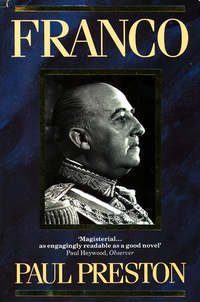
Kitabı oxu: «Franco»

PAUL PRESTON
DEDICATION
For James and Christopher
CONTENTS
Cover
Title Page
Dedication
Prologue: The Enigma of General Franco
| I | The Making of a Hero: 1892–1922 |
| II | The Making of a General: 1922–1931 |
| III | In the Cold: Franco and the Second Republic, 1931–1933 |
| IV | In Command: Franco and the Second Republic, 1934–1936 |
| V | The Making of a Conspirator: Franco and the Popular Front, 1936 |
| VI | The Making of a Generalísimo: July – August 1936 |
| VII | The Making of a Caudillo: August – November 1936 |
| VIII | Franco and the Siege of Madrid: October 1936–February 1937 |
| IX | The Axis Connection: Guadalajara & Guernica, March – April 1937 |
| X | The Making of a Dictator: Franco & the Unificación, April 1937 |
| XI | Franco’s War of Annihilation: May 1937–January 1938 |
| XII | Total Victory: February 1938–April 1939 |
| XIII | Basking in Glory: The Axis Partnership, April – September 1939 |
| XIV | The Man Who Would Be Emperor: The Defeat of France, 1940 |
| XV | The Price of Empire: Franco and Hitler, September – October 1940 |
| XVI | In the Wings: Franco & the Axis November 1940–February 1941 |
| XVII | Towards a New Crusade: February 1941–January 1942 |
| XVIII | Watching the Tide Turn: January – December 1942 |
| XIX | The Hero as Chameleon: January 1943–January 1944 |
| XX | ‘Franco’s Victory’: January 1944–May 1945 |
| XXI | The Hero Besieged: 1945–1946 |
| XXII | A Winning Hand: 1947–1950 |
| XXIII | The Sentinel of the West: 1950–1953 |
| XXIV | Years of Triumph and Crisis: 1953–1956 |
| XXV | Learning to Delegate: Homo Ludens, 1956–1960 |
| XXVI | Intimations of Mortality: 1960–1963 |
| XXVII | Preparing for Immortality: 1964–1969 |
| XXVIII | The Long Goodbye: 1969–1975 |
Epilogue: ‘No enemies other than the enemies of Spain’
Notes
Sources
Index
Acknowledgements
About the Author
Praise
Other Works
Copyright
About the Publisher
PROLOGUE The Enigma of General Franco
DESPITE fifty years of public prominence and a life lived well into the television age, Francisco Franco remains the least known of the great dictators of the twentieth century. That is partly because of the smoke screen created by hagiographers and propagandists. In his lifetime, he was compared with the Archangel Gabriel, Alexander the Great, Julius Caesar, Charlemagne, El Cid, Charles V, Philip II, Napoleon and a host of other real and imaginary heroes.1 After a lunch with Franco, Salvador Dalí said ‘I have reached the conclusion that he is a saint’.2 For others, he was much more. A children’s textbook explained that ‘a Caudillo is a gift that God makes to the nations that deserve it and the nation accepts him as an envoy who has arisen through God’s plan to ensure the nation’s salvation’, in other words, the messiah of the chosen people.3 His closest collaborator and eminence grise, Luis Carrero Blanco, declared in 1957 in the Francoist Cortes: ‘God granted us the immense mercy of an exceptional Caudillo whom we can judge only as one of those gifts which, for some really great purpose, Providence makes to nations every three or four centuries’.4
Such adulation may be dismissed as typical of the propaganda machine of a despotic regime. Nonetheless, there were many who spontaneously accepted these comparisons and many others, who by dint of their relentless repetition, failed to question them. This is not an obstacle to knowing Franco. What does render him more enigmatic is the fact that Franco saw himself in the inflated terms of his own propaganda. His inclination to compare himself to the great warrior heroes and empire-builders of Spain’s past, particularly El Cid, Charles V, Philip II, came to be second nature, and only partly as a consequence of reading his own press or listening to the speeches of his supporters. That Franco revelled in the wild exaggerations of his own propaganda seems at odds with the many eyewitness accounts of a man who was shy in private and inhibited and ill-at-ease on public occasions. Similarly, his cruelly repressive politics may seem to be contradicted by the personal timidity which led many who met him to comment just how little he coincided with their image of a dictator. In fact, the hunger for adulation, the icy cruelty and the tongue-tied shyness were all manifestations of a deep sense of inadequacy.5
The inflated judgements of the Caudillo and his propagandists are at the other extreme from the left-wing view of Franco as a vicious and unintelligent tyrant, who gained power only through the help of Hitler and Mussolini, and survived for forty years through a combination of savage repression, the strategic necessities of the great powers and luck. This view is nearer the truth than the wild panegyrics of the Falangist press, but it explains equally little. Franco may not have been El Cid but was neither so untalented nor so lucky as his enemies suggest.
How did Franco get to be the youngest general in Europe since Napoleon? How did he win the Spanish Civil War? How did he survive the Second World War? Does he deserve credit for the great Spanish economic growth of the 1960s? These are important questions with a crucial bearing on Spanish and European history in the twentieth century and they can be answered only by close observation of the man. He was a brave and outstandingly able soldier between 1912 and 1926, a calculating careerist between 1927 and 1936, a competent war leader between 1936 and 1939 and a brutal and effective dictator who survived a further thirty-six years in power. Even close observation, however, has to grapple with mysteries such as the contrast between the skills and qualities required to achieve his successes and a startling intellectual mediocrity which led him to believe in the most banal ideas.
The difficulties of explanation are compounded by Franco’s own efforts at obfuscation. In maturity, he cultivated an impenetrability which ensured that his intentions were indecipherable. His chaplain for forty years, Father José María Bulart, made the ingenuously contradictory comment that ‘perhaps he was cold as some have said, but he never showed it. In fact, he never showed anything’.6 The key to Franco’s art was an ability to avoid concrete definition. One of the ways in which he did that was by constantly keeping his distance, both politically and physically. Always reserved, at innumerable moments of crisis throughout his years in power, Franco was simply absent, usually uncontactable while hunting in some remote sierra.
The greatest obstacle of all to knowing Franco is that, throughout his life, he regularly rewrote his own life story. In late 1940, when his propagandists would have us believe that he was keeping a lonely and watchful vigil to prevent Hitler pulling Spain into the World War, he found the time and emotional energy to write a novel-cum-filmscript. Raza (Race) was transparently autobiographical. In it, and through its heroic central character, he put right all of the frustrations of his own life.7
Raza was merely the most extreme, and self-indulgent, manifestation of Franco’s tireless efforts to create a perfect past. Like his war diary of 1922, it provides invaluable insight into his psychology. In his scattered writings and thousands of pages of speeches, in his fragments of unfinished memoirs and in innumerable interviews, he endlessly polished his role and remarks in certain incidents, consistently putting himself in the best light and providing the raw material to ensure that any biography would be hagiography. The persistence of many favourable myths is a testimony to his success.
The need to tamper with reality which is revealed by Franco’s tinkering with his own past was indicative of considerable insecurity. He dealt with this not just in his writings but also in his life by creating for himself successive public personae. The security provided by these shields permitted Franco almost always to seem contained and composed. Everyone who came into contact with him remarked on his affably courteous, but always distant, manner. Behind the public display, Franco remained intensely private. He was abundantly imbued with the inscrutable pragmatism or retranca of the gallego peasant. Whether that was because of his origins as a native of Galicia, or the fruit of his Moroccan experiences is impossible to say. Whatever its roots in Franco, retranca may be defined as an evasion of commitment and a taste for the imprecise. It is said that if you meet a gallego on a staircase, it is impossible to deduce if he is going up or down. Franco perhaps embodied that characteristic more than most gallegos. When those close to him tried to get hints about forthcoming ministerial changes, they were rebuffed with skill: ‘People are saying that in the next reshuffle of civil governors so-and-so will go to Province X’, tries the friend; ‘Really?’ replies the sinuous Franco, ‘I’ve heard nothing’. ‘It’s being said that Y and Z are going to be ministers’, ventures his sister. ‘Well’, replies her brother, ‘I haven’t met either of them’.8
The monarchist aviator Juan Antonio Ansaldo wrote of him ‘Franco is a man who says things and unsays them, who draws near and slips away, he vanishes and trickles away; always vague and never clear or categoric’.9 John Whitaker met him during the Civil War: ‘He was effusively flattering, but he did not give a frank answer to any question I put to him. A less straightforward man I never met.’10
Mussolini’s Ambassador Roberto Cantalupo met him some months later and found Franco to be ‘icy, feminine and elusive [sfuggente]’.11 The day after first meeting Franco in 1930, the poet and noted wit José María Pemán was introduced by a friend as ‘the man who speaks best in all Spain’ and remarked ‘I think I’ve just met the man who keeps quiet best in all Spain’ (‘Tengo la sospecha de baber conocido al bombre que mejor se calla en España’).12
In his detailed chronicles of their almost daily contact during more than seventy years of friendship, his devoted cousin and aide-de-camp, Francisco Franco Salgado-Araujo, ‘Pacón’, presents a Franco who issued instructions, recounted his version of events or explained how the world was threatened by freemasonry and Communism. Pacón never saw a Franco open to fruitful dialogue or to creative self-doubt. Another lifelong friend, Admiral Pedro Nieto Antúnez, presented a similar picture. Born, like Franco, in El Ferrol, ‘Pedrolo’ was to be successively ADC to the Caudillo in 1946, Assistant Head of the Casa Civil in 1950, and Minister for the Navy in 1962. He was one of Franco’s constant companions on the frequent and lengthy fishing trips on his yacht, the Azor. When asked what they talked about during the long days together, ‘Pedrolo’ said ‘I have never had a dialogue with the General. I have heard very long monologues from him, but he wasn’t speaking to me but to himself’.13
The Caudillo remains an enigma. Because of the distance that Franco so assiduously built around himself through deliberate obfuscations and silences, we can be sure only of his actions, and, provided they are judiciously evaluated, of the opinions and accounts of those who worked with him. This book is an attempt to observe him more accurately and in more detail than ever before. Unlike many books on Franco, it is not a history of twentieth-century Spain nor an analysis of every aspect of the dictatorship, but rather a close study of the man. Through memoirs and interviews, his collaborators have provided ample material and there are copious despatches by foreign diplomats who dealt with him face-to-face and reported on his activities. Franco’s own writings, his speeches – in which he often held a kind of dialogue with himself – and his recently published papers also constitute a rich, if not easy, source for the biographer. They are the instrument of his own obfuscations but they also provide remarkable insight into his own self-perception.
By use of these sources, it is possible to follow Franco closely as he became successively a conspirator, Generalísimo of the military rebels of 1936 and Caudillo of the victorious Nationalists. Several myths do not survive a comprehensive investigation of his survival of the Second World War and the Cold War and of his devious dealings with Hitler, Mussolini, Churchill, Roosevelt, Truman and Eisenhower. Equally striking is the picture which emerges of his passage from the active dictator of the 1950s to the somnolent figurehead of his last days. By following him step by step and day by day, a more accurate and convincing picture can emerge than has hitherto been current. Indeed, only by such an exhaustive examination can the enigma of the elusive Franco begin to be resolved.
I
THE MAKING OF A HERO
1892–1922
FRANCISCO FRANCO BAHAMONDE was born at 12.30 a.m. on 4 December 1892 in the calle Frutos Saavedra 108, known locally as the calle María, in El Ferrol in the remote north-western region of Galicia. He was christened Francisco Paulino Hermenegildo Teódulo on 17 December in the nearby military parish church of San Francisco.*
At the time, El Ferrol, an inward-looking and still walled town, was a small naval base with a population of twenty thousand. The Franco family had lived there since the early eighteenth century and had a tradition of work in the intendencia naval (pay corps/administration).†1 Franco’s grandfather, Francisco Franco Vietti, was Intendente Ordenador de la Marina (naval paymaster) with a rank equivalent to brigadier general in the Army. He had married Hermenegilda Salgado-Araujo, with whom he had two children. The first, Nicolás Franco Salgado-Araujo, the father of the future Caudillo, was born on 22 November 1855, his sister Hermenegilda on 1 December 1856.
Nicolás followed his father into the administrative branch of the Spanish navy in which, after fifty years service, he rose to be Intendente-General, a rank also equivalent to brigadier general. As a young man, stationed first in Cuba then in the Philippines, Nicolás acquired a reputation for fast living.‡ On 24 May 1890, when he was nearly thirty-five, Nicolás Franco Salgado-Araujo married the twenty-four year-old María del Pilar Bahamonde y Pardo de Andrade in the Church of San Francisco in El Ferrol. She was the pious daughter of Ladislao Bahamonde Ortega, commissar of naval equipment at the port. The union of this free-thinking bon viveur with the conservative, moralistic Pilar was not a success. Nevertheless, they had five children, of whom Nicolás was the first, Francisco the second, followed by Paz, Pilar and Ramón.*2
Franco’s family had been concerned for over a century with the administration of the naval base in El Ferrol. When Franco was born, the town was remote and isolated, separated from La Coruña by a twelve-mile steamer journey to the south across the bay or by forty miles of poor, and in bad weather, often impassable, road. La Coruña was in turn 375 miles, or two days by bone-shaking railway, from Madrid. El Ferrol was hardly a cosmopolitan place. It was a town of rigid social hierarchies in which the privileged caste consisted of naval officers and their families. Naval administrators or merchant navy officers were considered to be of a lower category. Social barriers cut the lower middle-class Franco family off from ‘proper’ naval officers since the administration corps was regarded as inferior to the sea-going Navy, or Cuerpo General. The idea of a heroic family naval tradition, so carefully nurtured by Franco himself in later life, was an aspiration rather than a reality. That can be perceived in Nicolás Franco Salgado-Araujo’s determination that his sons become ‘real’ naval officers.
Partly because a naval commission was a common ambition among the Ferrolano middle class and because of his father’s job, Francisco developed an interest in things of the sea. As a child he played pirates in the harbour with the gangplanks of the ferries and rowed in the tranquil waters of the virtually enclosed ría (firth or fjord) of El Ferrol.3 As an adolescent, he tried to join the Navy. His two primary schools, the Colegio del Sagrado Corazón and the Colegio de la Marina, both specialised in preparing children for the Navy entrance examinations.4 Nicolás Franco Bahamonde did manage to fulfil his father’s expectations, but Francisco’s naval ambitions were to be thwarted. His failure to enter the navy would weigh heavily on him. In Salamanca during the Civil War, it was common knowledge that to please him or deflect his anger it was always worth trying to change the subject to naval matters.5 As Caudillo, he spent as much time as he could aboard his yacht Azor, wore an admiral’s uniform at every opportunity and, when visiting coastal cities, liked to arrive from the sea on board a warship.
His childhood was dominated by the efforts of his mother to cope with the overbearing severity and later the constant absences of his father, the shadow of whose infidelities hung over the home. He was brought up by Doña Pilar in an atmosphere of piety and stifling provincial lower middle class gentility. Marriage had only briefly diminished the number and length of Nicolás Franco Salgado-Araujo’s card games and drinking sessions at the officers’ club. After the birth of his daughter Paz, in 1898, Nicolás had returned to his bachelor habits. The distress that this caused his wife was compounded by the death of Paz in 1903, after an undiagnosed illness lasting four months. Pilar Bahamonde was devastated.6 Nicolás Franco was, at home, a bad-tempered authoritarian who easily lost control of himself if contradicted. His daughter Pilar described him as running the house like a general, although she also claimed that he beat his sons no more than was the norm at the time, a double-edged claim which leaves it difficult to evaluate the scale and intensity of his violence. The young Nicolás bore the brunt of his anger and Ramón also carried a deep resentment of his father and his uncontrolled violence all through his life. Until Nicolás Franco left home in 1907, his children and his wife were often the victims of his frequent rages.
Francisco was too well-behaved, too much of a ‘little old man’ (niño mayor), in his sister’s phrase, to arouse his father’s anger with any frequency. Nevertheless, Pilar recounts the deep sulk that came over him whenever he was cuffed unjustly by his father.7 Unable to win his father’s acceptance and affection, Francisco seems to have turned in on himself. He was a lonely child, withdrawn to the point of icy detachment. A story is told that when he was aged about eight, Pilar heated a long needle until the tip was red-hot and pressed it onto his wrist. Allegedly, gritting his teeth as his flesh burnt, he said only ‘how shocking the way burnt flesh smells’.8 Within the family, Francisco was long overshadowed by his two brothers, Nicolás and Ramón, who were extroverts and took after their father. Nicolás, who became a naval engineer, was the father’s favourite. Interviewed in the press in 1926, Franco père dismissed as unremarkable the achievements of his two younger sons, Francisco as commander of the Foreign Legion and Ramón who had become the first man to fly the south Atlantic.9 Even in later life, when Francisco was Head of State, his father, when asked about ‘his son’, would perversely talk about Nicolás or sometimes Ramón. Only when pressed would Don Nicolás talk about the person he called ‘my other son’.
In total contrast to her despotic husband, Pilar Bahamonde was a gentle, kindly and serene woman. She responded to the humiliations suffered at the hands of the gambling and philandering Nicolás by presenting to the world a facade of quiet dignity and religious piety that hid her shame and the economic difficulties she had to face. That is not to say that the family suffered privations, since she received financial help from her father, Ladislao Bahamonde Ortega, who lived with her after the death of his wife, and also from her husband. Nevertheless, once her husband established residence in Madrid from 1907, what Pilar Bahamonde received from him must necessarily have been limited. There was always a maid in the house, but some sacrifices were required to keep up appearances. Sending all four children to private schools put a strain on the family economy. It has been suggested, although strenuously denied by the family, that she had to take in lodgers.10 Despite these difficulties, her kindness extended to her relations and she helped to bring up the seven younger children of her brother-in-law Hermenegildo Franco.11
Pilar Bahamonde tried to imbue her children with a determination to get on in life and to escape from their situation by study and hard work, a philosophy which seems to have taken root principally with her second son and her daughter Pilar. Nevertheless, all four of her surviving children were to be fearless and powerfully ambitious in one way or another. Nicolás Franco Salgado-Araujo was a liberal, sympathetic to freemasonry and critical of the Catholic Church. In contrast, Pilar Bahamonde was politically conservative and a deeply pious Catholic. Given the circumstances of his childhood, and the nature and ideas of his father, it is hardly surprising that an enduring and unsubtle Catholicism, sexual prurience and a hatred for liberalism and freemasonry should be part of the legacy which the young Franco was left by his mother.12 What is more intriguing is the fact that his brothers followed in the footsteps of Don Nicolás rather than those of Doña Pilar. After her husband left, Doña Pilar always wore black. It seems too that, as Francisco witnessed her introspective piety becoming an effective shield against her misfortunes, he suppressed his own emotional vulnerability at the cost of developing a cold inner emptiness.
Doña Pilar’s unhappiness and stoical attempts to put a good face on her plight made it difficult for her to compensate her children for the behaviour of her husband. Each responded differently: Francisco identified with his mother, denying the need for his father’s approval which he longed for and never achieved. His hedonistic elder brother Nicolás grew up to be as pleasure-loving as his father, free with money and with women. His wild younger brother Ramón would be an irresponsible adventurer, famous for his exploits as an air-ace and notorious for his decadent private life in the 1920s and for a superficial involvement with both anarchism and freemasonry. Francisco was much more deeply attached to his mother than were either of his brothers. He regularly accompanied her to communion and was a pious child. He cried when he made his first communion. When on leave in El Ferrol, the adult Francisco would never fail to fulfil any religious duty for fear of upsetting his mother.*13
It is impossible to say with any precision what effect the separation of his parents and the departure of his father had on Francisco, although there is surely some significance in the fact that one of the few remarks that he ever made on the subject of children was: ‘small children should never be separated from their parents. It is not good to let that happen. The child needs to have the security provided by the support of his parents and they should not forget that their children are their personal responsibility.’14 As Caudillo, Franco denied vehemently that there was anything abnormal in Don Nicolás’s relationship with his wife or his children. On one occasion, however, when given irrefutable evidence of his father’s pecadillos, his reaction was revealing. He snapped ‘Alright but they never diminished his paternal authority’.15 The difficulties of Franco’s relationship with his father were later reflected in various efforts to reconstruct it in an idealised way. In his diary of his first year in the Spanish Foreign Legion, he told a clearly apocryphal story in which can be discerned his own longings. A young officer in Morocco is crossing the street when a grizzled veteran soldier salutes him. The officer goes to return the salute, their eyes meet, they look at each other and embrace in tears. It is the officer’s long-lost father.16 It was a trial run for his autobiographical novel, Raza, in which he created the father he would rather have had as a naval hero of total moral rectitude. When his father died, he had the body seized and implicitly reinvented the second part of his life by having him buried with a pomp which, while in accord with military regulations, was hardly appropriate to the bohemianism of Don Nicolás’s final years. Franco’s own lifelong avoidance of drink, gambling and women bore testimony to a determination to create an existence which was the antithesis of his father’s life.
Franco would implacably reject all the things he associated with his father, from the pleasures of the flesh to the ideas of the Left. Franco’s repudiation of his father was matched by a deep identification with his mother, something which might perhaps be seen in many aspects of his personal style, a gentle manner, a soft voice, a propensity to weep, an enduring sense of deprivation. A tone of self-pitying resentment runs through his speeches as Caudillo, a continual echo of the hard-done-by little boy that he must have been, and was one of the motivating forces of his drive to greatness.
Two great political events of Franco’s early youth were to dominate his later development – the loss of Cuba in 1898 and the involvement of Spain in a costly colonial war in Morocco. Imperial disaster provoked civilian distrust of an incompetent Army and intensified military resentment of the political establishment and of civilian hostility to conscription. Throughout his life, Franco would remark on the profound effect that the 1898 ‘disaster’ had on him. In 1941, when he was near to declaring war on the Axis side, he declared ‘when we began our life, … we saw our childhood dominated by the contemptible incompetence of those men who abandoned half of the fatherland’s territory to foreigners’. He would see his greatest achievement as wiping out the shame of 1898.17
Franco would soon be joined by his eternal cronies, his cousin Pacón, and Camilo Alonso Vega. He charged Alonso Vega with creating a battalion farm to provide funds to permit decent provisioning and the building of better barracks. The farm was a great success, not only providing fresh meat and vegetables for the troops but also making a profit. Similarly, Franco made the arrangements for a permanent fresh water supply from the nearby mountains to Dar-Riffien.83 It was typical of his methodical and thoughtful approach to the practicalities of both camp life and hostilities against the Moors. His concerns were narrowly military. Encased in the shell of his public persona, he apparently shared few of the feelings and appetites of his comrades, becoming known as the man without fear, women or masses, (‘sin miedo, sin mujeres, y sin misa’). With no interests or vices other than his career, his study of terrain, map work and general preparations for action made the units at his command stand out in an Army notorious for indiscipline, inefficiency and low morale.
In addition, in the Legion, Franco was to show a merciless readiness to impose his power over men physically bigger and harder than himself, compensating for his size with an unnerving coldness. Despite fierce discipline in other matters, no limits were put by Millán Astray or by Franco on the atrocities which were committed against the Moorish villages which they attacked. The decapitation of prisoners and the exhibition of severed heads as trophies was not uncommon. The Duquesa de la Victoria, a philanthropist who organized a team of volunteer nurses, would receive in 1922 a tribute from the Legion. She was given a basket of roses in the centre of which lay two severed Moorish heads.84 When the Dictator General Primo de Rivera visited Morocco in 1926, he was appalled to find one battalion of the Legion awaiting inspection with heads stuck on their bayonets.85 Indeed, Franco and other officers came to feel a fierce pride in the brutal violence of their men, revelling in their grim reputation. That notoriety was itself a useful weapon in keeping down the colonial population and its efficacy taught Franco much about the exemplary function of terror. In his Diario de una bandera, he adopted a tone of benevolent paternalism about the savage antics of his men.86 In Africa, as later in the Peninsula during the Civil War, he condoned the killing and mutilation of prisoners. There can be little doubt that the years of early manhood spent amidst the inhuman savagery of the Legion contributed to the dehumanizing of Franco. It is impossible to say whether he arrived in Africa already so cut off from normal emotional responses as to be untouched by the pitiless brutality which surrounded him. When Franco had been in the Regulares, a somewhat older officer, Gonzalo Queipo de Llano, was struck with the imperturbability and satisfaction with which he presided over the cruel beatings to which Moorish troops were subjected in punishment for minor misdemeanours.87 The ease with which he now became accustomed to the bestiality of his troops certainly suggests a lack of sensitivity bordering on inner emptiness. That would account for the unflinching, indeed insouciant, way he was able to use terror in the Civil War and the subsequent years of repression.
To survive and prosper in the Legion, the officers had to be as hard and ruthless as their men. At one point, preoccupied by a rash of indiscipline and desertions, Franco wrote to Millán Astray requesting permission to resort to the death penalty. Millán consulted with higher authorities and then told Franco that death sentences could be passed only within the strict rules laid down by the code of military justice. A few days later, a legionaire refused to eat his food and then threw it at an officer. Franco quietly ordered the battalion to form ranks, picked a firing squad, had the offending soldier shot, and then made the entire battalion file past the corpse. He informed Millán that he took full responsibility for an action which he regarded as a necessary and exemplary punishment to re-establish discipline.88 On another occasion, Franco was informed that two legionaires who had committed a robbery and then deserted had been captured. ‘Shoot them’, he ordered. In reply to a protest from Vicente Guarner, his one-time contemporary at the Toledo military academy who happened to be visiting the unit, Franco snapped ‘Shut up. You don’t realize what kind of people they are. If I didn’t act with an iron hand, this would soon be chaos.’89 According to one sergeant of the Legion, both men and officers were frightened of him and of the eery coldness which enabled him to have men shot without batting an eyelid. ‘You can be certain of getting everything that you have a right to, you can be sure that he knows where he’s taking you but as for how he treats you … God help you if there is anything missing from your equipment, or if your rifle is dirty or you are a loafer’.90
At the beginning of 1921, General Berenguer’s long-term scheme of slow occupation, fanning out from Ceuta, was prospering. At the same time, General Manuel Fernández Silvestre was engaged in a more ambitious, indeed reckless, campaign to advance from Melilla westwards to the bay of Alhucemas. On 17 February 1921, Silvestre had occupied Monte Arruit and was making plans to cross the Amekran River. Advancing into inaccessible and hostile territory, Silvestre’s success was more apparent than real. Abd-el-Krim, the aggressive new leader who had begun to impose his authority on the Berber tribes of the Rif, warned Silvestre that, if he crossed the Amekran, the tribes would resist in force. Silvestre just laughed.91 However, Berenguer was satisfied that Silvestre had the situation under control and had decided to squeeze El Raisuni’s territory by capturing the Gomara mountains. The Legion was ordered to join the column of one of the outstanding officers in the Spanish Moroccan Army, Colonel Castro Girona. Their task was to help in the establishment of a continuous defensive line of blockhouses between Xauen and Uad Lau. When that line met the other which joined Xauen to Alcazarquivir, El Raisuni was surrounded. On 29 June 1921, the legionaries were in the vanguard of the force sent to assault El Raisuni’s headquarters.
However, before the attack was mounted, on 22 July 1921, one of the banderas of the Legion was ordered to proceed to Fondak without being given any reason. Lots were drawn and Franco’s bandera was selected. After an exhausting forced march, they arrived to be ordered to carry on to Tetuán and then to Ceuta. When they reached Tetuán, they heard rumours of a military disaster near Melilla. On arrival at Ceuta, the rumours were confirmed and they were put aboard the troop transport Ciudad de Cádiz and sent to Melilla.92 What they did not know was the scale of the disaster. General Fernández Silvestre had over-extended his lines across the Amekran towards the Bay of Alhucemas and suffered a monumental defeat at the hands of Abd-el-Krim. Known by the name of the village Annual, where it began, the defeat was in fact a rout which took place over a period of three weeks and rolled back the Spanish occupation to Melilla itself. As the Spanish troops fled, enthusiastic tribesmen joined the revolt. Garrison after garrison was slaughtered. The fragility and artificiality of the Spanish protectorate was brutally exposed. All of the gains of the last decade, five thousand square kilometres of barren scrub, won at the cost of huge sums of money and thousands of lives, disappeared in a matter of hours. There would be horrific massacres at outposts near Melilla, Dar Drius, Monte Arruit and Nador. Within a few weeks, nine thousand Spanish soldiers died. The tribesmen were on the outskirts of a panic-stricken Melilla yet, too preoccupied with looting, they failed to capture it, unaware that the town was virtually undefended.93
At that point, reinforcements arrived, among them Franco and his men who reached Melilla on 23 July 1921 and were given orders to defend the town at all costs.94 The Legion was used first to mount an immediate holding operation, then to consolidate the outer defences of Melilla to the south. From their defensive position in the hills outside the town, Franco could observe the siege of the last remnants of the garrison at the village of Nador but his request for permission to take a detachment of volunteers to relieve them was denied. Defeat followed defeat, Nador falling on 2 August and Monte Arruit on 9 August.95 The Legion was sent out piecemeal to strengthen other units in the area, to escort supply columns, to hold the most exposed blockhouses. It was an exhausting task, with officers and men on duty round the clock.96 Through the press and his published diary, the role played by Franco in the defence of Melilla contributed to his conversion into a national hero. In particular, he enhanced his reputation in the relief of the advanced position at Casabona, by unexpectedly using his escort column to attack the besieging Moroccans.97 He had learned from fighting the Moorish tribesmen how, contrary to peninsular field regulations, effective use could be made of ground cover.98
By 17 September 1921, Berenguer was able to order a counter-attack to recoup some of the territory lost. The Legion was once more in the vanguard. On the first day of the offensive, near Nador, Millán Astray was seriously wounded in the chest. He fell to the ground shouting ‘they’ve killed me, they’ve killed me’ then sat up to shout ‘¡Viva el Rey! ¡Viva España! ¡Viva la Legión!’. As stretcher-bearers came to carry him away, he handed over command to Franco.
When the young major and his men entered Nador, they found heaps of the unburied, rotting corpses of their comrades killed six weeks earlier. Franco wrote later that Nador, with the bodies lying in the midst of the scattered booty of the attackers, was ‘an enormous cemetery’.99 In the following weeks, he and his men were used in many similar operations, taking part in the recapture of Monte Arruit on 23 October. He saw no contradiction in the fact that, although he approved of the atrocities committed by his own men, he was appalled by the mutilation of the hundreds of corpses of Spanish soldiers found at Monte Arruit. He and his men left Monte Arruit ‘feeling in our hearts a desire for revenge, for the most exemplary punishment ever seen down the generations’.100 Franco himself recounted that, on one occasion during the campaign, a captain ordered his men to cease firing because their targets were women. One old Legionarie muttered ‘but they are factories for baby Moors’. ‘We all laughed’, wrote Franco in his diary, ‘and we remembered that during the disaster [at Melilla], the women were the most cruel, finishing off the wounded and stripping them of their clothes, in this way paying back the welfare that civilization brought them.’101
On 8 January 1922, Dar Drius fell to Berenguer’s column and much of what had been lost at Annual had been recaptured. Franco was indignant about the fate of Spanish soldiers massacred by the Moors at Dar Drius in 1921 and outraged that the Legion was not permitted to enter the village and take its revenge.102 However, they had their chance a few days later. An incident took place which led the press in Galicia to praise ‘the sang froid, the fearlessness and the contempt for life’ of the ‘beloved Paco Franco’. A blockhouse near Dar Drius was attacked by tribesmen and the defending legionãrios were forced to appeal for help. The Commander of the Spanish forces in the village ordered the entire detachment of the Legion there to go to their aid. Franco said that twelve would be enough and asked for volunteers. When the entire unit stepped forward, he chose twelve and they set off. The attack on the blockhouse was driven off. The next morning Franco and his twelve volunteers returned carrying ‘as trophies the bloody heads of twelve harqueños (tribesmen)’.103
When occasional leave permitted, Franco would visit Carmen Polo in Asturias. On these trips to Oviedo, as an ever more celebrated military hero, he was a welcome guest at the dinner parties of the local aristocracy. His presence was entirely compatible with a reverence for the nobility which would remain constant throughout his life.104 Here, as he socialised, he began to make contacts which would be useful in later life and he also began to make an investment in his public image which suggests the scale of his ambition. The press began to seek him out. In interviews, speeches made at banquets given in his honour and in his publications, he began consciously to project the image of the selfless hero. Shortly after he had taken over command of the Legion from Millán Astray, Franco had received a telegram of congratulations from the Alcalde (mayor) of El Ferrol. In the heat of battle, he found time to make a self-deprecatory reply: ‘The Legion is honoured by your greeting. I merely fulfil my duties as a soldier. An affectionate greeting to the town from the legionarios’.105 It was typical of Franco’s perception of himself at the time as the brave but self-effacing officer who is interested only in his duty. It was an image in which he believed implicitly and also one which he made some effort to project publicly. On leaving an audience with the King in early 1922, he told reporters that the King had embraced him and congratulated him on his success commanding the Tercio during Millán Astray’s absence: ‘What he has been said about me is a bit exaggerated. I merely fulfil my duty. The rank-and-file soldiers are truly valiant. You could go anywhere with them’.106 It would be wrong to say that when Franco spoke in such terms he was merely being cynical. There is little doubt that the young major sincerely saw himself in the Beau Geste terms of his own diary. Nonetheless, his behaviour in interviews and the fact that he published the diary in late 1922, freely giving away copies of it, suggest an awareness of the value of a public presence in the longed-for transition from hero to general.
* Francisco in memory of his paternal grandfather, Hermenegilda in memory of his paternal grandmother and in honour of his godmother, Paulino in honour of his godfather and Teódulo because he was christened on the feast of Saint Teódulo.
† There has been much idle speculation that his family was Jewish, on the basis of his appearance and because both Franco and Bahamonde are common Jewish surnames in Spain.
‡ Indeed, after Franco’s death, there were press revelations concerning Nicolás’s relationship in Manila with a fourteen-year-old girl, Concepción Puey, with whom he was said to have had an illegitimate son, Eugenio Franco Puey, who made himself known to Francisco Franco in 1950 – Opinión, 28 February 1977; Interviu, No. 383, 14–20 September 1983.
* Nicolás was born 1 July 1891, Pilar 27 February 1895 and Ramón 2 February 1896.
* Often he would join her in the difficult trek up the Pico Douro to the east of El Ferrol to pray to the Virgen de Chamorro in fulfilment of promises she had made in her prayers for his safe return.
* ‘Pacón’ means ‘big Frank’ which he was always called to distinguish him from Franco, who was known in the family as ‘Paquito’ or ‘little Frank’.
* In retrospect, he nurtured considerable resentment about his failure to receive the Gran Cruz for what happened at El Biutz. Forty-five years later, when he reconstructed the episode, he said that the wound had been to the liver rather than the lower abdomen, which might suggest some sensitivity about its alleged consequences for his masculinity. He claimed that, despite the gravity of the wound, he had heroically continued directing operations from his stretcher. In this fanciful recollection, he had missed the medal only because the doctor who attended him had reported later that he had been on the verge of collapse, in the mistaken belief that this would strengthen his case for the award. As it was, according to Franco, this led the adjudicators to conclude that his state of health would not have permitted him to continue in command. Ramón Soriano, La mano izquierda de Franco (Barcelona, 1981) pp. 141–2.
II
THE MAKING OF A GENERAL
1922–1931
FRANCO WAS beginning to evince signs of cultivating his public image, but he was genuinely popular with his men because of his methodical thoroughness and his insistence on always leading assaults himself. He was a keen advocate of the use of bayonet charges in order to demoralize the enemy. With his exploits well reported in the national press, he was being converted into a national hero, ‘the ace of the Legion’. The rotund and plain-speaking General José Sanjurjo, himself one of the heroes of the African campaign and Franco’s superior officer, said to him ‘you won’t be going to hospital as a result of shot fired by a Moor but because I’m going to knock you down with a stone the next time I see you on horseback in action’.1
In June 1922, Sanjurjo recommended Franco for promotion to Lieutenant-Colonel for his role in the recapture of Nador. Because enquiries were still being held into the disaster of Annual, the request was turned down. Nevertheless, Millán Astray was promoted to full colonel and Sanjurjo himself to Major-General. Franco merely received the military medal and remained a Major. Outraged by civilian criticisms of the Army and by indications that the government was contemplating withdrawal from Morocco, Millán Astray made a number of injudicious speeches and was removed from command of the Legion on 13 November 1922. To his chagrin, Franco was not invited to take his place since, still a major, he was too junior. Command was given instead to Lieutenant-Colonel Rafael de Valenzuela of the Regulares. Having been passed over for command, Franco then left the Legion. For the man who had built it up from scratch with Millán, the prospect of being second-in-command to a newcomer must have seemed unacceptable.2 He requested a mainland posting and was eventually sent back to the Regimiento del Príncipe in Oviedo.
To the dismay of most Army officers, the collapse at Annual reinforced the pacifism of the Left and diminished the public standing of both the Army and the King. Alfonso XIII was widely suspected of having encouraged Silvestre to make his rash advance.3 In August 1921, General José Picasso had been appointed to head an investigation into the defeat. The Picasso report led to the indictment of thirty-nine officers including Berenguer, who was obliged to resign as High Commissioner on 10 July 1922. Throughout the autumn of 1922, the Picasso report was the object of hostile scrutiny by a committe of the Cortes, known as the ‘Responsibilities Commission’, set up to examine political responsibilities for the disaster. The brilliant Socialist orator Indalecio Prieto denounced the corruption which had weakened the colonial Army and so ensured that Silvestre’s temerity would turn into overwhelming defeat. The Socialist deputy called for the closure of the military academies, the dissolution of the quartermasters corps and the expulsion from the Army of the senior officers in Africa. His speech was printed as a pamphlet and one hundred thousand copies were distributed free of charge.4
Berenguer had been replaced by General Ricardo Burguete, under whom Franco had served in Oviedo in 1917. Burguete as High Commissioner followed government orders to attempt to pacify the rebels by bribery rather than by military action. On 22 September 1922, he made a deal with the now obese and burnt-out El Raisuni whereby, in return for controlling the Jibala on behalf of Spain, he was given a free hand and a large sum of money. Since he was already under siege in his headquarters at Tazarut in the Jibala, El Raisuni’s power might have been squashed definitively had the Spaniards had the imagination and daring to occupy the centre of the Jibala. The policy of accommodation was a major error. Spanish troops were withdrawn from the territory of a man on the verge of defeat. He was enriched and his reputation and power inflated.
Burguete’s aim was to pacify the tribes in the west in order to have more freedom in his efforts to crush the altogether more dangerous Abd-el-Krim in the east. After first pursuing negotiations with him for the ransom of Spanish prisoners of war, Burguete passed to the offensive in the autumn. Burguete intended to use, as his forward base, the hill-top fortified position of Tizi Azza, to the south of Annual. However, before his attack could get under way, the Rif tribes struck at the beginning of November 1922. Safely ensconced in the slopes above the town, they fired down on the garrison causing two thousand casualties and obliging the Spaniards to dig in for the winter.5
The worsening situation in Morocco and the compromises pursued by Burguete may have convinced Franco that he was right to have left the Legion, whatever his reasons might have been. He was showered with honours as he passed through Madrid en route to Asturias. The King bestowed on him the Military Medal on 12 January 1923 and the honour of being named gentilhombre de cámara, one of an élite group of military courtiers.6 Franco was also the guest of honour at a dinner given by his admirers.
He was also the subject of an immensely flattering and revealing profile written by the Catalan novelist and journalist Juan Ferragut. It constitutes a portrait of Franco at the point when, with marriage around the corner, heroism was giving way to a more calculated ambition.* In Ferragut’s profile, there can still be heard the tone of the eager man of action which would soon disappear from Franco’s repertoire. Nevertheless, the clichéd patriotism and romanticised heroism of many of his remarks suggest that the persona of the intrepid desert hero was not entirely natural and spontaneous. When asked why he had left Morocco, Franco replied ‘because we aren’t doing anything there anymore. There’s no shooting. The war has become a job like any other, except that it’s more exhausting. Now all we do is vegetate.’ There was a contrived element about Franco’s answers which suggested an intense consciousness of his public image. When Ferragut asked him if he liked action, the thirty year-old Major replied ‘yes … at least up to now. I believe that a soldier has two periods, one of war and one of study. I’ve done the first and now I want to study. War used to be more simple; all you needed was heart. But today it is more complicated; it is, perhaps, the most difficult science of them all’. Ferragut described him as boyish: ‘his sunburnt face, his black, brilliant eyes, his curly hair, a certain timidity in his speech and gestures and his quick and open smile make him seem like a child. When he is praised, Franco blushes like a girl who has been flattered.’ He brushes aside the praise, as befits a hero, ‘but I’ve done nothing really! The dangers are less than people think. It’s all a question of endurance’.
Asked about his most emotional memory of the war, he replied ‘I remember the day at Casabona, perhaps the hardest day of the war. That day we saw what the Legion was made of. The Moors were pressing strongly and we were fighting at twenty paces. We had a company and a half and we suffered one hundred casualties. Handfuls of men were falling, almost all wounded in the head or the stomach, yet our strength never wavered for a second. Even the wounded, dragging themselves along covered in blood, cried ‘¡Viva la Legión! Seeing them, so manly, so brave, I felt an emotion which choked me.’ Asked if he had ever felt fear, he smiled as if puzzled, and shyly replied ‘I don’t know. No one knows what courage and fear are. In a soldier, all this is summed up in something else: the concept of duty, of patriotism.’ The romantic note continued with references to the anxious vigils of his mother and bride-to-be. Ferragut asked him directly, ‘Are you in love, Franco?’ to which the affable interviewee replied ‘¡Hombre!, what do you think? I’m just off to Oviedo to get married.’7
On 21 March 1923, Franco arrived in Oviedo where his exploits ensured that he would be feted. At the beginning of June, local society turned out in force for a banquet at which he was presented with a gold key, the symbol of his recently acquired status as Gentilhombre de cámara, purchased for him after a local subscription. The King had still not granted the reglamentary permission for his wedding. Since this was a mere formality, the ceremony was being planned for June. However, while Carmen and Francisco were waiting to hear from the Palace, their plans suffered another reversal. Franco had gone to El Ferrol where he spent most of May with his family. In early June, Abd el Krim launched another attack on Tizi Azza, the key to the outreaches of the Melilla defence lines. If Tizi Azza fell, it would have been relatively easy for other Spanish positions to collapse in a domino effect. On 5 June 1923, the new commander of the Legion, Lieutenant-Colonel Valenzuela, was killed in a successful action aimed at breaking the siege.8
An emergency cabinet meeting three days later, on 8 June 1923, decided that the most suitable replacement for Valenzuela was Franco. The Minister of War, General Aizpuru, telegrammed to inform him that he had been promoted to Lieutenant-Colonel with retrospective effect from 31 January 1922 and that the King had bestowed command of the Legion upon him. His marriage would have to be postponed again. The ambitious Carmen may have found consolation for the loss of her bridegroom in his promotion, the signs of royal patronage and the enormous local prestige that he thereby enjoyed, although, interviewed in 1928, she talked of her anxieties while he was away and of his principal defect being his love for Africa.9
Prior to leaving Spain, Franco was the guest of honour at banquets in both the Automobile Club in Oviedo and at the Hotel Palace in Madrid. One of the principal Asturian newspapers dedicated an entire front page to his promotion and his prowess, complete with extravagant tributes from General Antonio Losada, the military governor of Oviedo, from the Marqués de la Vega de Anzó and other local dignitaries.10 Interviewed on arrival at the Automobile Club banquet on the evening of Saturday 9 June, Franco showed himself to be the public’s ideal young hero, dashing, gallant and, above all, modest. He dismissed talk of special bravery and showed himself perplexed by all the fuss that was being made. Clearly conscious of the dash he was cutting, he interrupted the journalist’s attempted eulogy by saying ‘I just did what all the Legionaires did, we fought with a desire to win and we did win’. A discreet reminder of what he was leaving behind brought a delicate glimpse of emotion which Franco quickly put behind him. The journalist remarked sycophantically ‘how the brave Legionaires will rejoice at your appointment!’. Franco replied ‘Rejoice? Why? I’m an officer just like …’, only to be interrupted by a passing ex-Legionaire who said ‘say yes, that they will all rejoice, of course they will rejoice’. Like a hero of romantic fiction, Franco replied with a modest laugh, saying ‘Don’t go overboard. Yes, you’re right, the lads care for me a lot.’
The interview ended with Franco being asked about his plans, at which he gave another hint of the sacrifice he was having to make. He replied with a curious mixture of virile enthusiasm and self-regarding pomposity: ‘Plans? What happens will decide that. I repeat that I am a simple soldier who obeys orders. I will go to Morocco. I will see how things are. We will work hard and as soon as I can get some leave I will come back to Oviedo to … to do what I thought was virtually done, which for the moment duty prevents, taking precedence over any feelings, even those with roots deep in the soul. When the Patria calls, we have only rapid and concise response: ¡Presente!’11 There is no doubt that this, and other interviews from this period, show an altogether more attractive figure than the one that Franco was later to become, in large measure as a consequence of the corrupting influence of constant adulation. The Minister of War and future President of the Second Republic, Niceto Alcalá Zamora, thought Franco’s near contemporary and rival, Manuel Goded, a more promising officer than Franco. However, he liked Franco’s air of modesty, ‘the loss of which when he became a general damaged him significantly’.12
Within a week of passing through Madrid, Franco had taken up his new command in Ceuta and was soon in the thick of the action. Shortly after Franco’s arrival in Africa, Abd el Krim followed up his attack on Tizi Azza with another on Tifaruin, a Spanish outpost near the River Kert to the west of Melilla. Nearly nine thousand men besieged Tifaruin and they were dislodged on 22 August by two banderas of the Legion under Franco’s command.13
Such was the accumulated military discontent about what was perceived as civilian betrayal of the Army in Morocco that since early in 1923 two groups of senior generals, one in Madrid and the other in Barcelona under Miguel Primo de Rivera, had been toying with the idea of a military coup.14 The incident which triggered it off took place on 23 August. There were a number of public disturbances in Málaga involving conscripts being embarked for Africa. Civilians were jostled and Army officers assaulted. Some of the recruits were merely drunk, others were Catalan and Basque nationalists making political protests. Order was finally restored by the Civil Guard. An NCO in the Engineering Corps (suboficial de ingenieros), José Ardoz, was killed and the crime was attributed to a gallego, Corporal Sánchez Barroso. Sánchez Barroso was immediately tried and sentenced to death. Since Annual, there had been a widespread public revulsion against the Moroccan enterprise and, in consequence, there was a huge outcry about the death sentence. On 28 August, Sánchez Barroso was given a royal pardon, at the request of the cabinet. The officer corps was outraged by the humiliation of the Málaga incidents, by the subsequent public rejection of their cause in Morocco and by what they saw as the slight involved in the pardon.15
Accordingly, it was a cause of the greatest embarrassment to Franco that his brother Ramón had moved into the orbit of the republican opposition to the regime. From the later part of 1929, their relations became very strained. Franco had been annoyed and embarrassed in July 1924 when Ramón had married Carmen Díaz Guisasola without seeking the King’s permission.101 The breach between his brother and the King had been forgotten in the wake of his Atlantic crossing in 1926. However, Ramón’s ever more frantic efforts to repeat that success had ended in disgrace. The reasons for his fall from grace were complex. In the summer of 1929, to boost the domestic aircraft industry, the Spanish government agreed to sponsor an attempt by Ramón to cross the North Atlantic in a Dornier Super Wal flying boat built under licence in Spain. Because of doubts about the reliability of the Spanish aeroplane, Ramón used a German-built one bought in Italy, fraudulently switching the registration markings. The flight was a disaster: the aircraft was blown off course near the Azores, and it and the crew were lost for days and only found at the end of June after a massive and immensely costly search involving the Spanish, British and Italian navies.102 When he was found, there was widespread rejoicing and a tearful General Franco was publicly embraced by an equally lacrimose General Primo de Rivera.103 Franco led a massive demonstration to the British Embassy in Madrid to express thanks for the role of the Royal Navy.104 It then emerged that the planes had been switched and rumours began to circulate that Ramón had been promised a fabulous sum of money if he broke the world seaplane distance record flying a German aircraft. Colonel Alfredo Kindelán, the head of Military Aviation, was furious and had Ramón expelled from the Air Force on 31 July 1929. Thereafter, he moved rapidly to the left, became a freemason and got involved in anarcho-syndicalist conspiracies aimed at bringing down the monarchy.105
After this disgrace, Ramón’s relations with his brother were virtually non-existent and were reduced to letters; patronizing, sententious, though ultimately kindly ones from Franco, mischievously disrespectful ones from Ramón. On 8 April 1930, Franco wrote a long letter to Ramón revealing of his loyalty both to his family and to the established order. In an effort to head off his brother’s demise, Franco warned him that his activities within the Army, inciting garrisons and officers to rebel, were known to the authorities. Regarding the Berenguer regime as entirely legal, Franco was worried that his brother was risking the loss of his prestige and his good name. He appealed to him to think of ‘the great sorrow that such things cause Mamá, a sorrow which the rest of us share’ and ended fondly, ‘Your brother loves and embraces you, Paco’.106
Its tone of tolerant restraint is remarkable given that, in Francisco’s eyes, Ramón’s behaviour would not only bring dishonour on the family but also possibly impede his own chances of advancement. There is also a typical readiness to attribute the lowest motives to Ramón’s revolutionary friends while assuming that Ramón himself is free of such baseness. The letter also revealed a political naïvety in Franco’s suggestion that the dictatorship of General Berenguer was more legal than that of Primo de Rivera. Ramón was not slow to comment on that in his reply on 12 April. Ramón was shocked by what he called his brother’s ‘healthy advice’ and ‘vain bourgeois counsels’ and invited him to step down from his ‘little general’s throne’. He also took the opportunity to comment that the education being given the cadets in Zaragoza would ensure that they would be bad citizens.107
Engrossed in his work at the Zaragoza military academy, Franco paid little attention to the rising tide of political agitation in 1930 except in so far as it involved his brother. The anti-monarchical movement was growing with labour unrest intensifying by the day. A broad front of Socialists, middle class Republicans, Basque and Catalan regionalists and renegade monarchists who, repelled by the mistakes of the King, had become conservative republicans, joined together in mid-August 1930. United by the so-called Pact of San Sebastián, they established a provisional government-in-waiting which began to plot the downfall of the monarchy.108 Ramón Franco was an important element in the republican conspiracies. In late 1930, watched by agents of the Dirección General de Seguridad, he was travelling around Spain liaising with other conspirators, trying to buy arms and organizing the making of bombs.109 General Emilio Mola, now Director-General de Seguridad, had taken the decision to arrest him but, as an admirer of his heroic exploits and as a friend of Franco, he decided to give Ramón a last chance to avoid the consequences of his activities. Mola asked Franco to try to persuade his brother to desist. Although he agreed to try, Franco showed no optimism that he might succeed but he was immensely faithful to the family and still felt a protective loyalty towards his madcap brother. He visited Madrid and they dined together on 10 October but Ramón remained committed to the planned republican rising. Mola then had Ramón brought in for questioning on the evening of 11 October and detained in military prison on the following morning. Mola again called Franco in and informed him of the charges against his brother which included bomb-making, gun-smuggling and involvement in the attempted murder of a monarchist aviator, the Duque de Esmera. Franco and Mola hoped to use these charges to frighten Ramón into abandoning his revolutionary activities: Franco visited his brother in his cell and recited them to him. This merely provoked him into escaping from prison on 25 November. Thereafter, he took part, with General Queipo de Llano, in the revolutionary movement of mid-December 1930. Both Ramón’s escape and his participation in the events of December would cause Franco intense chagrin both as an officer and as a monarchist.110
Having failed in his efforts to make his brother see sense, Francisco returned hastily to Zaragoza where he had to receive the visit of a French delegation led by André Maginot. On 19 October, Maginot presented Franco with the Légion d’Honneur for his part in the Alhucemas landing. On his return to France, he declared that the Zaragoza Academy was the most modern of its kind in the world.111 Maginot’s ideas of modernity had yet to be put to the test by the armies of the Third Reich.
In November, Franco was approached by an emissary from the most prominent figure of the San Sebastián coalition, the grand old man of Spanish republicanism, the wily and cynical Alejandro Lerroux. He was invited to join in the Republican conspiracies along with so many other officers including his brother. According to Lerroux, Franco refused point blank but then insinuated, at a later meeting, that he would rebel against the constituted power but only if the Patria were in danger of being overwhelmed by anarchy.112 Despite warnings from his cousin Pacón and the attitude of his brother, Franco was so far distanced from day-to-day politics that he was convinced that the monarchy was in no danger.113
The revolutionary plot in which Ramón was implicated aimed to bring the San Sebastián provisional government to power. One of its ramifications was to be a rebellion by the garrison of the tiny Pyrenean mountain town of Jaca in the province of Huesca. Anticipating what was supposed to be a nationally co-ordinated action, the Jaca rebellion was precipitated on 12 December. Its leaders, Captains Fermín Galán, Angel García Hernández and Salvador Sediles, hoped to march south from Jaca and spark off a pro-Republican movement in the garrisons of Huesca, Zaragoza and Lérida.114 Along the road to Huesca, Galán’s column was challenged by a small group of soldiers led by the military governor of Huesca, General Manuel Lasheras, who was wounded in the clash. When the news of the actions of the Jaca rebels reached Madrid in the early hours of the morning of 13 December, the government declared martial law in the entire Aragonese military region. A sporadic general strike broke out in Zaragoza. Franco put the Academy in a state of readiness and armed the cadets. The Captain-General of the Aragonese military region, General Fernández de Heredia, put together a large column and sent them to Huesca, half way between Zaragoza and Jaca. In case the rebels should have left Huesca already and headed south, he ordered Franco to use his cadets to hold the Huesca-Zaragoza road. In the event, it was not necessary. Galán’s cold, wet and hungry column was stopped at Cillas, three kilometres from Huesca, and the Jaca revolt was put down.115
Galán and García Hernández were seen as being the two ringleaders and were shot after summary courts martial on 14 December.116 As far as Franco was concerned, their punishment was entirely appropriate since they were mutineers. He was perhaps fortunate that he did not have to make similar considerations about his brother, who was heavily involved in the central action of the plot in the capital. On 15 December, Ramón had flown over the royal Palacio de Oriente in Madrid, planning to bomb it but, in the event, seeing civilians strolling in the gardens, had merely dropped leaflets calling for a general strike. He had then fled to Portugal and then on to Paris.117 Franco did not vacillate in his condemnation of the revolutionary events of mid-December, but his sense of family solidarity prevented him applying the same standards to his brother. Hours after Ramón’s flight over the Palacio Real, another aircraft flew over Madrid and dropped leaflets directed at the city’s inhabitants denouncing Ramón as a ‘bastard apparently drunk on your blood’. Franco was so incensed on behalf of his mother (if not his brother) that he left Zaragoza for Madrid where he demanded explanations from Berenguer, the Head of the Government, General Federico Berenguer, the Captain-General of Madrid and Mola, the Director-General of Security, all of whom assured him that the flight and the pamphlets had no official status.118
On 21 December, Franco sent another letter to Ramón. Not surprisingly, in the light of the scandal that Ramón’s activities had occasioned, the distress of their mother and the fact that he was in danger of being shot, the letter is deeply sorrowful. Despite the gulf between their political views, Francisco showed compassionate concern for ‘My beloved and unfortunate brother’ and enclosed two thousand pesetas. He ended sanctimoniously ‘May you break away from the vice-ridden ambience in which you have lived for the last two years, in which the hatred and the passion of the people who surround you deceive you in your chimeras. May your forced exile from our Patria calm your spirit and lift you above all passions and egoisms. May you rebuild your life far from these sterile struggles which fill Spain with misfortunes. And may you find well-being and peace in your path. These are the wishes of your brother who embraces you.’ The money which accompanied the letter was a substantial sum at the time. Grateful as Ramón was for his brother’s help, he was repelled by his reactionary notions and surprised by his lack of awareness of the tide of popular feeling.119
If Franco had any doubts about the legitimacy of the executions of Galán and García Hernández, they would have been resolved on 26 December when General Lasheras died from an infection and uraemia which may have been related to the wound that he had received when trying to stop Galán. Franco attended his funeral.120 The public outcry about the execution of Galán and García Hernández damaged the monarchy in a way that the Jaca revolt itself had failed to do. As the two executed rebels were being turned into martyrs, to the outrage of many senior military figures including Franco, the Liberals in the government withdrew their support and General Berenguer was obliged to resign on 14 February.121 After an abortive attempt by the Conservative politician José Sánchez Guerra to form a government with the support of the imprisoned Republican leaders, Berenguer was finally replaced as prime minister on 17 February by Admiral Juan Bautista Aznar. He did, however, continue in the cabinet as Minister for the Army.122
Since the Jaca rebellion of Galán and García Hernández had taken place within the military region of Aragón, Franco was appointed a member of the tribunal which was to court martial Captain Salvador Sediles and other officers and men who had been involved. It took place between 13 and 16 March when the campaign for the municipal elections of 12 April had already begun. There was no more potent subject during that campaign than that of the executions of Galán and García Hernández. Admiral Aznar declared in advance of the verdicts in the supplementary court martial that he was of a mind to ask the King for clemency whatever the sentences. Franco, however, declared: ‘it is necessary that military crimes committed by soldiers be judged by soldiers who are accustomed to command’, within which category he clearly included a readiness to punish indiscipline by death. In the event, there was one more death sentence, for Captain Sediles, five life sentences and other lesser sentences, all of which were commuted.123
In the municipal elections of 12 April 1931, Franco voted for the monarchist candidacy in Zaragoza.124 The results would go against Alfonso XIII, provoke his withdrawal from Spain and open the way to the establishment of the Second Republic. For Franco, the deeply conservative monarchist and royal favourite, it would be a severe shock. To the ambitious young general, it would seem to be the end of a meteoric rise. That fact, taken with Franco’s prominence in the military uprising of 1936, has led the Caudillo’s hagiographers to portray him as working towards that glorious denouement from the very first. This was far from being the case. Franco had still to undergo many experiences before he became an implacable enemy of the Republic.
Ironically, in early 1931, there was an event in Franco’s personal life which was to reveal its full significance only in 1936. In 1929, the Director of the Military Academy had met a brilliant lawyer, Ramón Serrano Suñer, who was working in Zaragoza as a member of the élite legal corps of Abogados del Estado (State lawyers) and they had become friends. Serrano Suñer often lunched or dined with the Franco family.125 As a result, Serrano Suñer came to know Doña Carmen’s beautiful younger sister, Zita. In February 1931, Serrano Suñer married her, then aged nineteen, in Oviedo. The groom’s witness was José Antonio Primo de Rivera, son of the Dictator and future founder of the Falange, the bride’s Francisco Franco.126 The marriage clinched the close relationship between Serrano Suñer and Franco out of which would be forged the Caudillo’s National-Syndicalist State. The wedding ceremony also provided the occasion for a historic first meeting for the eventual dictator and fascist leader whose names were to be tied together for forty years after 1936. At the time, none of the three could have had any idea of the imminent political cataclysm which would link their fates.
* Ferragut had written the fictionalised Memorias de un legionario and had been rumoured to have ghost-written Franco’s Diario de una bandera, although the article made a great point of the interview being their first meeting.
* In later life, particularly after Franco gained power, the relationship seemed more formal than spontaneously affectionate. Pacón commented that Franco seemed morose and inhibited in the company of Doña Carmen.
* At the time, each military region of Spain had two divisions, each composed of two brigades. However, given the shortage of recruits, in practice only the first brigade of each Captaincy General was at operational strength. (Suárez Fernández, Franco, I, pp. 187, 191.)
* It would be an abiding obsession. On a visit to the Zaragoza Military Academy in 1942, he told one of the staff that an additional bed should be put in rooms that had two ‘to avoid marriages’ – Baón, La cara humana, p. 117.
III
IN THE COLD
Franco and the Second Republic, 1931–1933
THE MUNICIPAL elections of 12 April 1931 were intended by the government to be the first stage of a controlled return to constitutional normality after the collapse of the Primo de Rivera dictatorship. However, on the evening of polling day, as the results began to be known, people started to drift onto the streets of the cities of Spain and, as the crowds grew, Republican slogans were shouted with increasing excitement. In the countryside, the power of the local bosses or caciques was unbroken but in the towns, where the vote was much freer, monarchist candidates had suffered a disaster. With the artillerymen on his staff at the Academy openly rejoicing at the Republican triumph, Franco was deeply worried about the situation.1 While he mused in his office in Zaragoza, his one-time commanding officer and a man whom he admired, General Sanjurjo, was clinching the fate of the King. Sanjurjo now Director-General of the para-military Civil Guard, the monarchy’s most powerful instrument of repression, had informed several cabinet ministers that he could not guarantee the loyalty of the men under his command in the event of mass demonstrations against the monarchy.2 In fact, there was little reason to suspect the loyalty of the Civil Guard, a brutal and conservative force. Sanjurjo’s fear was rather that the defence of the monarchy could be attempted only at the cost of copious bloodshed, given the scale of the popular hostility to the King.
That Sanjurjo was not prepared to risk a bloodbath on behalf of Alfonso XIII reflected the fact that he had personal reasons for feeling resentment towards the King. He felt that he had been snubbed by the King for marrying beneath his rank and he had not forgiven Alfonso XIII for failing to stand by Primo de Rivera in January 1930.3 Sanjurjo’s reluctance to defend his King may also have reflected two conversations that he had with Alejandro Lerroux in February and April 1931, during which the Republican leader had tried to persuade him to ensure the benevolent neutrality of the Civil Guard during a change of regime. Sanjurjo informed the Director-General of Security, General Mola, of the first of these meetings and assured him that he had not agreed to Lerroux’s request.4 His subsequent actions during the crisis of 12, 13 and 14 April, together with the favourable treatment which he received afterwards from the new regime, were to lead Franco to suspect that perhaps Sanjurjo had been bought by Lerroux and betrayed the monarchy.
Franco was unaware of what Sanjurjo was saying to the cabinet ministers on 12 April, but he was in telephone contact with Millán Astray and other generals. He considered marching on Madrid with the cadets from the Academia but refrained from doing so after a telephone conversation with Millán Astray at 11.00 a.m. on the morning of 13 April.5 Millán Astray asked him if he thought that the King should fight to keep his throne. Franco replied that everything depended on the attitude of the Civil Guard. For the next five and a half years, the stance of the Civil Guard would be Franco’s first concern in thinking about any kind of military intervention in politics. Most of the Spanish Army, apart from its Moroccan contingent, was made up of untried conscripts. Franco was always to be intensely aware of the problems of using them against the hardened professionals of the Civil Guard. Now, Millán Astray told Franco that Sanjurjo had confided in him that the Civil Guard could not be relied upon and that Alfonso XIII therefore had no choice but to leave Spain. Franco commented that, in view of what Sanjurjo said, he too thought that the King should go.6
Franco had also been greatly influenced by the telegram that Berenguer sent in the early hours of 13 April to the Captains-General of Spain. The Captains-General in command of the eight military regions into which the country was divided were effectively viceroys. In the telegram, Berenguer instructed them to keep calm, maintain the discipline of the men under their command and ensure that no acts of violence impede ‘the logical course that the supreme national will imposes on the destinies of the Fatherland’.7 Berenguer’s attitude derived from his own pessimism about Army morale. He believed that some Army officers were simply blasé about the danger to the monarchy. More seriously, he suspected that many others were indifferent and even hostile to its fate in the wake of the divisions created in the 1920s. Nevertheless, despite his telegram and his own inner misgivings, on the morning of 14 April, out of loyalty to the monarchy, Berenguer told the King that the Army was ready to overturn the result of the elections. Alfonso XIII refused.8 Shortly after Berenguer’s interview with the King, Millán Astray told Berenguer about his conversation with the Director of the Zaragoza Academy on the previous day repeating, as ‘an opinion which has to be taken into account’, Franco’s view that the King had no choice but to leave.9
The King decided to leave Spain but not to abdicate, in the hope that his followers might be able to engineer a situation in which he would be begged to return. Power was assumed on 14 April 1931 by the Provisional Government whose membership had been agreed in August 1930 by the Republicans and Socialists who had made the Pact of San Sebastián. Although led by Niceto Alcalá Zamora, a conservative Catholic landowner from Córdoba who had once been a Minister under the King, the Provisional Government was dominated by Socialists and centre and left Republicans committed to sweeping reform.
In a number of ways in the first week of the Republic, Franco displayed unmistakably, if guardedly, a repugnance for the new regime and a lingering loyalty to the old. There was nothing unusual in his feeling such loyalty – a majority of Army officers were monarchists and would have been unlikely to change their convictions overnight. Franco was ambitious but took discipline and hierarchy very seriously. On 15 April, he issued an order to the cadets, in which he announced the establishment of the Republic and insisted on rigid discipline: ‘If discipline and total obedience to orders have been the invariable practice in this Centre, they are even more necessary today when the Army is obliged, with serenity and unity, to sacrifice its thoughts and its ideology for the good of the nation and the tranquility of the Patria.’10 It was not difficult to decipher the hidden meaning: Army officers must grit their teeth and overcome their natural repugnance towards the new regime.
For a week, the red and gold monarchist flag continued to fly over the Academia. The Captain-General of Aragón, Enrique Fernández de Heredia, had been instructed by the Provisional Government to raise the Republican tricolour throughout the region. With the military headquarters in Zaragoza surrounded by hostile crowds demanding that Cacahuete (peanut), as the vegetarian Fernández de Heredia was known, fly the Republican flag, he refused. At midnight on 14 April, the new Minister of War, Manuel Azaña, ordered him to hand over command of the region to the military governor of Zaragoza, Agustín Gómez Morato, who was considered loyal to the Republican cause and who, indeed, was to be imprisoned by the Nationalists in July 1936 for opposing the military rebellion in Morocco. Gómez Morato undertook the substitution and telephoned all units in Aragón to order them to do the same. At the Military Academy, Franco informed his superior that changes of insignia could be ordered only in writing. It was not until after 20 April when the new Captain-General of the region, General Leopoldo Ruiz Trillo, had signed an order to the effect that the Republican flag should be flown, that Franco ordered the monarchist ensign struck.11
In 1962, Franco wrote a partisan and confused interpretation of the fall of the monarchy in his draft memoirs in which he blamed the guardians of the monarchist fortress for opening the gates to the enemy. The enemy consisted of a group of ‘historic republicans, freemasons, separatists and socialists’. The freemasons were ‘atheistic traitors in exile, delinquents, swindlers, men who betrayed their wives’.12 The narrowness of his interpretation is striking in several ways. Franco’s admiration for the dictatorship is understandable. His assumption that the King had not contravened the constitution in acquiescing in a military coup d’état in 1923 and that the situation in April 1931 was therefore one of constitutional legality was clearly the view of a soldier who never questioned the Army’s right to rule. The clear implication is that the monarchy should, and but for Sanjurjo and the Civil Guard could, have been defended by force in April 1931, which was certainly not his view at the time. Franco conveniently forgot his own ruthless pragmatism. The mistake having been made by others, he had made the best of a bad job and got on with his career.
Nonetheless, the flag incident suggested that Franco was sufficiently affected by the fall of the monarchy to want to establish some distance between himself and the Republic. It was not a question of outright indiscipline nor is it plausible that he was trying well in advance to build up credit with conservative political circles. In keeping the monarchist flag flying, Franco was advertising the fact that, unlike some officers who had been part of, or at least in touch with, the Republican opposition, he could not be considered as in any way tainted by disloyalty to the monarchy. Perhaps even more than from the pro-Republican officers whom he despised anyway, he was marking distance between himself and his brother Ramón who had been one of the most notorious military traitors to the King. Francisco clearly saw his own position as altogether more praiseworthy than that of General Sanjurjo whom he later came to regard, with Berenguer, as responsible for the fall of the monarchy.13 However, he would not permit his regret at the fall of the monarchy to stand in the way of his career. As military monarchism went, Franco’s pragmatic stance was a long way from, for instance, that of the founder of the Spanish Air Force, General Kindelán, who went into voluntary exile on 17 April rather than live under the Republic.14 Nonetheless, Franco felt great repugnance for those officers who had opposed the monarchy and were rewarded by being given important posts under the Republic. On 17 April, General Gonzalo Queipo de Llano became Captain-General of Madrid, General Eduardo López Ochoa of Barcelona and General Miguel Cabanellas of Seville. All three would play crucial roles in Franco’s later career and he never trusted any of them.
It was perhaps with these promotions in mind that, on 18 April, Franco wrote a letter to the Director of ABC, the Marqués de Luca de Tena. The monarchist ABC was the most influential newspaper on the Right in Spain. The issue of that morning had published his photograph alongside a news item that he was about to go to Morocco as High Commissioner, the most coveted post in the Army and one which was, at the time, the peak of Franco’s ambition. The basis of the item was a suggestion by Miguel Maura, the Minister of the Interior, to Manuel Azaña, the Minister of War, that Franco be appointed to the post. It would have been a sensible way of buying his loyalty. In fact, the plum Moroccan job was given to General Sanjurjo, who held it briefly in conjunction with the headship of the Civil Guard – such preferment no doubt feeding Franco’s suspicions that Sanjurjo was being paid off for his treachery. The ostensible objective of Franco’s letter was to request that the newspaper publish a correction but it was another gesture aimed at establishing his distance from Spain’s new rulers. In convoluted and ambiguous language, he denied that he had been offered any appointment and asserted that ‘I could not accept any such post unless I was ordered to do so. To accept such a post might be interpreted in some circles as suggesting that there had been some prior understanding on my part with the regime which has just been installed or else apathy or indifference in the fulfilment of my duties’.15 That Franco believed that he needed to make his position clear in the leading conservative daily reflects both his ambition and his sense of himself as a public figure. Having clarified his loyalty to the monarchy, he then went on to mend his fences with the Republican authorities by proclaiming his respect for the ‘national sovereignty’, a reflection of his cautious pragmatism and of the flexibility of his ambitions.
The limits of military loyalty were to be severely tried under the Republic. The new Minister of War, Azaña, had studied military politics and was determined to remedy the technical deficiencies of the Spanish Army and to curtail its readiness to intervene in politics. Azaña was an austere and brilliantly penetrating intellectual who, despite laudable intentions, was impatient of Army sensibilities and set about his task without feeling the need to massage the collective military ego. The Army which he found on taking up his post was under-resourced and over-manned, with a grossly disproportionate officer corps. Equipment was obsolete and inadequate and there was neither ammunition nor fuel enough for exercises and manoeuvres. Azaña wished to reduce the Army to a size commensurate with the nation’s economic possibilities to increase its efficiency and to eradicate the threat of militarism from Spanish politics. Even those officers who approved of these aims were uneasy about a decimation of the officer corps. Nevertheless, implemented with discretion, Azaña’s objectives might have found some support within the Army. However, conflict was almost inevitable. Azaña and the government in which he served were determined to eliminate where possible the irregularities of the Dictatorship of Primo de Rivera. There were those, Franco foremost among them, who admired the Dictatorship and had been promoted by it. They could not view with equanimity any assault on its works. Secondly, Azaña was inclined to be influenced by, and to reward the efforts of, those sections of the Army which were most loyal to the Republic. That necessarily meant military opponents of the Dictatorship, who were junteros and largely artillerymen. That in turn infuriated the Africanistas who had opposed the junteros since 1917.16
Pulsuz fraqment bitdi.