Kitabı oxu: «The Groundwater Diaries: Trials, Tributaries and Tall Stories from Beneath the Streets of London»

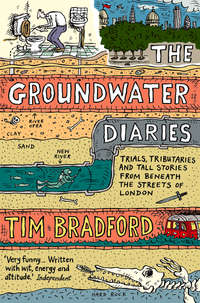
THE GROUNDWATER DIARIES
Trials, Tributaries and Tall Storiesfrom beneath the Streets of London
TIM BRADFORD

Dedication
To Cindy, Cathleen and Seán
Contents
Cover
Title Page
Dedication
AUTUMN
1. A Bloody Big River Runs Through It
2. Special-Brew River Visions (No Boating, No Swimming, No Fishing, No Cycling)
London Stories 1: The Dogpeople
WINTER
3. Football, the Masons and the Military-Industrial Complex
London Stories 2: A Young Person’s Guide to House Prices
4. From Eel to Eternity: William Morris and the Saxon-Viking Duopoly
London Stories 3: Going to the Dogs
5. Spa Wars
London Stories 4: The Secret Policeman’s Bar
6. Invisible Streams
London Stories 5: Triumph of the Wilf
SPRING
7. The Pot and the Pendulum
London Stories 6: Catching Muggers, Starsky-and-Hutch Style
8. Can You Feel the Force?
London Stories 7: Our Man in a Panama Hat
9. Danish Punk Explosion Dream
London Stories 8: Suspicious Mind
10. Big Sky Over Norton Folgate
London Stories 9: Hidden Art Soundscapes in the Aura of Things
11. River of Punk
London Stories 10: The Secret Life of the Market Trader
12. Fred the Cat and the River of the Dead
SUMMER
13. Acton Baby!
London Stories 11: How to Fuck Your Knees Before You’re Fifty
14. The Suburban River Goddess at the Brent Cross Shopping Centre
London Stories 12: Swedish DIY Fascism
15. The Unbearable Shiteness of Being (in South London)
London Stories 13: 30 Love in the Time of Henmania
16b. Sorry to Keep You
17. The Tim Team
18. Doing the Lambeth Walk
London Stories 14: Welcome to Shakespeare Country – Britain’s Heritage Industry
AUTUMN
19. Bridge Over the River Peck
London Stories 15: A Night Out at the Ministry of Sound
20. The Black Wicked Witch Knife and Fork in Old Ed’s Dinertown
London Stories 16: An Alternative Global Financial System Written on the Back of a Beermat
22. Up Shit Creek
London Stories 17: Dome Time
23. The Tao of Essex
London Stories 18: The Eighties Were Shit But Free Jazz Pool Was Great
24. Smoke on the Water
25. Black Sewer, Crimson Cloud, Silver Fountain
Appendix
Flow rate Chart
What is London?
London Weather
Some Top London Buskers
Bullshit Detector Detector
Etymologists
Further reading
Credits
Pubs that appear in the text
Index
Acknowledgements
About the Author
Further praise for The Groundwater Diaries:
Other Works
Copyright
About the Publisher
AUTUMN
1. A Bloody Big River Runs Through It
• London’s forgotten rivers
Dream of a big river – river obsession – Danish punk explosion – Samuel Johnson – London – electric windows – pissed-up Jamaican grandads – Hemingway – burning Edward Woodward – global warming – the underground rivers – old maps – lots of rain – roads flooded – blokes digging up the road
I have a recurring dream. I’m standing in the shallows of a silver-grey mile-wide river. My wife, in a blue forties-style polka-dot swimsuit, is next to me, with our daughter. We are picking bits of granary bread out of the river and putting them into black bin liners. On the shore stands a big wooden colonial-style house. I first had the dream before my daughter was conceived, in fact long before my wife and I even got together. Dream analysts might say I was crazy. But they are the crazy ones, thinking that punters will be fooled by fancy titles like ‘Dream Analyst’. I contacted a dream analyst, anyway, because I can’t help myself. It was one of those Internet ones with swirly New Ageish graphics which denote a certain amateur-cosmic badge of quality. You had to type in your dream, then your credit card details. I’m no mug, so I chose one that only cost sixty dollars. A few days later my dream analyst (whose name was Keith – I had expected something a little more along the lines of Lord Sun Ra Om Le Duke de Dream Chaos Universale) sent me an email.
It is a pleasant dream showing you the very positive feelings of the family. You are together, safe, gathering and storing food. We survive best in a family and ‘tribe’, and this very primitive dream stimulus prompts you to make the most of that. You are lucky, most of the dreams like this work the other way by having the unit threatened. You might see your daughter drowning, thus frightening you (the objective of the dream) into increased protection in life.
I like it! A good dream. You even had it before the event, stirring you on to make the union and reproduce the species.
But I wasn’t totally satisfied. Why did my wife’s swimsuit have polka dots? Did the bread have something to do with religion? From my description, would he say the wooden house was designed in an Arts-and-Crafts style? And why were we in a river? Dream Analyst had gone quiet. Except for a ghostly hand that reached out from my computer terminal with a note that said ‘60 dollars please’.
OK, I am obsessed with rivers. Especially dark ones, like the River Trent in the East Midlands, 20 miles from where I grew up. It’s deep and unfathomable. Like time, but with fish and old bikes at the bottom. My mum used to tell me a story about a local man whose daughter fell from a boat into the river. He jumped in and saved her, but was carried off by the tide. Is his body still there, in the river? Maybe. So how deep is it, then? Very deep, my parents would say, shaking their heads and sucking in their breath. Fantastic. I’d lie in bed thinking abut the river and what it must be like to drown. I couldn’t imagine the bottom. It was like visualizing a million people or the edge of the universe.
I remember everything in the town where I grew up being smaller than elsewhere in the world (the cars, the voices, the people) and this was especially true of our ‘river’, the Rase. At its highest near the mill pond, the Rase could be up to 2 feet deep, but it usually flowed at a more ankle-soaking 8 to 12 inches. In early 1981, the placid river burst its banks and many people, my aunt included, were flooded out of their homes (ironically, my new copy of Lubricate Your Living Room by the Fire Engines floated off past her sofa). A couple of months later my friend Plendy and I decided to try and placate the Rase by making a pagan sacrifice. It was important to give something that we both treasured, but in the end were too stingy and instead nailed down a copy of Bullshit Detector (an anarcho-punk compilation album I’d bought some months earlier) to a wooden board, placed it in the water and watched it head off downstream. We liked to think it eventually found its way to the North Sea then travelled the world, spreading its gospel of three-chord mayhem and anarchist politics.
The men with the powerHave pretty flowersThe men with the gunsHave robotic sons.
‘The Men with the Guns’
At the very least, most Scandinavian punk music must be down to us.
Scene 1: A farm in Denmark. A big-boned farmer finds a record nailed to a board on the shore near his house. He removes it then puts it on a record player. It’s good. He starts pogoing.
Scene 2: A few days later, in the farmer’s barn, a punk band is practising. The farmer is on lead vocals.
Scene 3: A tractor lies half-buried beneath long grass. There are cobwebs on the steering wheel.
Scene 4: A painting of the farmer and his wife in the style of Gainsborough’s Mr and Mrs Andrews. The farmer has a mohican. The wife looks very, very angry.
Long before we were offering third-class punk records to the water spirits, rivers were worshipped as gods. Those red-haired party animals, the Celts, threw things they most valued – shields, swords, jewellery, and other anarcho-Celtpunk memorabilia – into them (a residue of this is our need to chuck loose change and crap jewellery into fountains). To different cultures across the globe, rivers have represented time, eternity, life and death. It is believed that our names for rivers are the oldest words in the language, some predating even the Celts. Many major settlements were located at healing springs sacred to the pre-Roman goddesses, and many rivers, such as the Danube, Boyne and Ganges, were named after goddesses. The Thames is one of these, its name apparently deriving from a pre-Indo-European tongue and referring to the Goddess Isis. Some posh Oxbridge rowing types still call it that. Well, we’ve got names for posh Oxbridge rowing types. Like ‘big-toothed aristo wanker’, etc.
London is beautiful. Samuel Johnson, in the only quote of his anyone can really remember, said, ‘When a man is tired of London, he is tired of life.’ He may have been a fat mad-as-a-hatter manic depressive in a wig, but there is something in his thesis. London’s got its fair share of nice parks and museums, but I love its underbelly, in fact its belly in general – the girls in their first strappy dresses of the summer, the smell of chips, the liquid orange skies of early evening, high-rise glass office palaces, the lost-looking old men still eating at their regular caffs even after they’ve been turned into Le Café Trendy or Cyber Bacon, the old shop fronts, the rotting pubs, the cacophony of peeling and damp Victorian residential streets, neoclassical shopping centres, buses that never arrive on time, incessant white noise fizz of gossip, little shops, big shops, late-night kebab shops with slowly turning cylinders of khaki fat and gristle in the window, the bitter caramel of car exhaust fumes, drivers spitting abuse at each other through the safety of tinted electric windows, hot and tightly packed tubes in summer, the roar of the crowd from Highbury or White Hart Lane, dog shit on the pavements, psychopathic drunken hard men who sit outside at North London pub tables. London has got inside me. I’ve tried to leave. But I always come back. It’s love, y’see.
As you can probably tell, I’m a sentimental country boy. No real self-respecting Londoner would love their city the way I do (and before you ask, Dr J. was from the Black Country).
My love affair started early. The first trip was in the late sixties. We went to the Tower of London and some museums while the streets were ‘aflame’ with the lame English version of the ‘68 riots (‘What do we want? Cheap cigarettes and decent central heating! When do we want it? How about Wednesday? I’m visiting my Auntie for a long weekend!’). Years later I visited an old college mate in a little flat in Finsbury Park. I slept on the floor and spent three days sitting in pubs where we were the only people without overgrown moustaches and some obscure connection to the Brinks Matt robbery. A drunken fat bloke with a moustache the size of Rutland showed me how to drink Guinness properly. Throughout these years it seemed that London was a place full of record shops, shouty Irish blokes, pissed-up Jamaican grandads and stoners. I’ve found it hard to shake off these early impressions.
In January 1988 I hit cold evening air at Highgate tube, north London, a heavy-duty iron forties typewriter (a prerequisite for the aspiring writer) strapped to my body with a mustard and maroon dressing-gown cord, guitar on my back, clutching a bag with a spare pair of jeans, a couple of T-shirts and a change of underwear.
I had arrived, like Hemingway in Paris, in a grand European capital where I would soon become a famous novelist and songwriter. OK, not like Hemingway at all. Unless his music has been kept quiet all these years.1 I had a simple plan. Within six months I’d have clinched a record deal and would be starting my second novel. I was here to scrape the gold off the London pavements and cart it back to Lincolnshire, to be held aloft in procession through the streets of my old home town, before sharing my booty with all and sundry in the market place.
And so twelve years on I’m still here. Pushing a pram around for an hour or so every day and watching too much kids’ TV.
I love London in late summer/early autumn. Hot weather. Then it’s cold. Then it’s cold-but-hot cold. Cold days have warm miasmic breezes. Hot days have brittle, icy winds that hide behind hedges and garden walls. Then it’ll piss down. The weather’s going crazy. You always start your books with stuff about weather, said one (pedantic) mate. What do you mean always? I’ve only written one. Yeah but you started that with weather and now you’re starting this the same way.
But weather is important. People on these islands have always been obsessed with it. The Celtic people worshipped the weather gods. The seasons. Agriculture. Sacrifice. Dancing naked around standing stones. Burning Edward Woodward in The Wicker Man. Listening to ambient techno while off their faces on magic mushrooms. The British Isles can have wind, sun, rain and snow all in one day. My mate agreed and pointed out that he lived here too so also knew these things. But now it’s changing more and more, What With Global Warming And That. The east of England could be underwater in a few decades. I want to write a book about Lincolnshire some day. But Lincolnshire may not be around for much longer.2 London too. The climate will get wetter rather than hot and dry. It could also get colder in winter if the Gulf Stream gets clobbered by cold water from the melting ice caps flowing into the North Atlantic, pushing the warmer water further south. More importantly, my book about Lincolnshire will then be about an area that no longer exists. Or one of those Undersea-Lost-World-type things.
‘How do you know all this stuff?’ asked my mate.
‘I saw it on TV.’
Anyway after all the hotcoldrainsnowsuncoldhot stuff, it went cold again. Maybe we had gone straight from early summer to late winter. It became so consistently grey that my sensitivity to the London seasons became even more numbed than usual. As a kid, in rural Lincolnshire, every day held new smells and sensations. Cow parsley. Corn. Peas. Sugar beet. Rotting leaves. The perfume of a girl who’d just chucked me. Singed hairs on the back of a fat farmer’s neck as he gets his ‘winter cut’ at the local barber shop. Rotting roadkill. Cow shit. Blood.
And after a few days of cold, the sun suddenly came out and I guessed, from stuff in the newspaper, it must be some time in August. On the way back I walked along the little avenue of trees in Clissold Park. This is a sacred space where we sometimes sit in the evenings, surrounded by people doing tai chi, yoga, reading, skinning up or snogging, and we watch some of the crap football lower down in the park. Fat women jog tortuously around the little running track. Above, breadcrumb clouds scud across a perfect sky, and a leather football hits a nearby tree.
For someone who finds rivers fascinating (‘Yes, would you like to see my gold-embossed collection of nineteenth-century etchings of the tributaries of the Tyne?’) underground rivers give me an extra thrill. As well as all that energy and … water … there’s the fact that you can’t see them. They’re erotic, mysterious and magical because they’re hidden and therefore may or may not really exist. In the early nineties when I lived near Ladbroke Grove I frequented a little second-hand bookstore at the northern stretch of Portobello Road run by a serious young Muslim with a goatee. His big gimmick was a job lot of poetry books by Reggie Kray, but my real find was a three-volume set called Wonderful London which he sold me for twenty quid. The volumes were published in 1926 – lots of pictures of London in the 1880s contrasted with the twenties with captions saying ‘Gosh chaps, look what a mess we’ve made of our city, eh what.’ If only they could have seen what was to come.
The books were brilliant – lots of highbrow columns, anecdotal journalism and chummy recollections, but by far the best was a chapter in Volume Two, ‘Some Lost Rivers of London’ by Alan Ivimey. He described in exquisitely bright purple prose the undulations to be experienced in Greater London – the geography and geology of the Thames Valley. London, said Alan, was an uneven plain, bordered north and south respectively by clay and chalk hills with a large river flowing through the middle of it, and in between the hills and the river were undulations of sand and gravel and clay. The once proud tributaries that flowed through this flood plain were now little more than ‘dirty drains beneath the bowels of the earth, trickling weakly along their old beds’.
There was a small map showing the main rivers that had disappeared around fourteen (though possibly more) including the Westbourne, the Tyebourne, Bridge Creek, Hammersmith Creek, the Wandle, the Effra, the Neckinger, Falcon Brook, the Holebourne (also known as the Fleet), the Walbrook and the New River. For hundreds of years people had been shitting and pissing and throwing their dead relatives into these rivers so that, by the start of the nineteenth century, most had become open sewers.
Travel back in time. Imagine I’ve a Public-Information-Broadcast-type voice:
(Swirly ethereal New Age synth music). Once upon a time London was full of vales with water meadows, woods and streams. Man first inhabited the area in Neolithic times, the Celts had a trading and fishing settlement near the Thames. Since then Romans, Saxons, Vikings and Normans invaded … blah blah Tudors and Stuarts … Georgians … lovely squares … Victorians – nice train stations … then Edwardians then wartime then the sixties, seventies … design nightmares … eighties … nineties … modern London, a teeming famed-piled post-modern high-tech metropolis where once was once rolling countryside.
I like to look at urban landscapes or, to be more specific, how urban landscapes would have looked before the industrial revolution. I can see the past, although it takes a lot of concentration. I walk down a street, look up at the old buildings then look down again at the winding lanes that once would have been filled with shit, rats and corpses. I’ve invented a special virtual reality gizmo that allows the user to input map co-ordinates then choose a year and the display will show the scene as it was then. So, for example, if I’m walking up Blackstock Road in Finsbury Park and I input 1760, it’d be a sandy lane leading from Stroud Green Farm to the heights of Highbury. A button would allow you to turn off all modern interference, such as cars or other people, but, of course, this would only be advisable in very safe conditions. Actually, by ‘invented’, I mean had an idea and talked to my wife about it. She smiled and asked, ‘Are the dreams still bad?’
After doing some research (half an hour on the Internet looking for ‘underground rivers’), I discovered that living above an underground river, or groundwater, is bad for your health and should be avoided. This is to do with radiation and ‘bad’ spirits – that’s why feng shui experts, hippies and mad country folk practise water divining. I’m always on the lookout for unified (and easy) theories of everything and it occurred to me that my insomnia, strange dreams and fragmented state of mind could be due to the fact that, since coming to London I had always lived above subterranean streams.
I got a surveyor to come round to investigate a little damp problem we had noticed and, as he was walking around with his damp detector, I tossed a casual question in his general direction:
‘Do you think the … er, damp … could be caused by … er … the lost underground rivers of London like the New River, Fleet, Westbourne, etc., ha ha, as it were?’
‘What a load of bullshit,’ said the surveyor. He moaned that people were always banging on about underground rivers. Were they? I said. I’m the only person I know who does – everyone else seems to be very bored with the whole concept already.
I live on a road with a watery name so thought that should be enough evidence, but decided to check out my theory on various old maps I’d picked up. Two Victorian maps showed the New River, which seemed to run along where our road is now. Then, during a visit to Stoke Newington library, I found an old leaflet about Clissold Park which showed that the raised avenue of trees was where the heavily banked river ran and continued past the brick shed at the park gate (actually an old pump house), then it went under Green Lanes and along our road before heading north. ‘My God,’ I thought to myself, slapping my forehead, ‘so the tai chi people, crap footballers, snoggers and dopeheads are perhaps in exorably drawn to the electro-magnetic currents of the river!’ I was so excited I got goose pimples and had to go for a shit immediately.
At the eastern end of my street, opposite Shampers Unisex Hair Salon (cut £3.50, blow dry £7.00), water is bubbling up through the cracks in the pavement in about six places. This little spring is clear and shiny in the morning sun and I want to reach down and drink from it, only it’s flowing over fag butts, withered banana skins, discarded ice cream wrappers and dog shit. It babbles and swirls for a few moments at the side of the road among a narrow band of cobbles, then pours along the kerb to a shallow trough in the road, where a pool is slowly forming. An empty can of Strongbow is already floating in it. As the water level in the pool increases, a group of middle-aged black people start to arrive at this end of the street. They are all impeccably dressed, the men in dark suits and blazers with ties, the women in dazzling summer dresses and hats. A tall man in specs issues instructions then they fan out, rapping fastidiously on doorsteps in twos, clutching their books and spreading the word.
‘Who is it?’
‘We want to talk to you about Paradise.’
‘Fuck off,’ says a bloke from an upstairs window.
‘The end of the world is coming.’
‘Who gives a fuck?’
It has been raining on and off for forty-eight hours, melancholy vertical summer holiday rain with an afterscent that’s like faint pipe tobacco mixed with petrol and oranges. Plump droplets hang from the trees. A quick sortie around the neighbourhood shows that many of the area’s drains are rebelling. In the network of streets to the north east of the Arsenal Tavern pub small lakes are forming in the roads. It’s as if the tarmac and concrete have been pushed down and the area is reverting to swampland.
By early evening, the pool of water stretches across to the other side of the road. It’s still flowing heavily from the same cracks and along underneath the iron railings. Half an hour later, four men are standing in the pool, one with a clipboard. They’re all looking down at the water.
‘Have you got a burst underground river, then?’ I ask, smiling. The man with the board looks at me nervously and smiles, but doesn’t say anything. As I walk down the road a mechanical drill starts opening up the pavement Er er er er er ererererererererererereerererere. Down below, the New River flows on, biding its time.
1 (Peter Skellern style number) Is it me Is it you We two Let’s do It.
2 Reader: Does Lincolnshire only exist so that you can write a book about it?
2. Special-Brew River Visions (No Boating, No Swimming, No Fishing, No Cycling)
• The New River – Turnpike Lane to Clerkenwell
Invisible rivers – Sex File – magic glasses – more dream analysis – in the library – Turnpike Lane – Clifford Brown – Patrick Swayze in Albanian Ladyboys – Finsbury Park – Woodberry Down – Swedish prisons – Highbury Vale – Clissold Park – Canonbury – Islington – Clerkenwell – Special Brew visions – the floods
Another dream. I’m walking along the bank of the New River in the park with my wife and daughter. The path is very narrow and the water is full of crocodiles. We start to throw golf clubs at them (irons, not woods) to stop them climbing onto the bank. I throw the whole bag in and tell the others to run for it.
London is a city of invisible boundaries. Areas alter in atmosphere or architecture in the space of a few yards, and a reason for this might be that the rivers which once flowed were often the borderlines between ancient parishes and settlements. You might walk down a street now and suddenly notice a change in the air. Chances are you have walked across the course of an underground river. The New River would have been no different. Although a recent addition to the waterways of London (about 400 years old), when it was built it would have run through mostly open countryside and settlements would have grown around it.
Some portions of the New River are visible to the naked eye. Yet these sections (for instance, Turnpike Lane to Finsbury Park), which flow silently behind housing estates and terraced streets, seem somehow not as alive as those which have disappeared. It’s the ghost parts of the river, now covered by houses, gardens, shops, parks and roads, that get me going more than the algae scum1 cuts I can see filled with bikes, shopping trolleys and empty plastic Coke bottles.
Searching for lost rivers is, in a way, a spiritual journey, searching for things that I once valued but have lost, like my Yofi acoustic guitar, God, my grandfather’s retirement watch, a sense of childlike wonder at the universe, old girlfriends’ phone numbers, a large cardboard box containing copies of the New Musical Express 1979–82, and my Sex File. Actually, my Sex File, one of the Really Big Things in my life that was truly lost (or, rather, forgotten about – it’s often the same thing) – a pink four-sided A4 folder plastered with pictures of models from a stolen late-seventies edition of Playboy, with notes and drawings (and even coloured in areas) by me – was recently rediscovered by my father. He found it folded up in an old cobwebby red-brick chicken shed in the field behind the family house, where it had lain untouched (except by spiders) for over twenty years. The Sex File was a snapshot of my early teenage desires and fears, in many ways a mystical (almost religious) document – sort of like an East Midlands Dead Sea Scrolls but with leggy blondes, huge breasts, erect nipples and adverts for penis enlargers.
Before I could track the exact course of the New River I needed to do some research at my local library. However, I was immediately faced with a problem. I wouldn’t be able to take any books out because I was currently a library Non-Person as I had a couple of books that were seven months overdue. One was an earnest tome about water spirits (the author had apparently lived with the spirits for several months and had been accepted as one of them), the other a teach-yourself aikido manual written in the fifties.
Aikido is a jolly nice way to get fit and beat up chaps who are giving you a hard time or staring at your wife. Rather than going into the ring with them you simply give them a couple of hefty aikido chops and, hey presto, their nose cartilage has been pushed up into their brain and they’re stone-cold dead! Crikey! You’ll be the talk of the Lounge Bar. I say, old chap, here come the rozzers. Remember, this is the fifties. The forces of Law and Order don’t take kindly to fellows who are dressed up as Chinamen. You’d better leg it, old man. Aiiee banzaaai!
The Gentleman’s Guide to Aikido
To go with my new habitat I also had a new look, a pair of mid-seventies National Health glasses. I’d originally got them when I was thirteen but never used them, having been anxious in my early teenage years to appear both tough (to stave off the hard cases who roamed the playground like carnivorous dinosaurs with feather cuts) and cool (to try and impress just one of the many girls I fell hopelessly in love with every week). Janus-like, I looked in two directions, at the birds and the bullies. Pity they weren’t in focus. Like the Sex File, the glasses had been forgotten about for a couple of decades until I recently found them at the back of a drawer in my parents’ house and brought them back to London. Now I wanted to reclaim my swottishness. If I hadn’t been so hung up on not being beaten up and getting a snog I would probably have been a pupil who enjoyed learning (‘Ha ha, not really, Togger. Only joshin’, mate!’) Now I was going to recreate the Anal Years and spend weeks in libraries. The National Health specs would give me the vision of an inquisitive and swotty thirteen year old. Without the spots, the Thin Lizzy albums and the contraband porn mags.
Leaves were already blowing across Clissold Park. The skies were now grey and heavy. Then, just as an autumn melancholy was descending over north London, summer started up again, with muggy days and tropical drizzle and dragonflies dancing around the park. Then came a full-blown three-day heat wave while all over the country irate lorry divers were picketing garages due to a petrol shortage. A sense of unreality was in the air, culminating in England winning a cricket series against the West Indies. Then the rains came again.
An email arrived from Keith the online dream analyst:
Water in dreams is a consistent symbol for emotions. (Some people speculate that our first emotional memories are created when we’re still floating in our mother’s wombs. This may explain the correlation between water and emotions.) Accordingly, floods and tidal waves and other dream visions of rising water usually are associated with periods of ‘heightened’ emotion in our lives.
Keith
This was getting annoying. Keith the online dream analyst hadn’t analysed my dream – he’d completely ignored the stuff about crocodiles and golf clubs. This highlighted a major problem with the online world. Things don’t get done properly and you, the consumer, have no come-back because even the biggest corporations are actually run from some student bedroom in the LA suburbs. With razor-sharp clarity I realized there was only one way to sort this out – go to a better and more expensive online dream analyst.
More rain. The old tree-covered New River embankment in the park was dotted with pools of murky water. Beneath some of the trees were clusters of magic mushrooms. A few years ago I would have been tempted to pick them to find out what strange dreams the river might offer me. Now, my drug of choice was a strong cup of tea. Maybe with a biscuit. While splodging around at the edge of the park I noticed that the gate to the little Victorian pump house was open and I just had to peek inside. Expecting to find lost and magical artefacts relating to the New River’s past, I found only empty cans of strong lager and cigarette packets. I stood in the building trying to imagine what it would have been like 150 years ago, but all I could picture was a couple of blokes in tatty leather jackets with beetroot faces swearing at each other. I then walked to Stoke Newington Library and sat there surrounded by books on London, place names, rivers, architecture. For the first hour I flicked through free leaflets on yoga and local arts courses, then read the papers. The other people, mostly old or worn-out looking folk and the odd goateed library employee, seemed to be there because they didn’t have anything else to do. But not me. No, ha ha, not me.
(Adjusts National Health glasses) When James VI of Scotland arrived in London in the hot summer of 1603 to be crowned King of England, he soon discovered to his horror that his new capital had a foul and unhealthy water supply. Most of the city’s medieval wells and streams had been used up and the water in the larger rivers was undrinkable. The largest of the tributaries, the Fleet, was little more than an open sewer, while the Thames was also, literally, full of shit. Small-scale conduits were piped in from outlying villages such as Paddington, but these had little impact on the now rapidly rising population. James knew that something had to be done quickly because he was thirsty.
After my first book Is Shane MacGowan Still Alive? was published in the spring of 2000 I began to consider the idea of myself as Travel Writer. Travelling, jotting things down on the back of beer mats and being paid for it seemed too good to be true. Emboldened, I decided to embark on my second book. One idea was provisionally titled Heartbreak On The Horizon, a sort-of-travel-book about (me) trying to make it as a country music songwriter, incorporating my experiences in a group which once nearly supported Eric Random and the Bedlamites at Nottingham Ad Lib Club.
However, I’d also been plugging away on a book about my experiences of London. It had developed from a novel I’d written in 1988 about tai chi film-buff bikers, set in and around a squat in Leytonstone (with free jazz, Leeds United and the history of the pullover thrown in) and had entered in the P. G. Wodehouse Comic Novel competition. After getting the rejection slip back I buried it in a field somewhere – I still get backache just thinking about it. Now I dusted down the idea. Travelling in London seemed more intriguing than roaming the planet in search of the exotic. The stuff happening at the end of any street in London is far more interesting than, say, the antics of someone stuck on a didgeridoo farm for a year. The idea of finding mystery and adventure on the other side of the world has been hijacked by the tourist industry and TV travel shows. There’s nothing new to find out there so people are turning in on themselves and looking for enchantment closer to home, looking at the things they’d forgotten about or possibly never even looked at. Like the Hare Krishna food delivery van parked across the road, the bloke at the end of the street who shouts ‘Grandad Grandad’ at the top of his voice every evening, the 125-year-old Greek woman who sits at the top of her front steps and waves to passers by. It was now obvious to me that my only course of action was to attempt a book about real life, a diary about my various journeys along the courses of the underground rivers of London.
Maybe I could do the rivers book and incorporate the country music stuff – get C&W stars to don wetsuits and swim in some of the subterranean water courses. For charity. Then record a concept album about the whole experience.
Using the old maps, I traced the course of the New River – as close as I could get – onto my A to Z. I had decided to start the walk just up the road in Hornsey, near Turnpike Lane tube, where the river reappeared after an underground stretch. There are also various sections further north – an original loop, an ornamental waterway, now flows around Enfield Town (it was replaced by a straight section of underground pipes in the thirties) and there’s also a section to the north of Wood Green. I took the Piccadilly line to Turnpike Lane, then ambled east along Turnpike Lane with its flaking Edwardian buildings, mostly small red-brick shops with awnings, selling fruit and vegetables, kebabs, the odd estate agent. It’s a tight squeeze. You almost have to move sideways to get past the people staring at the traffic, at each other, at that nowhere-in-particular place in the middle distance that many bored people look at. There also seemed to be some kind of work-for-all scheme going on – it took five people to transport a crate of satsumas or packet of toilet paper from van to shop and the pavement was full of blokes nattering to each other about the news of the day (‘Oi, Memhet, the bloke next door has got seven blokes outside his shop and there’s only six of us. We need another bloke – can we hire someone?’)
What is a turnpike? The name derives simply from a ‘lane beside a toll barrier’. Many of the major thoroughfares into London had these barriers, presumably to pay for the upkeep of the roads. However, whenever I hear the word turnpike I think of Clifford Brown, the jazz trumpeter who died driving off the Pennsylvania Turnpike. It sounds so much more glamorous than, say, smacking into the back of a bus near Turnpike Lane tube (it’d be the 341 or 141). That’s American roads for you. If there was a road in the US called the North Circular it would seem romantic and mysterious. We’ve all been brainwashed, somehow. Maybe through hamburgers or subliminal messages in rock ’n’ roll records and Hollywood films. They’re much better at that sort of thing than us Brits. Our idea of subliminal messaging is backtaping on LPs so when spotty fourteen-year-old introverts at boarding schools in the seventies played their Led Zeppelin records backwards they would hear stuff like ‘You must worship the deviiiiiiiiiilllll. If you are a girl you want to shag Jimmy Paaaaaaaage.’
I scrutinized the squiggly blue biro line I’d drawn in my A to Z. The section of the New River I was looking for was at the junction of Turnpike Lane and Wightman Road. The New River appeared not very majestically behind a high, half-rotten wooden fence crusted with barbed wire. It snaked from around a small housing estate into a bit of a straight.
Four years after James’s succession to the throne, his patience was at an end. The cleanest drinking water on offer in the capital, for which you had to pay good money, was now suspiciously brown. James invited some of his most celebrated engineers to consider solutions and think ‘out of the box’. In those days the phrase meant that if they didn’t sort it out they would soon find themselves in a box, six feet under.
There was an idea knocking about to build a man-made water channel that would bring in fresh supplies from the boring but clear-watered countryside of Hertfordshire to the north of the City. It was a madcap plan, but it needed someone with a posh-sounding name to bring it to fruition. Step forward wealthy Welsh goldsmith Hugh Myddelton, a man whose life so far had been a classic rags to riches story – young boy leaves the Valleys to find fortune in London, flukes a job at a jewellers in the City, works hard and gets own business, chosen by King to become Royal Jeweller. Myddleton not only offered himself up as the engineering genius to oversee the project but also put up the money as well (the projected cost was £500,000). Work began on the water channel – already called the ‘New River’ – in 1609, starting out at two springs at Amwell and Chadwell in Hertfordshire.
The New River, as if bored with hugging the main drag of Wightman Road, meanders off to the south-east between the houses of the Harringay Ladder, a row of long parallel streets than run down the hill to Green Lanes. I spotted an opening next to an old school and saw the river stealthily heading south. The path was inaccessible, with heavily bolted steel fences and Water Board signs telling people to keep out. I zig-zagged up and down a few of the streets just to peer over walls and railings to spot sections of the river, then walked down to where the river eventually crosses Tollington Road. Further down is the Albanian video shop and its window full of movies by Albanian Patrick Swayze lookalikes with film titles like I Love A Patrick Swayze Lookalike Ladyboy (possibly my translations are not 100 per cent correct).
At one point Myddleton ran out of money and asked the Corporation of London for help. He was refused so turned to King James who agreed to take on half the costs (and profits). Work was finished in 1613, the river ending at an artificial pond called New River Head just off Rosebery Avenue in Clerkenwell, from where water was distributed to houses in wooden pipes. Over its 38-mile course the New River had many long twists and turns as it followed the contours of the land to maintain the steady drop from Hertfordshire to London. The New River was hailed as a great success and Myddleton became a hero. Statues of him can be seen at various stages along the river’s route.
The river travels under the road and reappears in Finsbury Park where it snakes across the ‘American Gardens’. Finsbury Park is one of the few areas in this part of north London which doesn’t seem to have had the clean-up treatment in recent years, possibly due to the fact that three borough councils – Haringey, Hackney and Islington – are responsible for different parts of it. It still has, according to official figures, a higher proportion than most parts of London of crazy nodding people, walking around talking to themselves, staring in glassy-eyed gangs outside the tube station, bumping into you and asking for money, then looking forgetful and wandering off.
One of my favourite buildings in Finsbury Park was a music venue, The George Robey, a Victorian pub which in its time had been the birth place of many third-division punk bands (though no Danish ones) is now some kind of dance club with blackened windows, a fence surround and the ubiquitous ‘security’ hanging around.
As the wooden-sided river passes the cricket pitch and under a little bridge, it’s a bizarrely rural scene, a snapshot of how the whole landscape might have looked when the river was first built. Trees hang down over the banks, the water is clear. The river winds quickly across the north side of the park then disappears under Green Lanes, in the direction of the Woodberry Down Estate, where it disappears behind a fence and railings. Woodberry Down sounds like something from Rupert Bear. By all accounts it was actually like that (not the talking animals bit) until relatively recently – photos from 100 years ago show the New River meandering gently through water meadows past trees, stationary men with big moustaches and a little country cottage. The view is still good, though, and it’s easy to imagine standing on a gentle hill looking down into a green valley of farms and rolling fields, and across Tottenham and Walthamstow marshes.
Naturally there was a danger that, people being people, the New River would soon get clogged up with all the usual debris – shit, blood, pigs’ intestines, sheep’s brains, the rotting heads of traitors, bloated corpses of drunkards who’d fallen in, everything that at that time clogged up most of the waterways of the city. The New River Company decided to combat this by building paths on each side of the river and employing walkers, big burly moustachioed men who would patrol the river and have their pictures taken when photography was invented. These walkers had the power to fine or even imprison anyone they caught throwing rubbish or simply pissing into the river.
By the mid-nineteenth century most of the water supplies in London were once again polluted. The cholera epidemic of 1849 would eventually be traced to the contaminated water supply at Broad Street in Soho. Thanks to the New River Company’s vigilance, their water remained pure and drinkable but as a result it was too expensive for the poor of London. The philanthropist Samuel Gurney spotted a gap in the charity market and under the auspices of his new and snappily named the Metropolitan Free Drinking Fountain Association, opened London’s first drinking fountain in Snow Hill, from water pumped (and bought) from the New River.
I cut across past Manor House, named after the old manor of Stoke Newington which stood nearby. Manor House is a big strippers’ and showbands’ pub, or at least it would have been in its glory days. I walk along the rumbling and dusty Seven Sisters Road for a quarter of a mile until the New River appears on my left looking very sad, chained up, covered in green American algae, another of those crap Stateside imports up there with grey squirrels and confessional TV, with a shopping trolley and plastic football set fast in the gunge. At Sluice House Nine (Kurt Vonnegut’s London novel), on Newnton Close, in the shadow of three big tower blocks, I am finally able to get back down to the river and walk alongside it as it winds past the East Reservoir, still covered in algae scum. There’s a sense of boundary here between the self-conscious bourgeois charm of Stoke Newington to the south – with the reservoir and trees, a church spire, Victorian rooftops, it could be the countryside – and the more uncontrolled and more recently built-up area around Seven Sisters Road to the right, a canvas of white council slab flats, shopping trolleys left upturned, kids playing football (two kids are trying to juggle a ball then the smaller of the two nicks it off the big one. The big kid knocks him over), an old people’s haven with three plastic benches like a prison. These tower blocks, another part of the huge Woodberry Down Estate, are quite spectacular.
The scheme had originally been planned in the early twenties when it was decided to get rid of much of the Victorian architecture in the area (Victorians hated Georgians, Modernists hated Victorians, we hate the Modernists – those fucking bastards), although not finished until 1952. Its four eight-storey slab blocks with projecting flat roofs in parallel rows were designed in a ‘progressive Scandinavian style coloured in the pale cream like Swiss municipal architecture’ according to the bloke in the little Turkish grocer’s shop across the way on Lordship Road.
The reservoir is a haven for birds and their human sidekicks, birdwatchers. Looking back, where the river meets the road, is my favourite view of the New River – a blanket of green covers a small sluiced section dotted with cans, blue girders, a red plastic football, aerosols and bottles coming up for air like gasping fish, the three identical tower blocks of Stamford Hill rising in the distance like silver standing stones. There’s ducks too, one old lad with four duck chicks – well, not chicks, they’re ducks, and one younger male with a dodgy leg who’s just been beaten up, probably in a fight over the duck harem, which waits in the background ready to change allegiance at a moment’s notice should the old fella peg it suddenly.
Across the road on Spring Park Drive is a fifties estate. A fat woman shouts out of a sixth-storey window to her daughter below, ‘Oi, get me some leeks.’
‘I don’t want to get leeks,’ says the girl.
‘Get me some fucking leeks, you little bitch,’ shouts her mum.
‘I don’t want to,’ says the girl and the mother is looking very, very angry. Get the leeks, go on, for a quiet life.
‘I don’t know what leeks look like anyway,’ the girl shouts up, then runs away. A right turn and there’s an old wooden bench on a patch of grass that once would have had old lads sitting down looking over the view, now it just looks onto the health centre. Look, there’s the window where they had the wart clinic. Ah, those were the days. Across Green Lanes again into the back streets and onto Wilberforce Road, with its rows of massive Victorian houses where there are always big puddles on the tarmac. Only 150 years ago all this area north of here up to Seven Sisters Road was open countryside with two big pubs, the Eel Pie House and the Highbury Sluice alongside the river, where anglers and holidaymakers would hang out. Then, in the 1860s, the pubs were pulled down and everything built over in a mad frenzy. If you compare an 1850s map of the district and the 1871 census map you can see the rapid growth of residential streets in Highbury and south Finsbury Park.
On Blackstock Road there are a couple of charity shops and a huge Christian place, all with great second-hand (or more likely third-or fourth-hand) record sections. Their main trade, however, is in the suits of fat-arsed and tiny-bodied dead people and eighties computer games (i.e. Binatone football and tennis – which is just that white dot moving from a line one side of your screen to another). They also have a fine selection of crappy prints in plastic gilt frames – mostly rural scenes, Italian village harbours and matadors. I buy a lot of crappy pictures in gilt frames and paint my own crappy pictures of London scenes over them, most recently Finsbury Park crossroads on top of a Haywainy pastiche. It’s cheaper than buying canvases and you get the frame thrown in too.
Now on Mountgrove Road, the old accordion shop is empty, the estate agents have moved, the graphics company has closed up, the electrical shop has been turned into flats. This was originally a continuation of what is now Blackstock Road, called Gypsy Lane, but it’s been cut off, like an oxbow lake. Cross over my road and you’re suddenly into very different territory – there’s an invisible border I call The Scut Line with cafés and corner shops on one side, nice restaurants and flower shops on the other. It marks a boundary of the old parishes of Hornsey, St Mary’s and Stoke Newington. The mad drunken people of Finsbury Park and Highbury Vale don’t stray south of the line, marked by the Bank of Friendship pub (‘bank’ possibly alluding to a riverbank). People would stand on one side of the river here and shout at the poncey Stoke Newington wankers – ‘Oi, Daniel Defoe, your book is rubbish!’
The course of the New River has been altered several times in the last 400 years. Originally it flowed around Holloway towards Camden, but in the 1620s it was diverted east to Finsbury Park and Highbury. Since these early days most of the winding stretches were replaced by straighter sections and its capacity was increased to cope with the capital’s increased demand for water. This meant taking water from other streams, to the fury of people whose livelihood relied on the rivers, such as millers, fishermen and fat rich red-faced landowners who just liked complaining. Later on, pumping stations were put up along the route which pumped underground water to add to the river’s flow. Until recently the New River still supplied the capital with drinking water, 400 years after completion. It’s obsolete now that Thames Water’s new Ring Main system is operational.
The river now runs only as far as the reservoirs to the north of Stoke Newington. South of here it’s mostly been covered over – this happened in 1952 when the Metropolitan Board of Works, eager four-eyed bureaucrats with E. L. Whisty voices, made it their policy for health reasons.
Across Green Lanes yet another time, past the little sluice house and the White House pub where skinheads drink all afternoon, and into Clissold Park. Originally called Newington Park and owned by the Crawshay family it was renamed, along with the eighteenth-century house, after Augustus Clissold, a sexy Victorian vicar who married the heiress (all property in those days going to the person in the family with the fuzzy whiskers). The now ornamental New River appears and bends round in front of the house. It ends at a boundary stone between the parishes of Hornsey and Stoke Newington, marked ‘1700’, although it would originally have turned a right-angle here and flowed back west along the edge of the park. Where there used to be a little iron-railed bridge over the stream is the site of a café where the chips are fantastic and the industrial-strength bright-red ketchup makes your lips sting. This is the very edge of Stoke Newington (origin: ‘New Farm by the Tree Stumps’). The area, once a smart retreat for rich city types and intellectual nonconformists such as Daniel Defoe and Mary Shelley. went downhill badly after the war and by the seventies was regarded as an inner-city shit hole. Over the last ten years or so the urban pioneers (people with snazzy glasses, sharp haircuts and a liking for trendy food) have moved in and the place is on the up once more. I walk down the wide Petherton Road, which has a grassed island in the middle where the river used to run, towards Canonbury.
At Canonbury I enter a little narrow park where an ornamental death mask of the river runs for half a mile. This is a great idea in principle but in reality it’s faux-Zen Japaneseland precious, some sensitive designer’s idea of tranquillity, rather than reflecting the history of the area and its people. Completely covered in bright green algae, the river looks more like a thin strip of lawn. Here, too, the river marks a boundary, between the infamous Marquess estate on one side and Tony Blair Victorian villa land on the other.
Canonbury Park, further south, is a more typical London scene: silver-haired senior citizens in their tight-knit Special Brew Appreciation Societies sit and watch the world go by (and shout at it now and again in foghorn voices). More and more people walk around these days clutching a can of extra strong lager, as a handy filter for the pain of modern urban life. Out of the park and into Essex Road – a statue of Sir Hugh Myddelton stands at the junction of Essex Road and Upper Street on Islington Green.
The walk ends at Clerkenwell at the New River Head, once a large pond and now a garden next to the Metropolitan Water Board’s twenties offices. Above the main door is the seal of the New River Company showing a hand emerging from the clouds, causing it to rain upon early seventeenth-century London. I go into the building and take a photo, then ask the receptionist if there are any pamphlets or information about the New River. He shrugs, although apparently the seventeenth-century wood-panelled boardroom of the New River Company still exists somewhere in the building.
Pulsuz fraqment bitdi.