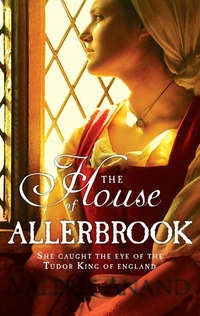
Kitabı oxu: «The House Of Allerbrook»
Born in London, Valerie Anand knew at the age of six she wanted to be an author. At the age of fifteen, she saw MGM’s film Ivanhoe and walked out of the cinema knowing that historical novels were the kind she most wanted to write.
Over the course of her long and distinguished writing career, Valerie has written many works of historical fiction, most recently The House of Lanyon.
Still living in London, Valerie frequently visits Exmoor, the setting featured in The House of Allerbrook.
THE HOUSE OF ALLERBROOK
VALERIE ANAND
 www.mirabooks.co.uk
This book is dedicated, with grateful thanks, to the
Lamacraft family in Somerset, from whom, in bygone years,
I many times hired horses to ride on and around Exmoor.
Without them, this book would probably
never have been written.
ACKNOWLEDGEMENTS
I would be hard put to list all the books, pamphlets and people I have consulted while preparing this novel.
Books concerning the Tudor age include Elizabeth Jenkins’s excellent work Elizabeth the Great, as well as books by Jane Dunn, Lady Antonia Fraser, Wallace MacCaffrey, Alison Plowden, Jasper Ridley, Anne Somerset and Alison Weir. I must also give special mention to Elizabeth’s Spymaster by Robert Hutchinson and Big Chief Elizabeth by Giles Milton.
Books concerning Exmoor include Living on Exmoor by Hope Bourne, The Old Farm by Robin Stanes, Yesterday’s Exmoor by Hazel Eardley-Wilmot, Devon Families by Rosemary Lauder and Somerset Families by Dr Robert Dunning.
Dr Dunning (County editor for Somerset), David Holt of North Molton, the Reverend Peter Attwood of All Saints Church, North Molton, David Bromwich (Somerset Studies Librarian) and the members of the Exmoor Society also gave me much help in my research.
V.A.
Part One
THE RELUCTANT MAID OF
HONOUR
1535–1540

CHAPTER ONE
New Gowns For Court 1535
Allerbrook House is a charming and unusual manorhouse in the Exmoor district of Somerset. The charm lies in the pleasant pro portions, in the three gables looking out from the slate roof, echoed by the smaller, matching gable over the porch, and the two wings stretching back toward the hillside that sweeps up to the moorland ridge above.
In front, the land drops away gently, but to the west there is a steep plunge into the wooded combe where the Allerbrook River flows noisily down from its moorland source toward the village of Clicket in the valley, a mile or so away.
There is no other house of its type actually on Exmoor. It has other uncommon features, too. These include the beautiful Tudor roses (these days they are painted red and white just as they were originally) carved into the panels and window seats of the great hall, and the striking portrait of Jane Allerbrook which hangs upstairs in the east wing.
The portrait is signed “Spenlove” and is the only known work by this artist. Jane looks as though she is in her early forties. She is sturdily built, clear skinned and firm of feature—not a great beauty, but, like the house, possessed of charm. She is dressed in the Elizabethan style, though without excess, her ruff and farthingale modest in size. Her hair, still brown, is gathered under a silver net. Her gown is of tawny damask, open in front to reveal a cream damask kirtle, and her brown eyes are gentle and smiling.
But the painter knew his business and recorded his sitter’s face in detail. There is a guarded look in those smiling eyes, as though their owner has secrets to keep, and there are little lines of worry around them, too. Well, Jane in her forties already knew the meaning of trouble.
Her original name was Jane Sweetwater. The household didn’t adopt the name of Allerbrook until the 1540s. She was sixteen years of age on that day in 1535, when the family was preparing to send her elder sister, Sybil, to court to serve Queen Anne Boleyn as a maid of honour, and with only a week to go before Sybil’s departure and a celebration dinner planned for the very next day, there was much anxiety in the household, because the new gowns that had been made for her had not yet been delivered.
“Eleanor,” said Jane Sweetwater to her sister-in-law, “Madame La Plage is coming. I’ve just seen her from the parlour window.”
“Thank God,” said Eleanor, brushing back the strand of hair that had escaped from her coif. “I know she sent word that she’d come without fail today, but I was beginning to think that Sybil would have to attend her celebration dinner in one of her old gowns.”
She wiped her forehead, which was damp. The March day was chilly enough, but she had been pulling extra benches around the table in the great hall, and the whole house seemed to be full of the steam from the kitchen. Preparations were under way for the feast tomorrow, when notable guests would gather to congratulate Sybil on her appointment to court, a great honour for the daughter of a Somerset yeoman.
Now everything that could possibly be prepared in advance was being so prepared, with much rolling and whisking and chopping by energetic maidservants, and pots and cauldrons simmering over a lively fire.
“Let me help you,” said Jane contritely, looking at her harassed sister-in-law. “I should have come down before. I was doing some mending. Where are we going to seat people?”
“There’ll be Sir William Carew and Lady Joan just here…and Master Thomas Stone and Mary Stone had better go opposite and they’ll want their daughter, Dorothy, beside them, I expect. Then there’s Ralph Palmer. He’ll probably have his father with him. Now, they’re family, though I’ve never got the relationship clear….”
“Distant cousins. I’ve never quite worked it out myself,” Jane remarked.
“Well, we’ll seat them on that side,” said Eleanor, pointing. “Then there’s the Lanyons from Lynmouth….”
“They’re distant relations, too,” Jane said.
“Yes. All from Francis’s side. I’m almost relieved that my own family can’t come, but my father’s not in good health…. If I put Owen and Katherine Lanyon here, they can talk to the Carews and the Stones quite easily and…”
Outside in the courtyard, dogs were barking and geese had begun a noisy cackling.
“That’s surely Madame La Plage at last,” said Jane. “I’d better go and tell Sybil.”
“I bring my most sincere regrets for the delay,” Madame La Plage said, leading her laden pack mule into the yard and descending from her pony into the midst of the cackling geese and barking dogs, just as Eleanor hastened out to greet her. “But I will do any needful adjustments immédiatement.”
Madame La Plage affected a French name and a French accent, but she was actually a local woman who had married one Will Beach of Porlock, a few miles west of the port of Minehead. After his death she had taken over his tailoring and dressmaking business. However, since Anne Boleyn, who’d spent many years in France, had captivated King Henry VIII, French food and styles of dress were in fashion. Mistress Beach had therefore moved herself and her business to Minehead and, with an appropriate accent, made a new start as Madame La Plage.
Most of her customers knew perfectly well that she was no more French than they were, but her work was good and she had prospered, acquiring clientele not only in Minehead but in the nearby port of Dunster, at the mouth of the River Avill, and even in Dunster Castle itself. Later she had become known more widely, even as far as Dulverton, in the very centre of the moor, and other places deep in the moorland, such as Allerbrook House, the home of the Sweetwater family, and the village of Clicket, which belonged to them.
The commission to make Sybil’s new gowns was a very good one, and she had worried because she had been too busy hitherto to ride the fourteen miles (as the crow flew; ponies had to take a longer route) from Minehead. She dismounted now with a flustered air, flapping her cloak at the livestock. “I…go away, you brute…cease flapping your wings! Be quiet, you noisy barking animals! Mistress Sweetwater, can you not…?”
Eleanor seized the two dogs by their respective collars and said “Shoo!” loudly to the geese just as two grooms appeared from the stable to take charge of pony and mule and unload the hampers. She sighed a little as she did so. Eleanor’s family in Dorset were dignified folk who lived in an elegant manorhouse, and she was often pained by the way her husband’s home had never quite shaken off its humble farming history.
Only a few generations ago it had been a simple farm, rented from a local landowner. Nowadays the Sweetwaters owned it as well as other land and had a family tomb in the church of St. Anne’s in Clicket, and neither Eleanor nor her husband’s two sisters had ever been asked to help spread muck on the fields or make black pudding from pig’s blood and innards or go out at harvest time to stock corn behind the reapers.
But the old atmosphere still lingered. The front windows of the otherwise beautiful house overlooked a farmyard surrounded by a confused array of stables, byres, poultry houses and sheds, and infested by aggressive geese, led by a gander with such a savage peck that even the huge black tomcat, Claws, who kept the mice in order, was terrified of him.
Peggy Ames, the chief cook and housekeeper, came out in her stained working apron, brandishing a rolling pin and laughing all over her plain, cheery face, to help chase the geese away, and Madame La Plage, along with her hampers, was taken into the hall. Eleanor sent Jane to call her sister, and offered refreshments which Madame said she would welcome after her long ride. The wind had been chilly, she said. She kept her mind on her business, though, and while sipping wine, began to talk of Sybil and the new gowns.
“You will like the tawny especially, I think. It will look charming over the pale yellow kirtle. It is ideal for a girl with fair hair. Ah, she is such a pretty girl, your sister-in-law Sybil. The fashion now is all for dark ladies, of course, but such blond hair is rare, above all with brown eyes.”
“Sybil is pretty enough,” conceded Eleanor, just a little sourly. Her own hair was mousy and her eyes an indeterminate grey. She had never been handsome. Her dowry had got her safely married and Francis had grown fond of her, but she didn’t have the looks to turn anyone’s head, and she knew it. Sybil, at court, would probably have every young man in sight dedicating sonnets to her. One could only hope that she would behave herself. “She’s a little greedy, I fear,” Eleanor said. “She eats too much cream. I have warned her that she will grow fat, but she takes no notice.”
“Perhaps her brother Master Francis should tell her, and maybe she will take notice of him. He is not here just now?”
“No, he’s out exercising his horse and riding round the farms. He takes good care of his estate,” Eleanor said.
Madame La Plage beamed. “Ah, his horse! He is known for his love of fine horses. He has good taste in all ways, has he not? I hope he will approve my work. Well, Mistress Sweetwater, shall we call Mistress Sybil and fit the gowns? Where is she? Most young ladies come running when new clothes are delivered!”
She and Eleanor both turned as a door opened at the end of the hall, but it was only Jane, on her own.
“Where has Sybil got to? I asked you to fetch her,” said Eleanor.
“She’s in her bedchamber,” said Jane, sounding puzzled. “She seems upset about something.”
“She’s been very quiet for a while now,” Eleanor said. “Can she be nervous about going to court? It’s not like Sybil to be nervous. She isn’t ill, is she?”
“I don’t think so,” said Jane. “But I think she has been crying.”
“Well,” said Madame La Plage, “let us see what pretty new gowns can do for her, shall we?”
“May I come, too?” asked Jane.
“Yes, of course.” Eleanor had dutifully tried to love and be a mother to both her husband’s young sisters, but she had never quite managed to become really fond of Sybil. Sturdy brown-haired kindhearted Jane, on the other hand, who always had a smile in her eyes, was easy to love. Sybil was affectionate enough, but she was careless. If you sent her to fetch something from another room, she’d probably bring you the wrong thing or get distracted on the way and forget her errand altogether. Now she had apparently found a new way of being difficult. What on earth was she crying about? “We’ll all go,” said Eleanor. “Come along.”
They found Sybil reading on the window seat in her chamber. She put down her book of poems when they entered, slipped from the seat and curtsied politely to the older women. Her little pointed face was very pale, however, and her eyes were certainly red. She looked at the hampers, which Jane and Madame La Plage were carrying between them, as though they were instruments of torture, or possibly execution.
“Now, why this sad face?” said Eleanor briskly. “Come. It’s an adventure, to be going to court to wait on the queen of England! Jane will help you off with what you’re wearing and we will see how these fit. Madame, shall we start with the tawny gown?”
“Has the young lady no tirewoman?” Madame La Plage enquired. “Surely, at court…”
“Yes, we have found a maid for her, but she lives in Taunton. We shall pass through Taunton on the way to London and the woman will join us there. We live simply here at Allerbrook, and assist each other instead of employing tiring maids,” said Eleanor with regret. She had had a maid in Dorset, but Francis had seen no need for one here. He had a parsimonious streak, except when it came to buying the fine horses he so loved.
“I’ll help you,” said Jane, going to her sister.
“No. No, I can do it myself,” said Sybil.
At Allerbrook they mostly wore clothes of simple design except on feast days. Sybil’s light yellow gown was loose and comfortable and she could draw it over her head without aid. Slowly, and it seemed with reluctance, she pulled it off and removed her kirtle and undergarments, leaving only her stays.
“Stays, too,” said Madame La Plage. “New stays are included in the price and I have them here. You must have strong new stays to wear under the gowns I have made for you.”
Miserably Sybil removed her stays, as well.
“But…that is not the result of too much cream!” gasped Madame La Plage.
Jane said, “Oh, Sybil, Sybil!”
Eleanor said, “Oh, my God!” and then clapped her hands to her mouth and burst into tears.
CHAPTER TWO
Breaking the News 1535
Afterward, what Jane remembered most vividly about that dreadful day was the fear: fear on behalf of Sybil, and another, more amorphous dread that this awful discovery heralded awful changes; that nothing in their lives would ever be the same again.
It was near dusk before Francis rode in on his handsome dark chestnut horse Copper. He had been pleased with the condition of his land and stock and he came into the farmyard whistling. In the kitchen, Peggy Ames looked at the other maids, Beth and Susie, and said grimly, “Just listen to ’un! He won’t be that merry for long!”
Up in the parlour in the little tower above the family chapel, Jane and Eleanor, who had been watching for Francis and had also heard the whistling, looked at each other in anguish.
“I can’t imagine what he’ll say!” said Eleanor. She was a cool, sensible woman as a rule, but just now she looked terrified. “He’ll be so angry, and he has all the Lanyon temperament! Will he think it was my fault? That I haven’t watched over the two of you as I ought?”
“But you have,” said Jane unhappily. “You can’t be everywhere, all the time.”
“No, I can’t! God’s teeth, Sybil is the silliest little girl in Christendom! I’ll go down and meet him…oh, I don’t know how to tell him!”
Pale with anxiety, she descended the spiral stairs to the hall. Madame La Plage had long since left to go back to Minehead, and Sybil had been locked in her chamber. Francis, stepping into the hall, pulling off his red velvet hat and stripping off his gloves, greeted her and asked if his sister’s gowns had come. “I’ll have something to say to Madame La Plage if they haven’t!”
“They’re here,” said Eleanor, “but…”
“Good. I hope they’re suitable,” Francis said. “Where’s Sybil now? I want to see her in her new finery.” Then he saw Peggy looking at him from the kitchen door, and must have recognized the fear in her face and Eleanor’s. “God’s death, what’s the matter?”
“Please come up to the parlour, Francis,” Eleanor said. “I have terrible news. Peggy, bring wine. Your master will need it.”
“For the love of heaven, what’s happened? Is Sybil all right?”
“It’s worse than that. We must be private when I explain. Not that we can keep it secret for long—well, it isn’t now. All the household knows, and Madame La Plage. Jane is in the parlour, but she knows, too. She was there when…”
“Will you stop dithering, woman!” shouted Francis as Eleanor turned and led the way back up the staircase. “Tell me!”
In the parlour she turned to face him, and while Jane sat shivering in her seat by the window, Eleanor said the words that had to be said. “Sybil can’t go to court. She is expecting a child. Probably in August.”
Francis collapsed onto the nearest settle. “What was that? Repeat it, if you please.”
“Sybil can’t take up her post at court. She’s with child.”
Francis bore the name of Sweetwater, but another family, the Cornish Lanyons, also formed part of his ancestry. His blue eyes were inherited from his mother but otherwise he was a Lanyon—tall, handsome, strongly made and dark haired. He also possessed what was known as the Lanyon temperament. This was thoroughly Celtic, as passionate and explosive as gunpowder. Eleanor and Jane, observing Francis now, could almost hear the fuse fizzing toward the barrel, almost see the travelling flame.
The explosion came. Francis shot to his feet and crashed a fist on the back of the settle. “This is beyond belief! Who’s the man? Who did it? And where’s Sybil now?”
“She’s locked in her chamber. I have the key,” said Eleanor. “The man is Andrew Shearer.”
“Andrew Shearer? Of Shearers Farm? My tenant? He’s married!”
“Yes. We all went to the christening of his little son last November, if you recall,” said Eleanor, keeping her voice steady with an effort. “That’s when it happened, it seems. We went to Shearers for the celebration dinner, and stayed on after dark—do you remember? There was dancing, by candlelight. Sybil and Andrew danced together. I never noticed that they disappeared for a while, but it seems that they did. He somehow enticed her into another part of the house and…she says she hasn’t seen him since, but that he’d paid her compliments before, when they met during the harvesting. We sent her out with cider for the harvesters. She says she didn’t mind when he…I mean, she wasn’t forced. She admits that.”
“He’s married. I can’t make him wed her. I can order the Shearers off my land, of course, though they’ll only get a tenancy somewhere else, and thumb their noses at me, I suppose. I can think of three Exmoor farms straightaway in need of new tenants, since we had that outbreak of smallpox last year. The trouble that brought us! Killed our chaplain and two of our farmhands! But it’ll no doubt make life easier for the Shearers. I’ll be throwing them out on principle, that’s all. But…dear God!” shouted Francis. “Sybil’s farewell dinner is tomorrow! It’s too late to cancel it! The Carews have probably set off from Devon already!”
The fury in his voice was so intense that Eleanor visibly trembled and Jane began to cry. Francis swept on.
“The Stones from Clicket Hall are coming, and bringing their girl Dorothy—they want to get her to court in a year or two, when she’s older! Owen Lanyon and his wife from Lynmouth, they’re coming…”
His voice faded somewhat. The one branch of the family that still bore the name of Lanyon wasn’t actually entitled to it. Many years ago there had been another unsanctioned baby in the clan. That child’s descendants, though, still called themselves Lanyons. Francis resumed, however, as the enormity of the present situation grew larger and larger in his mind.
“Luke and Ralph Palmer are coming! They’re very likely on their way by now, too. Bideford’s only twenty-five miles off, but Luke’s at least sixty and they’ll have to take it slowly.” Francis was literally clutching at his hair. “They’re only distant connections but, God’s elbow, it was their wealthy London cousin who pulled the strings to get Sybil her place at court! And now this! What am I to say to them? I…we’ll say Sybil’s ill! And I’ll give her such a beating that with luck she’ll miscarry and then she can go to court after all! Yes, that’s the best thing to do. I’ll—”
“No!” sobbed Jane. “No, you can’t! Francis, you mustn’t! It could kill her. She’s past four months gone.”
“And no one noticed anything?” Francis spluttered. “She never told anyone?”
“She said—” Eleanor gulped “—that she kept hoping it wasn’t true. She’s just gone on from day to day, hoping …there are so many women in this house, Sybil and Jane and me, and the maids…no one noticed that she hasn’t been using her usual cloths. She didn’t have much sickness, it seems. Oh, Sybil can be so silly!”
“She certainly can,” said Francis. “A fault I propose to cure. Give me her key, Eleanor. At once!”
“Francis, no, you mustn’t.” Jane was frightened but determined. “If you hurt Sybil too much, yes, she might lose the child, but if that happened she really could die! You can’t want that!”
“I don’t need to be told my business by a little girl of sixteen!”
“She might not lose the child,” Eleanor pointed out. “And if she did, and survived and went to court, how could we trust her, after this! She might create a scandal there, and what good would that do us?”
“It’s a complete disaster!” Francis groaned. “It’s been trouble enough, planning for portions for my sisters. We were well-off when I was a boy, but that was before Father sold our stone quarry so as to rebuild the east wing. We’ve lost income without it. Letting Clicket Hall doesn’t make up for it. I’ve worried! Getting one of the girls to court would help—there’d be all sorts of opportunities. Good contacts are worth having in a dozen ways and they can smooth the path to marriage even for a girl with a modest dowry.”
“We have good contacts already,” said Eleanor weakly.
“I want to do better! But now…! We can’t keep it secret. You said yourself, the whole household knows—Peggy, the maidservants… Susie’s courting Tim Snowe and I saw them as I came in, talking in the yard. By tomorrow all the farmhands will know and the whole lot of them have families roundabout. And Madame La Plage will have taken the news back to Minehead!”
“Yes,” agreed Eleanor dismally.
There was a dreadful silence.
“Well,” said Eleanor, “all we can do is face it out, and I’m sorry, Francis, but even if she is only sixteen, Jane is right. You can’t beat a young girl while she’s carrying.”
“I’m entitled, and the whole world would say so.”
“Not if you killed her, and you might. That’s true.”
“But what are we to do?” demanded Francis. He sat down on the settle again, his head in his hands. “What are we to do?”
“I suggest,” said Eleanor, “that we hold the dinner—without Sybil, of course—and tell our guests the truth and ask their advice. Andrew Shearer can’t marry her, but perhaps they know of someone who will. Let’s be candid. Then the truth can’t creep up behind us years in the future and do any harm. These things…well, they do happen. Owen Lanyon’s father was a love child, after all. But everyone respects Owen well enough. He won’t refuse to know us, and nor will any of the others. I’m sure they won’t. They’re all our friends and some are kinsfolk. They’ll want to help.”
After a very long pause, Francis said, “Very well. Very well. I’ll get rid of the Shearers—that I will do. Sybil must stay in her chamber. I will neither see her nor speak to her. And we will tell the truth to our friends and family.”
Eleanor said reassuringly, “We will find a way through, my dear. Somehow. You’ll see.”
CHAPTER THREE
A Remarkable Occasion 1535
The four families who attended that remarkable gathering at Allerbrook House on 16 March 1535 all arrived in good time, in happy expectation of a festive dinner and the pleasure of congratulating young Sybil Sweetwater on her appointment to the court.
They were startled to discover that Sybil, who should have been the centre of attention, was nowhere to be seen, while their hostess, Eleanor Sweetwater, looked harassed and her husband, Francis, their host, had a distracted expression, a bruise on his jaw and a spectacular black eye.
The first to ride in, though their home at Mohuns Ottery in Devon was the farthest away, were Sir William Carew and his wife, Lady Joan. Lady Joan was a picture of elegance, but Sir William, though he represented a leading Devonshire family, was an earthy and outspoken individual with a broad Devon accent.
Having dismounted, aimed a kick at the gander and helped his wife to alight, Sir William came up the steps to where Eleanor and Francis were waiting to welcome them, looked in candid amazement at Francis’s face and said, “God save us, who’ve you been a’vightin’, then?”
“It’s a sorry story,” said Francis, leading the way indoors. “I’ll tell it in full when everyone’s here.”
“Ah, well, you’m still in your twenties—suppose you can still give an account of yourself. Wait till you get to your forties, like me.” Sir William actually looked older than that, his face too flushed to be healthy and his hair and moustache already turning grey. “What’s the other man look like?” he demanded.
Eleanor, who had been taught by her parents that a lady should always retain her composure, no matter what the circumstances, carried the situation off as best she could and tried to satisfy at least some of Sir William’s curiosity.
“My husband had occasion this morning to order one of our tenants, Andrew Shearer, who has—well, had—a farm of ours, on the other side of the combe, to surrender his tenancy. Master Shearer took exception and there was a fight. The Shearers will be gone by tomorrow, however.”
“Shearer looks worse than I do,” said Francis, with a certain amount of grim humour. “But not entirely because of my fists. His wife joined in. With a frying pan. Applied to him, I mean, not to me.”
“Good God! Reckon the story behind this must be interestin’, sorry or not,” said Carew and his wife said, “My dear Eleanor, how tiresome to have this happen just now. But where is your sweet Sybil?”
“The tale concerns her,” said Francis, “and that’s why I want to wait until the other guests are here before I explain in full. Meanwhile, my sister Jane will show Lady Joan to a bedchamber—ah, there you are, Jane. Look after the Lady Joan, please. But no gossiping!”
The next to arrive was Francis’s distant cousin, Ralph Palmer, who rode in alone. “Your father is not with you?” Francis asked, forestalling any comments on his battered face.
Ralph, who was young and good-looking, dark haired and dark eyed, was studying his host’s appearance with evident amazement, but took the social hint, restrained his curiosity and said, “No. Father is having an attack of gout and couldn’t make the journey from Bideford.”
“I am sorry to hear that,” said Francis gravely. “Please convey our sympathy when you go home, and wish him a quick recovery.”
“Certainly, Cousin,” said Ralph, equally gravely. He added in a low voice, “It may be as well that he can’t be here. I am sorry for him, but he is still very interested in the Lutheran teachings and it can be, well, uncomfortable when he insists on talking about them to people he doesn’t know well.”
Ralph himself was a merry soul with a flirtatious reputation, but his father, Luke Palmer, at sixty, was a known blight on even the happiest occasions. Luke’s principal interest in life was religion and being what he called godly and most other people called tediously righteous. He disapproved of dancing and he hardly ever smiled.
His interest in the new Lutheran heresy which was beginning to be called Protestantism was also a worry to his relatives. It was an unsafe point of view, since some prominent Protestants had been put unpleasantly to death. Conversation with Luke Palmer could be embarrassing at the best of times, which this certainly was not. Francis Sweetwater would not have dreamed of saying so aloud, but he was not sorry to be spared both Luke’s tendency to heretical remarks and his probable comments on Sybil.
The next party to arrive was the Stone family, consisting of Master Thomas Stone, his wife, Mary, and their daughter, Dorothy. The Stones had just taken on the lease of Clicket Hall after the previous tenant’s death.
Clicket Hall, which stood on a knoll overlooking Clicket, a mile away down Allerbrook Combe, had once been called Sweetwater House and had been the home of the Sweetwaters until they decided that they liked Allerbrook House better. Francis had changed the name to Clicket Hall because first-time visitors were often confused into turning up there instead of riding on up the combe. The Stones had leased the hall because Mistress Mary Stone had cousins in the district and wished to see them sometimes. Thomas Stone, however, was actually the owner of extensive property in Kent and was better educated, better connected and a great deal better off than Francis.
Since the Stones were new to Clicket and had not hitherto met any of Francis’s womenfolk, the first thing Master Stone did was to assume that Jane was Sybil, and greet her with kind congratulations.
“I’m afraid this is my younger sister, Jane,” said Francis. “You will not after all meet Sybil today. A most unfortunate thing has occurred—involving Sybil and also involving me in a fight this morning, hence my half-closed eye. This is my wife, Eleanor…”
“Isn’t Sybil going to court after all, then?” asked Dorothy. She was sixteen, short and pale and somewhat overplump. She was dressed in crimson, which was too bright for her complexion. Her tone, regrettably, suggested pleasure in the girl’s trouble, rather than friendly concern for another’s disappointment.
Her mother and father frowned her into silence and Dorothy subsided, looking sulky. Francis, however, said, “Well, to my regret, Mistress Dorothy is right. Our plans for Sybil have had to change. Do please come into the hall. Seat yourselves around the hearth.”
Hard on the heels of the Stone family came the last arrivals, the dignified, bearded merchant Master Owen Lanyon, whose father had been the illegitimate Lanyon of bygone years. He had journeyed from the Exmoor port of Lynmouth, bringing his equally dignified wife, Katherine, and their fifteen-year-old son, Idwal. Both Owen and Idwal had red hair, and if Owen’s was fading now, Idwal’s looked vivid enough to set a house on fire. They civilly ignored Francis’s face but spoke approvingly of the pleasant aroma of roast mutton which was drifting out of the kitchen.
“One of my tenants, Harry Hudd, donated a haunch and shoulder of mutton for the occasion,” Francis said. “Very generous of him.”
“Will he be with us today?” Mistress Stone enquired.
“No, not today,” said Francis, thinking of Master Hudd’s rough accent and florid, gap-toothed face. “It wouldn’t be suitable.”
To begin with, however, although the dinner table waited in the centre of the hall, set with white napery and silver plate, Francis assembled everyone around the hearth, where a good fire was crackling. Peggy came bustling out of the kitchen with Beth and Susie, and handed around wine, cider and small pewter dishes full of sweetmeats.
“We have a good dinner for you,” Francis told the guests. “But what I have to tell you won’t fit in with chitchat across the roast. I only hope you don’t all walk out in horror when you’ve heard what I have to say, and leave the meal uneaten!”
“It sounds,” said Owen in his deep, slow voice, “as if you’re going to tell us of a scandal.”
Ralph, whose good looks included excellent teeth, grinned and said, “Are any of us likely to walk out in a pet? We all know the world. And we’re all agog with interest, aren’t we? Is it scandal?”
“Well, let’s hear what Francis has to say,” said Thomas Stone in a practical voice. “Should Dorothy be here?” he added, glancing at his daughter. “She’s only sixteen.”
Dorothy glowered but held her tongue. Francis nodded to where Jane had seated herself apart, on a window seat. “So is my sister Jane and she knows all about it,” he said.
“Very well.” Thomas exchanged looks with his wife and then shrugged. “Dorothy may stay.”
Dorothy’s expression changed from sullen to pleased. Francis took up a position with his back to the fire, cleared his throat and embarked on the unhappy business of explaining.
Jane sat quietly listening, hands clasped on her lap. She had been presented with the tawny gown and yellow kirtle originally meant for Sybil. Though younger, Jane was the same height as her sister, and the clothes fitted her quite well. Madame La Plage had had to make only very minor adjustments before she went home.
“Please, I don’t want Sybil’s gown,” Jane had said, while Sybil wept forlornly, out of fear for her future and grief at her lost hopes. Eleanor would not listen and so here Jane was, whether she liked it or not, at what should have been Sybil’s farewell dinner, dressed in what should have been Sybil’s gown, uneasy in the first farthingale she had ever worn, and miserably embarrassed. Originally these important guests, landowners, a prosperous merchant, even a knight and his lady, had been invited to do honour to Sybil. Now it felt as though they had become her judges.
Francis finished his speech and then looked gravely at Ralph Palmer. “I feel especially bad about you, Ralph, since it was your cousin Edmund, a kinsman to me just as you are, who so kindly used his influence at court to obtain Sybil’s appointment for her. She has failed you both. I feel that in some way I, too, have failed you both. I am sorry.”
Ralph shook his head. “I can’t see that you’re responsible, Francis. I was going to London as part of Sybil’s escort. I will see my cousin Edmund there and if you wish, I’ll tell him that the girl isn’t strong enough for court life. Maybe,” he added, with a smiling glance toward Jane, “I could say that there’s a younger sister coming along, who’ll be ready for court in a year or two.”
“That is kind indeed, Ralph,” said Eleanor. “We all appreciate it.”
Oh, no. As the eyes of the company turned to her, Jane shrank back into her window seat. The eyes were friendly, but they frightened her. She didn’t want to be taken away from the dark moors and the green combes of home, which she loved. Sending a girl to court, with the necessary gowns and jewellery, was expensive. Hitherto, the plan had concerned only Sybil. But now…inside her heavy skirts and the unfamiliar farthingale, she shivered.
Still, for the moment, the danger wasn’t immediate. Francis smiled at her, too, but then said, “We will think about that later. Meanwhile, I want to ask you all for your advice. What am I to do with Sybil? Some provision must be made for her, but I can’t condone what she has done.”
There was a pause. Owen and Katherine whispered together, but said nothing aloud. Mary Stone was the first to speak.
“I agree with Master Sweetwater.” Mary was fat and pallid, with a voice full of phlegm. Her amethyst-coloured damask was expensive but stretched so tightly around her ample form that it formed deep creases across her stomach. She offered a depressing suggestion of what Dorothy might turn into eventually. The sweetmeats had been passing unobtrusively around throughout the whole business and Mary’s plump white fingers had helped themselves liberally. She licked sugar off her fingertips and said, “If she were our girl, she’d find herself turned out and depending on the parish. Isn’t that so, Thomas?”
“I might not go that far,” said Stone, “but I’d not keep her at home.”
“Nor me,” said William Carew. “Young folk can be the devil and all. What my youngest boy put us through—I swear it’s why my hair’s goin’ badger-grey afore its time. Pert, forward brat, Peter was. Played truant when I put ’un to school—I was sent for to deal with ’un more than once. Got him a post as a page at the French court later on, and he behaved so bad, he ended up demoted to stable boy.”
“Peter’s doing well now, though,” said Lady Joan mildly, also licking sugar off her fingers but with more delicacy than Mary Stone. “He’s in England, at the royal court. He went into the French army when he was old enough and we heard nothing of him for so long, we thought he was dead, and then he just came home one day! What a surprise!”
“If he’s made good, it’s because I stood no nonsense and nor did the Frenchies,” said Sir William. “And you can’t stand for this, Sweetwater. I don’t say throw her on the parish, but you can’t keep her at home. We wouldn’t. We might take the child in if one of our men sires a bastard, we support it or give it a home—our blood, after all. But the woman has to shift for herself. That’s how the world is.”
“Marry her off, that’s the best thing,” said Stone.
“Yes,” Francis said. “We’d thought of that. The only problem is, who can we find to marry her? Andrew Shearer obviously can’t.”
“What was that you said about his wife hitting ’un with a frypan?” enquired Sir William Carew with interest. “Just what happened when you went to see the Shearers, Francis?”
“I told Shearer what I thought of him, seducing a young girl—and his landlord’s sister at that—at the christening of his own son,” said Francis. “He started denying it and suggesting that maybe he hadn’t been the only one…you know the sort of thing…”
There were nods and murmurs of Aye, we know, we’ve all heard that one.
“That I knew wasn’t true,” Francis continued. “Oh, Sybil’s a silly girl, too easily impressed. We think now that it’s as well she isn’t going to court—too many temptations there! But I watch over my sisters and she’s had little chance to play the fool, and in any case, she’s not a liar. And the timing’s right, if she’s to have the babe in August, as she says. Eleanor here says that by the look of her, August is very likely right.”
“Yes. That christening party fits in,” Eleanor said.
“So I told Shearer I believed her and not him and aimed a punch at him. He hit back and we were fighting in the kitchen when his wife came charging in—and I do mean charging.” For a moment, despite the unhappy situation, Francis grinned. “In she came, like a whole squadron of cavalry. I’ve been a-listening! So you’ve been at it again, have you, you lecherous hound! That’s what she said. Then she grabbed a frying pan off a hook on the wall and landed him a beauty on top of his head. He sat down on the floor looking dazed and I said to her, sorry, but the two of them had to pack up and be off the farm double-quick. I want new, decent tenants. She cried and he sat there rubbing his head and cursing but I wouldn’t give in. They’ve kin in Barnstaple and that’s where they’re going. The stock’s theirs. I settled to sell the animals and send them the money. I never want to see or hear of them again after that. I gathered from a few more remarks his wife threw at him that he’s left other by-blows scattered around.”
“Lively goings-on,” remarked Ralph. “But as for finding the girl a husband…”
“Got an unmarried tenant that might do?” Sir William enquired.
“Harry Hudd’s a widower,” said Eleanor. “He rents Rixons, down the hill from here. He’s looking for another wife. Only…”
“I know Harry,” Francis said. “He’s a rough type but he’s respectable. As his landlord, I could order him—or pay him—but he wouldn’t like the kind of talk there’d be if he married a girl in Sybil’s condition. There’d be folk saying it must be his, for one thing, and for another, he’s not the sort to want to rear another man’s child. No, I can’t offer Sybil to Hudd. It’s not fair on him.”
Neither of the Lanyons had so far commented, though they had gone on whispering to each other. Owen Lanyon now spoke up.
“I’ve a suggestion. Not about marriage—I don’t know anyone suitable and I’m not offering Idwal here.” Idwal, who had been looking worried, passed a hand over his fiery hair in a gesture of relief. “But we live at Lynmouth, a good way off—nigh on twelve miles if you’re a crow and farther on a horse. No one there’ll know who Sybil is. She can come to us.”
“Are you sure? That’s a very generous offer,” Francis said.
“She’s old enough to have been married.” Katherine, straight of back and stout of midriff, though not as massively so as Mary Stone, nodded in agreement. “We could say that she’s a distant kinswoman, which she is, and that she’s a young widow. That smallpox last year took a lot of lives.”
“We’ll not make a pet of her—don’t think that,” Owen said. “What she’s done was wrong and she has to realize it. But we won’t ill-treat her either, or her baby. They’ll have a home with us. Katherine can always use another pair of hands about the house. What about it?”
Jane cleared her throat and they all turned. “You want to say something, Jane?” said Francis.
“Need Sybil go away forever?” Jane asked. “If…if Master and Mistress Lanyon could look after her until the baby’s born, and if, maybe, we can find someone who’d like to foster the child, couldn’t Sybil come back then? She’s my sister. I’ll miss her so much and she’ll feel so unhappy, cast out from her home.”
“You’d have missed her if she went to court, and as for being unhappy, she’s brought that on herself,” said Francis. “No, Jane. Sybil must leave this house, and for good. Your affection for your sister is creditable, of course, but I shall not change my mind. What our parents would have said to her behaviour, I shudder to think.”
“We have an answer now, at least,” said Eleanor. “We are grateful, Master Lanyon.” Looking around, she saw Peggy hovering restively at the door to the kitchen. “I think,” she said, “that the feast is ready.”
* * *
Dinner had been served at half past two. It was not as prolonged as it would have been in more cheerful circumstances. The meal was over inside two hours. However, the March darkness still fell quite early and most of the guests were to stay overnight and leave in the morning. Only the Stones went home that evening, since they had to go only a mile down the combe to Clicket. After they had gone, Francis discovered that Jane had slipped out of the house. He found her leaning on the gate of the field where the Sweetwaters grazed their horses.
“So here you are. I was afraid you’d gone roaming up to the ridge, and it’s too late in the day for that.”
“I just wanted to be by myself for a while,” Jane said. Against the background of tussocky grass and grazing horses and soaring moorland, her damask finery was incongruous.
The narrow path from the rear of the house led past the small mews where Francis kept his two hawks and on past the field to join the track that ran up the side of the combe to the ridge. There the Allerbrook River had its springs in a spongy bog, and there were ring ouzels and curlews, and occasionally an adder slipping away through the grass from the sound of hooves or footfalls. Sybil, who was lazy, never walked up to the ridge, but Jane sometimes did, liking the solitude.
“I wanted to tell you,” said Francis, “that when the Lanyons leave tomorrow, taking Sybil with them, I will allow you to say goodbye to her if you wish.”
“I do wish!” said Jane. She turned to him. “Of course I want to say goodbye to her. I can’t bear it that you’re sending her away forever!”
“If she had gone to court and then married someone from the other side of the country, you might never have seen her again. You may make your farewells, but once Sybil goes, she is out of our lives for good. Remember that! Now, come indoors. After supper I want you to play your lute for us.”
“Francis…”
“Yes, what is it?”
“Today someone suggested I might go to court instead. I don’t want to, one little bit.”
“Listen to me, Jane. You and Sybil were born into a good family, into a comfortable life in a house where you have had fine clothes and no hard work—every indulgence. Do you think you can have all that and not give something back? Sybil has thrown away her chance to be of use to her family. I trust you don’t want to throw yours away, as well!” He laughed. “You’re still very young. When you’re older, you’ll feel differently, I promise. If Palmer’s cousin finds a post for you later on, believe me, you’ll be delighted with it.”
Jane was silent, still leaning on the gate. The sun had come out as evening approached, and as it set, it shed a softness over everything, so that the green meadow was tinged with gold and faintly dappled with the shadows of the tussocks.
There were things she knew Francis would not understand. Their father would have done, but Johnny Sweetwater had died two years ago, struck down by a fever after getting soaked and frozen while bringing sheep in to safety from an unexpected snowstorm. Her mother had gone two years earlier, from some internal malady that no physician could explain. Since then, Jane and Sybil had been in the care of their elder brother and his wife, and no one could say that Francis or Eleanor had been anything but conscientious and kind, but they were not like Father.
He had loved Allerbrook, loved the racing waters in the combe, and the moor with its varying moods, and the yearly cycle of the farm. And so did Jane. She did not want to go away to court, and her father would have known. He would have been less harsh with Sybil, too. Angry, yes, but perhaps —not so unforgiving. There would have been hope for Sybil in the end.
Francis had a hardness in him which their father had lacked. If he wanted her to go to court, then go she would. And if she cried for Sybil, she had better do it secretly, in bed. “I’ll be glad to play my lute after supper,” she said, and followed Francis obediently indoors.
At Richmond Palace, by the River Thames a little to the west of London, the atmosphere was fraught. Queen Anne Boleyn was the cause. Her high-pitched voice and shrill laughter had been heard less than usual that day, but she gave the impression of being like a wound crossbow, which might at any moment release a bolt, and who knew which one of them would be the target?
King Henry, who was planning improvements to the private rooms at Greenwich Palace, miles downstream to the east, was engaged all day with architects and did not see the queen until he joined her for supper. Most of the conversation then concerned the choice of wall hangings for the refurbished rooms and Queen Anne took part amiably enough though those who knew her well sensed that her apparent good humour had much in common with a set of gilded bars on a cage containing an irascible tigress.
When the meal was over, in her most gracious and persuasive tones Anne invited Henry to join a game of cards with her and some other friends.
As the darkness closed in, the group settled in a snug, tapestried chamber, lit by firelight, candles and lamps, scented by sweet lamp-oils, and the rosemary in the rushes on the floor.
There, in the flickering half-light, as the cards were dealt, Anne employed them to send a secret message to Henry.
It was one of their private games, this exchange of signals that only they could read. To hold the cards in one’s right hand and pensively flick the leftmost card with the other hand was to say, I love you. For him to run a forefinger slowly and sensually across the edge of the fan of cards was to say, I desire you. I will come tonight. For her to do the same was an invitation. Please come tonight. I will be awake and waiting. For either of them to flick the face of each card in turn with the nail of a forefinger was to reply, You will be welcome or I will come.
In the course of the evening’s play she fingered the edge of her cards four times, lingeringly, invitingly. But at no point did the king’s small greenish-grey eyes meet her dark ones; at no point did the square bearded face above the slashed velvet doublet show any awareness of her except as a fellow player in the game. Nor did his thick forefinger ever flick the face of any card at all.
What am I to do? I have borne him one daughter and lost one male infant. He is turning away from me. He had a mistress last year, I know he did, and she wasn’t the first. I will only win him back if I give him a son, and how can I give him a son if he will not make love to me? Or if he can’t?
The previous night Henry had failed her. She had used every art she could think of to help him, without success. Now it seemed he was refusing even to try. Perhaps he was ashamed. But she was afraid, because she knew he would blame her both for his failure and her own. Her dreadful failure, in his eyes, to produce a prince to follow him.
He had blamed her openly last night. He had said, “If only you were a real woman. If only you could have a healthy child every year, and half of them sons, like other women! If you were a real woman, I’d be a real man!”
“I am a real woman!” she had shouted. “What else could I be?”
“A witch,” said King Henry nastily. “Or a whore.”
Oh, God, make him come to me tonight and make him able. Let us make a sturdy son. Because if we don’t…
If we don’t make a son, I shall be blamed and blamed and blamed. I’ve given him a sweet red-haired Tudor daughter, but what use is a daughter? Elizabeth can’t be his heir, any more than her sister Mary can. He told his first wife, Catherine of Aragon, that for a king to have only daughters was the same as being childless altogether. But how can a woman choose whether her babies are boys or girls? Unjust, unjust! I could kill him! Or I could kill God, for denying me this one thing that I need, that he needs, so badly.
Henry was thinking, Candlelight doesn’t suit her. It suits most women, but it makes her look weird. Like a sorceress. Maybe she is a sorceress. I wanted her so much. I’ve turned the church upside down for her, broken away from the Pope, changed the ritual, started closing down monasteries…not that the monks don’t deserve it, fat, luxurious layabouts that most of them are. But how did she make me want her to that point, just the same? Was it witchery? If she doesn’t stop fingering those cards, I’ll get up and walk out of this room. We need another signal. One that says No, stop it.
I’m getting tired of her, and my other queen is still alive. Two unwanted queens and no son. Was ever a man so accursed?
CHAPTER FOUR
A Port in a Storm 1535
“There’s no room here for idle hands,” Katherine said to Sybil a matter of minutes after their arrival in Lynmouth.
Sybil had made the journey on a pillion behind a groom and they had travelled slowly, but she was tired. By the time they were on the steep track down into the little harbour village of Lynmouth at the base of its towering cliffs, she was longing for a quiet bedchamber with a cup of wine to restore her.
At the door of the house, just before the foot of the hill, they dismounted and servants came out to deal with panniers and horses. The main door opened straight into a big panelled parlour. Sybil had seen it before. When her parents were alive, the Allerbrooks had once or twice attended Christmas revels at the Lanyons’ home. Now, however, she paused uncertainly, wondering where to go, until Katherine tapped her arm and said, “Follow me.”
The house was old and creaky and tall. Katherine led the way up a steep and somewhat rickety staircase to an attic room. There were no luxuries here, no hearth or bed-hangings. There was a clothespress, a window seat that lifted to reveal a chest below, one small shelf with a candlestick on it and a plain truckle bed with no bedding.
“Your things will be fetched up presently and I’ll have the bed made up,” Katherine said. “For now, just take off your cloak and hat and leave them here, and then come down to the dining parlour. Do you remember where it is?”
No rest, then. Not even a wash! She went down to the dining parlour, which led out of the main parlour, and found that food was being set out. She was not, however, to eat anything yet.
“You can serve us while we eat and leave the other maids free to get on with other things,” Katherine said. Sybil stared at her and that was the moment when Katherine said, “There’s no room here for idle hands. Everyone’s always busy,” she added. “You can eat when we’ve finished.”
She was presented to the servants as Mistress Sybil Waters, a young widow, a relative, but without means. “We’ve never known anyone called Waters, so as a name it won’t cause confusion,” Owen said.
Sybil was willing enough to acquiesce, but the groom who had accompanied the party to Allerbrook certainly knew the truth, and she had no doubt that he would soon tell the three maids and the manservant Perkins all about it. If this was a port in a storm, it also promised to be a port in a hostile country.
The days that followed were harsh. Katherine, however well-bred in society, was less fastidious in private, where she raised her voice whenever she pleased. Only Owen was exempt. His wife shouted at everyone else and handed out frequent slaps, and Sybil was sure that she received more than her fair share. At Allerbrook such things were rare. At Allerbrook, too, people often smiled. If only, in Lynmouth, someone now and then would smile at her. But no one ever did and on top of that, there was the work.
Rooms must be dusted, clothes mended, onions peeled, loaves shaped, pots stirred, fish gutted, stores counted, floors swept, dishes washed, guests waited on, and Sybil was called upon to perform these tasks, for all the world as though she were a maidservant instead of a kinswoman.
Owen belonged to a consortium of merchants, but he had a ship of his own and often sailed abroad to buy dyes and spices and bales of silk in person, rather than leave it to agents. He and Idwal were often away from home on trading expeditions, and the first time the two of them set off, Sybil hoped that there might be less to do. She was wrong. Left in command, Katherine became not so much a conscientious housewife as a slave driver.
When the men were away, she said, that was the time to get some real work done. New shirts must be made for husband and son, and a spell of spring sunshine inspired her to have all the linen in the house, both bed linen and undergarments, thoroughly washed and put out to dry.
Never before had Sybil been asked to work so long or so hard. At home she sometimes helped in the kitchen and dairy, but she had had time to herself to enjoy books—poetry, travel and devotional works. In the evenings they would all take turns with the lute and there might be dancing or cards or backgammon.
She had realized that life at court would be different, but there she had hoped to find glamour, to wear fashionable clothes, to attend masques and tournaments. There was no glamour and precious little merriment in her life now. There wasn’t even time to read. She had pushed two books into her panniers, but she had not had a moment to open either of them.
At times she was so tired that she could scarcely force her feet to walk, and she would stumble off to bed as soon as she could after supper had been eaten and she had helped to wash the platters. And oh, the aching, desperate need for somebody to smile at her.
She was not asked to do heavy tasks like carrying full buckets about, but it seemed to her that the Lanyons were still, stealthily, creating conditions which might bring on a miscarriage. And that Francis had probably instructed them to do so.
Her back ached constantly and the calling of the gulls as they wheeled and soared above Lynmouth, free as the wind and gliding on it with outspread wings, was like mocking laughter. Now, lying on her pallet at the end of another dreadful day in which one menial task had followed another in pitiless procession, Sybil tossed unhappily, unable to find a position which would accommodate her swelling abdomen in comfort.
“All this,” she said aloud, “all this just because that Andrew Shearer got me giggly at his son’s christening party, plying me with cider, and then said, come and see how the red calf ’s grown, that was born so late this year. I don’t even like Andrew Shearer!”
Not that Shearer was ugly. He had flint-coloured eyes but they could glint with amusement, and he had a knack of fixing his gaze on someone in a way that made the someone feel as though they were the only person in his world. His narrow face was shapely enough, and on the night of the celebration his black hair, though overlong as usual, wasn’t untidy as it normally was, but carefully combed.
He had been persuasive, refilling her tankard with cider and looking at her, watching her, with those bright, flinty eyes. Then, before she knew what was happening, he’d put an arm around her, steered her out of the room where the others were dancing, across the central passage and into the adjoining byre, dark except for a glimmer of starlight through a gap under the eaves and full of the warm, pungent smell of cattle and horses.
There’d been no more talk of the red calf then—not that they could have seen it in the gloom, anyway. Instead, Andrew Shearer had put his mouth over hers and gripped her tightly and somehow slid them both down onto a pile of straw in a vacant stall.
She’d been fuddled and silly. The Shearers’ home-brewed cider was very strong and she knew she had drunk too much of it. She managed a feeble protest, of which he took no notice. He murmured soothingly and told her that she was adorable and petted her in a way which made her feel very strange, as though she wanted him to go on doing it, and then she’d been squashed beneath him and something rather painful but also rather exciting was happening….
And then it was all over, and he was kissing her and saying Thank you, sweeting. Now we’d better get back to the others before you’re missed, and a moment later they were back in the main room on the other side of the passageway.
At once Harry Hudd, that awful old man from Rixons, who smelt and had gaps in his teeth and a wind-reddened face that went all shiny when he drank cider and almost purple when anything annoyed him, was asking her to dance and Andrew was laughing and pushing her at him, and there she was, dancing, though she felt very peculiar, slightly sore and oddly wet. And that was that. Except that it wasn’t because the next time she should have started a course, she didn’t.
Such a little thing. A few foolish moments in the dark byre with its animal smell and the rustle of shifting hoofs, and the gleam now and then of an incurious equine or bovine eye. And now she’d lost both her home and her chance of a thrilling life at court, and come to this.
She had been given a pillow, stuffed with crackly straw but at least covered in smooth linen because that was the only kind of linen ever found in the Lanyon household. She drew it to her, put her arms around it as though it were a dear friend, pressed her nose into it and cried.
At Allerbrook Jane, too, had found her daily life subject to change. Eleanor had suddenly begun to discourage her from spending too much time in the open air. “If you’re going to court one day, we don’t want you having a sunburnt complexion. You’ll need to look like a lady. Ladies have pale skin and soft hands and keep their hair tidy. You should be practising your embroidery and music. The standard will be high at court.”
However, on the July day when Francis went out early with the young groom Tim Snowe and wouldn’t tell Jane where he was going (though Eleanor knew, to judge from her secretive smile), no one seemed to mind what Jane was doing. Eleanor was asking Peggy and the maids to help her move stools and tables about in one of the downstairs rooms off the hall, but she didn’t seem to want her young sister-in-law at all.
Jane promptly seized the chance to be out of doors, tossing grain to the chickens and geese and searching for eggs, and stealing a walk up to the ridge.
She was outside again, giving the poultry their evening meal and wondering whether Francis would be back for supper, when he came riding up from the combe on Copper, followed by a surprising procession.
Just behind him was an elderly man she had never seen before, on a stout, mealynosed Exmoor pony. Next came Tim Snowe, on the Allerbrook pony he usually used and leading a strange pack mule. Behind the mule came two packhorses, each carrying a large package done up in hides and rope. The horses were led by a groom apiece, trudging along on foot and checking every now and then that the package in his care wasn’t slipping.
“What in the world…?” said Jane, going to the gate, her grain basket on her arm.
“Oh, there you are, Francis! I was beginning to be anxious, but I see you had to take it slowly,” said Eleanor, appearing from the house. “And is this Master Corby? Welcome, sir. I take it that the packhorses are carrying the new virginals?”
“Yes, madam,” said the elderly man. “All in good order, we hope and trust. I will assemble the instrument myself.”
“Please come in. And here is your pupil,” said Eleanor. “This is my sister-in-law, Jane Sweetwater. Make your curtsy, Jane. This gentleman is a musician by profession and he has come to teach you to play the virginals. Proficiency in music is something that you’ll need when you go to court.”
So it was going to happen, and Francis was so determined to make it happen that he was willing to spend money on virginals and a tutor. Jane, who liked music, didn’t mind learning a new instrument, and Master Corby turned out to be a patient and agreeable instructor. It was the purpose behind the lessons that frightened her.
Just once she made a further attempt to protest. After she had practised daily on the virginals for a month, Master Corby invited Francis and Eleanor to listen while she played a simple melody. “I think you will be pleased,” he said to them. “A little polishing, and she’ll be an ornament to the court when she gets there.”
“But,” said Jane, seating herself, gathering up her courage and addressing the keyboard rather than her relatives, “I have no real wish to go to court. I would be so very happy to play music here at home, when anyone wants to dance, or to play at our Christmas and harvest revels. I am not…not eager for advancement in society.”
“Well,” said Francis, “let us hear how well you perform. Then we will talk privately.”
Afterward, when Master Corby, with a tactful smile, had left the room, Francis said, “My dear sister, it is time you accustomed yourself to the idea of going to court. Sybil has failed us and you are her natural replacement.”
“We have been in touch with Ralph Palmer’s cousin, Sir Edmund Flaxton,” said Eleanor. “He has sent commiserations for Sybil’s ill health and he is willing to obtain an appointment for you if he can.”
Francis nodded. “Do well, attract the right kind of notice, make worthwhile friends and you could become the route by which influence and wealth are drawn toward us all, and you might even find yourself a titled bridegroom!”
It was no use arguing. Francis could be severe when he was angry. Her duty was being made clear to her. There would be no escape.
“Broth,” said Katherine Lanyon shortly, putting her head into the kitchen where a pot was bubbling on the trivet over the fire and giving off an appetizing aroma. “Take her some mutton broth, and some hot milk, as well.”
Withdrawing from the kitchen, she marched into the parlour, stripping off her stained apron as she went. Owen, who was sitting by the window, shirtsleeved in a shaft of sunlight and playing chess against himself, got to his feet. “Is it over already?”
“Didn’t you hear it squalling? Yes, it’s over,” said Katherine, sitting down on the nearest settle. “Where’s Idwal?”
“I sent him to the jetty to see that consignment of ironware loaded properly. Well, Sybil hasn’t taken long.”
“No, she hasn’t! Oh, it’s so unfair!” Katherine cried. “I almost died bringing Idwal into the world. Three days and nights of agony and I’ve never conceived since. Yet I was a decent, honest young wife, bearing her husband’s son. While this little hussy…!”
“I wouldn’t call her that,” said Owen mildly. “I fancy she only made the one mistake.”
“That kind of mistake is the same whether it’s once or twenty times!” snapped Katherine. “She deserved what I went through, but does it happen to her? No, it does not. She abandons the dinner table, saying she has a stomachache, and before supper she’s slipped a great big bawling boy into the world as easily as though it were nothing at all, and now she’s sitting up and asking for something to eat, and I’m waiting on her!”
“What does she want to call him?” Owen asked.
“Stephen,” she said. “There was a Stephen in the family years ago, it seems, and she likes the name.”
“Well, if he thrives, he could be an asset to the business one day,” said Owen.
CHAPTER FIVE
The Blemished Queen 1535
The court rarely stayed in one place long. It took only a few weeks for a palace’s privies and cesspits to start stinking and then, to escape the smell, King Henry and his six-hundred-strong entourage would be off.
In a flurry of dismantling, they would pack up their goods, their clothes and ornaments and toiletries and workboxes, their books, their chess and backgammon sets, and in the case of the more important folk, their favourite tapestries, bed-coverings and items of furniture, including beds complete with their hangings, and depart, generally by water, since most of the palaces were along the River Thames or not far from it. Horses were sent by land, and there were wagons and pack animals to convey goods by land when this was required.
Everyone in the royal retinue was used to its gypsying habits, but the same problems appeared every time. Anne Boleyn, who had been at court long before she became queen, was well accustomed to them. Early in her reign she remarked to a newly appointed young lady-in-waiting called Jane Seymour that never, never had the court managed a move without somebody’s precious Florentine tapestry or sandalwood workbox or priceless ivory chess set or irreplaceable illuminated prayer book falling into the river or off a pack saddle.
“And when we go on the summer progress, it’s worse,” the queen had said irritably. “We move once a week and sometimes oftener. It’s hell.”
But the progress in the summer of 1535, through some of the southwest counties, was not hell for Jane Seymour because it included her family home, Wolf Hall. For the few days they spent there, she could be with her parents, at ease in what, to her, was a happy and informal world.
Not that Wolf Hall was so very informal. It stood amid farmland, but the fields did not press close to the house, which was surrounded instead by parkland and formal gardens. Sir John Seymour had a solid, gentlemanly background and Lady Margery was descended from King Edward III. They were well aware of their status. The brief stay made by King Henry that late summer should have been a very pleasant one. Unfortunately…
“My dear child, what in the world is the matter?” Sir John, strolling through the beautifully shaped yews of the topiary garden, was horrified to come upon his daughter, sitting alone on a bench and sobbing, her fists balled into her eyes as though she were an infant.
Jane lowered her hands unwillingly and he sat down beside her, taking them in his. “What is it?”
Jane gulped and said, “The king and queen are shut in their bedchamber and they’re quarrelling.”
“But, my dear daughter, why should you cry about it? I daresay it’s embarrassing, but it’s their business.”
“They’re quarrelling,” said Jane wretchedly, “about me.”
“I saw you!” said Anne Boleyn furiously, for the fourth time that morning. “I saw you with my own eyes!” She knew that she was doing herself no good by all these histrionics, but she couldn’t help herself. The anger and—yes—the fear had been building up inside her for so long. Now it had broken loose and she couldn’t stop it. “I was in the gallery and I looked out over the knot garden and there you were…”
“It’s a very pretty garden!” Henry snapped. “Even this late in the summer. I was admiring it. Mistress Seymour was walking there as well and I stopped and remarked upon the flowers. Is there anything wrong in that?”
“There is when you take her hand and lead her to a seat and sit beside her, smiling at her!”
“Would you expect me to scowl at her? She is one of your ladies and she is also the daughter of our hosts! And a very sweet, modest little thing she is! I did nothing more than sit and make conversation with her!”
“And you held her hand throughout!” shrieked Anne.
“Oh, for the love of God, will you have done?”
Across the width of the spacious bedchamber the two of them glared at each other—King Henry with feet apart and hands on hips, Queen Anne twisting her hands together and trying not to burst into tears.
And to think I was once out of my mind for love of her! Henry said to himself, staring at the termagant in front of him.
So short a time ago, she had been his one desire. He had adored her, lusted for her. He had written love letters to her, created songs and poems for her; in the gardens of Hever, her family home in Kent, he had knelt at her feet to plead with her. What on earth had possessed him? Look at her! Thin as a broom handle, her face drawn into lines of discontent, black hair escaping untidily from its expensive jewelled cap, dark eyes hard with rage.
Listening to her was no better than looking at her. Had he really ever raved about the beauty of her voice? She was as shrill as a bad-tempered cat. And look at those twisting hands! There was a tiny outgrowth at the base of one little finger, a little extra fingertip, even to the miniature nail. She was ashamed of it and wore long sleeves to conceal it. Once, in their courting days, when he caught sight of it, she had cried and said she hated it, and he had kissed it and called it sweet. Now he thought it an ugly blemish and recoiled from it. Suddenly he lost his temper.
“I have had enough! Half the morning I have been in here with you, listening while you screech at me! All because yesterday afternoon I spoke pleasantly to a shy young girl. She is timid. She was nervous of being alone with her king and I wished to make her mind easy. I will not be accused of…well, what are you accusing me of, if anything?”
“I’m not accusing you!” There was a point past which Anne dared not go. She did not know quite what she feared, except that it was the sense of power that emanated from King Henry. He couldn’t divorce her as he had her predecessor, Catherine of Aragon. He’d never get away with that twice. Catherine was still alive, after all. They’d laugh at him in the streets if he tried to take a third bride while he still had two wives living. Anne knew the people of England had no love for her. She’d heard the names they called her. That witch, Nan Bullen, they said, giving her surname the old English pronunciation rather than the French one, which she preferred. Another name they had for her was The Concubine.
All the same, she couldn’t imagine them letting Henry, their leader under God, play with the sacrament of marriage as though it were a tennis ball. If she couldn’t mend this breach between them, if he wanted to be rid of her and marry again…what would he do?
What, indeed? That was the cause of the fear. It lay deep in her mind, like a dark, frightening well that she didn’t want to look into. The only thing that would release him from her would be her death. And when a man had as much power as Henry had, and such a very great determination to get himself a son, one way or another…
The tears spilled over despite all her efforts to restrain them. She went to the great bed and threw herself down on it, weeping. Henry found himself moved by pity against his will. He went to her and put a hand on her shoulder. Her unblemished hand came up to cover his.
“I want to give you a son,” Anne sobbed. “I want to give you a son, so very, very much.”
Her despair, her defencelessness, stirred him as he had not been stirred for a long time, or not by her. He lifted her, and her thin form felt birdlike. He could have cracked those slender bones in his two hands. He forgot the aversion which had overwhelmed him only a few moments ago. His loins awoke. “Well, there’s only one way to go about that,” he said.
“The one thing none of us must do,” said Sir John Seymour firmly to his daughter, “is offend the king.” He was tired. His sixtieth birthday was behind him and he was feeling his years. “We should have got you married before this, I suppose,” he said. “You are already in your mid-twenties. Only, your mother hoped you would stand a better chance of a really fine match if you were at court. We didn’t expect this.”
“There isn’t really any this,” said Jane Seymour unhappily. “But the queen thinks there is.”
“Let us hope she is wrong, just a jealous woman seeing what isn’t really there. But if it is there…well, my dear, neither I nor your mother would want you to be anything but modest and virtuous. But in the last resort, if the only alternative is to make the king angry—well, don’t. That would be unwise. To annoy the king,” said Sir John warningly, “could be dangerous.”
Pulsuz fraqment bitdi.