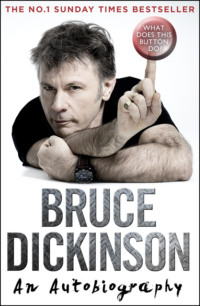
Kitabı oxu: «What Does This Button Do?: The No.1 Sunday Times Bestselling Autobiography»

Copyright
HarperCollinsPublishers
1 London Bridge Street
London SE1 9GF
www.harpercollins.co.uk
First published by HarperCollinsPublishers 2017
SECOND EDITION
© Bruce Dickinson 2017, 2018
Cover layout design © HarperCollinsPublishers 2018
Cover photograph © John McMurtie 2018
While every effort has been made to trace the owners of copyright material reproduced herein and secure permissions, the publishers would like to apologise for any omissions and will be pleased to incorporate missing acknowledgements in any future edition of this book.
A catalogue record of this book is available from the British Library
Bruce Dickinson asserts the moral right to be identified as the author of this work
All rights reserved under International and Pan-American Copyright Conventions. By payment of the required fees, you have been granted the nonexclusive, non-transferable right to access and read the text of this e-book on screen. No part of this text may be reproduced, transmitted, downloaded, decompiled, reverse engineered, or stored in or introduced into any information storage retrieval system, in any form or by any means, whether electronic or mechanical, now known or hereinafter invented, without the express written permission of HarperCollins e-books.
Find out about HarperCollins and the environment at
www.harpercollins.co.uk/green
Source ISBN: 9780008172442
Ebook Edition © October 2017 ISBN: 9780008172503
Version: 2018-04-03
Dedication
To Paddy, Austin, Griffin and Kia.
If eternity should fail, you will still be there.
Contents
Cover
Title Page
Copyright
Dedication
Preface
Foreword
Born in ’58
Life on Mars
If You Want Skool, You Got It
Angelic Upstart
The Kipper’s Revenge
An Unexpected Journey
Lock Up Your Daughters
Minibusted
Going to the Dogs
Dope Opera
A Heavy Metal Crusade
Ham of the Gods
Neighbour of the Beast
The Big Dipper
On the Bandwagon
New Battery
Organ Pipes
Powerslave
Iron Curtains
Snow, Leather and Bondage
The Boys from Brazil
Much Ado About Cutting
You’ll Believe a Drummer Can Fly
Double Dutch
You Cannot Be Serious
Moonchild
Slaughtering Daughters
Fault Lines
Wing Nut
Out of the Frying Pan
Into the Fire
Radio Pirate
Edison and the Light Bulb Moment
Brain Swap
Feet Wet in the Goose
To Fly, To Swerve
Black September
A Close Shave
The Spruce Bruce
What Could Possibly Go Wrong?
Bruce Air
Alchemy
Bitter Experience
To Ride the Storm
Fuck Cancer
Afterword
Acknowledgements
Picture Section
About the Publisher
Preface
I don’t keep a diary, although part of me thinks that perhaps I should. Anyway, I don’t. I’ve always found reading other people’s diaries becomes very tedious and seldom entertaining. I suppose keeping a diary can help future generations to assess the personal solar systems of the famous, the notorious and the merely self-important, but in the main I find diaries terrifically dull. More fool me for believing that they should be otherwise.
A brief extract from my life might read:
Monday 12 February. Answered the door. ‘No, I don’t want any fish, and I’m not in need of any hi-fi speakers, which you’ve obviously stolen and secreted in your anonymous white van parked where the CCTV can’t read its deliberately filthy number plate …’
One rather wished for a Jehovah’s Witness. At least I could have had a good argument, even though we wouldn’t have really got anywhere.
The cat has been shitting in the plant pot again. This accounts for the smell of crap that I mistakenly blamed on the drains. Not content with trying to drink the water out of the toilet, he now insists on presenting his bottom to me and puckering it like a sea anemone before taking his siege perilous on my chest and making biscuits with his claws on my T-shirt. This cat is by far the biggest rock star in the house.
This is the sort of stuff that diaries are composed of. I’m inclined to change the word ‘composed’ to ‘composted’ and suggest that this might well be the outcome most of them deserve.
It’s the mundanity of the diarist’s daily life versus their legend that makes me most wary of the genre. Richard Burton writes scathingly of his ‘underdone and dry halibut’, devoting several calories of effort to describing the undistinguished white wine that accompanied it; Joseph Goebbels finds time to comment on all manner of inconsequential family events while getting on with his role in launching and directing the Holocaust.
In spite of all these shortcomings, perhaps I should keep a diary for a bit – just to see what happens. It could even turn into a sequel to this book, although a second self-penned book about me sounds a bit suspect. In the meantime I’ve got 40,000 words of stories that for one reason or another never made it here: Ted Nugent discussing how to deal with a man holding a pointy stick; touring Scotland in a stolen car with a plastic goose on the roof; launching a practice thermonuclear strike from a submarine, only to fail dismally; the world of cross-dressing airline captains; disastrous flaming sambucas; the cultural insights gained from flying the Haj pilgrimage. These – and many others – are still to be revealed.
If the truth is ever told about my driving abilities then I might find it necessary to flee the country, although I’ll admit I did nearly kill Garry Bushell in Florida by accident in an incident that still divides public opinion.
Then there’s the whole world of public speaking, entrepreneurial enterprises, crooks and conmen that’s barely touched upon in this book. And, of course, there’s the not-so-small matter of an Iron Maiden tour on a 747, plus the tour that’s taking place as we speak.
So, it’s not that a little bit of water has passed under the bridge since 2015; it’s just that the equivalent of the Hoover Dam has built up in the interim.
‘Watch this space,’ as they say … whoever ‘they’ are.
Foreword
I had been circling for two hours over Murmansk, but the Russians would not let us land.
‘Landing permission denied,’ said in the best Star Trek original-series Mr Chekov accent.
I didn’t know if this controller was an Iron Maiden fan, but he would never have believed me anyway; a rock star moonlighting as an airline pilot – incredible. In any case, I didn’t have Eddie on board and this wasn’t Ed Force One. It was a fishing expedition.
A Boeing 757 from Astraeus Airlines with 200 empty seats and me as first officer. There were only 20 passengers from Gatwick to Murmansk: lots of men called John Smith, close personal protection, all of them armed to the teeth. Not that Lord Heseltine needed it. He was pretty good at swinging the mace around when he had to. Then there was Max Hastings, former editor of the Daily Telegraph. He was on board too. I wondered if the Soviet controller read any of his leader columns. I thought not.
‘What sort of fish are there in Murmansk?’ I had enquired of one of the John Smiths.
‘Special fish,’ he deadpanned.
‘Big fish?’ I offered.
‘Very big,’ he concluded as he left the cockpit.
Murmansk was the headquarters of the Soviet Northern Fleet. Lord Heseltine was a former Secretary of State for Defence, and what Max Hastings didn’t know about the world’s armed forces wasn’t worth printing.
The world below us was secret and obscured, submerged beneath a cotton-wool bed of low cloud. To negotiate, I had a radio and an old Nokia mobile phone. Incredibly, it got a signal halfway round each holding pattern, and I could text our airline operations who would talk to Moscow via the British Embassy. No sat phone, no GPS, no iPad, no Wi-Fi.
As James Bond says to Q at the beginning of Skyfall: ‘A gun and a radio. Not exactly Christmas, is it?’
After two hours of going round in circles, physical and metaphorical, the rules of the game changed: ‘Unless you go away, we will shoot you down.’
One day, I thought as we turned and headed towards Ivalo in Finland, I should write a book about this.
Born in ’58
The events that aggregate to form a personality interact in odd and unpredictable ways. I was an only child, brought up as far as five by my grandparents. It takes a while to figure out the dynamic forces in families, and it took me a long while for the penny to drop. My upbringing, I realised, was a mixture of guilt, unrequited love and jealousy, but all overlaid with an overwhelming sense of duty, of obligation to do the very best. I now realise that there wasn’t a great deal of affection going on, but there was a reasonable attention to detail. I could have done a lot worse given the circumstances.
My real mother was a young mum married in the nick of time to a slightly older soldier. His name was Bruce. My maternal grandfather had been assigned to watch over their courting activities, but he was neither mentally nor morally judgemental enough to be up to the task. I suspect his sympathies secretly lay with the young lovers. Not so my grandmother, whose only child was being stolen by a ruffian, not even a northerner, but an interloper from the flat lands and seagull-spattered desolation of the Norfolk coast. East England: the fens, marshes and bogs – a world that has for centuries been the home of the non-conforming, the anarchist, the sturdy beggar and of hard-won existence clawed from the reclaimed land.
My mother was petite, worked in a shoe shop and had won a scholarship to the Royal Ballet School, but her mother had forbidden her to go to London. Denied the chance to live her dream, she took the next dream that came along, and with that came me. I would stare at a picture of her, on pointe, probably aged about 14. It seemed impossible that this was my mother, a pixie-like starlet full of naïve joy. The picture on the mantelpiece represented all that could have been. Now, the dancing had gone out of her, and now it was all about duty – and the odd gin and tonic.
My parents were so young that it is impossible for me to say what I would have done had the roles been reversed. Life was about education and getting ahead, beyond working class, but working multiple jobs. The only sin was not trying hard.
My father was very serious about most things, and he tried very hard. One of a family of six, he was the offspring of a farm girl sold into service aged 12 and a raffish local builder and motorcycle-riding captain of the football team in Great Yarmouth. The great love of my father’s life was machinery and the world of mechanisms, timing, design and draughtsmanship. He loved cars, and loved to drive, although the laws relating to speed he deemed inapplicable to himself, along with seatbelts and driving drunk. After losing his driving licence, he volunteered for the army. Volunteers got paid better than conscripted men and the army didn’t seem picky about who drove their jeeps.
Driving licence (military) instantly restored, his engineering talents and tidy hand led to a job drawing up the plans for the end of the world. Around a table in Düsseldorf he would carefully draw the circles of megadeaths expected in the anticipated Cold War apocalypse. The rest of his time was spent drinking whisky to drown the boredom and the hopelessness of it all, one imagines. While still enlisted, this beefy Norfolk swimming champion – butterfly, no less – swept my waif-like ballerina mum off her feet.
As the unwanted offspring of the man who stole her only daughter, I represented the spawn of Satan for my grandmother Lily, but for my grandfather Austin I was the closest he would ever have to a son of his own. For the first five years of my life, they were de facto in loco parentis. As early childhood goes, it was pretty decent. There were long walks in the woods, rabbit holes, haunting flatland winter sunsets and sparkling frost, shimmering under purple skies.
My real parents had been travelling and working in a succession of nightclubs with their performing-dog act – as in poodles, hoops and leotards. Go figure.
The number 52 on the house at Manton Crescent was painted white. It was a standard, brick-built, semi-detached council house. Manton Colliery was a deep coal mine, and it was where my grandfather worked.
My grandfather had been a miner since the age of 13. Too small to be legal, he cunningly and barefacedly lied about his age and his height, which, like mine, was not very much. To get round the regulation that said you were tall enough to go ‘down the pit if your lantern did not trail on the ground by its lanyard while suspended from the belt’ he simply put a couple of knots in it. He came close to going to war, but got as far as the garden gate. He was in the Territorial Army, a part-time volunteer, but as coal mining was a reserved occupation he didn’t have to fight.
So he stood in his uniform, ready, as his platoon marched off to fight in France. It was one of these Back to the Future moments, when opening that garden gate and going to war along with his mates would have prevented a lot of things happening, including me. My grandmother stood defiant, hands on hips in the front doorway. ‘If you bloody go I won’t be here when you get back,’ she said. He stayed. Most of his regiment never came back.
With a miner for a grandfather, we got the council home and free coal delivered, and the art of making the coal fire that heated the house has turned me into a lifelong pyromaniac. We did not possess a telephone, a refrigerator, central heating, a car or an inside toilet. We borrowed other people’s fridges and had a small larder, dank and cold, which I avoided like the plague. Cooking was two electric hobs and a coal-fired oven, although electricity was seen as a luxury to be avoided at all costs. We had a vacuum cleaner and my favourite device, a mangle – two rollers that squeezed the water from washed clothing. A giant handle turned the machine over as sheets, shirts and trousers flopped out into a bucket after being squeezed through its rollers.
There was a plastic portable bath for me, as my grandfather would arrive home clean from the pit washrooms. On occasions he would come back from the pub, stinking of beer and onions, and crawl into bed next to me, snoring loudly. In the light from the moon through the wafer-thin curtains, I could see the blue scars that adorned his back: souvenirs of a life underground.
We had a shed in which bits of wood would be hammered and banged, to what end I have no idea, but for me it was a place to hide. It became a spaceship or a castle or a submarine. Two old railway sleepers in our small yard served as a sailing boat, and I fished repeatedly from the side catching sharks that lived in the crevices of the concrete. There was an allotment and some short-lived chrysanthemums that went up in smoke one bonfire night after a rocket went astray.
We had no pets, save a goldfish called Peter who lived for a suspiciously long time.
But one thing we did have was … a television. The presence of this television refocused the whole of my early existence. Through the lens of the TV screen – seven or eight inches across, black and white and grainy – came the wide world. Valve-driven, it took minutes to warm up, and there was a long, slow dying of the light to a singularity when it was switched off, which became a watchable event in its own right. We hosted visitors who came to look at it, caress it and not even watch it – it had such mystique. On the front were occult buttons and dials that turned like great combination locks to select the only two channels available.
The outside world, that is to say anywhere outside Worksop, was accessed primarily by gossip – or the Daily Mirror. The newspaper was always used to make the fire and I usually saw the news two days late, shortly before it was consigned to the inferno. When Yuri Gagarin became the first man to go into space I remember staring at the picture and thinking, How can we burn that? I folded it up and kept it.
If gossip or old newspaper wouldn’t do, the world outside might require a phone call. The big red phone box served as a cough, cold, flu, bubonic plague, ‘you name it you’ll catch it’ distribution centre for the neighbourhood. There was always a queue at peak hours, and a hellish combination of buttons to press and rotary dials in order to make a call, with large buckets of change required for long conversations.
It was like a very inconvenient version of Twitter, with words rationed by money and the vengeful stares of the other 20 people waiting in line to inhale the smoke-and-spit-infused mouthpiece and press the hair-oiled and sweat-coated Bakelite earpiece to the side of their head.
There were certain codes of conduct and regimes to obey in Worksop, although etiquette around the streets was very relaxed. There was little crime and virtually no traffic. Both my grandparents walked everywhere, or caught the bus. Walking five or ten miles each way across fields to go to work was just something they were brought up to do, and so I did it too.
The whole neighbourhood was in a permanent state of shift work. Upstairs curtains closed in daytime meant ‘Tiptoe past – coal miner asleep’. Front room curtains closed: ‘Hurry past – dead person laid out for inspection’. This ghoulish practice was quite popular, if my grandmother was to be believed. I would sit in our front room – permanently freezing, deathly quiet, bedecked with horse brasses and candlesticks that constantly required polishing – and imagine where the body might lie.
During the evening the atmosphere changed, and home turned into a living Gary Larson cartoon. Folding wooden chairs turned the place into a pop-up hair salon, with blue as the only colour and beehive the only game in town. Women with vast knees and polythene bags over their heads sat slowly evaporating under heat lamps as my grandmother roasted, curled and produced that awful smell of dank hair and industrial shampoo.
My escape committee was my uncle John. He forms quite an important part of what button to push next.
First of all, he wasn’t my uncle. He was my godfather – my grandfather’s best mate – and he was in the Royal Air Force and had fought in the war. As a bright working-class boy he was hoovered up by an expanding RAF, which required a whole host of technological skills that were in short supply, as one of Trenchard’s apprentices. An electrical engineer during the Siege of Malta, Flight Sergeant John Booker survived some of the most nail-biting bombardments of the war on an island Hitler was determined to crush at all costs.
I have his medals and a copy of his service Bible, annotated accordingly with verses to give support at a time when things must have been unimaginably grim. And there are pictures, one with him in full flying gear, about to stow away on a night-flying operation, which, as ground crew, was utterly unnecessary – done just for the hell of it.
While I sat on his knee he regaled me with aircraft stories and I touched his silvered Spitfire apprentice model, and a brass four-engined Liberator, with plexiglass propeller disc melted from a downed Spitfire and a green felt pad under its wooden plinth, the material cut from a shattered snooker table in a bombed-out Maltese club. He spoke of airships, of the history of engineering in Britain, of jet engines, Vulcan bombers, naval battles and test pilots. Inspired, I would sit for hours making model aircraft like many a boy of my generation, fiddling with transfers – later upgraded to decals, which sounded so much cleverer. It was a miracle any of my plastic pilots ever survived combat at all, given the fact that their entire bodies were encased in glue and their canopies covered in opaque fingerprints. The model shop in Worksop where I built my plastic air force was, amazingly, still there the last time I looked, on the occasion of my grandmother’s funeral.
Because Uncle John was a technical sort of chap, he had a self-built pond the size of the Möhne Dam, full of red goldfish and cunningly protected by chicken wire, and he drove a rather splendid Ford Consul, which was immaculate, of course. It was this car that transported me to my first airshow in the early sixties, when health and safety was for chickens and the term ‘noise abatement’ had not even entered the vocabulary.
Earthquaking jets like the Vulcan would shatter roofs performing vertical rolls with their giant delta wings while the English Electric Lightning, basically a supersonic firework with a man perched astride it, would streak past inverted, with the tail nearly scoring the runway. Powerful stuff.
Uncle John introduced me to the world of machinery and mechanisms, but I was equally as drawn to the steam trains that still plied their trade through Worksop station. The footbridge and the station today are virtually unchanged to those of my childhood. I swear that the same timbers I stood on as a boy still exist. The smoke, steam and ash clouds which enveloped me mingled with the tarry breath of bitumen to sting my nostrils. I walked to and from the station recently. I thought it was a bloody long way, but as a child it felt like nothing. The smell still lingers.
In short order, I would have settled for steam-train driver, then maybe fighter pilot … and if I got bored with that, astronaut was always a possibility, at least in my dreams. Nothing in childhood is ever wasted.
Somewhere, the fun has to stop, and so I went to school. Manton Primary was the local school for coalminers’ kids. Before it was closed, it achieved a level of notoriety with Daily Mail readers as the school where five-year-olds beat up the teachers. Well, I don’t recollect beating up any teachers, but I was given the gift of wings and also boxing lessons, after a fracas over who should play the role of Angel in the nativity play. I was lusting after those wings but instead got a good kicking in the melee that continued outside the school gates. The outcome was far from satisfactory. When I returned from school, dishevelled and clothes ripped, my grandfather sat me down and opened my hands, which were soft and pudgy. His hands were rough, like sandpaper, with bits of calloused skin stuck like coconut flakes to the deep lines that opened up as he spread his palms in front of me. I remember the glint in his eye.
‘Now, make a fist, lad,’ he said.
So I did.
‘Not like that – you’ll break your thumb. Like this.’
So he showed me.
‘Like this?’ I said.
‘Aye. Now hit my hand.’
Not exactly The Karate Kid – no standing on one leg on the end of a boat, no ‘wax on, wax off’ Hollywood moment. But after a week or so he took me to one side, and very gently, but with a steely determination in his voice, said, ‘Now go and find the lad that did it. And sort him out.’
So I did.
I think it was about 20 minutes before I was dragged away by the teacher and frogmarched home with a very firm grip. My boxing lessons had been rather too effective, and my judgement, at the age of four or five, rather less than discerning.
The ratatat-tat of the letterbox elicited an impassive grandfather: slippers, white singlet and baggy trousers. I don’t remember what the teacher said. All I remember was what my grandfather said: ‘I’ll take care of it.’
And with that, I was released.
What I got was not a beating, or a telling-off, but quiet disapproval and a lecture on the morality of fisticuffs and the rules of the game, which were basically don’t bully people, stick up for yourself and never strike a woman. A gentle, forgiving and thoroughly decent man, he never failed to protect what mattered to him.
Not bad for 1962.
In the midst of all this, my real parents, Sonia and Bruce, were back from the dog-show circuit and living in Sheffield. They would visit on Sunday lunchtimes. I still have the cream-and-brown Bakelite radio set that was on at these occasions. They were always rather strained affairs, leaving me with a lifelong horror of sit-down meals, as well as gin and lipstick. I would push food around the plate and be lectured about not leaving my Brussels sprouts and the perils of not eating food when it was rationed, which of course it wasn’t anymore, but no one could comprehend that reality. The same post-war hangover restricted you to three inches of bathwater, anxiety over the use of electricity and a morbid fear of psychological dissipation caused by speaking on the telephone excessively.
Conversations were peppered with local disasters. So and so had a stroke … auntie somebody had fallen downstairs … teenage pregnancy was rife … and some poor lad had sunk through the crust of one of the many slag heaps that surrounded the pit, only to find red-hot embers beneath, leaving the most horrific burns.
It was following one particular Sunday lunch, when I’d eaten the Brussels sprouts and the chicken formerly wandering about in the garden allotment, that it was time to move on and in with my parents. With my uncle John, I always rode in the front seat, but now I was in the back, staring through the rear window as the first five years of my life shrank away into the distance – then around the corner.
I finally faced forward, into an uncertain future. I could fight a bit, had caught several nasty bugs, commanded my own air force and was pretty close to defying gravity. Living with parents – how hard could it be?
Life on Mars
I have never smoked tobacco, except in the odd joint when I was aged 19 to 21, which we’ll address a bit later on. I say this because, in fact, I probably smoked a pack a day just by being around my parents. My God, could they puff away. Aged 16, they tried to enlist me in the filthy weed society, but it was my greatest act of rebellion to evade their yellow-stained clutches.
Drink was frequent, and frequently reckless. My father was violently anti-seatbelts on the grounds that they might strangle you, and I lost count of the number of times he drove home blind drunk.
Nothing in childhood is ever wasted, except occasionally parents.
So now I really don’t recommend drinking anything alcoholic at all and then driving, not even one. Of course, youth and indestructibility means I am guilty of hypocrisy of the first order, but fortunately I grew up a little bit before I killed myself, or, more importantly, killed an innocent somebody else.
But we have fast-forwarded way too far in our time machine. The button to push for the cassette recorder did not even exist as I joined my new school in what was supposedly a rough area of Sheffield, Manor Top.
Actually, I thought it was okay. I learnt to extrude mashed potato, fish and peas (it was Friday, after all) through pursed lips, forming a crinkly curtain with which you could compete with your fellow diners for longevity before it fell from your mouth.
I think Gary Larson must have attended this school too, because the scary horn-rimmed glasses on the female staff gave them that designer concentration-camp-guard look beloved of seventies sexploitation films. Better still were the Hannibal Lecter types who administered the punishment beatings. Abusing mashed potato and peas was a beatable offence, and a stick was laid heavily into your outstretched palm. To be quite honest I don’t even remember if it hurt that much. It just seemed a bizarre thing to do, witnessed and solemnly entered in the punishment book. I felt as though I should have been wearing striped pyjamas on Devil’s Island.
I didn’t stay at that school for long because we moved. Moving was to become a feature of my life forever, but as a family our stock in trade was moving house, mainly to make money. My new abode was a basement, which I shared with my new sister, Helena, who was by now a sentient being capable of actual words.
There was a window the size of an iPad, which opened into a gutter full of dead leaves. There was a refrigerator with an enjoyable electrical fault. I would hang on to it with a damp cloth and see how much electricity I could take before my teeth started rattling. Up the stone steps was the rest of humanity. And oh … what humanity. I was living in a hotel. A guest house. My parents ran it. My father had bought it. He sold second-hand cars from the front of it.
Dramatically, the house next door was purchased. Suddenly, the empire struck back and built an extension linking the two properties. Dad rolled out his blueprints, which he’d drawn and designed himself. I found a piece of wallpaper and tried to design a spaceship with life-support systems to go to Mars.
Builders appeared and they seemed to be working for him as well. As for me, I gained useful, if poorly paid employment. I didn’t put up buildings but it was bloody good fun knocking them down. Demolishing toilets was my speciality. When I was at university later on I could never take seriously the exhortation to ‘smash the system’; I knew much more about smashing cisterns than they ever would. It was all very impressive.
Next, the hotel, the Lindrick, had a bar constructed to Dad’s own design. As far as I could tell, the Lindrick never really closed at weekends, especially with Dad behind the bar. I would hear the tales on Monday from Lily.
‘Ooh, that Mr So and So headbutted Mr Rigby … and then that other fellow was dancing on the table and fell over. Ooh, he broke the table in half, you know. It was teak as well. I think it was his head what did it …’
It was all bed-hopping among the travelling salesmen, and some of the people who stayed were just plain odd. One creepy individual stayed for two weeks and gave me a card and whispered, ‘Ay up, I practise Karma Yoga.’ He would then leave at 7 p.m. and walk the streets till dawn. And no, he didn’t have a dog to walk.
Other people came, and some never left. A few dropped dead in bed. If it was a horrible death, everyone was kept informed by Grandma Lily: ‘She were burnt to death in her car …’
One evening, two gentlemen surprised each other in the dark, each of them assuming they had been fondling a female guest. That took quite some sorting out in the morning. It was like living in a permanent state of farce.
More bits were being added to the hotel all the time, and more of the family moved up to Sheffield. My paternal grandparents, Ethel and Morris, sold up their seaside boarding house and moved in down the road. Grandad Dickinson was a dead ringer for rascally actor Wilfrid Hyde-White, only with a broadish Norfolk accent. A roll-up behind one ear, a pencil behind the other and the racing paper in hand, he set about what would now be called ‘repurposing’ buildings. In practice that meant knocking them down, but using the dressed stone to put them up somewhere else.
Grandma Dickinson was a formidable woman. Six foot tall, with intense, black curly hair and a gaze that would fell a tree at 20 paces, she’d worked as a servant girl, and had been purchased from the railway carriage where she lived with 18 other girls on the land. She was fleet of foot and might have had an athletic career, but she couldn’t afford shoes: 200 metres barefoot was no match for the opposition in spikes. She never forgot that humiliation till the day she died.
While Ethel baked cakes, Morris would emerge from the toilet with a half-smoked roll-up and lots of boxes ticked for the horses. ‘Here you are, sonny – don’t let on,’ he’d say, and he would slip me half a crown from his hand, clawed from years of laying bricks and handling trowels.
At a family summit spent drinking all afternoon in our hotel bar, my uncle Rod did me several favours, one of which was to persuade me never to have a tattoo. Uncle Rod (who was actually my uncle – my dad’s brother) was charismatic to say the least, and frankly looked a bit like one of these roguish gangsters who might be surrounded by women of easy virtue. Right now, though, I sat on his knee aged 10 as he explained the British film-certification system to me: ‘Now, yer ’ave yer X films and, basically, yer have your sex X and yer horror X …’
Whatever he said next faded into the background as I stared at the scars on the back of both of his hands. Uncle Rod had a habit in his youth of misplacing other people’s motorcars. Despite the family’s best efforts, he was so prolific that he was sent to a horrific young offender’s institution known as borstal. Self-tattooing with brick dust and ink was the thing in borstal, and it marked you for life as a product of that institution. Uncle Rod had spent what then would have been a considerable amount of money to get them removed. It was early skin-graft surgery, and these days it would qualify as a special effect in a low-budget horror movie. I just thought, I think I’ll stick with what I’ve got. That really doesn’t look like much fun.
Then Uncle Rod reverted to talking about war films. I had seen loads of them with Grandfather Austin: 633 Squadron, The Dam Busters, Battle of Britain, The Charge of the Light Brigade.
‘And what about Ice Station Zebra?’ I piped up.
‘’Aven’t seen that one,’ he grunted, and he went back to his pint.
Ice Station Zebra was the movie that introduced me to my first rock ’n’ roll band. Yes, with a truck, electric guitars and gigs. The band were called the Casuals. They’d had a hit with a track called ‘Jesamine’ and were now playing residencies at clubs for a week or so at a time. They stayed in the hotel, and during the daytime – which for them, being creatures of the night, didn’t start till midday – they would surface, bleary-eyed and longhaired, in stack-heeled boots and white trousers, for a late breakfast of tea and toast provided by Lily, who was all of a twitter.
I am sure I must have appeared precocious with my questions about rockets and submarines, and it was probably a way of levelling the playing field that the guitarist brought down his electric guitar. I held it. It was surprisingly heavy. He explained carefully how it worked, and I just stared at the round steel discs under the strings and tried to imagine how sound really worked, produced from such tiny fragments with the tinniest-sounding twanging strings.
Like most bands, they were bored silly during the day, and they decided to go to the cinema. Ice Station Zebra was on at the Sheffield Gaumont. Popcorn in hand, aged 10, sitting in a cinema with a rock ’n’ roll band watching a war movie about nuclear submarines and rockets: I thought, This is living.
Dad expanded his empire and purchased a bankrupt petrol station. It was a huge property, an old tram garage with four ancient petrol pumps, no canopy, and workshops full of caked oil and dirt half an inch thick adhering to 50-year-old bricks. The motor trade started to dominate our lives. I pumped petrol in between falling off scaffolding (repurposing buildings), and polished cars and scrubbed wheels with wire wool until my fingers turned blue in winter. I washed windscreens, checked tyres and watched the growing number of cars coming and going as sales picked up.
Dad was an encyclopaedia of motor-car components. He was a natural engineer and would go straight to the heart of the problem. His diagnosis was seldom wrong. He could recount the provenance of the exhaust system of the Fiat whatever-it-was, and why it was superior to the gizmo of the Ford, but anyway, both of them were actually designed by an unknown Hungarian genius. That sort of thing. Get him started, it could go on for hours.
We sold up the hotel as he acquired the dealership for Lancia motor cars, and did rather well until they produced one that rusted faster than you could drive it. I expect money must have been made on the house transactions because there was a property boom, and a house was still an achievable objective for a working family. At one point we made the mistake of selling before we had anywhere else to live. It must have been a very good deal.
In the end we moved back into a terraced house only a hundred yards up from the hotel we’d vacated a year or so earlier. Some people are addicted to crack. We were addicted to moving house.
If You Want Skool, You Got It
In the midst of all this I was relocated to a hothouse environment. I was being spirited away from the evil influence of mashed potato, spit and being straight-armed by the locals.
I was on my way to a private school: Birkdale preparatory school, alma mater of, among others, Michael Palin of Monty Python fame. It was one of the strangest, most eccentric educational institutions I have ever encountered and actually, in the end, I quite enjoyed it. I say in the end because in the beginning the bullying was fairly intense. I use the term ‘fairly intense’ only in comparison with what came later, at boarding school.
Bullying happens because weak people need to prop up their ego by beating up or humiliating others. Of course, if you are a new arrival, or just different, you become a prime target. I ticked all the boxes. Break time was the worst, up against the dustbins with 12 kids hitting you, watched over by a female teacher, whom I assume must have got some kind of power trip from not stopping it. In remembrance of both grandfathers I always refused to submit. The odds were ridiculous, but I still fought back. I wasn’t going away.
After a year or so it calmed down, and a year after that it was as if nothing had happened and my very own self was assimilated into the group mind – or so they thought.
I took refuge in books, the library, writing and drama. The angelic wings of yore came back to haunt me, and I got my first namecheck in a review of a school play in the Sheffield Star, no less.
‘Mole, besmudged of face, played by Paul Dickinson.’ (Bruce, of course, is my middle name, but then you knew that.)
I was a bit disappointed that they omitted to mention that I got a good, proper laugh from the audience. Early lessons in comic timing during our school production of The Wind in the Willows also included dropping my wooden sword during a pregnant pause, which corpsed the stalls, and delivering the correct line ‘I say Ratty, this chicken is delicious’ while clearly eating a lemon tart.
Further productions followed and I was sold on the stage, though, truthfully, actors seemed to take it awfully seriously.
Lessons proceeded normally. In other words, I don’t remember a thing, except that the Merino sheep has a spectacular coat, and a rather splendid view of Tolkien from my history teacher, Mr Quiney: ‘One bloody feast after another, a long dreary walk, a battle and some rubbish songs.’ I read The Hobbit and The Lord of the Rings when I was 12. Entertaining, but he had a point.
For those wishing to learn French there was Mr White. But Mr White was only interested in playing with his vast train set, which occupied half of the top floor. French lessons consisted of watching the OO-gauge Flying Scotsman whizzing round for 20 minutes.
Classes were streamed in sets A, B, C or D, from the most brilliant to the severely challenged or just plain bored. I yo-yoed from one set to another. I was always just plain bored, but was bribed to do well by the promise of a bike with racing handlebars should I leap up the pecking order.
Towards the end of my time I found myself in a class with only eight people, and we didn’t have lessons as such. We sat around, talked, argued, discussed, wrote things because we wanted to, and played practical jokes that tried to be interesting rather than just cruel. Teachers came and we spoke as equals. It was extraordinary. It felt like my brain was popping with ideas, like popcorn in a pan. Delightful.
Of course, there was a reason. The aim of this whole process was to take a fairly stiff set of exams that took a whole week in order to get into the highly competitive boarding-school system from age 12 or 13 to 18.
Big boys’ stuff.
School wasn’t the only place to get an education, however. I learnt to ride a bike, and hurtled around the neighbourhood. I had a chemistry set, which stubbornly refused to make anything of any entertainment value, and my dad taught me to play chess. We played frequently, until one day I beat him, and then we stopped.
On holidays in Great Yarmouth I spent my time surrounded by zinc buckets full of pennies. The expression ‘bucketloads of money’ was simply work in progress for an amusement arcade on the sea front. It was owned by my cousin Russell’s parents.
Every trip to Great Yarmouth ended up in the flat above the amusement arcade. It was furnished with questionable coffee tables supported by Nubian-slave statues, and a carpet that was more like a white hairy sea of synthetic tendrils that looked like it would eat you if it didn’t like your shoes. There was small talk, and then I was presented with the cast-offs from my cousins: hideous suede-fronted cardigans and other monstrosities designed to make a 10-year-old look like 50 years old.
Buoyancy was a family trait. In order to learn not to drown, my father had simply been thrown in the Norfolk Broads. I learnt to swim under his supervision, but in not quite as abusive a fashion. Somewhere, lurking in the bottom of a mouldy suitcase, is my certificate from Heeley Baths, Sheffield, listing that I, on that day, swam 10 yards in approved style. After ingesting enough chlorine to blind a First World War battalion, I squinted pink-eyed from the sunlight, relieved that the ordeal was over. My dad swam like a fish. He would swim three miles in the ocean as a boy. I, on the other hand, have always regarded swimming as thoroughly hazardous. It is merely preventative drowning. I am one of nature’s sinkers. ‘Relax,’ cry the floaters, but sadly my feet go the way of gravity and the rest follows suit.
Before we venture through the hallowed portals of an English public school, there are a few more pieces of the jigsaw to throw on the table.
I was reasonably solitary. I wasn’t interested in sport. I spent long afternoons at the weekend in the public library, browsing and daydreaming. I had discovered wargaming, and my evenings were spent researching the accuracy of the Brown Bess musket and the tactics of the infantry square, and painting my white-metal Scots Highlanders, shortly to be unleashed on an unsuspecting Napoleon.
My uncle Stewart, a teacher, had been a county table-tennis champion, so, for Christmas, a rather fine table-tennis table appeared. Dad and his brothers batted away and argued over who had won, then went off to the pub. I immediately organised the Battle of Waterloo to be refought on it the next day. It was green and it was flat – perfect. It was one of many small events that caused my father to regard me somewhat strangely, as if subverting a table-tennis table was somehow unmanly.
I had developed a wonderful set of spots as I approached the day I would leave home and take up residence for the next four years at Oundle School in Northamptonshire. Not great, but seeing as there were no girls anywhere on the horizon, not a showstopper. What made them break out into suppurating sores was the application of engine oil, burnt rubber and grime-encrusted fingernails. Just before semi-leaving home, I’d been introduced to motor racing.
Tim, a friend at school, and his elder brother Nick had a very enthusiastic father. He drove a massive Cadillac and had a huge trailer, in which was a miniature racing team for his sons. As far as I could gather, he owned a nightclub and drank a great deal of barley wine.
The karts were 100cc rotary valve, and they were very fast. I had never even turned a wheel before, but I just got in the seat, got my bump start and hurtled off towards the first corner down the long straight at Lindholme, the former RAF base.
I turned the wheel, did a 360-degree spin and stalled the engine. I did the same thing at just about every corner round the circuit before I got back to the trailer, followed by two very sweaty brothers gasping their last after chasing me round the circuit and restarting me half-a-dozen times.
We debriefed. Clearly I needed more information as to what was going on.
By the end of the day I thought I was flying: foot flat to the floor, down the straight, braking as hard and as late as I dared, the adrenalin shooting through my hands and heart. The truth is, I probably just about made it round without spinning off, but bugger that, steam engine driver, fighter pilot and astronaut – add racing-car driver to the list.
Angelic Upstart
Before we go to boarding school, with all that entails, can I just have a word about religion? Something I experienced, and experimented with and had experimented upon me at four, too early an age. The outcome, though, was totally unexpected, and if God ever moved in a mysterious way, here was proof positive.
I don’t recall my baptism, but apparently I somehow managed to ingest quite a quantity of holy water. I could have drowned in the font. I am not sure that swallowing God’s special sauce caused any sort of aura to appear, but it might have been an influence on my early interest in angel wings.
School had the usual harvest festival and a bit of dreary carol singing, but it was only when I arrived at Birkdale that I was exposed to evangelical religion, bible black and fighting Satan on all fronts.
There was a cabal of zealous teachers and, by chance or design, they were the same teachers that ran school expeditions, including one to Fort William in Scotland. It consisted of 10 days’ camping, playing robust semi-military games, climbing mountains, bridging rivers, leaping from tree to tree (‘The Lumberjack Song’, anyone?) and religious brainwashing. Think Bear Grylls with no possibility of escape.
There were prayers and lectures, and every evening there was a group assembly in which 10-year-olds were encouraged to stand up and identify sins, and would be rewarded for their folly by rapturous praise, hugs and applause. I stood up and identified a fly on the wall, which was clearly a servant of Satan, because it had been distracting me from the balderdash being spouted by the part-time messiahs and full-time school teachers.
With no sense of irony at the age of 10, I was welcomed into the fold, and told that I was now evangelised. My purpose in life was to go and convert people to Christ.
Well, being a mission-oriented sort of chap, I sallied forth into the town and set about converting a couple of Highland girls by handing them a leaflet and inviting them to the campsite for a fun evangelical evening of happy-clappy hymns accompanied by bad guitar-playing and Aran sweaters.
‘Fuck off, you twat,’ was the robust response.
At home in Sheffield I was enrolled in the Christian Union, where I wore a little badge and was encouraged to read The Screwtape Letters and lots of other rather less inventive tracts, some of which covered subjects like masturbation and marriage. Confused, I thought, Did they go hand in hand?
My parents were a bit bemused, having seldom been near a church since I half-swallowed one when I was nine months old. However, they tolerated it on the basis that it seemed harmless enough and gave me something to do on Sunday mornings.
Not too long after this, hormones kicked in, and I began to look at girls in a rather different light. I no longer wanted only to convert them; there was something more that you could diddle about with. I just couldn’t put my finger on it.
My school friend Tim was discussing the subject of exactly where to put fingers. Incredibly, it was the only time anybody had spoken about sex thus far, other than being told it was, by and large, sinful, except for making babies. Further in-depth enquiries about what this fairly sexually advanced chap got up to revealed that he did something on his own time involving a sock and his pyjamas.
‘Then what happens?’ I asked, trying to picture the scene.
So he told me.
‘Really?’ This was all news to me. Well, God hates a coward, as the expression goes, and my monastic existence turned into an onanistic one. As for Sunday school, given a choice between wanking yourself silly and Christian Union, there was a clear winner. It was masturbation and libraries that saved my soul from the narrow-minded proselytising and a stifling, evangelical straitjacket, and thank God for that.
But I never got around to telling you the good bit about God and his mysterious ways.
The official custodian of our spiritual health at Birkdale was the Reverend B.S. Sharp, at the time the vicar of Gleadless at the splendidly dark Victorian Millstone Grit church. Unlike the part-time evangelical types, ‘Batty’, as his nickname suggested, was more than a little eccentric, and he was stone deaf. As reverends go, he was regarded as being harmless.
Batty would conduct hymn practice, and the entire school would traipse into his church and commence singing while he walked up and down the aisle waving his arms about, seemingly oblivious to the out-of-time, out-of-tune and smirking schoolboys (no girls, of course). As he passed me – I was standing at the end of a pew – singing, or rather mumbling, he paused; he cocked his head, rather like a parrot, and peered round at me. I suspect he was positioning his good ear.
‘Sing up, lad,’ he said.
So I sang a bit louder. He brought his entire face close to my mouth. I realised he was missing a lot of teeth and I tried hard not to laugh.
‘Sing up, lad.’
Well, I like a challenge, so I yelled at the top of my lungs, and once I started I didn’t stop. The embarrassment left me and I carried on to the end of whatever verse it was in whatever hymn. I confess that it felt wonderful – not that I would admit it at the time.
He stood up and waved his arms about a bit more, then leaned back over to me.
‘You have a very fine voice, boy,’ he said. And then he strode off down the aisle and I never saw him again.
Like I say, nothing in childhood is ever wasted, and if there is a God, he or she is full of mischief.
Sadly, the choirmaster at Oundle didn’t share Batty’s enthusiasm for my dulcet tones. It became clear that singing, as in singing in church, was very undesirable, although to describe the school chapel as a church would be to do it an injustice.
Oundle’s chapel had pretensions of being a cathedral at the very least. It had a choir and the usual, and possibly verifiable, rumours about choirboys and choirmasters. The school choir dressed in frocks and had their free time spirited away from them in fruitless praising of the ineffable one until their voices broke.
There was a singing test, which was compulsory. I was very proud to say that I failed in spectacular fashion. Every note that was white on a keyboard was black when I returned the favour. I was given a chit – a piece of paper – to deliver to my housemaster. On it was written: ‘Dickinson – Sidney House, NON-SINGER’.
The Kipper’s Revenge
I was never too sure why I ended up in boarding school. My parents kept asking me if I wanted to go, and my immediate instinct was, Anything to get out of this place. So I smiled and passed the crazy exams, and sat the IQ test and did the interview. The only part I remotely enjoyed was the IQ test because it was interesting and there was nothing you had to remember by rote. You only had to do your best. In early summer the letter arrived. I had passed: here are the uniform restrictions and please pay lots of money.
Oundle was, and still is, a small market town near Peterborough in the rolling countryside of Northamptonshire. Nestled in a bend of the sleepy but often disobedient River Nene, it sits on a mound above the flood plain. Fotheringhay Castle is a couple of miles down the road, along with its associated church, and the whole area is steeped in English, as opposed to British, history.
Half the town was occupied by the school. Most of the old buildings were either school rooms or accommodation, and the Worshipful Company of Grocers of the City of London founded the whole enterprise in the sixteenth century. The hub of it all was a faux-Oxbridge quadrangle with pillars and porticos, grand marble balustrades and architecture to remind you of your place. That is to say, small, ignorant and insignificant.
Hundreds of alumni hung on boards at every turn in the quadrangle. Rugby, fives, athletics, Classics, mathematics and all those boys whose names never got written down until they came back in body bags as dead heroes from two world wars. There were quite a few of those.
I still didn’t know why I was here. It got me out of the house was my best guess, and I must have proved something by passing all the wretched exams. One reason, though, could have been that my aunt was the cook. There was no clear logic to this, and even I was confused as to the relationship between school dinners and academic excellence, but there was some suggestion that life might be easier for me if people knew that my aunt cooked the school meals.
No one in my family, from any branch of it, had ever been to a private school. My father had been denied a place at university after getting into grammar school because Ethel could only afford to send one son out of four to higher education. Stewart was the eldest, so he received the college education.
Dad never forgot that.
My sister was to go down an entirely different path, leaving school with few academic qualifications and taking a long, hard road, virtually self-taught, to becoming one of the world’s leading show jumpers. When I was dragging my 19-year-old arse around East London playing pubs to three people, my 14-year-old sister was debuting a horse she’d trained herself in the Horse of the Year Show at Wembley Arena.
So, at the age of 13, having left Sheffield, I began a process of disengagement from family, and involuntary alienation from the human race, at least for a couple of years. It is hard to say, even in hindsight, whether there was a net gain or loss as a human being.
Academically, there is no question that the hothouse environment pushed up the less able and enabled the truly talented to excel – with the odd possible exception. I remember myself being stolidly average, but memorable for a variety of other reasons.
All boys were assigned to a house, around 50 or 60 strong, and this served as their tribe. Everything about the place was competitive. There were inter-school competitions, inter-house competitions and intra-house competitions. No stone was left unturned in the search for winners. If you weren’t a winner on the sports field, you might be a winner as an academic. If not as an academic, well, things got a little stickier – perhaps Oundle was not for you.
My house was called Sidney, and it had a grand mock-Georgian façade with a sweeping gravel drive. It backed onto acres of rugby and cricket pitches, and was miles away from the school classrooms. To this day I walk at breakneck pace everywhere in mortal terror of being late for English Lit. I covered, I guess, about five miles before lunch with an armful of textbooks. Nowadays, it’s probably hoverboards and iPads doing the hard work.
One of the first things to strike me, before the whips, chains and blunt instruments (more of that later), was a most-illuminating bout of salmonella poisoning. Along with red lipstick and beehive hairdos, you can add fish pie to the chamber of horrors that haunts me to this very day.
My auntie Dee attempted to kill me, along with 20 of my house mates, and a sharp piece of microbial detective work traced the offending pathogen back to a serving spoon. Those unlucky enough to take the left-hand path (fun though it might seem for witches) in the serving line were struck down by Pasteur’s revenge. Those in the right-hand queue suffered no ill effects. The stomach cramps began three hours after ingestion of the emetic fish pie. Shortly afterwards I was admitted to a ward to join my similarly stricken schoolmates. For three days stuff erupted from every available orifice. The lyric ‘And I filled them – their living corpses with my bile’ from ‘If Eternity Should Fail’ didn’t require all that much imagination.
We were kept rather busy with sport. Being no good at it meant being designated ‘pathetic’. Being good at it meant you walked on a small cloud and were infallible.
The school had innumerable rugby teams, and had a boathouse with eights, fours and sculls, plus cricket teams, shooting teams, tennis, squash and the somewhat obscure but popular game of fives.
Before being allowed to go in a boat of any description, children underwent the ‘boat test’. In the Middle Ages witches underwent a similar ordeal. It involved being dressed in army boots, jeans and a thick wool army sweater, and then being chucked in the river.
A road bridge over the River Nene served as the vantage point to observe the drowning of the adolescent witches. Victims were picked up and tossed into the freezing water, and had to swim 25 yards or so without drowning. Imagine how much I enjoyed that. I was regarded as being a possible rower, so I had a discreet second attempt, and a third. I think they would have just carried on until I drowned, so I gave up breathing, thought of my baptism and swallowed a lot of water before finally being fished out by a boat hook. The practice was discontinued shortly thereafter, when dead cows were found, infected with some horrendous bug, floating bloated upstream.
I was, of course, bullied, and as before in my previous school I didn’t back down, change my opinion or shut up. So, two years later, a bit of a fuss blew up, parents were called in, pupils were suspended and then it all petered out. But for those two years life was average-to-middling hellish.
We slept in dormitories, army-barrack style: cold giant windows with no curtains, and two lines of iron beds; a thin mattress on a chipboard base, a couple of blankets and cotton sheets. There was no privacy, no locks on drawers, and it was communal baths and washrooms. Things got interesting after lights out. After the teacher had left, the senior boy would wake me up. Half an hour later, a crowd would gather round. He was around 18, a big lad. He had a pillow wrapped into a tight ball.
‘Time for your lesson, Dickinson. Defend yourself,’ he’d say.
Not exactly Queensberry rules, and not much you could do about it, except build a reservoir of rage and anger. Often, my bed was pre-soaked or covered in eggs, or my personal kit was covered in washing-up liquid, or any number of petty infractions of personal space.
By year two I was pretty fucking angry. Rugby didn’t even touch the beginning of my rage, and I quite enjoyed rugby. Believe it or not, I was a prop, and as others got bigger but I did not, I was variously a hooker (not enjoyable), scrum half (not very good) and I finally settled down as a flanker, or wing forward as it was in rugby pre-history.
My sidestep was the Army Cadet Force. Sure, there was a hierarchy, but oddly the regime wasn’t directed mindlessly against me. It was the same bullshit for everyone. We had 400 in our cadet force, and I progressed rapidly through the various ranks, until one day I found myself being promoted to the exalted rank of under officer.
There were only two of us, and the other was one of my few close friends at Oundle, Ian, who went on to be a lieutenant colonel in the Highland Regiment and served in some pretty hairy locations. The last time we met, after 25 years, was in a grubby hotel in Jeddah. I was a captain flying a Boeing 757 chartered by Saudi Airlines during the Hajj and he was in charge of the Saudi National Guard. Go figure.
At Oundle we found ourselves with unexpected privileges. There were enough guns and ammunition in the school armoury to start a coup d’état in a small African nation. All of it was Second World War vintage. There were 100 or so 303 Lee–Enfield rifles, half-a-dozen Bren guns, thunderflashes, two-inch mortars, smoke grenades, and live and blank ammunition. Both of us had attended the UKLF leadership course, where we were equipped with all the latest army kit and spent two weeks in Thetford being chucked out of helicopters, doing 24-, 36- and 48-hour exercises, and getting a lot of blisters.
My platoon supervisor had been in the SAS, and he told me I was above average in teamwork, but average everywhere else. I spent summers on attachment with the Royal Anglian Regiment and the Royal Green Jackets, and dangled off lots of ropes at Lympstone with the Royal Marines. I was pretty serious about joining the army.
Ian and I hatched a plan to make our Wednesday afternoons more interesting and productive. Incredibly, as 16-year-olds, we had the authority to sign for and withdraw rifles and automatic weapons, high explosives and blank ammunition. So every Wednesday, that’s what happened. We would come up with scenarios then wander off armed to the teeth into a local wood and shoot the crap out of each other.
I should set the scene at Oundle School. Before 1914, the British Empire was demanding technocrats. The traditional public schools churned out the Greek-and-Latin educated civil servants to be, but the dark days of the future demanded leaders who understood metalwork, mechanical engineering and electronics.
Oundle established what was essentially an industrial estate. It had an aluminium foundry, composite and fibreglass workshops, lathes, milling machines, and woodworking, blacksmithing and metalworking shops. Every term, I spent one week dressed in overalls learning to chop and assemble bits of wood, metal and plastic.
The aim of all this activity was to build a vice. The halves were cast from wooden moulds in the foundry. The sand moulds you made yourself, and there were various ways of sabotaging them to make life less dreary.
Excessive moisture and too much tamping of the sand in the mould would cause it to explode. Even better was to leave a hole in the bottom of the mould so that molten aluminium dripped onto the shoes of the pourer – the taciturn master in charge, Mr Moynihan. I suspect he quite enjoyed having his shoes set on fire. To this end he came equipped with multi-layered steel-capped boots, asbestos helmet and gloves, plus a rich choice of language, which meant that no one would skip the foundry lesson.
‘Faacking ’ell … ’Oo faacking set fire to my faacking feet?’
Mr Moynihan was a good sport and he taught me never to panic, even when you are on fire.
In woodwork I was an abject failure, although I designed and built the world’s most useless and uncomfortable chair and the most incompetent set of bookshelves yet devised. Even M.C. Escher would have been confused as to where to position his books.
In the machine shop I broke windows with the chuck key, using the rotary action of the lathe as a catapult. Finally, by an act of sheer mechanical stupidity, I destroyed a vertical milling machine. Had I been parachuted in to a Nazi factory, I could not have done a better job at sabotage. I wish I could say it was deliberate. As the machine ripped itself in half, the drive shaft stripping its thread, I stood and watched as it vibrated itself to pieces. It was the master in charge I felt sorry for. He was actually crying as he switched it off.
‘Oh, no,’ he sighed. ‘You have broken the machine.’
The only bit about the electronics shop I liked was the smell of the circuit board. I carried it around in a plastic case with various resistors rattling around. I don’t recall what the point of it was, possibly an oscillator.
Disinterested, disgraced and dangerous, I entered the last iteration of my workshop sojourn at Oundle, and unexpectedly hit the jackpot when I discovered an inspirational teacher who knew a bit about metal.
John Worsley was calm and tidy, and wore such a large pair of glasses that it seemed impossible to imagine that he wasn’t interested in you. The moment he picked up a piece of metal, I noticed his fingers. They were thin and nimble, and they floated across the surface of the billet of steel as if he was imbuing it with some otherworldly quality. John would always turn up to classes on his bicycle – racing handlebars, cycle clips on the bottom of his trousers. He had a curious gait, as if one side of him was a sailor and the other had been employed in a previous incarnation as one leg of a tarantula. One of his favourite words was ‘plangent’, and it was an odd, almost archaic-sounding expression. John Worsley was like a hybrid between a bicycle repairman and Gandalf.
Metalworking covered wrought iron, forging, silversmithing and jewellery, plus welding and associated skills. Our project was to make a nickel-silver bracelet, which I quite enjoyed and was rather proud of. When I brought it home, Dad regarded it with deep suspicion.
John Worsley had a plan to get our attention. He thrust a shaft of steel into a glowing brazier and sparks showered forth. He pulled it out, still red hot, placed it on an anvil and started to beat out the shape of what I immediately realised was a sword. He quenched the metal with a satisfying hiss in a bucket of water, and thrust it back in the fire. Without saying a word, he produced a leather blanket and dramatically unfurled it to reveal a replica of Excalibur. The crossbar of the hilt was leather-covered, but the blade, broad and gleaming, was what entranced me.
‘I could teach you all to make this, if you want,’ he stated, rolling the weapon over and over in his palm. He paused for effect. ‘And I could teach you how to use it, of course.’
‘Sir? What, you mean … sword fighting?’
The reason John Worsley walked funny was because he had been a fencing teacher for most of his life. On arrival at a posh public school, as a working-class northerner, he seized his chance. My hand was up right away. I signed up. I would learn how to fence. It would change my life.
My drama teacher also had a profound effect on me. John Campbell was one of those rare but essential teachers who give you permission to dream.
Drama, as opposed to music, was another line of escape, and I was in several productions: Macbeth, Hadrian VII, The Royal Hunt of the Sun and some local inhouse plays that were usually awful West End farces.
In Macbeth I was a witch, murderer and various messengers, spending much of my time under a gigantic polystyrene skull encased in toilet paper. Downgraded to acolyte in Hadrian VII, I stepped up a gear as the mercenary in The Royal Hunt of the Sun and oily manservant in According to the Evidence, a play so silly I was amazed that Samuel French kept it in stock.
Nevertheless, the roar of the greasepaint and the smell of the crowd were taking their toll on my subconscious. The germ of a philosophy started to take root. The idea that it didn’t matter what it was that you engaged in, as long as you respected its nature and attempted some measure of harmony with the universe.
An Unexpected Journey
It wasn’t just the senior boys who kicked you around. You could be legally beaten up by teachers. Corporal punishment was common. It ranged from slippers across the backside by individual teachers to more formal floggings with a cane or birch. Opinions varied about the efficacy of a beating. The event was usually administered during the evening, with the unfortunate recipient in his pyjamas, after lights out. This was to ensure maximum psychological anxiety and maximum physical discomfort, as six strokes through cotton pyjamas was almost certain to draw blood. The now thankfully meaningless expression ‘books down the trousers’ was intended to convey a situation where, in anticipation of physical sanction, a geography notebook might shield the buttocks from damage.
There was general agreement that fives or squash players were the most devastating floggers on account of their fearsome backhand. Golfers came a close second. A great deal of discussion in dorm rooms revolved around angles, velocity and acceleration. After a beating, the victim usually stood on top of a chest of drawers and dropped his pants to invite comments by flashlight.
‘Not bad grouping.’
‘Ooh, stroke number four a bit low.’
‘He doesn’t like you much, does he?’
My housemaster had a variety of implements, ranging in length, flexibility and thickness according to the severity of the transgression. Four to six strokes were delivered, and his favourite armchair became the flogging stool, with the cushion removed and the boy exhorted to bend over and touch the bottom of the chair. There was a fetishistic streak to all this. Many of his beatings were administered while he was dressed in his rowing kit.
There are possibly people who still regard this sort of thing as character building. I am not one of them.
I began to think of school as a prison camp, and my duty was to disrupt, subvert and/or escape. But, of course, there was no escape. I felt I should make some kind of statement. I decided to deliver two tons of horseshit to my housemaster. Just one of those spur-of-the-moment ideas that comes with no logic in tow, but a great deal of emotional momentum.
I was wandering through town, considering the colour scheme for my squadron of Hannibal war elephants, which required painting before being blooded during the wargames society Roman stand-off. Pottering past the post office, I saw a postcard in the window, which read fatefully: ‘Manure delivered to your door.’
I went to the phone box and dialled.
‘Hello, do you deliver? Excellent. I’d like two tons, please … Yes, drop it in front of my house … The address? Sidney House, Oundle School. Thank you so much.’
That evening, the house gathered for supper. The housemaster stood up, sucking air through his teeth in lieu of the pipe he perennially puffed away at.
‘This afternoon,’ he said, ‘some wag thought it amusing to deliver two tons of shit onto my front doorstep. Unless the person owns up there will be no electricity for kettles or stereos in the house.’
Standard tactics for a low-grade despot. The stereo was an essential part of student existence. There were no CDs, and cassette recorders were in their infancy. Chronic audiophiles with rich daddies had reel-to-reel studio recorders and busily spliced tapes together to make compilations from their vinyl collections. It was only in your third year at Oundle that you were allocated to a study, a room not quite of your own but which you shared with one or two others. Decoration was possible and, inevitably, a music system was essential. By strolling past open study doors on a Sunday afternoon it was possible to sample most of the premier rock bands of the sixties and seventies. To cut off this lifeline to sanity and escape from the Oundlian Alcatraz, if only in spirit, was a dark and cruel punishment.
After supper, I knocked on the housemaster’s door.
‘Come!’
Seldom was the word ‘in’ ever used. I entered. He looked around from where he was seated at his desk, yellow pipe clenched in his teeth.
‘Ah, Dickinson. I thought it might be you.’
Actually, I was quite pleased. ‘Very amusing,’ he said. An unexpected compliment. He looked down. ‘Of course, I’ll thrash you for it.’ I heard the clack of his teeth on the pipe stem. Was he salivating? He looked up, startled. I just continued to stare. He dismissed me with an imperious wave.
On the dot at 9 p.m. I heard the squeak, squeak, squeak of rubber soles, and then the knock at the door.
‘I’ll see you now,’ the housemaster said.
He had changed into his rowing kit: shorts, chunky V-neck sweater and tennis shoes. His legs were ridiculously skinny and covered with a childlike coating of thin red hair. With every step I respected him less. He was using an extra-long cane, so he needed space for a good swing, and he was an amateur golfer, which did not bode well for the next 30 seconds or so. Really, these people should have been locked up.
Thankfully, among these sadistic floggers and the failed Oxbridge dons existed a small core of decent eccentrics. In this perverse society of dystopian hypocrisy, with its own internal politics and rigid hierarchy, the brown, smoky common room inhabited by the staff had a secret cabal of visionaries who made our lives worth living, and gave us hope. As well as Mr Campbell and Mr Worsley, we had an art teacher who somehow managed to promote rock concerts in Oundle’s Great Hall.
It’s probably time to come clean about music and how I ended up singing. Music, not singing, came first, and it is one of the peculiar schizophrenic traits of my academic boot camp that it introduced me to rock ’n’ roll more close-up than you could possibly imagine.
The first band I ever saw was called Wild Turkey. Then Van der Graaf Generator and, in similar prog-rock vein, we had String Driven Thing and a prog-folk band, Comus. Queen almost played, but they cancelled when they became massive overnight in America. The big story was that Genesis had played, the year before I arrived, complete with Peter Gabriel wearing a box on his head.
Wild Turkey had ex-Jethro Tull bass player Glenn Cornick in their lineup, and their first album, Battle Hymn, stands the test of time to this very day. Out of my mind on Fanta and Mars bars, raging with hormones, I was on a high for days. Every square inch of me was drenched in sweat as I staggered back to my dormitory across the forbidding lawns topped with dark shadows from academic spires. My heart was thumping, my ears were ringing and it seemed like my head was full of bells, with a madman tugging at ropes to ring the changes and pulling at the back of my eyeballs as if to say, ‘Listen to this feeling and never forget.’ Wild Turkey actually name-checked the gig in an interview as ‘one of the craziest reactions we’ve ever had’. That was me, with my head stuffed in the bass bin.
Afterwards, a long succession of prog bands took over; all very cerebral, but with the exception of Peter Hammill and Van der Graaf, not nearly so visceral. Nevertheless, when wandering the corridors with music drifting out from the individual studies in Sidney House, I was stopped in my tracks. What the fuck was that? I knocked tentatively. The senior boy looked at me scathingly: ‘What do you want?’
‘Er, what is that track?’
‘Oh, that. Deep Purple, “Speed King”, Deep Purple in Rock.’ He rolled his eyes and shut the door. My insides continued to churn. I wanted music.
My first record was a sampler called Fill Your Head with Rock, comprising mainly West Coast American CBS Records acts, and although I played it to death, it was barely satisfactory. I wanted a straight shot of adrenalin. A second-hand Deep Purple in Rock, scratched to bits, cost 50 pence in an auction of albums because someone needed to pay their tuck-shop bill. Now, my friends, we were cooking on gas.
A family trip to Jersey – that’s the Channel Islands, not New Jersey, folks – netted brand-new gatefold editions of Van der Graaf Generator classics H to He and Pawn Hearts. (The latter was such a manically depressive record that you could actually empty a room with it after a couple of minutes. On the other hand, I could listen to it for hours on end in solitary confinement, probably because I am not a manic depressive.) I took the two albums out of their brown paper bag. The gatefolds had some rather splendid surrealistic artwork by Paul Whitehead. I showed it to my father, who was an amateur oil painter.
‘What do you think?’ I offered.
‘Degenerate,’ he replied scathingly. We spent the rest of the day in silence. I decided that given a choice between being beaten at waterboarding school or being looked at as if I had two heads, I would take my chances back at school. I was determined to spend as much time as possible away from home, and set about signing up for school trips, army placements and whatever I could lay my hands on.
During summer holidays I moped around town, hanging around record shops and pressing my nose up against the glass of guitar and amplifier stores, lusting after speaker cabinets and hardware. My exposure to bands, albums and the stage had grown into a fantastic dream world. I had a transistor radio with a small earplug, and I would listen to pirate station Radio Caroline, the scratchy sound fading in and out, under the bed sheets at night.
I had memorised Deep Purple’s Made in Japan note for note. Every drumbeat, every thud of Ian Paice’s bass-drum beater, I had tried to replicate. Ditto the first Black Sabbath album, Aqualung by Jethro Tull, plus my eccentric collection of Van der Graaf Generator albums and treasured copy of Wild Turkey’s first offering.
Back home in Sheffield, I still had some friends from prep school. Seeing as we’d all been packed off to boarding schools, holidays were the only time we ever met up. Paul Bray was one of them. Paul had a drum kit in his garage, a real one: actual cymbals, the whole shebang. He was in a band and his guitarist came to visit. I sat in awe as he rattled off ‘Layla’ and half-a-dozen Cream standards. He may well have ended up as a chartered accountant. Paul is actually quite a successful solicitor these days. Life’s like that.
Back then I was spotty, wore an anorak, had flared blue jeans with ‘Purple’ and ‘Sabbath’ biro-engraved on the thighs, and rode an ear-splittingly uncool moped. Oh yes, and I wanted to be a drummer. My parents would have been horrified. It was my guilty secret. I had a pair of drumsticks, which I kept hidden, and a practice pad. Their intention was that I should be a doctor, vet, accountant, solicitor or some other ‘professional’ occupation.
I returned to school and set about forming a band. When deprived of something essential, the human mind is capable of surprising and often perverse adaptability. The Marquis de Sade, denied paper and sexual contact, solved both problems by writing down his increasingly feverish fantasies on toilet paper, recently retranslated by an academic at the university where I would shortly end up, but now we really are overreaching ourselves. So let’s presently deal with the past.
The bands I listened to were not the bands I would ever see in their heyday, stuck as I was in boarding school at the time, so my imagination filled the gaps. I overlaid their on-stage antics in my mind’s eye with some operatic stage setting, plus the energy from the improv drama I had engaged in. It was all very fevered, very intense, and I wanted to recreate it as a drummer. It was simply a question of activity, and drumming was frenzied. It was the thrashing around at the front of the stage; it was the sweat and the focus, but also the possibility of being a Keith Moon, an eccentric, a showman. The drummer, it seemed to me, was in the driving seat.
However, I possessed neither a driving seat nor a drum kit. Amusingly, a drummer’s chair or stool is technically termed a ‘throne’, and while I admired the sentiment, the delusion of grandeur was of no practical help. I conscripted several volumes of The Cambridge Medieval History. My drumsticks were strips of plywood, and I arranged the leather-bound volumes like tom-toms around my small rickety desk in my study. With the speaker close to my ear, I battered them in hopeful symphony. Eventually, I snuck into the music room and purloined a pair of bongos.
There were kids at boarding school in possession of real drum kits, amplifiers and electric guitars. They rehearsed in commandeered classrooms on a Saturday or Sunday afternoon. I gatecrashed one of their rehearsals. It was disorganised and it was all about how cool they looked. It was about fashion, about posing – about nothing. I was disgusted, though slightly jealous about their equipment. I was searching for the holy grail of innocence and experience. My vision was cloudy, but my purpose was crystal clear. Entertainment, yes, but truth above all things.
Four of us formed a band, at least for five minutes. The bass player, an Australian called Mike Jordan, had made his own bass in the woodwork and electric workshops. He was also my partner in crime when it came to running the school wargames society. He had failed to evade the curse of the school choir and had a classically trained bass voice. Two acoustic guitars completed the ensemble, and we attempted to play one Saturday afternoon. The only song we could agree on was ‘Let It Be’ by the Beatles, so we gave it a go. Hideously out of time, and with my hands beaten raw on the bongos, we staggered towards the chorus, at which point Mike realised that classical bass voices did not really suit extended Liverpudlian baritones.
‘Let it be …’ dissolved into a strangled yelp, while I carried on beating the song into submission on the two available skins.
We stopped. I was disappointed, as my enthusiasm was overcoming any pretence of accuracy. Mike could not handle the vocal high notes. He cleared his throat and, sounding terribly grown up, said, ‘Perhaps we might change the key?’
I didn’t know what he was talking about, but I chimed in with: ‘How does it go?’
I opened my mouth and let rip, and the guitarists carried on to the end of the song. My head was spinning with the vibrations from the resonance of my voice. There was a surprised silence when we ran out of talent at the end.
‘You can put those fucking bongos away.’
Mike, our bass player admitted defeat: ‘I think you are our vocalist, dear boy.’
Our future in the music business thus secured, we broke for tea, margarine, jam and toast. It was 6 p.m., after all.
My acting endeavours had continued to flourish, and I had started writing and even directing, after a fashion. The Dark Tower was a radio play by Louis MacNeice, which I adapted for the stage, playing the oily butler myself as well as directing and producing it, all with the encouragement of my mentor, Mr Campbell.
My fencing classes had turned into a full-time ‘official’ school sport. Having won the school fencing championship, I was declared ‘school captain of fencing’, and I had my picture taken looking pompous with prominent sideburns.
Bullying was no more. I began to resemble the institution that I had resented. I was being assimilated, absorbed into the fabric, as if the beatings and hypocrisy were simply a test, something every chap has to go through before he changes from a caterpillar to the right sort of social butterfly.
My status, I suppose, was best described as slightly eccentric but acceptable. All that was to change on a dark November evening in 1975.
The week leading up to my exit was unremarkable. I spent spare afternoons in the study of my guitar-playing friend Chris Bertram. An unlikely duo, we pillaged the B.B. King songbook, murdering the blues, and I discovered that I could scream like a banshee and rather overdid it, but then, that’s what adolescence is for, isn’t it?
By now I was in the sixth form, only months from taking English, history and economics at A level. There was no element of coursework; it was sudden death, three hours of essay writing, and if you kept your wits about you, you might do okay.
A couple of evenings before my demise there was a comical but depressingly despotic event that took place at a lecture on Machu Picchu and the archaeology of the Incas. It was delivered by an academic explorer who also happened to be a personal friend of the headmaster, the automotively initialled B.M.W. Trapnell. Trapnell was a cosmologist by trade, and had an emollient effect on parents and also, one imagines, school governors. Five minutes into the lecture, the plug was pulled on the slide projector, and in the chaos the slides were cruelly rearranged in what was clearly a very cleverly executed hit.
The aftermath descended into a Nazi-style persecution. Names were taken and the order from the top was clear. Punishment beatings were in order; pride was at stake. A birch was used to personally beat those deemed to be the ringleaders, and it was administered by Mr Cosmology himself, a big man and, sadly for their bottoms, a very good fives player.
After the event there was tension in the air. The school was in an angry mood, but no one would storm the Bastille. Most inappropriately, therefore, two days later there was to be a celebration in Sidney House. The joyful construction of a new dwelling for our illustrious housemaster would be commemorated by the convocation of the entire authority structure of the school.
The flogging cosmologist, the deputy flogging cosmologist, plus the flogging rowing-kit fetishist and all the school prefects assembled at one dinner table. The food was to be cooked by the more minor prefects in the house.
There was an atmosphere of quiet anarchy. I sat in a study with Neil Ashford, who was 16 and pretty bright, to be honest. We had a one-ring electric hob and a bottle of cheap sherry under the desk. We were just chatting, minding our own business and slightly tiddly when there was a knock at the door. The sherry was hurriedly stowed, and a prefect stuck his nose round the door, holding a block of frozen runner beans.
‘I say, I couldn’t borrow your hob, could I? We’ve run out of cooking rings,’ he said.
We nodded assent and consigned them to the saucepan. We watched the beans defrost, then start to bubble and boil. Around this time, we both felt the urge to urinate. Through careful coordination and impressive bladder control, we relieved ourselves into an empty bottle. I did have a flashback to being one of the three witches in Macbeth. As I poured our mixed consommé into the bubbling pan I found myself recalling ‘Eye of newt and toe of frog, wool of bat and tongue of dog … add thereto, a quarter bottle of piss’. A classical education is a wonderful thing.
The mixture bubbled away, and 15 minutes later the prefect appeared and pulled out a tasty morsel. ‘Perfect,’ he pronounced. We realised that the house was devoid of authority. All were busy fawning, bowing and scraping to the jailers and floggers, in search of self-promotion, I assumed.
So we tiptoed to other studies and, like a pair of Pied Pipers, managed to obtain the keys to the house bar in the attic, and then locked ourselves in with several barrels of beer. Down below, Neil and I could see the silhouettes and shadows of The Last Supper. Not for them, but for me, as it turned out.
We slowly sipped our pints of Marston’s Pedigree and started to giggle. The rest of the bar, half-a-dozen errant souls, wanted to know what was so funny. Being daft, we told them. By break time, 11 a.m. the next day, the whole school knew. I realised that I was some kind of breathless hero, until lunchtime when one of our house prefects declared me depraved, disgusting and an abomination. After lunch, the abomination was summoned to the housemaster.
‘There’s nothing I can do to save you,’ he told me. This was a surprise to me. I never thought of him as the messiah, and I certainly didn’t now.
I was called to see the headmaster: the cosmologist, the wielder of the birch, the flogger of the minor transgressors – the king rat. I put on my overcoat and took a contemplative slow walk through the dark November fog. I would be out, but I would not be broken. After all the bullying, the fencing, the drama, the music, this was it – the showdown. Admitted to the warm head-magisterial study, I sat down in front of Mr B.M.W. His feet were crossed over – very big feet, I thought fleetingly. He spoke, almost absentmindedly: ‘This is not the kind of behaviour we tolerate in a civilised establishment. Therefore I must ask you to leave the school.’
Therefore? You have to be kidding me. In what century, from what misanthropic ivory tower, did this creature originate? The hypocrisy, the twisted regime, the cover-ups, the maintenance of good order over all principles of humanity – therefore fuck you. But I didn’t say any of that. I smiled and looked him in the eye and thought, You have eaten my piss.
‘Any preference as to when you would like me to go? Next week? End of term?’ I said.
‘Tomorrow morning,’ he shot back.
‘Oh, that’s clear. Is that it?’
‘You may go.’
I closed the door gently, with a satisfying click. The cold, damp air felt good. I was out. I was on my own. I had taken a pot-shot at the system and, by God, I think I winged the blighter.
Lock Up Your Daughters
Winter, leading into spring and summer and culminating in my eighteenth birthday, was a period of cleansing and essentially re-entering the human race. I was allocated a place at King Edward VII School in Sheffield. It was an ex-grammar school, now a comprehensive, but with a good academic reputation. It was mixed, girls and boys, and – shock-horror – it was friendly. I waited for the hierarchy to become clear, for the punishment beatings, but nothing of that sort went on. I wondered about what might have been, had I not been packed off to boarding school.
There was little point in attending the school, except for the legal requirement to do so, because in a few months I would have to sit my exams, and unfortunately the exam board in Sheffield was radically different from the one in Oundle. I spent lots of time in the library, mugging up on my Norse mythology rather than studying.
I joined the Territorial Army as a private. My number was 2440525 and the sergeant said that I was too clever to be a private, and asked why I didn’t wait to become an officer at university. I told him I just wanted to get on with it, so he issued me with kit and that was that.
Our unit – D Company, Yorkshire Volunteers – was, in theory, on 24-hour call in the event of a war. We would be sent direct to the front, with mortars and rocket-propelled anti-tank weapons, one of which was given the surprisingly cute name of the ‘wombat.’ Our life expectancy in combat, I was informed, was 1 minute and 45 seconds.
I got drunk with a lot of steelworkers, dug holes in inhospitable pieces of Northumbria and got to carry a big belt-fed general-purpose machine gun, which used a lot of bullets, all of them blanks.
Otherwise, I shovelled shit on the farm, of which there was a great deal, and drove tractors and dump trucks, laid concrete and constructed fences. I converted my anger into the physical, and I felt a relief from the rage that had burned continually at boarding school.
Then, one English class, one fateful lunchtime, I heard mutterings from the back: ‘We don’t have a singer for rehearsals tonight.’
I turned round, and suddenly recognised my drumming buddy Paul Bray. He had two very cool dudes who already looked like seasoned rock professionals flanking him.
‘Er, hi …’ I began nervously. ‘I sing a bit.’
They looked me up and down. I was a bit pudgy, with an awful short haircut and terrible trousers.
‘Brilliant. See you at six o’clock.’
It would be nine months till I was due to start at university. Time to listen to Radio Caroline under the bed, draw fantasy stage sets and rehearse in my mate’s garage on a Tuesday evening. Limbo ain’t a bad place to be.
Our band had a real drum kit and two guitars, and the bass player had his own gear, a self-contained amp and speaker. The rest of us shared one Vox AC30. Two guitars plugged in plus the new vocalist: me.
My microphone had been snipped off the side of a portable cassette recorder and spliced via Sellotape onto a longer cable and thus into the Vox combo. It sounded truly awful, but the band were light years ahead of anything I had experienced up to then. They had learnt half of the album Argus by Wishbone Ash, plus ‘All Right Now’ by Free and the inevitable ‘Smoke on the Water’.
After one song and letting rip my Ian Gillan shriek a few times, they all nodded sagely: ‘You are the new singer.’
I asked if they had a name. ‘Paradox,’ came the reply. I thought it was a rubbish name.
I regarded home in Sheffield as being a kind of holding pattern. I didn’t feel as if I belonged, but then it wasn’t an unpleasant existence. It just seemed as if I was walking on eggshells unless I was outside digging holes or shovelling horseshit.
The local pub was a 20-minute walk, which was arduous in deep snow, and on the way was the old German prisoner-of-war camp, complete with half-demolished prison huts. Beyond that, down a steep hill, was the bus stop and, above it, looming Bram Stokerish in the moonlight, the Fulwood isolation hospital.
On two occasions, walking back from the bus stop in the darkness and wind, I met people wandering in the road, confused. I had to wait until I could flag down a rare passing car to get them to safety. I suspect now that they might have had Alzheimer’s. They would almost certainly have died of exposure, left to their own devices. In the seventies, people were simply ‘loopy’ and that was that.
Having done my good deed for the day, fate returned the favour. We actually had a gig. We debuted at the local youth club, with at least four people in front of the stage and the rest pinned against the wall in sheer terror as we hacked our way through ‘Smoke on the Water’. I think they had the Four Tops more in mind.
I had spent 15 quid on a half-decent mic, a Shure Unidyne B, which had a ridiculous stand that could lose its legs and vertical integrity suddenly and for no obvious reason. I had a tambourine, and had saved up for a very old pair of Vox 4 × 10-inch speaker columns. Signing on for the Summer, my dole cheque appeared in the post and I had enough to buy a 60-watt Carlsbro guitar amp from a secondhand store. Now we were all equipped, but with no gigs to go to.
I turned salesman. I went out and door-stepped publicans who had gigs. I scoured the ads in the local paper for bands and then went through the phone book to find the number of the pub where they were playing. I bullshitted for England, but there was no evading the awful truth that came with the question: ‘Do you have a demo tape?’
Of course we didn’t. I forget how we made one in the end, but anyway, it was awful. I think we just put a cassette recorder at one end of the garage and made a racket.
Somehow, we got a booking at a pub called the Broadfield, and we may even have done a second gig. We were paid three quid, as well as one dog-eared hamburger and a bottle of Newcastle Brown apiece, and had to sign a receipt.
Next was a council-sponsored Afternoon in the Park in Weston Park, by the university and just up the road from the Royal Hallamshire Hospital. A local DJ from Radio Sheffield turned up, but he’d been in the pub all afternoon and was quite possibly on acid.
The headline band was called Greensleeper, and they had that bored air of insouciance born of being the biggest thing in the postal district and doing gigs every weekend. They had a following, which turned up just before and left immediately after they played.
We were left to set up on the small stage in bright sunshine. There were some green fold-up chairs and some kids eating ice cream and squinting at us. We started to play. The drum kit was shifting around and the stage was not held together, so it started moving apart as well. At which point a ne’er-do-well gentleman jumped up on stage shouting, ‘Shut up – I’m trying to sleep!’ He pushed the guitar amp off the back of the stage, which was only two feet off the ground in any case.
I seized one of the fold-up chairs and hit him with it, and he just staggered backwards and then walked back down the hill, straight through the empty lines of chairs normally used for old ladies to sit by the bandstand.
Fuck, I thought. This is like the Who. But it wasn’t really, and the DJ on acid said so on his radio programme that night.
Nevertheless, with our new-found notoriety I pressed hard for playing our own material and a name change. Paradox was too wishy-washy; we needed something legendary.
‘How about Styx?’ I suggested.
‘Isn’t somebody else called that?’
‘Oh, they won’t notice,’ I stated confidently.
Our second appearance at the Broadfield was also our swansong, but our first as Styx. We even had badly photocopied handouts with wiggly letters, made by sticking individual letters to paper with glue, but not quite in a straight line. The tambourine was now polished aluminium, and it twirled around, but you had to be careful in case it severed the blood vessels around the base of your finger.
I was trying to be cool. Picture this: lumberjack shirt (because Rory Gallagher wore one), waistcoat with lots of badges on it, and Hush Puppies. Lock up your daughters, South Yorkshire.
We had one self-penned song, called ‘Samurai’. The lyrics were not mine, but a fellow sixth-form poet who contrived to combine the Samurai with vultures and to rhyme flesh with crèche in the same line.
‘Cool,’ I said. ‘Er, what’s a crèche?’
We decided to split up on a high, citing commercial pressures plus the fact that the two guitarists had summer jobs wearing wooden clogs and cleaning out steel furnaces, which paid rather better than the three quid we got paid in our final appearance.
Among all this, it was easy to forget that I was meant to be taking my final exams. I had done little studying; actually, I had nothing to study. I had a box of history notes; economics I thought was a load of rubbish made up by academics to create jobs for themselves; and English was fun to create, but oh my God, just the cover of anything by Jane Austen made me want to eat my own leg rather than drag my way through it.
Anyway, I sat my A levels having not read a single book for the English exams or opened many textbooks for economics. History I reckoned I could probably blag because I was actually interested in it, which was probably a good thing because I would be spending three years of university ostensibly studying it. I can’t remember what I wrote, but incredibly I passed all three with the lowest possible pass grade, an ‘E’. Even more incredibly, I had an offer from a London university who wanted me so badly that they only required an ‘E’ grade in two out of the three subjects.
Thus, with no wasted effort, I entered the halls of academia: Queen Mary College, University of London.
Minibusted
I was in London, with an agenda, an aim but no plan, and a Government grant putting actual money in my pocket. My first problem was surviving the day I arrived. I was immediately summoned to the head of the history department, Professor Leslie. He held up the piece of paper with my A level grades.
‘What is the meaning of this?’ he demanded.
‘Ah, well. I did have a little problem.’
‘What … problem?’
‘Well, you see, I was chucked out of school and had to home study.’
‘Why? Why were you thrown out?’
‘Er … drinking,’ I offered.
He pointed at me, and his eyes looked like giant gobstoppers behind the twin television screens that were his glasses. He also had an alarming resemblance to Mr Toad.
‘I have got my eye on you,’ he declared. ‘My spies will be watching you. A student needs only a bed, a chair, a desk and a suitably illuminated light.’
‘Well, thank you very much,’ I replied and, breathing a sigh of relief, I headed directly to the student union bar, where a fantastic pint of Bass lay in wait, priced at a quarter of the cost of beer in a pub. Happy days.
I had a plan cunningly concealed from my parents, and in truth even from myself. They were puzzled by my choice of a history degree.
‘What use is that?’ they asked.
‘Useful in the army,’ I replied. But the thought bubbles around my head told a different story.
I had a plot: anything to get out of here, and if I am going to be a rock singer, it must be London – but I can still join the army if it all falls apart. And here I was, almost out as soon as I’d arrived. I sipped my pint. Priorities, I thought. Number one, virginity. Must lose it, and fast.
I put an end to my military ambitions once and for all by joining the London University Officers’ Training Corps. I won’t dwell on the subject. I turned up to the drill nights and they were dreary affairs compared to running around the Northumbrian desolation of Otterburn with machine guns and steelworkers. It was more a gathering of chinless wonders intent on dressing up in ill-fitting uniforms and boots that had never seen mud.
I soon fell in with a lot of drunks, a very mixed crowd, and discovered they were called medical students. This, I thought, was the beginning of the end for virginity. So I began a career washing coffee cups late at night after the pubs shut, in the mistaken belief that doing useful things might make a 19-year-old dental student swoon. Eventually she did swoon, but not before I discovered that she was a virgin too, and worse, could recite chapter and verse the pharmacology of birth control. This removed the frisson of pure lust, but replaced it with a comforting reliability based on sound clinical practice. Practise we did, though.
That taken care of, I set off in search of rock ’n’ roll and the secret of the universe. And it was only Friday afternoon.
You don’t have to be Sherlock Holmes to spot musicians, especially rock musicians. Either wandering around in a daydream or driven by a burning ambition, they are often given away by guitar cases, drumsticks or a copy of Melody Maker turned to the classified adverts in the back. As quaint and faintly ridiculous as it sounds now, Melody Maker was the only serious magazine for adverts of musicians wanted, gear for sale, studios available, van for hire and all things rock and musical.
It was a broadsheet, and basically black and white. Interlopers like Sounds magazine had colour centrefolds of newspaper-grade quality – large sheets of toilet paper in order to try to make inroads into Melody Maker’s circulation.
So I just spotted a Gibson SG being carried, out of its case, by a slight, curly haired guy.
‘Hiya. Nice guitar. What kind of stuff you into?’ I asked.
‘Priest, Sabbath, Purple.’
So in the space of 30 seconds we had a band. Martin Freshwater was his name and he knew a bass player called Adam. Then we unearthed Southend’s very own Jon Lord, Noddy White.
Bits of Noddy looked like Noddy Holder of Slade, hence the name, and I never found out if he had been born with another one. Noddy taught guitar, had a double-neck bass and six-string combo, and an organ that didn’t sound nearly as impressive as it looked. All we lacked was a drummer.
Steve was the only non-student, and I have utterly forgotten how we found him, but he lived in Catford and had more drums than I had ever seen in my life.
We found a large room in the disused kitchens of the halls of residence, set up some kit and made a noise. The walls were tiled and the stainless-steel sinks created a natural tinny reverb, so the whole experience was like playing inside a biscuit tin.
I asked Noddy to show me how to play guitar, and I slowly crabbed and clawed and contorted my stubby fingers into the requisite shapes. Immediately I started to write, and the first thrill of creation soon turned to frustration without the ability to create form and structure.
I never forgot the initial joy, the thrill of that moment of inception, of meaning. Even if it only meant something to myself, and even if it ultimately was deemed rubbish. There was a purity in the art of creation. By now, we had worked up a small repertoire, and all the material was our own. We were basically ready, or so we thought, to get some gigs.
But we needed a name.
Names are vexatious things. They can unwittingly define and doom a band to perdition, or, even worse, to be damned by faint praise.
A name creates the tightrope that every band walks. Rock music walks that tightrope for eternity: too pomp, too punk, too serious, too laughable, too out of tune, too technical – none of it matters as long as you stay on the tightrope. In fact, it’s exciting to watch as you wobble.
But it’s hell if you fall off.
In 1977 punk was in full flow, and Queen Mary College, Mile End, the East End, was smack-bang in the middle of it. The Pistols’ secret gigs, the Jam, Bethnal – a punk band with a violinist. What’s in a name?
We played way too fast, and the more excited we got, the faster we played.
‘Speed?’ Noddy suggested.
‘Speed?’ I queried.
‘Yeah. Cos we play too fucking fast.’
None of us, and I mean NONE of us, had any idea that speed was a drug, and a rather popular one for a culture that hadn’t discovered – and anyway couldn’t yet afford – cocaine. Beer was the only drug in town. In the student union after 5 p.m. there was a gaggle of music fiends who stood by the jukebox and fiercely disagreed every day about the same things. They shouted at each other and remained friendly at the end of it. Future world leaders and football supporters, take note.
The union bar contained all shades of red, from light pink in high heels to communist scarlet, with blood-stained hatchets to bury in the heads of the filthy capitalist oppressors. As an avowed contrarian, I stood up and opposed a few of the more silly motions in public debates. It was worth it, just to wind up these po-faced and self-important arbiters of student political opinion.
The Socialist Workers Party rep was always polite but intense – a duffel-clad class warrior. We would have entertaining arguments before he decamped to plot the coming apocalypse, leaving me with the thought that I was on the list.
‘The Titanic,’ ‘I reminded him, ‘also had a list, and look what happened there.’
There were, however, departments in the student union that actually did things, as opposed to talking about doing things. Entertainment seemed absolutely the place to go. The entertainment officer was elected by students, along with his or her deputy, and essentially became a student-union-funded concert promoter.
Queen Mary had, and still does have, an extraordinary facility, the Great Hall. Built in the 1930s as the People’s Palace, it had one of the largest proscenium stages in London. Now it has been modified as more of a multi-purpose space, but back in 1977 it was still a theatre with a seated balcony and a large floor, which, for gigs, was devoid of chairs.
I started out as a volunteer by pushing boxes around and loading in and out for various bands. I assembled the ‘Atomhenge’ for Hawkwind, and these days I drink in my local pub with the drummer, who is now one of the UK’s leading authorities on waste recycling. At the same show were the reformed Pirates, minus Johnny Kidd himself, of course, who had been killed in a car crash some years before. The guitarist, sadly now deceased, was called Mick Green, and he is pretty essential listening for any guitar player.
Variously, Manfred Mann’s Earth Band, Ian Dury and the Blockheads, Lone Star, Racing Cars and Supertramp all adorned the People’s Palace stage. The BBC used it for a series of Sight and Sound in Concert broadcasts, and all the shows were open to the public. I did a bit of everything, from front of house to backstage and security – and a lot of truck loading.
From the sold-out psychedelia of Hawkwind to the smell of dirty old cookers and musty carpet was a reality check, but in our little rehearsal biscuit-tin Speed built up a repertoire that was an interesting but very odd mix. If we were a garden of sound, we would have been a mangled tornado of dead leaves and twigs, with the occasional daffodil visible through the browned gale-force fugue.
My two self-penned, very primitive guitar riffs were called ‘FBI’ and ‘Snoopy’. I possessed a large stuffed version of the cartoon character created by Charles Schulz. Snoopy abuse was a prominent feature of the show. I wish I could tell you why.
Our first gig was at the Green Man in Plumstead, where we played to not a lot of people. Snoopy was disembowelled and we played extremely fast and largely out of tune.
It went down a storm and the promoter gave us a residency once a month.
To get to and from gigs, we stole – er, borrowed – the college minibus. It had seats and windows, so the seats had to be removed and the bus loaded up out of sight, then rapidly driven through the gates before somebody realised that the windows were full of Mr Fender, Mr Marshall and a big stuffed white dog with a black nose.
After all the gear was in, there was no room for people, so we had to travel by train. We would then sneak back after the gig and replace the seats before dawn.
My first year at university wasn’t half bad. I saw a lot of bands and played in a band. I learnt to play bad guitar, wrote my first songs and did gigs. Time to move on, up and in – or maybe that should be down and out.
Going to the Dogs
If my account sounds strangely devoid of much in the way of historical studies, that’s because as I progressed to my second year, I wasn’t even turning up to most lectures. Very occasionally, I would drink two or three pints at lunchtime and wend my way into my medieval history tutorial. My tutor was a very nice old lady, and I think she might actually have experienced most of The Cambridge Medieval History she so adored. I can’t remember anything about Charlemagne or Frederick II, but I do remember that the sunshine was very bright and interfered with my daydreams as it streamed through the hazy window that framed her silhouette.
I was now the full-on entertainment officer. I had an office, went to committee meetings and I had a budget. Most crucially, I had a telephone with an outside line and a hotline to every agent in town. Suddenly I had a freshers’ week to organise: booking bands, discos and all that good stuff.
I think I ended up with Fairport Convention as the main event, and the whole week was extremely profitable. I made about 20 per cent on top of my expenditure. I was hauled before the committee and told I was a ‘disgrace’.
‘This is just exploitation of the student body,’ I was informed.
‘So you want me to lose money as a general moral principle?’ I enquired.
After the inquisition, I gave the problem some thought. I had never seen Ian Gillan – one of my vocal heroes – so I phoned up his agent and booked him. Money no object, I said. In return, I suggested, might there be a few pub gigs he could point in my general direction? Speed was fun but constrained. To borrow a song title from my future, I had a ‘Burning Ambition’.
The telephone, of course, gave me the ability to respond to adverts in Melody Maker. One in particular seemed promising: ‘Vocalist required to complete recording project.’ I phoned up. Just one problem: ‘Do you have a tape?’ Of course I didn’t. The guy I spoke to was a recording engineer and also the bass player. It was free studio time, and I had never been in a studio in my life. The influences, though, sounded like a shoo-in for me: Purple, Sabbath and, delightfully, Arthur Brown. He, Ian Gillan and Ronnie James Dio are probably the three singers you could refer to and say, ‘Aha! I see where Dickinson nicked that from.’
I should recount my history with Arthur Brown, one of England’s wackiest performance artists, and one of rock music’s most insanely talented voices. The first time I saw him was at Oundle when I was 16. Kingdom Come was the band, and the album was called Journey. The concert was, for me, a mind-blowing shamanic ritual. I have never tried acid or mushrooms or any hallucinogen, but with Arthur that night I didn’t need to. Deep, deep analogue-synth sine waves scooped your eyeballs up and planted them in stereo where your ears should be. The single screen of blobs and lights and stars compressed time to a singularity.
Then Arthur hit the stage dressed in face paint and a gigantic headdress, standing like an Aztec king before a gigantic tripod, and raised his hands in sacrifice and intoned, in a dark, extended baritone, a command to strip the rust from your soul: ‘Alpha waves compute before eternity began …’
Who cares if it sounds like hippy bollocks? I can tell you I thought I had seen a glimpse of God that night.
In 1976 Arthur had a band with no drummer. On top of that tripod was not an altar, but a Bentley Rhythm Ace drum machine. Arthur wasn’t sacrificing or blessing us; he was fiddling with the analogue tape loops of each individual drum, all of which ran at different speeds, and he was probably cursing frequently in frustration. No one but a madman would even have attempted it. There was a lead guitarist and a bass player, and two keyboard players, with every kind of analogue synth going, VCS3, Theremin and Mellotron.
Somewhere in the midst of this falling-into-a-musical-black-hole experience, two fellows came on stage dressed as brains to be beaten with a stick, and men danced around dressed as traffic lights. Inspired and deliciously potty.
‘Fire’ is the best known track of Arthur’s, and this alone is enough to secure him a place in rock’s pantheon, but all of his albums with Kingdom Come and as the Crazy World of Arthur Brown are worth exploring. Pete Townshend was the associate producer of The Crazy World of Arthur Brown – the whole idea of the Who’s Tommy came from it – and it’s a concept album, one of the first, about a man’s descent into hell. When he opens that door, well, you guessed it: ‘I am the god of hell fire, and I bring you, fire …’
There was a black voice trapped in Arthur’s body, because he could strip the paint off walls when he sang blues standards like ‘I Put a Spell on You’. That night I saw him, Arthur planted the seed for what I describe as ‘theatre of the mind’, with music the proscenium arch and your brain as the stage.
Anyway, back to my immediate problem – I didn’t have a demo tape. I would have to improvise. In my second year in London I had moved my lodgings away from South Woodford – a bland, characterless university halls-of-residence tower block that overlooked the motorway – to somewhere slightly more challenging, but so much more interesting.
The Isle of Dogs is the U-shaped bend in the Thames that features prominently in the credits of EastEnders. In the late seventies it was a desolate, windy and decaying place. Tower blocks sat alongside thirties council flats and houses, all built for the thousands of workers who once populated the London docks. In Tudor times it was a marsh and a refuge for criminals on the run from nearby jails. Because of the tidal flow a wall was built, which gradually formed the shape we all know and love. Water-operated mills were built on the wall, hence the Millwall, which ran down the west side of the Isle. Before basins were scooped out of the mud to form the docks, Henry VIII released wild dogs onto the marshes. He was fed up of spending money on chasing criminals, so he made sure the dogs were fed up in a rather more unpleasant sense.
Tate & Lyle still has a sugar refinery there, and tucked away, on Tiller Road, was the ground-floor flat that was my new abode and the location of my first demo recording. I had a flatmate, but I didn’t see much of him, as he would disappear into his lair and only emerge at odd hours of the night. He had long hair, an Afghan coat, goatee beard and John Lennon glasses, and he giggled a lot to himself for no reason I could fathom.
There was an upright piano left stranded in one bedroom. Clearly not the object to sling in the back of the car when your days at university are over, it had a mostly operating keyboard but sounded like a load of dinner gongs being hammered with tortured dissonance. I had a cassette recorder, and only one cassette. On one side was a series of awful easy listening, and on the other I had recorded some Monty Python. Cassette fiends will recall the curious rituals involved in taping over pre-recorded commercial cassettes. I got busy with a piece of Sellotape and then fiddled with the innards of the recorder, and eventually had my cassette poised and paused, standing atop the piano.
I didn’t bother playing the piano, because I couldn’t. I stepped well away from the tiny built-in condenser microphone and just yelled a lot, wailing through scales and letting off a nasal shriek with a couple of different vibratos as it faded away.
I put it in the post, to the PO box listed in the advert. With it was a note in red biro: ‘Here is the demo. If it’s rubbish there is some Python on the other side for a laugh.’
With that, I resumed normal operations. Go to college. Open the post. Avoid going to lectures. Sort out a rehearsal. Daydream a lot. Drink three pints at lunchtime. Go to tutorial. Remember nothing. Make some phone calls to agents. Wait an hour for the 277 bus. Eat something. See the girlfriend. Pub. Bed.
‘There is a message for you,’ I was told a couple of days later, when I showed up to the entertainments office. ‘This guy phoned back about a tape or something.’
I grabbed the message: ‘Call Phil on this number …’
I dialled ‘this number’, and a friendly, enthusiastic Brummie voice answered: ‘Yeah, I really liked the tape. You were doing some mad melody ideas. A bit like Arthur Brown.’
It was 3 p.m. By 6.30 I had found my way to the studio. It was homemade in a garage. Lined with egg boxes and foam it was Abbey Road as far as I was concerned. For a small pro-am studio it was quite well equipped. It had a small drum kit in situ, and lots of cables, pedals and stands to weave past on the way to the vocal booth. I had no idea about recording. I understood what a tape recorder did, and I understood a bit of what a mixer did (mix, right?), but of multitrack recording, I had no clue.
The idea of headphones was totally new; a monitor mix was an undiscovered country.
Phil played me the backing track. The guitar was pretty cool as well, I thought: a little bit Peter Green, early Fleetwood Mac, ‘The Green Manalishi’ feel. The song was called ‘Dracula’, and it had some corny Carry On/‘Fangs for the Memories’-style lyrics, but played absolutely deadpan serious. Try ‘My only sense of humour is in a jugular vein’ and ‘Your neck is on the menu tonight’ as a taster and you get the idea. I started to sing, having learnt the song in the control room. Phil leaned forward and pushed the talkback button: ‘Erm … how long have you got?’
‘All night if you want,’ I replied.
I could see him leaning back to dial a phone number.
Phil played bass and had called his big brother, Doug, who played drums. Together, we all listened back at four in the morning. I had never double-tracked, or harmonised with myself, but I did that night: three-part ascending choir vocals, big doubled choral pieces. If only the owner of the three-bedroomed semi whose garage it was knew what he started that night.
‘We’d better start the band, then, I suppose,’ said Doug.
I was most impressed by the fact that they had a battered blue transit van. It performed parcel deliveries by day, and at night it would turn into the most exotic four-wheeled magic carpet, transporting our merry souls to la-la land until dawn, when we all went back to the pumpkin patch with the rest of humanity. But before we could sprinkle fairy dust into that petrol tank, we had to find a guitarist.
So an ad was put in Melody Maker: ‘Guitarist wanted for pro recording band. Good prospects.’
My God, I came over all a twitter. Pinch yourself, Dickinson, here comes the Big Time.
Dope Opera
Speed was not so speedy anymore. We had all moved and were spread across East London. Varying degrees of work plus geography put paid to us, and in any case our drummer couldn’t get off from his job in Catford. Plumstead became Glumstead as we played our last gig, but not before a puzzled audience saw me disembowel Snoopy on the stage at the People’s Palace. I knew they were puzzled because I could clearly see the bemusement on the six faces in the cavernous venue. Perhaps they thought they had encountered a strange art installation, or they were simply so appalled that they stayed to see the car crash.
Actually, we weren’t that bad – just not that good.
Doug and Phil lived in a rather swish rented mansion block in Battersea in south-west London. In the seventies – and the eighties, for that matter – rents in London were affordable, and houses were cheap. One enterprising lad on a social-sciences course actually bought a flat during his time at university, using his grant as a deposit. Smart cookie.
I did something quite different with my grant money. I spent most of it on a PA system for the new band. It consisted of two large pieces of furniture with 2 × 15-inch speakers buried in the cabinetry. Sat atop were a pair of integrated double 12 inches with a tweeter on top, powered by four 200-watt valve amplifiers, designated as slaves, powerslaves, in fact. I had upped the ante in the microphone stakes and now gripped a gold AKG-something-or-other, with a cannon plug at one end and a jack plug at the other. I was halfway to paradise at least.
All of which depleted my bank account to almost zero. The nice people at Barclays had given me a chequebook, a bank card and what seemed to be a free overdraft, which was how I fed myself. I was also responsible for not paying my rent. I managed this by not being present between the hours of nine and five, Monday to Friday, or if I was present, I hid behind the cooker.
After a couple of terms of this, letters started to arrive. Quite a lot of letters, really. Never mind, I thought. One day all of this will be in a book.
In the meantime I manned the telephone in the rather swish mansion block in Battersea and waited for prospective guitarists to phone. By day three I was losing the will to live. If auditioning disciples was like auditioning guitarists then no wonder Jesus ascended to heaven. At first I listened and they talked, and talked …
I had maybe a hundred names, and we booked them in over three days at a rehearsal studio above the Rose and Crown in Wandsworth. I made notes on their stories and their influences and styles.
‘Well, I think I’m as good as Jimmy Page, but maybe not as clever.’
‘I like to think of myself as a cross between Ritchie Blackmore and Mozart.’
‘I think the guitar is, for me, an extension of my entire personality.’
Phil and Doug just jammed on a couple of chords and we watched as the helpless, the hopeless, the hapless, the naive and the outright lunatic failed to negotiate any musical material or collaborate with any rhythm at all, not even their own pulse.
At the end of three days, and after nearly throwing myself off Albert Bridge into the Thames in frustration, two shiny nuggets appeared. Both were over 30, which seemed an impossibly distant age. There was a fantastic Irish guy who had played in showbands, a total pro. Music was like flicking on a light switch for him. But then in walked Tony Lee. Tony was a chilled-out Australian with presence, and when he played, which he did effortlessly, he gurned in a most-agreeable manner. He was 30 years ahead of his time as far as facial hair was concerned. In short, he looked great and, boy, could he play guitar.
We called ourselves Shots, but we could have called ourselves Anal Catastrophe and only had to change one letter. It was the era of punk, after all. I thought it was a rubbish name as well, but I couldn’t think of a better one.
We set about rehearsing material and creating an image. Not being experienced at either past-time, I went with the received wisdom. After rehearsals, or lengthy discussions over vats of tea in Battersea, I would bounce around trains, tubes and the 277 bus before arriving back at the Isle of Dogs.
One random night, I unsuspectingly fell under the evil spell not of bell, book and candle, but of glass, resin and matches. Marijuana had arrived, and in the finest tradition of toilet archaeology, shit was about to happen. I had been hammering on the keys of the dilapidated piano when there was a knock at the door.
Peering around the door handle was my grinning, pixie-faced flatmate, he of the Afghan coat and John Lennon specs.
‘Fancy a glass?’ he said.
I had no idea what he was talking about but, in the spirit of ‘What Does this Button Do?’, I feigned nonchalance.
‘Why not?’
I tentatively followed him into his lair. It was full-on hippy-headband, joss-stick heaven: carpets on the walls and ceiling – even on the floor. It was a male boudoir, and a temple to a fragrance I couldn’t quite identify. He giggled a lot. He was still giggling when he took a badge from his lapel (students always wore at least 10 or 15 badges) and laid it down, bending the sharp end of the pin to vertical. This was intriguing behaviour.
He then crumbled a piece of a brown mud-like substance away from its bigger brother, and rolled it into a greasy lump. He impaled it with great care on the badge like a surgeon would treat a fragile liver before transplant.
Suddenly he lit the lump, swooped a glass over the top of the whole issue and, lifting the edge of the inverted glass, inhaled the resulting smoke before going very red in the face. I was nonplussed. Finally, he exhaled. The glass was still full of the joys of combustion.
He nodded at the glass.
I inhaled to maximum effect. My lungs felt singed, my epiglottis ravaged by a Brillo Pad, but for some reason I rolled on my back, put my hands and feet in the air, and I was suddenly on the ceiling looking down at myself. I had a few more puffs, and by now had figured out that this was a resinous form of marijuana. Things became funny that were not so before, and I spent several hours perforating the fabric of the universe looking for the joke. Though I am loath to admit it, that little puff of dope opened what They Might Be Giants would have called the little ‘Birdhouse in Your Soul’. That and a desire to eat doughnuts.
I never got the chance to thank my flatmate because the police arrived and took him away a few days later. He was a generous soul, and had sent a large lump of hash in the corner of an envelope via Her Majesty’s postal system. Whether impaired by his own fumes, or simply impaired in his judgement, he addressed the envelope to the wrong house. The recipient opened it, called the police and kindly gave them the name and address of the sender, helpfully provided within.
I think he was fined £400 and I never saw him again, but whatever was in that piece of dope had not gone away. My yearning was to transfer the theatre spinning through the cosmos of my brain into the very soul of an audience. But there was the problem of image. It was clear to me that I didn’t look the part. I also couldn’t bring myself to fall into the mire of the fake American rock ’n’ roller. Image in entertainment can be everything and nothing at the same time.
I had to be substantial. I had no choice, because judged on image I was a walk-on disaster. In case you think this judgement too harsh, there is a wealth of photographic evidence. Because the recording of ‘Dracula’ seemed to be in the right vein, we concocted a sort of pastiche Screaming Lord Sutch bargain-basement shock-horror band personality. Our lanky Australian wore a cape and a lot of eye shadow. Our bass player wore a rubber 80-year-old man mask and I wore green army long johns, boxing boots and a grandad shirt. The pièce de résistance was a gold lamé jockstrap. In case you think this may just have been a terrible accident during a game of blind man’s bluff in a charity shop, I had the gold jockstrap handmade.
Up in Hackney, East London, was a legal squat, basically a commune of three streets in a triangle. In the middle of it were all manner of vegan cafés and rainbow coalitions. There dwelt a lesbian seamstress who measured me up, somewhat unimpressed, and produced my sparkly willy-cover.
I had in mind Ian Anderson, he of the tramp overcoat and codpiece on Jethro Tull’s Aqualung. Although I didn’t sound like Ian Anderson vocally, I was a massive Jethro Tull fan, and of course Glenn Cornick, the founder of Wild Turkey, had been an original member.
I started to use my limited dramatic skills. A great deal of prancing went on in confined spaces during rehearsals, and twirling inanimate objects while standing on one leg.
Fast approaching was our first gig. The owner of the Rose and Crown took pity on us, I suspect because we spent a lot of money in his rehearsal room. There was one person in the audience and there is nothing quite so lonely as one man in a disco. He sat at a table in the middle of the dance floor, the blue flashing lights reflecting off the mirrored walls. No matter how many mirrors, it still didn’t look like a crowd.
More gigs followed, and our fame spread as far as Croydon. There, we suddenly came to the attention of an agent, who wanted to sign us. He made all the right noises but said all the wrong things.
He had red hair and a comb-over, and was an agent for rockabilly bands, fifties revival acts, Teddy-boy cover groups and any form of novelty to entertain awful people.
‘Brilliant, lads,’ he said. ‘Love it. Comedy heavy metal. Hilarious. Love the banter. Come up to the office and sign the contract.’
And then he was gone.
The office was on a damp-smelling first floor above a curry house in Finsbury Park, just around the corner from the tube and not too far from the Rainbow Theatre, a legendary rock venue (now sadly an evangelist church). That, of course, was where we really wanted to be, but this seemed better than nothing. We signed the contract. It said that we promised to do everything, and he promised to try to do something but with no guarantees.
‘Brilliant, lads. Fantastic, great, comedy heavy metal … bring the house down.’
We went away feeling strangely glum and unfulfilled.
After a few weeks of nothing in particular from this gentleman, we were offered a gig at an army base in Arbroath, Scotland. Research, plus a map, revealed the truth about economics espoused by Dickens: ‘When the petrol bill to drive from one end of the country exceeds the total fee available, result misery.’
Arbroath being notable for its smoked fish, I went down to the fishmongers and bought some boil-in-a-bag kippers to give us a taste of what might have been. Our agent protested: ‘Well, frankly lads, you’re blowing a great chance. Extremely disappointing.’
We consigned our agent with the Donald Trump comb-over to the bargain basement of history, and headed south-east, beyond even the mighty metropolis of Plumstead.
Gravesend is one of those town names, like Leatherhead or Maidenhead, which make Americans scratch their heads and wonder, Why? The why in this case was probably nautical and may have alluded to the end of the line for ships of the line. The Prince of Wales didn’t live there, but he certainly gave rise to a few pubs in his time, and Shots appeared one dull evening, setting up in front of the bar, with the gents’ toilet entrance just to one side of the non-existent stage.
Masks on, jockstrap firmly strapped and silver tambourine twirling away, we were enough to stop conversation at the bar, which is always a good start.
The big challenge came when patrons attempted to use the toilet facilities, and I decided to conduct a few improvised interviews with them as they stepped onto our territory. The more humiliating the better, and the landlord rebooked us.
Word got around about the prancing singer, the old geezer on the bass and the increasingly uncomfortable Tony Lee on black Gibson, black mascara, black lipstick and no work permit. As we returned to the scene of the crime weeks later the place was packed and then, after that, more packed. The landlord was delighted.
‘Love the banter,’ he’d say, ‘love it.’ And he would buy me lots of beer.
Summer of 1978 was, for me, stunning. I was free to roam the London streets with only dreams as my guide, and even then, the liberty to forget at will. I had resigned as entertainment officer, so I just pottered about the East End, getting a builder’s suntan.
Because of punk and its DIY attitude to records and record companies, everyone was in on the act now. Self-produced singles on vinyl were standard for rock bands too, but as Shots we were at a disadvantage. We didn’t have the cash to have one pressed. Tony, our Antipodean vampire, was showing signs of ultimatum fever. He was older, had actually earned money out of music and was in a reasonably tearing hurry to do so again.
Throughout my third and final year at university, we resumed our gigs in small pubs and clubs around London. We could have papered the walls of a small hamster cage with rejection slips for ‘Dracula’. The Prince of Wales was starting to get bored of us, and I think the feeling was mutual. There are only so many times you can try the same gags and the same songs before people begin to drift. One evening, however, we were out loading the van and I was standing, temporarily unused, when I was approached by three odd-looking individuals.
Paul Samson had a bowler hat, leather jacket and a moustache, plus shoulder-length hair in curls. He was not unlike a King Charles spaniel. Chris Aylmer was tall, had a mullet and seemed really quite mature. Barry Purkis had dyed red hair in ringlets, a Nazi-stormtrooper dress jacket, fluorescent earrings and bright-red trousers.
‘’Allo,’ started Paul. ‘We’re Samson. We’ve got a deal, an album and management, and we want a singer. Interested?’
‘Gary Holton, Heavy Metal Kids – that’s the sort of thing we’re after,’ chimed in Barry.
‘I can see the Ian Gillan influence,’ Chris intoned reflectively.
‘And Kiss, and the Residents. Mad shit,’ Barry added.
‘Mad,’ Chris muttered.
‘Yeah, mad,’ Paul chuckled.
‘Well, I am very flattered,’ I replied. ‘But I’ve got to finish my final exams in three weeks so I can’t do anything until I’ve got that over with. Is that okay?’
‘Yeah, alright. We’ll be in touch,’ Paul said, and he wrote down his phone number. I had become more and more preoccupied with exams, and for the six months before my finals had decided to catch up on the previous two-and-half-years of academic insufficiency.
With no wasted effort, I got a Desmond, a Tutu, or, more correctly, a second-class honours, lower division.
By the end of the exams I was starting to imagine that I was almost getting the hang of this academic business. My brain was creacking in all the right places, and I began to wonder if all this activity might have created some permanent impact.
I finished my last exam before lunch. I took a deep breath as I turned my back on the great white-fronted main building on the Mile End Road. I took the 277 bus down to the Greenwich foot tunnel and walked under the River Thames to the old wharves that lay on the south of the river. Wood Wharf Studios was a rehearsal room with a panoramic view of the water, but for today my destination was the small portable shed around the back.
Head still buzzing from cabinet papers about Munich, appeasement and the fall of France to the Nazis, I opened the studio door. It was 1979. I was 20 years old and I was about to start singing full-time with Samson.
Pulsuz fraqment bitdi.