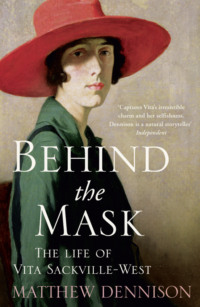
Kitabı oxu: «Behind the Mask: The Life of Vita Sackville-West»


Copyright
William Collins
An imprint of HarperCollinsPublishers
1 London Bridge Street
London SE1 9GF
WilliamCollinsBooks.com
This eBook first published in Great Britain by William Collins in 2014
Copyright © Matthew Dennison 2014
Matthew Dennison asserts the moral right to be identified as the author of this work.
A catalogue record for this book is available from the British Library.
Front cover shows Lady with a Red Hat (oil on canvas), Strang, William (1859–1921) / Art Gallery and Museum, Kelvingrove, Glasgow, Scotland © Culture and Sport Glasgow (Museums) / Bridgeman Images; Shutterstock.com (roses)
All rights reserved under International and Pan-American Copyright Conventions. By payment of the required fees, you have been granted the non-exclusive, non-transferable right to access and read the text of this e-book on-screen. No part of this text may be reproduced, transmitted, down-loaded, decompiled, reverse engineered, or stored in or introduced into any information storage and retrieval system, in any form or by any means, whether electronic or mechanical, now known or hereinafter invented, without the express written permission of HarperCollins.
Source ISBN: 9780007486960
Ebook Edition © October 2014 ISBN: 9780007486977
Version: 2015-05-20
Dedication
For Gráinne, with all love
‘… he told her that he could find no words to praise her; yet instantly bethought him how she was like the spring and green grass and rushing waters.’
(Orlando, Virginia Woolf)
‘All the coherence of her life belonged to Condaford; she had a passion for the place … After all she had been born there … Every Condaford beast, bird and tree, even the flowers she was plucking, were a part of her, just as were the simple folk around her in their thatched cottages, and the Early-English church, where she attended without belief to speak of, and the grey Condaford dawns which she seldom saw, the moonlit, owl-haunted nights, the long sunlight over the stubble, and the scents and sounds and feel of the air.’
John Galsworthy, Maid in Waiting (1931)
‘… we write, not with the fingers, but with the whole person. The nerve which controls the pen winds itself about every fibre of our being, threads the heart, pierces the liver.’
Virginia Woolf, Orlando (1928)

List of Illustrations
1. Vita by Philip Alexius de László, oil on canvas, 1910 (© National Trust Images/John Hammond)
2. Vita with her mother; Vita with her father
3. Knole; King’s Bedroom, Knole (© English Heritage)
4. Harold, Vita, Rosamund Grosvenor and Lionel Sackville on their way to court; Vita and her parents (Photo by Hulton Archive/Getty Images)
5. Vita as Portia by Clare Atwood, oil on canvas, 1910 (© National Trust Images)
6. Vita and Mrs Walter Rubens (© Illustrated London News Ltd/Mary Evans); Vita (© Illustrated London News Ltd/Mary Evans)
7. Sir Harold Nicholson, c.1920 (© Private Collection/Bridgeman Images); Vita at Ascot with Lord Lascelles (Photo by Hulton Archive/Getty Images)
8. Violet Keppel by Sir John Lavery, oil on canvas, 1919 (© National Trust Images)
9. Vita and her two sons (Photo by Hulton Archive/Getty Images)
10. View of Long Barn, Kent, in Winter by Mary Margaret Garman Campbell, oil on paper, c.1927–8 (© National Trust/Charles Thomas)
11. Vita at the BBC (© BBC/Corbis); Vita in sitting room at Long Barn with her sons (© Hulton-Deutsch Collection/CORBIS)
12. Vita (© Mary Evans/Everett Collection)
13. Dorothy Wellesley by Madame Yevonde (© The Yevonde Portrait Archive); Virginia Woolf (Photo by Mondadori Portfolio via Getty Images); Hilda Matheson by Howard Coster (© National Portrait Gallery, London)
14. Sissinghurst Tower (© Niek Goossen/Shutterstock); White Garden at Sissinghurst (© Eric Crichton/CORBIS)
15. Vita by John Gay, 1948 (© National Portrait Gallery, London); Vita in the Sissinghurst Tower by John Hedgecoe, 1958 (© 2006 John Hedgecoe/Topham/The Image Works)
16. Vita’s desk by Edwin Smith, 1962 (© Edwin Smith/RIBA Library Photographs Collection)
Preface
VITA SACKVILLE-WEST ONCE described herself as someone who loved ‘books and flowers and poetry and travel and trees and dragons and the wind and the sea and generous hearts and spacious ideals and little children’.1 Later she added that she loved ‘literature, and peace, and a secluded life’.2
There is no reason to doubt her. ‘Books and flowers and poetry’ became the outward purpose of her life: at the time of her death she was famous twice over, as a writer and a gardener. She never lost the taste for travel that began during her enormously privileged childhood; at home, she balanced curiosity and wanderlust with a powerful need for solitude (‘peace, and a secluded life’). Her love of nature – ‘trees and … the wind and the sea’ – is among her defining attributes as a poet and a novelist. It also shaped her understanding of the role of the landowning aristocracy to which she belonged, and in particular of her own role as a dispossessed aristocrat in the twentieth century. I interpret those ‘dragons’ symbolically. Vita was an extravagant dreamer. Her self-perception was shaped by myths and fairy tales. Intensely imaginative, like many artists she realised early in her life the subjectivity both of reality and realism. She valued intensity of feeling. She once described the ideal approach to life as ‘the ardour that [lights] the whole,/ Not expectation of that or this’.3 And she admired – and inclined to – lavishness. ‘I like generosity wherever I find it.’4
As in most lives, Vita defined ‘spacious ideals’ to suit herself. So too, although with greater particularity, ‘generous hearts’. These are the qualities which overwhelm Vita’s posthumous reputation. Since publication more than forty years ago of her confessional autobiography, written in 1920, in which she described her passionate affair with her childhood friend Violet Keppel, Vita’s literary achievements and the plantsmanship of her garden at Sissinghurst Castle have played second fiddle to her role as lesbian icon. Vita’s affair with Violet Keppel, described in Portrait of a Marriage, changed her life; it altered the course of what has become one of the best-known marriages of the last century, to diplomat, politician and writer Harold Nicolson, himself predominantly homosexual.
I suggest that this affair defines Vita as a person only to the extent that it demonstrates her determination to realise in her life the fullest possible understanding of the terms ‘spacious ideals’ and ‘generous hearts’. In arriving at working definitions of those terms, Vita hurt herself and others too, including her husband and her own ‘little children’, Ben and Nigel Nicolson. She was occasionally selfish, occasionally cruel. Jilted lovers threatened physical violence and legal action; on one occasion, Vita was forced to wrestle a pistol out of a lover’s grip; amorous entanglements forced Vita to deception and concealment. Neither her selfishness nor her cruelty was deliberate; blind to the small scale, she was without pettiness. ‘To hope for Paradise is to live in Paradise, a very different thing from actually getting there,’ she once wrote.5 She was a lifelong romantic, who understood herself well enough to recognise the slipperiness of her grasp on happiness. Her quest was for ‘beauty and comprehension, those two smothered elements which hide in all souls and are so seldom allowed to find their way to the surface’.6
We should not lose sight of the ‘irresistible charm’, remembered by those closest to her, her ‘nobility and grandeur … largeness and generosity in everything she did or said or felt’ – but must set against it the vehemence of her need for privacy and her obsessive secrecy.7 Even her immediate family sometimes had no idea of Vita’s current literary project.
Vita consistently legitimised her peccadilloes in her writing. Internal debates, the need for secrecy among them, were played out in black and white on the printed page, albeit in the case of her sexuality in necessarily disguised form. Of the heroine of her best novel, All Passion Spent, Vita wrote in 1930, ‘Pleasure to her was entirely a private matter, a secret joke, intense, redolent, but as easily bruised as the petals of a gardenia.’8 It was Vita’s own mission statement as faithless wife and lover. Through concealment, she achieved the compartmentalisation of her life that was essential to her. She rationalised it unapologetically as ‘carry[ing] one’s life inside oneself’.9
The equation of pleasure and privacy was fundamental to Vita. She rebelled behind closed doors or within the safety of a small circle of friends gathered frequently from her own elite background. She did not advertise her transgressions, but maintained her ‘secluded life’. She once described the literary hostess Lady Ottoline Morrell as ‘a very queer personality … with masses of purple hair, a deep voice, teeth like a piano keyboard and the most extraordinary assortment of clothes, hung with barbaric necklaces … a born bohemian by nature’.10 Vita never imagined herself ‘a born bohemian’. Her identity as daughter of Knole, the great Sackville house in Kent, overruled all other personae.
On 27 June 1890, less than two years before Vita’s birth, her mother Victoria Sackville-West wrote in her diary, ‘What a heavenly husband I have and how different our love and union is from that of other couples.’11 In time – and repeatedly – Vita would say something similar; Harold told her that ‘our love is something which only two people in the world can understand’ and that ‘the thought of you is a little hot water bottle of happiness which I hug in this cold world’.12 There is a variant on these statements for every happy marriage.
Vita claimed that hers was not an intellectual background, but she was mistaken when she insisted that analysis did not intrude upon her parents’ lives. Her mother’s diary contradicts her. Happily the trait, like many in Vita’s makeup, was inherited. The result is that Vita’s was a thoughtful and thought-provoking life, even if, surprisingly, she excluded the bulk of her questioning from her diary or, in some cases, her letters, choosing instead to resolve her conflicts in her poetry and prose (unpublished as well as published). She was a consistently autobiographical author, even in her nonfiction; in the best of her writing this autobiographical element was skilfully handled and subtly nuanced. Through role-play scenarios in her writing, Vita expanded and explained her sense of herself. I suggest that it was these varied roles, recognised and understood by those nearest to her, which provided this shy but uncompromising woman with the masks she needed to live the several lives she almost succeeded in uniting.
In her introduction to the diary of her redoubtable seventeenth-century kinswoman Lady Anne Clifford, Vita stated, ‘Few tasks of the historian or biographer can be more misleading than the reconstruction of a forgotten character from the desultory evidence at his disposal.’13 She indicated the danger of posthumous judgements based on ‘a patchwork of letters, preserved by chance, independent of their context’. That argument is a truism of all biography. In revisiting Vita’s own life story, I have supported the evidence of letters and her diary with the textual evidence of so much of her writing: poetry, novels, plays, short stories, travel books, books of literary criticism, biography and journalism. The sections of this book are named after Vita’s own novels and poems (or, in the case of Part Four, a book written about Vita during her lifetime by Virginia Woolf, who knew her well and loved her). Such recourse, I recognise, is a commonplace of literary biography; it is particularly apt in Vita’s case. ‘Few things are more distasteful than veiled hints,’ Vita wrote once, addressing head on rumours of lesbianism on the part of the Spanish saint, Teresa of Avila.14 I believe that her writing is full of hints – sometimes veiled, sometimes otherwise – indicative of her state of mind, her emotional dilemmas, the nature of her engagement with herself and the world around her. I have used these ‘hints’ to support more conventional evidence in order to reach the fullest possible picture of this remarkable woman. As Vita herself concluded about St Teresa, ‘every point concerning so complex a character and so truly extraordinary a make-up is of interest as possibly throwing a little extra light on subsequent behaviour’.15
Vita never fully succeeded in explaining herself to herself. In one of her poems she imagined staring at her reflection in a mountain pool: ‘seen there my own image/ As an upturned mask that floated/ Just under the surface, within reach, beyond reach’.16 I hope that the present account, which does not attempt a blow-by-blow chronology of her life, helps to bring reflections of Vita closer within reach.
PROLOGUE

Heritage
‘Those brief ten years we call Edwardian … were a gay and yet an earnest time … Money nobly flowed. Ideals changed … “Respectability”, that good old word, … sank into discredit … Among most of the wealthy, most of the titled, most of the gay and extravagant classes, a wider liberty grew.’
Rose Macaulay, Told by an Idiot, 1923
THE SUM OF money at stake was impressively large. At his death on 17 January 1912, Sir John Murray Scott, sixty-five-year-old great-grandson of Nelson’s captain of the fleet Sir George Murray, left estate valued at £1.18 million (the equivalent, at today’s values, of around £80 million).17 The challenge to Sir John’s will brought by his family the following year was heard in a packed courtroom. An eight-day trial conducted by England’s foremost barristers, it made headlines on both sides of the Atlantic. It transformed its plaintiffs – a family notable for reserve and taciturnity – into reluctant celebrities. In the process, it exposed the deceits and compromises of Edwardian morality, stripping away the veneer of well-mannered discretion to reveal a cynical culture of avarice and lust, a preference for appearances over truth.
Like many rich men, Sir John had enjoyed playing a cat-and-mouse game with family and friends over the contents of his will, which extended to numerous bequests. Principal legatees were his brothers and sisters – middle-aged, unmarried, overweight: the sober-minded offspring of a Scottish doctor. Collectively they inherited £410,000 and the family’s London home in Connaught Place plus contents. Further legacies, to the tune of £223,000, benefited a series of recipients. A single large legacy provided the bone of contention. In addition to furniture and works of art valued at the enormous total of £350,000, childless bachelor Sir John left £150,000 in cash to the woman he described as ‘ma chère petite amie’.
Victoria Sackville-West was fifty years old. Of mixed English and Spanish parentage, she had the wide-eyed gaze of a languorous fawn, a complexion which, with care, had retained its lustre into middle age and an ample bosom ideally suited to the role of Edwardian grande dame. In her youth, she claimed she had received twenty-five proposals of marriage before accepting her husband, who was also her first cousin and heir to one of the greatest houses in England; she was a vain and fanciful woman. At twelve stone, her height five feet seven inches, she may no longer have been as ‘petite’ as formerly: undimmed were her powers of persuasion and her theatricality. She was also prone to an unpredictable Latin exactingness. This trait appears to have had an invigorating rather than an alienating effect on admirers including the American millionaire banker John Pierpont Morgan, hero of the Sudan, Lord Kitchener, and Observer editor J. L. Garvin. Rudyard Kipling described Victoria as ‘on mature reflection the most wonderful person I have ever met’; throughout her life she attracted rich and powerful men.18 Even less sympathetic onlookers acknowledged her distinctive allure. ‘In her too fleshy face, classical features sought to escape from the encroaching fat. An admirable mouth, of a pure and cruel design, held good. It was obvious that she had been beautiful.’19 Counsel for the prosecution described her damningly as possessing all ‘the fascinations of an accomplished woman’.20 Unspoken accusations of immorality added a tang to the courtroom proceedings.
In fact the ‘affair’ of Sir John Murray Scott and Victoria Sackville-West was a sentimental friendship of rare intensity, a compromise at which the latter excelled. Their relationship was almost certainly unconsummated. In her diary Victoria claimed to be ‘much too fond of [her] husband to flirt with anybody’;21 the frisky baby talk of her letters to Scott suggests otherwise. Bachelor Sir John may have been over-fastidious in the matter of sex.
Victoria’s past was romantic and picaresque. She was illegitimate, Catholic, the daughter of a small-town Spanish dancer Josefa Durán, known as Pepita, ‘the Star of Andalusia’. Pepita had become the mistress of an English nobleman. She bore him seven children, including Victoria. In a bid for respectability, she reinvented herself as Countess West and enlisted kings and princes as godparents to her illegitimate children. At her lover’s request, she set up home on the French coast southwest of Bordeaux, away from the eyes of the world.
Like Sir John, Victoria had lived part of her life in Paris. Until her absent father reappeared to rescue her, she had been educated for a governess at the Convent of St Joseph on rue Monceau. In 1890 she became chatelaine of Knole in Kent. She described it with simple pride – and truthfully – as ‘bigger than Hampton Court’. The vast house was the ancestral home of her husband, Lionel Sackville-West. Victoria learned swiftly that the income which supported it was less splendid. That Victoria’s husband was also her first cousin was a curious twist worthy of Victorian popular fiction: the English nobleman, Pepita’s lover, was the 2nd Baron Sackville, not only Victoria’s father but her husband’s uncle. Pepita died in 1871, her lover, Lord Sackville, in 1908. In the absence of legitimate offspring the latter’s title passed to his nephew.
After ‘ten perfect years of the most complete happiness and passionate love’, Lionel and Victoria’s marriage had turned sour.22 In the summer of 1913, the couple had a single child, their daughter Vita, who had lately celebrated her twenty-first birthday. Given her sex, the Sackville title would again descend collaterally. Meanwhile, out of love with his wife, Lionel took a series of mistresses: Lady Camden, Lady Constance Hatch, called Connie, an opera singer called Olive Rubens. Like miscreants on a saucy seaside postcard, Lionel and Lady Connie played a lot of golf.
Sir John Murray Scott had been a giant of a man. Measuring more than five feet around the waist and tall too, he weighed in excess of twenty-five stone. He died of a heart attack. The fortune he left behind him derived neither from his family nor his own entrepreneurialism. Instead, in 1897, he had inherited £1 million from his employer, a former shop girl who had caught the eye of Sir Richard Wallace, first as his mistress and afterwards his wife. Wallace was the illegitimate son of the 4th Marquess of Hertford. Lord Hertford left him estates in Ireland, a Parisian apartment of legendary magnificence at 2 rue Laffitte and the chateau de Bagatelle, a charming neoclassical maison de plaisance built by Louis XVI’s brother, the comte d’Artois, and surrounded by sixty acres of the Bois de Boulogne to the west of Paris. To this splendid inheritance Wallace had added a lease on Hertford House in London, today home of The Wallace Collection, which is named after him. All these glittering prizes Lady Wallace willed to John Murray Scott. For three decades he had served the Wallaces as their devoted secretary. No conditions restricted the bequest. He was free to act as he wished, which is exactly what he did.
What Sir John wished was to help his ‘chère petite amie’. In a letter delivered to Victoria after his death, he had written, ‘It will be found that I have left you in my Will … a sum of money which I hope will make you comfortable for life and cause all anxiety as to your future ways and means to cease.’23 Gratitude inspired his generosity: ‘You did everything to make my broken life, and my last words to you are: “I am very grateful.”’24 Victoria had ensured that Sir John, or ‘Seery’ as the Sackvilles called him, was fully aware of the contrast between his own wealth and the relatively modest income generated by the Sackville estates (a sum of £13,000 a year, recently estimated at ‘perhaps a third of what was needed to support an establishment such as Knole’25). As an added sweetener to his £500,000 bequest, he left Victoria a diamond necklace that had once belonged to Queen Catherine Parr, a pocket book of Marie Antoinette’s and, from Connaught Place, a bust by eighteenth-century French sculptor Houdon and a chandelier. Together, chandelier and sculpture were worth a further £50,000: Sir John intended them for Knole. For good measure, he left a second diamond necklace to Victoria’s daughter Vita and a valuable pearl necklace, which became his posthumous twenty-first birthday present to her.
A fly on the wall in Connaught Place would have known the way the wind was blowing long before writs were issued. Even during Sir John’s lifetime, his siblings had referred to Lionel and Victoria as ‘the Locusts’. Sir John had made Victoria a number of ‘gifts’ in the dozen years of their friendship. Beginning with a modest single payment of £42 8s 6d, these ultimately amounted to a figure close to £84,000. In several instances the purpose of these gifts was understood to be expenses relating to Knole or the settlement of Sackville debts and mortgages (a handout of £38,600, for example, begun as a loan for this purpose, was subsequently written off). The real recipients were not Victoria but Lionel and Knole. In addition, at a cost of £17,000, Sir John had provided Victoria with a handsome London townhouse at 34 Hill Street in Mayfair. With little regard for the feelings of his unmarried sisters, who nominally kept house for him, Victoria chose to divide much of her time between Hill Street and Connaught Place. There she rearranged the furniture, instructed the servants, commandeered Sir John’s carriage and hosted dinner parties from which she excluded his sisters Miss Alicia and Miss Mary. She dismissed them both as irredeemably drab. Sir John did not object. To rub salt into the wound, he presented Victoria with a handsome and valuable red lacquer cabinet, which he had bought for his sisters’ boudoir. By the summer of 1913, in the eyes of her opponents, Victoria’s offences were manifold.
The case that began on 26 June concerned Victoria’s exercise of ‘undue influence’ over Sir John’s will. As The New York Times explained to American readers, F. E. Smith, counsel for the prosecution, ‘in concluding his nine hours’ [opening] speech, said the question was whether the testator at a vital and critical moment was in a position to give free play to his own wishes or whether he was so under the influence of Lady Sackville that the decisions he took were not his, but hers’.26 Sir John’s siblings were clear on the matter. So, too, was Victoria. Dressed with colourful and costly panache, she gave a bravura performance in the witness box. In one of several early, unpublished novels, Vita reimagined her mother’s triumph: ‘Her evidence was miraculous in its elusiveness; she held the court’s attention, charmed the judge, took the jury into her confidence, routed the opposing counsel, wept at some moments, looked beautiful and distressed …’27 The jury needed only twelve minutes to reach their judgement. Victoria emerged victorious and just about exonerated. The judge, Sir Samuel Evans, acclaimed her as a woman of ‘very high mettle indeed’; afterwards Victoria made a friend of him. The Pall Mall Gazette reached a less partial assessment: ‘Sir John was ready to give, and Lady Sackville scrupled not to receive.’ In acknowledgement of her gratitude, Victoria afterwards invited all twelve jurymen to her daughter’s wedding.
As long ago as 17 June 1904, Victoria had confided to her diary ‘I hate gossiping’.28 Later she wrote, ‘People may do what they like but it ought to be either sacred or absolutely private. It is nobody’s business to know our private life. The less said about it, the better …’29 It was fear of exposure which added a frisson to Edwardian misbehaviour. ‘The code was rigid,’ Vita later wrote in a novel about the period. ‘Within the closed circle of their own set, anybody might do as they pleased, but no scandal must leak out to the uninitiated. Appearances must be respected, though morals might be neglected.’30
Swayed by such feelings, and in an attempt to shield her husband and her daughter from scandal, Victoria had written to the Scotts’ counsel on the eve of the trial, ‘Do Spare Them, and attack me as much as you like.’31 Her plea fell on deaf ears. Her victory involved the very public airing of family secrets she had hoped to conceal; even Lady Connie was called on to give evidence. Among unwelcome revelations were those concerning the Sackville finances, aspersions on Victoria’s own morality and rapacity, and an exposé of Lionel’s relationship with Lady Connie, with all the associated inferences to be drawn about the Sackvilles’ marriage. In Leicester Square, the Alhambra Theatre, home of popular music-hall entertainment, staged a musical revue based on the trial. One of Victoria’s maxims confided to Vita was, ‘One must always tell the truth, darling, if one can, but not all the truth; toute verité n’est pas bonne à dire.’32 With hindsight, it sounds like closing the stable door when the horse had already bolted. The public display of the Sackvilles’ dirty linen offended every stricture of aristocratic Edwardian conduct: it would mark them for the remainder of their lives. Both Lionel and Victoria paid a high price for the latter’s hard-fought riches. As Vita wrote afterwards, they would realise ‘that innocence was no shield against the pointed fingers of the crowd’.33
Yet rich Victoria undoubtedly was. Disregarding Sir John’s unspoken wish that she transfer the contents of the rue Laffitte apartment to Knole, Victoria sold them en bloc to French antiques dealer Jacques Seligmann for £270,000. They were dispersed across the globe, the memory of their rich assembly confined to a short story, Thirty Clocks Strike the Hour, which Vita published in 1932. ‘There were silence and silken walls, and a faint musty smell, and the shining golden floors, and the dimness of mirrors, and the curve of furniture, and the arabesques of the dull gilding on the ivory boiseries.’34
Extravagant as she was covetous, Victoria settled down to living off the interest on the sum of £150,000. The capital itself became part of the Sackville Trust, in accordance with the terms of her marriage settlement. Only Vita emerged from the courtroom unscathed. Jurymen and journalists had discovered that Sir John had called her by the pet name ‘Kidlet’. Harmless enough, the label stuck.
In her diary for 7 July, Vita wrote briefly in Italian: ‘Triumphant day! All finished!’35 She invested the short word ‘all’ with considerable feeling. Her mother’s ‘triumph’ concluded what threatened to be costly legal action with a magnificent windfall. It also brought to an end a troubling five-year period in which the Sackvilles had been continuously involved in, or threatened with, court proceedings.
Three years earlier, in February 1910, Victoria had found herself with Lionel and, briefly, Vita, in London’s High Court. In order to defend her husband’s inheritance of the Sackville estates and title in preference to her brother, Pepita’s son Henry, Victoria was forced publicly to attest her own illegitimacy and that of her siblings. The Daily Mail called the case ‘The Romance of the Sackville Peerage’. It was anything but a romantic interlude for Victoria. Proud and spoilt, she habitually masked deep embarrassment about the circumstances of her birth behind ferocious snobbery. Had it not been for her greedy possessiveness towards Knole, she would have found it a more painful experience. Her mother and father were dead, her husband unfaithful and indifferent to her. In the cold light of the High Court she battled the treachery of her brother Henry and her spiteful, disaffected sisters Amalia and Flora. Only one of Pepita’s surviving children, Victoria’s brother Max, kept clear of the fray. As in the Scott case, Victoria and Lionel won. Knole remained theirs. They retained too the Sackville title, which assured the illegitimate Victoria the respect and deference she craved. In Sevenoaks, their victory was celebrated with a public holiday. They returned to Knole in a carriage drawn by men of the local fire brigade. Bouquets covered the seats. Defeated and deeply in debt, Henry subsequently committed suicide. Expenses associated with the case cost the Sackvilles the enormous sum of £40,000.
In a poem called ‘Heredity’, written in 1928, Vita Sackville-West asked: ‘What is this thing, this strain,/ Persistent, what this shape/ That cuts us from our birth,/ And seals without escape?’ To her cousin Eddy she would write: ‘You and I have got a jolly sort of heredity to fight against.’36 Dark shadows clouded Vita’s adolescence. On two occasions, crises in the life of her family became public spectacles, she herself – as ‘Kidlet’ – an unwitting heroine of the illustrated papers. Exposed to public gawping were the sexual foibles of her parents and her grandparents, and a world in which love, sex, money and rank coexisted in a greedy system of barter and plunder. Set against this was the feudal loyalty of Sevenoaks locals, the splendour of life in the rue Laffitte, where Seery entertained European royalty, and the majesty and mystery of Knole itself. It was, for Vita, a varied but not a straightforward existence: courtroom exposure of its flaws increased a tendency to regard herself as distinct and apart, which began in her childhood. Ultimately she longed to retreat from view. Inheritance became a vexed issue for Vita, and one that dominated chapters of her life and facets of her mind. Over time she regarded heredity as immutable and inescapable, but unreliable. This in turn coloured her sense of identity: an element of bravado underpinned her stubborn pride. She did not struggle to escape. Her understanding of her inheritance – temperamental, physical, material – shaped the person she became.
PART I
The Edwardians
‘While he was still an infant John learned not to touch glass cases and to be careful with petit-point chairs. His was a lonely but sumptuous childhood, nourished by tales and traditions, with occasional appearances by a beautiful lady dispensing refusals and permissions …’
Violet Trefusis, Broderie Anglaise, 1935
‘IN LIFE,’ WROTE Vita Sackville-West in her best-known novel, The Edwardians, ‘there is only one beginning and only one ending’: birth and death.37 So let it be in this retelling of Vita’s own life.
Imagine her as a newborn baby, as she herself suggested, ‘lying in a bassinette – having just been deposited for the first time in it … surrounded by grown-ups … whose lives are already complicated’.38 The bassinette stands temporarily in her mother’s bedroom. The grown-ups are Mrs Patterson the nurse and Vita’s mother and father, Victoria and Lionel Sackville-West. We have already seen something of the complications: more will reveal themselves by stages.
In the early hours of 9 March 1892, the grey and green courtyards of Knole were not, as Vita later described them, ‘quiet as a college’.39 Howling and shrieking attended her birth. Outside the great Tudor house, once the palace of the Archbishop of Canterbury, once a royal palace and expansive as a village with its six acres of roof, seven courtyards, more than fifty staircases and reputedly a room for every day of the year, darkness hung heavy, ‘deepening the mystery of the park, shrouding the recesses of the garden’;40 the Virginia creeper that each year crimsoned the walls of the Green Court clung stripped of its glowing leaves. Inside, a night of turmoil dragged towards dawn. Dizzy with her husband’s affection, less than two years into their marriage, Vita’s mother confessed to having ‘drunk deep at the cup of real love till I felt absolutely intoxicated’:41 not so intoxicated that the experience of childbirth was anything but terrible. Its horrors astonished Victoria Sackville-West. She wept and she yelled. She begged to be killed. She demanded that Lionel administer doses of chloroform. It was all a hundred times worse than this charming egotist had anticipated. Lionel could not open the chloroform bottle; Mrs Patterson was powerless to prevent extensive, extremely painful tearing. And then, within three quarters of an hour of giving birth, she succumbed to ‘intense happiness’. Elation displaced agony. She was dazzled by ‘such a miracle, such an incredible marvel’: ‘one’s own little baby’. She was no stranger to lightning changes of mood.
Her ‘own little baby’ was presented to Victoria Sackville-West by her doting husband. Like a precious stone or a piece of jewellery, Vita lay upon a cushion. Her tiny hands, her miniature yawning, entranced her mother. So, too, her licks and tufts of dark hair. Throughout her pregnancy Victoria had been certain that her unborn child would be a daughter. Long before she was born, Victoria and Lionel had taken to calling her Vita (they could not refer to her as ‘Baby’ since ‘Baby’ was Victoria’s name for Lionel’s penis); her wriggling in the womb had kept Victoria awake at night. On the day of Vita’s birth, Victoria headed her diary entry ‘VITA’: bold capitals indicate that she considered the name settled, inarguable. It was, of course, a contraction of Victoria’s own name, just as the daughter who bore it must expect to become her own small doppelgänger. For good measure Victoria christened her baby Victoria Mary. Mary was a sop to the Catholicism of her youth. It was also a tribute to Mary, Countess of Derby, Lord Sackville’s sister, who had once taken under her wing Pepita’s bastards when first Lord Sackville brought Victoria and her sisters to England. Vita was the only name she would use. Either way, the identities of mother and child were interwoven. Even-tempered and still infatuated, Lionel consented.
And so, at five o’clock in the morning, in her comfortable Green Court bedroom with its many mirrors and elegant four-poster bed reaching right up to the ceiling, Victoria Sackville-West welcomed with open arms the baby she regarded for the moment as a prize chattel. ‘I had the deepest gratitude to Lionel, who I was deeply in love with, for giving me such a gift as that darling baby,’ she remembered many years later.42 She omitted to mention the lack of mother’s milk which prevented her from feeding Vita: her thoughts were not of her shortcomings but her sufferings. ‘I was not at all comfy,’ she recorded with simple pique. She was ever self-indulgent. The combination of intense love, possessiveness and an assertive sort of self-absorption imprinted itself on Vita’s childhood. In different measure, those same characteristics would re-emerge throughout her life.
In the aftermath of Vita’s birth, Lionel Sackville-West retreated to his study to write letters. He may or may not have been disappointed in the sex of his child, for which Victoria, with a kind of sixth sense, had done her best to prepare him. On 9 March, he conveyed news of his new daughter to no fewer than thirty-eight correspondents. The habit of entrusting intense emotions to the page and ordering those emotions through the written word would similarly form part of Vita’s make-up. As would his daughter, Lionel wrote quickly but with care. Later he shared with her his advice on how to write well.
When Lionel was not writing he read. In the fortnight up to 27 March, he offered his French-educated bride an introduction to the works of Victorian novelist William Makepeace Thackeray. Beginning with The Book of Snobs, he progressed, via Vanity Fair, to The History of Henry Esmond. Appropriately it was Becky Sharpe, self-seeking heroine of Vanity Fair, ‘a wicked woman, a heartless mother and a false wife’, who captured Victoria’s interest. The women shared coquetry, worldliness, allure. In time Victoria would indeed prove herself capable of falsity, heartlessness and something very like wickedness. But it was the story of Henry Esmond that ought to have resonated most powerfully for Lionel and his family.
Victoria’s diary does not suggest that either husband or wife drew parallels between the novel and their own circumstances. Those are for us to identify. As the illegitimate son of an English nobleman, Henry Esmond is unable to inherit the estate of his father, Viscount Castlewood, and ineligible as a suitor for his proud but beautiful cousin Beatrix: the paths to happiness, riches, respectability and title are liberally strewn with thorns. As we have seen, the legal and social ramifications of illegitimacy would for a period dominate the married life of Lionel and Victoria Sackville-West: their affection did not survive the struggle. In turn, Vita’s own life would be shaped, indeed distorted, by her inability as a daughter to inherit her father’s title and estates. In the early hours of 9 March 1892, wind buffeted the beeches of Knole’s park, ‘dying in dim cool cloisters of the woods’ where deer huddled in the darkness;43 the grey walls of the house, which later reminded Vita of a medieval village, stood impassive. All was not, as Vita wrote glibly in the fictional account of Knole she placed at the centre of The Edwardians, ‘warmth and security, leisure and continuity’:44 in her own life it seldom would be. There were very real threats to the security of her infant world. In addition, it was ‘continuity’ that demanded the perpetuation of that system of male primogeniture which was to cause her such lasting unhappiness. She once claimed for Knole ‘all the quality of peace and permanence; of mellow age; of stateliness and tradition. It is gentle and venerable.’45 But that statement was for public consumption. On and off, what Vita expressed publicly and what she felt most strongly failed to overlap. She was born at Knole, but died elsewhere. She would struggle to reconcile that quirk of fate.
In the short term, within days of her birth, baby Vita’s left eye gave cause for concern. Boracic lotion cleared up the problem and Victoria Sackville-West complacently committed to her diary the similarity between the blue of her daughter’s eyes and those of her great-uncle by marriage, Lord Derby. A smoking chimney in Vita’s bedroom resulted in her being moved back into her mother’s room. It was a temporary solution. Victoria’s diary frequently omits any mention of her daughter, even in the first ecstatic days which she celebrated afterwards as more wonderful than anything else in the world. Her thoughts were of herself, of Lionel, of how much she loved him. Most of all she recorded the extent of his love for her. It would be more than a month before she witnessed for the first time Mrs Patterson giving Vita her bath, a sight that nevertheless delighted her. In the meantime she rested, cocooned and apparently safe in her husband’s adoration.
These were happy days, as winter gave way to spring and Vita made her first sorties outdoors. She was accompanied on these excursions by Mrs Patterson, by her father or her grandfather, Lord Sackville. As the little convoy passed, clouds of white pigeons fluttered on to the roof, startled by the opening and closing of doors. ‘You have to look twice before you are sure whether they are pigeons or magnolias,’ Vita remembered.46 March faded into April and ‘underfoot the blossom was/ Like scattered snow upon the grass’;47 in the Wilderness, close to Knole’s garden front, daffodils and bluebells carpeted the artful expanse of oak, beech and rhododendron. Sometimes, indoors, Vita was placed on her mother’s bed, with its hangings embroidered with improbably flowering trees, ‘and I watched her for hours, lying or sitting on my lap. Her little sneezes or yawning were so comic. I hugged her till she screamed.’ At other times, husband and wife lay next to one another with their baby between them. When Vita cried, Lionel walked up and down Victoria’s bedroom, cradling her in his arms. In time, when Vita had learnt to talk, ‘she used to look at each of us in turn and nod her head, saying “Dada – Mama –”. This went on for hours and used to delight us.’48
These are common enough pictures, albeit the surroundings were uncommonly sumptuous. The air was densely perfumed with a mix of Victoria’s scent (white heliotrope, from a shop off the rue St Honoré in Paris), potted jasmine and gardenias that stood about on every surface, apple logs in the grate and, on window ledges and tables, ‘bowls of lavender and dried rose leaves, … a sort of dusty fragrance sweeter in the under layers’: the famous Knole potpourri, made since the reign of George I to a recipe devised by Lady Betty Germain, a Sackville cousin and former lady-in-waiting to Queen Anne.49 Such conventional domesticity – husband, wife and baby happy together – is unusual in this chronicle of fragmented emotions. ‘She loved me when I was a baby,’ Vita wrote of her mother in the private autobiography that was published posthumously as Portrait of a Marriage.50 In her diary, which she kept in French, Victoria described her baby daughter as ‘charmant’, ‘adorable’, ‘si drôle’: ‘toujours de si bonne humour’ (always so good humoured). On 17 June, she and Vita were photographed together by Mr Essenhigh Corke of Sevenoaks. But it was Lionel’s name, ‘Dada’, that Vita uttered first. It was 4 September. She was six months old.
Victoria’s diary charts Vita’s growth and progress. Some of it is standard stuff. There are tantalising glimpses of the future too. On 19 April 1892, Victoria opened a post office savings account for her daughter. Her first deposit of £12 was partly made up of gifts to Vita from Lionel and Lord Sackville. The sum represented the equivalent of nearly a year’s wages for one of Knole’s junior servants, a scullery maid or stable boy. Until her death in 1936, Victoria would continuously play a decisive role in Vita’s finances: her contributions enabled Vita to perpetuate a lifestyle of Edwardian comfort. Later the same year, Victoria introduced her baby daughter to a group of women at Knole. Vita’s reaction surprised her mother. Confronted by new faces, she behaved ‘wildly’ and struggled to get away. It is tempting to witness in her response first flickers of what the adult Vita labelled ‘the family failing of unsociability’.51 In Vita’s case, that Sackville ‘unsociability’ would amount to virtual reclusiveness.
The faces little Vita loved unhesitatingly belonged to her dolls. Shortly after her first birthday, Victoria made an inventory of her daughter’s dolls. It included those which she herself had bought at bazaars, a French soldier and ‘a Negress’ given to Vita by Victoria’s unmarried sister Amalia, as well as Scottish and Welsh dolls. ‘Vita adores dolls,’ Victoria wrote. In the ‘Given Away’ column of her list of expenses at the end of her diary for 1896, she included ‘Doll for Vita’, for which she paid five shillings. It is the only present Victoria mentions for her four-year-old daughter and contrasts with the many gifts she bestowed on her friends, her expenditure on clothing and the sums she set aside for tipping servants. Happily Vita could not have known of this imbalance. The following year she was photographed on a sturdy wooden seat with three of her dolls, Boysy, Dorothy and ‘Mary of New York’. Wide-eyed, Vita gazes uncertainly at the viewer. She is wearing a froufrou bonnet reminiscent of illustrations in novels by E. Nesbit; her ankles are neatly crossed in black stockings and buttoned pumps. She was two months short of her fifth birthday then and had ceased to ask her mother when she would bring her a little brother;52 she was still too young to be told of Victoria’s fixed resolve that she would rather drown herself than endure childbirth for a second time. Vita’s dolls had become her playmates and surrogate siblings. She had quickly grown accustomed to being alone: eventually solitude would be her besetting vice. For the moment her favourite doll was tiny and made of wool: Vita called him Clown Archie. He was as unlike ‘Mary of New York’, with her flaxen curls and rosebud mouth, as Vita herself, though there was nothing clown-like about the serious, dark-haired child. There never would be.
By the age of two, Vita was a confident walker. Earlier her grandfather had described to Victoria watching her faltering progress across one of Knole’s courtyards. On that occasion a footman attended the staggering toddler. In the beginning, Vita’s world embraced privilege and pomp. ‘My childhood [was] very much like that of other children,’ she afterwards asserted, itemising memories of children’s games, dressing up and pets.53 She was mistaken. Granted, there were universal aspects to Vita’s formative years: her love for her dogs and her rabbits; her fear of falling off her pony; her disappointment at the age of five, on witnessing Queen Victoria’s Diamond Jubilee procession from the windows of a grand house in Piccadilly, that the Queen was not wearing her crown; her frustration at her parents’ strictures; even the ugly, homemade Christmas presents she embroidered for Victoria in pink and mauve. Too often her childhood lacked a run-of-the-mill quality. Hers was a distinctive upbringing, even among her peers. Its atypical aspects shaped her as a person and a writer; shaped too her feelings about herself, her family and her sex; shaped her outlook and her sympathies, her moral compass, her emotional requirements.
The trouble lay mostly with her mother. At thirty, recovering at her leisure from her confinement, Victoria Sackville-West remained beguilingly contrary; she had not yet been wholly spoiled. On the one hand she was capricious and snobbish (she described Queen Victoria as looking ‘very common and red-faced’54); on the other she was passionate and romantic, still the same eager, loving young woman who had confided to her diary with cosy delight, ‘Every day the same thing, walking … reading, playing the piano, making love’; still capable of enchantment.55 With her hooded dark eyes and hair that tumbled almost to her knees, she was lovely to look at. In the right mood, she was exhilarating company. Like Juliet Quarles in Vita’s novel The Easter Party, ‘she was irresponsible, unstable, intemperate, and a silly chatterer – but … under all these things she possessed a warm heart’.56 In time the combination of beauty, wealth and position encouraged less attractive facets to her character, but this illegitimate daughter of a poor Spanish dancer had yet to forget her good fortune in marrying her cousin. Hers was the zeal of a convert, leavened at this stage with apparently boundless joie de vivre: she embraced with gusto the life of an aristocratic chatelaine that had come to her like the happy ending to a fairy tale. As she herself repeated with justification, ‘Quel roman est ma vie!’ (My life is just like a novel). No one ever persuaded her to relinquish the heroine’s role.
Victoria’s year consisted of entertaining at Knole, country house visits and extended Continental holidays; her favourite days were those she spent alone with Lionel. These were leisurely days of flirtation and passionate lovemaking, of arranging and rearranging the many rooms she thrilled to call her own. She papered one room entirely with used postage stamps and made a screen to match. She installed bathrooms, the first for Lord Sackville, one for herself and another for Vita, close to the nursery. Along the garden front of the house, she rearranged furniture in the Colonnade Room to complete its transformation into an elegant if draughty sitting room. Its walls were painted in grisaille with grand architectural trompe l’oeil; seventeenth-century looking glasses and silver sconces threw light on to deep sofas. There Vita’s fifth birthday was celebrated with a Punch and Judy show; Vita dressed on that occasion with appropriate smartness in ‘an embroidered dress with Valenciennes insertion over [a] blue silk slip’, the sort of dress Victoria herself might have worn.57 As would her daughter, Victoria Sackville-West exulted in her splendid home. ‘Everybody says that I made Knole the most comfortable large house in England, uniting the beauties of Windsor Castle with the comforts of The Ritz, and I never spoilt the real character of Knole,’ she claimed for herself.58 Knole became her passion and filled her with a pride that was essentially vanity; she delighted in her ‘improvements’ to its vast canvas. ‘No one knew how, when the day was over and the workmen had gone home, she would lay her cheek against the panelling, marked like watered silk, and softer to her than any lips,’ imagined one of her observers.59 She had no intention of allowing motherhood to unsettle a routine that suited her so admirably. Inevitably, her manner of life affected her daughter.
Vita’s first Christmas was spent in Genoa. It was a family party of Victoria, Lionel, Lord Sackville, Vita, and Vita’s nurse, Mrs Brown. After Christmas, Mrs Brown took Vita to the South of France to stay with Victoria’s former chaperone, Mademoiselle Louet, known as Bonny; Lionel and Victoria continued on to Rome. Vita’s parents did not cut short their travels in order to celebrate her first birthday in March 1893: they were more than 1,600 miles from their baby daughter, in Cairo. In subsequent years they exchanged Cairo for Monte Carlo, their destination for Vita’s third, fourth and sixth birthdays. On those occasions Vita remained at Knole. On 9 March 1896, Victoria enumerated in her diary her losses and winnings, and those of Lionel, at the Casino: only as a parting shot did she note ‘Vita is four today.’ She did not suggest that she missed her daughter or regretted their separation; on the same day two years later, she admitted: ‘I think so much of my Vita today.’60 Every year there were visits to nearby London and a trip to Paris in the spring, ‘with the chestnut trees coming out and the spring sunshine sparkling on the river’.61
Accommodated within this routine, Vita’s childhood was by turns permissive and repressive. From infancy she was frequently left alone at Knole with her shy and silent grandfather. Lord Sackville believed in fairies. Morose and uncommunicative in adult company, he enjoyed the companionship of a tame French partridge and a pair of ornamental cranes called Romeo and Juliet, who accompanied him on his walks outdoors. His presence in Vita’s early years was benign if detached. Together they played draughts in the hour after nursery tea: as time passed, a shared antipathy to parties and smart society types sharpened their bond. Vita endeavoured to please her grandfather: ‘She is very busy gardening and cultivates mostly salad and vegetables for her Grand Papa,’ noted Victoria when Vita was eleven.62 Nurses and governesses oversaw Vita’s days; they were overseen in turn by Victoria, whose volatility ensured that none remained long at their post and that each dismissal could be traumatic and painful for Vita. When Vita was five, ‘Nannie’ was dismissed for theft. The truth was somewhat different. After the unexplained disappearance of three dozen quail, ordered for a dinner party, Victoria decided that Nannie had secretly consumed the entire order and acted accordingly.
With her parents abroad, as soon as she could walk Vita was free to lose herself in the self-contained fastness of Knole. She remembered ‘[splashing] my way in laughter/ Through drifts of leaves, where underfoot the beech-nuts/ Split with crisp crackle to my great rejoicing’.63 She climbed trees and stole birds’ eggs. She ran wild in ‘wooded gardens with mysterious glooms’ and on one occasion she fell into a wishing well. Indoors, even the frayed and faded curtains of Knole’s state rooms possessed a peculiar power of enchantment over her. After nightfall, beginning as a small child, she wandered through the rooms with only a single candle to hold fear at bay. Hers was a playground like few others.
The company of her mother, ‘maddening and irresistible by turns’,64 was predictably more stringent. Victoria’s sharp tongue was quick to wound, particularly on the subject of Vita’s looks, which proved an ongoing source of disappointment. ‘Mother used to hurt my feelings and say she couldn’t bear to look at me because I was so ugly’:65 it was Vita’s hair, with its stubborn resistance to curling, that exercised Victoria above all. She may have spoken more from pique than conviction – on 20 February 1903 she recorded in her diary, ‘The drawing of Vita by Mr Stock is finished and is quite pretty, but the child is much prettier and has far more depth and animation in her face;’66 it was all the same to Vita. Vita subsequently categorised her mother ‘more as a restraint than anything else in my existence’,67 but as a small child she delighted her with her quick affection and her loving nature. ‘She is always putting her little arm round my neck and saying I am the best Mama in the world,’ Victoria wrote on 1 August 1897.68 Vita grew up to regard her mother as compelling but incomprehensible: she dreaded her unpredictability and her ability to humiliate with a look or word. ‘She wounded and dazzled and fascinated and charmed me by turns.’69 Mutual misunderstanding coloured their relationship almost from the first: Vita was probably thinking of her mother when, in an essay about art composed in her late teens, she wrote, ‘It is possible, and indeed common, to possess personality allied to a mediocre soul.’70 In one letter, written in a round, childish hand, Vita implored Victoria to ‘forgive me. Punish me, I deserve it, but forgive me if you can and please don’t say you are sorry to have me and go on loving me.’71 Vita learned from Victoria that so-called loving relationships could embrace indifference, pain and even hatred, and that equality was not assured between partners in love. As she wrote in 1934 of one particularly mismatched couple in her novel The Dark Island, ‘She liked him, yet she hated him. She was surprised to find how instantly she could like and yet hate a person, at first sight.’72 For Vita that model of loving and hating existed in the first instance not in stories but her family life. It was a dangerous lesson.
It was Victoria, not Lionel, who administered punishments, and Victoria who ordered Vita’s life. When Vita was five, Victoria forced her to eat dinner upstairs: ‘she is always eating raw chestnuts and they are so bad for her’.73 Instead she insisted on simple food typical of nursery regimes of the period; Vita’s particular hatred was for rice pudding. The following year, Vita was again punished by dining upstairs: the six-year-old tomboy with the post office savings account had escaped her nursemaid in Sevenoaks in order to buy herself a ball and a balloon. Accustomed to extravagant flattery and naturally autocratic in all her relationships, Victoria inclined to high-handedness: where Vita was concerned she expected obedience. As it happened, her treatment of her daughter hardly differed from her behaviour towards her husband or her father. In each case she preferred to jeopardise affection rather than yield control.
Until Vita was four, Knole was home not only to her parents and her grandfather, but also her Aunt Amalia, ‘very Spanish and very charming’ in one estimate,74 remembered by Vita only as ‘a vinegary spinster … [who] annoyed Mother by giving me preserved cherries when Mother asked her not to’.75 (She annoyed Victoria more with her constant requests for money. The women were temperamentally incompatible and ‘endless rows and quarrels’ made both miserable.76) Also in the great house, hugger-mugger within its far-flung walls and ‘rich confusion of staircases and rooms’,77 lived Vita’s other families: four centuries of Sackville forebears, ‘heavy-lidded, splenetic’,78 preserved in heraldic flourishes and the rows of portraits in which Vita would glimpse ‘our faces cut/ All in the same sad feature’;79 and Knole’s servants and retainers. All influenced the small girl in their midst.
From the outset of her marriage, Victoria Sackville-West had set about rationalising Knole’s running costs. By 1907, she would successfully reduce the annual household expenditure by a third to £2,000.80 She did so while retaining a staff of sixty, including twenty gardeners; their combined wage bill cost her father and afterwards her husband a further £3,500.81 Few of these servants were known personally to Victoria, Lionel or Lord Sackville, or even recognised by them by sight. To Vita, free to explore regions of the house her parents seldom visited, they formed an extended kinship.
‘As a mere child, I was privileged. I could patter about, between the housekeeper’s room and the servants’ hall,’ Vita recalled in an article written for Vogue in 1931. ‘The Edwardians Below Stairs’ examines the elaborate staff hierarchies of her childhood. It also demonstrates how much of Vita’s time was spent among Knole’s servants, whom she knew by name, who shared her games and who omitted to lower their voices or silence their gossip in front of the dark-haired little girl who moved among them so easily. ‘I could help to stir the jam in the still-room or to turn the mangle in the laundry; I could beg a cake in the kitchen or a bottle of cider in the pantry; I could watch the gamekeeper skinning a deer or the painter mixing a pot of paint; my comings and goings remained unnoticed; conversation and comment were allowed to fall uncensored on my childish ears.’82 As Vita wrote of Sebastian and Viola in The Edwardians, ‘As children in the house, they had of course been on terms of familiarity with the servants, particularly when their mother was away.’83 So it was in her own case.
On the surface Vita’s childhood world was one of order and stability. Foresters cut timber and sawmen sawed logs – different lengths for different fires. Melons, grapes and peaches ripened in hothouses. Victoria’s guests enjoyed clean linen sheets daily; the flowers in their rooms were rearranged with similar frequency. Extravagance was endemic, splendid in its excess – as Vita remembered it in The Edwardians, ‘the impression of waste and extravagance … assailed one the moment one entered the doors of the house’.84 It contributed the necessary note of magnificence to this feudal environment of fixed places and shared loyalties. For Knole and its denizens, the world of 1892 appeared to differ from that of 1592 only in refinement and ease: given the estate’s modest income, it was a gorgeous charade. On the shell of Victoria’s pet tortoise, as it shuffled between sitting rooms, glittered her monogram, a liquid swirl of diamonds. It was a fantastical detail, afterwards appropriated by Evelyn Waugh in the lushest of his novels, Brideshead Revisited.
That the childish Vita should take for granted these insubstantial cornerstones of her parents’ existence is inevitable. Her memories indicate something more, a window on to Vita’s position as Knole’s only child: at home upstairs and downstairs, nowhere fully at home, everywhere proprietorial, keenly aware of her connection to the house and its history – as she herself offered, ‘Small wonder that my games were played alone; …/ I slept beside the canopied and shaded/ Beds of forgotten kings./ I wandered shoeless in the galleries …’85 Knole dominates all Vita’s memories of her childhood. She regarded it as her own munificent present and disdained to share it; later she would claim that a house was ‘a very private thing’.86 It was also an irresistible compulsion and seeped into so many of her thoughts. ‘At the centre of all was always the house,’ she wrote in an early story: ‘the house was at the heart of all things.’87 It occupied voids left by the absence of more conventional emotional outlets. That she learned early on that one day she must relinquish it, that as a girl she was prevented from inheriting what she already considered her own, served only to quicken those feelings which transcended ordinary love, feelings which went too deep to be put into words, so deep that throughout her life she hardly dared examine them.
A journalist in Vita’s lifetime described Knole as ‘too homely to be called a palace, too palatial to be called a home’88 – an outsider’s view. For Vita, even as a child, Knole was more than either home or palace. It was a living organism, ‘to others dormant but to me awake’:89 she lavished upon it the quick affection children usually reserve for their parents. ‘God knows I gave you all my love,’ she wrote later, ‘Scarcely a stone of you I had not kissed.’90 ‘So I have loved thee, as a lonely child/ Might love the kind and venerable sire/ With whom he lived,’ she claimed in a poem she dedicated to Knole.91
Finding her way through passages and galleries, crossing courtyards, peeping into workshops and domestic offices, what was Vita looking for and what did she see? Why did she give over her days to wandering and exploring, save for the pleasure of escaping her nursemaid or eluding her mother? At times, the connection she forged with Knole was the strongest bond of her life: to strengthen her conviction of reciprocity she endowed the house and its park with human attributes. ‘I knew thy soul, benign and grave and kind/ To me, a morsel of mortality,’ she wrote self-consciously, the night before she left Knole as a married woman for a new home of her own;92 in a later unpublished poem she went a step further and claimed that she was Knole’s soul. From a precociously young age, she was nourished and sustained by Knole’s accumulated memories: swaggering, picturesque, tragic or simply humdrum. The history she learned she read in its tapestries and portraits. In the first instance it was companionship Vita sought in the cavernous house: the romantic distraction of the past came next. ‘I knew all the housemaids by name … [and] was on intimate terms with the hall-boy … The hall-boy and I used to play cricket together.’93 They also indulged in wrestling bouts, for which Vita was punished by being made to keep her diary in French. But the hall-boy’s name is lost and we question the intimacy of those terms.
Day by day Vita absorbed an inflated, erroneous sense of Knole’s importance. Its place in British life – the prestige of her own family – overwhelmed her imagination. That sense persisted. A novel written when she was fourteen included the question, from father to son, ‘And you can bear that name, the name of Sackville, and yet commit a disgraceful action?’94 In fact, in the 850 years since Herbrand de Sackville had journeyed from Normandy with William the Conqueror, the Sackville achievement had been middling. Knole suggested otherwise, and it was Knole’s version of her family history that the young Vita unquestioningly imbibed and the mature Vita avoided revising.
As a child events conspired to delude her. In 1896, after Lord Sackville had persuaded the prime minister, Lord Salisbury, to make Lionel a temporary honorary attaché to the British embassy in Moscow, Lionel and Victoria set off from Knole to the coronation of Nicholas II of Russia; on the eve of departure their neighbours flocked to admire Victoria’s dresses and her jewels laid out for display like wedding presents. Two years later, the Prince and Princess of Wales lunched at Knole, in a party that included the Duke and Duchess of Sparta, heirs to the throne of Greece. Photographs show Vita and the Princess of Wales holding hands, an intimacy few six-year-olds could rival; they had stood side by side at the inevitable tree-planting ceremony. In his thank-you letter written afterwards, the prince admired Knole as ‘so beautifully kept’, a state he attributed to ‘the tender care “de la charmante Chatelaine!”’.95 In the summer of 1897, Victoria had recorded in her diary the visit to Knole of ‘Thomas the Bond Street jeweller’. She had summoned him to examine the silver. ‘He said that we had not the largest, but the best collection of silver in England.’96 Her life at Knole turned Victoria’s head. Knole turned Vita’s head too. In Vita’s case she knew no alternative.
The child shaped by parental absenteeism, maternal whim and her extraordinary surroundings was all angles and corners, ‘all knobs and knuckles’, ‘with long black hair and long black legs, and very short frocks, and very dirty nails and torn clothes’.97 She regarded her mother – indeed everyone outside the closed Knole–Sackville circle – with unavoidable hesitancy. Like the Godavarys in her later novella, The Death of Noble Godavary, she mistrusted any alien element within the family circle. From an early age, she took on her grandfather’s role of showing the house to visitors: the task exacerbated a tendency to unsociability. Although by modern standards Knole’s visitor numbers were low – on a ‘busy’ August day in 1901, the tally reached twenty-seven98 – Vita’s guide work stimulated her sense of possessiveness towards the house that would never be hers, and a rigid, atavistic pride in its glories. Showing the house was an exercise in showing off. Even as a teenager, travelling through Warwickshire en route to Scotland, Vita measured everything she saw against Knole’s yardstick. Of Anne Hathaway’s cottage she noted only its ‘very small, low rooms’, and she poured scorn on the idea that ruined Kenilworth Castle, covering three acres, had any claim to be considered ‘enormous’: ‘Knole covers between four and five acres.’99
The ‘tours’ she led even as quite a young child sealed the imaginative pact Vita made with Knole. She was reluctant and unskilled at making friends, sullen and shy confronted by unknown visitors, hostile and bullying to local children to the extent that ‘none of [them] would come to tea with me except those who … acted as my allies and lieutenants’.100 Knole superseded Clown Archie as her childhood love; perhaps it precluded – or prevented – other intimacies. ‘Vita belonged to Knole,’ Violet Keppel remembered; ‘to the courtyards, gables, galleries; to the prancing sculptured leopards, to the traditions, rites, and splendours. It was a considerable burden for one so young.’101
Unsurprisingly, given her surrounds, while her social instincts faltered, her imagination blossomed: her taste was for adventure. Vita was a scruffy, despotic, busy child. Her inclinations were starkly at odds with late-Victorian ideas about little girls. Victoria did her best. She commissioned elaborate fancy dress costumes, including a tinsel fairy dress, a May queen dress complete with a maypole made from wild flowers, and a flower-encrusted frock intended to transform Vita into a basket of wisteria (Victoria herself had been ‘very much admired’ when she wore a dress of similar design, with added diamonds, to a costume ball in 1897102). It was not enough. Neither in appearance nor character would Vita achieve conventional prettiness and all that it implied; Victoria’s diary does not suggest she always troubled to sympathise with the daughter whose nature and instincts were so different from her own. Of a seaside holiday in August 1898, her mother recorded simply: ‘Vita was much impressed by seeing a runaway horse smashing a butcher’s cart.’103 Victoria and Lionel’s presents to Vita that year included a costly tricycle and a balloon. Even Vita’s greedy passion for chocolates and bonbons challenged Victoria’s ideas of appropriate behaviour. Concerned for her daughter’s complexion, and the figure she would later cut in the marriage market, Victoria ‘put away mercilessly what I thought was bad for her’.104
Although she was not aware of it, Vita learnt cruelty from her mother. It was not simply that isolation bred introspection or that Knole itself made Vita a dreamer, uninterested in those outside her gilded cage. Victoria’s exactingness threatened to deprive those closest to her both of autonomy and their sense of themselves. Her unconditional love for her daughter, whose birth she had regarded as a ‘miracle’, an ‘incredible marvel’, ceased with Vita’s babyhood. In time Vita learned to fear the mother whose love was so contrary, ‘so it was really a great relief when she went away’105: she never stopped loving her mother extravagantly. The family name for Victoria, ‘BM’ (Bonne Mama), contained no deliberate irony. ‘I love thee, mother, but thou pain’st me so!/ Thou dost not understand me; it is sad/ When those we love most, understand us least,’ Vita’s Chatterton exclaims in the verse drama she wrote about the doomed poet in 1909.106 Vita wrote the part of Chatterton for herself. Like many who are bullied, she responded by becoming herself a bully. Children invited to Knole to play with Vita were left in little doubt of the value she placed on their companionship.
Vita contributed a less-than-flattering anecdote to a volume of childhood reminiscences published at the height of her literary fame in 1932. It concerned the children of neighbours called Battiscombe, four girls and a boy, and happened at the beginning of the Second Boer War in 1899. Vita befriended the boy, Ralph. ‘The four girls were our victims’, forced to impersonate Boers. Together Vita and Ralph Battiscombe tied the girls to trees, thrashed their legs with nettles and blocked their nostrils with putty.107 Vita dressed for this activity in a khaki suit in which she masqueraded as Sir Redvers Buller, a popular military commander in South Africa and winner of the Victoria Cross. At her mother’s insistence, and much to Vita’s irritation, the suit had a skirt in place of trousers. The girls, she insisted in 1932, enjoyed their ordeal ‘masochistically’. She was equally clear about the sadistic pleasure she derived from her own part in this horseplay. For her seventh birthday that year, according to Victoria’s diary, Vita had received only presents of model soldiers. Within a year her toy box included guns, swords, a bow and arrow, armour and a fort for the soldiers. Seery bought her a cricket set. It ranked alongside her football among her prized possessions. ‘I made a great deal of being hardy, and as like a boy as possible,’ she wrote in 1920.108 She described a Dutch museum full of ‘all kinds of odds and ends: instruments of torture … old carriages’ as ‘a place where one could spend hours’.109 Forgotten were Clown Archie and his fellows. She composed a single poem about a doll. It was written in French in 1909 and called simply ‘La Poupée’. She invested more of herself in her subsequent biography of Joan of Arc. Like Vita, the tomboyish French saint fought her battles in armour and men’s clothing: brave, zealous, uncompromising. ‘One wonders what her feelings were, when for the first time she surveyed her cropped head and moved her legs unencumbered by her red skirt,’ Vita mused.110
Throughout her life Vita would appear easy with the inevitability of inflicting pain. There was a thoughtlessness to much of her cruelty, just as there was to Victoria’s. From Victoria, Vita had learnt that pain and suffering were implicit in the complicated experience of love. ‘Pain holds beauty in a fiery ring/ Much as the wheelwright fits the hissing tyre/ White-hot to wooden wheel,’ she wrote later.111 In a short poem, ‘The Owl’, she admired a similar combination: ‘Such beauty and such cruelty were hers,/ Such silent beauty, taloned with a knife.’112 All the principal relationships of Vita’s life – with her mother, with her husband Harold Nicolson, with Violet Keppel and a host of subsequent lovers, as well as with Knole – included this negotiation between positive and negative. The surprise is that she herself remained highly sensitive and easily wounded.
In keeping with her cruelty and her sensitivity, Vita also retained the habit, learnt in childhood, of secrecy. ‘Secrecy was my passion,’ she confessed.113 She later suggested that the passion for secrecy was the natural state of childhood.114 She avoided punishment as a small child by hiding under the pulpit in Knole’s Chapel, which lay within easy reach of her bedroom; as a teenager she resorted to code for those parts of her diary she meant to be private; later, in order to foil her mother, she wrote her diary entirely in Italian. Secrecy was Vita’s retreat: it inspired neither guilt nor reflection. Instead she excused it on grounds of heredity: ‘it’s a trait I inherit from my family. So I won’t blame myself excessively for it.’115 But while the family she referred to meant Lionel and the Sackvilles, the secretive impulse she developed as a child arose in response to the non-Sackville aspect of her upbringing, Vita’s understanding of her mother’s uncontrolled, unmannerly ‘Spanish’ emotionalism, which frightened and, over time, alienated her and forced her to keep her own counsel. For all her unwitting cruelty, Vita was seldom histrionic. The instinct for concealment, her dislike of ‘scenes’, were legacies of her childhood. As one future lover would remember, ‘She did demand peace and quiet … no rows. Certainly no inquisitiveness …’116
It seems surprising that Vita claimed subsequently that her memories of her childhood were hazy. As early as February 1912, weeks short of her twentieth birthday, she wrote to her future husband Harold Nicolson a selective description of her growing up that excluded more than it confided. It revealed what we know already, that like all children of her class, Harold included, Vita had led a double life: that of her parents’ daughter and that of the girl entrusted to a shifting cast of nurses and governesses. In addition, in Vita’s case, was the interior life of an only child who, inspired by her home and by loneliness, absented herself into daydreams and make-believe. As she grew older, while her parents travelled, Vita mastered time travel. She spirited herself into moments of Knole’s past, at one with the portraits and historic artefacts which surrounded her: the silver furniture made for James I in the King’s Room; the paintings by Holbein, Frans Hals, Van Dyck and Gainsborough; the heraldic leopards which prompted her to verse (‘Leopards on the gable ends, Leopards on the painted stair’); the white-painted rocking horse belonging to the 4th Duke of Dorset, an object doubly endowed in Vita’s eyes since the duke’s tragic early death in the hunting field had resulted in Knole’s inheritance by his sisters, a period of female ownership spanning half a century. Her spirited reveries excluded her parents. Often she dressed up, as in those Boer War games with the Battiscombes, fought in trenches among the rhododendrons; actually and metaphorically she would go on dressing up for much of her life. At the outset, the performance was for herself, Vita as player and Vita as audience.
As a writer, Vita seldom dwelt on the subject of childhood. Even the stories she wrote as a child focused on adults. Her poetic description of ‘children taken unawares’, ‘Arcady in England’, is an outdoor scene as much concerned with the lushness of an idealised autumn day as the particular nature of the children who catch the poet’s eye. For Vita’s upbringing was one in which, unusually alone, she learnt above all to observe; she forged few childish relationships, even within her family. Some things she saw clearly: the wonders of the great house that captivated her from infancy, ghosts of the past, the power of genius loci. Others she struggled to discern with any clarity throughout her life, among them her mother’s oscillation between absence and presence, affection withheld and affection lavishly bestowed, spite and charm. As in every childhood, happiness was balanced with unhappiness for Vita. As an adult she quoted one of her favourite forebears, Lady Anne Clifford: ‘the marble pillars of Knole in Kent … were to me oftentimes but the gay arbours of anguish’.117
Vita’s response to her dilemma was creative: she mythologised an existence she only partly understood. It was her own version of her mother’s ‘Quel roman est ma vie!’, but lacked the unqualified exuberance of Victoria’s joyful exclamation. For Vita, she and Knole and its whole population of relatives and servants became characters in a fable. She described her grandfather as ‘rather like an old goblin’. Contemptuously she listened to her mother ‘making up legends about the place, quite unwarrantable and unnecessary’, but acknowledged that ‘no ordinary mother could introduce such fairy tales into life’.118 Stalwartly and in silence, she worshipped her long-suffering father whom she imagined not as an individual but a type, ‘a pleasing man’119 – as Virginia Woolf described him, ‘the figure of an English nobleman, decayed, dignified, smoothed, effete’.120 Even the buildings themselves had an unreal quality, like a theatrical backcloth: ‘my little court [is] so lovely in the moonlight. With its gabled windows it looks like a court on a stage, till I half expect to see a light spring up in one window and the play begin.’121 When at length Vita devised a role for herself, she existed in a mythical tower, part heroine, part observer. At Sissinghurst thirty years on, she made good that pretence. Her sense of life as a performance – theatrical and containing elements of make-believe – began much earlier.
Victoria rejoiced in a reality that surpassed any romantic novel: Vita transformed the reality of her unsatisfactory childhood into a personal fiction. It was one way of placing herself centre stage and making sense of her fellow actors; the process also implied distance. These impulses of mythomania and detachment would remain part of Vita’s psyche until death. Early on, albeit subconsciously, she resorted to fiction to clarify the business of living: later she recycled her own reality as the principal element of her fiction, and all her novels contain fragments of autobiography. Despite this, Vita was an honest child and naturally affectionate. For the most part, those traits too would endure.
Vita Sackville-West described the childhood of the Spanish saint, Teresa of Avila, in The Eagle and the Dove, published in 1943. Identifying Teresa’s favourite childhood pastime as ‘tales of adventure’, she warmed to her theme. Throughout her youth, Vita wrote, Teresa, along with her brother Rodrigo, ‘could think of nothing but honour and heroism, knights and giants and distressed ladies, defeated evil and conquering virtue; they even collaborated in composing a story of their own, modelled on these lines’.122
Vita’s was a life of storytelling. Aspects of her poetry, the fiction she wrote in order to make money, her nonfiction and much of her journalism have a strong narrative content; ditto her diary, in which events, appointments and people take the place of analysis or self-searching. Honour, heroism and conquest – sometimes metaphorical, sometimes reimagined – all find a place within the stories Vita spun; invariably she projects herself into the person of her hero. She glimpsed an echo of these vigorous heroics in the youthful St Teresa, a fiery and imaginative aristocratic teenager sent to the Convent of Santa Maria de Gracia after suspicions of a lesbian affair. It was this swashbuckling quality that endeared Teresa to her: similar feelings coloured Vita’s interpretation of seventeenth-century writer Aphra Behn and French saint Joan of Arc, whose biographies she also wrote. Vita’s juvenilia, written in her teens, includes ‘tales of adventure’: so too the more fanciful of her mature fiction, for example, Gottfried Künstler and The Dark Island. The greatest adventure was writing itself. It would remain so. ‘I do get so frightfully, frenziedly excited writing poetry,’ she once admitted. ‘It is the only thing that makes me truly and completely happy.’123 Predictably her happiness was shared by neither of her parents, both of whom disapproved.
At Knole, Vita wrote at a small wooden table in a summerhouse shaded by tall hedges. It overlooked the Mirror Pond and the sunken garden. Previously, it had served as her schoolroom. She did her lessons there: by the time she was ten, essays written in English, French and German on geography and history (Norway and Sweden, ‘L’Amérique du Nord’, Charlemagne, Charles I, William and Mary, Trafalgar), as well as exercises in creative writing (‘Un jour de la vie d’un petit Chien’). Vita cannot have enjoyed these lessons unreservedly: she remembered at moments of boredom or revolt gouging the table’s wooden surface with the blade of her pocketknife.
Initially she wrote what she subsequently described as ‘historical novels, pretentious, quite uninteresting, pedantic’.124 She wrote plays, too, inspired by history or by plays she had seen or read and particularly enjoyed. She wrote at speed. Fully bilingual until her late teens, she was as comfortable in French as in English; she worked with an easy facility, as if writing were for her the most natural thing imaginable. Inspiration never failed her: ‘the day after one [book] was finished another would be begun’.125 In 1927 she quoted a contemporary assessment of Aphra Behn: ‘her muse was never subject to the curse of bringing forth with pain, for she always writ with the greatest ease in the world’.126 So it was, at the outset of her career, for Vita. Rapidly, the pile of lined Murray’s exercise books and foolscap ledgers mounted. All were neatly written in the clear, unselfconscious, undecorated handwriting that scarcely changed until her death. She dated her efforts, noting the days she began and ended. Sometimes a comment recurs in the margin: V. E. – ‘my private sign, meaning Very Easy; in other words, “It has gone well today.”’127 From the outset Vita’s manuscripts were remarkable for their tidiness and the absence of large-scale corrections and alterations. She claimed that she began writing at the age of twelve and ‘never stopped writing after that’.128 She identified as a catalyst Edmond Rostand’s Cyrano de Bergerac.
When Vita first encountered it, Rostand’s play was relatively new: it was written in 1897. By her twelfth birthday seven years later, she knew all five acts by heart. It was a work custom-made for this proud, fierce, boyish but still, on occasion, sentimental young woman of gnawing insecurities, a story of a nobly born soldier-poet, swashbuckling by nature but crippled by self-doubt on account of his enormous nose: ‘My mother even could not find me fair … and, when a grown man, I feared the mistress who would mock at me.’ The play is set in seventeenth-century France. The teenage Vita followed Rostand’s lead and repeatedly returned to the grand siècle: in Richelieu, a 368-page historical novel she began in French in October 1907; Jean Baptiste Poquelin, a one-act comedy about Molière, also written in French the same year; and Le Masque de Fer, a five-act French drama about Richelieu and Louis XIII, written, like Cyrano, in a poetic form resembling alexandrines. At the time Vita’s favourite writers were historical novelists Walter Scott and Alexandre Dumas: their shadows loomed large.
A portrait of Scott hung in Knole’s Poets’ Parlour, the room used by Lionel and Victoria as their family dining room. Vita’s early writing could never be anything but self-conscious. ‘She allowed her readings of … heroic romances to … flavour her interpretation of her hero with an air of classic chivalry,’ the mature Vita wrote of Aphra Behn’s story of thwarted love and racial prejudice, Oroonoko. ‘Oroonoko resembles those seventeenth-century paintings of negroes in plumes and satins, rather than an actual slave on a practical plantation.’129 It was a criticism she might have levelled at her younger self. The teenage Vita admired heroism, grand gestures, the dramatic (and the melodramatic) impulse. ‘In our adolescence, I suppose we have all thought Ludwig [II of Bavaria] a misunderstood figure of extravagant romance,’ she reflected later; ‘in the sobriety of later years we see him to have been only an exaggerated egoist … who happened also to be a king.’130 Twice as a young woman she wrote about Napoleon, a suitably leviathan figure – in a novel, The Dark Days of Thermidor, and a verse drama, Le roi d’Elbe, both written in 1908. Both are exercises in historic romanticism.
In the beginning Vita approached her writing in a spirit of earnestness and painful sincerity: she described her adolescent self as ‘plain, priggish, studious (oh, very!)’.131 Her teenage notebooks include historical jottings, scene-by-scene breakdowns of her plays, and chapter summaries for novels. Heavily she puzzled over the nature of literature, the qualities necessary to write well and the purpose and requirements of art; essays from this time include ‘The difference between genius and talent’, and ‘The outburst of lyric poetry under Elizabeth’. ‘Sincerity is the only possible basis for great art,’ she offered sententiously;132 certainly her output lacked humour. Vita’s submergence in her self-appointed task was complete. She revelled in losing herself in an imaginary past; she was dizzy with the thrill of creation: here was an occupation to match her loneliness. Her adult self likened the experience to drunkenness. It was especially heady on those occasions when she turned her attention to family history.
Vita wrote her first ‘Sackville’ novel in 1906. The Tale of a Cavalier was inspired by Edward Sackville, 4th Earl of Dorset, for Vita ‘the embodiment of Cavalier romance’. His portrait by Van Dyck, in breastplate and striped vermilion doublet, hung in Knole’s Great Hall, constantly before her. The following year she wrote The King’s Secret. Its subject was Charles Sackville, 6th Earl of Dorset, minor poet, rake, lover of Nell Gwyn, latter-day patron of Dryden and friend of Charles II (Victoria described it as Vita’s ‘Charles II book’). The 6th Earl was largely responsible for the appearance of the Poets’ Parlour in Vita’s childhood. In addition to Scott, its panelled walls were crowded with portraits of Chaucer, Shakespeare, Milton and Dr Johnson, alongside Sackville’s friends and contemporaries Dryden, Addison, Congreve, Wycherley and Pope. Such an illustrious visual compendium provided a powerful spur to Vita’s sense of vocation.
The King’s Secret included a self-portrait: ‘a boy muffled up in a blue scarf … scribbling something in a ponderous book … His pen flowed rapidly over the paper … He wrote from morning till evening.’133 She called her alter ego Cranfield Sackville, the first of numerous masculine fictional self-representations. He wrote ‘in a little arbour situated in the garden at Knole’.134 As she worked, Vita remembered, ‘the past mingled with the present in constant reminder’,135 the former as tangible as the latter, she herself in her own words a fragment of an age gone by.136 Victoria queried Vita’s self-portrait: Cranfield she considered ‘more open, less reserved’ than Vita. Plaintively she confided to her diary the wish that her daughter could ‘change and become warmer-hearted’.137 By chance, a visit to Dover Castle on 18 July, midway through The King’s Secret, brought Vita to the last meeting place of Charles II and his sister Henrietta. ‘This is interesting to me, as I am just writing about their meeting!’ she noted.138 Her earliest approaches to fiction were the literary equivalent of method acting.
But it was from a less picturesque source that Vita drew her first literary income. In July 1907, she was one of five winners of an Onlooker competition to complete a limerick. Her prize was a cheque for £1. In her diary, fifteen-year-old Vita put a characteristically heroic spin on events: ‘This morning I received the £1 I had won in the “Onlooker” verse competition. This is the first money I have got through writing; I hope as I am to restore the fortunes of the family that it will not be the last.’139 She resorted to code to record her intention of restoring the family fortunes. A fitting ambition for this ardent Sackville scion, it was not one she intended to expose to her mother’s watchful gaze.
Predictably, opposition came from close to home: Vita’s parents. Lionel was too conventional to embrace the idea of a daughter whose writing was more than a diversion. Like the majority of upper-class Englishmen of the time he mistrusted intellectualism, particularly in women: Vita described life at Knole as ‘completely unintellectual … analysis wasn’t the fashion’.140 Lionel had sown his wild oats in marrying his illegitimate cousin; in the short term, there would be no further public transgressions. Even the eventual breakdown of his marriage was managed with relative decorum on Lionel’s part. In her diary Victoria noted the physical resemblance between father and daughter and Lionel’s pride in Vita; his only plan for her was marriage into a family like his own, preferably to an eldest son. More than anything he longed for her to embrace ‘normal and ordinary things’, among which he did not count writing.141
On the surface, Victoria showed more sympathy. Victoria was Vita’s chosen reader. ‘How marvellously well she writes!’ she admitted later. ‘Reading her calm descriptions fills me with admiration … No one can beat her at her wonderful descriptions of Nature, or analysing a difficult character.’142 But Victoria too mistrusted the intensity of Vita’s involvement with her writing. Pepita’s daughter was too parvenu to condone such evident disregard for the conventional preoccupations of the society she had married into. (Vita afterwards condemned these preoccupations as limited to parties and investments, pâté de foie gras and the novels of E. F. Benson.) Two years earlier Victoria had confided to her diary her relief that Vita was ‘getting a little more coquette and tidy’, suggesting a growing interest in clothes and appearances to match her own; it was a chimera. On 16 July 1907, while she continued to work on The King’s Secret, Vita’s parents finally made their feelings plain: ‘Mama scolded me this morning because she said I write too much, and Dada said he did not approve of my writing … Mother does not know how much I love my writing.’
Vita was mistaken. Both her parents saw the extent of her passionate engagement with her writing. They noted, for example, that the majority of her thirteenth birthday presents were books: as a counterbalance, their own present consisted of sumptuous squirrel furs.143 Yet, despite their disapproval, they did little to redirect Vita’s energies. By 1907, confronted by overwhelming evidence of Lord Sackville’s mismanagement, they had embarked on a course of unwelcome financial retrenchment which only the Scott bequest would resolve; Victoria’s troublesome siblings continued their carping demands for money and title which afterwards erupted into the succession case of 1910. Above all, Victoria and Lionel knew now that their marriage was broken beyond repair. If Lionel’s response was one of courteous indifference, Victoria’s emphatically was not. She was angry, hurt, uncomprehending. There would be no resolution. Their days of acting in unison were running out. For her twenty-first birthday, Victoria presented Vita with the Italian desk which remains today in her writing room at Sissinghurst.
On 8 April 1908, an ebullient Vita recorded in her diary, ‘We had the results of the exams at Miss Woolff’s. I am first in French literature, French grammar, English literature and geography, and I won the prize essay. Brilliant performance!’ Later that year she consolidated her position. ‘Prize essay day at Miss Woolff’s,’ she wrote on 16 December: ‘I won it (“Reminiscences of an Oak Tree”). I was also first in mythology!’ She won the same prize for the third time on 5 April 1909. The title on that occasion played to bookish Vita’s strengths: ‘Thoughts in a Library’.
By 1909, Vita was in her fourth and final year at Helen Woolff’s School for Girls in London’s South Audley Street. She had first attended classes there at the age of thirteen and pursued her studies thereafter during the autumn and Easter terms. At the same time, until July 1905, Victoria retained the services of Vita’s French governess of ‘such an uneven temper’, Hermine Hall.144 Vita continued to write outside school: her earliest surviving poems, along with fragments of poems, date from this period. Like Cyrano de Bergerac, Miss Woolff’s school was a catalyst in Vita’s life: it represented her first sustained participation in the world of her contemporaries outside Knole. Neither the curriculum studied nor Miss Woolff herself impacted significantly on her intellectual growth or her development as a writer. Nor did she much relish the company of her peers, dismissing in her diary ‘the average run of English girls’ as dull and stupid.145 Meanwhile Victoria oversaw her cultural education: on 13 February 1909, Vita attended a matinée of The Mikado; on 16 February she went to an organ recital in Westminster Abbey given by Master of the King’s Musick, Sir Walter Parratt; on the following day she was present at ‘a most interesting lecture on Madame Récamier’.
More compelling than anything Miss Woolff or Victoria offered was Vita’s unquenchable thirst for her writing. ‘There is writing, always writing,’ she remembered of this period:146 her best days resembled those of Cranfield Sackville, at work undisturbed in his garden arbour. Vita was an autodidact. In every area she prized most highly, from poetry to gardening, she was partly self-taught. Writing had the added attraction of temporarily screening Vita from her parents’ world of acrimony and threats of litigation: she excluded from her first fictions anything unheroic in her Sackville heredity. In Orlando, her fictional ‘biography’ of Vita, Virginia Woolf describes Orlando’s hope ‘that all the turbulence of his youth … proved that he himself belonged to the sacred race rather than the noble – was by birth a writer rather than an aristocrat’.147 Throughout her life, Vita thirsted for just such an acknowledgement. She was never brave enough to separate her two identities. At first an aristocrat who wrote, she became a writer whose work affirmed her own ideal of aristocracy. It was one of several conflicts in her nature.
Vita considered that she had worked hard at Miss Woolff’s. ‘I set myself to triumph at that school, and I did triumph. I beat everybody there sooner or later, and in the end-of-term exams, I thought I had done badly if I didn’t carry off at least six out of eight first prizes.’148 Her triumph transcended examinations. She did indeed earn the reputation for cleverness she had deliberately cultivated. It went some way towards softening the blow of her unpopularity, which she attributed to her moroseness, pedantry, priggishness and savagery, as well as an appearance of aloofness that she was at a loss to explain. There were other discoveries too. Among her fellow pupils were girls who fell in love with Vita.
As an adult, Vita seldom loved singly and was always, as one of her sons remembered, in love.149 Her childhood had been poor preparation for intimacy. Neither Victoria nor Lionel consistently gave her grounds to suppose herself the exclusive object of their affections. Victoria’s love was erratic, Lionel’s mostly implied. As Vita wrote of Shirin le Breton in The Dark Island, ‘It was not a particularly united family, and indeed was held together, as is the case in many families, less by the ties of affection than by those of convenience and convention.’150 Vita loved Knole and believed that Knole returned her love. Her attitude refuted that of Leonard Anquetil in The Edwardians: ‘Chevron [Knole] is really a despot of the most sinister sort: it disguises its tyranny under the mask of love.’151 Yet the house could not wholly replace more conventional relationships. When she was older, Vita wrote in one of the unpublished private poems she called diary poems: ‘The horrible loneliness of the soul makes one crave for some contact.’152 ‘Contact’ was not love, nor limited to a single donor or recipient. During her teenage years at Miss Woolff’s, Vita inspired, and partly reciprocated, the love of two classmates: Rosamund Grosvenor and Violet Keppel.
She had known them both before. Rosamund Grosvenor was an old familiar, Vita’s first friend, a relation of the Duke of Westminster. They were ten and six respectively when Rosamund first visited Vita at Knole in 1899. In his capacity as commander of the West Kent Yeomanry, Lionel had departed for South Africa and the Boer War, and Victoria worried that Vita would be lonely. Rosamund stayed for three days: Vita remembered only that her neatness and cleanliness contrasted with her own grubbiness. Until 1908, when her family moved away from Sevenoaks, Rosamund shared Vita’s morning lessons at Knole. Initially, theirs was a milk-and-water relationship. Vita complained in private of Rosamund’s ordinariness and lack of personality; Rosamund fell under the combined spell of Vita and Knole. Despite her four years’ seniority, Rosamund learned to adopt the role of supplicant. It may have come naturally to her or she may have realised that the Vita who prided herself on her hardiness and her resemblance to a boy could only be conquered by weakness. Fortunately for Rosamund, who by her late teens was deeply in love, she had good looks on her side. Her soft, creamy curvaceousness earned her the nickname ‘the Rubens lady’. Eventually it was Rosamund’s body, not her mind, which provoked a response in Vita. In her diary for 17 July 1905, she noted that Rosamund had gone swimming, noted too her appearance in a bathing costume ‘on the skimpy side’. Vita was thirteen, Rosamund seventeen. When their relationship progressed beyond girlish friendship, Vita was clear that, as far as she was concerned, its root was physical attraction: Rosamund was fatally uninterested in books.
Hero worship, and a tendency she could not resist to regard Vita as the living incarnation of centuries of Sackville swank, characterised Rosamund’s love. She revelled too in Vita’s Spanish blood, an association of exotic glamour which Vita herself exploited. Vita provoked a similar response in Violet Keppel: ‘All this, and a gipsy too! My romantic heart overflowed.’153 Rosamund addressed Vita as ‘Princess’; for Violet, Vita was her ‘Rosenkavalier’.154 Both names imply status, desirability, a prize.
Violet’s novel Broderie Anglaise offers a version of her relationship with Vita, whom she reimagines as a youthful peer, John Shorne. There is ‘a languid grace’ about Shorne, ‘a latent fire’. Like Vita, he bears a strong resemblance to his family portraits. His ‘face recalled so many others seen in frames and surrounded by a ruff, a jabot or a stock, a face that had been a type since 1500 … a hereditary face which had come, eternally bored through five centuries’.155 Like Rosamund, Violet romanticised Vita. Yet while Rosamund’s affection had the puppyishness of first love, Violet’s, even as a child, was characterised by an obsessive decisiveness. It was not, Vita insisted, ‘the kind of rather hysterical friendship one conceives in adolescence’:156 there was nothing exploratory about Violet’s feelings. Her emotional precocity was matched only by her determination. If Rosamund’s love for Vita resembled the blushing passions of a girls’ school story, Violet’s possessed from the beginning a more adult quality. Her decision that Vita was her destiny was virtually instantaneous and never rescinded. Decades later she underlined in her copy of The Unquiet Grave Cyril Connolly’s statement that ‘We only love once, for once only are we perfectly equipped for loving.’157 She had not needed a book to tell her that. Even at the end of her life, fragile and lonely in the Villa Ombrellino in Florence, Violet spoke of Vita in adulatory tones. When it happened, she became Vita’s lover through force of will. Vita was a mostly willing participant, but it was Violet who contrived their collision.
Their first meeting took place on a winter afternoon: Mayfair, 1905, a tea party of sorts for a girl friend with a broken leg, who remained in her bed. The only fellow guest Violet noticed at the bedside was Vita. Vita was thirteen, tall for her age, ungainly and unmannerly (Lionel had recently complained of her abruptness and her roughness). Violet was two years younger. Vita rebuffed her conversational gambits, Violet inwardly criticised Vita’s dress. Both were evidently curious. Violet persuaded her mother to invite Vita to tea; Vita’s mother was delighted and Vita went. Again their conversation was at cross purposes. Violet described Paris while Vita enlarged on her rabbits. They found common ground in inventorying aloud lists of their ancestors: as Vita explained later, in upper-class Edwardian society ‘genealogies and family connections … formed almost part of a moral code’.158 On Vita’s departure, Violet kissed her. At home Vita congratulated herself on having made a friend – this was so unusual that she sang about it in the bath – while Violet embarked on what would become a lengthy and at times inflammatory sequence of letters. Vita responded with more news of her rabbits and also her dogs: an Aberdeen terrier called Pickles and an Irish terrier predictably known as Pat. Nothing daunted, Violet poured out what Vita labelled ‘precocious letters on every topic in a variety of tongues, imaginative exceedingly, copiously illustrated, bursting occasionally into erratic and illegible verse’.159
Between letters Vita visited Violet at her parents’ house in Portman Square; Violet was invited to Knole. Portman Square, where Violet’s mother, Alice Keppel, played host to Edward VII as his mistress, suggested sex at its most discreet and profitable; Knole, with its whispering galleries of Sackville history, imparted romance, a thrill of derring-do glittering in dust motes. Vita’s shortcomings as a correspondent notwithstanding, for Violet it was a perfect combination. ‘I fell in love with John when I was eleven and a half – I swear that’s the truth – and for eight years I never stopped thinking about him,’ she wrote of Vita–John in Broderie Anglaise.160 In another novel, Hunt the Slipper, she suggested that ‘one never loves more passionately than at the age of ten’.161
Vita and Violet shared dancing and Italian lessons. In the spring of 1906 they were in Paris at the same time. In the apartment in the rue Laffitte, in front of an audience of Lionel and Victoria and Sir John Murray Scott’s French servants, they staged Vita’s play about the reign of Louis XIII, Le Masque de Fer. Vita took the part of the Man in the Iron Mask and was delighted when Seery’s cook burst into tears. Less competent a French speaker than Vita (she did not have the benefit of a French-convent-educated mother), Violet took French lessons. They began to talk to one another in French. There was a special excitement to the intimacy of addressing each other as ‘tu’. That sense of intimacy grew. In the spring of 1908, Violet told Vita she loved her, ‘and I,’ wrote Vita, ‘finding myself expected to rise to the occasion, stumbled out an unfamiliar “darling”’.162 Violet sought to make a pact of the exchange by presenting Vita with a ring when next they met. The ring had been a reluctant present to Violet from the Bond Street art dealer Sir Joseph Duveen when Violet was six. It was carved from red lava with the image of a woman’s head and had belonged to a Venetian Doge of the early Renaissance. The sixteen-year-old Vita composed a special entry in her diary and kept the ring lifelong.
Vita’s relationship with Violet Keppel changed the course of her life: she was slow to respond fully to overtures which, on Violet’s part, contained a sexual dimension almost from the start. This was not, Vita would claim, because she mistook Violet’s intentions. Violet was always unique among Vita’s friends: colourful and sophisticated; her ‘erratic’ friend, as she introduced Violet to Harold Nicolson; ‘this brilliant, this extraordinary, this almost unearthly creature’, as Vita described her at the height of their affair in 1920;163 the friend whose love she argued she had recognised immediately. She said that she had understood Violet’s early feelings for her as she had understood those of Rosamund, whom she had admitted she loved by the time she was fifteen. Her mother’s diary challenges such assertions of sexual maturity. ‘Vita and I had begun together The Woman in White,’ Victoria wrote on 21 September 1904; ‘I dropped it as the child’s mind is still too young and I am careful to keep her very pure-minded.’ She had confiscated The Count of Monte Cristo for the same reasons.
If Vita was aware of the nature of Rosamund and Violet’s feelings, she ought to have recognised that they were rivals. In the event she admitted no need to arbitrate between them. In this way, at the outset of her romantic career, she established a pattern which would continue, juggling multiple lovers with no apparent sense of conflict or disloyalty. ‘All love is a weakness … in so far as it destroys some part of our independence,’ says Sebastian in The Edwardians.164 For Vita, invariably more loved than loving, love would seldom compromise her independence. She exercised freedom of choice both romantically and sexually, countering Silas’s statement to Nan in her early novel The Dragon in Shallow Waters that ‘freedom goes when the heart goes’.165 Invariably she retained a clear conscience, and she did not often lose her heart.
Vita did not return to Miss Woolff’s school in the autumn of 1909. Instead she went abroad with her mother and Sir John. Her extended visit to the Continent took in Germany, Austria, Poland and Russia. At Antoniny in the Ukraine, Vita experienced a last gasp of the ancien régime, staying with Count Joseph Potocki, ‘riding, dancing, laughing; living at a fantastic rate in that fantastic oasis of extravagance and feudalism, ten thousand horses on the estate, eighty English hunters, and a pack of English hounds; a park full of dromedaries; … Tokay handed round by a giant; cigarettes handed round by dwarfs in eighteenth-century costumes’.166 Potocki’s estate covered a hundred miles. Dazzled by splendour, aware of the poverty endured by all bar her host, Vita recognised an alternative, and disturbing, version of the tale of inheritance she had imbibed as Knole’s child. The inequalities shocked her. ‘That experience was really like going back to France before 1789,’ she wrote in 1944. ‘It was horrible; it was revealing.’ The travellers wound up in October in Paris, where Victoria ordered dresses for Vita at Worth. As her eighteenth birthday approached, her mother had different plans for Vita, who that year had begun her reluctant career as a debutante. ‘Party in the evening at Lady Jane Coombe’s,’ Vita had written laconically in her diary on 25 January: ‘Hated it.’ For Lionel and Victoria, whose ambitions for Vita’s marriage were considerable, it was an ominous beginning to her first season. Vita would discover, as she had predicted leaving Russia, a stultifying sense of confinement about the life that was now expected of her at home: ‘How shall I ever be able to live in this restricted island! I want expanse.’167 In the short term she did not rebel. She wrote out her protest in a new novel. In Behind the Mask, a story of modern marriage set in France, she dismissed ‘the whole business’ of the marriage market as ‘coarse and vulgar’.168
On 5 October 1905, Victoria Sackville-West had decided to make a new will. She had visited the family solicitor, Mr Pemberton of Meynell & Pemberton, back in March 1897, in order to formalise her intention of leaving ‘everything to Lionel in trust for Vita, till she marries with his consent; then he will give her the income of the capital’.169 On that occasion Vita was days short of her fifth birthday. By the time Victoria returned to the fray, her daughter was thirteen. Victoria explained her motives: ‘Now … I do not think I shall have another child, after all the precautions Lionel and I have taken.’170
Sexual intercourse ceased for Lionel and Victoria Sackville-West in 1904. Once it had formed the bedrock of this mismatched couple’s relationship. The decision was Victoria’s, her justification the weakness of her nervous system, as explained to her by her obliging physician Dr Ferrier. From now on, iron tablets rather than Lionel would be her medicine. Her husband was thirty-seven years old, active and highly sexed: previously Victoria had described him as ‘a stallion’, their lovemaking ‘delirium’. Lionel, for his part, had once thought Victoria ‘the very incarnation of passionate love’: ‘Her breasts are too delicious for words – round firm and soft with two darling little buttons which I adore kissing. She has the most magnificent hips and legs with the most ravishing little lock of hair between them which is as silky and soft as possible.’171 During the early years of their marriage, Victoria’s diary is full of sex: when, where and how often. In the beginning, the naughtiness of ‘Baby’ (Lionel’s penis) is a constant refrain. Sex forced the couple to miss morning appointments; it inconvenienced the servants; it kept Victoria awake at night; it bound them together.
Childbirth brought about the change. For Victoria, desire gave way to fear. Uppermost in her mind was the spectre of another unendurable confinement. In the aftermath of Vita’s birth, she claimed she would do anything to make Lionel happy, ‘even if it meant undergoing the horrors of childbirth’.172 Then she persuaded him to adopt the rudimentary contraceptive practices of the time and did her best to avoid that very contingency.
If abstinence appeared to reassure Victoria, its effect on Lionel was quite different. Victoria was volatile. In all her relationships she lacked self-control. In her marriage she positively embraced the Sturm und Drang of lovers’ quarrels. By contrast Lionel was peaceable, uncommunicative, too polite for histrionics: the more Victoria railed, the further Lionel retreated behind a carapace of good manners and watery dislike, and so on and on. Like Evelyn Jarrold in need of reassurance from Miles Vane-Merrick in Family History, ‘the more she saw that she was making herself a nuisance, the more of a nuisance she made herself’.173 Despite their close blood relationship, the Sackville-Wests were remarkably ill-suited. For ten years, beginning around 1899, they no longer scrupled to disguise their differences. Vita witnessed this breakdown. She absorbed a highly distorted idea of marriage at a time when she was insufficiently emotionally mature to set it in context or to recognise the unusual starkness of her parents’ incompatibility. Instead she struggled to reach a solution through writing. In Behind the Mask, written between November 1909 and March 1910, her heroine renounces the man she loves in order to avoid the coruscating effects of marriage: ‘It is better for us to live apart and love each other all our lives, than to marry and quarrel after a few months.’174 The extremes in her parents’ behaviour suggested to Vita an oversimplified equation of Englishness and equanimity on Lionel’s part and Victoria’s Spanish blood and emotional misrule, as well as a model of marriage in which love was doomed to fail. Increasingly she would choose to blame Victoria. As one of her later fictional heroines states, ‘I hate lack of control … I hate people who let themselves go.’175
The collapse of her parents’ marriage was one factor which convinced Vita of her own ‘duality’: that her nature combined conflicting elements or ‘sides’, the English and the Spanish, which both demanded satisfaction. She imagined those elements as opposites and therefore irreconcilable: propriety pitched against protest, conformity against self, kindness against cruelty, ‘a free spirit or a prisoner’;176 or, as Violet Keppel explained it to Vita, purity and gravity on the one hand, dominance, sensuousness and brutality on the other. An inward struggle along these lines is often part of the experience of growing up. Vita never fully outgrew it because she regarded it as a quirk of her heredity rather than a passing phase; it further complicated her transition from childhood to adulthood. In her first published novel, Heritage, of 1919, she investigated the same dichotomy in the character of Ruth, a version of herself. Ruth is ‘cursed with a dual nature, the one coarse and unbridled, the other delicate, conventional, practical, motherly, refined …’.177 Another of her heroines likens such polarities to the two halves of an apple: ‘Was it impossible ever to keep the apple whole?’ she asks herself, ‘a globe to hold entire in the hand?’178 For Vita, the ‘coarse and unbridled’ side of her nature was every bit as appealing as its more refined opposite. On the eve of her first visit to Spain in 1913, a journey that took her from Madrid south to Granada, she wrote to her friend Irene Lawley: ‘I am going to SPAIN … If I write about it, my hand begins to shake, and my hair piles itself up on the top, like under a mantilla, with a comb, all of its own accord. So I won’t say any more.’179 A kind of coarseness could excite Vita.
Instead of steering a middle course, or choosing one way over the other, Vita indulged both inclinations separately. ‘My whole curse has been a duality with which I was too weak and too self-indulgent to struggle,’ as she explained in 1920.180 ‘Nothing is foreordained./ I hold my liberty/ Unstained and unconstrained,’ Vita would write in her poem ‘Heredity’. In the event, the ‘stain’ of her parents’ marriage proved ineradicable. The desire to satisfy in full both facets of her make-up would shape key moments in her life.
Lionel and Victoria had in common their devotion to Knole and to Vita: even that was at variance, different in origin, form and expression. A selfish and romantically uncomplicated man, Lionel was incapable of interpreting Victoria’s sexual withdrawal other than as a corresponding emotional withdrawal, so he sought satisfaction elsewhere. In transferring his desire he ended up transferring his affection. Victoria expended her energy on Knole and, with increasing frequency, on scenes of the sort guaranteed to drive Lionel further away. Unwitting it may have been, but Victoria’s first blind steps along the road to bitterness and disillusion were taken deliberately.
Vita watched her and saw what she regarded as her mother’s ‘mistake’. It did not occur to her that Victoria’s behaviour was a cri de coeur. She had not read in her mother’s diary her desperate desire for warmth; she suspected nothing then of her frustration at the coldness first of Lord Sackville, then Lionel and even Vita herself, with her tendency to keep her feelings secret and resist confidences. Vita’s solution, explored through fiction, was a world in which partners simply deceived one another, concealing their true emotions beneath a smiling veneer, their motives self-protection and survival, the result a semblance of marriage in appearance only: legitimate mendacity in the interests of the greater happiness. Behind the Mask is among the most aptly titled of her books. ‘Is there anyone without the mask?’ she asks.181 It was a pragmatic, cynical approach, and undesirable in a girl of eighteen on the brink of adulthood. She saw it very clearly: she was never wholly disabused of her theory. ‘Men have two natures,’ she wrote later, ‘and one of them they keep concealed.’182 At another level, her conviction that each of us presents to the world a mask which conceals as much as it reveals explained the impossibility of ever fully knowing anyone but ourselves, another theme she would explore in her fiction. ‘When you see a person, a body, marvellous casket and mask of secrets, what do you think?’ she asked in Heritage.183
Unsurprisingly, Victoria proved incapable of wearing any sort of mask. As her relationship with Lionel worsened, she took up with Seery instead. As an added distraction, she opened a shop on South Audley Street, selling lampshades, waste-paper baskets, boxes, blotters and ashtrays decorated with epigrams and mottoes, including her favourite: ‘A camel can go for nine days without water, but who wants to be a camel?’ She called the shop Spealls, an anagram of the name of its first manageress, and harried Vita to think up similar mottoes and short verses; Vita failed. Spealls enabled Victoria to visit London frequently. Her relationship with Seery grew closer; it was peppered with rows and reconciliations. Seery resented Spealls and its call on Victoria’s time; the shop provided further grounds for differences. Then, sporadically, Seery threatened to cut Victoria out of his will. To both of them this constant negotiation and renegotiation of the terms of their relationship was the breath of life. Even as a teenager, such tempestuousness appalled Vita. After witnessing a particularly acrimonious quarrel between Seery and her mother on 22 March 1910, Vita wrote: ‘I thought they would quarrel for good, but he became apologetic and they have half patched it up, though it can’t ever be as before. It was all very unpleasant, and they called each other names and I hated it.’184
For Victoria, such incidents were a game, a form of self-affirmation. They proved her continuing ability to dominate a man completely. With Seery in the role of cavaliere servente, there was no unwelcome complication of sex. Vita’s own self-affirmation would take different forms, though, like Victoria, her ‘Spanish’ side revelled in the world of feelings: like the narrator of Heritage, ‘Spanish’ Vita believed that ‘the vitality of human beings is to be judged … by the force of their emotion’.185 In the decades to come, her own emotions, alongside her attitude to sex, would give rise to numberless complications.
PART II
Challenge
‘Oh, what an awful word!’ said Juliet, her spirits suddenly reasserting themselves. ‘Wedlock! It makes me feel as though I had chains round my wrists and ankles, and a great dragging load of wood. Wed-lock! Locked-in!’
V. Sackville-West, The Easter Party, 1953
‘I SHALL NEVER forget it,’ Vita recorded of The Masque of Shakespeare, staged in the park at Knole on the afternoon of 2 July 1910. In a costume loaned to her by Ellen Terry, Vita took the part of Portia from The Merchant of Venice. Terry herself had worn the costume in 1875, voluminous robes of red velvet. It was Portia’s disguise as the ‘young doctor of Rome’, a celebrated instance of Shakespearean cross-dressing.
Vita was photographed and painted in her borrowed robes. She was eighteen and had grown into a beauty. ‘The knobs and knuckles had disappeared. She was tall and graceful. The profound hereditary Sackville eyes were as pools from which the morning mist had lifted. A peach might have envied her complexion.’186 Victoria drew attention to the loveliness of Vita’s skin and her eyes, ‘with their double curtain of long lashes’.187 Shyness appeared as aloofness: with ‘her sleek brown head, her glowing skin, her disdainful poise’, she resembled Ruth Pennistan in Heritage.188 Thanks to the Sackville succession case in February, Vita also possessed, in attractive measure, a degree of notoriety; newspaper reports had emphasised her connection to Knole, which possessed a glamour of its own. With her schooldays at Miss Woolff’s behind her, Vita would find that she had graduated from inspiring schoolgirl crushes to provoking a similar response in the young men she encountered. At eighteen, there was a soft and gentle quality to Vita’s beauty. Later this softness gave way to something more florid: a harder, bolder, more masculine appearance, ‘all rather heroic and over life-size; all on a big scale; no feminine charm at all’, as she herself described one of her fictional alter egos.189 The shift would reflect a change in her attitudes. For the moment, youthful curiosity had yet to be overwhelmed by the certainties of middle age.
Clare Atwood’s portrait of Vita as Portia, which today hangs in Ellen Terry’s former home of Smallhythe Place, suggests androgyny: Vita as a romantic Italian youth. Set against a medieval cityscape, she appears as she would have wished: as she described herself three years later, ‘essentially primitive; and not 1913, but 1470; and not “modern”’.190 For all its self-consciousness, it is a picture of a sitter without vanity, as if she disregarded her own looks. Victoria considered that a true assessment: she claimed that Vita was not in the least conceited. Unlike her mother, Vita at eighteen was not interested in feminine wiles; her interests lay elsewhere. Two years previously, in Le Masque de Fer, she had dressed up as the Man in the Iron Mask; a year ago, in her verse drama about doomed poet Thomas Chatterton, she was Chatterton himself, forger and Romantic hero, martyr to the written word. She wore a costume of breeches, white stockings, buckled shoes and a white shirt, which her maid Emily made for her in secret. Each time she played the part, learnt by heart and performed in an attic at Knole to an audience of abandoned trunks and cast-off furnishings, she reduced herself to tears: ‘Earth has been my hell,/ Another world must surely be my heaven.’191 Even at their most vulnerable, the men Vita chose for her alter egos were heroic. Her posturing arose from other impulses than vanity, but the element of self-association was potent. ‘Each time I burnt Chatterton’s manuscripts in the candle I felt I was burning my own,’ she remembered; ‘each time I died most uncomfortably on the oak settle, it was not only Chatterton but I myself who died.’192
On a rainy July day in 1910, in the guise of Portia masquerading as a lawyer in order to contrive her own happy ending, Vita continued that narrative of heroism and wish fulfilment she had begun in childhood – as Sir Redvers Buller, bold in khaki amid Knole’s flowerbeds, and as Cranfield Sackville in The King’s Secret, writing, always writing. This was Vita’s other life, the life of her imagination. In imagination, every Sackville was a conquering hero and each, as she described them in 1922, ‘the prototype of his age’;193 Vita was their latest incarnation. Her life would retain this element of fantasy. Repeatedly in her fiction she celebrated a male version of herself, because she associated maleness with control, possession, inheritance, fulfilment and love – as she invested ‘the bull’ in her poem of the same name, the ability to ‘stand four-square and lordly scan/ His grass, his calves, his willing cows,/ Male, arrogant, alone’.194 She is Julian in Challenge, buoyant with love for Eve; Peregrine Chase in The Heir, inheriting, and refusing to give up, the Tudor manor house of Blackboys; Sebastian in The Edwardians, handsome, fêted, secretive, heir to a fictional Knole; Nicholas Lambarde in her unpublished story ‘The Poet’, certain of his writer’s vocation, author of ‘a contemplative poem on solitude’ as Vita would be: ‘The only important thing in the world to him was poetry.’195 Most of all, and most revealingly, she is aspects of Miles Vane-Merrick in Family History. His house is a castle in Kent, based on Vita’s future home of Sissinghurst; his interests include poetry, farming and philosophy; his emotional requirements are specific and unyielding: ‘He wanted to retain his individuality, his activity, his time-table. He wanted to lead his own life, parallel with the life of love, separate, independent.’196 For Miles, everything has its allotted place. His life is docketed, divided into compartments, but he relinquishes nothing. From early in her romantic career, the same idea appealed to Vita. She would prove herself mostly skilful at maintaining her independence, her ‘separateness’ from the life of love. Like Julian in Challenge, she learned to put things – people – aside until she wanted them: ‘not forgotten, not faded … but merely put aside, laid away like winter garments in summer weather’.197
In the neverlands of her fiction and drama, Vita changed her sex as a means of taking control and a preliminary to action. It was a simple conceit. She continually rewrote her own history and, in swapping her sex, perfected what she regarded as imperfections. It enabled her for an instant to bypass those impediments to inheriting Knole which she could never overcome; it enabled her to love as she wished, unconstrained by social expectation; as Cranfield, Chatterton and Portia, using language with a lawyer’s skill, she staked her claim to be a writer in the face of parental resistance. The Vita of her books was never dispossessed and never without love: always the cynosure, never the pariah; always autonomous. In Seducers in Ecuador, the unreliable Miss Whitaker shares Vita’s fantasy: ‘her own stories were marvellously coming true. Indeed, to her, they were always true; what else was worthwhile? But that the truth of fact should corroborate the truth of imagination! Her heart beat.’198
In fiction, imagination and reality merged: it was a mission statement for Vita. Even Shakespeare forced her into men’s clothing. She did not resist. Her desire to share in all the possibilities and perquisites of a man’s life shaped her. If, as she suggested, her role, like her forebears’, was to be the ‘prototype’ of the age, it is appropriate that this woman who was born into the smug certainties of aristocratic Victorian England, and who witnessed their collapse in the aftermath of the First World War, should in her life embrace areas of confusion and uncertainty. Added to which, she enjoyed dressing up. Events like the Masque, which included several of her friends, were a high point in that debutante life she decried as ‘distasteful and unsuccessful’. Deep down Vita’s real reservation, as at Miss Woolff’s, arose from her fear of not being liked.
The Masque was a fundraising exercise. A theatrical performance showcasing many of Shakespeare’s best-known characters, it was intended, as the programme notes explained, to benefit ‘the Shakespeare Memorial National Theatre Fund, which is established to promote the erection and endowment of a Tercentenary Memorial to Shakespeare to take the form of a National Repository Theatre’. Vita had attended her first rehearsal at Apsley House on 10 June. Also taking part were Rosamund Grosvenor and Vita’s friend Irene Lawley, along with Lionel’s current mistress Olive Rubens, as well as professionals including Ellen Terry. A London performance on 30 June was abandoned midway because of rain. Three days later it rained at Knole, too, ‘torrents, but cleared up and we were able to finish it’.199
In her diary, Vita makes no comment on her role. She lists rehearsal times and weather conditions for the outdoor performances; she records the loan of Terry’s costume. She does not reflect on Portia’s emotional dilemma – or her own. In Shakespeare’s Venetian comedy, Portia is the wealthy young woman whom suitors squabble over. Her father has set a riddle to determine the choice; her own choice is set on Bassanio. ‘The lottery of my destiny/ Bars me the right of voluntary choosing,’ Portia tells the Prince of Morocco. In the summer of 1910, Vita’s case appeared quite different. She was surrounded by choices. She understood her parents’ hopes for her, but estimated correctly that they would allow her to make up her own mind. To Victoria, Lionel wrote, ‘I see that it’s no good trying to force her.’200 To Vita, when the time came to choose between suitors, he made it ‘clear he had other dreams’. Even in his disappointment, Vita wrote, he was ‘sweet’.201
Rosamund Grosvenor was still in love with Vita; only Vita’s engagement would painfully sever their tie. There was Violet Keppel, too, who had symbolically bound Vita to her with the gift of the Doge’s ring. At the end of October, departing for Ceylon with her mother in the aftermath of the death of Edward VII, Violet kissed Vita goodbye with all the (considerable) passion she could muster; Vita was disturbed by her passion and by her urgency. Violet wrote her love letters: ‘I love you, Vita, because you never gave me back my ring.’202 Later Violet wrote asking Vita not to get married before her return.
Her letter was prescient. On 29 June, only four days before the Masque, Vita met the man she would marry. The occasion was a dinner party before a trip to Conan Doyle’s The Speckled Band at the Adelphi Theatre. The young man was subsequently invited to Knole for the Masque. With Rosamund and a small party, he stayed for the weekend. Victoria took the chance to show him over the house. Vita felt a degree of curiosity, no more. On 29 June, the first words she had heard the young man utter were ‘What fun!’. She liked at once ‘his irrepressible brown curls, his laughing eyes, his charming smile’:203 these were not necessarily lover-like attributes. He appeared boyish and light-hearted. These, too, were not lover-like traits but they appealed to Vita – even as they contrasted with the vigorous, troubadour quality that distinguished the men she herself impersonated in her writing and her daydreams. It was not love at first sight when Vita met Harold Nicolson, though she would later recycle the scene in Family History: ‘Miles came to fetch [Evelyn]. He was especially gay. What fun, he said in his most boyish way.’204
In fact, Vita wrote, it was not until three years later, in the spring of 1913, that ‘something snapped, and I loved Harold from that day on’.205 In her diary, she contradicts herself: she decided that she loved Harold as soon as he had kissed her. That was September 1912. Harold’s kiss took him more than two years. In his defence, he was away for much of that period: in Madrid until September 1911, thereafter in Constantinople, where he served as a secretary at the British embassy. In the meantime for Vita there was Rosamund; a Florentine marquess called Orazio Pucci, who had fallen in love with her in Italy in 1909 and the following year trailed her halfway across Europe, even to Knole; and, in Pucci’s footsteps, a nameless artist encountered on a boat trip on Lake Como, whom Vita rejected lightly as ‘second coup de foudre!!!’.206 With beauty came the brittleness and casual unkindness of one growing rapidly accustomed to being pursued. On and off during that summer of 1910, Harold and Vita met, often at Victoria’s invitation at Knole. In November, in her first surviving letter to Harold, Vita asked him to accompany her to dinner and then a dance. Her letter was deliberately light in tone. She told Harold that she was not alone: Rosamund was with her, and one of Harold’s colleagues from the Foreign Office. Harold could not dance and disliked it as a pastime. He would learn that Vita was a poor dancer too.
Clearly, unlike Portia, Vita’s ‘destiny’ would not deny her ‘voluntary choosing’. Nevertheless, there were similarities as well as differences between the women’s predicaments. Like Portia, Vita too was squabbled over. Her own actions served to complicate rather than to simplify those squabbles and, at times, as we shall see, she actively encouraged jealousies among her lovers. The child who had spent so much time on her own, uncertain of her parents’ love, grew up to crave close, intense, intimate connections and, often, to need more than one person’s love at a time. Her parents intended Vita to make ‘a great match with a great title’. Vita balked; but her interlude as a debutante was a busy one, with four balls a week and lunch parties daily.
The young men Vita met did not attract her. She dismissed them disparagingly as ‘little dancing things in ballrooms’, ‘the little silly pink and whites’.207 Even dancing frequently left her unmoved: ‘All the dance tunes sounded much the same … Faintly lascivious, faintly cacophonous; a young man’s arm round one, a young man’s body surprisingly close, his breath on one’s hair, and yet a disharmony between oneself and him, or, at most, a fictitious temporary closeness which tumbled to pieces as soon as the music stopped.’208 She made an exception for the clever Patrick Shaw-Stewart (and he was ‘so ugly’ that she dressed him up in her mind ‘in Louis XI clothes’209 but omitted to think of him romantically) and for Lady Desborough’s tall son Julian Grenfell. Grenfell was ‘a Soul’, part of a pre-war set of thoughtful, poetic, politically minded aristocrats, and Vita liked Souls: ‘They are amusing and easy and not heavy to talk to.’210
Given Vita’s literary aspirations, Lionel considered it a distinct, if troubling, possibility that she would marry a Soul. (Handsome Edward Horner, another Soul, was also attentive.) In the event Julian Grenfell may have been put off by his mother; Lady Desborough’s ambivalence is clear in a letter she wrote after Vita’s marriage to Harold. She reported that Vita had become ‘so charming, so pretty and so clean! and quite tidy, and not a bit of a prig or a bore’.211 Her tone of surprise indicates her previous assessment. For her part, Vita explained simply that, until she married Harold, she had ‘scarcely understood the meaning of being young’.212 Grenfell himself, like several of Vita’s would-be suitors including Edward Horner and Patrick Shaw-Stewart, died in the First World War. Before that he was caught in a downstairs cloakroom with Violet Keppel.
Yet even as Vita failed to feel any quickening of the pulse in the company of her most notable suitors – Lord Granby, heir to the Duke of Rutland, ‘a curious rather morose person’,213 and Lord Lascelles, future Earl of Harewood, whom she considered ‘rather dull’ – she realised she would have to marry someone. She never seriously considered the possibility of an unmarried life, or a life restricted to female admiration of the sort Rosamund and Violet offered her. Meeting Harold Nicolson did not persuade her to give up such admiration, however. Harold’s on-and-off, three-year courtship of Vita was conducted against a background of Rosamund’s constant companionship; constrained by his work, Harold himself was more often absent than present. From the summer of 1911, Rosamund had her own bedroom at Knole. It was next door to Vita’s, overlooking the Pheasants’ Court. Vita described the two of them as ‘inseparable’. She also claimed that they were ‘living on terms of the greatest possible intimacy’.214 A letter written by Rosamund during a separation from Vita appears to corroborate that statement: ‘I do miss you, darling, and I want to feel your soft cool face coming out of that mass of pussy hair.’215 Vita, however, denied that they made love: she admitted only that she was so overwhelmingly in love with Rosamund, that ‘passion … used to make my head swim sometimes’.216
Also asserting her claim on Vita’s heart long distance was Violet Keppel, who travelled from Ceylon to Italy and Germany. ‘You won’t tell me you love me, because you fear (wrongly, most of the time) that I will not make the same declaration to you at the same moment!’ she wrote from Bavaria.217 Since Vita’s side of their correspondence has not survived, we do not know exactly what she said or did to inspire such an outburst. Having been sustained by the thought of Vita through her ‘exile’ in Ceylon, Violet had decided already on the course of their relationship. In the end, as in all her relationships, it was Vita who would make the crucial decision. If Vita was slow to fall in love with Harold, and untouched by the attentions of men like Granby, Lascelles, Grenfell, Horner and Shaw-Stewart, it was because her heart was otherwise occupied, her physical appetites fully stimulated and mostly satisfied.
Harold’s recommendation to Vita was unusual. She regarded him as an ideal companion, a ‘playmate’ (her own italics) and someone with whom she could ‘talk about anything without minding, quite brutally’.218 He corresponded exactly to her description of the hero of Behind the Mask, which Vita began that year: ‘a playmate, clever and gay, with whom she feels an effortless affinity’;219 in another unpublished novel, Marian Strangways, of 1913, Vita described feelings of ‘companionable love … half-friendship, half-playfellowship’.220 Harold would remain all of these things for half a century; these commendations survived the crises in their marriage. Vita did not base her choice on sexual attraction. Portia tells Bassanio, ‘In terms of choice I am not solely led/ By nice direction of a maiden’s eyes.’ The same was true for Vita. Physical attraction characterised her relationship with Rosamund Grosvenor, whom she first admired in her bathing costume when she was thirteen; her relationship with Violet Keppel subsequently represented a more intense infatuation. Vita knew already that these feelings were different from those which men inspired in her; she admitted that she did not think of men ‘in what is called “that way”’.221 Where men were concerned she remained as she was at eleven, when a farmer’s son in Scotland ‘told [her] a great many things he oughtn’t to have told [her]’ about sex: she was ‘neither excited nor interested’ by his revelations.222 His subsequent demonstration of the physical differences between boys and girls provoked a more dramatic response. Deeply shocked, Vita fled.223
For all his boyishness and his bright eyes, the curly-haired young man invited to Knole for the Masque of Shakespeare failed to excite Vita physically. At no point in his undemonstrative courtship would he do so. Afterwards, Vita stated that it was Harold’s own fault. He was too ‘over-respectful’; his behaviour convinced her (correctly, in the event) that he was not ‘the lover-type of man’.224 Until Harold’s kiss in September 1912, Vita’s response to him was like that of Gottfried Künstler, in her novella of the same name. As Gottfried grew closer to Anna Roche, we read, nevertheless ‘it never entered his head to fall in love with her’.225 Unlike Vita, Gottfried did not blame Anna for his conduct. Her protest has a hollow ring to it. She later claimed of the period before Harold’s proposal, ‘People began to tell me he was in love with me, which I didn’t believe was true, but wished that I could believe it.’ Significantly she adds: ‘I wasn’t in love with him then.’226 Yet for reasons of her own – insecurity and confusion uppermost – she needed to believe that Harold loved her.
Harold almost certainly did fall in love with Vita, albeit his affection, like hers, lacked physical ardour. It was a conundrum rich in irony. At eighteen, Vita had yet to realise the implications of her feelings of arousal or non-arousal: she did not regard her ‘intimacy’ with Rosamund as any sort of disqualification from marriage or, more surprisingly, disloyalty to Harold. ‘It never struck me as wrong that I should be more or less engaged to Harold, and at the same time very much in love with Rosamund,’ she confessed in her autobiography.227 To Harold she wrote: ‘I love the Rubens lady [Rosamund], and somewhere in the world there is you.’228 She did not think of herself as gay. Like the majority of women of her generation, she considered her long-term sexual choices as marriage or abstinence. Lesbianism, as understood today, did not exist as an option for Vita; the word itself had yet to enter common parlance. Later she told Harold that she had known nothing then of homosexuality. It was, anyway, a label she would have rejected. Rosamund provided affection, distraction and physical excitement during Harold’s lengthy absences. There was virtually no intellectual companionship between the women. In time, Vita would come to consider them temperamentally mismatched: ‘She is a stupid little thing, and her conventionality drives me mad.’229 Regardless of her sexual feelings for Rosamund – or Rosamund’s apparently deeper feelings for her – Vita would shortly decide to marry Harold. Rosamund’s destiny, like Julian’s winter garments in Challenge, was to be ‘put aside’.
Six years her senior and a man, Harold was less naïve than Vita. He was aware that, despite his love for her, his sexual inclinations were predominantly homosexual and could not be satisfied by a wife. As recently as September 1911, he had been forced to leave Madrid under a cloud after contracting gonorrhoea from an unidentified partner. (Unaware of the nature of his illness, Vita described him sympathetically as ‘rather a pathetic figure wrapped up in an ulster’.230) But he was not deterred. Throughout his life Harold treated his affairs lightly. They provided physical pleasure, they were divertissements, but they did not, in his own eyes, define him as a person. With few exceptions, they never overwhelmed him emotionally in the way that Vita was repeatedly consumed by her affairs. Intermittently Harold craved sex with another man: he avoided acknowledging any need for the larger commitments – and rewards – of a full-scale relationship. Marriage was still a conventional expectation in early-twentieth-century England: Harold Nicolson was a man of conventional background. He had chosen a conventional career and would pursue it with more or less conventional success until Vita’s intransigence knocked the wheels off the cart. In 1910, male homosexuality was a criminal offence. The need for secrecy in relation to this central aspect of his life surely shaped Harold’s behaviour in the summer he met Vita; the fact of his homosexuality partly accounted for the nature of his polite but dilatory courtship. As it happened, his chosen wife was every bit as secretive as he was. She allowed Harold to believe that her love for Rosamund was no more than an intensely loving friendship, while reciprocating Rosamund’s devotion and, up to a point, her desires. The courtship of this young man and woman already skilled in concealment, uncertain or dishonest about the nature of their sexual appetites and their emotional needs, was inevitably bound for choppy waters.
In the eyes of Vita’s mother, Harold’s parents Sir Arthur and Lady Nicolson were ‘very ugly and very small and very unsmart looking’.231 From the beginning, Vita and her parents discounted Harold’s family. (Fifty years later, Vita forbad Harold to be buried alongside her in the family vault at Withyham on the grounds that he was not a Sackville.) They discounted Sir Arthur’s achievements as ambassador to Russia; they discounted Lady Nicolson’s Anglo-Irish connections and her sister’s marriage to the Viceroy, Lord Dufferin and Ava. (Lord Dufferin was an eminent Victorian whose record as a diplomat and public servant eclipsed that of any Sackville since the end of the sixteenth century, when Thomas Sackville served his cousin Elizabeth I as Lord High Treasurer of England. Lord Dufferin had an Irish estate at Clandeboye – the Sackvilles discounted that too.) After Lionel had failed his Foreign Office examinations in 1890 and given up on the idea of a career, the Sackvilles discounted the world of work entirely. Referring to Harold’s position as a junior diplomat in Constantinople, Sackville family gossip labelled him ‘a penniless Third Secretary’. Harold did not deny it. With a salary of £250 a year, he described himself as ‘supremely ineligible’;232 he categorised his family background as that of a ‘landless tribe’ lacking ‘hereditary soil’.233 There was the rub. For though the Nicolson baronetcy originated in the first half of the seventeenth century, and Sir Arthur would be created Baron Carnock in 1916, the Nicolsons were members of a service class which the Sackvilles had forgotten and forsaken. They could not lay claim to a Knole. Rather they lived at 53 Cadogan Gardens, supported only by Sir Arthur’s salary. Harold’s own salary contrasted poorly with that of his wealthiest competitors for Vita’s hand: the annual income of Lord Granby’s father, the Duke of Rutland, was somewhere in the region of £100,000,234 while Lord Lascelles told Victoria that his father’s income was ‘£31,000 a year from his land alone, plus plenty of cash’.235 With uncharacteristic understatement, Victoria wrote in her diary about the prospect of an engagement between Vita and Harold: ‘It is not at present a good marriage.’236
Vita was as conscious as her parents of the discrepancy, however slight, between her own claim to elite status and Harold’s. It was a claim which counted for more then than now. Brought up as a child of the diplomatic aristocracy, Harold’s childhood memories included vignettes of the royal courts of Bulgaria, Spain and Russia, of the British embassy in Paris, with its powdered footmen and gilded opulence, and of the Anglo-Irish ascendancy life of his mother’s family and his Uncle Dufferin. He confessed a sense of ‘effortless superiority’.237 It was an attitude of mind. That he chose to articulate this feeling at all suggests a degree of self-consciousness incompatible with effortlessness. Vita’s social outlook was more straightforward. Hers were the assumptions of an age-old landed caste; later in life she adopted a tag of Victoria’s about her attitudes having been formed before the French Revolution. Virginia Woolf would describe her as ‘very splendid’: ‘all about her is … patrician’. An upbringing at Knole, latterly smoothed by Seery’s generous handouts, had done little to cultivate ‘ordinary’ instincts in Vita. Only in middle age did she acknowledge that the Sackville glory days were long past: she never made such an admission to Harold. She ‘ought to be a grande dame, very rich’, Victoria wrote, ‘where she could do what she likes and not have to do anything against the grain’.238 To Harold, Vita wrote: ‘I like having things done for me.’ It bored her to do things for other people.239 She never learned to cook and, until her death, relied on servants in most areas of her domestic life. As a debutante she preferred ‘a very fine ball … with powdered footmen announcing duchesses’ to ‘those scrimmages at the Ritz’.240 There was an opulence to Vita that was mostly uncontrived.
As Vita herself was aware, her own background was closer to that of the early suitors she rejected – Lord Granby and Lord Lascelles – than to Harold’s family, with its steady accumulation of diligent public service. On 6 June 1912, Vita attended a ‘100-years-ago’ ball at the Royal Albert Hall. She was dressed as a figure from one of the Hoppner portraits at Knole, in the very costume worn by the sitter, with ‘two tall grey feathers and a white turban’.241 Walking round the hall in company with the heirs to dukedoms, she told Harold, ‘I could see “How suitable!” in people’s eyes as we went by.’242 Her motive in writing in this vein was partly ironic; she may also have intended to rouse Harold to jealousy. In her complacency she overlooked Harold’s previous unofficial engagement – to Lady Eileen Wellesley, herself a duke’s daughter (as well as one of Vita’s fellow cast members in the Shakespeare Masque). If the Nicolsons lacked élan, they were not, as all acknowledged, what the Sackvilles termed ‘bedint’: middle class, vulgar or worse. Despite Vita’s family pride, the marriage of Harold Nicolson to Vita Sackville-West was no mésalliance.
Her sense of social superiority notwithstanding, Vita was ripe to fall in love. Remembering in 1920, she disparaged Rosamund’s intellectual limitations (in Challenge, where Rosamund appears loosely fictionalised as Fru Thyregod, Vita dismisses her conversation as a ‘babble of coy platitudes’243); their liaison undoubtedly made Vita happier than otherwise. It stimulated that streak of romance which inspired her to write; the same impulse affected the nature of her writing and some, but not all, of her relationships. It would never leave her. In 1913, in a poem called ‘Early Love’, she described a relish for ‘those fond days when every spoken word/ [Is] sweet, and all the fleeting things unspoken/ Yet sweeter …’.244 She told Harold: ‘There is no fun equal to being quite at the beginning of things.’245 A part of Vita was in love with the idea of love and would remain so.
Pulsuz fraqment bitdi.