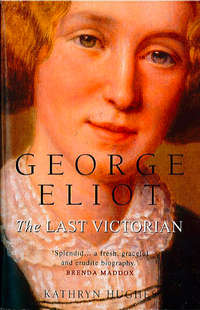
Kitabı oxu: «George Eliot: The Last Victorian»

GEORGE
ELIOT
The LAST VICTORIAN
KATHRYN HUGHES

Dedication
For my parentsAnne and John Hughesagain
Contents
Cover
Title Page
Dedication
CHAPTER 1: ‘Dear Old Griff’ Early Years 1819–28
CHAPTER 2: ‘On Being Called a Saint’ An Evangelical Girlhood 1828–40
CHAPTER 3: ‘The Holy War’ Coventry 1840–1
CHAPTER 4: ‘I Fall Not In Love With Everyone’ The Rosehill Years 1841–9
CHAPTER 5: ‘The Land of Duty and Affection’ Coventry, Geneva and London 1849–51
CHAPTER 6: ‘The Most Important Means of Enlightenment’ Life at The Westminster Review 1851–2
CHAPTER 7: ‘A Man of Heart and Conscience’ Meeting Mr Lewes 1852–4
CHAPTER 8: ‘I Don’t Think She Is Mad’ Exile 1854–6
CHAPTER 9: ‘The Breath of Cows and the Scent of Hay’ Scenes of Clerical Life and Adam Bede 1856–9
CHAPTER 10: ‘A Companion Picture of Provincial Life’ The Mill on the Floss 1859–60
CHAPTER 11: ‘Pure, Natural Human Relations’ Silas Marner and Romola 1860–3
CHAPTER 12: ‘The Bent of My Mind Is Conservative’ Felix Holt and The Spanish Gypsy 1864–8
CHAPTER 13: ‘Wise, Witty and Tender Sayings’ Middlemarch 1869–72
CHAPTER 14: ‘Full of the World’ Daniel Deronda 1873–6
CHAPTER 15: ‘A Deep Sense of Change Within’ Death, Love, Death 1876–80
Epilogue
Select Bibliography
Index
Acknowledgements
About the Author
Notes
Praise
Copyright
About the Publisher
CHAPTER 1
‘Dear Old Griff’
Early Years 1819–28
IN THE EARLY hours of 22 November 1819 a baby girl was born in a small stone farmhouse, tucked away in the woodiest part of Warwickshire, about four miles from Nuneaton. It was not an important event. Mary Anne was the fifth child and third daughter of Robert Evans, and the terse note Evans made in his diary of her arrival suggests that he had other things to think about that day.1 As land agent to the Newdigate family of Arbury Hall, the forty-six-year-old Evans was in charge of 7000 acres of mixed arable and dairy farmland, a coal-mine, a canal and, his particular love, miles of ancient deciduous forest, the remnants of Shakespeare’s Arden. A new baby, a female too, was not something for which a man like Robert Evans had time to stop.
Six months earlier another little girl, equally obscure in her own way, had been born in a corner of Kensington Palace. Princess Alexandrina Victoria was also the child of a middle-aged man, the fifty-two-year-old Prince Edward of Kent, himself the fourth son of Mad King George III. None of George’s surviving twelve children had so far managed to produce a viable heir to succeed the Prince Regent, who was about to take over as king in his own right. It had been made brutally clear to the four elderly remaining bachelors, Edward among them, that the patriotic moment had come to give up their mistresses, acquire legal wives and produce a crop of lusty boys. But despite three sketchy, resentful marriages, the desired heir had yet to appear. Still, at this point it was too soon to give up hope completely. Princess Alexandrina Victoria, born on 24 May 1819, was promisingly robust and her mother, while past thirty, was young enough to try again for a son. If anyone bothered to think ahead for the little girl, the most they might imagine was that she would one day become the elder sister of a great king.
Officially the futures of these two little girls, Mary Anne and Alexandrina Victoria, were not promising. As for every other female child born that year, the worlds of commerce, industry and the professions were closed to them. As adults they would not be able to speak in the House of Commons, or vote for someone to do so on their behalf. They would not be eligible to take a degree at one of the ancient universities, become a lawyer, or manage the economic processes which were turning Britain into the most powerful nation on earth. Instead, their duties would be assumed to lie exclusively at home, whether palace or farmhouse, as companions and carers of husbands, children and ageing parents.
Yet that, as we know, is not what happened. Neither girl lived the life that the circumstances of her birth had seemed to decree. Instead, each emerged from obscurity to define the tone and temper of the age. Princess Alexandrina Victoria, pushed further up the line of succession by her father’s early death, even gave her name to it. ‘Victorian’ became the brand name for a confident, expansive hegemony which was extended absent-mindedly beyond her own lifetime. ‘Victorian’ was the sound of unassailable depth, stretch and solidity. It meant money in the bank and ships steaming the earth, factories that clattered all night and buildings that stretched for the sky. Its shape was the odd little figure of Victoria herself, sweet and girlish in the early years, fat and biddyish at the end. Wherever ‘Victorian’ energy and bustle made themselves felt, you could be sure to find that distinctive image, stamped into coins and erected in stone, woven into tablecloths and framed in cheap wood. In its ordinary femininity the figure of Victoria offered the moral counterpoise to all that striving and getting. The solid husband, puffy bosom and string of children represented the kind of good woman for whom Britain was busy getting rich.
George Eliot’s image, by contrast, was rarely seen by anyone. Indeed, it was whispered that she was so hideous that, Medusalike, you only had to look upon her to be turned to stone. And her name, during its early years of fame, suggested the very opposite of Victorianism. Her avowed agnosticism, sexual freedom, commercial success and childlessness were troubling reminders of everything that had been repressed from the public version of life under the great little Queen. By 1860 Victoria and Eliot had come to stand for the twin poles of female behaviour, respectability and disgrace. One gave her name to virtuous repression, a rigid channelling of desire into the safe haven of marriage and family. The other, made wickeder by male disguise, became a symbol of the ‘Fallen Woman’, banished to the edges of society or, in Eliot’s actual case, to a series of dreary suburban exiles.
That was the bluster. In real life – that messy matter which refuses to run along official lines – the Queen and Eliot shared more than distracted, greying fathers. Their emotional inheritance was uncannily similar and pressed their lives into matching moulds. Both had mothers who were intrusive yet remote, a tension which left them edgy for affection until the end of their days. Victoria slept in the Duchess of Kent’s room right up to her coronation, while Eliot spent her first thirty years looking for comfortable middle-aged women whom she could call ‘Mother’. When it came to men, both clung with the hunger of children rather than the secure attachment of grown women. Prince Albert and George Henry Lewes not only negotiated the public world for their partners, but lavished them with the intense and symbiotic affection usually associated with maternally minded wives. And when both men died before them, their widows fell into an extended stupor which recalled the despair of an abandoned baby.
What roused them in the end were intense connections with new and unsuitable men. The Queen found John Brown, then the Munshi, both servants, one black. Eliot, meanwhile, married John Cross, a banker twenty years younger and with nothing more than a gentleman’s education. Menopausal randiness was sniggeringly invoked as the reason for these ludicrous liaisons. Victoria was called ‘Mrs Brown’ behind her back. And when John Cross had to be fished out of Venice’s Grand Canal during his honeymoon, the whisper went round the London clubs that he had preferred to drown rather than make love to the hideous old George Eliot.
Because of Eliot’s ‘scandalous’ private life, which actually the Queen did not think so very bad, there was no possibility of the two women meeting. Yet recognising their twinship, they stalked each other obliquely down the years. Eliot first mentions Victoria in 1848 when, having briefly caught the revolutionary mood, she speaks slangily in a letter of ‘our little humbug of a queen’.2 Ironically, only eleven years later, Victoria had fallen in love with Eliot’s first full-length novel, Adam Bede, because of what she saw as its social conservatism, its warm endorsement of the status quo. The villagers of Hayslope, headed by Adam himself, reminded her of her beloved Highland servants, and in 1861 she commissioned paintings of two of the book’s central scenes by the artist Edward Henry Corbould.
George Eliot noticed how hard the Queen took the loss of Prince Albert in 1861 and, aware of the similarities in their age and temperament, wondered how she would manage the dreadful moment when it came to her. The Queen, in turn, was touched by the delicate letter of condolence that Eliot and Lewes wrote to one of her courtier’s children on his death and asked whether she might tear off their double signature as a memento.3
The Queen’s daughters went even further. By the 1870s Eliot’s increasing celebrity and the evident stability of her relationship with Lewes meant that she was no longer a total social exile. Among the great and the good who pressed for an introduction were two of the royal princesses. Brisk and bright, Vicky and Louise lobbied behind the scenes for a meeting and then, in Louise’s case at least, dispensed with royal protocol by coming up to speak to George Eliot first.4
The princesses were among the thousands of ordinary Victorians, neither especially clever nor brave, who ignored the early grim warnings of clergymen and critics about the ‘immorality’ of George Eliot’s life and work. By the 1860s working-class men and middle-class mothers, New Englanders (that most puritan of constituencies) and Jews, Italians and Australians were all reading her. Cheap editions and foreign translations carried George Eliot into every kind of home. Even lending libraries, those most skittishly respectable of ‘family’ institutions, bowed to consumer demand and grudgingly increased their stock of Adam Bede and The Mill on the Floss.
What is more, all these Victorians read the damnable George Eliot with an intensity and engagement that was never the case with Dickens or Trollope. While readers of Bleak House might sniff over the death of Jo and even stir themselves to wonder whether something might not be done for crossing-sweepers in general, they did not bombard Dickens with letters asking how they should live. That intimate engagement was reserved for Eliot, who alone seemed to understand the pain and difficulty of being alive in the nineteenth century. From around the world, men and women wrote to her begging for advice about the most personal matters, from marriage through God to their own poetry. Or else, like Princess Louise, they stalked her at concert halls, hoping for a word or a glance.
The worries which Eliot’s troubled readers laid before her concerned the dislocations of a social and moral world that was changing at the speed of light. Here were the doubts and disorientations that had been displaced from that triumphant version of Victorianism. An exploding urban population, for instance, might well suggest bustling productivity, but it could also mean a growing sense of social anomie. Rural communities were indeed invigorated by their new proximity to big towns, but they were also losing their fittest sons and daughters to factories and, later, to offices and shops. Meanwhile the suburbs, conceived as a rus in urbe, pleased no one, least of all George Eliot, who spent five years hating Richmond and Wandsworth for their odd mix of nosy neighbours and lack of real green.
For if in one way Victorians felt more separate from each other, in others they were being offered opportunities to come together as never before. It was not just the railway that was changing the psycho-geography of the country, bringing friends, enemies and business partners into constant contact. The postal service, democratised in 1840 by the introduction of the Penny Post, allowed letters to fly from one end of the country to the other at a pace that makes our own mail service look like a slowcoach. Then there was the telephone which, at the end of her life, George Eliot was invited to try. As a result of these changes Victorians found themselves pulled in two directions. Scattering from their original communities, they spent the rest of their lives trying to reconstitute these earlier networks in imaginary forms.
Science, too, was taking away the old certainties and replacing them with new and sometimes painful ones. It would not be until 1859 that Darwin would publish Origin of Species, but plenty of other geologists and biologists were already embracing the possibility that the world was older than Genesis suggested, in which case the Bible was perhaps not the last word on God’s word. Perhaps, indeed, it was not God’s word at all, but rather the product of man’s need to believe in something other than himself. This certainly was the double conclusion that Eliot came to during the early anonymous years of her career when she translated those seminal German texts, Strauss’s The Life of Jesus (1835–6) and Feuerbach’s The Essence of Christianity (1841). Her readers likewise wrestled with the awful possibility that there was no moral authority except the one which was to be found by digging deep within themselves. Not only did a godless universe lay terrifying burdens of responsibility upon the individual, but it unsettled the idea of an afterlife. To a culture which had always believed that, no matter how dismal earthly life might be, there was a reward waiting in heaven, this was a horrifying blow beside which the possibility that one was an ape paled into insignificance.
That much-vaunted prosperity turned out to be a tricky business too. For every Victorian who felt rich, there were two who felt very poor indeed, especially during the volatile 1840s and again in the late 1860s. During Eliot’s early years in the Midlands she saw the effect of trade slumps on the lives of working families. As a schoolgirl in Nuneaton she had watched while idle weavers queued for free soup; at home, during the holidays, she sorted out second-hand clothing for unemployed miners’ families. Even her own sister, married promisingly to a gentlemanly doctor, found herself as a widow fighting to stay out of the workhouse.
To middle-class Victorians these sights and stories added to a growing sense that they were not, after all, in control of the economic and social revolution being carried out in their name. Getting the vote in 1832 had initially seemed to give them the power to reshape the world in their own image: the repeal of the Corn Laws in 1846 had represented a real triumph of urban needs over the agricultural interest. But it soon became clear that early fears that 1832 would be the first step towards a raggle-taggle democracy were justified. On three occasions during the ‘hungry forties’ working-class men and women rallied themselves around the Charter, a frightening document demanding universal suffrage and annual parliaments. By the mid-186os, with the economy newly unsettled, urban working men were once again agitating violently for the vote.
These were worrying times. The fat little figure of the Queen was not enough to soothe Victorians’ fears that the blustery world in which they lived might not one day blow apart completely. In fear and hope they turned to the woman whose name they were initially only supposed to whisper and whose image they were seldom allowed to see. George Eliot’s novels offered Victorians the chance to understand their edginess in its wider intellectual setting and to rehearse responses by identifying with characters who looked and sounded like themselves. Thanks to her immense erudition in everything from theology to biology, anthropology to psychology, Eliot was able to give current doubts their proper historic context. Dorothea’s ardent desire to do great deeds, for instance, is set alongside St Teresa’s matching passion in the sixteenth century and their contrasting destinies explained. In the same way Tom Tulliver’s battles with his sister Maggie are understood not just in terms of their individual personalities, but as the meeting point of several arcs of genetic, cultural, and family conditioning at a particular moment in human history.
While disenchantment with Victorianism led readers to George Eliot, George Eliot’s advice to them was that they should remain Victorians. Despite the ruptures of the speedy present, Eliot believed that it was possible, indeed essential, that her readers stay within the parameters of the ‘working-day world’ – a phrase that would stand at the heart of her philosophy. She would not champion an oppositional culture, in which people put themselves outside the ordinary social and human networks which both nurtured and frustrated them. From Darwin she took not just the radical implications (we are all monkeys, there is probably no God), but the conservative ones too. Societies evolve over thousands of years; change – if it is to work – must come gradually and from within. Opting out into political, religious or feminist Utopias will not do. Eliot’s novels show people how they can deal with the pain of being a Victorian by remaining one. Hence all those low-key endings which have embarrassed feminists and radicals for over a century. Dorothea’s ardent nature is pressed into small and localised service as an MP’s wife, Romola’s phenomenal erudition is set aside for her duties as a sick-nurse, Dinah gives up her lay preaching to become a mother.
Eliot’s insistence on making her characters stay inside the community, acknowledge the status quo, give up fantasies about the ballot, behave as if there is a God (even if there isn’t) bewildered her peers. Feminist and radical friends assumed that a woman who lived with a married man, who had broken with her family over religion, who was one of the highest-earning women in Britain, must surely be encouraging others to do the same. And when they found that she did not want the vote for women, that she felt remote from Girton and that she sometimes even went to church, they felt baffled and betrayed.
What Eliot’s critics missed was that she was no reactionary, desperately trying to hold back the moment when High Victorianism would crumble. Right from her earliest fictions, from the days of Adam Bede in 1859, she had understood her culture’s fragility, as well as its enduring strengths. None the less, she believed in the Victorian project, that it was possible for mankind to move forward towards a place or time that was in some way better. This would only happen by a slow process of development during which men and women embraced their doubts, accepted that there would be loss as well as gain, and took their enlarged vision and diminished expectations back into the everyday struggle. In Daniel Deronda, Eliot’s penultimate book and last proper novel, she shows how this new Victorianism, projected on to a Palestinian Jewish homeland, might look and sound. Although it will cohere around a particular social, geographic and religious culture, it will acknowledge other centres and identities. It will know and honour its own past, while anticipating a future which is radically different. By being sure of its own voice, it will be able to listen attentively to those of others.
It was Eliot’s adult reading of Wordsworth and Scott that instilled in her the conviction that ‘A human life, I think, should be well rooted in some spot of a native land … a spot where the definiteness of early memories may be inwrought with affection.’5 But it was during her earliest years, as she accompanied her father around the Arbury estate in his pony trap, that she fell deeply in love with the Midlands countryside. Her ‘spot’ was Warwickshire, the midmost county of England. Uniquely, the landscape was neither agricultural nor industrial, but a patchwork of both. In a stunning Introduction to Felix Holt, The Radical, George Eliot used the device of a stagecoach thundering across the Midlands on the eve of the 1832 Reform Act to describe a countryside where the old and new sit companionably side by side.
In these midland districts the traveller passed rapidly from one phase of English life to another: after looking down on a village dingy with coal-dust, noisy with the shaking of looms, he might skirt a parish all of fields, high hedges, and deep-rutted lanes; after the coach had rattled over the pavement of a manufacturing town, the scene of riots and trades-union meetings, it would take him in another ten minutes into a rural region, where the neighbourhood of the town was only felt in the advantages of a near market for corn, cheese, and hay.6
Mary Anne’s early life, contained within the four walls of Griff farmhouse, where her family moved early in 1820, still belonged securely to the agricultural ‘phase of English life’ and was pegged to the daily and seasonal demands of a mixed dairy and arable farm. Although there were male labourers to do the heavy work and female servants to help in the house, much of the responsibility was shouldered by the Evans family itself. Like many of the farmers’ wives who appear in Eliot’s books, Mrs Evans took particular pride in her dairy, running it as carefully as Mrs Poyser in Adam Bede, who continually frets about low milk yields and late churnings. Like the wealthy but practical Nancy Lammeter in Silas Marner, too, Mrs Evans and her two daughters had bulky, well-developed hands which ‘bore the traces of butter-making, cheese-crushing, and even still coarser work’.7 Some years after George Eliot’s death, a rumour circulated in literary London that one of her hands was bigger than the other, thanks to years of turning the churn. It was a story which her brother Isaac, now gentrified by a fancy education, good marriage and several decades of high agricultural prices, hated to hear repeated.
The rhythms of agricultural life made themselves felt right through Mary Anne’s young adulthood. As a prickly, bookish seventeen-year-old left to run the farmhouse after her mother’s death, she railed against the fuss and bother of harvest supper and the hiring of new servants each Michaelmas. And yet the very depth of her adolescent alienation from this repetitive, witless way of life reveals how deeply it remained embedded in her. Thirty years on and established in a villa in London’s Regent’s Park, her first thought about the weather was always how it would affect the crops.
But life on the Arbury estate was no bucolic idyll. The Newdigate lands contained some of the richest coal deposits in the county. As she grew older, the fields in which Mary Anne played had names like Engine Close and Coal-pit Field. Lumps of coal lay casually amid the grass. At night the girl was kept awake by the chug-chug of the Newcomen engine pumping water out of the mine less than a mile from her home. The canal in which she and Isaac fished was busy with barges taking the coal to Coventry. And when Mary Anne accompanied her father on his regular visits to Mr Newdigate at Arbury Hall, she would have noticed the huge crack which cut across the gold-and-white ceiling of the magnificent great hall. Subsidence caused by the mine-working had dramatically marked a building whose elaborate refashioning only a generation before had come to stand for everything that was elegantly Arcadian about aristocratic life.
Nor did Mary Anne have to look very far to fit the uneven textures of the Arbury estate into the wider landscape. Most of the people in the scrappy hamlet of Griff were not farm labourers but miners. In the nearby villages people were mainly employed in cottage industries like nail making, ribbon weaving and framework knitting. The pale faces and twisted bodies of the handloom weavers struck Mary Anne as absolutely different from the Arbury farmers, a contrast she was to use later in suggesting the weaver Silas Marner’s alienation from his ruddy Raveloe neighbours.
Only a few miles along the road was Nuneaton, the market town where Mary Anne was soon to go to school. In her very first piece of fiction she describes the town – renamed Milby – as a place where intensive homeworking had already left its grimy mark: ‘The roads are black with coal-dust, the brick houses dingy with smoke; and at that time – the time of handloom weavers – every other cottage had a loom at its window, where you might see a pale, sickly-looking man or woman pressing a narrow chest against a board, and doing a sort of treadmill work with legs and arms.’8
As Eliot’s description of hard labour and pinched surroundings suggests, these were not prosperous times for the Midlands. Victory over Napoleon in 1815 had meant an end to protection against imports of French and Swiss ribbon. A couple of months before Mary Anne’s birth, a cut in the rate paid to silk weavers brought an angry crowd out on to the street. There was jeering and jostling, and a man accused of working under-price was tied backwards on a donkey and led through the streets.9 Later, as a schoolgirl in Nuneaton, she was to see hunger-fuelled rioting at first hand.
As Mary Anne followed her father from miner’s cottage to farmhouse to Arbury Hall itself, she learned to place herself within this complex social landscape. She noted that while tenant farmers might nod respectfully at her, when she got to Arbury Hall, she was left in the housekeeper’s room while her father went to speak to the great man. She observed a whole range of accents, dress, customs and manners against which her own must be measured and adjusted. In this way she built up a library of visual and aural references to which she could return in her imagination when she was sitting, years later, in Richmond trying to recapture the way a gardener or a clergyman spoke. It was this faithfulness to the actual past, rather than a greetings-card version of it, which was to become a plank in her demand for a new kind of realism in fiction. In Adam Bede she breaks off in the middle of describing the young squire’s coming-of-age party to ask her sentimental, suburban reader: ‘Have you ever seen a real English rustic perform a solo dance? Perhaps you have only seen a ballet rustic, smiling like a merry countryman in crockery, with graceful turns of the haunch and insinuating movements of the head. That is as much like the real thing as the “Bird Waltz” is like the song of the birds.’10 Mary Anne Evans had not only seen labourers dancing, she had watched them getting drunk, making love, milking and shearing. She had been patronised by the gentry and petted by their servants. And while these pictures were neither charming nor quaint, they sustained her sense of being rooted in a community which was to carry her through the long years of urban exile. She knew every field, every hedgerow and every clump of trees. In later life, she had only to close her eyes and she could conjure up the smell of cows’ breath, hay and fresh rain. But she also knew the way the muddy canal absorbed the sunlight and the noise the looms made as the weavers worked into the night. Looking at the world through her father’s expert eyes, she learned to see that these two strands of life were not conflicting, but that they represented a particular moment in the development of English life. The rural community had not been destroyed, but it was being radically regeared towards technology, profit and the power of the individual to manage his own life. And no one had benefited more from these changes than Robert Evans.
Evans had been born in Roston Common, Derbyshire, in 1773, one of eight children. There were the usual family romances about gentry stock, but by the time Robert arrived any grand connections were nothing more than stories. His father, George, was a carpenter and his mother was called Mary Leech. The five Evans boys were determined to ride the wave of social and economic expansion unleashed by the first phase of industrialisation. Second son William rose to be a wealthy builder, while Thomas overcame a shaky start to become county surveyor for Dorset. Even dreamy Samuel, who turned Methodist and kept his eye on the future world, ran a ribbon factory. Only the eldest boy, George, was unsteady. He boycotted the family’s carpentry business and there was talk of heavy drinking. When he died, the Evans clan turned its collective and implacable back on his young children.
Mary Anne was to experience both sides of this Evans legacy. Like her father and his brothers, she rose out of the class into which she was born by dint of hard work and talent. She left behind the farm, the dairy and the brown canal, and fashioned herself into one of the leading intellectual and literary artists of the day. But just like her Uncle George – was it coincidence that she took his name as the first half of her writing pseudonym? – she learned what it was like to belong to a family which regularly excluded those of whom it did not approve. When, at the age of twenty-two, she announced that she did not believe in God, her father sent her away from home. Fifteen years later, when she was living with a man to whom she was not married, her brother Isaac instructed her sisters never to speak or write to her again. The Evanses, like thousands of other ambitious families at that time, demanded that its members forge their individual destinies while skirting nonconformity.
School did not turn out to be an emotional second start for Mary Anne. Although she sometimes came home on Saturdays, and saw her nearby Aunt Evarard more often, she felt utterly abandoned. At the end of her life she told John Cross that her chief memory of Miss Lathom’s was of trying to push her way towards the fireplace through a semicircle of bigger girls. Faced with a wall of implacable backs, she resigned herself to living in a state of permanent chill. The scene stuck in her memory because it reinforced her feelings of being excluded from the warmth of her mother’s lap. No wonder, then, that her childhood nights were filled with dreadful dreams during which, reported Cross, ‘all her soul … [became] a quivering fear’.42 It was a terror which stayed with her throughout her life, edging into consciousness during those times when she was most stressed, depressed or alone. Even in late middle age she had not forgotten that churning sickness, working it brilliantly into the pathology of Gwendolen Harleth, the neurotic heroine of her last novel, Daniel Deronda.
Children who are separated from their parents often imagine that their bad behaviour is to blame. Mary Anne was no exception. She interpreted her banishment from Griff as a sign that she had been naughty and adopted the classic strategy of becoming very good. The older girls at Miss Lathom’s nicknamed her, with unconscious irony, ‘Little Mama’ and were careful not to upset her by messing up her clothes.43 The toddler who had once loved to play mud pies with Isaac grew into a grave child who found other little girls silly. When, at the age of nine or ten, she was asked why she was sitting on the sidelines at a party, she replied stiffly, ‘I don’t like to play with children; I like to talk to grown-up people.’44
As part of her plunge into goodness, Mary Anne buried herself in books. Her half-sister Fanny, who had once worked as a governess, recalled for John Cross the surprising fact that the child had been initially slow to read, preferring to play out of doors with her brother. But once Isaac withdrew his companionship Mary Anne was left, like so many lonely children, to construct an imaginary world of her own. In 1839 she told her old schoolmistress Maria Lewis how as a little girl ‘I was constantly living in a world of my own creation, and was quite contented to have no companions that I might be left to my own musings and imagine scenes in which I was chief actress. Conceive what a character novels would give to these Utopias. I was early supplied with them by those who kindly sought to gratify my appetite for reading and of course I made use of the materials they supplied for building my castles in the air.’45 Quite who ‘supplied’ these novels is unclear. At the age of seven or so Mary Anne would have found very few books lying around Griff. The Evanses were literate but not literary and the little girl was obliged to read nursery standards like Aesop’s Fables and Pilgrim’s Progress over and over. Her father’s gift of a picture book, The Linnet’s Life, was special enough to make Mary Anne cherish it until the end of her life, handing it over to John Cross with a warm dedication.46 Joe Miller’s Jest Book was learned by heart and repeated ad nauseam to whoever would listen. In middle age Eliot recalled that an unnamed ‘old gentleman’ used to bring her reading material, but no more is known.47 For the girl who was to grow up to be the best-read woman of the century, it was an oddly unbookish start.
CHAPTER 2
‘On Being Called a Saint’
An Evangelical Girlhood 1828–40
AT THE AGE of eight Mary Anne took a step towards a new world, urban and refined. In 1828 she followed Chrissey to school in Nuneaton. Miss Lathom’s had been only three miles from Griff and was attended by farmers’ daughters with thick Warwickshire tongues, broad butter-making hands and little hope of going much beyond the three Rs. The Elms, run by Mrs Wallington, was a different proposition altogether. The lady herself was a genteel, hard-up widow from Cork. She had followed one of the few options available to her by opening a school and advertising for boarders whom she taught alongside her own daughters. There were hundreds of these ‘ladies’ seminaries’ struggling to survive in the first half of the nineteenth century and most of them were dreadful. What marked out The Elms was its excellent teaching: by the time Mary Anne arrived, the school was reckoned to be one of the best in Nuneaton. Responsibility for the thirty pupils was shared between Mrs Wallington, her daughter Nancy, now twenty-five, and another Irishwoman, Maria Lewis, who was about twenty-eight.
The change of environment did nothing to help Mary Anne shed her shyness. Adults and children still steered clear, assuming they had nothing to offer the little girl whom they privately described as ‘uncanny’.1 Only the assistant governess Miss Lewis, with her ugly squint and her Irishness, recognised in Mary Anne something of her own isolation. Looking beyond the smooth, hard shell of perfection, she saw a deeply unhappy child ‘given to great bursts of weeping’. Within months of her arrival at Nuneaton Mary Anne had formed an attachment to Miss Lewis, which was to be the pivot of both women’s lives for the next ten years. Miss Lewis became ‘like an elder sister’ to the Evans girls, often staying at Griff during the holidays.2
Mr and Mrs Evans were delighted with Mrs Wallington’s in general and Maria Lewis in particular. In their different ways they both set great store by their youngest girl getting an education. Shrewdly practical, Robert Evans had already schooled his eldest daughter, Fanny, to a standard that had enabled her to work as a governess to the Newdigates before her marriage to a prosperous farmer, Henry Houghton. Anticipating that the quiet, odd-looking Mary Anne might remain a spinster all her life, Evans was determined that she would not be reduced to relying on her brothers for support. A life as a governess was not, as Miss Lewis’s example was increasingly to show, either secure or cheerful. Still, it was the one bit of independence open to middle-class women and Robert Evans was determined that it should be Mary Anne’s if she needed it.
Christiana’s hopes for her daughter were altogether fancier.3 Like many a prosperous farmer’s wife, she expected a stint at boarding-school to soften her child’s rough corners and round out her flat vowels. A smattering of indifferent French and basic piano were the icing on the cake of an education designed to prepare the girl for marriage to a prosperous farmer or local professional man. In the case of young Chrissey the investment was soon to pay off handsomely. A few years after leaving Mrs Wallington’s she married a local doctor, the gentlemanly Edward Clarke. Still, husbands were a long way off for little Mary Anne. All Mrs Evans hoped for at this stage was that her odd little girl would become near enough a lady. Maria Lewis may not have been pretty, but her careful manners and measured diction were held up to Mary Anne – who still looked and sounded like a farm girl – as the model to which she should aspire.
It did no harm, either, that Miss Lewis was ‘serious’ in her religion, belonging to the Evangelical wing of the Church of England. From the end of the previous century the Evangelicals had worked to revitalise an Established Church that had become lethargic and indifferent to the needs of a changing social landscape. A population which was increasingly urban and mobile found nothing of relevance in the tepid rituals of weekly parish worship. During the 1760s and 1770s, the charismatic clergyman John Wesley had taken the Gospel out to the people, preaching with passion about a Saviour who might be personally and intimately known. For Wesley ritual, liturgy and the sacrament were less important than a first-hand knowledge of God’s word as revealed through the Bible and private prayer. When it came to deciding questions of right and wrong, the authority of the priest ceded to individual conscience. This made Methodism, as Wesley’s brand of Anglicanism became known, a particularly democratic faith. Mill workers, apothecaries and, until 1803, women, were all encouraged to preach the word of the Lord as and when the spirit moved them.
This challenge of Methodism, together with the continuing vitality of other dissenting sects such as the Baptists and the Independents, had forced the Established Church to put its house in order. The result was Evangelicalism – a brand of Anglicanism which held out the possibility of knowing Christ as a personal redeemer. In order to attain this state of grace an individual was to prepare her soul by renouncing all manner of leisure and pleasure. A constant diet of prayer, Bible study and self-scrutiny was required to stamp out temptation. Yet at the same time as renouncing the world, the Evangelical Anglican was to be busily present within it. Visiting the poor, leading prayer meetings and worrying about the state of other people’s souls were part of the programme by which the ‘serious’ Christian would reach heaven. Uninviting though this dour programme might seem, Evangelicalism swept right through the middle classes and even lapped the gentry during the first decades of the century. Its combination of self-consciousness, sentimentality and pious bustle went a long way to defining the temper of domestic and public life in early nineteenth-century England. In ‘Janet’s Repentance’, one of her first pieces of fiction, George Eliot showed how Evangelical Anglicanism had worked a little revolution in the petty hearts and minds of female Milby, a barely disguised Nuneaton: ‘Whatever might be the weaknesses of the ladies who pruned the luxuriance of their lace and ribbons, cut out garments for the poor, distributed tracts, quoted Scripture, and defined the true Gospel, they had learned this – that there was a divine work to be done in life, a rule of goodness higher than the opinion of their neighbours.’4
Even Robert Evans, not known for his susceptibility to passing trends, was affected by Evangelical fervour. During the late 1820s he went to hear the Revd John Jones give a series of passionate evening sermons in Nuneaton. Jones’s fundamentalist style was credited with inspiring a religious revival in Nuneaton and with provoking a reaction from more orthodox church members – events which Eliot portrayed in ‘Janet’s Repentance’. But Evans was too much of a conservative to do more than dip into this new moral and political force. As the Newdigates’ representative, he was expected to uphold the tradition of Broad Church Anglicanism. The parish church of Chilvers Coton stood at the heart of village life and it was here the Evanses came to be christened – as Mary Anne was a week after her birth – married and buried. Labourers, farmers and neighbouring artisans gathered every Sunday to affirm not so much that Christ was Risen but that the community endured.
At a time when many country people still could not read, it was the familiar cadences of the Prayer Book rather than the precise doctrine it conveyed which brought comfort, a point Eliot was to put into the mouth of the illiterate Dolly Winthrop as she urged the isolated weaver Silas Marner to attend Raveloe’s Christmas service: ‘If you was to … go to church, and see the holly and the yew, and hear the anthim, and then take the sacramen’, you’d be a deal the better, and you’d know which end you stood on, and you could put your trust i’ Them as knows better nor we do, seein’ you’d ha’ done what it lies on us all to do.’5
While this was exactly the kind of hazy, casual observance which the Evangelical teenage Mary Anne abhorred, as a mature woman she came to value the way it strengthened social relations. Mr Ebdell, who had christened her, turns up in fiction as Mr Gilfil of ‘Mr Gilfil’s Love Story’. Schooled in his own suffering, Gilfil is a much-loved figure in the community, with an instinctive understanding of his parishioners’ needs. He pulls sugar plums out of his pockets for the village children and sends an old lady a flitch of bacon so that she will not have to kill her beloved pet pig. Yet when it comes to preaching, that key activity for a new generation of zealous church-goers, Mr Gilfil is sadly lacking: ‘He had a large heap of short sermons, rather yellow and worn at the edges, from which he took two every Sunday, securing perfect impartiality in the selection by taking them as they came, without reference to topics.’6
Gilfil begins a long line of theologically lax, but emotionally generous, Anglican clergy in Eliot’s fiction which includes Mr Irwine of Adam Bede and Mr Farebrother in Middlemarch. Irwine may hunt and Farebrother play cards, much to the horror of their dissenting and Evangelical neighbours, but both extend a charity and understanding to their fellow men which was to become the corner-stone of Eliot’s adult moral philosophy.
Ironically, it was just this kind of loving acceptance which drew Mary Anne away from her family’s middle-of-the-road Anglicanism towards the Evangelicalism of Miss Lewis. At nine years old she was hardly able to comprehend the doctrinal differences between the two ways of worship, but she was easily able to register that Maria Lewis gave her the kind of sustained attention which her own mother could not. If loving God was what it took to keep Miss Lewis loving her, Mary Anne was happy to oblige. With the insecure child’s eager need to please, she adopted her teacher’s serious piety with relish. After her death, when family and friends were busy offering commentaries on Eliot’s early influences, the idea grew that it was Maria Lewis’s indoctrination that had provoked Mary Anne into the flamboyant gesture of abandoning God at the age of twenty-two. In fact Miss Lewis’s observance, though rigorous, was always sweet and sentimental. She was hardly a hell-fire preacher, more a gentle woman who talked earnestly of God’s tender mercies. But she was not so gentle, however, that she was not prepared to push the blame in the direction where she believed it lay. Reminiscing after Eliot’s death, she maintained that it was Mary Anne’s next teachers, the Baptist Franklin sisters, who were to blame for the girl’s ‘fall into infidelity’.7
The Franklins, whose establishment was in the smartest part of Coventry, ran the best girls’ school in the Midlands. The ambitious curriculum and pious ambience attracted girls from as far away as New York. Too rarefied for Chrissey Evans, who returned home to Griff after her stint at Mrs Wallington’s, it was none the less the perfect place for twelve-year-old Mary Anne.
The Franklin sisters, Mary, thirty, and Rebecca, twenty-eight, were the daughters of a local Baptist minister who preached at a chapel in Cow Lane. Despite these stern-sounding origins, they were generally agreed to be the last word in female charm and culture. In what was becoming a classic pattern for the early nineteenth-century schoolmistress, Miss Rebecca had spent time in Paris perfecting her French before coming home to pass on her elegant accent to her pupils. Indeed, her combination of refinement and learning had given the younger Miss Franklin a personal reputation as one of the cleverest women in the county.
In such an exquisite atmosphere Mary Anne could hardly fail to flourish. Her French improved by leaps and bounds, and she won a copy of Pascal’s Pensées for her efforts, a triumph which still gave her pleasure at the very end of her life. Her English compositions were immaculate, read with admiration by Miss Franklin ‘who rarely found anything to correct’.8 As the best pianist in the school, she was sometimes asked to play for visitors, even if she often fled from the parlour in ‘an agony of tears’ at her failure to excel.9
Mary Anne’s educational progress went hand in hand with her social transformation. She had already lost her accent by listening carefully to Miss Lewis’s pedantic, old-fashioned diction. Now she took Miss Rebecca as her model, developing the low, musical voice which in later life continued to hint at the effort it had taken to acquire. These were the years when the question of who or what was ‘genteel’ pressed hard upon the provincial middle classes. Women of the previous generation – like her brisk Pearson aunts – rooted their self-worth in keeping a spotless home and helping their husbands run a thriving business. They felt no shame in being spotted up to their elbows in whey or poring over an account book. But from the 1820s middle-class women were increasingly required to behave in ways which showed that they were ‘ladies’. Ladies did not involve themselves in profit making and they employed domestic servants to do the rougher housework. Instead of curing bacon they spent their time in a series of highly ornamental activities – painting, music and fine needlework – which advertised the fact that their husbands and fathers could afford to keep them in leisure. Evangelicalism went some way towards curbing the worst excesses of this faux-gentility, but even a serious Christian like Mary Anne Evans was expected to drop the ways of speaking and behaving which she had learned in her parents’ farmhouse.
The Franklins’ brand of Baptism was mild, but still they believed in the conversion experience, that moment when an individual realises his sinfulness and asks to be born again in Christ. It is not clear if Mary Anne underwent a sharply defined crisis in her mid-teens, but it is certainly the case that she became more ponderously religious than ever before. She was always first to lead her schoolmates in spontaneous prayer, a habit that aroused in them feelings of queasy awe. One of the daughters of these unfortunate girls recalled years later that Mary Anne’s schoolfellows ‘loved her as much as they could venture to love one whom they felt to be so immeasurably superior to themselves’.10
Delighted with her growing reputation for perfection, Mary Anne’s response was to compose a poem entitled ‘On Being Called a Saint’ in which she tortured herself deliriously with the possibility that she was not quite as perfect as everyone believed. Her opening stanza sighs,
A Saint! Oh would that I could claim
The privileg’d, the honor’d name
And confidently take my stand
Though lowest in the saintly band!11
Saints, of course, are not supposed to worry about what they look like. At a time when even her most pious classmates were becoming interested in their looks and the things that went with them – flirtation, courtship, marriage – Mary Anne was increasingly aware that she was unlikely to attract many admirers. Her big nose, long upper lip and lank hair were really not so very ugly, especially at a time when many a teenage girl had to worry about black teeth and smallpox scars, but her mother’s early lessons about her unacceptability had been well learned. Believing herself a fright, she became one.
Evangelical and dissenting Protestantism had always warned against the pleasures of the flesh, identifying vanity as a particularly besetting sin. Mary Anne seized on this licence with enthusiasm, deliberately playing up her plainness by looking unkempt and adopting a severe style of dress, including an unflattering Quaker-type cap.12 If being pretty was the one thing at which she did not excel, she would turn the situation on its head and become expert at looking plain. In a plodding essay on ‘Affectation and Conceit’ written at this time, she upbraids pretty, vapid women who ‘study no graces of mind or intellect. Their whole thoughts are how they shall best maintain their empire over their surrounding inferiors, and the right fit of a dress or bonnet will occupy their minds for hours together.’13 At fifteen Mary Anne was a long way from the realisation that she was just as guilty of manipulating her appearance in order to maintain superiority over her peers.
Throughout her adult life, other people made periodic attempts to get Mary Anne interested in her appearance. But her sense of hopelessness in this area was so embedded that nothing made much difference. While she was staying in a boarding-house in Geneva in 1849 a fellow guest – a marquise no less – insisted on giving her a more up-to-date hairstyle. Mary Anne felt ridiculous: ‘All the world says I look infinitely better so I comply, though to myself I seem uglier than ever – if possible.’14
Years later, in 1863, when she and Lewes held a housewarming party at their new home off Regent’s Park, their interior designer Owen Jones gave Mary Anne a talking-to about ‘her general neglect of personal adornment’ and insisted on shoehorning her into a splendid moiré dress bought especially for the occasion.15
Mary Anne reported these two incidents to her correspondents with amused disbelief. She was so convinced of her own ugliness, other people’s kind attentions were always suspected as possible teases. As a result she never acquired the confidence which would have allowed her to make the best of herself. In middle age, when she was seen regularly at the theatre and in concert halls, she became well known for the awful mishmash of her outfits, part high fashion, part provincial dowdiness. At the end of her life, and married to the much younger John Cross, her attempts to put together a flattering new image earned her sniggers from the effortlessly elegant.
Yet behind the poker-faced demeanour which sometimes confused visitors into thinking she was a third Miss Franklin, Mary Anne’s emotions worked as violently as ever. One schoolmate recalled her shock at finding a passionate demand for love scribbled in the back of the paragon’s German dictionary.16 The tearful exits which usually followed her piano recitals in the Franklins’ drawing-room suggest the intensity with which she lived. Performance of all kinds was to remain a tricky business throughout her life. She longed for the praise, acclaim and love that went with setting her fiction before the public, but could not bear the criticism and gossip that naturally accompanied them. Her need to be right and perfect went beyond vanity and became a matter of survival, to the point where Lewes realised he had better suppress all but the most flattering reviews if she were not to plunge into a paralysing despair. The teenage Mary Anne was, if anything, even more thin-skinned. Performing for the Misses Franklin and their visitors offered the possibility of reaching an instant of perfection and, better still, having it witnessed by others. When that moment of transcendence failed to appear – because, in her own eyes, she had failed to reach the required standard – it was as if she had blown her last chance at love.
Mary Anne’s surviving exercise book, too, reveals a deep interest in the whole drama of rejection. In her neat hand she copied out a trashy poem called ‘The Forsaken’ in which a young woman is jilted by a casual, arrogant man. Melodramatic though this might have been, it explores Mary Anne’s experience of her brother’s early coldness. The man in the poem behaves much as Isaac had done – leaving his sweetheart – sister bereft, while he sets out to explore a wider world, returning in this case not with a pony but with another woman. By way of a fantasy revenge, one of the last poems Mary Anne copied out in her notebook is ‘To a Sister’ in which a far-away brother begs his sister to remember him.17 These verses and the trauma behind her choice of them laid the basis for Mary Anne’s pessimistic expectations about adult sexuality: women are doomed to love men who will not love them back. The future she imagined for herself was the one which came to pass. Until the age of thirty-four she was to endure one romantic rejection after another.
In 1835 Christiana Evans fell ill with breast cancer, and at Christmas Mary Anne was called home from school to nurse her. All the French prizes and piano performances in the world could not rescue the cleverest girl in the school from the expectations which the nineteenth-century family placed on its unmarried daughters. Any hopes Mary Anne might have harboured about moving on from the Franklins to an even more prestigious school, perhaps on the Continent, were dashed by the summons home to Griff.
Mary Anne’s entire education had been shaped by the demands of her mother’s health. At five she had been sent away because Christiana was too frail to manage her and at sixteen she was being called back because she was dying. Characteristically, any grievance Mary Anne felt was kept well buried. The one surviving letter of this time, written to Maria Lewis, uses the conventional pieties of the sickroom, ‘We dare not hope that there will be a permanent improvement.’18 There wasn’t. In the early hours of 3 February 1836 Christiana Evans died.
In a letter to his employer a few weeks later Robert Evans appeared to accept the situation stoically: ‘I have gone through a great deal of pain and Greif, but it is the work of God therefore I submit to it chearfully as far as Human Nature will permit.’19 In fact, he was far from resigned. When it became apparent in late December that Christiana was about to die, Evans had fallen violently and suddenly ill with a kidney complaint. The man who had always seemed as solid as an oak crumpled at the prospect of losing a wife for the second time. For a while it looked as if he too might die. But tender nursing and ferocious bleeding with leeches had their effect, and by mid-January he was shakily mobile. For a difficult few weeks it had seemed as if the Evans family – always a more fragile structure than it appeared – might collapse completely.
For the first time, almost, since Mary Anne’s birth the three children of Robert Evans’s second marriage were living under one roof. Chrissey was the housekeeper, Isaac the apprentice and Mary Anne her father’s surrogate wife. It was she who accompanied the old man on shopping trips to Coventry, mended his clothes and read from Walter Scott, the author whom they both loved. There is no evidence that the placid Chrissey resented her younger sister’s place in their father’s affections. Always her mother’s favourite daughter, the elder girl was released by Mrs Evans’s death into forming an attachment outside the family. A little over a year later she was married and her housekeeping duties devolved on Mary Anne.
With Isaac, the situation was not so easy. This could have been a time of reconciliation, with brother and sister moving beyond their childhood estrangement to build a new, adult relationship. But a single surviving anecdote which Cross tells from their intervening boarding-school years suggests that the tensions between them were as alive as ever. ‘On coming home for their holidays the sister and brother began … the habit of acting charades together before the Griff household and the aunts, who were greatly impressed with the cleverness of the performance; and the girl was now recognised in the family circle as no ordinary child.’20 No teenage boy enjoys being outshone by his younger sister, especially in front of those family members who had previously placed him first. Between the lines of an anecdote anxiously repeated by John Cross to emphasise the harmony between Isaac and Mary Anne, there lurked a rivalry which was to reemerge now that the two were once more under the same roof.
On the surface theirs was an argument about religion. Isaac was a High Anglican, at the very opposite end of the spectrum from Mary Anne. At its most intellectually sophisticated, the Anglo-Catholic movement was rigorous and ascetic, favouring a return to the liturgy and monastic practices of the pre-Reform church. But Isaac had imbibed, probably from the tutor in Birmingham where he had finished his education, a more comfortable version, which celebrated the pleasures of the material world. While Mary Anne’s transformation from village girl to young lady had been modelled on Evangelical ideals of genteel behaviour, Isaac’s parallel metamorphosis into a gentleman – and that, indeed, is how he described himself in 1844 when he acted as executor to Aunt Evarard’s will – had been along decidedly High Church lines. His was a faith which allowed a man to hunt, drink and dine, before absolving himself from sin through the sacrament. It would be hard to imagine a greater contrast with Mary Anne’s conscience-scourging, Bible-reading puritanism.
Brother and sister were on a collision course and the crash came in August 1838. They spent a few days together in London, during which Mary Anne was picky about everything. The choir at St Paul’s was frivolous and silly. Going to the theatre was sinful and she preferred to spend the evening reading. The only time she cheered up was on a visit to Greenwich Hospital. Finally, brother and sister went to a bookshop where he bought a couple of hunting sketches, while she pounced triumphantly on a copy of Josephus’s History of the Jews.21
Here was a return to the power struggle of a decade earlier. Isaac’s rejection of his little sister in favour of a pony had been the catalyst for her plunge into books and religion. Now she was using the intellectual muscle developed as a result to try and regain control of him. No longer sufficiently undefended to ask openly for love, she insisted that he bend down and do her will instead. The fact that he did not, that he constantly eluded her with his sociability and worldliness, only made her angrier. Her response was to become even more censorious, sniping at what she admitted later were his perfectly ‘lawful amusements’22 and adopting a superior, critical tone whenever talking about him. ‘Isaac is determinately busy, and altogether improving,’ she wrote smugly to Maria Lewis on 13 March 1840, as if discussing an annoying child.23
Pulsuz fraqment bitdi.