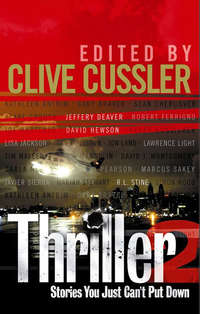
Kitabı oxu: «Thriller 2: Stories You Just Can't Put Down»
Thriller 2 Stories You Just Can’t Put Down
Edited By
Clive Cussler

www.mirabooks.co.uk
For Gayle Lynds and David Morrell
Co-founders
International Thriller Writers, Inc.
Introduction
What is a thriller?
It’s an interesting question when you consider so many of today’s bestsellers fall into that category. Look at the top sellers any given month and you might find novels of suspense, adventure tales, paranormal investigations, or even police procedurals—works by writers who couldn’t be more different from each other, and yet their books share a common goal, if not a specific language.
All these books push their readers just a little closer to the edge of their seats. They cost their readers sleep, get carried to the grocery store to be read while standing in line and are held tightly until the last page.
And even though the reader can’t wait to see how it’s going to end, a book like this gets closed reluctantly, with a feeling of anticipation and longing for the next book that can quicken the pulse and fire the imagination.
As a reader, that’s a feeling I know well. I grew up in the heyday of the pulps, devouring stories about globe-spanning adventures, one man facing impossible odds, racing against time to save the world. These were magazines and books that kept you up all night, sometimes reading under your covers with a flashlight.
Adventures that were, simply, thrilling.
That’s really what I set out to do when I decided to try my hand at writing fiction over thirty years ago. I wanted to write a thrilling story with a modern setting and contemporary characters in the tradition of the great adventure stories that kept me turning the pages when I was a kid. I never imagined that one day my books would be translated into more than forty languages and read by millions of people around the world.
And now, an entire generation later, it seems that tradition lives on, because many of the most successful and finest authors today are writing thrillers. And this book you’re holding now brings many of those writers together in a single volume.
This book is called Thriller 2 because, as you probably suspect or already know, there was another anthology entitled Thriller that was edited by my friend James Patterson. The two books share a common source of inspiration, so let me take a moment to explain how this collection came together.
The first Thriller was the brainchild of an organization called ITW, which is short for International Thriller Writers. Barely five years old, ITW’s roster reads like a Who’s Who of thriller writing with 900 members worldwide and over 2,000,000,000 books in print. Headed by current co-presidents Steve Berry and James Rollins, its board of directors has included such notables as Lee Child, Tess Gerritsen, M. J. Rose, Carla Neggers, Douglas Preston, Gayle Lynds, David Morrell and David Hewson. This organization, of which I am a proud member, is dedicated to supporting the readers and writers of thrillers everywhere.
This anthology and its predecessor are collections of short stories written exclusively by ITW members from around the world, not only bestselling authors but also gifted writers you might not have discovered until you read this book.
But the two anthologies also differ slightly. The first Thriller included stories featuring well-known or established characters from our writers’ novels and series, sometimes seen in a new light but very recognizable to their fans.
Thriller 2, by contrast, consists almost entirely of original stories featuring colorful characters you’ve never seen before. For the rabid fan, it’s a unique chance to discover another side of your favorite author. For someone new to the world of thrillers, this collection is a wonderful opportunity to discover someone who just might become your new favorite writer.
Which brings us back to our question, what is a thriller? Or more precisely, what makes a story thrilling?
This collection attempts to answer that timeless question, if not directly than by showcasing over twenty writers who delivered an extraordinary range of thrilling stories. Stories that shock you. Stories that cause your heart to skip a beat. Stories that might make you laugh and flinch at the same time. Stories that you finish and then read again in disbelief, looking for the clues you must have missed the first time around.
There are many ingredients that go into an unforgettable thriller. These stories use them all, but each mixes them together differently, every tale delivering a unique blend of thrills that sets it apart. As a reader I can truly say this is one of the most consistently entertaining and eclectic collections I’ve ever read.
And as a writer, I’m incredibly proud to have my name on this remarkable book that you’re about to read. I hope you find it as thrilling as I do. Clive Cussler 2009
Chapter One
Jeffery Deaver
The stakes are high and time is short in “The Weapon”—the perfect story to begin the collection. Originally written for the stage, “The Weapon” demonstrates why Jeff is considered a master of both the modern thriller and the short story. When it comes time to write a critical scene, Jeff turns down the lights, shuts his eyes and starts typing. The room is either heavily shaded or windowless. For some characters in “The Weapon,” such a dark room where devious scenarios are born would still be preferable to the bleak places they find themselves in. Shaped by today’s headlines, these characters are trapped in an intrigue as topical as it is thrilling.
Keep your eyes open for this one. Sit in a well-lit room, with a window. Maybe even go outside and read where people can see you, and you know it’s safe, because Jeff’s stories are anything but.
Chapter Two
The Weapon
Monday
“A new weapon.”
The slim man in a conservative suit eased forward and lowered his voice. “Something terrible. And our sources are certain it will be used this coming Saturday morning. They’re certain of that.”
“Four days,” said retired Colonel James J. Peterson, his voice grave. It was now 5:00 p.m. on Monday.
The two men sat in Peterson’s nondescript office, in a nondescript building in the suburban town of Reston, Virginia, about twenty-five miles from Washington, D.C. There’s a misconception that national security operations are conducted in high-tech bunkers filled with sweeping steel and structural concrete, video screens ten feet high and attractive boys and babes dressed by Armani.
This place, on the other hand, looked like an insurance agency.
The skinny man, who worked for the government, added, “We don’t know if we’re talking conventional, nuke or something altogether new. Probably mass destruction, we’ve heard. It can do quote ‘significant’ damage.’”
“Who’s behind this weapon? Al-Qaeda? The Koreans? Iranians?”
“One of our enemies. That’s all we know at this point…So, we need you to find out about it. Money is no object, of course.”
“Any leads?”
“Yes, a good one—an Algerian who knows who formulated the weapon. He met with them last week in Tunis. He’s a professor and journalist.”
“Terrorist?”
“He doesn’t seem to be. His writings have been moderate in nature. He’s not openly militant. But our local sources are convinced he’s had contact with the people who created the weapon and plan to use it.”
“You have a picture?”
A photograph appeared as if by magic from the slim man’s briefcase and slid across the desk like a lizard.
Colonel Peterson leaned forward.
Tuesday
Chabbi music drifted from a nearby café, lost intermittently in the sounds of trucks and scooters charging frantically along this commercial street of Algiers.
The driver of the white van, a swarthy local, stifled a sour face when the music changed to American rock. Not that he actually preferred the old-fashioned, melodramatic chabbi tunes or thought they were more politically or religiously correct than Western music. He just didn’t like Britney Spears.
Then the big man stiffened and tapped the shoulder of the man next to him, an American. Their attention swung immediately out the front window to a curly-haired man in his thirties, wearing a light-colored suit, walking out of the main entrance of the Al-Jazier School for Cultural Thought.
The man in the passenger seat nodded. The driver called “Ready” in English and then repeated the command in Berber-accented Arabic. The two men in the back responded affirmatively.
The van, a battered Ford that sported Arabic letters boasting of the city’s best plumbing services, eased forward, trailing the man in the light suit. The driver had no trouble moving slowly without being conspicuous. Such was the nature of traffic here in the old portion of this city, near the harbor.
As they approached a chaotic intersection, the passenger spoke into a cell phone. “Now.”
The driver pulled nearly even with the man they followed, just as a second van, dark blue, in the oncoming lane, suddenly leapt the curb and slammed directly into the glass window of an empty storefront, sending a shower of glass onto the sidewalk as bystanders gaped and came running.
By the time the crowds on rue Ahmed Bourzina helped the driver of the blue van extricate his vehicle from the shattered storefront, the white van was nowhere to be seen.
Neither was the man in the light suit.
Wednesday
Colonel James Peterson was tired after the overnight flight from Dulles to Rome but he was operating on pure energy.
As his driver sped from DaVinci airport to his company’s facility south of the city, he read the extensive dossier on the man whose abduction he had just engineered. Jacques Bennabi, the journalist and part-time professor, had indeed been in direct communication with the Tunisian group that had developed the weapon, though Washington still wasn’t sure who the group was exactly.
Peterson looked impatiently at his watch. He regretted the day-long trip required to transport Bennabi from Algiers to Gaeta, south of Rome, where he’d been transferred to an ambulance for the drive here. But planes were too closely regulated nowadays. Peterson had told his people they had to keep a low profile. His operation here, south of Rome, was apparently a facility that specialized in rehabilitation services for people injured in industrial accidents. The Italian government had no clue that it was a sham, owned ultimately by Peterson’s main company in Virginia: Intelligence Analysis Systems.
IAS was like hundreds of small businesses throughout the Washington area that provided everything from copier toner to consulting to computer software to the massive U.S. government.
IAS, though, didn’t sell office supplies.
Its only product was information and it managed to provide some of the best in the world. IAS obtained this information not through high-tech surveillance but, Peterson liked to say, the old-fashioned way:
One suspect, one interrogator, one locked room.
It did this very efficiently.
And completely illegally.
IAS ran black sites.
Black site operations are very simple. An individual with knowledge the government wishes to learn is kidnapped and taken to a secret and secure facility outside the jurisdiction of the U.S. The kidnapping is known as extraordinary rendition. Once at a black site the subject is interrogated until the desired information is learned. And then he’s returned home—in most cases, that is.
IAS was a private company, with no official government affiliation, though the government was, of course, its biggest client. They operated three sites—one in Bogotá, Colombia, one in Thailand and the one that Peterson’s car was now approaching: the largest of the IAS sites, a nondescript beige facility whose front door stated Funzione Medica di Riabilitazione.
The gate closed behind him and he hurried inside, to minimize the chance a passerby might see him. Peterson rarely came to the black sites himself. Because he met regularly with government officials it would be disastrous if anyone connected him to an illegal operation like this. Still, the impending threat of the weapon dictated that he personally supervise the interrogation of Jacques Bennabi.
Despite his fatigue, he got right to work and met with the man waiting in the facility’s windowless main office upstairs. He was one of several interrogators that IAS used regularly, one of the best in the world, in fact. A slightly built man, with a confident smile on his face.
“Andrew.” Peterson nodded in greeting, using the pseudonym the man was known by—no real names were ever used in black sites. Andrew was a U.S. soldier on temporary leave from Afghanistan.
Peterson explained that Bennabi had been carefully searched and scanned. They’d found no GPS chips, listening devices or explosives in his body. The colonel added that sources in North Africa were still trying to find whom Bennabi had met with in Tunis but were having no luck.
“Doesn’t matter,” Andrew said with a sour smile. “I’ll get you everything you need to know soon enough.”
Jacques Bennabi looked up at Andrew.
The soldier returned the gaze with no emotion, assessing the subject, noting his level of fear. A fair amount, it seemed. This pleased him. Not because Andrew was a sadist—he wasn’t—but because fear is a gauge to a subject’s resistance.
He assessed that Bennabi would tell him all he wanted to know about the weapon within four hours.
The room in which they sat was a dim, concrete cube, twenty feet on each side. Bennabi sat in a metal chair with his hands behind him, bound with restraints. His feet were bare, increasing his sense of vulnerability, and his jacket and personal effects were gone—they gave subjects a sense of comfort and orientation. Andrew now pulled a chair close to the subject and sat.
Andrew was not a physically imposing man, but he didn’t need to be. The smallest person in the world need not even raise his voice if he has power. And Andrew had all the power in the world over his subject at the moment.
“Now,” he said in English, which he knew Bennabi spoke fluently, “as you know, Jacques, you’re many miles from your home. None of your family or colleagues know you’re here. The authorities in Algeria have learned of your disappearance by now—we’re monitoring that—but do you know how much they care?”
No answer. The dark eyes gazed back, emotionless.
“They don’t. They don’t care at all. We’ve been following the reports. Another university professor gone missing. So what? You were robbed and shot. Or the Jihad Brothership finally got around to settling the score for something you said in class last year. Or maybe one of your articles upset some Danishjournalists…and they kidnapped and killed you.” Andrew smiled at his own cleverness. Bennabi gave no reaction. “So. No one is coming to help you. You understand? No midnight raids. No cowboys riding to the rescue.”
Silence.
Andrew continued, unfazed, “Now, I want to know about this weapon you were discussing with your Tunisian friends.” He was looking carefully at the eyes of the man. Did they flicker with recognition? The interrogator believed they did. It was like a shout of acknowledgment. Good.
“We need to know who developed it, what it is and who it’s going to be used against. If you tell me, you’ll be back home in twenty-four hours.” He let this sink in. “If you do n’t…things won’t go well.”
The subject continued to sit passively. And silent.
That was fine with Andrew; he hardly expected an immediate confession. He wouldn’t want one, in fact. You couldn’t trust subjects who caved in too quickly.
Finally he said, “Jacques, I know the names of all your colleagues at the university and the newspaper where you work.”
This was Andrew’s talent—he had studied the art of interrogation for years and knew that people could much more easily resist threats to themselves than to their friends and family. Andrew had spent the past two days learning every fact he could about people close to Bennabi. He’d come up with lists of each person’s weaknesses and fears. It had been a huge amount of work.
Over the next few hours Andrew never once threatened Bennabi himself; but he was ruthless in threatening his colleagues. Ruining careers, exposing possible affairs, questioning an adoption of a child…Even suggesting that some of his friends could be subject to physical harm.
A dozen specific threats, two dozen, offering specific details: names, addresses, offices, cars they drove, restaurants they enjoyed.
But Jacques Bennabi said not a word.
“You know how easy it was to kidnap you,” Andrew muttered. “We plucked you off the street like picking a chicken from a street vendor’s cage. You think your friends are any safer? The men who got you are back in Algiers, you know. They’re ready to do what I say.”
The subject only stared back at him.
Andrew grew angry for a moment. He cleared his raw throat and left the room, had a drink of water, struggled to calm down.
For three more hours he continued the interrogation. Bennabi paid attention to everything Andrew said, it seemed, but he said nothing.
Goddamn, he’s good, Andrew thought, struggling not to reveal his own frustration. He glanced at his watch. It had been nearly nine hours. And he hadn’t uncovered a single fact about the weapon.
Well, it was time to get serious now.
He scooted the chair even closer.
“Jacques, you’re not being helpful. And now, thanks to your lack of cooperation, you’ve put all your friends at risk. How selfish can you be?” he snapped.
Silence.
Andrew leaned close. “You understand that I’ve been restrained, don’t you? I had hoped you’d be more cooperative. But apparently you’re not taking me seriously. I think I have to prove how grave this matter is.”
He reached into his pocket. He pulled out a printout of a computer photograph that had been taken yesterday.
It showed Bennabi’s wife and children in the front yard of their home outside of Algiers.
Thursday
Colonel Peterson was in his hotel room in the center of Rome. He was awakened at 4:00 a.m. by his secure cell phone.
“Yes?”
“Colonel.” The caller was Andrew. His voice was ragged.
“So, what’d he tell you?”
“Nothing.”
The colonel muttered, “You just tell me what he said and I’ll figure out if it’s important. That’s my job.” He clicked the light on and fished for a pen.
“No, sir, I mean, didn’t say a single word.”
“Not a…word?”
“Over sixteen hours. Completely silent. The entire time. Not one goddamn word. Never happened in all my years in this business.”
“Was he getting close to breaking, at least?”
“I…No, I don’t think so. I even threatened his family. His children. No reaction. I’d need another week. And I’ll have to make good on some of the threats.”
But Peterson knew they were already on shaky ground by kidnapping somebody who was not a known terrorist. He wouldn’t dare kidnap or endanger the professor’s colleagues, let alone his family.
“No,” the colonel said slowly. “That’s all for now. You can get back to your unit. We’ll go to phase two.”
The woman was dressed conservatively, a long-sleeved blouse and tan slacks. Her dark blond hair was pulled back and she wore no jewelry.
Since Bennabi wasn’t culturally or religiously conservative, worked with women at the university and had actually written in favor of women’s rights, Peterson decided to use Claire for the second interrogator. Bennabi would view her as an enemy, yes, but not as an inferior. And, since it was known that Bennabi had dated and was married, with several children, he was a clearly a man with an appreciation of attractive women.
And Peterson knew that Claire was certainly that.
She was also an army captain, in charge of a prisoner-of-war operation in the Middle East, though at the moment she, too, was on a brief leave of absence to permit her to practice her own skills as an interrogator—skills very different from Andrew’s but just as effective in the right circumstances.
Peterson now finished briefing her. “Good luck,” he added.
And couldn’t help reminding her that it was now Thursday and the weapon would be deployed the day after tomorrow.
In perfect Arabic, Claire said, “I must apologize, Mr. Bennabi, Jacques…May I use your first name?” She was rushing into the cell, a horrified look on her face.
When Bennabi didn’t reply, she switched to English. “Your first name? You don’t mind, do you? I’m Claire. And let me offer you my deepest apologies for this terrible mistake.”
She walked behind him and took the hand restraints off. There was little risk. She was an expert at aikido and tae kwan do martial arts and could easily have defended herself against the weak, exhausted subject.
But the slim man, eyes dark from lack of sleep, face drawn, simply rubbed his wrists and offered no threatening gestures.
Claire pressed the button on the intercom. “Bring the tray in, please.”
A guard wheeled it inside: water, a pot of coffee and a plate of pastries and candy, which she knew from his file Bennabi was partial to. She sampled everything first, to show nothing was spiked with poison or truth serum. He drank some water but when she asked, “Coffee, something to eat?” he gave no response.
Claire sat down, her face distraught. “I’m am so terribly sorry about this. I can’t begin to describe how horrified we are…Let me explain. Someone—we don’t know who—told us that you’d met with some people who are enemies of our country.” She lifted her hands. “We didn’t know who you were. All we heard was that you were sympathetic to these enemies and that they had some plans to cause huge destruction. Something terrible was going to happen. Imagine what we felt when we heard you were a famous professor…and an advocate of human rights!
“No, someone gave us misinformation about you. Maybe accidental.” She added coyly, “Maybe they had a grudge against you. We don’t know. All I can say is we reacted too quickly. Now, first, let me assure you that whatever threats Andrew made, nothing has or will happen to your colleagues or family…That was barbaric what he suggested. He’s been disciplined and relieved of duty.”
No response whatsoever.
Silence filled the room and she could hear only her heartbeat, as she tried to remain calm, thinking of the weapon and the hours counting down until it was used.
“Obviously this is a very awkward situation. Certain officials are extremely embarrassed about what’s happened and are willing to offer, what we could call, reparation for your inconvenience.”
He continued to remain silent but she could tell he was listening to every word.
She scooted the chair closer and sat, leaning forward. “Mr. Bennabi…Jacques, I have been authorized to transfer one hundred thousand euros into an account of your choice—that’s tax free money—in exchange for your agreement not to sue us for this terrible error.”
Claire knew that he made the equivalent of fifteen thousand euros as a professor and another twenty as a journalist.
“I can order all of this done immediately. Your lawyer can monitor the transaction. All you have to do is sign a release agreeing not to sue.”
Silence.
Then she continued with a smile, “And one more small thing…I myself have no doubt that you have been wrongly targeted but…the people who have to authorize the payments, they want just a little more information about the people you met with. The ones in Tunis. They just wish to be reassured that the meeting was innocent. I know it was. If I had my way I’d write you a check now. But they control the money.” A smile. “Isn’t that the way the world works?”
Bennabi said nothing. He stopped rubbing his wrists and sat back.
“They don’t need to know anything sensitive. Just a few names, that’s all. Just to keep the money men happy.”
Is he agreeing? she wondered. Is he disagreeing? Bennabi was different from anybody she’d ever interrogated. Usually by now subjects were already planning how to spend the money and telling her whatever she wanted to know.
When he said nothing she realized: he’s negotiating. Of course.
A nod. “You’re a smart man…And I don’t blame you one bit for holding out. Just give us a bit of information to verify your story and I can probably go up to a hundred fifty thousand euros.”
Still no response.
“I’ll tell you what. Why don’t you name a figure. Let’s put this all behind us.” Claire smiled coyly again. “We’re on your side, Jacques. We really are.”
Friday
At 9:00 a.m. Colonel Jim Peterson was in the office of the rehabilitation center, sitting across from a large, dark-complexioned man, who’d just arrived from Darfur.
Akhem asked, “What happened with Claire?”
Peterson shook his head. “Bennabi didn’t go for the money. She sweetened the pot to a quarter million euros.” The colonel sighed. “Wouldn’t take it. In fact, he didn’t even say no. He didn’t say a word. Just like with Andrew.”
Akhem took this information with interest but otherwise unemotionally—as if he were a surgeon called in to handle an emergency operation that was routine for him but that no one else could perform. “Has he slept?”
“Not since yesterday.”
“Good.”
There was nothing like sleep deprivation to soften people up.
Akhem was of Middle Eastern descent, though he’d been born in America and was a U.S. citizen. Like Peterson he’d retired from the military. He was now a professional security consultant—a euphemism for mercenary soldier. He was here with two associates, both from Africa. One white, one black.
Peterson had used Akhem on a half-dozen occasions, as had other governments. He was responsible for interrogating a Chechen separatist to learn where his colleagues had stashed a busload of Moscow schoolchildren last year.
It took him two hours to learn the exact location of the bus, the number of soldiers guarding them, their weapons and passcodes.
No one knew exactly how he’d done it. No one wanted to.
Peterson wasn’t pleased he’d had to turn to Akhem’s approach to interrogation, known as extreme extraction. Indeed, he realized that the Bennabi situation raised the textbook moral question on using torture: you know a terrible event is about to occur and you have in custody a prisoner who knows how to prevent it. Do you torture or not?
There were those who said, no, you don’t. That it is better to be morally superior and to suffer the consequences of letting the event occur. By stooping to the enemy’s techniques, these people say, we automatically lose the war, even if we militarily prevail.
Other said that it was our enemies who’d changed the rules; if they tortured and killed innocents in the name of their causes we had to fight them on their own terms.
Peterson had now made the second choice. He prayed it was the right one.
Akhem was looking at the video of Bennabi in the cell, slumped in a chair, his head cocked to the side. He wrinkled his nose and said, “Three hours at the most.”
He rose and left the office, gesturing his fellow mercenaries after him.
But three hours came and went.
Jacques Bennabi said nothing, despite being subjected to one of the most horrific methods of extreme extraction.
In waterboarding, the subject is inverted on his back and water poured into his nose and mouth, simulating drowning. It’s a horrifying experience…and also one of the most popular forms of torture because there’s no lasting physical evidence—provided, of course, that the victim doesn’t in fact drown, which happens occasionally.
“Tell me!” Akhem raged as the assistants dragged Bennabi to his feet, pulling his head out of the large tub. He choked and spit water from under the cloth mask he wore.
“ Where is the weapon. Who is behind it? Tell me.”
Silence, except for the man’s coughing and sputtering.
Then to the assistants: “Again.”
Back he went onto the board, his feet in the air. And the water began to flow once more.
Four hours passed, then six, then eight.
Drenched himself, physically exhausted, Akhem looked at his watch. It was now early evening. Only five hours until Saturday—when the weapon would be deployed.
And he hadn’t learned a single fact about it. He could hardly hide his astonishment. He’d never known anybody to hold out for this long. That was amazing in its own right. But more significant was the fact that Bennabi had not uttered a single word the entire time. He’d groaned, he’d gasped, he’d choked, but not a single word of English or Arabic or Berber had passed his lips.
Subjects always begged and cursed and lied or offered partial truths to get the interrogators at least to pause for a time.
But not Bennabi.
“Again,” Akhem announced.
Then, at 11:00 p.m., Akhem sat down in a chair in the cell, staring at Bennabi, who lolled, gasping, on the waterboard. The interrogator said to his assistants, “That’s enough.”
Akhem dried off and looked over the subject. He then walked into the hallway outside the cell and opened his attaché case. He extracted a large scalpel and returned, closing the door behind him.
Bennabi’s bleary eyes stared at the weapon as Akhem walked forward.
The subject leaned away.
Akhem nodded. His assistants took Bennabi by the shoulders, one of them gripping his arm hard, rendering it immobile.
Akhem took the subject’s fingers and leaned forward with the knife.
“Where is the weapon?” he growled. “You don’t have any idea of the pain you’ll experience if you don’t tell me! Where is it? Who is behind the attack? Tell me!”
Bennabi looked into his eyes. He said nothing.
The interrogator moved the blade closer.
It was then that the door burst open.
“Stop,” cried Colonel Peterson. “Come out here into the hallway.”
The interrogator paused and stood back. He wiped sweat from his forehead. The three interrogators left the cell and joined the colonel in the hallway.
“I just heard from Washington. They’ve found out who Bennabi was meeting with in Tunis. They’re sending me the information in a few minutes. I want you to hold off until we know more.”
Akhem hesitated. Reluctantly, he put the scalpel away. Then the large man stared at the video screen, on which was an image of Bennabi sitting in the chair, breathing heavily, staring back into the camera.
The interrogator shook his head. “Not a word. He didn’t say a single word.”
Saturday
At 2:00 a.m., on the day the weapon would be deployed, Colonel Jim Peterson was alone in the office on the Rehabilitation Center, awaiting the secure e-mail about the meeting in Tunis. Armed with that information, they would have a much better chance to convince Bennabi to give them information.
Come on, he urged, staring at his computer.
A moment later it complied.
The computer pinged and he opened the encrypted e-mail from the skinny government man he’d met with in his Reston, Virginia, office on Monday.
Colonel: We’ve identified the people Bennabi met with. But it’s not a terrorist cell; it’s a human rights group. Humanity Now. We double-checked and our local contacts are sure they’re the ones who’re behind the weapon. But we’ve followed the group for years and have no—repeat, no—indication that it’s a cover for a terrorist organization. Discontinue all interrogation until we know more.
Peterson frowned. He knew Humanity Now. Everybody believed it to be a legitimate organization.
My God, was this all a misunderstanding? Had Bennabi met with the group about a matter that was completely innocent?
What’ve we done?
He was about to call Washington and ask for more details when he happened to glance at his computer and saw that he’d received another e-mail—from a major U.S. newspaper. The header: Reporter requesting comment before publication.
He opened the message.
Colonel Peterson. I’m a reporter with the New York Daily Herald. I’m filing the attached article in a few hours with my newspaper. It will run there and in syndication in about two hundred other papers around the world. I’m giving you the opportunity to include a comment, if you like. I’ve also sent copies to the White House, the Central Intelligence Agency and the Pentagon, seeking their comments, too.
Oh, my God. What the hell is this?
With trembling hands the colonel opened the attachment and—to his utter horror—read:
ROME, May 22—A private American company, with ties to the U.S. government, has been running an illegal operation south of the city, for the purpose of kidnapping, interrogating and occasionally torturing citizens of other countries to extract information from them.
The facility, known in military circles as a black site, is owned by a Reston, Virginia, corporation, Intelligence Analysis Systems, whose corporate documents list government security consulting as its main purpose.
Italian business filings state that the purpose of the Roman facility is physical rehabilitation, but no requisite government permits for health care operations have been obtained with respect to it. Further, no licensed rehabilitation professionals are employed by the company, which is owned by a Caribbean subsidiary of IAS. Employees are U.S. and other non-Italian nationals with backgrounds not in medical science but in military and security services.
The operation was conducted without any knowledge on the part of the Italian government and the Italian ambassador to the United States has stated he will demand a full explanation as to why the illegal operation was conducted on Italian soil. Officials from the Polizia di Stato and the Mini-stero della Giustizia likewise have promised a full investigation.
There is no direct connection between the U.S. government and the facility outside of Rome. But over the course of the past week, this reporter conducted extensive surveillance of the rehabilitation facility and observed the presence of a man identified as former Colonel James Peterson, the president of IAS. He is regularly seen in the company of high-ranking Pentagon, CIA and White House officials in the Washington, D.C., area.
Peterson’s satellite phone began ringing.
He supposed the slim man from Washington was calling.
Or maybe his boss.
Or maybe the White House.
Caller ID does not work on encrypted phones.
His jaw quivering, Peterson ignored the phone. He pressed ahead in the article.
The discovery of the IAS facility in Rome came about on a tip last week from Humanity Now, a human rights group based in North Africa and long opposed to the use of torture and black sites. The group reported that an Algerian journalist was to be kidnapped in Algiers and transported to a black site somewhere in Europe.
At the same time the human rights organization gave this reporter the name of a number of individuals suspected of being black site interrogators. By examining public records and various travel documents, it was determined that several of these specialists—two U.S. military officers and a mercenary soldier based in Africa—traveled to Rome not long after the journalist’s abduction in Algiers.
Reporters were able to follow the interrogators to the rehabilitation facility, which was then determined to be owned by IAS.
Slumping in his chair, Peterson ignored the phone. He gave a grim laugh, closing his eyes.
The whole thing, the whole story about terrorists, about the weapon, about Bennabi…it was a setup. Yes, there was an “enemy,” but it was merely the human rights group, which had conspired with the professor to expose the black site operation to the press—and the world.
Peterson understood perfectly: Humanity Now had probably been tracking the main interrogators IAS used—Andrew, Claire, Akhem and others—for months, if not years. The group and Bennabi, a human rights activist, had planted the story about the weapon themselves to engineer his kidnapping, then alerted that reporter for the New York newspaper, who leapt after the story of a lifetime.
Bennabi was merely bait…and I went right for it. Of course, he remained silent the whole time. That was his job. To draw as many interrogators here as he could and give the reporter a chance to follow them, discover the facility and find out who was behind it.
Oh, this was bad…this was terrible. It was the kind of scandal that could bring down governments.
It would certainly end his career. And many others’.
It might very likely end the process of black sites altogether, or at least set them back years.
He thought about calling together the staff and telling them to destroy all the incriminating papers and to flee.
But why bother? he reflected. It was too late now.
Peterson decided there was nothing to do but accept his fate. Though he did call the guards and tell them to arrange to have Jacques Bennabi transferred back home. The enemy had won. And, in an odd way, Peterson respected that.
“And make sure he arrives unharmed.”
“Yessir.”
Peterson sat back, hearing in his thoughts the words of the slim man from Washington.
The weapon…It can do quote “significant” damage…
Except that there was no weapon. It was all a fake.
Yet, with another sour laugh, Peterson decided this wasn’t exactly true.
There was indeed a weapon. It wasn’t nuclear or chemical or explosive but in the end was far more effective than any of those and would indeed do significant damage.
Reflecting on his prisoner’s refusal to speak during his captivity, reflecting, too, on the devastating paragraphs of the reporter’s article, the colonel concluded: the weapon was silence.
The weapon was words.
Chapter Three
Blake Crouch
Blake started writing stories in elementary school to scare his little brother at bedtime. He has since perfected the craft of creating intense and insulated worlds in which unspeakable evil can exist. A photograph Blake took of a deserted road on the high desert plain in Wyoming was the inspiration for his first book, Desert Places. The horrifying villain in that novel is shaped from the terrors Blake thought might be waiting for him in that unforgiving landscape.
Blake’s story for this collection, “Remaking,” is influenced by landscape in much the same way. Tragic events unfold in a snowy, sleepy Colorado town. From the first scene, in which a man sits alone in the cold, watching a father and son in a diner, you know something is about to go horribly wrong. With a sickening sense of isolation magnified by the blanketing snow, you’ll find your fingers getting numb from gripping the pages as you turn them inexorably toward the final scene.
Chapter Four
Remaking
Mitchell stared at the page in the notebook, covered in his messy scrawl, but he wasn’t reading. He’d seen them walk into the coffeehouse fifteen minutes prior, the man short, pudgy and smooth-shaven, the boy perhaps five or six and wearing a long-sleeved OshKosh B’Gosh—red with blue stripes.
Now they sat two tables away.
The boy said, “I’m hungry.”
“We’ll get something in a little while.”
“How long is a little while?”
“Until I say.”
“When are you gonna—”
“Joel, do you mind?”
The little boy’s head dropped and the man stopped typing and looked up from his laptop.
“I’m sorry. Tell you what. Give me five minutes so I can finish this e-mail, and we’ll go eat breakfast.”
Mitchell sipped his espresso, snow falling beyond the storefront windows into this mountain hamlet of eight hundred souls, Miles Davis squealing through the speakers—one of the low-key numbers off Kind of Blue.
Mitchell trailed them down the frosted sidewalk.
One block up, they crossed the street and disappeared into a diner. Having already eaten in that very establishment two hours ago, he installed himself on a bench where he could see the boy and the man sitting at a table by the front window.
Mitchell fished the cell out of his jacket and opened the phone, scrolling through ancient numbers as the snow collected in his hair.
He pressed TALK.
Two rings, then, “Mitch? Oh, my God, where are you?”
He made no answer.
“Look, I’m at the office, getting ready for a big meeting. I can’t do this right now, but will you answer if I call you back? Please?”
Mitchell closed the phone and shut his eyes.
They emerged from the diner an hour later.
Mitchell brushed the inch of snow off his pants and stood, shivering. He crossed the street and followed the boy and the man up the sidewalk, passing a candy shop, a grocery, a depressing bar masquerading as an Old West saloon.
They left the sidewalk after another block and walked up the driveway to the Antlers Motel, disappeared into 113, the middle in a single-story row of nine rooms. The tarp stretched over the small swimming pool sagged with snow. In an alcove between the rooms and the office, vending machines hummed against the hush of the storm.
Ten minutes of brisk walking returned Mitchell to his motel, the Box Canyon Lodge. He checked out, climbed into his burgundy Jetta, cranked the engine.
“Just for tonight?” she asked.
“Yes.”
“That’ll be $69.78 with tax.”
Mitchell handed the woman behind the front desk his credit card.
Behind her, a row of Hummels stood in perfect formation atop a black-and-white television airing The Price is Right.
Mitchell signed the receipt. “Could I have 112 or 114?”
The old woman stubbed out her cigarette in a glass ashtray and reached for the key cabinet.
Mitchell pressed his ear to the wood paneling. A television blared through the thin wall. His cell phone vibrated—Lisa calling again. Flipped it open.
“Mitch? You don’t have to say anything. Please just listen—” He powered off the phone and continued writing in the notebook.
Afternoon unspooled as the snow piled up in the parking lot of the Antlers Motel. Mitchell parted the blinds and stared through the window as the first intimation of dusk began to blue the sky, the noise of the television next door droning through the walls.
He lay down on top of the covers and stared at the ceiling and whispered the Lord’s Prayer.
In the evening, he startled out of sleep to the sound of a door slamming, sat up too fast, the blood rushing to his head in a swarm of black spots. He hadn’t intended to sleep.
Mitchell slid off the bed and walked to the window, split the blinds, heard the diminishing sound of footsteps—a single set—squeaking in the snow.
He saw the boy pass through the illumination of a streetlamp and disappear into the alcove that housed the vending machines.
The snowflakes stung Mitchell’s cheeks as he crossed the parking lot, his sneakers swallowed up in six inches of fresh powder.
The hum of the vending machines intensified, and he picked out the sound of coins dropping through a slot.
He glanced once over his shoulder at the row of rooms, the doors all closed, windows dark save for slivers of electric blue from television screens sliding through the blinds.
Too dark to tell if the man was watching.
Mitchell stepped into the alcove as the boy pressed his selection on the drink machine.
The can banged into the open compartment, and the boy reached down and claimed the Sprite.
“Hi, Joel.”
The boy looked up at him, then lowered his head like a scolded dog, as though he’d been caught vandalizing the drink machine.
“No, it’s all right. You haven’t done anything wrong.”
Mitchell squatted down on the concrete.
“Look at me, son. Who’s that man you’re with?”
The voice so soft and high: “Daddy.”
A voice boomed across the parking lot. “Joel? It don’t take this long to buy a can of pop! Make a decision and get back here.”
The door slammed.
“Joel, do you want to come with me?”
“You’re a stranger.”
“No, my name’s Mitch. I’m a police officer actually. Why don’t you come with me.”
“No.”
“I think you probably should.” Mitchell figured he had maybe thirty seconds before the father stormed out.
“Where’s your badge?”
“I’m undercover right now. Come on, we don’t have much time. You need to come with me.”
“I’ll get in trouble.”
“No, only way you’ll get in trouble is by not obeying a police officer when he tells you to do something.” Mitchell noticed the boy’s hands trembling. His were, too. “Come on, son.”
He put his hand on the boy’s small shoulder and guided him out of the alcove toward his car, where he opened the front passenger door and motioned for Joel to get in.
Mitchell brushed the snow off the windows and the windshield, and as he climbed in and started the engine, he saw the door to 113 swing open in the rearview mirror.
“You eaten yet?”
“No.”
Main Street empty and the newly scraped pavement already frosting again, the reflection of the high beams blinding against the wall of pouring snow.
“Are you hungry?”
“I don’t know.”
He turned right off Main, drove slow down a snow-packed side street that sloped past little Victorians, inns and motels, Joel buckled into the passenger seat, the can of Sprite still unopened between his legs, tears rolling down his cheeks.
Mitchell unlocked the door and opened it.
“Go on in, Joel.”
The boy entered and Mitchell hit the light, closing and locking the door after them, wondering if Joel could reach the brass chain near the top.
It wasn’t much of a room—single bed, table, cabinet housing a refrigerator on one side, hangers on the other. He’d lived out of it for the last month and it smelled like stale pizza crust and cardboard and clothes soured with sweat.
Mitchell closed the blinds.
“You wanna watch TV?”
The boy shrugged.
Mitchell picked the remote control off the bedside table and turned it on.
“Come sit on the bed, Joel.”
As the boy climbed onto the bed, Mitchell started flipping. “You tell me to stop when you see something you wanna watch.”
Mitchell surfed through all thirty stations twice and the boy said nothing. He settled on the Discovery Channel, set the remote control down.
“I want my dad,” the boy said, trying not to cry.
“Calm down, Joel.”
Mitchell sat on the bed and unlaced his sneakers. His socks were damp and cold. He balled them up and tossed them into the open bathroom, staring now at his pale feet, toes shriveled with moisture.
Joel had settled back into one of the pillows, momentarily entranced by the television program where a man caked in mud wrestled with a crocodile.
Mitchell turned up the volume.
“You like crocodiles?” he asked.
“Yeah.”
“You aren’t scared of them?”
The boy shook his head. “I got a snake.”
“Nuh-uh.”
The boy looked up. “Uh-huh.”
“What kind?”
“It’s black and scaly and it lives in a glass box.”
“A terrarium?”
“Yeah. Daddy catches mice for it.”
“It eats them?”
“Uh-huh. Slinky’s belly gets real big.”
Mitchell smiled. “I bet that’s something to see.”
They sat watching the Discovery Channel for twenty minutes, Joel engrossed now, Mitchell with his head tilted back against the headboard, eyes closed, a half grin where none had been for twelve months.
At 8:24 p.m., the cell vibrated against Mitchell’s hip. He opened the case and pulled out the phone.
“Hi, Lisa.”
“Mitch.”
“Listen, I want you to call me back in five minutes and do exactly what I say.”
“Okay.”
Mitchell closed the phone and slid off the bed.
The boy looked up, still half watching the program on the world’s deadliest spiders.
He said, “I’m hungry.”
“I know, sport. I know. Give me just a minute here and I’ll order a pizza.”
Mitchell crossed the carpet, tracking through dirty clothes he should’ve taken to the laundry a week ago.
His suitcase lay open in the space between the dresser and the baseboard heater. He knelt down, searching through wrinkled oxfords and blue jeans, khakis that had long since lost their creases.
It was a tiny, wool sweater—ice-blue with a magnified snow-flake stitched across the front.
“Hey, Joel,” he said, “it’s getting cold in here. I want you to put this on.” He tossed the sweater onto the bed.
“I’m not cold.”
“You do like I tell you now.”
As the boy reached for the sweater, Mitchell undid the buttons on his plaid shirt and worked his arms out of the sleeves. He dropped the shirt on the carpet and rifled his suitcase again until he found the badly faded T-shirt he’d bought fifteen years ago at a U2 concert.
On the way back to the bed, he stopped at the television and lifted the videotape from the top of the VCR, pushed it in.
“No, I wanna watch the—”
“We’ll turn it back on in a minute.”
He climbed under the covers beside the boy and stared at the bedside table, waiting for the phone to buzz.
“Joel, I’m gonna answer the phone. I want you to sit here beside me and watch the television and don’t say a word until I tell you.”
“I’m hungry.”
The phone vibrated itself toward the edge of the bedside table.
“I’ll buy you anything you want if you do this right for me.”
Mitchell picked up the phone.
Lisa calling.
He closed his eyes, gave himself a moment to engage. He’d written it all down months ago, the script in the bedside table drawer under the Gideon Bible he’d taken to reading every night before bed, but he didn’t need it.
“Hi, honey.”
“Mitch, I’m so glad you—”
“Stop. Don’t say anything. Just hang on a minute.” He reached for the remote control and pressed Play. The screen lit up, halfway through the episode of Seinfeld. He lowered the volume, said, “Lisa, I want you to say, ‘I’m almost asleep.’”
“What are you—”
“Just do it.”
A pause, then: “I’m almost asleep.”
“Say it like you really are.”
Mitchell closed his eyes.
“I’m almost asleep.”
“We’re sitting here, watching Seinfeld.” He looked down at the top of Joel’s head, his hair brown with gold highlights, just the right shade and length. He kissed the boy’s head. “Our little guy’s just about asleep.”
“Mitch, are you drunk—”
“Lisa, I will close this fucking phone. Ask how our day was. Do it.”
“How was your day?”
“You weren’t crying that night.” He could hear her trying to gather herself.
“How was your day, Mitch?”
He closed his eyes again. “One of those perfect ones. We’re in Ouray, Colorado, now. This little town surrounded by huge mountains. It started snowing around midday as we were driving down from Montrose. If they don’t plow the roads we may not be able to get out tomorrow.”
“Mitch—”
“We had a snowball fight after dinner, and our motel has these Japanese soaking tubs out back, full of hot mineral water from the springs under the town. Say you wish you were here.”
“That’s not what I said that night, Mitch.”
“What did you say?”
“I wish I could be there with you, but part of me’s so glad you two have this time together.”
“There aren’t many days like this, are there?”
“No.”
“Now, I just want to hear you breathing over the phone.”
He listened. He looked at the television, then the boy’s head, then the ice-blue sweater.
Mitchell held the phone to Joel’s mouth.
“Say good night to Mom, Alex.”
“Good night.”
Mitchell brought the phone to his ear. “Thank you, Lisa.”
“Mitch, who was that? What have you—”
He powered off the phone and set it on the bedside table.
When the boy was finally asleep, Mitchell turned off the television. He pulled the covers over the both of them and scooted forward until he could feel the hard ridge of the boy’s little spine press against his chest.
In the back window, through a crack in the closed blinds, he watched the snow falling through the orange illumination of a streetlamp, and his lips moved in prayer.
The knock finally came a few minutes after 3:00 a.m., and nothing timid about it—the forceful pounding of a fist against the door.
“Mitchell Griggs?”
Mitchell sat up in bed, eyes struggling to adjust in the darkness.
“Mr. Griggs?”
More pounding as his feet touched the carpet.
“Griggs!”
Mitchell made his way across dirty clothes and pizza boxes to the door, which he spoke through.
“Who is it?”
“Dennis James, Ouray County sheriff. Need to speak with you right now.”
“Little late, isn’t it?” He tried to make his voice sound light and unperturbed. “Maybe I could come by your office in the—”
“What part of right now went past you?”
Mitchell glanced up, saw the chain still locked. “What’s this about?” he asked.
“I think you know.”
“I’m sorry I don’t.”
“Six-year-old boy named Joel McIntosh went missing from the Antlers Motel this evening. Clerk saw him getting into a burgundy Jetta just like the one you drive.”
“Well, I’m sorry. He’s not here.”
“Then why don’t you open the door, let me confirm that so you can get back to sleep and we can quit wasting precious minutes trying to find this little boy.”
Mitchell glanced through the peephole, glimpsed the sheriff standing within a foot of the door under one of the globe lights that lit the second-floor walkway, his black parka dusted with snow, his wide-brimmed cowboy hat capped with a half inch of powder.
Mitchell couldn’t nail down the sheriff’s age in the poor light—late sixties perhaps, seventy at most. He held the fore end stock of a pump-action shotgun in his right hand.
“I’ve got two deputies out back on the hill behind your room if you’re thinking of—”
“I’m not.”
“Just tell me if you have the boy—”
A radio squeaked outside.
The sheriff spoke in low tones, then Mitchell heard the dissipation of footsteps.
A minute limped by before the sheriff’s voice passed faintly through the door again.
“You still there, Mitch?”
“Yeah.”
“If it’s all right with you, I’m gonna sit down. I been walking all over town since seven o’clock.”
The sheriff lowered out of sight, and through the peephole, Mitchell could only see torrents of snow dumping on the trees and houses and parked cars.
He eased down on the carpet and leaned against the door.
“I was just speaking with your wife. Lisa’s concerned for you, Mitch. Knows why you’re here.”
“She doesn’t know any—”
“And so do I. You may not know this, but I helped pull you and your son out of the car. Never forget it. Been what, about a year?”
“To the day.”
Drafts of frigid air swept under the door, Mitchell shivering, wishing he’d brought a blanket with him from the bed.
“Mitch, Lisa’s been trying to call you. You have your cell with you?”
“It’s turned off, on the bedside table.”
“Would you talk to her for me?”
“I don’t need to talk to her.”
“I think it might not be a bad—”
“I had a meeting the next morning in Durango. Had brought him along, ‘cause he’d never seen the Rockies. That storm came in overnight, and you know, I just…I almost waited. Almost decided to stay the day in Ouray, give the plows a chance to scrape the pass.”
“I got a boy of my own. He’s grown now, but I remember when he was your Alex’s age, can’t say I’d have survived if something like what happened to your son happened to him. You got a gun in there, Mitch?”
In the back of Mitchell’s throat welled a sharp, acidic tang, like tasting the connectors of a nine-volt battery, but all he said was, “Yeah.”
“Is the boy all right?”
Mitchell said nothing.
“Look, I know you’re hurting, but Joel McIntosh ain’t done a thing to deserve getting dragged into this. Boy’s probably terrified. You thought about that, or can you not see past your own—”
“Of course I’ve thought about it.”
“Then why don’t you send him on out, and you and me can keep talking.”
“I can’t do that.”
“Why not?”
“I just…I can’t.”
Mitchell heard footsteps outside the door. He got up quickly, glanced through the peephole just in time to see the battering ram swing back.
He stumbled toward the bed as the door exploded off its hinges and slammed to the floor, two men standing in the threshold—the sheriff with the shotgun trained on him, a deputy with a flashlight and a handgun.
Mitchell shielded his eyes—specks of snow blowing in, luminescent where they passed through the LED beam—couldn’t see the man behind the light, but the sheriff’s eyes were hard and kind. He could tell this even though they lived in the shadow of a Stetson.
The sheriff said, “I don’t see the boy, Wade. Mitchell, let me see those hands.”
Mitchell took a deep, trembling breath.
“Come on, Mitch, let me see your hands.”
Mitchell shook his head.
“Goddamn, son, I won’t tell you—”
Mitchell swung his right arm behind his back, his fingers wrapping around the remote control jammed down his boxer shorts, the room fired into blue by the illumination of the television, the laugh track to Seinfeld blaring, Wade screaming the sheriff’s name as a greater light bloomed beside the lesser.
Sheriff James flicked the light, felt the breath leave him as he blinked through the tears.
He leaned the shotgun against the wall and stepped inside the bathroom.
The cheap fiberglass of the tub had been lined with blankets and pillows, and the little boy was sitting up staring at the sheriff, orange earplugs protruding from his ears.
The sheriff knelt down, smiled at the boy, pulled out the earplugs.
“You okay, Joel?”
The boy said, “A noise woke me up.”
“Did he make you sleep in here?”
“Mitchell said if I was a good boy and kept my earplugs in and stayed in here all night, I could see my daddy in the morning.”
“He did, huh?”
“Where’s my daddy?”
“Down in the parking lot. We’ll take you to him, but I need to ask you something first.” The sheriff sat down on the cracked linoleum tile. “Did Mitchell hurt you?”
“No.”
“He didn’t touch you anywhere private or make you touch him?”
“No, we just sat on the bed and watched about spiders and stuff.”
“You mean, on the TV?”
“Yeah.”
“What’s that?” The sheriff pointed to the notebook sitting on a pillow under the faucet.
“Mitchell said to give this to the people who came to get me.”
Wade walked into the bathroom, stood behind the sheriff as he lifted the spiral-bound notebook and opened the red cover to a page of handwriting in black ink.
“What is it?” Wade asked.
“It’s to his wife.”
“What’s it say?”
The sheriff closed the notebook. “I believe that’s some of her business.” He stood, faced his deputy, snow melting off his Stetson. “Get this boy wrapped up in some blankets and bring him down to his dad. I gotta go call Lisa Griggs.”
“Will do.”
“And, Wade?”
“Yeah?”
“You throw a blanket over Mr. Griggs before you bring Joel out. Don’t want so much as a strand of hair visible. Shield the boy’s eyes if you have to, maybe even turn the lights out when you carry him through the room.”
The deputy shook his head. “What the hell was wrong with this man?”
“You got kids yet, Wade?”
“You know I don’t.”
“Well, just a heads-up—if you ever do, this is how much they make you love them.”
Pulsuz fraqment bitdi.