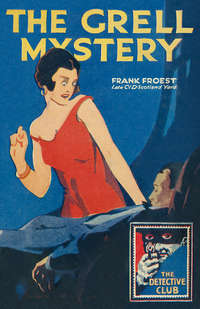
Kitabı oxu: «The Grell Mystery»

Published by COLLINS CRIME CLUB
An imprint of HarperCollinsPublishers Ltd
1 London Bridge Street
London SE1 9GF
www.harpercollins.co.uk
First published in Great Britain 1913
Published by The Detective Story Club Ltd
for Wm Collins Sons & Co. Ltd 1929
Introduction © Tony Medawar 2015
Cover design © HarperCollinsPublishers Ltd 1929, 2015
A catalogue copy of this book is available from the British Library.
This novel is entirely a work of fiction. The names, characters and incidents portrayed in it are the work of the author’s imagination. Any resemblance to actual persons, living or dead, events or localities is entirely coincidental.
All rights reserved under International and Pan-American Copyright Conventions. By payment of the required fees, you have been granted the non-exclusive, non-transferable right to access and read the text of this e-book on screen. No part of this text may be reproduced, transmitted, down-loaded, decompiled, reverse engineered, or stored in or introduced into any information storage and retrieval system, in any form or by any means, whether electronic or mechanical, now known or hereinafter invented, without the express written permission of HarperCollins.
Source ISBN: 9780008137175
Ebook Edition © August 2015 ISBN: 9780008137182
Version: 2015-08-17
Contents
Cover
Title Page
Copyright
Introduction
Chapter I
Chapter II
Chapter III
Chapter IV
Chapter V
Chapter VI
Chapter VII
Chapter VIII
Chapter IX
Chapter X
Chapter XI
Chapter XII
Chapter XIII
Chapter XIV
Chapter XV
Chapter XVI
Chapter XVII
Chapter XVIII
Chapter XIX
Chapter XX
Chapter XXI
Chapter XXII
Chapter XXIII
Chapter XXIV
Chapter XXV
Chapter XXVI
Chapter XXVII
Chapter XXVIII
Chapter XXIX
Chapter XXX
Chapter XXXI
Chapter XXXII
Chapter XXXIII
Chapter XXXIV
Chapter XXXV
Chapter XXXVI
Chapter XXXVII
Chapter XXXVIII
Chapter XXXIX
Chapter XL
Chapter XLI
Chapter XLII
Chapter XLIII
Chapter XLIV
Chapter XLV
Chapter XLVI
Chapter XLVII
Chapter XLVIII
Chapter XLIX
Chapter L
Chapter LI
Chapter LII
Chapter LIII
Chapter LIV
Chapter LV
Chapter LVI
The Detective Story Club
About the Publisher
INTRODUCTION
First published a hundred years ago, The Grell Mystery is best regarded as an early example of what has become known as the police procedural. However, it is also one of the earliest instances of a novel written by an individual who has already attained fame, in this case Frank Froëst, a former Superintendent at Scotland Yard and once the most famous policeman in the world.
Frank Castle Froëst was born in the West of England around 1858. He joined the Metropolitan Police in 1879 and was promoted to detective two years later. In 1903, Froëst attained the rank of Chief Inspector and in 1906 he was appointed Superintendent of the Yard’s premier division, the Criminal Investigation Department. According to contemporary newspaper reports, ‘Frankie’ Froëst was a genial, kindly-faced man, broad-shouldered and thick-set with twinkling blue eyes, a short greyish moustache and a misleading air of innocence. There are also numerous references to Froëst’s extraordinary strength and, in particular, his ability to bend coins and to tear a pack of playing cards in two.
There are therefore some similarities between Froëst and Heldon Foyle, the detective who resolves The Grell Mystery, and if its central puzzle has little in common with any of the crimes that Froëst himself investigated, the detective’s experiences and knowledge of what happened at a real crime scene give the novel a more realistic feel than many of its contemporaries. Heldon Foyle also works closely with the newspapers, something that Froëst was renowned for, but it is hard to believe that the real detective ever used disguise as Foyle does in The Grell Mystery. The book has a strong sense of place and the locations and minor characters are vividly realised.
Froëst achieved international renown in 1894 with the arrest of Jabez Balfour. In 1869, Balfour, a Liberal Party politician and one time Member of Parliament for Tamworth, founded the Liberator Permanent Benefit and Investment Society. The society grew to become one of Britain’s largest but its success was built on false accounting and, inevitably, it collapsed, owing millions and leaving thousands of small investors defrauded and penniless. Balfour promptly fled to South America with his wife and sister-in-law, and he must have believed himself far beyond the reach of the Metropolitan Police. But he had reckoned without Frank Froëst. Tasked by the Assistant Commissioner at Scotland Yard with bringing the financier to justice, the detective travelled to Argentina where, after a year of battling officialdom, he tracked down his man. However, the business of returning Balfour to England was far from straightforward. Working with a British diplomat, Froëst chartered a train and, narrowly evading arrest for murder en route when a local sheriff’s officer was killed trying to board the moving train, the two men reached the coast with their prisoner. Froëst chartered passage for Britain and as soon as the ship reached international waters he arrested Balfour who was later sentenced to fourteen years. The arrest was Froëst’s first major success and in the course of his long career there would be many, many others, including the resolution of the Liverpool Bank Fraud and the arrest of Dr Hawley Crippen after he too had fled from justice.
When Frank Froëst retired in September 1912 after over 30 years’ service, he was by general acclaim ‘the best known of all the detectives in the world’. His fame was even such that the speech marking his retirement was given by King George V, who a few months earlier had awarded the detective the King’s Police Medal, an honour then given rarely to officers of Froëst’s rank.
On his retirement, Frank Froëst and his wife Sarah moved to Axbridge in Somerset, where he became a justice of the peace. Working with the journalist George Dilnot, he wrote The Grell Mystery and in return he helped Dilnot with his history of the Metropolitan Police, The Story of Scotland Yard (1915). The newspaperman and the former policeman got on well together and co-authored two further works of fiction: The Crime Club (1915), an entertaining collection of short stories; and The Rogues’ Syndicate (1916). A silent film was made of each of the two novels by the Vitagraph Company of America and released in 1917 with The Rogues’ Syndicate re-titled as The Maelstrom. Both films starred Earle Williams, an American actor, who played Heldon Foyle in the film of The Grell Mystery.
After his wife died in 1916, Frank Froëst lost his appetite for writing about crime. He moved into politics instead and was elected to Somerset County Council on which he served for some years before a second retirement after the onset of blindness. He died in 1930 in a convalescent home at Weston-super-Mare. Froëst’s passing was marked around the world with one obituary describing him as ‘one of the most brilliant, courageous and resourceful men who ever graduated through Scotland Yard’.
TONY MEDAWAR
February 2015
CHAPTER I
OUTSIDE the St Jermyn’s Club the rain pelted pitilessly upon deserted pavements. Mr Robert Grell leaned his arms on the table and stared steadily out through the steaming window-panes for a second. His shoulders lifted in a shrug that was almost a shiver.
‘It’s a deuce of a night,’ he exclaimed with conviction.
There was a faint trace of accent in his voice—an almost imperceptible drawl, such as might remain in the speech of an American who had travelled widely and rubbed shoulders with all sorts and conditions of men.
His companion lifted his eyebrows whimsically and nipped the end from a cigar.
‘It is,’ he agreed. ‘But the way you put it is more like plain Bob Grell of the old days than the polished Mr Robert Grell, social idol, millionaire and diplomat, and winner of the greatest matrimonial prize in London.’
Grell tugged at his drooping iron-grey moustache. ‘That’s all right,’ he said. ‘This is not a meeting of the Royal Society. Here, in my own club, I claim the right of every free-born citizen to condemn the weather—or anything else—in any language I choose. Great Scott, Fairfield! You don’t expect me to wear my mantle all the time. I should explode if I didn’t have a safety valve.’
Sir Ralph Fairfield nodded. He understood. For years the two had been close friends, and in certain phases of temperament they were much alike. Both had tasted deeply of the sweets and hardships of life. Both had known the fierce wander-lust that drives men into strange places to suffer hunger, thirst, hardship and death itself for the sheer love of the game, and both had achieved something more than national fame. Fairfield as a fertile writer on ethnography and travel; and Grell equally as a daring explorer, and as a man who had made his mark in the politics and finance of the United States. More than once he had been employed on delicate diplomatic missions for his Government, and always he had succeeded. Great things were within his reach when he had suddenly announced his intention of giving up business, politics and travel to settle in England and lead the life of a gentleman of leisure. He had bought a thousand acres in Sussex, and rented a town house in Grosvenor Gardens.
Then he had met Lady Eileen Meredith, daughter of the Duke of Burghley. Like others, he had fallen a victim to her grey eyes. The piquant beauty, the supple grace, the intangible charm of the girl had aroused his desire. A man who always achieved his ends, he set himself to woo and win her with fierce impetuosity. He had won. Now he was spending his last night of bachelordom at his club.
A man of about forty-five, he carried himself well and the evening dress he wore showed his upright muscular figure to advantage. Every movement he made had a swift grace that reminded one irresistibly of a tiger, with its suggestion of reserve force. His close-cropped hair and a drooping moustache were prematurely grey. He had a trick of looking at one through half-closed eyelids that gave the totally erroneous impression that he was half asleep. The face was square, the chin dogged, the lips, half-hidden by the moustache, thin and tightly pressed together. He was the type of man who emerges victor in any contest, whether of wits or muscle. Plain and direct when it suited his purpose; subtle master of intrigue when subtlety was needed.
A nervous gust of wind flung the rain fiercely against the window. Sir Ralph Fairfield uncrossed his knees with care for the scrupulous crease in his trousers.
‘You’re a great man, Bob,’ he said slowly. ‘You take it quite as a matter of course that you should win the prettiest girl in the three kingdoms.’ His voice became meditative. ‘I wonder how married life will suit you. You know, you’re not altogether the type of a man one associates with the domestic hearthstone.’
Their eyes met. The twinkle of humour which was in the baronet’s did not reflect itself in the other’s. Grell, too, was wondering whether he was fitted for domestic life. He had a taste for introspection, and was speculating how far the joyous girl who had confided her heart to his keeping would fit in with the scheme of things. He roused himself with an effort and glanced at his watch. It was half-past nine.
‘You make a mistake, Fairfield,’ he laughed. ‘Eileen and I fit each other, and you’ll see we’ll settle down all right. Care to see the present I’m giving her tomorrow? It’s to be a little surprise. Look here!’
He inserted a hand in his breast pocket and produced a flat case of blue Morocco leather. He touched a spring: ‘There!’
Soft, shimmering white against the sombre velvet lining reposed a string of pearls which even the untrained eye of Fairfield knew must be of enormous value. Each gem was perfect in its soft purity, and they had been matched with scrupulous care. Grell picked it up and dangled it on his forefinger, so that the crimson glow of the shaded electric lights was reflected in the smooth surface of the jewels.
‘Pretty toy, isn’t it?’ he commented. ‘I gave Streeters carte blanche to do the best they could.’
He dropped the necklace carelessly back in its case, snapped the catch, and placed it in his pocket. Fairfield’s jerk of the head was significant.
‘And you are fool enough to carry the thing around loose in your pocket. Good heavens, man! Do you know that there are people who would not stick at murder to get a thing like that?’
The other laughed easily. ‘Don’t you worry, Fairfield. You’re the only person I’ve shown it to, and I’m not afraid you’ll sandbag me.’ He changed the subject abruptly. ‘By the way, I’ve got an engagement I want to keep. Do you mind answering the telephone if I’m rung up by anyone? Say I’m here, but I’m frightfully busy clearing up some business matters, will you?’
The baronet frowned half in perplexity, half in protest. ‘Why—forgive me, Bob—why not say that you are gone out to keep an appointment?’
Grell was plainly a little embarrassed, but he strove to disguise the fact. ‘Oh, it’s only a fancy of mine,’ he retorted lightly. ‘I shan’t be gone long. You’ll do it, won’t you?’
‘Of course,’ agreed Sir Ralph, still frowning.
‘That’s all right, then. Thanks. I’ll be back in half an hour.’
He strode away with an abrupt nod. Shortly afterwards Fairfield heard a taxicab scurry away down the sodden street. He leaned back in his chair and puffed a cloud of smoke towards the ceiling. There was a dim uneasiness in his mind, though he could have given no reason for it. He picked up an evening paper and threw it aside. Then he strolled up into the card-room and tried to interest himself in watching a game of bridge. But the play only bored him. Time hung heavily on his hands. A servant spoke to him. Instantly he rose and made his way to the telephone. A call had been made for Grell.
‘Hello! Is that you, dear? This is Eileen speaking.… I can’t hear. What do you say?’
It was the clear, musical voice of the girl Robert Grell was to marry. Fairfield wondered if his friend had expected this.
‘This is not Mr Grell,’ he said. ‘This is Fairfield—Sir Ralph Fairfield—speaking.’
‘Oh!’ He could detect the disappointment in her voice. ‘Is he there? I am Lady Eileen Meredith.’
Fairfield mentally cursed the false position in which he found himself. He was usually a ready-witted man, but now he found himself stammering almost incoherently.
‘Yes—no—yes. He is here, Lady Eileen, but he has a guest whom it is impossible for him to leave. It’s a matter of settling up an important diplomatic question, I believe. Can I give him any message?’
‘No, thank you, Sir Ralph.’ The voice had become cold and dignified. He could picture her chagrin, and again anathematised Grell in his thoughts. ‘Has he been there long? When do you think he will be free?’
‘I can’t say, I’m sure. He met me here for dinner at seven and has been here since.’
He hung up the receiver viciously. He had not expected to have to lie to Grell’s fiancée when he had promised not to disclose his friend’s absence from the club. It was too bad of Grell. His eye met the clock, and with a start he realised that it was a few minutes to eleven o’clock. Grell had been gone an hour and a half.
‘Queer chap,’ he murmured to himself, as he lit a fresh cigar and selected a comfortable chair in the deserted smoking-room. ‘He’s certainly in love with her all right, but it’s strange that he should have used me to put her off tonight like that. Wonder what it means.’
Two hours later a wild-eyed, breathless servant, bareheaded in the pouring rain, was stammering incoherently to a police-constable in Grosvenor Gardens that Mr Robert Grell had been found murdered in his study.
CHAPTER II
THE shattering ring of the telephone awoke Heldon Foyle with a start. There was only one place from which he was likely to be rung up at one o’clock in the morning, and he was reaching for his clothes with one hand even while he answered.
‘That you, sir?’…The voice at the other end was tremulous and excited. ‘This is the Yard speaking—Flack. Mr Grell, the American explorer, has been killed—murdered…yes…at his house in Grosvenor Gardens. The butler found him.…’
When a man has passed thirty years in the service of the Criminal Investigation Department at New Scotland Yard his nerves are pretty well shock-proof. Few emergencies can shake him—not even the murder of so distinguished a man as Robert Grell. Heldon Foyle gave a momentary gasp, and then wasted no further time in astonishment. There were certain obvious things to be done at once. For, up to a point, the science of detection is merely a matter of routine. He flung back his orders curtly and concisely.
‘Right. I’m coming straight down. I suppose the local division inspector is on it. Send for Chief Inspector Green and Inspector Waverley, and let the finger-print people know. I shall want one of their best men. Let one of our photographers go to the house and wait for me. Send a messenger to Professor Harding, and telephone to the assistant commissioner. Tell any of the people who are at the house not to touch anything and to detain everyone there. And Flack—Flack. Not a word to the newspaper men. We don’t want any leakage yet.’
He hung up the receiver and began to dress hurriedly, but methodically. He was a methodical man. Resolutely he put from his mind all thoughts of the murder. No good would come of spinning theories until he had all the available facts.
For ten years Heldon Foyle had been the actual executive chief of the Criminal Investigation Department. He rarely wore a dressing-gown and never played the violin. But he had a fine taste in cigars, and was as well-dressed a man as might be found between Temple Bar and Hyde Park Corner. He did not wear policemen’s boots, nor, for the matter of that, would he have allowed any of the six hundred odd men who were under his control to wear them. He would have passed without remark in a crowd of West-end clubmen. It is an aim of the good detective to fit his surroundings, whether they be in Kensington or the Whitechapel Road. A suggestion of immense strength was in his broad shoulders and deep chest. His square, strong face and heavy jaw was redeemed from sternness by a twinkle of humour in the eyes. That same sense of humour had often saved him from making mistakes, although it is not a popular attribute of story-book detectives. His carefully kept brown moustache was daintily upturned at the ends. There was grim tenacity written all over the man, but none but his intimates knew how it was wedded to pliant resource and fertile invention.
Down a quiet street a motor-car throbbed its way and stopped before the door of his quiet suburban home. It had been sent from Scotland Yard.
‘Don’t worry about speed limits,’ he said quietly as he stepped in. ‘Refer anyone to me who tries to stop you. Get to Grosvenor Gardens as quickly as you can.’
The driver touched his hat, and the car leapt forward with a jerk. A man with tenderer nerves than Foyle would have found it a startling journey. They swept round corners almost on two wheels, skidded on the greasy roads, and once narrowly escaped running down one of London’s outcasts who was shuffling across the road with the painful shamble that seems to be the hallmark of beggars and tramps. Few, save policemen on night duty, were about to mark their wild career.
As they drew up before the pillared portico of the great house in Grosvenor Gardens a couple of policemen moved out of the shadow of the railing and saluted.
Foyle nodded and walked up the steps. The door had flown open before he touched the bell, and a lanky man with slightly bent shoulders was outlined in the radiant glow of the electric light. It was Bolt, the divisional detective inspector, a quiet, grave man who, save on exceptional occasions, was with his staff responsible for the investigation of all crime in his district.
‘You’re the first to come, sir,’ he said in a quiet, melancholy tone. ‘It’s a terrible job, this.’
He spoke professionally. Living as they do in an atmosphere of crime, always among major and minor tragedies, C.I.D. men—official detectives prefer the term—are forced to view their work objectively, like doctors and journalists. All murders are terrible—as murders. A detective cannot allow his sympathies or sensibility to pain or grief to hamper him in his work. In Bolt’s sense the case was terrible because it was difficult to investigate; because, unless the perpetrators were discovered and arrested, discredit would be brought upon the service and glaring contents-bills declare the inefficiency of the department to the world. The C.I.D. is very jealous of its reputation.
‘Yes,’ agreed Foyle. ‘Where is the butler? He found the body, I’m told. Fetch him into some room where I can talk to him.’
The butler, a middle-aged man, nervous, white-faced and half-distracted, was brought into a little sitting-room. His eyes moved restlessly to and from the detective: his fingers were twitching uneasily.
Foyle shot one swift appraising glance at him. Then he nodded to a chair.
‘Sit down, my man,’ he said, and his voice was silky and smooth. ‘Get him a drink, Bolt. He’ll feel better after that. Now, what’s your name?—Wills?—Pull yourself together. There’s nothing to be alarmed about. Just take your own time and tell us all about it.’
There was no hint of officialdom in his manner. It was the sympathetic attitude of one friend towards another. Wills gulped down a strong mixture of brandy and soda which Bolt held out to him, and a tinge of colour returned to his pale cheeks.
‘It was awful, sir—awful,’ he said shakily. ‘Mr Grell came in shortly before ten, and left word that if a lady came to see him she was to be brought straight into his study. She drove up in a motor-car a few minutes afterwards and went up to him.’
‘What was her name? What was she like?’ interrupted Bolt. Foyle held up his hand warningly to his subordinate.
Wills quivered all over, and words forsook him for a moment. Then he went on—
‘I—I don’t know. Ivan, Mr Grell’s valet, let her in. I saw her pass through the hall. She was tall and slim, but she wore a heavy veil, so I didn’t see her face. I don’t know when she left, but I went up to the study at one o’clock to ask if anything was needed before I went to bed. I could get no answer, although I knocked loudly two or three times; so I opened the door. My God! I—’
He flung his hands over his eyes and collapsed in an infantile paroxysm of tears.
Foyle rose and touched him gently on the shoulder. ‘Yes, then?’
‘The room was only dimly lit, sir, and I could see that he was lying on the couch, rather awkwardly, his face turned from me. I thought he might have dozed off, and I went into the room and touched him on the shoulder. My hand came away wet!’ His voice rose to a scream. ‘It was blood—blood everywhere—and he with a knife in his heart.’
Foyle leaned over the table. ‘Where’s Ivan?—Russian, I suppose, by the name? He must be about the house somewhere.’
‘I haven’t seen him since he let the lady in,’ faltered the butler.
The superintendent never answered. Bolt had silently disappeared. For five minutes silence reigned in the little room. Then the door was pushed open violently and Bolt entered like a stone propelled from a catapult.
‘Ivan has gone—vanished!’ he cried.
CHAPTER III
FOYLE caressed his chin with his well-manicured hand.
‘H’m!’ he said reflectively. ‘Don’t let’s jump to conclusions too quickly, Mr Bolt. There’s a doctor here, I suppose? Take this man to him, and when he’s a bit calmer take a statement from him. I’ll leave Ivan to you. Get some of the servants to give you a description of him, and ’phone it through to Flack at the Yard. Let him send it out as an “all station” message, and get in touch with the railway stations. The chap can’t have got far. Detain on suspicion. No arrest. Hello, there’s the bell. That’s some of our people, I expect. All right, I’ll answer. You get on with that.’
He had not raised his voice in giving his directions. He was as cool and matter-of-fact as a business man giving instructions to his secretary, yet he was throwing a net round London. Within five minutes of the time Bolt had gathered his description, the private telegraph that links Scotland Yard with all the police stations of London would be setting twenty thousand men on the alert for the missing servant. The great railway stations would be watched, and every policeman and detective wherever he might be stationed would know exactly the appearance of the man wanted, from the colour of his hair and his eyes to the pattern of his socks.
Foyle opened the door to a little cluster of grave-faced men. Sir Hilary Thornton, the assistant commissioner, was there; Professor Harding, an expert retained by the authorities, and a medical man whose scientific researches in connection with the Gould poisoning case had sent a man to the gallows, and whose aid had been most important in solving many murder mysteries; Grant of the finger-print department, a wizard in all matters relating to identification; a couple of men from his department bearing cameras, and lastly the senior officer of the Criminal Investigation Department, Green, and his assistant, Waverley.
Sir Hilary drew Foyle a little aside, and they conversed in low tones. Professor Harding, with a nod to the superintendent, had gone upstairs to where the divisional surgeon and another doctor were waiting with Lomont, the secretary of the murdered man, outside the door of the room where Robert Grell lay dead.
The doctors had done no more than ascertain he was dead, and Foyle himself had purposely not gone near the room until Harding had an opportunity of making his examinations.
‘I shall take charge of this myself, if you do not mind, Sir Hilary,’ Foyle was saying. ‘Mainland is capable of looking after the routine work of the department, and in the case of a man of Mr Grell’s importance—’
‘That is what I should have suggested,’ said Sir Hilary. ‘We must get to the bottom of this at all costs. You know Mr Grell was to have been married to Lady Eileen Meredith at St Margaret’s, Westminster, this morning. It’s a bad business. Let’s see what Harding’s got to say.’
Their feet sank noiselessly into the thick carpet of the stairs as they moved towards the death-chamber. From an open doorway near the landing a flood of light issued.
‘Very handy for anyone to get away,’ commented Foyle. ‘The stairs lead direct to the hall, and there are only two rooms to pass. This carpet would deaden footsteps too.’
They entered softly. Someone had turned all the lights on in the room, and it was bathed in brilliance.
A dying fire flickered in the grate; bookcases lined the red-papered walls, which were broken here and there by curios and sporting trophies gathered from many countries. There were a few etchings, which had evidently been chosen with the skill of a connoisseur.
Parallel with the window was a desk, scrupulously tidy. Half a dozen chairs were scattered about, and in a recess was a couch, over which the angular frock-coated figure of Professor Harding was bent. He looked up as the two men approached.
‘It’s clearly murder,’ he said. ‘He was probably killed between ten and eleven—stabbed through the heart. Curious weapon used too—look!’
He moved aside and for the first time Foyle got a view of the body. Robert Grell lay sprawled awkwardly on the couch, his face turned towards the wall, one leg trailing on the floor. A dark crimson stain soiled the white surface of his shirt, and one side of his dinner jacket was wringing wet. The dagger still remained in the wound, and it was that riveted Foyle’s attention. He stepped back quickly to one of the men at the door.
‘Send Mr Grant to me,’ he ordered.
Returning to the body, he gently withdrew the knife, handling it with the most delicate care. ‘I’ve never seen anything like this before,’ he said. ‘Queer thing, isn’t it?’
It was a sheath knife with a blade of finely tempered steel about three inches long and as sharp as a razor. Its abnormality lay in a hilt of smooth white ivory set horizontally and not vertically to the blade, as is a rule with most knives.
Foyle carried it in the palm of his hand nearer to the light and squinted at it from various angles. One at least of the observers guessed his purpose. But the detective seemed dissatisfied.
‘Can’t see anything,’ he grumbled peevishly. ‘Ah, there you are, Grant. I want to see whether we can make anything of this. Let me have a little graphite, will you?’
The finger-print expert took an envelope from his pocket and handed it to the superintendent. From it Foyle scattered fine black powder on the hilt. A little cry of satisfaction came from his lips as he blew the stuff away in a little dark cloud. Those in the room crowded around.
Outlined in black against the white surface of the ivory were four finger-prints. The two centre ones were sharp and distinct, the outside prints were fainter and more blurred.
‘By Jove, that’s good!’ exclaimed the professor.
Foyle rubbed his chin and handed the weapon to Grant without replying. ‘Get one of your men to photograph those and have them enlarged. At any rate, it’s something to go on with. It would be as well to compare ’em with the records, though I doubt whether that will be of much use.’ He drew his watch from his pocket and glanced at it. ‘Now, if you will excuse me, gentlemen, I should like to have the room to myself for a little while. And, Grant, send Green and the photographer up, and tell Waverley to act with Bolt in examining the servants.’
The room cleared. Harding lingered to exchange a few words with the superintendent.
‘I can do nothing, Mr Foyle,’ he said. ‘From a medical point of view it is all straightforward. There can be no question about the time and cause of death. Good night—or rather, good morning.’
‘Thank you, Mr Harding, good morning.’
His eyes were roving restlessly about the room, and he dictated the work the photographer was to do with scrupulous care. Half a dozen times a dazzling flash of magnesium powder lit up the place. Photographs of the room in sections were being taken. Then with a curt order to the photographer to return immediately to Scotland Yard and develop his negatives, he drew up a chair to the couch and began to go methodically through the pockets of the dead man.
Green stood by, a note-book in hand. Now and again Foyle dictated swiftly. He was a man who knew the value of order and system. Every step in the investigation of a crime is reduced to writing, collected, indexed, and filed together, so that the whole history of a case is instantly available at any time. He was carrying out the regular routine.
Only two things of any consequence rewarded his search—one was a note from Sir Ralph Fairfield confirming an appointment with Grell to dine at the St Jermyn’s Club the previous evening; the other was a miniature set in diamonds of a girl, dark and black-haired, with an insolent piquant beauty.
‘I’ve seen that face before somewhere,’ mused the superintendent. ‘Green, there’s a “Who’s Who” on the desk behind you. I want Sir Ralph Fairfield.’
Rapidly he scanned the score of lines of small type devoted to the baronet. They told him little that he had not known before. Fairfield was in his forty-third year, was the ninth baronet, and had great estates in Hampshire and Scotland. He was a traveller and a student. His town address was given as the Albany.
‘You’d better go round to Fairfield’s place, Green. Tell him what’s happened and bring him here at once.’
As the chief inspector, a grim, silent man, left, Foyle turned again to his work. He began a careful search of the room, even rummaging among the litter in the waste-paper basket. But there was nothing else that might help to throw the faintest light on the tragedy.
A discreet knock on the door preceded Waverley’s entrance with a report of the examination of everyone in the house. He had gathered little beyond the fact that Grell, when not concerned in social duties, was a man of irregular comings and goings, and that Ivan, his personal valet, was a man he had brought from St Petersburg, who spoke French but little English, and had consequently associated little with the other servants.
Foyle subsided into his chair with his forehead puckered into a series of little wrinkles. He rested his chin on his hand and gazed into vacancy. There might be a hundred solutions to the riddle. Where was the motive? Was it blackmail? Was it revenge? Was it jealousy? Was it robbery? Was it a political crime? Was it the work of a madman? Who was the mysterious veiled woman? Was she associated with the crime?
These and a hundred other questions beat insistently on his brain, and to none of them could he see the answer. He pictured the queer dagger, but flog his memory as he would he could not think where it might have been procured. In the morning he would set a score of men making inquiries at every place in London where such a thing was likely to have been obtained.
He was in the position of a man who might solve a puzzle by hard, painstaking experiment and inquiry, but rather hoped that some brilliant flash of inspiration or luck might give him the key that would fit it together at once. They rarely do come.
Once Lomont, Grell’s secretary, knocked and entered with a question on his lips. Foyle waved him impatiently away.
‘I will see you later on, Mr Lomont. I am too busy to see you now. Mr Waverley or Mr Bolt will see to you.’
The man vanished, and a moment or two later a discreet tap at the door heralded the return of Green, accompanied by Sir Ralph Fairfield.
The baronet’s hand was cold as it met that of Foyle, and his haggard face was averted as though to avoid the searching gaze of the detective.
CHAPTER IV
FAIRFIELD, awakened from sleep by the news of the murder of his friend, had stared stupidly at the detective Foyle had sent to him.
‘Grell killed!’ he exclaimed. ‘Why, he was with me last night. It is incredible—awful. Of course, I’ll come at once—though I don’t see what use I can be. What time was he murdered?’
‘About ten o’clock. So far as we know you were the last person to see him alive—except the murderer,’ said Green. ‘Believe me, we’re sorry to have to trouble you.’
The baronet’s face had suddenly gone the colour of white paper. A sickening dread had suddenly swept over him. His hands trembled as he adjusted his overcoat. He remembered that he had assured Lady Eileen that Grell had been with him at the club from six till eleven. What complexion would that statement bear when it was exposed as a lie—in the light of the tragedy? His throat worked as he realised that he might even be suspected of the crime.
The ordinary person suddenly involved in the whirlpool of crime is always staggered. There is ever the feeling, conscious or unconscious: ‘Why out of so many millions of people should this happen to me?’ So it was with Sir Ralph Fairfield. He pictured the agony in Eileen Meredith’s eyes when she heard of the death of her lover, pictured her denunciation of his lie. The truth would only sound lame if he were to tell it. Who would believe it? Like a man stricken dumb he descended in the lift with Green, out into the wild night in a taxicab, his thoughts a chaos.
He was neither a coward nor a fool. He had known close acquaintance with sudden death before. But that was different. It had not happened so. He was incapable of connected thought. One thing only he was clear upon—he must see Eileen, tell her the truth and throw himself on her mercy. Meanwhile he would answer no questions until he had considered the matter quietly.
This was his state of mind when he shook hands with Foyle. He had schooled his voice, and it was in a quiet tone that he spoke.
‘It’s a horrible thing, this,’ he said, twirling his hat between his long, nervous fingers.
Foyle was studying him closely. The movement of the hands was not lost upon him.
‘Yes,’ he agreed, stroking his chin. ‘I asked you to come here because Mr Grell dined with you last night. Do you know if he left you to keep an appointment?’
‘No—that is, it might have been so. He left me, and I understood he would be back. He did not return.’
‘At what time?’
Fairfield hesitated a second before replying. Then, ‘I haven’t the remotest idea.’
The face of Foyle gave no indication of the surprise he felt. He did not press the question, but slid off to another.
‘Do you know of any woman who was likely to visit him at that time of night?’
‘Great heavens, no, man! Do you suspect a woman? He—’ He checked himself, and looked curiously at the detective. ‘Mr Grell was a friend of mine,’ he went on more quietly. ‘Things are bad enough as they are, but you know that he had influential friends both here and in America. They won’t thank you, Mr Foyle, for trying to go into such things.’
Heldon Foyle’s eyes lingered in quiet scrutiny on the other’s face.
‘I shall do what I consider to be my duty,’ he said, his voice a little hard. ‘Come, Sir Ralph, you will see I must do my best to bring the murderer of this man to justice. Had Mr Grell any relations?’
‘I don’t believe there’s one in the wide world.’
‘And you don’t remember what time he left? Try, Sir Ralph. It is important. Before you came I sent a man to the club, and none of the servants recollects seeing either of you go. They say he was with you most of the evening. You can clear up this matter of time.’
‘I don’t remember what time he left me.’
The baronet’s voice was hoarse and strained. Foyle rose and stood towering over him.
‘You are lying,’ he said deliberately.
Sir Ralph recoiled as though he had been struck in the face. A quick wave of crimson had mounted to his temples. Instinctively his hands clenched. Then regaining a little control of himself he wheeled about without a word. His hand was on the handle of the door when the superintendent’s suave voice brought him to a halt.
‘Oh, by the way, Sir Ralph, you might look at this before you go, and say whether you recognise it.’
He held his clenched hand out, and suddenly unclasped it to disclose the miniature set in diamonds.
Sir Ralph gave a start. ‘By Jove, it’s little Lola of Vienna!’ he exclaimed. Then realised that he had been trapped. ‘But I shall tell you nothing about her,’ he snapped.
‘Thank you, Sir Ralph,’ said the other quietly.
‘But this I think it right you should know,’ went on Fairfield, standing with one hand still on the handle of the door: ‘When Grell was with me last night he showed me a pearl necklace, which he said he had bought as a wedding present for Lady Eileen Meredith. If you have not found it, it may give you some motive for the tragedy.’
‘Ah!’ said Foyle unemotionally.
CHAPTER V
DAY had long dawned ere Foyle and his staff had finished their work at the great house in Grosvenor Gardens. There had been much to do, for every person who might possibly throw a light on the tragedy had to be questioned and requestioned. The place had been thoroughly searched from attic to cellar, for letters or for the jewels that, if Sir Ralph Fairfield were right, were missing.
Much more there would be to do, but for the moment they could go no further. Foyle returned wearily to Scotland Yard to learn that of the finger-prints on the dagger two were too blurred to serve for purposes of identification. He ordered the miniature to be photographed, and held a short consultation with the assistant commissioner. The watch kept for Ivan had so far been without avail. In the corridor, early as it was, a dozen journalists were waiting. Foyle submitted good-humouredly to their questions as they grouped themselves about his room.
‘Yes. Of course, I’ll let you know all about it,’ he protested. ‘I’ll have the facts typed out for you, and you can embroider them yourselves. There’s a description of a man we’d like to get hold of—not necessarily the murderer, but he might be an important witness. Be sure and put that in.’
He always had an air of engaging candour when dealing with newspaper men. Sometimes they were useful, and he never failed to supply them with just as much information about a case as would in any event leak out. That saved them trouble and made them grateful. He went away now to have the bare details of the murder put into shape. When he returned he held the diamond-set miniature in his hand.
‘This has been left at the Lost Property Office,’ he declared unblushingly. ‘It’s pretty valuable, so they’ve put it into our hands to find the owner. Any of you boys know the lady?’
Some of them examined it with polite interest. They were more concerned with the murder of a famous man. Lost trinkets were small beer at such time. Only Jerrold of The Wire made any suggestion.
‘Reminds me of that Russian princess woman who’s been staying at the Palatial, only it’s too young for her. What’s her name?—Petrovska, I think.’
‘Thanks,’ said Foyle; ‘it doesn’t matter much. Ah, here’s your stuff. Good-bye, boys, and don’t worry me more than you can help. This thing is going to keep us pretty busy.’
He saw them out of the room and carefully closed the door. Sitting at his desk he lifted the receiver from the telephone.
‘Get the Palatial Hotel,’ he ordered. ‘Hello! That the Palatial? Is the Princess Petrovska there? What? Left last night at ten o’clock? Did she say where she was going? No, I see. Good-bye.’
He scribbled a few words on a slip of paper, and touching the bell gave it to the man who answered. ‘Send that to St Petersburg at once.’
It was a communication to the Chief of the Russian police, asking that inquiries should be made as to the antecedents of the Princess.
For the next three hours men were coming rapidly in and out of the superintendent’s office, receiving instructions and making reports. Practically the whole of the six hundred men of the C.I.D. were engaged on the case, for there was no avenue of investigation so slender but that there might be something at the end of it. Neither Foyle nor his lieutenants were men to leave anything to chance. Green was seated opposite to him, discussing the progress they had made.
The superintendent leaned back wearily in his chair. Someone handed him a slim envelope. He tore it open and slowly studied the cipher in which the message was written. It read:
Silinsky, Chief of Police, St Petersburg.
To Foyle, Superintendent C.I.D., London.
Woman you mention formerly Lola Rachael, believed born Paris;
formerly on stage, Vienna; married Prince Petrovska, 1898.
Husband died suddenly 1900. Travels much.
No further particulars known.
Foyle stroked his chin gravely. ‘Formerly Lola Rachael,’ he murmured. ‘And Sir Ralph recognised the miniature as little Lola of Vienna. She’s worth looking after. We must find her, Green. What about this man Ivan?’
‘No trace of him yet, sir, but I don’t think he can give us the slip. He hadn’t much time to get away. By the way, sir, what do you think of Sir Ralph?’
‘I don’t know. He’s keeping something back for some reason. You’d better have him shadowed, Green. Go yourself, and take a good man with you. He mustn’t be let out of sight night or day. I may tackle him again later on.’
‘Very good, sir. Waverley’s still at Grosvenor Gardens. Will you be going back there?’
‘I don’t know. I want to look through the records of the Convict Supervision Office for the last ten years. I have an idea that I may strike something.’
Green was too wise a man to ask questions of his chief. He slipped from the room. Half an hour later Foyle dashed out of the room hatless, and, picking up a taxicab, drove at top speed to Grosvenor Gardens. He was greeted at the door by Lomont.
‘What is it?’ he demanded, the excitement of the detective communicating itself to him. ‘Have you carried the case any further?’
‘I don’t know,’ replied the detective. ‘I must see the body again. Come up with me.’
In the death-chamber he carefully locked the door. A heavy ink-well stood on the desk. He twisted up a piece of paper and dipped it in. Then, approaching the murdered man, he smeared the fingers of his right hand with the blackened paper and pressed them lightly on a piece of blotting paper. The secretary, in utter bewilderment, watched him compare the prints with a piece of paper he took from his pocket.
‘What is it?’ he repeated again.
‘Mr Lomont,’ replied the detective gravely, ‘I wish I knew. Unless our whole system of identification is wrong—and that is incredible—that man who lies dead there is not Robert Grell.’
Pulsuz fraqment bitdi.