Kitabı oxu: «The Orphans of Halfpenny Street»


Copyright
Harper
An imprint of HarperCollinsPublishers Ltd
The News Building
1 London Bridge Street
London SE1 9GF
www.harpercollins.co.uk
First published in Great Britain by Harper 2015
Copyright © HarperCollinsPublishers 2015
Cover layout design © HarperCollinsPublishers 2015
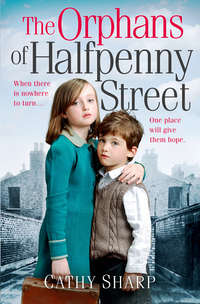
Cover photographs © Henry Steadman (children); The Bridgeman Art Library (East End background)
Cathy Sharp asserts the moral right to be identified as the author of this work.
A catalogue copy of this book is available from the British Library.
This novel is entirely a work of fiction. The names, characters and incidents portrayed in it are the work of the author’s imagination. Any resemblance to actual persons, living or dead, events or localities is entirely coincidental.
All rights reserved under International and Pan-American Copyright Conventions. By payment of the required fees, you have been granted the non-exclusive, non-transferable right to access and read the text of this e-book on screen. No part of this text may be reproduced, transmitted, down-loaded, decompiled, reverse engineered, or stored in or introduced into any information storage and retrieval system, in any form or by any means, whether electronic or mechanical, now known or hereinafter invented, without the express written permission of HarperCollins.
Source ISBN: 9780008118440
Ebook Edition © September 2015 ISBN: 9780008118457
Version 2015-07-22
Dedication
For my wonderful agent, Judith Murdoch, who gave me the chance to write these books, and for my equally wonderful editor, Kate Bradley, for inspiring me.
Table of Contents
Cover
Title Page
Copyright
Dedication
Chapter One
Chapter Two
Chapter Three
Chapter Four
Chapter Five
Chapter Six
Chapter Seven
Chapter Eight
Chapter Nine
Chapter Ten
Chapter Eleven
Chapter Twelve
Chapter Thirteen
Chapter Fourteen
Chapter Fifteen
Chapter Sixteen
Chapter Seventeen
Chapter Eighteen
Chapter Nineteen
Chapter Twenty
Chapter Twenty-One
Chapter Twenty-Two
Chapter Twenty-Three
Chapter Twenty-Four
Chapter Twenty-Five
Chapter Twenty-Six
Chapter Twenty-Seven
Chapter Twenty-Eight
Chapter Twenty-Nine
Chapter Thirty
Chapter Thirty-One
Chapter Thirty-Two
Chapter Thirty-Three
Chapter Thirty-Four
Chapter Thirty-Five
Chapter Thirty-Six
Chapter Thirty-Seven
Chapter Thirty-Eight
Chapter Thirty-Nine
Chapter Forty
Chapter Forty-One
Chapter Forty-Two
Chapter Forty-Three
Chapter Forty-Four
Read on for a Gripping Extract of the Next Novel in the Halfpenny Street Series, Coming in Spring 2016
About the Author
About the Publisher
ONE
‘Mary Ellen, I need you,’ her mother’s voice called from the front door of their terraced house as she approached. ‘Hurry up, love …’
Mary Ellen sighed and walked faster. She’d been all the way to the busy market in the heart of Spitalfields and her basket was heavy with the items her mother had asked her to bring. There was a ham bone, which would be made into soup with some turnips, potatoes, pearl barley and carrots, all of which she’d bought from the market, because they were cheaper, and her arm ached from carrying them.
She hoped Ma wasn’t going to send her anywhere else until she’d had a drink of water, because it was hot and sticky and she was feeling tired after her long walk. She’d been up at six that morning to wash the kitchen floor and the sink, before going to school for a few hours. After returning home for lunch, Ma had sent her shopping because it was only sports and games in the afternoon, and Ma said she didn’t need to bother with them, though Mary Ellen knew her teacher would give her a black mark next time she attended school; but that might not be for a few days, because Ma had been coughing all night. Mary Ellen had seen spots of blood on her nightgown when she’d taken her a cup of tea before she left for school that morning.
‘I’m sorry, love,’ her ma said as she reached the door. ‘You’ll have to go back out for my medicine. I’ve got none for tonight and I can’t seem to stop this …’ She couldn’t finish her sentence because the coughing fit seized her and she sounded terrible. Her body bent double with the pain and her face went an awful pasty white. Mary Ellen could see bright red spots on the handkerchief that Ma held to her lips, and her heart caught with fear. ‘Mary Ellen …’
Ma gave a strange little cry and then sort of crumpled up in a heap at Mary Ellen’s feet. She bent over her, trying to make her open her eyes, but her mother wasn’t responding.
‘Don’t be ill, Ma,’ she said, tears welling up. She didn’t know what to do and she’d been living alone with her mother since her big sister Rose went off to train as a nurse. ‘Please … wake up, Ma …’
Mary Ellen was conscious of the slightly grubby lace curtains twitching at the neighbouring house, then the door opened and Mrs Prentice came out and looked at her for a moment before asking, ‘What’s up wiv yer ma, Mary Ellen?’
‘She’s not well,’ Mary Ellen said. ‘She told me to go for her medicine but then she just fell down.’
‘I expect she fainted,’ the neighbour said. ‘I reckon your ma has been proper poorly. Your Rose should be ashamed of herself. You not even nine yet and ‘er goin’ orf and leavin’ her to cope on her own … and you with no pa.’
‘Pa died before we moved here,’ Mary Ellen said defensively, because she knew some of her neighbours thought she’d never had a father. Her tears began to spring in her eyes once more. ‘Ma’s never been well since …’
‘We’d best get someone to go fer the doctor, and I’ll tell my husband to go round and fetch your Rose when he comes home …’ Mrs Prentice went into her house and shouted and a lad of about thirteen came out and stared at them. His trousers were too big and falling off him and his boots had holes in the toes, but he smiled at Mary Ellen.
‘What’s wrong, Ma?’
Mary Ellen’s mother was stirring. Mrs Prentice signalled to her son and between them they helped Ma to her feet. She stood swaying for a moment, seeming bewildered, and then straightened up.
‘I’ll be all right now,’ she said. ‘Thank you, Lil. It’s just the heat.’
‘Not from what I’ve seen,’ Mrs Prentice said. ‘Get orf and fetch the doctor to her, Rip, and then yer can cut orf down the Docks and tell yer father to fetch Rose O’Hanran back tonight.’
‘No, you mustn’t,’ Ma protested faintly. ‘Rose is busy; she hasn’t got time … and I can’t afford the doctor …’
‘Likely he won’t charge yer, as long as it’s all goin’ ter be free soon, that’s what the papers say anyway, though I’ll believe it when I bleedin’ see it,’ Mrs Prentice said. ‘Go on in, Mary Ellen, and make yer ma a cup of tea. I’ll bring her in and settle her down and then you can go and fetch that medicine.’
Mary Ellen nodded. The last thing she wanted was another walk to the High Street, but she had to go, because Ma needed it.
‘Ma, you’re ill.’ Rose’s voice was sharp and the sound of it sent a tingle down Mary Ellen’s spine as she sat on the bottom stair behind the half-opened door into the kitchen, listening to her mother and sister. She was supposed to be in bed. ‘You’ve got to see the doctor. You can’t go on like this – and you know I can’t come home and look after you. I’m taking my final exams next week and if I miss them I’ll have to do at least another term and perhaps an extra year.’
‘I don’t expect you to come home,’ Ma said, sounding weary and defeated to Mary Ellen’s ears. ‘I saw the doctor weeks ago, Rose. He did some tests and it seems I have consumption. According to Dr Marlow I’ll have to go to an isolation hospital in Norfolk, by the sea – and what is going to happen to Mary Ellen then?’
Mary Ellen stiffened. No one knew better than her how tired Ma was; she’d been neglecting all the things she’d once taken pride in and that included looking after her younger daughter. It wasn’t that her mother didn’t care; Mary Ellen knew she was loved, but Ma couldn’t raise the energy to fetch in the bath and see that her daughter was clean. Instead, she told her to wash in the sink and got cross if Mary Ellen’s clothes were dirty too soon. Instead of baking pies and cakes and making delicious stews, she gave Mary Ellen three pennies to fetch chips and mushy peas from the pie shop most days.
Mary Ellen was hungry all the time and Ma said there was no money to buy good food, because Pa’s employers had stopped paying the pension they’d given her. Mary Ellen didn’t understand why it had happened; she just knew that her mother could barely manage. Pa’s firm had said because of the accident Ma was entitled to a generous amount, but now it seemed they’d changed their minds and they’d cut it to just a pound a month. They’d offered her a job cleaning offices but Ma was too ill to work.
Mary Ellen thought Ma’s illness had got much worse in the past few weeks. At first it had been just a little cough, but now she coughed all the time and there were sometimes spots of blood on her mouth. Rose didn’t come home often so she didn’t see how tired Ma looked; she wasn’t the one who had to scrub the kitchen floor and wash their clothes in the copper in the scullery. Ma tried to help her with the mangle but she was so tired afterwards that she had to go to bed. It was Mary Ellen who had to peel vegetables when they did have a proper meal, and her mother just watched her as she put the pans on the stove and told her when the soup was ready.
She didn’t mind helping out, but because of her mother’s illness Mary Ellen had missed school three times this week and two the week before. If they weren’t careful the inspector would be knocking at their door and Ma would be in trouble.
‘Mary Ellen will have to go into a home,’ Rose said and the determination in her words sent chills through her sister. ‘I’ve got a couple of days off after I’ve taken my exams next week. I’ll come and arrange to take her in myself, to that place in Halfpenny Street – and you must agree to go away for that treatment.’
In the semi-darkness, Mary Ellen hugged herself, tears trickling down her cheeks. She didn’t want to be sent away; she wanted to be with her mother and look after her. Forgetting that she was supposed to be in bed, she jumped up and rushed into the kitchen, temper flaring.
‘I won’t go away and nor will Ma,’ she cried. ‘You’re mean, Rose O’Hanran. I hate you.’
‘Oh, Mary Ellen, love,’ her mother said. ‘You should be in bed. You don’t understand. Rose is only trying to help us. I can’t look after you properly … you would be better in St Saviour’s, if they’ll take you.’
‘I’ll go round and ask Father Joe if he thinks they’ll take her,’ Rose said. She looked at Mary Ellen in the yellowish light of the gas lamps and sighed. ‘Your hair could do with a wash, child. Come here, and I’ll do it before I go and see Father Joe.’
Grabbing Mary Ellen’s arm and ignoring her protests that she’d washed her own hair only two days previously her sister filled a jug with water from the kettle and added cold, then bent Mary Ellen’s head over the sink and poured the water, rubbing at her hair and scalp with the carbolic soap they used for everything.
‘Your neck is as black as ink …’
‘Liar! I washed it this week …’ Mary Ellen retorted.
‘Well, you didn’t make much of a job of it.’
‘I hate you, Rose.’
‘Stop quarrelling, the pair of you,’ Ma said wearily.
‘I shan’t come back when I’ve been to see Father Joe,’ Rose said as she rubbed at Mary Ellen’s head, her nails scratching as she bent to her task. She poured out the rest of the jug, washing away the soap and making Mary Ellen gasp because it was too cold and the soap stung her eyes. ‘I need to get some sleep and I’ve got to work on my revision every day. I don’t want to fail my exams after all the work I’ve put in …’
Mary Ellen’s eyes watered. She didn’t want Rose to come back home, because in that moment she hated her. Rose was selfish and mean and they didn’t need her, because Mary Ellen could look after her mother.
Rose was giving her hair a rough rub with the towel. Next, she took a comb and began to pull the teeth through the long hair, making Mary Ellen yell because it tangled and hurt her.
‘Don’t make such a fuss,’ Rose said crossly. ‘You’re not a baby.’
‘I can do it myself,’ Mary Ellen said. ‘You’re a brute and a bully, Rose. Just go back to nursing and leave us alone. I’ll look after Ma.’
Rose looked at her and her face softened a little. ‘You’re not old enough, love,’ she said in a kinder tone. ‘You’ve done your best, Mary Ellen, but you’re not nine yet and you need to go to school. Ma told me how you make her a cup of tea before you go and do as much of the work as you can when you get back – but you’re missing school and Ma will be in trouble if it continues. I’m sorry, but you will have to go into a home – just until Ma is better. You do want her to get better?’
‘Yes.’ Mary Ellen looked at her mother in alarm. ‘Ma … I don’t want to go to that place …’
‘I know you don’t, love. Come here.’ Her mother held out her arms. ‘I don’t want to go away either, but Rose is right. I am ill and if I stay I could make you ill too – so they will make me go soon even if I try to stay. You do as Rose says. Rose, give me that comb.’ She took it and began to smooth it through Mary Ellen’s hair without pulling anywhere near as much. ‘You get off, Rose. I’ll see the doctor tomorrow and make arrangements to go to that hospital … and you can ask at St Saviour’s if they’ll take our Mary Ellen …’
Mary Ellen’s throat was tight and painful, but she knew it was useless to resist. Ma’s illness was getting worse all the time and neither of them had enough food to eat. It was summer now but in the winter this damp old house would make Ma’s chest even worse.
Holding back her tears, she bowed her head, accepting defeat. ‘I’ll do what you want, Ma,’ she said.
‘There’s my good girl,’ her mother said and kissed the top of her head. ‘I’ll put some milk on and we’ll have a cup of the cocoa Rose brought us. It was good of her, wasn’t it?’
Mary Ellen nodded. ‘Yes, I like cocoa.’
‘You like ham too,’ Rose said and smiled at her. ‘When I come on my day off I’ll bring some ham and tomatoes. You’ll like that, won’t you?’
Ham was a rare treat these days, because even if you had the money it was hard to find in the shops, but the manager of Home and Colonial, the grocers where Rose had worked until she left to train as a nurse, had a soft spot for his former employee and he would find her a couple of slices.
‘Yes, I’ll like that,’ Mary Ellen agreed, but a slice of ham and tomatoes wouldn’t make up for the way she was being cast out of her home … it wouldn’t take away the grief of losing her mother and not knowing if she would ever see her again.
‘Wotcha! Lovely day, ain’t it?’
Mary Ellen O’Hanran ignored the cheery greeting as the delivery boy whizzed by her on his shop bicycle. Ma would say he was common and tell her to ignore the likes of Bertie Carter. Even though they were forced to live in the dirty little houses crammed close to the Docks, they did not have to lower their standards.
‘You know better, Mary Ellen, and don’t you forget it. We may live here, but we came from better things and one day we’ll be back where we belong,’ her mother had used to say when they first came to Dock Lane, but that was nearly four years ago, just after her father had died and her mother had still been fit and healthy.
Even the last rays of a late summer sun could not cheer the grime of the dingy street, its narrow gutters choked with rubbish. Peeling paint on the doors of terraced houses and windows that were almost uniformly filthy from the dirt of the slums were at odds with the spotless white lace curtains at number ten Dock Lane. A scrawny tabby arched its back and hissed at a scavenging rat amongst the debris, and the cheeky delivery boy whistled loudly as he swerved to avoid two snarling dogs fighting over a scrap of food further down. He waved as he turned the corner of the narrow lane, before disappearing out of sight. Mary Ellen stared after him, a small, lonely figure with her fair hair curling about a thin, pale face in wayward wisps that had escaped from her plait.
A single tear trickled from the corner of her eye but she dashed it away with her hand, refusing to give in to the feeling of misery that kept threatening to overcome her, because Ma had shouted and told her to keep out of the way. Ma never shouted, but she was so tired, at the end of her tether. She was lying down on her bed after another bout of terrible coughing, her face so pale and drawn that Mary Ellen was afraid she might collapse again. In the distance, the towering cranes on the East India Docks and the smoking chimneystacks of merchant vessels out on the river were outlined against a clear sky. The sound of a ship’s horn blasted suddenly through the mean streets and the foul stench from the oily water had worsened with the heat of the day. The noise of the trams clanging their way through the main thoroughfare echoed in the stillness of the unusually quiet lane. For once there were no gossiping women standing at their front doors, the heat having driven them all inside, thick lace curtains closed to shut out what had been a relentless sun.
Mary Ellen’s home stood out from the crowd, because until these last few weeks, when she’d got so ill, Ma had kept her doorstep scrubbed and her curtains washed despite the constant struggle against the filth of the East End of London. Mary Ellen had scrubbed the step herself this morning, and Ma told her it looked lovely, but the soap had stung her hands and her knees hurt where she’d grazed them on the stone. Yet Mary Ellen would do it again tomorrow, because Ma had been used to better and her pride made her battle against the poverty and wretchedness of her surroundings.
Hunting for the right kind of stone, Mary Ellen was set on playing a game of hopscotch to while away the hours until Rose came home as she’d promised, and it was time to go in for her tea. Maybe one of the other children in the lane would come and play with her, though because Ma kept herself to herself, her neighbours thought they were stuck up and the other kids often refused to notice the O’Hanran girl.
‘Who does she think she is, with her airs and graces?’ their mothers whispered to each other when Ma put her spotless washing out to dry in the back yard. Hair in wire curlers peeping out beneath their headscarves, they made faces at the woman whose hair shone like silk and wore no apron over her dress when she came into the street. ‘Just because her father owns a shop over the river she needn’t think she’s better than the rest of us.’
Mary Ellen bet some of them were gloating to see her mother’s pride tumbled in the dust and tears of anger stung her eyes when she thought of what was going to happen when Rose came home. She knew where she was going, because she’d passed St Saviour’s on her way to visit the park with her school, St Mary’s. There she’d seen the St Saviour’s girls, all dressed in grey skirts, white blouses and dark red coats.
The other kids at St Mary’s laughed and pointed at the orphans, calling them the ’Alfpenny kids, because that was the name of the street the home was in, and now Mary Ellen was going to be one of them. The idea filled her with dread.
Why couldn’t she stay at home? Rebellious thoughts filled her head, though sometimes, her mother looked so pale and fragile that Mary Ellen grew frightened. When she saw the blood on the handkerchief that Ma tried to hide, she prayed to that God in the sky her father had impressed on her was there to save them, especially little children.
‘Ah, whist, me darlin’,’ Tom O’Hanran would say, as he sat her on his knee and stroked her head, his breath always smelling faintly of good Irish whiskey. ‘Sure, Jesus in His heaven and Mary Mother of God will smile on you, my Mary. You’ve the charm of the Irish and the smile of an angel, and no one could help but love you.’
‘Now then, Tom O’Hanran.’ Ma would smile fondly on them. ‘Don’t you be spoiling her with your daft stories. Mary Ellen has to learn that life does not always flow smoothly for the likes of us.’
Mary Ellen still missed her father. Sometimes it hurt so much that it was like a big hole in her chest, but Ma didn’t talk about him so she had to keep her grief inside.
Ma was English, not Irish, and in the opinion of her shopkeeper father she had disgraced herself by marrying a wild Irish Catholic, who would, he prophesied, ruin her. Ma had been in love with her handsome husband in those days, and she’d even converted to his faith at the start, though after his death she had lapsed and no longer sent her children to the Catholic Church. Ma seldom went to church at all, but when she did, she chose the Methodist one because the minister did not scold her for changing her mind over the matter of religion. In a huge city teeming with people of all faiths, the minister had long grown used to accepting those in need, whatever their denomination, and did what he could to help the poor of the area, regardless of whether they attended his church.
Ma’s father had disowned her when she married, and he had not relented when she became a widow, even though he could have helped her to stay in the nice little cottage she’d gone to when she wed. Mary Ellen’s elder sister Rose said that Grandpa would’ve given Ma money if she’d grovelled and begged him, but Ma was too proud to beg. Instead, she’d been forced to come here to this slum and fight her battles against an encroaching illness and the tide of dirt that threatened to engulf them.
Rose still attended the Catholic Church, not out of devotion but because, she said, they had allowed her to take a scholarship under their aegis that had enabled her to enter nursing college. Rose was determined to better herself, to make a good life, and her only way of getting the chance she needed had been to take advantage of being a good Catholic. Father Joe had been a friend to all of them and he took an interest in Rose’s future, telling Ma that she should be proud of her daughter’s hard work.
‘You’ve a good daughter there, Mrs O’Hanran,’ he’d said when he came to visit. ‘Respectable and devout, she’ll make a wonderful nurse.’
Ever since she was Mary Ellen’s age, Rose had dreamed of becoming a nurse one day, and the recent terrible war which had ended only two years earlier had made her even more eager to take up the profession.
‘When I see men fresh home from the war, with legs missing and awful scars, some of them so weak that they will never recover, I want to help them,’ Rose had told her young sister. ‘I only wish I had been old enough to go out to the Front – somewhere the fighting was at its worst – to help nurse the men. I could never work in an office or a dress shop when there is something more worthwhile to be done. Hitler is beaten, and London will recover from the Blitz in time, but the injuries some of those men received will never be healed.’
Rose wanted to help sick people, but she hated the slum area they’d been forced to live in after Pa died, and Mary Ellen knew she wanted to become a nurse so that she need never come back here. She was ashamed of their home and wanted something better. Mary Ellen didn’t care about such things, she just wanted to be at home with her mother … but after today she would be sent away and she wouldn’t be able to see or touch Ma …
Mary Ellen had often sat unseen on the stairs in the evenings and listened to her mother and sister talking in the kitchen. At nights, Ma lit the gas lamps and made a pot of tea, which they drank together, discussing subjects that they considered her too young to comprehend, but life hadn’t been easy since Pa died, and Mary Ellen understood grief all too well. She heard things that worried her, though she often made sense of only a fraction.
Yet she knew that Britain was still struggling to pay back its war debts and there were not enough decent jobs for able-bodied men, let alone those who could not do a full day’s work.
Everyone had hoped rationing would end with the war, but instead it seemed that every month they were told there would be less of something else. ‘Only one ounce of bacon per person per week now, and three pounds of potatoes,’ Ma complained when Rose came home with whatever she could find. ‘We shall all starve before they’ve done – and what was it all about, that’s what I’d like to know.’
‘Governments falling out like spoiled children,’ Rose said in a harsh tone. Ma sometimes complained that Rose was becoming a radical and too critical of politics and things that were best left to men, but that just made Rose toss her head and retort, ‘You’ll see, Ma. Women are going to have more to say in the future. It’s time ordinary people had enough to eat and decent homes to live in – it’s time women were equal to men, in wages and everything else.’
Ma would laugh and warn her that pride came before a fall, but Mary Ellen thought that her sister was right. Why shouldn’t women have more say in their lives? And it wasn’t right that people went hungry. Yet when she said so both Ma and Rose told her she was too young.
‘It’s not really the Government’s fault,’ Ma said. ‘There isn’t enough of everything to go round and things haven’t got going yet after the war.’
‘And who is to blame for all the shortages, the way the shops are empty even though the war has been over for months and months; more than two years? Who says we have to go on being rationed? No one has enough to eat, Ma. I can’t even buy a decent pair of shoes for work. What did all those men fight for if it wasn’t to make life better for us all? If those fat idiots in Westminster stopped rabbiting on and sorted things out perhaps we shouldn’t have to put up with all this austerity. With a country to rebuild there should be plenty of work for everyone and money to live decently – but it’s still hard to find work for most of the men, even though it may not be as bad as it was after the first big war.’
Mary Ellen sort of understood, because she was good at listening to people talking and because she was small and quiet they didn’t always realise she was there. She heard Mr Jones the butcher talking about the fact that he couldn’t get supplies of lamb from his usual suppliers.
The big freeze in January and February had made it seem that life in Austerity Britain could not get worse. And the floods in April with the resulting catastrophic loss of livestock, with millions of sheep drowned and arable crops flooded, had only aggravated the situation.
Yet here in the East End, which had taken much of the damage during those terrible nights of war when waves of bombers flew like great birds of prey over the city, disease and poverty still haunted the streets. Life had always been hard for these people and somehow they endured, though they never stopped moaning about the bloody Government. Moved by the pity and despair she saw in the faces of wounded men, returned to a life without work and precious little to eat, Rose was fired with a zeal to do what she could to put things right, to make life better for others as well as herself. A nursing career was the only way she knew to leave the poverty of the East End behind her and find the kind of life she wanted: a way of forgetting the drabness of life in Austerity Britain.
Mary Ellen admired her sister. Rose was dark-haired and beautiful, with her pert nose, full red lips and firm chin. She was also one of the most determined people that Mary Ellen had ever come across.
Mary Ellen finished chalking the squares for her game of hopscotch and then selected a flat stone from amongst the filth in the gutters. Her chores finished for the day, she’d come out to play while Ma had a rest on the bed, and they waited for Rose to return home from work with food for their tea.
Mary Ellen threw her stone into the first square and hopped into the one after it. She was preparing to perform a hop, skip and jump before turning to go back and pick up her stone when a voice spoke from behind her and made her start and lose her balance.
Turning, she saw a boy of similar age to her own. He was a little taller, dressed in long trousers that had been cut down from an old pair of his brother’s, a washed-out shirt and scuffed black boots. His dark auburn hair was tousled and unwashed, his nose red and dripping and there were streaks of dirt on his face where he’d rubbed it with his filthy hands. As she watched he wiped his nose on the back of his hand and then, to her disgust, slid his hand down his trousers. Ma might be ill and they might be poor, but Mary Ellen was clothed in an almost clean cotton pinafore skirt and blouse her mother had made before she became ill, and she had better manners than to wipe snot on her dress.
‘That’s rude, that is, Billy Baggins,’ she said. ‘What did you make me jump for? I shall have to start again now.’
‘I didn’t mean to, Mary Ellen,’ he answered meekly. ‘Can I play?’
‘You’ll have to find a stone,’ she said, looking at him curiously but without malice. Billy Baggins had no mother and his father had recently been killed in an incident on the Docks. Mr Baggins had been a bully with a loud voice, who hit both his sons whenever he was drunk, but at least he’d kept the family together and they hadn’t starved. Since his death, Billy’s elder brother had cleared off to no one knew where, and Billy had been collared by the authorities who had said he was going to be put into care.
Mary Ellen had felt sorry for him, because he might look unkempt and his manners were rough, but she knew he was kind and generous. When her own father had died, Billy had been the only one who understood how she felt, sharing his sherbet dip with her as they sat on the doorstep and she battled with her tears. He was her one real friend in these lanes and she’d missed him when he’d gone off to stay with his nanna. She knew how bad he must feel now that his own father was dead and all he had was an old lady and his rogue of a brother. ‘I thought you’d gone away?’ she said now.
‘Not yet,’ he said. ‘I’ve been stayin’ with me nanna in Whitechapel, but she was taken into hospital sudden and I came home ter see if Arfur had come back.’
‘Has he?’ Mary Ellen asked sympathetically, but with little expectation of a good outcome. Everyone knew that Arthur Baggins was a bad ’un.
‘Nah, didn’t fink he would’ve,’ Billy said. ‘Came ter make sure ’cos the bloody council bloke will ’ave me in a home afore you can sneeze if I don’t watch it.’
‘That’s bad, that is,’ Mary Ellen said, feeling her eyes sting with tears she would never dream of letting Billy see. They weren’t just for him, because it was going to happen to her too – and she hadn’t got anyone else she could go to, because her grandfather hadn’t even opened the door to them when Ma had tried to tell him she was ill. She hated the thought of leaving her home and being with people she didn’t know, and her voice wobbled as she asked, ‘What are you going to do?’
‘Don’t know,’ he said and pounced on a stone with glee. ‘This is a good ’un, this is.’ He showed it to Mary Ellen, who nodded her agreement. Because she was feeling sorry for him, she told him he could have first go. He grinned, showing a gap in his bottom set of teeth. ‘You’re the best friend I’ve got. I wish I could stay wiv you and your ma.’
‘Ma’s not well.’ Her heart felt as if it were being squeezed, because she was afraid of what was going to happen to her. ‘She’s got to go away … and that means I can’t stay here.’
‘Why ain’t your Rose ’ere then, if yer ma is bad?’
‘She’s going to be a nurse. She’ll work in a hospital and live in the home for nurses. She’s too busy to look after me, she said so.’
‘That’s bad fer yer then, Mary Ellen.’
‘Yes,’ Mary Ellen agreed unhappily, moving from one foot to the other. ‘Rose said they’re going to put me in St Saviour’s. I heard them talking about it the other night. I think Ma might go away to the hospital … somewhere a long way off …’
‘That’s rotten luck,’ Billy said. Then he threw his stone, did the feet-apart jump and the hopping motions, as he went up the squares and down again to retrieve his stone without a fault. ‘I reckon that’s where they might send me, St Saviour’s. I wouldn’t mind being sent there if I thought you would be there an’ all …’
‘No,’ she replied doubtfully, watching as he threw for the next square and set off again. He performed the actions perfectly. She wasn’t going to get a turn for ages at this rate. ‘What do you think they do to you at that place? Is it a house of correction? I don’t know what that is but I heard someone say they ought to send your Arthur there when they thought he broke into the corner shop …’
Billy looked anxious, because his brother had been in trouble with the police over that years ago, but no one could prove he’d done it and so he’d got away with the crime.
‘Nah,’ he said and threw his stone, which missed. He swore, a word that would have earned him a cuff round the ear from Mary Ellen’s mother. ‘It’s your turn. Proper put me off, that did – but St Saviour’s ain’t a punishment house. Those places are for bad boys, not orphans. Not that you’re an orphan, yer ma is still alive. Still, sometimes they put yer in a home even if both of ’em are still around. I heard as they’re all right at St Saviour’s – not like some places where they treat yer rotten. Nanna told me I should go there. She warned me she was too old to have the care of a young lad, and I reckon it’s the worry of it wot’s made her bad.’
‘I put you off; you can throw again,’ Mary Ellen offered, because he looked worried about his nanna, but he insisted it was her turn. She threw, hopped up the squares and executed a perfect turn, coming back to balance on one leg as she picked up her stone. ‘I reckon we’d be all right there together – it wouldn’t be as bad as if we were on our own and didn’t know anyone.’
‘All right,’ he said and gave her a wide grin. ‘If they say that’s where I’m goin’ I’ll let them put me there. I can always run orf if I don’t like it.’
‘Where would you go?’
‘Don’t know; I’d probably just hang about the streets until I could find Arfur. There’s plenty of bombsites wiv ’ouses half standin’ where you can hide. Me bruvver won’t have left the East End and he might let me stay wiv him if I asked,’ he said hopefully.
‘It would be better than living on the streets alone, I suppose.’ Mary Ellen didn’t much like Billy’s brother. He was mean and vicious and made her feel nervous when he looked at her. ‘Besides, you’re nine, aren’t you? How long can they keep you at places like that?’
‘If Dad was alive I should’ve gone to work down the Docks as soon as I was twelve, that’s wot he told me. I ain’t sure if it was legal but he said he’d be damned if he kept me any longer than me twelfth birthday. He was an old devil but I wish he was still around.’
‘You’ve only got three years until you can work then,’ Mary Ellen said with a sigh. ‘I’ve got ages more before I can train to be a nurse like Rose.’
‘Work’s a waste of time if yer ask me,’ he said, watching as she completed a second turn. ‘Arfur says he can earn more in one night than me farvver made in a month.’
‘What does Arthur do?’
‘I dunno,’ Billy said, but Mary Ellen thought he was lying. She could always tell, because his ears went red and so did his neck. Rose said Arthur was a thief for certain, but she couldn’t say that to her friend. She threw for a top square and missed, and Billy chortled, stepping in to throw his own stone. This time he landed it exactly where he wanted and set off up the squares. He was on his way back when Mary Ellen saw her sister coming down the lane and knew it was time to call a halt. Before she could speak the delivery boy screeched to a stop beside her.
‘Wotcha, Billy,’ Bertie Carter called. ‘I ain’t seen yer for a while. Where yer been?’
‘To stay wiv me nanna,’ Billy said, his attention turned. ‘What yer doin’, then?’
‘Got a job delivering sausages,’ Bertie said. ‘Me bloody pa’s drunk all his pay again so ma told me to get out and find a job.’
Mary Ellen saw Rose glaring at her and knew she would be annoyed to see her talking to two boys she would describe as being rogues.
‘I’ve got to go, Billy,’ she said. ‘It’s time for my tea now.’
‘All right,’ he agreed but looked disappointed. ‘It was nice seein’ yer, Mary Ellen. Don’t forget, if they put me in that home I shall be there waitin’ fer yer …’
‘I’m orf,’ Bertie said. ‘Yer can come wiv me, Billy. I’ll get a bag of chips on me way home and you can share ’em.’
‘All right,’ Billy agreed.
Whistling, he ran off after Bertie, the pair of them reaching the end of the lane just as Rose came up to Mary Ellen. She stared after him with a look of annoyance on her pretty face. ‘Was that that Baggins boy?’
‘Yes. His nanna’s gone into hospital and he came to see if his brother is back, but he isn’t – and they’re going to put him in a home.’
‘In my opinion they should have done it long ago,’ Rose said. ‘If he’s left to run the streets he will turn out just like that good-for-nothing brother of his …’
‘Billy isn’t like his brother.’
‘Ma told you not to have anything to do with him, Mary Ellen, and now I’m telling you. He comes from bad blood and we do not want you getting into trouble because of him. Go in now and wash your hands. Then you can help me set the table and get the tea on …’
‘I thought we were going to have ham and tomatoes tonight?’
It was Friday night and before Ma got ill they’d always had ham for tea, because it was pay day, but now there wasn’t enough money for treats like that unless Rose brought them.
‘There was no ham left by four this afternoon, and Mr Brown wouldn’t cut a new one until tomorrow. I bought a bit of fish and I’ll mash some potatoes to go with it.’
Mary Ellen pulled a face behind her sister’s back. She didn’t like fish and she’d been looking forward to a slice of ham all day, because all she’d had at midday was a slice of bread and dripping. Rose could be mean sometimes, finding fault with Billy for no reason, and then bringing fish for tea when she knew Mary Ellen hated it.
She would rather have a piece of bread and jam and if Rose hadn’t brought a fresh loaf, she would make toast of the old bread and put the last of the strawberry jam on it.
TWO
‘Angela, this is a welcome surprise.’ Mark Adderbury rose to his feet, offering his hand as his guest entered the study of his old, rambling, but rather lovely house, which adjoined the surgery attended by his private patients. Situated at the edge of the small but charming Sussex village where they both lived, its appearance was testament to his status as a respected and expensive psychiatrist. He’d come down for a long weekend and did not return until the following day. ‘What may I do for you?’
‘I haven’t come as a patient,’ Angela said with the sweet smile that won hearts but these days did not quite reach her eyes. Mark understood the sadness that lay behind those expressive eyes, because when her husband John had been killed in the war, he too had felt the sharp pang of loss for his best friend. It had been then that Angela had drawn closer to him, glad of his sympathy and understanding. ‘I wanted to ask your advice.’
His eyes moved over her, noting the style of her dress, the New Look which Christian Dior had introduced that April, with its longer full skirt and shaped waist that gave women’s figures that hourglass shape. The rag trade in London had copied it within hours, getting cheaper versions into their shop windows to tempt women who were sick to death of the Utility dresses that were all that had been available during the war. However, by the look of Angela’s dress, she had probably bought it in Paris when she stopped there on her way back from Switzerland, where she’d been on behalf of some patients; military personnel with private means, whose families had sent them for a rest cure after their traumatic experiences.
In her capacity as an administrator for the military hospital in Portsmouth, she’d sought Mark’s advice when it was deemed necessary to find a clinic which might just be able to mend the minds of some badly damaged war heroes. Yet Angela had known only too well that it wasn’t just their minds that had been damaged; in many cases they had lost a leg or arm, sometimes both, but there was help for amputees these days. It was the men with faces so severely burned that they looked like something from a horror film that Angela had felt for the most, skin blistered, eyes damaged, sometimes sightless – and some poor devils didn’t even have a nose. Yes, there were wonderful surgeons ready to reconstruct a face, but it would mean endless pain and operations. She’d told Mark afterwards that she believed a lot of men would rather be dead than endure the look in the eyes of friends and family … and he knew she’d broken her heart over the hopeless cases.
He’d told her about the clinic, of which he was a co-owner, and she’d managed the rest herself, though she’d complained bitterly because she wasn’t able to offer the same service to deserving soldiers who didn’t have private means. He suspected that she’d paid for one or two of her lame ducks to have the special treatment out of her own pocket; he’d often done the same himself and thought that having money to spare came in handy sometimes.
It was a pity that the job of hospital administrator had been her last, because she had excellent managerial skills. The hospital had been loath to lose her but Angela’s mother had wanted her to come home, and since she was recovering from a severe bout of flu and seemed very low, Angela had obliged her – perhaps because she too needed to rest and recover her spirits.
Mark saw the signs of strain in her face and the dullness of those eyes that had once seemed to glow with life and vitality. Only five years ago she had been considered beautiful, with her dark blonde hair, azure eyes and sensual mouth, the only daughter of middle-class parents, her father a much respected family lawyer. Angela had been expected by her parents – some would say required – to make a brilliant marriage, and indeed she had, though rather later than had been hoped. For years she had led a butterfly existence, playing at being her father’s secretary and enjoying the social whirl, despite her mother’s frequent hints that it was time she settled down. Even though she was presented to several eligible men, Angela just hadn’t found anyone she could bear to think of as a husband and stubbornly refused to give way to her mother’s urging, even though they argued often. However, after meeting Captain John Morton, a handsome and charming Army officer, at a Young Farmer’s ball at the age of twenty-nine, she had fallen madly in love, been swept off her feet and married him within a month. Much to her mother’s displeasure, she had chosen a quiet wedding without any fuss and drama. Angela told her closest friends that her mother had never forgiven her for cheating her out of a big society wedding, but as she had also been fond of saying, ‘With a war going on we just didn’t have time to waste, besides, it would have seemed wrong when everyone was suffering.’
‘You know you can count on me as your friend,’ Mark said now, giving her his comforting smile, which, he was well aware, his wealthy patients declared was worth every penny of the exorbitant fees he charged for consultations. ‘You are feeling less tired now, I think?’
‘Yes, absolutely,’ Angela replied. ‘In fact I have so much energy that I am bored to tears. I just cannot live at home and help my mother with her charity work or I shall go mad …’ She laughed softly, and his heart caught because it was a while since he’d heard her do so – not since John was killed. ‘Not literally. I’m not going to have a breakdown or anything. I just want something to do with my life – something worthwhile. I’ve had enough of endless society engagements and dinners with my mother’s friends. Besides, Mother wants to find me another husband and I can’t … I won’t let her bully me into another marriage.’
‘I agree that three years is too soon for you to think of anyone else, because you were so much in love with John,’ he said, although he wished it were otherwise, because he would have liked the chance to offer her love and a reason to be happy again. ‘Do you want me to speak to her for you?’
‘No, thank you. I need work, proper work that takes me away from here – away from my comfortable life. I want to live in the real world rather than Mother’s. I find most of her friends shallow and selfish and I want to help those in need. I’m not hysterical, even though Mother looks at me as if she thinks I am when I say something like that. She thinks she helps people because she sits on the board of a charity and raises funds for her pet projects but she has no true idea of what goes on.’
‘A little unkind, wouldn’t you say?’ Mark raised his brows. ‘Your mother does help others less fortunate in her own way; she just doesn’t wish to get her hands dirty. That’s what you’re after, isn’t it?’
‘Yes.’ Angela’s smile was rueful. ‘It sounds awful put like that – as if I’m a middle-class do-gooder trying to earn my Brownie points.’
‘Have you considered that that is how you may appear to people who truly have to get their hands dirty to survive? If I were to find you a job – or at least point you in the right direction – you would almost certainly come up against prejudice because of your background.’
‘Do you know of something that might suit me? All I want is a chance … something to make it worthwhile getting up in the morning. Something to take away this emptiness …’
Her eagerness touched him, the sudden glow in her eyes making him realise that she was truly in earnest. Although the perfect beauty she’d once enjoyed had gone, she retained the clean symmetry of good bones, her face a little angular these days, but perhaps more arresting because it told of her suffering – and she had the best ankles Mark had ever seen on a woman. It couldn’t hurt to help her on her way. She might change her mind once the reality of hard work came home to roost, but there was no harm in letting her try. He realised now that it had been in his mind to ask her for a while, because she would be perfect for the role of the new Administrator of St Saviour’s – and of course it would give Mark the perfect excuse to see her more often. He smiled inwardly, because he knew his own feelings had played their part in his decision.
‘As it happens, I do know of something. I was actually thinking of mentioning it to you, Angela. You may not be aware, but I am on the board of a charity that runs a children’s home in the East End of London …’
‘Daddy told me a little about it. It’s why I came to you, because I thought you might know of someone needing help? I don’t have to be paid.’
Mark nodded, because he knew that John had left her well provided for; Angela didn’t need to work, but he could see that she needed the discipline of it. Outwardly, she appeared to have coped well with her bereavement, but one had only to watch her to see the grief that lived inside her. She’d come home for her mother’s sake, but he’d never approved of her giving up work for such a reason; of course if John had lived he would have expected it, but then she would have had a busy life caring for a home and a husband she adored.
Mark had been attracted to Angela from the first time he saw her, at a charity dance her mother had arranged when she was about twenty-two and he just twenty-six. He’d still been married then, of course, and working in a London hospital, down for the weekend to look at a house he hoped to purchase with a small inheritance from an uncle. He’d simply admired the bright and beautiful girl that she was from a distance, arranged to put a deposit on his house and gone back to London the next day, visiting occasionally to oversee the renovations at the property. He’d acquired the house mostly for Edine’s sake, thinking it might suit her health to live in the country, but he’d often wondered since if it had been a mistake. Over the years Edine and he had met Angela and her parents at various social affairs, but by the time Mark had suddenly found himself free, Angela had been in the throes of falling in love with his best friend. It was really only after John’s death, when he’d held her in his arms and let her cry against his broad shoulder, that he’d realised how deep his feelings ran.
Mark felt the ache like a yearning hunger deep in his guts. It was hard behaving like a perfect gentleman and a good friend, when what he really wanted was to take her in his arms and kiss her until she melted into him, submitting herself to his loving … but that was the daydream of a man in love and Mark had to face reality.
He got up and went over to the sideboard to pour a small glass of sherry for each of them, and brought the tray back to the desk, giving himself time to think over how to answer her.
‘St Saviour’s has recently been given a Government grant, which is wonderful, but it means big changes, and that’s where you could help, Angela. Sister Beatrice is an excellent nurse. She has been in charge of the home for the past two years and we are delighted with the improvements she’s made on the nursing side; but good as she is, she dislikes paperwork – and she does tend to drag her feet a bit when it comes to change. Her desk is always piled high with papers in no order whatsoever, and her reports are always late and usually leave much to be desired. She is a nurse first and foremost: a dedicated, hard-working and intelligent woman, but the office work is beginning to slip. Some of the governors are growing concerned and I think she may find the new order hard to accept.’
‘She sounds a wonderful person, Mark.’
‘She is, but we do need to bring St Saviour’s into the modern world, Angela. Right-thinking people are questioning the way some homes have been run in the past – especially after that fiasco when all those children were sent overseas. Three thousand of them went down on that ship the Germans torpedoed and it caused an outcry against the high-handed men who sent them off without a thought for what the children wanted. In my opinion it’s time we started to think about the wishes of the child involved. Look at the way they were just shipped off to the country at the start of the war – and some of them went missing; others had a terrible time. Instead of being kept safe and cared for they were treated little better than servants.’
‘That was awful,’ Angela said. ‘If they were going to send them off like that, they could at least have made sure the homes they went to were properly vetted.’
‘From what I heard, people just turned up and selected who they wanted and took them off. Some mothers didn’t even know where their kids were … but that’s not what concerns us now. I want to make sure that our home is run for the benefit of the children in order to give them a better future – education comes into that and it helps if their minds are stimulated, not just at school, but in their home too. I want us to show them there is another way of life …’
‘You mean take them to places of interest, outings that they will enjoy but will open their minds too?’
‘Yes, but perhaps there are other ways you could encourage them to think for themselves, Angela? I should like you to consider what we could do to change both the way St Saviour’s is run and any improvements to both the old and the new building. You have a clear mind and I’m sure your views and your sense of order would help Sister Beatrice. I am not asking you to take over from her, Angela, but she is struggling to cope with all the responsibility, and once the Board approves any changes, it will be your task to implement them. You are not supplanting Sister but you could help her find her way.’
‘I did quite a bit of reorganising at the hospital.’
‘Yes, so I’ve been told, and they were grateful for the changes you suggested. The difference is that change will not be welcome to everyone at St Saviour’s, Angela.’
‘I’m prepared for that,’ she said and sipped her sherry thoughtfully. ‘I need a challenge, Mark. At the moment life feels a bit empty …’
‘You will have more than enough to do if you take this on. Make no bones about it, Angela; the children you will meet are often the casualties of violent and broken homes. Some are so damaged mentally that I’m not sure we shall ever get them right, others are physically ill. St Saviour’s takes in any children in need of help, no matter what their background or religion.’
‘That’s perfect,’ Angela said and leaned forward, her face alight with interest. Mark caught a breath of her perfume; it was light and sensual and made his guts ache with the need to take her in his arms.
Mark continued, ‘It is a poor area; many of the old houses are not far off being slums. Hitler got rid of some of the worst, but there are still too many narrow lanes and rundown streets. St Saviour’s itself is in Halfpenny Street, but there are lots of alleys and lanes leading off it, though locals refer to the whole area as the ’Alfpenny or if they really want to bamboozle you, as the Two Farthin’s.’
‘That’s clever.’
Angela laughed and Mark nodded his appreciation of her humour. ‘Yes, they’re unique, these people. It doesn’t seem to matter what hardships they have to endure, they will come up with something to laugh at.’
‘I can’t wait to find out for myself. Please go on, Mark; it’s fascinating.’
‘The house was once a Georgian mansion, quite beautiful inside, I believe, but all that grandeur was lost when it became a hospital for contagious illnesses. The people of the area have never had enough to eat and rationing hasn’t made that much difference to some of them, because they couldn’t afford to buy more even if food was plentiful. Indeed, at St Saviour’s our children eat better than they ever have in their lives; they wear decent clothes and have shoes without holes. Of course, you’ll find decent families living in the vicinity, businesses and shops too, but it’s the kind of area where in the old days diphtheria would have swept through like wildfire. Thank goodness we have a vaccine for that now, but there are plenty of other diseases to cope with. Polio is a terrible illness and there’s too much of it about these days.’
‘Terrible,’ she agreed. ‘I do understand that it is a poor area, but that is why I think I might be able to do some good.’ Angela gave him a hot, urgent look, her eyes full of passion. Mark wished she felt as passionate about him. ‘What would I be asked to do?’
‘Your job would be mainly in the office, but they cannot afford as many carers as they would like, and you would undoubtedly be asked to help out – perhaps with trips outside, pleasure outings, if you like. If Sister Beatrice likes and trust you, she may allow you to help with the children. Mrs Burrows – or Nan, as everyone calls her – is a surrogate mother to the children. She is the one who looks after those most damaged by trauma, and she often puts the young ones to bed, and cares for them if they are ill – at least, with small things that do not require they be placed in the nursing ward. Make a friend of her and she will put you right.’
‘Oh, if only they will take me. It sounds just exactly what I should like. If I had trained as a nurse I could have been of more help, but Mother hated the idea and when the military hospital discovered I was good at keeping order they made me one of the administrators; it was a bit of a shambles when I arrived. They were always inundated with casualties and often out of their depth. We had to provide temporary wards wherever we could find space and that took a lot of co-ordinating, so I think I can manage to bring in some changes at St Saviour’s. However, I also did an extensive first aid course and I know a little about helping out in a crisis.’
‘A lot of your time will be spent dealing with the setup of a new wing and the paperwork, also some fundraising. With the grant from the Government’s department to help with repairing war-damaged infrastructure, we’ve been able to purchase an old building just next door. We’ve had the architects in and the plans have been approved. The builders expect to move in shortly, perhaps next month if things go well. It has to be completely gutted and refurbished, which is a big job and will cost a great deal of money. We have also been given a small grant to help with running costs for the first year; it’s a part of the grand new welfare scheme that is coming in next year. Even with the grant we are going to need to raise a lot of money in the future … I’m hoping you will take that on, Angela? We need to get some wealthy people interested – and you know quite a few through John’s family.’
Mark saw the colour leave her face and wished he hadn’t spoken, because it was obvious that her grief lay hidden just beneath the surface, but he also knew from experience that grief had to be brought out and dealt with.
‘Do you think it sounds like something you want to tackle?’
‘Do you think they will give me an interview?’ she countered, and her stricken look had gone. ‘It’s just what I need, Mark.’
‘You’re sure you feel able to cope with an area like Halfpenny Street? Local legend has it that the street earned its name from the ragged orphans that would do any job, not matter how demeaning, just to earn a halfpence or two. It is part of the Spitalfields, Stepney and Bethnal Green area, at the heart of the East End, once a prosperous area when the rich silk merchants lived there. However, when the richer people moved out, the area went into a slow decline and was taken over by less well-off immigrants, Used as a fever hospital, the building was damaged inside but the shell survived and is the only one that has managed to do so in this particular area. We took it over in a neglected state and made it habitable again. However, it is a dingy area, teeming with all kinds of people, all nationalities these days. The Huguenots were there from the start, of course, but then it became very much a Jewish centre; you will see evidence of that in the old synagogues and shops. Many of the synagogues are now used as factories or storehouses. There are lots of little manufacturers and craftsmen working in the lanes and streets around the home, and most look grimy and neglected.’
Pulsuz fraqment bitdi.