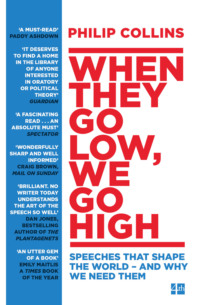
Kitabı oxu: «When They Go Low, We Go High: Speeches that shape the world – and why we need them»

Copyright
4th Estate
An imprint of HarperCollinsPublishers
1 London Bridge Street
London SE1 9GF
www.4thEstate.co.uk
This eBook first published in Great Britain in 2017 by 4th Estate
Copyright © Philip Collins 2017
Philip Collins asserts the moral right to be identified as the author of this work
A catalogue record for this book is available from the British Library
Excerpts from ‘I Have a Dream’ speech by Martin Luther King Jr reprinted by arrangement with The Heirs to the Estate of Martin Luther King Jr., c/o Writers House as agent for the proprietor New York, NY. Copyright © Martin Luther King Jr 1963, renewed copyright © Coretta Swift King 1991. We are also grateful to Chatham House, the Royal Institute of International Affairs, for permission to reproduce the extract entitled ‘The speech from the Berlin Sportsplatz 1938’ from The Speeches of Adolf Hitler April 1922 – August 1939 (1942), Adolf Hitler and Professor Norman Hepburn Baynes, Oxford University Press and Royal Institute of International Affairs. Speech by Isidora Dolores Ibárruri Gómez (La Pasionaria), ‘No Pasarán’, 1936, reproduced courtesy of Lawrence & Wishart.
All rights reserved under International and Pan-American Copyright Conventions. By payment of the required fees, you have been granted the non-exclusive, non-transferable right to access and read the text of this e-book on-screen. No part of this text may be reproduced, transmitted, down-loaded, decompiled, reverse engineered, or stored in or introduced into any information storage and retrieval system, in any form or by any means, whether electronic or mechanical, now known or hereinafter invented, without the express written permission of HarperCollins.
Source ISBN: 9780008235680
Ebook Edition © October 2017 ISBN: 9780008235673
Version: 2018-05-01
Dedication
To the memory of Jennifer Anne Taylor (1942–2014) and Frederick John Collins (1940–2015)
Contents
Cover
Title Page
Copyright
Dedication
Acknowledgements
List of Speeches
PROLOGUE – The Perils of Indifference
CHAPTER 1 – Democracy: Through Politics the People Are Heard
CHAPTER 2 – War: Through Politics Peace Will Prevail
CHAPTER 3 – Nation: Through Politics the Nation Is Defined
CHAPTER 4 – Progress: Through Politics the Condition of the People Is Improved
CHAPTER 5 – Revolution: Through Politics the Worst Is Avoided
EPILOGUE – When They Go Low, We Go High
Bibliography
Index
PAPERBACK EXCLUSIVE – The Rights of Man
About the Author
About the Publisher
Acknowledgements
I have been privileged to write speeches in one great institution and about them in another. In 10 Downing Street I had the pleasure of writing for Tony Blair, which changed the course of my career, if such a word is appropriate for my random array of jobs. The Times then took me in and my thanks are due to Daniel Finkelstein for suggesting that move in the first place. Then also to successive editors, James Harding and John Witherow, for commissioning the speech analysis format which I have followed in this book.
For the way the format stretched into an ambitious thesis, I salute Claire Conrad, my agent, and Helen Garnons-Williams, my editor, whose diplomatic skill in making a major rewrite sound like a tweak was exemplary. I think I minded more, not less, because she was always right. Thanks to Siobhan Reynolds for reading things so that I didn’t have to and to the team at 4th Estate for doing such a professional job, so quickly. I hope I did the same.
Finally, an enormous yes to Geeta Guru-murthy and the two perfect perishers, my chief critics, Hari and Mani Collins. If any errors have eluded their searching questions the fault for that will be mine. That’s their story, anyway. My story is in the pages that follow.
Speeches
Marcus Tullius Cicero: First Philippic against Mark Antony, The Senate, the Temple of Concord, Rome, 2 September 44 BC
Thomas Jefferson: Equal and Exact Justice to All Men, First Inaugural Address, Washington DC, 4 March 1801
Abraham Lincoln: Government of the People, by the People, for the People, The Gettysburg Address, 19 November 1863
John F. Kennedy: Ask Not What Your Country Can Do for You, Washington DC, 20 January 1961
Barack Obama: I Have Never Been More Hopeful about America, Grant Park, Chicago, 7 November 2012
Pericles: Funeral Oration, Athens, Winter, c. 431 BC
David Lloyd George: The Great Pinnacle of Sacrifice, Queen’s Hall, London, 19 September 1914
Woodrow Wilson: Making the World Safe for Democracy, Joint Session of the Two Houses of Congress, 2 April 1917
Winston Churchill: Their Finest Hour, House of Commons, 18 June 1940
Ronald Reagan: Tear Down This Wall, The Brandenburg Gate, Berlin, 12 June 1987
Elizabeth I of England: I Have the Heart and Stomach of a King, Tilbury, 9 August 1588
Benjamin Franklin: I Agree to This Constitution with All Its Faults, The Constitutional Convention, Philadelphia, 17 September 1787
Jawaharlal Nehru: A Tryst with Destiny, Constituent Assembly, Parliament House, New Delhi, 14 August 1947
Nelson Mandela: An Ideal for Which I Am Prepared to Die, Supreme Court of South Africa, Pretoria, 20 April 1964
Aung San Suu Kyi: Freedom from Fear, European Parliament, Strasbourg, 10 July 1991
William Wilberforce: Let Us Make Reparations to Africa, House of Commons, London, 12 May 1789
Emmeline Pankhurst: The Laws That Men Have Made, The Portman Rooms, 24 March 1908
Isidora Dolores Ibárruri Gómez (La Pasionaria): No Pasarán, Mestal Stadium, Valencia, 23 August 1936
Martin Luther King: I Have a Dream, The March on Washington, 28 August 1963
Neil Kinnock: Why Am I the First Kinnock in a Thousand Generations?, Welsh Labour Party conference, Llandudno, 15 May 1987
Maximilien Robespierre: The Political Philosophy of Terror, The National Convention, Paris, 5 February 1794
Adolf Hitler: My Patience Is Now at an End, Berlin Sportpalast, 26 September 1938
Fidel Castro: History Will Absolve Me, Santiago, Cuba, 16 October 1953
Václav Havel: A Contaminated Moral Environment, Prague, Czechoslovakia, 1 January 1990
Elie Wiesel: The Perils of Indifference, The White House, Washington DC, 12 April 1999
Edmund Burke: He is not Member of Bristol, but he is a Member of Parliament, Guildhall, Bristol, 3 November 1774
PROLOGUE
The Perils of Indifference
The Birth of Rhetoric
The beautiful ideas of rhetoric and democracy were born in the same moment, in the winter of 431 BC in Athens, when the statesman Pericles stood to deliver his Funeral Oration. It might seem grimly appropriate, as democracy struggles through yet another of its crises, that its birth should have been marked by a funeral oration. There are plenty of predictions that another doleful eulogy will be required soon. Democracy is going through a troubled time and rhetoric is in the dock beside it. The chapters that follow have been written in the conviction that no funeral oration is needed for either.
In his speech, Pericles commemorated the sons of Athens lost in the Peloponnesian War, but he also applauded the glory of the city and made a sparkling case for government with the consent of the people. The currency of persuasion in a democracy, he argued, is not force or authority. It is speech. The moment that fiat is replaced by consent is the moment that oratory begins to count. Rhetoric and democracy are twinned; their histories run together. In this book I shall tell these parallel stories and mount a vigorous defence of the practice of politics in a time when cynicism has become the norm.
The politics of ancient Athens and Rome are distant and unfamiliar to us today except for a single unchanged element. The spectacle of a single person walking to a podium to persuade an audience remains now exactly as it was then. Very few disciplines survive twenty centuries. Nothing of the science of the period is of much more than curiosity value. The drama is still performed, but most of its stylistic conventions are anachronisms. Disciplines tend to date, positions are superseded, ideas fall into disuse, new frontiers are discovered. None of that is true of rhetoric. Reputations in the ancient republics were won and burnished by theatrical performance, and in politics today, they still are. Whether they know it or not, public speakers of all the succeeding ages owe a debt to Aristotle’s The Art of Rhetoric and Cicero’s De oratore.
Cicero gives us a portrait of the ideal orator. There was no separation, for him, between rhetoric and politics, so the orator needed to be steeped in political wisdom, to display a command of language and psychological insight into the audience, to be witty, shrewd and funny. In an age in which speeches were delivered by heart, the orator needed perfect recall. They also needed a resonant voice, although not all of them have had it. Demosthenes practised with pebbles in his mouth with the aim of improving his timbre. Abraham Lincoln was barely audible at Gettysburg, Winston Churchill sought medical help over his lisp, and John F. Kennedy’s voice was often said to be too reedy for his grand words.
The central point of De oratore, what Cicero calls the Topic, should be engraved over the desk of every speechwriter: make sure you know your central point. This is advice that has worked for all speakers, in every nation and every time, and will always work. The central point of this book is that liberal democracies are the best imaginable places to live and that this claim needs to be compressed poetically into a clear message of hope. As I write, democracy is once again coming under threat from populists, and rhetoric is, like nostalgia, one of those things that are always said not to be as good as they used to be. The threat to democracy is linked to the attack on rhetoric. If we want to attend to the good health of our democracy, and we really must, then we need to attend to the integrity of the way we speak about politics.
The Sophisticated Speechwriter
For many years it was my job to write the words that carry public arguments. As the chief speechwriter to Prime Minister Tony Blair I tried to draft words that did justice to the hopes and passions of politics while at the same time respecting the limitations involved. It was a fascinating and privileged vantage point on the politics of Britain and its chief allies. If Blair’s speeches feature prominently in the chapters that follow it is because of that personal insight rather than necessarily a claim that the words bear comparison with the finest rhetoric in history.
During my time as Blair’s speechwriter I regularly fielded the accusation that rhetoric had declined and that the duplicity of crafted words was contributing to the low repute of politics. These are dangerous illusions that need to be countered. Rhetoric is not crafted deception and it is not worse than it was. There is a serious prospect that, in our time, we are losing faith in politics. The words of politicians float by, practised and polished, but profligate. The respect, veneration and hope first expressed by Pericles, has gone missing. It is the grand purpose of this book to help to call it back.
The accusation that rhetoric is simply duplicity has a long pedigree, and speechwriters have always come in for opprobrium as purveyors of fine falsehoods. In the sixth and fifth centuries BC, Greece was making the transition from aristocracy to democracy. Social class was no longer enough to support a political career, as every free male citizen enjoyed the right to speak in the assembly. This created a novel demand for tuition in the art of rhetoric. A band of itinerant writers and teachers of oratory met that demand, for high fees. They were known as the Sophists and they came in straight away for vilification. Taking money for instruction was thought to be ignoble and the Sophists were immigrants who imported new and unwelcome ideas, such as the notion that truth was not transcendent but emerged from the clash of arguments.
In 423 BC, in The Clouds, Aristophanes was the first to note that rhetorical genius can be turned to ill effect or can conceal dubious motives: It’s just rhetoric, we say. Aristophanes satirises Socrates’ rhetorical fluency and his ability, in the boast of the Sophist Protagoras, to ‘make the weaker case appear the stronger’. In The Clouds Aristophanes has Socrates teach a boy how to argue that a son should beat his parents. They take revenge by burning down Socrates’ ‘Thinking Shop’. Plato, who lived in Athens in the generation following the arrival of the Sophists, shared Aristophanes’ distrust and wrote the classic statement of suspicion about rhetoric. In his dialogue Gorgias, he condemned rhetoric as a ‘knack of flattering with words’ which led not to truth but to mere persuasion. Plato regarded rhetoric as a low art form of no great import, like cookery, in particular pastry cookery. The writer might be an enchanter, thought Plato, but his work touched the surface alone and never penetrated to the deeper truths.
Plato’s villain, the superficial malignant, was the Sophist speechwriter rather than the speaker himself. Tacitus echoed the complaint at the beginning of the second century AD. When the emperor Nero gave a speech praising his predecessor Claudius, Tacitus criticised Nero for reading words written by his tutor, Seneca. It is often said that political leaders would be more authentic if they wrote their own material. Many of them, in fact, have. Cicero was a practitioner as well as a student and a theorist of oratory. Benjamin Franklin, Thomas Jefferson and Abraham Lincoln all composed their own words. Franklin D. Roosevelt wrote his famous Inaugural Address of March 1933. Winston Churchill never stopped reading and writing his own speeches. Even now, the most senior politicians write more of their own words than is commonly supposed. Barack Obama was heavily involved in his major speeches. I can attest that Tony Blair often took his fountain pen and scribbled his own words in a spider hand.
But why should a politician not seek help for a task as central to democracy as making a case? George Washington got help for his Farewell Address from Alexander Hamilton and James Madison, though neither took the title of speechwriter. Judson Welliver, the man credited with coining the phrase ‘the Founding Fathers’, was known as a ‘literary clerk’ when he wrote for Warren Harding and Calvin Coolidge between 1921 and 1925. Herbert Hoover always denied that French Strother wrote his words. Franklin D. Roosevelt had a group of advisers that he called his Brains Trust, to help with his speeches.
The first man to be given the title of speechwriter in the White House was Emmet J. Hughes, who wrote for President Dwight D. Eisenhower. The turning point, when the speechwriter becomes a shadowy figure of national importance, is often said to be President Kennedy’s relationship with his amanuensis Ted Sorensen, though it was actually Richard Nixon who was the first president to establish a Writing and Research Department in the White House. The supposed promotion to a department of their own concealed a change that would have puzzled and irritated Cicero. Before they were separated into a distinct craft, writers took part in policy deliberation. In Nixon’s new dispensation they became wordsmiths. The industrial term describes the demotion from profession to trade, from statecraft to prettifying decisions made somewhere else.
The speechwriting office, once established, never closed, and every president employed a host of writers, sometimes as many as six. There is a cultural difference here between the common practice of America and that of Britain. British speechwriters tend to be cats who prowl alone, like Joe Haines who wrote for Harold Wilson and Ronald Millar who wrote some of Margaret Thatcher’s best speeches. Though the British speechwriter writes solo, he or she has to contend with the attention of a multitude. Part of the job is to be editor-in-chief, fielding the reams of unsolicited passages sent in by academics and pet projects pushed by ministers. It is a curiosity of the job that people seem to believe that if they send in a few lines with no context then the speech can be assembled from all these bits, like flat-pack furniture comprised of the parts from different chairs. In Britain it can be a lonely task, whereas counterparts in the White House are collectively crafting clap lines in pairs or, for big speeches such as the State of the Union, in numbers even greater.
However they do it, their words really count. Robert Schlesinger, the author of White House Ghosts, a history of presidential speechwriters (one of them was his father Arthur, who wrote for Kennedy), has suggested that there may be cause and not just correlation in the fact that the one-term presidents – Ford, Carter, George H. W. Bush – were poor speakers while the charmers – Reagan, Clinton, Obama – talked themselves into second terms. No politician ever fares better with phrases ragged and unformed. Their words would, to use an old speechwriting joke, be read long after Milton and Shakespeare are forgotten – but not until then. For all the fine speakers who make it for the consideration of posterity there are countless would-be orators whose dreary platitudes would have benefited from the attention of a writer with an ear for rhythm.
The Temple of Concord
The enemy of good writing is not the good speechwriter. It is bad politics. When a politician is timid they will avoid all controversial topics. They will then have nothing to say. The cause of the distance that opens up between the people and politics is empty talk. Then, into the vacuum, there is always the danger that something unpleasant can insert itself. That is where we will find ourselves heading again, if we fail to attend to the quality of political speech. The suggestion of manipulation by fiendish speechwriters is the first denigration. The second accusation is that rhetoric is now boring. The travails of democracy are attributed to the poor quality of contemporary speech. The truth is closer to the opposite. If speeches are duller today than they once were, that is largely on account of the manifold successes of the liberal democracies.
This charge is also perennial. Every change brings an accusation of decline; every age is written off as a dying fall. Abraham Lincoln revolutionised rhetoric on the field at Gettysburg and attracted criticism for the plainness of his novel style. Robert Peel, whose maiden speech in Parliament in 1810 was judged to be one of the finest ever given, was mocked when he replaced the ornate Thucydides-inspired curlicues of Chatham, Burke and Fox with a flatter, demotic vocabulary. Roosevelt and Churchill adapted their rhetorical style to the new technology of the wireless, which demanded a quieter, more intimate tone than a podium calls for. They too incurred the claim that rhetoric was in decline. This is more than a lament about language. As rhetoric and democracy run together, any allegation about the decline of rhetoric is always a coded way of claiming the concomitant decline of politics itself. We need to be clear that both claims are nonsense. Rhetoric is thriving and so is democracy. They have simply changed together.
The extension of the franchise meant that oratory had to become more demotic. The electorate of the late eighteenth century in England would have been classically educated, and all to the same extent. The Great Reform Act 1832 added the merchant class to the electorate, and further extensions to the franchise in 1867, 1884, 1918 and 1928 brought the whole adult nation into the conversation. The pivotal change was not that politicians became more stupid or less literary but that the audience grew. Classical and biblical references and quotations from Shakespeare and Dickens were once commonplace because a speaker could be sure that the audience would share them. With a larger audience, the common denominator is lower and political language becomes less courtly, more colloquial. The decline of the grand oratorical style is thus the same process as the extension of the franchise. To lament the consequence without recognising the cause is a form of historical snobbery.
Less florid rhetoric is not necessarily worse rhetoric. There is a tendency, even today, for poor writers to come on like a pastiche of Robin Williams in Dead Poets Society because they think of that style as somehow properly rhetorical. But purple prose does not sound black and white when it is spoken. When he was criticised by William Faulkner for his limited vocabulary, Ernest Hemingway gave a reply that was not intended as advice for speechwriters but works as such anyway: ‘Poor Faulkner. Does he really think big emotions come from big words? He thinks I don’t know the ten-dollar words. I know them all right. But there are older and simpler and better words and those are the ones I use.’
Soon after the audience started to grow, the world started to shrink. Radio, television and the internet have vastly extended the reach of a political speech. Before mass media connected leaders to their public, rhetoric was an elite game. The political class talked about the people but largely to each other. The real setting of the great speech is no longer the Temple of Concord, Freedom Hall or the steps of the Capitol, even though the words may be spoken there. The speech exists in the lines cut into soundbites on social media, edited to seven seconds on the evening news or published in next day’s newspaper. Even that had ceased until I revived the format in The Times, which now carries analyses of all the major political speeches. The format devised there appears in this book, for the select band of speeches that have endured among the mass that have been given.
The test of time proves too much for most rhetoric, plenty of which falls victim to the sheer pace of modern politics. There are two types of modern politician, the quick and the dead. No one can afford to be silent for long, and the outcome is that politicians today speak far too often. Gladstone and Disraeli would deliver polished speeches three times a year. Their speeches would be deeply researched and considered rather than knocked out in the heat of a passing crisis. Most political speeches today are unnecessary: press releases stretched far beyond their natural span. They also have to stretch further than they did. Government has grown broader in scope, and more complex. Speeches get made about such unpromising subjects as environmental directives and the gradient of welfare benefit tapers.
The great causes, at least in the rich, fortunate democracies, have gone. If there are fewer uplifting speeches today than there once were, then the chief cause is a heartening one. Momentous speeches are always given in answer to a signal injustice or crisis – think of Abraham Lincoln, Martin Luther King, Nelson Mandela. The success of the developed democracies means injustice is less acute than it once was. The great questions – the entitlement to vote, material and gender equality, freedom of association and speech, war and peace – are not entirely resolved, but the first decades of the twenty-first century show progress that would have been unimaginable two centuries before.
The line towards freedom is crooked, as we shall see. Nevertheless, the issues are smaller, the injustices largely less raw. The conflict between capitalism and communism pitted two sets of utopian aspirations against each other, with liberals and socialists everywhere painting the war of ideas in vivid colours. The victory of capitalism over socialist planning changed politics even in countries that had never been run by the communists. It meant that the left-of-centre parties largely accepted the writ of the market. The argument continued about where the lines of regulation should be drawn, but the dispute was now in the details, not the principles. At much the same time, the political Left won a cultural victory over the respect that was due to people of all creeds and colours. Each side, by and large, accepted the lesson it had been taught by the other, and the upshot was the creation of a new, benign, largely liberal consensus.
This means that public speech that truly sings is harder to pull off. Rhetoric, like all drama, needs a dispute. Agreement writes white, as Montherlant said about happiness. Politics, though, has to go on and this explains the rather exaggerated, overwrought nature of rhetoric today. No politician ever gets into office by volubly agreeing with his opponents. The political dispute therefore carries on regardless, as if there were no consensus. Public speech is easily reduced to an exercise in caricature, confected and boring, with the volume set too high. Amid this vast ado about nothing, it is little wonder that a decline in the standard of rhetoric is declared. But it is an illusion, and if public speech is boring the proper response is to be thankful. There are plenty of examples of shining speech in this book given during times when politics was far from boring and some of it was terrifying.
There is, though, still a reasonable complaint here. Language in the public square today does not always rise to the occasion. Too little of what is said in politics is memorable. It needs to be. Politics is the best idea about government that anybody ever had, or ever will have. Words need to inspire because disenchantment with politics fosters the illusion that there is an alternative. It is certainly still possible to write well rather than badly. The Obamas, Barack and Michelle, have shown that it is still possible to go high when everyone else is going low. It is still possible, as Mark Twain put it, to apply ‘a minimum of sound to a maximum of sense’. The aim of good public speaking is to borrow the rhythms of everyday speech but at the same time to heighten its effects. The objective is to write high-octane ordinary speech, as if an eloquent person were speaking naturally at their best, fluent and uninterrupted, with all the connecting threads edited away.
The greatest speeches are essays in simple language, easily comprehensible to a democratic audience, but works of beauty and profundity all the same. As a collection, the finest public speeches tell the story of the unfolding of human accomplishment through politics. This book is not a story of human progress in the manner of the old Whig theory, in which history moves serenely from darkness towards the light. There have been too many desperate times. But to the extent that there has been progress in the material conditions of life, as unquestionably there has, that progress is owed to political argument that began with the Funeral Oration of Pericles and continues to this day.
That is the spirit, and the thesis, of this book, which defines five political virtues and applauds the greatest words that have been spoken in their defence. The first political virtue is that through politics the voice of the people is heard. The second is that politics commits us to persuasion rather than force. The third virtue is that through politics the demand for recognition can be heard. Fourth, the equal consideration of all citizens in free societies is the means by which the material condition of the population is improved. Then, fifth, perhaps the most profound point of all: it is only when politics prevails that the worst of human instincts can be tamed. All of these virtues require poetic political speech.
The Quarrel with Ourselves
William Butler Yeats once said that poetry was made out of a quarrel with ourselves whereas rhetoric derived from the quarrel with others. It can, alas, be more than a quarrel. We now face new threats to the liberal democratic order, from both without and within. In the wealthy democracies today an insidious lack of confidence has set in. Conspiracy theories have flourished and people are tempted towards fringe candidates. This lack of confidence in democracy is misplaced and dangerous. Cynicism with politics is everywhere and it is everywhere nihilistic.
The history of fine speech is proof against cynicism of this kind. Public speech can be elevated and it can still be uplifting. It needs to be because it is in the spoken word that the defence of politics has to be conducted. The final speech in this book tells the most heartbreaking story of the modern age. ‘Not far from Goethe’s beloved Weimar, in a place of eternal infamy called Buchenwald’, says Elie Wiesel, the worst of instincts was let loose. Politics is the human achievement that prevents a repetition of terrors such as this. The title of Elie Wiesel’s great speech is a reminder to us all of the perils of indifference. We can compose a funeral oration for politics if we choose. Or we can fight back.
This book exhibits the examples that we can choose to follow. By explaining what the great speakers meant and how they said it, I hope to elucidate the principles through which good politics can be conducted. All we have at our disposal are beautiful words, but what a weapon to hold. Stirring words in a skilled arrangement are all the power we need. The question for us now, when confidence in politics and democratic process is low, is not whether good things are still being said. Good things are still being said. The question is whether we are still listening.
1
Democracy: Through Politics the People Are Heard
The Best State of the Commonwealth
Good politics is founded on extraordinary hope. Political imagination is the fancy that the world can get better and that the actions of men and women can together make it so. That act of utopian imagination is a description of democratic politics at its best. It is heard to great effect in the words of Marcus Tullius Cicero, Thomas Jefferson, Abraham Lincoln, John F. Kennedy and Barack Obama. This is where we hear the idea of popular power expressed in language lifted to move the people. It is politics enchanted once again.
One of the flaws of liberal democracies is that, when they succeed, they start to sound boring. Over time, power has a tendency to corrupt language, though not because politicians are venal. It is because success turns a politician from a campaigner into a technocrat. Their speeches – and I plead guilty to writing some of them – become one half braggadocio about achievements to date and one half technical exposition on policy detail. The enchantment goes missing and so does utopian hope.
Half a millennium ago, in 1516, Thomas More published a strange and remarkable volume called Utopia. Oddly, for a man with a deserved reputation for severity, a lifelong wearer of a hair shirt, More was fond of jokes, and the title of his most famous book is a tease. Does he mean eutopia, the good place, or does he mean outopia, no place at all? He adds to the sense of play by giving his narrator the name of Raphael Hythloday, which translates from Greek as ‘speaker of nonsense’. More’s text causes us to ponder whether Utopia is his version of the perfect society or a kind of Tudor cabaret act.
The clue to the riddle is also the link between Cicero and the rhetoric of the American republic, and it is found in More’s subtitle Optimus status republicae: ‘The Best State of the Commonwealth’. Or to put it in a current idiom, the perfect state of the union. More sends his narrator Hythloday on a journey to Utopia where he discovers, ready-made in the ocean, a society that dramatises Cicero’s argument for the Roman republic. That argument, which More revives and which Jefferson, Lincoln, Kennedy and Obama all articulate, is how the people are to be heard. More’s answer to that question is politics. The noble life, he argues, is one that is dedicated to public service in the name of the people. This marks a change from the Greek tradition in which it was thought that a citizen had to be of noble birth. Cicero’s argument is that virtue, rather than inherited wealth, should have its reward. It is in the finest speeches about popular power that this idea is expressed.
But it is not just the beauty of the idea that makes these speeches fine. The beauty of the diction counts too. Fixing problems is the purpose of democratic politics but saying so is never enough. As La Rochefoucauld said, ‘the passions are the only orators that convince’. Democratic politics still needs the elevation of Cicero’s case for the Roman republic, Thomas Jefferson’s praise of the blessing of equal liberty for all, Abraham Lincoln’s ability to summarise the promise of democracy in a single phrase, John F. Kennedy’s call for an active citizen body and Barack Obama’s extraordinary, audacious hope. All these speakers express in unforgettable cadences the political virtue of granting power to the people.
But, in our time, an alternative utopia to liberal democratic politics has risen again in the form of populism. If politics is to turn away from this phoney appeal to the people, it can only do so in words that once again resound to the times. If politics has become dry then it needs to be reinvigorated by the precious democratic gift represented by the principle of hope.
Popular politics cannot work without utopian spirit. We need to draw from More’s Utopia its sense of possibility, because the spirit of utopia is a desire for progress. It is a way of thinking that reminds us that the world might be different. This hope needs to be expressed in words that take wing. Rhetoric is the art of public persuasion, and if the ideas of liberal democracy are to retain their hold over the imagination of the people, they need to be argued with clarity and elevation. In the speeches that follow, they are.
MARCUS TULLIUS CICERO
First Philippic against Mark Antony
The Senate, the Temple of Concord, Rome
2 September 44 BC
Marcus Tullius Cicero (106–43 BC) was the first man to claim that rhetoric can save the state. Cicero was a philosopher, politician, lawyer and writer. He was the first among equals of the rhetoricians, both as a speaker himself and as the man who made the subject a systematic field of study. Cicero’s De oratore is still the best rhetorical instruction manual. He is headmaster of the school of oratory.
Cicero’s five canons of rhetoric still work; they will always work. Invention, he says, is the drafting of good arguments; disposition is the arrangement of those arguments for best effect; style is giving the argument shape in language; memory is recall in an age before autocue; pronunciation is delivery on the day. Cicero also identified three styles. The plain style should be used to teach, the ornate middle style to please, and the grand style to arouse the emotions. But De oratore was more than a book of instructions on how to talk. It was a book of statecraft as well: the subjects were for Cicero indivisible. If rhetoric and democracy were born together with Pericles, then rhetoric and statecraft were united by Cicero.
After a spell as a slum landlord, Cicero devoted his life to the theory and practice of oratory. He learned his trade in Rome under the tutelage of Crassus, the leading orator of his day. Cicero was debarred from a career in politics due to his ignoble plebeian ancestry. He grew up in the provincial town of Arpinum, the son of a fuller, a cloth-maker who soaked wool in urine for cleansing purposes. Cicero instead built a reputation as a lawyer of great integrity and gained public recognition when he acted in the impeachment of the corrupt governor Gaius Verres in 70 BC. Low birth notwithstanding, he did then make it into politics. In 63 BC he exposed a plot by Lucius Sergius Catiline to launch a coup against the Roman republic. The Orations against Catiline are the most ferocious tirades against a rival in the history of speech. The story is told, fictionalised to dramatic effect, in Robert Harris’s trilogy of historical novels about Cicero.
When Cicero said of Catiline in the Temple of Jupiter: ‘Among us you can dwell no longer’, he ended Catiline’s career. But he also damaged himself. Cicero was granted the title of Pater Patriae, Father of the Fatherland, but he was exiled from the republic for having, in the aftermath of triumph, executed a Roman citizen without trial. The law of the republic made no exceptions, even for its saviour.
It is to the curatorial brilliance of Cicero’s devoted secretary Tiro that we owe the fifty-eight Cicero speeches, of the eighty-eight we know he gave, that we have today. We also know Cicero from his letters to Atticus, which were discovered by Petrarch in 1345 and which are the source of the influence that Cicero was to have on the European Renaissance. In the decade of his retreat after fleeing Rome in 55 BC, Cicero composed a series of works that have among their debtors the significant names of Hobbes, Locke, Voltaire, Montesquieu, Burke, Adam Smith and Rousseau.
The speech that follows was delivered in the wake of the slaughter of Julius Caesar on 15 March 44 BC. Cicero had been no supporter of Caesar’s tyranny but, mindful that the republic was bigger than any ruler, he had negotiated a settlement in which Caesar’s late decrees would be honoured. The consul Mark Antony confirmed that he would consent, but then, at Caesar’s funeral, seemed to renege on the commitment by inflaming public opinion against the conspirators. Cicero fled the city, disillusioned at the decline of the republic, but returned, to be greeted by multitudes in the streets. The next day, rather than turn up at the Senate to hear Mark Antony, he pleaded fatigue. The Senate met again a day later, when Cicero delivered this speech.
We know it now as the first in a series of fourteen venomous speeches directed at Mark Antony. In a knowing reference to Demosthenes, who, between 351 and 341 BC, tried to rouse the Athenians against the threat of domination by King Philip II of Macedon, Cicero referred to these speeches as ‘Philippics’. Lest this be thought too much invective to be spent solely on Mark Antony, remember that Cicero’s true purpose was to save the republic. In the Second Philippic, published as a pamphlet rather than spoken, Cicero compares Mark Antony with Catiline. The series then leads towards the explicit conclusion of the Fourteenth Philippic that Mark Antony was the enemy of the people and a threat to the republic. When politics fails, the only option, Cicero warns, is discord. The Philippics are the high point of Cicero’s career. In his fledgling years he had been full of ingenious phrases searching for an appropriate cause. Twenty years before, the Catiline conspiracy had given him his first great moment. The Philippics are his glorious second act. All at once his verbal fluency rhymed with the times.
Before, O conscript fathers, I say those things concerning the republic which I think myself bound to say at the present time, I will explain to you briefly the cause of my departure from, and of my return to the city. When I hoped that the republic was at last recalled to a proper respect for your wisdom and for your authority, I thought that it became me to remain in a sort of sentinelship, which was imposed upon me by my position as a senator and a man of consular rank. Nor did I depart anywhere, nor did I ever take my eyes off the republic …
The opening of a speech, like the first still in a film, should contain the address in miniature. Cicero here defines his Topic: the future of the republic. He gets to the main point quickly, as all speakers ought. The point is the defence of the republic and the liberty of the people against those, the tyrants Caesar and Mark Antony, who would violate its principles. This is rhetoric about crisis which increases the crisis with each utterance. Note how Cicero establishes his credentials as sentinel, senator and consul, which give him standing in the republic. He does this to justify his intervention in a dispute from which he has been absent.
The stakes are high, hence Cicero’s dramatic language. The conspirators against Caesar knew, and Cicero himself knew, that his voice in the Temple of Concord could be decisive. Defeat would probably mean death. There is also a personal frailty on display. Cicero had at first struggled to break into politics because his family were plebeian rather than patrician. If he sounds more than a little defensive, ostentatiously reading out his curriculum vitae, this is why. He also has a material reason for defending his calling. The republic thrives on argument; dictatorship would banish his skill. Cicero’s standing as a man of repute rests on the credentials he begins with and the mastery of argument that he commands.
I declare my opinion that the acts of Caesar ought to be maintained; not that I approve of them (for who indeed can do that?) but because I think that we ought above all things to have regard to peace and tranquillity. I wish that Antonius himself were present, provided that he had no advocates with him. But I suppose he may be allowed to feel unwell, a privilege he refused to grant me yesterday. He would then explain to me, or rather to you, O conscript fathers, to what extent he would defend the acts of Caesar. Are all the acts of Caesar that may exist in the bits of notebooks, and memoranda, and loose papers, produced on his single authority, and indeed not even produced, but only recited, to be ratified? And shall the acts he caused to be engraved on brass, in which he declared that the edicts and laws passed by the people were valid for ever, be considered as of no power? I think, indeed, that there is nothing so well entitled to be called the acts of Caesar as Caesar’s laws.
This speech registers Cicero’s deep disapproval of the way in which Mark Antony is squandering Caesar’s legacy. Cicero dismisses Mark Antony with bitterly feigned generosity about the privilege of being deemed unwell. Later passages in this Philippic make it clear that Cicero’s absence the previous day had been as pointed as Antony’s is today. Cicero therefore hardly deserves the high moral ground on which he stands to make his central accusation that Antony is betraying the legacy of Caesar. Framed as a battery of rhetorical questions – always a tactic to sound reasonable while delivering a vicious blow – Cicero here fatally undermines Antony’s claim to be the guardian of Caesar’s legacy. Later in the speech Cicero bluntly accuses Mark Antony of ‘branding the name of the dead Caesar with everlasting ignominy, and it was your doing – yours I say’.
The vivid passage about the notebooks shows how a good image adorns an argument. An audience gets only one hearing, and pictures dwell longer in the mind than abstract arguments. As Cicero describes them, we can see the contents of Caesar’s office. This is the only time Caesar is depicted as a person rather than a representative of the lost republic. The image has a brutal purpose. Cicero is insinuating that Antony is abusing his access to Caesar’s private papers, entrusted to his care by Caesar’s widow. Cicero requests that Mark Antony supply an explanation, not to himself but to the fathers of the republic. That act of transference identifies his own status and perspective with that of the wider republic itself.
And yet, concerning those laws that were proposed, we have, at all events, the power of complaining; but concerning those that are actually passed we have not even had that privilege. For they, without any proposal of them to the people, were passed before they were framed. Men ask, what is the reason why I, or why any one of you, O conscript fathers, should be afraid of bad laws while we have virtuous tribunes of the people? … The forum will be surrounded, every entrance of it blocked up; armed men placed in garrison, as it were, at many points. What then? – whatever is accomplished by those means will be law. And you will order, I suppose, all those regularly passed decrees to be engraved on brazen tablets. ‘The consuls consulted the people in regular form’ – (is this the way of consulting the people that we have received from our ancestors?) – ‘and the people voted it with due regularity.’ What people? That which was excluded from the forum? Under what law did they do so? Under that which has been wholly abrogated by violence and arms? But I am saying all this with reference to the future, because it is the part of a friend to point out the evils that may be avoided; and if they never ensue, that will be the best reflection of my speech. I am speaking of laws that have been proposed, concerning which you have still full power to decide either way. I am pointing out the defects; away with them! I am denouncing violence and arms; away with them, too!
There are direct and deliberate echoes of the Philippics of Demosthenes throughout Cicero’s speeches against Mark Antony. Rhetoric, even at this early stage, is already a tradition. We can see this first at the level of style. Cicero’s interest in Demosthenes was a reaction to a movement of orators in Rome known as the Neo-Attics, who criticised the elder statesmen, of whom Cicero was the sovereign example, of being stylistically weighed down by decoration. The criticism, that Cicero was, to use the contemporary term, an “Asiatic” orator, was always unfair; Cicero never set much store by purple prose. He insisted that a sentence needed rhythm rather than the ‘embroidery’ he found in some Greek examples, notably the work of Gorgias. The Philippics are, though, plainer in style than Cicero’s previous work.
Not having a style is, of course, a style of its own. ‘I am no orator, as Brutus is, but as you know me all, a plain, blunt man, that love my friend,’ says Antony in Julius Caesar, which is about as rhetorically effective as it gets. The Philippics do not, by the standards of the day, set off many fireworks. They are exact and precise, perhaps to a fault, and they are rather light on memorable imagery. The picture of Antony’s wife Fulvia, in the Second Philippic, with the blood of innocent soldiers splashed on her clothes, is exceptional. For the greater part, the series is forensically argued.
There are also echoes of Demosthenes in Cicero’s argument. Both profess that liberty is in peril, threatened by a dominant individual whose seizure of arbitrary power must be resisted. This is a threat to peace because, as Cicero argues later, peace follows liberty. Both Cicero and Demosthenes before him were seeking to persuade a divided and hesitant audience to take action. There is a choice for both between self-government and tyranny, between true peace and illusory peace, between liberty and slavery.
What I am more afraid of is lest, being ignorant of the true path to glory, you should think it glorious for you to have more power by yourself than all the rest of the people put together, and lest you should prefer being feared by your fellow citizens to being loved by them. And if you do think so, you are ignorant of the road to glory. For a citizen to be dear to his fellow citizens, to deserve well of the republic, to be praised, to be respected, to be loved, is glorious; but to be feared and to be an object of hatred, is odious, detestable; and moreover, pregnant with weakness and decay.
This short section is a clear definition of the philosophical tradition of the Roman republic. This is the argument that was passed down from the classical world to the European Renaissance. The esteem in which Cicero is held is satirised by Erasmus in his 1528 treatise Ciceronianus, written in the form of a dialogue, which contains a character who has emptied his library of all books except those by Cicero.
The idea of the Roman republic begins with the fact that the central goal of the city was peace. The greatest danger to peace, says Cicero, is discord. The setting for this speech is the Temple of Concord, but how is concord to be attained? Concord requires justice for all, and that can only be achieved if all the citizens live in liberty. There can be no freedom except in a republic, and the citizen of the free republic is the engaged man, the political man. This is an echo of an argument Cicero uses in De re publica, where he suggests that political participation can overcome the constant dangers of complacency, ‘the blandishments of pleasure and repose’.
The law of the republic is a vital institution, but Cicero argues that the actions of those who will defend the republic, even to the extent of murder, are legitimate all the same because they uphold the honour of the republic. The story goes that when Caesar was murdered on the Ides of March in 44 BC by a group of senators who called themselves the liberatores, one of their number lifted his bloodstained dagger and cried out the name of Cicero, imploring him to ‘restore the republic!’ Cicero’s primary objective in the speech was therefore the restoration of the res publica libera – the free republic.
And, indeed, you have both of you had many judgements delivered respecting you by the Roman people, by which I am greatly concerned that you are not sufficiently influenced. For what was the meaning of the shouts of the innumerable crowd of citizens collected at the gladiatorial games or of the verses made by the people? Or of the extraordinary applause at the sight of the statue of Pompeius? And at that sight of the two tribunes of the people who are opposed to you? Are these things a feeble indication of the incredible unanimity of the entire Roman people? What more? Did the applause at the games of Apollo, or, I should rather say, testimony and judgement there given by the Roman people, appear to you of small importance? Oh! Happy are those men who, though they themselves were unable to be present on account of the violence of arms, still were present in spirit, and had a place in the breasts and hearts of the Roman people.
It is evident from this first Philippic that Cicero is vying to be the leader of the political opposition. Look at how brazenly he enlists the audience in his cause. In mocking Mark Antony’s deafness to popular opinion, Cicero casts himself as the tribune of the people. It is a reminder that the verdict on a public speech in a democracy is settled by the audience. This is an indispensable lesson for every speaker, at every level. It’s not, in the end, you who decides whether a passage works. The audience will decide for you.
Mark Antony reacted with fury to the accusation that he disdained his audience, and seventeen days later delivered a withering attack on Cicero’s career in the Senate. Cicero did not attend because his safety could not be guaranteed. Fearful for his life, he published the Second Philippic as a pamphlet and issued instructions through his friend Atticus for it to be circulated carefully and narrowly. The Second Philippic is written as though it were a speech, with plentiful references to the setting, the occasion, to Antony’s dandy dress sense, and it contains a direct request for a fair hearing. But it was never actually delivered. In his Tenth Satire, Juvenal says that the Second Philippic is Cicero’s masterpiece, the eloquent testament that cost him his life. Antony ordered that Cicero’s right hand, the one which had written the Philippics, be amputated. For good measure the head which had devised and spoken them was cut off. That severed head and hand were nailed to the Rostra on the Forum to discourage imitation. Legend has it that Antony’s wife Fulvia stabbed her hairpins through the dead man’s tongue, which gives chilling meaning to the cliché dangerous rhetoric. Cicero left behind a lament for this and for all times: ‘O tempora, O mores’ – ‘Oh, the times! Oh, the manners!’
Cicero once said that ‘the real quality of an orator can only be deduced from the practical results his speech-making obtains’. By that strict measure the Philippics must count as a failure. Any speaker who ends up with his head and hand nailed to the Rostra is obliged to conclude that the speech might have gone better. Mark Antony went on, with Marcus Lepidus and Caesar’s nephew Octavian, to form a dictatorship known as the Second Triumvirate. The harmony of the group, though, was not helped by Mark Antony, who was married to Octavian’s sister, beginning his affair with Cleopatra. Civil war broke out in 31 BC. Antony and Cleopatra fled to Egypt, where they committed suicide together.
The republic did not end well, but Cicero left a legacy unrivalled in the field. Time and again the speeches of the American republic invoke the spirit of Cicero. It is there in Benjamin Franklin’s defence of the constitution, with all its faults. It is there in Thomas Jefferson’s appeal for exact and equal liberty for all. It is there in Abraham Lincoln’s tribute to popular power and in Barack Obama’s quest for the perfect state of the union. John Quincy Adams said that American democracy had been ‘spoken into existence’. Cicero was one of the scriptwriters.
THOMAS JEFFERSON
Equal and Exact Justice to All Men
First Inaugural Address, Washington DC
4 March 1801
Thomas Jefferson (1743–1826) was a Founding Father and the third president of the United States, serving two terms from 1801 to 1809. As the principal author of the Declaration of Independence, Jefferson stood, against Alexander Hamilton, for a version of the American republic in which the power of the federal government would be limited.
Born and educated in Virginia, where he trained as a lawyer, Thomas Jefferson was asked, in 1776, to draft a statement describing to the world America’s break with Britain. The resulting Declaration of Independence, which ‘affirmed the natural rights of humanity to protect itself from arbitrary and autocratic forms of government’, was adopted by the Second Continental Congress in 1776.
For the rest of the American Revolution, Jefferson served as a governor of Virginia, in which position he remains rightly renowned for his Statute on Religious Freedom. He then succeeded Benjamin Franklin as America’s minister to France and, during five years spent in Paris, witnessed the start of the French Revolution, which he regarded – wrongly as it turned out – as an extension of the example lately offered by America. Upon his return, Jefferson accepted President George Washington’s request that he serve as the nation’s first secretary of state.
Jefferson in Cabinet participated in the most creative tension in democratic history. His own preference for a weak constitution that gave the greater power to the states ran into the objections of Alexander Hamilton, secretary of the Treasury, who wanted a stronger mandate for the federal government. The conflict was managed, rather than resolved, with the formation of the young republic’s first opposition party, Jefferson’s Republicans.
This speech is how Jefferson chose to inaugurate his first presidency, with a statement of his mission in politics. As president after 1801 Jefferson set about reducing government, cutting the budgets of the army and navy and closing diplomatic missions. He was elected for a second term and in 1807 signed the Act Prohibiting Importation of Slaves – this despite being himself a slave owner and fathering a child with one of his slaves.
Jefferson retired in 1809, aged sixty-five, but went on to found the University of Virginia. He died on 4 July 1826, the fiftieth anniversary of the adoption of his Declaration of Independence.
Friends and fellow citizens, called upon to undertake the duties of the first executive office of our country, I avail myself of the presence of that portion of my fellow-citizens which is here assembled to express my grateful thanks for the favour with which they have been pleased to look toward me, to declare a sincere consciousness that the task is above my talents, and that I approach it with those anxious and awful presentiments which the greatness of the charge and the weakness of my powers so justly inspire … Utterly, indeed, should I despair did not the presence of many whom I here see remind me that in the other high authorities provided by our Constitution I shall find resources of wisdom, of virtue, and of zeal on which to rely under all difficulties.
Jefferson’s modesty would be excessively false were it not for his political purpose. His intention is not so much to diminish himself, but rather – like Cicero in the Temple of Concord – to venerate the republic, beside which any individual must appear small. Jefferson, in fact, had named Cicero as an influence on his drafting of the Declaration of Independence.
We know, from the three handwritten texts that survive in Jefferson’s papers at the Library of Congress, that he amended his script to make it more overtly republican with each iteration. His first sentence originally read ‘executive magistrate’. The final version instead lauds ‘the executive office’, which transfers the honour from himself, the president, to the office, the presidency.
Jefferson sought to embody this humility in the spartan festivities of the day. Even though he had done so much to bring the city of Washington DC into being, Jefferson eschewed the splendid parades that had inaugurated George Washington and John Adams. In the Senate Room, the only completed room in the new Capitol, he dressed in the habit of a plain citizen without any badge of office or ceremonial sword. There was no festive ball afterwards either. Legend has it that after his lecture he walked back to his boarding house, where he stood in line for dinner to be served as usual.
The absence of flourish in the speech was taken to excess in the manner of delivery. Jefferson’s tone was so low that, apart from those at the front, most of the audience had to read what he said in the Washington papers the following morning. Before electronic amplification, to be audible to a sizeable audience was no easy task. Early presidents scattered emissaries around the crowd, whispering the text as the principal spoke.
During the contest of opinion through which we have passed the animation of discussions and of exertions has sometimes worn an aspect which might impose on strangers unused to think freely and to speak and to write what they think; but this being now decided by the voice of the nation, announced according to the rules of the Constitution, all will, of course, arrange themselves under the will of the law, and unite in common efforts for the common good. All, too, will bear in mind this sacred principle, that though the will of the majority is in all cases to prevail, that will to be rightful must be reasonable; that the minority possess their equal rights, which equal law must protect, and to violate would be oppression. Let us, then, fellow-citizens, unite with one heart and one mind. Let us restore to social intercourse that harmony and affection without which liberty and even life itself are but dreary things. And let us reflect that, having banished from our land that religious intolerance under which mankind so long bled and suffered, we have yet gained little if we countenance a political intolerance as despotic, as wicked, and capable of as bitter and bloody persecutions.
Pulsuz fraqment bitdi.