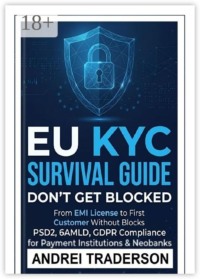
Kitabı oxu: «EU KYC Survival Guide. Don’t get blocked»
© Andrei Traderson, 2026
ISBN 978-5-0071-1952-8
Created with Ridero smart publishing system
EU KYC Survival Guide: Don’t Get Blocked
From EMI License to First Customer Without Blocks
PSD2, 6AMLD & GDPR Compliance for Payment Institutions & Neobanks
By Andrei Traderson
* * *
Disclaimer
This book is a practical, educational playbook written for fintech founders, Chief Compliance Officers (CCOs), MLROs, and compliance managers. It is not legal advice. Regulations evolve, supervisory expectations differ by jurisdiction, and your specific situation may require tailored counsel. The templates, scripts, and examples in this book are realistic illustrations built from publicly available regulatory guidance, enforcement actions, and common industry practice. Where this book references onboarding questions from specific Electronic Money Institutions (EMIs) or audit questions from regulators, these are representative
reconstructions based on how such processes typically work in
practice — not verbatim copies of any company’s confidential internal documents. Always validate against the current text of PSD2 (Directive (EU) 2015/2366), the 6th Anti-Money Laundering Directive (Directive (EU) 2018/1673 and the broader AMLD framework), the GDPR (Regulation (EU) 2016/679), and the rules of your competent authority before relying on anything here in production.
Use it to ship faster. Verify before you sign.
* * *
How To Use This Book
You did not buy this book to learn the theory of money laundering. You bought it because an EMI partner, a sponsor bank, or a regulator is standing between you and your launch — and they keep asking you for documents you do not have, in a format you do not understand, with a deadline that is already too tight.
So this book is built like a field manual, not a textbook.
If you are 2 weeks from a bank onboarding call, jump straight to Chapter 3 (Real Onboarding Questions) and Chapter 2 (Bank-Ready Documents). Bring the answers. Bring the templates.
If you are choosing a license, start with Chapter 1.
The KYC/AML burden of a PI, an EMI, and a banking license are radically different, and picking the wrong one costs you a year.
If you are building the tech, Chapter 4 (Transaction Monitoring) has the rule logic and code you can adapt.
If you are scared of the GDPR/AML conflict, Chapter 5 resolves the paradox that paralyzes most founders.
If your audit is scheduled, Chapter 6 is your rehearsal script.
If you want to know what actually kills companies, Chapter 7 is the graveyard tour: Wirecard, N26, and 15 founder mistakes.
Read it in order once. Then keep it open on the second monitor while you build.
* * *
Introduction: The Product Was Never the Hard Part
Here is the uncomfortable truth that every fintech founder eventually learns, usually too late and too expensively: the product is the easy part.
You can build a beautiful app. You can integrate a card issuer. You can wire up a ledger, a KYC vendor, an IBAN provider, and a slick onboarding flow in a quarter. Engineers are abundant, APIs are mature, and the technical path from idea to a working payment app is more paved than it has ever been.
And then you go to open the account that makes the whole thing real — the safeguarding account, the sponsor relationship, the EMI partnership — and you hit the wall.
The wall is compliance. And the wall does not care how good your app is.
Roughly three out of four EU fintechs that attempt bank or EMI onboarding stumble or fail on the first pass — not because they are fraudulent, not because their idea is bad, but because their AML policy is a Google Doc with three bullet points, their KYC flow has no documented risk tiers, and their transaction monitoring is “we’ll add that later.” The partner asks three questions — Show me your AML policy. Show me your KYC flow.
Show me your transaction monitoring rules. — and the founder
freezes.
Get one answer wrong and you do not get a “try again next week.” You get a six-month delay while you rebuild documentation you should have had on day one. You get €200k—
€500k in legal and consulting fees as you scramble to retrofit a compliance program. Or you get the worst answer of all: a flat, unexplained “No,” with no appeal and no feedback, because the partner has a hundred other applicants and zero obligation to coach you.
This book exists to make sure that does not happen to you.
I have written it as the manual I wish I’d had — the one that skips the academic history of the Financial Action Task Force and gets straight to: here is exactly what they will ask, here is the document that answers it, here is the rule that satisfies the regulator, and here is the mistake that will get you blocked.
Compliance done right is not a tax on your business. It is the moat. The founders who treat AML/KYC as a product feature — designed, documented, and demonstrable — are the ones who onboard in weeks instead of quarters, who survive audits without panic, and who turn “we’re compliant” into a sales advantage when they court enterprise clients.
Let’s get you onboarded.
* * *
Chapter 1 — License Breakdown: PI vs EMI vs Banking License
Before you write a single line of an AML policy, you need to know which regime you are actually in. The single most expensive mistake founders make is choosing a license without understanding the compliance weight attached to it. The KYC/AML obligations of a Payment Institution, an Electronic Money Institution, and a credit institution (bank) are not the same
— and the gap between them is measured in millions of euros and years of runway.
Pulsuz fraqment bitdi.