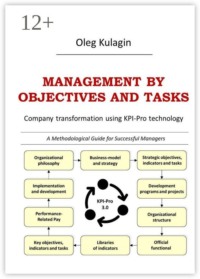
Kitabı oxu: «Management by Objectives and Tasks. Company transformation using KPI-Pro technology»
© Oleg Kulagin, 2026
ISBN 978-5-0070-9250-0
Created with Ridero smart publishing system
Introduction
What is a goal-oriented company? This is a company in which:
1) there is a vision for the future, and all employees know, understand, and share it; a strategy has been developed to move towards this future;
2) strategic and tactical goals have been formulated, continuous monitoring and control of key enterprise and employee indicators, operational analysis of deviations, and management decision-making are carried out;
3) employees understand not only their duties, but also the goals of their work, and do everything necessary and sufficient to achieve them; all people’s thoughts and actions are focused on obtaining results;
4) purposefulness, efficiency, productivity, ambition, innovativeness, proactivity, and development have become the values of the corporate culture and a habit in the work behavior of the staff.
This is the dream of many managers. However, this is an ideal picture that is difficult to achieve for most modern companies. But getting closer to this dream is already something, and that’s a good thing. To do this, you can use both well-known and less well-known tools and techniques for goal management, which are combined into a ten-step KPI-Pro system technology.
The top of the iceberg in KPI-Pro technology is the use of a Key Performance Indicator (KPI) system. It is important to note that in recent years, many managers and some management experts have developed certain prejudices and stereotypes regarding KPIs. Moreover, they are often actively imposed on us by spreading far-fetched myths and disinformation in order to promote another three-letter “magic pill” to the market of management technologies.
In short, the main of these myths are as follows:
1. KPIs are metrics designed only to measure the effectiveness of regular processes, and not to manage change and implement a company’s strategy.
2. KPIs are focused exclusively on financial performance and do not contribute to increasing customer satisfaction or creating value for clients.
3. KPIs are developed locally in different parts and divisions of the organization and are not coordinated with each other or with the goals of the enterprise.
4. KPIs are intended solely for material incentives and calculation of pay based on work results.
5. KPIs are developed by order and are rigidly imposed on employees by cascading from top to bottom.
6. KPIs are used for operational planning of operational activities, rather than for setting ambitious and difficult-to-achieve development goals.
7. KPIs do not provide the necessary focus on the most important work results.
8. KPIs are “set in stone”, it is a rigid and inflexible technology that slows down the development of the organization.
All this is not true. It can be said that in these myths, erroneous and even vicious practices of using KPIs are consciously or unconsciously attributed to the very nature of KPIs. Similarly, it can be argued that a chainsaw or a jackhammer are unsuitable and ineffective tools, since they can cause injury or even… Yes, with the help of KPIs you can also cripple or even destroy your organization if you use them incompetently and only in line with the mythology mentioned above.
The KPI-Pro technology is free from the listed stereotypes, errors and prejudices. The truth is that:
1. KPIs are designed not only to measure operational performance, but also to manage change, innovative projects, and the implementation of a company’s strategy.
2. KPIs are primarily aimed at the interests and goals of clients, both external and internal.
3. KPIs are linked into a coordinated and balanced system that ensures the achievement of the company’s goals.
4. KPIs are not intended for remuneration, but for identifying and analyzing company problems, discussing their causes, managing employees and making various management decisions.
5. KPIs are developed both top-down and bottom-up through discussion and agreement on key objectives between managers and employees.
6. KPIs can be used to set ambitious, inspiring and challenging goals.
7. KPIs focus attention and other resources on achieving a small number of the most important results.
8. KPI system is a flexible system that can quickly restructure and adapt to changing situations in the external or internal environment of an organization.
But the KPI system is not the only tool for goal management. And it is not an end in itself, but just a means for setting specific, measurable, agreed upon, realistic and time-bound strategic and operational objectives for the company, departments, project teams and employees, as well as measuring and monitoring key performance results, feedback, decision making and moving towards business success.
Chapter I. BASICS OF MANAGEMENT BY OBJECTIVES
1.1. How does the management system work?

Let’s start from afar. In the most general and simplified form, the organization’s management system can be represented as a combination of two subsystems: the subject of management and the object of management.
The subject of management is the managers of different levels: from the general director to the heads of structural divisions (departments, workshops, sections, teams, etc.).
The object of management is employees who are responsible for certain work processes and their corresponding performance results.
To achieve these results, managers send information control actions to employees in the form of assignments (orders, requests, etc.), rules (plans, instructions, regulations), objectives and tasks, values, and any other information affecting the object of management. And in this book, we will be most interested in objectives and tasks as one of the possible ways to manage a company. At the same time, we will understand the objectives as qualitative directions of movement or development of the organization and tasks are like “digitized” objectives tied to the cost of resources and time. But more on that later.
Thus, control actions are information. And this information can be conveyed in a variety of ways: orally/in writing, verbally/non-verbally, explicitly/implicitly, personally/publicly, etc. By implementing these actions, employees perform labor actions (work processes) and obtain certain results (financial, market, production, etc.) that are important for external or internal clients.
Information about the results in one form or another (in the form of reports, indicator values, customer reviews, etc.) is transmitted to the subject of management, where it is processed, and decisions are made (if necessary) to adjust control actions in order to eliminate undesirable deviations from planned results (negative feedback) or enhance desirable ones (positive feedback connection).
Then the management cycle repeats. And so it is constantly as long as the organization lives and thrives. And if the management processes are of high quality and high efficiency (which, as you understand, are not the same thing), then your organization will live long and happily.
Depending on the control actions used, several management methods are used simultaneously in any management system, but one of them is the main one, depending on the prevailing corporate culture and the level of maturity of the organization. Let’s consider them below.
1.2. Five management ways

There are five basic management ways, depending on WHAT acts as the key control actions in the organization. These ways correspond to the different types of culture described in the Spiral Dynamics model.
Management by Tradition is the first step, corresponding to the “Culture of Belonging”. Management in such organizations is based on tradition and habits. The main principle is: “we have always worked this way”. As it happened, so it happened. There is no formalization. There is no strategy.
Management by Orders is the second step (“Culture of Force”). At this level of management, managers work in the “manual control” mode, giving employees numerous orders (assignments, requests) and monitoring their execution.
Management by Orders is the management of an organization based on pre-developed and agreed upon rules for performing work and relationships within a team (“Culture of Rules”). Practically, when using this way, the organization describes and optimizes business processes, develops regulations and standards, implements planning procedures, forms an organizational structure, creates various regulatory documents (on divisions, etc.) and, of course, much-loved job descriptions.
Management by Objectives is a way of management based on clearly setting objectives and monitoring their achievement (“Culture of Success”). You need to be aware of your objectives, and not just guess about them or somehow feel them. Awareness of the objectives increases the probability of its achievement. And only then, under a correctly formulated objective, we create or attract the necessary resources and organize the process of its achievement. This is the logic of management by objectives. We will consider all practical tools and technologies of management by objectives later in this book.
Management by Values is the highest level of management. At this level, we are talking about the formation and development of corporate culture. As the saying goes, if we don’t manage culture, culture will manage us. And culture is based on values. Values are always important, but management by values is becoming the dominant way of management in a “Culture of Possibilities” focused on flexibility, innovation and the exploitation of opportunities. In practice, the tools of value-based management include developing the company’s mission and ideology; development of informal rules of labor and relations, enshrined in the corporate code; the introduction of organizational habits (traditions, customs, rituals); the daily use of a variety of managerial attitudes that form the desired norms of behavior.
1.3. What are objectives and tasks?

Since this book is called “Management by Objectives and Tasks”, it is important to immediately agree on the concepts of “objective” and “task”, which we will actively use in the future.
So, any organization is created to achieve its objectives. And management by objectives, as a management technology, begins with the awareness and formulation of the company’s objectives. This is not disputed by anyone. But what exactly is a goal?
Different people understand objectives differently. In management practice, I can identify two approaches to defining objectives.
The first approach: the objective is understood as the direction of desired changes or an idea of some desired state of the organization. For example, maximize profits, increase sales, reduce costs, increase productivity, reduce staff turnover, become a market leader, etc. In this formulation, the objective is defined as a certain vector, i.e. the direction of movement, but it does not specify at what moment and under what conditions the objective is achieved. And this is how, most often, objectives are formulated by managers at the initial stage of objective setting. After all, in order to understand what we plan to achieve, we must first understand what we want in principle, in which direction we should move and develop. Objectives in this form are defined as intentions. And they are formulated qualitatively, in words. We can say that objective setting begins with intentions. From now on we will simply call them objectives. But objectives are the basis for setting tasks. The second approach: the goal is understood as the planned result of the activity.
The second approach: the objective is understood as the planned result of the activity. In this case, the objective statement specifies the specific useful effect we are striving for and the required or acceptable expenditure of resources and time to achieve it. For example, increase revenue by 5% next month, increase customer satisfaction to 85% within a year, complete all project works on time, etc. We will call such objectives tasks. Thus, tasks are formulated on the basis of objectives. And one quality objective can be formalized in the form of one or several tasks. In other words, tasks are “digitized” and time-bound objectives. And it is to setting tasks (not objectives) that we can apply the well-known SMART rules.
So, objectives are formulated qualitatively with the help of words, and then they are “digitized” in the form of tasks. Tasks are not actions or works, as they are often understood. For example, when a manager assigns a task to a subordinate, what does he need from him? For the subordinate to perform some action or achieve a certain result? That’s right, the manager needs a result, not an action for the sake of an action. But this is a result that has not yet been achieved, but planned. Therefore, tasks are also objectives! But objectives that are specific, measurable, agreed upon, realistic and time-bound.
1.4. Rules for setting tasks

As we will see later, setting tasks based on key objectives and key performance indicators is the main procedure in the KPI-Pro technology. Therefore, it is appropriate and useful to recall the rules for setting tasks using the SMART methodology. These rules are used specifically for tasks, but not objectives. We have already found out what the difference is between them. But how this abbreviation is not deciphered! It’s different for everyone. For example, the letter A is often interpreted as “achievable” and the letter R as “realistic.” But aren’t they the same thing? There are other oddities in the interpretation of SMART. I will give the correct interpretation, in my opinion.
The first rule. Tasks should be Specific, i.e. clear, unambiguous and understandable. The task should be formulated in simple language, and it is useful to make sure that the employee understands it correctly.
The second rule. The tasks should be Measurable. To evaluate the performance of a task, it is necessary to be able to measure the result obtained — quantitatively or, at least, qualitatively. Everything seems clear with quantitative assessment. For this, we use quantitative indicators (or metrics). For example, profit, revenue, turnover period, share of defects, logistics cycle, etc. If it is impossible to measure the result quantitatively, then it must be assessed based on qualitative indicators.
The third rule. The tasks must be Agreed. Firstly, here we are talking about the task being agreed upon between the employee and the manager. Secondly, organizational tasks must be aligned “horizontally”. That is, the tasks of related departments and employees should complement each other, and not duplicate each other. In other words, a system of agreed tasks must be created to ensure the achievement of the overall goals of the organization.
The fourth rule. Tasks should be Realistic, i.e. achievable and resourced. But being realistic does not mean that the tasks should be simple. They should be intense, and sometimes ambitious, and require extra effort from the performers.
The fifth rule. Tasks must be Time-bound, i.e. completed by a certain point. At least approximately, but better precisely. And, of course, the time reference should not contradict the previous rule. There should be enough time.
In general, before formulating any management task, it must first be “tested” using the SMART rules. Over time, this will become a habit and an important management skill and practical tool.
1.5. Requirements for objectives

It is important to understand that in order to correctly set organizational objectives, it is necessary to take into account two basic requirements: balance and quality of objectives [21].
The balance of objectives means that the company’s objectives must be balanced in terms of the interests of different stakeholder groups. These are owners, customers, suppliers, partners, investors, staff, etc. Everyone has some interest in us. Therefore, their objectives must be taken into account when formulating the objectives of our organization. And we must try to find a balance of objectives.
The quality of objectives means that the company’s objectives should reflect not only the basic needs of the business, but also flexibly adapt to changes in the external or internal environment, and not only adapt, but try to create and change this environment. Therefore, the criterion for the quality of objectives is their subjectivity, i.e. the extent to which we choose them ourselves.
1.6. Balance of objectives

So, the first requirement is to achieve a balance of objectives.
Any organization is created to satisfy the interests and achieve the objectives of a wide variety of groups of people. The main groups that have the strongest influence on the organization’s activities are owners, customers, managers, staff, and, of course, society as a whole, represented by the state, the local population, public and political organizations, etc. And the objectives of our organization are their objectives, because behind every objective there is someone’s interest.
What objectives do the owners of the business pursue? These are, first of all, increasing profitability, cash flow and increasing the value of the business. But advanced owners, in addition to financial objectives, strive to realize their values through business and increase their own status in society, become a famous and influential person in the city, country, etc.
Let’s turn now to the objectives of the staff. Why do people sacrifice their freedom and join an organization? Of course, their basic interests are material well — being, financial stability, social guarantees, and confidence in the future. But it is also career growth, recognition, respect, communication, development of professionalism, and the realization of one’s life values.
Managers are part of the staff, and therefore they have the same clear and human objectives as the rest of the staff. But at the same time, managers have specific objectives that reflect their special role in the organization. This is an increase in the manageability, efficiency and competitiveness of the enterprise. If this does not happen, the organization will not be able to be an effective tool for doing business, and the managers will not be able to fulfill their functions and obligations to the owners.
The objectives of a business come from the market; these are the objectives of clients in the broad sense of the word — consumers, buyers, suppliers, investors, partners — everyone who is somehow connected with the organization and is interested in its existence and development. All these people and organizations in some sense want something from our company, and we must “serve” them well for them and with benefit for ourselves.
The goals of society and the state cannot be ignored either. And what does this include? It is the entire world that surrounds the organization and extends far beyond the market. And this world has many of its own objectives. And so that the company’s objectives do not contradict, but preferably contribute to the achievement of society’s goals, business must strive for sustainable development, which is based on three principles: responsible attitude to the environment, social responsibility and high level of corporate governance (ESG). Otherwise, there may be problems.
Thus, the company’s objectives must reflect the interests of the owners, the market, the staff and society as a whole. In other words, the system of objectives must be harmonious and balanced. And there is a special technology for formulating balanced company objectives. We will study it.