Kitabı oxu: «A History of North American Birds, Land Birds. Volume 3»
RAPTORES. 1 —The Birds of Prey
The group of birds usually known as the Raptores, or Rapacious Birds, embraces three well-marked divisions, namely, the Owls, the Hawks, and the Vultures. In former classifications they headed the Class of Birds, being honored with this position in consequence of their powerful organization, large size, and predatory habits. But it being now known that in structure they are less perfectly organized than the Passeres and Strisores, birds generally far more delicate in organization, as well as smaller in size, they occupy a place in the more recent arrangements nearly at the end of the Terrestrial forms.
The complete definition of the order Raptores, and of its subdivisions, requires the enumeration of a great many characters; and that their distinguishing features may be more easily recognized by the student, I give first a brief diagnosis, including their simplest characters, to be followed by a more detailed account hereafter.
Common Characters. Bill hooked, the upper mandible furnished at the base with a soft skin, or “cere,” in which the nostrils are situated. Toes, three before and one behind. Raptores.
Strigidæ. Eyes directed forwards, and surrounded by radiating feathers, which are bounded, except anteriorly, by a circle or rim of differently formed, stiffer feathers. Outer toe reversible. Claws much hooked and very sharp. Legs and toes usually feathered, or, at least, coated with bristles. The Owls.
Falconidæ. Eyes lateral, and not surrounded by radiating feathers. Outer toe not reversible (except in Pandion). Claws usually hooked and sharp, but variable. Head more or less completely feathered. The Hawks.
Cathartidæ. Eyes lateral; whole head naked. Outer toe not reversible; claws slightly curved, blunt. The Vultures.
The preceding characters, though purely artificial, may nevertheless serve to distinguish the three families of Raptores belonging to the North American Ornis; a more scientific diagnosis, embracing a sufficient number of osteological, and accompanying anatomical characters, will be found further on.
The birds of prey—named Accipitres by some authors, and Raptores or Rapaces by others, and very appropriately designated as the Ætomorphæ by Professor Huxley—form one of the most strongly characterized and sharply limited of the higher divisions of the Class of Birds. It is only recently, however, that their place in a systematic classification and the proper number and relation of their subdivisions have been properly understood. Professor Huxley’s views will probably form the basis for a permanent classification, as they certainly point the way to one eminently natural. In his important paper entitled “On the Classification of Birds, and on the Taxonomic Value of the Modifications of certain Cranial Bones observable in that Class,”2 this gentleman has dealt concisely upon the affinities of the order Raptores, and the distinguishing features of its subdivisions. In the following diagnoses the osteological characters are mainly borrowed from Professor Huxley’s work referred to. Nitzsch’s “Pterylography”3 supplies such characters as are afforded by the plumage, most of which confirm the arrangement based upon the osteological structure; while important suggestions have been derived from McGillivray’s “History of British Birds.”4 The Monographs of the Strigidæ and Falconidæ, by Dr. J. J. Kaup,5 contain much valuable information, and were they not disfigured by a very eccentric system of arrangement they would approach nearer to a natural classification of the subfamilies, genera, and subgenera, than any arrangement of the lesser groups which I have yet seen.
The species of this group are spread over the whole world, tropical regions having the greatest variety of forms and number of species. The Strigidæ are cosmopolitan, most of the genera belonging to both continents. The Falconidæ are also found the world over, but each continent has subfamilies peculiar to it. The Cathartidæ are peculiar to America, having analogous representatives in the Old World in the subfamily Vulturinæ belonging to the Falconidæ, The Gypogeranidæ are found only in South Africa, where a single species, Gypogeranus serpentarius (Gmel.), sole representative of the family, is found.
As regards the comparative number of species of this order in the two continents, the Old World is considerably ahead of the New World, which might be expected from its far greater land area. 581 species are given in Gray’s Hand List,6 of which certainly not more than 500, probably not more than 450, are valid species, the others ranking as geographical races, or are synonymous with others; of this number about 350 nominal species are accredited to the Old World. America, however, possesses the greatest variety of forms, and the great bulk of the Old World Raptorial fauna is made up chiefly by a large array of species of a few genera which are represented in America by but one or two, or at most half a dozen, species. The genera Aquila, Spizætus, Accipiter, Haliætus, Falco, Circus, Athene, Strix, and Buteo, are striking examples. As regards the number of peculiar forms, America is considerably ahead.
Family STRIGIDÆ.—The Owls
Char. Eyes directed forward, and surrounded by a radiating system of feathers, which is bounded, except anteriorly, by a ruff of stiff, compactly webbed, differently formed, and somewhat recurved feathers; loral feathers antrorse, long, and dense. Plumage very soft and lax, of a fine downy texture, the feathers destitute of an after-shaft. Oil-gland without the usual circlet of feathers. Outer webs of the quills with the points of the fibres recurved. Feathers on the sides of the forehead frequently elongated into ear-like tufts; tarsus usually, and toes frequently, densely feathered. Ear-opening very large, sometimes covered by a lappet. Œsophagus destitute of a dilated crop; cœca large. Maxillo-palatines thick and spongy, and encroaching upon the intervening valley; basipterygoid processes always present. Outer toe reversible; posterior toe only about half as long as the outer. Posterior margin of the sternum doubly indented; clavicle weak and nearly cylindrical, about equal in length to the sternum. Anterior process of the coracoid projected forward so as to meet the clavicle, beneath the basal process of the scapula. Eggs variable in shape, usually nearly spherical, always immaculate, pure white.
The Owls constitute a very natural and sharply limited family, and though the species vary almost infinitely in the details of their structure, they all seem to fall within the limits of a single subfamily.
They have never yet been satisfactorily classified, and all the arrangements which have been either proposed or adopted are refuted by the facts developed upon a close study into the true relationship of the many genera. The divisions of “Night Owls,” “Day Owls,” “Horned Owls,” etc., are purely artificial. This family is much more homogeneous than that of the Falconidæ, since none of the many genera which I have examined seem to depart in their structure from the model of a single subfamily, though a few of them are somewhat aberrant as regards peculiarities in the detail of external form, or, less often, to a slight extent, in their osteological characters, though I have examined critically only the American and European species; and there may be some Asiatic, African, or Australian genera which depart so far from the normal standard of structure as to necessitate a modification of this view. In the structure of the sternum there is scarcely the least noticeable deviation in any genus7 from the typical form. The appreciable differences appear to be only of generic value, such as a different proportionate length of the coracoid bones and the sternum, and width of the sternum in proportion to its length, or the height of its keel. The crania present a greater range of variation, and, if closely studied, may afford a clew to a more natural arrangement than the one which is here presented. The chief differences in the skulls of different genera consist in the degree of pneumaticity of the bones, in the form of the auricular bones, the comparative length and breadth of the palatines, and very great contrasts in the contour. As a rule, we find that those skulls which have the greatest pneumaticity (e.g. Strix and Otus) are most depressed anteriorly, have the orbital septum thicker, the palatines longer and narrower, and a deeper longitudinal median valley on the superior surface, and vice versa.
The following classification is based chiefly upon external characters; but these are in most instances known to be accompanied by osteological peculiarities, which point to nearly the same arrangement. It is intended merely as an artificial table of the North American genera, and may be subjected to considerable modification in its plan if exotic genera are introduced.8
Genera and Subgenera
A. Inner toe equal to the middle in length; inner edge of middle claw pectinated. First quill longer than the third; all the quills with their inner webs entire, or without emargination. Tail emarginated. Feathers of the posterior face of the tarsus recurved, or pointed upwards.
1. Strix. No ear-tufts; bill light-colored; eyes black; tarsus nearly twice as long as middle toe; toes scantily haired. Size medium. Ear-conch nearly as long as the height of the skull, with an anterior operculum for only a portion of its length; symmetrical.
B. Inner toe decidedly or much shorter than the middle; inner edge of middle claw not pectinated. First quill shorter than the third; one to six outer quills with their inner webs emarginated. Tail rounded. Feathers of the posterior face of the tarsus not recurved but pointed downwards.
I. Nostril open, oval, situated in the anterior edge of the cere, which is not inflated.
a. Cere, on top, equal to, or exceeding, the chord of the culmen; much arched. Ear-conch nearly as long as the height of the skull, with the operculum extending its full length; asymmetrical.
2. Otus. One or two outer quills with their inner webs emarginated. With or without ear-tufts. Bill blackish; iris yellow. Size medium.
Ear-tufts well developed; only one quill emarginated … Otus.
Ear-tufts rudimentary; two quills emarginated … Brachyotus.
b. Cere, on top, less than the chord of the culmen; gradually ascending basally, or level (not arched). Ear-conch nearly the height of the skull, with the operculum extending only a part of its full length, or wanting entirely.
† Anterior edge of the ear-conch with an operculum; the two ears asymmetrical.
3. Syrnium. Five to six outer quills with their inner webs emarginated. Top of cere more than half the culmen. Without ear-tufts. Bill yellow; iris yellow or black. Size medium or large.
Six quills emarginated; toes densely feathered, the terminal scutellæ concealed; iris yellow. Size very large … Scotiaptex.
Five quills emarginated; toes scantly feathered, the terminal scutellæ exposed; iris black. Size medium … Syrnium.
4. Nyctale. Two outer quills with inner webs emarginated. Top of cere less than half the culmen, level. Without ear-tufts. Bill yellow or blackish; iris yellow. Size small.
†† Anterior edge of the ear-conch without an operculum. The two ears symmetrical. Tail slightly rounded, only about half as long as the wing.
5. Scops. Two to five quills with inner webs emarginated; second to fifth longest. Bill weak, light-colored. Ear-conch elliptical, about one-third the height of the head, with a slightly elevated fringed anterior margin. Size small; ear-tufts usually well developed, sometimes rudimentary.
6. Bubo. Two to four outer quills with inner webs emarginated; third to fourth longest. Bill robust, black. Ear-conch elliptical, simple, from one third to one half the height of the skull. Size large. Ear-tufts well developed or rudimentary.
Ear-tufts well developed. Two to three outer quills with inner webs emarginated; lower tail-coverts not reaching end of the tail. Toes covered with short feathers, the claws exposed, and bill not concealed by the loral feathers … Bubo.
Ear-tufts rudimentary. Four outer quills with their inner webs emarginated; lower tail-coverts reaching end of the tail. Toes covered with long feathers, which hide the claws, and bill nearly concealed by the loral feathers … Nyctea.
††† Similar to the last, but the tail graduated, nearly equal to the wing.
7. Surnia. Four outer quills with inner webs emarginated. Third quill longest. Bill strong, yellow; ear-conch simple, oval, less than the diameter of the eye. Size medium; no ear-tufts.
II. Nostril, a small circular opening into the surrounding inflated membrane of the cere. Ear-conch small, simple, oval, or nearly round, without an operculum.
First quill shorter than the tenth.
8. Glaucidium. Third to fourth quills longest; four emarginated on inner webs. Tarsus about equal to the middle toe, densely feathered. Tail much more than half the wing, rounded. Bill and iris yellow. Size very small.
9. Micrathene. Fourth quill longest; four emarginated on inner webs. Tarsus a little longer than middle toe, scantily haired. Tail less than half the wing, even. Bill light (greenish ?); iris yellow. Size very small.
First quill longer than sixth.
10. Speotyto. Second to fourth quills longest; three emarginated on inner webs. Tarsus more than twice as long as middle toe, closely feathered in front to the toes, naked behind. Tail less than half the wing, slightly rounded. Bill yellowish; iris yellow. Size small.
In their distribution, the Owls, as a family, are cosmopolitan, and most of the genera are found on both hemispheres. All the northern genera (Nyctea, Surnia, Nyctale, and Scotiaptex), and the majority of their species, are circumpolar. The genus Glaucidium is most largely developed within the tropics, and has numerous species in both hemispheres. Otus brachyotus and Strix flammea are the only two species which are found all over the world,—the former, however, being apparently absent in Australia. Gymnoglaux, Speotyto, Micrathene, and Lophostrix are about the only well-characterized genera peculiar to America. Athene, Ketupa, and Phodilus are peculiar to the Old World. The approximate number of known species (see Gray’s Hand List of Birds, I, 1869) is about two hundred, of which two, as stated, are cosmopolitan; six others (Surnia ulula, Nyctea scandiaca, Glaucidium passerinum, Syrnium cinereum, Otus vulgaris, and Nyctale tengmalmi) are found in both halves of the Northern Hemisphere; of the remainder there are about an equal number peculiar to America and the Old World.
As regards the distribution of the Owls in the Nearctic Realm, a prominent feature is the number of the species (eighteen, not including races) belonging to it, of which six (Micrathene whitneyi, Nyctale acadica, Syrnium nebulosum, S. occidentale, Scops asio, and S. flammeola) are found nowhere else. Speotyto cunicularia and Bubo virginianus are peculiarly American species found both north and south of the equator, but in the two regions represented by different geographical races. Glaucidium ferrugineum and G. infuscatum (var. gnoma) are tropical species which overreach the bounds of the Neotropical Realm,—the former extending into the United States, the latter reaching to, and probably also within, our borders. Of the eighteen North American species, about nine, or one half (Strix flammea var. pratincola, Otus brachyotus, O. vulgaris var. wilsonianus, Syrnium cinereum, Nyctale acadica, Bubo virginianus, and Scops asio, with certainty, and Nyctea scandiaca var. arctica, and Surnia ulula var. hudsonia, in all probability), are found entirely across the continent. Nyctale tengmalmi, var. richardsoni, and Syrnium nebulosum, appear to be peculiar to the eastern portion,—the former to the northern regions, the latter to the southern. Athene cunicularia var. hypugaea, Micrathene whitneyi, Glaucidium passerinum var. californicum, Syrnium occidentale, and Scops flammeola, are exclusively western, all belonging to the southern portion of the Middle Province and Rocky Mountain region, and the adjacent parts of Mexico, excepting the more generally distributed Speotyto cunicularia, var. hypogæa, before mentioned. Anomalies in regard to the distribution of some of the species common to both continents, are the restriction of the American representative of Glaucidium passerinum to the western regions,9 and of Strix flammea to the very southern and maritime portions of the United States, the European representatives of both species being generally distributed throughout that continent. On the other hand, the northwest-coast race of our Scops asio (S. kennicotti) seems to be nearly identical with the Japanese S. semitorques (Schlegel), which is undoubtedly referrible to the same species.
As regards their plumage, the Owls differ most remarkably from the Hawks in the fact that the sexes are invariably colored alike, while from the nest to perfect maturity there are no well-marked progressive stages distinguishing the different ages of a species. The nestling, or downy, plumage, however, of many species, has the intricate pencilling of the adult dress replaced by a simple transverse barring upon the imperfect downy covering. The downy young of Nyctea scandiaca is plain sooty-brown, and that of Strix flammea immaculate white.
In many species the adult dress is characterized by a mottling of various shades of grayish mixed with ochraceous or fulvous, this ornamented by a variable, often very intricate, pencilling of dusky, and more or less mixed with white. As a consequence of the mixed or mottled character of the markings, the plumage of the Owls is, as a rule, difficult to describe.
In the variations of plumage, size, etc., with differences of habitat, there is a wide range, the usually recognized laws10 applying to most of those species which are generally distributed and resident where breeding. Of the eight species common to the Palæarctic and Nearctic Realms, all but one (Otus brachyotus) are modified so as to form representative geographical races on the two continents. In each of these cases the American bird is much darker than the European, the brown areas and markings being not only more extended, but deeper in tint. The difference in this respect is so tangible that an experienced ornithologist can instantly decide to which continent any specimen belongs. Of the two cosmopolitan species one, Otus brachyotus, is identical throughout; the other is modified into geographical races in nearly every well-marked province of its habitat. Thus in the Palæarctic Realm it is typical Strix flammea; in the Nearctic Realm it is var. pratincola; while Tropical America has at least three well-marked geographical races, the species being represented in Middle America by the var. guatemalæ, in South America by var. perlata, and in the West Indies by the var. furcata. The Old World has also numerous representative races, of which we have, however, seen only two, namely, var. javanica (Gm.), of Java, India, and Eastern Africa, and var. delicatula (Gould) of Australia, both of which we unhesitatingly refer to S. flammea.11
On the North American continent the only widely distributed species which do not vary perceptibly with the region are Otus brachyotus and O. vulgaris (var. wilsonianus). Bubo virginianus, Scops asio, and Syrnium nebulosum all bear the impress of special laws in the several regions of their habitat. Starting with the Eastern Province, and tracing either of these three species southward, we find it becoming gradually smaller, the colors deeper and more rufous, and the toes more scantily feathered. Scops asio reaches its minimum of size and maximum depth of color in Florida (var. floridana) and in Mexico (var. enano).
Of the other two I have not seen Florida specimens, but examples of both from other Southern States and the Lower Mississippi Valley region are much more rufous, and—the S. nebulosum especially—smaller, with more naked toes. The latter species is darkest in Eastern Mexico (var. sartori), and most rufescent, and smallest, in Guatemala (var. fulvescens). In the middle region of the United States, Scops asio (var. maccalli) and Bubo virginianus (var. arcticus) are more grayish and more delicately pencilled than from other portions. In the northwest coast region they become larger and much more darkly colored, assuming the clove-brown or sooty tints peculiar to the region. The var. kennicotti represents S. asio in this region, and var. pacificus the B. virginianus. The latter species also extends its range around the Arctic Coast to Labrador, and forms a northern littoral race, the very opposite extreme in color from the nearly albinescent examples of var. arcticus found in the interior of Arctic America.
A very remarkable characteristic of the Owls is the fact that many of the species exist in a sort of dimorphic condition, or that two plumages sufficiently unlike to be of specific importance in other cases belong to one species. It was long thought that these two phases represented two distinct species; afterwards it was maintained that they depended on age, sex, or season, different authors or observers entertaining various opinions on the subject; but it is now generally believed that every individual retains through life the plumage which it first acquires, and that young birds of both forms are often found in the same nest, their parents being either both of one form, or both of the other, or the two styles paired together.12 The normal plumage, in these instances, appears to be grayish, the pattern distinct, the markings sharply defined, and the general appearance much like that of species which do not have the other plumage. The other plumage is a replacing of the grayish tints by a bright lateritious-rufous, the pencillings being at the same time less well defined, and the pattern of the smaller markings often changed. This condition seems to be somewhat analogous to melanism in certain Falconidæ, and appears to be more common in the genera Scops and Glaucidium (in which it affects mainly the tropical species), and occurs also in the European Syrnium aluco. As studied with relation to our North American species, we find it only in Scops asio and Glaucidium ferrugineum. The latter, being strictly tropical in its habitat, is similarly affected throughout its range; but in the former we find that this condition depends much upon the region. Thus neither Dr. Cooper nor I have ever seen a red specimen from the Pacific coast, nor do I find any record of such an occurrence. The normal gray plumage, however, is as common throughout that region as in the Atlantic States. In the New England and Middle States the red plumage seems to be more rare in most places than the gray one, while toward the south the red predominates greatly. Of over twenty specimens obtained in Southern Illinois (Mt. Carmel) in the course of one winter, only one was of the gray plumage; and of the total number of specimens seen and secured at other times during a series of years, we can remember but one other gray one. As a parallel example among mammals, Professor Baird suggests the case of the Red-bellied Squirrels and Foxes of the Southern States, whose relationships to the more grayish northern and western forms appear to be about the same as in the present instance.
Genus STRIX, Savigny
Strix, Savigny, 1809 (nec Linn. 1735). (Type, Strix flammea, Linn.)
Stridula, Sellys-Longch, 1842.
Eustrinx, Webb & Berth. 1844.
Hybris, Nitzsch.

6885 ⅓
Strix pratincola.
Gen. Char. Size medium. No ear-tufts; facial ruff entirely continuous, very conspicuous. Wing very long, the first or second quill longest, and all without emargination. Tail short, emarginated. Bill elongated, compressed, regularly curved; top of the cere nearly equal to the culmen, straight, and somewhat depressed. Nostril open, oval, nearly horizontal. Eyes very small. Tarsus nearly twice as long as the middle toe, densely clothed with soft short feathers, those on the posterior face inclined upwards; toes scantily bristled; claws extremely sharp and long, the middle one with its inner edge pectinated. Ear-conch nearly as long as the height of the head, with an anterior operculum, which does not extend its full length; the two ears symmetrical?
The species of Strix are distributed over the whole world, though only one of them is cosmopolitan. This is the common Barn Owl (S. flammea), the type of the genus, which is found in nearly every portion of the world, though in different regions it has experienced modifications which constitute geographical races. The other species, of more restricted distribution, are peculiar to the tropical portions of the Old World, chiefly Australia and South Africa.
Synopsis of the Races of S. flammea
S. flammea. Face varying from pure white to delicate claret-brown; facial circle varying from pure white, through ochraceous and rufous, to deep black. Upper parts with the feathers ochraceous-yellow basally; this overlaid, more or less continuously, by a grayish wash, usually finely mottled and speckled, with dusky and white. Primaries and tail barred transversely, more or less distinctly, with distant dusky bands, of variable number. Beneath, varying from pure snowy white to tawny rufous, immaculate or speckled. Wing, 10.70–13.50.
Wing, 10.70–12.00; tail, 4.80–5.50; culmen, .75–.80; tarsus, 2.05–2.15; middle toe, 1.25–1.30. Tail with four dark bands, and sometimes a trace of a fifth. Hab. Europe and Mediterranean region of Africa … var. flammea.13
Wing, 12.50–14.00; tail, 5.70–7.50; culmen, .90–1.00; tarsus, 2.55–3.00. Tail with four dark bands, and sometimes a trace of a fifth. Colors lighter than in var. flammea. Hab. Southern North America and Mexico … var. pratincola.
Wing, 11.30–13.00; tail, 5.30–5.90; tarsus, 2.55–2.95. Colors of var. flammea, but more uniform above and more coarsely speckled below. Hab. Central America, from Panama to Guatemala … var. guatemalæ.14
Wing, 11.70–12.00; tail, 4.80–5.20; tarsus, 2.40–2.75. Tail more even, and lighter colored; the dark bars narrower, and more sharply defined. Colors generally paler, and more grayish. Hab. South America (Brazil, etc.) … var. perlata.15
Wing, 12.00–13.50; tail, 5.60–6.00; culmen, .85–.95; tarsus, 2.70–2.85; middle toe, 1.45–1.60. Colors as in var. perlata, but secondaries and tail nearly white, in abrupt contrast to the adjacent parts; tail usually without bars. Hab. West Indies (Cuba and Jamaica, Mus. S. I.) … var. furcata.16
Wing, 11.00; tail, 5.00; culmen, about .85; tarsus, 2.05–2.45; middle toe, 1.30–1.40. Colors of var. pratincola, but less of the ochraceous, with a greater prevalence of the gray mottling. Tail with four dark bands Hab. Australia … var. delicatula.17
Wing, 11.00–11.70; tail, 5.10–5.40; culmen, .85–.90; tarsus, 2.30–2.45; middle toe, 1.35–1.45. Same colors as var. delicatula. Tail with four dark bands (sometimes a trace of a fifth). Hab. India and Eastern Africa … var. javanica.18
Strix flammea, var. pratincola, Bonap
AMERICAN BARN OWL
Strix pratincola, Bonap. List, 1838, p. 7.—De Kay, Zoöl. N. Y. II, 1844, 31, pl. xiii. f. 28.—Gray, Gen. B., fol. sp. 2.—Cassin, B. Cal. & Tex. 1854, p. 176.—Newb. P. R. Rep. VI, iv, 1857, 76.—Heerm. do. VII, 1857, 34.—Cass. Birds N. Am. 1858, 47.—Coues, Prod. Orn. Ariz. (P. A. N. S. Philad. 1866), 13.—Scl. P. Z. S. 1859, 390 (Oaxaca).—Dresser, Ibis, 1865, 330 (Texas).—? Bryant, Pr. Bost. Soc. 1867, 65 (Bahamas). Strix perlata, Gray, List Birds Brit. Mus. 1848, 109 (not S. perlata of Licht. !).—Ib. Hand List, I, 1869, 52.—Kaup, Monog. Strig. Pr. Zoöl. Soc. Lond. IV, 1859, 247. Strix americana, Aud. Synop. 1839, 24.—Brewer, Wilson’s Am. Orn. 1852, 687. Strix flammea, Max. Reise Bras. II, 1820, 265.—Wils. Am. Orn. 1808, pl. l, f. 2.—James, ed. Wilson’s Am. Orn. I, 1831, 111.—Aud. B. Am. 1831, pl. clxxi.—Ib. Orn. Biog. II, 1831, 403.—Spix, Av. Bras. I, 21.—Vig. Zoöl. Jour. III, 438.—Ib. Zoöl. Beech. Voy. p. 16.—Bonap. Ann. N. Y. Lyc. II, 38.—Ib. Isis, 1832, 1140; Consp. Av. p. 55.—Gray, List Birds Brit. Mus. 1844, 54.—Nutt. Man. 1833, 139. Ulula flammea, Jardine, ed. Wilson’s Am. Orn. II, 1832, 264. Strix flammea, var. americana, Coues, Key, 1872, 201.
Char. Average plumage. Ground-color of the upper parts bright orange-ochraceous; this overlaid in cloudings, on nearly the whole of the surface, with a delicate mottling of blackish and white; the mottling continuous on the back and inner scapulars, and on the ends of the primaries more faint, while along their edges it is more in the form of fine dusky dots, thickly sprinkled. Each feather of the mottled surface (excepting the secondaries and primaries) has a medial dash of black, enclosing a roundish or cordate spot of white near the end of the feather; on the secondaries and primaries, the mottling is condensed into obsolete transverse bands, which are about four in number on the former and five on the latter; primary coverts deeper orange-rufous than the other portions, the mottling principally at their ends. Tail orange-ochraceous, finely mottled—most densely terminally—with dusky, fading into whitish at the tip, and crossed by about five distinct bands of mottled dusky. Face white, tinged with wine-red; an ante-orbital spot of dark claret-brown, this narrowly surrounding the eye; facial circle, from forehead down to the ears (behind which it is white for an inch or so) soft orange-ochraceous, similar to the ground-color of the upper parts; the lower half (from ears across the throat) deeper ochraceous, the tips of the feathers blackish, the latter sometimes predominating. Lower parts snowy-white, but this more or less overlaid with a tinge of fine orange-ochraceous, lighter than the tint of the upper parts; and, excepting on the jugulum, anal region, and crissum, with numerous minute but distinct specks of black; under surface of wings delicate yellowish-white, the lining sparsely sprinkled with black dots; inner webs of primaries with transverse bars of mottled dusky near their ends.
Extreme plumages. Darkest (No. 6,884, ♂, Tejon Valley, Cal.; “R. S. W.” Dr. Heermann): There is no white whatever on the plumage, the lower parts being continuous light ochraceous; the tibiæ have numerous round spots of blackish. Lightest (No. 6,885, same locality): Face and entire lower parts immaculate snowy-white; facial circle white, with the tips of the feathers orange; the secondaries, primaries, and tail show no bars, their surface being uniformly and finely mottled.
Measurements (♂, 6,884, Tejon Valley, Cal.; Dr. Heermann). Wing, 13.00; tail, 5.70; culmen, .90; tarsus, 2.50; middle toe, 1.25. Wing-formula, 2, 1–3. Among the very numerous specimens in the collection, there is not one marked ♀. The extremes of a large series are as follows: Wing, 12.50–14.00; tail, 5.70–7.50; culmen, .90–1.10; tarsus, 2.55–3.00.
Hab. More southern portions of North America, especially near the sea-coast, from the Middle States southward, and along the southern border to California; whole of Mexico. In Central America appreciably modified into var. guatemalæ. In South America replaced by var. perlata, and in the West Indies by the quite different var. furcata.
Localities: Oaxaca (Scl. P. Z. S. 1859, 390); Texas (Dresser, Ibis, 1865, 330); Arizona (Coues, P. A. N. S. 1866, 49); ? Bahamas (Bryant, Pr. Bost. Soc. 1867, 65). Kansas (Snow, List of B. Kansas); Iowa (Allen, Iowa Geol. Report, II, 424).

6885 ½ nat. size.
Strix pratincola.
The variations of plumage noted above appear to be of a purely individual nature, since they do not depend upon the locality; nor, as far as we can learn, to any considerable extent, upon age or sex.
Habits. On the Atlantic coast this bird very rarely occurs north of Pennsylvania. It is given by Mr. Lawrence as very rare in the vicinity of New York, and in three instances, at least, it has been detected in New England. An individual is said, by Rev. J. H. Linsley, to have been taken in 1843, in Stratford, Conn.; another was shot at Sachem’s Head in the same State, October 28, 1865; and a third was killed in May, 1868, near Springfield, Mass.
In the vicinity of Philadelphia the Barn Owl is not very rare, but is more common in spring and autumn than in the summer. Its nests have been found in hollow trees near marshy meadows. Southward it is more or less common as far as South Carolina, where it becomes more abundant, and its range then extends south and west as far as the Pacific. It is quite plentiful in Texas and New Mexico, and is one of the most abundant birds of California. It was not met with by Dr. Woodhouse in the expedition to the Zuñi River, but this may be attributed to the desolate character of the country through which he passed, as it is chiefly found about habitations, and is never met with in wooded or wild regions.

Strix flammea.
Dr. Heermann and Dr. Gambel, who visited California before the present increase in population, speak of its favorite resort as being in the neighborhood of the Missions, and of its nesting under the tiled roofs of the houses. The latter also refers to his finding numbers under one roof, and states that they showed no fear when approached. The propensity of the California bird to drink the sacred oil from the consecrated lamps about the altars of the Missions was frequently referred to by the priests, whenever any allusion was made to this Owl. Dr. Gambel also found it about farm-houses, and occasionally in the prairie valleys, where it obtains an abundance of food, such as mice and other small animals.
Dr. Heermann, in a subsequent visit to the State, mentions it as being a very common bird in all parts of California. They were once quite numerous among the hollow trees in the vicinity of Sacramento, but have gradually disappeared, as their old haunts were one by one destroyed to make way for the gradual development and growth of that city. Dr. Heermann found a large number in the winter, sheltered during the day among the reeds of Suisun Valley. They were still abundant in the old Catholic Missions, where they frequented the ruined walls and towers, and constructed their nests in the crevices and nooks of those once stately buildings, now falling to decay. These ruins were also a shelter for innumerable bats, reptiles, and vermin, which formed an additional attraction to the Owls.
Dr. Cooper speaks of finding this Owl abundant throughout Southern California, especially near the coast, and Dr. Newberry frequently met with it about San Francisco, San Diego, and Monterey, where it was more common than any other species. He met with it on San Pablo Bay, inhabiting holes in the perpendicular cliffs bordering the south shore. It was also found in the Klamath Basin, but not in great numbers.
Mr. J. H. Clark found the Barn Owl nesting, in May, in holes burrowed into the bluff banks of the Rio Frio, in Texas. These burrows were nearly horizontal, with a considerable excavation near the back end, where the eggs were deposited. These were three or four in number, and of a dirty white. The parent bird allowed the eggs to be handled without manifesting any concern. There was no lining or nest whatever. Lieutenant Couch found them common on the Lower Rio Grande, but rare near Monterey, Mexico. They were frequently met with living in the sides of large deep wells.
Dr. Coues speaks of it as a common resident species in Arizona. It was one of the most abundant Owls of the Territory, and was not unfrequently to be observed at midday. On one occasion he found it preying upon Blackbirds, in the middle of a small open reed swamp.
It is not uncommon in the vicinity of Washington, and after the partial destruction of the Smithsonian Building by fire, for one or two years a pair nested in the top of the tower. It is quite probable that the comparative rarity of the species in the Eastern States is owing to their thoughtless destruction, the result of a short-sighted and mistaken prejudice that drives away one of our most useful birds, and one which rarely does any mischief among domesticated birds, but is, on the contrary, most destructive to rats, mice, and other mischievous and injurious vermin.
Mr. Audubon mentions two of these birds which had been kept in confinement in Charleston, S. C., where their cries in the night never failed to attract others of the species. He regards them as altogether crepuscular in habits, and states that when disturbed in broad daylight they always fly in an irregular and bewildered manner. Mr. Audubon also states that so far as his observations go, they feed entirely on small quadrupeds, as he has never found the remains of any feathers or portions of birds in their stomachs or about their nests. In confinement it partakes freely of any kind of flesh.
The Cuban race (var. furcata), also found in other West India islands, is hardly distinguishable from our own bird, and its habits may be presumed to be essentially the same. Mr. Gosse found the breeding-place of the Jamaica Owl at the bottom of a deep limestone pit, in the middle of October; there was one young bird with several eggs. There was not the least vestige of a nest; the bird reposed on a mass of half-digested hair mingled with bones. At a little distance were three eggs, at least six inches apart. On the 12th of the next month he found in the same place the old bird sitting on four eggs, this time placed close together. There was still no nest. The eggs were advanced towards hatching, but in very different degrees, and an egg ready for deposition was found in the oviduct of the old bird.
An egg of this Owl, taken in Louisiana by Dr. Trudeau, measured 1.69 inches in length by 1.38 in breadth. Another, obtained in New Mexico, measures 1.69 by 1.25. Its color is a dirty yellowish-white, its shape an oblong oval, hardly more pointed at the smaller than at the larger end.
An egg from Monterey, California, collected by Dr. Canfield, measures 1.70 inches in length by 1.25 in breadth, of an oblong-oval shape, and nearly equally obtuse at either end. It is of a uniform bluish-white. Another from the Rio Grande is of a soiled or yellowish white, and of the same size and shape.
Genus OTUS, Cuvier
Otus, Cuv. Reg. An. 1799. (Type, Strix otus, Linn.)
Asio, Swains. 1831 (nec Brisson, 1760).
Brachyotus, Gould, P. Z. S. 1837, 10. (Type, Stryx brachyotus.)
Ægolius, Keys. & Bl. 1840 (nec Kaup, 1829).
Char. Size medium. Ear-tufts well developed or rudimentary; head small; eyes small. Cere much arched, its length more than the chord of the culmen. Bill weak, compressed. Only the first, or first and second, outer primary with its inner web emarginated. Tail about half the wing, rounded. Ear-conch very large, gill-like, about as long as the height of the skull, with an anterior operculum, which extends its full length, and bordered posteriorly by a raised membrane; the two ears asymmetrical.
Species and Varieties
A. Otus, Cuvier. Ear-tufts well developed; outer quill only with inner web emarginated.
Colors blackish-brown and buffy-ochraceous,—the former predominating above, where mottled with whitish; the latter prevailing beneath, and variegated with stripes or bars of dusky. Tail, primaries, and secondaries, transversely barred (obsoletely in O. stygius).
1. O. vulgaris. Ends of primaries normal, broad; toes feathered; face ochraceous.
Dusky of the upper parts in form of longitudinal stripes, contrasting conspicuously with the paler ground-color. Beneath with ochraceous prevalent; the markings in form of longitudinal stripes, with scarcely any transverse bars. Hab. Europe and considerable part of the Old World … var. vulgaris.19
Dusky of the upper parts in form of confused mottling, not contrasting conspicuously with the paler ground-color. Beneath with the ochraceous overlaid by the whitish tips to the feathers; the markings in form of transverse bars, which are broader than the narrow medial streak. Wing, 11.50–12.00; tail, 6.00–6.20; culmen, .65; tarsus, 1.20–1.25; middle toe, 1.15. Wing-formula, 2, 3–4–1. Hab. North America … var. wilsonianus.
2. O. stygius.20 Ends of primaries narrow, that of the first almost falcate; toes entirely naked; face dusky, or with dusky prevailing.
Above blackish-brown, thinly relieved by an irregular sparse spotting of yellowish-white. Beneath with the markings in form of longitudinal stripes, which throw off occasional transverse arms toward the edge of the feathers. Wing, 13.00; tail, 6.80; culmen, .90; tarsus, 1.55; middle toe, 1.50. Wing-formula, 2, 3–4, 1. Hab. South America.
B. Brachyotus, Gould (1837). Similar to Otus, but ear-tufts rudimentary, and the second quill as well as the first with the inner web emarginated.
Colors ochraceous, or white, and clear dark brown, without shadings or middle tints. Beneath with narrow longitudinal dark stripes upon the whitish or ochraceous ground-color; crown and neck longitudinally striped with dark brown and ochraceous.
3. O. brachyotus. Wings and tail nearly equally spotted and banded with ochraceous and dark brown. Tail with about six bands, the ochraceous terminal. Face dingy ochraceous, blackish around the eyes. Wing, about 11.00–13.00; tail, 5.75–6.10; culmen, .60–.65; tarsus, 1.75–1.80; middle toe, 1.20. Hab. Whole world (except Australia?).
Though this genus is cosmopolitan, the species are few in number; two of them (O. vulgaris and O. brachyotus) are common to both North America and Europe, one of them (the latter) found also in nearly every country in the world. Besides these, South Africa has a peculiar species (O. capensis) while Tropical America alone possesses the O. stygius.
Otus vulgaris, var. wilsonianus, Less
LONG-EARED OWL; LESSER-HORNED OWL
? Strix peregrinator (?), Bart. Trav. 1792, p. 285.—Cass. B. Cal. & Tex. 1854, 196. Asio peregrinator, Strickl. Orn. Syn. I, 1855, 207. Otus wilsonianus, Less. Tr. Orn. 1831, 110.—Gray, Gen. fol. sp. 2, 1844.—Ib. List Birds Brit. Mus. p. 105.—Cass. Birds Cal. & Tex. 1854, 81.—Ib. Birds N. Am. 1858, 53.—Coop. & Suck. 1860, 155.—Coues, Prod. 1866, 14. Otus americanus, Bonap. List, 1838, p. 7.—Ib. Consp. p. 50.—Wederb. & Tristr. Cont. Orn. 1849, p. 81.—Kaup, Monog. Strig. Cont. Orn. 1852, 113.—Ib. Trans. Zoöl. Soc. IV, 1859, 233.—Max. Cab. Jour. VI, 1858, 25.—Gray, Hand List, I, 1869, No. 540, p. 50. Strix otus, Wils. Am. Orn. 1808, pl. li, f. 1.—Rich. & Sw. F. B. A. II, 72.—Bonap. Ann. N. Y. Lyc. II, 37.—Ib. Isis, 1832, 1140.—Aud. Orn. Biog. IV, 572.—Ib. Birds Am. pl. ccclxxxiii.—Peab. Birds, Mass. 88. Ulula otus, Jard. ed. Wils. Am. Orn. I, 1831, 104.—Brewer, ed. Wils. Am. Orn. Synop. p. 687.—Nutt. Man. 130. Otus vulgaris (not of Fleming!), Jardine, ed. Wils. Am. Orn. 1832, II, 278.—Aud. Synop. 1831, 28.—Giraud, Birds Long Island, p. 25. Otus vulgaris, var. wilsonianus (Ridgway), Coues, Key, 1872, 204. Bubo asio, De Kay, Zoöl. N. Y. II, 25, pl. xii, f. 25.
Sp. Char. Adult. Upper surface transversely mottled with blackish-brown and grayish-white, the former predominating, especially on the dorsal region; feathers of the nape and wings (only), ochraceous beneath the surface, lower scapulars with a few obsolete spots of white on lower webs. Primary coverts dusky, with transverse series of dark mottled grayish spots, these becoming somewhat ochraceous basally; ground-color of the primaries grayish, this especially prevalent on the inner quills; the basal third (or less) of all are ochraceous, this decreasing in extent on inner feathers; the grayish tint is everywhere finely mottled transversely with dusky, but the ochraceous is plain; primaries crossed by a series of about seven quadrate blackish-brown spots, these anteriorly about as wide as the intervening yellowish or mottled grayish; the interval between the primary coverts to the first of these spots is about .80 to 1.00 inch on the fourth quill,—the spots on the inner and outer feathers approaching the coverts, or even underlying them; the inner primaries—or, in fact, the general exposed grayish surface—has much narrower bars of dusky. Ground-color of the wings like the back, this growing paler on the outer feathers, and becoming ochraceous basally; the tip approaching whitish; secondaries crossed by nine or ten narrow bands of dusky.
Ear-tufts, with the lateral portion of each web, ochraceous; this becoming white, somewhat variegated with black, toward the end of the inner webs, on which the ochraceous is broadest; medial portion clear, unvariegated black. Forehead and post-auricular disk minutely speckled with blackish and white; facial circle continuous brownish-black, becoming broken into a variegated collar across the throat. “Eyebrows” and lores grayish-white; eye surrounded with blackish, this broadest anteriorly above and below, the posterior half being like the ear-coverts. Face plain ochraceous; chin and upper part of the throat immaculate white. Ground-color below pale ochraceous, the exposed surface of the feathers, however, white; breast with broad longitudinal blotches of clear dark brown, these medial, on the feathers; sides and flanks, each feather with a medial stripe, crossed by as broad, or broader, transverse bars, of blackish-brown; abdomen, tibial plumes, and legs plain ochraceous, becoming nearly white on the lower part of tarsus and on the toes; tibial plumes with a few sagittate marks of brownish; lower tail-coverts each having a medial sagittate mark of dusky, this continuing along the shaft, forking toward the base. Lining of the wing plain pale ochraceous; inner primary coverts blackish-brown, forming a conspicuous spot.

38256 ½ ½
Otus wilsonianus.
♂ (51,227, Carlisle, Penn.; S. F. Baird). Wing formula, 2, 3–1, 4, etc. Wing, 11.50; tail, 6.20; culmen, .65; tarsus, 1.20; middle toe, 1.15.
♀ (2,362, Professor Baird’s collection, Carlisle, Penn.). Wing formula, 2, 3–4–1. Wing, 12.00; tail, 6.00; culmen, .65; tarsus, 1.25; middle toe, 1.15.
Young (49,568, Sacramento, Cal., June 21, 1867; Clarence King, Robert Ridgway). Wings and tail as in the adult; other portions transversely banded with blackish-brown and grayish-white, the latter prevailing anteriorly; eyebrows and loral bristles entirely black; legs white.
Hab. Whole of temperate North America? Tobago? (Jardine).
Localities: Tobago (Jardine, Ann. Mag. 18, 116); Arizona (Coues, P. A. N. S. 1866, 50).
The American Long-eared Owl is quite different in coloration from the Otus vulgaris of Europe. In the latter, ochraceous prevails over the whole surface, even above, where the transverse dusky mottling does not approach the uniformity that it does in the American bird; in the European bird, each feather above has a conspicuous medial longitudinal stripe of dark brownish: these markings are found everywhere except on the rump and upper tail-coverts, where the ochraceous is deepest, and transversely clouded with dusky mottling; in the American bird, no longitudinal stripes are visible on the upper surface. The ochraceous of the lower surface is, in the vulgaris, varied only (to any considerable degree) by the sharply defined medial longitudinal stripes to the feathers, the transverse bars being few and inconspicuous; in wilsonianus, white overlies the ochraceous below, and the longitudinal are less conspicuous than the transverse markings; the former on the breast are broader than in vulgaris, in which, also, the ochraceous at the bases of the primaries occupies a greater extent. Comparing these very appreciable differences with the close resemblance of other representative styles of the two continents (differences founded on shade or depth of tints alone), we were almost inclined to recognize in the American Long-eared Owl a specific value to these discrepancies.

Otus vulgaris.
The Otus stygius, Wagl., of South America and Mexico, is entirely distinct, as will be seen from the foregoing synoptical table.
Habits. This species appears to be one of the most numerous of the Owls of North America, and to be pretty generally distributed. Its strictly nocturnal habits have caused it to be temporarily overlooked in localities where it is now known to be present and not rare. Dr. William Gambel and Dr. Heermann both omit it from their lists of the birds of California, though Dr. J. G. Cooper has since found it quite common. It was once supposed not to breed farther south than New Jersey, but it is now known to be resident in South Carolina and in Arizona, and is probably distributed through all the intervening country. Donald Gunn writes that to his knowledge this solitary bird hunts in the night, both summer and winter, in the Red River region. It there takes possession of the deserted nests of crows, and lays four white eggs. He found it as far as the shores of Hudson’s Bay. Richardson states it to be plentiful in the woods skirting the plains of the Saskatchewan, frequenting the coast of the bay in the summer, and retiring into the interior in the winter. He met with it as high as the 16th parallel of latitude, and believed it to occur as far as the forests extend.
Dr. Cooper met with this species on the banks of the Columbia, east of the Dalles. The region was desolate and barren, and several species of Owls appeared to have been drawn there by the abundance of hares and mice. Dr. Suckley also met with it on a branch of Milk River, in Nebraska. It has likewise been taken in different parts of California, in New Mexico, among the Rocky Mountains, in the valley of the Rio Grande, at Fort Benton, and at Cape Florida, in the last-named place by Mr. Würdemann.
Dr. Cooper found this Owl quite common near San Diego, and in March observed them sitting in pairs in the evergreen oaks, apparently not much troubled by the light. On the 27th of March he found a nest, probably that of a Crow, built in a low evergreen oak, in which a female Owl was sitting on five eggs, then partly hatched. The bird was quite bold, flew round him, snapping her bill at him, and tried to draw him away from the nest; the female imitating the cries of wounded birds with remarkable accuracy, showing a power of voice not supposed to exist in Owls, but more in the manner of a Parrot. He took one of the eggs, and on the 23d of April, on revisiting the nest, he found that the others had hatched. The egg measured 1.60 by 1.36 inches. Dr. Cooper also states that he has found this Owl wandering into the barren treeless deserts east of the Sierra Nevada, where it was frequently to be met with in the autumn, hiding in the thickets along the streams. It also resorts to caves, where any are to be found.
Dr. Kennerly met with this bird in the cañons west of the Aztec Mountains, where they find good places for their nests, which they build, in common with Crows and Hawks, among the precipitous cliffs,—places unapproachable by the wolf and lynx.
On the Atlantic coast the Long-eared Owl occurs in more or less abundance from Nova Scotia to Florida. It is found in the vicinity of Halifax, according to Mr. Downes, and about Calais according to Mr. Boardman, though not abundantly in either region. In Western Maine, and in the rest of New England, it is more common. It has been known to breed at least as far south as Maryland, Mr. W. M. McLean finding it in Rockville. Mr. C. N. Holden, Jr., during his residence at Sherman, in Wyoming Territory, met with a single specimen of this bird. A number of Magpies were in the same bush, but did not seem either to molest or to be afraid of it.
The food of this bird consists chiefly of small quadrupeds, insects, and, to some extent, of small birds of various kinds. Audubon mentions finding the stomach of one stuffed with feathers, hair, and bones.
The Long-eared Owl appears to nest for the most part in trees, and also frequently to make use of the nests of other birds, such as Crows, Hawks, or Herons. Occasionally, however, they construct nests for themselves. Audubon speaks of finding such a one near the Juniata River, in Pennsylvania. This was composed of green twigs with the leaflets adhering, and lined with fresh grass and sheep’s wool, but without feathers. Mr. Kennicott sent me from Illinois an egg of this bird, that had been taken from a nest on the ground; and, according to Richardson, in the fur regions it sometimes lays its eggs in that manner, at other times in the deserted nests of other birds, on low bushes. Mr. Hutchins speaks of its depositing them as early as April. Richardson received one found in May; and another nest was observed, in the same neighborhood, which contained three eggs on the 5th of July. Wilson speaks of this Owl as having been abundant in his day in the vicinity of Philadelphia, and of six or seven having been found in a single tree. He also mentions it as there breeding among the branches of tall trees, and in one particular instance as having taken possession of the nest of a Qua Bird (Nyctiardea gardeni), where Wilson found it sitting on four eggs, while one of the Herons had her own nest on the same tree. Audubon states that it usually accommodates itself by making use of the abandoned nests of other birds, whether these are built high or low. It also makes use of the fissures of rocks, or builds on the ground.
As this Owl is known to breed early in April, and as numerous instances are given of their eggs being taken in July, it is probable they have two broods in a season. Mr. J. S. Brandigee, of Berlin, Conn., found a nest early in April, in a hemlock-tree, situated in a thick dark evergreen woods. The nest was flat, made of coarse sticks, and contained four fresh eggs when the parent was shot.
Mr. Ridgway found this Owl to be very abundant in the Sacramento Valley, as well as throughout the Great Basin, in both regions inhabiting dense willow copses near the streams. In the interior it generally lays its eggs in the deserted nests of the Magpie.
The eggs of this Owl, when fresh, are of a brilliant white color, with a slight pinkish tinge, which they preserve even after having been blown, if kept from the light. They are of a rounded-oval shape, and obtuse at either end. They vary considerably in size, measuring from 1.65 to 1.50 inches in length, and from 1.30 to 1.35 inches in breadth. Two eggs, taken from the same nest by Rev. C. M. Jones, have the following measurements: one 1.60 by 1.34 inches, the other 1.50 by 1.30 inches.
Otus (Brachyotus) brachyotus, Steph
SHORT-EARED OWL; MARSH OWL
Strix brachyotus, Gmel. Syst. Nat. 289, 1789.—Forst. Phil. Trans. LXII, 384.—Wils. Am. Orn. pl. xxxiii, f. 3.—Aud. Birds Am. pl. ccccxxxii, 1831.—Ib. Orn. Biog. V, 273.—Rich. & Swains. F. B. A. II, 75.—Bonap. Ann. Lyc. N. Y. II, 37.—Thomps. N. H. Vermont, p. 66.—Peab. Birds Mass. p. 89. Ulula brachyotus, James. (Wils.), Am. Orn. I, 106, 1831.—Nutt. Man. 132. Otus brachyotus, (Steph.) Jard. (Wils.), Am. Orn. II, 63, 1832.—Peale, U. S. Expl. Exp. VIII, 75.—Kaup, Monog. Strig. Cont. Orn. 1852, 114.—Ib. Tr. Zoöl. Soc. IV, 1859, 236.—Hudson, P. Z. S. 1870, 799 (habits). Asio brachyotus, Strickl. Orn. Syn. I, 259, 1855. Otus brachyotus americanus, Max. Cab. Jour. II, 1858, 27. Brachyotus palustris, Bonap. List. 1838, p. 7.—Ridgw. in Coues, Key, 1872, 204. Otus palustris, (Darw.) De Kay, Zoöl. N. Y. II, 28, pl. xii, f. 27, 1844. Brachyotus palustris americanus, Bonap. Consp. Av. p. 51, 1849. Brachyotus cassini, Brewer, Pr. Boston Soc. N. H.—Newb. P. R. Rep’t, VI, iv, 76.—Heerm. do. VII, 34, 1857.—Cassin (in Baird) Birds N. Am. 1858, 54.—Coop. & Suckl. P. R. Rep’t, XII, ii, 155, 1860.—Coues, P. A. N. S. (Prod. Orn. Ariz.) 1866, 14.—Gray, Hand List, I, 51, 1869. Brachyotus galopagoensis, Gould, P. Z. S. 1837, 10. Otus galopagoensis, Darw. Zool. Beag. pt. iii, p. 32, pl. iii.—Gray, Gen. fol. sp. 3; List Birds Brit. Mus. 108.—Bonap. Consp. 51. Asio galopagoensis, Strickl. Orn. Syn. I, 1855, 211.
Sp. Char. Adult. Ground-color of the head, neck, back, scapulars, rump, and lower parts, pale ochraceous; each feather (except on the rump) with a medial longitudinal stripe of blackish-brown,—these broadest on the scapulars; on the back, nape, occiput, and jugulum, the two colors about equal; on the lower parts, the stripes grow narrower posteriorly, those on the abdomen and sides being in the form of narrow lines. The flanks, legs, anal region, and lower tail-coverts are always perfectly immaculate; the legs most deeply ochraceous, the lower tail-coverts nearly pure white. The rump has obsolete crescentic marks of brownish. The wings are variegated with the general dusky and ochraceous tints, but the markings are more irregular; the yellowish in form of indentations or confluent spots, approaching the shafts from the edge,—broadest on the outer webs. Secondaries crossed by about five bands of ochraceous, the last terminal; primary coverts plain blackish-brown, with one or two poorly defined transverse series of ochraceous spots on the basal portion. Primaries ochraceous on the basal two-thirds, the terminal portion clear dark brown, the tips (broadly) pale brownish-yellowish, this becoming obsolete on the longest; the dusky extends toward the bases, in three to five irregularly transverse series of quadrate spots on the outer webs, leaving, however, a large basal area of plain ochraceous,—this somewhat more whitish anteriorly. The ground-color of the tail is ochraceous,—this becoming whitish exteriorly and terminally,—crossed by five broad bands (about equalling the ochraceous, but becoming narrower toward outer feathers) of blackish-brown; on the middle feathers, the ochraceous spots enclose smaller, central transverse spots of blackish; the terminal ochraceous band is broadest.
Eyebrows, lores, chin, and throat soiled white, the loral bristles with black shafts; face dingy ochraceous-white, feathers with darker shafts; eye broadly encircled with black. Post-orbital circle minutely speckled with pale ochraceous and blackish, except immediately behind the ear, where for about an inch it is uniform dusky.
Lining of the wing immaculate delicate yellowish-white; terminal half of under primary coverts clear blackish-brown; under surface of primaries plain delicate ochraceous-white; ends, and one or two very broad anterior bands, dusky.
♂ (906, Carlisle, Penn.). Wing-formula, 2–1, 3. Wing, 11.80; tail, 5.80; culmen, .60; tarsus, 1.75; middle toe, 1.20.

6888 ½ ½
Otus brachyotus.

6883 ⅓
Otus brachyotus.
♀ (1,059, Dr. Elliot Coues’s collection, Washington, D. C.). Wing-formula, 2–3–1–4. Wing, 13.00; tail, 6.10; culmen, .65; tarsus, 1.80; middle toe, 1.20.
Hab. Entire continent and adjacent islands of America; also Europe, Asia, Africa, Polynesia, and Sandwich Islands.
Localities: Oaxaca (Scl. P. Z. S. 1859, 390); Cuba (Cab. Journ. III, 465; Gundl. Rept. 1865, 225, west end); Arizona (Coues, P. A. N. S. 1866, 50); Brazil (Pelz. Orn. Bras. I, 10); Buenos Ayres (Scl. & Salv. P. Z. S. 1868, 143); Chile (Philippi, Mus. S. I.).
In view of the untangible nature of the differences between the American and European Short-eared Owls (seldom at all appreciable, and when appreciable not constant), we cannot admit a difference even of race between them. In fact, this species seems to be the only one of the Owls common to the two continents in which an American specimen cannot be distinguished from the European. The average plumage of the American representative is a shade or two darker than that of European examples; but the lightest specimens I have seen are several from the Yukon region in Alaska, and one from California (No. 6,888, Suisun Valley).
Not only am I unable to appreciate any tangible differences between European and North American examples, but I fail to detect characters of the least importance whereby these may be distinguished from South American and Sandwich Island specimens (“galopagoensis, Gould,” and “sandwichensis, Blox.”). Only two specimens, among a great many from South America (Paraguay, Buenos Ayres, Brazil, etc.), are at all distinguishable from Northern American. These two (Nos. 13,887 and 13,883, Chile) are somewhat darker than others, but not so dark as No. 16,029, ♀, from Fort Crook, California. A specimen from the Sandwich Islands (No. 13,890) is nearly identical with these Chilean birds, the only observable difference consisting in a more blackish forehead, and in having just noticeable dark shaft-lines on the lower tail-coverts.

Otus brachyotus.
In the geographical variations of this species it is seen that the average plumage of North American specimens is just appreciably darker than that of European, while tropical specimens have a tendency to be still darker. I know of no bird so widely distributed which varies so little in the different parts of its habitat, unless it be the Cotyle riparia, which, however, is not found so far to the south. The difference, in this case, between the American and European birds, does not correspond at all to that between the two easily distinguished races of Otus vulgaris, Nyctale tengmalmi, Surnia ulula, and Syrnium cinereum.
A specimen from Porto Rico (No. 39,643) is somewhat remarkable on account of the prevalence of the dusky of the upper parts, the unusually few and narrow stripes of the same on the lower parts, the roundish ochraceous spots on the wings, and in having the primaries barred to the base. Should all other specimens from the same region agree in these characters, they might form a diagnosable race. The plumage has an abnormal appearance, however, and I much doubt whether others like it will ever be taken.
Habits. The Short-eared Owl appears to be distributed, in varying frequency, throughout North America, more abundant in the Arctic regions during the summer, and more frequently met with in the United States during the winter months. Richardson met with it throughout the fur countries as far to the north as the 67th parallel. Professor Holböll gives it as a bird of Greenland, and it was met with in considerable abundance by MacFarlane in the Anderson River district. Mr. Murray mentions a specimen received from the wooded district between Hudson’s Bay and Lake Winnipeg. Captain Blakiston met with it on the coast of Hudson’s Bay, and Mr. Bernard Ross on the Mackenzie River.
Mr. Dresser speaks of it as common at times near San Antonio during the winter months, keeping itself in the tall weeds and grass. It is given by Dr. Gundlach as an occasional visitant of Cuba.
Dr. Newberry met with it throughout Oregon and California, and found it especially common in the Klamath Basin. On the level meadow-like prairies of the Upper Pitt River it was seen associating with the Marsh Hawk in considerable numbers. It was generally concealed in the grass, and rose as the party approached. He afterwards met with this bird on the shores of Klamath Lake, and in the Des Chutes Basin, among grass and sage-bushes, in those localities associated with the Burrowing Owl (A. hypogæa). In Washington Territory it was found by Dr. Cooper on the great Spokane Plain, where, as elsewhere, it was commonly found in the long grass during the day. In fall and winter it appeared in large numbers on the low prairies of the coast, but was not gregarious. Though properly nocturnal, it was met with, hunting on cloudy days, flying low over the meadows, in the manner of the Marsh Hawk. He did not meet with it in summer in the Territory.
Dr. Heermann found it abundant in the Suisun and Napa valleys of California, in equal numbers with the Strix pratincola. It sought shelter during the day on the ground among the reeds, and, when startled from its hiding-place, would fly but a few yards and alight again upon the ground. It did not seem wild or shy. He afterwards met with the same species on the desert between the Tejon Pass and the Mohave River, and again saw it on the banks of the latter. Richardson gives it as a summer visitant only in the fur countries, where it arrives as soon as the snow disappears, and departs again in September. A female was killed May 20 with eggs nearly ready for exclusion. The bird was by no means rare, and, as it frequently hunted for its prey in the daytime, was often seen. Its principal haunts appeared to be dense thickets of young pines, or dark and entangled willow-clumps, where it would sit on a low branch, watching assiduously for mice. When disturbed, it would fly low for a short distance, and then hide itself in a bush, from whence it was not easily driven. Its nest was said to be on the ground, in a dry place, and formed of withered grass. Hutchins is quoted as giving the number of its eggs as ten or twelve, and describing them as round. The latter is not correct, and seven appears to be their maximum number.
Mr. Downes speaks of it as very rare in Nova Scotia, but Elliott Cabot gives it as breeding among the islands in the Bay of Fundy, off the coast, where he found several nests. It was not met with by Professor Verrill in Western Maine, but is found in other parts of the State. It is not uncommon in Eastern Massachusetts, where specimens are frequently killed and brought to market for sale, and where it also breeds in favorable localities on the coast. Mr. William Brewster met with it on Muskeget, near Nantucket, where it had been breeding, and where it was evidently a resident, its plumage having become bleached by exposure to the sun, and the reflected light of the white sand of that treeless island. It is not so common in the interior, though Mr. Allen gives it as resident, and rather common, near Springfield. Dr. Wood found it breeding in Connecticut, within a few miles of Hartford.
Dr. Coues gives it as a resident species in South Carolina, and Mr. Allen also mentions it, on the authority of Mr. Boardman, as quite common among the marshes of Florida. Mr. Audubon also speaks of finding it so plentiful in Florida that on one occasion he shot seven in a single morning. They were to be found in the open prairies of that country, rising from the tall grass in a hurried manner, and moving in a zigzag manner, as if suddenly wakened from a sound sleep, and then sailing to some distance in a direct course, and dropping among the thickest herbage. Occasionally the Owl would enter a thicket of tangled palmettoes, where with a cautious approach it could be taken alive. He never found two of these birds close together, but always singly, at distances of from twenty to a hundred yards; and when two or more were started at once, they never flew towards each other.
Mr. Audubon met with a nest of this Owl on one of the mountain ridges in the great pine forest of Pennsylvania, containing four eggs nearly ready to be hatched. They were bluish-white, of an elongated form, and measured 1.50 inches in length and 1.12 in breadth. The nest, made in a slovenly manner with dry grasses, was under a low bush, and covered over with tall grass, through which the bird had made a path. The parent bird betrayed her presence by making a clicking noise with her bill as he passed by; and he nearly put his hand on her before she would move, and then she hopped away, and would not fly, returning to her nest as soon as he left the spot. The pellets disgorged by the Owl, and found near her nest, were found to consist of the bones of small quadrupeds mixed with hair, and the wings of several kinds of coleopterous insects.
This bird was found breeding near the coast of New Jersey by Mr. Krider; and at Hamilton, Canada, on the western shore of Lake Ontario; Mr. McIlwraith speaks of its being more common than any other Owl.
A nest found by Mr. Cabot was in the midst of a dry peaty bog. It was built on the ground, in a very slovenly manner, of small sticks and a few feathers, and presented hardly any excavation. It contained four eggs on the point of being hatched. A young bird the size of a Robin was also found lying dead on a tussock of grass in another similar locality.
The notes of Mr. MacFarlane supply memoranda of twelve nests found by him in the Anderson River country. They were all placed on the ground, in various situations. One was in a small clump of dwarf willows, on the ground, and composed of a few decayed leaves. Another nest was in a very small hole, lined with a little hay and some decayed leaves. This was on a barren plain of some extent, fifty miles east of Fort Anderson, and on the edge of the wooded country. A third was in a clump of Labrador Tea, and was similar to the preceding, except that the nest contained a few feathers. This nest contained seven eggs,—the largest number found, and only in this case. A fourth was in an artificial depression, evidently scratched out by the parent bird. Feathers seem to have been noticed in about half the nests, and in all cases to have been taken by the parent from her own breast. Nearly all the nests were in depressions made for the purpose.
Mr. Dall noticed the Short-eared Owl on the Yukon and at Nulato, and Mr. Bannister observed it at St. Michael’s, where it was a not unfrequent visitor. In his recent Notes on the Avi-fauna of the Aleutian Islands, (Pr. Cal. Academy, 1873,) Dall informs us that it is resident on Unalashka, and that it excavates a hole horizontally for its nesting-place,—usually to a distance of about two feet, the farther end a little the higher. The extremity is lined with dry grass and feathers. As there are no trees in the island, the bird was often seen sitting on the ground, near the mouth of its burrow, even in the daytime. Mr. Ridgway found this bird in winter in California, but never met with it at any season in the interior, where the O. wilsonianus was so abundant.
The eggs of this Owl are of a uniform dull white color, which in the unblown egg is said to have a bluish tinge; they are in form an elliptical ovoid. The eggs obtained by Mr. Cabot measured 1.56 inches in length and 1.25 in breadth. The smallest egg collected by Mr. MacFarlane measured 1.50 by 1.22 inches. The largest taken by Mr. B. R. Ross, at Fort Simpson, measures 1.60 by 1.30 inches; their average measurement is 1.57 by 1.28 inches. An egg of the European bird measures 1.55 by 1.30 inches.
Genus SYRNIUM, Savigny
Syrnium, Savigny, Nat. Hist. Egypt, I, 112; 1809. (Type, Strix aluco, L.)
Scotiaptex, Swains., Classif. B. II, 1837, p. 216. (Type, Strix cinerea, Gmel.)
? Ciccaba, Wagl. Isis, 1831. (Type, Strix huhula, Daud.)
? Pulsatrix, Kaup, 1849. (Strix torquatus, Daud.)
Gen. Char. Size varying from medium to very large. No ear-tufts. Head very large, the eyes comparatively small. Four to six outer primaries with their inner webs sinuated. Tarsi and upper portion, or the whole of the toes, densely clothed with hair-like feathers. Tail considerably more than half as long as the wing, decidedly rounded. Ear-orifice very high, but not so high as the skull, and furnished with an anterior operculum, which does not usually extend along the full length; the two ears asymmetrical. Bill yellow.

4357 ⅓
Syrnium nebulosum.
Subgenera
Scotiaptex. Six outer quills with their inner webs emarginated. Toes completely concealed by dense long hair-like feathers. Iris yellow. (Type, S. cinereum.)
Syrnium, Swainson. Five outer quills with their inner webs emarginated. Toes not completely concealed by feathers; sometimes nearly naked; terminal scutellæ always (?) exposed. Iris blackish. (Type, S. aluco.)
The typical species of this genus are confined to the Northern Hemisphere. It is yet doubtful whether the Tropical American species usually referred to this genus really belong here. The genera Ciccaba, Wagl., and Pulsatrix, Kaup, have been instituted to include most of them; but whether these are generically or only subgenerically distinct from the typical species of Syrnium remains to be decided.
Our S. nebulosum and S. occidentale seem to be strictly congeneric with the S. aluca, the type of the subgenus Syrnium, since they agree in the minutest particulars in regard to their external form, and other characters not specific.

4337 ½ ½
Syrnium nebulosum.
Species and Varieties
a. Scotiaptex, Swains
1. S. cinereum. Iris yellow; bill yellow. Dusky grayish-brown and grayish-white, the former prevailing above, the latter predominating beneath. The upper surface with mottlings of a transverse tendency; the lower surface with the markings in the form of ragged longitudinal stripes, which are transformed into transverse bars on the flanks, etc. Face grayish-white, with concentric rings of dusky. Wing, 16.00–18.00; tail, 11.00–12.50.
Dark markings predominating. Hab. Northern portions of the Nearctic Realm … var. cinereum.
Light markings predominating. Hab. Northern portions of the Palæarctic Realm … var. lapponicum.
b. Syrnium, Sav
Common Characters. Liver-brown or umber, variously spotted and barred with whitish or ochraceous. Bill yellow; iris brownish-black.
2. S. nebulosum. Lower parts striped longitudinally. Head and neck with transverse bars.
Colors reddish-umber and ochraceous-white. Face with obscure concentric rings of darker. Wing, 13.00–14.00; tail, 9.00–10.00. Hab. Eastern region of United States … var. nebulosum.
Colors blackish-sepia and clear white. Face without any darker concentric rings. Wing, 14.80; tail, 9.00. Hab. Eastern Mexico (Mirador) … var. sartorii.21
Colors tawny-brown and bright fulvous. Face without darker concentric rings (?). Wing, 12.50, 12.75; tail, 7.30, 8.50. Hab. Guatemala … var. fulvescens.22
3. S. occidentale. Lower parts transversely barred. Head and neck with roundish spots. Wing, 12.00–13.10; tail, 9.00. Hab. Southern California (Fort Tejon, Xantus) and Arizona (Tucson, Nov. 7, Bendire).
Syrnium (Scotiaptex) cinereum, Audubon
GREAT GRAY OWL
Strix cinerea, Gmel. Syst. Nat. p. 291, 1788.—Lath. Ind. Orn. p. 58, 1790; Syn. I, 134; Supp. I, 45; Gen. Hist. I, 337.—Vieill. Nouv. Dict. Hist. Nat. VII, 23, 1816; Enc. Méth. III, 1289; Ois. Am. Sept. I, 48.—Rich. & Swains. F. B. A. II, pl. xxxi, 1831.—Bonap. Ann. Lyc. N. Y. II, 436; Isis, 1832, p. 1140.—Aud. Birds Am. pl. cccli, 1831; Orn. Biog. IV, 364.—Nutt. Man. p. 128.—Tyzenhauz, Rev. Zoöl. 1851, p. 571. Syrnium cinereum, Aud. Synop. p. 26, 1839.—Cass. Birds Cal. & Tex. p. 184, 1854; Birds N. Am. 1858, p. 56.—Brew. (Wils.) Am. Orn. p. 687.—De Kay, Zoöl. N. Y. II, 26, pl. xiii, f. 29, 1844.—Strickl. Orn. Syn. I, 188, 1855.—Newb. P. R. R. Rept. VI, iv, 77, 1857.—Coop. & Suck. P. R. R. Rept. XII, ii, 156, 1860.—Kaup, Tr. Zoöl. Soc. IV, 1859, 256.—Dall & Bannister, Tr. Chicago Acad. I, 1869, 173.—Gray, Hand List, I, 48, 1869.—Maynard, Birds Eastern Mass., 1870, 130.—Scotiaptex cinerea, Swains. Classif. Birds, II, 217, 1837. Syrnium lapponicum, var. cinereum, Coues, Key, 1872, 204. Strix acclamator, Bart. Trans. 285, 1792.
Sp. Char. Adult. Ground-color of the upper surface dark vandyke-brown, but this relieved by a transverse mottling (on the edges of the feathers) of white, the medial portions of the feathers being scarcely variegated, causing an appearance of obsolete longitudinal dark stripes, these most conspicuous on the scapulars and back. The anterior portions above are more regularly barred transversely; the white bars interrupted, however, by the brown medial stripe. On the rump and upper tail-coverts the mottling is more profuse, causing a grayish appearance. On the wing-coverts the outer webs are most variegated by the white mottling. The alula and primary coverts have very obsolete bands of paler; the secondaries are crossed by nine (last terminal, and three concealed by coverts) bands of pale grayish-brown, inclining to white at the borders of the spots; primaries crossed by nine transverse series of quadrate spots of mottled pale brownish-gray on the outer webs, those beyond the emargination obscure,—the terminal crescentic bar distinct, however; upper secondaries and middle tail-feathers with coarse transverse mottling, almost forming bars. Tail with about nine paler bands, these merely marked off by parallel, nearly white bars, enclosing a plain grayish-brown, sometimes slightly mottled space, just perceptibly darker than the ground-color; basally the feathers become profusely mottled, so that the bands are confused; the last band is terminal. Beneath with the ground-color grayish-white, each feather of the neck, breast, and abdomen with a broad, longitudinal ragged stripe of dark brown, like the ground-color of the upper parts; sides, flanks, crissum, and lower tail-coverts with regular transverse narrow bands; legs with finer, more irregular, transverse bars of dusky. “Eyebrows,” lores, and chin grayish-white, a dusky space at anterior angle of the eye; face grayish-white, with distinct concentric semicircles of blackish-brown; facial circle dark brown, becoming white across the foreneck, where it is divided medially by a spot of brownish-black, covering the throat.
♂ (32,306, Moose Factory, Hudson Bay Territory; J. McKenzie). Wing-formula, 4=5, 3, 6–2, 7–8–9, 1. Wing, 16.00; tail, 11.00; culmen, 1.00; tarsus, 2.30; middle toe, 1.50.
♀ (54,358, Nulato, R. Am., April 11, 1868; W. H. Dall). Wing-formula, 4=5, 3, 6–2, 7–8–9, 1. Wing, 18.00; tail, 12.50; culmen, 1.00; tarsus, 2.20; middle toe, 1.70.
Hab. Arctic America (resident in Canada?). In winter extending into northern borders of United States (Massachusetts, Maynard).
The relationship between the Syrnium cinereum and the S. lapponicum is exactly parallel to that between the Otus vulgaris, var. wilsonianus, and var. vulgaris, Surnia ulula, var. hudsonia, and the var. ulula, and Nyctale tengmalmi, var. richardsoni, and the var. tengmalmi. In conformity to the general rule among the species which belong to the two continents, the American race of the present bird is very decidedly darker than the European one, which has the whitish mottling much more prevalent, giving the plumage a lighter and more grayish aspect. The white predominates on the outer webs of the scapulars. On the head and neck the white equals the dusky in extent, while on the lower parts it largely prevails. The longitudinal stripes of the dorsal region are much more conspicuous in lapponicum than in cinereum.

Syrnium cinereum.
A specimen in the Schlütter collection, labelled as from “Nord-Europa,” is not distinguishable from North American examples, and is so very unlike the usual Lapland style that we doubt its being a European specimen at all.
Habits. The Great Gray or Cinereous Owl appears to be confined to the more northern portions of North America. It is rarely met with in any part of the United States, and only in winter, with the exception of Washington Territory, where it is presumed to be a resident. It is also said to be a resident in Canada, and to be found in the vicinity of Montreal. Mr. Lawrence does not include this bird in his list of the birds of New York, but Mr. Turnbull states that several have been taken as far south as New Jersey. Throughout New England it is occasional in the winter, but comparatively rare. Mr. Allen did not hear of any having been taken near Springfield. On the coast of Massachusetts they are of infrequent occurrence, and are held at high prices. A fine specimen was shot in Lynn in the winter of 1872, and is now in the collection of my nephew, W. S. Brewer. On the Pacific coast it is resident as far south as the mouth of the Columbia, and is found in winter in Northern California.
Dr. Richardson met with this Owl in the fur regions, where it seemed to be by no means rare. He mentions it as an inhabitant of all the wooded districts which lie between Lake Superior and latitude 67° and 68°, and between Hudson’s Bay and the Pacific. It was common on the borders of Great Bear Lake, in which region, as well as in a higher parallel of latitude, it pursues its prey during the summer months by daylight. It was observed to keep constantly within the woods, and was not seen to frequent the barren grounds, in the manner of the Snowy Owl, nor was it so often met with in broad daylight as the Hawk Owl, apparently preferring to hunt when the sun was low and the recesses of the woods deeply shadowed, when the hares and other smaller quadrupeds, upon which it chiefly feeds, were most abundant.
On the 23d of May, Dr. Richardson discovered a nest of this Owl, built on the top of a lofty balsam-poplar, composed of sticks, with a lining of feathers. It contained three young birds, covered with a whitish down, to secure which it was necessary to cut down the tree. While this was going on, the parent birds flew in circles around the tree, keeping out of gun-shot, and apparently undisturbed by the light. The young birds were kept alive for several weeks, but finally escaped. They had the habit, when any one entered the room in which they were kept, of throwing themselves back and making a loud snapping noise with their bills.
In February, 1831, as Audubon was informed, a fine specimen of one of these Owls was taken alive in Marblehead, Mass., having been seen perched upon a woodpile early in the morning. It was obtained by Mr. Ives, of Salem, by whom it was kept several months. It was fed on fish and small birds, and ate its food readily. It would at times utter a tremulous cry, not unlike that of the common Screech-Owl (Scops asio), and manifested the greatest antipathy to cats and dogs.
Dr. Cooper found this bird near the mouth of the Columbia River, in a brackish meadow partially covered with small spruce-trees, where they sat concealed during the day, or made short flights from one to another. Dr. Cooper procured a specimen there in June, and has no doubt that the bird is resident and breeds in that neighborhood. He regards it as somewhat diurnal in its habits, and states that it is especially active toward sunset.
Dr. Newberry speaks of this Owl as one generally distributed over the western part of the continent, he having met with it in the Sacramento Valley, in the Cascade Mountains, in the Des Chutes Basin, and in Oregon, on the Columbia River. Mr. Robert MacFarlane found it in great abundance in the Anderson River region. On the 19th of July, as we find in one of his memoranda, he met with a nest of this species near Lockhart River, on the route to Fort Good Hope. The nest was on the top of a pine-tree, twenty feet from the ground. It contained two eggs and two young, both of which were dead. The nest was composed of sticks and mosses, and was lined thinly with down. The female was sitting on the nest, but left it at his approach, and flew to a tree at some distance, where she was shot.
Mr. Donald Gunn writes that the Cinereous Owl is to be found both in summer and in winter throughout all the country commonly known as the Hudson Bay Territory. He states that it hunts by night, preys upon rabbits and mice, and nests in tall poplar-trees, usually quite early in the season.
A single specimen of this Owl was taken at Sitka by Bischoff, and on the 20th of April Mr. Dall obtained a female that had been shot at Takitesky, about twenty miles east of the Yukon, near Nulato. He subsequently obtained several specimens in that region. Mr. Dall describes it as very stupid, and easy to be caught by the hand during the daytime. From its awkward motions its Indian name of nūhl-tūhl, signifying “heavy walker,” is derived. So far as observed by Mr. Dall, this Owl appeared to feed principally upon small birds, and he took no less than thirteen crania and other remains of Ægiothus linaria from the crop of a single bird.
Specimens of this Owl have also been received by the Smithsonian Institution, collected by Mr. Kennicott, from Fort Yukon and from Nulato; from Mr. J. McKenzie, Moose Factory; from J. Lockhart, obtained at Fort Resolution and at Fort Yukon; from J. Flett, at La Pierre House; from B. R. Ross, at Big Island; and from Mr. S. Jones and Mr. J. McDougall, at Fort Yukon. These were all taken between February 11 and July 19.
One of the eggs of this Owl, referred to above in Mr. MacFarlane’s note, is in my cabinet. It is small for the size of the bird, and is of a dull soiled-white color, oblong in shape, and decidedly more pointed at one end than at the other. It measures 2.25 inches in length by 1.78 in breadth. The drawing of an egg of this species, made by Mr. Audubon from a supposed specimen of an egg of this species, referred to in the “North American Oölogy,” and which measured 2.44 by 2.00 inches, was probably a sketch of the egg of the Snowy Owl.
Syrnium nebulosum, Gray
BARRED OWL; “HOOT OWL.”
Strix nebulosa, Forst. Phil. Trans. XXII, 386 & 424, 1772.—Gmel. Syst. Nat. p. 291, 1789.—Lath. Ind. Orn. p. 58, 1790; Syn. I, 133; Gen. Hist. I, 338.—Daud. Tr. Orn. II, 191, 1800.—Shaw, Zoöl. VII, 245, 1839; Nat. Misc. pl. xxv.—Vieill. Ois. Am. Sept. pl. xvii, 1807; Nouv. Dict. Hist. Nat. VII, 32; Enc. Méth. III, 1292.—Aud. Birds Am. pl. xlvi, 1831; Orn. Biog. I, 242.—Temm. Man. Orn. pt. i, p. 88; pt. iii, p. 47.—Wern. Atl. Ois. Eur.—Meyer, Taschenb. Deutsch Vogelk. III, 21; Zusätze, p. 21.—Wils. Am. Orn. pl. xxxiii, f. 2, 1808.—Rich. & Swains. F. B. A. II, 81.—Bonap. Ann. Lyc. N. Y. II, 38; Isis, 1832, p. 1140.—Jard. (Wils.) Am. Orn. II, 57, 1832. Ulula nebulosa, Steph. Zoöl. XIII, pl. ii, p. 60, 1815.—Cuv. Reg. An. (ed. 2), I, 342, 1829.—James. (Wils.) Am. Orn. I, 107, 1831; IV, 280.—Bonaparte, List, page 7, 1838; Conspectus Avium, p. 53.—Gould, Birds Eur. pl. xlvi.—Less. Man. Orn. I, 113, 1828; Tr. Orn. p. 108.—Gray, Gen. B. fol. (ed. 2), p. 8, 1844.—De Kay, Zoöl. N. Y. II, 29, pl. x, f. 21, 1844. Syrnium nebulosum, Gray, Gen. B. fol. sp. 9, 1844; List Birds Brit. Mus. p. 104.—Cass. Birds Cal. & Tex. p. 184, 1854; Birds N. Am. 1858, 56.—Giraud, Birds Long Island, p. 24, 1844.—Woodh. in Sitgr. Rept. Expl. Zuñi & Colorad. p. 63, 1853.—Brew. (Wils.) Am. Orn. p. 687, 1852.—Kaup, Monog. Strig. Cont. Orn. 1852, p. 121.—Ib. Tr. Zoöl. Soc. IV, 256.—Strickl. Orn. Syn. I, 189, 1855.—Max. Cab. Jour. VI, 1858, 28.—Dresser, Ibis, 1865, 330 (Texas, resident).—Coues, Key, 1872, 204.—Gray, Hand List, I, 48, 1869.
Sp. Char. Adult. Head, neck, breast, back, scapulars, and rump with broad regular transverse bars of ochraceous-white and deep umber-brown, the latter color always terminal; on the upper surface the brown somewhat exceeds the whitish in width, but on the neck and breast the white rather predominates. The lower third of the breast is somewhat differently marked from the upper portion, the brown bars being connected along the shaft of the feather, throwing the white into pairs of spots on opposite webs. Each feather of the abdomen, sides, flanks, and lower tail-coverts has a broad medial longitudinal stripe of brown somewhat deeper in tint than the transverse bars on the upper parts; the anal region is plain, more ochraceous, white; the legs have numerous, but rather faint, transverse spots of brown. Ground-color of the wings and tail brown, like the bars of the back; middle and secondary wing-coverts with roundish transverse spots of nearly pure white on lower webs; lesser coverts plain rich brown; secondaries crossed by six bands of pale grayish-brown, passing into paler on the edge of each feather,—the last is terminal, passing narrowly into whitish; primary coverts with four bands of darker ochraceous-brown; primaries with transverse series of quadrate pale-brown spots on the outer webs (growing deeper in tint on inner quills), the last terminal; on the longest are about eight. Tail like the wings, crossed with six or seven sharply defined bands of pale brown, the last terminal.
Face grayish-white, with concentric semicircular bars of brown; eyebrows and lores with black shafts; a narrow crescent of black against anterior angle of the eye. Facial circle of blackish-brown and creamy-white bars, the former prevailing along the anterior edge, the latter more distinct posteriorly, and prevailing across the neck in front, where the brown forms disconnected transverse spots.
♀ (752, Carlisle, Penn.). Wing-formula, 4–3, 5–2, 6; 1=9. Wing, 13.00; tail, 9.00; culmen, 1.05; tarsus, 1.90; middle toe, 1.50.
♂. A little smaller. (No specimen marked ♂ in the collection.)
Hab. Eastern North America, west to the Missouri; Rio Grande region.
A female (?) from Calais, Me., (4,966; G. A. Boardman,) is somewhat lighter-colored than the type, owing to the clearer white of the bars. It measures, wing, 13.50; tail, 9.80.
A specimen (4,357, January) from Washington, D. C., is quite remarkable for the very dark tints of plumage and the unusual prevalence of the brown; this is of a more reddish cast than in all other specimens, becoming somewhat blackish on the head and neck; anteriorly it prevails so as to almost completely hide the pale bars of the back and nape. The tail has no bars except three or four very obsolete ones near the end; beneath, the ochraceous tinge is quite deep. The toes, except their first joint, are perfectly naked; the middle one, however, has a narrow strip of feathering running along the outer side as far as the last joint. The darker shades of color, and more naked toes, seem to be distinguishing features of southern examples.

Syrnium nebulosum.
Habits. The Barred Owl has an extended range, having been met with nearly throughout North America, from about latitude 50° to Texas. Minnesota is the most western point to which, so far as I am aware, it has been traced. It is more abundant in the Southern States than elsewhere, and in the more northern portions of North America is somewhat rare. Richardson did not encounter it in the more arctic portion of the fur countries, nor has it, so far as I can learn, been observed on the Pacific coast. It is said to be of accidental occurrence in northern Europe.
In Louisiana, as Mr. Audubon states, it is more abundant than anywhere else; and Dr. Woodhouse speaks of it as very common in the Indian Territories, and also in Texas and New Mexico, especially in the timbered lands bordering the streams and ponds of that region. In July, 1846, while in pursuit of shore birds in the island of Muskeget, near Nantucket, in the middle of a bright day, I was surprised by meeting one of these birds, which, uninvited, joined us in the hunt, and when shot proved to be a fine male adult specimen.
The Barred Owl was found in great abundance in Florida by Mr. J. A. Allen, the only species of Owl at all common, and where its ludicrous notes were heard at night everywhere, and even occasionally in the daytime. At night they not unfrequently startle the traveller by their strange utterances from the trees directly over his head.
Mr. Dresser speaks of it as very abundant at all seasons of the year in the wooded parts of Texas. He was not able to find its nest, but was told by the hunters that they build in hollow trees, near the banks of the rivers.
According to Mr. Downes, this Owl is common throughout Nova Scotia, where it is resident, and never leaves its particular neighborhood. It breeds in the woods throughout all parts of that colony, and was observed by him to feed on hares, spruce and ruffed grouse, and other birds. It is said to be a quite common event for this bird to make its appearance at midnight about the camp-fires of the moose-hunter and the lumberer, and to disturb their slumbers with its cries, as with a demoniacal expression it peers into the glare of the embers. Distending its throat and pushing its head forward, it gives utterance to unearthly sounds that to the superstitious are quite appalling.
Mr. Wilson regarded this species as one of the most common of the Owls in the lower parts of Pennsylvania, where it was particularly numerous in winter, among the woods that border the extensive meadows of the Schuylkill and the Delaware River. He frequently observed it flying during the day, when it seemed to be able to see quite distinctly. He met with more than forty of these birds in one spring, either flying or sitting exposed in the daytime, and once discovered one of its nests situated in the crotch of a white oak, among thick foliage, and containing three young. It was rudely put together, made outwardly of sticks, intermixed with dry grasses and leaves, and lined with smaller twigs. He adds that this Owl screams in the day in the manner of a Hawk. Nuttall characterizes their peculiar hooting as a loud guttural call, which he expresses by ’koh-’koh-’ko-’ko-’ho, or as ’whah-’whah-’whah-’whah-aa, heard occasionally both by day and by night. It is a note of recognition, and may be easily imitated, and can be used as a means to decoy the birds. Nuttall received a specimen that had been shot in November, hovering, in the daytime, over a covey of Quail.
Mr. Audubon speaks of the peculiar hooting cries of this species as strangely ludicrous in sound, and as suggestive of an affected burst of laughter. He adds that he has frequently seen this nocturnal marauder alight within a few yards of his camp-fire, exposing its whole body to the glare of the light, and eying him in a very curious manner, and with a noticeable liveliness and oddness of motion. In Louisiana, where he found them more abundant than anywhere else, Mr. Audubon states that, should the weather be lowering, and indicative of the approach of rain, their cries are so multiplied during the day, and especially in the evening, and they respond to each other in tones so strange, that one might imagine some extraordinary fête was about to take place among them. At this time their gesticulations are said to be of a very extraordinary nature.
The flight of this Owl is described as remarkably smooth, light, noiseless, and capable of being greatly protracted. So very lightly do they fly, that Mr. Audubon states he has frequently discovered one passing over him, and only a few yards distant, by first seeing its shadow on the ground, in the bright moonlight, when not the faintest rustling of its wings could be heard.
This Owl has the reputation of being very destructive to poultry, especially to half-grown chickens. In Louisiana they are said to nest in March, laying their eggs about the middle of the month. Audubon states that they nest in hollow trees on the dust of the decomposed wood, and at other times take possession of the deserted nest of a crow, or of a Red-tailed Hawk. In New England I think they construct their own nest. Mr. William Street, of Easthampton, Mass., has twice found the nest of this Owl. On one occasion it had young, unfledged. Upon returning to get them, a few days later, they had disappeared, and as he conjectures, had been removed by their parents. Another time he found a nest in a lofty pine, and at a height of sixty feet. He saw and shot the old bird. He has often found them hiding themselves by day in a thick hemlock. In the winter of 1869, Mr. Street witnessed a singular contest between a Barred Owl and a Goshawk over a Grouse which the latter had killed, but of which the Owl contested the possession. The Hawk had decidedly the advantage in the fight, when the contest was arrested by shooting the Owl. He has noticed a pair of Barred Owls in his neighborhood for the past four years, and has never known them to hoot from the time they have reared their young to the 14th of February. They then begin about an hour after dark, and their hooting continues to increase until about the 8th of April, when they mate, at which time their hooting may be heard both day and night. There is a very great difference observable between the cries of the female and the utterances of the male. The latter seldom hoots, and there is as much difference between his voice and that of the female as between the crowing of a young bird and of the old cock.
In two instances I have known well-developed eggs of this Owl taken from the oviduct of the female in February. One of these cases occurred near Niagara Falls in the spring of 1852. The other, in 1854, was noticed by Professor William Hopkins, then of Auburn, N. Y., to whose kindness I was indebted for the egg the parentage of which is so unquestionable. It is purely white, almost globular, and, except in shape, hardly distinguishable from the egg of the domestic Hen. It is 2.00 inches in length, and 1.69 in breadth.
Syrnium occidentale, Xantus
WESTERN BARRED OWL; SPOTTED OWL
Syrnium occidentale, Xantus, P. A. N. S. Philad. 1859, 193.—Baird, Birds N. Am. App. pl. lxvi.—Coues, Key, 1872, 204.
Sp. Char. Adult (♂, 17,200, Fort Tejon, California; J. Xantus. Type of Xantus’s description). Above deep umber-brown, much as in S. nebulosum. Whole head and neck with circular and cordate spots of white, one near the end of each feather; on the scapulars and back, rump, wings, and tail, they are rather sparse and more transverse, but of very irregular form; they are most conspicuous on the scapulars and larger wing-coverts. Secondaries crossed with about six bands of paler brown, each spot growing white on the edge of the feather,—the last band terminal; primaries with seven transverse series of pale brown, or brownish-white, quadrate spots on outer webs, the last terminal; these spots are almost clear white on the third, fourth, fifth, and sixth quills. Tail with about eight very narrow, rather obsolete, bands of pale brown, growing whiter and more distinct terminally, the last forming a conspicuous terminal band. Ground-color of the lower parts dull white, somewhat tinged with ochraceous laterally; everywhere with numerous transverse spots and bars of brown like the back,—this predominating anteriorly, the white forming spots on opposite webs; on the lower tail-coverts the transverse spots or bars are very sharply defined and regular, the brown rather exceeding the white. Face, eyebrows, and lores soiled brownish-white, the former with obscure concentric semicircles of darker brownish. Facial circle blackish-brown, spotted posteriorly with white; across the neck in front, it is more broken. Legs white, with sparse obsolete transverse specks. Wing-formula, 4, 3, 5–6–2; 1=9. Wing, 13.10; tail, 9.00; culmen, .85; tarsus, 2.10; middle toe, 1.30. Length, “18”; extent, “40.”
Hab. Southern Middle Province of United States (Fort Tejon, California, Xantus; and Tucson, Arizona, Bendire).

Syrnium occidentale.
Habits. Nothing is on record concerning the habits of this bird.
Genus NYCTALE, Brehm
Nyctale, Brehm, 1828. (Type, Strix tengmalmi, Gmel.)
Gen. Char. Size small. Head very large, without ear-tufts. Eyes moderate; iris yellow. Two outer primaries only with their inner webs distinctly emarginated. Tarsi and toes densely, but closely, feathered. Ear-conch very large, nearly as high as the skull, with an anterior operculum; the two ears exceedingly asymmetrical, not only externally, but in their osteological structure. Furcula not anchylosed posteriorly, but joined by a membrane.

12053 ½
Nyctale acadica.
Of this genus only three species are as yet known; two of these belong to the Northern Hemisphere, one of them (N. tengmalmi) being circumpolar, the other (N. acadica) peculiar to North America. The habitat of the remaining species (N. harrisi) is unknown, but is supposed to be South America. If it be really from that portion of the New World, it was probably obtained in a mountainous region.
Species and Races
Common Characters. Above umber, or chocolate, brown, spotted with white (more or less uniform in the young); beneath white with longitudinal stripes of reddish-brown (adult), or ochraceous without markings (young).
A. Nostril sunken, elongate-oval, obliquely vertical, opening laterally; cere not inflated. Tail considerably more than half the wing. Bill yellow.
1. N. tengmalmi. Wing, 7.20; tail, 4.50; culmen, .60; tarsus, 1.00; middle toe, .67 (average).
Legs white, almost, or quite, unspotted; lower tail-coverts with narrow shaft-streaks of brown. (Light tints generally predominating.) Hab. Northern portions of Palæarctic Realm … var. tengmalmi.23
Legs ochraceous, thickly spotted with brown; lower tail-coverts with broad medial stripes of brown. (Dark tints generally predominating.) Hab. Northern portions of Nearctic Realm … var. richardsoni.
B. Nostril prominent, nearly circular, opening anteriorly; cere somewhat inflated. Tail scarcely more than half the wing. Bill black.
2. N. acadica. Wing, 5.25 to 5.80; tail, 2.60 to 3.00; culmen, .50; tarsus, .80; middle toe, .60. Juv. Face dark brown; forehead and crown brown; occiput brown; eyebrows and sides of chin white; throat and breast umber-brown. (= “albifrons,” Shaw = “kirtlandi,” Hoy.) Hab. Cold temperate portions of Nearctic Realm.
3. N. harrisi.24 Wing, 5.80; tail, 3.00; culmen, .50; tarsus, 1.00; middle toe, .80. Juv. (?) Face and forehead and anterior half of crown and whole nape ochraceous; posterior half of crown and occiput black; eyebrows and sides of chin ochraceous; throat and breast ochraceous. A narrow belt of black spots in ruff across throat. Hab. South America?
Nyctale tengmalmi, var. richardsoni, Bonap
AMERICAN SPARROW OWL; RICHARDSON’S OWL
Nyctale richardsoni, Bonap. List. E. & N. A. Birds, p. 7, 1838; Consp. Av. p. 54, 1850.—Gray, Gen. B. fol. sp. 2, 1844.—Cass. Birds Cal. & Tex. p. 185, 1854; Birds N. Am. 1858, p. 57.—Kaup, Monog. Strig. Cont. Orn. 1852, p. 105 (sub. tengmalmi).—Ib. Tr. Zoöl. Soc. IV, 1859, 208.—Strickl. Orn. Syn. I, 176, 1865.—Maynard, Birds Eastern Mass. 1870, 133.—Gray, Hand List, I, 51, 1869. Strix tengmalmi, Rich. & Swains. F. B. A. II, 94, pl. xxxii, 1831.—Aud. Birds Am. pl. ccclxxx, 1831; Orn. Biog. IV, 599, 1831.—Peab. Birds Mass. p. 91, 1841. Nyctale tengmalmi, Dall & Bannister, Tr. Chicago Acad. I, 1869, 273. Nyctale tengmalmi, var. richardsoni, Ridgway, Am. Nat. VI, May, 1872, 285.—Coues, Key, 1872, 206.
Sp. Char. Adult (♀, 3,886, Montreal, Canada, September, 1853; Broome). Upper surface brownish-olive or umber-brown. Forehead and crown with numerous elliptical (longitudinal) marks of white, feathers everywhere with large partly concealed spots of the same; these spots are largest on the neck and scapulars, on the latter of a roundish form, the outer webs of those next the wing being almost wholly white, the edge only brown; on the nape the spots form V-shaped marks, the spots themselves being somewhat pointed; below this is a transverse, less distinct collar, of more concealed spots; wing-coverts toward the edge of the wing with a few large, nearly circular, white spots; secondaries with two transverse series of smaller white spots, these crossing about the middle, remote from the end and base; outer feathers of the alula with two white spots along the margin; primary coverts plain; primaries with four or five transverse series of white spots; tail with the same number of narrow transverse spots, forming incontinuous bands, the spots not touching the shaft,—the last spot not terminal. Facial circle much darker brown than the crown, and speckled with irregular spots of white, these either medial or upon only one web; across the throat the circle becomes paler brown, without the white spotting. Eyebrows and face grayish-white; lores and eyelids blackish. Lower parts white, becoming pale ochraceous on the legs; sides of the breast, sides, flanks, and lower tail-coverts with daubs of brown (slightly lighter and more reddish than on the back), those of the breast somewhat transverse, but posteriorly they are decidedly longitudinal; front of tarsus clouded with brown. Wing-formula, 3, 4–2–5–6–7–1. Wing, 7.20; tail, 4.50; culmen, .60; tarsus, 1.00; middle toe, .67.
A female from Alaska (49,802, Nulato, April 28, 1867; W. H. Dall) is considerably darker than the specimen described above; the occiput has numerous circular spots of white, and the tarsi are more thickly spotted; no other differences, however, are appreciable. Two specimens from Quebec (17,064 and 17,065; Wm. Cooper) are exactly similar to the last, but the numerous white spots on the forehead are circular.
Hab. Arctic America; in winter south into northern border of United States; Canada (Dr. Hall); Wisconsin (Dr. Hoy); Oregon (J. K. Townsend); Massachusetts (Maynard).
The Nyctale richardsoni, though, without doubt, specifically the same as the N. tengmalmi of Europe, is, nevertheless, to be distinguished from it. The colors of the European bird are very much paler; the legs are white, scarcely variegated, instead of ochraceous, thickly spotted; the lower tail-coverts have merely shaft-streaks of brown, instead of broad stripes. Very perfect specimens from Europe enable me to make a satisfactory comparison.

Nyctale richardsoni.
From an article by Mr. D. G. Elliot in Ibis (1872, p. 48), it would appear that the young of N. tengmalmi is very different from the adult in being darker and without spots; a stripe from the eye over the nostrils, and a patch under the eye at the base of bill, white. It is probable, therefore, that the American race has a similar plumage, which, however, has as yet escaped the honor of a name; more fortunate than the young of N. acadica, which boasts a similar plumage. This (N. albifrons) Mr. Elliot erroneously refers to the N. tengmalmi, judging from specimens examined by him from the Alps, from Russia, and from Norway. The most striking difference, judging from the description, apart from that of size, appears to be in the whiter bill of the tengmalmi.
Habits. This race is an exclusively northern bird, peculiar to North America, and rarely met with in the limits of the United States. A few specimens only have been obtained in Massachusetts. Dr. Hoy mentions it as a bird of Wisconsin, and on the Pacific Dr. Townsend met with it as far south as Oregon, where it seems to be more abundant than on the eastern coast.
Mr. Boardman thinks that this Owl is probably a resident in the vicinity of Calais, where, however, it is not common. It was not taken by Professor Verrill at Norway, Maine. Mr. J. A. Allen regards it as a very rare winter visitant in Western Massachusetts, but obtained a specimen near Springfield in December, 1859. In the same winter another was shot near Boston, and one by Dr. Wood, near Hartford, Conn. Mr. Allen subsequently records the capture of a specimen in Lynn, Mass., by Mr. J. Southwick, in the winter of 1863, and mentions two other specimens, also taken within the limits of the State. It is not mentioned by Dr. Cooper as among the birds of California.
Specimens of this Owl were taken at Fort Simpson in May, and at Fort Resolution by Mr. B. R. Ross, at Big Island by Mr. J. Reid, at Fort Rae by Mr. L. Clarke, and at Fort Yukon by Mr. J. Lockhart and Mr. J. McDougall, and at Selkirk Settlement, in February and March, by Mr. Donald Gunn.
Mr. B. R. Ross states that though no specimens of this Owl were received from north of Fort Simpson, yet he is quite certain that it ranges to the Arctic Circle. He says it is a fierce bird, and creates great havoc among the flocks of Linnets and other small birds. Its nest is built on trees, and the eggs are three or four in number, of a pure white color and nearly round shape. It sometimes seizes on the deserted hole of a Woodpecker for a habitation.
Mr. Dall obtained a female specimen of this Owl at Nulato, April 28, where it was not uncommon. It was often heard crying in the evenings, almost like a human being, and was quite fearless. It could be readily taken in the hand without its making any attempt to fly away, but it had a habit of biting viciously. It was frequently seen in the daytime sitting on trees. According to the Indians, it generally nests in holes in dead trees, and lays six spherical white eggs. Richardson informs us that it inhabits all the wooded country from Great Slave Lake to the United States, and is very common on the banks of the Saskatchewan. It was obtained in Canada by the Countess of Dalhousie, but at what season the bird was met with is not stated; the Smithsonian Institution also possesses specimens from the vicinity of Montreal. It probably does not breed so far south as that place, or, if so, very rarely. Mr. Audubon procured a specimen near Bangor, Maine, in September, the only one he ever met with.
This Owl, according to Mr. Hutchins, builds a nest of grass half-way up a pine-tree, and lays two eggs in the month of May.
A drawing, taken by Mr. Audubon from a specimen in an English cabinet, represents a nearly spherical egg, the color of which is white with a slight tinge of yellowish, and which measures 1.18 inches in length by one inch in breadth.
The only authenticated eggs of this variety which have come under my notice are three collected at Fort Simpson, May 4, 1861, by B. R. Ross. One of these measures 1.28 by 1.06 inches.
Nyctale acadica, Bonap
SAW-WHET OWL; WHITE-FRONTED OWL; KIRTLAND’S OWL
Strix acadica, Gmel. Syst. Nat. p. 296, 1789.—Daud. Tr. Orn. II, 206, 1800.—Vieill. Ois. Am. Sept. I, 49, 1807.—Aud. Birds Am. pl. cxcix, 1831; Orn. Biog. V, 397.—Rich. & Swains. F. B. A. II, 97, 1831.—Bonap. Ann. Lyc. N. Y. II, pp. 38, 436; Isis, 1832, p. 1140.—Jard. (Wils.) Am. Orn. II, 66.—Naum. Nat. Vög. Deutschl. (ed. Nov.) I, 434, pl. xliii, figs. 1 & 2.—Peab. Birds Mass. p. 90.—Nutt. Man. p. 137, 1833. Nyctale acadica, Bonap. List, p. 7, 1838; Consp. Av. p. 44.—Gray, Gen. B. fol. App. p. 3, 1844.—Kaup, Monog. Strig. Cont. Orn. 1852, p. 104.—Ib. Tr. Zoöl. Soc. IV, 1859, 206.—Strickl. Orn. Syn. I, 176, 1855.—Newb. P. R. R. Rept. VI, 77, 1857.—Cass. Birds N. Am. 1858, 58.—Coop. & Suck. P. R. R. Rept. XII, ii, 156, 1860.—Coues, Prod. B. Ariz. 14, 1866.—Gray, Hand List, I, 1869, 51.—Lord, Pr. R. A. I. IV, iii (Brit. Columb.).—Ridgway, Am. Nat. VI, May, 1872, 285.—Coues, Key, 1872, 206.—Gray, Hand List, I, 51, 1869. Scotophilus acadicus, Swains. Classif. Birds II, 217, 1837. Strix passerina, Penn. Arct. Zoöl. p. 236, sp. 126, 1785.—Forst. Phil. Transl. LXII, 385.—Wils. Am. Orn. pl. xxxiv, f. 1, 1808. Ulula passerina, James. (Wils.), Am. Orn. I, 159, 1831. Strix acadiensis, Lath. Ind. Orn. p. 65, 1790. S. albifrons, Shaw, Nat. Misc. V, pl. clxxi, 1794; Zoöl. VII, 238, 1809.—Lath. Orn. Supp. p. 14. Bubo albifrons, Vieill. Ois. Am. Sept. I, 54, 1807. Scops albifrons, Steph. Zoöl. XIII, ii, 51. Nyctale albifrons, Cass. Birds Cal. & Tex. 187, 1854.—Bonap. Consp. Av. p. 54.—Cass. Birds N. Am. 1858, 57.—Gray, Hand List, I, 52, 1869. Strix frontalis, Licht. Abh. Ak. Berl. 1838, 430. Nyctale kirtlandi, Hoy, Proc. Ac. Nat. Sc. Phil. VI, 210, 1852. S. phalænoides, Daud. Tr. Orn. II, 206, 1800.—Lath. Ind. Orn. Supp. p. 16, 1802; Syn. Supp. II, 66; Gen. Hist. I, 372, 1828. Athene phalænoides, Gray, Gen. B. fol. sp. 43, 1844. Athene wilsoni, Boie, Isis, 1828, 315.
Sp. Char. Adult (♀, 120,044, Washington, D. C., Feb., 1859; C. Drexler). Upper surface plain soft reddish-olive, almost exactly as in N. richardsoni; forehead, anterior part of the crown, and the facial circle, with each feather with a short medial line of white; feathers of the neck white beneath the surface, forming a collar of blotches; lower webs of scapulars white bordered with brown; wing-coverts with a few rounded white spots; alula with the outer feathers broadly edged with white. Primary coverts and secondaries perfectly plain; five outer primaries with semi-rounded white spots on the outer webs, these decreasing toward the ends of the feathers, leaving but about four series well defined. Tail crossed with three widely separated narrow bands of white, formed of spots not touching the shaft on either web; the last band is terminal. “Eyebrow” and sides of the throat white; lores with a blackish suffusion, this more concentrated around the eye; face dirty white, feathers indistinctly edged with brownish, causing an obsoletely streaked appearance; the facial circle in its extension across the throat is converted into reddish-umber spots. Lower parts, generally, silky-white, becoming fine ochraceous on the tibiæ and tarsi; sides of the breast like the back, but of a more reddish or burnt-sienna tint; sides and flanks with longitudinal daubs of the same; jugulum, abdomen, lower tail-coverts, tarsi, and tibiæ, immaculate. Wing formula, 4–3=5–1=8. Wing, 5.40; tail, 2.80; culmen, .50; tarsus, .80; middle toe, .60.
Seven specimens before me vary from, wing, 5.25 to 5.80; tail, 2.60 to 3.00 (♀). The largest specimen is 12,053 (♀, Fort Tejon, California; J. Xantus). This differs from the specimen described in whiter face, more conspicuous white streaks on forehead, smaller, less numerous, red spots below, and in having a fourth white band on the tail; this, however, is very inconspicuous. 32,301 (Moose Factory; J. McKenzie), 9,152 (Fort Vancouver, February; Dr. J. G. Cooper), and 11,793 (Simiahmoo, October; Dr. C. B. Kennedy) are exactly like the type. There are no authentic males before me, though only two are marked as females; the extremes of the series probably represent the sexual discrepancy in size.
Young (♂, 12,814, Racine, Wisconsin, July, 1859; Dr. R. P. Hoy). Upper surface continuous plain dark sepia-olive; face darker, approaching fuliginous-vandyke,—perfectly uniform; around the edge of the forehead, a few shaft-lines of white; scapulars with a concealed spot of pale ochraceous on lower web; lower feathers of wing-coverts with a few white spots; outer feather of the alula scalloped with white; primary coverts perfectly plain; five outer primaries with white spots on outer webs, these diminishing toward the end of the feathers, leaving only two or three series well defined; tail darker than the wings, with three narrow bands composed of white spots, these not touching the shaft on either web. “Eyebrows” immaculate white; lores more dusky; face and eyelids dark vandyke-brown; sides of the chin white. Throat and whole breast like the back, but the latter paler medially, becoming here more fulvous; rest of the lower parts plain fulvous-ochraceous, growing gradually paler posteriorly,—immaculate. Lining of the wing plain dull white; under surface of primaries with dusky prevailing, but this crossed by bands of large whitish spots; the three outer feathers, however, present a nearly uniformly dusky aspect, being varied only basally. Wing formula, 3, 4–2=5 6–7, 1. Wing, 5.50; tail, 2.80; culmen, .45; tarsus, .80; middle toe, .65.
Hab. North America generally. Cold temperate portions in the breeding-season, migrating southward in winter. Mexico (Oaxaca, Sclater, P. Z. S. 1858, 295); California (Dr. Cooper); Cantonment Burgwyn, New Mexico (Dr. Anderson); Washington Territory (Dr. Kennerly).

Nyctale acadica. Young.

Nyctale acadica. Adult.
A specimen (15,917, ♂, Dr. C. B. Kennerly, Camp Skagitt, September 29, 1859) from Washington Territory is exactly similar to the young described above. No. 10,702 (Fort Burgwyn, New Mexico; Dr. Anderson) is much like it, but the facial circle is quite conspicuous, the feathers having medial white lines; the reddish-olive of the breast and the fulvous of the belly are paler, also, than in the type. No. 12,866, United States, (Professor Baird’s collection, from Audubon,) is perfectly similar to the last.
My reasons for considering the N. albifrons as the young of N. acadica are the following (see American Naturalist, May, 1872):—
1st. All specimens examined (including Hoy’s type of N. kirtlandi) are young birds, as is unmistakably apparent from the texture of their plumage.
2d. All specimens examined of the N. acadica are adults. I have seen no description of the young.
3d. The geographical distribution, the size and proportions, the pattern of coloration (except that of the head and body, which in all Owls is more or less different in the young and adult stages), and the shades of colors on the general upper plumage, are the same in both. The white “scalloping” on the outer web of the alula, the number of white spots on the primaries, and the precise number and position of the white bars on the tail, are features common to the two.
4th. The most extreme example of albifrons has the facial circle uniform brown, like the neck, has no spots on the forehead, and the face is entirely uniform dark brown; but,
5th. Three out of the four specimens in the collection have the facial circle composed of white and brown streaks (adult feathers), precisely as in acadica, and the forehead similarly streaked (with adult feathers). Two of them have new feathers appearing upon the sides of the breast (beneath the brown patch), as well as upon the face; these new feathers are, in the most minute respects, like the common (adult) dress of N. acadica.
The above facts point conclusively to the identity of the Nyctale “albifrons” and N. acadica. This species is easily distinguishable from the N. tengmalmi, which belongs to both continents, though the North American and European specimens are readily separable, and therefore should be recognized as geographical races.
Since the above was published in the American Naturalist for May, 1872, Dr. J. W. Velie, of Chicago, writing under date of November 20, 1872, furnishes the following proof of the identity of N. “albifrons” and N. acadica: “In 1868, I kept a fine specimen of “Nyctale albifrons” until it moulted and became a fine specimen of Nyctale acadica. I had, until the fire, all the notes about this interesting little species, and photographs in the different stages of moulting.”
Habits. The Little Acadian or Saw-Whet Owl, as this bird is more generally denominated, appears to have a widespread distribution over temperate North America. It is not known to be anywhere very abundant, though its nocturnal and secluded habits tend to prevent any intimate acquaintance either with its habits or its numbers in any particular locality. It is rarely found in the daytime out of its hiding-places. It was not met with by Richardson in the fur regions, yet it is generally supposed to be a somewhat northern species, occurring only in winter south of Pennsylvania, but for this impression there does not seem to be any assignable reason or any confirmatory evidence. It has been said to breed near Cleveland, Ohio, and its nest and eggs to have been secured. The taking of Kirtland’s Owl, which is now known to be the immature bird of this species, near that city, as well as in Racine, and at Hamilton, Canada, is also suggestive that this Owl may breed in those localities.
Dr. Townsend is said to have found this Owl in Oregon, Dr. Gambel met with it in California, Mr. Audubon has taken it both in Kentucky and in Louisiana, Mr. Wilson met with it in New Jersey, Mr. McCulloch in Nova Scotia, and Dr. Hoy in Wisconsin. Dr. Newberry met with this bird in Oregon, but saw none in California. Dr. Suckley obtained it at the Dalles, on the north side of the Columbia, in December. This was several miles from the timbered region, and the bird was supposed to be living in the basaltic cliffs of the vicinity. Dr. Cooper found one at Vancouver in February. It was dead, and had apparently died of starvation. Professor Snow speaks of it as rare in Kansas. Mr. Boardman and Professor Verrill both give it as resident and as common in Maine. It is rather occasional and rare in Eastern Massachusetts, and Mr. Allen did not find it common near Springfield. On one occasion I found one of these birds in April, at Nahant. It was apparently migrating, and had sought shelter in the rocky cliffs of that peninsula. It was greatly bewildered by the light, and was several times almost on the point of being captured by hand.
This Owl is not unfrequently kept in confinement. It seems easily reconciled to captivity, becomes quite tame, suffers itself to be handled by strangers without resenting the familiarity, but is greatly excited at the sight of mice or rats. Captain Bland had one of these birds in captivity at Halifax, which he put into the same room with a rat. The bird immediately attacked and killed the rat, but died soon after of exhaustion.
The notes of this Owl, during the breeding-season, are said to resemble the noise made by the filing of a saw, and it is known in certain localities as the Saw-Whet. Mr. Audubon, on one occasion, hearing these notes in a forest, and unaware of their source, imagined he was in the vicinity of a saw-mill.
According to Mr. Audubon, this Owl breeds in hollow trees, or in the deserted nests of other birds; and lays from four to six glossy-white eggs, which are almost spherical. He states, also, that he found near Natchez a nest in the broken stump of a small decayed tree not more than four feet high. He also mentions the occasional occurrence of one of these Owls in the midst of one of our crowded cities. One of them was thus taken in Cincinnati, where it was found resting on the edge of a child’s cradle. Mr. McCulloch, quoted by Audubon, gives an interesting account of the notes and the ventriloquial powers of this bird. On one occasion he heard what seemed to him to be the faint notes of a distant bell. Upon approaching the place from which these sounds proceeded, they appeared at one time to be in front of him, then behind him, now on his right hand, now on his left, again at a great distance, and then close behind him. At last he discovered the bird at the entrance of a small hole in a birch-tree, where it was calling to its mate. As he stood at the foot of the tree, in full sight of the bird, he observed the singular power it possessed of altering its voice, making it seem near or remote,—a faculty which he had never noticed in any other bird.
An egg given me by Mr. Rufus E. Winslow as one of this bird, and figured in the North American Oölogy, was undoubtedly that of a Woodpecker. It is of a crystalline whiteness, nearly spherical, and measures 1.13 inches in length by .87 of an inch in breadth.
A well-identified egg in the collection of the Smithsonian Institution, taken by Mr. R. Christ at Nazareth, Penn., (No. 14,538, S. I.,) measures .95 of an inch by .88. The two ends are exactly similar or symmetrical. The egg is white, and is marked as having been collected April 25, 1867.
Genus SCOPS, Savigny
Scops, Savigny, 1809. (Type, Strix scops, L. = Scops zorca (Gm.) Swains.)
Ephialitis, Keys. & Bl. 1840, nec Schrank, 1802.
Megascops, Kaup, 1848. (Type, Strix asio, L.)
Gen. Char. Size small, the head provided with ear-tufts. Bill light-colored; iris yellow. Three to four outer quills with inner webs sinuated. Wings long (more than twice the length of the tail, which is short and slightly rounded); second to fifth quills longest. Toes naked, or only scantily feathered. Ear-conch small and simple. Plumage exceedingly variegated, the colors different shades of brown, with rufous, black, and white, in fine mottlings and pencillings; feathers above and below usually with blackish shaft-streaks, those beneath usually with five transverse bars; primaries spotted with whitish, and outer webs of the lower row of scapulars the same edged terminally with black. Tail obscurely banded.

½
Scops asio.
The species of this genus are cosmopolitan, the greater number, however, being found in tropical regions. All the American species differ from S. zorca of Europe in having the fourth and fifth quills longest, instead of the second, and in having three to four, instead of only two, of the outer quills with the inner web sinuated, as well as in having the quills shorter, broader, and more bowed, and their under surface more concave. They may, perhaps, be distinguished as a separate subgenus (Megascops, Kaup). Of the American species all but S. asio (including its several races) have the toes perfectly naked to their very bases.
Species and Races
Common Characters. Plumage brown, gray, or rufous, and whitish, finely mottled above; lower parts transversely barred, and with dark shaft-streaks. Outer webs of lower scapulars light-colored (white or ochraceous) and without markings. Tail crossed by rather obscure mottled light and dark bars of nearly equal width. Outer webs of primaries with nearly equal bands of whitish and dusky.
1. S. asio. Toes covered (more or less densely) with bristles, or hair-like feathers. Wing, 5.50–7.80; tail, 3.20–4.10; culmen, .50–.70; tarsus, 1.00–1.70; middle toe, .70–.80. Ear-tufts well developed; facial circle black.
Colors smoky-brown and pale fulvous, with little or none of pure white. Outer webs of the scapulars pale ochraceous-fulvous. Wing, 6.90–7.30; tail, 3.50–4.50. Hab. North Pacific region, from Western Idaho and Washington Territory, northward to Sitka … var. kennicotti.
Colors ashy-gray and pure white, with little or none of fulvous. Outer webs of the scapulars pure white. Varying to bright brick-red, or lateritious-rufous.
Mottlings coarse, the blackish median streaks above not sharply defined, and the bars beneath heavy and distinct.
Wing, 6.10–7.75; tail, 3.30–4.35. In the red plumage, white prevailing on the lower parts, where the red markings are not broken into transverse bars. Hab. United States; except the Southern Middle Province, the northwest region, and Florida … var. asio.
Wing, 5.50–6.00; tail, 2.75–3.10. In the red plumage, red prevailing on the lower parts, where the markings are much broken into transverse bars. Hab. Florida and Southern Georgia … var. floridanus.
Wing, 5.50–5.80; tail, 3.20–3.30. Gray plumage, like var. asio, but the mottling above much coarser, and the nape with a strongly indicated collar of rounded white spots in pairs, on opposite webs. Red plumage not seen. Hab. Eastern Mexico and Guatemala … var. enano.25
Mottlings fine, the blackish median streaks above very sharply defined and conspicuous; bars beneath delicate and indistinct.
Wing, 6.20–6.50; tail, 3.35–3.50. Hab. Southern Middle Province, and Southern California; Cape St. Lucas … var. maccalli.
2. S. flammeola. Toes perfectly naked, the feathering of the tarsus terminating abruptly at the lower joint. Wing, 5.40; tail, 2.80; culmen, .35; tarsus, .90; middle toe, .55. Ear-tufts short, or rudimentary. Facial circle rusty. Outer webs of the scapulars rusty-ochraceous, in striking contrast to the grayish of the wings and back. Other markings and colors much as in asio. Hab. Mountain regions of Mexico and California, from Guatemala to Fort Crook, Northern California.
Scops asio, Bonap
LITTLE RED OWL; MOTTLED OWL; “SCREECH-OWL.”
Noctua aurita minor, Catesby, Carol. I, 1754, 7, pl. vii. Asio scops carolinensis, Briss. Orn. I, 1760, 497. Strix asio, Linn. Syst. Nat. 1758, 92.—Gmel. S. N. 1789, 287.—Lath. Ind. Orn. 1790, 54.—Ib. Syn. I, 123.—Ib. Supp. I, 42; Gen. Hist. I, 314.—Daud. Tr. Orn. II, 1800, 216.—Shaw, Zoöl. VII, 1809, 229.—Temm. Pl. Col. 80.—Wils. Am. Orn. 1808, pl. xlii, f. 1.—Jard. (ed. Wils.) Orn. I, 1831, 307.—Bonap. Ann. N. Y. Lyc. II, 36.—Ib. Isis, 1832, 1139.—Audubon, Birds N. A. 1831, pl. xcvii.—Ib. Orn. Biog. I, 486.—Brewer (ed. Wils.) Orn. 1852, p. 687.—Hobs. Nat. 1855, 169. Bubo asio, Vieill. Ois. Am., Sept., 1807, 53, pl. xxi.—Giraud, Birds Long Island, 1844, 28.—Max. Cab. J. VI, 1858, 23. Otus asio, Stephens, Zoöl. XIII, pt. ii, 1815, 57. Scops asio, Bonap. List, 1838, 6.—Less. Tr. Orn. 107.—Cass. Birds Cal. & Tex. 1854, 179.—Ib. Birds N. Am. 1858, 51.—Kaup, Monog. Strig. Cont. Orn. 1852, 112.—Strickl. Orn. Syn. I, 1855, 199.—Heerm. P. R. Rept. II, 1855, 35.—Coop. & Suckl. P. R. Rept. 155.—Maynard, Birds Eastern Mass., 1870, 131.—Coues, Key, 1872, 202.—Gray, Hand List, I, 1869, 46. Ephialtes asio, Gray, Gen. B. fol. 1844, sp. 9.—Ib. List Birds Brit. Mus. 1844, p. 96.—Woodh. 1853, 62. Strix nævia, Gmel. S. N. 1789, 289.—Lath. Ind. Orn. 1790, p. 55.—Ib. Syn. I, 126; Gen. Hist. I, 321.—Daud. Tr. Orn. II, 1800, 217.—Shaw, Zoöl. VII, 1809, 230.—Wils. Am. Orn. 1808, pl. xix, f. 1. Asio nævia, Less. Man. Orn. I, 1828, 117. Otus nævius, Cuv. Reg. An. (ed. 2), I, 1829, 341. Surnia nævia, James. (ed. Wils.), Orn., 1831, I, 96 & 99.
a. Normal plumage
Sp. Char. Adult. Ground-color above brownish-cinereous, palest on the head, purest ashy on the wings, minutely mottled with fine zigzag transverse bars of black, each feather with a medial ragged stripe of the same along the shaft. Inner webs of ear-tufts, outer webs of scapulars, and oval spots occupying most of the outer webs of the two or three lower feathers of the middle and secondary wing-coverts, white, forming (except on the first) conspicuous spots, those of the scapulars bordered with black. Secondaries crossed with about seven regular paler bands, each enclosing a more irregular dusky one; the ground-color, however, is so mottled with grayish, and the pale bands with dusky, that they are by no means sharply defined or conspicuous, though they are very regular; alula and primary coverts more sharply barred with cream-colored spots, those on the former nearly white; primaries with broad quadrate spots of creamy-white on outer webs, these forming from seven (♂) to eight (♀) transverse bands, the last of which is not terminal. Tail more irregularly mottled than the wings, and crossed by seven (♂) to eight (♀) narrow, obsolete, but continuous, pale bands.
Eyebrows white, the feathers bordered with dusky (most broadly so in ♂); cheeks, ear-coverts, and lower throat dull white, with transverse bars of blackish (most numerous in the ♂); chin immaculate; upper eyelid dark brown; facial circle black; neck and jugulum like the cheeks, but more strongly barred, and with blackish along the shaft. Ground-color of the lower parts white, each feather with a medial stripe of black, this throwing off distinct bars to the edge of the feather; the medial black is largest on sides of the breast, where it expands into very large conspicuous spots, having a slight rusty exterior suffusion; the abdomen medially, the anal region, and the lower tail-coverts, are almost unvaried white. Tibiæ and tarsi in the male dull white, much barred transversely with blackish; in the female, pale ochraceous, more sparsely barred with dark brownish. Lining of the wing creamy-white, varied only along the edge; light bars on under surface of primaries very obsolete.
♂ (16,027, Fort Crook, North California; John Feilner). Wing, 6.70; tail, 3.80; culmen, .61; tarsus, 1.35; middle toe, .72; ear-tufts, 1.00; wing-formula, 3=4, 5–2, 6, 1=9. “Length, 9.50; extent, 23.75.”
♀ (18,299, Hellgate, Montana; Jno. Pearsall). Wing, 7.80; tail, 4.10; culmen, .70; tarsus, 1.70; middle toe, .80; ear-tufts, 1.00.
Young ♂ (No. 29,738, Wood’s Hole, Mass., July 25, 1863; S. F. Baird. “Parent gray”). Secondaries, primaries, and tail, as in the adult, gray plumage; but the latter more mottled, the bands confused. Rest of the plumage everywhere grayish-white, with numerous transverse bars of dusky-brown; eyebrows and lores scarcely variegated dull white; facial circle obsolete.
♀ (41,891, Philadelphia, Penn.; J. Krider). Whole head, neck, back, rump, and entire lower parts transversely barred with dark brown and grayish-white, the bands of the former on the upper parts rather exceeding the white in width, but on the lower surface much narrower; scapulars with large transverse spots of white on the outer webs. Wings and tail as in the adult. Facial disk conspicuous. (More advanced in age than the preceding.)
b. Rufescent plumage
Adult. General pattern of the preceding; but the grayish tints replaced by lateritious-rufous, very fine and bright, with a slight vinaceous cast: this is uniform, and shows no trace of the transverse dark mottling; there are, however, black shaft-lines to the feathers (these most conspicuous on the head above, and scapulars, and narrower and more sharply defined than in the gray plumage). The inner webs of the ear-tufts, outer webs of scapulars, and lower secondary and middle wing-coverts, are white, as in the gray plumage; those of the scapulars are also bordered with black. The secondaries, primaries, and tail are less bright rufous than the other portions, the markings as in the gray plumage, only the tints being different. The upper eyelid, and, in fact, all round the eye, fine light rufous; cheeks and ear-coverts paler, scarcely variegated; black facial circle rather narrower than in the gray plumage. Lower parts without the transverse bars of the gray plumage, but in their place an irregular clouding of fine light red, like the back; the lower parts medially (very broadly) immaculate snowy-white; most of the feathers having the red spotting show black shaft-stripes, but the pectoral spots are not near so large or conspicuous as in the gray bird. Tibiæ fine pale ochraceous-rufous; tarsi the same posteriorly, in front white with cuneate specks of rufous; lower tail-coverts each with a medial transversely cordate spot of dilute rufous, the shaft black. Lining of the wing with numerous rufous spots.
♂ (12,045, Washington, D. C., January). Wing, 6.30; tail, 3.00.
♀ (22,512, Maryland; R. G. Campbell). Wing, 6.70; tail, 3.50.
Young (29,792, Peoria, Illinois; Ferd. Bischoff). Wings and tail as in adult; markings on head and body as in the young gray bird, but white bars more reddish, and dark ones more brown.
Hab. Temperate North America, from the South Atlantic States to Oregon, and from the northern United States to Texas. Replaced in the southern Middle Province and Southern California by var. maccalli, in Florida by var. floridana, and on the northwestern coast region by var. kennicotti.
Localities: (?) Cuba (Cabanis, Journ. III, 465).
The above stages of plumage have caused ornithologists a great deal of perplexity; and it is only very recently that they have become correctly understood. Even yet many persist in regarding the red plumage as being that of the young bird.

Scops asio.
That these two very different plumages are entirely independent of age, sex, or season, and that they are purely individual, there can be no doubt; since in one nest there may often be found both red and gray young ones, while their parents may be either both red or both gray, the male red and the female gray, or vice versa. Occasionally specimens (such as No. 39,093, ♂, Neosho Falls, Kansas, April 13; parent of five eggs, and captured on the nest with a gray male) are exactly intermediate between these two plumages, it being difficult to decide which predominates; the combination is not only of the tints, but of the markings, of the two stages.
Habits. The habit of all the varieties of Scops asio in their different localities will be found after their zoölogical description.
Scops asio, var. floridana, Ridgway
Scops asio, Allen, Bull. Mus. Comp. Zoöl. and other citations from Florida.
Char. Similar to var. asio, but much smaller, and the colors deeper. The gray stage very similar to that of var. asio, but the red phase very appreciably different, in there being a greater amount of rufous on the lower parts, the breast being nearly uniformly colored, and the rufous broken elsewhere into transverse broad bars, connected along the shaft. Wing, 5.50–6.00; tail, 2.75–3.10.
Hab. Florida and Lower Georgia.
This extreme southern form is much smaller than the more northern ones, being about the same in size as the var. enano (see p. 1374) of Middle America, and the S. atricapilla, Temm., of Tropical America generally. The colors, as may be expected, are also darker and richer.
In the collection of the Smithsonian Institution there are both red and gray birds from Florida; a red one (No. 5,857, Indian River; Dr. A. W. Wall) measures, wing, 5.50; tail, 2.70; culmen, .55; tarsus, 1.05; middle toe, .65; ear-tufts, .70. The colors are much darker than those of typical asio. The rufous of the neck, all around, shows obsolete darker transverse bars; the black border to the white scapular spots is restricted to the tip, as in the gray plumage; the inner webs of the ear-tufts are scarcely paler than the outer; the neck and face are deeper rufous, while the rufous of the lower parts is more general, and more in transverse rays; tibiæ and tarsi plain rufous; the middle of the abdomen and the anal region only are pure white.
Scops asio, var. maccalli, Cass
WESTERN MOTTLED OWL
Scops maccalli, Cass. Birds Cal. & Tex. p. 180, 1850; Birds N. Am. 1858, 52.—Strickl. Orn. Syn. I, 200, 1865.—Coues, Prod. Orn. Ariz., p. 13, 1869.—Scl. & Salv. P. Z. S., 1868, 57 (= trichopsis, Wagl. Isis, 1832, 276! see remarks below).—Baird, Mex. Bound. II, 4, pl. i.—Gray, Hand List, I, 47, 1869. Scops asio, var. maccalli (Ridgway) Coues, Key, 1872, 203. Ephialtes choliba (not of Vieillot!), Lawr. Ann. N. Y. Lyc. VI, 1853, p. 4.
Char. Adult (9,147, Camp 118, New Mexico, February 10, 1854; Kennerly and Möllhausen). Above cinereous, the ashy appearance being caused by a minute transverse mottling of blackish and pale ashy, on a deeper ash ground; each feather with a distinct medial stripe of black, these broadest on the forehead; outer webs of only a few scapulars white, these not bordered with black; outer webs of two or three lower middle and secondary coverts white. Secondaries with about seven transverse, mottled pale bands; primaries with about eight transverse series of white spots; tail with about eight narrow pale bands.
Ear-coverts, cheeks, throat, neck, and jugulum finely and uniformly barred transversely with dusky and grayish-white; the facial circle interrupted across the throat, where in its place is a series of longitudinal black dashes.
Lower parts grayish-white, with numerous, very narrow transverse bars of dusky, rather more distant from each other than those of the neck, etc.; each feather with a medial narrow stripe of black, those on the breast forming conspicuous spots; tibiæ and tarsi dull soiled white, with numerous spots of dark brown; lower tail-coverts immaculate. Wing-formula, 3=4–2, 5, 6, 7, 8–1–9. Wing, 6.50; tail, 3.30; culmen, .55; tarsus, 1.15; middle toe, .70; ear-tufts, .85.
(A specimen from California (Stockton, E. S. Holden), kindly sent by Mr. Lawrence for examination, differs from the preceding in rather more brown ground-color above; the black shaft-streaks more obscure. In other respects as regards plumage it is the same, and is typical maccalli. The size is less, it measuring, wing, 6.20; tail, 3.10.)
Young (first full, but incomplete plumage; 16,932, Cape St. Lucas, Lower California). Secondaries, primaries, and tail as in the gray adult. Rest of the plumage transversely barred with grayish-white and dusky, the latter predominating on the upper parts; eyebrows and lores white; rings finely transversely mottled with white, this forming spots on the lower feathers; tibiæ and tarsi with numerous transverse dusky bars. Wing, 5.40; tail, 2.65; tarsi, 1.00; middle toe, .63. No. 16,933 (same locality, etc.) is similar, but smaller, measuring, 5.00, 2.00, 1.00, and .60.
Hab. Southern Middle Province of United States; Lower and Southern California.
Localities. (?) Oaxaca (Scl. 1858, 296); (?) Guatemala (Scl. Ibis, I, 220); (?) Texas (Dresser, Ibis, 1856, 330).
While the Scops maccalli is without doubt to be distinguished from S. asio, its being specifically distinct is not a matter of so much certainty; with a simple statement of the differences between the two, I shall leave the value of these differences to the appreciation of each one, according to his own fancy. The species is represented in the collection by but four specimens, two adult and two young. I have not seen the red plumage as described by Cassin.
The characters of this race, as given in the diagnosis, appear to be really constant; and there is not a specimen in the series of those from the west which may not readily be referred to one or the other.
The gray adult maccalli differs from that of asio in the much finer mottling of the general plumage; the medial black stripes of the feathers above being more sharply defined, and more distinct from the transverse zigzags. Below, the transverse dark bars are much finer, and nearer together. The face, neck, and jugulum more finely and uniformly barred. The white scapular spots have not the black border seen in asio. The size is smaller.
The young of maccalli differs from that of asio in much finer bars above, the dusky rather prevailing; below, also, the bars are finer and nearer together.
It is not necessary to compare this bird with any other than the S. asio, since it is not at all related to choliba, or any other southern species.
Scops maccalli is entirely distinct from the S. trichopsis, Wagler, notwithstanding the statement in the Ibis, for April, 1872 (p. 6), that “the name” is “really synonymous with S. trichopsis of Wagler, the bird being quite distinct from S. asio, as has been pointed out elsewhere.” (P. Z. S. 1868, p. 57.)
Scops asio, var. kennicotti, Elliot
KENNICOTT’S OWL
Scops kennicotti, Elliot, Pr. Ac. Nat. Sc. Phil. 1867, p. 69; Illust. Am. Birds, pl. xi.—Baird, Trans. Chicago Acad. Sc. I, ii, 311, pl. xxvii, 1869.—Dall & Bannister, Tr. Chic. Ac. I, 1869, 273.—Gray, Hand List, I, 47, 1869.—Elliot, Illust. Birds Am. I, xxvii.—Finsch, Abh. Nat. III, 28.—Scops asio, var. kennicotti, (Ridgway) Coues, Key, 1872, 203. ? Scops asio, Coop. & Suck. P. R. R. Rept. XII, ii, 155, 1860 (all citations from northwest coast).
Sp. Char. Adult (♂, 59,847, Sitka, Alaska, March, 1866; Ferd. Bischoff. Elliott’s type). Above umber-brown, with a reddish cast; feathers confusedly mottled transversely with dusky, and showing rounded spots of rufous, most conspicuous on the nape; each feather with a conspicuous medial broad ragged stripe of black, these stripes most conspicuous on the forehead and scapulars; outer webs of scapulars light rufous, bordered terminally with black. Wings of a more grayish cast than the back, but similarly variegated; lower feathers of the middle and secondary wing-coverts, each with a large oval pale rufous spot, covering most of the lower web. Secondaries crossed by six narrow obscure bands of pale rufous; primaries with seven somewhat rounded, quadrate spots of the same on the outer webs, forming as many transverse series; each light spot with a central dusky mottling. Tail more finely and confusedly mottled than the wings; the bands, though present, are so obsolete as to be scarcely traceable, and so irregular or badly defined as to be of uncertain number. The ear-tufts are black and rusty, the former along the shafts, and in transverse spots; on the outer webs the black predominates, on the inner the rusty.
The lores and basal half of the frontal bristles are white, the terminal half abruptly black; eyebrows about equally blackish and paler, the former bordering the feathers; eye surrounded by dark snuff-brown; cheeks and ear-coverts pale rusty, transversely barred with deeper rusty; facial circle not well defined, black. Chin and lores only white.
Ground-color of the lower parts dilute-rusty, becoming white on the flanks; each feather of the throat, jugulum, breast, sides, and flanks with a broad medial stripe of black, this throwing off very narrow, rather distant, bars to the edge; the spaces between these bars are alternately paler and deeper dilute-rusty; the black marks are broadest on the sides of the breast, where they have an external deep rusty suffusion; the abdomen medially, and the anal region, are scarcely maculate rusty-white; the lower tail-coverts have each a central cuneate longitudinal stripe of black. Tibiæ, tarsi, and lining of the wing, plain deep rusty. Wing-formula, 3=4, 5–2, 6–1=9. Wing, 7.40; tail, 4.00; culmen, .65; tarsus, 1.50; middle toe, .80.
No. 59,068 (Idaho; Dr. Whitehead) is considerably darker than the type, the ground-color above approaching to snuff-brown; it differs, however, in no other respect, as regards coloration; the size, however (as would be expected), is considerably smaller, measuring as follows: Wing, 6.80; tail, 3.50; culmen, .60; tarsus, 1.20; middle toe, .80. Wing-formula the same as in type.
Hab. Northwestern coast of North America, from Columbia River, northward; Idaho (Dr. Whitehead).
No. 4,530 (Washington Territory; Dr. Geo. Suckley) is just intermediate in all respects between typical kennicotti and asio, being referrible to either with equal propriety, though perhaps inclining most to the former.
This well-marked form is, according to recognized laws, properly to be regarded as only an extremely dark northwestern form of Scops asio. There is no deviation from the specific pattern of coloration, the difference being merely in the tints; while in this it corresponds in every way with other species as modified in the northwest coast region; the somewhat greater size, too, merely results from its more northern habitat.
The only characters which we find in kennicotti which cannot be recognized in asio are the smaller, more quadrate, and more rufous spots on the primaries, and more obsolete bands on the tail; but this is merely the consequence of the greater extension of the brown markings, thus necessarily contrasting the lighter spots. In these respects only does the Washington Territory specimen differ from the two typical examples before us, having the larger, more whitish, spots on primaries, and more distinct tail-bands, of asio.

Scops asio, var. kennicotti.
The Scops kennicotti must, however, be recognized as a well-marked geographical race, and, not taking into consideration any natural laws which influence changes in species, it would be very proper to recognize the validity of the present bird. If, however, the rule of which we speak will apply to others, as indeed it does to a majority of the birds of the region inhabited by the Scops kennicotti, the extreme conditions of some species of which are even more widely different than in the present instance, and which have been referred to their lighter representatives in consequence of the applicability of this law, we cannot possibly do otherwise with it.
In general appearance, size, and proportions, as well as in pattern and tints of coloration, except in their details, there is a wonderfully close resemblance in this race of S. asio to the S. semitorques, Schlegel, of Japan. Indeed, it is probable that the latter is also a mere geographical form of the same species. The only tangible points of difference are that in semitorques the jugulum is distinctly white centrally, there is a quite well-defined lighter nuchal band, with a more indistinct occipital one above it, and the pencillings on the lower parts are more delicate. The size and proportions are essentially the same; the shades of color are identical, while the markings differ only in minute detail, their pattern being essentially the same. In kennicotti the light nuchal collars are indicated, though they do not approach the distinctness shown by them in semitorques. Should they be considered as races of one species (S. asio), their differential characters may be expressed as follows:—
Var. semitorques.26 A well-defined nuchal collar, of mottled pale ochraceous; jugulum immaculate white centrally. Feathers of the lower parts with their transverse pencillings growing fainter towards the middle line, which is unvariegated white, from the central jugular spot to the anal region. Wing, 6.60–7.10; tail, 3.60–3.70; culmen, .60; tarsus, 1.25–1.40; middle toe, .80–.90. (Two specimens.) Hab. Japan.
Var. kennicotti. No well-defined nuchal band; jugulum closely barred centrally; feathers of the lower parts with their transverse pencillings not growing fainter toward the middle line, which is unvariegated white only on the abdominal portion; the medial black streaks to the feathers of the lower surface much broader, and transverse pencillings rather coarser. Wing, 6.90–7.30; tail, 3.50–4.50; culmen, .60–.65; tarsus, 1.35–1.45; middle toe, .80–.90. (Three specimens.) Hab. North Pacific coast of North America from Sitka to Washington Territory, and Western Idaho.
The zoölogical characters of the different varieties of the Scops asio having been thus indicated, we proceed to consider the species as a whole, and to point out the more important features of its habits and history.
Habits. The common Mottled Owl has an extended distribution throughout the temperate portion of North America. It is also the most numerous of this family wherever found. It does not appear to have been detected in any part of the Arctic regions. Although given on the authority of Fabricius as a bird of Greenland, it is not retained in the list of Reinhardt. It was not met with by Richardson, nor is any reference made to it in any of the Arctic notes furnished by Mr. MacFarlane or others. It is quite common throughout New England, as well as in the Central, the Western, and some of the Southern States. Mr. Boardman gives it as resident, but not very common, near Calais, where it breeds. It is found near Hamilton, Canada, according to McIlwraith, but it is not common, although Dr. Hall found it quite numerous in the vicinity of Montreal. Mr. Downes does not mention its occurrence in Nova Scotia. It was found breeding by Dr. Lincecum, at Long Point, Texas. It occurs in California, and as Scops kennicotti as far to the northwest as Sitka.
The Mottled Owl is nocturnal in its habits, never appearing abroad in the daylight except when driven out by the attacks of hostile birds that have discovered it in its retreat. Its eyes cannot endure the light, and it experiences great inconvenience from such an exposure. During the day it hides in hollow trees, in dark recesses in the forests, or in dark corners of barns, and comes out from its retreat just before dark. During the night it utters a very peculiar wailing cry, not unlike the half-whining, half-barking complaints of a young puppy, alternating from high to low, intermingled with deep guttural trills. These cries, which are sometimes prolonged until after midnight, usually elicit an answer from its mate or companions, and would seem to be uttered as a call soliciting a reply from some lost associate. When kept in confinement the Mottled Owl soon becomes familiarized to its new mode of life, and rarely attempts to injure its captors, though it will at first snap its bill in a threatening manner and manifest considerable irritation on being approached or handled. In the daytime they keep secluded, appear sleepy or stupid, with half-closed eyes, but, as night approaches, become quite lively and eager for their food. They utter their nocturnal cries in confinement, the doleful sounds of which are in singular contrast with the lively and excited air of the birds as they utter them. Their flight is noiseless and gliding, and they move in a manner so nearly silent as to be hardly perceptible. They are excellent mousers, and swallow their food whole, ejecting the indigestible parts, such as hair, bones, feathers, etc.
Wilson caught an adult bird, and kept it in confinement some time. At first it was restless and attempted to escape, beating against the glass of the window repeatedly, and several times with so much violence as to stun itself. In a few days it was reconciled to its situation, and became quite tame and familiar, and in the evening was very lively, sprightly, and active.
The food of the Screech-Owl is chiefly small quadrupeds, insects, and occasionally, when they have young, small birds. They destroy a vast number of mice, beetles, and vermin, and are of great service to the agriculturist, although their services are not appreciated, and they are everywhere persecuted and hunted down without mercy or justice.
The nest of this species is usually constructed in hollow trees or stumps, most frequently in orchards in the vicinity of farm-houses, and not more than six or seven feet from the ground. Mr. Audubon states, however, that he has sometimes found them at the height of thirty or forty. To show the provident habits of this Owl in procuring for its young a great superabundance of food, Mr. Nuttall mentions finding in the hollow stump of an apple-tree, which contained a single brood of these young Owls, several Bluebirds, Blackbirds, and Song-Sparrows.
Dr. Cooper, on the other hand, relates an instance where one of these Owls resided as an inmate in a dove-cot, where it was not known to do any injury to its inmates.
The Screech-Owl can hardly be said to construct any nest, but lines the hollow in which it rears its young with a few loose leaves, dry grasses, and feathers. The eggs are usually five or six in number; they are pure white, and nearly round. Their average measurement is 1.38 inches in length by 1.19 in breadth.
In regard to the distinctive peculiarities of var. maccalli, we are in possession of but little information. Its habits probably do not essentially vary from those of the common Scops asio, which it so closely resembles in other respects, and of which it is to be regarded as a geographical race. It was first taken by Mr. E. S. Holden, near Sacramento, and described by Mr. Lawrence as the Ephialtes choliba of Vieillot. It has since been found in other parts of California, in Northern Mexico, Arizona, and on the Rio Grande. It was obtained in Tamaulipas—where it is evidently rather common—by the late Dr. Berlandier, who had also procured its eggs. A single specimen of this Owl was obtained by Mr. A. Schott in Texas, and Mr. Dresser also obtained two small Owls which he doubtfully refers to this variety,—one near San Antonio, and the other in Bandera County. Lieutenant Bendire writes that it is quite common in the vicinity of Tucson, Arizona, though Dr. Coues did not meet with it. Dr. Kennerly observed it on Bill Williams Fork, in New Mexico. It was there found living in the large Cereus giganteus so common in that region, where it occupied the deserted holes of various kinds of Woodpeckers. It rarely made its appearance during the day, and then only to show its head from the hole, ready at any moment to disappear at the approach of danger. On one occasion it was observed among some very thick bushes near the water. It does not appear to have been met with by Dr. Cooper in California, where he refers all the Owls of this genus to the common asio. A single individual, referred doubtfully to this bird, was taken by Mr. Skinner in Guatemala. The eggs of this bird, taken in Tamaulipas by Dr. Berlandier, are of nearly globular shape, of a clear, almost crystal-white color, and measure 1.13 inches in length by 0.93 of an inch in breadth. As compared with the eggs of Scops asio they are much smaller, their relative capacity being only as five to eight.
The eggs of the var. asio vary greatly in size according to their locality. Those taken in Florida are so much smaller than those from Massachusetts as almost to be suggestive of specific differences. An egg from Hudson, Mass., taken by Mr. Jillson in April, 1870, measures 1.50 by 1.30 inches, while one from Monticello, Fla., taken by Mr. Samuel Pasco, measures 1.30 by 1.15 inches. Mr. T. H. Jackson, of Westchester, Penn., informs me that he has found a nest of this Owl containing six fresh eggs, on the 5th of April.
Scops flammeola, Licht
FEILNER’S OWL
Scops flammeola, Licht. Mus. Berol. Nomenclat. p. 7, 1854.—Kaup, Trans. Zoöl. Soc. IV, 226.—Schlegel, Mus. de Pays-Bas, Oti, p. 27.—Sclat. Proc. Zoöl. Soc. 1858, 96.—Scl. & Salv. P. Z. S. 1868, 57; Exot. Orn. VII, 99, pl. l, July, 1868.—Gray, Hand List, I, 47, 1869.—Elliot, Illust. Birds Am. I, pl. xxviii.—Coues, Key, 1872, 203.
Sp. Char. Adult (42,159, Orizaba Mountains, “rare,” February 3, 1865; Professor F. Sumichrast). Ground-color above pale cinereous, this overlaid on the top of the head, nape, and back by a brownish-olive shade, the ash showing pure only on the borders of the crown and on the wing-coverts and scapulars; the whole upper surface transversely mottled with white and blackish, the latter in the form of fine zigzag lines and a splash along the shaft, this expanding transversely near the end of the feather; the white is in the form of larger transverse spots, these largest across the nape. Outer webs of the scapulars fine light orange-rufous (becoming white beneath the surface), bordered terminally with black. Coverts along the lower edge of the wing spotted with pale rufous; outer webs of the several lower feathers of the middle and secondary wing-coverts with a large conspicuous spot of white. Secondaries crossed by four well-defined narrow pale ochraceous bands; primary coverts transversely spotted with the same; primaries with about five transverse series of very large white spots on the outer webs, the spots approaching ochraceous next the shaft and towards the end of the feather. Tail profusely mottled like the back, and crossed with about five ragged, badly defined pale bands, the last of which is not terminal. Ear-tufts inconspicuous.
Eyebrow white, feathers bordered with blackish; eye encircled with rusty rufous; lores strongly tinged with the same; cheeks, ear-coverts, neck, and jugulum with numerous transverse dusky bars upon a grayish-white ground. Facial circle rusty-rufous spotted with black; throat with a tinge of rufous; chin white.

Scops flammeola.
Lower parts, in general, white; each feather with a black shaft-stripe, this throwing off bars in pairs, across the feather; the medial stripes are very broad, forming longitudinal spots on the breast, and have here an external rufous suffusion; lower tail-coverts very sparsely marked. Tibiæ and tarsi white, with very sparse transverse dusky spots. Lining of the wing plain yellowish-white; bars on under surface of primaries very obsolete, except basally. Wing-formula, 3=4; 5, 2–6; 1=8. Wing, 5.40; tail, 2.45; culmen, .35; tarsus, .87; middle toe, .55.
Young (first full, but imperfect plumage: ♂, 24,172, Fort Crook, North California, August 23, 1860; John Feilner). Wings and tail as in the adult (last pale band of latter apparently terminal). Whole head and body with numerous, about equal, transverse bands of dusky and grayish-white; the two colors about equal, but on lower parts both are much wider and more distinct than above the white gradually increasing posteriorly. Breast and outer webs of scapulars with a rusty tinge, the latter scarcely variegated. Eyebrow white, feathers bordered with dusky; eye-circle and ear-coverts bright rusty-rufous; lores much tinged with the same. No facial circle. Wing, 5.50; tail, 2.70.
Hab. Guatemala and central Mexico, northward (along Sierra Nevada) to Fort Crook; California (breeding).
Habits. This is essentially a Mexican and Central American species, occurring among the mountains of Mexico and thence to Guatemala. One individual, however, the only one as yet recorded as taken in the United States, was obtained at Fort Crook by Captain John Feilner, and is now in the collection of the Smithsonian Institution. This was a young bird, evidently raised in that locality, and apparently showing that the species breeds in that vicinity. It has been taken also at Orizaba, in the State of Vera Cruz, Mexico. Nothing is known as to any peculiarities of habit. These are not probably different from those of the asio.
Genus BUBO, Dum
Gen. Char. Size varying from medium to very large; head with or without ear-tufts. Bill black; iris yellow. Two to four outer quills with their inner webs emarginated. Third or fourth quill longest. Bill very robust, the lower mandible nearly truncated and with a deep notch near the end; cere gradually ascending basally (not arched) or nearly straight, not equal to the culmen. Tail short, a little more than half the wing, slightly rounded. Ear-conch small, simple, without operculum; the two ears symmetrical.
Subgenera
Bubo. Two to three outer quills with their inner webs emarginated. Ear-tufts well developed; loral feathers not hiding the bill, and the claws and terminal scutellæ of the toes exposed. Lower tail-coverts not reaching the end of the tail. (Type, B. maximus.)
Nyctea. Four outer quills with their inner webs emarginated. Ear-tufts rudimentary; loral feathers hiding the bill, and claws and entire toes concealed by long hair-like feathers. Lower tail-coverts reaching to end of the tail. (Type, N. scandiaca.)
The species of this genus are mostly of very large size, two of them (B. maximus and N. scandiaca) being the largest birds of the family. They are nearly cosmopolitan, and are most numerous in the Eastern Hemisphere.
Subgenus BUBO, Dum
Bubo, Duméril, 1806. (Type, Strix bubo, Linn. = B. maximus, Sibb.)
Rhinostrix, Kaup, 1849. (Type, Strix mexicana, Gmel. = B. mexicanus, Ridgw.)
Rhinoptynx, Kaup, and Rhenoptynx, Kaup, 1857. (Same type.)
Species and Races
1. B. virginianus. Lower parts transversely barred with black, and without longitudinal stripes. Above without longitudinal stripes on the anterior portions.
a. A conspicuous patch of white on the jugulum; lining of the wing immaculate, or only faintly barred. Wing, 14.00–16.00; tail, 8.00–10.00; culmen, 1.10–1.20; tarsus, 2.00–2.20; middle toe, 1.95–2.10.
Rufous tints of the plumage prevailing; face dingy rufous. Hab. Atlantic Province of North America … var. virginianus.
Lighter tints of the plumage prevailing; face dirty or fulvous white. All the colors lighter. Hab. Western Province of United States, and interior regions of British America. Upper Mississippi Valley in winter (Wisconsin, Hoy; Pekin, Illinois, Museum, Cambridge) … var. arcticus.
Dusky tints of the plumage prevailing; face dull grayish, barred with dusky. All the colors darker, chiefly brownish-black and grayish-white, with little or no rufous. Hab. Littoral regions of northern North America, from Oregon northward, and around the northern coast to Labrador … var. pacificus.
b. No conspicuous patch of white on the jugulum, which, with the lining of the wing, is distinctly barred with blackish. Wing, 12.00; tail, 7.50; culmen, 1.00; tarsus, 2.10; middle toe, 1.85.
Colors much as in var. virginianus, but more densely barred beneath, the dark bars narrower and closer together. Hab. South America … var. magellanicus.27
2. B. mexicanus.28 Lower parts longitudinally striped with black, and without transverse bars. Above with longitudinal stripes on the anterior portions. Wing, 11.20–12.00; tail, 6.00–6.50; culmen, .90; tarsus, 2.00; middle toe, 1.95. Hab. Middle and South America generally.
Subgenus NYCTEA, Stephens
Nyctea, Stephens, Cont. Shaw’s Zoöl. XIII, 62, 1826. (Type Strix nyctea, Linn. N. Scandiaca, Linn.).
Species and Races
1. N. scandiaca. Adult. Color pure white, more or less barred transversely with clear dusky, or brownish-black. Male sometimes almost pure white. Downy young, sooty slate-color. Wing, 16.00–18.00; tail, 9.00–10.00.
Dusky bars sparse, narrow, umber-brown. Hab. Northern parts of Palæarctic Realm … var. scandiaca.29
Dusky bars more numerous, broader, and clear brownish-black. Hab. Northern parts of Nearctic Realm … var. arctica.
Bubo virginianus, var. virginianus, Bonap
GREAT HORNED OWL
Asio bubo virginianus, Briss. Orn. I, 484, 17, 1760. Strix virginiana, Gmel. Syst. Nat. I, 287, 1788.—Lath. Ind. Orn. p. 52; Syn. I, 119; Supp. I, 40; Gen. Hist. I, 304.—Daud. Tr. Orn. II, 210, pl. xiii.—Wils. Am. Orn. pl. l, f. 1.—Bonap. Ann. Lyc. N. Y. II, 37 and 435; Isis, 1832, p. 1139.—Aud. Birds Am. pl. lxi, 1831; Orn. Biog. I, 313.—Thomps. Nat. Hist. Vermont, pl. lxv.—Peab. Birds Mass. p. 87. Bubo virginianus, Bonap. List, p. 6, 1838; Consp. Av. p. 48.—Jard. (Wils.) Am. Orn. II, p. 257.—De Kay, Zoöl. N. Y. II, 24, pl. x, f. 2.—Nutt. Man. Orn. p. 124.—Max. Cab. Jour. 1853, VI, 23.—Kaup, Tr. Zoöl. Soc. IV, 1859, 241.—Coues, Key, 1872, 202. Bubo virginianus atlanticus, Cassin, Birds of Cal. & Tex. I, 178, 1854.—Birds N. Am. 1858, 49 (under B. virginianus). Otus virginianus, Steph. Zoöl. XIII, ii, 57, 1836. Ulula virginiana, James. (Wils.), Am. Orn. I, 100, 1831. Strix virginiana, α, Lath. Gen. Hist. I, 306, 1821. Strix bubo, δ, Lath. Ind. Orn. p. 52, 1790.—Shaw, Zoöl. VII, 215. Strix maximus, Bart. Trav. Carol. p. 285, 1792. Bubo ludovicianus, Daud. Tr. Orn. II, 210, 1800. Bubo pinicola, Vieill. Ois. Am. Sept. pl. xix, 1807; Enc. Méth. p. 1282.

6886 ½ ½
Bubo virginianus.
Sp. Char. Adult ♂ (12,057, Philadelphia; C. Drexler). Bases of all the feathers yellowish-rufous, this partially exposed on the head above and nape, along the scapulars, on the rump, and sides of the breast. On the upper surface this is overlaid by a rather coarse transverse mottling of brownish-black upon a white ground, the former rather predominating, particularly on the head and neck, where it forms broad ragged longitudinal stripes (almost obliterating the transverse bars), becoming prevalent, or blended, anteriorly. The lower feathers of the scapulars, and some of the lower feathers of the middle and secondary wing-coverts, with inconspicuous transverse spots of white. On the secondaries the mottling is finer, giving a grayish aspect, and crossed with eight sharply defined, but inconspicuous, bands of mottled dusky; primary coverts with the ground-color very dark, and crossed with three or four bands of plain blackish, the last terminal, though fainter than the rest; ground-color of the primaries more yellowish, the mottling more delicate; they are crossed by nine transverse series of quadrate dusky spots. The ground-color of the tail is pale ochraceous (transversely mottled with dusky), becoming white at the tip, crossed by seven bands of mottled blackish, these about equalling the light bands in width; on the middle feathers the bands are broken and confused, running obliquely, or, in places, longitudinally. Outer webs of ear-tufts pure black; inner webs almost wholly ochraceous; eyebrows and lores white, the feathers with black shafts; face dingy rufous; eye very narrowly encircled with whitish; a crescent of black bordering the upper eyelid, and confluent with the black of the ear-tufts. Facial circle continuous black, except across the foreneck; chin, throat, and jugulum pure immaculate white, to the roots of the feathers. Beneath, white prevails, but the yellowish-rufous is prevalent on the sides of the breast, and shows as the base color wherever the feathers are disarranged. The sides of the breast, sides, and flanks have numerous sharply defined narrow transverse bars of brownish-black; anteriorly these are finer and more ragged, becoming coalesced so as to form conspicuous, somewhat longitudinal, black spots. On the lower tail-coverts the bars are distant, though not less sharply defined. The abdomen medially is scarcely maculate white. Legs and toes plain ochraceous-white.

6886 ⅓
Bubo virginianus.
Wing-formula, 2, 3–4–1, 5. Wing, 14.50; tail, 8.20; culmen, 1.10; tarsus, 2.00; middle toe, 2.00.
♀ (12,065, Maryland; R. J. Pollard). General appearance same as the male. Black blotches on head above and nape less conspicuous, the surface being mottled like the back, etc.; primary coverts with three well-defined narrow pure black bands; primaries with only six bands, these broader than in the male; secondaries with only five bands; tail with but six dark bands, these very much narrower than the light ones. Tibiæ and tarsi with sparse transverse bars of dusky. Wing-formula, 3, 2, 4–1=5. Wing, 16.00; tail, 9.00; culmen, 1.20; tarsus, 2.20; middle toe, 2.10.
Young. Wings and tail as in adult. Downy plumage of head and body ochraceous, with detached, rather distant, transverse bars of dusky. (12,062, Washington, D. C., May 20, 1859; C. Drexler.)
Hab. Eastern North America, south of Labrador; west to the Missouri; south through Atlantic region of Mexico to Costa Rica; Jamaica (Gosse).
Localities: (?) Oaxaca (Scl. 1859, 390; possibly var. arcticus); Guatemala (Scl. Ibis, I. 222); Jamaica (Gosse, 23); Texas (Dresser, Ibis, 1865, 330, breeds); Costa Rica (Lawr. IX, 132).
Specimens from the regions indicated vary but little, the only two possessing differences of any note being one (58,747,30 ♂) from Southern Illinois, and one (33,218, San Jose; J. Carmiol) from Costa Rica. The first differs from all those from the eastern United States in much deeper and darker shades of color, the rufous predominant below, the legs and crissum being of quite a deep shade of this color; the transverse bars beneath are also very broad and pure black. This specimen is more like Audubon’s figure than any other, and may possibly represent the peculiar style of the Lower Mississippi region. The Costa Rica bird is remarkable for the predominance of the rufous on all parts of the plumage; the legs, however, are whitish, as in specimens from the Atlantic coast of the United States. These specimens cannot, however, be considered as anything else than merely local styles of the virginianus, var. virginianus.
Bubo virginianus, var. arcticus, Swains
WESTERN GREAT HORNED OWL
? Strix wapacuthu, Gmel. Syst. Nat. 1789, p. 290. Strix (Bubo) arctica, Swains. F. B. A. II, 1831, 86. Heliaptex arcticus, Swains. Classif. Birds, I, 1837, 328; Ib. II, 217. Bubo virginianus arcticus, Cass. Birds N. Am. 1858, 50 (B. virginianus).—Blakiston, Ibis, III, 1861, 320. Bubo virginianus, var. arcticus, Coues, Key, 1872, 202. Bubo subarcticus, Hoy, P. A. N. S. VI, 1852, 211. Bubo virginianus pacificus, Cass. Birds Cal. & Tex. 1854, and Birds N. Am. 1858 (B. virginianus, in part only). Bubo magellanicus, Cass. Birds Cal. & Tex. 1854, 178 (not B. magellanicus of Lesson!). Bubo virginianus, Heerm. 34.—Kennerly, 20.—Coues, Prod. (P. A. N. S. 1866, 13).—Blakiston, Ibis, III, 1861, 320. ? Wapacuthu Owl, Pennant, Arctic Zoöl. 231.—Lath. Syn. Supp. I, 49.
Char. Pattern of coloration precisely like that of var. virginianus, but the general aspect much lighter and more grayish, caused by a greater prevalence of the lighter tints, and contraction of dark pencillings. The ochraceous much lighter and less rufous. Face soiled white, instead of deep dingy rufous.
♂ (No. 21,581, Camp Kootenay, Washington Territory, August 2, 1860). Wing, 14.00; tail, 8.60; culmen, 1.10; tarsus, 2.00. Tail and primaries each with the dark bands nine in number; legs and feet immaculate white. Wing-formula, 3, 2=4–5–1.
♀ (No. 10,574, Fort Tejon, California). Wing, 14.70; tail, 9.50; culmen, 1.10; tarsus, 2.10; middle toe, 2.00. Tail and primaries each with seven dark bands; legs transversely barred with dusky. Wing-formula, 3, 4, 2–5–1, 6.
Hab. Western region of North America, from the interior Arctic districts to the table-lands of Mexico. Wisconsin (Hoy); Northern Illinois (Pekin, Mus. Cambridge); Lower California; ? Orizaba, Mexico.
Localities: (?) Orizaba (Scl. P. Z. S. 1860, 253); Arizona (Coues, P. A. N. S. 1866, 49).
The above description covers the average characters of a light grayish race of the B. virginianus, which represents the other styles in the whole of the western and interior regions of the continent. Farther northward, in the interior of the fur countries, the plumage becomes lighter still, some Arctic specimens being almost as white as the Nyctea scandiaca. The B. arcticus of Swainson was founded upon a specimen of this kind, and it is our strong opinion that the Wapecuthu Owl of Pennant (Strix wapecuthu, Gmel.) was nothing else than a similar individual, which had accidentally lost the ear-tufts, since there is no other discrepancy in the original description. The failure to mention ear-tufts, too, may have been merely a neglect on the part of the describer.
Bubo virginianus, var. pacificus, Cass
Bubo virginianus pacificus, Cassin, Birds N. Am. 1858, 49. Bubo virginianus, var. pacificus, Coues, Key, 1872, 202. Bubo virginianus, Coop. & Suckley, P. R. Rept. XII, ii, 1860, 154.—Lord, Pr. R. A. S. IV, III (British Columbia). ? Dall & Bannister, Tr. Chicago Ac. I, 1869, 272 (Alaska).—? Finsch, Abh. Nat. III, 26 (Alaska).
Sp. Char. The opposite extreme from var. arcticus. The black shades predominating and the white mottling replaced by pale grayish; the form of the mottling above is less regularly transverse, being oblique or longitudinal, and more in blotches than in the other styles. The primary coverts are plain black; the primaries are mottled gray and plain black. On the tail the mottling is very dark, the lighter markings on the middle feathers being thrown into longitudinal splashes. Beneath, the black bars are nearly as wide as the white, fully double their width in var. arcticus. The legs are always thickly barred. The lining of the wings is heavily barred with black. Face dull grayish, barred with dusky; ear-tufts almost wholly black.
♂ (45,842, Sitka, Alaska, November, 1866; Ferd. Bischoff). Wing-formula, 3, 2=4–5–1, 6. Wing, 14.00; tail, 8.00; culmen, 1.10; tarsus, 2.05; middle toe, .95.
Face with obscure bars of black; ochraceous of the bases of the feathers is distinct. There are seven black spots on the primaries, eight on the tail; on the latter exceeding the paler in width.
♀ (27,075, Yukon River, mouth Porcupine, April 16, 1861; R. Kennicott). Wing-formula, 3, 2=4–5–1, 6. Wing, 16.00; tail, 9.80; culmen, 1.15; tarsus, 2.00. Eight black spots on primaries, seven on tail.
Hab. Pacific coast north of the Columbia; Labrador. A northern littoral form.
A specimen from Labrador (34,958, Fort Niscopec, H. Connolly) is an extreme example of this well-marked variety. In this the rufous is entirely absent, the plumage consisting wholly of brownish-black and white, the former predominating; the jugulum and the abdomen medially are conspicuously snowy-white; the black bars beneath are broad, and towards the end of each feather they become coalesced into a prevalent mottling, forming a spotted appearance.
Another (11,792, Simiahmoo, Dr. C. B. Kennerly) from Washington Territory has the black even more prevalent than in the last, being almost continuously uniform on the scapulars and lesser wing-coverts; beneath the black bars are much suffused. In this specimen the rufous tinge is present, as it is in all except the Labrador skin.
Habits. The Great Horned Owl has an extended distribution throughout at least the whole of North America from ocean to ocean, and from Central America to the Arctic regions. Throughout this widely extended area it is everywhere more or less abundant, except where it has been driven out by the increase of population. In this wide distribution the species naturally assumes varying forms and exhibits considerable diversities of coloring. These are provided with distinctive names to mark the races, but should all be regarded as belonging to one species, as they do not present any distinctive variation in habit.
Sir John Richardson speaks of it as not uncommon in the Arctic regions. It is abundant in Canada, and throughout all parts of the United States. Dr. Gambel met with it also in large numbers in the wooded regions of Upper California. Dr. Heermann found it very common around Sacramento in 1849, but afterwards, owing to the increase in population, it had become comparatively rare. Dr. Woodhouse met with it in the Indian Territory, though not abundantly. Lieutenant Couch obtained specimens in Mexico, and Mr. Schott in Texas.
Genus SURNIA, Duméril
Surnia, Duméril, Zoöl. Anal. 1806, 34. (Type, Strix ulula, Linn.)
Gen. Char. Size medium; form elongated, and general aspect hawk-like. No ear-tufts. Four outer quills with their inner webs sinuated, the third longest; tail nearly as long as the wing, graduated. Ear-conch small, simple, oval. Bill strong, yellow; eyes small, the iris yellow. Tarsi and toes thickly covered with soft dense feathers; tarsus shorter than the middle toe. Plumage much more compact, and less downy, and remiges and rectrices stiffer and straighter than in other Owls.
The single species of this genus belongs exclusively to the cold temperate and arctic zones of the Northern Hemisphere, and is circumpolar. Though somewhat hawk-like in its appearance, it is nevertheless a true Owl, and possesses no affinities of structure with the Hawks, any more than other species of Strigidæ.
Species and Races
S. ulula. Above dark vandyke-brown, the head above dotted with white, and the scapulars spotted with the same. Beneath transversely barred with vandyke-brown and white, the bars regular, continuous, and sharply defined. Head and neck with two lateral, and one posterior medial, stripes of brownish-black, the space between them with white prevailing. Bill and iris yellow. Wing, about 9.00; tail, 6.80–7.00.
White spotting prevailing. Hab. Palæarctic Realm … var. ulula.31
Brown spotting prevailing. Hab. Nearctic Realm … var. hudsonia.
Surnia ulula, var. hudsonia (Gmelin)
AMERICAN HAWK OWL
Strix freti hudsonis, Briss. Orn. I, 520, 1760. Strix hudsonia, Gmel. Syst. Nat. p. 295, 1789.—Wils. Am. Orn. pl. l, f. 6, 1808.—Shaw, Zoöl. VII, 274, 1809.—Vieill. Ois. Am. Sept. I, 50. Surnia hudsonia, James. (Wils.) Am. Orn. I, 90, 1831. Surnia ulula, var. hudsonica, (Ridgway) Coues, Key, 1872, 205. Strix canadensis, Briss. Orn. I, 518, pl. xxxvii, f. 2, 1789.—Shaw, Zoöl. VII, 273, 1809. Strix funerea (not of Linnæus!), Rich. & Swains. F. B. A. II, 92, 1831.—Aud. Birds Am. pl. ccclxxviii, 1831; Orn. Biog. IV. 550.—Bonap. Ann. Lyc. N. York, II, 35.—Brewer (Wils.), Am. Orn. p. 686.—Thomps. Hist. Vermont, p. 64.—Peab. Birds Mass. III, 83. Surnia ulula (not ulula of Linn.!), Cass. Birds Calif. & Tex. p. 191, 1854.—Birds N. Am. 1858, 64.—Gray, Hand List, I, 39, 1869.—Blackist. Ibis, III, 320.—Lord, Pr. R. A. I. IV, iii (Brit. Columb.).—Kaup, Tr. Zoöl. Soc. IV, 1859, 214.—Dall & Bannister, Tr. Chicago Acad. I, ii, 274.—Maynard, Birds Eastern Mass., 1870, 133.
Sp. Char. Adult. Above rich dark vandyke-brown, darker anteriorly, less intense and more grayish on tail. A narrow streak of brownish-black originating over the middle of eye, and extending backward above the upper edge of the ear-coverts, where it forms an elbow passing downward in a broad stripe over the ends of the ear-coverts; confluent with this, at about the middle of the vertical stripe, is another of similar tint, which passes more broadly down the side of the nape; between the last stripes (those of opposite sides) is another or medial one of less pure black, extending from the occiput down the nape. Every feather of the forehead, crown, and occiput with a central ovate dot of white; those anterior more circular, on the occiput less numerous and more linear. Between the lateral and posterior nuchal stripes the white prevails, the brown forming irregular terminal and transverse or medial spots; these grow more linear toward the back. Interscapulars plain; posterior scapulars variegated with partially concealed large transverse spots of white, the lower feathers with nearly the whole outer webs white, their confluence causing a conspicuous elongated patch above the wing. Rump with sparse, irregular, but generally transverse, spots of white; upper tail-coverts with broader, more regular bars of the same, these about equal to the brown in width. Lower feathers of the middle and secondary wing-coverts each with an ovoid spot of white on the outer web; secondaries crossed by about three transverse series of longitudinally ovoid white spots (situated on the edge of the feather), and very narrowly tipped with the same; primary coverts with one or two less continuous transverse series of spots, these found only on the outer feathers; primaries with about seven transverse series of white spots, these obsolete except on the five outer feathers, on which those anterior to the emargination are most conspicuous; all the primaries are very narrowly bordered with white at the ends. Tail with seven or eight very narrow bands of white, those on the middle feathers purely so, becoming obsolete exteriorly; the last is terminal. Eyebrows, lores, and face grayish-white, the grayish appearance caused by the blackish shafts of the feathers; that of the face continues (contracting considerably) across the lower part of the throat, separating a large space of dark brown, which covers nearly the whole throat, from an indistinct collar of the same extending across the jugulum,—this collar uniting the lower ends of the auricular and cervical dusky bands, the space between which is nearly clear white. Ground-color of the lower parts white, but everywhere with numerous very regular transverse bars of deep brown, of a tint more reddish than the back, the brown bars rather more than half as wide as the white ones; across the upper part of the breast (beneath the dark gular collar) the white invades very much and reduces the brown, forming a broad lighter belt across the jugulum; below this the brown bars increase in width, their aggregation tending somewhat to a suffusion, giving the white jugular belt better definition. On the legs and toes the bars are narrower, more distant, and less regular.
The whole lining of the wing is barred just like the sides. The dark brown prevails on the under surface of the primaries, etc.; the former having transverse, irregular, elliptical spots of white, these touching neither the shaft nor the edge: on the longest quill are seven of these spots; on all they are anterior to the emargination.
♂ (49,808, Nulato, Alaska, April 21, 1867; W. H. Dall). Wing-formula, 3, 4–2–5–6–1. Wing, 9.00; tail, 7.00; culmen, .70; tarsus (of another specimen; wanting in the present), .90; middle toe, .82.
♀ (49,807, Nulato, April 20; W. H. Dall). Wing-formula, 3, 4–2–5–6–7=1. Wing, 9.00; tail, 6.80; culmen, .70; middle toe, .80.
Hab. Arctic America, south in winter into northern United States; Wisconsin (Dr. Hoy); Massachusetts (Dr. Brewer; Maynard); Dakota and Montana (Mus. S. I.).
The Hawk Owl of North America is to be distinguished from that of Europe and Siberia by the same characters which distinguish the American Sparrow Owl from the European, namely, much darker shade of the brown and its greater prevalence. Three perfect specimens of the Old World bird (a pair from Lapland, and a specimen from Kamtschatka, Petropawloosk, W. H. Dall) agree in prevalence of the white over the head above, the confluence of the spots on the scapulars forming a larger, more conspicuous patch, and very broad and almost immaculate jugular belt; the brown bars beneath are very much narrower than in the American bird, and the tint is not different from that of the back. The legs and toes are scarcely variegated. While acknowledging the identity of the two representative forms, the differences are such as to entitle them to separation as races.
Habits. The American form of the Hawk Owl inhabits the northern portions of both continents, and is common in the Arctic portions. On the Atlantic coast of this continent it has been found as far south as Philadelphia and the State of New Jersey, but its presence south of latitude 45° is probably only occasional and rather rare. The European form, according to Mr. Dresser, has not been known to exist in the British Islands, but several instances are quoted of the occurrence of the American form in Great Britain. One was taken off the coast of Cornwall in March, 1830; another was shot near Yatton, in Somersetshire, on a sunny afternoon in August, 1847; a third had previously been taken at Maryhill, near Glasgow, in December, 1863. On the Pacific coast it has not been taken farther south than Alaska, though it is quite probable it may yet be found to be an occasional visitant in Washington Territory and Oregon, and even the northern portions of California. It remains all the winter in high northern latitudes, and the instances of its having been taken even in Massachusetts, so far as is now known, are not many. Wilson only met with two specimens. Audubon and Nuttall never met with one of these birds alive.

Surnia ulula.
Mr. Downes states that the Hawk Owl is very abundant in Nova Scotia in the winter time in some years, but may not be seen again for four or five seasons. It is common in Newfoundland, where it breeds in the Caribou districts. Mr. Downes often kept living specimens in confinement, which had been taken on board the Cunard steamers off the coast.
Mr. Boardman gives this species as resident, though rare, in the neighborhood of Calais, being occasionally found there in the breeding-season. In Oxford County, Maine, Professor A. E. Verrill says it is a common autumnal and winter visitant, and that it is quite abundant from the first of November to the middle of March, but not found there in the summer. Mr. Allen has never met with it in Western Massachusetts. Near Boston, in some seasons, it is not uncommon, though never occurring with any frequency, and only singly. It is found throughout the State, and is probably more common late in November than at any other time; several having been taken in Westfield, and also in Berkshire County, among the Green Mountains. I am not aware that any have been taken farther south than Philadelphia, near which city Mr. Edward Harris obtained one specimen, while another was shot at Haddington in 1866. Mr. McIlwraith calls it a rare winter visitant near Hamilton, Canada.
Richardson states that it is a common species throughout the fur countries from Hudson Bay to the Pacific, where it is killed by the hunters more frequently than any other, which may be attributed to its boldness and to its diurnal habits. During the summer season it feeds principally upon mice and insects, but in the regions in which it is found in winter, where the snow is very deep, and where this food is not procurable, it must depend on the Ptarmigan, and, indeed, is found a constant attendant upon the flocks of these birds in their spring migrations. When the hunters are shooting Grouse, it is said to be occasionally attracted by the report of the gun, and is often bold enough, when a bird has been killed, to pounce down upon it, although it is unable, from its inferior size, to carry it off. It is also said to occasionally hover round the fires made by the Indians at night.
To this account of its habits Richardson adds that it builds its nest on a tree, of sticks, grass, and feathers, and lays two white eggs. In regard to the number of eggs, he is now known to be inaccurate. Mr. MacFarlane met with this bird in considerable numbers in the region of Anderson River, where he found several nests, and all of which he made any record were built in pine-trees at considerable height from the ground. One nest is said to have been on the top of a pine about twenty feet in height, and was composed of small sticks and twigs, lined with moss. Both parents were obtained. This nest contained two young birds—one of which was about ten days old, the other about three weeks—and an addled egg. This nest was found on the 20th of June, showing that the bird began to incubate early in May.
Another nest, taken on the 28th of April, was found to contain six eggs. It was built in the top crotch of a tall pine, was composed of dry sticks, and lined with hay and a few feathers. A third nest also contained six eggs, and was lined with green mosses and deer’s hair. One nest contained as many as seven eggs, and all but one had as many as six. Mr. MacFarlane speaks of it as a winter resident.
Mr. B. R. Ross states that he found this bird throughout the Great Slave Lake district, but not plentiful. It winters in even the northernmost parts of the wooded country. It is said to build its nest not only on trees, but also on cliffs, and to lay as early as the last of March or the first of April. He states that the eggs are usually four in number, and describes them as of a dead white, of an oblong-oval shape, and as measuring 1.39 inches by 1.21. He received three eggs with the parent bird, taken at Lapierre’s House, and another parent, with nest and four eggs, from Salt River.
Mr. Dall found this the most common species of Owl about Nulato. Many of both sexes were obtained, and on the 16th of April he took from the ovary of a female an egg ready for laying. On the 5th of May Mr. Dall obtained six eggs which were laid on the top of an old birch stump, and fifteen feet from the ground. There was no nest other than that the rotten wood was somewhat hollowed out, and the eggs laid directly upon it. As he was climbing to the nest, the male bird which had been sitting on the nest attacked Mr. Dall, and knocked off his cap. The female did not appear.
Mr. Donald Gunn states that these Owls hunt in the daytime, and feed chiefly upon mice; and Mr. Dall seldom found anything but mice in their crops, and adds that it is very fond of flying, towards dusk, from the top of one tall spruce to another, apparently swinging or balancing itself, calling to its mate at intervals, while chasing or being chased by it.
Captain Drummond states, in “Contributions to Ornithology” (p. 37), that he noticed a bird of this species, on the wing, within a few yards of him, in the Bermudas.
Mr. Dresser, who had ample opportunities of observing the Hawk Owl in New Brunswick, where he found it by no means uncommon, describes it as a true day Owl. It was often seen by him hawking after prey in the strongest sunshine, or seated quietly blinking on the top of an old blasted tree, apparently undisturbed by the glare of the sun. In its general appearance, and particularly in its flight, it appeared to him to have considerable affinity to the Sparrow Hawk. In New Brunswick it affected the open plains or so-called blueberry barrens, where the open country is covered with low bushes and an occasional scathed tree. It would sit on one of these trees for hours in an upright hawk-like position, occasionally hunting over the ground, like the Kestrel of Europe, in search of small field-mice. It showed but little fear, and could be easily approached within gun-shot. When shot at and missed, it would take a short flight and return to its former perch. On one occasion Mr. Dresser, firing at one with a rifle, cut the branch close under the bird, which returned almost immediately to another branch, was a second time missed, and finally fell under a third shot.
Its note is said to be a shrill cry, similar to the call of the European Kestrel, and generally uttered on the wing. The stomach was generally found filled with small field-mice, and rarely contained any remains of small birds. They appeared to hunt after food chiefly early in the forenoon and in the evening. During the day they rested on some elevated perch. In the night they retired to rest like other diurnal Raptores.
An egg of this Owl, taken from the oviduct of its parent by Mr. B. R. Ross, April 16, at Fort Simpson, measures 1.50 inches in length by 1.20 in breadth. It is of oval shape, and of a dull-white color. Another egg measures 1.62 by 1.30 inches, is of a rounded oval, equally obtuse at either end, and of a yellowish-white color. It was taken by Mr. MacFarlane at Fort Anderson.
Genus GLAUCIDIUM, Boie
Glaucidium, Boie, Isis, 1826, 970. Microptynx, Kaup. (Type, Strix passerina, Linn.)
Microglaux, Kaup. (Type, Strix havanense, Kaup, = G. siju (D’Orb.) Cab.)
? Taenioptynx, Kaup. (Type, Noctua brodiei, Burt.)
Gen. Char. Size very small; head rather small; bill and feet very strong and robust; no ear-tufts; tail long, about three fourths as long as the wing, rounded. Nostrils circular, opening in the middle of the inflated cere-membrane (except in G. siju). Tarsus about equal to the middle toe, densely feathered; toes haired. Four outer quills with their inner webs emarginated; third to fourth longest. Ear-conch very small, simple, rounded. Bill yellowish (except in G. phalænoides?); iris yellow.
The genus is most largely developed within the tropical regions, only one species (G. passerinum) belonging to the cold temperate zone, and this is found on both continents. They are the most robustly organized of all Owls, and, for their size, are very predatory, as in the next genus (Micrathene), though themselves hardly larger than a Sparrow, they frequently feed upon small birds, and, no doubt, often destroy the passerine species of nearly their own size. Like the most of the group to which this genus belongs, they are diurnal in their habits, and fly about during the brightest sunshine. They inhabit chiefly dense forests, and for this reason, are less well known than the more easily accessible Owls.

36874
Glaucidium californicum.
The following synopsis includes only the North American and Mexican species of Glaucidium. In tropical America are several others very distinct from those here given.
Species and Races
Common Characters. Above brown, varying from nearly gray to bright ferruginous, in some species this color interrupted by a more or less distinct whitish nuchal collar, with an adjacent blackish spot (sometimes concealed) on each side of the neck. Tail with narrow bands. Beneath white, the sides striped with brown or blackish. Throat and jugulum white, with a dusky collar between. Crown speckled or streaked with lighter; wings more or less spotted with the same.
A. Markings on the crown circular, or dot-like.
1. G. passerinum. Tail with six to eight narrow white bands. Upper parts varying from brownish-gray to chocolate-brown. Ground-color of the lower parts pure white.
Tail, and stripes on sides, not darker than the back; tail-bands six, and continuous; toes rather thickly feathered. Hab. Europe … var. passerinum.32
Tail, and stripes on sides, much darker than the back; tail-bands 7 (♂)–8 (♀), not continuous; toes only scantily haired. Wing, 3.50–4.00; tail, 2.50–2.80; culmen, .43–.48; tarsus, .60; middle toe, .55. Hab. Western Province of North America. Table-lands of Mexico … var. californicum.
B. Markings on the crown longitudinal and linear.
2. G. infuscatum. Tail dark brown, crossed by six to seven non-continuous bands of white, narrower than the dark ones. Above varying from grayish-brown to reddish-umber and sepia. Beneath white, the stripes on the sides grayish-brown or dark brown, like the back.
Above dark sepia, or blackish-brown. Tail brownish-black or deep black. Wing, 3.70–3.90; tail, 2.50–2.90; culmen, .45; tarsus, .65–.80; middle toe, .65–.70. Hab. Eastern South America … var. infuscatum.33
Above grayish, or reddish-umber. Tail clear dark brown, or grayish-umber.
Wing, 3.60–3.90; tail, 2.35–2.75; culmen, .45–.50; tarsus, .65–.80; middle toe, .60–.70. Hab. Middle America, from the Rio Grande (probably in Texas) to Panama … var. gnoma.34
3. G. ferrugineum. Tail crossed by seven to nine continuous bands of dark brown and bright rufous, of nearly equal width. Above varying from grayish-brown to bright ferruginous; beneath varying from pure white to pale rufous, the stripes on the sides like the back. Wing, 3.70–4.15; tail, 2.20–2.90; culmen, .45–.50; tarsus, .70–.80; middle toe, .70–.75. Hab. Tropical America, from southern border of United States to Southern Brazil.
Glaucidium passerinum, var. californicum (Sclater)
THE CALIFORNIA PIGMY OWL
Glaucidium californicum, Sclater, Proc. Zoöl. Soc. Lond. 1857, p. 4. Glaucidium passerinum, var. californicum (Ridgway) Coues, Key, 1872, 206. Strix passerinoides (not of Temminck!), Aud. Orn. Biog. V, 271, 1831. Glaucidium infuscatum (not of Temm.!), Cass. Birds of Cal. & Tex. p. 189, 1854.—Newb. P. R. R. Rept. VI, iv, 77, 1857. Glaucidium gnoma (not of Wagler!), Cass. Birds N. Am. 1858, 62.—Heerm. P. R. R. Rept. VII, 31, 1857.—Coop. & Suck. P. R. R. Rept. XII, ii, 158, 1860.—Coues, Prod. Orn. Ariz. p. 14, 1866.—Cab. Jour. 1862, 336.—Lord. Int. Obs. 1865, 409 (habits).—Gray, Hand List, I, 42, 1869.—Cab. Ueb. Berl. Mus. 1869, 207.
Sp. Char. Adult (♂, 12,054, Puget Sound, Washington Territory; Dr. C. B. Kennerly). Above, including the auriculars, umber-brown, with a faint reddish cast; this tinge most apparent in a sharply defined band across the throat. The continuity of the brown above is interrupted by a scarcely observable collar round the nape of concealed whitish; this is discernible only laterally, where there is also an inconspicuous black space. Whole head above, and neck behind, with numerous small circular spots of reddish-white; back, scapulars, and wings more sparsely and more minutely marked with the same; the two or three lower feathers of the secondary coverts have each a terminal, somewhat oval, larger spot of pure white. Secondaries crossed by three (exposed) bands of pure white, and narrowly tipped with the same; the bands formed by semicircular spots on the outer webs. Primaries almost plain, but showing faintly defined obsolete bands,—the third, fourth, and fifth with two or three conspicuous white spots on outer webs, beyond their emargination; primary coverts perfectly plain. Tail considerably darker than the wings, and purer umber; crossed with seven narrow bands of pure white, the last of which is terminal and not well defined,—these bands are formed by transverse spots, not touching the shaft on either web. Lores, sides of the forehead, sides of the throat (beneath the cheeks and ear-coverts), and lower parts in general, pure white; the ante-orbital white continuing back over the eye to its middle, but not beyond it. Lateral portion of the neck and breast (confluent with the gular belt), and sides, umber, like the back, but more numerously, though more obsoletely, speckled, the spots rather larger and more longitudinal on the sides. Breast, abdomen, anal region, and lower tail-coverts with narrow longitudinal stripes of nearly pure black. Jugulum immaculate. Tarsi mottled on the outside with brown. Lining of the wing white; a transverse patch of blackish across the ends of the under primary coverts, formed by the terminal deltoid spot of each feather; a blackish stripe, formed of blended streaks (parallel with the edge of the wing), running from the bend to the primary coverts. Under surface of primaries dusky, with transverse spots of white anterior to the emargination; these white spots on the longest quill are eight in number. Axillars plain white.
Wing, 3.60; tail, 2.60; culmen, .45; tarsus, .60; middle toe, .55. Wing-formula, 4, 3, 5–2, 6, 7, 8, 9, 10, 1.
♀ (36,874, Fort Whipple, near Prescott, Arizona, October 11, 1864; Dr. Coues). In general appearance scarcely different from the male. Upper surface more ashy, the specks of whitish less numerous, being confined chiefly to the head; those on the scapulars, however, are large, though very sparse. The middle wing-coverts have each a conspicuous roundish white spot near the end of the outer web; the secondary coverts are similarly marked, forming a band across the wing. The primaries and tail are as in the male, except that the latter has eight, instead of seven, white bands. The brown of the gular band extends upward over the throat to the recurved feathers of the chin; the white dots in the brown of the sides are considerably larger and (though very irregular) more circular than in the male; the stripes on the abdomen, etc., are rather broader and less deeply black than in the male. Wing, 4.00; tail, 2.80; culmen, .48. (Wing-formula as in male.)
Hab. Pacific Province of North America, from Vancouver Island southward; Arizona (Fort Whipple); Colorado (El Paso Co., Aiken); Table-lands of Mexico (Coll., G. N. Lawrence). Perhaps whole of the Western Province, from the Rocky Mountains to the Pacific.
One specimen in the collection (59,069) differs from those described in much darker colors. The original label is lost, but it was probably received from the northwest coast, as the darker, more reddish colors bear about the same relation to the paler gray tints of the southern birds that the dark northwest coast style of Scops asio (var. kennicotti) does to the true asio. The stripes beneath are nearly pure black, the general tint above being a reddish sepia-brown. Wing, 3.65; tail, 2.70.
The Glaucidium californicum requires comparison only with the G. passerinum of Europe, to which it is quite closely related, though easily distinguishable by the characters pointed out in the diagnoses; it is not at all like gnoma, nor indeed any other American species, with which it has been confounded by nearly all ornithologists, even by Cabanis, in his excellent paper above cited.

Glaucidium californicum.
I have seen only one Mexican specimen of this species, which is one in Mr. Lawrence’s collection; the locality is not given, but it is probably from the higher regions of the interior. It differs in no respect, except in size, from North American examples; it measures, wing, 3.40; tail, 2.60.
Habits. This species, one of the smallest of our North American Owls, was first obtained on the Columbia River by Dr. Townsend, near Fort Vancouver; and subsequently, Dr. Merideth Gairdner procured several others from the same locality, which were sent to the Edinburgh Museum. Dr. Townsend’s specimen was said to have been taken on the wing at midday.
Dr. Cooper met with a single specimen in Washington Territory early in November, 1854. He observed it among a flock of Sparrows, that did not seem at all disturbed by its presence. At first he mistook it for one of these birds. Its stomach was found to contain only insects.
Dr. Suckley obtained two specimens at Puget Sound, where he found it moderately abundant. It seemed to be diurnal in its habits, gliding about in shady situations in pursuit of its prey. He saw one about midday in a shady alder-swamp near Nisqually. It flitted noiselessly past him several times, alighting near by, on a low branch, as if to examine the intruder.
Near a small lake in the neighborhood of Fort Steilacoom, Dr. Suckley frequently heard the voice of a diminutive Owl, which he supposed to come from one of these birds, as this is the only small species of the family he ever saw in that neighborhood. The notes were subdued and clear, like the soft, low notes of a flute.
Dr. Newberry procured specimens of the Pigmy Owl on the Cascade Mountains, in Oregon, where, however, it was not common. It occurs also in California, as he saw several individuals in San Francisco that had been obtained in that State, but he did not meet with any in the Sacramento Valley. It was apparently confined to wooded districts, which is probably the reason why it is not more frequent in the open country of California. He adds that it flies about with great freedom and activity by day, pursuing the small birds upon which it subsists, apparently as little incommoded by the light as they are. It is, however, doubtful whether it subsists, to any large extent, on small birds. So far as observed it appears to feed almost exclusively on insects, although the Owl taken by Townsend is said to have had the entire body of a Regulus in its stomach.
Dr. Cooper speaks of this Owl as not uncommon in the middle part of California, though he did not meet with it in the southern part of the State. It is probable that it is occasional in Southern California, as it has been found in Mexico, where however, it is undoubtedly rare, as Mr. Ridgway informs me that only a single specimen of this Owl, among a hundred others from Mexico, has ever been seen by him.
Dr. Heermann met with this beautiful little species among the mountainous districts of the mining regions of California, where it was by no means rare. It was, however, seldom captured by him, and he regarded its flying by night as the reason; but this view is not corroborated by the observations of others. In 1852 he procured three specimens on the borders of the Calaveras River, others were taken on the Cosumnes River, and Mr. J. G. Bell, of New York, met with it on the American River, thus demonstrating its wide and general distribution throughout the State.
Mr. John K. Lord met with a pair on Vancouver Island. He characterizes the bird as of shy and solitary habits, always hiding among the thick foliage of the oak or pine, except when feeding. Early one spring, while collecting specimens of the smaller migrant birds, he was favored with unusual opportunities for watching their habits. The pair had made their home in the hollow of an oak-tree that stood in an open patch of gravelly ground near a small lake. The remains of an Indian lodge which was close to the place enabled Mr. Lord to watch closely the habits of this interesting pair. In the first morning twilight the Owls were up and in motion, hungry after a whole night’s fasting. Their flight was short, quick, and jerking, similar to that of the Sparrow Hawk, but wholly unlike the muffled, noiseless flap of the Night Owls. Their food was found to be entirely insectivorous, chiefly grasshoppers and field-crickets, with an occasional beetle or butterfly. When in pursuit of food, they perch on a small branch near the ground, and sit bolt upright in an indolent drowsy manner until their quick eye detects an insect, when they suddenly pounce upon it, hold it down with their small but powerful claws, and with their sharp beaks tear it to pieces. Only the soft abdominal parts are thus eaten. As soon as their hunger is satiated they return to the tree, cuddling close together, and doze away the greater part of the day. In the evening twilight the Owls again come out of their hole and take erratic flights around their abode, chasing each other up and down the plain, and performing all kinds of inexplicable manœuvres. Occasionally they settle on the ground, but never long at a time.
Mr. Lord never observed them to capture an insect while on the wing, and a very small quantity of food seemed to supply their wants. As soon as it became dark they retired to their nest, and there apparently passed the night.
To this account Mr. Lord adds, that early in May two small eggs were laid, white in color, round and very rough on their surface, a large knot-hole in the branch of the tree having been selected as the nesting-place. Nothing of any kind was used as a lining, the eggs being deposited on the bare wood. The length of time occupied in incubation Mr. Lord was not able to ascertain in consequence of the shortness of his stay.
Glaucidium ferrugineum, Kaup
THE RED-TAILED OWL
Strix ferruginea, Max. Reis. Bras. I, 105, 1820; Trav. Bras. p. 88; Beitr. III, 234.—Temm. Pl. Col. 199.—Lath. Gen. Hist. I, 373. Noctua f., Steph. Zoöl. XIII, pt. ii, p. 69.—Less. Man. Orn. I, 111; Tr. Orn. 104.—Cuv. Règ. An. (ed. 2), I, 346.—Tschudi, Av. Consp. Wiegm. Archiv. 1844, 267; Faun. Per. pp. 19, 117. Surnia f., Bonap. Oss. Cuv. Règ. An. p. 56; Isis, 1833, 1053. Athene f., Gray, Gen. B. fol. sp. 17; List B. Brit. Mus. p. 92.—Bonap. Consp. Av. p. 38.—Strickl. Orn. Syn. I, 162, 1855. Glaucidium f., Kaup, Mon. Strig. Cont. Orn. 1852, 104.—Burm. Thier. Bras. II, 141, 146.—Caban. Ueb. Berl. Mus. 1869, 206.—Coues, Am. Nat. VI, 370 (Arizona).—Ib. Key, 1872, 206. ? Athene nana (King), Gray, Gen. 1844, pl. xii (normal plumage).
a. Normal plumage
Sp. Char. Adult (♂, 23,792, Mazatlan, Mexico; J. Xantus). Upper surface umber-brown, more ashy anteriorly, posteriorly more brownish. Head above with a few narrow longitudinal lines of yellowish-white, anteriorly and laterally; a quite distinct collar of whitish spots across the nape, the black lateral spaces rather obsolete; scapulars with a few conspicuous oval spots of pure white; two lower feathers of secondary coverts each with a similar spot on outer web. Secondaries darker brown, crossed with five bands of dull rufous, the last not terminal; outer webs of primaries with semicircular pale spots along the margin, these nearly white beyond the sinuation of the feathers, anteriorly brownish. Tail bright rufous, crossed with about seven distinct bands of dark brown, these hardly equalling the rufous in width, which is also terminal. Longitudinal stripes of the sides of the same soft grayish-brown tint as the head; tarsi sparsely speckled with the same on outer side. Wing-formula, 4, 5, 3–6–7, 2, 8; first shortest. Wing, 3.70; tail, 2.20; culmen, .45; tarsus, .70; middle toe, .70.
b. Rufescent plumage
Adult. Upper surface continuously deep lateritious-rufous, all the lighter markings almost obliterated. Bars on the tail scarcely traceable. Black cervical transverse space conspicuous. Sides of the breast and stripes of the sides duller rufous than the tint above; white of ground-color with yellowish tinge; legs pale rufous, deepest on outer side, immaculate. Gular collar blackish.
♂ (43,055, La Palma, Costa Rica, January 27, 1866; José Zeledon). Wing-formula, 4=5, 3–6–2; first shortest. Wing, 3.80; tail, 2.40.
♀ (33,216, San José, Costa Rica; J. Carmiol). Wing-formula, 4, 3=5–6, 2; first shortest. Wing, 4.15; tail, 2.90; tarsus, .80; middle toe, .75.
Hab. Whole of eastern South America, and Middle America (both coasts) north into southern border of United States (Arizona, Bendire; probably entire southern border).
The numerous specimens examined come from the Rio Grande of Texas (across the whole breadth of Middle America) to Paraguay, everywhere the same species, those from the extremes of its range showing scarcely any difference.
A specimen of the ferruginous plumage, in the collection of the Philadelphia Academy, is remarkable for the great intensity and uniformity of the rufous; the entire plumage, in fact, being of this color, a fine light tint of which replaces the white below. There is no trace of bars on either wings or tail.
In the very large series before me I find in individuals every possible shade between the two extremes described. Over fifty specimens have come under my notice.
Habits. This little Owl claims a place in our fauna on the strength of several specimens taken in Southern Arizona by Captain Bendire. It is a southern bird, found throughout the whole of Mexico, and ranges thence though the whole of South America, except the Pacific coast, as far south as Southern Brazil. In Mexico it is as abundant on the Pacific as on the eastern coast, and is by far the most common Owl of its genus found in that country.
Mr. E. C. Taylor states that he found this bird pretty common in Trinidad, where it is said to fly about in the daytime, apparently indifferent to the blazing tropical sun, and is much smaller than any other species of Owl he met with.
Genus MICRATHENE, Coues
Micrathene, Coues, P. A. N. S. Philad. 1866, 57. (Type, Athene whitneyi, Cooper.)
Gen. Char. Size very small (the smallest Owl known); head small, and without ear-tufts. Bill and feet weak. Tail short, less than half the wing, even. Nostril small, circular, opening in the middle of the much inflated ceral membrane. Tarsus a little longer than the middle toe, naked, scantily haired, as are also the toes. Four outer quills with their inner webs sinuated; fourth longest. Ear-conch very small, simple, roundish. Bill pale greenish; iris yellow.

½
Micrathene whitneyi.
This well-marked genus is represented by a single species, found in the Colorado region of the United States, and in Western Mexico. It is the smallest of all known Owls, and has the general aspect of a Glaucidium. From the fact that feathers of birds were found in its stomach, we may reasonably infer that it is of exceedingly rapacious habits, like the species of that genus.
Species
M. whitneyi. Above grayish olive-brown, sprinkled with small, rather obscure, spots of pale rusty, and interrupted by a whitish nuchal collar; outer webs of the lower series of scapulars pure white. Wings spotted with white and pale fawn-color; tail grayish-brown, crossed by five to six narrow interrupted bands of pale fawn-color. Eyebrows and lores pure white; a cravat of the same on the chin. Beneath white, marked with large, rather longitudinal, ragged blotches of pale rusty, mottled with dusky. Bill pale greenish; iris yellow. Length, 5.50–6.25; extent of wings, 14.25–15.25 (measurements of freshly killed specimens). Wing, 4.00–4.40; tail, 1.90–2.30. Hab. Fort Mohave, California (April), and Socorro Island, west coast of Mexico.
Micrathene whitneyi, Coues
WHITNEY’S OWL
Athene whitneyi, Cooper, Proc. Cal. Acad. Sc. 1861, p. 118. Micrathene whitneyi, Coues, Pr. Ac. Nat. Sc. Philad. 1866, 15.—Elliot, Illust. Am. B. I, xxix.—Grayson (Lawrence), Ann. N. Y. Lyc.—Coues, Key, 1872, 207.
Sp. Char. Adult (♂, 208, J. G. Cooper, Fort Mohave, California, April 26, 1861). Above umber-brown (less pure and uniform than in Glaucidium), each feather with an irregular, transversely elliptical spot of pale rufous, these largest on the forehead, bordering the white eyebrows; the feathers everywhere minutely mottled transversely with darker, this being most noticeable where bordering the yellowish spots. Scapulars with their outer webs almost wholly white. Wings with the ground-color a little darker than the back; lesser coverts with numerous spots of light rufous, there being two on each feather, one concealed; middle and secondary coverts with a very large oval spot of pure white terminating the outer webs, the white spot on the latter preceded by a pale rufous one. Secondaries with five (exposed) bands of pale ochraceous (the last terminal), these passing into white on the edge; primary coverts with three large ochraceous spots; primaries with about six (including the terminal) conspicuous spots of the same, those anterior to the emargination, on the third, fourth, and fifth quills, almost white. Tail like the wings, but more uniform; crossed by six irregular narrow bands of pale ochraceous, the last, or terminal, of which is not well defined; these do not touch the shaft, and on the inner webs they are pure white. Lores and eyebrows, cheeks, lining of the wings, and ground-color of the lower parts, white; ear-coverts and sub-orbital space like the crown, but more rusty; lateral lower parts much washed with plumbeous, this especially prevalent on the flanks. Behind the sharply defined white of the cheeks is a black transverse wash. Throat, jugulum, breast, and abdomen, with each feather having a medial longitudinal ragged-edged blotch of pale rufous, these blotches most clearly defined on the abdomen, more confused anteriorly; anal region and tibiæ almost immaculate; tibiæ with numerous transverse narrow blackish bars, on a pale ochraceous ground. Lining of the wing faintly spotted at the bend, and on the primary coverts, the terminal half of which is plain dusky; under surface of primaries blackish, with obscure transverse paler spots,—those anterior to the emargination almost white; those beyond darker, the last being scarcely distinguishable; on the longest quill eight can be detected. Wing-formula, 4, 3=5–2, 6, 7, 8, 9–1. Length, “6.25”; extent, “15.25”; wing, 4.40; tail, 2.30; culmen, .35; tarsus, .80; middle toe, .60.
A male from Socorro Island (49,678, Colonel A. J. Grayson) is less adult than the preceding. The upper plumage is more brownish and more mottled; the rufous spots, though deeper and larger, are less sharply defined; the spots on the primaries are all ochraceous; the bands on the tail are broader, though of the same number. Beneath the longitudinal blotches do not appear, but the rusty rufous covers nearly the whole surface, leaving the medial portion only white, and this not well defined; the rusty shows ragged minute transverse bars of blackish. The whitish collar round the nape is also better defined than in the type. Wing, 4.20; tail, 2.10. Wing-formula, 4, 3=5–6, 2–7, 8, 9, 10, 1. Length, 5.20; extent, 14.25.
Another specimen, 50,765, from the same locality, also apparently immature, is just like the preceding in plumage. It measures, wing, 4.00; tail, 1.90.
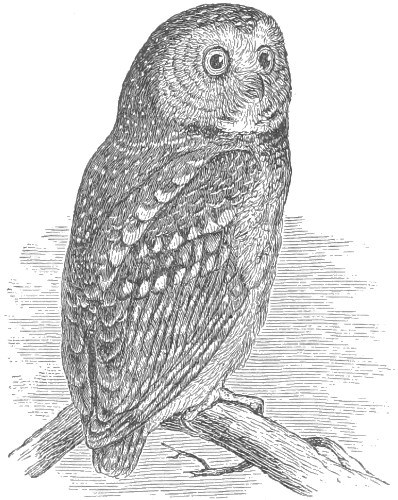
Micrathene whitneyi.
Habits. The type specimen of this diminutive species was shot at Fort Mohave, in the Colorado Valley, latitude 35°, April 26, 1861, and two others have since been taken on the Socorro Islands, off the western coast of Mexico, by Colonel Grayson. It is smaller even than the little California Pygmy Owl, and is therefore the smallest known to inhabit North America. It resembles that species in its colors, but is thought by Dr. Cooper to be more similar to the burrowing Owls in its generic characters. It was found in a dense thicket, on a very windy morning, and where it may have taken only a temporary refuge, after having been blown down from some of the caverns in the barren mountains surrounding the valley. In its stomach were found the remains of insects and the feathers of small birds. Several specimens of this Owl were taken in Arizona by Captain Bendire, one of which is now in the collection of the Boston Society of Natural History. Captain Bendire also found one of their nests, with two fully fledged young ones, in a hole of a mesquite stump.
Genus SPEOTYTO, Gloger
Speotyto, “Gloger, 1842.” (Type, Strix cunicularia, Mol.)
“Pholeoptynx, Kaup, 1848.” (Same type.)
Gen. Char. Size small; head small, and without ear-tufts. Bill moderately strong, pale yellowish. Tarsi more than twice as long as the middle toe, feathered in front, naked behind; toes scantily haired. Tail short, less than half the wing, nearly even, or very slightly rounded. Three outer quills with their inner webs emarginated; second to fourth longest. Ear-conch very small, simple, roundish. Diurnal and terrestrial.

5896 ½ ½
Speotyto hypogæa.
This genus is peculiar to America, where it is distributed over the whole of the southern and the western half of the northern continent, as well as in some of the West India Islands. There appears to be but one well-characterized species,35 this one modified into representative races in the several geographical provinces over which it ranges. The species is terrestrial, inhabiting the abandoned burrows of Armadillos and Rodents. It is diurnal, possessing as much freedom of sight, hearing, and motion in the brightest sunlight, as any species of the Falconidæ.
Species and Races
S. cunicularia. Colors umber-brown and ochraceous-white, the former predominating above, the latter prevailing below. Upper parts spotted with whitish; lower parts transversely barred with brown on the breast and sides, and sometimes on the abdomen. A white gular patch, and jugular collar, with a brown band between them. Legs, crissum, anal and femoral regions, always immaculate.
A. Primaries with broad regular bars of ochraceous-white on both webs; primary coverts with large spots of the same.
Brown markings of the lower parts irregularly transverse, and ragged. White spots on the upper parts nearly equal in extent to the brown.
Wing, 6.15–6.40; tail, 2.90–3.60; culmen, .58–.62; tarsus, 1.50–1.80; middle toe, .65. Hab. Peru … var. grallaria.36
Brown markings on the lower parts regularly transverse, and not ragged. White spots on the upper parts much less than the brown in extent.
Wing, 7.00–7.50; tail, 3.30–4.00; culmen, .70; tarsus, 1.70–1.85; middle toe, .85. Outer tail-feathers and inner webs of primaries with the white much greater in amount than the brown (sometimes continuous along outer webs of the latter). Hab. Southern South America (Chile, Buenos Ayres, Paraguay, etc.) … var. cunicularia.37
Wing, 6.40–7.00; tail, 3.00–3.30; culmen, .50–.60; tarsus, 1.50–1.70; middle toe, .80. Outer tail-feathers and inner webs of the primaries with the white less in extent than the brown (never continuous along outer webs of the primaries). Hab. Middle America, and Western Province of North America … var. hypogæa.
B. Primaries without broad or regular bars of whitish on either web; primary coverts plain brown.
Brown markings on the lower parts regularly transverse, and equal in extent to the white. White spots on the upper parts very small, reduced to mere specks on the dorsal region.
Wing, 6.40; tail, 3.40; culmen, .60; tarsus, 1.82; middle toe, .85. Outer tail-feathers and inner webs of the primaries with the light (ochraceous) bars only about one fourth as wide as the brown (disappearing on the inner quills). Hab. Guadeloupe … var. guadeloupensis.38
Spheotyto cunicularia, var. hypogæa, Bonap
BURROWING OWL
Strix hypogæa, Bonap. Am. Orn. I, 72, 1825. Athene hypogæa, Bonap. Consp. Av. p. 39, 1850.—Woodh. (Sitgr.) Expl. Zuñi and Colorado, p. 62, 1853.—Cass. Birds N. Am. 1858, 59.—Newb. P. R. R. Rept. VI, 77, 1857.—Coop. & Suck. P. R. R. Rept. XII, ii, 157, 1860.—Gray, Hand List, I, 52, 1869. Speotyto cunicularia, var. hypogæa, (Ridgway) Coues, Key, 1872, 207. Strix cunicularia (not of Molina!), Aud. B. Am. pl. ccccxxxii, 1831; Orn. Biog. V, 264; Synop. p. 22.—Nutt. Man. Orn. p. 118, 1844.—Bonap. Am. Orn. p. 68, pl. vii, f. 2, 1825; Ann. Lyc. N. Y. II, 36.—James. (Wils.), Am. Orn. IV, 30.—Say, Long’s Exp. Rocky Mts., II, 36, 200. Ulula cunicularia, Jard. (Wils.) Am. Orn. III, 325, 1832. Athene cunicularia, Bonap. List, p. 6; Consp. Av. p. 38. Strickl. Orn. Syn. I, 160, 1855.—Cassin, Birds N. Am. 1858, 60.—Coop. & Suck. P. R. R. Rept. XII, ii, 157, 1860.—Canfield, Am. Nat. 1869, 583 (habits). Strix californica, Aud. B. Am. pl. ccccxxxii, 1831. Athene socialis, Gamb. Pr. Acad. Nat. Sc. Phil. III, 47, 1846.
Sp. Char. Adult. Above earth-brown, the whole surface covered with numerous spots of dull white,—those on the scapulars roundish, and in pairs (on both webs); of similar form, but larger and more sparse, on the wings. Anteriorly they become more longitudinal (nearly linear), and medial; on the rump and upper tail-coverts, they are nearly obsolete. Secondaries crossed by four distinct bands of dull white, the last terminal; primaries with five to six transverse series of semi-rounded spots of ochraceous-white on their outer webs; primary coverts with about three transverse series of whitish spots. Tail with five to six bands of dull white, or pale ochraceous (the last terminal), composed of transverse oval spots, those on the middle pair of feathers not touching either the shaft or the edge. Ear-coverts uniform brown, becoming gradually paler beneath the eye and on the cheeks; eyebrows, a transverse chin-patch,—covering the whole chin and jaw and reaching back beneath the auriculars, and another across the jugulum, immaculate cottony-white; shafts of the loral bristles blackish; a broad, well-defined collar across the throat, between the white malar and jugular bands, deep brown, mixed with paler spots.
Beneath white with a faint ochraceous tinge, especially on the legs; the breast, abdomen, and sides with transverse spots of brown, this often predominating on the breast; legs, anal region, and crissum, immaculate. Whole lining of the wing immaculate creamy-white, the primary coverts, however, with large terminal spots of dusky; under surface of the primaries grayish-brown, deeper terminally, and with large, transversely ovate spots of ochraceous-white (about five in number on the longest quill), and growing larger basally.
♂. Wing, 6.40–7.00; tail, 3.00–3.30; culmen, .55–.60; tarsus, 1.50–1.70; middle toe, .80. (Smallest, No. 5,183, Fort Pierre, Nebraska; largest, No. 6,881, Sacramento, California.)
♀. Wing, 6.50–6.80; tail, 3.15–3.30; culmen, .51–.55; tarsus, 1.50–1.60; middle toe, .80. (Smallest, No. 45,020, Laredo, Texas; largest, No. 3,971, San José, Lower California.)
Juv. Upper surface earth-brown, as in the adult, but entirely uniform, except the wings and tail; upper tail-coverts, and a large oval patch on the wing (covering the middle coverts and the posterior half of the lesser-covert region), plain isabella-white; the anterior portion of the lesser-covert region darker brown than the back. Gular region well-defined pure white; jugular collar conspicuous and unspotted. Whole lower parts immaculate isabella-white.
Hab. Western Province of United States, from the Plains to the Pacific, and from the Rio Grande to Cape St. Lucas; Mexico.
Localities: Xalapa (Scl. 1857, 290); Texas (Dresser, Ibis, 1865, 330; resident).
Specimens never vary in the pattern of coloration, and but little in the relative amount of the brown and white spotting; the shade of the brown and the depth of the ochraceous tinge vary considerably, however, in different individuals,—but irrespective of locality,—the brown being paler and the white purer in summer than in fall and winter, after the new dress is freshly assumed. The brown on the breast varies considerably in quantity, being sometimes nearly uniform, thereby abruptly contrasting with the white jugular band, and again frequently with the brown hardly greater in amount than the white, the two colors being in regular bars, as on the sides and flanks.
There is certainly but one species, or even race, of Burrowing Owl in North America. This is represented in the Smithsonian collection by over fifty specimens, including examples from all parts of its range. Upon a close inspection of all the specimens in this extensive series, I was very much surprised to find so little variation; indeed, all the specimens are so much alike that a detailed description of the colors of one would answer for almost any individual. The shade of color varies mainly according to the age of the feathers, those newly acquired having a darkness of tint and a softness of texture not seen in those more worn (as in midsummer dress), which have a bleached or faded appearance. I fail entirely to detect the different styles of plumage which Mr. Cassin has described, and his diagnoses of two supposed species will not at all hold good when applied to specimens from either of the two regions which they were considered to characterize.
Examining critically the large series at my command, I find that the principal discrepancy among individuals is the amount of feathering on the tarsus; this extending to the toes was supposed to characterize the A. cunicularia of North America the habitat of which was considered as restricted in North America to the west of the Rocky Mountains (see Cassin, Birds of North America, as cited above); the nearly naked tarsus was believed to be characteristic of the A. hypogæa, as restricted, and the habitat assigned to this was “from the Mississippi River to the Rocky Mountains.” Now, dividing the series under examination into two sets, according to this feature, we have, first, cunicularia from the following localities: from the Rio Grande, all specimens but one; Tongue River, Montana; and Petaluma, Santa Clara, and San Francisco, California. Next, hypogæa represents the following localities, besides places within the range ascribed to it: Utah; Lower California, including Cape St. Lucas, all specimens; San Diego, California, several specimens; Santa Barbara, San Francisco, Sacramento, and Fort Tejon, California; and Tamaulipas, Mexico.
Though we have but one species or form in North America, the South American bird is different: this is the true cunicularia of Molina, and though not specifically distinct from our bird, is nevertheless an easily recognized geographical race. It is larger, the wing measuring from 7.00 to 7.50, instead of 6.40 to 7.00; the brown of the plumage is appreciably darker than that of most specimens of hypogæa, but less extended; on the outer web of the primaries the white spots are larger,—sometimes confluent along the edge,—and on their inner webs the white largely prevails, the dusky bars appearing only towards the ends; the outer tail-feather is almost wholly white, instead of having brown bars, broader than the white ones. Of the var. cunicularia there are eight specimens in the collection (chiefly from Paraguay, Buenos Ayres, and Chile), while numerous others, in various collections, have been examined besides. All the American forms of this subgenus seem clearly referrible to one species, as being at the most but geographical races.
Habits. The Burrowing Owl of North America inhabits the country between the Pacific coast and the Mississippi River, especially in the lower plains in Nebraska and in Kansas, as well as in particular districts in Utah, Arkansas, New Mexico, the Indian Territory, Texas, Arizona, California, and Mexico. They are usually very abundant, congregating together in large communities, and differing from most members of their family by living and breeding in burrows in the ground. Their habits are peculiar and interesting.
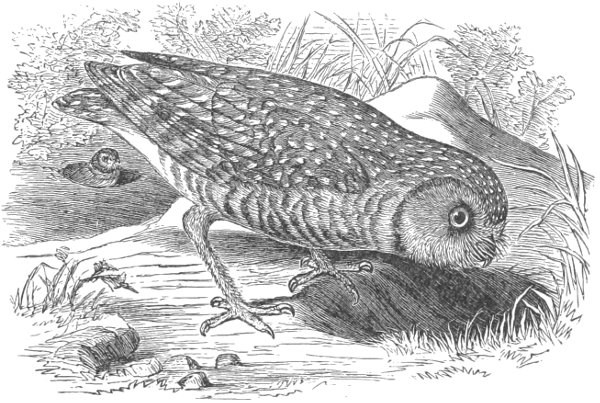
Speotyto hypogæa.
Thomas Say, during Colonel Long’s expedition to the Rocky Mountains, was the first of American naturalists to meet with this bird. He encountered it in our trans-Mississippian Territories, where he described it as residing exclusively in the villages of the prairie-dog, whose excavations are so commodious as to make it unnecessary for the bird to dig for itself, which it is able to do when occasion requires. These villages are very numerous, and variable in their extent, sometimes covering only a few acres, and at others spreading over the surface of the country for miles together. They are composed of slightly elevated mounds, having the form of a truncated cone, about two feet in width at base, and seldom rising as high as eighteen inches above the surface. The entrance is at the top or on the side. From the entrance the passage descends vertically one or two feet, and thence it continues obliquely downward until it terminates in the snug apartment where these animals enjoy their winter’s sleep, and where they and the Owls are common, but unfriendly, occupants.
Mr. Dresser noticed this bird at all seasons, in the prairie country of Texas. They were rather common near the Rio Leon and Medina, and in one place he found they had taken possession of some deserted rat-holes. He obtained several specimens near San Antonio and at Eagle Pass. In the latter place he found them quite common on the sand plains near the town. The stomachs of those he shot were found to contain coleopterous insects and field-mice.
Dr. Newberry states that he found this species in Northern California, in several places between San Francisco and Fort Reading, and again at the Klamath Basin, though less frequently at the northward than in the Sacramento Valley. There they occupied the burrows made by the Beechey’s and the Douglass’s Spermophile. He usually saw them standing at the entrance to these burrows, often permitting him to approach within gun-shot, and before taking to flight twisting their heads about and bowing with many ludicrous gestures, apparently in order to aid their imperfect sight, and to get a better view of the intruder. When shot at or otherwise alarmed, they fly with an irregular jerking motion, dropping down much like a Woodcock.
Dr. Suckley obtained a specimen near Fort Benton, on the Upper Missouri, in Dakotah, and Dr. Cooper procured others thirty-five miles west of Fort Kearney, in Nebraska, in August. He saw them in great numbers on the plains of Nebraska, and did not observe any difference in habits between them and the birds of California.
This species was found in Texas, near Fort Davis, and also at El Paso, by Mr. J. H. Clark. It was taken in Tamaulipas, Mexico, by Lieutenant Couch. Mr. Clark remarks that they were seen by him only in the prairie-dog towns, and were found in conjunction with the rattlesnake, and accuses them of feeding upon the young of the prairie-dog; but this ungrateful requital of the hospitality given them in the burrows of this marmot is discredited by Dr. Kennerly and others, who regard the apparent harmony in which the two dwell together as altogether incompatible with this habit.
This species is also found on our Pacific coast, west of the Rocky Mountains, as far north as British Columbia. Mr. Lord met with it along the entire course of the boundary-line. It was not by any means plentiful, but pairs of them were occasionally seen. While in camp at the Dalles he dug out several squirrel-holes. In one he found two eggs of this species, the female bird, a racer-snake, and a female ground-squirrel (Spermophilus douglassi). The Owl he found to be strictly of diurnal habits, feeding principally on crickets, grasshoppers, large beetles, and larvæ. He thinks it never captures small animals or birds, and regards it as a peaceful and harmless bird.
Dr. Kennerly met with this species near Los Angeles, California. At any hour of the day they might be seen seated upon the mounds erected around the holes of the marmot, or else with head protruding from its orifice, disappearing immediately when approached. When molested, they commence bowing and chattering in a somewhat ludicrous manner at the intruder, or fly swiftly away, keeping near the earth and alighting suddenly in the vicinity of a burrow to renew these amusing motions. He found it very abundant in the valley of the San Gabriel River, where it associated with the large ground-squirrel of that region.
Dr. Heermann, who found them common on the extensive open prairies, speaks of its sight as very clear by day, and adds that it will not allow the hunter on foot to approach within shooting distance; but that, if approached on a horse or a mule, it may be easily shot. The nests he found were formed of a few straws carelessly thrown together at the bottom of its tortuous burrow, which is from six to eight feet in length. The eggs were usually four in number, and are described as nearly spherical, and as pure white.
Dr. Townsend states that this Owl resorts to the forsaken burrows of marmots and badgers, but never lives on terms of intimacy with either. The nest he describes as of fine grass, and placed at the extremity of the hole. The eggs are uniformly four in number, pale white, and about the size of those of the common House Pigeon.
Dr. Gambel, who observed this bird in California, states that he has occasionally found it in solitary burrows, and also that it often makes use of the holes dug by the Spermophilus beecheyi. They occasionally dig their own burrows, and live in scattered companies of four or five. Dr. Gambel also states that the bird is a resident of California throughout the year.
Mr. Darwin, in the Zoölogy of the Beagle, met with the var. cunicularia in crossing the pampas of South America. In Banda Oriental, he says, it is its own workman, and excavates its burrows on any level spot of sandy soil; but in the pampas, or wherever the Bizcacha is found, it uses those made by that animal. It usually preys on mice and reptiles. Lieutenant Gilliss gives a similar account of it, from observations made in Chile.
Mr. Nathaniel H. Bishop met with cunicularia on the banks of the river San Juan, in Banda Oriental, where a few pairs were seen, devouring mice and insects. After crossing the river Las Vacas, and coming upon a sandy waste covered with scattered trees and low bushes, he again encountered it. Upon the pampas of the Argentine Republic they were found in great numbers, from a few miles west of Rosario to the vicinity of San Luis, where the pampas end. On these immense plains of grass it lives in company with the Bizcacha (Lagostomus trichodactylus), dwelling with it in perfect harmony, and during the day, while the animal is sleeping, a pair of Owls stand a few inches within the main entrance of the burrow, and at the first sound, be it near or distant, leave their station and remain outside the hole, or upon the mound that forms the roof of their domicile. At the approach of man, both birds, with their irides dilated, mount above him in the air, and keep up an alarm-note until he passes. Then they quietly settle down in the grass, or return to their former place. On the pampas Mr. Bishop did not observe them taking their prey during the daytime, but as soon as the sun had set, the Bizcacha and Owls both leave their holes in search of food, the young of the former playing about the birds as they alight near them. They do not associate in companies, there being but one pair to a hole. Each couple keep separate from their neighbors, and at night do not stray from their homes.
It is both diurnal and nocturnal, and feeds at all hours. Outside the town of San Juan, which lies upon the eastern base of the Andes, Mr. Bishop had a fine opportunity to watch their habits in a locality differing entirely from the pampas. The country around San Juan is a dreary desert, covered with low thorn-trees, and over this waste a few Owls are found, principally near the town itself, in the vicinity of the pastures that are cultivated by irrigation. They mate in September and October. “One evening,” Mr. Bishop writes, “I was attracted by a strange sound that I supposed proceeded from a frog, but it proved to be the love-note of a little Athene cunicularia, and which was answered by its mate. It alighted upon a post, and commenced turning around upon it, with throat dilated, and emitting a guttural sound. These antics were continued for more than a minute, it occasionally bowing its head in a mysterious manner. The female soon after joined it, and they flew away. Each night it perched upon a tall flagstaff and uttered its love-note. Close by the house was a lagoon, the borders of which were swampy, and over this a pair often hovered in search of food. I watched one that kept on the wing for nearly two hours, some fifty feet from the ground, and during that time did not change its position in any other way than by rising or falling a few feet. A boy brought me a female with five eggs, that had been taken from a burrow five feet from the mouth. The bird was very fierce, and fought me with her wings and beak, uttering all the while a long shrill note, resembling a file drawn across the teeth of a saw. I supplied her with eleven full-grown mice, which she devoured during the first thirty-six hours of her confinement. It is said to place a small nest of feathers at the end of the hole, in which are deposited five white eggs.”
The eggs of the var. cunicularia are of a rounded-oval shape, more obtuse at one end than at the other, measure 1.30 inches in length by 1.05 in breadth, and are of a uniform white color, with a slightly bluish tinge.

6885 ½ nat. size.
Strix pratincola. (See page 10.)
The egg of the A. hypogæa is of a rounded-oval shape, equally obtuse at either end, and averages 1.35 inches in length by 1.13 in breadth, and is of a uniform clear white color. This description is taken from an egg obtained by Mr. E. S. Holden near Stockton in California. Captain Bendire writes that he has found as many as nine, and once even ten, eggs in the nest of the North American species.
NOTE
The crania of the Owls present many features of interest, which may serve a good purpose in the definition of the sections and the genera, and to which attention has been occasionally called in the preceding pages. The tendency to asymmetry is especially marked in some species, and the better to illustrate this and other features we append several plates, in which the corresponding views are placed side by side.39 The figures and accompanying lettering tell their own story, without any necessity of a labored description.
R. R.

Syrnium aluco (copied from Kaup).

Athene noctua (from Kaup).

Nyctale richardsoni.

7449.

428.

4886.

7272.

7899.

414.

773.

628.

7897.

437.
7449. Strix pratincola. Natural size.
4886. Otus wilsonianus. Natural size.
7272. Scotiaptex cinereum. Two thirds.
7899. Nyctale richardsoni. Natural size.
414. Scops asio. Natural size.
773. Bubo virginianus. Two thirds.
628. Nyctea nivea. Two thirds.
7897. Surnia ulula. Natural size.
428. Glaucidium ferrugineum. Natural size.
437. Spheotyto hypogæa. Natural size.

428.

7449.

4886.

7272.

414.

7899.

773.

628.

7897.

437.
7449. Strix pratincola. Natural size.
4886. Otus wilsonianus. Natural size.
7272. Scotiaptex cinereum. Two thirds.
7899. Nyctale richardsoni. Natural size.
414. Scops asio. Natural size.
773. Bubo virginianus. Two thirds.
628. Nyctea nivea. Two thirds.
7897. Surnia ulula. Natural size.
428. Glaucidium ferrugineum. Natural size.
437. Spheotyto hypogæa. Natural size.

7449.

4886.

7272.

7897.

414.

628.

773.

7899.

437.

428.
7449. Strix pratincola. Natural size.
4886. Otus wilsonianus. Natural size.
7272. Scotiaptex cinereum. Two thirds.
7899. Nyctale richardsoni. Natural size.
414. Scops asio. Natural size.
773. Bubo virginianus. Two thirds.
628. Nyctea nivea. Two thirds.
7897. Surnia ulula. Natural size.
428. Glaucidium ferrugineum. Natural size.
437. Spheotyto hypogæa. Natural size.

7449.

4886.

7272.

7899.

733.
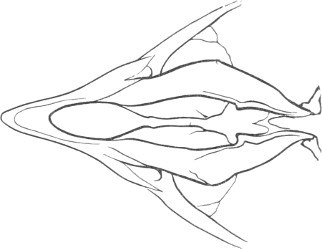
628.

7897.

414.
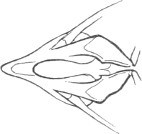
437.

428.
7449. Strix pratincola.
4886. Otus wilsonianus.
7272. Scotiaptex cinereum.
7899. Nyctale richardsoni.
414. Scops asio.
773. Bubo virginianus.
628. Nyctea nivea.
7897. Surnia ulula.
428. Glaucidium ferrugineum.
437. Spheotyto hypogæa.
(All natural size.)

12088.

504.

49808.

504.

A.

49808.
12088. Nyctea nivea. (Ear copied from Swainson, F. B. A)
504. Scotiaptex cinereum.
49808. Surnia ulula. (Ear copied from Swainson.)
A. Brachyotus “cassinii.” (Left ear and nostril, from fresh specimen.)
Family FALCONIDÆ.—The Falcons
Char. Eyes directed laterally, and eyelids provided with lashes. Toes invariably naked, and tarsus usually naked and scutellate (feathered only in Aquila and Archibuteo). Outer toe not reversible (except in Pandion). Head never with ear-tufts, and never wholly naked (except in the Vulturinæ, of the Old World).
The above characters are about the only readily observable points in the external anatomy in which the Falconidæ differ strikingly from the Strigidæ and Cathartidæ, and may serve to distinguish the birds of this family from those of the two others. The osteological characters, however, as expressed on page 1328, are more decided and important in a taxonomic point of view, and serve to separate the Hawk family as a well-defined group.
In the following treatment of the North American Falconidæ, I confine that part relating to the systematic arrangement strictly to the species embraced within the province of our work, for the reason that in a forthcoming monograph of all the American species I hope to present a systematic classification based upon the species of the whole world. All preliminary details regarding the general characteristics and distinctive peculiarities of the family, as well as all discussions and generalizations upon the subject, will therefore be omitted here.
The following synopsis of the North American genera is intended as an artificial arrangement which may enable the student to identify, by simple and readily understood characters, the forms belonging to this country.40
Genera
A. Nasal bones almost completely ossified, the nostril being a small orifice, with a conspicuous central bony tubercle; its form nearly or quite circular, or linear and oblique (in Polyborus), with its upper end the posterior one Falconinæ.
1. Falco. Nostril circular. Commissure with a prominent tooth and notch; lower mandible abruptly truncated and notched. Primaries stiff and hard, and more or less pointed, the first to the second longest, and the outer one or two with their inner webs cut, the angular emargination being near the end of the quill. Middle toe much more than half as long as the tarsus; claws strongly curved, very acute.
2. Polyborus. Nostril linear, oblique, the upper end the posterior one; commissure without prominent tooth nor notch; lower mandible not distinctly truncated or notched. Primaries soft, obtuse, the third longest, and the outer four or five with their inner webs cut, the shallow sinuation being toward the middle of the quill. Middle toe less than half the tarsus; claws weakly curved, very obtuse. Face and cheeks naked, and scantily haired.
B. Nasal bones very incompletely ossified, the nostril being a large, more or less oval, opening, of oblique direction, its lower end being invariably the posterior one; without a bony tubercle, and never perfectly circular. (Accipitrinæ.)
a. Sides of the head densely feathered close up to the eyelids.
3. Pandion. Outer toe reversible; claws contracted and rounded on their under surface, and not graduated in size.41 Wing long, third quill longest; outer four with inner webs emarginated. Tail rather short, rounded.
4. Nauclerus. Outer toe not reversible; claws not contracted or rounded on under side, and graduated in size. Wing long, third quill longest; outer two with inner webs sinuated. Tail excessively lengthened and forked, the lateral pair of feathers more than twice as long as the middle pair.
b. Sides of the head with a more scantily feathered orbital space, with a projecting superciliary “shield” covered with a naked skin.
* A well-developed membrane, or “web,” between the outer and middle toes at the base.
† Tarsus about equal to the middle toe.
§ Claws short and robust; two outer quills with their inner webs cut.
5. Ictinia. Commissure irregularly toothed and notched; front of tarsus with transverse scutellæ. Tail emarginated; third quill longest.
6. Elanus. Commissure without irregularities; front of tarsus with minute roundish scales. Tail double-rounded; second quill longest.
§§ Claws long and slender; five outer quills with inner webs cut.
7. Rostrhamus. End of bill bent downward, with a long pendent hook; inner edge of middle claw slightly pectinated, or serrated. Tail emarginated; third or fourth quill longest.
†† Tarsus very much longer than the middle toe.
¶ Front of tarsus unfeathered, and, with the posterior face, covered with a continuous series of broad transverse scutellæ.
α. Form very long and slender, the head small, the tail and legs long and claws excessively acute; bill weak, compressed, very high through the base, the culmen greatly ascending basally, and the cere much arched; commissure usually with a very prominent “festoon.”
8. Circus. Face surrounded by a “ruff” of stiffened, differently formed feathers, as in the Owls. Tarsus more than twice as long as the middle toe. Wing very long, hardly concave beneath; third to fourth quill longest; outer four with inner webs sinuated.
9. Nisus. Face not surrounded by a ruff. Tarsus less than twice as long as the middle toe. Wing short, very concave beneath, the outer quill much bowed; third to fifth quills longest; outer five with inner webs sinuated.
β. Form short and heavy, the head larger, the tail shorter, the legs more robust. Bill stronger, less compressed, lower through the base, the upper outline less ascending basally, and the cere less arched. Commissure variable.
10. Antenor. Form heavy, the wings and tail moderately long, and feet very robust; bill rather elongated, the commissural lobe prominent, and the base of the culmen somewhat depressed. Fourth quill longest; outer five with inner webs cut. Lores naked, and almost destitute of bristles.
11. Onychotes. Outstretched feet reaching beyond end of tail; tibial plumes short, close, not reaching below the joint. Wing short, rounded, very concave beneath, the fourth quill longest; outer five with inner webs sinuated. Tail short, but little more than half the wing, slightly rounded. Claws very long, and extremely acute.
12. Asturina. Bill and feet as in Antenor; lores densely bristled; wing short, rounded, concave beneath, the third to fourth quills longest; outer four with their inner webs cut.
13. Buteo. Form of Antenor, but primaries longer and more pointed, the fourth usually longest, and the outer three or four with inner webs cut. Bill and feet as in Asturina. Tail moderate, or rather short, nearly even, or slightly rounded.
¶¶ Front of the tarsus densely feathered down to the base of the toes.
14. Archibuteo. Feathering of the tarsus interrupted behind by a bare strip along the full length; middle toe less than half as long as the tarsus. Nostril broadly oval, obliquely horizontal; bill weak, the upper outline of the cere much ascending basally. Feathers of the nape normal, blended. Third to fourth quills longest; outer four or five with inner webs cut.
15. Aquila. Feathering of the tarsus uninterrupted behind; middle toe more than half as long as the tarsus. Nostril narrowly oval, obliquely vertical; bill strong, the upper outline of the cere nearly parallel with the lower. Feathers of the nape lanceolate, distinct. Fourth quill longest; five to six with inner webs cut.
** No trace of membrane between outer and middle toes.
16. Haliætus. Tarsus feathered in front one third, or more, of the way down; the naked portion with an imperfectly continuous frontal, and less well defined posterior, series of transverse plates, and covered elsewhere with roundish granular scales. Feathers of the neck, all round, lanceolate, distinct. Bill very large, the chord of the culmen more than twice as long as the cere on top; nostril oval, obliquely vertical. Third to fifth quills longest; outer six with inner webs cut. Tail rounded or cuneate, sometimes consisting of fourteen feathers.
The foregoing diagnoses embrace merely the more conspicuous external characters whereby the genera may be most readily distinguished by the student. The following table presents additional accompanying characters afforded by the osteological and anatomical structure, of more importance in defining with precision the several groups embraced in our fauna.
A. Scapular process of the coracoid produced forward so as to meet the clavicle42 (Huxley). Nasal bones almost completely ossified, the nostril being a small, usually circular opening, with a raised or “rimmed” margin, and conspicuous, usually central, bony tubercle. Inferior surface of the supermaxillary bone with a prominent median angular ridge. Superciliary process of the lachrymal consisting of a single piece. (Falconinæ.43)
B. Scapular process of the coracoid not produced forward so as to meet the clavicle (Huxley). Nasal bones incompletely ossified, the nostrils being very large, and without bony rim or tubercle. Inferior surface of the supramaxillary bone without a median ridge. Superciliary process of the lachrymal variable. (Accipitrinæ.)
a. Superciliary process of the lachrymal composed of a single, excessively abbreviated piece;44 posterior margin of the sternum with a pair of indentations, and without foramina. (Pandion and Nauclerus.)
b. Superciliary process of the lachrymal double, or composed of two pieces, joined by a cartilaginous “hinge,” and reaching nearly across the orbit. Posterior margin of the sternum without indentations, and usually with a pair of foramina. (All except Pandion and Nauclerus.)
† Septum of the orbits and nostrils incompletely ossified (the former always and the latter usually) and with foramina; posterior margin of the sternum most produced backwards laterally, and incompletely ossified, there being usually a pair of foramina. Intestinal canal short, broad, with the duodenum simple, forming a single loop (McGillvray). A well-developed “web” between the outer and middle toes. (All but Haliætus.)
†† Septum of the orbits and nostrils completely ossified, and without any trace of foramina; posterior margin of the sternum produced medially into a convex lobe, and without any trace of foramina. Intestinal canal extremely elongated, attenuated, with the duodenum arranged in several convolutions (McGillvray). No trace of a web between outer and middle toes. (Haliætus.)
Subfamily FALCONINÆ
Genus FALCO, Auct
Gen. Char. Bill strong, its breadth at the base equalling or exceeding its height; upper outline of cere on a level with, or rather lower than, the base of the culmen; gonys much arched, the chord of the arch equalling about half that of the culmen. Near the tip of the upper mandible is a prominent tooth on the commissure, and near the end of the lower mandible, which is truncated, is a deep notch corresponding; the end of the upper mandible is compressed, giving the situation of the tooth an inflated appearance when viewed from above. Nostrils circular, with a conspicuous central tubercle. Orbital region bare; projecting superciliary shield conspicuous, arched, but not very prominent. Tail shorter than wing, the feathers hard and stiff. Primaries very strong, elongated, tapering rapidly toward their points; only the first or first and second with their inner webs emarginated, the cutting being angular, and near the end of the quill. Tarsus never with a single series of transverse scutellæ either in front or behind; middle toe very long.

13077, ♀. ½
Subgenera
One primary only with inner web emarginated; first to second longest; first longer than fourth.
Tarsus longer than middle toe, and feathered far below the knee; first quill shorter than third. Coloration of the sexes alike; old and young slightly different in pattern and tints. Size large … Hierofalco.
Tarsus not longer than middle toe, and scarcely feathered below the knee; first quill equal to or longer than the third. Coloration of the sexes alike; old and young very different in pattern and tints. Size, very small to large … Falco.
Two primaries with inner webs emarginated; second to third longest; first shorter than fourth.
Basal joint of toes without transverse scutellæ; tarsus about equal to middle toe.
Coloration of the sexes in adult plumage very different in tints; in the young alike, the young ♂ resembling the adult ♀. Size small … Æsalon.
Basal joint of toes with transverse scutellæ; tarsus longer than middle toe.
Coloration of the sexes very different, in pattern and tints, at all ages; old and young alike. Scutellæ of the toes and tarsus interrupted at the digito-tarsal joint; tarsus much longer than middle toe. Bill small, the cere on top less than one fourth the culmen. Size small … Tinnunculus.
Coloration of the sexes alike at all ages; old and young slightly different in pattern and tints. Scutellæ of tarsus and toes uninterrupted from “knees” to claws; tarsus but little longer than middle toe. Bill large, the cere on top about one third the culmen. Size medium; form very slender … Rhynchofalco.
Subgenus HIEROFALCO, Cuvier
Hierofalco, Cuvier, 1817. (Type, Falco gyrfalco, Linn.)
Jerafalco, Boie, 1822; Kaup, 1851. (Same type.)
Gennaia, Kaup, 1847. (Type, Falco jugger, Gray.)
Species and Races
1. F. gyrfalco. Wing, 13.00–17.00; tail, 8.50–11.50; culmen, .85–1.05; tarsus, 2.10–3.00; middle toe, 1.80–2.25.45 Ground-color varying from entirely pure white to wholly dusky, but generally bluish (in adult) or grayish-brown (in young) above, and white beneath. Adult. All the markings transverse.46 No lighter nuchal band. Young. Markings of the lower surface longitudinal, the upper parts without transverse bars (except on the tail47).
a. Lower parts with white predominating, or wholly white.
Lower tail-coverts never with markings. No tinge of blue anywhere on the plumage, the ground-color of which is entirely pure white at all ages.
1. Adult. Upper parts, excepting head and neck, with transverse crescentic bars of dark plumbeous; lower parts immaculate, or else without well-defined markings. Young. Upper parts with longitudinal stripes of dark plumbeous; lower parts usually conspicuously striped. Hab. Greenland (in the breeding-season); in winter, occasionally wandering into the northern portions of Europe and North America … var. candicans.
Lower tail-coverts always with markings. A tinge of ashy-blue more or less prevalent above. Young dusky above.
Head and neck above abruptly lighter than the back. Young plain grayish-brown above, with conspicuous whitish borders to the feathers.
2. Adult. Upper parts white, passing into bluish posteriorly; everywhere (except on head and neck) with sharply defined, transverse (not crescentic, but continuous) bars of dark plumbeous. Abdomen and flanks with transverse spots of the same. Young without irregular light mottling to the plumage above, and with broad longitudinal stripes beneath. Hab. Iceland and Southern Greenland, in the breeding-season; in winter, south into Northeastern United States, and Northern Europe … var. islandicus.
Head and neck above abruptly darker than the back. Young (of var. sacer) variegated grayish-brown above, without light borders to the feathers.
3. Adult. Top of the head streaked with whitish; back with sharply defined, continuous, narrow transverse bars, of creamy-white. Hab. Interior regions of Continental Arctic America (Slave Lake, Yukon, and McKenzie River district) … var. sacer.
4. Adult. Top of head not streaked with whitish; back without sharply defined bars of the same. Hab. Continental Arctic Europe (Scandinavia) and Siberia. Migrating south, in winter, to Bengal (Hardwicke) … var. gyrfalco.48
b. Lower parts with dusky predominating, or wholly dusky.
5. Adult. Almost entirely dusky, without well-defined markings anywhere. Hab. Littoral regions of the Hudson Bay Territory and Labrador … var. labradora.
2. F. lanarius. Wing, 11.50–16.00; tail, 6.60–9.50; culmen, .70–1.00; tarsus, 1.90–2.40; middle toe, 1.65–2.00. Ground-color varying from pale grayish-plumbeous to dark sepia-brown; beneath white, with sparse markings, these coalesced into a broken patch on the flanks. Adult. Above obscurely barred transversely with pale ashy and brownish-dusky, the former prevailing posteriorly, the latter anteriorly; a lighter nuchal band. Spots on the sides and flanks transverse. Young. Above brown, varying from grayish-drab to dark sepia, the feathers usually bordered with paler (rusty in youngest individuals); markings beneath all longitudinal.
a. Outer webs of tail-feathers with large well-defined light spots; outer webs of the primaries sometimes with light spots on the basal portion; secondaries without distinct spots on the outer webs. Lower tail-coverts immaculate.
Wing, 13.65–16.00; tail, 8.40–9.50; culmen, .85–1.00; tarsus, 1.95–2.15; middle toe, 1.85–1.95. Top of the head white, with narrow streaks of dark brown. Hab. Central and Eastern Europe, Western Asia, and adjoining portions of Africa … var. lanarius.49
b. Outer webs of tail-feathers without distinct light spots, or without any at all; outer webs of primaries with no trace of spots; secondaries with light spots on outer webs. Lower tail-coverts sparsely spotted.
Wing, 12.00–14.25; tail, 7.60–9.00; culmen, .75–.90; tarsus, 2.15–2.40; middle toe, 1.70–2.00. Top of head brown, with narrow black streaks. Adult. Above with obscure transverse spots of bluish. Young. Above with feathers bordered with rusty … var. polyagrus.
Wing, 11.50; tail, 6.60; culmen, .70; tarsus, 1.90; middle toe, 1.65. Above uniform dark brown, with a faint plumbeous cast, the feathers without trace of light or rusty edges; outer web of tail-feathers without trace of light spots. Hab. Mexico … var. mexicanus.50
Wing, 13.60–14.30; tail, 8.25–9.00; culmen, .80–.87; tarsus, 1.85–1.90; middle toe, 1.85–1.90. Colors similar to the last; entire auriculars white; mustache narrow and conspicuous. Hab. Southern Asia … var. jugger.51
The only point of difference in the external anatomy between the Lanner Falcons and Gerfalcons consists in the different degree of feathering on the upper part of the tarsus; this is much denser and extends farther down and more around the posterior face in the Gerfalcons, but they, being inhabitants of a very northern latitude, need this protection against the rigor of the climate. These slight specific differences are illustrated by the figures on page 1430. The same difference is observable in many birds whose habitat extends through a great range of latitude, as, for instance, the Pediocætes phasianellus, the northern race of which has the feathers covering the base of the toes so long as to reach beyond the claws and nearly conceal them, while in the southern form (var. columbianus) the toes are almost completely naked.
My determination of the number and character of the geographical races of F. gyrfalco is the result of a very careful critical examination of over sixty specimens, aided by the important conclusions of Mr. Hancock (Annals and Magazine of Natural History, 2d ser., XIII, 110; London, 1834), Schlegel (Falcones, Muséum d’Histoire Naturelle des Pays-Bas, 1862), Pelzeln (Uebersicht der Geier und Falken der Kaiserlichen ornithologischen Sammlung, April, 1863), and Alfred Newton (History of British Birds, revised ed., part 1, June, 1871, pp. 36–52, and Proc. Acad. Nat. Sc. Philadelphia, July, 1871, pp. 94, 95), in their important papers bearing upon this subject, which, though they each express the peculiar individual views of the writer, together clear up pretty satisfactorily the problem of the number, character, and habitats of the several races, as well as the different phases of variation to which each is subject.
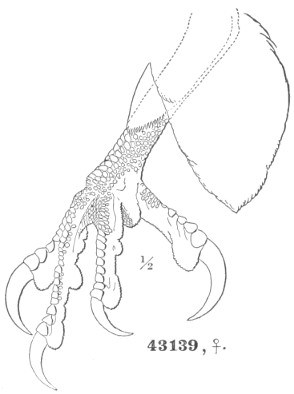
43139, ♀. ½
Falco sacer.

43139, ♀. ¼

5482, ♀. ½
Falco polyagrus.

43139, ♀. ½
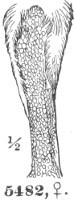
5482, ♀. ½
In studying the F. lanarius, I have experienced most discouraging difficulties from the want of sufficient series of the Old World races, and from the unsatisfactory character of most descriptions and figures of them, besides being much perplexed by the confusion of their synonymy by different authors. In consequence of this, my diagnoses of the four races of which alone I have seen examples may be very unsatisfactory as regards the characters by which they may be most readily distinguished. Having seen the adult of only a single one of these four races, I am therefore compelled to base my differential characters upon the immature stages.
In addition to the four races of F. lanarius characterized above, there are several geographical forms belonging to the Old World, chiefly intertropical Asia and Africa. These are the var. babylonicus, Scl. and Irby, (Gray’s Hand List, I, p. 20, No. 173,) of Southeastern Europe and Western Asia; var. barbarus, L. (Gray’s Hand List, p. 20, No. 174), of Northern Africa; and var. tanypterus, Licht. (Gray’s Hand List, No. 175), of both the preceding regions, which Mr. Gurney writes me “is simply the intertropical race of F. lanarius, from which it only differs in being of a darker shade throughout.” The F. saker, Schleg. (Gray’s Hand List, No. 176), seems, to judge from the descriptions and figures which I have seen, to be also merely a form of the same species, but I have seen no specimens of it.
Falco (Hierofalco) gyrfalco, Linn
Var. candicans, Gmelin
WHITE GERFALCON
Accipiter falco freti hudsonis, Bris. Orn. I, 356, 1763. A. gyrfalco, Briss. Orn. I, 370, pl. xxx, f. 2, 1763. Falco rusticolus, Fabr. Faun. Grœn. p. 55, 1780.—Lath. Syn. Supp. I, 15, 1781. F. candicans, Gmel. Syst. Nat. p. 275, 1788.—Daud. Tr. Orn. II, 101, 1800.—Benick, Isis, 1824, 882.—Schleg. Krit. Ubers. p. 1, 1844.—Bonap. Rev. Zool. 1850, 484; Consp. Av. p. 33.—Cassin, Proc. Ac. Nat. Sc. Phil. 1855, 278; Birds N. Am. 1858, 13.—Strickl. Orn. Syn. I, 77, 1855.—Blasius, Cab. Jour. 1862, 43 (thinks all boreal ones same in Europe and America).—Elliot, Birds N. Am. pl. xii. Hierofalco candicans, Cuv. Reg. An. ed. 1, I, 312, 1817; ed. 2, I, 323, 1829.—Less. Man. Orn. I, 80, 1828; Tr. Orn. p. 97, pl. xvi, p. 2.—Gray, Hand List I, 18, 1869. Falco islandicus, Lath. Ind. Orn. p. 32, 1790; Syn. I, 71, A, B; Gen. Hist. I, 72, A, 1821.—Steph. Zool. XIII, pt. ii, p. 39, 1826.—Gould, B. Eur. pl. xix.—Aud. Birds Am. 1831, pl. ccclxvi. F. buteo β, Lath. Ind. Orn. p. 24, 1790; Gen. Hist. I, 80, A. F. lagopus, β, Lath. Ind. Orn. p. 19, 1790; Syn. Supp. I, 36; Gen. Hist. I, 68, A. F. grœnlandicus, Daud. Tr. Orn. II, 157, 1800. Hierofalco grœnlandicus, Brehm. Voy. Deutsch, I, 16, 1831. F. gyrfalco, Bonap. List, p. 4, 1838.
Sp. Char. Adult (♀, 18,577, Greenland; Univ. Zool. Mus. Copenhagen). Ground-color entirely pure white; whole upper surface (posterior to the nape) with transverse crescentic bars of dark plumbeous-brown, generally about two on each feather, the first concealed by the feather which overlaps. Primaries crossed at regular intervals with quadrate spots of the same tint, these becoming fused toward ends of quills, forming a terminal dusky space of two or three inches in extent; tips of all the quills narrowly white; the black bars do not extend quite to the primary coverts, and decrease both in extent and regularity toward the base. Middle tail-feathers crossed with seven or eight imperfect bars of dusky, the shafts of the feathers blackish; rest of tail immaculate, the shafts pure white. Nape with a very few fine shaft-streaks of dusky. Whole lower surface of body and wing utterly immaculate. Wing-formula, 2–3–1. Wing, 16.50; tail, 9.00; culmen, 1.05; tarsus, 2.10–1.35; middle toe, 2.20; inner, 1.50; outer, 1.50; posterior, 1.00.
(No. 56,152, ♀, Greenland; Schlüter Collection.) Head above, occiput, nape, and upper half of ear-coverts, with sparse shaft-streaks of black, these most numerous on the latter region; primaries barred to the coverts. Tail entirely crossed by eleven plumbeous bars. Bars above clearer plumbeous. The snowy-white beneath is relieved by a few minute variable flecks of dusky upon the lower part of the abdomen, becoming larger as they approach the sides. Wing-formula, 2–3–1. Wing, 16.70; tail, 9.30.
Juv. transition stage? (♂ 56,047, “Hoher Norden”; Schlüter Collection). Markings above quite different from those of the two preceding; each feather has a large central longitudinal sagittate spot of dusky, leaving only the borders (of the exposed portion) white; on the primaries the dusky is almost confined to the terminal portion; the rump and upper tail-coverts have each feathers with a medial longitudinal stripe of dusky. The tail is immaculate, but the shafts of the middle feathers are dusky. The neck, breast, abdomen, and sides have numerous cuneate marks of dusky, one near the end of each feather. The lining of the wing, even, has a few narrow streaks. Wing, 14.75; tail, 9.40.
No. 56,049 (♀, Greenland, Schl. Coll.) is similar in pattern of markings, but above the dusky is more extended, forming the predominating color; the rump, etc., has broad sagittate spots instead of narrow stripes; the primaries are barred to the coverts; the tail is crossed by about ten continuous bands of dusky. Beneath the lanceolate spots or streaks cover the whole surface, except the anal region, lower tail-coverts, and throat. On the lining of the wing the streaks are less sparse than in the preceding, though they are by no means numerous. Wing, 15.75; tail, 9.50.
Adult female (58,339, Jacksonville, Fla., June 10, 1869; C. J. Maynard). Differing from the female of var. sparverius in much darker colors, the rufous inclining to castaneous; bars broader, more sharply defined, pure black. Head above pure dark plumbeous, conspicuously different from the fine light ash of var. sparverius; vertex with touches only of rufous; markings beneath narrower, and nearly pure black, upon a deeper ochraceous ground. Wing, 7.20; tail, 4.50; tarsus, 1.20; middle toe, .83; culmen, .42. Primaries, 2, 3–1, 4.
Hab. North Atlantic and Caribbean coasts of South America, from Demerara northward, along the Gulf coast of Mexico and United States, through Texas and Louisiana to Florida.
This form, though quite different in its extreme condition from true sparverius, gradually grades into it. Few, if any, other specimens possess in so exaggerated a degree all the distinctive characters of those described, though all from the regions indicated agree in having darker colors and less rufous on the crown than specimens from the interior of North and Middle America.
A series of six adult male Sparrow Hawks from Florida, kindly loaned me for examination by Mr. J. A. Allen, includes three typical examples of this littoral race of subtropical continental America. They all agree in very deep dark colors, entire absence or merely slight indication of rufous on the vertex, and deeply ochraceous breast, with few markings. No. 14,499 (Miami, Fla., June 19, 1871) is remarkable for lacking entirely the black spots on wings and flanks, and bars on the back or longer scapulars; the three outer tail-feathers are almost wholly ashy-white, with about five transverse spots of black; the terminal white band is strongly tinged with ash; there is no trace of rufous on the crown. Wing, 6.80; tail, 4.80.
In the unspotted wings and sides and unbarred scapulars there is a resemblance in this specimen to F. leucophrys; which, however, has the ash very much lighter, the black “mustache” obsolete or wanting, the lower breast pure white instead of deep ochraceous; the under surface of the primaries plain white, with shallow dusky serrations along the shaft, instead of being heavily barred with dusky; always has a patch of rufous on the crown, a conspicuous frontal and superciliary stripe of white, and an entirely differently marked tail. In its much barred tail it also resembles the var. dominicensis to a slight extent; but the latter has the middle feathers also barred, and always has the scapulars, generally the entire dorsal region, heavily barred with black, and the wings, breast, and sides heavily spotted; the bill is larger, and there is always more or less rufous on the crown. The other two specimens are more like the average; they both have a mere trace of rufous on the crown, conspicuous bars on the scapulars, and spots on the wings. No. 5,188 (Hibernia, Fla., February 3, 1869) has only a few black specks on the flanks; the outer tail-feather ashy-white, with seven transverse black spots across inner web. Wing, 6.80; tail, 4.80. No. 5,373 (Hawkinsville, Fla., March 12, 1869) is similar, but has the flanks distinctly spotted with black, and the outer tail-feather with inner web plain pale rufous, with only the subterminal large black spot. Wing, 6.80; tail, 4.80.
A series of ten specimens (five males and five females) from Florida, kindly sent me for examination by Mr. C. J. Maynard, contains nothing but var. sparverius, with a few individuals inclining slightly toward var. isabellinus. The extreme are measurements of the series as follows: ♂. Wing, 6.60–6.90; tail, 4.50–4.70. ♀. Wing, 6.90–7.50; tail, 4.80–5.10. Four out of the five males have the deeply ochraceous unspotted breast of var. isabellinus, but all have more or less rufous on the crown, while the ash is of that light shade seen in var. sparverius. No. 476 has the upper tail-coverts mixed with feathers which are either wholly or partially ash, while the light bands of the outer tail-feathers are much tinged with the same; the scapulars are almost wholly fine ash, like the wings, and with heavy black bars. The females likewise all incline toward var. isabellinus, all having the dark bars above equal to or broader than the rufous ones. No. 6,441 is transversely spotted on the flanks with heavy black bars, and is scarcely distinguishable from females of var. dominicensis.
An adult male labelled as coming from Cuba, but probably from the southeastern United States, in the collection of the Boston Society, is so deeply colored as to strongly resemble the young male of T. sparveroides. There is not a trace of rufous on the crown, which is dark plumbeous; the lower parts are entirely deep rufous, except the throat, inclining more to ochraceous on the tibiæ and crissum; the whole lower surface entirely free from spots of any kind. The tail is very uniformly marked, being wholly rufous, except the usual narrow terminal band, or the outer web of lateral feathers, which are white,—the latter with a few indications of black spots near the shaft,—and the usual subterminal zone of black, which is very regular and continuous. Though in these respects so closely resembling the young ♂ of T. sparveroides, it may be distinguished from it by the sharp definition of the black markings on the side of the head and on the wing-coverts, and of the black bars on the inner webs of the primaries. We have every reason to doubt whether this specimen was actually collected in Cuba, since so many of the specimens in the Lafresnaye Collection are incorrectly labelled as regards locality.
A young ♂ from Georgia, in the same collection, is somewhat similar, but differs in the following respects. The rufous beneath is confined to the breast, sides, and abdomen, but is as deep (i.e. only a shade or two lighter than that on the back); the two outer pairs of tail-feathers are mostly ashy-white, with large spots of black.
LIST OF SPECIMENS EXAMINED
National Museum, 4; Boston Society, 2; Mus. Comp. Zoöl., 3; Philadelphia Academy, 4; New York Museum, 2; G. N. Lawrence, 4. Total, 19.

Habits. The common Sparrow Hawk of America has an extended distribution throughout the greater portion of North America, although it was not observed by Mr. MacFarlane, nor by any other collectors in the higher Arctic regions, nor was it met with by Mr. Dall in Alaska. Mr. Kennicott found it nesting at Fort Resolution (lat. 62°), on Great Slave Lake, and Mr. Clark at Fort Rae. These are the highest points to which we have any knowledge of its having been traced.

Tinnunculus sparverius.
Sir John Richardson speaks of it as abundant on the banks of the Saskatchewan, in the neighborhood of Carlton House. It probably breeds throughout North America, from Hudson’s Bay to Mexico, and from Maine to California, though it is rare in a large portion of the New England States. It is, however, quite abundant in the vicinity of Calais, Me., in New Brunswick, and in Nova Scotia, though less abundant about Halifax. It has not been taken, or if so only very rarely, in Eastern Massachusetts, though it has been known to breed in Williamstown and Amherst, in the western part of the State. It is equally rare in Rhode Island and in Connecticut. Dr. Woods, of East Hartford, knew of a pair which entered a dove-cot in that place, destroyed its inmates, and laid four eggs. They committed so many depredations on the neighbors’ chickens that they were shot.
Mr. Ridgway found this species exceedingly abundant in all portions of the West. In the cañons of the East Humboldt Mountains it was observed to have nests in holes on the faces of the limestone cliffs.
The Sparrow Hawk is a bird of irregular flight, now momentarily hovering over a particular spot, suspending itself in the air, and then shooting off in another direction. At other times it may be seen perched on the top of a dead tree, or on a projecting branch, sitting there in an almost perpendicular position for an hour or more at a time. It frequently jerks its tail, and appears to be reconnoitring the ground below for small birds, mice, or lizards, on which it chiefly preys. When it alights, it closes its long wings so suddenly that, according to Wilson, they seem to disappear. It often approaches the farm-house early in the morning, skulking about the barnyard in pursuit of mice, and occasionally of young chickens. Frequently it plunges into a thicket, as if at random, but always with an object in view, and with a sure and fatal aim.
Wilson once observed one of this species perched on the highest top of a large poplar, and, just as he was about to take aim, it swept down with the rapidity of an arrow into a thicket of briers, where he shot it, and found a small Field Sparrow quivering in its grasp. It is said to be fond of watching along hedge-rows and in orchards, where small birds usually resort. When grasshoppers are plentiful, they form the principal part of its food. The young are fed with the usual food of the parents,—mice, small birds, grasshoppers, etc. It also feeds upon small snakes, but rarely, if ever, touches anything that it has not itself killed, and has been known to reject its prey when, after having been killed, it proved to be in unsuitable condition for food.
Mr. Audubon states that the flight of this species is never protracted. It seldom flies far at a time; a few hundred yards are all the distance it usually goes before alighting. It rarely sails long on the wing at a time; a half-hour is its utmost extent. In pursuing a bird, it flies with great rapidity, but never with the speed of the Sharp-shinned and other Hawks. Its cry is so similar to that of the Kestrel of Europe that it might be readily mistaken for it but for its stronger intonation. At times it gives out these notes as it perches, but they are principally uttered while on the wing. Mr. Audubon has heard them imitate the feeble cries of their offspring, when these have left the nest and are following their parents.
The young birds, when they first appear, are covered with a white down. They grow with great rapidity, and are soon able to leave their nest, and are well provided for by their parents until they are able to take care of themselves. They feed at first on grasshoppers and crickets.
At Denysville, Me., these Hawks were observed to attack the Cliff Swallows, while sitting on their eggs, deliberately tearing open their covered nests, and seizing their occupants for their prey.
In winter, these birds, for the most part, desert the Northern and Middle States, but are resident south of Virginia. They can be readily tamed, especially when reared from the nest. Mr Audubon raised a young Hawk of this species, which continued to keep about the house, and even to fly to it for shelter when attacked by some of its wilder kindred, and never failed to return at night to roost on its favorite window-shutter. It was finally killed by an enraged hen, whose chickens it attempted to seize.
This Hawk constructs no nest, but makes use of hollow trees, the deserted hole of a Woodpecker, or even an old Crow’s nest. Its eggs are usually as many as five in number, and Mr. Audubon once even met with seven in a single nest. The ground of the eggs is usually a dark cream-color or a light buff. In their markings they vary considerably. Five from a nest in Maryland were covered throughout the entire surface with small blotches and dottings of a light brown, at times confluent, and, except in a single instance, not more frequent at the larger end than the smaller. The contents of a nest obtained by Mr. Audubon on the Yellowstone River had a ground-color of a light buff, nearly unspotted, except at the larger end, with only a few large blotches and splashes of a deep chocolate. In others, interspersed with the light-brown markings are a few of a much deeper shade. In some, the eggs are covered with fine markings of buff, nearly uniform in size and color; and others again are marked with lines and bolder dashes of brown, of a distinctly reddish shade, over their entire surface, and often so thickly as nearly to conceal the ground. The eggs are nearly spherical. The average length is 1.38 inches by a breadth of 1.13. They are subject to variation in size, but are uniform as to shape. They range in length from 1.48 to 1.32 inches, and in breadth from 1.08 to 1.20 inches.
The eggs of Tinnunculus sparveroides, from Cuba, and of var. cinnamominus from Chile, differ in size and markings from those of North American birds. Their ground-color is much whiter, is freer from markings which have hardly any tinge of rufous, but are more of a yellowish-brown. The Cuban egg measures 1.28 by 1.08 inches; the Chilian, 1.25 by 1.08.
Genus POLYBORUS, Vieillot
Polyborus, Vieill. 1816. (Type, Falco brasiliensis, Gmelin. P. tharus, Molina.)
Caracara, Cuvier, 1817. (Same type.)
Gen. Char. General aspect somewhat vulturine, but bearing and manners almost gallinaceous. Neck and legs very long. Bill very high and much compressed, the commissure very straight and regular, and nearly parallel with the superior outline; cere very narrow, its anterior outline vertical and straight. Nostril very small, linear, obliquely vertical, its upper end being the posterior one; situated in the upper anterior corner of the cere. Lateral and under portions of the head naked and scantily haired, the skin bright-colored (reddish or yellow in life). Occipital feathers elongated. Wings and tail long, the latter rounded; five outer quills with inner webs sinuated; third to the fourth longest; first shorter than the sixth, sometimes shorter than the seventh. Feet almost gallinaceous, the tarsus nearly twice as long as the middle toe, but stout; outer toe longer than the inner; posterior toe much the shortest; claws long, but slender, weakly curved, and obtuse. Tarsus with a frontal series of large transverse scutellæ, the lower fourth to sixth forming a single row, the others disposed in two parallel series of alternating plates; the other parts covered by smaller hexagonal scales.

37871, ♀. nat. size.

37871, ♀. ¼

37871, ♀. ¼
Wing and tail.

37871, ♀. ¼
Polyborus auduboni.
This well-marked genus contains but a single species, the P. tharus, Mol., which extends its range over the whole of tropical and subtropical America, exclusive of some of the West India Islands. North and south of the Isthmus it is modified into geographical races, the southern of which is var. tharus, Mol., and the northern var. auduboni, Cass.
The closely related genera Phalcobænas, Milvago, Ibycter, and Daptrius are peculiar to South America and the southern portion of Middle America, most of them being represented by two or more species. They all form a well-marked and peculiarly American group, for which I shall retain Schlegel’s term Polybori.
Their habits are quite different in many respects from those of other Falconidæ, for they combine in many respects the habits of the gallinaceous birds and those of the Vultures. They are terrestrial, running and walking gracefully, with the exception of the species of Ibycter and Daptrius, which are more arboreal than the others, and are said also to feed chiefly upon insects, instead of carrion.
Species and Races
P. tharus. Wing, 14.50–17.70; tail, 10.00–11.00; culmen, 1.20–1.48; tarsus, 3.20–4.20; middle toe, 1.75–2.30.
Adult. Forehead, crown, occiput, back, rump, abdomen, sides, and tibiæ, and terminal zone of the tail, dull black. Neck, breast, tail-coverts, and tail, dingy whitish. Interscapulars, breast, and tail with transverse dusky bars.
Young. Blackish areas replaced by dull brown; region of the transverse bars marked, instead, with longitudinal stripes.
Adult. Whole body, with middle wing-coverts, variegated with transverse bars of black and white; tail-coverts barred. Terminal zone of the tail about 2.00 wide. Young. Longitudinal stripes over the whole head and body, except throat, cheeks, and tail-coverts; tail-coverts transversely barred. Hab. South America … var. tharus.67
Adult. Transverse bars confined to the breast and interscapulars; rest of body continuous black; tail-coverts without bars; wing-coverts unvariegated. Terminal zone of tail about 2.50 wide. Young. Longitudinal stripes confined to the breast and interscapulars; rest of the body continuous brown. Tail-coverts without bars. Hab. Middle America, and southern border of United States, from Florida to Cape St. Lucas … var. auduboni.
Polyborus tharus, var. auduboni, Cassin
CARACARA EAGLE; “KING BUZZARD” OF FLORIDA
Polyborus auduboni, Cassin, Proc. Acad. Nat. Sc. Philad. 1865, p. 2. Polyborus vulgaris (“Vieill.”), Aud. Orn. Biog. II, 350, 1834 (not of Vieillot!). Polyborus brasiliensis (“Gmel.”), Aud. Birds Am. Oct. ed. I, 21, 1840 (not of Gmelin!). Polyborus tharus (“Mol.”) Cassin, Birds of Cal. & Tex. I, 113; 1854 (not of Molina!); Brewer, Oölogy, 1857, p. 58, pl. xi, figs. 18 & 19; Baird, Birds N. Am. 1858, p. 45.—Heerm. P. R. R. Rept. VII, 31, 1857.—Coues, Prod. Orn. Ariz. p. 13, 1866.—Owen, Ibis, III, 67.—Gurney, Cat. Rapt. B. 1864, 17.—Dresser, Ibis, 1865, 329 (Texas).
Sp. Char. Adult male (12,016, Texas; Capt. McCall). Forehead, crown, occiput, and nape, wings, scapulars, rump, belly, thighs, and anal region continuous deep dull black; chin, neck, jugulum, breast, and tail-coverts (upper and lower), soiled white. Breast with numerous cordate spots of black, these growing larger posteriorly, and running in transverse series; back with transverse bars of white, which become narrower and less distinct posteriorly. Basal two-thirds of tail white, crossed by thirteen or fourteen narrow transverse bands of black, which become narrower and more faint basally; outer web of lateral feather almost entirely black; broad terminal band of the tail uniform black (2.40 inches in width); third, fourth, fifth, and sixth primaries grayish just beyond the coverts, this portion with three or four transverse bars of white. Middle portion of primaries beneath, faintly barred with white and ashy; the barred portion extending obliquely across. Third quill longest, fourth a little shorter, second shorter than fifth; first 3.60 inches shorter than longest. Wing, 16.70; tail, 9.60; tarsus, 3.40; middle toe, 2.10.
Adult female. Plumage similar; white more brownish; abdomen with indication of bars. Wing, 15.50; tail, 8.70; tarsus, 3.30; middle toe, 2.20.
Young (42,130, ♀, Mirador, Mexico; Dr. C. Sartorius). Black of adult replaced by dingy dark brown, this darkest in the hood; white and dusky regions gradually blended, the feathers of the breast being whitish, edged (longitudinally) with brown. No trace of the transverse bars, except on the tail, which is like that of the adult.
Hab. Middle America north of Darien; southern border of United States from Florida to Lower California; Cuba.
Localities: Guatemala (Scl. Ibis, I, 214); Cuba (Cab. Journ. II, lxxix; Gundl. Rept. 1865, 221, resident); ? Trinidad (Taylor, Ibis, 1864, 79); Texas (Dresser, Ibis, 1865, 329, breeds); Arizona (Coues); Costa Rica (Lawr. IX, 132); Yucatan (Lawr. 16, 207.)
LIST OF SPECIMENS EXAMINED
National Museum, 16; Boston Society, 2; Philadelphia Academy, 4; Museum Comp. Zoöl., 1; R. Ridgway, 2. Total, 25.


Polyborus tharus, var. auduboni.
Habits. The Caracara Eagle, as this bird is called, though it seems to possess, to a large degree, the characteristics of a Vulture, and hardly any of the true aquiline nature, is found in all the extreme southern portions of the country, in Florida, Texas, Southern Arizona, and California. Audubon met with it abundantly in Florida in the winter of 1831. Mr. Boardman has seen it quite common at Enterprise, associating with the Vultures. Dr. Woodhouse, while encamped on the Rio Saltado, near San Antonio, in Texas, frequently saw the Caracaras, and always in company with the Vultures, which he says they greatly resemble in their habits, excepting that they were much more shy. He could, however, readily approach them when on horseback. Mr. Dresser also frequently encountered it in Texas in the vicinity of San Antonio, and speaks of it as abundant from the Rio Grande to the Guadaloupe, but never noticed any farther east. In Arizona, Dr. Coues says, it is not a rare bird in the southern and western portions of that Territory. Lieutenant Couch likewise describes them as exceedingly abundant from the Rio Grande to the Sierra Madre. He speaks of killing a male bird on the nest, which was in a low tree and composed of sticks. He adds that this bird destroys the Texas field-rats (Sigmodon berlandieri) in large numbers.
Dr. Heermann met with this species on the Colorado River, near Fort Yuma, in company with the Cathartes aura. He found it so shy that it was impossible to procure a specimen. He found it along the Gila River, and again met with it in Texas wherever there were settlements. At San Antonio, wherever there were slaughter-houses, he met with them in great numbers, twenty or thirty being often seen at a time.
Grayson gives the Caracara as quite abundant in the Tres Marias. Although it subsists mainly on dead animals and other offal, it is said to sometimes capture young birds, lizards, snakes, and land-crabs. It generally carries its prey in its beak; but Colonel Grayson states that he has seen it also bear off its food in its claws, as Hawks do. It walks with facility on the ground, and was often met with in the thick woods, walking about in search of snakes. Mr. Xantus found it nesting at Cape San Lucas, placing its nest on the top of the Cereus giganteus. It occurs also in the West Indies, especially in the island of Cuba, where it is known to breed. Eggs were obtained and identified by the late Dr. Berlandier, of Matamoras, in Northern Mexico, on the Rio Grande, in considerable numbers.
Mr. Salvin (Ibis, I, 214) says the Caracara is universal in its distribution in Central America, appearing equally abundant everywhere. At Duenas it was a constant resident, breeding on the surrounding hills. Its food seemed to consist largely of the ticks that infested the animals. In Honduras Mr. G. C. Taylor found them very common, quite tame, and easily shot. They feed on carrion and offal, were often seen scratching among the half-dry cow-dung, and are “a very low caste bird.” Mr. E. C. Taylor (Ibis, VI, 79) frequently saw this bird on the shores of the Orinoco. It was very tame, and generally allowed a near approach, and when disturbed did not fly far. He did not meet with it in Trinidad.
On the Rio Grande the popular name of this species is Totache, while in Chile the P. tharus is called Traro, but its more common name throughout South America is Carrancha.
According to Audubon, the flight of this bird is at great heights, is more graceful than that of the Vulture, and consists of alternate flapping and sailing. It often sails in large circles, gliding in a very elegant manner, now and then diving downwards and then rising again.
These birds feed on frogs, insects, worms, young alligators, carrion, and various other forms of animal food. Mr. Audubon states that he has seen them walk about in the water in search of food, catching frogs, young alligators, etc. It is harmless and inoffensive, and in the destruction of vermin renders valuable services. It builds a coarse, flat nest, composed of flags, reeds, and grass, usually on the tops of trees, but occasionally, according to Darwin, on a low cliff, or even on a bush.
Mr. R. Owen, who found this bird breeding near San Geronimo, Guatemala, April 2 (Ibis, 1861, p. 67), states that the nest was built on the very crown of a high tree in the plain. It was made of small branches twisted together, and had a slight lining of coarse grass. It was shallow, and formed a mass of considerable size. The eggs were four in number, and are described as measuring 2.15 inches by 1.60, having a light red ground-color, and spotted and blotched all over with several shades of a darker red.
Dr. Heermann found the nest of this species on the Medina River. It was built in an oak, and constructed of coarse twigs and lined with leaves and roots. It was quite recently finished, and contained no eggs. Mr. Dresser states that it breeds all over the country about San Antonio, building a large bulky nest of sticks, lined with small roots and grass, generally placed in a low mesquite or oak tree, and laying three or four roundish eggs, similar to those of the Honey Buzzard of Europe. He found several nests in April and through May, and was told by the rancheros that its eggs are found as late as June. The nests found in the collection of Dr. Berlandier, of Matamoras, were coarse flat structures, composed of flags, reeds, and grass. The nests, though usually built on the tops of trees, are occasionally found, according to Darwin, on a low cliff, or even on a bush. The number of the eggs is rarely, if ever, more than three or four. Four eggs, taken by Dr. Berlandier near the Rio Grande, exhibit a maximum length of 2.44 inches; least length, 2.25; average, 2.41. The diameter of the smallest egg is 1.75 inches; that of the largest, 1.88; average, 1.81. These eggs not only present the great and unusual variation in their length of nearly eight per cent, but very striking and anomalous deviations from uniformity are also noticeable in their ground-color and markings. The ground-color varies from a nearly pure white to a very deep russet or tan-color, and the markings, though all of sepia-brown, differ greatly in their shades. In some, the ground-color is nearly pure white with a slight pinkish tinge, nearly unspotted at the smaller end, and only marked by a few light blotches of a sepia-brown. These markings increase both in size and frequency, and become of a deeper shade, as they are nearer the larger end, until they become almost black, and around this extremity they form a large confluent ring of blotches and dashes of a dark sepia. Others have a ground-color of light russet, or rather white with a very slight wash of russet, and are marked over the entire surface, in about equal proportion, with irregular lines and broad dashes of dark sepia. Again, in others the ground is of the deepest russet or tan-color, and is marked with deep blotches of a dark sepia, almost black. The eggs are much more oblong than those of most birds of prey, and in this respect also show their relation to the Vultures, rather than to the Hawks or Eagles. They are pyriform, the smaller end tapers quite abruptly, and varies much more, in its proportions, from the larger extremity, than the eggs of most true Hawks.
Lieutenant Gilliss found the South American race exceedingly numerous throughout Central and Southern Chile. It was constantly met with along the roads, and wherever there was a chance of obtaining a particle of flesh or offal. At the annual slaughtering of cattle they congregate by hundreds, and remain without the corral, awaiting their share of the rejected parts. It was so tame, from not being molested, that it could be taken with the lasso, but when thus captured, it fights desperately, and no amount of attention or kindness can reconcile it to the loss of liberty.
Throughout South America it is one of the most abundant species, its geographical range extending even to Cape Horn. Mr. Darwin found the Polyborus nowhere so common as on the grassy savannas of the La Plata, and says that it is also found on the most desert plains of Patagonia, even to the rocky and barren shores of the Pacific.
Genus PANDION, Savigny
Pandion, Savign. 1809. (Type, Falco Haliætus, Linn.)
Triorchis, Leach, 1816. (Same type.)
Balbusardus, Fleming, 1828. (Same type.)
Gen. Char. Bill inflated, the cere depressed below the arched culmen; end of bill much developed, forming a strong, pendent hook. Anterior edge of nostril touching edge of the cere. Whole of tarsus and toes (except terminal joint) covered with rough, somewhat imbricated, projecting scales. Outer toe versatile; all the claws of equal length. In their shape, also, they are peculiar; they contract in thickness to their lower side, where they are much narrower than on top, as well as perfectly smooth and rounded; the middle claw has the usual sharp lateral ridge, but it is not very distinct. All the toes perfectly free. Tibiæ not plumed, but covered compactly with short feathers, these reaching down the front of the tarsus below the knee, and terminating in an angle. Primary coverts hard, stiff, and acuminate, almost as much so as the quills themselves; third quill longest; first longer than fifth; second, third, and fourth sinuated on outer webs; outer three deeply emarginated, the fourth sinuated, on inner webs.
Of this remarkable genus, there appears to be but a single species, which is almost completely cosmopolitan in its habitat. As in the case of the Peregrine Falcon and Barn Owl, different geographical regions have each a peculiar race, modified by some climatic or local influence. These races, however, are not well marked, and are consequently only definable with great difficulty.
Species and Races
P. haliætus. Wing, 15.20–21.50; tail, 7.00–11.11; culmen, 1.20–1.40; tarsus, 2.00–2.15; middle toe, 1.60–2.00. Second or third quills longest. Above clear dark grayish-brown, inclining to brownish-black, plain, or variegated with white. Tail brownish-gray (the inner webs almost entirely white), narrowly tipped with white, and crossed by about six or seven nearly equal bands of dusky-black. Head, neck, and entire lower parts, snowy-white; the breast with or without brown spots or wash. A dusky stripe on side of head (from lores across the ear-coverts), and top of head more or less spotted, or streaked, with the same. Adult. Upper parts plain. Young. Feathers of the upper parts bordered terminally with white. Sexes alike (?).
Wing, 17.00–20.50; tail, 7.00–10.00; culmen, 1.20–1.45; tarsus, 1.95–3.15; middle toe, 1.50–1.90. Second or third quills longest (in eighteen specimens from Europe and Asia). First longer than fifth. Breast always (?) spotted with brownish, or uniformly so; top of head with the black streaks usually predominating. Tail with six to seven narrow black bands, continuous across both webs. Hab. Northern Hemisphere of the Old World … var. haliætus.68
Wing, 17.50–21.50; tail, 8.70–10.50; culmen, 1.25–1.40; tarsus, 2.00–2.40; middle toe, 1.70–2.00. Second and third quill longest. Breast often entirely without spots; top of head and nape usually with dark streaks predominating. Tail with six to seven narrow black bands, continuous across both webs. Hab. Northern Hemisphere of the New World … var. “carolinensis.”
Wing, 17.50–19.50; tail, 9.00–10.00; culmen, 1.25–1.40; tarsus, 2.10; middle toe, 1.70–1.95. Third quill longest, but second just perceptibly shorter (eight specimens, including Gould’s types). Breast with the markings sometimes (in two out of the eight examples) reduced to sparse shaft-streaks, but never (?) entirely immaculate. Top of the head with the white streaks usually predominating, sometimes (in three out of the eight specimens) immaculate white (the occiput, however, always with a few streaks). Tail with six to seven white bands on the inner webs, which (according to Kaup) do not touch the shaft. Hab. Australia … var. “leucocephalus.”69
Pandion haliætus, var. carolinensis (Gmel.)
FISH-HAWK; AMERICAN OSPREY
Falco carolinensis, Gmel. Syst. Nat. p. 263, 1789.—Daud. Tr. Orn. II, 69, 1800. Pandion carolinensis, Bonap. List, pt. iii, 1838; Consp. Av. p. 16.—Strickl. Orn. Syn. I, 64, 1855.—Aud. Birds Am. pl. lxxxi, 1831.—Cass. Birds Cal. & Tex. p. 112, 1854.—Brewer, Oölogy, 1857, p. 53, pl. iii, fig. 33, 34.—Newb. P. R. R. Rept. VI, iv, 75, 1857.—Heerm. VII, 21, 1857.—De Kay, Zoöl. N. Y. II, 8, pl. vi, fig. 18.—Cass. Birds N. Am. 1858, p. 44.—Coop. & Suck. P. R. R. Rept. XII, ii, 153, 1860.—Coues, Prod. Orn. Ariz. 1866, p. 13.—Gray, Hand List, I, 15, 1869.—Max. Cab. Journ. VI, 1858, 11.—Lord, Pr. R. A. I. IV, 1864, 110 (Brit. Columb.; nesting).—Fowler, Am. Nat. II, 1868, 192 (habits). Falco cayennensis, Gmel. Syst. Nat. p. 263, 1789.—Daud. Tr. Orn. II, p. 69, 1800. Falco americanus, Gmel. Syst. Nat. p. 257.—Lath. Index Orn. p. 13, 1790; Syn. I, 35, 1781; Gen. Hist. I, 238, 1821.—Daud. Tr. Orn. II, 50.—Shaw, Zoöl. VII, 88. Aquila americana, Vieill. Ois. Am. Sept. I, pl. iv, 1807. Pandion americanus, Vieill. Gal. Ois. pl. ii, 1825.—Vig. Zoöl. Journ. I, 336.—Swains. Classif. B. II, 207, 1837. Aquila piscatrix, Vieill. Ois. Am. Sept. I, pl. iv, 1807. Accipiter piscatorius, Catesby, Carolina, I, pl. ii, 1754. A. falco piscator antillarum, Briss. Orn. I, 361, 1760. A. falco piscator carolinensis, Briss. Orn. I, 362. Pandion haliætus, Rich. Faun. Bor. Am. II, 20, 1831.—Jard. (Wils.) Am. Orn. II, 103, 1832.—James. (Wils.) Am. Orn. I, 38, 1831.—Aud. Orn. Biog. I, 415, 1831.—Gray, List B. Brit. Mus. p. 22, 1844. ? Pandion fasciatus, Brehm, Allgem. deutsch. Zeitung, II, 1856, 66 (St. Domingo).
Sp. Char. Adult male (17.227, San José, Lower California, December 15, 1859; J. Xantus). Upper surface dark vandyke-brown, with a faint purplish cast; quills black. Every feather with a conspicuous, sharply defined terminal crescent of pure white. Tail brownish-drab, narrowly tipped with white, and crossed with seven (one concealed) regular bands of dusky; inner webs almost wholly white, the black bands sharply defined and continuous; shafts entirely white. Ground-color of the head, neck, and entire lower parts, pure white; a broad stripe from the eye back across upper edge of the ear-coverts to the occiput brownish-black; white head also sparsely streaked with blackish, these streaks suffusing and predominating medially; nape faintly tinged with ochraceous, and sparsely streaked. Breast with large cordate spots of brown, fainter than that of the back, a medial spot on each feather, the shaft black; rest of lower parts immaculate. Lining of the wing white, strongly tinged with ochraceous; the brown of the outer surface encroaching broadly over the edge. Under primary-coverts with broad transverse spots or bars; under surface of primaries grayish-white anterior to the emargination irregularly mottled with grayish; axillars immaculate. Wing-formula, 2=3, 4–1, 5. Wing, 20.00; tail, 8.80; culmen, 1.35; tarsus, 2.15–1.10; middle toe, 1.90; outer, 1.75; inner, 1.40; posterior, 1.15; posterior outer and inner claws of equal length, each measuring 1.20 (chord); middle, 1.15. “Iris yellow; feet greenish-yellow.”
Adult female (290, S. F. Baird’s Collection, Carlisle, Pa., April 17, 1841). Dark brown of the upper surface entirely uniform, there being none of the sharply defined white crescents so conspicuous in the male.70 Tail brown to its tip, the dusky bands obscure, except on inner webs. On the top of the head, the dusky is more confined to a medial stripe. Pectoral spots smaller, less conspicuous. Under surface of primaries more mottled with grayish. Wing-formula, 3, 2–4–1, 5. Wing, 20.50; tail, 9.15; culmen, 1.35; tarsus, 2.15; middle toe, 1.70.

12013, ♂. ½

12013, ♂. ½

17227, ♂. ¼
Pandion carolinensis.
Hab. Whole of North America, south to Panama; N. Brazil; Trinidad, Cuba, and other West India Islands.
Localities: Belize (Scl. Ibis, I, 215); Cuba (Cab. Journ. II, lxxx, nests; Gundl. Repert. Sept. 1865, 1, 222); Bahamas (Bryant, Pr. Bost. Soc. VII, 1859); Panama (Lawr. VIII, 63); Trinidad (Taylor, Ibis, 1866, 79); Arizona (Coues, Pr. A. N. S. 1866, 49); N. Brazil (Pelz. Orn. Bras. I, 4).
In eight out of twelve North American adult specimens, there is but the slightest amount of spotting on the breast; in two of these (4,366, Puget Sound, and 12,014, Oregon), none whatever; in 17,228 (♂, Cape St. Lucas), 2,512 (♂ S. F. B. Carlisle, Pa.), 34,065 (♀, Realejo, Central America), and 5,837 (Fort Steilacoom), there is just a trace of these spots.
The specimens described are those having the breast most distinctly spotted. Specimens vary, in length of wing, from 17.50 to 20.50. There appears to be no sexual difference in size.
The distinctness or identity of the European and North American Ospreys can only be determined by the comparison of a very large series; this we have not been able to do, and although it is our belief that they should not be separated, the impressions received from a close inspection of the specimens before us (twenty-seven American and eighteen European) seem to indicate the propriety of distinguishing them as races.
The male of the pair described appears to be perfectly identical, in all respects except size, with a very perfect, finely mounted European male; indeed, the only discrepancy is in the size, the wing of the European bird being only nineteen inches, instead of twenty inches as in the American. The female, however, differs from European females in having the brown on the breast in the form of detached faint spots, instead of a continuous grayish-brown wash, more or less continuous.
The types of our descriptions are the only specimens of the American series which show even an approach to the amount of spotting on the breast constant in birds from Europe.
The American bird, as indicated by the series before us, would seem to be rather the larger; for the European specimens measure uniformly about an inch less than the American in length of the wing.
In all the American specimens, of both sexes, the shafts of the tail-feathers are continuously white, while in the European they are clear white only at the roots or for the basal half.
While, in consideration of the above facts, I am for the present compelled to recognize the American Pandion under the distinctive name of carolinensis, I may say, that, if any European birds occur with the breast immaculate,—no matter what the proportion of specimens,—I shall at once waive all claims to distinctness for the American bird.
LIST OF SPECIMENS EXAMINED
National Museum, 7; Philadelphia Academy, 3; New York Museum, 1 (Brazil); Boston Society, 6; Museum Cambridge, 9; Cab. G. N. Lawrence, 1; Coll. R. Ridgway, 1. Total, 28.

Second and third quills longest; first shorter or longer than fifth.
Habits. The Fish Hawk of North America, whether we regard it as a race or a distinct species from that of the Old World fauna, is found throughout the continent, from the fur regions around Hudson’s Bay to Central America. According to Mr. Hill, it is seen occasionally in Jamaica, and, as I learn by letter from Dr. Gundlach, is also occasionally met with in the island of Cuba; but it is not known to breed in either place. Dr. Woodhouse, in his report of the expedition to the Zuñi River, speaks of this Hawk as common along the coasts of Texas and California. Dr. Heermann mentions it as common on the borders of all the large rivers of California in summer; and Dr. Gambel also refers to it as abundant along the coast of that State, and on its rocky islands, in which latter localities it breeds. I am not aware that it has ever been found farther south than Texas, on the eastern coast. On the Pacific coast it appears to have a more extended distribution both north and south, but nowhere to be so abundant as on certain parts of the Atlantic coast.

Pandion haliætus (European specimen).
Mr. Bischoff obtained this species about Sitka, where he found it breeding, and took its eggs; and Mr. Dall procured several specimens near Nulato in May, 1867, and in 1868. They were not uncommon, frequenting the small streams, and were summer visitors, returning to the same nest each season. Colonel Grayson found it breeding as far south as the islands of the Tres Marias, in latitude 31° 30′ north. The nest was on the top of a giant cactus. Mr. Xantus describes it as breeding on the ground at Cape St. Lucas.
In the interior it was met with by Richardson, but its migrations do not appear to reach the extreme northern limits of the continent. That observing naturalist saw nothing of this bird when he was coasting along the shores of the Arctic Sea, nor did Mr. Hearne find it on the barren grounds north of Fort Churchill. Its eggs were collected on the Mackenzie River by Mr. Ross, and on the Yukon by Messrs. Lockhart, Sibbiston, McDougal, and Jones. At Fort Yukon, Mr. Lockhart found it nesting on a high tree (S. I. 15,676).
On the Atlantic coast it is found from Labrador to Florida, with the exception of a portion of Massachusetts around Boston, where it does not breed, and where it is very rarely met with. It is most abundant from Long Island to the Chesapeake, and throughout this long extent of coast is very numerous, often breeding in large communities, to the number of several hundred pairs. Away from the coast it is much less frequent, but is occasionally met with on the banks of the larger rivers and lakes, and in such instances usually in solitary pairs. Dr. Hayden found it nesting in the Wind River Mountains on the top of a large cottonwood tree.
Mr. Allen reports this species as abundant everywhere in Florida, and as especially so around the lakes of the Upper St. Johns, where it commences nesting in January. At Lake Monroe he counted six nests from a single point of view. It is said by fishermen to occur on the coast of Labrador, but it is not cited as found there by Mr. Audubon, nor is it so given by Dr. Coues. It is, however, very common on the coast of Nova Scotia, breeding in the vicinity of most of the harbors. It is given by Mr. Boardman as common near Calais, where it arrives about the 10th of April, and remains until the middle of September. It is found along the whole coast more or less abundantly, especially near the heads of the numerous estuaries.
In Central America it is cited by Salvin as occurring abundantly on both the coast regions, and is particularly common about Belize, where it is believed to breed. It is said by Mr. Newton to be found on the island of St. Croix at all times except during the breeding-season. It was also occasionally seen at Trinidad by Mr. E. C. Taylor.
The Fish Hawk appears to subsist wholly on the fish which it takes by its own active exertions, plunging for them in the open deep, or catching them in the shallows of rivers where the depth does not permit a plunge. Its abundance is measured somewhat by its supply of food; and in some parts of the country it is hardly found, in others it appears in solitary pairs, and again in a few districts it is quite gregarious.
The American Fish Hawk is migratory in its habits, leaving our coasts early in the fall of the year, and returning soon after the close of the winter. Sir John Richardson states that the time of its arrival in the fur regions is as early as April, and on the coast it has been noticed in the middle of March. It breeds on the coast of Nova Scotia late in June, on that of Maine earlier in the same month, in New Jersey and Maryland in May, and still earlier in California.
It is said to arrive on the New Jersey coast with great regularity about the 21st of March, and to be rarely seen there after the 22d of September. It not unfrequently finds, on its first arrival, the ponds, bays, and estuaries ice-bound, and experiences some difficulty in procuring food. Yet I can find no instance on record where our Fish Hawk has been known to molest any other bird or land-animal, to feed on them, though their swiftness of flight, and their strength of wing and claws, would seem to render such attacks quite easy. On their arrival the Fish Hawks are said to combine, and to wage a determined war upon the White-headed Eagles, often succeeding by their numbers and courage in driving them temporarily from their haunts. But they never attack them singly.
The Fish Hawk nests almost invariably on the tops of trees, and this habit has been noticed in all parts of the country. It is not without exceptions, but these are quite rare. William H. Edwards, Esq., found one of their nests constructed near West Point, New York, on a high cliff overhanging the Hudson River. The trees on which their nests are built are not unfrequently killed by their excrement or the saline character of their food and the materials of their nest. The bird is bold and confiding, often constructing its nest near a frequented path, or even upon a highway. Near the eastern extremity of the Wiscasset (Me.) bridge, and directly upon the stage-road, a nest of this Hawk was occupied several years. It was upon the top of a low pine-tree, was readily accessible, the tree being easily climbed, and was so near the road that, in passing, the young birds could frequently be heard in their nest, uttering their usual cries for food.
The nests are usually composed externally of large sticks, often piled to the height of five feet, with a diameter of three. In a nest described by Wilson, he found, intermixed with a mass of sticks, corn-stalks, sea-weed, wet turf, mullein-stalks, etc., the whole lined with dry sea-grass (Zostera marina), and large enough to fill a cart and be no inconsiderable load for a horse.
When the nest of this Hawk is visited, especially if it contain young, the male bird will frequently make violent, and sometimes dangerous, attacks upon the intruder. In one instance, in Maine, the talons of one of these Hawks penetrated through a thick cloth cap, and laid bare the scalp of a lad who had climbed to its nest, and very nearly hurled him to the ground. A correspondent quoted by Wilson narrates a nearly similar instance of courageous and desperate defence of the young. They are very devoted in their attentions to their mates, and supply them with food while on the nest. Wilson relates a touching instance of this devotion, where a female that had lost one leg, and was unable to fish for herself, was abundantly supplied by her mate.
In some localities the Fish Hawk nests in large communities, as many as three hundred pairs having been observed nesting on one small island. When a new nest is to be constructed, the whole community has been known to take part in its completion. They are remarkably tolerant towards smaller birds, and permit the Purple Grakle (Quiscalus purpureus) to construct its nests in the interstices of their own. Wilson observed no less than four of these nests thus clustered in a single Fish Hawk’s nest, with a fifth on an adjoining branch.
The eggs of the Fish-Hawk are usually three in number, often only two, and more rarely four. They are subject to great variations as to their ground-color, the number, shade, and distribution of the blotches of secondary coloring with which they are marked, and also as to their size and shape. Their ground-color is most frequently a creamy-white, with a very perceptible tinge of red. This varies, however, from an almost pure shade of cream, without any admixture, to so deep a shade of red that white ceases to be noticeable. Their markings are combinations of an almost endless variation of shades of umber-brown, a light claret-brown, an intermingling of both these shades, with occasional intermixtures of purplish-brown. They vary in length from 2.56 to 2.24 inches, and in breadth from 1.88 to 1.69 inches. It would be impossible to describe with any degree of preciseness the innumerable variations in size, shape, ground-color, or shades of markings, these eggs present. They all have a certain nameless phase of resemblance, and may be readily distinguished from any other eggs except those of their kindred. There are, however, certain shades of wine-colored markings in the eggs of the Fish Hawk of Europe, and also in that of Australia, that I have never noticed in any eggs of the American bird; but that this peculiarity is universal I am not able to say. The smallest egg of the carolinensis measures 2.31 by 1.62 inches; the largest, 2.56 by 1.88.
The European egg is smaller than the American, is often, but not always, more spherical, and is less pointed at the smaller end. Among its varieties is one which is quite common, and is very different from any I have ever observed among at least five hundred specimens of the American which I have examined.
An Osprey’s egg in my collection, taken near Aarhuus, in Denmark, by Rev. H. B. Tristram, of Castle Eden, England, measures only 2.12 inches in length,—shorter by a fourth of an inch than the smallest American,—in breadth 1.62 inches; its ground-color is a rich cream, with a slight tinge of claret, and it is marked over its whole surface with large blotches of a beautifully deep shade of chocolate.
In their habits the European and the American birds seem to present other decided differences. The American is a very social bird, often living in large communities during the breeding-season. The European is found almost invariably in solitary pairs, and frequents fresh water almost exclusively. The American, though found also on large rivers and lakes, is much the most abundant on the sea-shore. The European bird rarely builds on trees, the American almost always. The latter rarely resorts to rocky cliffs to breed, the European almost uniformly do so. There is no instance on record of the American species attacking smaller birds or inferior land animals with intent to feed on them. The European species is said to prey on Ducks and other wild-fowl.
Genus NAUCLERUS, Vigors
Nauclerus, Vig. 1825. (Type, Falco furcatus, Linn.; F. forficatus, Linn.)
Elanoides, Gray, 1848. (Same type.)
Gen. Char. Form swallow-like, the tail excessively lengthened and forked, and the wings extremely long. Bill rather small, and narrow; commissure faintly sinuated; upper outline of the lower mandible very convex, the depth of the mandible at the base being only about half that through the middle; gonys drooping terminally, nearly straight. Side of the head densely feathered close up to the eyelids. Nostril ovoid, obliquely vertical. Feet small, but robust; tarsus about equal to middle toe, covered with large, very irregular scales; toes with transverse scutellæ to their base; claws short, but strongly curved; grooved beneath, their edges sharp. Second or third quill longest; first shorter than, equal to, or longer than, the fourth; two outer primaries with inner webs sinuated. Tail with the outer pair of feathers more than twice as long as the middle pair.
The genus contains but a single species, the N. forficatus, which is peculiarly American, belonging to the tropical and subtropical portions on both sides of the equator. The species is noted for the elegance of its form and the beauty of its plumage, as well as for the unsurpassed easy gracefulness of its flight. It has no near relatives in the Old World, though the widely distributed genus Milvus represents it in some respects, while the singular genus Chelictinia, of Africa, resembles it more closely, but is much more intimately related to Ictinia and Elanus.

52994, ♂. ½

52994, ♂. ½

52994, ♂. ¼ ¼
Nauclerus forficatus.
Species
N. forficatus. Head, neck, entire lower surface, and band across the rump, immaculate snowy-white; upper surface plain polished blackish, with varying lights of dark purplish-bronze (on the back and shoulders) and bluish-slaty, with a green reflection in some lights. Young, with dusky shaft-streaks on the head and neck, and the feathers of the upper parts margined with white. Wing, 15.40–17.70; tail, 12.50–14.50; culmen, .70–.80; tarsus, 1.00–1.30; middle toe, 1.15–1.20. Hab. The whole of tropical, subtropical, and warm-temperate America. Accidental in England.
Nauclerus forficatus, (Linn.) Ridgway
SWALLOW-TAILED HAWK; FORK-TAILED KITE
Accipiter cauda furcata, Catesby, Carolina, I, pl. iv, 1754. Falco forficatus, Linn. Syst. Nat. I, 89, 1758. Falco furcatus, Linn. Syst. Nat. p. 129, 1766.—Penn. Arct. Zoöl. p. 210, No. 108, pl. x.—Gmel. Syst. Nat. p. 262. Nauclerus forficatus, Ridgway, P. A. N. S. Phil. Dec. 1870, 144.—Daud. Tr. Orn. II, 152.—Shaw, Nat. Misc. pl. cciv; Zoöl. VII, 107.—Wils. Am. Orn. pl. li, f. 3, 1808.—Aud. Birds Am. pl. 72, 1831; Orn. Biog. I, 368; V, 371.—Bonap. Ann. Lyc. N. Y. II, 31; Isis, 1832, 1138. Milvus furcatus, Vieill. Ois. Am. Sept. pl. x, 1807. Elanoides furcatus, Gray, List B. Brit. Mus. p. 44, 1844.—Strickl. Orn. Syn. I, 141, 1855.—Owen, Ibis, II, 1860, 240 (habits). Nauclerus furcatus, Vig. Zoöl. Journ. II, 387; Isis, 1830, p. 1043.—Less. Man. Orn. I, 101; Tr. Orn. p. 73.—Swains. Classif. B. I, 312; II, 210, 1837.—Bonap. List, p. 4; Cat. Ucc. Eur. p. 20; Consp. Av. p. 21.—Gould, B. Eur. pl. xxx.—Aud. Synop. p. 14, 1839.—Rich. Schomb. Reis. Brit. Guian. p. 735.—De Kay, Zoöl. N. Y. II, p. 12, pl. vii, f. 15.—Gray, Gen. B. fol. sp. 1, pl. ix, f. 9; Gen. & Subgen. Brit. Mus. p. 6.—Brew. (Wils.) Synop. Am. Orn. p. 685.—Woodh. Sitgr. Exp. Zuñi & Colorado, p. 60.—Kaup, Monog. Falconidæ, Cont. Orn. 1850, p. 57.—Brewer, Oölogy, I, 1857, 38.—Cass. Birds N. Am. 1858, 36.—Coues, Prod. Orn. Ariz. 1866, p. 12.—Dresser, Ibis, 1865, 525 (Texas, nesting).—Gray, Hand List, I, 27, 1869. Elanus furcatus, Vig. Zoöl. Journ. I, 340.—Steph. Zoöl. XIII, pl. ii, p. 49.—Cuv. Règ. An. (ed. 2), I, p. 334.—James. (Wils.) Am. Orn. I, 75.—Jard. (Wils.) Am. Orn. II, 275.—Jard. Orn. Eur. p. 29.—Nutt. Man. p. 94. Accipiter milvus carolinensis, Briss. Orn. I, 418, 1760. Elanoides yetapa, Vieill. Enc. Méth. III, 1205, 1823.
Sp. Char. Adult, male and female. Whole head and neck, lining of wings, broad band across the rump, and entire lower parts, pure white. Interscapulars and lesser wing-coverts, rich, dark, soft, bronzed purplish-black. Rest of upper parts, including lower part of rump, upper tail-coverts, and tail, more metallic slaty-black, feathers somewhat greenish basally, more bluish terminally, with a peculiar, soft milky appearance, and with very smooth compact surface. Tertials almost entirely white, black only at tips. White on under side of wing occupying all the coverts, and the basal half of the secondaries. Wing, 15.40–17.70; tail, 12.50–14.50; tarsus, 1.00–1.30; middle toe, 1.15–1.20.
Younger. Similar, but with the beautiful soft purplish-bronzed black of shoulders and back less conspicuously different from the more metallic tints of other upper parts. Young (youngest? 18,457, Cantonment Burgwyn, New Mexico). The black above less slaty, with a brownish cast, and with a quite decided gloss of bottle-green; secondaries, primary coverts, primaries, and tail-feathers finely margined terminally with white. Feathers of the head and neck with fine shaft-lines of black.
Hab. Whole of South and Middle America, and southern United States; very rarely northward on Atlantic coast to Pennsylvania; along the Mississippi Valley to Minnesota and Wisconsin; breeding in Iowa (Sioux City) and Illinois; exceedingly abundant in August in southern portion of the latter State; Cuba; accidental in England.
Localities: Guatemala (Scl. Ibis. I, 217); Cuba (Cab. Journ. II, lxxxiii); Brazil (Cab. Journ. V, 41); Panama (Lawr. VII, 1861, 289); N. Texas (Dresser, Ibis, 1865, 325, common, breeding); Veragua (Salv. 1867, 158); Costa Rica (Lawr. IX, 134); Minnesota (thirty miles north of Mille Lac, lat. 47°; Trippe, Birds of Minn., Pr. Essex Inst. VI, 1871, p. 113).
A pair marked as from England (56,099, ♀, and 56,100, ♂, “in England geschossen”; Schlüter Collection) are smaller than the average of American skins, the female measuring, wing, 15.50; tail, 13.00. The colors of this female, however, are as in American examples. The male has the plumage somewhat different from anything we have seen in the small series of American specimens. The whole upper parts are a polished violaceous slaty-black, this covering the back and lesser wing-coverts, as well as other upper parts. Were a large series of American specimens examined, individuals might perhaps be found corresponding in all respects with the pair in question.
LIST OF SPECIMENS EXAMINED
National Museum, 9; Philadelphia Academy, 3; New York Museum, 4 (Brazil); Boston Society, 1; Cambridge Museum, 2; Cab. G. N. Lawrence, 3; Coll. R. Ridgway, 1. Total, 23.

Nauclerus forficatus.
Habits. The Swallow-tailed Hawk has an extended distribution in the eastern portion of North America. It is irregularly distributed; in a large part of the country it occurs only occasionally and in small numbers, and is probably nowhere abundant except in the southwestern Gulf States, or along the rivers and inland waters. On the Atlantic coast it has been traced, according to Mr. Lawrence, as far north as New York City. According to Mr. Nuttall, individuals have been seen on the Mississippi as far as St. Anthony’s Falls, in latitude 44°. It is found more or less common along the tributaries of the Ohio and Mississippi, where it is essentially a prairie bird, and breeds in Southern Wisconsin, in Iowa, Nebraska, and Kansas, and throughout Illinois. It has been taken in Cuba, and occasionally also in Jamaica. It is found in Central America, and in South America to Northern Brazil, Buenos Ayres, and, according to Vieillot, to Peru. It nests in South Carolina and in all the States that border on the Gulf of Mexico, frequenting the banks of rivers, but is not found near the seaboard.
Mr. Thure Kumlien noticed a pair of these Hawks in the neighborhood of Fort Atkinson, Wis., in the summer of 1854, and had no doubt they were breeding, though he was not able to find their nest.
Mr. Osbert Salvin, in a letter from San Geronimo, in the Vera Paz (Ibis, 1860, p. 195), states that he has positive information that this Hawk breeds in the mountains about Coban, his chief collector having found a nest there with young the previous year. Specimens had been before that received by Mr. Sclater, forwarded by Mr. Skinner, from the neighborhood of Cajabon, Guatemala. It was said to be more numerous at Belize.
Mr. Dresser informs us that he was so fortunate as to find this graceful bird very abundant in some parts of Texas, and he had a good opportunity of observing and admiring it in its true home. It was occasional about San Antonio de Bexar, where it was usually seen late in July before heavy rains. Near the Rio Grande or in Texas he did not see it at all. At Peach Creek and near Gonzales he found it not unfrequent; and on the Colorado, Brazos, and Trinity Rivers it was one of the most common birds. It only remains there during the summer months, arriving early in April, and breeding later than the other birds of prey. On the 26th of May he found them very abundant on a creek near the Colorado, but none had commenced breeding. They were preparing their nests; and, from the number he saw about one large grove, he judged that they breed in society. On his wounding one of them, the rest came flying over his head in the manner of Seagulls, uttering harsh cries; and he counted forty or fifty over him at one time. He was informed that these Kites build high up in oak, sycamore, or cottonwood trees, sometimes quite far from the creeks.
Mr. Dresser describes this bird as exhibiting a singularly pleasing appearance on the wing, gliding in large circles, without apparent effort, in very rapid flight. The tail is widely spread, and when sailing in circles the wings are almost motionless. One was noticed as it was hunting after grasshoppers. It went over the ground as carefully as a well-trained pointer, every now and then stooping to pick up a grasshopper, the feet and bill seeming to touch the insect simultaneously. They were very fond of wasp grubs, and would carry a nest to a high perch, hold it in one claw, and sit there picking out the grubs. Their stomachs were found to contain beetles and grasshoppers.
Dr. Woodhouse speaks of this Hawk as common in Texas, and also in the country of the Creek and Cherokee nations. He confirms the accounts which have been received of its fondness for the neighborhood of streams, and adds that along the Arkansas and its tributaries it was very abundant.
Mr. Ridgway states that this Hawk arrives in Richland County, Ill., in May, and lives during the summer on the small prairies, feeding there upon small snakes, particularly the little green snake (Leptophis æstivus) and the different species of Eutænia. It builds its nest there among the oak or hickory trees which border the streams intersecting the prairies. Towards the latter part of summer it becomes very abundant on the prairies, being attracted by the abundance of food, which at that season consists very largely of insects, especially Neuroptera. It is most abundant in August, and in bright weather dozens of them may be seen at a time sailing round in pursuit of insects.
Mr. Audubon speaks of the movements of this bird in flight as astonishingly rapid, the deep curves they describe, their sudden doublings and crossings, and the extreme ease with which they seem to cleave the air, never failing to excite admiration. In the States of Louisiana and Mississippi, where, he adds, these birds are very abundant, they arrive in large companies in the beginning of April, and utter a sharp and plaintive note. They all come from the westward; and he has counted upwards of a hundred, in the space of an hour, passing over him in an easterly direction. They feed on the wing, and their principal food is said to be grasshoppers, caterpillars, small snakes, lizards, and frogs. They sweep over the fields, and seem to alight for a moment to secure a snake or some other object. They also frequent the creeks, to pick up water-snakes basking on the floating logs.
On the ground their movements are said to be awkward in the extreme. When wounded, they rarely strike with their talons, or offer serious resistance. They never attack other birds or quadrupeds to prey upon them.
This Hawk is a great wanderer, and a number of instances are on record of its having been taken in Europe. One of these was in Scotland, in 1772; another in England, in 1805.
Mr. R. Owen (Ibis, 1860, p. 241), while travelling from Coban to San Geronimo, in Guatemala, among the mountains, came suddenly upon a large flock of two or three hundred of these Hawks, which were pursuing and preying upon a swarm of bees. At times they passed within four or five yards of him. Every now and then the neck was observed to be bent slowly and gracefully, bringing the head quite under the body. At the same time the foot, with the talons contracted as if grasping some object, would be brought forward to meet the beak. The beak was then seen to open and to close again, and then the head was again raised and the foot thrown back. This movement was repeatedly observed, and it was quite clear to him that the birds were preying upon the bees.
This Hawk constructs its nest on tall trees, usually overhanging or near running water. The nest is like that of the Crow in its general appearance. It is constructed externally of dry twigs and sticks, intermixed with which are great quantities of the long Spanish moss peculiar to the Southern States, and lined with dry grasses, leaves, and feathers. One found by Dr. C. Kollock, of Cheraw, S. C., in May, 1855, containing young, was on a large tree, not near the trunk, but on one of the projecting branches, and difficult of approach.
The eggs are described by Mr. Audubon as from four to six in number, of a greenish-white color, with a few irregular blotches of dark brown at the larger end. The drawing of an egg, obtained by Dr. Trudeau in Louisiana, and which was made by that gentleman, is very nearly spheroidal, and its measurements are, length 1.75 inches, breadth 1.56. It corresponds with Mr. Audubon’s description of the egg of this Hawk.
An egg in the collection of the Smithsonian Institution, taken in Iowa by Mr. Krider, does not correspond very well with the description and figure mentioned. It measures 1.80 in length by 1.40 in breadth; its form is very regularly oval, both ends being of nearly the same shape. The ground-color is a creamy white, one end (the smaller) splashed with large confluent blotches of ferruginous, and the remainder of the surface more sparsely spotted with the same; these rusty blotches are relieved by smaller, sparser spots of very dark brown.
Dr. Cooper, in a letter dated Sioux City, May 21, 1860, mentions finding the nest of this Hawk in a high tree in Northwestern Iowa, latitude 41° 30′. The bird had not begun to lay.
Genus ELANUS, Savigny
Elanus, Sav. 1809. (Type, Falco melanopterus, Daudin.)
Milans, Boie, 1822.
Gen. Char. Bill rather small and narrow, the tip normal; commissure moderately sinuated; upper outline of lower mandible greatly arched, the height at base less than half that through middle; gonys almost straight, declining downward toward tip. Nostril roundish, in middle of cere. Tarsus and toes (except terminal joint) covered with small roundish scales; under surface of claws just perceptibly flattened; sharp lateral ridge on middle claw very prominent; a very slight membrane between outer and middle toes. Second quill longest, third very slightly shorter; first just exceeding fourth; second and third with outer webs slightly sinuated; inner web of first emarginated, of second sinuated. Tail peculiar, emarginated, but the lateral feather much shorter than the middle, the one next to it being the longest.

5895. ½

5895. ½

5895. ¼
Elanus leucurus.
The species of this well-marked genus are confined to the tropical and subtropical portions of the world, and appear to be only two in number, of which one is cosmopolitan, and the other peculiar to the Old World.
Species and Races
Common Characters. Above pearly ash, becoming white or whitish on the head and tail, with a large black patch covering the lesser-covert region. Lower surface continuous pure white; a black spot on front of, and partly around, the eye.
1. E. leucurus. A large black patch on the lining of the wing, in the region of the primary coverts. First quill very much shorter than the third; second quill longest.
Black patch on lining of the wing restricted to the primary coverts; lesser coverts, on outer surface, not conspicuously bordered anteriorly with white.
Above deep bluish-ash, with the inner webs of the secondaries appreciably paler, sometimes abruptly white. Wing, 11.60–12.65; tail, 6.80–7.80; culmen, .65–.80; tarsus, 1.20–1.50; middle toe, .94–1.20. Hab. Tropical and subtropical America … var. leucurus.
Above pale ash, with the inner webs of the secondaries hardly, or not at all, appreciably paler than the outer. Wing, 11.00–12.50; tail, 6.20–7.00; culmen, .70–.77; tarsus, 1.10–1.66; middle toe, 1.05–1.08. Hab. Western Australia … var. axillaris.71
Black patch on the lining of the wing extending over the whole of the lesser coverts; lesser coverts, on the outside, conspicuously bordered anteriorly with white.
Similar to var. axillaris, except as above. Wing, 11.75–12.30; tail, 6.30–7.00; culmen, .75–.80; tarsus, 1.10–1.40; middle toe, 1.15–1.25. Hab. Southern Australia … var. scriptus.72
2. E. cæruleus. No black on lining of the wing. First quill usually longer than the third, never very much shorter; second longest. Colors darker than in E. leucurus.
Wing, 12.00; tail, 6.10; culmen, .75; tarsus, 1.25; middle toe, 1.20. No ashy tinge on side of breast. Hab. Southern Europe and North Africa … var. cæruleus.73
Wing, 9.50–10.70; tail, 5.40–5.75; culmen, .65–.70; tarsus, 1.05–1.10; middle toe, 1.00–1.10. Sides of the breast strongly tinged with ashy. Hab. Southern Africa and India … var. minor.74
Elanus leucurus (Vieillot)
BLACK-SHOULDERED KITE; WHITE-TAILED KITE
Milvus leucurus, Vieill. Nouv. Dict. Hist. Nat. XX, 556, 1816; Enc. Méth. III, 1205, 1823. Elanoides leucurus, Vieill. Enc. Méth. III, 1205, 1823. Elanus leucurus, Bonap. Eur. & N. Am. Birds, p. 4, 1838; Consp. Av. p. 22, 1850.—Gray, Gen. B. fol. sp. 4, 1844; List B. Brit. Mus. p. 46, 1844.—Rich. Schomb. Reis. Brit. Guiana, p. 735.—Cass. B. Cal. & Tex. p. 106, 1854; Birds N. Am. 1858, 37.—Kaup, Monog. Falc. Cont. Orn. 1850, p. 60.—Heerm. P. R. R. Rept. VII, 31, 1857.—Coop. & Suck. P. R. R. Rept. XII, ii, 149, 1860.—Coues, Prod. Orn. Ariz. p. 12, 1866.—Strickl. Orn. Syn. I, 138, 1855.—Gray, Hand List, I, 28, 1869. Falco melanopterus, Bonap. Journ. Ac. Phil. V, 28; Ann. Lyc. N. Y. II, 31; Isis, 1832, p. 1137. Milvus dispar, Less. Man. Orn. I, 99, 1828. Falco dispar, Bonap. Am. Orn. pl. xi, f. 1, 1825; Ann. Lyc. N. Y. II, 435.—Aud. Am. B. pls. cccli, ccclvii; Orn. Biog. IV, 367, 1831.—Temm. pl. cl. 319 (Juv.).—James. (Wils.) Am. Orn. IV. 13, 1831. Elanus dispar, Cuv. Reg. An. (ed. 2), I, 334, 1829.—Less. Tr. Orn. p. 72, 1831.—Jard. (Wils.) Am. Orn. III, 378, 1832.—Bridg. Proc. Zoöl. Soc. pt. ii, p. 109; Ann. Nat. Hist. XIII, 500.—Aud. Syn. B. p. 13, 1831.—Brew. (Wils.) Synop. p. 685, 1852.—Nutt. Man. p. 93, 1833. E. leucurus, Brewer, Oölogy.
Sp. Char. Adult. Upper surface, including occiput, nape, interscapulars, scapulars, rump, upper tail-coverts, and wings (except lesser and middle coverts), soft, delicate, rather light bluish-cinereous, becoming gradually white on anterior portion of the head above. Rest of the head, with the tail, lining of the wing, and entire lower parts, pure white, sometimes with a very faint tinge of pale pearl-blue, laterally beneath; two middle tail-feathers ashy, but much lighter than the rump; shafts of tail-feathers black, except toward ends. Bristly loral feathers (forming ante-orbital spot, extending narrowly above the eye), a very large patch on the shoulder, covering lesser and middle wing-coverts, and large quadrate spot on under side of wing (on first row of primary coverts), deep black. Under side of primaries deep cinereous (darker than outer surface); under surface of secondaries nearly white. Second quill longest; third scarcely shorter (sometimes equal, or even longest); first longer than fourth. Tail slightly emarginated, the longest feather (next to outer) being about .50 longer than the middle, and .60 (or more) longer than the lateral, which is shortest.
Male. Wing, 12.50; tail, 7.10; tarsus, 1.20; middle toe, 1.15.
Female. Wing, 12.80; tail, 7.10; tarsus, 1.45; middle toe, 1.35.
Specimens not perfectly adult have the primary coverts, secondaries, and inner primaries, slightly tipped with white.
Still younger individuals have these white tips broader, the tail more ashy, and the upper parts with numerous feathers dull brown, tipped narrowly with white; the breast with sparse longitudinal touches of brownish.
Young (♀, 48,826, Santiago, Chile, May, 1866; Dr. Philippi). Occiput and nape thickly marked with broad streaks of dusky, tinged with rusty; scapulars umber-brown, tipped with rusty; all the feathers of wings narrowly tipped with white; tail-feathers with a subterminal irregular bar of dark ashy; breast tinged with rufous, and with badly defined cuneate spots of deeper rusty. Wing, 12.25; tail, 7.50. (Perhaps not the youngest stage.)
Hab. Tropical and warm temperate America (except the West Indies), from Chile and Buenos Ayres to Florida, South Carolina, Southern Illinois, and California; winter resident in latter State.
Localities: Xalapa (Scl. 1857, 201); Guatemala (Scl. Ibis, I, 220); Brazil (Pelz. Orn. Bras. I, 6); Buenos Ayres (Scl. & Salv. 1869, 160); Venezuela (Scl. & Salv. 1869, 252).
Specimens are from Santa Clara, California, Fort Arbuckle, Mirador and Orizaba, Mexico, Chile, and Buenos Ayres; from all points the same bird.
This species presents a very close resemblance to the E. melanopterus of Europe, and the most evident specific difference can only be detected by raising the wing, the under side of which is quite different in the two, there being in the European bird no trace whatever of the black patch so conspicuous in the American species. The primaries, also, on both webs are lighter ash, while the ash of the upper parts in general is darker than in leucurus and invades more the head above, the forehead merely approaching white. The tail is more deeply emarginated, and the proportions of the primaries are quite different, the second being much longer than the third, and the first nearly as long as the second, far exceeding the third, instead of being about equal to the fourth. In the melanopterus, too, the black borders the eye all round, extending back in a short streak from the posterior angle, instead of being restricted to the anterior region and upper eyelid, as in leucurus.
A specimen of “E. axillaris” from Australia (13,844, T. R. Peale) appears, except upon close examination, to be absolutely identical in all the minutiæ of coloration, and in the wing-formula, with E. leucurus; and differs only very slightly in the measurements of bill and feet, having these proportionally larger, as will be seen from the table. Another (32,577, H. Mactier Warfield) has the upper parts so pale as to be nearly white.
A young specimen of E. axillaris differs from that of E. leucurus as follows: the occiput, nape, and dorsal region are stained or overlaid by dull ashy-rufous, instead of dark brownish-ashy; more blackish on the head. No other differences are appreciable.
A very characteristic distinction between leucurus and axillaris is seen in the coloration of the inner webs of the secondaries: in the former, they are abruptly lighter than the outer webs, often pure white, in very striking contrast to the deep ash of the outer surface; in the latter, both webs are of about the same shade of ash, which is much paler than in the other race. Occasional specimens of leucurus occur, however, in which there is little difference in tint between the two webs.
LIST OF SPECIMENS EXAMINED
National Museum, 10; Philadelphia Academy, 2; New York Museum, 2; Boston Society, 4; Cambridge Museum, 2; Cab. G. N. Lawrence, 2; Coll. R. Ridgway, 2. Total, 24.

Habits. The Black-shouldered Hawk is a southern, western, and South American species. On the Pacific it is found to occupy a much more northern range of locality than in the eastern States, where it is not found above South Carolina and Southern Illinois. Specimens have been taken near San Francisco in midwinter.
Several individuals of this species, precisely identical with others from the United States, were taken by Lieutenant Gilliss, in the astronomical expedition to Chile. Its range in South America does not appear to be confined, as was supposed, to the western coast, as specimens are recorded by Von Pelzeln as having been obtained by Natterer in Brazil, at Ytarare, Irisanga, and San Joaquin, on the Rio Branco, in August, February, and January. These were taken on the heights. They are also found in the countries of Mexico and Central America.

Elanus leucurus.
This species has been met with in South Carolina, Georgia, Florida, Alabama, Mississippi, Louisiana, and Texas, and probably occurs also in New Mexico and Arizona. Dr. Gambel describes them as very abundant in California, where they are said to be familiar in their habits, and breed in clumps of oaks, in the immediate vicinity of habitations. Dr. Heermann also speaks of them as common in that State. But neither of these naturalists appears to have met with their nests or eggs. It is not mentioned either as a bird of Cuba or Jamaica by Mr. Lembeye, Dr. Gundlach, Mr. Gosse, or Mr. March.
Dr. Cooper speaks of this bird as a beautiful and harmless species, quite abundant in the middle districts of California, remaining in large numbers, during winter, among the extensive tulé marshes of the Sacramento and other valleys. He did not meet with any during winter at Fort Mohave, nor do they seem to have been collected by any one in the dry interior of that State, nor in the southern part of California. He has met with them as far north as Baulines Bay, and near Monterey, but always about streams or marshes. Their food consisted entirely of mice, gophers, small birds, and snakes, and they were not known to attack the inmates of the poultry-yard.
Bonaparte, who first introduced the species into our fauna, received his specimen from East Florida. The late Dr. Ravenel obtained one living near Charleston, S. C., which he kept several days without being able to induce it to eat. Mr. Audubon received another, taken forty miles west of Charleston by Mr. Francis Lee. This gentleman, as quoted by Audubon, mentioned its sailing very beautifully, and quite high in the air, over a wet meadow, in pursuit of snipe. It would poise itself in the manner of the common Sparrow Hawk, and, suddenly closing its wings, plunge towards its prey with great velocity, making a peculiar sound with its wings as it passed through the air. Its cries on being wounded resembled those of the Mississippi Kite. It was so shy that Mr. Lee was only able to approach it on horseback.
Audubon states that Mr. Ward, his assistant, found this species breeding on the Santee River early in the month of March. Their nests were said to be placed on low trees near the margin of the river, and to be not unlike those of the common Crow, but without the substantial lining of its nests. Mr. Ward also mentioned seeing them flying over the cane-brakes, in pursuit of large insects, in the manner of the Mississippi Kite, and finding the birds very shy.
In Southern Illinois it has been known to occur as far north as Mount Carmel, where Mr. Ridgway saw a pair in July, flying about among the dead trees bordering a lagoon near the Wabash River.
Mr. Audubon, in his visit to Texas, saw several of these birds flying at a small elevation over the large marshes, and coursing in search of its prey in the manner of the common Marsh Harrier.
Dr. Heermann found the extensive marshes of Suisun, Napa, and Sacramento Valleys the favorite resorts of these birds, especially during the winter, and there they seemed to find a plentiful supply of insects and mice. They ranged over their feeding-grounds in small flocks from a single pair up to six or seven. He fell in with an isolated couple in the mountains between Elizabeth Lake and Williamson’s Pass, hovering over a small freshwater marsh. In July and August the young were quite abundant, from which Dr. Heermann inferred that it does not migrate for the purposes of incubation. Dr. Gambel, who procured his specimens at the Mission of St. John, near Monterey, describes it as flying low and circling over the plains in the manner of a Circus, and as feeding on the small birds. It was easy of approach when perched on trees, and uttered a loud shrill cry when wounded, and fought viciously.
Lieutenant Gilliss, who found them in Chile, describes the nest as composed of small sticks, and states that the number of the eggs is from four to six, and that they are of a dirty yellowish-white with brownish spots. The common name of this Hawk in Chile is Bailarin (from the verb bailar, to dance or balance), from the graceful and easy manner in which it seems almost to float upward or to sink in the air.
An egg of this species, in the collection of the Boston Society of Natural History, measures 1.64 inches in length by 1.48 in breadth. In shape it is very nearly spherical, and equally obtuse at either end. The ground-color, though nowhere very distinctly apparent, appears to be of a dull white, strongly tinged with a reddish hue. Distributed over the entire egg are broad deep flashes of a dark mahogany-brown, intermingled with others of a similar color, but lighter in shading. These cover the egg more or less completely, in the greater portion of its surface. This egg was taken near Fort Arbuckle, Indian Territory, May 9, 1861, by J. H. Clark, Esq., and sent to the Smithsonian Institution.
Genus ICTINIA, Vieillot
Ictinia, Vieill. 1816. (Type, Falco mississippiensis, Wilson.)
Nertus, Boie, 1826. (Type, Falco plumbea, Gmelin.)
Pœcilopteryx, Kaup, 1844. (Same type.)

♂ 1485, r. r. ½
Ictinia mississippiensis.

♂ 1486, r. r. ¼
Ictinia mississippiensis.

32974, ♀. ½

32974, ♀. ½

32974, ♀. ¼
I. plumbea.
Gen. Char. Form falcon-like; the neck short, wings long, and pointed, the primaries and rectrices strong and stiff, and the organization robust. Bill short and deep, the commissure irregularly toothed, and notched; gonys very convex, ascending terminally; cere narrow; nostril very small, nearly circular; feet small, but robust; tarsus about equal to middle toe, with a distinct frontal series of broad transverse scutellæ; claws rather short, but strongly curved, slightly grooved beneath, their edges sharp. Third quill longest; first of variable proportion with the rest. Tail moderate, the feathers wide, broader terminally, and emarginated.
This genus is peculiar to America, the two most closely related genera being Elanus on the one hand and Harpagus on the other. Its species belong to the tropical and subtropical regions, one of them (I. plumbea) generally distributed throughout the intertropical portions, the other (I. mississippiensis) peculiar to Mexico and the southern United States.
In their habits, they are very aerial, like the genus Nauclerus, sailing for the greater time in broad circles overhead, occasionally performing graceful evolutions as they gyrate about. Like Nauclerus, they are also partially gregarious, and, like it, feed chiefly on insects and small reptiles, which they eat while flying.
Species
Common Characters. Adult. Uniform plumbeous, becoming lighter (whitish) on the head, and darker (blackish) on the primaries and tail. Inner webs of primaries with more or less rufous. Young. Beneath whitish, striped longitudinally with brownish; above much variegated: tail with several narrow whitish bands.
1. I. mississippiensis. Adult. Wings lighter than the tail, the secondaries hoary whitish; inner webs of primaries with only obscure spots of rufous, the outer webs with a very obscure stripe of the same. Tail wholly black. Young. Stripes beneath reddish-umber; lower tail-coverts with longitudinal shaft-streaks of the same. Second to third quills longest; first shorter than seventh and longer than sixth. Wing, 10.60–12.30; tail, 6.00–7.00; culmen, .60–.65; tarsus, 1.30–1.55; middle toe, 1.00–1.10. Hab. Prairies and savannas of the southern United States and Northern Mexico, from Wisconsin and Georgia to Mirador.
2. I. plumbea.75 Adult. Wing concolor with the tail, the secondaries black; inner webs of the primaries almost wholly rufous; outer webs with only a trace of rufous. Tail with about three bands of pure white, formed by transverse spots on the inner webs. Young. Stripes beneath brownish-black; lower tail-coverts transversely spotted with the same; upper parts darker. Third quill longest; first shorter or longer than the seventh. Tail more nearly square. Wing, 10.50–12.20; tail, 5.60–6.80; culmen, .62–.70; tarsus, 1.15–1.50; middle toe, 1.00–1.05. Hab. Tropical America, from Paraguay to Southern Mexico.
Ictinia mississippiensis (Wilson)
MISSISSIPPI KITE; BLUE KITE
Falco mississippiensis, Wils. Am. Orn. pl. 25, f. 1, 1808.—Lath. Gen. Hist. I, 275.—James. (Wils.) Am. Orn. I, 72, 1831. Nertus mississippiensis, Boie, Isis, 1828, 314. Milvus mississippiensis, Cuv. Règ. An. (ed. 2), I, 335, 1829. Ictinia mississippiensis, Gray, Gen. B. fol. sp. 2; List B. Brit. Mus. p. 48, 1844; Gen. & Sub-Gen. Brit. Mus. p. 6, 1855.—Cass. B. Cal. & Tex. p. 106, 1854.—Kaup, Ueb. Falk. Mus. Senck. p. 258, 1845; Monog. Falc. Cont. Orn. 1850, p. 57.—Strickl. Orn. Syn. I, 140, 1855.—Brewer, Oölogy, I, 1857, 41.—Coues, Prod. Orn. Ariz. p. 13, 1866.—Dresser, Ibis, 1865, 327 (Texas).—Gray, Hand List, I, 28, 1869. Falco plumbeus, Aud. Orn. Biog. II, 108, pl. cxvii; V, p. 374, 1831. Ictinia plumbea, Bonap. Eur. & N. Am. B. p. 4, 1838; Ann. N. Y. Lyc. II, 30; Isis, 1832, p. 1137.—Jard. (Wils.) Am. Orn. I, 368, pl. 25, f. 1, 1832.—Brew. (Wils.) Synop. 685, 1852.—Aud. Synop. B. Am. p. 14, 1839.—Woodh. (Sitgr.) Exp. Zuñi & Colorad. p. 61, 1853.—Nutt. Man. 92, 1833.
Sp. Char. Adult male (No. 1,486, Coll. R. Ridgway, Richland Co., Ill., August 19, 1871). Head, neck, secondaries, and entire lower parts plumbeous-ash, becoming, by a gradual transition, lighter on the head and secondaries, where the shade is pale cinereous; the head anteriorly, and the tips of the secondaries, being silvery-white. Lores and eyelids black. Rest of the plumage dark plumbeous, approaching plumbeous-black on the lesser wing-coverts, primaries, and upper tail-coverts, the tail being nearly pure black. Primaries with an indistinct narrow concealed stripe of chestnut-rufous on the outer webs, and larger spots of the same on the inner webs; feathers of the head, neck, and lower parts abruptly pure white beneath the surface, this showing in partially exposed spots on the pectoral region and crissum. Scapulars also with large concealed white spots. Shafts of primaries and tail-feathers black on both sides. Wing-formula, 3, 2–4–5–6, 1. First primary angularly, the second concavely, emarginated. Tail emarginated, lateral feather longest; depth of fork, .40. Wing, 11.75; tail, 6.80; culmen, .63; tarsus, 1.20; middle toe, 1.15.
Adult female (No. 1,487, Coll. Ridgway, Richland Co., Ill., August 19, 1871). Similar to the male, but head and secondaries decidedly darker, hardly approaching light ash; scarcely any trace of rufous on the primaries, none at all on outer webs; shafts of tail-feathers white on under side. Wing, 11.80; tail, 7.25. Bill, cere, eyelids, and interior of mouth, deep black; iris deep lake-red; rictus orange-red; tarsi and toes pinkish orange-red; lower part of tarsus and large scutellæ of toes dusky. (Notes from fresh specimens, the ones above described.)
Immature male (transition plumage; 1,488, Coll. Ridgway, Richland Co., Ill., August 21, 1871.) Similar to the adult female, but the white spots on basal portion of pectoral and crissal feathers distinctly exposed; secondaries not lighter than rest of the wing. Tail-feathers with angular white spots extending quite across the inner webs, producing three distinct transverse bands when viewed from below. Inner web of outer primary mostly white anterior to the emargination. Wing, 10.50; tail, 6.25. Color of bill, etc., as in the adult, but interior of mouth whitish, and the iris less pure carmine.
Immature female (Coll. Philadelphia Academy, Red Fork of the Arkansas, 1850; Dr. Woodhouse). Similar to the last. Wing, 11.10; tail, 6.31.
Young female (first plumage; Coll. Philadelphia Academy, North Fork Canadian River, September 19, 1851; Dr. Woodhouse). Head, neck, and lower parts white, with a yellowish tinge; this most perceptible on the tibiæ. Each feather with a medial longitudinal ovate spot of blackish-brown; more reddish on the lower parts. The chin, throat, and a broad superciliary stripe, are immaculate white. Lower tail-coverts each with a medial acuminate spot of rusty, the shaft black. Upper parts brownish-black; wing-coverts, scapulars, and interscapulars, feathers of the rump, and the upper tail-coverts, narrowly bordered with ochraceous-white, and with concealed quadrate spots of the same; primary coverts, secondaries, and primaries sharply bordered terminally with pure white. Tail black (faintly whitish at the tip), with three (exposed) obscure bands of a more slaty tint; this changing to white on the inner webs, in the form of angular spots forming the bands. Lining of the wing pale ochraceous, transversely spotted with rusty rufous; under primary-coverts with transverse spots of white. Wing, 11.90; tail, 6.40.
Hab. Central Mexico and Southern United States; common as far north as Georgia (accidental in Pennsylvania, Vincent Barnard), on the Atlantic coast, and Illinois, Iowa, and Wisconsin, in the Mississippi Valley. Exceedingly abundant summer bird on the prairies of Southern Illinois.
Localities: Coban (Salvin, Ibis, III, 1861, 355); E. and N. Texas (Dresser, Ibis, 1865, 327); Chester Co., Pa. (breeds; Barnard.)
LIST OF SPECIMENS EXAMINED
National Museum, 6; Philadelphia Academy, 4; New York Museum, 1; Cambridge Museum, 1; Cab. G. N. Lawrence, 1; R. Ridgway, 3. Total, 16.

Habits. This Hawk appears to be confined to the extreme southern and southwestern portion of the Gulf States. It is not known to occur farther north than South Carolina on the Atlantic, though on the Mississippi it has been traced much farther north. It is most abundant about the Mississippi. It was first discovered by Wilson near Natchez, where he found it quite abundant. Mr. Say afterwards observed it far up the Mississippi, at one of Major Long’s cantonments. On Captain Sitgreave’s expedition to the Zuñi and Colorado Rivers, it was found to be exceedingly abundant in Eastern Texas, as well as in the Indian Territory, more particularly on the Arkansas River and its tributaries.
Dresser states that he found this Hawk by no means an unfrequent bird in Texas, and generally in the same localities with the Nauclerus forficatus. It was not very common near San Antonio, but was occasionally found, and even breeds there, as he procured both the old and the young birds during the summer. In travelling eastward in the month of May, he first noticed them near the Rio Colorado, and was told by the negroes on one of the plantations that they were then nesting. On the 20th of May he shot a female on the banks of that river, from which he extracted a fully formed egg. It was almost round, and rather large for the size of the bird. Eastward from the Colorado he also saw this Hawk quite often.

Ictinia mississippiensis.
Though the species, no doubt, occurs in Mexico, Mr. Sclater states that all the Mexican Ictiniæ which he has seen, collected by Sallè, Boucard, and others, have belonged to I. plumbea (Ibis, 1860, p. 104). A single specimen from Coban, Central America, was obtained by Mr. Salvin, but I. plumbea was by far the most common species of Ictinia in Vera Paz.
This species was first discovered within the territory of the United States by Wilson, in his visit to Natchez. He had noticed the bird sailing about in easy circles, and at a considerable height in the air, generally in company with the Turkey Buzzards, whose manner of flight it almost exactly imitated, so much so as to make it appear either a miniature of that species, or like one of them at a great distance, both being observed to soar at great heights previous to a storm. Wilson conjectures that this apparent similarity of manner of flight may be attributable to their pursuit of their respective kinds of food,—the Buzzard on the lookout for carrion, and the birds of the present species in search of those large beetles that are known to fly in the higher regions of the air, and which, in the three individuals dissected by him, were the only substances found in their stomachs. For several miles, as he passed near Bayou Manahak, the trees were swarming with a kind of Cicada, or locust, that made a deafening noise. He there observed a number of these birds sweeping about among the trees in the manner of Swallows, evidently in pursuit of the insects, which proved indeed, on dissection, to be their principal food.
One of these Hawks was slightly wounded by Wilson, and though disabled and precipitated from a great height exhibited evidence of great strength and an almost unconquerable spirit. As he approached to pick it up, the bird instantly gave battle, striking rapidly with its claws, wheeling round and round, and defending itself with great vigilance and dexterity, while its dark red eye sparkled with rage. His captor wished to preserve it alive, but, notwithstanding all his precautions in seizing it, the Hawk struck one of its claws into his hand with great force, and this could only be disengaged by Wilson’s dividing the sinew of the heel with a pen-knife. As long as the bird afterwards lived with Wilson, it seemed to watch every movement, erecting the feathers of the back of its head, and eying him with a savage fierceness. Wilson was much struck with its great strength, its extent of wing, its energy of character, and its ease and rapidity of flight.
Audubon regards this species as remarkable for its devotion to its young, and narrates that in one instance he saw the female bird lift up and attempt to carry out of his reach one of her fledglings. She carried it in her claws the distance of thirty yards or more.
He also describes their flight as graceful, vigorous, and protracted. At times the bird seems to float in the air as if motionless, or sails in broad and regular circles, then, suddenly closing its wings, is seen to slide along to some distance, and then renews its curves. At other times it sweeps in long undulations with the swiftness of an arrow, passing within touching distance of a branch on which it seeks an insect. Sometimes it is said to fly in hurried zigzags, and at others to turn over and over in the manner of a Tumbler Pigeon. Audubon has often observed it make a dash at the Turkey Buzzard, and give it chase, as if in sport, and so annoy this bird as to drive it to a distance. It feeds on the wing with great ease and dexterity. It rarely, if ever, alights on the earth; and, when wounded, its movements on the ground are very awkward. It is never known to attack birds or quadrupeds of any kind, though it will pursue and annoy foxes and Crows, and drive them to seek shelter from its attacks. The Mississippi Kite is said to be by no means a shy bird, and may be easily approached when alight, yet it usually perches so high that it is not always easy to shoot it.
In Southern Illinois, Mr. Ridgway found this Kite to be a very abundant summer bird on the prairies. There it is found from May till near the end of September, and always associated with the Swallowtail (Nauclerus forficatus.) It breeds in the timber which borders the streams intersecting the prairies; but it is not until the hottest weather of July and August that it becomes very abundant, at this time feeding chiefly upon the large insects which swarm among the rank prairie herbage. Its particular food is a very large species of Cicada, though grasshoppers, and occasionally small snakes (as the species of Eutænia, Leptophis æstivus, etc.), also form part of its food. Its prey is captured by sweeping over the object and picking it up in passing over, both the bill and feet being used in grasping it; the food is eaten as the bird sails, in broad circles, overhead. Mr. Ridgway describes the flight of this Kite as powerful and graceful in the extreme, and accompanied by beautiful and unusual evolutions.
According to Mr. Audubon, the nest of this species is always placed in the upper branches of the tallest trees. It resembles a dilapidated Crow’s nest, and is constructed of sticks slightly put together, Spanish moss, strips of pine bark, and dry leaves. The eggs are three in number, nearly globular, and are described by Mr. Audubon as of a light greenish tint, blotched thickly over with deep chocolate-brown and black; but the eggs thus described are those of some totally different species.
The same writer mentions that a pair of these Hawks, whose nest was visited by a negro sailor, manifested the greatest displeasure, and continued flying with remarkable velocity close to the man’s head, screaming, and displaying the utmost rage.
The description given by Mr. Audubon of the egg of this species, and also that in my North American Oölogy, of the drawing of an egg said to be of this bird, taken in Louisiana by Dr. Trudeau, do not correspond with an egg in the cabinet of the Boston Society of Natural History, formerly in that of the late Dr. Henry Bryant. This egg measures 1.50 inches in length by 1.32 in breadth, is very nearly globular, but is also much more rounded at one end, and tapering at the other. It is entirely unspotted and of a uniform chalky whiteness, with an underlying tinge of a bluish green. It was found by Mr. C. S. McCarthy in the Indian Territory, on the north fork of the Canadian River, June 25, 1861. The nest was made of a few sticks, and was in the fork of a horizontal branch, fifteen feet from the ground. There were two eggs in the nest.
It was also found breeding by Mr. J. H. Clark at Trout Creek, Indian Territory, June 21, and by Dr. E. Palmer at the Kiowa Agency (S. I. 13,534).
Genus ROSTRHAMUS, Lesson
Rostrhamus, Less. 1831. (Type, Falco hamatus, Illig.)
Gen. Char. Wings and tail large, the latter emarginated. Bill very narrow, the upper mandible much elongated and bent, the tip forming a strong pendent hook; lower mandible drooping terminally, the gonys straight; the upper edge arched, to correspond with the concavity of the regular commissure. Nostril elongate-oval, horizontal. Tarsus short, about equal to middle toe, with a continuous frontal series of transverse scutellæ; claws extremely long and sharp, but weakly curved; inner edge of the middle claw slightly pectinated. Third to fourth quills longest; outer five with inner webs sinuated.

53081, ♀. ¼

53081, ♀. ½

53081, ♀. ½
Rostrhamus sociabilis.
The species of this genus are two in number, and are peculiar to the tropical portions of America, one of them being confined to the Amazon region, the other extending to Florida in one direction and Buenos Ayres on the other. Their nearest allies are the species Circus and Elanus, like them inhabiting marshy localities, where their food is found, which consists, in large part, of small mollusca.
Species and Races
Common Characters. Adult. Prevailing color plumbeous-black, or bluish-plumbeous; the tail and primaries black. Entirely concolored, or with white tail-coverts. Cere and feet orange-red. Young. Spotted with blackish-brown and ochraceous, the former prevailing above, the latter beneath.
1. R. sociabilis. Tail-coverts, with terminal and basal zones of the tail, white; that of the tail more or less shaded with grayish-brown. Adult. Uniform blackish-plumbeous, darker on the head, quills, and tail. Hab. South America, West Indies, and Florida.
Plumbeous of a glaucous cast, the head dark plumbeous, and the wing-coverts lighter, inclining to grayish-brown. Wing, 13.25–15.50; tail, 6.75–8.25; bill, .85–1.04; tarsus, 1.70–2.40; middle toe, 1.40–1.55. (2 sp. P. A. N. S.) Hab. Florida and West Indies … var. plumbeus.
Plumbeous of a blackish cast, the head deep black, and the wing-coverts not lighter, and not inclining to brownish. Wing, 12.90–14.00; tail, 7.60–7.80; bill, .90–1.25; tarsus, 1.50–1.80; middle toe, 1.45–1.65. Hab. South America … var. sociabilis.76
2. R. hamatus.77 Tail-coverts, with end and base of the tail, slaty-black. Adult. Uniform bluish-plumbeous, darker on the head, wings, and tail. Tail uniform black, or with two narrow, interrupted, white bands across the middle portion (♂, Brazil, B. S. Coll.). Wing, 11.00–12.00; tail, 5.00–7.00; bill, 1.02–1.07; tarsus, 1.75–1.90; middle toe, 1.45. Hab. Amazon region of South America.
Rostrhamus sociabilis, var. plumbeus, Ridgway
HOOK-BILL KITE; EVERGLADE KITE
Rostrhamus sociabilis, Vieill. D’Orb. Hist. Nat. Cuba, av. p. 15.—Cass. Birds N. Am. 1858, 38.—Maynard, Birds Florida, Prospectus, 1872.
Sp. Char. Adult male (No. 61,187, Everglades, Florida; C. J. Maynard). Prevailing color plumbeous, becoming black on the secondaries, primaries, and tail, somewhat brownish-ashy on the wing-coverts, and with a glaucous cast on the neck, the head becoming nearly black anteriorly. Tail-coverts (the longer of the upper and all of the lower) and base of the tail pure white, this occupying more than the basal half of the outer feather, and changing into grayish-brown next the black; tail with a terminal band of grayish-brown, about .75 wide. Inner webs of primaries marbled, anterior to their emargination, with grayish and white. Tibiæ tinged with rusty fulvous. Wing-formula, 4, 3, 5–2–6–7, 1. Wing, 14.01; tail, 7.25; culmen, .95; tarsus, 1.90; middle toe, 1.55; hind claw, 1.10, the toe, .90. Bill deep black; cere and naked lore bright orange-red; feet deep orange-red.
Young female (Cuba; Dr. Gundlach, Coll. G. N. Lawrence). Prevailing color above brownish-black, with a glaucous cast on the dorsal region; tail deep black, with a faint greenish-bronze reflection, with white and grayish base and tip, as in the adult. Each feather of the upper parts rather broadly tipped with ochraceous-rufous; crown, occiput, and auriculars streaked longitudinally with the same. Prevailing color of the head and lower parts deep ochraceous, on the head forming a broad superciliary stripe from the forehead back to the occiput; throat and cheeks streaked longitudinally with dusky; crissum immaculate; other lower parts, including lining of the wing, thickly covered with large transverse spots of brownish-black. Upper tail-coverts white, with a blackish shaft-line; tail with the basal third white anteriorly and brownish-ashy next the black, and with a terminal band, about 1.00 wide, of brownish-ashy, passing into white at the tip. Under surface of primaries cream-color anterior to the emargination, towards the ends grayish, with transverse spots of dusky. Wing-formula, 4, 3=5–2–6–7, 1. Wing, 13.90; tail, 8.25; tarsus, 1.90; middle toe, 1.55.
An older specimen in young plumage (11,755, Florida) differs as follows: The colors generally are lighter, the ochraceous being more prevalent and lighter in tint; the throat is immaculate, and the markings beneath more longitudinal. The secondaries and primaries are broadly tipped with ochraceous. Wing, 14.00; tail, 7.20; tarsus, 1.95; middle toe, 1.50.
Hab. West Indies and Southern Florida.
LIST OF SPECIMENS EXAMINED
National Museum, 3; Coll. C. J. Maynard, 7; Philadelphia Academy, 2; Museum Comp. Zoöl., 3; Coll. R. Ridgway, 1. Total, 16.
Habits. The Black Kite is a Central and South American species, well known in that section, but having no other claim to be regarded as a bird of North America than its presence in a restricted portion of Florida, where it is, in the extreme southern section, not very uncommon, and where it is also known to breed. It was first taken in that peninsula by Mr. Edward Harris, and subsequently by Dr. Heermann. It was supposed by Mr. Harris to breed in Florida, from his meeting with young birds; and this supposition has been confirmed by Mr. Maynard, who has since found them nesting, and procured their eggs.
Mr. Salvin met with what he presumed to be this species in Central America, ascribing the immense flights of Hawks seen by him in the month of March, in the Pacific Coast region, migrating in a northwesterly direction, to this Kite. The bird was well known to the Spaniards under the name of Asacuani,—a term that has become proverbial for a person who is constantly wandering from place to place. Mr. Leyland obtained a single specimen of the Rostrhamus near the Lake of Peten. In the spring of 1870, Mr. Maynard met with several individuals of this species among the Florida everglades. He first observed one on February 18, but was not able to secure it. Visiting the same spot ten days later, with Mr. Henshaw, three birds of this species were shot, and the nest of one was discovered. It was at that time only partly completed, was small, flat, and composed of sticks somewhat carelessly arranged. It was built upon the top of some tall saw-grass, by which it was supported. This grass was so luxuriant and thick that it bore Mr. Maynard up as he sought to reach the nest, which did not contain any eggs. On the 24th of March, Mr. Maynard discovered another nest of this species. It was built in a bush of the Magnolia glauca, and was about four feet from the water. It contained one egg. It was about one foot in diameter, was quite flat, and was composed of sticks carelessly arranged, and lined with a few dry heads of the saw-grass. The female was shot, and found to contain an egg nearly ready for exclusion, but as yet unspotted. Other eggs were subsequently procured through the aid of Seminole Indians, by whom this Hawk is called So-for-funi-kar.

Rostrhamus sociabilis (young).
The usual number of eggs laid by this Kite is supposed to be two, as in three instances no more were found, and this was said to be their complement by the Indians. It also appeared to be somewhat irregular in the time of depositing its eggs.
This Hawk is described as very sociable in its habits, unlike, in this respect, most other birds of prey. Six or eight specimens were frequently seen flying together, at one time, over the marshes, or sitting in company on the same bush. In their flight they resemble the common Marsh Hawk, are very unsuspicious, and may be quite readily approached. The dissection of the specimens showed that this bird feeds largely on a species of freshwater shell (Pomus depressa of Say).
The egg of this species taken in Florida by Mr. Maynard is of a rounded oval shape, equally obtuse at either end, and measures 1.70 inches in length by 1.45 in breadth. The ground-color is a dingy white, irregularly, and in some parts profusely, blotched with groups of markings of a yellowish brown, shading from a light olive-brown to a much duller color, almost to a black hue. These markings in the specimen seen are not grouped around either end, but form a confluent belt around the central portions of the egg. The following description is given by Mr. Maynard of the other specimens taken by him.
Egg No. 1. Ground-color bluish-white, spotted and blotched everywhere with brown and umber. Dimensions, 1.72 × 1.45. No. 2. Ground-color same as No. 1. Two large irregular blotches of dark brown and umber on the larger end, with smaller confluent blotches and streaks of the same, covering nearly the entire surface of that end; smaller end much more sparsely spotted with the same. Dimensions, 1.76 × 1.40. No. 3. Ground-color dirty brown. The entire egg, except the small end, covered with a washing of dark brown, which forms dark irregular blotches at various points, as if the egg had been painted and then taken in the fingers before drying. Dimensions, 1.55 × 1.55.
Genus CIRCUS, Lacepede
Circus, Lacép. 1800, 1801. (Type, Falco æruginosus, Linn.)
Pygargus, Koch, 1816. (Same type.)
Strigiceps, Bonap. 1831. (Type, Falco cyaneus, Linn.)
Glaucopteryx, Kaup, 1844. (Type, Falco cineraceus, Mont.)
Spilocircus, Kaup, 1847. (Type, Circus jardini, Gould.)
Pterocircus, Kaup, 1851. (Same type.)
Spizacircus and Spiziacircus, Kaup, 1844 and 1851. (Type, Circus macropterus, Vieill.)

1042, ♀. ½

½

¼
Circus hudsonius.
Gen. Char. Form very slender, the wings and tail very long, the head small, bill weak, and feet slender. Face surrounded by a ruff of stiff, compact feathers, as in the Owls (nearly obsolete in some species). Bill weak, much compressed; the upper outline of the cere greatly ascending basally, and arched posteriorly, the commissure with a faint lobe; nostril oval, horizontal. Loral bristles fine and elongated, curving upwards, their ends reaching above the top of the cere. Superciliary shield small, but prominent. Tarsus more than twice the middle toe, slender, and with perfect frontal and posterior continuous series of regular transverse scutellæ; toes slender, the outer longer than the inner; claws strongly curved, very acute. Wings very long, the third or fourth quills longest; first shorter than the sixth; outer three to five with inner webs sinuated. Tail very long, about two thirds the wing; rounded.
The relationships of this well-marked genus are, to Accipiter on the one hand, and Elanus on the other; nearest the former, though it is not very intimately allied to either. I cannot admit the subgenera proposed by various authors (see synonomy above), as I consider the characters upon which they are based to be merely of specific importance, scarcely two species being exactly alike in the minute details of their form.
The species are quite numerous, numbering about twenty, of which only about four (including the climatic sub-species, or geographical races) are American. North America possesses but one (C. hudsonius, Linn.), and this, with the C. cinereus, Vieill., of South America, I consider to be a geographical race of C. cyaneus of Europe.
The birds of this genus frequent open, generally marshy, localities, where they course over the meadows, moors, or marshes, with a steady, gliding flight, seldom flapping, in pursuit of their food, which consists mainly of mice, small birds, and reptiles. Their assault upon the latter is sudden and determined, like the “Swift Hawks,” or the species of Accipiter.
In the following synopsis, I include only the three forms of C. cyaneus, giving the characters of the European race along with those of the two American ones.
Species and Races
C. cyaneus. Wing, 12.50–16.00; tail, 9.00–10.70; culmen, .60–.80; tarsus, 2.42–3.25; middle toe, 1.10–1.55. Third to fourth quills longest; first shorter than sixth or seventh; outer four with inner webs sinuated. Adult male.78 Above pearly-ash, with a bluish cast in some parts; breast similar; beneath white, with or without rufous markings. Adult female. Above brown, variegated with ochraceous on the scapulars and wing-coverts; beneath yellowish-white or pale ochraceous, with a few longitudinal stripes of brown. Young (of both sexes). Like the adult female, but darker brown above, the spotting deeper ochraceous, or rufous; beneath pale rufous, the stripes less distinct.
Tail and secondaries without a subterminal band of dusky; lower parts without any markings.
Wing, 12.50–15.00; tail, 9.00–10.70; culmen, .60–.75; tarsus, 2.70–2.85; middle toe, 1.10–1.35. Hab. Europe … var. cyaneus.79
Tail and secondaries with a subterminal band of dusky; lower parts with rufous markings.
Wing, 12.90–16.00; tail, 9.00–10.50; culmen, .65–.75; tarsus, 2.90–3.25; middle toe, 1.20–1.55. Lower parts with scattered irregular specks, or small cordate spots, of reddish-rufous. Hab. North and Middle America … var. hudsonius.
Wing, 12.40–14.50; tail, 8.50–10.50; culmen, .62–.81; tarsus, 2.42–3.00; middle toe, 1.20–1.50. Lower parts with numerous regular transverse bars of reddish-rufous Hab. South America … var. cinereus.80
Circus cyaneus, var. hudsonius (Linn.)
MARSH HAWK; AMERICAN HARRIER
Falco hudsonius, Linn. Syst. Nat. p. 128, 1766.—Gmel. Syst. Nat. p. 277, 1789.—Lath. Syn. I, 91, sp. 76, 1781; Gen. Hist. I, p. 97, sp. C. 1821.—Daud. Tr. Orn. II, 173, 1800.—Shaw, Zoöl. VII, 165, 1809. Circus hudsonius, Vieill. Ois. Am. Sept. pl. ix, 1807.—Cass. B. Cal. & Tex. p. 108, 1854; Birds N. Am. 1858, p. 38.—Heerm. P. R. R. Rep’t, II, 33, 1855.—Kennerly, P. R. R. Rep’t, III, 19, 1856.—Newb. P. R. R. Rep’t, VI, 74, 1857.—Coop. & Suck. P. R. R. Rep’t, XII, ii, 150, 1860.—Strickl. Orn. Syn. I, 150, 1855.—Coues, Prod. B. Ariz. 13, 1866.—Blakist. Ibis, 1861, 319.—Lord, Pr. R. A. I. IV, 1864, 110 (Brit. Coll.). Circus cyaneus hudsonius, Schleg. Mus. Pays-Bas, Circi, 2, 1862. Circus cyaneus, var. hudsonius, (Ridgway) Coues, Key, 1872, 210.—Gray, Hand List, I, 37, 1869. Strigiceps hudsonius, Bonap. Consp. Av. p. 35, 1850. Falco spadicens, Gmel. Syst. Nat. p. 273, 1789.—Forst. Phil. Trans. LXII, 383, 1772. Falco buffoni, Gmel. Syst. Nat. p. 277, 1789.—Lath. Gen. Hist. I, 98, D, 1821. Falco uliginosus, Gmel. Syst. Nat. p. 278, 1789.—Lath. Ind. Orn. p. 40, 179; Syn. I, 90, 1781; Gen. Hist. I, 271, 1821.—Daud. Tr. Orn. II, 173, 1800.—Wils. Am. Orn. pl. li, f. 2, 1808.—Sab. App. Frankl. Exp. p. 671. Circus uliginosus, Vieill. Ois. Am. Sept. I, 37, 1807.—De Kay, Zoöl. N. Y. II, 20, pl. iii, figs. 5, 6, 1844.—James. (Wils.) Am. Orn. I, 88, 1831.—Max. Cab. Journ. VI, 1858, 20. Strigiceps uliginosus, Bonap. Eur. & N. Am. B. p. 5, 1838.—Kaup, Monog. Falc. Cont. Orn. 1850, p. 58. Falco cyaneus & β. Lath. Ind. Orn. p. 40, 1790; Syn. I, 91, 7 sp. 6 A.—Shaw, Zoöl. VII, 164, 1809. Falco cyaneus, Aud. B. Am. pl. ccclvi, 1831.—James. (Wils.) Am. Orn. IV, 21, 1831.—Bonap. Am. Orn. pl. 12; Ann. Lyc. N. Y. II, 33; Isis, 1832, p. 1538.—Peab. B. Mass. p. 82, 1841. Circus cyaneus, Bonap. Ann. Lyc. N. Y. p. 33.—Jard. (Wils.) Am. Orn. II, 391.—Rich.
Measurements.—♂. Wing, 12.50–13.25; tail, 9.00–9.30; culmen, .60–.70; tarsus, 2.75–2.90; middle toe, 1.10–1.25. Specimens, 8. ♀. Wing, 13.50–15.00; tail, 9.50–10.70; culmen, .75; tarsus, 2.70–2.85; middle toe, 1.25–1.35. Specimens, 4.
Observations.—The adult female of cyaneus is distinguishable from that of hudsonius by lighter colors and less distinct ochraceous blotches on the shoulders. & Swains. Faun. Bor. Am. pl. xxix, 1831.—Aud. Synop. p. 19, 1839.—Brew. (Wils.) N. Am. Orn. Syn. 685, 1852.—Peab. U. S. Expl. Exp. p. 63, 1848.—Woodh. in Sitgr. Rep’t, Exp. Zuñi & Colorad. p. 61, 1853.—Nutt. Man. Orn. U. S. & Can. p. 109, 1833.—Giraud. B. Long Isl’d, p. 21, 1844.—Gray, List B. Brit. Mus. p. 78, 1844.
Sp. Char. Adult male (10,764, Washington, D. C., December). Head, neck, breast, and upper parts light cinereous, palest anteriorly where it is uninterruptedly continuous; occiput somewhat darker, with a transverse series of longitudinal dashes of white, somewhat tinged with reddish. Back, scapulars, and terminal third of secondaries, with a dusky wash, the latter fading at tips; five outer primaries nearly black, somewhat hoary on outer webs beyond their emargination; lesser wing-coverts faintly mottled with paler, or with obsolete dusky spots. Upper tail-coverts immaculate pure white. Tail bluish-cinereous, mottled with white toward base; crossed near the end with a distinct band of black, and with about five narrower, very obscurely indicated ones anterior to this; tip beyond the subterminal zone fading terminally into whitish. Whole under side of wing (except terminal third or more of primaries) pure white; immaculate, excepting a few scattered transverse dusky spots on larger coverts. Rest of under parts pure white everywhere, with rather sparse transverse cordate spots of rufous. Wing, 14.00; tail, 9.20; tarsus, 2.80; middle toe, 1.30. Third and fourth quills equal, and longest; second intermediate between fifth and sixth; first 5.81 inches shorter than longest.
Another specimen differs as follows: The fine cinereous above is replaced by a darker and more brownish shade of the same, the head and breast much tinged with rusty. Tail much darker, the last black band twice as broad and near the tip; other bands more numerous (seven instead of five), and although still very obscure on middle feathers are better defined than in the one described; inner webs of tail-feathers (especially the outer ones) tinged with cream-color; white of lower parts tinged with rufous; the deep rufous transverse bars on the breast and sides broader, larger, and more numerous than in No. 16,764; abdomen and tibiæ with numerous smaller cordate spots of rufous; lower tail-coverts with large cordate spots of the same, and a deep stain of paler rufous; lining of wings more variegated. Wing, 14.10; tail, 9.00; tarsus, 2.90; middle toe, 1.30.
Adult female (16,758, Hudson’s Bay Territory; Captain Blakiston). Umber-brown above; feathers of the head and neck edged laterally with pale rufous; lores, and superciliary and suborbital stripes dull yellowish-white, leaving a dusky stripe between them, running back from the posterior angle of the eye. Lesser wing-coverts spattered with pale rufous, this irregularly bordering and indenting the feathers; feathers of the rump bordered with dull ferruginous. Tail deep umber, faintly fading at the tip, and crossed by six or seven very regular, sharply defined, but obscure, bands of blackish; the alternating light bars become paler and more rufous toward the edge of the tail, the lateral feathers being almost wholly pale cream-color or ochraceous, darker terminally; this tint is more or less prevalent on the inner webs of nearly all the feathers. Ear-coverts dull dark rufous, obsoletely streaked with dark brown; the feathers of the facial disk are fine pale cream-color, each with a middle stripe of dark brown; throat and chin immaculate dirty-white, like the supraorbital and suborbital stripes. Beneath dull white, with numerous broad longitudinal stripes of umber-brown; these broadest on the breast, growing gradually smaller posteriorly. Under surface of primaries dull white, crossed at wide intervals with dark-brown irregular bars, of which there are five (besides the terminal dark space) on the longest quill.
Juv. (♀, 15,585, Bridger’s Pass, Rocky Mountains, August; W. S. Wood). Upper parts very dark rich clove-brown, approaching sepia-black; feathers of the head bordered with deep ferruginous, and lesser wing-coverts much spotted with the same, the edges of the feathers being broadly of this color; secondaries and inner primaries fading terminally into whitish; upper tail-coverts tinged with delicate cream-color (immaculate). Tail with four very broad bands of black, the intervening spaces being dark umber on the two middle feathers, on the others fine cinnamon-ochre; the tip also (broadly) of this color. Ear-coverts uniform rich dark snuff-brown, feathers of a satiny texture; feathers of facial disk the same centrally, edged with fine deep rufous. Entire lower parts deep reddish-ochraceous or fulvous-rufous, growing gradually paler posteriorly; immaculate, with the exception of a few faint longitudinal stripes on the breast and sides. Under side of wing as in the last, but much tinged with rufous.
Hab. Entire continent of North America, south to Panama; Cuba, and Bahamas.
Localities: Oaxaca (Scl. 1859, 390); Orizaba (Scl. 1857, 211); Guatemala, winter (Scl. Ibis, I, 221); Cuba (Cab. Journ. II, lxxxiii; Gundlach, Repert. 1865, 222, winter); City of Mexico (Scl. 1864, 178); E. Texas (Dresser, Ibis, 1865, 328, resident); W. Arizona (Coues); Bahamas (Bryant, Pr. Bost. Soc. 1867, 65); Costa Rica (Lawr. IX, 134).
LIST OF SPECIMENS EXAMINED
National Museum, 53; Museum Comp. Zoöl., 24; Boston Society, 8; Philadelphia Academy, 10; Cab. of G. N. Lawrence, 5; R. Ridgway, 6. Total, 106.

Habits. The Marsh Hawk is one of the most widely distributed birds of North America, breeding from the fur regions around Hudson’s Bay to Texas, and from Nova Scotia to Oregon and California. It is abundant everywhere, excepting in the southeastern portion of the United States. Sir John Richardson speaks of it as so common on the plains of the Saskatchewan that seldom less than five or six are in sight at a time (in latitude 55°). Mr. Townsend found it on the plains of the Columbia River and on the prairies bordering on the Missouri. The Vincennes Exploring Expedition obtained specimens in Oregon. Dr. Gambel and Dr. Heermann found it abundant in California. Dr. Suckley’s party obtained specimens in Minnesota; Captain Beckwith’s, in Utah; Captain Pope, Lieutenant Whipple, and Dr. Henry, in New Mexico; and Lieutenant Couch, in Tamaulipas, Mexico. Dr. Woodhouse met with it abundantly from the Mississippi River to the Pacific Ocean, throughout the summer, showing conclusively that it breeds in those different sections of country. De la Sagra, Lembeye, and Dr. Gundlach, all give it as a bird of Cuba, but not as breeding there.
Dall records it as very rare on the Yukon, and an occasional summer visitor only at St. Michael’s, where an individual was killed as late as November. Donald Gunn states that it makes its appearance in the fur countries about the opening of the rivers, and departs about the beginning of November. It preys upon small birds and mice, is very slow on the wing, flies very low, and in a manner very different from all other kinds of Hawks.
In Nova Scotia it is very abundant, and is very destructive of young game. Mr. Downes regards it as an indiscriminating feeder upon fish, snakes, and even worms. He took two green snakes from the stomach of one of them.

Circus hudsonius (male and female).
Mr. Dresser found them abundant throughout the whole country east of the Rio Nueces at all seasons of the year. They were more abundant in full blue plumage than elsewhere. Near San Antonio he met with them on the prairies, where they feed on the small green lizards which abound there, and which they are very expert in catching. Dr. Coues mentions them as very abundant in Arizona. Dr. Kennerly met with them on both sides of the Rio Grande wherever there was a marsh of any extent. Flying near the surface, just above the weeds and canes, they round their untiring circles hour after hour, darting after small birds as they rise from cover. Pressed by hunger, they will attack even wild Ducks. Dr. Kennerly also observed them equally abundant in the same localities in New Mexico. Dr. Newberry mentions finding this Hawk abundant beyond all parallel on the plains of Upper Pitt River. He saw several hundred in a single day’s march.
In Washington Territory both Dr. Suckley and Dr. Cooper found this Hawk abundant throughout the open districts, and especially so in winter. Dr. Cooper found it no less common in California, and among several hundreds saw but two birds in the blue plumage. Near Fort Laramie he found it no less common, but there, at least one half were in the blue plumage. From this he infers that the older birds seek the far interior in preference to the seaboard.
Mr. Allen mentions it as common in winter about the savannas in Florida, and Mr. Salvin states that it is a migratory species in Guatemala. It occurred in the Pacific Coast Region, and examples were also received from Vera Paz.
In evidence of the nomadic character of the Marsh Hawk it may be mentioned that specimens asserted to be of this species are in the Leyden Museum that were received from the Philippines and from Kamtschatka.
In Wilson’s time this Hawk was quite numerous in the marshes of New Jersey, Pennsylvania, and Delaware, where it swept over the low grounds, sailing near the earth, in search of a kind of mouse very common in such situations, and was there very generally known as the Mouse Hawk. It is also said to be very serviceable in the Southern rice-fields in interrupting the devastations made by the swarms of Bobolinks. As it sails low and swiftly over the fields, it keeps the flocks in perpetual fluctuation, and greatly interrupts their depredations. Wilson states that one Marsh Hawk was considered by the planters equal to several negroes for alarming the Rice-birds. Audubon, however, controverts this statement, and quotes Dr. Bachman to the effect that no Marsh Hawks are seen in the rice-fields until after the Bobolinks are gone. Dr. Coues, on the other hand, gives this Hawk as resident throughout the year in South Carolina.
According to Audubon, the Marsh Hawk rarely pursues birds on the wing, nor does it often carry its prey to any distance before it alights and devours it. While engaged in feeding, it may be readily approached, surprised, and shot. When wounded, it endeavors to make off by long leaps; and when overtaken, it throws itself on the back and fights furiously. In winter its notes while on the wing are sharp, and are said to resemble the syllables pee-pee-pee. The love-notes are similar to those of the columbarius.
Mr. Audubon has found this Hawk nesting not only in lowlands near the sea-shore, but also in the barrens of Kentucky and on the cleared table-lands of the Alleghanies, and once in the high covered pine-barrens of Florida.
After having paired, the Marsh Hawks invariably keep together, and labor conjointly in the construction of the nest, in sitting upon the eggs, and in feeding the young. Their nests are variously constructed as to materials, usually chiefly of hay somewhat clumsily wrought together into the form of a nest, but never very nicely interwoven; occasionally, in more northern localities, they are lined with feathers, in some cases with pine-needles and small twigs.
Richardson states that all the nests of this Hawk observed by him were built on the ground by the side of small lakes, of moss, grass, feathers, and hair, and contained from three to five eggs, of a bluish-white color, and unspotted. The latter measured 1.75 inches in length, and were an inch across where widest. The position and manner of constructing the nest correspond with my own experience, but the size of the eggs does not. The nests have been invariably on the ground, near water, built of dry grass, and lined with softer materials.
Mr. Audubon gives a very minute account of a nest which he found on Galveston Island, Texas. It was about a hundred yards from a pond, on a ridge just raised above the marsh, and was made of dry grass; the internal diameter was eight, and the external twelve inches, with the depth of two and a half. No feathers were found. This absence of a warm lining in Texas really proves nothing. A warm lining may be required in latitude 65° north, and the same necessity not found in one of 29°. A nest observed in Concord, Mass., by Dr. H. R Storer, was on the edge of a pond, and was warmly lined with feathers and fine grasses. Many other instances might be named.
The eggs found in the Galveston nest were four in number, smooth, considerably rounded or broadly elliptical, bluish-white, 1.75 inches in length, and 1.25 in breadth. Another nest, found under a low bush on the Alleghanies, was constructed in a similar manner, but was more bulky; the bed being four inches above the earth, and the egg slightly sprinkled with small marks of pale reddish-brown.
The prevalent impression that the eggs of this Hawk are generally unspotted, so far as I am aware, is not correct. All that I have ever seen, except the eggs above referred to from Texas, and a few others, have been more or less marked with light-brown blotches. These markings are not always very distinct, but, as far as my present experience goes, they are to be found, if carefully sought. In 1856 I received from Dr. Dixon, of Damariscotta, a nest with six eggs of a Hawk of this species. The female had been shot as she flew from the nest. With a single exception, all the eggs were very distinctly blotched and spotted. In shape they were of a rather oblong-oval, rounded at both ends, the smaller end well defined. They varied in length from 2.00 to 1.87 inches, and in breadth from 1.44 to 1.38 inches. Their ground-color was a dirty bluish-white, which in one was nearly unspotted, the markings so faint as to be hardly perceptible, and only upon a close inspection. In all the others, spots and blotches of a light shade of purplish-brown occured, in a greater or less degree, over their entire surface. In two, the blotches were large and well marked; in the others, less strongly traced, but quite distinct.
The nest was found in a tract of low land, covered with clumps of sedge, on one of which it had been constructed. It is described as about the size of a peck basket, circular, and composed entirely of small dry sticks, “finished off or topped out with small bunches of pine boughs.” There was very little depth to the nest, or not enough to cover the eggs from view in taking a sight across it. “No feathers were found in or about it. It was simply made of small dry sticks, about six inches thick, with about one inch of pine boughs for finishing off the nest.” The eggs were found about the 20th of May. They contained young at least two weeks advanced, showing that the bird began to lay in the latter part of April, and to sit upon her eggs early in the following month.
It will be thus seen that the eggs of this Hawk vary greatly in size and shape, and in the presence or absence of marking, varying in length from 1.75 to 2.00 inches, and in breadth from 1.25 to 1.50, and in shape from an almost globular egg to an elongated oval. Some are wholly spotless, and others are very strongly and generally blotched with well-defined purplish-brown.
This Hawk was found breeding in the Humboldt Valley by Mr. C. S. M‘Carthy, on the Yellowstone by Mr. Hayden, at Fort Benton by Lieutenant Mullan, at Fort Resolution by Mr. Kennicott, at Fort Rae and at Fort Simpson by Mr. Ross, at La Pierre House by Lockhart, and on the Lower Anderson by Mr. MacFarlane.
Instances of a similar relation between the plants of the Western Province of North America and those of Europe, and more striking likeness between the flora of the Eastern Region and that of Eastern Asia, are beautifully explained in Professor Gray’s interesting and instructive paper entitled “Sequoia, and its History,” an address delivered at the meeting of the American Association for the Advancement of Science, at Dubuque, Iowa, August, 1872. The poverty in the species of tortoises, and richness in lizards, and the peculiarities of the ichthyological fauna, as well as absence of forms of Western North America and Europe, compared with Eastern North America and Eastern Asia, afford other examples of parallelism in other classes of the Animal Kingdom.
No. 24,283, Nicaragua, (Captain J. M. Dow,) is like the specimen just described, in the uniform dark wash of the upper parts, but this is deeper; the lower parts, however, are quite different, being ochraceous-orange, instead of pure white.
The remaining five specimens (from San Salvador, Costa Rica, and Nicaragua) are alike, and differ from northern birds in the deeper dark mottling of the upper parts; the white specks very conspicuous, and usually sagittate. The facial circle deep black where it crosses the foreneck. The lower parts vary in color from nearly pure white to deep orange-rufous; the dark markings of the lower surface are larger, more angular, and more transverse than in true pratincola. The wing measures 11.30–13.00; tarsus, 2.55–2.95. The northern form varies from 12.50–13.00 (wing) and 2.50–2.85 (tarsus). It is thus seen that while these southern birds average smaller in general dimensions, they have actually larger feet, the average length of the tarsus being 2.80 in the Central American series, and only 2.60 in the northern series. This exactly coincides with the case of Sturnella, the S. magna var. mexicana of the same region being smaller bodied and shorter winged than var. magna of the United States, but with much larger feet, see p.
This is a still further differentiated or more appreciably modified race. It differs in smaller size (wing, 11.70–12.50; tail, 4.80–5.20; tarsus, 2.40–2.75) and more square tail, while the colors also present constant differences. The tail is much lighter compared with the wings, the bands narrower and more sharply defined, though the same in number.
This form is the most distinctly characterized of all the races of S. flammea which we have examined. It has the general plumage decidedly lighter and less rufous, while the secondaries and tail are abruptly lighter than the adjacent parts, and usually free from bands, though there are sometimes traces of them.
All the American races of Strix flammea differ very decidedly from the European form (var. flammea) in much larger size. The differences in color are not so appreciable, and there is hardly any certain difference in this respect. The extreme phases, however, appear to be darker in the var. flammea than in the var. pratincola. The supposed differences in the character of the feathers fringing the operculum, insisted on by MacGillivray (History of British Birds, III, 1840, p. 473), I am unable to appreciate, for I cannot find that they differ in the least in the two races. That excellent ornithologist states that in the American “species” the feathers of the operculum are reduced to a simple tube, having neither filaments nor shaft, while in the European bird they are perfect feathers, with all their parts complete. Though this may have been the case with the one or more specimens of pratincola examined by Mr. MacGillivray, I have yet to see an American specimen which has not the feathers of the operculum just as perfectly developed as in European examples.
I have been unable to find any description of this form, and believe it to be unnamed. It is certainly not the S. dominicensis, Gmel. (S. N. 296, S. domingensis, Müll. Gray’s Hand List, 43, No. 438), not S. fusca, Vieill. (Gray’s Hand List, No. 439). The type is in the collection of the Boston Society of Natural History, and belongs to the Lafresnaye collection (No. 787).
Wing, 13.00–14.50; tail, 9.30; culmen, .98; tarsus, 2.50; middle toe, 1.92.
Adult male (21,850, South America; T. R. Peale). Forehead, crown, occiput, and wings brownish-black; middle wing-coverts fainter, with obscure whitish bars; primaries white in the middle (just beyond the coverts), this portion having obsolete washes of grayish, in form of faintly indicated transverse bars; basal three-fourths of the tail white, with numerous narrow, washed bars of grayish, these becoming more faint toward the base; tail with a terminal zone of black, about two inches broad. Cheeks, chin, and throat soiled white, unvaried; body in general (including neck, breast, sides, abdomen, back, and scapulars) transversely barred with black and white, the white prevailing anteriorly; beneath, the black bars grow gradually wider posteriorly, giving the tibiæ and femorals a uniformly blackish appearance; on the back and scapulars also the black bars exceed the white in width, but they are very sharply defined, regular, and continuous; rump, upper and lower tail-coverts, white, with numerous faint bars of grayish. Under side of the wing black; outer six primaries white in the middle portion, beyond the coverts, this patch extending obliquely across; secondaries rather broadly barred on basal two-thirds with black and white, leaving the terminal third unvaried. Third quill longest; fourth scarcely shorter; second intermediate between fifth and sixth; first a little longer than seventh. Wing, 16.00; tail, 6.50; tarsus, 3.50; middle toe, 1.75.
Young (13,923, South America; T. R. Peale). Forehead, crown, occiput, nape, back, wings, and lower parts dark sepia-brown; feathers of the breast, sides, and abdomen marked centrally with a broad longitudinal stripe of soiled fulvous-white; those of nape and back more obsoletely striped, and variegated irregularly at ends with the same; wing-coverts passing terminally into pale brownish; secondaries obscurely barred with the same. Cheeks, chin, and throat unvariegated soiled white; tibial feathers with shaft-stripes of pale fulvous. Rump, tail-coverts, and tail as in adult. Several specimens from Buenos Ayres (Conchitas; Wm. H. Hudson), and one from Paraguay (59,236; T. J. Page, U. S. N.), have the black of the lower part of the abdomen and flanks quite continuous. There is never, however, in South American specimens, an approach to the peculiar characters of auduboni, as defined.
List of Specimens examined.—Nat. Mus., 7; Bost. Soc., 4; Philad. Acad., 3; N. Y. Mus., 3. Total, 17.
Measurements.—♂. Wing, 16.00–17.20; tail, 10.00–11.00; culmen, 1.20–1.30; tarsus, 3.70–3.90; middle toe, 1.75–2.15. Specimens, 2. ♀. Wing, 17.70; tail, 10.00; culmen, 1.41; tarsus, 4.20; middle toe, 2.30. Specimens, 1. Sex? Wing, 15.50; tail, 10.00; culmen, 1.30; tarsus, 3.65; middle toe, 1.90. Smallest of 4.
Specimens examined.—Nat. Mus., 3; Bost. Soc., 2; Philad. Acad., 3; other sources, 10. Total, 18.
Measurements.—♂. Wing, 18.00–18.50; tail, 8.50–8.70; culmen, 1.20–1.30; tarsus, 1.95–2.00; middle toe, 1.50–1.80. Specimens, 4. ♀. Wing, 19.50–20.50; tail, 9.00–9.50; culmen, 1.35–1.45; tarsus, 2.00–2.10; middle toe, 1.85–1.90. Specimens, 4.
Five specimens from the Palæarctic Region (including one from Japan and one from Morocco) compare with three from India as follows:—
Palæarctic specimens: Wing, 18.70–20.40; tail, 9.00–10.00; culmen, 1.28–1.35; tarsus, 2.15; middle toe, 1.75–1.80.
Indian specimens: Wing, 17.00–19.75; tail, 7.00–8.75; culmen, 1.28–1.35; tarsus, 2.00; middle toe, 1.75.
The Indian specimens are slightly darker than the northern ones. In the northern series, the smallest is one from Morocco. This has the breast as white as any Australian example, and has the head and neck above as light as in many of them. The Japanese specimen is exactly like European ones in color, but is intermediate between them and the Indian ones in size, measuring, wing, 17.50; tail, 8.80; culmen, 1.30; tarsus, 2.15; middle toe, 1.60. The smallest in the series is one from Celebes, in the Museum of Comparative Zoölogy at Cambridge (No. 12,196). This one measures, wing, 15.20; tail, 7.50; culmen, 1.20; tarsus, 2.00; and middle toe, 1.60. In colors it approaches very closely to var. leucocephalus.
Specimens examined.—Nat. Mus., 3; Boston Soc., 1.
Specimens examined.—Mus. Comp. Zoöl., Cambridge, 1.
Specimens examined.—Nat. Mus., 2 (Southern Europe).
Specimens examined.—Am. Mus., N. Y., 4 (2 India, 2 Africa); Boston Soc., 4 (3 Juv.); Mus. Comp. Zoöl., Cambridge, 2. Total, 10.
Specimens examined.—National Museum, 4; Philadelphia Academy, 4; New York Museum, 4; Boston Society, 4; Museum Comp. Zoöl., 1; Cab. G. N. Lawrence, 2; Coll. R. Ridgway, 1. Total, 20.
Hab. South and Middle America, from Buenos Ayres to Eastern Mexico (Mirador).
Localities: Guatemala (Scl. Ibis, I, 220); Ecuador (Sclater, 1860, 289); Panama (Lawrence, VII, 1861, 316); La Plata (Burmeister, II, 1861, 435); Brazil (Pelz. Orn. Bras. I, 6); Buenos Ayres (Scl. & Salv. 1869, 160).
The numerous South American specimens which have come under my notice all differ in the respects pointed out in the synopsis from West Indian and Floridan examples. The following descriptions of a pair of the southern race will show the average characters of var. sociabilis.
Adult male (Baranquilla, Ecuador, Crowther; Coll. G. N. Lawrence). Differing from the Florida male in being much darker; general color plumbeous-black, instead of glaucous-plumbeous; head, wings, and tail deep black. Wing-formula, 3=4, 5–2, 6–7, 1. Wing, 12.90; tail, 7.80; culmen, 1.05; tarsus, 1.65; middle toe, 1.45; hind toe, .80; its claw, 1.10.
Adult female, with traces of immature plumage (53,081, Conchitas, Buenos Ayres, September, 1867; William H. Hudson). Whole plumage (except tail-coverts) brownish-black, deepest black on head and tail; more brownish on wing-coverts and slightly glaucous on the neck. All the feathers, except those of the head, neck, and back, bordered inconspicuously with paler; these edgings more distinct and rufescent on the lesser wing-coverts; tibiæ tinged with rusty. Wing-formula, 3=4, 5–2–6–7, 1. Wing, 14.00; tail, 7.60; culmen, 1.00; tarsus, 1.70; middle toe, 1.60; hind toe, .95; its claw, 1.20.
A specimen from Mexico, supposed to be from Mirador (No. 44,444), is dark in color, like South American examples; the bill is unusually large, the chord of the culmen measuring 1.25; wing, 14.25; tail, 8.30; tarsus, 1.70; middle toe, 1.65.
Specimens examined.—National Museum, 2; Philadelphia Academy, 7; New York Museum, 2; Cab. G. N. Lawrence, 2; Museum, Cambridge, 1; Boston Society, 3. Total, 17.
Specimens examined.—National Museum, 3; Philadelphia Academy, 4; New York Museum, 1; Boston Society, 5. Total, 13.
Specimens examined.—National Museum, 7; Philadelphia Academy, 5; Boston Society, 3; Museum Cambridge, 1; Cab. G. N. Lawrence, 1. Total, 17.
Measurements.—♂. Wing, 12.40–13.25; tail, 8.50–9.00; culmen, .62–.63; tarsus, 2.42–2.60; middle toe, 1.20–1.25. Specimens, 11. ♀. Wing, 13.75–14.50; tail, 9.30–10.50; culmen, .75–.80; tarsus, 2.80–3.00; middle toe, 1.40–1.50. Specimens, 5.