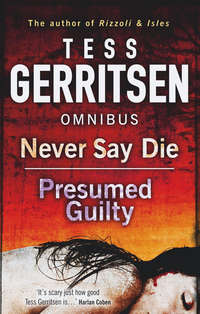
Kitabı oxu: «Never Say Die / Presumed Guilty: Never Say Die / Presumed Guilty»
Thrilling praise for

‘Tess Gerritsen is an automatic must-read in my house.
If you’ve never read Gerritsen, figure in the price
of electricity when you buy your first novel by her,
’cause, baby, you are going to be up all night. She is
better than Palmer, better than Cook… Yes, even
better than Crichton.’
—Stephen King
‘[Gerritsen] has an imagination…so dark and
frightening that she makes Edgar Allan Poe…
seem like goody-two-shoes’
—Chicago Tribune
‘Superior to Patricia Cornwell and
as good as James Patterson…’
—Bookseller
‘It’s scary just how good Tess Gerritsen is…’
—Harlan Coben
‘Gerritsen has enough in the locker to seriously worry
Michael Connelly, Harlan Coben and even the great
Denis Lehane. Brilliant.’
—Crimetime
‘Gerritsen is tops in her genre.’
—USA TODAY
‘Tess Gerritsen writes some of the smartest, most
compelling thrillers around.’
—Bookreporter
Also available by Tess Gerritsen
IN THEIR FOOTSTEPS
UNDER THE KNIFE
CALL AFTER MIDNIGHT
NEVER SAY DIE
STOLEN
WHISTLEBLOWER
PRESUMED GUILTY
MURDER & MAYHEM COLLECTION
Omnibus
Never Say Die
Presumed
Guilty
Tess
Gerritsen

www.mirabooks.co.uk
Never Say Die
To Adam and Joshua, the little rascals
Prologue
1970
Laos–North Vietnam border
THIRTY MILES OUT of Muong Sam, they saw the first tracers slash the sky.
Pilot William “Wild Bill” Maitland felt the DeHavilland Twin Otter buck like a filly as they took a hit somewhere back in the fuselage. He pulled into a climb, instinctively opting for the safety of altitude. As the misty mountains dropped away beneath them, a new round of tracers streaked past, splattering the cockpit with flak.
“Damn it, Kozy. You’re bad luck,” Maitland muttered to his copilot. “Seems like every time we go up together, I taste lead.”
Kozlowski went right on chomping his wad of bubble gum. “What’s to worry?” he drawled, nodding at the shattered windshield. “Missed ya by at least two inches.”
“Try one inch.”
“Big difference.”
“One extra inch can make a hell of a lot of difference.”
Kozy laughed and looked out the window. “Yeah, that’s what my wife tells me.”
The door to the cockpit swung open. Valdez, the cargo kicker, his shoulders bulky with a parachute pack, stuck his head in. “What the hell’s goin’ on any—” He froze as another tracer spiraled past.
“Got us some mighty big mosquitoes out there,” Kozlowski said and blew a huge pink bubble.
“What was that?” asked Valdez. “AK-47?”
“Looks more like .57-millimeter,” said Maitland.
“They didn’t say nothin’ about no .57s. What kind of briefing did we get, anyway?”
Kozlowski shrugged. “Only the best your tax dollars can buy.”
“How’s our ‘cargo’ holding up?” Maitland asked. “Pants still dry?”
Valdez leaned forward and confided, “Man, we got us one weird passenger back there.”
“So what’s new?” Kozlowski said.
“I mean, this one’s really strange. Got flak flyin’ all ’round and he doesn’t bat an eye. Just sits there like he’s floatin’ on some lily pond. You should see the medallion he’s got ’round his neck. Gotta weigh at least a kilo.”
“Come on,” said Kozlowski.
“I’m tellin’ you, Kozy, he’s got a kilo of gold hangin’ around that fat little neck of his. Who is he?”
“Some Lao VIP,” said Maitland.
“That all they told you?”
“I’m just the delivery boy. Don’t need to know any more than that.” Maitland leveled the DeHavilland off at eight thousand feet. Glancing back through the open cockpit doorway, he caught sight of their lone passenger sitting placidly among the jumble of supply crates. In the dim cabin, the Lao’s face gleamed like burnished mahogany. His eyes were closed, and his lips were moving silently. In prayer? wondered Maitland. Yes, the man was definitely one of their more interesting cargoes.
Not that Maitland hadn’t carried strange passengers before. In his ten years with Air America, he’d transported German shepherds and generals, gibbons and girlfriends. And he’d fly them anywhere they had to go. If hell had a landing strip, he liked to say, he’d take them there—as long as they had a ticket. Anything, anytime, anywhere, was the rule at Air America.
“Song Ma River,” said Kozlowski, glancing down through the fingers of mist at the lush jungle floor. “Lot of cover. If they got any more .57s in place, we’re gonna have us a hard landing.”
“Gonna be a hard landing anyhow,” said Maitland, taking stock of the velvety green ridges on either side of them. The valley was narrow; he’d have to swoop in fast and low. It was a hellishly short landing strip, nothing but a pin scratch in the jungle, and there was always the chance of an unreported gun emplacement. But the orders were to drop the Lao VIP, whoever he was, just inside North Viet-namese territory. No return pickup had been scheduled; it sounded to Maitland like a one-way trip to oblivion.
“Heading down in a minute,” he called over his shoulder to Valdez. “Get the passenger ready. He’s gonna have to hit the ground running.”
“He says that crate goes with him.”
“What? I didn’t hear anything about a crate.”
“They loaded it on at the last minute. Right after we took on supplies for Nam Tha. Pretty heavy sucker. I might need some help.”
Kozlowski resignedly unbuckled his seatbelt. “Okay,” he said with a sigh. “But remember, I don’t get paid for kickin’ crates.”
Maitland laughed. “What the hell do you get paid for?”
“Oh, lots of things,” Kozlowski said lazily, ducking past Valdez and through the cockpit door. “Eatin’. Sleepin’. Tellin’ dirty jokes—”
His last words were cut off by a deafening blast that shattered Maitland’s eardrums. The explosion sent Kozlowski—or what was left of Kozlowski—flying backward into the cockpit. Blood spattered the control panel, obscuring the altimeter dial. But Maitland didn’t need the altimeter to tell him they were going down fast.
“Kozy!” screamed Valdez, staring down at the remains of the copilot. “Kozy!”
His words were almost lost in the howling maelstrom of wind. The DeHavilland shuddered, a wounded bird fighting to stay aloft. Maitland, wrestling with the controls, knew immediately that he’d lost hydraulics. The best he could hope for was a belly flop on the jungle canopy.
He glanced back to survey the damage and saw, through a swirling cloud of debris, the bloodied body of the Lao passenger, thrown against the crates. He also saw sunlight shining through oddly twisted steel, glimpsed blue sky and clouds where the cargo door should have been. What the hell? Had the blast come from inside the plane?
He screamed to Valdez, “Bail out!”
The cargo kicker didn’t respond; he was still staring in horror at Kozlowski.
Maitland gave him a shove. “Get the hell out of here!”
Valdez at last reacted. He stumbled out of the cockpit and into the morass of broken crates and rent metal. At the gaping cargo door he paused. “Maitland?” he yelled over the wind’s shriek.
Their gazes met, and in that split second, they knew. They both knew. It was the last time they’d see each other alive.
“I’ll be out!” Maitland shouted. “Go!”
Valdez backed up a few steps. Then he launched himself out the cargo door.
Maitland didn’t glance back to see if Valdez’s parachute had opened; he had other things to worry about.
The plane was sputtering into a dive.
Even as he reached for his harness release, he knew his luck had run out. He had neither the time nor the altitude to struggle into his parachute. He’d never believed in wearing one anyway. Strapping it on was like admitting you didn’t trust your skill as a pilot, and Maitland knew—everyone knew—that he was the best.
Calmly he refastened his harness and grasped the controls. Through the shattered cockpit window he watched the jungle floor, lush and green and heartwrenchingly beautiful, swoop up to meet him. Somehow he’d always known it would end this way: the wind whistling through his crippled plane, the ground rushing toward him, his hands gripping the controls. This time he wouldn’t be walking away…
It was startling, this sudden recognition of his own mortality. An astonishing thought. I’m going to die.
And astonishment was exactly what he felt as the DeHavilland sliced into the treetops.
Vientiane, Laos
AT 1900 HOURS THE REPORT came in that Air America Flight 5078 had vanished.
In the Operations Room of the U.S. Army Liaison, Colonel Joseph Kistner and his colleagues from Central and Defense Intelligence greeted the news with shocked silence. Had their operation, so carefully conceived, so vital to U.S. interests, met with disaster?
Colonel Kistner immediately demanded confirmation.
The command at Air America provided the details. Flight 5078, due in Nam Tha at 1500 hours, had never arrived. A search of the presumed flight path—carried on until darkness intervened—had revealed no sign of wreckage. But flak had been reported heavy near the border, and .57-millimeter gun emplacements were noted just out of Muong Sam. To make things worse, the terrain was mountainous, the weather unpredictable and the number of alternative nonhostile landing strips limited.
It was a reasonable assumption that Flight 5078 had been shot down.
Grim acceptance settled on the faces of the men gathered around the table. Their brightest hope had just perished aboard a doomed plane. They looked at Kistner and awaited his decision.
“Resume the search at daybreak,” he said.
“That’d be throwing away live men after dead,” said the CIA officer. “Come on, gentlemen. We all know that crew’s gone.”
Cold-blooded bastard, thought Kistner. But as always, he was right. The colonel gathered together his papers and rose to his feet. “It’s not the men we’re searching for,” he said. “It’s the wreckage. I want it located.”
“And then what?”
Kistner snapped his briefcase shut. “We melt it.”
The CIA officer nodded in agreement. No one argued the point. The operation had met with disaster. There was nothing more to be done.
Except destroy the evidence.
Chapter One
Present
Bangkok, Thailand
GENERAL JOE KISTNER did not sweat, a fact that utterly amazed Willy Jane Maitland, since she herself seemed to be sweating through her sensible cotton underwear, through her sleeveless chambray blouse, all the way through her wrinkled twill skirt. Kistner looked like the sort of man who ought to be sweating rivers in this heat. He had a fiercely ruddy complexion, bulldog jowls, a nose marbled with spidery red veins, and a neck so thick, it strained to burst free of his crisp military collar. Every inch the blunt, straight-talking, tough old soldier, she thought. Except for the eyes. They’re uneasy. Evasive.
Those eyes, a pale, chilling blue, were now gazing across the veranda. In the distance the lush Thai hills seemed to steam in the afternoon heat. “You’re on a fool’s errand, Miss Maitland,” he said. “It’s been twenty years. Surely you agree your father is dead.”
“My mother’s never accepted it. She needs a body to bury, General.”
Kistner sighed. “Of course. The wives. It’s always the wives. There were so many widows, one tends to forget—”
“She hasn’t forgotten.”
“I’m not sure what I can tell you. What I ought to tell you.” He turned to her, his pale eyes targeting her face. “And really, Miss Maitland, what purpose does this serve? Except to satisfy your curiosity?”
That irritated her. It made her mission seem trivial, and there were few things Willy resented more than being made to feel insignificant. Especially by a puffed up, flat-topped warmonger. Rank didn’t impress her, certainly not after all the military stuffed shirts she’d met in the past few months. They’d all expressed their sympathy, told her they couldn’t help her and proceeded to brush off her questions. But Willy wasn’t a woman to be stonewalled. She’d chip away at their silence until they’d either answer her or kick her out.
Lately, it seemed, she’d been kicked out of quite a few offices.
“This matter is for the Casualty Resolution Committee,” said Kistner. “They’re the proper channel to go—”
“They say they can’t help me.”
“Neither can I.”
“We both know you can.”
There was a pause. Softly, he asked, “Do we?”
She leaned forward, intent on claiming the advantage. “I’ve done my homework, General. I’ve written letters, talked to dozens of people—everyone who had anything to do with that last mission. And whenever I mention Laos or Air America or Flight 5078, your name keeps popping up.”
He gave her a faint smile. “How nice to be remembered.”
“I heard you were the military attaché in Vientiane. That your office commissioned my father’s last flight. And that you personally ordered that final mission.”
“Where did you hear that rumor?”
“My contacts at Air America. Dad’s old buddies. I’d call them a reliable source.”
Kistner didn’t respond at first. He was studying her as carefully as he would a battle plan. “I may have issued such an order,” he conceded.
“Meaning you don’t remember?”
“Meaning it’s something I’m not at liberty to discuss. This is classified information. What happened in Laos is an extremely sensitive topic.”
“We’re not discussing military secrets here. The war’s been over for fifteen years!”
Kistner fell silent, surprised by her vehemence. Given her unassuming size, it was especially startling. Obviously Willy Maitland, who stood five-two, tops, in her bare feet, could be as scrappy as any six-foot marine, and she wasn’t afraid to fight. From the minute she’d walked onto his veranda, her shoulders squared, her jaw angled stubbornly, he’d known this was not a woman to be ignored. She reminded him of that old Eisenhower chestnut, “It’s not the size of the dog in the fight but the size of the fight in the dog.” Three wars, fought in Japan, Korea and Nam, had taught Kistner never to underestimate the enemy.
He wasn’t about to underestimate Wild Bill Maitland’s daughter, either.
He shifted his gaze across the wide veranda to the brilliant green mountains. In a wrought-iron birdcage, a macaw screeched out a defiant protest.
At last Kistner began to speak. “Flight 5078 took off from Vientiane with a crew of three—your father, a cargo kicker and a copilot. Sometime during the flight, they diverted across North Vietnamese territory, where we assume they were shot down by enemy fire. Only the cargo kicker, Luis Valdez, managed to bail out. He was immediately captured by the North Vietnamese. Your father was never found.”
“That doesn’t mean he’s dead. Valdez survived—”
“I’d hardly call the man’s outcome ‘survival.’”
They paused, a momentary silence for the man who’d endured five years as a POW, only to be shattered by his return to civilization. Luis Valdez had returned home on a Saturday and shot himself on Sunday.
“You left something out, General,” said Willy. “I’ve heard there was a passenger…”
“Oh. Yes,” said Kistner, not missing a beat. “I’d forgotten.”
“Who was he?”
Kistner shrugged. “A Lao. His name’s not important.”
“Was he with Intelligence?”
“That information, Miss Maitland, is classified.” He looked away, a gesture that told her the subject of the Lao was definitely off-limits. “After the plane went down,” he continued, “we mounted a search. But the ground fire was hot. And it became clear that if anyone had survived, they’d be in enemy hands.”
“So you left them there.”
“We don’t believe in throwing lives away, Miss Maitland. That’s what a rescue operation would’ve been. Throwing live men after dead.”
Yes, she could see his reasoning. He was a military tactician, not given to sentimentality. Even now, he sat ramrod straight in his chair, his eyes calmly surveying the verdant hills surrounding his villa, as though eternally in search of some enemy.
“We never found the crash site,” he continued. “But that jungle could swallow up anything. All that mist and smoke hanging over the valleys. The trees so thick, the ground never sees the light of day. But you’ll get a feeling for it yourself soon enough. When are you leaving for Saigon?”
“Tomorrow morning.”
“And the Vietnamese have agreed to discuss this matter?”
“I didn’t tell them my reason for coming. I was afraid I might not get the visa.”
“A wise move. They aren’t fond of controversy. What did you tell them?”
“That I’m a plain old tourist.” She shook her head and laughed. “I’m on the deluxe private tour. Six cities in two weeks.”
“That’s what one has to do in Asia. You don’t confront the issues. You dance around them.” He looked at his watch, a clear signal that the interview had come to an end.
They rose to their feet. As they shook hands, she felt him give her one last, appraising look. His grip was brisk and matter-of-fact, exactly what she expected from an old war dog.
“Good luck, Miss Maitland,” he said with a nod of dismissal. “I hope you find what you’re looking for.”
He turned to look off at the mountains. That’s when she noticed for the first time that tiny beads of sweat were glistening like diamonds on his forehead.
GENERAL KISTNER WATCHED as the woman, escorted by a servant, walked back toward the house. He was uneasy. He remembered Wild Bill Maitland only too clearly, and the daughter was very much like him. There would be trouble.
He went to the tea table and rang a silver bell. The tinkling drifted across the expanse of veranda, and seconds later, Kistner’s secretary appeared.
“Has Mr. Barnard arrived?” Kistner asked.
“He has been waiting for half an hour,” the man replied.
“And Ms. Maitland’s driver?”
“I sent him away, as you directed.”
“Good.” Kistner nodded. “Good.”
“Shall I bring Mr. Barnard in to see you?”
“No. Tell him I’m canceling my appointments. Tomorrow’s, as well.”
The secretary frowned. “He will be quite annoyed.”
“Yes, I imagine he will be,” said Kistner as he turned and headed toward his office. “But that’s his problem.”
A THAI SERVANT IN A CRISP white jacket escorted Willy through an echoing, cathedral-like hall to the reception room. There he stopped and gave her a politely questioning look. “You wish me to call a car?” he asked.
“No, thank you. My driver will take me back.”
The servant looked puzzled. “But your driver left some time ago.”
“He couldn’t have!” She glanced out the window in annoyance. “He was supposed to wait for—”
“Perhaps he is parked in the shade beyond the trees. I will go and look.”
Through the French windows, Willy watched as the servant skipped gracefully down the steps to the road. The estate was vast and lushly planted; a car could very well be hidden in that jungle. Just beyond the driveway, a gardener clipped a hedge of jasmine. A neatly graveled path traced a route across the lawn to a tree-shaded garden of flowers and stone benches. And in the far distance, a fairy blue haze seemed to hang over the city of Bangkok.
The sound of a masculine throat being cleared caught her attention. She turned and for the first time noticed the man standing in a far corner of the reception room. He cocked his head in a casual acknowledgment of her presence. She caught a glimpse of a crooked grin, a stray lock of brown hair drooping over a tanned forehead. Then he turned his attention back to the antique tapestry on the wall.
Strange. He didn’t look like the sort of man who’d be interested in moth-eaten embroidery. A patch of sweat had soaked through the back of his khaki shirt, and his sleeves were shoved up carelessly to his elbows. His trousers looked as if they’d been slept in for a week. A briefcase, stamped U.S. Army ID Lab, sat on the floor beside him, but he didn’t strike her as the military type. There was certainly nothing disciplined about his posture. He’d seem more at home slouching at a bar somewhere instead of cooling his heels in General Kistner’s marble reception room.
“Miss Maitland?”
The servant was back, shaking his head apologetically. “There must have been a misunderstanding. The gardener says your driver returned to the city.”
“Oh, no.” She looked out the window in frustration. “How do I get back to Bangkok?”
“Perhaps General Kistner’s driver can take you back? He has gone up the road to make a delivery, but he should return very soon. If you wish, you can see the garden in the meantime.”
“Yes. Yes, I suppose that’d be nice.”
The servant, smiling proudly, opened the door. “It is a very famous garden. General Kistner is known for his collection of dendrobiums. You will find them at the end of the path, near the carp pond.”
She stepped out into the steam bath of late afternoon and started down the gravel path. Except for the clack-clack of the gardener’s hedge clippers, the day was absolutely still. She headed toward a stand of trees. But halfway across the lawn she suddenly stopped and looked back at the house.
At first all she saw was sunlight glaring off the marble facade. Then she focused on the first floor and saw the figure of a man standing at one of the windows. The servant, perhaps?
Turning, she continued along the path. But every step of the way, she was acutely aware that someone was watching her.
GUY BARNARD STOOD AT THE French windows and observed the woman cross the lawn to the garden. He liked the way the sunlight seemed to dance in her clipped, honeycolored hair. He also liked the way she moved, the coltish swing of her walk. Methodically, his gaze slid down, over the sleeveless blouse and the skirt with its regrettably sensible hemline, taking in the essentials. Trim waist. Sweet hips. Nice calves. Nice ankles. Nice…
He reluctantly cut off that disturbing train of thought. This was not a good time to be distracted. Still, he couldn’t help one last appreciative glance at the diminutive figure. Okay, so she was a touch on the scrawny side. But she had great legs. Definitely great legs.
Footsteps clipped across the marble floor. Guy turned and saw Kistner’s secretary, an unsmiling Thai with a beardless face.
“Mr. Barnard?” said the secretary. “Our apologies for the delay. But an urgent matter has come up.”
“Will he see me now?”
The secretary shifted uneasily. “I am afraid—”
“I’ve been waiting since three.”
“Yes, I understand. But there is a problem. It seems General Kistner cannot meet with you as planned.”
“May I remind you that I didn’t request this meeting. General Kistner did.”
“Yes, but—”
“I’ve taken time out of my busy schedule—” he took the liberty of exaggeration “—to drive all the way out here, and—”
“I understand, but—”
“At least tell me why he insisted on this appointment.”
“You will have to ask him.”
Guy, who up till now had kept his irritation in check, drew himself up straight. Though he wasn’t a particularly tall man, he stood a full head taller than the secretary. “Is this how the general normally conducts business?”
The secretary merely shrugged. “I am sorry, Mr. Barnard. The change was entirely unexpected…” His gaze shifted momentarily and focused on something beyond the French windows.
Guy followed the man’s gaze. Through the glass, he saw what the man was looking at: the woman with the honeycolored hair.
The secretary shuffled his feet, a signal that he had other duties to attend to. “I assure you, Mr. Barnard,” he said, “if you call in a few days, we will arrange another appointment.”
Guy snatched up his briefcase and headed for the door. “In a few days,” he said, “I’ll be in Saigon.”
A whole afternoon wasted, he thought in disgust as he walked down the front steps. He swore again as he reached the empty driveway. His car was parked a good hundred yards away, in the shade of a poinciana tree. The driver was nowhere to be seen. Knowing Puapong, the man was probably off flirting with the gardener’s daughter.
Resignedly Guy trudged toward the car. The sun was like a broiler, and waves of heat radiated from the gravel road. Halfway to the car, he happened to glance at the garden, and he spotted the honey-haired woman, sitting on a stone bench. She looked dejected. No wonder; it was a long drive back to town, and Lord only knew when her ride would turn up.
What the hell, he thought, starting toward her. He could use some company.
She seemed to be deep in thought; she didn’t look up until he was standing right beside her.
“Hi there,” he said.
She squinted up at him. “Hello.” Her greeting was neutral, neither friendly nor unfriendly.
“Did I hear you needed a lift back to town?”
“I have one, thank you.”
“It could be a long wait. And I’m heading there anyway.” She didn’t respond, so he added, “It’s really no trouble.”
She gave him a speculative look. She had silver-gray eyes, direct, unflinching; they seemed to stare right through him. No shrinking violet, this one. Glancing back at the house, she said, “Kistner’s driver was going to take me…”
“I’m here. He isn’t.”
Again she gave him that look, a silent third degree. She must have decided he was okay, because she finally rose to her feet. “Thanks. I’d appreciate it.”
Together they walked the graveled road to his car. As they approached, Guy noticed a back door was wide open and a pair of dirty brown feet poked out. His driver was sprawled across the seat like a corpse.
The woman halted, staring at the lifeless form. “Oh, my God. He’s not—”
A blissful snore rumbled from the car.
“He’s not,” said Guy. “Hey. Puapong!” He banged on the car roof.
The man’s answering rumble could have drowned out thunder.
“Hello, Sleeping Beauty!” Guy banged the car again. “You gonna wake up, or do I have to kiss you first?”
“What? What?” groaned a voice. Puapong stirred and opened one bloodshot eye. “Hey, boss. You back so soon?”
“Have a nice nap?” Guy asked pleasantly.
“Not bad.”
Guy graciously gestured for Puapong to vacate the back seat. “Look, I hate to be a pest, but do you mind? I’ve offered this lady a ride.”
Puapong crawled out, stumbled around sleepily to the driver’s seat and sank behind the wheel. He shook his head a few times, then fished around on the floor for the car keys.
The woman was looking more and more dubious. “Are you sure he can drive?” she muttered under her breath.
“This man,” said Guy, “has the reflexes of a cat. When he’s sober.”
“Is he sober?”
“Puapong! Are you sober?”
With injured pride, the driver asked, “Don’t I look sober?”
“There’s your answer,” said Guy.
The woman sighed. “That makes me feel so much better.” She glanced back longingly at the house. The Thai servant had appeared on the steps and was waving goodbye.
Guy motioned for the woman to climb in. “It’s a long drive back to town.”
She was silent as they drove down the winding mountain road. Though they both sat in the back seat, two feet apart at the most, she seemed a million miles away. She kept her gaze focused on the scenery.
“You were in with the general quite a while,” he noted.
She nodded. “I had a lot of questions.”
“You a reporter?”
“What?” She looked at him. “Oh, no. It was just…some old family business.”
He waited for her to elaborate, but she turned back to the window.
“Must’ve been some pretty important family business,” he said.
“Why do you say that?”
“Right after you left, he canceled all his appointments. Mine included.”
“You didn’t get in to see him?”
“Never got past the secretary. And Kistner’s the one who asked to see me.”
She frowned for a moment, obviously puzzled. Then she shrugged. “I’m sure I had nothing to do with it.”
And I’m just as sure you did, he thought in sudden irritation. Lord, why was the woman making him so antsy? She was sitting perfectly still, but he got the distinct feeling a hurricane was churning in that pretty head. He’d decided that she was pretty after all, in a no-nonsense sort of way. She was smart not to use any makeup; it would only cheapen that girl-next-door face. He’d never before had any interest in the girl-next-door type. Maybe the girl down the street or across the tracks. But this one was different. She had eyes the color of smoke, a square jaw and a little boxer’s nose, lightly dusted with freckles. She also had a mouth that, given the right situation, could be quite kissable.
Automatically he asked, “So how long will you be in Bangkok?”
“I’ve been here two days already. I’m leaving tomorrow.”
Damn, he thought.
“For Saigon.”
His chin snapped up in surprise. “Saigon?”
“Or Ho Chi Minh City. Whatever they call it these days.”
“Now that’s a coincidence,” he said softly.
“What is?”
“In two days, I’m leaving for Saigon.”
“Are you?” She glanced at the briefcase, stenciled with U.S. Army ID Lab, lying on the seat. “Government affairs?”
He nodded. “What about you?”
She looked straight ahead. “Family business.”
“Right,” he said, wondering what the hell business her family was in. “You ever been to Saigon?”
“Once. But I was only ten years old.”
“Dad in the service?”
“Sort of.” Her gaze stayed fixed on some faraway point ahead. “I don’t remember too much of the city. Lot of dust and heat and cars. One big traffic jam. And the beautiful women…”
“It’s changed a lot since then. Most of the cars are gone.”
“And the beautiful women?”
He laughed. “Oh, they’re still around. Along with the heat and dust. But everything else has changed.” He was silent a moment. Then, almost as an afterthought, he added, “If you get stuck, I might be able to show you around.”
She hesitated, obviously tempted by his invitation. Come on, come on, take me up on it, he thought. Then he caught a glimpse of Puapong, grinning and winking wickedly at him in the rearview mirror.
He only hoped the woman hadn’t noticed.
But Willy most certainly had seen Puapong’s winks and grins and had instantly comprehended the meaning. Here we go again, she thought wearily. Now he’ll ask me if I want to have dinner and I’ll say no I can’t, and then he’ll say, what about a drink? and I’ll break down and say yes because he’s such a damnably good-looking man…
“Look, I happen to be free tonight,” he said. “Would you like to have dinner?”
“I can’t,” she said, wondering who had written this tired script and how one ever broke out of it.
“Then how about a drink?” He shot her a half smile and she felt herself teetering at the edge of a very high cliff. The crazy part was, he really wasn’t a handsome man at all. His nose was crooked, as if, after managing to get it broken, he hadn’t bothered to set it back in place. His hair was in need of a barber or at least a comb. She guessed he was somewhere in his late thirties, though the years scarcely showed except around his eyes, where deep laugh lines creased the corners. No, she’d seen far better-looking men. Men who offered more than a sweaty one-night grope in a foreign hotel.
So why is this guy getting to me?
“Just a drink?” he offered again.
“Thanks,” she said. “But no thanks.”
To her relief, he didn’t press the issue. He nodded, sat back and looked out the window. His fingers drummed the briefcase. The mindless rhythm drove her crazy. She tried to ignore him, just as he was trying to ignore her, but it was hopeless. He was too imposing a presence.
By the time they pulled up at the Oriental Hotel, she was ready to leap out of the car. She practically did.
“Thanks for the ride,” she said, and slammed the door shut.
“Hey, wait!” called the man through the open window. “I never caught your name!”
“Willy.”
“You have a last name?”
She turned and started up the hotel steps. “Maitland,” she said over her shoulder.
“See you around, Willy Maitland!” the man yelled.
Not likely, she thought. But as she reached the lobby doors, she couldn’t help glancing back and watching the car disappear around the corner. That’s when she realized she didn’t even know the man’s name.
GUY SAT ON HIS BED in the Liberty Hotel and wondered what had compelled him to check into this dump. Nostalgia, maybe. Plus cheap government rates. He’d always stayed here on his trips to Bangkok, ever since the war, and he’d never seen the need for a change until now. Certainly the place held a lot of memories. He’d never forget those hot, lusty nights of 1973. He’d been a twenty-year-old private on R and R; she’d been a thirty-year-old army nurse. Darlene. Yeah, that was her name. The last he’d seen of her, she was a chain-smoking mother of three and about fifty pounds overweight. What a shame. The woman, like the hotel, had definitely gone downhill.
Maybe I have, too, he thought wearily as he stared out the dirty window at the streets of Bangkok. How he used to love this city, loved the days of wandering through the markets, where the colors were so bright they hurt the eyes; loved the nights of prowling the back streets of Pat Pong, where the music and the girls never quit. Nothing bothered him in those days—not the noise or the heat or the smells.
Not even the bullets. He’d felt immune, immortal. It was always the other guy who caught the bullet, the other guy who got shipped home in a box. And if you thought otherwise, if you worried too long and hard about your own mortality, you made a lousy soldier.
Eventually, he’d become a lousy soldier.
He was still astonished that he’d survived. It was something he’d never fully understand: the simple fact that he’d made it back alive.
Especially when he thought of all the other men on that transport plane out of Da Nang. Their ticket home, the magic bird that was supposed to deliver them from all the madness.
He still had the scars from the crash. He still harbored a mortal dread of flying.
He refused to think about that upcoming flight to Saigon. Air travel, unfortunately, was part of his job, and this was just one more plane he couldn’t avoid.
He opened his briefcase, took out a stack of folders and lay down on the bed to read. The file he opened first was one of dozens he’d brought with him from Honolulu. Each contained a name, rank, serial number, photograph and a detailed history—as detailed as possible—of the circumstances of disappearance. This one was a naval airman, Lieutenant Commander Eugene Stoddard, last seen ejecting from his disabled bomber forty miles west of Hanoi. Included was a dental chart and an old X-ray report of an arm fracture sustained as a teenager. What the file left out were the nonessentials: the wife he’d left behind, the children, the questions.
There were always questions when a soldier was missing in action.
Guy skimmed the pages, made a few mental notes and reached for another file. These were the most likely cases, the men whose stories best matched the newest collection of remains. The Vietnamese government was turning over three sets, and Guy’s job was to confirm the skeletons were non-Vietnamese and to give each one a name, rank and serial number. It wasn’t a particularly pleasant job, but one that had to be done.
He set aside the second file and reached for the next.
This one didn’t contain a photograph; it was a supple-mentary file, one he’d reluctantly added to his briefcase at the last minute. The cover was stamped Confidential, then, a year ago, restamped Declassified. He opened the file and frowned at the first page.
Code Name: Friar Tuck
Status: Open (Current as of 10/85)
File Contains: 1. Summary of Witness Reports
2. Possible Identities
3. Search Status
Friar Tuck. A legend known to every soldier who’d fought in Nam. During the war, Guy had assumed those tales of a rogue American pilot flying for the enemy were mere fantasy.
Then, a few weeks ago, he’d learned otherwise.
He’d been at his desk at the Army Lab when two men, representatives of an organization called the Ariel Group, had appeared in his office. “We have a proposition,” they’d said. “We know you’re visiting Nam soon, and we want you to look for a war criminal.” The man they were seeking was Friar Tuck.
“You’ve got to be kidding.” Guy had laughed. “I’m not a military cop. And there’s no such man. He’s a fairy tale.”
In answer, they’d handed him a twenty-thousand-dollar check—“for expenses,” they’d said. There’d be more to come if he brought the traitor back to justice.
“And if I don’t want the job?” he’d asked.
“You can hardly refuse” was their answer. Then they’d told Guy exactly what they knew about him, about his past, the thing he’d done in the war. A brutal secret that could destroy him, a secret he’d kept hidden away behind a wall of fear and self-loathing. They told him exactly what he could expect if it came to light. The hard glare of publicity. The trial. The jail cell.
They had him cornered. He took the check and awaited the next contact.
The day before he left Honolulu, this file had arrived special delivery from Washington. Without looking at it, he’d slipped it into his briefcase.
Now he read it for the first time, pausing at the page listing possible identities. Several names he recognized from his stack of MIA files, and it struck him as unfair, this list. These men were missing in action and probably dead; to brand them as possible traitors was an insult to their memories.
One by one, he went over the names of those voiceless pilots suspected of treason. Halfway down the list, he stopped, focusing on the entry “William T. Maitland, pilot, Air America.” Beside it was an asterisk and, below, the footnote: “Refer to File #M-70-4163, Defense Intelligence. (Classified.)”
William T. Maitland, he thought, trying to remember where he’d heard the name. Maitland, Maitland.
Then he thought of the woman at Kistner’s villa, the little blonde with the magnificent legs. I’m here on family business, she’d said. For that she’d consulted General Joe Kistner, a man whose connections to Defense Intelligence were indisputable.
See you around, Willy Maitland.
It was too much of a coincidence. And yet…
He went back to the first page and reread the file on Friar Tuck, beginning to end. The section on Search Status he read twice. Then he rose from the bed and began to pace the room, considering his options. Not liking any of them.
He didn’t believe in using people. But the stakes were sky-high, and they were deeply, intensely personal. How many men have their own little secrets from the war? he wondered. Secrets we can’t talk about? Secrets that could destroy us?
He closed the file. The information in this folder wasn’t enough; he needed the woman’s help.
But am I cold-blooded enough to use her?
Can I afford not to? whispered the voice of necessity.
It was an awful decision to make. But he had no choice.
IT WAS 5:00 P.M., AND the Bong Bong Club was not yet in full swing. Up onstage, three women, bodies oiled and gleaming, writhed together like a trio of snakes. Music blared from an old stereo speaker, a relentlessly primitive beat that made the very darkness shudder.
From his favorite corner table, Siang watched the action, the men sipping drinks, the waitresses dangling after tips. Then he focused on the stage, on the girl in the middle. She was special. Lush hips, meaty thighs, a pink, carnivorous tongue. He couldn’t define what it was about her eyes, but she had that look. The numeral 7 was pinned on her G-string. He would have to inquire later about number seven.
“Good afternoon, Mr. Siang.”
Siang looked up to see the man standing in the shadows. It never failed to impress him, the size of that man. Even now, twenty years after their first meeting, Siang could not help feeling he was a child in the presence of this giant.
The man ordered a beer and sat down at the table. He watched the stage for a moment. “A new act?” he asked.
“The one in the middle is new.”
“Ah, yes, very nice. Your type, is she?”
“I will have to find out.” Siang took a sip of whiskey, his gaze never leaving the stage. “You said you had a job for me.”
“A small matter.”
“I hope that does not mean a small reward.”
The man laughed softly. “No, no. Have I ever been less than generous?”
“What is the name?”
“A woman.” The man slid a photograph onto the table. “Her name is Willy Maitland. Thirty-two years old. Five foot two, dark blond hair cut short, gray eyes. Staying at the Oriental Hotel.”
“American?”
“Yes.”
Siang paused. “An unusual request.”
“There is some…urgency.”
Ah. The price goes up, thought Siang. “Why?” he asked.
“She departs for Saigon tomorrow morning. That leaves you only tonight.”
Siang nodded and looked back at the stage. He was pleased to see that the girl in the middle, number seven, was looking straight at him. “That should be time enough,” he said.
WILLY MAITLAND WAS standing at the river’s edge, staring down at the swirling water.
From across the dining terrace, Guy spotted her, a tiny figure leaning at the railing, her short hair fluffing in the wind. From the hunch of her shoulders, the determined focus of her gaze, he got the impression she wanted to be left alone. Stopping at the bar, he picked up a beer—Oranjeboom, a good Dutch brand he hadn’t tasted in years. He stood there a moment, watching her, savoring the touch of the frosty bottle against his cheek.
She still hadn’t moved. She just kept gazing down at the river, as though hypnotized by something she saw in the muddy depths. He moved across the terrace toward her, weaving past empty tables and chairs, and eased up beside her at the railing. He marveled at the way her hair seemed to reflect the red and gold sparks of sunset.
“Nice view,” he said.
She glanced at him. One look, utterly uninterested, was all she gave him. Then she turned away.
He set his beer on the railing. “Thought I’d check back with you. See if you’d changed your mind about that drink.”
She stared stubbornly at the water.
“I know how it is in a foreign city. No one to share your frustrations. I thought you might be feeling a little—”
“Give me a break,” she said, and walked away.
He must be losing his touch, he thought. He snatched up his beer and followed her. Pointedly ignoring him, she strolled along the edge of the terrace, every so often flicking her hair off her face. She had a cute swing to her walk, just a little too frisky to be considered graceful.
“I think we should have dinner,” he said, keeping pace. “And maybe a little conversation.”
“About what?”
“Oh, we could start off with the weather. Move on to politics. Religion. My family, your family.”
“I assume this is all leading up to something?”
“Well, yeah.”
“Let me guess. An invitation to your room?”
“Is that what you think I’m trying to do?” he asked in a hurt voice. “Pick you up?”
“Aren’t you?” she said. Then she turned and once again walked away.
This time he didn’t follow her. He didn’t see the point. Leaning back against the rail, he sipped his beer and watched her climb the steps to the dining terrace. There, she sat down at a table and retreated behind a menu. It was too late for tea and too early for supper. Except for a dozen boisterous Italians sitting at a nearby table, the terrace was empty. He lingered there a while, finishing off the beer, wondering what his next approach should be. Wondering if anything would work. She was a tough nut to crack, surprisingly fierce for a dame who barely came up to his shoulder. A mouse with teeth.
He needed another beer. And a new strategy. He’d think of it in a minute.
He headed up the steps, back to the bar. As he crossed the dining terrace, he couldn’t help a backward glance at the woman. Those few seconds of inattention almost caused him to collide with a well-dressed Thai man moving in the opposite direction. Guy murmured an automatic apology. The other man didn’t answer; he walked right on past, his gaze fixed on something ahead.
Guy took about two steps before some inner alarm went off in his head. It was pure instinct, the soldier’s premonition of disaster. It had to do with the eyes of the man who’d just passed by.
He’d seen that look of deadly calm once before, in the eyes of a Vietnamese. They had brushed shoulders as Guy was leaving a popular Da Nang nightclub. For a split second their gazes had locked. Even now, years later, Guy still remembered the chill he’d felt looking into that man’s eyes. Two minutes later, as Guy had stood waiting in the street for his buddies, a bomb ripped apart the building. Seventeen Americans had been killed.
Now, with a growing sense of alarm, he watched the Thai stop and survey his surroundings. The man seemed to spot what he was looking for and headed toward the dining terrace. Only two of the tables were occupied. The Italians sat at one, Willy Maitland at the other. At the edge of the terrace, the Thai paused and reached into his jacket.
Reflexively, Guy took a few steps forward. Even before his eyes registered the danger, his body was already reacting. Something glittered in the man’s hand, an object that caught the bloodred glare of sunset. Only then could Guy rationally acknowledge what his instincts had warned him was about to happen.
He screamed, “Willy! Watch out!”
Then he launched himself at the assassin.
Chapter Two
AT THE SOUND of the man’s shout, Willy lowered her menu and turned. To her amazement, she saw it was the crazy American, toppling chairs as he barreled across the cocktail lounge. What was that lunatic up to now?
In disbelief, she watched him shove past a waiter and fling himself at another man, a well-dressed Thai. The two bodies collided. At the same instant, she heard something hiss through the air, felt an unexpected flick of pain in her arm. She leapt up from her chair as the two men slammed to the ground near her feet.
At the next table, the Italians were also out of their chairs, pointing and shouting. The bodies on the ground rolled over and over, toppling tables, sending sugar bowls crashing to the stone terrace. Willy was lost in utter confusion. What was happening? Why was that idiot fighting with a Thai businessman?
Both men staggered to their feet. The Thai kicked high, his heel thudding squarely into the other man’s belly. The American doubled over, groaned and landed with his back propped up against the terrace wall.
The Thai vanished.
By now the Italians were hysterical.
Willy scrambled through the fallen chairs and shattered crockery and crouched at the man’s side. Already a bruise the size of a golf ball had swollen his cheek. Blood trickled alarmingly from his torn lip. “Are you all right?” she cried.
He touched his cheek and winced. “I’ve probably looked worse.”
She glanced around at the toppled furniture. “Look at this mess! I hope you have a good explanation for—What are you doing?” she demanded as he suddenly gripped her arm. “Get your hands off me!”
“You’re bleeding!”
“What?” She followed the direction of his gaze and saw that a shocking blotch of red soaked her sleeve. Droplets splattered to the flagstones.
Her reaction was immediate and visceral. She swayed dizzily and sat down smack on the ground, right beside him. Through a cottony haze, she felt her head being shoved down to her knees, heard her sleeve being ripped open. Hands probed gently at her arm.
“Easy,” he murmured. “It’s not bad. You’ll need a few stitches, that’s all. Just breathe slowly.”
“Get your hands off me,” she mumbled. But the instant she raised her head, the whole terrace seemed to swim. She caught a watery view of mass confusion. The Italians chattering and shaking their heads. The waiters staring openmouthed in horror. And the American watching her with a look of worry. She focused on his eyes. Dazed as she was, she registered the fact that those eyes were warm and steady.
By now the hotel manager, an effete Englishman wearing an immaculate suit and an appalled expression, had appeared. The waiters pointed accusingly at Guy. The manager kept clucking and shaking his head as he surveyed the damage.
“This is dreadful,” he murmured. “This sort of behavior is simply not tolerated. Not on my terrace. Are you a guest? You’re not?” He turned to one of the waiters. “Call the police. I want this man arrested.”
“Are you all blind?” yelled Guy. “Didn’t any of you see he was trying to kill her?”
“What? What? Who?”
Guy poked around in the broken crockery and fished out the knife. “Not your usual cutlery,” he said, holding up the deadly looking weapon. The handle was ebony, inlaid with mother of pearl. The blade was razor sharp. “This one’s designed to be thrown.”
“Oh, rubbish,” sputtered the Englishman.
“Take a look at her arm!”
The manager turned his gaze to Willy’s blood-soaked sleeve. Horrified, he took a stumbling step back. “Good God. I’ll—I’ll call a doctor.”
“Never mind,” said Guy, sweeping Willy off the ground. “It’ll be faster if I take her straight to the hospital.”
Willy let herself be gathered into Guy’s arms. She found his scent strangely reassuring, a distinctly male mingling of sweat and after-shave. As he carried her across the terrace, she caught a swirling view of shocked waiters and curious hotel guests.
“This is embarrassing,” she complained. “I’m all right. Put me down.”
“You’ll faint.”
“I’ve never fainted in my life!”
“It’s not a good time to start.” He got her into a waiting taxi, where she curled up in the back seat like a wounded animal.
The emergency-room doctor didn’t believe in anesthesia. Willy didn’t believe in screaming. As the curved suture needle stabbed again and again into her arm, she clenched her teeth and longed to have the lunatic American hold her hand. If only she hadn’t played tough and sent him out to the waiting area. Even now, as she fought back tears of pain, she refused to admit, even to herself, that she needed any man to hold her hand. Still, it would have been nice. It would have been wonderful.
And I still don’t know his name.
The doctor, whom she suspected of harboring sadistic tendencies, took the final stitch, tied it off and snipped the silk thread. “You see?” he said cheerfully. “That wasn’t so bad.”
She felt like slugging him in the mouth and saying, You see? That wasn’t so bad, either.
He dressed the wound with gauze and tape, then gave her a cheerful slap—on her wounded arm, of course—and sent her out into the waiting room.
He was still there, loitering by the reception desk. With all his bruises and cuts, he looked like a bum who’d wandered in off the street. But the look he gave her was warm and concerned. “How’s the arm?” he asked.
Gingerly she touched her shoulder. “Doesn’t this country believe in Novocaine?”
“Only for wimps,” he observed. “Which you obviously aren’t.”
Outside, the night was steaming. There were no taxis available, so they hired a tuk-tuk, a motorcycle-powered rickshaw, driven by a toothless Thai.
“You never told me your name,” she said over the roar of the engine.
“I didn’t think you were interested.”
“Is that my cue to get down on my knees and beg for an introduction?”
Grinning, he held out his hand. “Guy Barnard. Now do I get to hear what the Willy’s short for?”
She shook his hand. “Wilone.”
“Unusual. Nice.”
“Short of Wilhelmina, it’s as close as a daughter can get to being William Maitland, Jr.”
He didn’t comment, but she saw an odd flicker in his eyes, a look of sudden interest. She wondered why. The tuk-tuk puttered past a klong, its stagnant waters shimmering under the streetlights.
“Maitland,” he said casually. “Now that’s a name I seem to remember from the war. There was a pilot, a guy named Wild Bill Maitland. Flew for Air America. Any relation?”
She looked away. “Just my father.”
“No kidding! You’re Wild Bill Maitland’s kid?”
“You’ve heard the stories about him, have you?”
“Who hasn’t? He was a living legend. Right up there with Earthquake Magoon.”
“That’s about what he was to me, too,” she muttered. “Nothing but a legend.”
There was a pause in their exchange, and she wondered if Guy Barnard was shocked by the bitterness in her last statement. If so, he didn’t show it.
“I never actually met your old man,” he said. “But I saw him once, on the Da Nang airstrip. I was working ground crew.”
“With Air America?”
“No. Army Air Cav.” He sketched a careless salute. “Private First Class Barnard. You know, the real scum of the earth.”
“I see you’ve come up in the world.”
“Yeah.” He laughed. “Anyway, your old man brought in a C-46, engine smoking, fuel zilch, fuselage so shot up you could almost see right through her. He sets her down on the tarmac, pretty as you please. Then he climbs out and checks out all the bullet holes. Any other pilot would’ve been down on his knees kissing the ground. But your dad, he just shrugs, goes over to a tree and takes a nap.” Guy shook his head. “Your old man was something else.”
“So everyone tells me.” Willy shoved a hank of windblown hair off her face and wished he’d stop talking about her father. That’s how it’d been, as far back as she could remember. When she was a child in Vientiane, at every dinner party, every cocktail gathering, the pilots would invariably trot out another Wild Bill story. They’d raise toasts to his nerves, his daring, his crazy humor, until she was ready to scream. All those stories only emphasized how unimportant she and her mother were in the scheme of her father’s life.
Maybe that’s why Guy Barnard was starting to annoy her.
But it was more than just his talk about Bill Maitland. In some odd, indefinable way, Guy reminded her too much of her father.
The tuk-tuk suddenly hit a bump in the road, throwing her against Guy’s shoulder. Pain sliced through her arm and her whole body seemed to clench in a spasm.
He glanced at her, alarmed. “Are you all right?”
“I’m—” She bit her lip, fighting back tears. “It’s really starting to hurt.”
He yelled at the driver to slow down. Then he took Willy’s hand and held it tightly. “Just a little while longer. We’re almost there…”
It was a long ride to the hotel.
Up in her room, Guy sat her down on the bed and gently stroked the hair off her face. “Do you have any pain killers?”
“There’s—there’s some aspirin in the bathroom.” She started to rise to her feet. “I can get it.”
“No. You stay right where you are.” He went into the bathroom, came back out with a glass of water and the bottle of aspirin. Even through her cloud of pain, she was intensely aware of him watching her, studying her as she swallowed the tablets. Yet she found his nearness strangely reassuring. When he turned and crossed the room, the sudden distance between them left her feeling abandoned.
She watched him rummage around in the tiny refrigerator. “What are you looking for?”
“Found it.” He came back with a cocktail bottle of whiskey, which he uncapped and handed to her. “Liquid anesthesia. It’s an old-fashioned remedy, but it works.”
“I don’t like whiskey.”
“You don’t have to like it. By definition, medicine’s not supposed to taste good.”
She managed a gulp. It burned all the way down her throat. “Thanks,” she muttered. “I think.”
He began to walk a slow circle, surveying the plush furnishings, the expansive view. Sliding glass doors opened onto a balcony. From the Chaophya River flowing just below came the growl of motorboats plying the waters. He wandered over to the nightstand, picked up a rambutan from the complimentary fruit basket and peeled off the prickly shell. “Nice room,” he said, thoughtfully chewing the fruit. “Sure beats my dive—the Liberty Hotel. What do you do for a living, anyway?”
She took another sip of whiskey and coughed. “I’m a pilot.”
“Just like your old man?”
“Not exactly. I fly for the paycheck, not the excitement. Not that the pay’s great. No money in flying cargo.”
“Can’t be too bad if you’re staying here.”
“I’m not paying for this.”
His eyebrows shot up. “Who is?”
“My mother.”
“Generous of her.”
His note of cynicism irritated her. What right did he have to insult her? Here he was, this battered vagabond, eating her fruit, enjoying her view. The tuk-tuk ride had tossed his hair in all directions, and his bruised eye was swollen practically shut. Why was she even putting up with this jerk?
He was watching her with curiosity. “So what else is Mama paying for?” he asked.
She looked him hard in the eye. “Her own funeral arrangements,” she said, and was satisfied to see his smirk instantly vanish.
“What do you mean? Is your mother dead?”
“No, but she’s dying.” Willy gazed out the window at the lantern lights along the river’s edge. For a moment they seemed to dance like fireflies in a watery haze. She swallowed; the lights came back into focus. “God,” she sighed, wearily running her fingers through her hair. “What the hell am I doing here?”
“I take it this isn’t a vacation.”
“You got that right.”
“What is it, then?”
“A wild-goose chase.” She swallowed the rest of the whiskey and set the tiny bottle down on the nightstand. “But it’s Mom’s last wish. And you’re always supposed to grant people their dying wish.” She looked at Guy. “Aren’t you?”
He sank into a chair, his gaze locked on her face. “You told me before that you were here on family business. Does it have to do with your father?”
She nodded.
“And that’s why you saw Kistner today?”
“We were hoping—I was hoping—that he’d be able to fill us in about what happened to Dad.”
“Why go to Kistner? Casualty resolution isn’t his job.”
“But Military Intelligence is. In 1970, Kistner was stationed in Laos. He was the one who commissioned my father’s last flight. And after the plane went down, he directed the search. What there was of a search.”
“And did Kistner tell you anything new?”
“Only what I expected to hear. That after twenty years, there’s no point pursuing the matter. That my father’s dead. And there’s no way to recover his remains.”
“It must’ve been tough hearing that. Knowing you’ve come all this way for nothing.”
“It’ll be hard on my mother.”
“And not on you?”
“Not really.” She rose from the bed and wandered out onto the balcony, where she stared down at the water. “You see, I don’t give a damn about my father.”
The night was heavy with the smells of the river. She knew Guy was watching her; she could feel his gaze on her back, could imagine the shocked expression on his face. Of course, he would be shocked; it was appalling, what she’d just said. But it was also the truth.
She sensed, more than heard, his approach. He came up beside her and leaned against the railing. The glow of the river lanterns threw his face into shadow.
She stared down at the shimmering water. “You don’t know what it’s like to be the daughter of a legend. All my life, people have told me how brave he was, what a hero he was. God, he must have loved the glory.”
“A lot of men do.”
“And a lot of women suffer for it.”
“Did your mother suffer?”
She looked up at the sky. “My mother…” She shook her head and laughed. “Let me tell you about my mother. She was a nightclub singer. All the best New York clubs. I went through her scrapbook, and I remember some reviewer wrote, ‘Her voice spins a web that will trap any audience in its magic.’ She was headed for the moon. Then she got married. She went from star billing to a—a footnote in some man’s life. We lived in Vientiane for a few years. I remember what a trouper she was. She wanted so badly to go home, but there she was, scraping the store shelves for decent groceries. Laughing off the hand grenades. Dad got the glory. But she’s the one who raised me.” Willy looked at Guy. “That’s how the world works. Isn’t it?”
Pulsuz fraqment bitdi.