Kitabı oxu: «Man and Boy»
MAN AND BOY
Tony Parsons

Copyright
HarperCollinsPublishers Ltd
1 London Bridge Street
London SE1 9GF
www.harpercollins.co.uk
First published in Great Britain by HarperCollinsPublishers 1999
Copyright © Tony Parsons 1999
Cover design by Sim Greenaway © HarperCollinsPublishers Ltd 2019
Cover photograph © Joe Partridge
Tony Parsons asserts the moral right to be identified as the author of this work.
A catalogue copy of this book is available from the British Library.
This novel is entirely a work of fiction. The names, characters and incidents portrayed in it are the work of the author’s imagination. Any resemblance to actual persons, living or dead, events or localities is entirely coincidental.
All rights reserved under International and Pan-American Copyright Conventions. By payment of the required fees, you have been granted the non-exclusive, non-transferable right to access and read the text of this e-book on screen. No part of this text may be reproduced, transmitted, down-loaded, decompiled, reverse engineered, or stored in or introduced into any information storage and retrieval system, in any form or by any means, whether electronic or mechanical, now known or hereinafter invented, without the express written permission of HarperCollins.
Source ISBN: 9780006512134
Ebook Edition © July 2019 ISBN: 9780007362899
Version: 2019-06-18
Praise for Tony Parsons
‘As ever, [Tony Parsons] is in impressively depth-charging, straight-talking form. A broadsheet mind with a tabloid tongue, he remains one of the few male writers prepared to look beyond his own navel in search of answers’
GQ
‘As tautly plotted as a thriller and its rich cast of characters defy stereotype … Like Kern or Gershwin, he touches the universal via the specific and we weep’
Irish Times
‘Unashamedly touching … funny and well-written’
Telegraph magazine
‘I sobbed my way shamelessly through this book’
Woman’s Journal
‘Superb. Man and Boy is as witty and sharp as you would expect from Parsons but it is not at all bitter – rather profoundly moving. It will strike chords with many readers’
Yorkshire Post
‘Entertaining. Hugely so. Parsons has the skill to grip you by the collar and drag you into the heart of the story’
Manchester Evening News
‘Parsons is a brisk and punchy writer, moving the story on in a series of jaunty episodes and comic vignettes’
Times Literary Supplement
‘Anyone expecting Parsons’ trademark razor-sharp mockney one-liners will find something altogether more subtle. It might sound a bit Nick Hornby but I’d liken it to Kramer v Kramer. A surprising tear-jerker’
Mirror
‘What distinguishes Parsons’s effort from a shelfful of “male identity” outings is his ability to take the traditional framework of the genre … and work within it to produce a series of wholly unexpected twists and eddies … If this is the direction in which British chaps’ fiction is heading, then no one who cares about contemporary writing can seriously complain’
Literary Review
‘The writing is confident and accomplished … He makes the reader care … This is art shot through with humanity’
Independent on Sunday
‘He takes as his specialist subject contemporary emotional issues which almost every other male writer has ignored’
Guardian
‘Funny, serious, tender and honest … Tony Parsons is writing about the genuine dilemmas of modern life’
Sunday Express
‘Memorable and poignant – nobody squeezes more genuine emotion from a scene than Tony Parsons’
Spectator
‘One of the many great things about a Tony Parsons novel is that they always make you feel not just alive, but even more aware of how precious life is … Another modern classic’
Mirror
‘Parsons manages to astutely cut right to the heart of family life’
Woman and Home
‘His stories show all too well how we muddle along in search of love and fulfilment, and when we fluff it … sometimes that’s just because it’s easier’
Observer
Dedication
For my mother
Contents
Cover
Title Page
Copyright
Praise for Tony Parsons
Dedication
Foreword to the 20th Anniversary Edition
Part One: Skylarking
The Most Beautiful Boy in the World
Chapter One
Chapter Two
Chapter Three
Chapter Four
Chapter Five
Chapter Six
Chapter Seven
Chapter Eight
Chapter Nine
Chapter Ten
Chapter Eleven
Chapter Twelve
Chapter Thirteen
Chapter Fourteen
Chapter Fifteen
Chapter Sixteen
Chapter Seventeen
Chapter Eighteen
Part Two: The ding-dong man
Chapter Nineteen
Chapter Twenty
Chapter Twenty-One
Chapter Twenty-Two
Chapter Twenty-Three
Chapter Twenty-Four
Chapter Twenty-Five
Chapter Twenty-Six
Chapter Twenty-Seven
Chapter Twenty-Eight
Chapter Twenty-Nine
Chapter Thirty
Part Three: Guess what?
Chapter Thirty-One
Chapter Thirty-Two
Chapter Thirty-Three
Chapter Thirty-Four
Chapter Thirty-Five
Chapter Thirty-Six
Chapter Thirty-Seven
Chapter Thirty-Eight
Chapter Thirty-Nine
Chapter Forty
Inside:
Writing Man and Boy: Q & A with Tony Parsons
Keep Reading …
About the Author
Also by Tony Parsons
About the Publisher
Foreword to the 20th Anniversary Edition
I started writing Man and Boy the day that I held my mother’s hand as the doctor told her that she had terminal lung cancer and there was nothing more they could do.
My mum took the news with her usual combination of humour, stoicism and defiance. She came out of the doctor’s surgery with a big grin, totally convinced she was about to prove the medical profession wrong. Typical mum. I went home and started writing a story about a family that looked a lot like my family.
It hit me hard that day, knowing that I would soon be in a world that would not contain either of my parents. My dad – Victor, but always Vic – had been gone for twelve years. My mum – Emma, but always Em – would be gone in twelve months, the doctors said (Em begged to differ). The story I started that day was about family and feelings, parents and their children, illness that is terminal and a love that can’t be killed by death. It was a celebration of family, but there was a sadness in it because I suddenly knew how hard – impossible, in the end – it is to hold on to the ones you care about. Man and Boy was a simple story, plainly told, and for some reason it went on to sell in millions.
We all watch our parents age as our children grow, and we all look for love and often misplace it. We see our family grow and change, and in the end we all must say goodbye to those we love the most. In the end, children grow up and find a family of their own. In the end your parents die. It is the most natural thing in the world, and yet somehow the most unimaginable. But not even a family full of love lasts forever.
At events to promote Man and Boy, I regularly looked up and saw members of the audience crying – and of course they were not crying about my story, they were remembering their own losses. It was a book that was written from the heart and so it had no trouble touching many other hearts. Because a lot of people knew exactly what this stuff felt like. And if they didn’t, then they knew it was waiting down the road. It wasn’t complicated.
I wrote Man and Boy when my mum was dying and that is why it is full of raw emotion. Although much of it is about fathers and sons and the gaps between them, it is my mother’s love and spirit that gives life to every line. She smiled when I told her the book was going to be dedicated to her. “Then I must be on the way out!” Em said. And we laughed with tears in our eyes because it was true – she really was on her way out of this life.
My mum’s illness made me think long and hard about my father and how different it had been when the old man – always my hero – was dying.
With my mum, I was by her side for every doctor’s appointment, for every blood test and x-ray, all those dates marked by slowly diminishing hope. My father had died of the same disease – lung cancer, for my folks were from the generation who believed in the glamour of Bogart and Bacall’s languidly-held cigarettes – without telling anyone that he was dying. Because my dad – and more than thirty years later, I still find this hard to believe – decided not to tell anyone that he had terminal cancer. As the bewildered characters in Man and Boy reflect, perhaps he was trying to protect the people he loved. Or perhaps he could not find the words. Or perhaps it was some strange combination of pride and vulnerability, and a reluctance to admit to human weakness. But memories of my singular old man gave the book its shape and its central theme. “A love letter to a son from his father, and to a father from his son,” said an early review, one of those rare reviews that help an author better understand their own book. Harry Silver, the protagonist of Man and Boy, is poised between the generations in a way that we are all at some point in our lives. I wrote Man and Boy when my last surviving parent was dying and my first-born child was growing up fast. As the twentieth century ran out and I banged away at Man and Boy, I never felt so much like somebody’s son and somebody’s father. I was never so aware of the generation that came before me and the generation that would eventually replace me. The cycle of life was no longer theoretical – the evidence was all around me, in my blood and in my bones and in my dreams, and in the changing faces of my dying mother and my growing son.
Man and Boy is a book that was written from the heart. I had something I needed to say about the most ordinary things in the world – family and feelings, fathers and sons, our mothers and their love, growing children and dying parents – that are also the most momentous things we ever know.
The simple tale I told is, as they say, based on a true story. Yes, I had been a young single father with a beautiful four-year-old son who helped me meet girls. And it’s true that my father was a suburban working class man on a modest income who was also a war hero with a torso covered in scar tissue and a Distinguished Service Medal shoved at the back of some dusty drawer. But fiction sets you free to mould the raw messy, material of real life into something that makes much more sense. So, although my father was a lot like the dying dad in Man and Boy, somehow it is still not quite my old man. One of the most vivid memories of my childhood is going into the garage of our house in Billericay and seeing a handgun on the back seat of my father’s car. Now my dad was a greengrocer – why did he have a handgun on the backseat of his car? I never asked, and so I never knew. But that colourful vignette never made it into Man and Boy because it simply did not fit the story. In real life, people remain a mystery. Even people we love; especially people we love. But in fiction, everything is a slave to the story.
Writers make sense of their world by telling stories about it. That’s really all I was doing with Man and Boy – trying to understand a world that I never expected to live in. A world without my mum and dad. A world where I was a single parent. My son – all grown up now – once asked me if it was true that he had split open his head in an empty swimming pool, as Pat – Harry’s young son – does in Man and Boy. I had to think about that one. And it turned out that, no, in real life my boy split his head open using a bed as a trampoline. But every parent in the world knows the sick fear that never leaves the parental heart, the dread that real harm is coming for your child.
Like Harry in Man and Boy, I took my small son to see his grandfather when he was on his death bed because I thought it would be good for both of them. Like Harry, I was dead wrong – it was painful, confusing and heartbreaking for both of them. The scene made it to the book because often fiction can improve on real life but sometimes it really can’t.
Man and Boy was published in July 1999. A few weeks earlier, just before dawn of a lovely spring day, my mum died in the home where I had grown up, the semi-detached house in Billericay where she had been a young wife and mother, and for twelve years a widow. She died in the home where she had built a life – and a life for her tough old husband, her wayward son, and her beloved grandson whose parents divorced before he started school.
The prospect of death had not scared my mother. In a family full of hard men – she had six brothers who all served in the armed forces during the war and a husband who had been a Royal Naval Commando – she was by some distance the bravest of the lot. The only thing she was afraid of was being made to leave her home to die in a hospital or a hospice. She got her wish to die at home.
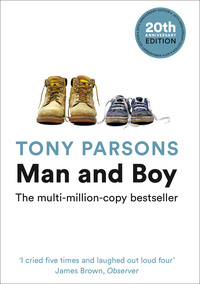
And while I was still reeling from that fact – although I think we reel from it forever, I think we never really get over the feeling of being orphaned, no matter how old we get – Man and Boy went out into the world. And slowly, steadily, driven by word-of-mouth from readers and a passionate publisher and not least by a beautiful iconic cover, it went on to sell millions.
In the course of a career that lasts for a lifetime, a novelist writes all kind of books. Runaway bestsellers and commercial flops. Critical successes and their widely-derided opposite. Books that are talked about and, far more often, books that are ignored. If he or she is blessed – or in possession of some dumb luck – once in a lifetime they might write a book that is loved. That is what happened to me with Man and Boy.
I will be forever grateful to the book, and to the readers who took it to their hearts, and to the family who inspired it.
TONY PARSONS
London, 2019
part one: skylarking
The Most Beautiful Boy in the World
It’s a boy, it’s a boy!
It’s a little boy.
I look at this baby – as bald, wrinkled and scrunched up as an old man – and something chemical happens inside me.
It – I mean he – looks like the most beautiful baby in the history of the world. Is it – he – really the most beautiful baby in the history of the world? Or is that just my biological programming kicking in? Does everyone feel this way? Even people with plain babies? Is our baby really so beautiful?
I honestly can’t tell.
The baby is sleeping in the arms of the woman I love. I sit on the edge of the bed and stare at the pair of them, feeling like I belong in this room with this woman and this baby in a way that I have never belonged anywhere.
After all the excitement of the last twenty-four hours, I am suddenly overwhelmed, feeling something – gratitude, happiness, love – well up inside me and threaten to spill out.
I am afraid that I am going to disgrace myself – spoil everything, smudge the moment – with tears. But then the baby wakes up and starts squawking for food and we – me and the woman I love – laugh out loud, laugh with shock and wonder.
It’s a small miracle. And although we can’t escape the reality of everyday life – when do I have to get back to work? – the day is glazed with real magic. We don’t really talk about the magic. But we can feel it all around.
Later my parents are there. When she is done with the hugs and kisses, my mother counts the baby’s fingers and toes, checking for webbed feet. But he is fine, the baby is fine.
‘He’s a little smasher,’ my mum says. ‘A little smasher!’
My father looks at the baby and something inside him seems to melt.
There are many good things about my father, but he is not a soft man, he is not a sentimental man. He doesn’t gurgle and coo over babies in the street. My father is a good man, but the things he has gone through in his life mean that he is also a hard man. Today some ice deep inside him begins to crack and I can tell he feels it too.
This is the most beautiful baby in the world.
I give my father a bottle I bought months ago. It is bourbon. My father only drinks beer and whisky, but he takes the bottle with a big grin on his face. The label on the bottle says ‘Old Granddad’. That’s him. That’s my father.
And I know today that I have become more like him. Today I am a father too. All the supposed landmarks of manhood – losing my virginity, getting my driving licence, voting for the first time – were all just the outer suburbs of my youth. I went through all those things and came out the other side fundamentally unchanged, still a boy.
But now I have helped to bring another human being into the world.
Today I became what my father has been forever.
Today I became a man.
I am twenty-five years old.
one
Some situations to avoid when preparing for your all-important, finally-I-am-fully-grown thirtieth birthday.
Having a one-night stand with a colleague from work.
The rash purchase of luxury items you can’t afford.
Being left by your wife.
Losing your job.
Suddenly becoming a single parent.
If you are coming up to thirty, whatever you do, don’t do any of that.
It will fuck up your whole day.
Thirty should be when you think – these are my golden years, these are my salad days, the best is yet to come – and all that old crap.
You are still young enough to stay up all night, but you are old enough to have a credit card. All the uncertainties and poverty of your teens and twenties are finally over – and good riddance to the lot of them – but the sap is still rising.
Thirty should be a good birthday. One of the best.
But how to celebrate reaching the big three-oh? With a collection of laughing single friends in some intimate bar or restaurant? Or surrounded by a loving wife and adoring small children in the bosom of the family home?
There has to be a good way of turning thirty. Perhaps they are all good ways.
All my images of this particular birthday seemed to be derived from some glossy American sitcom. When I thought of turning thirty, I thought of attractive thirty-nothing marrieds snogging like teens in heat while in the background a gurgling baby crawls across some polished parquet floor, or I saw a circle of good-looking, wisecracking friends drinking latte and showing off their impressive knitwear while wryly bemoaning the dating game. That was my problem. When I thought of turning thirty, I thought of somebody else’s life.
That’s what thirty should be – grown-up without being disappointed, settled without being complacent, worldly wise, but not so worldly wise that you feel like chucking yourself under a train. The time of your life.
By thirty you have finally realised that you are not going to live forever, of course. But surely that should only make the laughing, latte-drinking present taste even sweeter? You shouldn’t let your inevitable death put a damper on things. Don’t let the long, slow slide to the grave get in the way of a good time.
Whether you are enjoying the last few years of unmarried freedom, or have recently moved on to a more adult, more committed way of life with someone you love, it’s difficult to imagine a truly awful way of turning thirty.
But I managed to find one somehow.
The car smelled like somebody else’s life. Like freedom.
It was parked right in the window of the showroom, a wedge-shaped sports car which, even with its top off, looked as sleek and compact as a muscle.
Naturally it was red – a flaming, testosterone-stuffed red.
When I was a little bit younger, such blatant macho corn would have made me sneer, or snigger, or puke, or all of the above.
Now I found it didn’t bother me at all. In fact, it seemed to be just what I was looking for at this stage of my life.
I’m not really the kind of man who knows what cars are called, but I had made it my business – furtively lingering over the ads in glossy magazines – to find out the handle of this particular hot little number. Yes, it’s true. Our eyes had met before.
But its name didn’t really matter. I just loved the way it looked. And that smell. Above all, that smell. That anything-can-happen smell. What was it about that smell?
Amidst the perfume of leather, rubber and all those yards of freshly sprayed steel, you could smell a heartbreaking newness, a newness so shocking that it almost overwhelmed me. This newness intimated another world that was limitless and free, an open road leading to all the unruined days of the future. Somewhere they had never heard of traffic cones or physical decay or my thirtieth birthday.
I knew that smell from somewhere and I recognised the way it made me feel. Funnily enough, it reminded me of that feeling you get when you hold a newborn baby.
The analogy was far from perfect – the car couldn’t squint up at me with eyes that had just started to see, or grasp one of my fingers in a tiny, tiny fist, or give me a gummy little smile. But for a moment there it felt like it just might.
‘You only live once,’ the car salesman said, his heels clicking across the showroom floor.
I smiled politely, indicating that I would have to think that one over.
‘Are you in the market for some serious fun?’ he said. ‘Because if the MGF is about one thing, it’s about fun.’
While he gave me his standard sales pitch, he was sizing me up, trying to decide if I was worth a test drive.
He was pushy, but not so pushy that it made your flesh crawl. He was just doing his job. And despite my weekend clothes – which because of the nature of my work were not really so different from my weekday clothes – he must have seen a man of substance. A fast-track career looking for some matching wheels. Young, free and single. A life as carefree as a lager commercial. How wrong can you be?
‘This model has the Variable Valve Control system,’ he said, with what seemed like genuine enthusiasm. ‘The opening period of the inlet valves can be varied by altering the rotational speed of each cam lobe.’
What the fuck was he going on about? Was it something to do with the engine?
‘A total babe magnet,’ he said, noting my dumbfounded expression. ‘Plenty of poke. A young single guy couldn’t do any better than the MGF.’
This was my kind of sales pitch. Forget the technical guff, just tell me that you can lose yourself in a car like this. Let me know you can lose yourself. That’s what I wanted to hear.
The salesman was distracted by something on the street, and I followed his gaze out of the showroom’s plate-glass wall.
He was looking at a tall blonde woman holding the hand of a small boy wearing a Star Wars T-shirt. They were surrounded by bags of supermarket shopping. And they were watching us.
Even framed by all those plastic carrier bags and chaperoning a little kid, the woman was the kind that you look at more than once.
What you noticed about her child – and he was certainly her child – was that he was carrying a long, plastic tube with a dull light glowing faintly inside.
If you had been to the cinema at any time over the last twenty years you would recognise it as a light sabre, traditional weapon of the Jedi Knights. This one needed new batteries.
The beautiful woman was smiling at me and the salesman. The little kid pointed his light sabre, as if about to strike us down.
‘Daddy,’ he mouthed from the other side of the plate-glass wall which divided us. You couldn’t hear him, but that’s what he was saying.
‘My wife and son,’ I said, turning away, but not before I caught the disappointment in the salesman’s eyes. ‘Got to go.’
Daddy. That’s me. Daddy.
‘You don’t even like cars,’ my wife reminded me, edging our old VW estate through the thick early-evening traffic.
‘Just looking.’
‘And you’re too young for a mid-life crisis,’ she said. ‘Thirty is much too young, Harry. The way it works, you wait for fifteen years and then run off with a secretary who’s young enough to be your second wife. And I cut off the sleeves of all your suits. Not to mention your bollocks.’
‘I’m not thirty, Gina,’ I chuckled, although it wasn’t really all that funny. She was always exaggerating. ‘I’m twenty-nine.’
‘For one more month!’ she laughed.
‘It’s your birthday soon,’ our boy said, laughing along with his mother, although he didn’t have a clue why, and tapping me on the back of the head with his sodding light sabre.
‘Please don’t do that, Pat,’ I said.
He was back there with the week’s shopping, strapped into his little car seat and muttering under his breath, pretending to be in the cockpit of the Millennium Falcon with Harrison Ford.
‘I’ve lost my starboard engine,’ he jabbered away to himself. ‘Fire when ready.’
I turned to look at him. He was four years old with dirty blond hair that hung down over eyes that were the same shade of blue as his mother’s. Tiffany blue. Catching my eye, he grinned at me with pure childish delight.
‘Happy birthday, dear Daddy,’ he sang. ‘Happy birthday, birth-day.’
To Pat, my birthday was a chance to finally give me the home-made card he had hidden under his bed (Luke Skywalker decapitating a space monster with his trusty light sabre). To me it meant that the best might already be over. It really did.
When would I feel the way I felt the night my wife said that she would marry me? When would I feel the way I felt the morning my son was born? When would life be that – I don’t know – real again? When?
‘When did you become interested in cars?’ Gina asked. She wouldn’t let this car thing rest. ‘I bet you don’t even know what kind of petrol this one uses, do you?’
‘Oh, come on, Gina.’
‘What is it, then?’
Fucking hell.
‘The green kind,’ I said, taking a wild guess. ‘You know – non-leaded. The one that saves a rain forest every time you fill her up.’
‘It’s diesel, you doughnut,’ she laughed. ‘I never knew a man less interested in cars than you. What happened?’
What could I tell her? You don’t tell a wife that some inanimate object somehow represents all those things you know you are never going to have. The places you are never going to see, the women you are never going to love, the things you are never going to do. You can’t tell a wife all that stuff. Not even a wife you love very much. Especially not a wife like that.
‘It only carries one passenger,’ she said.
‘What does?’ I said, playing dumb.
‘You know very well what I’m talking about,’ she said. ‘It only carries one passenger – one thin, female passenger.’
‘You’re still pretty thin and female,’ I said. ‘Or you were the last time I looked.’
‘What’s brought all this on, Harry? Come on. Tell me.’
‘Maybe I’m compensating for becoming an old git,’ I said. ‘I’m joining the old gits’ club, so, pathetically, I want to recapture my glorious youth. Even though I know it’s ultimately futile and even though my youth wasn’t particularly glorious. Isn’t that what men do?’
‘You’re turning thirty,’ she said. ‘We’re going to open a couple of bottles and have a nice cake with candles.’
‘And balloons,’ Pat said.
‘And balloons,’ Gina said. She shook her lovely head. ‘We’re not having you put down, Harry.’
Gina was a couple of months older than me. She had breezed through her thirtieth birthday surrounded by friends and family, dancing with her son to Wham’s greatest hits, a glass of champagne in her hand. She looked great that night, she really did. But clearly my own birthday was going to be a bit more traumatic.
‘You don’t regret anything, do you?’ she said.
‘Like what?’
‘You know,’ she said, suddenly deadly serious. ‘Like us.’
We had married young. Gina was three months pregnant with Pat on our wedding day and it was, by some distance, the happiest day of my life. But nothing was ever really the same again after that day. Because after that there was no disguising the fact that we were grown-ups.
The radio station where I was working gave me the week off and we spent our honeymoon back at our little flat watching daytime television in bed, eating M&S sandwiches and talking about the beautiful baby we were going to have.
We talked about eventually taking a proper, grown-up honeymoon – Gina wanted us to snorkel among the tropical fish of Okinawa. But by the time there was a bit of money and a bit of time, we had Pat and the course of our lives seemed set.
Gina and I found ourselves separated from the rest of the world by our wedding rings. The other married couples we knew were at least ten years older than us, and friends our own age were still in that brief period between living with their mothers and living with their mortgages. Our little family was on its own.
While our friends were dancing the night away in clubs, we were up all hours with our baby’s teething problems. While they were worrying about meeting the right person, we were worrying about meeting the payments on our first real home. Yet I didn’t regret any of it. Yes, we had given up our freedom. But we had given it up for something better.
I loved my wife and I loved our son. Together, the two of them made my world make sense. My life without them was unimaginable. I knew I was a lucky man. But I couldn’t help it, I just couldn’t help it – lately I found myself wondering when I had stopped being young.
‘I just really hate the way that life starts to contract as you get older,’ I said. ‘The way your options narrow. I mean, when did owning a car like that become ridiculous for me? When exactly? Why is it such a joke? I would love to know. That’s all.’
‘The Force is strong in this one,’ Pat said.
‘A red sports car,’ Gina said to herself. ‘And you don’t even like driving.’
‘Listen, I was just looking, okay?’ I said.
‘Happy birthday to you,’ Pat sang, smacking me across the ear with his light sabre. ‘Squashed tomatoes and glue. You-look-like-a-monkey-and-you-act-like-one-too.’
‘That’s not nice,’ I told him, as the traffic ground to a halt and my ear began to throb.
Gina put the handbrake on and looked at me, as if trying to remember what she had liked about me in the first place. She seemed a bit stumped.
I remembered what I had liked about her. She had the longest legs I had ever seen on a woman. But I still didn’t know if that was the best basis for the love of your life.
Or the worst.
two
When I could no longer stand the sight of the rusty white van dawdling along in front of me, I swung the MGF into the oncoming traffic and smacked my foot down.
My new car squirted past the old van with a confident, throaty roar. As I cut back in front of it I caught a glimpse of the driver – a blur of bad teeth, tattoos and loathing – before he disappeared in my rear-view mirror. I felt good. The MGF meant that I no longer had to look at rusty white vans or their drivers. All that was behind me now. I could look forward to a future full of open-top motoring and admiring glances. Then the van pulled up alongside me at the very next red light.
Jesus, I thought. Road rage.
‘You stupid little git,’ he told me, winding down his window to reveal a face like a Big Mac in a bucket of beer. ‘Get out and push it.’
After he had driven off at the green light, I sat shaking for a while, thinking about what I should have said to him.
If I get out, pal, it will be to push your crappy van up your tattooed back passage! If I pushed this thing, pal – it would have been really good to call him pal – I’d still be going faster than you. You lager-bellied moron! You fat fuck!
I saw myself delivering some perfect put-down and then pulling away in a squeal of rubber, an infuriating little smile on my face. But what actually happened was that I just sat there trembling and dreaming until all the cars behind me started sounding their horns and shouting stuff about the lights having changed.
So I drove off, thinking about what my dad would have done.
He certainly wouldn’t have sat there and said nothing. And he wouldn’t have wasted time cooking up some devastating response worthy of Oscar Wilde at his pithy best.
My father would simply have got out of the MGF and punched that van driver’s lights out. He really would.
Not that my dad would ever be seen dead in a fancy sports car, to tell you the truth. He thought they were for wankers.
My dad would have felt much more at home in one of those white vans.
Gina had been incredibly understanding about the MGF. She had encouraged me to go back and talk to the salesman when even I was starting to find the idea of buying a sports car a bit stupid.
And there were plenty of reasons why buying it was crazy. Its boot was smaller than a supermarket trolley. We really didn’t need two cars. A soft top in London is a hate object for any spotty fourteen-year-old cretin with a chip on his shoulder and a blade in his sock. But Gina just wasn’t interested.
She told me to buy the thing and to stop thinking that my life was over just because I was turning thirty. She told me I was being pathetic, but she laughed when she said it and put her arm around me, giving me a little shake. Trying to force some sense into me. Fat chance.
At any other time during the seven years we had been together, we wouldn’t have been able to afford a good second car. In fact, at any other time we wouldn’t have been able to afford an incredibly crappy second car. We hadn’t even owned our crappy first car for very long.
But we no longer practically had to have a heart attack every time we received a red-topped bill. At last my job was going well.
I was the producer of The Marty Mann Show, a late-night talk show that went out every Saturday on terrestrial television. For the six years before that I had been the producer of The Marty Mann Show back when it was on local radio and most of the country had not even heard the first rumours about its mad bastard presenter. It seemed a long time ago now.
Over the last twelve months Marty and I had turned a no-budget radio show into a low-budget TV show. The line between the two was surprisingly thin. But crossing that thin line was enough to make Marty Mann some sort of star.
If you walked into a restaurant with him, everybody stopped eating and talking just so they could look at him. Girls, who a few years earlier wouldn’t have touched him wearing surgical gloves, now thought he was a love god. He got photographed even when he wasn’t doing anything special. Marty had arrived big time and he had been decent enough to bring me along with him.
The critics, or at least the ones who liked him, called Marty child-like – meaning he was open, frank and intuitive. They thought he asked the kind of questions other interviewers decided it was best not to even think about. And it was true – the editing process that exists in most of us seemed to be completely missing from Marty’s brain. And he got answers, even when what he really deserved was a punch in the mouth.
The critics who didn’t like Marty also called him child-like – meaning he was selfish, immature and cruel. But Marty wasn’t really child-like at all. Sometimes I watched our Pat peacefully play for hours with his little plastic Star Wars toys. That was child-like. Marty’s attention span was nowhere near that long. Marty wasn’t child-like. He was just undeveloped.
We had met at a local radio station where the staff were either on their way up or on their way out. It was a grotty little building full of curdled ambition and stale cigarette smoke, and most of our regular callers were either hopelessly lonely or borderline barking. But I always sort of missed the place. Because that was where I met Gina.
The station was always desperate to get guests – for some reason there was never a mad rush for our cheques, which were so small they were invisible to the naked eye – and so there was often an improvisational element to our bookings.
For instance, when the first Japanese banks started to go bust, the person we booked to talk about what it all meant was not an economist or a financial journalist, but the professor who taught Japanese at the college across the street.
Okay, so he was a language teacher, but like any language teacher he was in love with the country whose lingo he taught. Who better to discuss why the Asian tigers were turning into neutered pussycats? Well, lots of people, probably. But he was the best we could get. Except he didn’t show up.
As if in sympathy with the exploding Japanese bubble, the professor’s appendix burst on the morning he was due to come in, and coming off the bench as his substitute we got his star pupil – Gina.
Tall, radiant Gina. She was fluent in Japanese, apparently an expert on the culture, and she had legs that went on for weeks. I took her into the studio and couldn’t even find the courage to talk to her, couldn’t even look in her eyes. She was beautiful, charming, intelligent. But most important of all, she was also way, way out of my league.
And then when the red light came on in the studio, something happened. Or rather, nothing happened at all. Gina became paralysed with nerves. She couldn’t speak.
When I had first seen her I had thought she was unapproachable. But as I watched her stuttering and sweating her way through her incoherent tale of economic decline, she was suddenly human. And I knew I had a chance. A slim chance, maybe. A snowball’s chance in hell, perhaps. But a chance all the same.
I also knew exactly how she felt. The red light always did that to me too. I was never comfortable in front of a microphone or a camera, and the very thought of it can still make me break out in a cold sweat.
So when it was over and Marty had put her out of her misery, it was not difficult for me to commiserate with her. She was very good about it, laughing at her nerves and vowing that her career in broadcasting was over.
My heart sank.
I thought – then when will I see you again?
The thing that got me about Gina is that she didn’t make a big deal about the way she looked. She knew she was good-looking, but she didn’t care. Or rather, she thought it was the least interesting thing about her. But you wouldn’t look twice at me if you saw me in the street. And someone as ordinary-looking as me can never be that casual about beauty.
She took me for sushi in Sogo, the big Japanese department store on Piccadilly Circus, where the staff all knew her. She talked to them in Japanese and they called her ‘Gina-san’.
‘Gina-san?’ I said.
‘It’s difficult to translate exactly,’ she smiled. ‘It sort of means – honourable, respected Gina.’
Honourable, respected Gina. She had been in love with Japanese culture ever since she was a little girl. She had actually lived there during her year out between sixth form and college, teaching English in Kyoto – ‘The happiest year of my life’ – and she was planning to go back. There was a job offer from an American bank in Tokyo. Nothing was going to stop her. I prayed that I would.
Desperately racking my brain for my little knowledge of Japan, I mentioned Yukio Mishima. She dismissed the novelist as a right-wing fruitcake – ‘It’s not all raw fish and ritual suicide, you know’ – and told me I should read Kawabata if I really wanted to understand Japan. She said she would lend some of his stuff to me, if I wanted. I saw my chance and grabbed it.
We met for a drink and she brought a book called Snow Country. I read it as soon as I got home – a jaded playboy falls in love with a doomed geisha in a mountain resort, it was actually pretty good – dreaming of Gina’s eyes, her legs, the way her whole face seemed to light up when she laughed.
She cooked dinner back at her flat. I had to take my shoes off before I came in. We discussed Japanese culture – or rather Gina talked and I listened, dropping bits of chicken teriyaki on the carpet with my chopsticks – until it was time to call a cab or brush my teeth. And then we were making love on the floor – or the futon, as Gina called it. I was ready to bomb Pearl Harbor for her.
And I wanted her to stay with me forever. So I promised her everything – happiness, endless love and, crucially, a family. I knew the family thing would get her – her dad had buggered off when Gina was four years old, and she had grown up pining for the security of family life. But she still cried when she told the bank that she wouldn’t be going to Tokyo after all.
Instead of living in Japan, she worked as a freelance translator for Japanese companies in the City. But many of them were going under or going home by now. Her career wasn’t what it should have been. I knew she had given up a lot to be with me. If I hadn’t been so deliriously happy, I might even have felt a bit guilty.
After we were married and Pat was born, she stayed home. She said she didn’t mind giving up work for Pat and me – ‘my two boys,’ she called us.
I suspected that the fact her career had disappointed her had as much to do with staying home as wanting a real family life. But she always tried to make it sound like the most natural thing in the world.
‘I don’t want my son brought up by strangers,’ she said. ‘I don’t want some overweight teenager from Bavaria sticking him in front of a video while I’m in an office.’
‘Fine,’ I said.
‘And I don’t want him eating all his meals fresh from the microwave. I don’t want to come home from work too tired to play with him. I don’t want him growing up without me. I want him to have some sort of family life – whatever that is. I don’t want his childhood to be like mine.’
‘Right,’ I said. I knew this was a touchy subject. Gina looked like she was ready to start bawling at any minute. ‘What’s wrong with being a woman who stays home with her kid?’ she said. ‘All that ambition stuff is so pathetically eighties. All that having-it-all crap. We can get by with less money, can’t we? And you’ll buy me sushi once a week, won’t you?’
I told her I would buy her so much raw fish she would sprout gills. So she stayed home to look after our son.
And when I came back from work at night I would shout, ‘Hi honey, I’m home,’ as though we were characters in some American sitcom from the fifties, with Dick Van Dyke bringing home the bacon and Mary Tyler Moore making bacon sandwiches.
I don’t know why I tried to make a joke of it. Maybe because in my heart I believed that Gina was only pretending to be a housewife, while I pretended to be my father.
three
Marty grew up eating dinner with the TV on. Television had been his babysitter, his best friend, his teacher. He could still recite entire programming schedules from his childhood. He could whistle the theme tune to Dallas. His Dalek impersonation was among the best I have ever heard. The Miss World contest had taught him everything he knew about the birds and bees, which admittedly wasn’t very much.
Although I was nothing like him, Marty took to me because I came from the same sort of home. That doesn’t sound like much of a basis for friendship, but you would be surprised at how few people in television come from that kind of background. Most of the people we worked with came from homes with books.
When we first met at the little radio station we were both what was laughingly referred to as multi-skilled. Marty was mostly skilled in fetching sandwiches, sorting mail and making the tea. But even then his grinning, pop-eyed energy was such that everyone noticed him, even if nobody took him seriously.
I was in a more elevated position than Marty, writing items, producing shows and sometimes very nervously reading the news. As I said, I was always lousy at coming alive when the red light came on – only slightly better than Gina. The red light came on and, instead of coming alive, I went sort of dead. But it turned out to be what Marty was born to do.
When we suddenly lost the regular presenter of our late-night phone-in – the nut shift, we called it – to a job in cable television, I persuaded the station to give Marty a shot. Partly because I thought he would be good at it. But mostly because I was terrified of having to do it myself.
Amazingly, he worked wonders with the most unpromising material imaginable. Five nights a week Marty took calls from hangers, floggers, conspiracy theorists, alien watchers and assorted loony tunes. And he turned it into good radio.
What made it good radio was that Marty sounded like there was nowhere else he would rather be than chatting to the mouth-foaming denizens of nut nation.
We slowly started to build what they call a cult following. After that, we very quickly began to get offers to put the show on television. People bought us lunch, made flattering noises and made big promises. And very soon we abandoned our successful radio show, a rare case of rats deserting a floating ship.
But it was different on television. We couldn’t just let our guests practically wander in off the street as they had done on radio. Amusing lunatics who had been impregnated by randy aliens were no longer quite enough.
After a year fronting his own show, Marty still looked like he was exactly where he wanted to be. But the strain was starting to tell, and every week he needed a little more time in make-up to cover the cracks. It wasn’t just the seven-day stress of finding good guests that was putting those licks of grey in his bottle-blond hair. When we were on radio, Marty had nothing to lose. And now he did.
He was in the chair of the make-up room when I arrived at the studio, brainstorming about future guests to the group of young women who surrounded him, hanging on to his every wishful thought while the make-up girl attempted to make his skin look vaguely human for the cameras. He dubiously sipped the glass of water which had been placed in front of him.
‘Is this Evian?’
‘Did you want sparkling?’ asked a sweet-faced young woman in combat trousers and army boots.
‘I wanted Evian.’
She looked relieved. ‘That’s Evian.’
‘I don’t think so.’
‘Well, it’s Badoit.’
Marty looked at her.
‘But there wasn’t any Evian in the vending machine,’ she said.
‘Try the green room,’ he suggested with a little sigh.
There were murmurs of assent. The green room – the holding pen for the show’s guests – was definitely the place to find Marty’s Evian. Crestfallen but smiling bravely, the girl in combat trousers went off to find the right water.
‘I’m thinking classic encounter with Hollywood legend,’ Marty said. ‘I’m thinking Michael Parkinson meets the stars with his clipboard. I’m thinking Tinsel Town. I’m thinking Oscar nominee. I’m thinking … Jack Nicholson?’
‘Jack’s not in town,’ our researcher said. She was a small, nervous girl who wouldn’t be doing this job for much longer. Her fingernails were already chewed to the knuckle.
‘Leonardo DiCaprio?’
‘Leo’s unavailable.’
‘Clint Eastwood?’
‘I’ve got a call in with his office. But – doubtful.’
‘Robert Mitchum? James Stewart?’
‘They’re dead.’
Marty shot her a vicious look.
‘Don’t ever say that,’ he said. ‘They are merely unable to commit to the show at this moment in time.’
He looked at me in the mirror, his beady eyes blinking inside a cloud of orange foundation.
‘Why can’t we get any of these fucking screen greats, Harry?’
‘Because none of the people you mentioned have any product out,’ I told him, as I had to tell him every week. ‘And when they do, we still have to fight for them with all the other talk shows.’
‘Did you see the news tonight?’ the make-up girl said dreamily, the way make-up girls do, completely oblivious to the nervous breakdowns that were happening all around her. ‘It was really interesting. They showed you those protesters out at the airport. The ones chaining themselves to the trees? Protesting against the new terminal?’
‘What about them?’ Marty asked. ‘Or are you just making conversation?’
‘I really like their leader,’ she said. ‘You know – Cliff. The one with the dreadlocks? He’s gorgeous.’
Every woman in the room muttered agreement. I had seen this Cliff character up his tree – skinny, well-spoken, dreadlocks – but I had had no idea he was considered a sexual entity.
‘That’s who you should have on the show,’ the make-up girl said triumphantly, dabbing Marty’s face with a powder puff. ‘He’s much more interesting than some old superstar with a hair transplant and an action thriller on general release.’
‘Cliff’s not a bad idea,’ I said. ‘But I don’t know how to reach him. Although he can’t be as difficult as Clint Eastwood.’
‘Well, I’ve got a mobile number for him,’ someone said from the back of the make-up room. ‘If that’s any use.’
We all turned to look at her.
She was a slim redhead with that kind of fine Irish skin that is so pale it looks as though it has never seen the sun. She was in her early twenties – she looked as though she had been out of university for about forty-five minutes – but she still had a few freckles. She would always have a few freckles. I had never seen her before.
‘Siobhan Kemp,’ she said to no one in particular, blushing as she introduced herself. ‘I’m the new associate producer. Well – shall I give Cliff a call?’
Marty looked at me. I could tell that he liked the idea of the tree man. And so did I. Because, like all television people, what we worshipped above all else was authenticity. Apart from genuine, high-octane celebrity, of course. We worshipped that most of all.
We were sick of junior celebs pushing their lousy product. We hungered after real people with real lives and real stories – stories not anecdotes. They offered us great television at rock-bottom prices. We offered them therapy, a chance to get it all off their chest, an opportunity to let it all just gush out over a million carpets.
Of course, if Jack Nicholson had suddenly called up begging to appear on the show then we would have immediately called a security guard to escort all the real people from the building. But somehow Jack never did. There were just not enough celebrities to go round these days.
So we revered real people, real people who felt passionate about something, real people with no career to protect. And someone up a tree with police dogs snapping at his unwashed bollocks sounded about as real as it gets.
‘How do you know him?’ I asked her.
‘I used to go out with him,’ she said.
Marty and I exchanged a glance. We were impressed. So this Siobhan was a real person too.
‘It didn’t work out,’ she said. ‘It’s difficult when one of you is up a tree for so much of the time. But we managed to stay close and I admire him – he really believes in what he’s doing. The way he sees it, the life-support systems of the planet are nearing exhaustion, and all the politicians ever do is pay lip service to ecological issues. He thinks that when man enters the land, he should leave only footprints and take only memories.’
‘Fucking brilliant,’ Marty said. ‘Who’s his agent?’
I was up in the gallery watching a dozen screens showing five different shots of Marty interviewing a man who could inflate a condom with it pulled down over the top half of his head – he was actually pretty good – when I felt someone by my side.
It was Siobhan, smiling like a kid on her first day at a new school who has suddenly realised that she is going to be okay.
In the darkness of the gallery her face was lit by the monitors on the wall. They are TV sets, that’s all, but we call them monitors. They provide the director with a choice of shots for transmission. Monitors don’t only show the image that is going out, but all the images that could be. Siobhan smiled up at them. She had a beautiful smile.
‘I thought that this Cliff didn’t do interviews,’ I said. ‘Not since he was stitched up by that Sunday paper who said he was just in it for the glory and the hippy chicks.’ Then I remembered she had gone out with him. ‘No offence meant.’
‘None taken,’ she said. ‘That’s true, but he might do this one.’
‘Why? Because of you?’
‘No,’ she laughed. ‘Because he likes Marty. He doesn’t consider him part of the media establishment.’
I looked at Marty on the monitors, almost gagging with laughter as the condom exploded on the guy’s head. If anyone was part of the media establishment, it was Marty. He would have considered it a compliment.
‘And most of all,’ said Siobhan, ‘because we’re live.’
It was true that we were practically the last live show on television. By now most shows were what are called ‘as live’ – meaning they faked the excitement of live television while always having the safety net of recording. Phoney as hell.
But The Marty Mann Show was the real thing. When you watched that guy with a condom on his head, it was actually being inflated at that very moment.
‘The way these eco-warriors see it,’ Siobhan said, ‘the only place in the media where there’s no censorship is live television. Can I ask you something?’
‘Go ahead.’
‘Is that your MGF down in the carpark? The red one?’
Here it comes, I thought. The lecture about what cars do to the muck in the air and the hole in the sky. Sometimes I despair for the young people of today. All they ever think about is the future of the planet.
‘Yeah, that’s mine,’ I said.
‘Nice car,’ she said.
They were both asleep by the time I got home. I brushed my teeth and undressed in the darkness, listening to my wife softly breathing in her sleep.
The sound of Gina sleeping never failed to stir an enormous tenderness in me. It was the only time she ever seemed vulnerable, the only time I could kid myself that she needed me to protect her. She stirred when I slid into bed and wrapped my arm around her.
‘Good show tonight,’ she murmured.
She was warm and sleepy and I loved her like that. She had her back to me, her usual sleeping position, and she sighed as I snuggled up against her, kissing the back of her neck and letting my hand trace the length of one of those long legs that had knocked me out when I first met her. And still did.
‘Oh, Gina. My Gina.’
‘Oh, Harry,’ she said softly. ‘You don’t want to – do you?’ She brushed me with her hand. ‘Well. Maybe you do.’
‘You feel great.’
‘Pretty frisky, aren’t you?’ she laughed, turning to look at me, her eyes still half-closed with sleep. ‘I mean, for a man of your age.’
She sat up in bed, pulled the T-shirt she was wearing over her head and tossed it to the floor. She ran her fingers through her hair and smiled at me, her long, familiar body lit by the street light seeping through the blinds. It was never really dark in our room.
‘Still want me?’ she said. ‘Even after all these years?’
I may have nodded. Our lips were just about to touch when Pat began to cry. We looked at each other. She smiled. I didn’t.
‘I’ll get him,’ Gina said, as I flopped back against the pillow.
She returned to the bedroom with Pat in her arms. He was sort of gasping for breath and tearfully trying to explain his nightmare – something about big monsters – while Gina soothed him, rolling him into bed between us. As always, in the warmth of our bed his sobbing immediately stopped.
‘Make spoons,’ Gina told us.
Pat and I obediently rolled over, his warm little legs in their brushed cotton pyjamas tucked up inside the back of mine. I could hear him sniffing, but he was okay now. Gina threw one of her long thin arms over the pair of us, nestling up against Pat.
‘Go to sleep now,’ she whispered. ‘Everything’s going to be all right.’
I closed my eyes, the boy between us, and as I drifted away I wondered if Gina was talking to me, or to Pat, or to both of us.
‘There are no monsters,’ she said, and we slept in her arms.
Pulsuz fraqment bitdi.