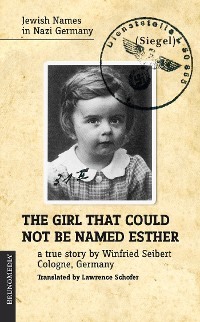
Kitabı oxu: «The girl that could not be named Esther»

Winfried Seibert
Copyright © 2011 and published by
dedication
Dedicated to my daughter Esther
and her brothers Daniel
and Raphael
Summary
You can’t name her Esther. And you can’t name him Joshua. These are not truly Germanic names. – German bureaucratic and judicial decisions in 1938.
Residents of English-speaking countries are in the main accustomed to naming their children with any name they want. Other countries are not so permissive, requiring an approval for registration of names. In countries with a Christian tradition, a distinction is drawn between family names and given names, also called baptismal names or Christian names. In Germany this was customary as long ago as the 14th century. So long as there were no state registration authorities — that is, no office of vital records — and, to simplify a complex process, before the division of church and state, the church was responsible for putting order in names. Names of false gods or pagan heathens were frowned upon, while names of recognized saints and Biblical figures were desirable. It was impossible to give a non-Christian name to a Christian.
Similar restrictions on the choice of names arose after the Revolution of 1789 in France and in practically all European countries. Not so in the USA – there the law on personal status never developed in a fashion similar to that in Europe, and the resulting customs are correspondingly looser. Whether freedom is totally unlimited is hard to say, but the freedom there has led to varieties of names, which, when extravagant parents load extravagant names on their children, can develop into significant problems for the children. Whether Geronimo, son of the bassist Alex James, will later be happy with his name, will depend very much on how he regards the history of Indians in his country. Elijah Bob Patricius Goggi Q may let himself be reduced to a simple Elijah Bob, but this still leaves the question open of what the “Q” stands for in this name of the son of the front man for Bono. Whether Sharleen Spiteri of the pop band Texas thought of any joy to be brought her in writing her name as Mysty Kyd or whether she thought about her daughter, we probably will never know.
In Nazi Germany, this ordinarily innocuous law became part of the racist arsenal of the regime, a regime that had enthusiastic adherents all through the bureaucracy and the judicial system.
An article in a law journal caught the eye of attorney Winfried Seibert, born in 1938, and he set off on an ingenious search of German history in the Nazi period, looking for the girl who couldn’t be named Esther.
A determined pastor in a small town in the Ruhr Valley demanded in 1938 that his daughter’s name be registered as Esther. He ran into bureaucratic opposition and fought his case through the courts all the way to the Supreme Court for Civil Matters in Berlin. He lost. So did a park ranger, who wanted to perpetuate the family name Cuno Josua.
What the author has done in this book resembles the unfolding of a mystery story. Who was this minister, identified only as the Minister L. from the town of W.? Why was he so hard-headed? Who were these local officials who so adamantly defended the purity of German names? What kind of justice system enforced these laws?
The author started with L. from the town of W. With some ingenious detective work, he found the town, the likely person, and then even the son of that courageous pastor — though not the daughter Esther.
This book is a very close examination of the people involved — the minister, the bureaucrats, and especially the judges. The author reconstructs the life stories of the three judges who sat on the Supreme Court. Interestingly, the judges found that Esther was a criminal prostitute of the Jewish race, while Ruth, a name that one might expect to be condemned in the same way, was allowed as a Germanified name.
The book contains a fascinating reconstruction of the German justice system based on the use of this single case.
Through the use of this case, the readers sees the Nazi justice system and Germany itself through its pogroms and then into the war period itself. Instead of relying on masses of data and statistical compilations, this book energetically and passionately moves through the daily activities of Nazi justice. The unfolding of these items is a gripping tale that caught the attention of tens of thousands of German book-buyers and of reviewers throughout the German language press in Germany and in Israel (originally published in 1996).
And what of little Esther, who was denied her name so that she would not be embarrassed when she would be taken into the League of German Girls? Named Elisabeth by the officials, the author found notice of her baptism in 1946 as Esther. Unhappily, the search showed that the little girl had died of a childhood disease at age 2½, but her father had preserved her memory by renaming her after the defeat of the Nazis. The pastor himself served in the German army, but continued to incur the wrath of his superiors for his sermons, which used ambiguous language to denigrate the German leadership.
Foreword
This is a story taken from the everyday workings of the legal system under the Third Reich, the Nazi regime. It is limited to a minor event that involved only a few people, but I think it is symptomatic of a much larger story.
The Nazis had no great love for the judiciary; nonetheless, that group certainly did not produce any resistance fighters. Judges just didn’t do that sort of thing. The judges kept up the pretense of business as usual; they adapted. It’s true that they were subject to the pressure of the National Socialist state apparatus. Judges were kept on a short rein by judicial instruction letters that made a mockery of judicial independence. Many of the judges let themselves be coerced, suffering from more or less of a bad conscience, into giving the National Socialist system what they thought was its due because it was, after all, the State.
Thus, for the German judges, May 8, 1945, the date of Germany’s surrender, was a day of liberation. Their grateful commemoration of this event has filled tomes. Unfortunately, these have all gone missing. Or is there more to the story?
In the early post-war years, we were subjected to attempts at forgetting, at concealing, at hushing up, and even out and out lying. The first president of the new Federal Court of Justice created after the war, Hermann Weinkauff, is responsible for a multi-author study of the judiciary in the Third Reich – happily, he never completed it. The book is noteworthy only for its self-excusing tone, not for any attempt at a critical look at the institution. Others had previously described the judges in the Third Reich as victims of their training in legal positivism. They had merely applied the letter of the law as it had been laid down by an unscrupulous legislature. That was the grand illusion of the postwar judiciary in West Germany. The legal historian Bernd Ruethers made the first attempts in 1968 to come to terms in a scholarly way with the distortion of the law and of legal decisions in the Third Reich.
But that is not what this book is about. I am reporting here only about three decisions handed down by the Superior Court in the year 1938, in which it was decided what given names a person could have if he or she was born under the Third Reich. These three decisions by a central court have not yet been subject to scrutiny, even though they lead deep into the secret heart of National Socialist justice. It is often said that, at least in the case of civil law, the judges managed to stand firm against their Nazi masters. After all, civil law concerns itself with everyday matters, such as rent problems, contracts, social issues, and, as we shall see, the question of what names a person could have. But the truth is that the judges did not stand firm on such issues, not by a long shot. Their decisions and their findings formed only small building blocks of the structure of an unjust state, but they were still part and parcel of the injustice that was done.
That injustice prevailed is clear from the decisions discussed in this book. Although not one Jewish person was involved in this legal procedure involving names, under the surface the whole affair was about Jews and nothing else. These decisions and the others cited here formed part of the fight against the Jews, which the Third Reich pursued to the bitter end. Can the judges thus be made to share the responsibility for that horrible end? Can one reproach them with making judgments and decisions that undoubtedly contributed to stripping the German Jews of their rights under the law, decisions that helped pave the way for the final solution? In their decisions, the judges adopted the National Socialist body of thought and thus made it socially and judicially acceptable. Didn’t the language of their decisions, couched in Nazi jargon, contribute to the maltreatment of the Jews in Germany? Didn’t all this lead to the loss of respect for Jews as fellow human beings that played a major role in their destruction?
One could answer — and this is how the answer usually comes out — that nobody could have foreseen the assembly-line annihilation of the Jews that came later. Occasional excesses, yes, one would have to reckon with them, but nobody thought about death camps. That would have far surpassed anyone’s imagination. There is no obvious answer here. Perhaps it makes more sense if one separates the evaluation of judicial decisions from the overarching theme of the final solution.
One has to try to imagine what the fate of the Jews in Germany would have been if the dictates of the court had been followed and the National Socialist dictatorship had not dared to carry out the exterminations. What if the everyday life of German Jews had been determined only by harassment by the bureaucracy and the party with the blessings of the judicial system? How would they have experienced life starting in 1939?
The situation of 1938 would have developed into an ongoing state of affairs. The German Jews would have lived in a state that had undertaken not to protect its Jewish citizens any longer; instead, it would deprive them of their rights under the law and punish them wherever possible. They would have to vacate their homes and move to buildings owned by Jews. This would eventually lead to concentration in a modern ghetto. Contact with the outside world would be unwelcome. Contact perceived as sexual in nature with people of German blood would be punishable by law. Children’s given names would be restricted to an official list issued in 1938. School and university attendance, the use of libraries, and a thousand other things would be forbidden to the Jews. They would not be able to work as physicians, attorneys, real estate brokers, guides for foreigners, or in credit agencies. Even street peddling would be forbidden. Public transportation would be off limits. Synagogues would be burned down. Significant Jewish property or Jewish firms in general would cease to exist. All of this would have been taken away from them, stolen, taxed away, Aryanized. There would be no right to vote; there would not even be any elections – and no hope.
Such are the conditions under which the German Jews were living at the end of 1938. Even without war and extermination, the steady policy of elimination of Jews would have gone on. These were exactly the conditions that the judges, with their verdicts and their decisions, had approved: a master race barely tolerating on the outermost fringe of society a guest people of lepers, deprived of all rights, plundered, despised, and outcast. And prevented from fleeing. Not enough to die of, but too little to live on.
And that would be perfectly acceptable. The purity of German blood would be assured. Any danger of contact with Jews was nipped in the bud, to quote the Superior Court. No half measures here – the separation would be complete and unambiguous. And it would be legal as well because German judges had determined the conditions to be correct under the letter of the law.
That’s what they have to answer for. That immeasurably greater damage would still come – that can be no excuse. The struggle of the National Socialists against the Jews was a war; that is how it was understood and carried out. Matthias Claudius’ lament, It’s war! It’s war! ... It’s unfortunately war, and his closing plea, and I wish it were not my fault, would have been fitting words for many of the German judges. Unfortunately, they weren’t the ones to say them.
If we want to live in a moral state, in a society that does not have to avert its eyes from its own history, then we must face up to this part of the past as well, not overcome it, but come to grips with it.
This is as true for the still virulent past of the National Socialist regime as it is for the more recent German past, for the unjust system of the German Democratic Republic. The necessary grappling with the past cannot be considered closed so long as it is not really over. Trying to prematurely bring to a close the process of honest confrontation with what has gone before comes at the high price of some longlived psychological damage.
This book is not concerned with simply repeating judicial verdicts and decisions. In order to really grasp their significance, it is necessary to conjure up an image of the actual people involved. After more than a lifetime has passed, this is not completely possible, but it will be attempted here. In the end, a frightening normality can be discerned in this story that makes one afraid that we have not really precluded every danger of repeating what has gone before. The language used to describe minorities is a reliable gage here, for the process of violating human dignity begins with words themselves.
A personality like Esther, who played such an historical role, though not through open and above-board negotiations, but through tricks, deception, and misuse of her bodily attractions and of her position, such a criminal prostitute of Jewish race can stand for nothing to the German women of our time and above all cannot be looked on as a personality after whom German parents should name their children.
Kammergericht, 28.10.1938
Chapter 1
The Prussian Supreme Court (Kammergericht) had issued its judgment on the given name Esther on October 28, 1938. It had rejected it as typically Jewish and had forbidden the parents to name their daughter Esther. At first — it was summer, 1989 — I had before me only the decision of the Supreme Court as published in the Juristische Wochenschrift (JW) – (Legal Weekly). This gave me the impetus to look more closely into this decision. Being myself the father of a daughter named Esther, born in 1983, I liked the name very much, and the expressly malevolent dealing with the name and the Biblical story of Esther affected me greatly. I wanted to know more, more about those involved, the judges and the little girl named Esther.
The records of the Berlin proceedings were no longer to be found. According to information from the Court, they had been burned in 1945, and anything that was left had been taken by the American soldiers. I had nothing more to go on than the published decision. The initial data for such a search were quite meager.
Section 1b of the Senate of the Supreme Court had made the decision. The only thing I knew was that this Senate was not responsible for Greater Berlin. The actual content which might have helped me further was sparse. It concerned the birth on August 11, 1938 of a daughter to Pastor L., who had registered the birth at the Registry Office in G. The mayor of G. had participated in the proceedings. G. at that time must have been an independent city, not located in a county. So the first thing to do was to locate the city G.
By the middle of 1992, I had achieved my goal. At that time I summarized the search for our Esther in a written report. It went like this:
I assumed — I had no doubt about it — that G. was to be found in Brandenburg, a province in the central-eastern portion of Germany, adjoining Berlin. In the completely altered world since fall 1989, when the wall had come down, this was a particularly exciting task. Maybe that‘s why it was so easy to make a false assumption. Since September 1991, I had represented the newly founded state of Brandenburg in the soon-to-be reunited Germany for its Establishment under Article 36 of the Unification Treaty, and I was also advising the East German Radio Network for Brandenburg (ORB) in its initial phase. Everything seemed quite simple – in 1938 the independent city G. in Brandenburg could only have been the city of Gubin1› Reference .
My query of October 16, 1991, to the registry office in Gubin at first went unanswered. I had unexpected difficulties in making a telephone call there because my office first had to find out that the listing was not under Gubin, but under the East German name of Wilhelm-Pieck-Stadt Gubin2› Reference. Finally I learned that the new Gubin lay left of the Goerlitz branch of the Neisse River — that is, in East Germany — while the old city, with the town hall and the courts, lay on the right bank of the Neisse and had thus become Polish. The archive in Zielona Gora, previously Gruenberg, responded with a cordial letter and the report of my being dead wrong. There were no registry documents and no church records for our Pastor L.
If you are stuck, you ask the press. Other than that, I hoped to find in old newspaper records at least a birth notice of a little girl born on August 11, 1938. Maybe even with the name Esther, since for a few days after the birth the ban on this name might not have been communicated to this family.
All this activity made a big commotion, both in Gubin and around Gubin. The newspaper Lausitzer Rundschau was extremely helpful; it even did research on its own — ultimately all in vain — at the church supervisory office regarding Pastor L. On March 19, 1992, it issued a call to its readers:
The RUNDSCHAU has received an unusual letter from an attorney‘s office in the previous West German Republic. He is seeking documents and information regarding a certain Pastor L. and his daughter born August 11, 1938, in Gubin...
The attorney’s office is interested as well in finding this daughter, who apparently was born on August 11, 1938, and whose parents wanted to name her Esther. In accordance with the demonic spirit of the Nazi era, this name was rejected with somewhat fearful reasoning.
That was worded verbatim from my letter of January 24, 1992. There was a reader response that led to a certain Pastor Friedrich Wilhelm Lucas, who had however been pastor in Gubin only up to 1929. I then learned from his housekeeper, then living in Remscheid, that from Gubin he had moved to Usedom (Baltic island). After the war, in 1946, he had buried Gerhart Hauptmann3› Reference on Hiddensee (another Baltic island).
These events were hazy in the memory of the readers of the Lausitzer Rundschau. It could hardly be otherwise after so long a time. After all, this Pastor Lucas had already been away from Gubin for 17 years at the time he presided at the burial of the great writer. This makes it all the more amazing that a few people even remembered the burial of a writer far from Gubin. A few even thought that Pastor Lucas had officiated at the burial of the Danish writer Martin Andersen Nexo, who had died in Dresden in 1954. This was all very exciting and very interesting, but it brought me no nearer to finding the Pastor L. I was looking for.
Old runs of Gubin newspapers were not to be found in Gubin. On the Polish side as well, the search was fruitless. In the Gubin of today, a barren field with a few stunted trees stands where the marketplace and town center used to be. Just beyond this there is a very lively black market, and only then does the town proper begin. I still had no answer from archives in Berlin (East or West) regarding any existing copies of Gubin newspapers. A birth announcement would have helped a lot. At least then the family name, of which only the initial letter “L” was known, would have been revealed.
On April 10, 1992, the Protestant Central Archive in Berlin wrote to me that, based on the pastoral almanac of the church province of Brandenburg of the year 1939, in 1938 no Pastor “L.” was active in Gubin. Thus in the entire Gubin area there was no Pastor L. to be found. How was that possible?
If G. was Gubin, then Pastor L. would not necessarily have to have been from Gubin, that is, he need not have been a pastor in Gubin. The registry office was then, as it is today, responsible for every child born in its district. The child had to be registered at the birthplace. G. was then the birthplace of Esther. That much was certain. The parents‘ place of residence, however, was still an open question. The family of the pastor could have been passing through, or perhaps they were visiting the wife‘s parents for the birth. Anything was possible. But then the birth would still have had to be registered in Gubin. If that were the case, then the search had to be broken off. Pastor L. could have come from any place in the German Reich. He was not to be found.
This is, if G. was Gubin. But was it really Gubin? How had I come to that conclusion? I had assumed that G. must lie in the jurisdiction of the Supreme Court, and I had liberally identified that jurisdiction with the state of Brandenburg. But was that correct? It was unbelievably wrong – but more of that later.
I then took a step back in my search. Perhaps there was a chance to fill in some of the unknown quantities in the equation. If the Supreme Court decision had been published in other professional journals, perhaps there was more to read there. The content in such publications is often given in an abridged form. It might be possible to find information in another journal that had fallen by the wayside when the item was published in the Legal Weekly. In the library of my state court, I found a reference to two other publications: StAZ 38.464 and JFG 18.261.
StAZ stands for Zeitschrift fuer Standesamtswesen — The Bulletin for Registry Office Activities — which still exists today under the title The Registry Office. The publisher sent me a copy of its publication of the Esther decision in which there was a reference not to G., but to a place called W. At first I thought this was a typo in the transcription of the decision — W. instead of G., an easy mistake to make — now I know better. Here too I should have read the text more carefully, for it said the following:
Pastor L. in W. reported to the registry office that he had given the name ‘Esther’ to his daughter born August 11, 1938.
Pastor L. thus lived in W., and the responsible registry office could still have been in G. The combination of the two place-name initials didn’t help much. There remained the search suggested by the third publication: JFG. Those initials stood for the Jahrbuch fuer Rechtsprechung in der freiwilligen Gerichtsbarkeit – Yearbook of Legal Decisions in Civil Status Matters That was the breakthrough.
From this yearbook I could identify the two lower level jurisdictions of the district and state courts of Essen, a large industrial city in the Ruhr Valley, completely on the other end of the country from Gubin. Gubin, Lusatia, Brandenburg without Greater Berlin – all these had been dead ends. Hard to understand, even if I learned a lot from these detours. So – Essen it was. The two cities with a „G“ in the area of Essen, Gladbeck and Gelsenkirchen, each had their own district court.
A quick look at the text of the law, which would have been a smart thing to do earlier, gave me the answer. According to section 50 of the Civil Status Law, the district courts with authority in matters of civil status are those courts that are based in the same place as a state court. The district court in Essen was then responsible for the entire state court area of Essen.
So now it came down merely to a choice between Gladbeck or Gelsenkirchen, two medium-sized industrial towns. At first it seemed more important to look for records in the Essen courts, and if not there, perhaps in the state archive in Dusseldorf. It turned out that the records of the district court in Essen had been destroyed in 1976. They had survived the war, but they had not been considered significant for modern history and had therefore not been archived. They certainly would have been worth keeping. We had lost a small historical possibility. Now the records were irrevocably gone.
It’s true that the lawsuit register at the district court in Essen provided an important clue, but the letter came a few days too late. Barely a week earlier I had solved the puzzle.
First I have to report on another false turn. Once the search had been narrowed to Gelsenkirchen and Gladbeck, I could concentrate on looking for Pastor L. in these two places. There could not have been many pastors whose names started with “L” in 1938 in Gladbeck or Gelsenkirchen. With the help of the Protestant Church Office in Cologne, I soon knew that at that time there were no pastors “L” in Gladbeck, but there were two such in Gelsenkirchen: Johannes Karl Leckebusch, born 1882, pastor in Gelsenkirchen-Buer starting November 1930, and Theobald Lehbrink, born 1898, pastor in Gelsenkirchen starting November 1933. Both were still of an age to be fathers in 1938.
To be sure, Pastor Leckebusch, 65 years old in 1938, seemed less likely than Pastor Lehbrink, who was 16 years younger. Besides, Lehbrink had additional interesting personal data. On January 31, 1939, he had retired from the active ministry. Why? He was barely 40 years old and had another good 25 years of service ahead of him. It could be that he had to quit the ministry because of his hard-headed confrontation over the name Esther, or it could have been that his church, to protect him, had cautiously relieved him of his duties because of the stand-to with the Nazi state. Besides that, he had published something in 1935 about God and authority, a very Protestant theme, which might have gotten him into trouble. After the war he wrote something about Arminius, the Teutonic opponent of the Romans. This too led me to believe that he was no run-of-the-mill pastor. He seemed likely to have been a pastor who took on the Third Reich in other articles as well – Theobald Lehbrink could be my man!
He had died in 1962 in Dassel, near Hanover. In 1941 he had remarried. Whether his first wife — Esther‘s mother, if he was the right one — had died early or if the marriage ended in divorce could not be determined from the short biographical data. If however he had divorced between 1938 and 1941, this could also explain his withdrawal from the ministry.
If he was Esther‘s father, and if Esther, under whatever name, was still alive, then there must be evidence in the estate papers. A call to the district court in Einbeck revealed that there were records of the estate, but they were in storage. By telling the person in charge that there were some copyright issues to clear up in connection with the pastor’s literary efforts, I was able to obtain — somewhat irregularly — a copy of the certificate of inheritance. Luckily, two days later I could discard it since other inquiries had shown that Pastor Lehbrink could not have been the mysterious Pastor L.
A telephone call to the church office in Dassel took me to a helpful woman who, as luck would have it, not only had known Pastor Lehbrink but had even been confirmed at the same time as his daughter. Even though this confirmand had been named Gisela, this did not mean anything since our Esther was originally not allowed to be called so. But the birthdate! After looking in the church records, the friendly woman said that Gisela had been born on May 18, 1939. Again nothing. With that birthdate, she could not have had an older sister born August 11, 1938.
Now what? There were two Pastors L. in Gelsenkirchen, and according to the list of Protestant pastors in Westphalia from the age of the Reformation down to 1945 only these two were of the right age, and neither one was the right one. The one to whom a lot of the evidence pointed was Lehbrink, but he wasn‘t the one. As it turned out, I almost had the fox guarding the henhouse. On May 8, 1992, the State Church Archive of the Protestant Church in Westphalia wrote me:
Unfortunately, on the basis of the available documents, we were unable to confirm your assumption of the possible paternity of the Pastor and Superintendent Theobald Lehbrink of a daughter named Esther, born August 11, 1938. Since Pastor Lehbrink numbered among the German Christians [Nazi-oriented breakaway church group], it is quite unlikely that he would have chosen such a name.
That was stated quite modestly. Lehbrink, as it later was shown, was an almost fanatical National Socialist with a rigid belief in the Fuehrer, or at least that was the way he expressed it in his Christmas 1935 tract on God and authority, as we shall later see. It is impossible that such a pastor, who stood so close to the Nazi-faithful German Christians, would have caused such a row over the name Esther in 1938. Why Lehbrink left his ministry in 1939 could not be explained. That wasn’t important now. What mattered was that Pastor L. was still unknown.
I didn’t know what to do next. Perhaps I had gotten carried away. Court decisions are not published with the purpose of identifying the parties to the dispute. But I only wanted to find the little girl Esther, born on August 11, 1938, in G., apparently Gelsenkirchen. I will never forget the decisive long-distance telephone call that ended my search.
On May 7, 1992, I reached a very friendly woman at the registry office in Gelsenkirchen, who was really surprised at what I had to ask her about. In 1938, I said, some 5,500 births were registered in Gelsenkirchen. That would come out to an average of about 15 children a day. Statistically, there must have been some seven little girls registered on August 11, 1938. Could there have been one or more whose family name began with “L“?
Luckily, the woman had become curious. It didn’t take more than two minutes for her to confirm that on August 11, 1938, the birth of a girl with the surname L. had been registered. That MUST have been Esther. But she couldn’t say – on account of the data protection law. I then explained why I was looking for this girl. Yes, she said, I was at the right place, and then she read next to the given name Elizabeth a subsequent registration of the name Esther in 1946. Unfortunately, she could not tell me the family name. She was really very sorry, but I had to understand.
We quickly established that the family name was neither Leckebusch nor Lehbrink. That used up the only two pastors L. in Gelsenkirchen. I was so to speak standing in front of the open birth registry book with the entry I was seeking, and I had forgotten my glasses. Esther was so close, but I couldn’t get any farther. I could only conclude that this Pastor L. had not been a pastor in Gelsenkirchen, and that the child had been born more or less by accident in Gelsenkirchen. We had had that problem in Gubin.
The woman understood my despair. When she heard my deep sigh and my utterance that a name starting with L must continue with a vowel and that there were only five of these, she suggested that I start at the end of the alphabet. In addition, she raved about the women’s hospital in Gelsenkirchen, which was always popular with mothers from Wattenscheid, a small town that is now part of the city of Bochum. – That was the answer!
Pastor L. came from Wattenscheid, and Esther had come into the world at the hospital in Gelsenkirchen. The presumed typo of “W” in place of “G” was not an error; both letters were correct. Suddenly, everything fell into place. After a lightning visit to the church office and a look at the centuries-long list of Westphalian pastors, it was clear that the name of Pastor L. was Friedrich Luncke.
He had been born on July 10, 1908, the son of a miner in Heeren. After a short interlude as an assistant pastor in Spenge, he was inducted as minister in Wattenscheid-Leithe on April 4, 1937, where he remained until July 31, 1973. He died on September 16, 1976. His first wife, the mother of the Esther I was seeking, had died in 1966.
A call back to the registry office in Gelsenkirchen erased all doubts. The name was correct. Now I had only to find out what had happened to the little girl who had received the name Esther after the war and where the 53-year-old woman was now to be found.
At this point I am going to break off my reciting of the report for my daughter. The end of the story belongs at the end.
He was foster father to Hadassah
— that is, Esther — his uncle’s daughter, for she had neither father nor mother. The maiden was shapely and beautiful; and when her father and mother died, Mordecai adopted her as his own daughter.
The Book of Esther, Chapter 2, verse 7

Marc Chagall, 1960
Chapter 2
It happened in 1938, in a critical year for German history, a fateful year for lots of people.4› Reference In its Esther decree of October 28, 1983, the Prussian Supreme Court for Civil Matters wrote of a great and meaningful year, great and meaningful for Germany. The Watchword of the Week, a colorful Nazi Party wall poster, celebrated 1938 as a God-blessed year of struggle, which even after a thousand years Germans will speak of with pride and reverence. 5› Reference Great times, great words.
In October 1938 the Prussian Supreme Court for Civil Matters issued the last word in the Esther case, or at least for all those involved it was the last word: A non-Jewish German girl, daughter of a pastor, whose parents wanted to name her Esther, could not be named after the biblical Queen Esther because the Supreme Court considered the name to be typically Jewish. Such a name was out of the question for a German child.
The Supreme Court did not have an easy time explaining the grounds behind its decision. The very extensive legal reasoning allows us a view into the mental world of the three judges, on whom the God-blessed year of struggle had left its mark.
Such decisions are easy to criticize. From today’s point of view, everything appears clear and readily understandable; Good and Evil can be cleanly separated. People are often smarter in hindsight. Still, a person may ask himself despairingly, how did they come to such decisions, how could they have arrived at such gross and spiteful legal grounds? How did it happen that the presumably quite sharp minds of the judges were so befuddled? In the attempt to understand the decision and those responsible for it, you have to get closer to the spirit of the times, no matter how much you believe that the spirit was evil, embodying the demonic character of those years. You have to consider this spirit of the times because otherwise you won’t understand anything.
Even though the Berlin proceedings concerned only the given name of a Christian girl, the controversy over Esther’s name revolved completely around the Jewish Question. Almost everything at that time revolved around this phenomenon, whose meaning for the party comrades of the year 1938 cannot be grasped from today’s point of view by rational consideration alone.
The Jews in Germany formed a minority of less than 1% of the population. At the last census in 1933, 502,799 persons of Jewish faith were counted, including 94,717 foreigners, mainly Poles.6› Reference 160,000 of these people, a good third of all the Jews in Germany, lived in Berlin, making up 5.33% of its population. At the beginning of 1938, before the annexation of Austria, the German Reich had 68 million inhabitants, including some 300,000 so-called persons of the Jewish faith. That came to 0.44% of the total population.
It was well known that Jews were heavily represented in several economic sectors and professions. This was based on historical grounds, which were connected with the restricted rights of the Jews in Germany over the centuries. German Jews also contributed to Germany’s scientific fame. Of the fourteen German Nobel Prize winners in chemistry, four were of Jewish origin.7› Reference Of the Nobel Prize winners in physics, three of the twelve German laureates were Jewish,8› Reference and in medicine, three out of seven.9› Reference These were numbers to be proud of, but they didn’t help at all.
By the beginning of 1938 — a good 200,000 Jewish Germans had meanwhile left the increasingly dangerous country — the concentration in Berlin had become even greater.
128,000 Jews still lived in the capital, some 43% of all Jews remaining in Germany. Their proportion of the Berlin population had sunk to barely 3%.10› Reference Propaganda minister Joseph Goebbels exerted deliberate pressure on them, as he noted in his diary on June 11, 1938:
Lectured to over 300 police officers in Berlin about the Jewish question. I really stirred them up. Oppose all sentimentality. Don’t worry about the law; harass them. The Jews must be driven out of Berlin. The police will help me in doing that.
The Germany of 1938 had grown larger. With the annexation of the so-called Eastern Marches (Ostmark – a centuriesold term for Austria), the population of Greater Germany had grown to 76 million. Bringing in Austria had brought in another 180,000 Jews, now totaling 0.63% of the German population.11› Reference
And yet this tiny minority stood at the very center of the thinking and aspirations of the National Socialist government. The judiciary was also fixated on this minority in the way it persecuted them, excluded them, and deprived them of their rights. These judicial activities cannot be explained away or excused with reference to loyalty to a positivistic reading of the law, in which the judges were bound to follow the letter of the law literally. The wording of many, many decisions makes it clear that nothing here can be excused.
Seen from a modern foreshortened perspective, the year 1938 was especially notable for the annexation of Austria, the crisis of the Sudeten area of Czechoslovakia which ended with the Munich Agreement, and, most significant for us today, the Night of Broken Glass (Kristallnacht) with all its fearsome consequences. The Germans of 1938 were unaffected by the persecution; they went about their daily lives. The propaganda machine of the ever-more-arrogant Greater German State churned out reports of successes. There were quite a few of these, serving to distract people from the difficulties of daily life. The economy of the Third Reich was, strictly speaking, heavily indebted, if not over its head in debt. Rearmament and the attempts at full employment had their price, though of course nothing of this appeared in the papers. Foreign policy successes might make people euphoric, but they did not fill the state treasury. From time to time the state needed to throw the dog a bone. The grass roots, the party faithful, demanded their due.
The press reported in much greater detail the August 1, 1938 introduction of the plan for the common people to save for a private automobile than it reported the burning synagogues of November 10. Isn’t this what people actually wanted to know about? All the same, we may still be curious to know what there was to fear, to see, to hear, and to suspect before November 10, 1938.
Life for the non-Jewish Volksgenossen, National Comrades — by definition, there could be no Jewish National Comrades — life for the National Comrades in 1938 went on as normal. To most Germans, conditions may have appeared better than in previous years. This came out in the birth rates. The number of births in 1938 in the country as a whole rose to 1,493,000, the largest number since 1922. That corresponded to 19 births per 1,000 inhabitants (compared to 8.7 in 2005). Still, the Journal of the Office for Racial Policy of the National Socialist Workers‘ Party (the Nazis) noted in a warning tone:
There were still lacking another 148,000 live births, some 9%, for the birth rate needed to maintain the strength of the people and its military power.12› Reference
The Olympic Games of 1936 had brought success, fame, and international prestige. The Nazi system had restrained itself for the sake of this international renown, and had even cut back on the harassment of the Jews in Germany, at least on the surface. What lay dormant in the heads and in the desk drawers of the Party comrades and the Party organizations was not visible. The situation was comparatively quiet; the Sturm und Drang (Storm and Stress) and the rowdyism of 1933-1935, the early years of Nazi rule, seemed to have subsided. Actually, it was only the lull before the storm.
The little girl who was to be named Esther was born on August 11, 1938, in Gelsenkirchen. The baby was healthy, 52 centimeters (20.5 inches) long, and weighed 3150 grams (6 pounds, 15 ounces).

ESTHER
We announce the birth of a healthy baby girl to FRIEDRICH LUNCKE AND WIFE Luise, nee Peuckmann.
Gelsenkirchen, August 11, 1938, the Protestant Hospital Wattenscheid-Leithe, Protestant Parish House
One month later, on September 11, 1938, the father, Pastor Friedrich Luncke, baptized the baby in Wattenscheid with the name Esther. To be sure, the child had no official given name because the State Registry Office had refused the name Esther. For the state, Esther had no name.
The baptism was not only somewhat late; it was now a conscious act of protest by the father. After the Registry Office had refused the child the name which he desired, he had gone ahead and baptized his daughter with the beautiful name of Esther. He and his wife stood firm with this name; let the Registry Office official decide whatever he wanted. To be sure, the Lunckes had thought about the choice of a name long and hard.
They were familiar with the biblical book of Esther and the wonderful story of the beautiful Jewish girl in the Persian diaspora who found favor in the eyes of the king and had been elevated to the position of Queen Esther. They were touched by the dilemma of Esther, torn between conflicting duties. She would have to disregard a command of her husband the king, something punishable by death, if she wanted to save her people from a threatened pogrom. She overcame her dilemma with the determined words, If I perish, so I perish.
According to Jewish tradition, Esther is numbered among the four most beautiful women in the history of the world. That doesn’t have to be taken literally, but one can certainly see from the story that the biblical Esther combined beauty with courage. As parents are wont to do, you could read a lot into this name, a name resounding with wishes and hopes.
As thoughtful readers of the Bible, the Lunckes must have been aware that the Book of Esther also presents problems. No matter whether this was a pious tale or not, they would have had their doubts about the fact that Esther’s courage in saving the Jews in Persia was sullied by the alleged death of 75,000 Persians – a thoroughgoing counter-pogrom going beyond pure defensive measures. This was no simple story with simple answers. It was vigorously debated among theologians.
But it was just that circumstance that made the name so much more endearing to the Lunckes. They had set their hearts on this name. It involved threats to themselves, will power, personal courage to stand in opposition, hope for salvation from an apparently omnipotent evil. Haman, the biblical enemy of the Jews, was equivalent to Hitler – that fit in with the spirit of the times. And they weren’t alone in their parish house in Leithe. Pastor Luncke was part of the Bekennende Kirche (Confessing Church) subgroup within the dominant Protestant grouping in Germany that early on began to oppose the Nazis. As early as 1934 the Confessing Church had suggested sermons to its pastors on the book of Esther to show that every enemy of the Jews, like Haman, would come to a bad end.
In a less belligerent manner, even rather meekly, the Carmelite nun Teresia Benedicta a Cruce, better known as Edith Stein, at that time viewed herself as a very poor and defenseless Esther, who like the Biblical Esther was taken from her people so that she could represent them before the king. 13› Reference
The registry official in Gelsenkirchen had refused to register the name Esther. The birth certificate of August 13, 1938, identifies the child as a girl without a given name. There is no trace of this conflict on the birth announcements sent to friends and acquaintances. The birth of the daughter Esther is expressed simply there. On August 15, Pastor Luncke reported the birth of his daughter Esther to the Protestant Church Consistory in Muenster and from then on received an extra child allowance of 10 Reichsmarks. His monthly salary thus rose to 330.89 Reichsmarks.
The legal battle for the correct given name went through three levels of courts, and finally ended with the decision of the Prussian Supreme Court for Civil Matters in Berlin on October 28, 1938. It was only on December 3 that the little girl received an official name – Elisabeth, not Esther. Esther was inadmissible. The registry office could close its records. The state had won out. But that was not the end of the story, not by a long shot!
Esther was the first child of the pastor and his wife, who had gotten married on April 29, 1937, and shortly thereafter had moved to the big parish house in Leithe, a neighborhood in Wattenscheid, a working-class town in the Ruhr Valley. Luise Luncke, maiden name Peuckmann, two years older than her husband, had studied German and theology at the university. In order to be able to devote herself to working alongside her husband in the community, she gave up on her goals for an independent career. She worked hard, with no regard for her own health. She died at the early age of 60.
Friedrich Luncke had studied theology with Rudolf K. Bultmann, said to be one of the most influential theologians of the 20th century, one who wished to remove myth from Christianity while staying true to his faith. Luncke knew Greek and Hebrew.
Pastor Luncke was no ivory tower scholar; he was a fighter and a great preacher before the Lord. He studied the Bible in the original; and he worked on his sermons, in which he did not shy away from confrontation with the state. In general he was very conscious of what he was doing, and he was determined to live that way in times that were hard for an engaged Christian. He set about working with all his might for his congregation. That brought him negative publicity and quickly got him in trouble. On January 6, 1938, he was arrested by the Bochum branch of the Gestapo, though he was released three days later. The affair concerned the Investigation of the League of Women in Leithe14› Reference , but no further details are available. He had been warned.
Luncke did not let himself be scared off. True to his nature, he remained uncompromising, a most obstinate gentleman. In the matter of stubbornness bordering on pig-headedness, he was a true son of Westphalia.
In 1934 Luncke had become assistant pastor in Spenge, a working-class district with major social problems.
In only seven months — the church authorities did not leave him in Spenge any longer than that — he had won over the workers, the socially weaker portion of the church congregation. He did not keep his distance from them, but rather he approached the workers in the cigar industry. He had an understanding of their needs and visited them in their meager living quarters. As the son of a manual worker, he found the right tone to address them in. When he preached on a Sunday, the church was jammed to the eaves.15› Reference
He may have been too socially conscious, to the point where the church elders did not go along with him. Here is what he was like: An older woman was crossing the street with a wheelbarrow. Luncke went up to her and said, ‘I’m going the same way as you. I’ll push the wheelbarrow.’ That caused a sensation in Spenge. Someone like that couldn’t be allowed to stay.16› Reference
He didn’t stay. When word got out that he would not receive the position of pastor in Spenge, his supporters assembled in protest, something unprecedented at that location. Two- to threehundred Protestants blocked the parish house and railed against the church authorities who had ordered the transfer of Assistant Pastor Luncke. The police had to be called to break up the meeting.17› Reference
His ordination as pastor, which finally took place on August 18, 1935, in Gelsenkirchen-Bulmke, met with unusual difficulties, which Luncke — and not Luncke alone — attributed to the Nazi-sympathizing German Christians (G.C.). In this vein, the congregation of Bulmke questioned the Confessional Synod of the Province of Westphalia on June 28, 1935 about the possible intervention of the German Christians:
Your refusal of ordination must certainly have been done with blinders on. Or might the refusal have been the fruit of meetings with three G.C. [German Christian] men last Monday at the consistory office?
Luncke belonged to the Confessing Church, which fought against National Socialist church policy and its puppets, the German Christians. He spoke out quite frankly, even though the Confessing Church had its cautious and lukewarm members as well. Belonging to the Confessing Church did not mean unambiguous opposition to the Third Reich. Traditional Lutheran ideas on obedience to authority, which appeared in the circles of the Confessing Church as well, could accommodate the brown shirts who held power. Besides them, there were of course the German Christians, who were faithful to the Nazis.
In Gelsenkirchen, in the immediate vicinity of Friedrich Luncke, the Superintendent in charge was Theobald Lehbrink, whom we recently met in our search for Pastor L. from G. At Christmastime 1935, Lehbrink authored a nasty tract entitled On God and Authority, which was nothing more than National Socialist propaganda expressed in theological vocabulary. The style shows what was going on in the heads even of theologians. The Swiss theologian Karl Barth, the Father of the Confessing Church, had been a professor at the University of Bonn until the end of 1934. Since he had refused to take the oath of service to the Fuehrer, prescribed as of August 1934, he had been discharged. Lehbrink wrote the following about him:
A theologian like him seems a noxious weed to every National Socialist who understands the Fuehrer and his inexpressible deeds for Germany’s welfare...
A holy rage should come over us when we use our yardstick of Luther against the unbiblical and anti-German thought of Karl Barth, the chief inspiration of the Barmen Confessional Synod, the Swiss foreigner, the one-time Social Democrat...18› Reference
Lehbrink gets worse, as he merges the Crusaders’ cry of Deus Vult! — God wills it! with the triumphant model of the Protestant Reformer to create a hymn to Adolf Hitler. Even the party-faithful comrades might have thought that he had gone too far, had they received this sorry work to read:
“Since our heart belongs to God, it also belongs to this genuine revolutionary, who is leading the God-created people of our ancestors and of our posterity into the promised land of the future. We will be faithful to him to our last breath, for: ‘God wills it!’...
The Fuehrer Adolf Hitler, by the good and gracious will of God, has overcome the deadly rule of liberalism for the good of the widest possible living space for the German people. He rules and guides the existence of the entire nation according to ‘natural’ laws of life as set down by God, which are inspired by a single Will, all to insure the existence of the People for all eternity. Since the Third Reich is being led according to God’s laws of creation and preservation, we must cast off the theologian Karl Barth, the effect of whose teachings can be identified with the spread of liberalism...
Martin Luther overcame mortal sin against the belief of our people and by the truth of God became the great reformer of the way of life of all men. Adolf Hitler overcame mortal sin against the life our people and thus gives Christians the God-given opportunity to proclaim themselves ready to undergo a test of the truth of God for the life of faith of all men.“19› Reference
The Third Reich and God’s laws, Hitler as a God-given opportunity and as one who has overcome mortal sin, Karl Barth as a foreigner and former Social Democrat, as a noxious weed who must be driven out. Wasn’t Superintendent Lehbrink verging on sacrilege with such words? Wasn’t the idolatrous placing of Hitler on the level of the Messiah pure blasphemy? What need did the German Christians have of the Messiah from Nazareth when this one from the Austrian town of Braunau was active among them in the flesh? Where was the church protest, where was the lightning which should have struck against such profanity? We know nothing at all of any response to this tract.
Still, the language of the ecstatic Theobald Lehbrink was a language that was not out of the ordinary. The language had been long prepared; it was well entrenched even before 1933. Deeply entrenched.
In opposition, there stood the Confessing Church. Not that resistance was the rule in the Confessing Church, not through silent protest and not through word and deed. It was rather the exception. Protestantism, too, could show a significant anti-Semitic tradition, one which was not so easy to lay aside. In Bismarck’s day (chancellor, 18641888), the well-known royal court preacher Adolf Stoecker had not only preached anti-Semitism; he had also made it the center of his Christian party platform. Consider this – on December 11, 1935, the Confessing Church celebrated Stoecker’s 100th birthday. You could hardly hush up his struggle against the Jews.
The Temporary Leadership of the German Evangelical Church went even further. They sang the praises of Stoecker’s campaign against the spirit of unbridled egoism and unbounded arrogance; they lauded Stoecker with words applicable to their own times:
He saw this spirit of the age driven by a Jewry disengaged from its religious roots and by an irresponsible liberal press. He took up arms against both of them.20› Reference
The courage to resist the spirit of the times that now appeared was the exception. The brave ones included Pastor Luncke from Leithe, who laid into the German Christians in a controversy between the Evangelical Church Service Club for Men, maintained by the Confessing Church, and the German Evangelical Men’s Group, set up by the German Christians as a competing group. He accused the German Christians of deceit, and if something was fraudulent in his eyes, he let everyone know it.21› Reference He even got involved physically when some German Christians tried to take over his pulpit. He grabbed the intruders by the collar and singlehandedly threw them out of the church.22› Reference
Despite all its weaknesses, the Confessing Church provided the theological support that was indispensable even for men like Friedrich Luncke. In its theological declaration of May 1934, the denominational synod of Barmen had formulated six church truths23› Reference against the errors of the ‘German Christians’ and the present-day national church administration that are ravaging the churches and destroying the unity of the German Evangelical Protestant Church. In this cry for help, dramatically underscored with the Latin closing words, Verbum Dei manet in aeternum — The word of God remains for ever and ever — the Confessing Church spoke out clearly against the false teachings of National Socialism. Here is an example of what they said:
We reject the false teaching that the church, which is the source of the word of God and the source of its teaching, can and must recognize other events and powers, figures and truths as God’s revelation...
We reject the false teaching that there are areas of our lives in which not Jesus Christ but other lords are sovereign, areas in which we do not need Him for salvation and healing...
We reject the false teaching that the church should turn over the shape of its mission and its order to the discretion of others, or that it should turn over such definition to the currently ruling world view and political outlook of others...
We reject the false teaching that the church may with human arrogance place the word and the works of the Lord in the service of arbitrary wishes, goals, and plans chosen in some high-handed manner...24› Reference
The conflict was now an open one with the authority of the Hitler regime. The way led to the Memorandum of the Confessing Church to the Fuehrer and the German chancellor on May 28, 1936. The memorandum complained about the many forms of dechristianizing being carried on by the state. It criticized the idolatrous reverence for the Fuehrer. About the anti-Semitism in the National Socialist view of the world, the memo had this to say:
If blood, race, national traditions, and honor achieve the status of eternal values, the Evangelical Christian is forced by the First Commandment to reject this mode of thinking. While others glorify the Aryan human, the word of God testifies to the sinfulness of all men.
If Christians are required by the National Socialist world view to adopt anti-Semitism and are required to hate the Jews, this is opposed by the Christian commandment to ‘Love thy neighbor’.25› Reference
The closing words of the declaration betray an oppressive taste of the prevailing atmosphere. It was written and submitted to Hitler in 1936, two months before the beginning of the Summer Olympic Games on August 1, which would gather the youth of the world in Berlin and which were supposed to communicate and did communicate to them a spruced-up picture of the new German state. The memo ended with these words:
We ask for the freedom of our people to make their way into the future under the sign of the Cross of Jesus, so that our descendants will not curse their forefathers for having built and left behind a state on this earth while closing off to them the Kingdom of God.
The duty of our office requires us to say to the Fuehrer what we have said in this document.
The church stands in the hands of God.26› Reference
So that descendants will not curse their forefathers — Pastor Luncke could have preached that. That was his belief as well. Presumably, that is what determined the choice of a baptis-mal name for his daughter Esther. The external successes of the Third Reich, its widespread international recognition after the Olympics of 1936, the reunification with Austria in March 1938 and the practically unanimous approval of the union by the population — these did not change his negative attitude. The more the state accumulated power and external glory, the more strongly did Friedrich Luncke internalize his beliefs. When he chose his baptismal name for his daughter Esther, he consciously opposed the haughtiness of the state powers with the hymn to Christ from Paul’s letter to the Colossians:27› Reference
For in him all things were created,
in heaven and on earth,
visible and invisible,
whether thrones or dominions or
principalities or authorities —
all things were created through him and for him.
This confession of faith and the choice of the name Esther were one for the parents. They had decided on this name, which they found beautiful and appropriate. There was no family tradition to be sustained, either in the family of the pastor or in the family of his wife, of perpetuating the names of uncles or aunts, godparents or ancestors. In the choice of names, they were happily independent of such familiar constraints. They were free. Free to protest as well.
But were they really free?
Esther did not reveal her people or her kindred, for Mordecai had told her not to reveal it.
The Book of Esther, 2:10

Aert des Gelder, Esther and Mordecai, 1685
Chapter 3
There could be no unlimited freedom in the choice of a name – that much was clear to the Lunckes as well. The concern for state orderliness took precedence. Names were not strictly a private affair.
Names have always been something special. In the beginning there were only first names; people had no need of anything more to distinguish themselves. In the Bible, which is the beginning of the history of names for us, the first people were named Adam — Hebrew for human being — and Eve (Khava), which can be translated as Mother of Living Beings or Creating Life. Many biblical names are dependent on the circumstances of the birth. Very often they are plays on words, which are lost in translation. In the telling of the story of the twins Jacob and Esau, the Bible ties together a double folk etymology. Jacob (ya-akov), Hebrew for May God protect us, at birth held on to the heel (akev) of his twin brother Esau: And they called him Yaakov, 28› Reference that is, one who grabs the heel. Esau, later tricked out of his right of the first-born and of his father’s blessing, complains to his father Isaac, and says, Was he then named Jacob that he might supplant [akav- deceive] me these two times?29› Reference Akav means deceiver. The two words sounded very similar, something that allowed Esau a bitter play on words with the names. Later, after wrestling with God — I will not let you go unless you bless me — Jacob received the name Israel, which can mean he who struggles with God. 30› Reference The name Sarah, which cannot be skipped here, stands for princess or mistress. More on that later.
In the New Testament, the angel Gabriel appears to Mary and announces to her that she will bear a son, whom you shall name Jesus. 31› Reference In Hebrew this name was Yeshua, with the letter “Y” becoming “J” in English. Jeshua, Jehoshua, Joshua, or Josua — all mean God (Yahweh) helps. We will meet this name again as well.
In later periods names were supposed to be good for a healthy or lucky life. Wishes, hopes, magic, incantations – even today parents take all these into consideration when choosing names for their children. For the state, on the other hand, names principally have the function of distinguishing one individual from another. The state is interested in an orderly society. Given the large number of distinguishable family names, there must be order in given names as well.
Up to the middle of 1938 this was administered relatively liberally. According to section 1627 of the Civil Code, the father had parental power and with it the right to determine the given name of his child. There were no legal limitations on the choice of names. The only limitation lay in the old principle that given names should not be offensive to customs and order; they could not be senseless, ridiculous, or offensive.32› Reference It was in the interest of the children to put certain reins on any parental naming fantasy that got out of hand.
There were always attempts by some parents to show their political preferences or their patriotic spirit in the choice of names for their children. Bismarck as a given name was acceptable.33› Reference There was an amusing story about this. When Bismarck was still alive — he was then 70 years old — a Livonian (now part of Estonia) named Trampeldang had applied to the chancellor with the request to be allowed to name his first-born son Bismarck. Bismarck had approved, adding the personal comment, If heaven should bestow on me at my advanced aged another son, I will not miss the opportunity to let him be baptized with the name Trampeldang.34› Reference Lassaline (after Ferdinand Lassalle, considered the father of German Socialism) was approved as a girl’s name in 1912.35› Reference Inadequate regulations led to remarkable flights of fancy. Quite often such names turned out to be a burden for the children, who subsequently requested a name change.
That this form of hero worship was to be expected or even to be feared after 1933 as well is attested to by the Directive of the Minister of the Interior on July 3, 1933 (just a few days after Hitler took over the office of chancellor):36› Reference
If a registrar receives the request to register the name of the Reich Chancellor as a given name, even in the feminine form of Hitlerine, Hitlerike, or the like, he is to require that another name be chosen since the adoption of this name is unwelcome to the Reich Chancellor.
Too close an identification with the currents of the day when choosing a name had its down side as well. After a few years, the acknowledgment of this or that political orientation as expressed in a name became quite embarrassing for many a father. The post-war years had examples that were not restricted to the name Adolf, and it was the same in the Weimar period (1918-1933) and in the Third Reich (1933-1945). In such cases the district court could often be helpful after the fact. For example, in 1936 the given name Lenin, pushed through by a father for his son born in 1928, was stricken by the district court in Darmstadt on the grounds of its being offensive. The court wrote:
The surname ‘Lenin’ as a given name for a German child may have been admissible in the year 1928 in consideration of the then-reigning perception of the law. It was the expression of a time when the administration of justice demanded neutrality even in the face of forces that threatened the people. At that time there were no legal means to forbid the name ‘Lenin’ while permitting family names of historical personalities to be used as given names – e. g., Bismarck, Zeppelin, and so on. This value-free expression of justice has been superseded. Although foreign names for German citizens are not essentially inadmissible, there is no longer any room in a German birth register for the name of the Russian Bolshevik Lenin as the given name of a German child.37› Reference
We are not told exactly which new legal means had emerged, in contrast to 1928, to allow the district court to decide as it did. The applicable legislation had not changed.
The district court in Darmstadt had in any case been able to overcome the administration of a type of justice that demanded neutrality, whatever that’s supposed to mean.
All of this should have been no hindrance for the name Esther. This biblical name had nothing to do with current politics. The name was certainly not ridiculous or senseless, nor was it offensive. There was not only a book of the Bible named Esther; many authors had written about Esther, Mordecai, and Haman, including Hans Sachs, Lope de Vega, Racine, and Grillparzer. Georg Friedrich Handel had composed an oratorio on this biblical story. Even Goethe had written about Purim (in his early play Plundersweilern Fair), a Jewish festival commemorating the rescue of the Jews from Haman’s plot against them, and thus every year celebrating Queen Esther, who saved them.
Apparently even more important for the registrars in 1938 was the fact that in the German Unified Family Record Book, the name Esther stood alongside Edith, Elisabeth, and Eva.38› Reference
The family record book, which was given to Pastor Luncke on his wedding by the registrar in Wanne-Eickel, had an almost official character.39› Reference A name from the list in this unified family record book could simply not be inadmissible; it belonged, so to speak, to the canon. To be sure, the list of names differentiated between Given Names of Foreign Origin, including Esther, and the puffed-up list entitled Given Names from the Treasures of the German Past, but it nonetheless contained over one hundred female names of foreign origin without any limitation or warning. Nothing stood in the way of parents naming their daughter Esther. A limitation on the choice of this name, and thus a danger for the name Esther, could come about only if there were a legal regulation expressly forbidding such a name or if a court should find that the name Esther was offensive or a breach of morals and order.
Pastor Luncke could not foresee how his choice of the name Esther would move him to the edge of a precipice. The Lunckes could not know what state regulations were in the works and would come into effect one week after the birth of Esther. Except for a few people in the know in Berlin, no one could have explained to them that they had wandered into a sideshow of the National Socialist war against the Jews, a war in which the judicial system would participate with all its might. In matters of naming, the mills of the ministerial bureaucracy had started to turn again in 1937 and were grinding away slowly and relentlessly, but the average citizen had hardly any clue about what was going on. The judicial system gave their day in court to Pastor Luncke from Wattenscheid and the West Prussian forest ranger Cuno Lassen from the district of Marienwerder in order to set a precedent on the highest judicial level of how the administration of a type of justice that demanded neutrality could indeed be overcome. The new order had to obtain in matters of naming. The forest ranger and the pastor had never met, but the Supreme Court brought them together.
Up until the middle of 1938 the question of names, whether correct or incorrect, admissible or inadmissible, had stirred up just a few people. To be sure, even at the time of Esther‘s birth there was no biding regulation, just some very general principles for the choice of names, principles that had existed since the end of the previous century. This liberal situation was increasingly treated with hostility. A look at these voices is therefore absolutely necessary since in populist times such signals can be significant.
Sie hatte nicht gedacht,
so langen Gang zu tun mit allen Steinen,
die schwerer wurden von des Koenigs Scheinen
und kalt von ihrer Angst. Sie ging und ging –
Und als sie endlich, fast von nahe, ihn,
aufruhend auf dem Thron von Turmalin,
sich türmen sah, so wirklich wie ein Ding:
empfing die rechte von den Dienerinnen
die Schwindende und hielt sie zu dem Sitze.
Er rührte sie mit seines Szepters Spitze:
...und sie begriff es ohne Sinn, innen.
She had not thought to walk so far,
to come laden with all these jewels,
which all the time absorbing the King’s majesty
grew heavier, and colder too as they took up her fear.
Gradually she drew nearer. Now she saw
him, upright on his throne of tourmaline,
as potent as a tree or tower.
A servant by her side still steered her on
as weak with terror she began to swoon,
fell senseless to the ground before the King.
His sceptre touched her. She knew everything.
Rainer Maria Rilke, Esther, 1908
translated by Stephen Cohn
Chapter 4
Everyday citizens had no idea what was brewing under the surface, but press reports conveyed an inkling of what was going on. If you look at the professional literature of the registrars, especially the publications of the Journal of Registry Office Affairs (StAZ), even before 1933 and then afterwards you could hear the demand sounding louder and louder, German names for German children! At first, this resembled the path laid down by the campaign for the purification of the German language from Romance language influences, but after 1933 the drive became increasingly aggressive. Leaders began to lose self-control, though at first only in their language.
It began moderately in the foreword to the names section of the first edition (1921) of the German Unified Family Record Book, written by a Mr. Wlochatz, retired director of the registry office and a regular contributor to the Journal of Registry Office Affairs.
That German parents should prefer to give good German names to their children is a duty not only to their People, but even more to their children. We don’t need to be ashamed of the old German names! We have no lack of them! On the contrary – we have a rich supply of them from our Teutonic history, a host of names with a wonderful sound and with great meaning! One glance at the riches we have inherited reveals to us the depths of the Germanic soul. These names ring out with superior virtues, with the outstanding properties of the spirit and the heart of the Teutons of antiquity. The ancient Teutons were a warrior people, and many names breathe the spirit of battle and armed victories. If we were to add such names to our vocabulary, this would have the effect of eliciting in every way the heroic spirit and victorious power needed for the great struggle for existence in which we now find ourselves. The old names, resonant with battle and triumph, can be well used in a symbolic sense.40› Reference
Wlochatz points to another change in the second edition of the family record book. On the basis of comments from linguists, names long established and familiar to the reader are listed in the Foreign Names section, names like Anna, Johanna, Maria, Paul, Peter, Johannes, Michel, Sepp, and others, which clearly have been seamlessly integrated into the German People for over a thousand years. A registry office, however, he continues in a conciliatory tone, must take into consideration not only the wishes of the German experts, but also the events of everyday life. He goes on:
And so established biblical names should be retained, even though most of them come from the Hebrew; otherwise, we would have to logically exclude names like those mentioned above. Where would all this lead us?41› Reference
That sounds compassionate and reasonable – Wlochatz wanted to retain established biblical names. A decade later, in 1931, Wlochatz turned his attention to swings of the people’s spirit in the giving of names (in an article in the Journal of Registry Office Affairs). He names four major trends, with the primary one being consciously and decidedly German names. 42› Reference
He distinguishes three sub-trends which all have in common that their motivating spirit absolutely demands that German children be given good German names.
In these sub-divisions of the consciously German trend, Wlochatz includes the Nordic movement, and especially the Folkish movement, referring to an unspecified Germanic element of the Volk — Folk, the People — a movement increasingly identified with Nazi ideology or at least recognized as its forerunner. He naively calls this a part of ethical cultural longings.
In Germany the religious beliefs of our pre-Christian ancestors are fostered and spread in the rapidly growing ‘Nordic Community of Faith,’ which aspires to the spiritual rebirth of the ‚Germanic’ man. In these circles children receive ancient Teutonic names. This spiritual attitude often overlaps with the other trend, the more recent ‘Folkish’ movement, which is much larger and more significant in its effects on the life of our people. Here, we are naturally not interested in this movement as a political party, but rather only in its effect within the sphere of German ethical cultural aspirations. And it is here that we find a decided rejection of all foreign influences, especially Semitic ones, and a move toward the goal of racial purification of the German people. As a result, within this movement we meet only pure Germanic names, even from time to time in ancient Teutonic form. Of course, it should be observed that through the ‘Folkish’ movement a large number of old German words have been brought back to life as well.
The religious Christian trend delineated by Wlochatz — seen among our nation’s Catholic brethren, who are unquestionably of good German orientation — is accustomed to many foreign names, including, since they are taken from the Bible, many of Hebrew origin. Wlochatz takes a critical view of this:
Since the religious writings of the Hebrews, that is, the Israelites, have found a home in the Christian world as well, and since their children are familiar with the great personalities of the Jewish people through Bible instruction, it should not be surprising that there are still a number of Germans who in the choice of names for their children reach into the treasury of a people foreign to us. Quite frequently this occurs as the expression of personal piety.
The registry office director, now at ease in retirement, clearly has made progress. He declares himself at one with the consciously German point of view, which calls for racial purification, that is, an inner rebirth of the Germans. 43› Reference This stance has made the naming question a question of conscience, driven by an imperious, demanding spirit. From Wlochatz’ point of view, the partisans of this route feel responsible for the coming generation. They are conscious of challenges to existence that remain completely foreign to the others. It thus follows that:
The call to give German names to German children became a demand, since it has been recognized that the German child undoubtedly has a right to a good German given name, and that German parents have the duty to start their children out in life equipped with such names... It can happen that the custom of pious Christian German parents to give a child a biblical name, and thus a sort of Hebrew name, may later lead to conflicts between child and parents. After all, the religious orientation of parents cannot be definitely assumed to be the orientation of the children, and certainly not when later in life the children learn to think differently about matters of faith.
For the first time, the viewpoint of the child’s welfare is sounded, an approach that could serve several purposes and one which we will meet in the Supreme Court. You can’t help being impressed by the certainty with which the ideology of the future was foretold. The thousand-year Reich was well established in the minds of many even before the thousand years had begun.
After these rather ponderous meditations by a retired registrar — to be sure, one with considerable influence on the activities of the registry office — the Berlin district court judge Dr. Boschan, also a longtime contributor to the Journal of Registry Office Affairs, took up the legal question. In mid-1936 he demanded a German-oriented giving of names, and inveighed against the danger of the German essence being infiltrated by foreign elements and the practice of half-hearted naming of children. 44› Reference He wrote:
According to the principles of the National Socialist state, which wants to create a true German homeland for its citizens, there must be a limit to the choice of foreign given names since the choice of foreign names is a purely capricious act. Legitimate grounds for the choice of a foreign name have not been demonstrated.
In today’s Germany we must establish the following principle: German children receive German names; foreign children receive foreign names. If legitimate grounds are given, exceptions may be allowed.45› Reference
This statement did not go unchallenged. Another Berlin state court judge commented briefly on Judge Boschan’s principle with these words:
These remarks may be relevant for future legislation. They should not be taken as the statement of current law; they certainly are not conceived as such.46› Reference
True, there was no legislation, but there was at any rate a directive from the Minister of the Interior on April 14, 1937, regarding the use of German given names.47› Reference It was not published in any official ministerial journal but rather in the Journal of Registry Office Affairs. Despite its questionable status as an official regulation, it played a great role in future decisions. Here is the text in full:
Children of Germans should basically receive only German names. However, not all Nordic names can be included as German names; insofar as concerns non-German names (e. g., Bjoern, Knut, Sven, Ragnhild, etc.), they are no more desirable than are other non-German names. On the other hand, names have been used in Germany for centuries that are originally of foreign origin but that are no longer regarded as foreign in the minds of the people and are indeed completely Germanized; these can continue to be used unreservedly (e. g., Hans, Johann, Peter, Julius, Elisabeth, Maria, Sophie, Charlotte, etc.). It serves the development of clan thinking to rely on previously used clan names . Very often, these will be Germanized names, which in the future will still indicate the origin of the clan in a specific German territory (e. g., Dierk, Meinert, Uwe, Wiebke, etc.).
Should basically receive only German names is a phrase that permits exceptions. There was no legal basis for this ministerial recommendation, and a recommendation is all it was. Even the current Reich and Prussian Minister of the Interior, referring to his own directive, wrote a good six months later:
Special regulations regarding given names still do not exist. It has simply been determined that given names of German citizens are in principle to be entered in the German language in the civil registry, and that indecent, senseless, or ridiculous given names may not be used.48› Reference
Everything seemed so open and above-board. To our astonishment, we find in the middle of 1938 clear and disturbing references in the press to developments on the name front – the military expression seems quite appropriate here. The name question had taken on another dimension since the end of 1937. The echoes in the press served partly as a trial balloon for what was to come, and may have been meant as a warning to be read between the lines about this new development. It was especially Germany‘s most famous newspaper, the Frankfurter Zeitung, that conspicuously followed the story of the naming question, and in the summer of 1938 published reports whose journalistic significance is hard to grasp for the modern reader.
In Mein Kampf, Hitler had assigned this newspaper to the bourgeois democratic Jew papers, to the so-called intelligentsia press, which, as he expressed it, wrote for our intellectual demimonde. 49› Reference By 1938, the Frankfurter Zeitung had long been without Jewish owners. In honor of the Fuehrer’s birthday the following year, ownership shares were to go as a present to the Eher Publishing House in Munich.50› Reference It should not be forgotten that this newspaper, which Hitler and Goebbels repeatedly wanted to finish off, was important for the foreign policy image of the Third Reich because a certain distance was perceived between the regime and the paper.
How far the editorial board could stand apart from the Nazis is not a question that can be answered here. In point of fact, there was no single editorial opinion.
Be that as it may, during this period the Frankfurter Zeitung reported on three occasions about our topic, one that was probably only of remote interest to the average reader. Two of these cases were quite important and were reported on in a manner that was unusual and striking for that period. We should consider it possible that this constituted an effort to warn the alert reader at home and abroad of hidden signals indicating an otherwise little-known development. Such signals could warn people, but they could change nothing.
In the Saturday edition of July 1, 1938, a short article entitled Restriction to Two Given Names ended with this sentence: Names of German origin are to be preferred. This was hardly anything more than the kind of signal mentioned above. The report itself was generally scanty. It was based on an article published in the Journal of Registry Office Affairs, by a Dr. Stoelzel, professor at the University of Marburg,51› Reference an article which could itself, however, be considered explosive. Stoelzel‘s relentless proposals went much further than the bureaucrats and even than the Reich Ministry of the Interior had dared.
Stoelzel, also a frequent contributor to this journal, and its expert on questions of marital status, complained primarily that the new marital affairs law of 1937 had allowed an unlimited number of given names, and he took a stand for a limit of at the most two given names. He painted a dire picture of what misuse could be made of an unlimited set of names, and he then switched over to the question of which names conscientious registrars should allow, which names should be denied, and what attitude they should take regarding the current demand to encourage the choice of given names of Germanic origin. 52› Reference
Stoelzel’s concluding recommendation went much further: he advised for the sake of simplicity to allow parents no choice at all or at the most a very limited one. German parents should have a choice only among names on two lists. Any names not found on either of these lists would henceforth not be considered for German children – that is, banned. These points remained hidden from the readers of the Frankfurter Zeitung, although this radical solution should have had greater publicity. After all, after about half a century of following this suggestion, German given names would have been reduced to a rudimentary inventory of scarcely more than a hundred, and for the rest of the Thousand Year Reich people would have had to resort to numbering their children instead!
On Sunday, August 7, and the following Thursday, August 11, 1938, the Frankfurter Zeitung published two items under the title German and Jewish Given Names. The sources for these articles couldn’t have been more different. One came from a legal decision on names from the Prussian Supreme Court on Civil Matters of July 1, 1938; the other, from an article drawn from the magazine The New Folk, a publication of the Office for Racial Policy of the Nazi Party.
In the August issue of this family-oriented illustrated magazine, heavy on pictures, Rolf L. Fahrenkrog demanded German names for German children. This was the article featured in the Frankfurter Zeitung on August 11, 1938, the day Esther Luncke was born. In an unusually subdued report, it cited a few passages without comment, then turned with the words In conclusion, the author writes to a rather amusing episode, which gives the impression that the whole article was similarly light-hearted:
A party comrade insisted to me that we must avoid un-German, and especially Jewish, given names. He proudly stated that his boys had beautiful German names, Georg and Paul. I had to disappoint him. Georg comes from the Greek and has the beautiful and proud meaning of farmer. Paulus is an old Christian name of Latin origin, meaning small, modest. This name developed like Johannes. They were ‘Germanified,’ so to speak. From Georg we have forms sounding like old German, like Joerg, Joern, Juern, or Juergen, but that doesn‘t alter the fact that its origin is not German.
The original doesn’t sound so easy-going; there the author ended with the following appeal:
We desire to and should stand fast on this point — Our children, who are born German and are educated in the Folk Society of the Third Reich as pure German people, should bear truly German names that correspond to the true value of our German blood. There are no justifiable grounds to give them un-German names; in fact, there are many reasons not to. Everything supports the demand of GERMAN NAMES FOR GERMAN CHILDREN!53› Reference
Completely lacking in the Frankfurter Zeitung article were the vehement anti-Semitic outbursts with which Fahrenkrog punctuated his article, aside from various incorrect or at least questionable etymological derivations.
Hardly any other people is as rich in beautiful, praiseworthy, but still distinctive family names as is the German people. And if Jews have acquired them or are attempting to acquire them today, it is their unmistakable intention to conceal themselves behind the variety of these German name forms so that they can continue undisturbed to pursue their Jewish business. Jewish name camouflage has been so successful that today there are real live Jews bearing the names Mueller or Schmidt who are immediately accepted as Folk-Comrades by trusting and naive Germans.
Since in every marriage in Germany the maiden name of a woman is replaced by the family name of her husband, and the children of such a marriage bear only these family names, this results in every case in the „disappearance“ of the mother‘s maiden name, whether Jewish or not. Fahrenkrog cannot have been referring to this standard situation, though he was hardly concerned with logical argumentation. He was on a hateful rant against Jew names, that is, Jewish given names, without giving rational reasons (assuming there were any). So he thundered:
For the National Socialist German, who is obviously an enemy of the Jews, it is selfevident that no Jewish names should be chosen. His children have a natural right to bear German names.
All this lay hidden from the reader of the Frankfurter Zeitung. Such a reader was told only that another person had demanded German names for German children. It is not clear what the editorial board hoped to do by so basically changing the content and the purport of the article in question as to render it seemingly harmless.
The introductory sentence of the article in The New Folk is striking for another reason. There — and thus in the Frankfurter Zeitung — the subject is a recently released directive of the Reich and Prussian Minister of the Interior, according to which Jews from then on should bear only Jewish given names. Since this sentence appears in the August issue of The New Folk, and on August 11, 1938, the Frankfurter Zeitung already cites this article, the phrase recently released directive can refer only to a directive published shortly before August 1938. But there was no such directive! Not yet. It appeared exactly one week after the article was published in the Frankfurter Zeitung, that is, on August 17, 1938. Guidelines on administration appeared on August 18. While writing his article for the August issue, the author must have assumed that the directive would have already come out. Where he got his information is an open question.
The other article, German and Jewish Given Names, had appeared in the Frankfurter Zeitung on August 7, 1938, and concerned a decision of the Supreme Court on Civil Matters in Berlin of July 1, 1938, published August 5, 1938. The Private Telegram of the Frankfurter Zeitung column began with these words:
A registrar is not obligated to register a typically Jewish given name for a pure-blood German child. In one sentence, that is the essence of the decision pronounced on July 1 by the Prussian Supreme Court on Civil Matters and published in German Justice.
The trial involved the name Josua (Joshua in English), which a forest ranger named Lassen from Marienwerder had intended for his son. The name was rejected by the Supreme Court as typically Jewish. The version published in the professional journals would have been available to the responsible registrar in Gelsenkirchen when he was to decide about the given name of Esther. Pastor Luncke, had he read the Frankfurter Zeitung of August 7, 1938, could not escape the conclusion that in the view of the Supreme Court the name Esther as well would be considered typically Jewish and thus not admissible for German children. Following the reasoning of the Supreme Court as conveyed in the Frankfurter Zeitung, this fate was to be shared by the name Esther with the names Josua, Abraham, Israel, Samuel, Salomon, and Judith. Consequently, the registrar in Gelsenkirchen refused to enter the name Esther in the book of births, since it was a typically Jewish name.
No more talk about senseless, ridiculous, or offensive – typically Jewish was now enough. Typically Jewish as a grounds for refusal was new. That’s why the Josua decision of the Supreme Court merits closer consideration. It must be read under a magnifying glass to understand it depths and its shoals. After all, this decision is one of the two most important decisions on the law of names made by the Supreme Court on Civil Matters in its role as an authoritative court.
The king loved Esther more than all the other women, and she won his grace and favor more than all the virgins. So he set a royal diadem on her head and made her queen instead of Vashti.
Book of Esther, 2:17

Andrea del Castagno c. 1450
Chapter 5
Since 1936 the Prussian Supreme Court in Berlin, along with the Appeals Court in Munich, had been responsible for jurisdiction over all civil administrative matters.54› Reference Its definitive responsibility as court of last appeal went far beyond the authority of its officially defined geographic jurisdiction.55› Reference Civil administrative affairs included the law on names, in which this Court had the final word for more than half of the German state. Its interpretation of the law set precedents, which in turn guided the decisions of the local registrars. A review of the decisions regarding the law on names from this period shows that the Appeals Court in Munich handed down a declining proportion of these decisions, while the lion’s share published in professional journals originated in the Supreme Court. A circumstance that may have played a role in this dominant position was that since the beginning of 1938 the state Senate committee with responsibility for names had among its members a young judge who regularly supplied the Journal of Registry Office Affairs with the current decisions of his Senate. We’ll hear more about him later.
If a registrar were to refuse to register a name, the father could apply to the appropriate district court to require the official to register the name,56› Reference upon which the registrar’s supervisor, that is, the head of the city involved, could file a complaint at the state court level. The law allowed a further appeal of the decision to the State Supreme Court, i. e. from 1936 on, to the State Appeals Court in Munich or to the Prussian Supreme Court for Civil Matters in Berlin.
And so the case of the forest ranger Cuno Josua Lassen from Marienwerder in West Prussia came before the Supreme Court. He had wanted to name his son, born February 16, 1938, with the same name, Cuno Josua. The registry official had refused to register the name Josua [English –
Joshua] on the grounds that this name is of Hebrew origin and has found so little entree into the German language that it can in no way be considered a German name.
Here is where the Decree of April 14, 1937 came into play. The opinion was defensible at the administrative level. Josua was without a doubt a foreign name, and it could hardly be called completely Germanized. The question was only if this decree was so binding on the registrar that he had to refuse it. If one were to go by the wording — basically only German given names are acceptable — then this was a recommendation and not a binding order. So there was still wiggle-room.
That is what Forest Ranger Lassen was counting on when he turned to the District Court. He based his appeal on the fact that Josua is a biblical name, and that the names Cuno Josua had been customary in his family for generations. He was living proof of this custom. He cited two traditions, the biblical tradition and his family tradition. Biblical tradition played no role in the 1937 decree, which distinguished only between German names and foreign names. Family tradition, however, was well accepted as an exception because, as they then said, it served the purpose of the development of clan thinking, if given names are chosen based on names previously used in the clan.
The District Court in Marienwerder ordered the registry official to register Josua as an additional given name beside Cuno. We don’t know the reasoning, but the State Court in Elbing overruled the decision when the city appealed. The grounds can be inferred from the later decision of the Supreme Court:
The name Josua is taken from the Old Testament57› Reference, is of Hebrew origin, and even today sounds Jewish. Assimilation into the German language and incorporation into the German vocabulary, such as has occurred with other biblical names like Hans, Peter, Maria, Ruth, Johannes, Paul, etc., has not happened with the name Josua. In light of the current viewpoint of the National Socialist state, such a given name should not be adopted for a German child. Even what can be considered a legitimate family tradition does not outweigh this conviction.
Here too there were echoes of the 1937 directive. Assimilation into the German language corresponded to the wording completely Germanized in that directive, while the reference to the current viewpoint of the National Socialist state was a freewheeling addition by the State Court. It was intended to make recognizable the legal basis for the refusal of a name unassimilated into the German language, a name with Jewish overtones. We don’t know if the State Court went further in its decision. The question of whether the current viewpoint of the National Socialist state could replace a legal regulation is one that we will follow to the Supreme Court. In its decision of July 1, 1938, the court put out a mighty effort to lay such a foundation, but that decision raised more questions than it answered.
The Supreme Court began its reasoning with a summary sentence cutting to the heart of the matter:
There has been no legal regulation up to this time. In the choice of given names, one must assume that the chosen name must first of all be a name, and it must not offend good morals, state order, or religious feeling.
The court here refers to its own decision of 1931, in which it said:
Therefore, the choice of given names, aside from indecent and offensive names, is basically unlimited. Thus nothing stands in the way of registering given names for children of residents of Germany, not even if they are in a foreign language.
Josua was a name; it did not offend religious feelings; there was nothing blasphemous in this biblical name; it was not indecent or offensive. It remained only to show whether or not this name offended good morals and/or state order.
To this end, these two undefined legal concepts, which in German law had long appeared as a formulaic expression, had to be elaborated for this concrete case.
If one were to understand under state order more than the regulatory framework set up by laws and ordinances, then this concept would encompass the totality of rules, including unwritten ones, which were followed in accordance with the prevailing social and ethical views as an essential prerequisite for people to live together successfully in a society.58› Reference This would not be a blanket formulation if the concept were more precise. The same goes for good morals. 59› Reference The criteria for the legally relevant aspect of morality are the rules of morality taken up by the law and the moral law. 60› Reference
And so these general formulations turned out to be the gateway through which the currents of the day poured in. In the systematically structured building of the Law, these are the open windows through which social changes can enter and become effective. Tempora et mores mutantur – Customs change with the times, as the Latin proverb goes. Of course, changes can be enforced only via a judicial decision.
For a definition of good morals, legislators and legal precedents give little more than hackneyed phrases. The Commentaries on the Civil Law Code speak of standards of propriety of all proper and right-thinking individuals. 61› Reference The Imperial Court supplemented this in 1901 with in the dominant popular consciousness, and in 1912 the Imperial Court described this standard of propriety with in morals, in the ordinarily occurring feeling of the average citizen. Then in 1930 a court spoke of the dominant moral outlook of all law-abiding and moral people and the feeling of propriety of all citizens with an average proper, fair and upright consciousness, and finally in 1936 the National Court [Reichsgericht] based its views on the National Socialist worldview, which is the dominant popular feeling since the radical breakthrough in the government [Hitler‘s assumption of power in 1933]. And so this court equated the dominant national feeling with this worldview,62› Reference and for the first time used the concept of a healthy national feeling — gesundes Volksbewusstsein, 63› Reference which the National Socialist legislators had instituted as early as 1935 in sweeping away the principle of Nulla poena sine lege — No law, no punishment. 64› Reference
The Supreme Court could have made things easy for itself in its decision about the name Josua. With a few sentences it could have deduced from the generally prevailing notion in Germany in 1938 that foreign given names for German children had in the meantime become undesirable, and that the recognition of such a name for a German child, which at an earlier time might have been in order, now was to be seen as an offense against good morals and state order. A test public opinion survey would undoubtedly have supported this result. German names for German children – that was presumably the majority opinion in 1938. Nobody would have criticized the Supreme Court if it had so viewed the case and had so decided.
The next step would then have been to consider the question of whether the given name Josua, which without a doubt was not originally a German name, could be considered as one no longer foreign and thus completely Germanized. The answer would have been an unequivocal NO. Josua sounded just too foreign and was too rarely used to consider it as incorporated into local society. All of that could have been reasoned out with a few sentences which would have harmed nobody outside of those directly involved in the affair. But the Supreme Court did not want to make it so simple. For the Court, a lot more was at stake.
To understand this, we have to follow the Supreme Court step by step, that is to say, sentence by sentence through its reasoning. This is a nasty road, but we have to take the Court at its word, at its every word.
After the appropriate title sentence, there follows a conceptual narrowing, which points out the road to be followed:
We must adhere to the fundamental principle that a German name is to be bestowed upon a German child, that is to say, a name that takes its origin from German history, German legend, or German custom and is accepted as German by the people.
There follows a reference to the Directive of April 14, 1937, which, as we already know, says that in principle only German names are to be given and others are not desirable. Even a sophisticated phrase referring to the situation that a German name is to be bestowed upon a German child can hardly conceal that this is only a wish for German parents to embrace German given names. If German parents in their ignorance fall short by choosing names that in this view are not to be bestowed upon German children, then that is perhaps a regrettable error, but not one that is forbidden. This could only be a guideline to be respected if the requirement for German names for German children should be in line with the viewpoints of state order or good morals. The Supreme Court makes no reference to this however. It simply presumes a fundamental principle, of which until now we know only that it is not compulsory and is nothing more than a recommendation.
Even the words, we must adhere to the fundamental principle, make no sense. With this decision the Court did not want to confirm some good old custom or perhaps to prevent modern deviations; it wished exactly the opposite. With the demand for exclusively German names for German children it was entering virgin territory for the law on names. With one sentence, and with no basis, the not desirable of the ministerial directive had become a not permitted.
With its comment that a German given name is a name that takes its origin from German history, German legend, or German custom and is accepted as German by the people, the Supreme Court presented a definition that incorrectly relied on the Directive of April 14, 1937. In that directive there is no definition of German given names, no word of German history, legend, or custom. Beyond that, it only spoke of names originally of foreign origin but in use in Germany for centuries, which, if completely Germanized, could continue to be used without further hesitation. That was the only item of interest. Josua without a doubt was not a German name, and all well-founded references to German given names and their origins were beside the point.
The next sentence went back to the directive and pointed to another group of names that was admissible, with these words:
Furthermore, other names are possible that stem from a foreign language and foreign historical and philosophical circles, but have been assimilated into the texture of the German language in the course of longterm development to the point where they seem German and people hardly consider them foreign anymore. To this group belong given names like Alexander, Julius, Rose, and Agathe.
The preliminary decision had already been made against foreign given names, even though the Supreme Court had had no objection to such names in 1931. Not one syllable touched on the overturning of this earlier decision, despite express reference to it. If the court had decided to approve only German or Germanized names, this would have been the occasion to quickly make such a decision. With but a few words, the Supreme Court could have decided that the name Josua could not pass for German, that it was still considered foreign by the people, and consequently could not be allowed. Instead, the Supreme Court now developed its own system of names of foreign origin that were hardly considered foreign anymore. While the area laid out with the examples Alexander, Julius, Viktor, Rose, and Agathe was not explained any further, the Supreme Court did go on to distinguish two equivalent groups:
Names of Christian origin, that is, names of persons who had a direct, personal relationship to the founder of the Christian religion and who were mentioned in the New Testament. This involves names primarily of Hebrew origin, like Joseph, Johannes, Matthäus, Matthias, Maria, Elisabeth, Martha,
and
Names of Christian but not Hebrew origin of people who in later Christian history achieved fame, e. g., Thekla, Agnes, Nikolaus, Franziskus.
In the eyes of the court, names from both these groups were generally not considered un-German. It referred in particular to the German variations derived from these names, like Hans, Peter, Paul, etc. If one were to take seriously the stipulation the court itself had set, the only point that mattered was whether or not a specific name of foreign origin — Josua was such a name — had been absorbed into the texture of the German language over the years to the extent that it was no longer (or hardly any longer) considered foreign. Where the name came from, whether there were prominent people of that name in history or literature, was meaningless for the question of whether the name was completely Germanized. The Supreme Court had taken a wrong turn.
In its definition, names of persons who had a direct personal relationship to Jesus and who are named in the New Testament were the ones most likely to no longer be considered foreign. This group undoubtedly included the Disciples of Christ, the later Twelve Apostles, whose names we know from the Gospels. Petrus — Peter — actually was named Simon, and among the Disciples there were as well Simon the Cananaean and Simon the Zealot. Was the name Simon then Germanized and no longer considered foreign? The National Office for Clan Research had at the beginning of 1938 given the Ministry of the Interior a list with typically Jewish names, which were to be made compulsory for German Jewish children in a future regulation. The list included the name Simon. And what about Judas? In Luke there were two Disciples of this name, including not only Judas Iscariot but also another Judas, the son of James.65› Reference Despite a highly direct personal relationship to Jesus, people would certainly have considered these names to be foreign. It seems then that the criterion thought up by the Supreme Court was useless.
Perhaps it will become clearer from the broader reasoning why the Supreme Court went off on this tangent. Here the Court was concerned with the third group of biblical names, which they said required special handling. Now we are getting to the heart of the matter.
Names at issue were those that
are cited in the Old Testament, are of Hebrew origin, and whose bearers have no relationship to Christianity or who have only a distant, indirect relationship to it.
If one grants that the Supreme Court was seeking a solution to the question of which names were no longer considered foreign, then behind this formulation there stood the assumption that the more distant the relationship of the first bearer of an Old Testament name to Christianity, the more likely such a name was to be regarded as un-German. Still, the question remains how proximity to Christianity is to be measured, since the Old Testament and all the people mentioned in it are inevitably part of the Christian tradition.
Without an Old Testament there would be no New Testament; without Jesus, who came from the Jewish tradition, there would be no Christianity. The Court was building for itself here a system based on what seemed to be a spiritual exploration, one which was completely irrelevant for its decision. This wasn’t a matter of the significance of the first bearers of biblical names to Christianity; but rather — according to the court’s own stipulation mark you — it was a matter of the general consensus of the year 1938, that is, how such a name was perceived. Theological argumentation was of no help here.
Asked in another way – in the opinion of the Court, were Old Testament names automatically acceptable without any pre-conditions if their first bearers had a meaningful relationship to Christianity? This group is not even mentioned. Wasn’t the forefather Abraham indispensable for Christianity? And David, to whom Jesus traced his lineage? Could there have been any closer relationship than this? Where were these names in the new system of the Supreme Court?
The feeble nature of this argument is clear if you look at the further differentiation that the Court draws within this group of Old Testament names, whose first bearers stand at best in a distant, indirect relationship to Christendom. It writes:
Here too there are names which by usage over time have infiltrated into the German language to the point that they are no longer considered un-German, and as a result innocent German children are given such names as Eva and Ruth.
It is true that these names were used in Germany for centuries and therefore not seen as foreign. It was absurd to rank Eva, German for Eve, the original mother, among those in a distant relationship to Christianity. Christian belief, with its roots reaching deep into the Old Testament, would be inconceivable without Adam and Eve! And if the name Eve is brought up, why not Adam? Were there special reasons that just these two female names were brought up as innocent? For the name Eve, or Eva, the reasoning is obvious. For the beautiful name Ruth, the judges of the Court would include some explanatory material in the Esther decision. But enough about the innocent exceptions. The Supreme Court continues:
A different judgment must be made regarding names that have a particularly Jewish sound, which have not gained entry into the German vocabulary, and in the eyes of the general German public are considered ‘typically Jewish.’
It sounds like these three elements are meant to be cumulative, but it just wasn’t so. Sticking with the pronouncement of the Supreme Court given above, we see that it was important if a name had gained entrance into the German vocabulary so that it was not considered foreign. Everything else was nothing but unnecessary detail. It couldn’t be denied that names considered typically Jewish were in this sense not completely Germanized. That applied as well to names that people considered typically American or typically Italian. To create a sub-group labeled typically Jewish was not something that necessarily flowed from the grounds of the decision. Such detours in legal reasoning were superfluous, and according to the rules of the legal art were completely out of place. The judges could have long before achieved the desired result of refusing the name Josua, but the Court saw it differently. It went way beyond the topic at hand: it was concerned with much more, as its reasoning showed. It was looking for a greatly emphasized form of foreign and considered foreign, a form that would allow no loopholes. Without any technical legal need, on ideological grounds alone, and with unabashed adoption of Nazi phraseology, the Prussian Supreme Court on Civil Matters singled out a group of names as typically Jewish.
For its definition, it brought up a formula that had come into use and which for some time could be read in the guidelines for dealing with applications to change family names. The formula could certainly be applied to given names as well:
The names that are considered Jewish are determined by general public opinion.66› Reference
The Supreme Court did not go any further than that, but instead put its notions in the place of general public opinion and pronounced in a manner that brooked no opposition:
Such names are those like Abraham, Israel, Samuel, Salomon, Judith, and Esther.
There wasn’t much to say about the four men’s names, but Judith and Esther were less clear. The State Supreme Court in Munich, which had a level of jurisdiction in naming matters equal to that of the Prussian Supreme Court, had dealt with the name Judith in a decision of December 22, 1937, without any reference to this name’s being anything out of the ordinary. That did not faze the Prussian Supreme Court one bit. With a casual reference, applications concerning the names Judith and Esther were dispatched with, and one could hardly expect that the court would deviate from the line that it had laid down on July 1, 1938, should one of these names come before it. In the meantime, neither of these names was at issue, since Esther Luncke had not even been born yet.
The Court now made a short digression by noting that German parents had nonetheless sometimes given their children such typically Jewish names, especially in Reformed Protestant parishes such as those in and around Wuppertal, an area where the Lunckes happened to live. It conceded that the choice of such typically Jewish given names often fit the views of an earlier Germany, but then without apparent basis it dropped this theme of tradition in order to switch over to the biblical story of Joshua. If it was a matter of how the name Joshua (Josua in German) was seen by the public, this foray into the Old Testament was unnecessary. Even for the question of whether it was received by the public as typically Jewish, the answer could not be found in the Bible. The efforts at Bible commentary by the Supreme Court were absurd.
The first person to bear this name played a great role in the history of the Jewish people since he became the leader of the people after the death of Moses and conquered the land of Canaan for his people.
That’s the way it came out in the Bible. A victorious military leader, the one who smote the Amalekites right after the Exodus from Egypt at the place called Refidim, conqueror of the land of Canaan, destroyer of the walls of Jericho, a Jewish hero whose prayer in the battle against the Amorites had caused the sun over Gibeon to stand still. If not for his Jewish connection, he would have fit right into the Valhalla of conquering heroes. Since the name of a Jewish war hero in all likelihood was seen as typically Jewish, the decision could have quickly come to an end here. The Supreme Court however went down another irritating detour:
It cannot be ascertained that the name Josua has attained such a great significance for the Christian religion, let alone for the German nation, that on these grounds it could be allowed as the choice of a given name. People bearing the name Josua are not generally known as having stood out in German history, economics, or philosophy.
What was that supposed to mean? The name Josua was not Germanized. The Court had already labeled it as typically Jewish. Did it now want to take it all back and allow this name as an exception if there had been great people with the name Josua in German history, economics, or philosophy? Was it a matter of a name being well received by the German people in the year 1938 or wasn’t it? Could the great significance of some Josua for the Christian religion or for the German people justify allowing a typically Jewish and un-German name?
The Supreme Court got out of this sticky situation with the soothing recognition that such great men were not generally recognized; it could find only Josua Stegmann, composer of the church hymn Abide, O Dearest Jesus, Among Us with Thy Grace. In this case it turned out — luckily for the Supreme Court, one might add — that it was a matter of not being a person endeared to the entire German people.
All of this leads to the very heart of the reasoning in the decision, since the name Josua had by now become a secondary matter. Here is the way the Court formulated its basic declaration:
The question of whether one can allow names generally regarded as ‘typically Jewish’ to be given to German children must in today‘s world be answered from completely new and independent points of view. What is crucial in this matter is whether such given names are compatible with the National Socialist conception of the People and the State, as this conception has been put into practice since the take-over of power and has been increasingly spread everywhere. From this point of view, the admissibility of such names must absolutely be denied.
The National Socialist conception of the People and the State was thus to form the obligatory standard, even though the Court admitted that this standard did not yet prevail everywhere. But what are these completely new and independent points of view which, in the Supreme Court’s opinion, make it impossible to give a child a biblical name like Josua in today’s world? The Court pulled no punches on this point:
Pulsuz fraqment bitdi.