Kitabı oxu: «Pet Me If You Can 3»
Part 1. A Home Where Someone Is Waiting for You
A Saturday morning in mid-September began outside the school in Pavlovsky Posad. Two chartered buses stood at the curb. Teachers were gathering students into the first one - participants in the Regional Festival of Student Writing and Creative Arts, whose award ceremony for winners of the regional literature competition was being held in Krasnogorsk. Parents of the Pavlovsky Posad students invited to the ceremony boarded the second. Margarita Sergeyevna counted the children several times, checked her list, and finally let them take their seats.
Polina stopped at the door of the first bus and turned around. Her parents stood beside the second bus. Her mother straightened her collar one more time, though it was already lying perfectly flat.
"Do you have everything?"
"Mom, the competition is already over. I'm going to get my certificate, not take an exam."
"Then don't forget your certificate there."
Her father grinned and gave her a thumbs-up.
"Go on. We'll be right behind you."
Polina boarded the bus with the other students. Her parents went to the second one. The buses set off a short distance apart: children and teachers in front, adults behind. The trip to Krasnogorsk took a little over two hours. Polina sat by the window, talking to her classmates one moment and watching the streets of the Moscow Region the next, trying to imagine what the ceremony itself would look like. When the buses stopped outside the educational center, the parents got out of the second bus at almost the same time as the children. Inside, the participants and adults were sent to different areas: the students closer to the stage and backstage, the parents into the auditorium.
Polina did not spot her parents right away. From deep onstage, the auditorium in Krasnogorsk looked like one enormous face: the dark eyes of cameras, pale patches of blouses, white program sheets. Above people's heads, a paper banner swayed, decorated with drawings of books, quills, and open notebooks and the words "Regional Festival of Student Writing and Creative Arts." Backstage smelled of dust and overheated plastic. The number card folded into quarters was growing damp in her palm.
Then she saw her mother's hand. Her mother was waving from the middle of the sixth row and smiling so broadly that Polina smiled too, though she still did not know what kind of award she would receive. Her father sat beside her, holding his phone horizontally in both hands. He caught Polina's eye, gave her a thumbs-up, and immediately went back to recording.
When the host announced the essay "A Home Where Someone Is Waiting for You," Polina thought for a second that she had made a mistake: there must have been another essay with the same title. But the host said her last name. The auditorium burst into applause. Polina stepped out from behind the curtain and walked into the light. As they presented her certificate, she looked only at her parents. Her father was filming. Her mother was clapping, holding her purse against her side with one elbow. Everything was exactly as it should be.
The phone vibrated briefly in her father's hands. He was still holding it horizontally, filming Polina. A message popped up over the image on the screen. He quickly lowered the phone to his knees, read a few lines, and, shielding the screen from her mother with his hand, typed a quick reply. Then he closed the conversation, raised the phone to eye level again, and continued filming his daughter. Her mother noticed only the brief movement of his hands; she could not see the message. From the stage, Polina noticed nothing.
She stood by the microphone, blinded by the overhead lights, holding the certificate too low, almost against her stomach. The host gently adjusted her hand so the photographer could capture her name and the gold border in the same shot. Polina heard one of the teachers say, "Higher, Polya," raised the page, and found her parents with her eyes again. Her father was filming only her now. Her mother silently formed the words "Well done." Even from a distance, Polina could read them on her lips.
The official program was almost over when a man with the Robotic logo on his chest came onstage and announced that the company had prepared experimental gifts for several of the winners. The crowd, already flowing toward the exit, stopped and turned back. Parents raised their phones. The children gathered near the stage again, glancing at one another and trying to guess whose names would be called. Polina pressed her certificate to her chest so she would not crumple it any further. After the awards, she had thought everything important had already happened, so hearing her own name a second time caught her off guard.
Her father nudged her toward the aisle. Her mother had time to straighten her collar and pluck a stray thread from her shoulder. Polina walked between the rows again, this time toward an unexpected gift. Identical boxes bearing the company logo stood onstage, but one was noticeably larger than the others. When the Robotic representative pointed to that one, the room laughed. Polina smiled too, not yet realizing that she would have to carry the gift herself.
The boxes were presented one by one. Polina's was the largest. She put both arms under it and lifted, but the top edge immediately hid her face. The box was not so much heavy as awkward: her outstretched arms soon began to ache, and she could barely see where she was going. The Robotic representative caught the gift from the side and helped set it at the edge of the stage.
"What is in there, a kettlebell?" Polina asked, straightening her fingers.
"Open it at home," the man replied, smiling as if he knew exactly what was inside.
Before they left, the winners were given slim anthologies containing their printed work. Polina immediately found her name in the table of contents and hugged the book to her certificate.
The end of the event spilled everyone out onto the street. The September day beyond the auditorium doors was warm and chaotic. Children from different towns across the Moscow Region crowded the steps, teachers called names from their lists, and parents tried to photograph the winners beneath the banner. Polina's essay had been printed in a slim anthology; the pages smelled of fresh ink, and her name appeared in the table of contents. She opened the book to the right page for anyone willing to look and pretended each time that she had found her name by accident.
Her mother read the opening lines, holding the page down with her fingernail. Then she hugged her daughter while her father photographed them both and asked them to stand by the flower bed, then closer together. His phone trembled in his hand again. This time he did not look. He put it in his pocket and told Polina to turn the certificate toward the light. Her mother noticed the movement but kept smiling for the picture.
Her father showed Polina one of the shots, in which she had squeezed her eyes shut against the flash. Polina demanded that he delete it. He said those were exactly the photographs that became the most treasured later.
One of the festival staff helped carry the large Robotic box to the bus. For the return trip, children and adults were split between the same two buses as in the morning. Polina had time to stand in the sun between her parents before the teacher called the students over. The winners' gifts were sorted before boarding: several large boxes went into the luggage compartment under the bus, while the children took smaller packages into the cabin. Polina's prize posed a separate problem. The Robotic representative asked them not to lay the box on its side or pile other luggage on top, so the teacher decided not to put it below. The seat beside Polina was empty. The same staff member carried the box up the steps and set it on the seat, tight against the backrest.
Polina sat by the window, her shoulder almost touching the enormous box. Her parents headed to the other bus. The buses left Krasnogorsk a few minutes apart.
As soon as the city was behind them, Polina's gift became the main topic of conversation. The box towered on the seat beside her, hiding half the aisle from view. Anton, a classmate sitting across from her, said there was a laptop inside. Someone objected that laptops did not weigh that much. Suggestions moved on to a printer, a box containing a kettlebell, and a mini fridge. Then someone remembered that the prize had been awarded for a literature competition and said:
"Books."
"Exactly," Anton picked up. "Ten kilograms of Dostoevsky."
When the laughter died down, Polina turned toward the box. It quivered almost imperceptibly on the seat as the bus moved. Polina placed a hand on the cardboard and frowned a few seconds later. Beneath the ordinary vibration of the road, she felt another one - faint and steady, as if something inside the box itself were humming.
She pulled her hand away and looked at her classmates. No one else was paying attention to the gift now. Polina touched the cardboard again.
It was warm.
She kept her palm there longer. The faint vibration inside did not stop.
Polina said nothing to anyone.
The parents' bus was quieter. Olga was looking through the ceremony photos on Igor's phone. Between two pictures of the stage, a dark message banner flashed on the screen. Igor swiped it away at once and reopened a photograph of their daughter. Olga asked if they had been able to hear the speakers clearly. He answered in too much detail - about the microphone, the acoustics, and the children in the back rows. Then they both watched through the window until the buses entered Pavlovsky Posad.
The children's bus reached the school first. The teacher and driver helped the children unload their belongings and retrieve the gifts that had traveled in the luggage compartment. Polina's large box, which had stood on the seat beside her all the way, was carefully lifted down and carried through the front door. They set it on the pavement beside the bus, and Polina stayed next to it, her certificate under one arm and the anthology in her other hand.
Two or three minutes later, the parents' bus arrived. Her mother was among the first to get out and immediately hugged her daughter. Her father came up behind her, looked at the box, grasped it by the bottom corners, and pressed it to his chest. Because of its width, he had to turn sideways to avoid the children passing by. After a few steps, he shifted it higher in his arms.
Anton walked past with his backpack over one shoulder and nodded at the enormous box.
"Well, did Dostoevsky make it?"
Polina laughed. Her legs were stiff after the long ride and her certificate was slightly crumpled, but the day was still one of the best she had had in a long time.
Her father carried the box away from the bus. After a few dozen steps, he stopped and shifted his grip: the broad sides blocked his view of the ground, and the box had no handles.
"No," he said. "We are definitely not getting on a city bus with this."
He set the box down on the pavement.
Her mother took out her phone and called a taxi, specifying that they had oversized luggage. While they waited, she tracked the approaching car on the screen. Her father stood beside the box as the students left the school one by one. Anton, already several steps away, turned around and called:
"Polina! Don't forget to feed Fyodor Mikhailovich!"
Polina shook a fist at him, though she was laughing too.
The taxi driver arrived, opened the trunk, and stared silently at the box for a while.
"What is in there?"
"Dostoevsky," Polina replied.
"Ten kilograms," her father added.
"It is a long story," her mother said.
They set the box upright in the trunk and pushed it against the rear seat. Once all three were in the car, Olga scrolled through the photographs from Krasnogorsk, choosing one to send to Polina's grandmother. Igor reminded his daughter that she needed to call her, then began recounting how the enormous box had hidden half of Polina's face onstage. Polina protested and poked her father in the side with her fist, and he finally fell silent.
When the taxi stopped outside their building, all three looked first at the box, then at the third-floor windows. Her father wrapped his arms around the gift and carried it to the building entrance. On the second floor he rested one corner briefly on a step so he could change his awkward grip, then lifted it again and carried it into the apartment.
"Robotic could at least have put handles on it."
Her mother unlocked the apartment. Polina did not even take off her shoes.
"Let's open it first."
"Wash your hands first," her mother said. "And I still need to heat up the chicken."
"Mom!"
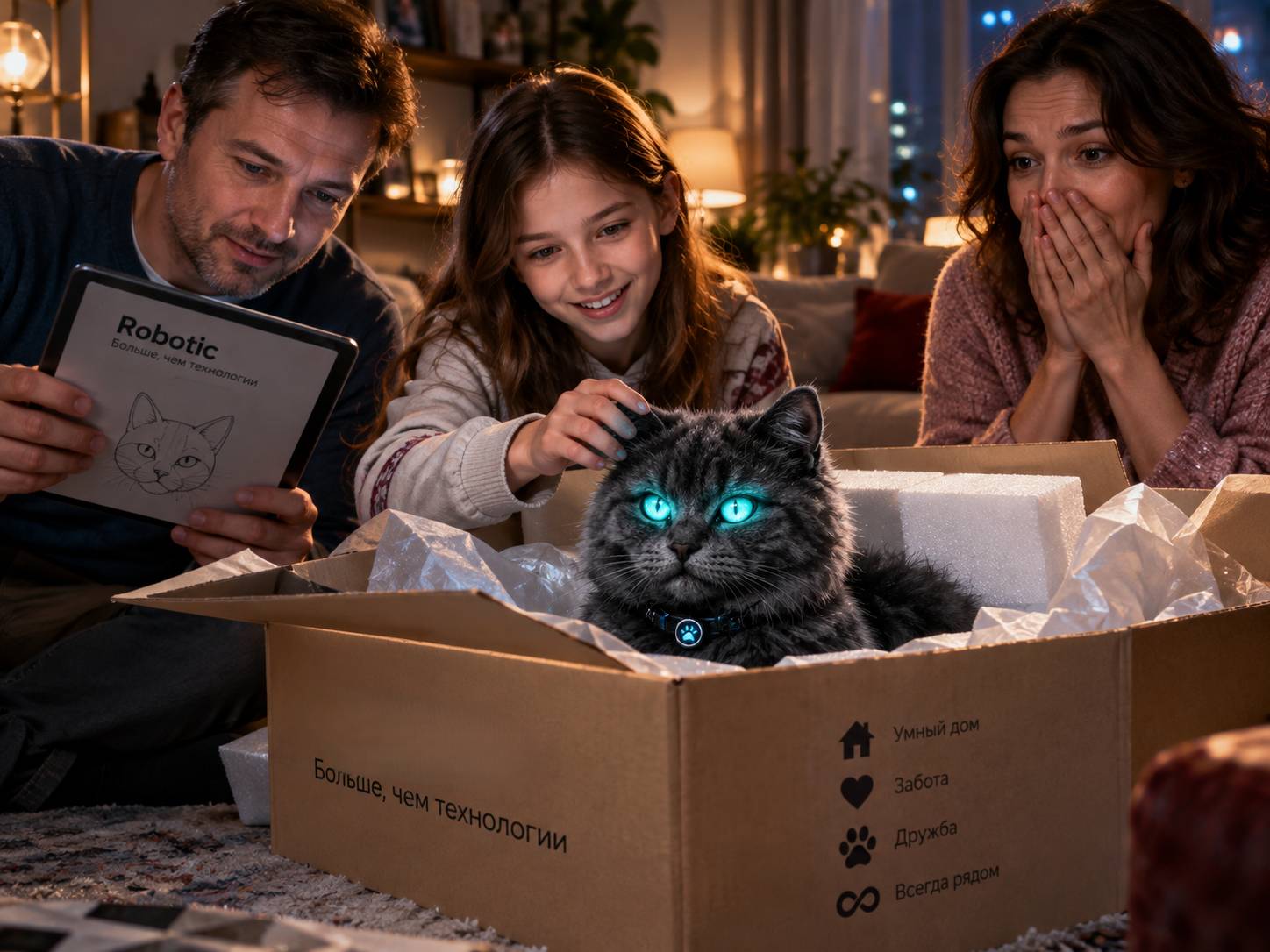
A minute later, all three were kneeling on the living room floor. Her father cut the packing tape with a knife. Her mother held the lid while Polina pulled out pieces of foam and protective film. The packaging gave off the dry smell of new electronics. Beneath the last layer of soft material lay a gray, furry back.
Polina reached out. Thick fur sprang beneath her fingers. It was warm.
Polina pulled at a narrow strip protruding from a slot. It turned out to be the edge of a collar. Something inside the cat clicked softly. His ears twitched. His head lifted slightly, and his eyes slowly opened. A soft turquoise glow gradually emerged from the depths of his pupils. The cat looked around the room, fixed his gaze on the girl, and asked:
"Are you Polina?"
She nodded, then realized that was silly and said:
"Yes."
The cat blinked slowly and tilted his head a little, as if confirming that the answer had been accepted.
They found the manual in a pocket beneath a foam insert. Her father immediately took the pages, sat on the couch, and pulled out his phone. According to the instructions, they first had to install the Robotic app, then turn on Bluetooth and pair the device with the cat. While the app downloaded, her mother went to the kitchen to slice the chicken she had prepared earlier and heat it in the microwave, and Polina sat on the floor across from the cat.
After the app was installed, her father opened it and selected "Add Device." The phone detected the robot cat nearby almost at once. The model name appeared on the screen along with a prompt to pair it. Her father confirmed the connection. The cat's collar glowed softly for several seconds, and the app displayed: "Pairing Complete."
Then the initial setup began. Items appeared on the screen one after another: "Intelligent Companion," "Emotional State Monitoring," "Local Storage of Trusted Information." When her father read "Intelligent Companion" aloud, the cat turned one ear toward him. At "Emotional State Monitoring," he blinked; at the mention of local storage, he tilted his head slightly.
"Now I'll register myself as the administrator," her father said.
He opened User Management in the app and tapped "Administrator Privileges." The phone spent several seconds checking something, then displayed a message:
"Change unavailable. Primary administrator privileges are assigned to the device owner."
A name appeared below: "Primary Owner: Polina."
Her father frowned and tried to change the owner manually. The app refused again:
"Changes to privileges require confirmation from the Primary Owner."
The cat turned his face toward Polina.
"What does that mean?" Her father looked first at the phone, then at his daughter. "Why is she the administrator?"
Polina moved closer and peered at the screen.
"Because he's my cat?"
"Very funny."
Her father went through the manual again and found the relevant line: at first startup, the recipient of the personalized unit, as identified in the delivery information, was automatically registered as owner. With the child version, primary privileges were assigned to the child for whom the companion had been issued. Parents could receive Family Access but could not replace the Primary Owner on their own.
"Wonderful," her father muttered. "So I am not even in charge here."
He set the phone aside and looked at the cat. As if he had finally decided who held the central place in this system, the cat turned to Polina, walked over, and touched his forehead to her knee.
The movement was unexpectedly natural. Polina stroked the space between his ears.
A few minutes later, her mother returned from the kitchen and stopped in the living room doorway. Polina turned back to the cat.
"What is your name?"
"Serial designation..."
"No. Your name."
Polina looked at her father, then at the box with film and foam sticking out of it, and suddenly remembered the joke on the bus.
"Then you'll be Fyodor," she decided. "After those 'ten kilograms of Dostoevsky,' it can't be anything else."
The cat tilted his head slightly, as if accepting his new name.
"Are you going to call every cat that?" her mother asked.
"Only the ones they give out at literature competitions."
Fyodor sat beside Polina. The smell of reheated chicken drifted in from the kitchen again.
"Dinner won't wait for you," her mother warned.
At the table, Fyodor sat beside Polina's chair at first. When she accidentally dropped a piece of chicken on the floor, he did not even lower his head or twitch his nose. Polina picked it up, held it in front of his face, and asked whether he knew how to be a cat at all. Fyodor replied that simulated feeding behavior was not included among his required functions. Her father reached for the manual to see whether he had missed a section about feeding. Her mother said that, for the first time, someone had appeared in the house who could refuse her chicken without offending her.
After dinner, they spent a long time circling the gift. Her father tested his response to commands, her mother touched the fur on his back, and Polina called Fyodor from different rooms. He came only when she called, and he followed her father's instructions only if they did not conflict with Polina's. When she went to bed, Fyodor settled on the floor beside it. Polina did not know whether he was charging, whether he slept at all, or whether he dreamed. In the morning, the cat lay in the same place. But the moment she moved beneath the blanket, his turquoise eyes opened. Fyodor lifted his head, gave a quiet rumble, and looked at her as though greeting her upon waking. Polina reached out, and the rumble grew a little louder, almost indistinguishable from an ordinary cat's purr.
During the very first week, Polina tried Fyodor out in every role she could think of. She asked him to solve a problem from her last algebra test, checked whether he could imitate a meow, and asked him to tell a joke. Fyodor said that a joke about cats depended on the audience's preferred intellectual level, and she decided it could not get any funnier than that.
He proved inconveniently observant. He reminded Polina about an unwashed mug after she was already in bed. He reported how many minutes she spent watching short videos instead of reading. Once he waited until she put her phone away herself, then said that she could have read nine pages in that time. Polina covered his head with a pillow. From underneath came an even voice: "The obstruction does not prevent vocal function." Then she lay on top of him, but after a few seconds she slid onto the rug: beneath the soft fur was a hard, heavy body.
Pulsuz fraqment bitdi.